<?xml version="1.0" encoding="utf-8" ?>
<rdf:RDF xmlns:rdf="http://www.w3.org/1999/02/22-rdf-syntax-ns#" xmlns:dc="http://purl.org/dc/elements/1.1/" xmlns:syn="http://purl.org/rss/1.0/modules/syndication/" xmlns="http://purl.org/rss/1.0/">


<channel rdf:about="https://www.iea.usp.br/en/search_rss">
  <title>en</title>
  <link>https://www.iea.usp.br</link>

  <description>
    
            These are the search results for the query, showing results 1 to 6.
        
  </description>


  <image rdf:resource="https://www.iea.usp.br/logo.png" />

  <items>
    <rdf:Seq>
      
        <rdf:li rdf:resource="https://www.iea.usp.br/en/news/ubias-launches-call-covid19" />
      
      
        <rdf:li rdf:resource="https://www.iea.usp.br/en/media-library/photos/events-2015/o-desafio-da-hospitalidade-emigrantes-e-refugiados-22-de-outubro-de-2015" />
      
      
        <rdf:li rdf:resource="https://www.iea.usp.br/en/news/sense-of-humanity-and-hospitality-in-a-world-of-wars-and-hunger" />
      
      
        <rdf:li rdf:resource="https://www.iea.usp.br/en/news/cop20" />
      
      
        <rdf:li rdf:resource="https://www.iea.usp.br/en/news/new-territorialities" />
      
      
        <rdf:li rdf:resource="https://www.iea.usp.br/en/news/soccer-and-society" />
      
    </rdf:Seq>
  </items>

</channel>


  <item rdf:about="https://www.iea.usp.br/en/news/ubias-launches-call-covid19">
    <title>UBIAS network launches call to receive essays on a post-COVID-19 world</title>
    <link>https://www.iea.usp.br/en/news/ubias-launches-call-covid19</link>
    <description></description>
    <content:encoded xmlns:content="http://purl.org/rss/1.0/modules/content/"><![CDATA[<table class="tabela-direita-300">
<tbody>
<tr>
<th><img src="https://www.iea.usp.br/imagens/pessoas-na-rua" alt="Mundo pós-Covid-19" class="image-inline" title="Mundo pós-Covid-19" /></th>
</tr>
<tr>
<td><span class="discreet">For the coordination of UBIAS, there are growing indicators that the world will be different after this crisis and that globalization will be questioned in many areas</span></td>
</tr>
</tbody>
</table>
<p class="Default">The network UBIAS (University-Based Institutes for Advanced Study) has an <a class="external-link" href="http://www.ubias.net/documents/letter_zif_ubias">open call</a> to receive essays on the theme <i>How will/should the world change? The corona crisis as an interdisciplinary challenge</i>. Researchers from all areas and countries may participate.</p>
<p class="Default">The articles will be published on the websites of the <a class="external-link" href="http://www.ubias.net">network</a> and of the IEA, as well as on the blog <a class="external-link" href="http://zif.hypotheses.org/">Interdisciplinarity</a>, managed by <span>University of Bielefeld's </span><a class="external-link" href="http://www.uni-bielefeld.de/ZIF/">ZiF (Center for Interdisciplinary Research)</a>. Texts <span>written in English </span>must have a maximum of 10,000 characters, including spaces, and sent to the emails <a class="mail-link" href="mailto:zif@uni-bielefeld.de">zif@uni-bielefeld.de</a> or <a class="mail-link" href="mailto:ubiasnetwork@gmail.com">ubiasnetwork@gmail.com</a> <span>by the end of May</span>. If the received material is considered to be of high quality, it is possible that it will later generate a publication by UBIAS.</p>
<p class="Default"><strong><br />The network</strong></p>
<p class="Default">UBIAS is currently composed of 41 members, representing 44 institutes of advanced studies, all based in universities. <a href="https://www.iea.usp.br/en/iea/organization/direction" class="external-link">Guilherme Ary Plonski</a>, deputy director of the IEA, is the coordinator for the 2018-2020 biennium. The network aims to exchange experiences and carry out joint research. For this call, UBIAS works in partnership with ZiF.</p>
<p class="Default" style="text-align: right; "><span class="discreet">Photo: <a class="external-link" href="https://pxhere.com/en/photo/421">Pxhere</a></span></p>]]></content:encoded>
    <dc:publisher>No publisher</dc:publisher>
    <dc:creator>Richard Meckien</dc:creator>
    <dc:rights>Original version in Portuguese by Fernanda Rezende.</dc:rights>
    
      <dc:subject>Ubias</dc:subject>
    
    
      <dc:subject>Science</dc:subject>
    
    
      <dc:subject>Covid-19</dc:subject>
    
    
      <dc:subject>Research</dc:subject>
    
    
      <dc:subject>Coronavirus</dc:subject>
    
    
      <dc:subject>Geopolitics</dc:subject>
    
    <dc:date>2020-04-08T16:05:00Z</dc:date>
    <dc:type>News Item</dc:type>
  </item>


  <item rdf:about="https://www.iea.usp.br/en/media-library/photos/events-2015/o-desafio-da-hospitalidade-emigrantes-e-refugiados-22-de-outubro-de-2015">
    <title>The Challenge of Hospitality: Migrants and Refugees - October 22, 2015</title>
    <link>https://www.iea.usp.br/en/media-library/photos/events-2015/o-desafio-da-hospitalidade-emigrantes-e-refugiados-22-de-outubro-de-2015</link>
    <description></description>
    
    <dc:publisher>No publisher</dc:publisher>
    <dc:creator>Richard Meckien</dc:creator>
    <dc:rights></dc:rights>
    
      <dc:subject>Europe</dc:subject>
    
    
      <dc:subject>Human Rights</dc:subject>
    
    
      <dc:subject>Geopolitics</dc:subject>
    
    
      <dc:subject>Violence</dc:subject>
    
    
      <dc:subject>Public Policies</dc:subject>
    
    
      <dc:subject>Glocal</dc:subject>
    
    
      <dc:subject>Society</dc:subject>
    
    
      <dc:subject>Globalization</dc:subject>
    
    
      <dc:subject>Middle east</dc:subject>
    
    
      <dc:subject>Migration</dc:subject>
    
    <dc:date>2015-10-22T02:00:00Z</dc:date>
    <dc:type>Folder</dc:type>
  </item>


  <item rdf:about="https://www.iea.usp.br/en/news/sense-of-humanity-and-hospitality-in-a-world-of-wars-and-hunger">
    <title>Sense of humanity and hospitality in a world of wars and hunger</title>
    <link>https://www.iea.usp.br/en/news/sense-of-humanity-and-hospitality-in-a-world-of-wars-and-hunger</link>
    <description></description>
    <content:encoded xmlns:content="http://purl.org/rss/1.0/modules/content/"><![CDATA[<p>Diversity is a feature of the contemporary world, from which some trends that transform countries in modern towers of Babel derive. Increasing global migration, aging, migration by sectarian wars and hunger are some traces of modernity.</p>
<p><span>The consequences of the Middle East conflicts put <span>the impact of the astonishing figures of war and hunger refugees </span>in evidence in the international agenda, with no similar situation in history.</span></p>
<p>The theme leads to the discussion of the principle of hospitality, defined by philosopher Jacques Derrida as the ability to receive the other as different, but essentially the same. It also raises a comparative analysis of the European and Brazilian reaction to the issue. <i>The Challenge of Hospitality: Migrants and Refugees</i> is the title of the debate to be held by the IEA on <strong>October 22</strong>, <strong>at 2.30 pm</strong>, in the Institute's Events Room.</p>
<p>This will be the second meeting of the Laboratory of Global Megatrends and Challenges to Democracy. The conference will have the coordination of Portuguese political scientist Álvaro de Vasconcelos, an assistant professor at the USP's Institute of International Relations (IRI), and the participation of Geraldo Adriano Godoy de Campos, a professor at the ESPM's course of international relations, and <a href="https://www.iea.usp.br/en/persons/researchers/sylvia-duarte-dantas-1" class="external-link">Sylvia Dantas</a>, coordinator of the <a href="https://www.iea.usp.br/en/research/research-groups/intercultural-dialogues" class="external-link">IEA's Intercultural Dialogues research group</a>. The laboratory was started in June this year with the debate <i><a href="https://www.iea.usp.br/en/news/identity-based-nationalism-in-focus" class="external-link">The Challenge of Identity-Based Nationalism</a></i>.</p>
<table class="tabela-direita-borda">
<tbody>
<tr>
<th>
<h3>Related material</h3>
<p><a href="https://www.iea.usp.br/en/news/identity-based-nationalism-in-focus" class="external-link">Identity-Based Nationalism in Focus</a></p>
</th>
</tr>
</tbody>
</table>
<p><span>"We have watched the drama of those who hoped to find refuge and hospitality and ended up finding walls, barbed wire, violence and mistrust in many countries that have 'fear of the other', especially Muslims and those who come from the Middle East," says Vasconcelos.</span></p>
<p>The war in Syria has forced four million people to leave the country and eight million to move internally. In addition to them there are war refugees from Iraq, Afghanistan, Sudan, Eritrea and Somalia. Thus, the number of refugees in the world in 2014 reached 59.5 million according to estimates by the <a class="external-link" href="http://www.unhcr.org/cgi-bin/texis/vtx/home">UN Refugee Agency</a><span>.</span></p>
<p><span>The event will be broadcast live over the </span><a href="https://www.iea.usp.br/en/aovivo" class="external-link">web</a><span>.</span></p>]]></content:encoded>
    <dc:publisher>No publisher</dc:publisher>
    <dc:creator>Richard Meckien</dc:creator>
    <dc:rights>Original version in Portuguese by Sylvia Miguel</dc:rights>
    
      <dc:subject>Europe</dc:subject>
    
    
      <dc:subject>Human Rights</dc:subject>
    
    
      <dc:subject>Sociology</dc:subject>
    
    
      <dc:subject>Citizenship</dc:subject>
    
    
      <dc:subject>Democracy</dc:subject>
    
    
      <dc:subject>Geopolitics</dc:subject>
    
    
      <dc:subject>Violence</dc:subject>
    
    
      <dc:subject>War</dc:subject>
    
    
      <dc:subject>Migration</dc:subject>
    
    
      <dc:subject>Globalization</dc:subject>
    
    
      <dc:subject>Social Sciences</dc:subject>
    
    
      <dc:subject>Middle east</dc:subject>
    
    
      <dc:subject>Political Science</dc:subject>
    
    
      <dc:subject>World</dc:subject>
    
    
      <dc:subject>Nationalism</dc:subject>
    
    
      <dc:subject>Event</dc:subject>
    
    
      <dc:subject>History</dc:subject>
    
    <dc:date>2015-10-16T16:35:00Z</dc:date>
    <dc:type>News Item</dc:type>
  </item>


  <item rdf:about="https://www.iea.usp.br/en/news/cop20">
    <title>A Debate on the Contributions the COP 20 May Make to Climate Negotiations</title>
    <link>https://www.iea.usp.br/en/news/cop20</link>
    <description></description>
    <content:encoded xmlns:content="http://purl.org/rss/1.0/modules/content/"><![CDATA[<table class="tabela-direita-400">
<tbody>
<tr>
<th><img src="https://www.iea.usp.br/imagens/alteracoes-nas-precipitacoes-no-final-do-seculo-21" alt="Alterações nas precipitações no final do século 21" class="image-inline" title="Alterações nas precipitações no final do século 21" /></th>
</tr>
<tr>
<td style="text-align: right; "><strong>Changes in rainfall patterns at the end of 21st century according to projections from the US government’s National Oceanic and Atmospheric Administration (NOAA) (in inches of liquid water per year)</strong></td>
</tr>
</tbody>
</table>
<p style="text-align: justify; ">The <a class="external-link" href="http://www.cop20lima.org/">20<sup>th</sup> Conference of the Parties of the UN Framework Convention on Climate Change (COP 20)</a>, which will take place in Lima, Peru, over the first two weeks of December, is particularly important as part of the process of negotiating a new global climate agreement to be signed in Paris, France, in 2015.</p>
<p style="text-align: justify; "><span><span>It is expected that the conference will clarify the main challenges, roadblocks and opportunities available over the course of this complex negotiation process, which, if it reaches fruition, may lead to the realization of a global agreement with responses to the climate crisis.</span></span></p>
<p class="Text" style="text-align: justify; ">What can one truly expect from the COP 20? Will actual foundations be set forth for a new climate agreement that, from now on, engages and commits all actions devoted to reducing negative impacts on climate? These issues will be discussed in the debate “COP 20: What Can We Expect?” which <a href="https://www.iea.usp.br/en/research/research-groups/environmental-sciences" class="external-link">IEA-USP's Environment and Society Research Group</a>, with support from the <a class="external-link" href="http://www.incline.iag.usp.br/data/index_USA.php"><span style="text-align: justify; ">Interdisciplinary Climate Investigation center</span><span style="text-align: justify; "> (INCLINE)</span></a>, will hold on November 26, at 2 pm, at the IEA-USP.</p>
<p style="text-align: justify; "><span><span class="hps"><span>Panel members will include </span></span>Eduardo Felipe Pérez Matias (from Nogueira, Elias, Laskowski e Matias law firm), Ricardo Baitelo (Greenpeace Brazil) and Wagner Costa Ribeiro (from USP’s School of Philosophy, Languages and Literature, and Human Sciences, and IEA-USP). The discussion will be moderated by the research group coordinator, <a href="https://www.iea.usp.br/en/persons/researchers/pedro-roberto-jacobi" class="external-link">Pedro Roberto Jacobi</a> (USP’s School of Education and IEA-USP).</span></p>
<p style="text-align: justify; "><span><span>According to Jacobi, the obstacles and arguments that hinder the adoption of effective commitments by the parties can worsen the progressive withering of multilateral governance on climate change: “As the central controversy of the negotiating process, differentiation may create new foundations to advance actions that mitigate and enable adaptation to climate changes.”</span></span></p>
<p style="text-align: justify; "><span><span>Also according to Jacobi, the central controversies – which are related to the differences – are the degree of responsibility and the ability of each country to measure and acknowledge what it might do to contribute to the actions of adaptation to climate change, inasmuch as mitigation depends on global agreements. For him, the decarbonization agreement between the US and China signed on November 12 is insufficient, but signals changes in the position of the major players.</span></span></p>
<p style="text-align: justify; "><span><span><span style="text-align: justify; ">The event will be broadcast live on the </span><a style="text-align: justify; " href="https://www.iea.usp.br/aovivo">web</a><span style="text-align: justify; ">.</span></span></span></p>
<div>
<div class="kssattr-target-parent-fieldname-inscricao-cc9d4e4bd39d4cd68c7e0a573e48ab46 kssattr-macro-rich-field-view kssattr-templateId-widgets/rich kssattr-atfieldname-inscricao " id="parent-fieldname-inscricao-cc9d4e4bd39d4cd68c7e0a573e48ab46">
<div>
<div class="kssattr-atfieldname-programacao kssattr-templateId-widgets/rich kssattr-macro-rich-field-view kssattr-target-parent-fieldname-programacao-353b5b8bc739427eb693b2f69ac41085" id="parent-fieldname-programacao-353b5b8bc739427eb693b2f69ac41085"></div>
</div>
</div>
</div>
<div>
<h3></h3>
</div>
<div></div>]]></content:encoded>
    <dc:publisher>No publisher</dc:publisher>
    <dc:creator>Richard Meckien</dc:creator>
    <dc:rights>Carlos Malferrari (translator)</dc:rights>
    
      <dc:subject>Research Group: Environment and Society</dc:subject>
    
    
      <dc:subject>Climate Change</dc:subject>
    
    
      <dc:subject>Commons</dc:subject>
    
    
      <dc:subject>Environment</dc:subject>
    
    
      <dc:subject>Geopolitics</dc:subject>
    
    
      <dc:subject>Event</dc:subject>
    
    <dc:date>2014-11-13T17:10:00Z</dc:date>
    <dc:type>News Item</dc:type>
  </item>


  <item rdf:about="https://www.iea.usp.br/en/news/new-territorialities">
    <title>Changes in Public Policy Planning &amp; Management</title>
    <link>https://www.iea.usp.br/en/news/new-territorialities</link>
    <description></description>
    <content:encoded xmlns:content="http://purl.org/rss/1.0/modules/content/"><![CDATA[<p style="text-align: justify; ">Among the myriad transformations facing contemporary society, those that occurred in the first decade of the 21<sup>st</sup> century deserve special mention for their impact on the geopolitical and territorial order, on the subjective dynamics of political participation, and, as could not be otherwise, on the processes of developing, implementing and evaluating public policies.</p>
<p class="Text" style="text-align: justify; ">To analyze these changes, <a href="https://www.iea.usp.br/en/research/research-groups/public-policies-territoriality-and-society" class="external-link">IEA’s Public Policies, Territoriality and Society Research Group</a> will host the <i>International Seminar on Geopolitical and Subjective Changes in the Processes of Political Participation and in the Production of New Territorialities</i> on <strong>October 20-22</strong>, in the <strong>Auditorium of the School of Arts, Sciences and Humanities (EACH)</strong> of the University of São Paulo (see <a class="anchor-link" href="#programa">schedule</a>).</p>
<p style="text-align: justify; ">The seminar will present an interdisciplinary view of the subject with contributions of researchers from Portugal, Brazil, Spain, France, Mexico and Peru. The emphasis will be discussions on the changes taking place in the planning and management of public policies brought forth by:</p>
<ul style="text-align: justify; ">
<li>the crisis of the Nation-State, concomitant with a strengthening of nationalism;</li>
<li>the porosity of borders caused by globalization and the strengthening of supranational organizations;</li>
<li>the emergence of social protests that demand new forms of political order, as well as increased participation in governance.</li>
</ul>
<p style="text-align: justify; "> </p>
<p style="text-align: justify; "><span style="text-align: justify; ">The event will be broadcast live on the </span><a style="text-align: justify; " href="https://www.iea.usp.br/aovivo">web</a><span style="text-align: justify; ">.</span></p>
<p style="text-align: justify; "><span style="text-align: justify; "><br /></span></p>
<p style="text-align: justify; "><i> </i></p>
<h3 style="text-align: justify; "></h3>
<h3 style="text-align: justify; "><a name="programa"></a>PROGRAMME</h3>
<h3 style="text-align: justify; ">October 20                              
<hr />
</h3>
<table class="invisible" style="text-align: justify; ">
<tbody>
<tr>
<td><strong>10 am to 12:30 pm</strong></td>
<td>
<p><strong><i>Environmental Policy Planning &amp; Management in France and Portugal</i><br /></strong><span>Eduarda Marques da Costa (Universidade de Lisboa, Portugal), Evandro Mateus Moretto (EACH) and Veronique Van Tilbeurgh (Université de Rennes 2, France)</span></p>
</td>
</tr>
<tr>
<td><i>BREAK</i><br /></td>
<td></td>
</tr>
<tr>
<td scope="col"><strong>3 to 5:30 pm</strong></td>
<td>
<p><strong>Political Participation, Geopolitics and Globalization<br /></strong><span>Eda Tassara (IP and IEA), José Luis Lezama (Universidad Nacional Autónoma de Mexico) and Neli Aparecida de Mello-Théry (EACH and IEA)</span></p>
</td>
</tr>
<tr>
<td><i>BREAK</i></td>
<td></td>
</tr>
<tr>
<td><strong>7 to 9: 30 pm</strong></td>
<td>
<p><strong>Citizenship and Processes of Political Negotiation and Decision-Making in the 21st Century<br /></strong><span>Alessandro Soares da Silva (EACH and IEA), Bernardo Mançano (UNESP), José Manuel Sabucedo (Universidad de Santiago de Compostela, Spain) and Salvador Sandoval (PUC-SP and IEA)</span></p>
</td>
</tr>
</tbody>
</table>
<h3 style="text-align: justify; ">October 21                                 
<hr />
</h3>
<table class="invisible" style="text-align: justify; ">
<tbody>
<tr>
<td scope="col"><strong>10 am to <br />12:30 pm</strong></td>
<td>
<p><strong>Geopolitics, Public Policies and New Territorialities in the 21st Century<br /></strong><span>Eduardo de Lima Caldas (EACH and IEA), Eduardo Girardi (UNESP) and Hervé Théry (CNRS, France)</span></p>
</td>
</tr>
<tr>
<td><i>BREAK</i></td>
<td></td>
</tr>
<tr>
<td><strong>2 to 5 pm</strong></td>
<td>
<p><strong>Political Participation, Social Change and the New Territorialities in the 21st Century<br /></strong><span>Agustín Espinoza (EACH and IEA), Dennis de Oliveira (ECA), Martin Jayo (EACH) and Salvador Sandoval (PUC-SP and IEA)</span></p>
</td>
</tr>
<tr>
<td><i>BREAK</i></td>
<td></td>
</tr>
<tr>
<td><strong><i>7 to 9:30 pm</i></strong></td>
<td><strong>Internal Meeting</strong></td>
</tr>
</tbody>
</table>
<h3 style="text-align: justify; ">October 22                                 
<hr />
</h3>
<table class="invisible" style="text-align: justify; ">
<tbody>
<tr>
<td scope="col"><strong>10 am to 12:30 pm</strong></td>
<td>
<p><strong>Social Transformations, Political Organizations and Public Policies<br /></strong><span>Celso Cancela (Universidad de Vigo, Spain), José Carlos Vaz (EACH), Úrsula Dias Peres (EACH and IEA) and Veronique Van Tibeurgh (Université de Rennes 2, France)</span></p>
</td>
</tr>
<tr>
<td>BREAK</td>
<td></td>
</tr>
<tr>
<td><strong>3 to 5:30 pm</strong></td>
<td><strong>Internal Meeting</strong></td>
</tr>
<tr>
<td>BREAK</td>
<td></td>
</tr>
<tr>
<td><strong>7 to 9:30 pm</strong></td>
<td>
<p><strong>Public Environmental Management and Changes in Environmental Governance<br /></strong>Aline Borges do Carmo (IBAMA and IEA), José Luis Lezama (Universidad Nacional Autónoma de Mexico), Márcio Gurgel (EACH) and Patricia Junia Viana (EACH)</p>
</td>
</tr>
</tbody>
</table>
<p style="text-align: justify; "><i><i> </i></i></p>]]></content:encoded>
    <dc:publisher>No publisher</dc:publisher>
    <dc:creator>Richard Meckien</dc:creator>
    <dc:rights>Carlos Malferrari (translator)</dc:rights>
    
      <dc:subject>Geopolitics</dc:subject>
    
    
      <dc:subject>Event</dc:subject>
    
    <dc:date>2014-10-15T14:55:00Z</dc:date>
    <dc:type>News Item</dc:type>
  </item>


  <item rdf:about="https://www.iea.usp.br/en/news/soccer-and-society">
    <title>Soccer and society: the effects of Brazil’s defeat</title>
    <link>https://www.iea.usp.br/en/news/soccer-and-society</link>
    <description></description>
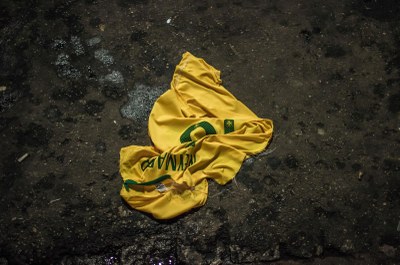
    <content:encoded xmlns:content="http://purl.org/rss/1.0/modules/content/"><![CDATA[<p><img src="https://www.iea.usp.br/en/images/brazilian-teams-t-shirt" style="float: right; " title="Brazilian team's t-shirt" class="image-inline" alt="Brazilian team's t-shirt" />To what extent did Brazil’s World Cup performance and elimination affect the country’s image and self-esteem, domestically and abroad, not only with regard to soccer, but particularly in the political, economic, social and cultural spheres?</p>
<p class="Text">This issue will be addressed during the event <i>A Debate in Two Halves: The Phantasmagoria of Defeat, Soccer as Metaphor</i>, that USP’s Institute of Advanced Studies (IEA-USP) will hold on July 25, from 10 am to 4 pm, in the Ruy Leme Room, at the School of Economics, Administration and Accounting (FEA).</p>
<p class="Text">The debate aims to draw a parallel between soccer and society, discussing the sport’s role in the country’s national identity, within the context of a new geopolitics where Brazil is seen as a rising leader.</p>
<p class="Text">In the first-half, from 10 am to 12 pm, the panelists will be Ugo Giorgetti, filmmaker and columnist of the “Sports Edition” section of <i>O Estado de S. Paulo</i> newspaper; Daniela Alfonsi, anthropologist, director of the Museum of Soccer; Luiz Carlos Ribeiro, historian, professor of the History Department at Paraná Federal University; and Bernardo Sorj (via Web), sociologist and visiting professor at IEA-USP.</p>
<p class="Text">The second-half, from 2 to 4 pm, will feature Carlos Melo, political scientist, professor at the Institute of Education and Research (Insper) and member of IEA’s Research Group on the Quality of Democracy; Fernando Mires (via Web), political scientist, professor at the University of Oldenburg, Germany; Germán Labrador Méndez (via Web), professor of the Department of Spanish &amp; Portuguese Languages ​​and Cultures at Princeton University, USA; and Lorenzo Mammì, art critic and professor of the Department of Philosophy at USP.</p>
<p class="Text">Renato Janine Ribeiro, <span style="text-align: justify; ">philosopher, will act as mediator. </span>The debate is part of the ongoing discussions taking place within the <a href="https://www.iea.usp.br/en/research/laboratories/sociedade-contemporaneas" class="external-link">Laboratory of Contemporary Societies</a>, which began in June 2013 in the heat of the street demonstrations that overtook Brazil’s major cities.</p>
<p class="Text">The event is open to the public and admission is free. To register, please email <a class="mail-link" href="mailto:leila.costa@usp.br">leila.costa@usp.br</a>. The event will also be broadcast live <a href="https://www.iea.usp.br/aovivo" class="external-link">on the Web</a>. FEA-USP is located at Av. Professor Luciano Gualberto, 908, Cidade Universitária, São Paulo, SP (<a class="external-link" href="http://www.fea.usp.br/conteudo.php?i=14">map</a>).</p>
<p class="Text" style="text-align: right; "><span style="text-align: right; "><span class="discreet">English revision by Carlos Malferrari - Photo: <a class="external-link" href="http://www.flickr.com/photos/midianinja" style="text-align: right; ">Boris Mercado/Mídia Ninja</a></span></span></p>]]></content:encoded>
    <dc:publisher>No publisher</dc:publisher>
    <dc:creator>Mauro Bellesa</dc:creator>
    <dc:rights>Carlos Malferrari (translator)</dc:rights>
    
      <dc:subject>Brazil</dc:subject>
    
    
      <dc:subject>Contemporary Societies Laboratory</dc:subject>
    
    
      <dc:subject>Geopolitics</dc:subject>
    
    
      <dc:subject>Commons</dc:subject>
    
    
      <dc:subject>Globalization</dc:subject>
    
    
      <dc:subject>Sociology</dc:subject>
    
    
      <dc:subject>Politics</dc:subject>
    
    
      <dc:subject>Social Sciences</dc:subject>
    
    <dc:date>2014-07-24T01:05:00Z</dc:date>
    <dc:type>News Item</dc:type>
  </item>


</rdf:RDF>
