<?xml version="1.0" encoding="utf-8" ?>
<rdf:RDF xmlns:rdf="http://www.w3.org/1999/02/22-rdf-syntax-ns#" xmlns:dc="http://purl.org/dc/elements/1.1/" xmlns:syn="http://purl.org/rss/1.0/modules/syndication/" xmlns="http://purl.org/rss/1.0/">


<channel rdf:about="https://www.iea.usp.br/en/search_rss">
  <title>en</title>
  <link>https://www.iea.usp.br</link>

  <description>
    
            These are the search results for the query, showing results 1 to 15.
        
  </description>


  <image rdf:resource="https://www.iea.usp.br/logo.png" />

  <items>
    <rdf:Seq>
      
        <rdf:li rdf:resource="https://www.iea.usp.br/en/news/iea-launches-documentary-on-human-rights" />
      
      
        <rdf:li rdf:resource="https://www.iea.usp.br/en/news/social-narratives-water-rights" />
      
      
        <rdf:li rdf:resource="https://www.iea.usp.br/en/news/prejudices-and-stereotypes-impact-progression-of-women-in-science" />
      
      
        <rdf:li rdf:resource="https://www.iea.usp.br/en/news/study-group-will-address-links-between-health-and-the-geographic-context-of-cities" />
      
      
        <rdf:li rdf:resource="https://www.iea.usp.br/en/news/social-geography-of-zika-in-brazil" />
      
      
        <rdf:li rdf:resource="https://www.iea.usp.br/en/news/new-research-group-on-human-rights-has-been-created" />
      
      
        <rdf:li rdf:resource="https://www.iea.usp.br/en/news/theoretical-and-practical-human-dignity-during-the-second-ica" />
      
      
        <rdf:li rdf:resource="https://www.iea.usp.br/en/news/akemi" />
      
      
        <rdf:li rdf:resource="https://www.iea.usp.br/en/news/international-seminar-discusses-the-judiciary-the-pressand-public-safety" />
      
      
        <rdf:li rdf:resource="https://www.iea.usp.br/en/media-library/photos/events-2015/o-desafio-da-hospitalidade-emigrantes-e-refugiados-22-de-outubro-de-2015" />
      
      
        <rdf:li rdf:resource="https://www.iea.usp.br/en/news/sense-of-humanity-and-hospitality-in-a-world-of-wars-and-hunger" />
      
      
        <rdf:li rdf:resource="https://www.iea.usp.br/en/news/children-who-care-global-perspectives-on-childrens-hidden-care-giving-roles-within-their-families" />
      
      
        <rdf:li rdf:resource="https://www.iea.usp.br/en/news/registration-for-the-2nd-intercontinental-academia-ends-august-23" />
      
      
        <rdf:li rdf:resource="https://www.iea.usp.br/en/news/second-edition-intercontinental-academia-will-address-human-dignity" />
      
      
        <rdf:li rdf:resource="https://www.iea.usp.br/en/news/mapping-human-rights" />
      
    </rdf:Seq>
  </items>

</channel>


  <item rdf:about="https://www.iea.usp.br/en/news/iea-launches-documentary-on-human-rights">
    <title>Documentary remembers stories of human rights’ achievements in São Paulo</title>
    <link>https://www.iea.usp.br/en/news/iea-launches-documentary-on-human-rights</link>
    <description></description>
    <content:encoded xmlns:content="http://purl.org/rss/1.0/modules/content/"><![CDATA[<p><img src="https://www.iea.usp.br/imagens/lancamento-cartografia-direitos-humanos" alt="Lançamento Cartografia Direitos Humanos" class="image-right" title="Lançamento Cartografia Direitos Humanos" /></p>
<p>A group of political scientists, sociologists, journalists and social activists have gathered for a documentary that helps telling part of the story of the conquest of human rights in São Paulo. To be launched next <strong>December 10 </strong>on <a class="external-link" href="http://www.videocamp.com/pt">Videocamp</a> (English subtitles available), the film ‘Human Rights Mapping’ brings together testimonies and images to show that many of the current rights are the result of demonstrations and interventions by the population on the streets of Brazilian cities, instead of State actions. Subtitles in English will be available.</p>
<p>Conceived by members of the UNESCO Chair on Education for Peace, Human Rights, Democracy and Tolerance, based at the Institute of Advanced Studies (IEA) of the University of São Paulo (USP), the documentary has been produced by Imagina Coletivo and directed by Tiago Pereira. It shows the relation of the city with the struggles for the recognition and effectiveness of the equality of race, sex, gender, the fight for the right to vote, the struggle for housing and freedom of expression, among others. The UNESCO Chair was active at the IEA from April 1996 to October 2014.</p>
<p>The 26-minute film splits the testimonies and reports into themes related to the right to the city,  rights of migrants, non-racial, gender and sex discrimination, right to work, civil rights, the rule of law and freedom of expression.</p>
<p>In order to tell the stories and analyze the importance of preserving the memory of such movements, many specialists have been heard: jurist José Gregori; journalist Sérgio Gomes; physicist Dina Lida Kinoshita; the leader of the ‘Housing Movement of the Center’ (<i>Movimento</i> <i>de Moradia do Centro – MMC</i>), Luiz Gonzaga da Silva, known as Gegê; Letícia Cardoso and Marcelo Hotimsky, from the Free Pass Movement (<i>Movimento Passe Livre</i>); Paulo Illes, from the Center for Human Rights and Immigrant Citizenship; Douglas Belchior and Milton Barbosa, both representatives of the black movement; Marcos Tupã and Jerá Giselda, from the Tenondé Porã Indigenous Lands; Waldemar Rossi, speaking of the ‘Unified Workers' Central’ (<i>Central</i> <i>Única dos Trabalhadores – CUT</i>) and the Osasco Strikes; Maria Amélia de Almeida Teles, from the Women’s Union of São Paulo and the newspaper <i>Brasil Mulher</i>; 'Rebeca', from the ‘March of the Bums’ (<i>Marcha das Vadias</i>); Fernando Quaresma, president of the LGBT Pride Parade Association; Margarida Genevois, from the Justice and Peace Commission; Belisário dos Santos Júnior, talking about the Carandiru massacre; Inês Virgínia Soares, from the Federal Public Ministry; Célia Galvão Quirino, addressing the ‘Battle of Maria Antonia’; and Binho, from ‘Sarau do Binho’.</p>
<p>Sociologist Sergio Adorno, then coordinator of the UNESCO Chair, and political scientist Rossana Reis, coordinator and idealizer of the Human Rights Cartography project, are also in the film.</p>
<p>The film came to be in 2014 from a project with the same name that addressed issues related to the theme, seeking to sensitize society and attract their attention to human rights. From this idea, places that hosted such struggles and achievements in São Paulo were selected and cataloged on a digital platform (<a class="external-link" href="http://www.cartografiadh.iea.usp.br">www.cartografiadh.iea.usp.br</a>), which georeferences and presents tour itineraries by region and theme. For each selected landmark, there are reference texts, photographs and testimonies of journalists and social activists. The system also allows new locations to be added and thus encompass even more achievements.</p>
<p>Among the movements and fights presented both in the video and on the platform there are: <i>Marcha das Vadias</i>, Unified Black Movement (<i>Movimento Negro Unificado</i>), CUT, Osasco Strikes, LGBT Parade, Justice and Peace Commission, UNEAFRO, Carandiru Massacre, ‘Battle of Maria Antônia’, Women's Union of São Paulo, <i>Brasil Mulher</i>, Tenondé Porã Indigenous Lands, Oboré, Ecumenical Act of 1975 in honor of Vladimir Herzog, Federal Public Ministry's Exposition ‘(Re) Knowing... To Never Forget!’ (‘<i>(Re) Conhecer... Para Nunca Esquecer!</i>’), Center for the Study of Violence (NEV), Demonstrations of June 2013, MMC, Kantuta Square and the Immigrants' March, ‘Sarau do Binho’ and the Assembly for the right to vote in the Anhangabaú Valley in the 1980s.</p>
<p><strong>Production and direction</strong></p>
<p>The choice of Imagina Coletivo, a non-profit organization, and Tiago Pereira for the production and direction of the documentary is in tune with the transforming character that the film seeks to have.</p>
<p>Pereira began his story in filming together with the birth of Imagina Coletivo, when the project <i>Imagina na Copa</i> was launched. It existed between 2012 and 2014. At that time, 75 web documentaries were produced in all 27 Brazilian states, telling stories of young people that act as transformers. He has also directed the short film <i>Rolezinhos</i>, which won as best film in the Social Vision category of the 2014 Entretodos Festival, and produced the film <i>Guardiões de </i><i>Santa Rosa</i> in partnership with the Futura Channel.</p>
<p>Imagina Coletivo is currently working with social content production in different languages - workshops, courses and facilitation of meetings, and advice on mobilization, engagement and social entrepreneurship.</p>
<p><strong>Financing and partnertships</strong></p>
<p>The ‘Human Rights Mapping’ project was contemplated in the 2013 contest of USP’s Dean for Culture and University Extension, which financed the initiative, and had partnerships with the Maria Antonia University Center and the Federal Public Ministry. The recording of the testimonies was done with the support of TV Alesp (Legislative Assembly of the State of São Paulo), and the visual identity was developed by the 2012 group of Advertising of USP’s School of Communications and Arts (ECA), under the guidance of Professor Dorinho Bastos.</p>
<p>The Coordination for the Improvement of Higher Education Personnel (CAPES), the Hannah Arendt Studies Center, the Rubens Paiva State Truth Commission of São Paulo, the Department of Political Science of USP’s Faculty of Philosophy, Languages and Literature, and Human Sciences (FFLCH), and USP’s Postgraduate Program In Political Science have also supported the activities.</p>]]></content:encoded>
    <dc:publisher>No publisher</dc:publisher>
    <dc:creator>Richard Meckien</dc:creator>
    <dc:rights>Original version in Portuguese by Fernanda Rezende.</dc:rights>
    
      <dc:subject>Human Rights</dc:subject>
    
    
      <dc:subject>UNESCO Chair</dc:subject>
    
    
      <dc:subject>Democracy</dc:subject>
    
    
      <dc:subject>Society</dc:subject>
    
    
      <dc:subject>Mapping</dc:subject>
    
    
      <dc:subject>Culture</dc:subject>
    
    
      <dc:subject>Social Sciences</dc:subject>
    
    <dc:date>2017-11-24T16:25:00Z</dc:date>
    <dc:type>News Item</dc:type>
  </item>


  <item rdf:about="https://www.iea.usp.br/en/news/social-narratives-water-rights">
    <title>Social narratives about water, citizenship and public policies</title>
    <link>https://www.iea.usp.br/en/news/social-narratives-water-rights</link>
    <description></description>
    <content:encoded xmlns:content="http://purl.org/rss/1.0/modules/content/"><![CDATA[<table class="tabela-direita">
<tbody>
<tr>
<th><img src="https://www.iea.usp.br/imagens/agua-narrativas-sociais-1" alt="Água narrativas sociais 1" class="image-inline" title="Água narrativas sociais 1" /></th>
</tr>
<tr>
<td>
<p><strong>The construction of narratives on the symbology of environmental themes will be discussed on April 17</strong></p>
</td>
</tr>
</tbody>
</table>
<p><a class="external-link" href="https://www2.warwick.ac.uk/fac/arts/theatre_s/cp/staff/garde-hansen/">Joanne Garde-Hansen</a>, director of the Center for Cultural and Media Policy Studies at the University of Warwick, UK, will be at the IEA on <strong>April 17</strong>, <strong>from 3.00 pm to 6.00 pm</strong>, to discuss the theme <span><i>Water: Nostalgia and Trauma - Narratives, Rights and Policies in England</i>. At the meeting, to take place in the former University Council Room, she will suggest a reflection on diversity related to issues that deserve more attention in scientific terminology and public policy.</span></p>
<p><span>Garde-Hansen has been working with Brazilian researchers in order to construct social narratives linked to water and public policies, and argues that seeking connections and convergences between terms such as "drought" (which assumes different meanings in Brazil and in Europe) may favor dialogue between nations and cultures. The event will be held in English and broadcast <a href="https://www.iea.usp.br/en/aovivo" class="external-link">live</a> on the IEA's website.</span></p>
<p>Moderation will be in charge of professors <a href="https://www.iea.usp.br/en/persons/researchers/pedro-roberto-jacobi" class="external-link">Pedro Jacobi</a>, from USP's School of Education (FE), Danilo Rothberg, from the São Paulo State University (UNESP), Antonio Almeida, from USP's Luiz de Queiroz School of Agriculture (ESALQ), and <a href="https://www.iea.usp.br/en/persons/speakers/gilson-schwartz" class="external-link">Gilson Schwartz</a>, from USP's School of Communications of Arts (ECA) and a participant of <a href="https://www.iea.usp.br/en/persons/sabbatical" class="external-link">IEA's Sabbatical Year Program</a> in 2017. <span>Schwartz is also </span>coordinating the event.</p>
<p>The fluid theme relating water, cultural sharing and memory invites for a dialogue on concepts between cultures, social narratives, rights and public policies. "The term 'drought', for example, <span>assumes a meaning </span>in Europe that does not coincide with the perception of the fact in Brazil or in other countries," says the researcher. "<span>There is no universal definition of terms that only theoretically have the same value or meaning."</span></p>
<p>Organized by the IEA, the debate is supported by USP's Center for Research in Technology of Architecture and Urbanism (NUTAU), the <span>São Paulo <span>Research </span></span>Foundation (FAPESP), UNESP and the University of Warwick.</p>
<p><strong> </strong></p>
<p><strong>The speaker</strong></p>
<p>Joanne Garde-Hansen is a lecturer in the field of Culture, Media and Communication, responsible for the Master's course in Global Media and Communication, and director of the Center for Cultural and Media Policy Studies at the University of Warwick. She conducts researches on media, memory, archives and patrimony, and keeps multidisciplinary collaborations with scientists of the most diverse areas, among them geography, natural resources, computation, history, besides communication and culture.</p>
<table class="tabela-direita">
<tbody>
<tr>
<th><img src="https://www.iea.usp.br/imagens/agua-narrativas-sociais-2" alt="Água narrativas sociais 2" class="image-inline" title="Água narrativas sociais 2" /></th>
</tr>
<tr>
<td>
<p><strong>In Crateús, in the dry region of the Brazilian State of Ceará, residents pay R$ 0.50 for 20 liters of non-potable water</strong></p>
</td>
</tr>
</tbody>
</table>
<p>Some of her latest books are <i>Emotion Online: Theorizing Affect in the Internet</i> (Palgrave Macmillan, 2013), with Kristyn Gorton; <i>Media and Memory</i> (Edinburgh University Press, 2011), with Andrew Hoskins and Anna Reading, and <i>Social Memory Technology: Theory, Practice, Action </i>(Routledge 2016).</p>
<p>Since 2012, she has been working on projects funded by FAPESP, the British Council and the Warwick Brazil Partnership.</p>
<p>She is the co-investigator of the project <i>Developing a Drought Narrative Resource in a Multi-Stakeholder Decision-Making Utility for Drought Risk Management</i>, or <a href="http://www1.uwe.ac.uk/et/research/dry.aspx" target="_parent">DRY (Drought Risk and You)</a>, from 2014 to 2019.</p>
<p>Since 2016, she has been visiting the city of Bauru, in the countryside of the State of São Paulo, exploring the theme "Narratives on Water and Digital Hydrocity", a research carried out with Professor Danilo Rothberg, from UNESP, with funding from FAPESP and the <span>University of Warwick</span>.</p>
<p style="text-align: right; "><span class="discreet">Images: Fernanda Carvalho/Fotos Públicas; Fernando Frazão/Agência Brasil</span></p>]]></content:encoded>
    <dc:publisher>No publisher</dc:publisher>
    <dc:creator>Richard Meckien</dc:creator>
    <dc:rights>Original version in Portuguese by Sylvia Miguel.</dc:rights>
    
      <dc:subject>Human Rights</dc:subject>
    
    
      <dc:subject>Epistemology</dc:subject>
    
    
      <dc:subject>Abstraction</dc:subject>
    
    
      <dc:subject>Citizenship</dc:subject>
    
    
      <dc:subject>Digital Culture</dc:subject>
    
    
      <dc:subject>Public Policies</dc:subject>
    
    
      <dc:subject>Water</dc:subject>
    
    
      <dc:subject>Culture</dc:subject>
    
    
      <dc:subject>Ecology</dc:subject>
    
    
      <dc:subject>Memory</dc:subject>
    
    <dc:date>2017-03-28T13:30:00Z</dc:date>
    <dc:type>News Item</dc:type>
  </item>


  <item rdf:about="https://www.iea.usp.br/en/news/prejudices-and-stereotypes-impact-progression-of-women-in-science">
    <title>Prejudices and stereotypes impact progression of women in science</title>
    <link>https://www.iea.usp.br/en/news/prejudices-and-stereotypes-impact-progression-of-women-in-science</link>
    <description></description>
    <content:encoded xmlns:content="http://purl.org/rss/1.0/modules/content/"><![CDATA[<table class="tabela-direita">
<tbody>
<tr>
<th><img src="https://www.iea.usp.br/imagens/mulheres-na-ciencia-1" alt="Mulheres na Ciência - 1 " class="image-inline" title="Mulheres na Ciência - 1 " /></th>
</tr>
</tbody>
</table>
<p>In Brazil, half of the female university students has suffered harassment, and almost 30% of them have experienced sexual violence during the academic life. The alarming figures revealed by the 2015 survey by the Avon <span>Institute </span>/ Data Popular show only one side of a cultural model that is reproduced in an environment that should be the place of difference and diversity. Instead of being a plural space, the university also reveals to be the place of the implied <span>prejudice against </span>women with regard to progression in the academic and scientific career, as demonstrated by the debate <i>Women in University and Science: Challenges and Opportunities</i>, held on September 15 at the IEA.</p>
<p>"Much of this discussion is associated with the power of women or with the conflict of power in relation to men and its social, cultural and political implications. In the private and public contexts, women are not <span>willingly </span>admitted in power domains. Even in large democracies of<span> the 21st century</span>, power relates to men," said the lecturer Leila Saadé, president of the <span><a class="external-link" href="https://www.auf.org/les-services-de-l-auf/rayonnement-international/reseau-des-femmes/">RESUFF</a></span> (<span>Francophone Network of Women Responsible for Higher Education and Research</span>).</p>
<p>The RESUFF's mission is to educate leaders and academics to question male-female inequality at universities, especially in access to positions of responsibility. It has been developing teaching modules on gender that offer training tools for professional and institutional strategies. The agency has also opened a call for proposals for a gender observatory at universities, which will work with a representative of the network in each participating university with the aim of consolidating data and indicators on women's participation in academic life.</p>
<p>As an expert in law and president of the Doctoral School of Law of the Middle East, Saadé addressed experiences in Lebanon and France on the issue of gender in academia and science. She also explored affirmative actions created by the Francophone University Association (AUF), which has been consolidating initiatives to promote women's access to positions of responsibility. The association, founded in Canada, funds university projects of teaching and research, and its headquarters is located in an office of São Paulo State University (UNESP), in São Paulo.</p>
<table class="tabela-direita">
<tbody>
<tr>
<th><img src="https://www.iea.usp.br/imagens/mulheres-na-ciencia-3" alt="Mulheres na Ciência - 3" class="image-inline" title="Mulheres na Ciência - 3" /></th>
</tr>
<tr>
<td>
<p><strong>Vera Soares, from USP Mulheres (USP Women), and conferencist Leila Saadé </strong></p>
</td>
</tr>
</tbody>
</table>
<p>"We can not want a better world where half the population is in a hidden corner of the planet. If women are struggling to reach the summit of positions of responsibility we are offering a gift to democracy as we strive for the triumph of a set of values that have founded democracies, ie the principle of equal rights and opportunities," she said.</p>
<p>Physicist Caroline Carvalho dos Santos, a professor at the Federal University of Rio Grande do Sul (UFRGS) and coordinator of the university extension program <a class="external-link" href="https://www.ufrgs.br/meninasnaciencia/">Girls in Science</a>, participated as a panelist. Moderation was in charge of Vera Soares, from <a class="external-link" href="http://sites.usp.br/uspmulheres/">USP Mulheres</a> (USP Women).</p>
<p><strong> </strong></p>
<p style="text-align: justify; "><span>The meeting has been organized by </span><span>the</span> <span><a class="external-link" href="http://saopaulo.ambafrance-br.org/">Consulate General</a></span><a class="external-link" href="http://saopaulo.ambafrance-br.org/"> </a><span><a class="external-link" href="http://saopaulo.ambafrance-br.org/">of France in</a></span><a class="external-link" href="http://saopaulo.ambafrance-br.org/"> </a><span><a class="external-link" href="http://saopaulo.ambafrance-br.org/">São</a></span><a class="external-link" href="http://saopaulo.ambafrance-br.org/"> </a><span><a class="external-link" href="http://saopaulo.ambafrance-br.org/">Paulo</a>,</span> <span>the</span> <a href="http://www.institutfrancais.com/fr" target="_blank">Institut Français in Brazil</a><span>,</span> <span>USP</span> <span>Women</span> <span>and</span> <span>the</span> <span>IEA</span><span>.</span></p>
<p><strong>Shear effect</strong></p>
<p><span>According to</span> <span>Saadé</span><span>, </span><span>20</span><span>%</span> <span>of the presidents</span> <span>in</span> French <span>university positions</span> <span>were women in 2008 and</span> <span>recently</span> <span>this ratio</span> <span>has halved</span><span>.</span> Eight years ago there were <span>58%</span> <span>of</span> <span>women</span> <span>enrolled in</span> <span>master's and</span> <span>bachelor courses</span><span>,</span> as well as <span>48</span><span>% in PhD courses. Only </span><span>23</span><span>%</span> <span>reached the</span> <span>position of</span> <span>university professor</span><span>, showing that</span> <span>the higher the</span> <span>career level</span><span>, the greater the</span> <span>shear</span> <span>effect.</span> <span>"</span><span>Unfortunately</span><span>,</span> <span>academia</span> <span>is</span> <span>deeply</span> <span>discriminatory</span> <span>against women</span> <span>and cultivates</span> <span>women's</span> <span>discrimination</span><span>," she said</span><span>.</span></p>
<table class="tabela-esquerda-borda">
<tbody>
<tr>
<th>
<h3>Related material</h3>
<p><a href="https://www.iea.usp.br/en/media-library/video/les-femmes-dans-luniversite-et-sciences-defis-et-opportunites" class="external-link">Video </a>(in French)</p>
<p><a href="https://www.iea.usp.br/en/media-library/photos/events-2016/women-in-university-and-science-challenges-and-opportunities-september-15-2016" class="external-link">Photos</a></p>
</th>
</tr>
</tbody>
</table>
<p><span>The</span> <span>European average</span> <span>is no exception</span><span>:</span> <span>only 9% of</span> <span>research</span> <span>management positions</span> <span>are occupied by</span> <span>women</span> <span>and only 11</span><span>% of them are</span> <span>high</span> <span>academic responsibility</span> positions<span>.</span></p>
<p><span>In Lebanon</span><span>, women represent</span> <span>37% of</span> <span>academic researchers</span><span>, and 11</span><span>% of them work</span> <span>in </span><span>engineering and</span> <span>technology.</span> <span>"</span><span>We have asked for a</span> <span>national observatory</span> <span>in Lebanon</span> <span>to define</span> <span>gender</span> <span>indicators</span> <span>and structure</span> <span>inclusion strategies</span><span>,"</span> said <span>Saadé</span><span>.</span></p>
<p><span>The</span> <span>shear ef</span><span>fect</span> <span>has deep roots</span> <span>in</span> <span>stereotypes</span> in which <span>unfortunately</span> <span>even</span> <span>women themselves</span> <span>believe</span> <span>and reproduce,</span> <span>she said</span><span>.</span> <span>"</span><span>The</span> <span>L'Oreal</span> <span>Foundation</span> has <span>conducted a survey on</span> <span>the view</span> <span>that Europeans have</span> <span>of women in science</span> <span>and revealed that</span> <span>67%</span> <span>believe that women</span> <span>are not</span> <span>qualified</span> <span>to occupy</span> <span>high</span> <span>positions</span> <span>in science</span><span>.</span> <span>The reasons given</span> for having that thinking are the <span>lack of perseverance</span><span>,</span> <span>practical</span> <span>spirit</span><span>, rigor</span> <span>and</span> <span>scientific spirit, as well as </span><span>rational and</span> <span>analytical mind</span><span>.</span> Wo<span>men have</span> <span>the same view, which is the worst part</span><span>.</span> <span>It is a universal</span> <span>vision.</span> <span>The same</span> <span>survey has been conducted</span> <span>among the</span> <span>Chinese, who</span> <span>reproduced the</span> <span>same responses</span><span>.</span> <span>We are</span> <span>forced to</span> <span>admit that</span> <span>cultural factors</span> <span>and stereotypes</span> <span>play an important</span> <span>role in this</span> <span>view of women</span><span>", she showed</span><span>.</span></p>
<p>The researcher believes that it is possible to change that, even if a long way to go is necessary. First, one must create a network that encourages and supports female scientists <span> besides consolidating data and indicators</span>. "There is a lack of indicators. The figures are uncertain and often false. We need surveys on the real situation of women in science and academia so we can create action strategies," she said.</p>
<p>Besides consolidating indicators, the network proposed by Saadé will need to act to "break the vicious circle in which research projects are created and evaluated only by men, and in which only men are accepted."</p>
<p><span>A survey in France has shown that women coursing the last year of graduation in science had better terms than men and this proves that they have scientific spirit, Saadé explained. "So we need to leave solitude and silence by valuing women, their skills and their ego; give them the opportunity to fall in love with the sphere of science," she said.</span></p>
<p><strong>Segregation by area</strong></p>
<table class="tabela-direita">
<tbody>
<tr>
<th><img src="https://www.iea.usp.br/imagens/mulheres-na-ciencia-2" alt="Mulheres na Ciência - 2" class="image-inline" title="Mulheres na Ciência - 2" /></th>
</tr>
<tr>
<td>
<p><strong>Carolina Brito: "There is a lack of female models in scientific <span>high </span>positions"</strong></p>
</td>
</tr>
</tbody>
</table>
<p>Physicist Carolina Brito, a professor at the Federal University of Rio Grande do Sul (UFRGS), said that women suffer both vertical and horizontal segregations <span>throughout their academic careers</span>. The first one relates to the shear effect, while the horizontal segregation concerns the areas in which women do <span>often </span>not seek for positions due to pre-existing prejudices in career choices.</p>
<p><span>Brito showed data of the 2006 School Census, in which women were the majority in high school both in enrollment (54%) and as graduates (58%). Women also represented most of the students in Brazilian universities according to <span>the <span>2012 data of the Anísio Teixeira</span></span> National Institute of Educational Studies (INEP). However, for each 100 graduate students, 15 graduated in engineering and mathematics, and only five women headed to the so-called hard sciences.</span></p>
<p>In the case of physics, segregation is even greater, showed Brito. If something like 30% of scientific initiation scholarships in physics go to women, only 15% of PhD scholarships and only 5% of <span>A-level </span>research scholarships remain with them.</p>
<p>Stereotypes, culture, and family and school influences play an important role so that women do not choose a scientific career, believes Brito, who also points to another important trend. "I insist on the lack of female models in scientific <span>high </span>positions. There are very few giving this example. Therefore, women do not see themselves in careers like that," she said.</p>
<p>Moreover, it is necessary to end scientific committees formed predominantly by men. The scientific committee of physics at the National Scientific and Technological Development Council (CNPq), for example, has only 10% of women in its composition. "The pharmacy case is even worse. Although the area has mostly women, the scientific committee at CNPq is 100% composed of men," she said.</p>
<p>The requirements for women are much higher. "In the Brazilian Academy of Sciences, the male presence on the chairs is very strong. But if we analyze the profile of the occupants by choosing the criterion members under 35 years studying PhD<span>, for example,</span> we notice that among men 15% do not have a Research Productivity scholarship (PQ), and only 1% of women do not have a PQ. This shows that the criteria are more restrictive for women," said Brito.</p>
<p>Professor Marcos Nogueira Martins, director of USP's Institute of Physics (IF), showed some figures from a foreign institution to confirm that gender segregation occurs worldwide.</p>
<p>"At the University of Chicago, men make up 87% of the academic body. This is a global phenomenon. But in my academic experience, I do not notice any difference in ability between men and women, and I agree that there is a loss of talent by leaving women out. But it is difficult for a person to get interested in what they do not know or do not understand. Unfortunately, you can not make miracles with the education we have in Brazil," said Martins.</p>
<p style="text-align: right; "><span class="discreet">Photos: Marcos Santos/Jornal da USP and Leonor Calasans/IEA</span></p>]]></content:encoded>
    <dc:publisher>No publisher</dc:publisher>
    <dc:creator>Richard Meckien</dc:creator>
    <dc:rights>Original version in Portuguese by Sylvia Miguel.</dc:rights>
    
      <dc:subject>Human Rights</dc:subject>
    
    
      <dc:subject>Exact sciences</dc:subject>
    
    
      <dc:subject>Citizenship</dc:subject>
    
    
      <dc:subject>Power</dc:subject>
    
    
      <dc:subject>Human Sciences</dc:subject>
    
    
      <dc:subject>Environmental Sciences</dc:subject>
    
    
      <dc:subject>Political Science</dc:subject>
    
    
      <dc:subject>Natural sciences</dc:subject>
    
    
      <dc:subject>Education</dc:subject>
    
    
      <dc:subject>Technology</dc:subject>
    
    
      <dc:subject>Social Sciences</dc:subject>
    
    
      <dc:subject>Inequality</dc:subject>
    
    <dc:date>2016-09-22T19:05:00Z</dc:date>
    <dc:type>News Item</dc:type>
  </item>


  <item rdf:about="https://www.iea.usp.br/en/news/study-group-will-address-links-between-health-and-the-geographic-context-of-cities">
    <title>Study group will address links between health and the geographic context of cities</title>
    <link>https://www.iea.usp.br/en/news/study-group-will-address-links-between-health-and-the-geographic-context-of-cities</link>
    <description></description>
    <content:encoded xmlns:content="http://purl.org/rss/1.0/modules/content/"><![CDATA[<table class="tabela-direita">
<tbody>
<tr>
<th><img src="https://www.iea.usp.br/imagens/Ligia-Vizeu-Barrozo-perfil.jpg" alt="Ligia Vizeu Barrozo - Perfil" class="image-inline" title="Ligia Vizeu Barrozo - Perfil" /></th>
</tr>
<tr>
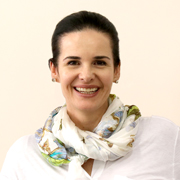
<td><strong><span>Geographer Ligia Vizeu Barrozo, coordinator of the new study group</span></strong></td>
</tr>
</tbody>
</table>
<p>A new study group will analyze the health inequities and their relation to the geographical context of cities. The proposal of its creation was approved by the IEA's Board in a meeting held on August 16.</p>
<p>The group <i>Urban Space and Health</i> will be coordinated by geographer <a href="https://www.iea.usp.br/en/persons/researchers/ligia-barrozo" class="external-link">Ligia Vizeu Barrozo</a>, a professor at the Department of Geography of USP's Faculty of Philosophy, Languages and Literature, and Human Sciences (FFLCH). The forecast is that the activities will last four years starting from August 2016. In addition to geography, the transdisciplinary group has members from areas such as urban planning, cartography, epidemiology, physical activity and health.</p>
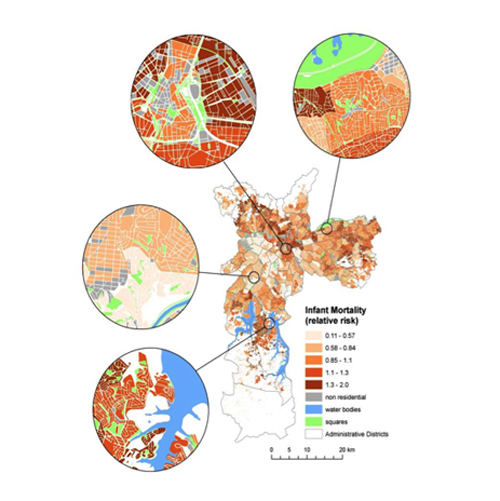
<p>According to the research project, the power of maps will be used to identify and highlight health inequities <span>mainly</span> related to socio-economic conditions and urban morphology. The goal is to have evidence to base policy recommendations in order to reduce inequities in health.</p>
<table class="tabela-esquerda">
<tbody>
<tr>
<th><img src="https://www.iea.usp.br/imagens/Mapa-Grupo-de-estudos-espaco-urbano-e-saude-web.jpg" alt="Mapa publicado no Journal of Maps, v. 11, 2015 - Barrozo, L. V. et al. " class="image-inline" title="Mapa publicado no Journal of Maps, v. 11, 2015 - Barrozo, L. V. et al. " /></th>
</tr>
<tr>
<td>
<p><span><strong>The dasymetric representation of the relative risk of child mortality between 2006 and 2009 in the city of São Paulo is an example of how maps can help showing inequality<br /></strong></span></p>
</td>
</tr>
</tbody>
</table>
<p>The group plans to use indicators such as life expectancy at birth and Potential Years of Life Lost (PYLL), evaluating how each of them appears in certain areas of cities. The first indicator "reflects the cumulative effect of the impact of risk factors, the occurrence and severity of diseases, and the effectiveness of interventions and treatment", and identifies when inequality becomes iniquity. In turn, the PYLL measures premature mortality (currently, the reference age is 70), focusing on the social and economic consequences of mortality. To observe the geographical variations in the results of this indicator can help in the planning of local health, according to the research project.</p>
<p>"The maps potentiate the investigation of the influence of the geographical context and the social determinants of health, particularly for allowing the visualization of spatial relationships, identifying iniquitous areas and the development of hypotheses," justify the researchers.</p>
<p>An example of the studies to be carried out is the evaluation of urban morphology, which can promote or hinder the daily practice of displacement, favoring physical inactivity in certain locations <span>or not</span>. Therefore, the researchers take <span>aspects such as topography, length of blocks, population density, urban sprawl, and density connections between streets, street lighting and paving </span>into account. According to the project, there are studies that raise the possibility that people living in more dense areas with well-connected streets and a <span>more diverse </span>use of the soil tend to be more physically active.</p>
<p>"The population is <span>unequally </span>exposed to urban infrastructure in terms of their morphology with regard to the pattern of the streets, to the cover of pavements, presence of bicycle paths, availability and accessibility to public transportation and aesthetics and safety, as p<span>leasant and safe</span> locations are more used and promote the practice of physical activity," they evaluate.</p>]]></content:encoded>
    <dc:publisher>No publisher</dc:publisher>
    <dc:creator>Richard Meckien</dc:creator>
    <dc:rights>Original version in Portuguese by Fernanda Rezende.</dc:rights>
    
      <dc:subject>Human Rights</dc:subject>
    
    
      <dc:subject>Study group</dc:subject>
    
    
      <dc:subject>Society</dc:subject>
    
    
      <dc:subject>Inequality</dc:subject>
    
    
      <dc:subject>Health</dc:subject>
    
    
      <dc:subject>Geography</dc:subject>
    
    <dc:date>2016-09-01T16:55:00Z</dc:date>
    <dc:type>News Item</dc:type>
  </item>


  <item rdf:about="https://www.iea.usp.br/en/news/social-geography-of-zika-in-brazil">
    <title>The Social Geography of Zika in Brazil</title>
    <link>https://www.iea.usp.br/en/news/social-geography-of-zika-in-brazil</link>
    <description></description>
    <content:encoded xmlns:content="http://purl.org/rss/1.0/modules/content/"><![CDATA[<table class="tabela-direita">
<tbody>
<tr>
<th><img src="https://www.iea.usp.br/imagens/jeffrey-lesser" alt="Jeffrey Lesser" class="image-inline" title="Jeffrey Lesser" /></th>
</tr>
<tr>
<td><strong>Jeffrey Lesser studies science and social history in the metropolises</strong></td>
</tr>
</tbody>
</table>
<p>Seen as a threat to global health, the Zika virus can be an indicator of the inequality that persists in Brazil, since its impact is greater in poorer areas. The topic has been discussed in the article <a href="http://www.tandfonline.com/doi/abs/10.1080/10714839.2016.1201268">The Social Geography of Zika in Brazil</a>, by <a href="https://www.iea.usp.br/en/persons/visiting-professors/jeffrey-lesser" class="external-link">Jeffrey Lesser</a>, a professor at <span>Emory University and </span>visiting professor at the IEA-USP. The article is co-authored by Uriel Kitron, head of the department of environmental sciences at Emory, and has been published in the 48th issue of the <a href="http://www.tandfonline.com/toc/rnac20/48/2">NACLA Report on the Americas</a>.</p>
<p><span>Samuel Candler Dobbs Professor and Chair at Emory's Department of History, Lesser specializes in Brazilian Studies and is the author of several books published in Brazil, including three for which he has won international awards: </span><i>A Discontented Diaspora: Japanese Brazilians and the Meanings of Ethnic Militancy, 1960–1980 </i>(Duke University Press, 2007; Editora Paz e Terra, 2008)<span>, </span><i>Welcoming the Undesirables: Brazil and the Jewish Question</i><span> (University of California Press, 1994; Imago Editora, 2005; Tel Aviv University Publishing Projects, 1997) and </span><i>Negotiating National Identity: Immigrants, Minorities, and the Struggle for Ethnicity in Brazil </i>(Duke University Press, 1999; Editora UNESP, 2001)<span>.</span></p>
<p><span></span>While taking a sabbatical year from Emory, Lesser is conducting research on a project entitled <a href="https://www.iea.usp.br/en/pesquisa/pessoas/projetos-lesser"><i>Metropolis, Migration and Mosquitoes: Historicizing Health Outcomes in São Paulo, Brazil</i></a>. His most recent book is <i>Immigration, Ethnicity and National Identity in Brazil</i> (<span>Cambridge University Press, 2013; Editora UNESP, 2015)</span>.</p>
<p>Approaches to public health in Brazil, the attitudes of the population on how to contain the mosquito that <span>primarily </span><span>transmits the </span>Zika virus (<i>Aedes aegypti</i>), government campaigns on the insect and the socioeconomic conditions of the areas that Lesser has visited for his research are some of the topics covered in the article. The analysis combines interdisciplinary methods of history, anthropology and epidemiology, as proposed in the project financed partly by Emory and partly by the IEA-USP.</p>
<p><span>When São Paulo <span>was still undergoing the <span>impacts of the </span>most critical drought in its history i</span></span>n March 2016, Lesser visited the <span>Capão Redondo neighbourhood</span><span> in the company of health officials in charge of orienting the population and fumigating possible sources of the mosquito. At that time, most part of the city was supplied by tanker trucks. The problem was that the water stored by families usually ended up turning into breeding sites of mosquito larvae due to <span>very poor </span>storage conditions.</span></p>
<table class="tabela-esquerda">
<tbody>
<tr>
<th><img src="https://www.iea.usp.br/imagens/mosquito-aedes-aegypti" alt="Mosquito Aedes Aegypti" class="image-inline" title="Mosquito Aedes Aegypti" /></th>
</tr>
<tr>
<td><strong><i>Aedes aegypti</i> is not the only vector of the Zika virus, which causes microcephaly in newborns</strong></td>
</tr>
</tbody>
</table>
<p>According to Lesser, the community residents (with an average monthly income of about two minimum wages and a half) had few resources to repair the water tanks or buy equipment to seal the storage tanks. In a region where most of the civil works is semi-finished and access to basic services such as garbage collection and sewage treatment is irregular or non-existent, the population ends up with an unequal burden to carry.</p>
<p>Poor and pregnant women living in areas where there is an outbreak of fever caused by Zika are also more penalized, both in relation to men and in relation to women who can afford private medical care or even leave the danger zone while pregnant. "Health officials recommend that women at risk areas should prevent pregnancy and avoid sexual intercourse, but generally ignore the men's role in this matter," says the author.</p>
<p>Government campaigns showing "monster mosquitoes" with fangs and bad guy expressions can be "remnants" of educational materials used in the 19th century, as <span>analyzed by Lesser</span>. This type of image has been criticized by experts, since it can lead people to believe that any type of mosquito can be an imminent danger.</p>
<p>Furthermore, the way to conduct mosquito containment campaigns assumes widely paternalistic characteristics, as in the past. The use of the military in public health operations also brings distrust of a population that is used to dealing with the police force especially in confrontational situations. Many people end up seeing health workers as state social agents responsible for monitoring individuals rather than prioritizing the community's health.</p>
<table class="tabela-esquerda">
<tbody>
<tr>
<th><img src="https://www.iea.usp.br/imagens/a-revolta-da-vacina-charge-de-leonidas" alt="A revolta da vacina - charge de Leonidas" class="image-inline" title="A revolta da vacina - charge de Leonidas" /></th>
</tr>
<tr>
<td><strong>"T<span>he Vaccine Revolt</span>", by Leonidas, published in the <i>O Malho</i> magazine in 1904</strong></td>
</tr>
</tbody>
</table>
<p>Such approaches of government campaigns and "brigades" against the mosquito resemble the practices of the 19th and early <span>20th </span>centuries, which led to episodes that culminated in clashes, as the Vaccine Revolt, held against compulsory vaccination for smallpox <span>in Rio de Janeiro <span>in 1904</span></span>.</p>
<p><strong>Crucial factors for transmission</strong></p>
<p>The concentration of people in poor areas, public health planning by managers attuned to the past century policies and the uneven distribution of water, which makes the <span>poor</span> more dependent on storage in water tanks, are three <span>crucial factors for the </span>transmission of Zika as evidenced in the survey.</p>
<p>These factors show that the geography of inequality in Brazil persists, making the poor more susceptible to a problem that is not new, since the epidemics caused by mosquitoes date back to the "age of discovery" of America, <span>concludes Lesser</span>.</p>
<p>In March, same month of the article's publication, it was discovered that the <i>Culex quinquefasciatus</i>, known as the southern house mosquito, can also transmit the Zika virus, which causes microcephaly and malformations in babies. The discovery of biologist <span>Constância Ayres</span>, from the Fiocruz Pernambuco, has the potential to provide a leap in knowledge about the virus and radically change the Brazilian strategy of prevention, since there are no <i>Culex</i> control strategies in Brazil.</p>
<p>Unlike the <i>Aedes</i>, the <i>Culex</i> is more active at night, which would imply in awareness campaigns on the use of repellents and long clothing also at this period of the day, especially for pregnant women. In addition, the mosquito prefers to lay its eggs in extremely polluted places such as sewers, drains and channels. Thus, basic sanitation measures can be even more urgent to prevent the spread of cases of Zika and microcephaly in more precarious neighbourhoods.</p>]]></content:encoded>
    <dc:publisher>No publisher</dc:publisher>
    <dc:creator>Richard Meckien</dc:creator>
    <dc:rights>Original version in Portuguese by Sylvia Miguel.</dc:rights>
    
      <dc:subject>Brazil</dc:subject>
    
    
      <dc:subject>Human Rights</dc:subject>
    
    
      <dc:subject>Institutional</dc:subject>
    
    
      <dc:subject>Interdisciplinarity</dc:subject>
    
    
      <dc:subject>Human Sciences</dc:subject>
    
    
      <dc:subject>Research</dc:subject>
    
    
      <dc:subject>Globalization</dc:subject>
    
    
      <dc:subject>Poverty</dc:subject>
    
    
      <dc:subject>Visiting Professors</dc:subject>
    
    <dc:date>2016-07-27T14:15:00Z</dc:date>
    <dc:type>News Item</dc:type>
  </item>


  <item rdf:about="https://www.iea.usp.br/en/news/new-research-group-on-human-rights-has-been-created">
    <title>New research group on human rights has been created</title>
    <link>https://www.iea.usp.br/en/news/new-research-group-on-human-rights-has-been-created</link>
    <description></description>
    <content:encoded xmlns:content="http://purl.org/rss/1.0/modules/content/"><![CDATA[<table class="tabela-direita">
<tbody>
<tr>
<th><img src="https://www.iea.usp.br/imagens/copy_of__endo.jpg" alt=" Paulo Endo - Perfil" class="image-inline" title=" Paulo Endo - Perfil" /><img src="https://www.iea.usp.br/imagens/jose-sergio-de-carvalho" alt="José Sergio de Carvalho" class="image-inline" title="José Sergio de Carvalho" /></th>
</tr>
<tr>
<td colspan="2" style="text-align: right; "><b><span style="text-align: right; "> <span style="text-align: right; "> Paulo </span></span><span style="text-align: right; ">Cesar Endo (on top) <span style="text-align: right; ">and </span><span style="text-align: right; ">José Sergio <span style="text-align: right; ">Fonseca</span><span style="text-align: right; "> de Carvalho are the coordinators</span></span> <span style="text-align: right; ">of the new group</span></span><br /></b></td>
</tr>
</tbody>
</table>
<p>The IEA's Board approved the creation of the Research Group on Human Rights, Democracy, Politics and Memory on May 9. The involved researchers shall continue part of the activities undertaken by the <a href="https://www.iea.usp.br/en/research/chairs/unesco-chair-of-education-for-peace-human-rights-democracy-and-tolerance" class="external-link">UNESCO Chair in Education for Peace, Human Rights, Democracy and Tolerance</a>, active at the Institute from April 1996 to October 2014.</p>
<p><span>In addition, the group intends to deepen <span>the interdisciplinary nature of research in human rights </span>in theoretical and conceptual levels, "testing their points of tangency and erosion in the consolidation or depreciation of democracies", according to the coordinators.</span></p>
<p><span>For the proposal to become more comprehensive, the group considers it appropriate to include the study of social memory and politics in their work, which are now "almost inextricable reflections on law in their subjective, cultural, social and political dimensions." According to the coordinators, this is evidenced by research, museums, memorials and <span>worldwide </span>struggles around memory.</span></p>
<p><span>The participants of the initiative are <span>researchers in psychoanalysis</span>, psychology, philosophy, sociology, literary theory and criticism, law, contemporary political theory, history, education, anthropology and political science. </span><span>Each member will approach initiatives, groups and researchers that make up their national and international research networks.</span></p>
<p>The outcomes of the research will be presented and discussed at seminars, "with special interest in contributing to the formation of a political culture based on the principles of democracy and human rights."</p>
<p>The group's programme foresees four public events:</p>
<ul>
<li><span>Seminar </span><i>Literature and War</i><span>, in 2016;</span></li>
<li><span>2</span><sup>nd</sup><span> </span><span>Seminar </span><span><i>Memory, Memorials and the Future of Democracies</i>, in 2017;</span></li>
<li><span>2</span><sup>nd</sup><span> Colloquium </span><i>Psychoanalysis and Contemporary Political Theory</i><span>, in 2017;</span></li>
<li><span>2</span><sup>nd</sup><span> </span><i>International Seminar on the Political Thought of Hannah Arendt and Education</i><span>, on a date to be set.</span></li>
</ul>
<p> </p>
<table class="grid listing">
<tbody>
<tr>
<td>
<h3><i>Members</i></h3>
<p><i><b>The new group has as permanent members:</b></i></p>
<ul>
<li><i>José Sergio Fonseca de Carvalho (coordinator), from the USP's School of Education (FE);</i></li>
<li><i>Paulo Cesar Endo (coordinator), from the USP's Institute of Psychology (IP);</i></li>
<li><i>Flavia Schilling (vice-coordinator), from the FE-USP;</i></li>
<li><i>Márcio Seligmann-Silva, from the UNICAMP's Institute for the Study of Language;</i></li>
<li><i>Andrei Koener, from the UNICAMP's Institute of Philosophy and Human Sciences;</i></li>
<li><i>Maria Cristina Vicentin, from PUC-SP</i></li>
<li><i>Maria Victoria Benevides, from the FE-USP;</i></li>
<li><i>Eduardo Bittar, from the USP's Faculty of Law;</i></li>
<li><i>Carlota Boto, from the FE-USP;</i></li>
<li><i>Ana Lúcia Pastore Schritzmeyer, from the USP's Faculty of Philosophy, Languages and Literature, and Human Sciences (FFLCH);</i></li>
<li><i>Deise Ventura, from the USP's Institute of International Relations (IRI);</i></li>
<li><i>Rossana Reis, from the IRI-USP and the FFLCH-USP.</i></li>
</ul>
<p><i><br /><b>The collaborators are:</b></i></p>
<ul>
<li><i>Etienne Tassin – Université Paris Diderot-Paris 7;</i></li>
<li><i>Paula Hunzikler – Universidad de Córdoba (Spain);</i></li>
<li><i>Fina Birulés – Universitat de Barcelona;</i></li>
<li><i>Wojciech Owczarski – University of Gdańsk;</i></li>
<li><i>Edson Souza – Federal University of Rio Grande do Sul;</i></li>
<li><i>Susel Oliveira da Rocha – State University of Paraíba;</i></li>
<li><i>Maria José de Resende – Londrina State University;</i></li>
<li><i>Wânia Pasinato – UN Women.</i></li>
</ul>
<p><br />The postdoctoral researchers Gabriela Gramkow and André Costa, and the postgraduates Fernanda Castro Fernandes de Oliveira, Juliana Brandão, Daniele Kowalewski, Juliana Martins, Pedro Lagatta and Rose Miyahara will also take part in the group.</p>
</td>
</tr>
</tbody>
</table>
<p style="text-align: right; "><span class="discreet">Photos: Leonor Calasans/IEA-USP</span></p>]]></content:encoded>
    <dc:publisher>No publisher</dc:publisher>
    <dc:creator>Richard Meckien</dc:creator>
    <dc:rights>Original version in Portuguese by Mauro Bellesa.</dc:rights>
    
      <dc:subject>Human Rights</dc:subject>
    
    
      <dc:subject>Democracy</dc:subject>
    
    
      <dc:subject>Memory</dc:subject>
    
    <dc:date>2016-05-13T12:50:00Z</dc:date>
    <dc:type>News Item</dc:type>
  </item>


  <item rdf:about="https://www.iea.usp.br/en/news/theoretical-and-practical-human-dignity-during-the-second-ica">
    <title>Theoretical and practical human dignity during the 2nd Intercontinental Academia </title>
    <link>https://www.iea.usp.br/en/news/theoretical-and-practical-human-dignity-during-the-second-ica</link>
    <description></description>
    <content:encoded xmlns:content="http://purl.org/rss/1.0/modules/content/"><![CDATA[<p class="Body"><i>by <a href="https://www.iea.usp.br/en/news/segunda-intercontinental-academia" class="external-link">Akemi Kamimura</a><br />Brazilian participant in the second edition of the Intercontinental Academia </i></p>
<p class="Body"><img src="https://www.iea.usp.br/imagens/cartaz-ica-jerusalem" alt="Cartaz ICA Jerusalém" class="image-right" title="Cartaz ICA Jerusalém" /></p>
<p>Can someone be tortured to save the lives of hundreds of people in imminent danger? Would you accept that someone was tortured to save your children in danger? Can torture be justified for national security protection? Who has dignity? What does "human dignity” mean? Is it an absolute or a relative concept? Does religion favor or hinder human dignity? Is dignity a value or a right? Do all people have dignity?</p>
<p>These and other questions were discussed during the first phase of the <a class="external-link" href="https://scholars.huji.ac.il/iahd">second edition of the Intercontinental Academia on Human Dignity</a>, held at the Israel Institute for Advanced Studies (IIAS) of The Hebrew University of Jerusalem, from March 6 to 18.</p>
<p>18 young researchers gathered for two weeks of master classes, academic debates and other activities related to the central theme. In August, <span>the Center for Interdisciplinary Research at </span><span>Bielefeld </span><span>University (ZiF)</span> will be the host of the second phase while more classes, debates and discussions will be held in order to build a collective and interdisciplinary project on the subject. The program of the first phase is available at: <a href="http://www.as.huji.ac.il/ias/public/121/intercontinentalAca201586/program.pdf">http://www.as.huji.ac.il/ias/public/121/intercontinentalAca201586/program.pdf</a></p>
<p>The group is formed by <a class="external-link" href="https://scholars.huji.ac.il/iahd/people/pepole/fellows"><span>young researchers</span></a> from various countries (Israel, Germany, USA, Italy, Romania, South Africa / Nigeria, Canada, Finland, the Netherlands, Brazil) and backgrounds (law, philosophy, theology, political science, anthropology, spatial planning, history, linguistics).</p>
<p class="Body"><strong>Experience</strong></p>
<p>Perhaps because of having worked in projects and programs with multi / interdisciplinary approach regarding the defense of human rights, the proposal of the Intercontinental Academia on Human Dignity to "promote an <span>unprecedented </span>interdisciplinary dialogue and start cooperation between participants with different scientific <span>and cultural </span>backgrounds" has inspired me to dream of building something with researchers from around the world.</p>
<table class="tabela-esquerda">
<tbody>
<tr>
<th><img src="https://www.iea.usp.br/imagens/participantes-ii-edicao-ica-jerusalem" alt="Participantes trabalhando na II Edição ICA Jerusalém" class="image-inline" title="Participantes trabalhando na II Edição ICA Jerusalém" /></th>
</tr>
<tr>
<td><strong>2nd edition of the Intercontinental Academia: 18 young researchers have met in Jerusalem to address human dignity</strong></td>
</tr>
</tbody>
</table>
<p>To promote human dignity, to alleviate human suffering and to combat human right violations, besides strengthening a culture of human dignity in Brazil and worldwide. To meet different people and realities, to contribute for a collective and interdisciplinary project on human dignity, and perhaps for the promotion of human dignity in an intercontinental academia. With all this in mind, I went to Israel willing to learn and discuss the topic.</p>
<p>But the path towards an intercontinental academia and a culture of human dignity is long and complex, and certainly does not depend on academic debates and conferences only. Theory and practice need to interact and dialogue with consistency.</p>
<p>One of the first activities was a round of presentations and a brief discussion on the understanding of each participant on the concept of human dignity. Is human dignity an open concept that would comprehend every and any value or ideal to be protected? Is it a tool for social transformation? Is there an "essential core" of human dignity? Does human dignity enshrine an individual or collective conception? Does human dignity include a sense of autonomy? What is the meaning of human dignity? Who has dignity?</p>
<p>Human dignity as a research theme has brought<span> young scholars with different scientific, cultural and social <span>backgrounds</span> <span>together.</span> But the common theme of research does not mean a shared understanding of dignity <span>by itself</span>. This has been evidenced during the first discussion. Human dignity seemed to have <span>different </span>shapes, colors and forms for each participant.</span></p>
<p>A sum of different opinions and views does not necessarily reflect a consensus on the term and a collective construction - which requires time, dedication and joint efforts. But we were still getting to know each other, and a common concept of human dignity and an interdisciplinary collective project would be developed in the course of two weeks in Jerusalem or in the second phase in Bielefeld.</p>
<p>The lack of a common concept on human dignity was even more evident in the second week, with discussions of human dignity at the end of life (which brings up dignity throughout life), and on human dignity and the defense of national security based on the Israeli experience in jurisprudence and relative social <span>(and sometimes institutional) </span>acceptance of torture as a research method in "time bomb" situations or scenarios.</p>
<p class="Body"><span>In Israel, torture is used as a method of investigation in certain cases of defense "necessity" in "time bomb" scenarios with relative approval of state institutions, including the Supreme Court. Is the protection of national security above human dignity?</span></p>
<p>For some, the practice of torture could be justified to "save lives" in a <span>"time bomb" scenario. Thus</span><span>, one would not question the violation of human dignity if torture was practiced to save "other lives". Is "life" the most supreme good of human dignity? Is one human life <span>more </span>worth than another? Is torture acceptable in a <span>"time bomb"</span> scenario? May torture be acceptable?</span></p>
<p>It seemed increasingly essential to have greater clarity on what the group meant by human dignity in order to develop an interdisciplinary collective project and a final product of this journey. How to build a common, collective and interdisciplinary <span>project </span>on human dignity if we do not even have a minimum common sense on the subject? How to discuss human dignity if some may have more dignity than others?</p>
<p>But perhaps <span>human dignity will only prevail in theory and practice, without borders or possibilities for torture under any circumstances </span>when each person starts being able to imagine themself in other roles and filling the shoes of the <span>"enemies" </span><span>under torture </span>or their families.</p>
<p>If an interdisciplinary approach invites each discipline to have doubts and questions for a collective construction, it becomes evident that to deliver a joint project on human dignity we must have a solid, well-defined and <span>interdisciplinarily</span> <span>built </span>foundation of concepts. But before that it seems even more necessary to go through some personal reflections, show humility, openness and maturity to questions and dialogue, to enable a common and collective understanding of human dignity, so we can move towards a collective and interdisciplinary construction. <span>Debating human dignity in an intercontinental academia seems to require that each participant makes a constant exercise of otherness and questioning, and not only discuss academic concepts of each discipline or the daily practices of institutions and societies. It is necessary that the other is seen and considered with equality of human dignity.</span></p>
<p>In the logic of war, the other is seen as an enemy. In an authoritarian past, the other should be watched and punished, if not "deleted". A slave story: the other as an object. In everyday life, is it worth questioning whether the other is worthy of dignity? Who decides who can (or should) live or die? Who has human dignity? Is this intrinsic or conquered? Is dignity absolute or can it be relativized? How to foster a <span>culture of</span> human dignity? What is the role of academia?</p>
<p>But even these questions also seem to have been carefully prepared by the organization and the coordination. In addition to master classes and lectures with experts and important figures of the Israeli scenario (see material: <a href="http://www.as.huji.ac.il/HM-brochure">http://www.as.huji.ac.il/HM-brochure</a>), visits and social activities have allowed an acquaintance with the social, <span>cultural and religious </span>identity of Israel, and has promoted greater interaction among the participants. In conversations during meals and tours we could know each other, discuss situations and issues that contributed to a sense of mutual trust and community that favor a joint project and a collective construction.</p>
<p>Even with the differences, the dialogue, reflection and discussion have prevailed among the participants. Opinions have been respectfully heard and debated. The limits of performance and arguments began to be outlined and reflected.</p>
<table class="tabela-direita">
<tbody>
<tr>
<th><img src="https://www.iea.usp.br/imagens/participantes-ii-edicao-ica-jerusalem-1" alt="Participantes II Edição ICA - Jerusalém" class="image-inline" title="Participantes II Edição ICA - Jerusalém" /></th>
</tr>
<tr>
<td><strong>Participants of the 2nd Intercontinental Academia</strong></td>
</tr>
</tbody>
</table>
<p>Social activities have allowed us an overview of Israel from the Holocaust memory at Yad Vashem to the promise of rebirth, reconstruction and return of the Jews to the promised land, represented by the works of the Israel Museum. We have got to know the role of the Supreme Court and the proposal <span>of the current government </span>for social integration, the narratives of the institutional practice of national security, and the representation of <span>the Israeli-Palestinian conflict through </span>documentaries. Bombings and terror news, fear and insecurity reactions, relative ease of everyday life: "<i>just another day</i>..."</p>
<p><span>The individual questioning may</span> probably also take part of an interdisciplinary collective construction on human dignity: it requires from us to exit the comfort zone provided by the training and academic discipline to discuss possibilities of common and collective projects. Although we have not returned from Jerusalem with a clear idea of the contours of this collective and interdisciplinary project, our discussions and conversations have led to a proposal for a third phase, still to be defined: a publication, a workshop, or some other format to contribute with the debate on human dignity, and perhaps for its implementation and execution.</p>
<p>But it may still be necessary for each participant to return to their daily activities so that the intense reflections and discussions decant a bit and we can boost a collective and interdisciplinary project on human dignity, with a solid <span>common </span>base grounded in interdisciplinary dialogues. It might take place in Bielefeld, or on a third stage, wherever it is.</p>]]></content:encoded>
    <dc:publisher>No publisher</dc:publisher>
    <dc:creator>Richard Meckien</dc:creator>
    <dc:rights>Translation by Artemis Romano.</dc:rights>
    
      <dc:subject>Human Rights</dc:subject>
    
    
      <dc:subject>Citizenship</dc:subject>
    
    
      <dc:subject>Ubias</dc:subject>
    
    
      <dc:subject>Intercontinental Academia</dc:subject>
    
    
      <dc:subject>ICA</dc:subject>
    
    
      <dc:subject>Inequality</dc:subject>
    
    
      <dc:subject>Interdisciplinarity</dc:subject>
    
    
      <dc:subject>Law</dc:subject>
    
    <dc:date>2016-04-06T13:55:00Z</dc:date>
    <dc:type>News Item</dc:type>
  </item>


  <item rdf:about="https://www.iea.usp.br/en/news/akemi">
    <title>Researcher indicated by the IEA is selected for the second edition of the Intercontinental Academia</title>
    <link>https://www.iea.usp.br/en/news/akemi</link>
    <description></description>
    <content:encoded xmlns:content="http://purl.org/rss/1.0/modules/content/"><![CDATA[<table class="tabela-direita">
<tbody>
<tr>
<th><img src="https://www.iea.usp.br/imagens/akemi-kamimura" alt="Akemi Kamimura" class="image-inline" title="Akemi Kamimura" /></th>
</tr>
<tr>
<td style="text-align: right; "><strong>Akemi Kamimura</strong></td>
</tr>
</tbody>
</table>
<p style="text-align: left; ">The Scientific Committee for the <a class="external-link" href="http://www.ubias.net/ica-dignity">second edition</a> of the <a class="external-link" href="http://ica.usp.br/">Intercontinental Academia</a> gathered in late October and chose lawyer and human rights activist Akemi Kamimura to be one of the 21 young researchers members of the project.</p>
<p style="text-align: left; ">The Intercontinental Academia is a program of the <a class="external-link" href="http://www.ubias.net/">University-Based Institutes for Advanced Study (UBIAS)</a>, a network that brings together 36 <span>institutes of </span>advanced studies from all continents. The first edition of the program, organized by the IEA-USP and the Institutes for Advanced Research of the University of Nagoya, is still ongoing and focuses on Time.</p>
<p style="text-align: left; ">The second edition's theme will be Human Dignity. The organizers are the <span>University of Bielefeld's <a class="external-link" href="https://www.uni-bielefeld.de/ZIF/"><span>Center for </span><span>Interdisciplinary Research </span></a></span><a class="external-link" href="https://www.uni-bielefeld.de/ZIF/">(ZiF)</a> and the <a class="external-link" href="http://www.as.huji.ac.il/">Israel Institute of Advanced Studies</a> at the Hebrew University of Jerusalem.</p>
<p class="western" style="text-align: justify; ">Both meetings of the projects will take place in 2016: Jerusalem will host the first phase in March while Bielefeld will host the second one in August.</p>
<p class="western" style="text-align: justify; ">According to the organizers, the theme of the second edition is related to ethical and practical debates, which are crucial in several disciplines: "Human dignity is referred in research on terrorism, torture, war, big data and data protection, care in the long term, poverty reduction, social security, minorities, history of human rights, assisted suicide, border control and genetic engineering, just to name a few areas."</p>
<p class="western" style="text-align: justify; "><span>Each phase of the Academia will feature three or four master classes given by prominent intellectuals. Some of the topics to be addressed are:</span></p>
<div id="_mcePaste">
<ul>
<li><span>the constitutional right to human dignity;</span></li>
<li><span>dignity as the core of human rights;</span></li>
<li><span>the recognition of human dignity after its denial;</span></li>
<li><span>human dignity in religion.</span></li>
</ul>
</div>
<ul>
</ul>
<p> </p>
<p><strong>Profile</strong></p>
<p class="western" style="text-align: justify; ">Kamimura holds a Masters in Human Rights from the USP's Faculty of Law, where she has also completed her bachelor's degree. In 2014 she was a fellow at the Max Planck Institute for Comparative Public Law in Heidelberg. In 2010 she was a student of the course <i>Human Rights and Women: Theory and Practice </i>at the Universidad de Chile's Faculty of Law.</p>
<p class="western" style="text-align: justify; ">She has been working in projects and institutions linked to human rights since 2000. In 2013/2014 she was a consultant of UNESCO for the coordination of a systematic project on human rights recommendations made by UN agencies and the Organization of American States (OAS). The aim of this study is to propose a monitoring mechanism for the implementation of these guidelines by the Brazilian government.</p>
<p class="western" style="text-align: justify; ">Kamimura hopes that her academic and professional experience can contribute to the debate about the international legal framework on human rights to be discussed at the Intercontinental Academia, especially with regard to equality and non-discrimination of gender.</p>
<p style="text-align: right; "><span class="discreet">Photo: Camila Rodrigues/SJESP</span></p>]]></content:encoded>
    <dc:publisher>No publisher</dc:publisher>
    <dc:creator>Richard Meckien</dc:creator>
    <dc:rights>Original version in Portuguese by Mauro Bellesa</dc:rights>
    
      <dc:subject>Human Rights</dc:subject>
    
    
      <dc:subject>Intercontinental Academia</dc:subject>
    
    
      <dc:subject>Ubias</dc:subject>
    
    <dc:date>2015-11-09T15:55:00Z</dc:date>
    <dc:type>News Item</dc:type>
  </item>


  <item rdf:about="https://www.iea.usp.br/en/news/international-seminar-discusses-the-judiciary-the-pressand-public-safety">
    <title>International Seminar Discusses the Judiciary, the Press and Public Safety</title>
    <link>https://www.iea.usp.br/en/news/international-seminar-discusses-the-judiciary-the-pressand-public-safety</link>
    <description></description>
    <content:encoded xmlns:content="http://purl.org/rss/1.0/modules/content/"><![CDATA[<p>Researchers from Brazil, Argentina, Chile and the United States will meet on <strong>December 3 and 4</strong> for a comparative analysis of their countries’ democratic principles, institutions and political participation. Organized by <a class="external-link" href="http://nupps.usp.br/index.php">USP’s Public Policies Research Center (NUPPs)</a> and <a href="https://www.iea.usp.br/en/research/research-groups/quality-of-democracy" class="external-link">IEA’s Quality of Democracy Research Group</a>, the international seminar <i>Quality of Democracy: Institutions, Agents and Public Policy</i> will be held <strong>from 9 am to 6 pm</strong>, at the IEA’s Events Room.</p>
<p class="Text"><span>Experts will analyze the penetration and effectiveness of democratic concepts in institutions such as the press, the Judiciary, laws, public policy and social movements. “We intend to discuss in comparative perspective the responsiveness and accountability of democratic institutions, especially in relation to the workings of the Judiciary and of public security,” according to José Álvaro Moisés, organizer of the event.</span></p>
<p><span>In the opening panel, Moisés will examine the 25 years of democratic opening in Brazil, making a critical assessment of public policies, institutions, civil society and political culture. </span></p>
<p class="Text">The seminar will offer an interdisciplinary overview through the contributions of researchers from the political sciences, social sciences and law. The speakers include <a href="https://www.iea.usp.br/en/persons/speakers/robert-moog" class="external-link">Robert Moog</a>, from the School of Public and International Affairs at North Carolina State University, who will discuss the democratization of the judicial system in India; Carlos Huneeus Madge, lawyer and professor at the Estudios Internacionales Institute at the University of Chile, who will discuss Chilean democracy from the perspective of the press and of the Judiciary; and professor Sérgio Adorno, from USP’s School of Philosophy, Literature and Human Sciences (FFLCH), who will talk about democratic construction in Brazil in recent years and the implications on corruption, organized crime, violence and the Rule of Law.</p>]]></content:encoded>
    <dc:publisher>No publisher</dc:publisher>
    <dc:creator>Richard Meckien</dc:creator>
    <dc:rights>Original version in Portuguese by Sylvia Miguel. Translation by Carlos Malferrari.</dc:rights>
    
      <dc:subject>Human Rights</dc:subject>
    
    
      <dc:subject>Citizenship</dc:subject>
    
    
      <dc:subject>Democracy</dc:subject>
    
    
      <dc:subject>Research Group: Quality of Democracy</dc:subject>
    
    
      <dc:subject>Justice</dc:subject>
    
    
      <dc:subject>Interdisciplinarity</dc:subject>
    
    
      <dc:subject>Public Security</dc:subject>
    
    
      <dc:subject>Political Science</dc:subject>
    
    
      <dc:subject>Law</dc:subject>
    
    <dc:date>2015-11-09T15:25:00Z</dc:date>
    <dc:type>News Item</dc:type>
  </item>


  <item rdf:about="https://www.iea.usp.br/en/media-library/photos/events-2015/o-desafio-da-hospitalidade-emigrantes-e-refugiados-22-de-outubro-de-2015">
    <title>The Challenge of Hospitality: Migrants and Refugees - October 22, 2015</title>
    <link>https://www.iea.usp.br/en/media-library/photos/events-2015/o-desafio-da-hospitalidade-emigrantes-e-refugiados-22-de-outubro-de-2015</link>
    <description></description>
    
    <dc:publisher>No publisher</dc:publisher>
    <dc:creator>Richard Meckien</dc:creator>
    <dc:rights></dc:rights>
    
      <dc:subject>Europe</dc:subject>
    
    
      <dc:subject>Human Rights</dc:subject>
    
    
      <dc:subject>Geopolitics</dc:subject>
    
    
      <dc:subject>Violence</dc:subject>
    
    
      <dc:subject>Public Policies</dc:subject>
    
    
      <dc:subject>Glocal</dc:subject>
    
    
      <dc:subject>Society</dc:subject>
    
    
      <dc:subject>Globalization</dc:subject>
    
    
      <dc:subject>Middle east</dc:subject>
    
    
      <dc:subject>Migration</dc:subject>
    
    <dc:date>2015-10-22T02:00:00Z</dc:date>
    <dc:type>Folder</dc:type>
  </item>


  <item rdf:about="https://www.iea.usp.br/en/news/sense-of-humanity-and-hospitality-in-a-world-of-wars-and-hunger">
    <title>Sense of humanity and hospitality in a world of wars and hunger</title>
    <link>https://www.iea.usp.br/en/news/sense-of-humanity-and-hospitality-in-a-world-of-wars-and-hunger</link>
    <description></description>
    <content:encoded xmlns:content="http://purl.org/rss/1.0/modules/content/"><![CDATA[<p>Diversity is a feature of the contemporary world, from which some trends that transform countries in modern towers of Babel derive. Increasing global migration, aging, migration by sectarian wars and hunger are some traces of modernity.</p>
<p><span>The consequences of the Middle East conflicts put <span>the impact of the astonishing figures of war and hunger refugees </span>in evidence in the international agenda, with no similar situation in history.</span></p>
<p>The theme leads to the discussion of the principle of hospitality, defined by philosopher Jacques Derrida as the ability to receive the other as different, but essentially the same. It also raises a comparative analysis of the European and Brazilian reaction to the issue. <i>The Challenge of Hospitality: Migrants and Refugees</i> is the title of the debate to be held by the IEA on <strong>October 22</strong>, <strong>at 2.30 pm</strong>, in the Institute's Events Room.</p>
<p>This will be the second meeting of the Laboratory of Global Megatrends and Challenges to Democracy. The conference will have the coordination of Portuguese political scientist Álvaro de Vasconcelos, an assistant professor at the USP's Institute of International Relations (IRI), and the participation of Geraldo Adriano Godoy de Campos, a professor at the ESPM's course of international relations, and <a href="https://www.iea.usp.br/en/persons/researchers/sylvia-duarte-dantas-1" class="external-link">Sylvia Dantas</a>, coordinator of the <a href="https://www.iea.usp.br/en/research/research-groups/intercultural-dialogues" class="external-link">IEA's Intercultural Dialogues research group</a>. The laboratory was started in June this year with the debate <i><a href="https://www.iea.usp.br/en/news/identity-based-nationalism-in-focus" class="external-link">The Challenge of Identity-Based Nationalism</a></i>.</p>
<table class="tabela-direita-borda">
<tbody>
<tr>
<th>
<h3>Related material</h3>
<p><a href="https://www.iea.usp.br/en/news/identity-based-nationalism-in-focus" class="external-link">Identity-Based Nationalism in Focus</a></p>
</th>
</tr>
</tbody>
</table>
<p><span>"We have watched the drama of those who hoped to find refuge and hospitality and ended up finding walls, barbed wire, violence and mistrust in many countries that have 'fear of the other', especially Muslims and those who come from the Middle East," says Vasconcelos.</span></p>
<p>The war in Syria has forced four million people to leave the country and eight million to move internally. In addition to them there are war refugees from Iraq, Afghanistan, Sudan, Eritrea and Somalia. Thus, the number of refugees in the world in 2014 reached 59.5 million according to estimates by the <a class="external-link" href="http://www.unhcr.org/cgi-bin/texis/vtx/home">UN Refugee Agency</a><span>.</span></p>
<p><span>The event will be broadcast live over the </span><a href="https://www.iea.usp.br/en/aovivo" class="external-link">web</a><span>.</span></p>]]></content:encoded>
    <dc:publisher>No publisher</dc:publisher>
    <dc:creator>Richard Meckien</dc:creator>
    <dc:rights>Original version in Portuguese by Sylvia Miguel</dc:rights>
    
      <dc:subject>Europe</dc:subject>
    
    
      <dc:subject>Human Rights</dc:subject>
    
    
      <dc:subject>Sociology</dc:subject>
    
    
      <dc:subject>Citizenship</dc:subject>
    
    
      <dc:subject>Democracy</dc:subject>
    
    
      <dc:subject>Geopolitics</dc:subject>
    
    
      <dc:subject>Violence</dc:subject>
    
    
      <dc:subject>War</dc:subject>
    
    
      <dc:subject>Migration</dc:subject>
    
    
      <dc:subject>Globalization</dc:subject>
    
    
      <dc:subject>Social Sciences</dc:subject>
    
    
      <dc:subject>Middle east</dc:subject>
    
    
      <dc:subject>Political Science</dc:subject>
    
    
      <dc:subject>World</dc:subject>
    
    
      <dc:subject>Nationalism</dc:subject>
    
    
      <dc:subject>Event</dc:subject>
    
    
      <dc:subject>History</dc:subject>
    
    <dc:date>2015-10-16T16:35:00Z</dc:date>
    <dc:type>News Item</dc:type>
  </item>


  <item rdf:about="https://www.iea.usp.br/en/news/children-who-care-global-perspectives-on-childrens-hidden-care-giving-roles-within-their-families">
    <title>Children Who Care – Global Perspectives on Children’s Hidden Care-Giving Roles within their Families</title>
    <link>https://www.iea.usp.br/en/news/children-who-care-global-perspectives-on-childrens-hidden-care-giving-roles-within-their-families</link>
    <description></description>
    <content:encoded xmlns:content="http://purl.org/rss/1.0/modules/content/"><![CDATA[<p style="text-align: justify; "><img src="https://www.iea.usp.br/imagens/YoungCarers-tucking1-bw-by-Produnis-self-made-first-published-at-NursingWiki.-Licensed-under-CC-BY-SA-3.0-via-Commons-https-commons.wikimedia.orgwikiFile-YoungCarers_tucking1_bw.jpg%23mediaFile-YoungCarers_tucking1_bw" alt="Jovens cuidadores " class="image-left" title="Jovens cuidadores " />Children and young people have been increasingly spending their time in a position which grows throughout the world. Tens of millions of them become informal caregivers of older members of their own family, often parents, grandparents or close relatives who are ill, disabled or in need of assistance, support and supervision.</p>
<p style="text-align: justify; ">Studies in this area, especially in the UK, Australia, the United States and sub-Saharan Africa, show that there is a diversity of social policies evolving to support these <span>unpaid </span>young care providers. However, it remains a hidden world which lacks global visibility and more knowledge on the theme.</p>
<p style="text-align: justify; ">Professor <a href="https://www.iea.usp.br/en/persons/speakers/saul-becker" class="external-link">Saul Becker</a>, Pro-Vice-Chancellor at the <a class="external-link" href="http://www.birmingham.ac.uk/index.aspx">University of Birmingham</a> and a specialist in this line of research, will address the theme at the conference <i>Children Who Care – Global Perspectives on Children’s Hidden Care-Giving Roles within their Families</i>, that will take place on <strong>October 21</strong>, in the IEA's Events Room, <strong>from 9.30 am to 12 pm</strong>. <a href="https://www.iea.usp.br/en/persons/researchers/ana-lydia-sawaya" class="external-link">Ana Lydia Sawaya</a>, coordinator of the <a href="https://www.iea.usp.br/en/research/research-groups/nutrition-and-poverty" class="external-link">IEA's Nutrition and Poverty Research Group</a> and a professor at UNIFESP, will participate as a debater.</p>
<p style="text-align: justify; ">Becker's work has influenced the academic debate and the implementation of public policies and practices that are designed to meet the needs of young carers. In his speech, he will explore the hidden worlds of children who provide assistance and care to adults, showing how and why some countries have identified and legislated this role as that of a specific group that requires support and intervention. In most countries, these children and young people remain hidden, invisible and isolated, with negative consequences for their lives, families and society as a whole.</p>
<p style="text-align: justify; "><span>Studies in the area suggest that the informal care provided by the young in developed and developing nations can be located along a continuous flow of care. They also show that these young people have much in common, regardless of where they live or how the social security systems of their countries are developed. Thus, there is a global need for these young people to get recognized, identified, analyzed and assisted as a distinct group of "vulnerable children".</span></p>
<p style="text-align: justify; "><span>Through its </span><a class="external-link" href="http://www.birmingham.ac.uk/research/activity/ias/index.aspx">Institute of Advanced Studies</a><span>, the University of Birmingham is linked to the </span><a class="external-link" href="http://www.ubias.net/">University-Based Institute of Advanced Studies (UBIAS)</a><span>, a network that brings together 34 institutes for advanced studies of the whole world. Created in 2010, it aims to promote the scientific exchange between generations, disciplines and cultures.</span></p>]]></content:encoded>
    <dc:publisher>No publisher</dc:publisher>
    <dc:creator>Richard Meckien</dc:creator>
    <dc:rights>Original version in Portuguese by Sylvia Miguel</dc:rights>
    
      <dc:subject>Human Rights</dc:subject>
    
    
      <dc:subject>Education</dc:subject>
    
    
      <dc:subject>Citizenship</dc:subject>
    
    
      <dc:subject>Interdisciplinarity</dc:subject>
    
    
      <dc:subject>Public Health</dc:subject>
    
    
      <dc:subject>Public Policies</dc:subject>
    
    
      <dc:subject>Elderly</dc:subject>
    
    
      <dc:subject>Social Sciences</dc:subject>
    
    
      <dc:subject>Globalization</dc:subject>
    
    
      <dc:subject>Sociology</dc:subject>
    
    
      <dc:subject>Medicine</dc:subject>
    
    
      <dc:subject>World</dc:subject>
    
    
      <dc:subject>Cities</dc:subject>
    
    
      <dc:subject>Childhood</dc:subject>
    
    <dc:date>2015-10-06T15:10:00Z</dc:date>
    <dc:type>News Item</dc:type>
  </item>


  <item rdf:about="https://www.iea.usp.br/en/news/registration-for-the-2nd-intercontinental-academia-ends-august-23">
    <title>Registration for the 2nd Intercontinental Academia through the IEA-USP postponed to August 23</title>
    <link>https://www.iea.usp.br/en/news/registration-for-the-2nd-intercontinental-academia-ends-august-23</link>
    <description></description>
    <content:encoded xmlns:content="http://purl.org/rss/1.0/modules/content/"><![CDATA[<p>The enrollment phase for young researchers who wish to investigate the subject “Human Dignity” in the second Intercontinental Academia (ICA) has been postponed by the IEA-USP to <strong>August 23</strong>. Organized by the <a class="external-link" href="http://www.as.huji.ac.il/">Institute for Advanced Studies at the Hebrew University of Jerusalem</a> and by the Center for Interdisciplinary Research (<a class="external-link" href="http://www.uni-bielefeld.de/ZIF/">Zentrum für interdisziplinäre Forschung – ZiF</a>) at Bielefeld University, the first stage of the project will be held from March 6 through 20, 2016 in Jerusalem, Israel. The second stage will take place from August 1 through 12 in Bielefeld, Germany.</p>
<p><span>Researchers may come from areas such as Law, Political Science, Sociology, Political Theory, History, Philosophy, Computer Science, Education, Cultural Studies, Literary Studies, Biology or Biogenetics. Participants must have reached the final phase of their PhD or post-doctoral work, and be fluent in English.</span></p>
<p><span>Candidates must present a cover letter on how they may contribute to the project, an updated résumé, and a letter of recommendation from an institute of advanced studies of the UBIAS network. In addition, they should provide a document summarizing their interest in the subject matter and their expectations for the project. Submissions should be made by e-mail (<a href="mailto:ica_iea@usp.br">ica_iea@usp.br</a><span>)</span> by August 23.</span></p>
<p>As the main member of the Ubias network in Latin America, the IEA-USP will be in charge of receiving the applications from the regional candidates and hold a pre-selection before sending the approved candidates to a final selection process by the host institutes.</p>
<p><span>Fifteen participants will be selected at the end of the process. Part of the costs of accommodation and travel will be reimbursed.</span></p>
<p><span><strong>Human dignity</strong></span></p>
<p class="Text">Human dignity is the object of several research studies, in various disciplines, and will involve a debate on international terrorism, torture, civil war, data protection, poverty reduction and social security, minorities, and history of human rights, among others. During the conferences in Israel and Germany, participants will attend master classes with eminent scholars from these fields. Some lectures have already been defined: “The constitutional right to human dignity,” “Dignity as the core of human rights,” “Recognizing human dignity after its denial” and “Human dignity in religion.”</p>
<p class="Text">Confirmed speakers include:</p>
<ul>
<li><span>Aleida Assmann, a <span>professor of English Literature at the University of Konstanz</span>;</span></li>
<li>Lynn A. Hunt, a <span>research professor and Eugen Weber endowed chair-holder in Modern European History at the University of California</span>;</li>
<li>Gertrude Lübbe-Wolff, a <span>professor of Public Law at Bielefeld University and former justice of the German Federal Constitutional Court</span>;</li>
<li>Ralf Poscher, a <span>professor of Constitutional Law and Legal Philosophy at the University of Freiburg</span>;</li>
<li>Mordechai Kremnitzer, <span>the Bruce W. Wayne professor of International Law at the Hebrew University of Jerusalem and vice-president of research at the Israel Democracy Institute</span>;</li>
<li>Aharon Barak, a professor of Law at the Interdisciplinary Center in Herzliya;</li>
<li>Bernadette Brooten, a researcher of American Religion and Kraft-Hiatt professor of Christian Studies at Brandeis University;</li>
<li>Marcus Düwell, who holds a chair in Philosophy Ethics at Utrecht University;</li>
<li>Moshe Halbertal, a senior fellow at the Shalom Hartman Institute of Jerusalem, and a professor of Jewish Thinking and Philosophy at the;</li>
<li>and Christine Hayes, Robert F. and Patricia Ross Weis professor of Religious Studies at Yale University and president of the Departament of Religious Studies.</li>
</ul>
<p class="Text"> </p>
<p class="Text"><span>The Intercontinental Academia is an initiative of the </span><a class="external-link" href="http://www.ubias.net/" target="_blank">UBIAS network</a><span>, an international association that connects 34 university-based institutes for advanced study from 19 countries, and aims to promote networked research and develop new leaders. The first edition of the Academia, which discussed “Time,” is being organized by the Institute of Advanced Studies of the University of São Paulo (IEA-USP) and the </span><a class="external-link" href="http://www.iar.nagoya-u.ac.jp/~iar/?lang=en" target="_blank">Institute for Advanced Research at the Nagoya University</a><span>. The first part was held in São Paulo from April 17 through 29 and the second is scheduled for March 2016, in Nagoya. Read about the São Paulo conferences </span><span><a class="external-link" href="http://ica.usp.br/news" target="_blank">here</a></span><span>. Learn more about the project at </span><a class="external-link" href="http://intercontinental-academia.ubias.net/" target="_blank">http://intercontinental-academia.ubias.net/</a><span>.</span></p>]]></content:encoded>
    <dc:publisher>No publisher</dc:publisher>
    <dc:creator>Richard Meckien</dc:creator>
    <dc:rights></dc:rights>
    
      <dc:subject>Human Rights</dc:subject>
    
    
      <dc:subject>Intercontinental Academia</dc:subject>
    
    <dc:date>2015-07-22T14:30:00Z</dc:date>
    <dc:type>News Item</dc:type>
  </item>


  <item rdf:about="https://www.iea.usp.br/en/news/second-edition-intercontinental-academia-will-address-human-dignity">
    <title>Second Edition of the Intercontinental Academia Will Address Human Dignity</title>
    <link>https://www.iea.usp.br/en/news/second-edition-intercontinental-academia-will-address-human-dignity</link>
    <description></description>
    <content:encoded xmlns:content="http://purl.org/rss/1.0/modules/content/"><![CDATA[<p><img src="https://www.iea.usp.br/imagens/ii-edicao-intercontinental-academia/@@images/2932ae82-f70b-4993-82c4-0e751189fc97.jpeg" alt="II edição Intercontinental Academia" class="image-right" title="II edição Intercontinental Academia" /></p>
<p>The second edition of the <a class="external-link" href="http://ica.usp.br/">Intercontinental Academia</a> has already defined subject matter, dates and venues. The project, in two stages, will study human dignity: the first stage, from March 6 through 20, 2016, will take place in Jerusalem; the second, from August 1 through 12, in Bielefeld. The event will be organized by the Israel <a class="external-link" href="http://www.as.huji.ac.il/">Institute for Advanced Studies of the Hebrew University Jerusalem (IIAS)</a> and the <a class="external-link" href="http://www.uni-bielefeld.de/ZIF/">Zentrum für interdisziplinäre Forschung<i> </i>(Center for Interdisciplinary Research) at Bielefeld University</a>.</p>
<p class="Text"><span>Human dignity is the object of several research studies, in various disciplines, and will involve a debate on international terrorism, torture, civil war, data protection, poverty reduction and social security, minorities, and history of human rights, among others. During the conferences in Israel and Germany, participants will attend master classes with eminent scholars from these fields. Some lectures have already been defined: “The constitutional right to human dignity,” “Dignity as the core of human rights,” “Recognizing human dignity after its denial” and “Human dignity in religion.”</span></p>
<p class="Text"><span>Confirmed speakers include Aleida Assmann, professor of English Literature at the University of Konstanz; Lynn A. Hunt, research professor and Eugen Weber endowed chair in Modern European History at the University of California; Gertrude Lübbe-Wolff, professor of Public Law at Bielefeld University and former justice of the German Federal Constitutional Court; Ralf Poscher, professor of Constitutional Law and Legal Philosophy at the University of Freiburg; and Mordechai Kremnitzer, the Bruce W. Wayne professor of International Law at the Hebrew University of Jerusalem and vice-president of research at the Israel Democracy Institute.</span></p>
<p class="Text">The Intercontinental Academia is an initiative of the <a class="external-link" href="http://www.ubias.net/">UBIAS network</a>, an international association that connects 34 university-based institutes for advanced study from 19 countries, and aims to promote networked research and develop new leaders. The first edition of the Academia, which discussed “Time,” is being organized by the Institute of Advanced Studies of the University of São Paulo (IEA-USP) and the <a class="external-link" href="http://www.iar.nagoya-u.ac.jp/~iar/?lang=en">Institute for Advanced Research at the Nagoya University</a>. The first part was held in São Paulo from April 17 through 29 and the second is scheduled for March 2016, in Nagoya. Read about the São Paulo conferences <span style="text-decoration: underline;"><span><a class="external-link" href="http://ica.usp.br/news">here</a></span></span>. Learn more about the project at <a class="external-link" href="http://intercontinental-academia.ubias.net">&lt;http://intercontinental-academia.ubias.net/&gt;</a>.</p>
<p><strong>Registration</strong></p>
<p>Young researchers wishing to take part in the Intercontinental Academia conferences on human dignity must undergo a careful selection process. Candidates may come from areas such as Law, Political Science, Sociology, Political Theory, History, Philosophy, Computer Science, Education, Cultural Studies, Literary Studies, Biology or Biogenetics. Participants must have reached the final phase of their PhD or post-doctoral work, and be fluent in English.</p>
<p class="Text"><span>Candidates must present a cover letter on how they may contribute to the project, an updated résumé, and a letter of recommendation from an institute of advanced studies of the UBIAS network. In addition, they should provide a document summarizing their interest in the subject matter and their expectations for the project. Submissions should be made by e-mail (ica-jerusalem-bielefeld@uni-bielefeld.de) by August 31.</span></p>
<p class="Text"><span>Fifteen participants will be selected at the end of the process. Part of the costs of accommodation and travel will be reimbursed.</span></p>
<p class="Text"><span>Additional information about the second stage of the project is available at the website of the </span>UBIAS<span> network.</span></p>]]></content:encoded>
    <dc:publisher>No publisher</dc:publisher>
    <dc:creator>Richard Meckien</dc:creator>
    <dc:rights>Original version in Portuguese by Fernanda Rezende and translation by Carlos Malferrari</dc:rights>
    
      <dc:subject>Human Rights</dc:subject>
    
    
      <dc:subject>Justice</dc:subject>
    
    
      <dc:subject>Intercontinental Academia</dc:subject>
    
    
      <dc:subject>Research</dc:subject>
    
    
      <dc:subject>Event</dc:subject>
    
    
      <dc:subject>History</dc:subject>
    
    <dc:date>2015-06-03T20:45:00Z</dc:date>
    <dc:type>News Item</dc:type>
  </item>


  <item rdf:about="https://www.iea.usp.br/en/news/mapping-human-rights">
    <title>Series of events brings back the memory of human rights in São Paulo</title>
    <link>https://www.iea.usp.br/en/news/mapping-human-rights</link>
    <description></description>
    <content:encoded xmlns:content="http://purl.org/rss/1.0/modules/content/"><![CDATA[<p style="text-align: justify; "><img src="https://www.iea.usp.br/imagens/cartografia-dos-direitos-humanos-em-sao-paulo-logomarca-vertical/@@images/105f8e1f-b508-4bb0-bcb9-d3eedcdaa393.jpeg" alt="Cartografia dos Direitos Humanos em São Paulo - Logomarca Vertical" class="image-right" title="Cartografia dos Direitos Humanos em São Paulo - Logomarca Vertical" />From November 3 to 7, <a style="text-align: justify; " href="https://www.iea.usp.br/en/research/chairs/unesco-chair-of-education-for-peace-human-rights-democracy-and-tolerance" class="external-link">IEA-USP's UNESCO Chair in Education for Peace, Human Rights, Democracy and Tolerance</a> will hold three meetings related to the project <a class="external-link" href="http://www.cartografiadh.iea.usp.br/?lang=en#!/loc=-23.65241549962681,-46.64526768190895,10">Human Rights Mapping in São Paulo</a>. It is the closure of a set of academic and cultural activities throughout the year with the aim of rescuing the memory of the struggle for human rights in the capital of the State of São Paulo and stimulating society to ponder the matter.</p>
<p style="text-align: justify; "><span><span>The release of Human Rights Mapping, a digital tool that maps geographic landmarks of the city of São Paulo associated with the trajectory of claims and achievements of human rights, will take place o</span>n November 4, at 8 pm, at USP's Maria Antonia Center. The chosen places symbolize the role of social movements and historical moments related to combating racial and gender discrimination; to democratization of access to justice; to the guarantee of freedom of expression; to the mobilization for the rights of workers, among other struggles.</span></p>
<p style="text-align: justify; "><span>Besides demarcating symbolically valuable places, the platform suggests itineraries of sightseeing by theme and region, matching each of the catalogued spots with texts, images and testimonials of journalists, and activists who have witnessed or were part of the fight in favor of human rights. The event will also include the opening of the Photography and Literature Festival, which will expose the work produced in art workshops promoted by the project.</span></p>
<p style="text-align: justify; ">The launch of the digital platform will be attended by <a href="https://www.iea.usp.br/en/iea/organization/diretoria" class="external-link">Martin Grossmann</a>, director of the IEA-USP; Moacyr Novaes, professor of USP's Faculty of Philosophy, Letters and Human Sciences (FFLCH) and associate provost for culture and universitary extension of USP; Pedro Barbosa Pereira Neto, chief prosecutor of the Federal Public Ministry (MPF); Rossana Rocha Reis, board member of the UNESCO Chair, professor at FFLCH and general coordinator of the project; and Sergio Adorno, coordinator of the UNESCO Chair and director of FFLCH.</p>
<p style="text-align: justify; ">Activities will continue with six roundtables on <i>Memory, Art and Human Rights Education</i>, which will take place on November 6 and 7, from 10 am to 6.30 pm at IEA's Event Room. During the debates, experts in literature, film, visual arts and museums will discuss the educational potential of artistic expression in the context of human rights.</p>
<p style="text-align: justify; "><span>Alongside the launch of the digital platform and roundtables, the UNESCO Chair will conduct the <span>International Art-Memory Workshop from November </span>3 to 5 at USP's Maria Antonia Center. The exhibitors will be artists Horst Hoheisel and Andreas Knitz, known by their joint works on the memory of the Holocaust, victims of military regime, and political and etchnic minorities persecution.</span></p>
<p style="text-align: justify; "><span><strong>PROJECT</strong></span></p>
<p style="text-align: justify; ">Conceived by Rossana Rocha Reis and proposed by the UNESCO Chair in partnership with USP's Maria Antonia Center, the project aims to restore the history of the struggle for rights in São Paulo and arouse the interest of society for the issue through discussions, workshops and art activities.</p>
<p style="text-align: justify; "><span>The project was awarded by <span>USP's</span> Dean of Culture and Universitary Extension (PRCEU) in the category Dissemination, and Cultural and Scientific <span> Intere</span><span>xchange</span> in 2013 and has the support of the Federal Public Ministry and the Legislative Assembly of the State of São Paulo.</span></p>
<p style="text-align: justify; "><span style="text-align: justify; ">The event will be broadcast live on the </span><a style="text-align: justify; " href="https://www.iea.usp.br/aovivo">web</a><span style="text-align: justify; ">.</span></p>
<p><strong> </strong></p>]]></content:encoded>
    <dc:publisher>No publisher</dc:publisher>
    <dc:creator>Richard Meckien</dc:creator>
    <dc:rights></dc:rights>
    
      <dc:subject>Human Rights</dc:subject>
    
    
      <dc:subject>Art</dc:subject>
    
    
      <dc:subject>Event</dc:subject>
    
    
      <dc:subject>Democracy</dc:subject>
    
    <dc:date>2014-10-29T16:15:00Z</dc:date>
    <dc:type>News Item</dc:type>
  </item>


</rdf:RDF>