<?xml version="1.0" encoding="utf-8" ?>
<rdf:RDF xmlns:rdf="http://www.w3.org/1999/02/22-rdf-syntax-ns#" xmlns:dc="http://purl.org/dc/elements/1.1/" xmlns:syn="http://purl.org/rss/1.0/modules/syndication/" xmlns="http://purl.org/rss/1.0/">


<channel rdf:about="https://www.iea.usp.br/en/search_rss">
  <title>en</title>
  <link>https://www.iea.usp.br</link>

  <description>
    
            These are the search results for the query, showing results 51 to 65.
        
  </description>


  <image rdf:resource="https://www.iea.usp.br/logo.png" />

  <items>
    <rdf:Seq>
      
        <rdf:li rdf:resource="https://www.iea.usp.br/en/news/mctaggart-metaphysics-theorize-cell-time" />
      
      
        <rdf:li rdf:resource="https://www.iea.usp.br/en/news/arte-ciencia-e-tecnologia-juntas-uma-visao-inusitada-sobre-a-vida" />
      
      
        <rdf:li rdf:resource="https://www.iea.usp.br/en/news/priorities-for-higher-education-and-research-in-japan" />
      
      
        <rdf:li rdf:resource="https://www.iea.usp.br/en/news/activities-in-nagoya-started" />
      
      
        <rdf:li rdf:resource="https://www.iea.usp.br/en/news/sabbatical-year-program-get-started" />
      
      
        <rdf:li rdf:resource="https://www.iea.usp.br/en/news/sabbatical-year" />
      
      
        <rdf:li rdf:resource="https://www.iea.usp.br/en/news/meeting-discusses-the-development-of-drugs-and-medicines-at-usp" />
      
      
        <rdf:li rdf:resource="https://www.iea.usp.br/en/news/ary-plonsky-is-named-for-the-costa-rica-board" />
      
      
        <rdf:li rdf:resource="https://www.iea.usp.br/en/news/participants-of-the-intercontinental-academia-gather-in-november-as-a-preparation-to-nagoya" />
      
      
        <rdf:li rdf:resource="https://www.iea.usp.br/en/news/the-dissemination-of-science-technology-and-innovation-at-USP" />
      
      
        <rdf:li rdf:resource="https://www.iea.usp.br/en/news/sabbatical-year-at-the-iea" />
      
      
        <rdf:li rdf:resource="https://www.iea.usp.br/en/news/goldemberg-e-escolhido-pelo-governador-para-a-presidir-a-fapesp" />
      
      
        <rdf:li rdf:resource="https://www.iea.usp.br/en/news/list-presidency-fapesp" />
      
      
        <rdf:li rdf:resource="https://www.iea.usp.br/en/news/brazilian-forum-of-advanced-studies" />
      
      
        <rdf:li rdf:resource="https://www.iea.usp.br/en/news/interdisciplinarity" />
      
    </rdf:Seq>
  </items>

</channel>


  <item rdf:about="https://www.iea.usp.br/en/news/mctaggart-metaphysics-theorize-cell-time">
    <title>McTaggart metaphysics to theorize cell time</title>
    <link>https://www.iea.usp.br/en/news/mctaggart-metaphysics-theorize-cell-time</link>
    <description></description>
    <content:encoded xmlns:content="http://purl.org/rss/1.0/modules/content/"><![CDATA[<table class="tabela-direita">
<tbody>
<tr>
<th><img src="https://www.iea.usp.br/imagens/kazuhiko-kume" alt="Kazuhiko Kume" class="image-inline" title="Kazuhiko Kume" /></th>
</tr>
<tr>
<td>
<p><strong>Neuroscientist Kazuhiko Kume, from the <span>Nagoya City University.</span> </strong></p>
</td>
</tr>
</tbody>
</table>
<p>Researcher in neuroscience and molecular biology, <a class="external-link" href="http://intercontinental-academia.ubias.net/nagoya/people/kazuhiko-kume?searchterm=Kazuhiko+Kume">Kazuhiko Kume</a>, from the Department of Neuropharmacology of the Nagoya City University, spoke to the participants of the <a class="external-link" href="http://intercontinental-academia.ubias.net/nagoya">Intercontinental Academia</a> as one of the pioneers to introduce the study of neuroethics in Japan. "Time in the brain" was the theme of the lecture given during the Biology Workshop, on March 8.</p>
<p><span>Kume studies sleep patterns and the molecular interaction in the <a class="anchor-link" href="#circadiano">circadian cycle</a>, and calls himself a "weekend philosopher". This is how he has introduced his vision on the relationship between the brain and the cells over time.</span></p>
<p><span><span>The professor</span> showed an image that, when stared at, makes the viewer have the illusion that it moves. "If your brain sees the movement, this happens by the time<span> the brain</span> takes to produce movement. So your brain produces time to a static figure," he said.</span></p>
<p><span>Kume initially addressed some concepts of neuroscience and bioethics, which he introduced in Japan from a textbook produced in 2006. In the original sense of the word it means "the ethics of neuroscience" or the behaviour that defines what is good or bad in the study of the brain." For example, is the erasure of negative memories or the improvement of cognitive activity through the use of drugs good or bad?," he pointed out.</span></p>
<p><span>Bioethics can also be seen as the neuroscience of ethics. "For example, there is a difference in individual decisions on ethics because of structural differences in the brain." Or: "Can you tell who would say yes or no in a moral dilemma just by looking at the structure of the person's brain?," he asked. </span><span>Discussing the brain and the mind incites some very common questions such as "What is mind or consciousness?" or "Do I really know why I want a certain thing?"</span></p>
<table class="tabela-esquerda-borda">
<tbody>
<tr>
<th>
<h3>Related material</h3>
<p>Video</p>
<p><a class="external-link" href="http://intercontinental-academia.ubias.net/nagoya/media-center/videos/intercontinental-academnia-second-phase-nagoya-tuesday-march-8-lecture-by-kazuhiko-kume">Time in the brain: synchronization and dissociation</a></p>
<p> </p>
<p><i style="text-align: center; ">More information:</i></p>
<p><a href="http://intercontinental-academia.ubias.net/nagoya/programme" target="_blank">Full programme</a></p>
<p><a class="external-link" href="http://intercontinental-academia.ubias.net/nagoya/news">All the news</a></p>
<br />
<p style="text-align: center; "><strong><i><a href="http://intercontinental-academia.ubias.net/" target="_blank">http://intercontinental-academia.ubias.net</a></i></strong></p>
</th>
</tr>
</tbody>
</table>
<p>According to K<span>ume, philosopher and mathematician René Descartes (1596-1650) proposed the idea of a center in the brain where the spirit (mind) would <span>dwell</span>; a kind of home to the soul or the thought. He believed that this center would be in the pineal body (or pineal gland), since it is a unique structure located in the central area of the brain. It is as if our mind stayed there, as if sitting in a theater watching us and deciding what we should do. As if there was a person inside the brain. But this would be impossible, Kume said, because it leads to an endless definition that within that person there would be another center inhabited by another person and so on.</span></p>
<p><span>Thus, the arguments against the beliefs of Descartes show that no region is particularly essential to consciousness, for any part can be deleted without the loss of consciousness. However, there are exceptions in the case of major head injuries. </span><span>On the other hand, the disconnection through sleep or anesthesia induces a reversible loss of consciousness. The brain and the body continue to work, but without consciousness. Furthermore, it is philosophically impossible to conceive the "center of the human being" as this would lead to an endless recursive redefinition, according to Kume.</span></p>
<p><span>When two brains of different people share the same feelings, perceptions and emotions then the idea gets a bit more complicated. Kume brought this issue up by showing twins connected by the brain. They have identical genes but different tastes and personalities. They can control their own hands and often fight with each other but they have connections that provide them with the same sensations. One does not like broccoli while the other one eats it and makes the first feel the taste. They also have the ability to communicate without talking out loud. For example, moving towards a particular direction or decide to watch TV.</span></p>
<p>"We can assume a human being as a set of different personalities. In the contemporary view, it is as if there were several dwarves acting within the brain," he said. Hence Kume's view of what the mind is: like a government without a president in which the mouth is the <span>spokesman</span> representing the government but does not decide and does not know everything. It is like a place of many ministries, each of which is headed by a minister who decides and executes different projects, and reports to the spokesman. In this logic, not even the minister knows everything that is done in their ministry, as each ministry is made of many parts, he compared.</p>
<p>Kume proposes an analysis of the brain from the time classification created by English metaphysicist John McTaggart Ellis McTaggart (1866 - 1925), plus Naoki Nomura's view on the author. <strong>(read the article below)</strong></p>
<p><span>Nomura uses the temporal structure of McTaggart and adds a new time series to the theory, the E-series, based on the synchronization and communication between agents. This series emerges when there is a synchronization between the objective time and the subjective time.</span></p>
<p><span>Kume showed that there are different times which vary depending on the instrument used to measure them. The clock, a programmed series, the seasons of the year, the calendar, the period of digestion, the menstrual period, the lunar period, breathing, the heart beat, eye blinking. All these are measures that give a notion of biological time. In this type of time, synchronization is important. For a tadpole to become a frog, for example, a specific objective time is not required, but rather an optimal temperature for the growth of the body and the atrophy of the tail, he exemplified.</span></p>
<p>Living beings are not exactly governed by a clock, but by a daily metabolic cycle that establishes the so-called circadian cycle<span><a name="circadiano"></a></span>. The <strong>circadian clock or circadian cycle</strong> is the period of approximately 24 hours, which is the base of the life cycle of almost all living beings. So it is a cycle influenced by variations of light, temperature, tides and winds, day and night.</p>
<p><span>According to Kume, there is a central region i<span>n the brain </span>that regulates the mechanism, but experiments show that only a cell or a neuron can acquire the ability to complete the circadian cycle. Thus, the keyword is synchrony between cells. Likewise, considering the body as a whole, each cell operates at a different rhythm (an imperfect synchronism). The final result, however, is a perfect sync.</span></p>
<table class="tabela-esquerda">
<tbody>
<tr>
<th><img src="https://www.iea.usp.br/imagens/metronomos-72.jpg" alt="Metrônomos" class="image-inline" title="Metrônomos" /></th>
</tr>
<tr>
<td>
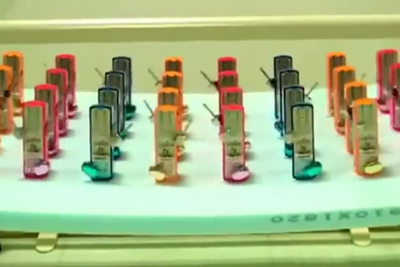
<p><strong>Metronomes adjust the beat and the time by synchronizing their movements</strong></p>
</td>
</tr>
</tbody>
</table>
<p>To illustrate this phenomenon, Kume used a <a class="external-link" href="https://www.youtube.com/watch?v=5v5eBf2KwF8">video</a> showing the beating of 32 metronomes that after being placed on a movable table at different rhythms end up getting in sync after one minute and 45 seconds. The same example was used by Professor Nomura.</p>
<p><span>For Kume, the reasoning of the E-series refers to the Integrated Information <span>Theory </span>(ITT), proposed by Giulio Tononi. A comatose patient regains consciousness when parts of the brain gradually connect the information of the environment, integrating them fully to the brain. Likewise, living beings adjust to the rhythm of the physical environment.</span></p>
<p><a name="nomu"></a><strong>E-Series of Nomura, a new approach to McTaggart</strong></p>
<p><span>Cultural anthropologist Naoki Nomura, a professor at the School of Humanities and Social Sciences of the Nagoya City University, talked about his study on assumptions developed by McTaggart about time.</span></p>
<p><span>"It is still an ongoing work and therefore what I bring here is unfinished, but still a good view of <span>McTaggart's</span> time," he said. A part of Nomura's study is available online in the article "<a class="external-link" href="http://nomuraoffcampus.com/wp-content/uploads/2016/02/07d4e906dd4a279c16a9a1040aa6584b.pdf">E-series Time As Prolegomena to McTaggart’s A- and B-series Time</a>", which he signs with Koichiro Matsuno, from the Nagaoka University of Technology.</span></p>
<p><span>"The Unreality of Time" is the best-known philosophical work by McTaggart, originally published in 1908 in the journal "<a class="external-link" href="http://mind.oxfordjournals.org/">Mind</a>". The author presents arguments to demonstrate the unreality of time. For McTaggart, the descriptions we know about time are either contradictory, circular or insufficient. </span></p>
<table class="tabela-direita">
<tbody>
<tr>
<th><img src="https://www.iea.usp.br/imagens/naoki-nomura" alt="Naoki Nomura" class="image-inline" title="Naoki Nomura" /></th>
</tr>
<tr>
<td>
<p><strong><span>Cultural anthropologist Naoki Nomura</span> speaks about the synchrony of biological time and physical time.</strong></p>
</td>
</tr>
</tbody>
</table>
<p><span>McTaggart basically proposes three time series to describe time. The A-Series is temporal and represents the subjective, psychological time, consisting of past, present and future. The B-Series is timeless. It is the objective, physical time, characterized by events <span>occurred </span>"earlier than" and "later than" another event. The C-series and the D-Series also have static temporal characteristics.</span></p>
<p><span>"The A-Series is a very important division for us because it represents the subjective or psychological time. But when we look at the clock we realize that it marks the hours and not whether it is past, present or future. The B-Series means the time without the division past-present-future, representing the objective time. In the B-Series the clock functions as a global timer or a common device that synchronizes the clocks of the world," <span>Nomura </span>said.</span></p>
<p><span>The C-Series is a sequence without order, with static temporal characteristics. The calendar may be viewed as a sequence of numbers and the clock as a mechanism that rotates around its axis. So these time objects can be viewed as a still image, a painting, a drawing of time, he said. "The musical score also marks the time, but we see it as a painting," he compared.</span></p>
<p><span>"But the biological clock does not seem to fit into any of these series. So my question is where the biological clock would fit under these descriptions," Nomura said.</span></p>
<p><span>For the scientist, the answer lies between the A-Series and B-Series. Or in their communication. This combination results in the E-Series, which he created and characterized by synchronization or communication between different times. </span><span>To illustrate the idea, Nomura showed what happened to the 32 metronomes.</span></p>
<p><span>"Their movement allowed them to fit together, all coming to the same rhythm. We see that material bodies may have an openness, interacting with each other and coordinating time. The <span>synchronization</span> of the metronomes happens due to the mutual adjusting movement and the displacement on the table. Where does the measure of time disappear? All come to a constant adjustment by trial and error until the time matches the beat. The communication between them makes the difference," Nomura said.</span></p>
<p><span>Similarly, Nomura says, it is possible to think that the flow of materials between cells occurs in the communication between them. The balance, therefore, is by synchronization. They enter a preset rhythm following the pulse of the rhythm given by walking, dancing, speaking. Thus, </span><span>the synchronization establishes a kind of time which is different from the clock time.</span></p>]]></content:encoded>
    <dc:publisher>No publisher</dc:publisher>
    <dc:creator>Richard Meckien</dc:creator>
    <dc:rights>Original version in Portuguese by Sylvia Miguel.</dc:rights>
    
      <dc:subject>Biology</dc:subject>
    
    
      <dc:subject>Institutional</dc:subject>
    
    
      <dc:subject>Interdisciplinarity</dc:subject>
    
    
      <dc:subject>Research</dc:subject>
    
    
      <dc:subject>Neuroscience</dc:subject>
    
    
      <dc:subject>Academia Intercontinental</dc:subject>
    
    <dc:date>2016-03-17T21:50:00Z</dc:date>
    <dc:type>News Item</dc:type>
  </item>


  <item rdf:about="https://www.iea.usp.br/en/news/arte-ciencia-e-tecnologia-juntas-uma-visao-inusitada-sobre-a-vida">
    <title>Art, science and technology together: an unusual outlook on life</title>
    <link>https://www.iea.usp.br/en/news/arte-ciencia-e-tecnologia-juntas-uma-visao-inusitada-sobre-a-vida</link>
    <description></description>
    <content:encoded xmlns:content="http://purl.org/rss/1.0/modules/content/"><![CDATA[<table class="tabela-direita">
<tbody>
<tr>
<th><img src="https://www.iea.usp.br/imagens/Hideo%20Iwasaki.jpg" alt="Hideo Iwasaki" class="image-inline" title="Hideo Iwasaki" /></th>
</tr>
<tr>
<td>
<p><strong>Hideo Iwasaki presents papers on the interface between science and art during the biology workshop.</strong></p>
</td>
</tr>
</tbody>
</table>
<p>Synthetic biology is a new approach to bioengineering. It involves modeling and the construction of organisms at the molecular scale, or the redesign of parts, devices or natural biological systems. It is a technology that seeks specific objectives through an intentional design. Instead of evolutionary pressures, the world of the <span>living beings </span>becomes a product of design choices. Through a fast progress, it has generated expectations to produce new biological applications in medicine, agribusiness, genomics, energy and other areas.</p>
<p><span>"It is a field that offers a new insight on how to relate to life. Its rapid advancement has resulted in many scientific and philosophical debates because it produces advances that lead to some exaggerations. Therefore, synthetic biology causes interest in some designers and artists involved in biotechnology," said biologist and artist Hideo Iwasaki, from the Waseda University, at the Biology <span>Workshop of the </span>second day of the <a class="external-link" href="http://intercontinental-academia.ubias.net/nagoya">Intercontinental Academia</a> (ICA).</span></p>
<table class="tabela-esquerda">
<tbody>
<tr>
<th><img src="https://www.iea.usp.br/imagens/Hideo%20Iwasaki-2.jpg" alt="Hideo Iwasaki e Martin Grossmann" class="image-inline" title="Hideo Iwasaki e Martin Grossmann" /></th>
</tr>
<tr>
<td>
<p><strong>Grossmann and Iwasaki debating.</strong></p>
</td>
</tr>
</tbody>
</table>
<p><a href="https://www.iea.usp.br/en/persons/researchers/martin-grossmann" class="external-link">Martin Grossmann</a><span>, former director of the IEA-USP and member of the Senior Committee for the ICA</span>, chaired the debates of Iwasaki's presentation and drew attention to the unusual union between biology and art. According to Grossmann, Iwasaki has innovated with the presented theme, a mix of science, technology and design.</p>
<p><span><span>Coordinator of the </span>Laboratory for Molecular Cell Network &amp; Biomedia Art at Waseda University, Iwasaki talked about the work of the <a class="external-link" href="http://www.syntheticaesthetics.org/">Synthetics Aesthetics</a>, an experimental project run by the University of Edinburgh and Stanford University. In 2010 the most renowned synthetic biologists, artists and social scientists gathered to explore collaborations focused on the conception, construction and understanding of the living world.</span></p>
<p><span>At the time, Iwasaki developed the project "Biogenic Timestamp" in partnership with Oron Catts, from the Aalto University of Helsinki. The work was defined by the microbiologist as a "critique to the hype of synthetic biology, a provocation on the link between the scale of geological time and the biological one."</span></p>
<p><span>They worked with tissue culture from cyanobacteria, a group of bacteria that obtains energy by photosynthesis and is among the most primitive forms of life. The community was applied to a computer board, which has undergone the action of these organisms to date. The work was exhibited in Austria and Japan. According to the creators, the experiment shows that the bacteria are able to internalize our technologies and creations, and modify them as they please.</span></p>
<table class="tabela-direita">
<tbody>
<tr>
<th><img src="https://www.iea.usp.br/imagens/Capa-Livro-SyntheticAesthetics.jpg" alt="Capa-Livro-SyntheticAesthetics.jpg" class="image-inline" title="Capa-Livro-SyntheticAesthetics.jpg" /></th>
</tr>
<tr>
<td>
<p><strong>Engineering principles applied to the complexity of living systems: biology transformed into a new design material.<br /></strong></p>
</td>
</tr>
</tbody>
</table>
<p>Another project, no less surreal by Western standards, is inspired by a relatively ancient habit in Japan, which is to create monuments in memory of insects, snails, plants, various objects and even the spirit of sperms.</p>
<p><span>Iwasaki showed that in some medical and research institutions, such as the Department of Human Sciences at the Waseda University, there is the habit of annual celebrations held in honor of animals used in experiments. In zoos there are funeral ceremonies for animals that have died. In 1971 a monument was created to honor the spirit of sperms.</span></p>
<p><span>Iwasaki thought of a memorial for artificial cells. "I am a microbiologist, so I can finally pray for the bacteria we use in experiments," he compared.</span></p>
<p><span>“The memorial service for synthetic cells” is the name of the technical and artistic work by Iwasaki, which will be displayed during the Kenpoku Art Festival 2016, a great show that dialogues with nature and art, incorporating science and technology. It is held in six cities in the northern Ibaraki Prefecture.</span></p>
<p><span>According to Iwasaki, his work is scientifically "stimulating, because it forces to think what life is in fact." The two projects that the scientist presented at the workshop seem to handle different things, but they actually "deal with the issue of time and how humans are involved with life," he said.</span></p>
<p><span>He cited a paper on the establishment of a bacterial cell from a chemically synthesized genome. "There is no common sense among scientists to answer if it is a living organism or a type of synthetic life. So I see that <span>each one's </span><span>subjective criterion of what life</span><span> is is required for</span> this kind of judgment," he added.</span></p>
<p style="text-align: right; "><span class="discreet">Photos: IAR/Nagoya</span></p>
<p style="text-align: right; "><span class="discreet"> syntheticaesthetics.org</span></p>]]></content:encoded>
    <dc:publisher>No publisher</dc:publisher>
    <dc:creator>Richard Meckien</dc:creator>
    <dc:rights>Original version in Portuguese by Sylvia Miguel.</dc:rights>
    
      <dc:subject>Biology</dc:subject>
    
    
      <dc:subject>Aesthetics</dc:subject>
    
    
      <dc:subject>Genetics</dc:subject>
    
    
      <dc:subject>Ubias</dc:subject>
    
    
      <dc:subject>Intercontinental Academia</dc:subject>
    
    
      <dc:subject>Research</dc:subject>
    
    
      <dc:subject>Engineering</dc:subject>
    
    
      <dc:subject>Technoscience</dc:subject>
    
    
      <dc:subject>Architecture</dc:subject>
    
    
      <dc:subject>Interdisciplinarity</dc:subject>
    
    
      <dc:subject>Art</dc:subject>
    
    <dc:date>2016-03-15T20:05:00Z</dc:date>
    <dc:type>News Item</dc:type>
  </item>


  <item rdf:about="https://www.iea.usp.br/en/news/priorities-for-higher-education-and-research-in-japan">
    <title>The priorities for higher education and research in Japan</title>
    <link>https://www.iea.usp.br/en/news/priorities-for-higher-education-and-research-in-japan</link>
    <description></description>
    <content:encoded xmlns:content="http://purl.org/rss/1.0/modules/content/"><![CDATA[<table class="tabela-direita-400">
<tbody>
<tr>
<th><img src="https://www.iea.usp.br/imagens/michinari-hamaguchi" alt="Michinari Hamaguchi" class="image-inline" title="Michinari Hamaguchi" /></th>
</tr>
<tr>
<td style="text-align: right; "><strong>Michinari Hamaguchi: "The goal of <br />research in Japan is innovation"</strong></td>
</tr>
</tbody>
</table>
<p>Scientific research and technological development in Japan should be guided by the social use of knowledge, innovation and cooperation between scientists, institutions and countries. The recommendation has been given by the president of the <a class="external-link" href="http://www.jst.go.jp/EN/">Japan Science and Technology Agency</a><span> (JST), Michinari Hamaguchi.</span></p>
<p>His was the final exhibition of the first day (March 7) of conferences at the <a class="external-link" href="http://ica.usp.br/nagoya">second phase of the Intercontinental Academia</a> (ICA), in Nagoya. The theme of his speech was <i>Higher Education and Academic Research From the View Point of Funding</i>.</p>
<p><span>Hamaguchi said that humanity must face the depletion of natural resources, the food crisis, the global warming, the environmental degradation and the population growth. According to him, these challenges can not be solved separately by institutions, sectors of research or even by a specific country.</span></p>
<p><span>To this scenario he adds the changes in life and society resulting from rapid technological development, such as information and communication technologies: "We live in a totally different world than </span><span>30 years ago. Jobs are disappearing and more and more people consider that we live in a false industrial revolution, being ours a critical time indeed."</span></p>
<p><span>Concerning the Japanese context, Hamaguchi said that there is an additional social component: the aging of the population due to increased longevity and low birth rate.</span></p>
<p><span><strong>Science for society</strong></span></p>
<p>He recalled that in the <a class="external-link" href="http://www.unesco.org/science/wcs/eng/declaration_e.htm">Declaration on Science and the use of scientific knowledge</a>, drawn up at a world conference organized by Unesco and the International Council for Science (ICSU) in Budapest, in 1999, the role of science was defined based on four objectives:</p>
<ul>
<li>
<div id="_mcePaste"><span>science for knowledge, knowledge for progress;</span></div>
</li>
<li>
<div id="_mcePaste"><span>science for peace</span><span>;</span></div>
</li>
<li><span>science for development</span>;</li>
<li><span>science in society and science for society</span>.</li>
</ul>
<p> </p>
<p><strong>Tragedy</strong></p>
<p>Regarding the contribution of science to society, Hamaguchi highlighted the urgency of efforts in Japan to overcome the consequences of the earthquake followed by a tsunami that devastated northeastern Japan on March 11, 2011, when more than 18,000 people died: "How can we contribute through scientific and technological development so that the survivors rebuild their lives and regain their joy?".</p>
<p>The tragedy had also a profound impact on the credibility of Japanese scientists. Before the tsunami, almost 80% of the Japanese trusted the scientists, but this percentage dropped to 40% after the tragedy, <span>now </span><span>reaching 60%.</span></p>
<p>Japan must prepare for similar events. Most importantly, he said, is to seek solutions to issues as infrastructure, education, urban areas, nourishment and communication networks.</p>
<p>According to Hamaguchi, the JST's actions support the communities affected by the tsunami and the radioactive leak in Fukushima. One of the cited examples has been the development of an equipment to quickly verify if the rice being produced in the region is or not contaminated by radiation.</p>
<p><span><strong>Universities</strong></span></p>
<p>The speaker stressed that the technological revolution, besides deeply affecting the industry, employability and various aspects of the society's life, also leads to drastic changes in the university and the production of knowledge.</p>
<p>For him, the traditional forms of education will no longer function as a means of transmitting knowledge to new generations, and professors are losing their special role in society and may become ordinary citizens in a network. Therefore, Hamaguchi considers essential that Japan creates a new academic system and a new way of setting up university networks based on cooperative work.</p>
<p><span><strong>JST programs</strong></span></p>
<p>Hamaguchi said that the main programs of the JST for research funding are designed to stimulate innovation, including those related to basic research. One of the concerns is to support the intellectual property and train professionals working in the interaction between companies and academia.</p>
<p>According to him, the main program focused on innovation considers three assumptions: an aging population, an intelligent society and sustainability. The initiative has three development guidelines: 1) "backcast approach": to imagine a future society and what needs it will have in 10 to 20 years, and to plan the steps to be taken so that the objectives are achieved; 2) "under the same roof": to put together researchers from industry and from universities to harmonize their differences in performance, such as the time dedicated to a long-term research, for example; 3) a longer period of funding: the JST funds projects for 9 years, something unusual in Japan, where the projects are usually supported for 3 to 5 years.</p>
<p><strong>Changes</strong></p>
<p>After the conference, Hamaguchi answered some questions from the audience. <a class="external-link" href="http://intercontinental-academia.ubias.net/nagoya/people/general-secretary">Carsten Dose</a><span>, executive director of the </span><a href="https://www.frias.uni-freiburg.de/en/home" target="_blank">Freiburg Institute for Advanced Studies</a><span> (FRIAS) and General Secretary for the ICA</span>, asked about the expectations in relation to changes in Japanese universities for them to become better in terms of innovation, given <span>Hamaguchi's </span> experience as president of the Nagoya University from 2009 to 2015. He said that Japan needs to change the style of doing science, paying greater attention to the needs of society.</p>
<p>In his view, another important aspect to demand changes is the fact that Japan has 2018 undergraduate programs and is facing the problem of reducing the Japanese population. One indicator of this gap is the reduction in competition in entrance exams at universities this year, he said. "The 18 year-old generation is decreasing rapidly. By 2025, Japan will be reduced by 103,000 (10%) in the number of people at that age. Currently, this population represents less than 60% from what it was in the peak period. This means that the system will collapse."</p>
<p>He added that there are 760 universities in Japan and 40% of them have problems. "We expect a kind of disaster in a few years. So we need to figure out how to reform higher education, but at the moment no one knows how to do this."</p>
<p><a href="https://www.iea.usp.br/en/persons/researchers/martin-grossmann" class="external-link">Martin Grossmann</a><span>, former director of the IEA-USP and member of the Senior Committee for the ICA</span><span>, </span>wanted to know if there is a crisis of the social sciences and humanities in Japanese universities, since the news have been reporting that the country's institutions will give less attention to them.</p>
<p>Hamaguchi said that, the important is to incorporate social scientists from the beginning of projects related to the natural sciences and also to harmonize the styles of both fields: "The social sciences generally work with long periods of the past and Japan needs to think about the future. In addition, natural scientists work in groups, while social science research is often carried out by a single researcher."</p>]]></content:encoded>
    <dc:publisher>No publisher</dc:publisher>
    <dc:creator>Richard Meckien</dc:creator>
    <dc:rights>Original version in Portuguese by Mauro Bellesa.</dc:rights>
    
      <dc:subject>Higher Education</dc:subject>
    
    
      <dc:subject>Intercontinental Academia</dc:subject>
    
    
      <dc:subject>Event</dc:subject>
    
    
      <dc:subject>Research</dc:subject>
    
    
      <dc:subject>Transformation</dc:subject>
    
    <dc:date>2016-03-10T18:40:00Z</dc:date>
    <dc:type>News Item</dc:type>
  </item>


  <item rdf:about="https://www.iea.usp.br/en/news/activities-in-nagoya-started">
    <title>Activities of the Intercontinental Academia have started in Nagoya</title>
    <link>https://www.iea.usp.br/en/news/activities-in-nagoya-started</link>
    <description></description>
    <content:encoded xmlns:content="http://purl.org/rss/1.0/modules/content/"><![CDATA[<table class="tabela-esquerda">
<tbody>
<tr>
<th><img src="https://www.iea.usp.br/imagens/oficial-grupo" alt="Oficial Grupo" class="image-inline" title="Oficial Grupo" /></th>
</tr>
<tr>
<td>
<p><strong>Group photo on the first day of the ICA's second phase.</strong></p>
</td>
</tr>
</tbody>
</table>
<p>The activities of the Intercontinental Academia (ICA) have started in Nagoya. <span>This second stage, to be held from March 6 to 18, continues the work begun in 2015, in São Paulo. Thirteen young researchers are preparing an online course on the subject "Time." The Massive Open Online Course (MOOC) will be available for free on a virtual platform, possibly Cousera.</span></p>
<p><span>The opening ceremony, held on March 7 at the <span>Nagoya</span> University, was chaired by <a class="external-link" href="http://intercontinental-academia.ubias.net/nagoya/people/hitoshi-sakakibara">Hitoshi Sakakibara</a>, and had the participation of the institution's president, Seiichi Matsuo. Further attendees were <a href="https://www.iea.usp.br/en/persons/researchers/martin-grossmann" class="external-link">Martin Grossmann</a>, former director of the IEA-USP and member of the Senior Committee for the ICA, <a class="external-link" href="http://intercontinental-academia.ubias.net/nagoya/people/general-secretary">Carsten Dose</a>, executive director of the <a href="https://www.frias.uni-freiburg.de/en/home" target="_blank">Freiburg Institute for Advanced Studies</a> (FRIAS) and General Secretary for the ICA, and <a class="external-link" href="http://intercontinental-academia.ubias.net/nagoya/people/hisanori-shinohara">Hisanori Shinohara</a>, director of the <a href="http://www.iar.nagoya-u.ac.jp/~iar/?lang=en" target="_blank">Institute for Advanced Research (IAR)</a>, co-organizer of the project and host of its second phase in Nagoya. After the welcome remarks, the research team conducted an acquaintance tour on the Higashiyama campus.</span></p>
<p><span><span>Physicist </span><a class="external-link" href="http://intercontinental-academia.ubias.net/nagoya/people/hideyo-kunieda">Hideyo Kunieda</a><span>, advisor and vice president of the Nagoya </span><span>University</span><span>, gave the opening speech. He</span> highlighted the motto of the University of São Paulo, "Sciencia Vinces" (Latin for "conquer by science"), drawing attention to the importance of this message to the present day. <span>By presenting an overview of the research conducted at the Nagoya </span><span>University</span><span>, Kunieda stressed out the fact that six professors of the institution have recently been awarded the Nobel Prize. </span>Kunieda was in São Paulo participating in the first phase of the Intercontinental Academia from April 17 to 29 last year, and gave a lecture on the theme <a href="https://www.iea.usp.br/en/news/time-astronomy" class="external-link">time in astronomy.</a></span></p>
<table class="tabela-esquerda">
<tbody>
<tr>
<th><img src="https://www.iea.usp.br/imagens/hideyo-kunieda" alt="Hideyo Kunieda" class="image-inline" title="Hideyo Kunieda" /></th>
</tr>
<tr>
<td>
<p><strong>Physicist Hideyo Kunieda <span>presenting an overview of the research conducted at the Nagoya </span><span>University</span></strong>.</p>
</td>
</tr>
</tbody>
</table>
<p><span><strong>Award-winning research</strong></span></p>
<p><a href="http://en.nagoya-u.ac.jp/people/nobel/ryoji_noyori/index.html" target="_blank">Ryoji Noyori</a> won the Nobel Prize in 2001 and Osamu Shimomura in 2008, both in Chemistry. Also in 2008, professors Makoto Kobayashi e <a href="http://en.nagoya-u.ac.jp/people/nobel/toshihide_maskawa/index.html" target="_blank">Toshihide Maskawa</a><span> </span>shared the award in Physics with Yoichiro Nambu, from the University of Chicago.</p>
<p><span>In 2014, another Nobel in Physics for the Nagoya University: Isamu Akasaki and Hiroshi Amano shared the award with Shuji Nakamura, from the University of California in Santa Barbara. The white LED, popular for being an economical source of light, was a creation of this trio of scientists.</span></p>
<p><span>Kunieda drew attention to the fact that some studies take decades to get to be a relevant invention. Hence the importance of young researchers to build the future. "But the role of a great mentor is also important," he said.</span></p>
<p><span><span>Attracting young talent is among the Nagoya University internationalization strategies, according to Kunieda. The institution promotes student symposiums, offers short and medium-term courses, short and long-term visits, exchanges between researchers, cooperative agreements and other actions.</span></span></p>
<table class="tabela-esquerda-300-borda">
<tbody>
<tr>
<td style="text-align: center; ">
<h3>Time in the sciences</h3>
<p style="text-align: left; ">The Intercontinental Academia is a project of the <a class="external-link" href="http://www.ubias.net/" target="_blank">University-Based Institutes for Advanced Study</a> (UBIAS), a network that brings together 36 institutes for advanced study of universities from all continents.</p>
<p style="text-align: left; "><span>The IEA-USP and the IAR-Nagoya are responsible for the first edition, which is producing interdisciplinary collaborative research on the concepts of time in the various sciences.</span></p>
<p style="text-align: left; "><span><span>The </span><a href="https://www.iea.usp.br/en/news/second-edition-intercontinental-academia-will-address-human-dignity" class="external-link">second edition of the Intercontinental Academia</a>, <span>also divided in two phases, addesses the theme "Human Dignity". The organizers are the Israel Institute for Advanced Studies at the Hebrew University of Jerusalem (March 6-18) and the Center for Interdisciplinary Research (Zentrum für </span><span>interdisziplinäre </span><span>Forschung - ZiF), of the Bielefeld University (August 1-12).</span></span></p>
<p style="text-align: left; "><a href="http://intercontinental-academia.ubias.net/nagoya/programme" target="_blank"><strong>Programme - Nagoya</strong></a></p>
<p style="text-align: left; "><span><strong><a href="http://intercontinental-academia.ubias.net/nagoya/programme" target="_blank"></a><a class="external-link" href="http://intercontinental-academia.ubias.net" style="text-align: center; ">More information on the Intercontinental Academia</a></strong></span></p>
</td>
</tr>
</tbody>
</table>
<p><span>Among the innovative projects of the Nagoya University there is the Center for Integrated Research of Future Electronics (CIRFE), whose research has resulted in savings of 7% in electricity costs in Japan, and the Institute of Innovation for Future Society, focused on <span>applied</span> research involving several areas.</span></p>
<p><span><strong>Intellectual courage</strong></span></p>
<p>Martin Grossmann thanked whoever has contributed to <span>bring the ICA</span> to life. The project of gathering young researchers from around the world to a work that lasts a whole year was released in 2012 during a meeting of the UBIAS Steering Committee held at <a class="external-link" href="http://www.jnu.ac.in/JNIAS/"><span>Jawaharlal Nehru</span> Institute of Advanced Study</a>, in New Delhi.</p>
<table class="tabela-direita">
<tbody>
<tr>
<th><img src="https://www.iea.usp.br/imagens/martin-grossmann-5" alt="Martin Grossmann Nagoya" class="image-inline" title="Martin Grossmann Nagoya" /></th>
</tr>
<tr>
<td>
<p><strong>Martin Grossmann, <span> former director of the IEA-USP and <span>member of the Senior Committee for the ICA</span></span>.</strong></p>
</td>
</tr>
</tbody>
</table>
<p>Grossmann remembered the master classs given by <span>Professor <a href="https://www.iea.usp.br/en/pessoas/pasta-pessoaj/jose-goldemberg" class="external-link">José Goldemberg</a>, </span>former president of USP and current president of the São Paulo Research Foundation (FAPESP), during the first meeting of the ICA, in São Paulo. <span> Goldemberg was a</span>sked what <span> a young researcher profile </span>should be to meet the challenges of career and the university of the future. "They should be aggressive," he said.</p>
<p><span>Grossmann pointed out that the meaning of "being aggressive" in the world of science could be translated to "being bold" or "having intellectual courage", which coincides with the motto of the <span>Nagoya </span>University: "cultivate the intellectual courage."</span></p>
<p><span>Interdisciplinary approach is fundamental to the university of the future, according to Grossmann, speaking of the research at the IEA-USP. "To listen to the others, even if from different disciplines, is fundamental to the advancement of science," he said.</span></p>
<p><span>"How can a network of young researchers have some relevance when there is a secular institution like university? The answer is to promote research and interdisciplinary encounters that allow to associate science, culture and technology," said Grossmann.</span></p>
<p><span><strong>Facilitating interdisciplinary dialogue</strong></span></p>
<p>"The Nagoya University has been playing a leading role and giving decisive support for the activities of the UBIAS," said Carsten Dose. "This is a leading institution on a global scale and, therefore, to be here in the second phase of the ICA is a privilege."</p>
<table class="tabela-direita">
<tbody>
<tr>
<th><img src="https://www.iea.usp.br/imagens/carsten-dose-1" alt="Carsten Dose Nagoya" class="image-inline" title="Carsten Dose Nagoya" /></th>
</tr>
<tr>
<td>
<p><strong>Carsten Dose, from the Freiburg Institute for Advanced Studies (FRIAS) and General Secretary for the ICA<span>.</span></strong></p>
</td>
</tr>
</tbody>
</table>
<p>Dose recalled the origins of the ICA and the UBIAS network, thanked the hospitality of the host university and the partnerships that enabled all the activities. "The ICA reminds us of what is essential for our institutions, which is to bring together young researchers in a work that facilitates dialogue between different disciplines and different countries," he said.</p>
<p><span>He remembered the advantages of having institutes for advanced studies related to universities, because these units have bases for producing science more freely, in a way that conventional institutions can not.</span></p>
<p><span>In a direct message to the young researchers of the ICA, Dose said he wanted "ambition" to be maintained, as well as the search for "new ideas to make the ICA keep advancing."</span></p>
<p><span><strong>The IAR in expansion</strong></span></p>
<p><span><span>Hisanori Shinohara presented the principles, activities and structure of the IAR. "We work with a small staff, as required by the modern institutions, but we intend to expand during my management, not only in terms of human resources but also in terms of budget," he said.</span></span></p>
<table class="tabela-esquerda">
<tbody>
<tr>
<th><img src="https://www.iea.usp.br/imagens/hisanori-shinohara" alt="Hisanori Shinohara " class="image-inline" title="Hisanori Shinohara " /></th>
</tr>
<tr>
<td>
<p><span><strong>Hisanori Shinohara, from the IAR-Nagoya, presenting the Institute's activities</strong></span></p>
</td>
</tr>
</tbody>
</table>
<p><span><span><span>Shinohara highlighted that </span>the principles governing the IAR are r</span>eporting <span> research excellence produced at Nagoya University and the IAR </span>to the academic community, giving substantial support to research excellence and promoting the independence of prominent researchers.</span></p>
<p><span>The academic advisory board of the IAR has 13 members, including the six scientists that have been awarded with the Nobel Prize. The institute currently has six research projects in progress. It seeks to encourage and promote informal interdisciplinary activities, promote meetings between young researchers and renowned academics, promote research exchanges with international institutions and manage a research fellowship program.</span></p>]]></content:encoded>
    <dc:publisher>No publisher</dc:publisher>
    <dc:creator>Richard Meckien</dc:creator>
    <dc:rights>Original version in Portuguese by Sylvia Miguel.</dc:rights>
    
      <dc:subject>Institutional</dc:subject>
    
    
      <dc:subject>Intercontinental Academia</dc:subject>
    
    
      <dc:subject>ICA</dc:subject>
    
    
      <dc:subject>Research</dc:subject>
    
    <dc:date>2016-03-10T16:50:00Z</dc:date>
    <dc:type>News Item</dc:type>
  </item>


  <item rdf:about="https://www.iea.usp.br/en/news/sabbatical-year-program-get-started">
    <title>Activities of the first edition of the IEA Sabbatical Year Program get started</title>
    <link>https://www.iea.usp.br/en/news/sabbatical-year-program-get-started</link>
    <description></description>
    <content:encoded xmlns:content="http://purl.org/rss/1.0/modules/content/"><![CDATA[<p>To make a philosophical reflection on the history of algebraic thinking, showing its relationship to the social and scientific development, is a starting point for a long-breath research. It takes time and commitment to its realization. That is why this and the research projects of five other professors of <span>USP </span>will be developed during 12 months, requiring full dedication at the first edition of the <a href="https://www.iea.usp.br/en/persons/sabbatical/sabbatical-professors" class="external-link">IEA Sabbatical Year Program</a>.</p>
<table class="tabela-direita">
<tbody>
<tr>
<th><img src="https://www.iea.usp.br/imagens/recepcao-aos-participantes-do-ano-sabatico-2016-2" alt="Recepção aos participantes do Ano Sabático 2016 - 2" class="image-inline" title="Recepção aos participantes do Ano Sabático 2016 - 2" /></th>
</tr>
<tr>
<td>
<p><strong>Directors of the IEA and board members host the professors on sabbatical</strong></p>
</td>
</tr>
</tbody>
</table>
<p>At the first meeting of researchers on sabbatical, held on January 7, the <span>professors</span> presented a brief summary of their projects and talked about their expectations for the program.</p>
<p>Mathematics, music, art history, archeology, sociology, oceanography and the interfaces of these with many other disciplines are some of the research areas of the <span>sabbatical period in</span> 2016. The studies will result in the publication of works such as books, public policy proposals or artistic works.</p>
<p>The initiative is unprecedented at USP and the Brazilian academic environment. By having the institutional and financial support of the University's Dean of Research, which will allocate a specific amount of aid for each selected proposal, the program will allow the selected professors to leave their original educational units in order to develop their individual projects.</p>
<p>In addition to the researchers, the meeting has been attended by the director and deputy director of the IEA, professors Martin Grossmann and Paulo Saldiva; USP's provost for research, Professor José Eduardo Krieger; journalist Eugenio Bucci, member of the Institute's board and a professor of USP's School of Communications and Arts (ECA); and <span>Hamilton Brandão Varela de Albuquerque, </span>vice-coordinator of IEA's São Carlos Center, technical adviser to the office of USP's <span>Dean of Research and </span>a professor at the Institute of Chemistry in São Carlos.</p>
<table class="tabela-esquerda">
<tbody>
<tr>
<th><img src="https://www.iea.usp.br/imagens/recepcao-aos-participantes-do-ano-sabatico-2016-3" alt="Recepção aos participantes do Ano Sabático 2016 - 3" class="image-inline" title="Recepção aos participantes do Ano Sabático 2016 - 3" /></th>
</tr>
<tr>
<td>
<p><strong>On their first meeting, the researchers talked about their projects and <span>expectations for the </span>sabbatical year</strong></p>
</td>
</tr>
</tbody>
</table>
<p><strong>The researchers and their projects</strong></p>
<p>Professor <a href="https://www.iea.usp.br/en/persons/researchers/flavio-coelho" class="external-link">Flávio Ulhoa Coelho</a>, from USP's Institute of Mathematics and Statistics, was the first to present his topic of study: "History of Algebraic Thinking and its Didactic Splits." "There is a moment of rupture between the concrete and the abstract in the history of algebraic thinking, with philosophical developments that impact our societies. Until today, this has not been very well studied and with this program it will be possible to deepen this subject," he said.</p>
<p><a href="https://www.iea.usp.br/en/persons/researchers/daria" class="external-link">Dária Gorete Jaremtchuk</a>, a professor at the School of Arts, Sciences and Humanities (EACH-USP), spoke about her work "Artistic Exile: <span>Movement</span> of Brazilian Artists to New York during the 1960s and 1970s" via videoconference. "I started wanting to understand that movement of our artists to the United States and I was led by the findings. The work has grown to unexpected directions. I needed to study the Cold War, cultural diplomacy, diplomatic relations and other subjects. This sabbatical will be a good opportunity to consolidate these studies," Jaremtchuk said.</p>
<p><a href="https://www.iea.usp.br/en/persons/researchers/lucia-barbosa" class="external-link">Lúcia Maciel Barbosa de Oliveira</a>, a professor at USP's School of Communications and Arts (ECA), believes that there is a mismatch between academy theories about the current artistic scene and the dynamics of cultural movements involving especially youngsters and new technologies. To understand the subject, she proposes to study the "<span>Contemporary Cultural Dynamics: Overlapping of Singularities, Collectives, Technologies and Cultural Institutions in the Common Perspective</span>". "The time for research demands a dreamy thought, which then shapes into something more concrete. But this is a little bit on the side of everyday life and I believe that it will be possible to exercise this dream during this sabbatical period. Interaction with people from different areas will be very important and I believe the program consolidates the IEA as an interdisciplinary interaction platform," she says.</p>
<p>To consolidate data from several surveys conducted throughout the career is also the goal of <a href="https://www.iea.usp.br/en/persons/researchers/maria-gasalla" class="external-link">Maria de los Angeles Gasalla</a>, from USP's Institute of Oceanography (IO), during her sabbatical leave. She will develop the study "<span>The Future of marine-dependent societies: climate change, innequalities and cooperation in complex socio-ecological systems</span>". According to Gasalla, there are many data generated from previous studies; diverse issues between natural, social and physical sciences; models for natural populations and the researcher's own experience with people who depend on the sea for their livelihoods. "I have drawn incredible knowledge of the fishermen's experience of the sea and learned a great deal about the social and cultural aspects of these communities. I will be able to develop a deeper reflection on the future of ocean-dependent societies in view of the scenarios of climate change impacts," she said. For the professor, it is feasible to establish relations on the context of inequalities in Latin America and the cooperation that emerges as social technology for the benefit of the planet. "The goals of the research are ambitious, but I believe that it will be possible to achieve them due to the time this program gives us.<span>"</span></p>
<p>A former professor of the School of Arts, Sciences and Humanities (EACH-USP), and current professor of the Museum of Archeology and Ethnology (MAE), <a href="https://www.iea.usp.br/en/persons/researchers/astolfo-araujo" class="external-link">Astolfo Gomes de Mello Araújo</a> proposes archeology as a case study to understand interdisciplinarity. "We see that interdisciplinarity in the University does not really exist. <span>I saw </span><span>it happen at </span><span>EACH, but overall it is still very much shallow. Archeology is the most interdisciplinary field I know and my idea is to scrutinize the process vision and how this discipline operates in time and space," said Araújo. "<span>Ontology and epistemology of an (inter)discipline: Archaeology as a Paradigm of Interdisciplinarity and its Theoretical and Practical Implications</span>" is the title of Araújo's work, who sees in the experience of the sabbatical year program the opportunity "to think new things." For him, acting in an interdisciplinary way "is the possibility of returning to a context similar to what I had at EACH," he said.</span></p>
<p>Professor <a href="https://www.iea.usp.br/en/persons/researchers/rodolfo-nogueira-coelho-souza" class="external-link">Rodolfo Nogueira Coelho de Souza</a>, a civil engineer from USP's Polytechnic School (POLI), ended up directing his career to music. He is a professor at the Music Department of the Faculty of Philosophy of Literature at the USP campus in Ribeirão Preto. He will develop the project "<span>Invention of an Opera: Pascal's machine in Pernaguá</span>". Coelho de Souza says that his invention is still a work of research. He will work on set theory looking for an algorithmic composition that is not motivated by human desire. However, human desire is projected into music through something abstract, which is the algorithm. The way to do this is to operate in the cinematographic dimension, making sound clippings, he said. "Few operas have been composed in a year and I know the project is ambitious. But it is the chance to develop more creative and technological, and essentially interdisciplinary work. It is like a dream to have a place where interdisciplinarity is well seen, unlike what happens in our departments," he said.</p>
<p><strong>“Out of the box”</strong></p>
<p><span>For IEA's director Martin Grossmann, the experience of the sabbatical program represents the discovery of a "missing link with the Dean of Research". The institutional relationship of these units comes to exist concretely with the support given by the provost to the program. In addition, the presence of Professor Hamilton Varela, who is an adviser to the </span><span>Dean of Research</span><span> and chair of IEA's Research Committee, is helping to structure that relationship, he said.</span></p>
<table class="tabela-esquerda">
<tbody>
<tr>
<th><img src="https://www.iea.usp.br/imagens/recepcao-dos-participantes-do-ano-sabatico-2016-1" alt="Recepção aos participantes do Ano Sabático 2016 - 1" class="image-inline" title="Recepção aos participantes do Ano Sabático 2016 - 1" /></th>
</tr>
<tr>
<td>
<p><strong>José Eduardo Krieger, Paulo Saldiva and Hamilton Varela</strong></p>
</td>
</tr>
</tbody>
</table>
<p><span>The </span><span>provost for </span><span>research, José Eduardo Krieger, recalled the importance of "inductive mechanisms to make think outside the box, or outside the comfort environment." Providing support and contributing with resources even in times of crisis is something managers need to see to enable even more important advancements than routine allows, Krieger said.</span></p>
<p>The institutes of advanced studies founded in various universities around the world in recent years represent an experimental tip; a transdisciplinary attempt and an outpost by definition, which runs "very interesting risks" precisely because of their methods and approaches, said journalist Eugênio Bucci, who is a member of the IEA's Board and responsible for the Superintendence of Social Communication (SCS) of USP.</p>
<p>"The necessary innovation and experimentation need to be considered at a time when the university in Brazil and in the world rethinks its role. We have to think about the next decades, what relationship the university will have with society and in what perspectives it will contribute to the future. The IEA is a fringe of contact with the future. You need to get out of disciplinary rigor and try different paths," said Bucci.</p>
<p><span>IEA's deputy director recalled the variety of topics covered at the IEA. "Particle physics, water, philosophy, urbanity, the Amazon, well, everything happens here. I come from a very dense, relatively monothematic area. In contrast, the IEA is very free and independent. And freedom is fascinating, but it is frightening. You who now start the sabbatical year will have the chance to give the program a keynote. Complex systems are now dominating the real world. Maybe the IEA could become a point where a real-world exercise is possible," said Saldiva.</span></p>
<p>Regina Pekelmann Markus, a member of the Institute's Board and of the Scientific Committee which has coordinated the work of the <a class="external-link" href="http://www.ica.usp.br">Intercontinental Academia</a>, said the sabbatical "rest" is "loaded of clouds; a way to carry dreams forward." For the scientist, "it is good to have a provost who believes we have to work outside the box."</p>
<p><span>Faced with the difficulties of instrumentalizing and practicing transdisciplinarity, perhaps the IEA can be a platform capable of adapting to this approach, because it is an "institute of free thinking, without frontiers or departments," <span>said </span>Varela.</span></p>
<p style="text-align: right; "><span class="discreet">Photos: Mauro Bellesa/IEA</span></p>]]></content:encoded>
    <dc:publisher>No publisher</dc:publisher>
    <dc:creator>Richard Meckien</dc:creator>
    <dc:rights>Original version in Portuguese by Sylvia Miguel.</dc:rights>
    
      <dc:subject>Institutional</dc:subject>
    
    
      <dc:subject>Interdisciplinarity</dc:subject>
    
    
      <dc:subject>Meta-curatorships</dc:subject>
    
    
      <dc:subject>Research</dc:subject>
    
    
      <dc:subject>Sabbatical</dc:subject>
    
    <dc:date>2016-01-15T17:40:00Z</dc:date>
    <dc:type>News Item</dc:type>
  </item>


  <item rdf:about="https://www.iea.usp.br/en/news/sabbatical-year">
    <title>IEA's Board announces the selected names for the sabbatical year</title>
    <link>https://www.iea.usp.br/en/news/sabbatical-year</link>
    <description></description>
    <content:encoded xmlns:content="http://purl.org/rss/1.0/modules/content/"><![CDATA[<p>The Sabbatical Year Program of the IEA, established on June 19, already has its six selected professors to develop individual research projects at the Institute. The research will start from 2016.</p>
<p><span>The candidates have been chosen by the Institute's Board after consulting the IEA's Research Committee. The program members will have the support of the Dean for Research, which will allocate specific funding for each approved project.</span></p>
<p><span>The researchers and their research projects are:</span></p>
<p><strong>Astolfo Gomes de Mello Araujo -</strong> "Ontology and epistemology of an (inter)discipline: Archaeology as a Paradigm of Interdisciplinarity and its Theoretical and Practical Implications";</p>
<p><strong>Dária Gorete Jaremtchuk -</strong> "Artistic exile: <span>Movement of </span>Brazilian Artists to New York during the 1960s and 1970s";</p>
<p><strong>Flavio Ulhoa Coelho -</strong> "<span>History of Algebraic Thinking and its Didactic Splits</span>";</p>
<p><strong>Lucia Maciel Barbosa de Oliveira - </strong><span>"Contemporary Cultural Dynamics: Overlapping of Singularities, Collectives, Technologies and Cultural Institutions in the Common Perspective";</span></p>
<p><strong>Maria de los Angeles Gasalla - </strong><span>"Future of marine-dependent societies: climate change, innequalities and cooperation in complex socio-ecological systems";</span></p>
<p><span> </span><strong>Rodolfo Nogueira Coelho de Souza - </strong><span>"Invention of an Opera: Pascal's machine in Pernaguá".</span></p>
<p><span><strong>The program</strong></span></p>
<p>The selected professors will conduct research at the IEA only, getting relieved of their activities, including teaching, at the unit or organ to which they are linked. Every professor in the exercise of a sabbatical year will have the following duties: to conduct at least one public lecture per semester and to produce a new and original paper or other outcome (book or work of art, for example). In the case of producing a paper, this will be published in the journal "Estudos Avançados" and / or the IEA website.</p>
<p><span>The next selection process should take place in the second half of 2016. </span><span>Applicants should submit projects related to and / or referenced by the four meta-curatorships (Commons, Transformation, Glocal and Abstraction) that were established in 2012 by the Institutional Project. They must also show proof that their participation in the program has been approved by the department council - or equivalent - and by the congregation or their unit or organ of origin.</span></p>]]></content:encoded>
    <dc:publisher>No publisher</dc:publisher>
    <dc:creator>Richard Meckien</dc:creator>
    <dc:rights>Original version in Portuguese by Sylvia Miguel</dc:rights>
    
      <dc:subject>Sabbatical</dc:subject>
    
    
      <dc:subject>Research</dc:subject>
    
    <dc:date>2015-12-04T19:05:00Z</dc:date>
    <dc:type>News Item</dc:type>
  </item>


  <item rdf:about="https://www.iea.usp.br/en/news/meeting-discusses-the-development-of-drugs-and-medicines-at-usp">
    <title>Meeting discusses the development of drugs and medicines at USP</title>
    <link>https://www.iea.usp.br/en/news/meeting-discusses-the-development-of-drugs-and-medicines-at-usp</link>
    <description></description>
    <content:encoded xmlns:content="http://purl.org/rss/1.0/modules/content/"><![CDATA[<p>The development of drugs and medicines at USP will be the theme of the third strategic workshop of the Dean for Research, which takes place on <strong>December 10</strong>, <strong>from 10 am to 6 pm</strong>, in the IEA Events Room. Carried out with IEA's support, the meeting will bring together experts from the university and the private sector.</p>
<p>Divided into thematic modules, the workshop <i>Development of Drugs and Medicines at USP</i> aims, like others of the series of meetings, to stimulate reflection and dialogue around the strategic themes for research at the University of São Paulo. It also seeks to create a scientific and technological environment of collaboration between the USP community and external agents.</p>
<p><span>The meeting has been organized by Hamilton Varela, advisor to the <span>Dean for Research</span>, professor of the IQSC (Institute of Chemistry in São Carlos) and president of the IEA Research Commission, and Adriano Andricopulo, a professor at the Institute of Physics in São Carlos. The coordinators are Andricopulo, Glaucius Oliva, a professor at the Institute of Physics in São Carlos, and Luiz Catalani, from the Institute of Chemistry. The speakers will be:</span></p>
<ul>
<li><span>Adriano Andricopulo (Institute of Physics - USP São Carlos)</span></li>
<li><span>Glaucius Oliva (<span>Institute of Physics - USP São Carlos</span>)</span></li>
<li><span>Luiz Catalani (Institute of Chemistry - USP)</span></li>
<li><span>Jorge Kalil (School of Medicine - USP)</span></li>
<li><span>Esper Georges Kallás (<span>School of Medicine - USP</span>)</span></li>
<li><span>Gustavo Kesselring (Brazilian Society of Pharmaceutical Medicine)</span></li>
<li><span>José Fernando Perez (Biopharma)</span></li>
<li><span>Reginaldo Arcuri (FarmaBrasil)</span></li>
<li><span>Célia R. S. Garcia (Institute of Biosciences - USP)</span></li>
<li><span>Norberto P. Lopes (Faculty of Pharmaceutical Sciences - USP Ribeirão Preto)</span></li>
<li><span>José Eduardo Krieger (<span>School of Medicine and Dean for Research </span>- USP)</span></li>
<li><span>Luiz Eduardo Caroli (Biozeus)</span></li>
</ul>]]></content:encoded>
    <dc:publisher>No publisher</dc:publisher>
    <dc:creator>Richard Meckien</dc:creator>
    <dc:rights>Original version in Portuguese by Fernanda Rezende</dc:rights>
    
      <dc:subject>Public Health</dc:subject>
    
    
      <dc:subject>Public event</dc:subject>
    
    
      <dc:subject>Research</dc:subject>
    
    
      <dc:subject>USP</dc:subject>
    
    
      <dc:subject>Medicine</dc:subject>
    
    <dc:date>2015-12-03T14:05:00Z</dc:date>
    <dc:type>News Item</dc:type>
  </item>


  <item rdf:about="https://www.iea.usp.br/en/news/ary-plonsky-is-named-for-the-costa-rica-board">
    <title>Guilherme Ary Plonski is named to Costa Rican IAS's Academic Council</title>
    <link>https://www.iea.usp.br/en/news/ary-plonsky-is-named-for-the-costa-rica-board</link>
    <description></description>
    <content:encoded xmlns:content="http://purl.org/rss/1.0/modules/content/"><![CDATA[<table class="tabela-direita">
<tbody>
<tr>
<th><img src="https://www.iea.usp.br/imagens/universidad-de-costa-rica" alt="Universidad de Costa Rica" class="image-inline" title="Universidad de Costa Rica" /></th>
</tr>
<tr>
<td style="text-align: right; "><strong>Universidad de Costa Rica</strong></td>
</tr>
</tbody>
</table>
<p>The president of the Universidad de Costa Rica (URC), Henning Jensen Pennington, has appointed IEA's board member <a href="https://www.iea.usp.br/en/iea/organization/conselho-deliberativo" class="external-link">Guilherme Ary Plonski</a> to the Academic Council of the Espacio de Estudios Avanzados (UCREA). The institution is the first IAS created in Central America.</p>
<p>The UCREA was established in August 2014 after more than two years of study with the participation of Costa Rican and foreign <span>researchers</span>.</p>
<p>The second preparatory meeting for the creation of the UCREA was a<a href="https://www.iea.usp.br/en/news/ieas-spreading-through-latin-america" class="external-link"> workshop</a> in February 2014, in which the features of the <a class="external-link" href="https://www.uni-bielefeld.de/(en)/ZIF/">University of Bielefeld's ZiF</a> were presented as a reference for the formulation of the Costa Rican institution's <span>project</span>.</p>
<p>At the workshop, in addition to the presentation of the ZiF's <span>Executive Secretary</span>, Britta Padberg, the IEA's director <a href="https://www.iea.usp.br/en/persons/researchers/martin-grossmann" class="external-link">Martin Grossmann</a> presented the <a href="https://www.iea.usp.br/en/iea/about-iea/institutional-project-2012-2017" class="external-link">Institutional Project 2012-2017</a>. Representatives of other IASs of several countries have also attended.</p>
<p><span>José Gracia Bondía, an honorary professor at the UCR, was the one to invite Grossmann to the workshop at that time and also to present the invitation for Plonski to join the UCREA's Academic Council on <span>a meeting at the University of Bielefeld</span>.</span></p>
<table class="tabela-esquerda">
<tbody>
<tr>
<th><img src="https://www.iea.usp.br/imagens/guilherme-ary-plonski-2" alt="Guilherme Ary Plonski" class="image-inline" title="Guilherme Ary Plonski" /></th>
</tr>
<tr>
<td><strong>Guilherme Ary Plonski</strong></td>
</tr>
</tbody>
</table>
<p><strong><strong>To think the not thought</strong></strong></p>
<p>According to the president of the UCR, the UCREA intends to be a multi and interdisciplinary, innovative and international space to streamline the organization and activities of the university to "think things that have not been previously thought."</p>
<p><span>The UCREA should be a critical awareness and <span>enhancement </span>tool for UCR to encourage creativity, and multi and interdisciplinary work. Another purpose is to build international networks of cooperation and learn from the successes and mistakes of similar institutions, making it a meeting place for academics from Costa Rica, Central America and the rest of the world.</span></p>
<p>The UCREA steering structure consists of an Academic Council, a Coordination and a Board. The Academic Council is in charge of setting the general direction of the institute, charging up the calls for research projects, workshops, and related activities and approval stages.</p>
<p>The Academic Council is composed of nine members: four representatives of the UCR areas (arts and letters, agri-food sciences, basic sciences and regional headquarters) and five members <span>external </span>to the UCR.</p>
<p style="text-align: right; "><span class="discreet">Photos (from the top): Universidad de Costa Rica; Leonor Calazans/IEA-USP</span></p>]]></content:encoded>
    <dc:publisher>No publisher</dc:publisher>
    <dc:creator>Richard Meckien</dc:creator>
    <dc:rights>Original version in Portuguese by Mauro Bellesa</dc:rights>
    
      <dc:subject>Institutional</dc:subject>
    
    
      <dc:subject>Transformation</dc:subject>
    
    
      <dc:subject>Glocal</dc:subject>
    
    
      <dc:subject>Research</dc:subject>
    
    <dc:date>2015-12-03T12:10:00Z</dc:date>
    <dc:type>News Item</dc:type>
  </item>


  <item rdf:about="https://www.iea.usp.br/en/news/participants-of-the-intercontinental-academia-gather-in-november-as-a-preparation-to-nagoya">
    <title>Participants of the Intercontinental Academia gather in November as a preparation to Nagoya</title>
    <link>https://www.iea.usp.br/en/news/participants-of-the-intercontinental-academia-gather-in-november-as-a-preparation-to-nagoya</link>
    <description></description>
    <content:encoded xmlns:content="http://purl.org/rss/1.0/modules/content/"><![CDATA[<table class="tabela-esquerda">
<tbody>
<tr>
<th><img src="https://www.iea.usp.br/imagens/center-for-advanced-studies-lmu/@@images/b18bc524-ed54-441b-a53d-dc669bedf3a0.jpeg" alt="Center for Advanced Studies - LMU" class="image-inline" title="Center for Advanced Studies - LMU" /></th>
</tr>
<tr>
<td><strong>The Center for Advanced Studies at the LMU, in Munich.</strong></td>
</tr>
</tbody>
</table>
<p>Senior <span>committee</span><span> members and young researchers of the first edition of the <a class="external-link" href="http://ica.usp.br/">Intercontinental Academia</a> will meet in <strong>November (25-28)</strong> for</span><span> an interim workshop. Held seven months after the first meeting in São Paulo, which has inaugurated the project, this meeting in Munich will enable the participants to advance the discussions and studies being conducted virtually since May, and plan activities for the meeting in Nagoya next March.</span></p>
<table class="tabela-direita-borda">
<tbody>
<tr>
<th>
<h3>Related material</h3>
<p>1st meeting</p>
<p class="kssattr-macro-title-field-view kssattr-templateId-kss_generic_macros kssattr-atfieldname-title documentFirstHeading" id="parent-fieldname-title"><a href="https://www.iea.usp.br/en/news/closing-report" class="external-link">Participants of the Intercontinental Academia present results of the event</a></p>
<p class="kssattr-macro-title-field-view kssattr-templateId-kss_generic_macros kssattr-atfieldname-title documentFirstHeading" style="text-align: left; ">2nd edition of the project</p>
<p><a href="https://www.iea.usp.br/en/news/akemi" class="external-link">Researcher indicated by the IEA is selected for the second edition of the Intercontinental Academia</a></p>
<p><a href="https://www.iea.usp.br/en/news/second-edition-intercontinental-academia-will-address-human-dignity" class="external-link">Second edition of the Intercontinental Academia will address human dignity</a></p>
<p><span>More information:</span><br /><a class="external-link" href="http://intercontinental-academia.ubias.net/" target="_blank">http://intercontinental-academia.ubias.net/</a></p>
</th>
</tr>
</tbody>
</table>
<p>The Intercontinental Academia is a program of the <a class="external-link" href="http://www.ubias.net/">University-Based Institutes for Advanced Study</a> (UBIAS), a network that brings together 36 <span>institutes for </span><span>advanced studies from all continents. The IEA-USP and the </span><a class="external-link" href="http://www.iar.nagoya-u.ac.jp/~iar/?lang=en">Institute for Advanced Research</a><span> (IAR) at the Nagoya University are responsible for the first edition. The meeting in São Paulo was organized by the IEA-USP and took place in April (17-30).</span></p>
<p>The project brings together <a class="external-link" href="http://ica.usp.br/people/candidates">13 young researchers</a> from different countries and areas of expertise to develop studies on the subject "time". At the end of every stage, they will produce content for a Massive Open Online Course (Mooc). The supervision of the research is led by a <a class="external-link" href="http://ica.usp.br/people/senior-committee">scientific senior committee</a><span>.</span></p>
<p>The workshop will take place at the headquarters of the <a class="external-link" href="http://www.en.cas.uni-muenchen.de/index.html">Centre for Advanced Studies of the </a><a class="external-link" href="http://www.en.cas.uni-muenchen.de/index.html">Ludwig-Maximilians</a> <a class="external-link" href="http://www.en.cas.uni-muenchen.de/index.html">Universität</a><span> (LMU)</span><span> and has the support of the </span><a class="external-link" href="https://www.frias.uni-freiburg.de/en/home">Freiburg Institute for Advanced Studies</a><span> (FRIAS). The meeting is intended to:</span></p>
<div id="_mcePaste">
<ul>
<li><span>discuss the work carried out from May to November by the young researchers;</span></li>
<li><span>present and define the program of activities for the meeting in Nagoya;</span></li>
<li><span>think of the details of the MOOC that will be produced by the young researchers;</span></li>
<li><span>discuss the partnership with Coursera.</span></li>
</ul>
</div>
<p> </p>
<p>The scientific committee will be represented by the director of the IEA-USP, <a href="https://www.iea.usp.br/en/persons/researchers/martin-grossmann" class="external-link">Martin Grossmann</a>, as well as <a href="https://www.iea.usp.br/en/persons/researchers/regina-pekelmann-markus" class="external-link">Regina Markus</a>, a professor at the USP's Institute of Biosciences and member of the IEA's Board, <a class="external-link" href="http://ica.usp.br/people/institutional-support">Dapeng Cai</a>, a professor of Economics at the Nagoya University and representative of the IAR-Nagoya; <a class="external-link" href="http://ica.usp.br/people/bernd-kortmann">Bernd Kortmann</a>, academic director of the <span>FRIAS, </span><a class="external-link" href="http://ica.usp.br/people/copy_of_sami-pihlstrom">Sami Pihlström</a><span>, director of the Helsinki Collegium for Advanced Studies, and </span><a class="external-link" href="http://ica.usp.br/people/copy_of_till-roenneberg">Till Roenneberg</a><span>, of the Institute of Medical Psychology at LMU. The General </span><span>Secretary of both UBIAS </span><span>and the project, </span><a class="external-link" href="http://ica.usp.br/people/general-secretary">Carsten Dose</a><span>, will also attend the meeting.</span></p>
<p><span>The young researchers will be represented by </span><a class="external-link" href="http://ica.usp.br/people/boris-roman-gibhardt">Boris Roman Gibhardt</a><span>, from the Bielefeld University, </span><a class="external-link" href="http://ica.usp.br/people/david-gange">David Gange</a><span>, from the University of Birmingham, </span><a class="external-link" href="http://ica.usp.br/people/eduardo-almeida">Eduardo Almeida</a><span>, from USP, </span><a class="external-link" href="http://ica.usp.br/people/eva-von-contzen">Eva von Contzen</a><span>, from the Ruhr-Universität Bochum, </span><a class="external-link" href="http://ica.usp.br/people/helder-nakaya">Helder Nakaya</a><span>, from USP, </span><a class="external-link" href="http://ica.usp.br/people/nikki-moore">Nikki Moore</a><span>, from Rice University, and </span><a class="external-link" href="http://ica.usp.br/people/valtteri-arstila">Valtteri Arstila</a><span>, from the University of Turku.</span></p>]]></content:encoded>
    <dc:publisher>No publisher</dc:publisher>
    <dc:creator>Richard Meckien</dc:creator>
    <dc:rights>Original version in Portuguese by Fernanda Rezende</dc:rights>
    
      <dc:subject>Institutional</dc:subject>
    
    
      <dc:subject>Intercontinental Academia</dc:subject>
    
    
      <dc:subject>Research</dc:subject>
    
    
      <dc:subject>Interdisciplinarity</dc:subject>
    
    <dc:date>2015-11-13T12:35:00Z</dc:date>
    <dc:type>News Item</dc:type>
  </item>


  <item rdf:about="https://www.iea.usp.br/en/news/the-dissemination-of-science-technology-and-innovation-at-USP">
    <title>The dissemination of science, technology and innovation at USP</title>
    <link>https://www.iea.usp.br/en/news/the-dissemination-of-science-technology-and-innovation-at-USP</link>
    <description></description>
    <content:encoded xmlns:content="http://purl.org/rss/1.0/modules/content/"><![CDATA[<p>The <a href="https://www.iea.usp.br/en/research/research-groups/innovation-and-competitiveness-observatory" class="external-link">IEA's Innovation and Competitiveness Observatory</a> will hold the debate <i>How USP Disseminates its Science, Technology and Innovation Outcomes </i>on <strong>November 11</strong>, <strong>from 2.30 pm to 5 pm</strong>, in the Institute's Events Room.</p>
<p><span>The event will be broadcast live over the </span><a href="https://www.iea.usp.br/en/aovivo" class="external-link">web</a><span>.</span></p>
<p>During the meeting, journalists Mônica Teixeira and Hérika Dias will discuss how the knowledge produced by the University is passed on to society and how we can broaden the dissemination of research produced at USP. Mediation will be in charge of professor Mario Salerno, from the USP's Polytechnic School (POLI) and coordinator of the OIC.</p>
<p><span>Only in 2014, the USP's Theses and Dissertations database registered 5,393 researches. The University of São Paulo accounts for approximately 25% of the scientific production in Brazil, according to the São Paulo Research Foundation (FAPESP).</span></p>
<p><span><strong>The conferencists</strong></span></p>
<p>Monica Teixeira is the director and presenter of the Virtual University of São Paulo (UNIVESP), in charge of the implementation of the scientific dissemination programme at USP.</p>
<p><span>Hérika Dias is a journalist of the USP News <span>Agency</span>, focused on the dissemination of the University's research.</span></p>]]></content:encoded>
    <dc:publisher>No publisher</dc:publisher>
    <dc:creator>Richard Meckien</dc:creator>
    <dc:rights>Original version in Portuguese by Fernanda Rezende</dc:rights>
    
      <dc:subject>Journalism</dc:subject>
    
    
      <dc:subject>Research Group: Innovation and Competitiveness Observatory (OIC)</dc:subject>
    
    
      <dc:subject>Research</dc:subject>
    
    <dc:date>2015-10-28T16:35:00Z</dc:date>
    <dc:type>News Item</dc:type>
  </item>


  <item rdf:about="https://www.iea.usp.br/en/news/sabbatical-year-at-the-iea">
    <title>USP professors can now apply for a sabbatical year at the IEA</title>
    <link>https://www.iea.usp.br/en/news/sabbatical-year-at-the-iea</link>
    <description></description>
    <content:encoded xmlns:content="http://purl.org/rss/1.0/modules/content/"><![CDATA[<table class="tabela-direita-300-borda">
<tbody>
<tr>
<td>
<h3>Measure enables full participation in projects of the Institute</h3>
<p style="text-align: justify; ">By instituting the Sabbatical Year Program at the IEA, USP's president justified the measure with the "need for a suitable environment for reflection and release of the professors from their teaching and administrative burdens to fully participate in projects" of the Institute.</p>
<p style="text-align: justify; ">Zago also highlights the specificity of the IEA, "which aims to research and discuss, in a comprehensive manner, fundamental questions of science, technology, arts, culture and other areas of knowledge, stimulating the generation of new ideas, contributing to the analysis of social issues and formulating public policies in order to integrate scientists and intellectuals in interdisciplinary projects."</p>
</td>
</tr>
</tbody>
</table>
<p style="text-align: justify; ">In an unprecedented initiative for USP and the Brazilian academia, president Marco Antonio Zago approved a resolution on June 19 establishing the Sabbatical Year Program at the IEA, an old aspiration of the Institute.</p>
<p style="text-align: justify; "><span>From 2016, the IEA will annually host six University professors on sabbatical for the development of individual research project.</span></p>
<p style="text-align: justify; "><span>The program has the support of the Dean of Research, which will offer up to R$ 12,000 for each approved project.</span></p>
<p style="text-align: justify; "><span>To apply for one of the six vacancies, the candidates need to have at least seven years of effective exercise of their functions in full devotion to teaching and research (RDIDP), and submit a CV and a research project to be developed. The project should include the objectives, the justification and the work plan for the desired sabbatical (six or twelve months). The open call for projects to be conducted in 2016 runs from September 9 to November 6, 2015.</span></p>
<p style="text-align: justify; ">Applicants should submit projects related to and / or referenced by the <a href="https://www.iea.usp.br/en/iea/meta-curatorships" class="external-link">four meta-curatorships (Commons, Transformation, Glocal and Abstraction)</a> that were established in 2012 by the <a href="https://www.iea.usp.br/en/iea/about-iea/institutional-project-2012-2017" class="external-link">Institutional Project</a>. They <span>must also show proof that their participation in the program has been approved by the department council - or equivalent - and by the congregation or their unit or organ of origin.</span></p>
<p style="text-align: justify; "><span>The Institute's Board will be in charge of selecting the participants of the programafter consulting the Institute Research Committee.</span></p>
<p style="text-align: justify; "><span>The selected professors will conduct research at the IEA only, getting relieved of their activities, including teaching, at the unit or organ to which they are linked. Every professor in the exercise of a sabbatical year will have the following duties: to conduct at least one public lecture per semester and to produce a new and original paper or other outcome (book or work of art, for example). In the case of producing a paper, this will be published in the journal "Estudos Avançados" and / or the IEA website.</span></p>]]></content:encoded>
    <dc:publisher>No publisher</dc:publisher>
    <dc:creator>Richard Meckien</dc:creator>
    <dc:rights>Original version in Portuguese by Mauro Bellesa</dc:rights>
    
      <dc:subject>Green Room</dc:subject>
    
    
      <dc:subject>Research</dc:subject>
    
    
      <dc:subject>Institutional</dc:subject>
    
    
      <dc:subject>Sabbatical</dc:subject>
    
    
      <dc:subject>IEA</dc:subject>
    
    
      <dc:subject>Transformation</dc:subject>
    
    <dc:date>2015-09-08T18:05:00Z</dc:date>
    <dc:type>News Item</dc:type>
  </item>


  <item rdf:about="https://www.iea.usp.br/en/news/goldemberg-e-escolhido-pelo-governador-para-a-presidir-a-fapesp">
    <title>José Goldemberg appointed President of FAPESP</title>
    <link>https://www.iea.usp.br/en/news/goldemberg-e-escolhido-pelo-governador-para-a-presidir-a-fapesp</link>
    <description></description>
    <content:encoded xmlns:content="http://purl.org/rss/1.0/modules/content/"><![CDATA[<table class="tabela-esquerda-200">
<tbody>
<tr>
<th><img src="https://www.iea.usp.br/imagens/jose-goldemberg-2" alt="José Goldemberg" class="image-inline" title="José Goldemberg" /></th>
</tr>
<tr>
<td style="text-align: left; "><strong>Physicist José Goldemberg, new president of FAPESP</strong></td>
</tr>
</tbody>
</table>
<p style="text-align: justify; ">Physicist José Goldemberg, an honorary professor of the IEA-USP, has been appointed President of <a class="external-link" href="http://www.fapesp.br/en/" style="text-align: justify; " target="_blank">FAPESP (São Paulo Research Foundation)</a> by State Governor Geraldo Alckmin. The nomination was published in the "Official Gazette of the State of São Paulo" on August 22. Goldemberg replaces jurist Celso Lafer, who has chaired the foundation since August 2007.</p>
<p style="text-align: justify; "><span>Alckmin chose Goldemberg from a list of three set by the <span style="text-align: justify; ">Foundation's Board, which he heads</span>. The list also contained sociologist José de Souza Martins, <span style="text-align: justify; ">a frequent collaborator of the IEA-USP</span>, and physiologist Eduardo Moacyr Krieger, also an honorary professor of the Institute and currently deputy president of FAPESP.</span></p>
<p style="text-align: justify; "><span><span style="text-align: justify; ">Goldemberg is a researcher and professor emeritus from the USP's Institute for Energy and Environment (IEE), and professor emeritus from the USP's Institute of Physics (IF). Since the establishment of the IEA-USP (during his term as president of USP), Goldemberg participates in activities related to environment, energy, sustainability and higher education. He was Secretary of Science and Technology, Secretary of the Environment and Minister of Education of the federal government, Secretary of the Environment of the State of São Paulo and president of the Brazilian Society for the Progress of Science (SBPC).</span></span></p>
<p style="text-align: justify; ">"Time" magazine chose Goldemberg as one of the "heroes of the environment" in 2007. In 2008 he received the Blue Planet Prize, awarded by the japanese f<span style="text-align: justify; ">oundation</span> Asahi Glass to personalities with outstanding work in research and in the formulation of public policies in the environmental area. In 2013 he won the <span style="text-align: justify; ">Zayed </span>Award for Energy of the Future, granted by the United Arab Emirates to professionals focused on renewable energy. Last year he won the "Education warrior" trophy, an award given by the newspaper "O Estado de S.Paulo" and by the School-Enterprise Integration Center (CIEE).</p>
<p style="text-align: right; "><span class="discreet">Photo: Mauro Bellesa/IEA-USP</span></p>]]></content:encoded>
    <dc:publisher>No publisher</dc:publisher>
    <dc:creator>Richard Meckien</dc:creator>
    <dc:rights>Original version in Portuguese by Mauro Bellesa</dc:rights>
    
      <dc:subject>Transformation</dc:subject>
    
    
      <dc:subject>Fapesp</dc:subject>
    
    
      <dc:subject>Research</dc:subject>
    
    <dc:date>2015-08-25T13:55:00Z</dc:date>
    <dc:type>News Item</dc:type>
  </item>


  <item rdf:about="https://www.iea.usp.br/en/news/list-presidency-fapesp">
    <title>José Goldemberg, Eduardo Moacyr Krieger and José de Souza Martins are on the list of possible presidents of FAPESP</title>
    <link>https://www.iea.usp.br/en/news/list-presidency-fapesp</link>
    <description></description>
    <content:encoded xmlns:content="http://purl.org/rss/1.0/modules/content/"><![CDATA[<table class="tabela-direita">
<tbody>
<tr>
<th><img src="https://www.iea.usp.br/imagens/jose-goldemberg-eduardo-moacyr-krieger-e-jose-de-souza-martins" alt="José Goldemberg, José de Souza Martins e Eduardo Moacyr Krieger" class="image-inline" title="José Goldemberg, José de Souza Martins e Eduardo Moacyr Krieger" /></th>
</tr>
<tr>
<td style="text-align: right; "><strong>José Goldemberg, José de Souza Martins and Eduardo Moacyr Krieger</strong></td>
</tr>
</tbody>
</table>
<p style="text-align: justify; "><a class="external-link" href="http://intercontinental-academia.ubias.net/people/speakers/jose-goldemberg">José Goldemberg</a> and Eduardo Moacyr Krieger, both honorary professors of the IEA-USP, and José de Souza Martins, a frequent collaborator of the Institute, are on the list of three names that has been submitted to the São Paulo state governor Geraldo Alckmin in order to choose the new president of <a class="external-link" href="http://www.fapesp.br/en/">FAPESP (São Paulo Research Foundation)</a>.</p>
<p style="text-align: justify; ">The list was defined by the Foundation's Board on August 12. The new president will replace Celso Lafer, whose second term as president of FAPESP ends on September 7.</p>
<p style="text-align: justify; ">Goldemberg is a researcher and professor emeritus from the USP's Institute for Energy and Environment (IEE), and professor emeritus from the USP's Institute of Physics (IF). Since the establishment of the IEA-USP (during his term as president of USP), Goldemberg participates in activities related to environment, energy, sustainability and higher education. He was Secretary of Science and Technology, Secretary of the Environment and Minister of Education of the federal government, Secretary of the Environment of the State of São Paulo and president of the Brazilian Society for the Progress of Science (SBPC).</p>
<p style="text-align: justify; ">Souza Martins is professor emeritus from the USP's Faculty of Philosophy, Languages and Literatures, and Human Sciences (FFLCH), institution in which he has spent all his academic career as a sociologist. He has been a frequent contributor to the IEA's journal "<a href="https://www.iea.usp.br/en/journal/editions" class="external-link">Estudos Avançados</a>". At the University of Cambridge he has been a visiting researcher at the Latin American Studies Center, besides of being holder of the Simón Bolivar Chair and a researcher at the Trinty College Hall. He also taught at the University of Florida and at the University of Lisbo's Institute of Social Sciences.</p>
<p style="text-align: justify; ">Krieger is deputy president of the Superior Council of FAPESP and professor emeritus from the USP's Ribeirão Preto School of Medicine (FMRP). At the IEA-USP, he participates in discussions on science and technology policy as well as in debates about higher education and academic research. Krieger has been president of the Brazilian Academy of Sciences (ABC) and director of the Heart Institute's Hypertension Unit at the USP's Faculty of Medicine (FMUSP).</p>]]></content:encoded>
    <dc:publisher>No publisher</dc:publisher>
    <dc:creator>Richard Meckien</dc:creator>
    <dc:rights>Original version in Portuguese by Mauro Bellesa</dc:rights>
    
      <dc:subject>Institutional</dc:subject>
    
    
      <dc:subject>Transformation</dc:subject>
    
    
      <dc:subject>Research</dc:subject>
    
    <dc:date>2015-08-17T14:35:00Z</dc:date>
    <dc:type>News Item</dc:type>
  </item>


  <item rdf:about="https://www.iea.usp.br/en/news/brazilian-forum-of-advanced-studies">
    <title>Institutes create the Brazilian Forum of Advanced Studies</title>
    <link>https://www.iea.usp.br/en/news/brazilian-forum-of-advanced-studies</link>
    <description></description>
    <content:encoded xmlns:content="http://purl.org/rss/1.0/modules/content/"><![CDATA[<p style="text-align: justify; "><span><img src="https://www.iea.usp.br/imagens/3o-encontro-de-ieas-brasileiros-1" alt="3º Encontro de IEAS Brasileiros - 1" class="image-right" title="3º Encontro de IEAS Brasileiros - 1" />The performance of institutes for advanced studies in Brazil as producers of research, and inter- and transdisciplinary analyses on issues of science, technology, innovation, arts, pubic policies and the future of universities<span style="text-align: justify; "> is becoming increasingly significant</span>. However, there was a lack of a better coordination between them for this catalytic role to benefit from the different experiences of each institute and the possibility of joint initiatives.</span></p>
<p style="text-align: justify; "><span>This organizational level was reached at the end of the 3rd National Meeting of Brazilian Institutes for Advanced Studies, held on August 11 and 12 in Belo Horizonte, with organization of the </span><a class="external-link" href="https://www.ufmg.br/ieat/?lang=pt" target="_blank">Institute of Transdisciplinary Advanced Studies (IEAT)</a><span> of the Federal University of Minas Gerais (UFMG).</span></p>
<p style="text-align: justify; "><span>Joint initiatives of IASs are becoming more frequent as one can see through the existence of the <span> </span><a class="external-link" href="http://www.ubias.net/" target="_blank">University-Based Institutes for Advance Study (UBIAS)</a> network, of which the IEA-USP is one of the founding members, and of the <a class="external-link" href="http://rfiea.fr/" target="_blank">Réseau Français des Instituts d'Études Avancées</a><span>, founded by the French government.</span></span></p>
<p style="text-align: justify; ">According to the letter written as a conclusion of the encounter and signed by the leaders to set the creation of the forum, it "aims to design and develop initiatives and programs for the integration between universities, governments, companies and social organizations through the construction of knowledge production networks based on <a href="https://www.iea.usp.br/noticias/documentos/interdisciplinarity-and-the-new-governance-of-universities" class="external-link">inter- and transdisciplinarity</a>, and on public responsibility of knowledge.” Despite of not having attended the meeting, the <span>University of Brasília's </span><a class="external-link" href="http://www.ceam.unb.br/portal/2.0/" target="_blank">Center of Multidisciplinary Advanced Studies (CEAM)</a> is also a member of the forum.</p>
<p style="text-align: justify; "><strong>Proposals</strong></p>
<p style="text-align: justify; ">The forum has already established some goals in the short and medium terms. One of them is the execution of a project that should bring together senior and junior <span style="text-align: justify; ">researchers fo</span>r the interdisciplinary study of a topic to be defined.</p>
<p style="text-align: justify; ">The initiative will have as its reference the first edition of the UBIAS <a class="external-link" href="http://intercontinental-academia.ubias.net/">Intercontinental Academia</a>, a project being developed by the IEA-USP and the University of Nagoya's Institute for Advanced Research. The first immersion period was held in April in São Paulo, while the second one will be in March, 2016, in Nagoya.</p>
<p style="text-align: justify; ">Another proposal discussed at the meeting has been presented by Francisco César de Sá-Barreto, from the Brazilian Academy of Sciences and member of the Supreme Council of CAPES: sponsoring professorships in IASs through the foundations that support research. The forum aims to add discussions with national funding agencies for a greater support to research projects of the IASs.</p>
<table class="tabela-esquerda-200-borda">
<tbody>
<tr>
<th>
<h3>Related material</h3>
<p>3nd National Meeting of Brazilian Institutes for Advanced Studies<br /><i>October, 2011 (São Paulo)</i><br /><a href="https://www.iea.usp.br/en/media-library/photos/institutional/copy_of_3o-forum-de-ieas-brasileiros" class="external-link">Photos</a> | <strong><a href="https://www.iea.usp.br/en/iea/encontro-fobreav-bh" class="external-link">Letter</a></strong> (creation of the FOBREAV)</p>
<p><strong>PREVIOUS MEETINGS</strong></p>
<p><strong>Workshop: Advanced Studies and the University</strong><br /><i>October, 2011 (São Paulo)<br /></i><a href="https://www.iea.usp.br/en/midiateca/video/videos-2011/i-workshop-estudos-avancados-e-a-universidade" class="external-link">Video (in Portuguese)</a></p>
<p><strong>2nd National Meeting of Brazilian Institutes for Advanced Studies<br /></strong><i>August, 2013 (Porto Alegre)<br /></i><a href="https://www.iea.usp.br/en/media-library/photos/events-2013/2o-encontro-nacional-de-institutos-de-estudos-avancados-do-brasil-23-e-24-de-agosto-de-2013/" class="external-link">Photos</a> | <a href="https://www.iea.usp.br/en/news/brazilians-institutes-for-advanced-studies-gather-to-discuss-cooperation-and-the-creation-of-a-forum" class="external-link">News</a> | <a href="https://www.iea.usp.br/en/iea/porto-alegre" class="internal-link">Letter</a></p>
</th>
</tr>
</tbody>
</table>
<p style="text-align: justify; "><span><span><strong>Participants</strong></span></span></p>
<p style="text-align: justify; "><span><span>The meeting has been attended by <span>Jaime Arturo Ramirez, President of the UFMG, and by</span> the most important leaders of the main IASs based in universities of the Federal District, and of the states of São Paulo, Rio de Janeiro, Rio Grande do Sul, Minas Gerais, Paraná, Pernambuco and Ceará.</span></span></p>
<p>The participating IASs and their representants were:</p>
<p><span>Martin Grossmann - IEA-USP</span></p>
<p><span> </span><span>Estevam Barbosa de Las Casas - </span><span>IEAT-UFMG</span></p>
<p>José Sérgio Leite Lopes - <a class="external-link" href="http://www.cbae.forum.ufrj.br/" target="_blank">Brazilian Advanced Studies College (CBAE)</a><span> - Federal University of Rio de Janeiro</span><span> </span></p>
<p><span> </span>Júlio César Hadler Neto - <a class="external-link" href="http://www.gr.unicamp.br/penses/" target="_blank">Forum for Strategic Thinking (PENSES)</a><span> - UNICAMP</span></p>
<p><span></span><span>César Barreira - College of Advanced Studies (being established) - Federal University of Ceará</span></p>
<p><span></span><span>Paulo Henrique Martins - Institute of Latin American Studies - Federal University of Pernambuco</span></p>
<p><span></span>José Vicente Tavares dos Santos - <a class="external-link" href="http://www.ilea.ufrgs.br/" target="_blank">Latin American Institute for Advanced Studies (ILEA)</a><span> - Federal University of Rio Grande do Sul</span></p>
<p><span></span>Alexandre Camera Varella - <a class="external-link" href="http://unila.edu.br/imea" target="_blank">Mercosur Institute of Advanced Studies (IMEA)</a><span> - Federal University of Latin American Integration</span></p>
<p><span>Fabiana Dultra Britto - Federal University of Bahia</span></p>
<p style="text-align: justify; "><span>José Vicente Tavares dos Santos has been appointed coordinator of the forum, while <span>Estevam Barbosa de Las Casas will be deputy coordinator. The IEA-USP will be in charge of developing and implementing the forum's website.</span></span></p>
<p style="text-align: justify; "><span><span></span></span><strong><span><img src="https://www.iea.usp.br/en/media-library/photos/institutional/copy_of_3o-forum-de-ieas-brasileiros/3oencontroIEASBr-11082015-5.jpg/@@images/b76ddb88-2b23-41b9-ae55-76ad18153ac5.jpeg" alt="Fabiana Dultra, Júlio César Neto, Francisco César de Sá Barreto, Estevam B. de Las Casas, reitor da UFMG Jaime Arturo Ramirez, Márcio F. Dutra Moraes, José Vicente T. dos Santos, César Barreira, Paulo H. Martins, Martin Grossmann and Alexandre Varella" class="image-left" title="Fabiana Dultra, Júlio César Neto, Francisco César de Sá Barreto, Estevam B. de Las Casas, reitor da UFMG Jaime Arturo Ramirez, Márcio F. Dutra Moraes, José Vicente T. dos Santos, César Barreira, Paulo H. Martins, Martin Grossmann and Alexandre Varella" />History</span></strong></p>
<p style="text-align: justify; "><strong><span></span></strong>The creation of the forum is the result of a process that initiated in October, 2011, in São Paulo, when the IEA-USP organized the workshop <i>Advanced Studies and the University</i>, a meeting that marked the first gathering of Brazilian IASs. Each institute had the chance to present its main features and lines of action.</p>
<p style="text-align: justify; "><span></span><span>The initiative to organize this meeting was of the then director of the IEA-USP, César Ades, who participated in the creation of the UBIAS network exactly one year before, at a meeting organized by the Institute of Advanced Studies of the University of Freiburg, Germany.</span></p>
<p style="text-align: justify; "><span></span><span>In August, 2013, in Porto Alegre, the <span>2nd National Meeting of Brazilian Institutes for Advanced Studies had the </span>coordination of the ILEA-UFRGS. At this meeting (which discussed ways of cooperation between the IASs) the creation of a forum was firstly mentioned.</span></p>
<p style="text-align: justify; "><span><strong>Profile of the forum</strong></span></p>
<p style="text-align: justify; ">In recent decades Brazilian IASs have been working hard not only regarding current issues of science and culture but also in what concerns to the structural issues for society, such as political science, technology and innovation, <span style="text-align: justify; ">judicial and institutional </span>political reforms, higher education and the future of universities, public policies in health, education, sustainability, public safety, sanitation, international relations and the integration of Latin American.</p>
<p style="text-align: justify; ">Thanks to the dedication to these issues, the IASs have naturally hosted <span style="text-align: justify; ">academic leaders and numerous representatives of politics, diplomacy, business, work, art and various other social sectors</span> in their teams, projects and discussions.</p>
<p style="text-align: justify; ">To confirm that, one just has to mention the case of the IEA-USP, which currently has three of its former Board members in positions of the federal government: philosopher <a href="https://www.iea.usp.br/en/persons/researchers/renato-janine-ribeiro" class="external-link">Renato Janine Ribeiro</a> as Minister of Culture, biochemist <a href="https://www.iea.usp.br/en/persons/researchers/hernan-chaimovich" class="external-link">Hernan Chaimovich</a> as President of CNPq and zoologist Carlos Roberto Ferreira Brandão, President of the Brazilian Institute of Museums. Other participants of the institute have also played prominent roles in the state and federal level, such as physicist <a class="external-link" href="http://intercontinental-academia.ubias.net/people/speakers/jose-goldemberg">José Goldemberg</a> (honorary professor of the IEA-USP - former dean of USP and former Minister of Education) and sociologist Glauco Arbix (creator and member of <span style="text-align: justify; ">IEA-USP's </span>Observatory for Innovation and Competitiveness - former president of Ipea and Finep).</p>
<p style="text-align: justify; "><span></span><span>Thus, the forum comes to live with an extremely qualified institutional profile, reflecting the competence of the members and employees of the IASs that constitute it. Certainly, this becomes an asset to articulate their demands for more support from the foundations that support research and federal funding agencies for the studies that the IASs have.</span></p>]]></content:encoded>
    <dc:publisher>No publisher</dc:publisher>
    <dc:creator>Richard Meckien</dc:creator>
    <dc:rights>Original version in Portuguese by Mauro Bellesa</dc:rights>
    
      <dc:subject>IEA</dc:subject>
    
    
      <dc:subject>Institutional</dc:subject>
    
    
      <dc:subject>Transformation</dc:subject>
    
    
      <dc:subject>Research</dc:subject>
    
    <dc:date>2015-08-13T14:40:00Z</dc:date>
    <dc:type>News Item</dc:type>
  </item>


  <item rdf:about="https://www.iea.usp.br/en/news/interdisciplinarity">
    <title>The challenges to interdisciplinarity</title>
    <link>https://www.iea.usp.br/en/news/interdisciplinarity</link>
    <description></description>
    <content:encoded xmlns:content="http://purl.org/rss/1.0/modules/content/"><![CDATA[<table class="tabela-direita-400">
<tbody>
<tr>
<th><img src="https://www.iea.usp.br/imagens/peter-weingart-1" alt="Peter Weingart" class="image-right" title="Peter Weingart" /></th>
</tr>
<tr>
<td style="text-align: right; "><strong>German sociologist Peter Weingart has defended the organizational restructuring of universities as essential to consolidate the interdisciplinary model of research</strong></td>
</tr>
</tbody>
</table>
<p class="Text"><span><span>Some foreign universities have adopted new organizational frameworks to meet the peculiarities of interdisciplinary research. More than necessary, this restructuring is essential to consolidate the interdisciplinary model, according to the German sociologist </span><a href="https://www.iea.usp.br/en/persons/speakers/peter-weingart" class="external-link">Peter Weingart</a><span>.</span></span></p>
<p class="Text"><span></span>Weingart is an adviser and former director of the <a class="external-link" href="http://www.uni-bielefeld.de/ZIF/">Center for Interdisciplinary Research (ZiF, in the German acronym) at Bielefeld University (Germany)</a>. The ZiF is a partner of the IEA in the <a class="external-link" href="http://www.ubias.net/">Ubias network (University-Based Institutes for Advanced Study)</a>.</p>
<p class="Text"><span>For him, in addition to adopting new ways to organize scholars, disciplines and teaching &amp; research units, interdisciplinarity requires a solid epistemological foundation: “Without the good internal reasons pertaining to the development of science and without a willingness to deal with problems outside specific areas, it will not succeed.”</span></p>
<p class="Text"><span>Weingart made these remarks at the conference <i>Interdisciplinarity and the New Governance of Universities</i> he gave at the IEA on July 28.</span></p>
<p class="Text"><span>For him, “interdisciplinarity has been fashionable in academia for more than 20 years, with research development agencies in every country advocating it as a goal to be achieved; until recently, however, the term was devoid of meaning.”</span></p>
<table class="tabela-esquerda-200-borda">
<tbody>
<tr>
<td>
<h3>Related material</h3>
<p><strong>Interdisciplinarity and the New Governance of Universities</strong></p>
<p><strong>Multimedia</strong></p>
<ul>
<li><a href="https://www.iea.usp.br/midiateca/video/videos-2015/peterweingart" class="external-link">Video</a></li>
<li><a href="https://www.iea.usp.br/en/media-library/photos/events-2015/interdisciplinaridade-e-a-nova-governanca-das-universidades-28-de-julho-de-2015" class="external-link">Photos</a></li>
</ul>
<p><strong>Reference text</strong></p>
<ul>
<li><a href="https://www.iea.usp.br/noticias/documentos/interdisciplinarity-and-the-new-governance-of-universities" class="external-link">Interdisciplinarity and the New Governance of Universities</a>, by Peter Weingart</li>
</ul>
<p><strong>News</strong></p>
<ul>
<li><a href="https://www.iea.usp.br/en/news/conference-addresses-interdisciplinary-organizational-structure-in-universities" class="external-link">Conference addresses interdisciplinary organizational structure in universities</a></li>
</ul>
<hr />
<p><a href="https://www.iea.usp.br/en/midiateca/video/videos-2015/o-futuro-da-universidades" class="external-link"><strong><br />THE FUTURE OF THE UNIVERSITIES</strong></a></p>
<p>A debate with presidents and former presidents of public universities held on April 24, 2015, during the <a class="external-link" href="http://intercontinental-academia.ubias.net/">Intercontinental Academia</a></p>
<hr />
<p><strong><br />More about:</strong></p>
<ul>
<li><a href="https://www.iea.usp.br/en/iea/green-room" class="external-link">Green Room</a></li>
</ul>
</td>
</tr>
</tbody>
</table>
<p class="Sub1"><span><strong>Kinds of interdisciplinarity and ways to achieve it</strong></span><i><span></span></i></p>
<p>Weingart said that during his term at the helm of the ZiF (1989-1994), the Center classified interdisciplinary relations into two types: small – when, for example, mathematicians and physicists get together, because “they can understand each other rather easily” – and large, as when a biologist and a sociologist discuss the biological foundations of culture and must overcome greater differences between their disciplines.</p>
<p class="Text"><span>He also sees two ways that interdisciplinarity can be achieved. One is through the combination of disciplines, resulting in areas such as biophysics. “However, it does not take long for the new area to become a new major field, with the same dynamics and traditional format of a discipline, namely, ‘turf’ protection, demarcation of outside areas and internalization of communication, characterized by the interaction of peers with similar ideas and attitudes.”</span></p>
<p class="Text"><span>The other way of achieving interdisciplinarity is “driven by a demand, often political, from outside the disciplines.” An example is environmental research, which according Weingart “has yet to succeed in becoming a discipline, because it is made up of a conglomerate of different disciplines cooperating among themselves.”</span></p>
<p><span>According to the sociologist, these two types of interdisciplinarity may face resistance in universities from well-established departments with whom it competes for funds. “Departments are interest groups and, of course, the strongest ones claim that only they are able to judge the quality and competence of scholars enrolling in the units and institutes of a university.”</span></p>
<p><strong>Experiences</strong></p>
<p>Weingart mentioned the <a class="external-link" href="https://www.uni-siegen.de/start/index.html.en?lang=en">University of Siegen (Germany)</a> as an example of an institution that is striving to move away from departmental model and pursue interdisciplinarity. He acknowledges, however, that the case in point is not really persuasive, because it is a small and somewhat obscure university.</p>
<p class="Text"><span>“The university regrouped its 12 departments into four faculties that, although maintaining the structure of disciplines, work on issues that arise from outside themselves.”</span></p>
<p class="Text">A more radical example mentioned by Weingart is <a class="external-link" href="http://www.asu.edu/">Arizona State University (United States)</a>: “Because this university cannot join the elite echelon of American institutions, president Michael Crow decided to follow a different path and adopt a strategy he calls ‘scientific entrepreneurship’: he dissolved all the departments and created a completely new, interdisciplinary mix between the areas.”</p>
<p><strong>Public demand</strong></p>
<p>Weingart stressed that the euphoria over interdisciplinary research can also be justified politically, with research responding to issues external to the university, fulfilling public demands and being accountable to taxpayers. “It’s best that science do things that are valued by society rather that doing only what is valued by scientists,” he added.</p>
<p class="Text"><span>Even with all the changes toward interdisciplinarity, he warns that “the democratization of science is not something that will abolish the trend toward specialization that we have witnessed over the last two centuries. The evolution of science depends on ever-increasing specialization and penetration, on plunging into unexplored territories, but the question we must ask is whether the model of disciplines, as created in the early 19<sup>th</sup> century, herald the end of their own history or whether it is possible that something else replace them.”</span></p>
<table class="tabela-direita-400">
<tbody>
<tr>
<th><img src="https://www.iea.usp.br/imagens/conferencia-de-peter-weingart" alt="Conferência de Peter Weingart" class="image-inline" title="Conferência de Peter Weingart" /></th>
</tr>
<tr>
<td style="text-align: right; "><strong>Various questions from the audience have been made to Peter Weingart regarding his ideas</strong></td>
</tr>
</tbody>
</table>
<h3>DEBATE</h3>
<p>Weingart’s statements led to several questions from the audience in the IEA Event Room and from those who followed the conference via Internet.</p>
<p class="Text">The debate began with a question from IEA director <a href="https://www.iea.usp.br/en/iea/organization/directorship" class="external-link">Martin Grossmann</a>, who asked the sociologist’s opinion regarding the role of institute of advanced studies (IAS) in expanding university interdisciplinarity.</p>
<p class="Text"><span>Weingart said there are various ways to understand what IASs should do. One of them is that this kind of institute should promote a gathering of brilliant minds. For him, no one today still believes this is enough: “It’s great to have these people accomplishing things in the same place, but this only works to a certain point. Furthermore, it is a somewhat lavish solution, feasible only for those with large budgets; if you don’t have that kind of money, you’re better off considering systemic solutions.”</span></p>
<p class="Text"><span>In his view, the first step towards establishing an IAS is to ensure that it has its own budget and research stations, with leeway to hire whoever it wants. With regard to their work properly, he believes these institutes should identify issues that cannot be studied in the departments, and also reflect on the relationship between scientific production and other spheres of social life.</span></p>
<p class="Text"><span>The director of the University of São Paulo’s Institute of Biosciences, Gilberto Fernando Xavier, asked Weingart if the difficulty to establish interdisciplinary groups in a competitive environment was not more a sociological problem than an organizational one, “because to create such a group there has to be trust and a cooperative attitude among people.”</span></p>
<p class="Text"><span>Weingart said this difficulty is not actually a sociological problem, but rather psychological: “Many academics are afraid and seek security; people like that are not good partners in groups, which require scholars resilient enough to sit down with someone and ask silly questions, because they know that silly questions need to be asked, that they need to learn, to start from scratch.”</span></p>
<p class="Text"><span>Carlos Graeff Teixeira, from the School of Biosciences at the Pontifical Catholic University of Rio Grande do Sul, asked by e-mail how university administrators may identify relevant social programs and if special groups are needed to accomplish this task.</span></p>
<p class="Text"><span>According to Weingart, there is a no recipe to identify societal problems that deserve to be studied, but that creating groups of social scientists dedicated to this work or seeking information from concerned people elsewhere may be one course of action.</span></p>
<p class="Text"><span>Leandro Giatti, from the School of Public Health, said we live amidst uncertainties and that experts do not have all the answers. He asked Weingart whether society shouldn’t participate more in discussions by scientists on matters of great uncertainty.</span></p>
<p class="Text"><span>According to Weingart, we must overcome the model in which politicians pose questions to scientists who are well informed on all the evidence and the issue is thereby resolved: “We know that public policy makers are very opportunistic with regard to scientific evidence, accepting what they like and discarding the rest; furthermore, there is no way eliminate insecurity from the process, leaving us the alternative of establishing mechanisms that reduce the risks of receiving information or that allow postponing decisions, in keeping with the principle of precaution.”</span></p>
<p class="Text"><span>Marcos Buckeridge, from the Institute of Biosciences, asked Weingart whether the systems of a university need both interdisciplinary workgroups using systemic tools and, at the same time, individuals doing basic science by themselves, and whether it would not be the case to create better connections between basic science and the systemic view.</span></p>
<p class="Text"><span>Weingart said that the notion of system is very different in each context and that a common ground – a prerequisite for interdisciplinary work – will always be at a level above two or three connected disciplines: “It will be a set of problems competing with each other or trying to fit the findings of what is above the disciplines.”</span></p>
<p class="Text"><span>According to Buckeridge, the University of São Paulo has mechanisms for this, but there is the problem of different language between different areas and the consequent need for “translators” (not people, but mechanisms that facilitate understanding).</span></p>
<p class="Text"><span>Weingart said that specialization is the touchstone and this implies highly specialized languages: “It would be impossible to use ‘translators’ to make each discipline translatable; the best would be for different disciplines to confront one specific problem with the help of one ‘translator’.” As an example of this “translation” work, Buckeridge mentioned the books on popular science that many American and British scientists produce. Weingart agreed that this is a possible mechanism.</span></p>
<p class="Text"><span>Silvio Salinas, from USP’s Institute of Physics and former adviser to the IEA, said that departments in the University of São Paulo are strong, well-established and productive, and that he considers concern with the comprehensive training of undergraduate students more important.</span></p>
<p class="Text"><span>Weingart said that with the expansion of the contents of disciplines it is impossible to know everything. In his view, curricula in every discipline are expanding and, therefore, “we need a constant process of rethinking the curricula and deciding which skills are absolutely crucial and which should be abandoned.”</span></p>
<p class="Text"><span>During the debate, the director of USP’s School of Arts, Sciences and Humanities, Maria Cristina Motta de Toledo, who followed the event over the Internet, sent an invitation for Weingart to visit the school on his next trip to São Paulo. She said the school adopts an interdisciplinary, not departmental, approach to undergraduate studies, based on integrated subjects and activities, with the freshman year being a common basic cycle for all courses.</span></p>
<p style="text-align: right; "><span class="discreet">Photos: Leonor Calazans/IEA-USP</span></p>]]></content:encoded>
    <dc:publisher>No publisher</dc:publisher>
    <dc:creator>Richard Meckien</dc:creator>
    <dc:rights>Original text by Mauro Bellesa. Translation by Carlos Malferrari.</dc:rights>
    
      <dc:subject>Higher Education</dc:subject>
    
    
      <dc:subject>Ubias</dc:subject>
    
    
      <dc:subject>Green Room</dc:subject>
    
    
      <dc:subject>University</dc:subject>
    
    
      <dc:subject>Transformation</dc:subject>
    
    
      <dc:subject>Research</dc:subject>
    
    
      <dc:subject>Event</dc:subject>
    
    <dc:date>2015-08-07T17:15:00Z</dc:date>
    <dc:type>News Item</dc:type>
  </item>


</rdf:RDF>