<?xml version="1.0" encoding="utf-8" ?>
<rdf:RDF xmlns:rdf="http://www.w3.org/1999/02/22-rdf-syntax-ns#" xmlns:dc="http://purl.org/dc/elements/1.1/" xmlns:syn="http://purl.org/rss/1.0/modules/syndication/" xmlns="http://purl.org/rss/1.0/">


<channel rdf:about="https://www.iea.usp.br/en/search_rss">
  <title>en</title>
  <link>https://www.iea.usp.br</link>

  <description>
    
            These are the search results for the query, showing results 1 to 15.
        
  </description>


  <image rdf:resource="https://www.iea.usp.br/logo.png" />

  <items>
    <rdf:Seq>
      
        <rdf:li rdf:resource="https://www.iea.usp.br/en/news/secretary-general-oecd" />
      
      
        <rdf:li rdf:resource="https://www.iea.usp.br/en/news/journal-95" />
      
      
        <rdf:li rdf:resource="https://www.iea.usp.br/en/news/project-analyzes-the-impact-of-rankings-in-brazilian%20research-universities" />
      
      
        <rdf:li rdf:resource="https://www.iea.usp.br/en/news/study-group-will-present-proposals-for-the-usp-of-the-21st-century" />
      
      
        <rdf:li rdf:resource="https://www.iea.usp.br/en/news/french-brazilian-conference" />
      
      
        <rdf:li rdf:resource="https://www.iea.usp.br/en/news/iea-30-years-anniverary" />
      
      
        <rdf:li rdf:resource="https://www.iea.usp.br/en/news/meeting-discusses-the-development-of-drugs-and-medicines-at-usp" />
      
      
        <rdf:li rdf:resource="https://www.iea.usp.br/en/news/future-universities" />
      
      
        <rdf:li rdf:resource="https://www.iea.usp.br/en/news/nicolau-sevcenko" />
      
      
        <rdf:li rdf:resource="https://www.iea.usp.br/en/iea/about-iea/usp/salutation-to-the-new-presidency-by-sergio-adorno-on-behalf-of-the-university-council-2013-january-25-2014" />
      
      
        <rdf:li rdf:resource="https://www.iea.usp.br/en/iea/about-iea/usp/address-by-jose-goldemberg-at-the-inauguration-of-usp2019s-new-president" />
      
      
        <rdf:li rdf:resource="https://www.iea.usp.br/en/iea/about-iea/usp/professor-marco-antonio-zago2019s-inauguration-speech-as-president-of-the-university-of-sao-paulo-on-january-25-2014" />
      
      
        <rdf:li rdf:resource="https://www.iea.usp.br/en/news/marco-antonio-zago-sworn-in-as-new-rector" />
      
      
        <rdf:li rdf:resource="https://www.iea.usp.br/en/news/d" />
      
      
        <rdf:li rdf:resource="https://www.iea.usp.br/en/news/board-of-the-iea-publishes-open-letter-about-the-depredations-of-usp2019s-central-administration-and-the-institute" />
      
    </rdf:Seq>
  </items>

</channel>


  <item rdf:about="https://www.iea.usp.br/en/news/secretary-general-oecd">
    <title>Meeting with OECD secretary-general inaugurates the organization's partnership with USP</title>
    <link>https://www.iea.usp.br/en/news/secretary-general-oecd</link>
    <description></description>
    <content:encoded xmlns:content="http://purl.org/rss/1.0/modules/content/"><![CDATA[<table class="tabela-direita-300">
<tbody>
<tr>
<th><img src="https://www.iea.usp.br/imagens/angel-gurria-6-5-2021/@@images/d52ac953-eb7d-48b4-8dbb-19ec9a56279a.jpeg" alt="Angel Gurría - 6/5/2021" class="image-inline" title="Angel Gurría - 6/5/2021" /></th>
</tr>
<tr>
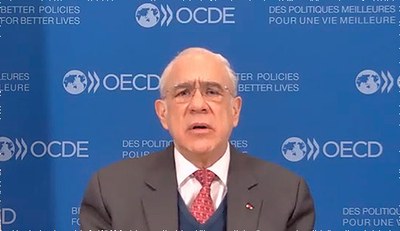
<td><span class="discreet">Angel Gurría, OECD secretary-general, during his presentation at the meeting</span></td>
</tr>
</tbody>
</table>
<p>Although not yet a member of the <a class="external-link" href="http://www.oecd.org/">Organisation for Economic Co-operation and Development (OECD)</a>, Brazil is like a "family member" and partnerships with Brazilian institutions allow the organization to work with and for the country in building a more inclusive and resilient society, said the secretary-general <a class="external-link" href="https://www.oecd.org/about/secretary-general/">Angel Gurría</a> during his participation in the online meeting "OECD and USP: Reconfiguring the World from Knowledge," on May 6.</p>
<p>Among the OECD partner countries, Brazil is the one that has made the most of this relationship and has invested in several areas of public policies to approach the organization's standards, according to Gurría. As an example, he cited a project launched in October that is helping to align Brazilian policies with OECD's environmental criteria.</p>
<p>The online meeting with Gurría, who will leave the OECD later this month after three consecutive five-year terms, celebrated the beginning of cooperation between the organization and USP. He will soon become an IEA researcher. In addition to the secretary-general, the Brazilian delegate with international economic organizations headquartered in Paris, ambassador <a class="external-link" href="http://agenciabrasil.ebc.com.br/en/internacional/noticia/2018-02/brazil-intensifies-talks-paris-join-oecd">Carlos Márcio Cozendey</a>, and the president of USP, Vahan Agopyan, gave presentations. Mediation was provided by the general coordinator of the International Economic Analysis Group (GACINT) of USP's Institute of International Relations (IRI), Alberto Pfeifer.</p>
<p><a href="https://www.iea.usp.br/en/iea/organization/direction" class="external-link">Guilherme Ary Plonski</a>, director of the IEA, opened the event by pointing out that the cooperation between USP and the OECD is based on the common concern of both institutions in promoting the production of knowledge "to move towards a prosperous human society in harmony with nature."</p>
<p>He highlighted the significance of OECD's slogan "Better Policies for Better Lives" and the organization's concern with formulating international evidence-based references in order to find solutions to economic, social, and environmental challenges.</p>
<p>"The IEA is available to collaborate in the production of knowledge based on this cooperation and to contribute to the initiatives for Brazil to become a member of the organization," he said.</p>
<table class="tabela-esquerda-300">
<tbody>
<tr>
<th><img src="https://www.iea.usp.br/imagens/carlos-marcio-conzenday-6-5-2021" alt="Carlos Márcio Cozendey - 6/5/2021" class="image-inline" title="Carlos Márcio Cozendey - 6/5/2021" /><br /><span class="discreet">Ambassador Carlos Márcio Cozendey</span></th>
</tr>
</tbody>
</table>
<p>"Even though not being a member of the organization, Brazil participates in almost all committees and working groups, and has already adhered to 99 OECD recommendations, according to Cozendey. "The country is interested in becoming a member to participate in all dimensions of the OECD, exchange experiences, and present public policies."</p>
<p>The partnership is part of this exchange of policy formulations, said the ambassador: "Having the University to establish and follow the interaction between public policies in Brazil and the OECD recommendations is an input for the organization's recommendations to also reflect the Brazilian reality."</p>
<p>For Agopyan, the internationalization present in the cooperation is a tool for USP to improve its levels of quality, "an essential search for all research universities."</p>
<p>In this century, all research universities seek to have ever greater interaction with society, he said. "USP is also doing this and it is natural that, for this purpose, universities seek partnerships with governments, entities, and international groups."</p>
<p>In June, at a meeting in Switzerland, Agopyan will defend the idea that universities are reliable sources of public policy. "If the OECD is concerned about this, USP and other research universities are at the disposal of the organization and national governments to develop proposals for public policies to be used by governments," concluded the president.</p>
<p><strong>Effects of the pandemic</strong></p>
<p>In his brief presentation followed by answers to questions from guests, Gurría commented that the COVID-19 pandemic reversed all the economic recovery achieved after the crisis that started in 2008, "but the prospects are improving and we expect a global economic growth of 5.6 %, with economy returning to pre-pandemic levels by the middle of this year." However, he warned that this projection depends on the rate of vaccination and the eventual spread of variants of the virus.</p>
<p>"Brazil was recovering from a recession when the pandemic a second recession came. The economic measures adopted by the government, such as emergency aid, supported millions of vulnerable families. Without these measures, the economic contraction would be even greater and the recovery in 2021 much slower than the projected GDP growth of 3.7%."</p>
<p>However, he stressed that the recovery must be guided by more just and sustainable growth. To that end, Gurría defended three lines of action, the first of which is to increase the effectiveness of social benefits to strengthen the population's first line of defense against economic shocks. "If well oriented, Brazil's conditional cash transfer system could be converted into a real social safety network," he said.</p>
<p>The second recommendation is to support professional qualification in order to allow workers to switch their jobs to better ones and for entrepreneurs to end unproductive and polluting activities. "In the long run, improving the quality and equity of vocational training reduces inequalities and poverty," according to the secretary-general.</p>
<p>His third suggestion is to link economic recovery measures to the sustainability agenda. "The most urgent task now is to vaccinate people quickly and protect us from further outbreaks of COVID-19, but the intergenerational commitment is to protect the planet," she said. For Gurría, the fact that the Amazon rainforest is the largest reserve of biodiversity in the world and 60% of it is in Brazil, makes the country a leader for the reshaping and reconstruction of the global economy in a more resilient way.</p>
<p><strong>Continuity and relations</strong></p>
<p>The questions from the guests to Gurría addressed the continuity of programs implemented in his management, mainly those related to environment and education, the organization's relationship with sub and supranational organizations, and prospects for Brazil's entry into the OECD.</p>
<table class="tabela-direita-300">
<tbody>
<tr>
<th><img src="https://www.iea.usp.br/imagens/vahan-agopyan-6-5-2021" alt="Vahan Agopyan - 6/5/2021" class="image-inline" title="Vahan Agopyan - 6/5/2021" /></th>
</tr>
<tr>
<td><span class="discreet">Vahan Agopyan, president of USP</span></td>
</tr>
</tbody>
</table>
<p>Jacques Marcovitch, former president of USP and former director of the IEA, asked whether OECD's emphasis on environmental issues will continue and what the weight of the environmental issue will be for Brazil's intentions to become one of the organization's members.</p>
<p>"Gurría said that the future secretary-general, a former finance minister in Australia, assured member countries that the OECD will continue its environmental policies. As for joining the organization, he said that Brazil has a huge advantage over the other five current candidates (Argentina, Peru, Romania, Croatia, and Bulgaria): "Brazil is already in the family, like a cousin who is already in the kitchen of the organization, because instead of waiting to be accepted, the work with the OECD has already started."</p>
<p>Cláudia Costin, a member of IEA's <a href="https://www.iea.usp.br/en/iea/organization/board" class="external-link">Board</a> and director of the Center for Excellence and Innovation in Education at the Getulio Vargas Foundation (FGV), expressed concern about the continuity in the new management of education programs, such as the Programme for International Student Assessment (PISA). There is no risk of interruption, according to Gurría: "The PISA is a brand of the organization and will constantly evolve. It is becoming not only a reference, but also an instrument for comparison and ranking, not to indicate who is better or worse, but to measure the fundamental issues, and indicate what is good or bad and what can be improved."</p>
<p>"Still in the field of education, <a href="https://www.iea.usp.br/en/iea/organization/direction" class="external-link">Roseli de Deus Lopes</a>, deputy director of the IEA, wanted to know what the OECD recommendations for Brazil are, since recent evaluations indicate a drop in school performance and greater inequality in education. The secretary-general argued that something very important is the acquisition of digital skills by young people. "We know that the future will be much more digital because we had to act almost entirely digitally due to the pandemic. To be able to reintegrate into the labour market, it is necessary to have digital competence, but only 50% of the countries' workforce has ability to act in a technological environment."</p>
<p>Vinicius Mota, editor in chief of the newspaper <i>Folha de S.Paulo</i>, asked if threats to democracy in Brazil could weigh on OECD's decision to accept the country as a member. Gurría said that problems with the quality of democracy are not on the agenda in relation to Brazil's entry. "I do not know anyone who says that Brazil is not a democracy. That is the great advantage of the country: to be recognized as a democracy". Problems with democracy "are no one's monopoly," he emphasized, recalling recent changes in electoral legislation in Georgia, USA, which make it difficult for some publics to participate in the local elections.</p>
<p>"The director of IRI, Janina Onuki, wanted to know what benefits can be expected from OECD partnerships with subnational governments, as in the case of the government of the state of São Paulo. These partnerships are increasingly important, said Gurría, "because everything is happening at the local level and it is necessary to go where the action takes place." He added that the OECD works with many states, provinces, and cities in many countries. "The world today is urbanized. Countries like Mexico and Brazil have become urban without becoming rich and all the problems arising from the growth of cities have arisen."</p>
<p>The relationship between the OECD and the World Trade Organization (WTO) was the subject of the question by USP professor emeritus <a href="https://www.iea.usp.br/en/persons/researchers/celso-lafer" class="external-link">Celso Lafer</a>, another member of IEA's Board and former Minister of Foreign Affairs. For the secretary-general, the organizations complement each other: "Although the WTO has a lot of technical capacity to deal with problems of jurisdictional systems and conflicts of interest, it does not have the technical capacity to carry out analyzes and comparisons, leading to the extraction of information for public policies."</p>
<p>"For him, there is a methodological problem, as the OECD has 37 members (soon 38 with the entry of Costa Rica) <span>and the WTO has 200 countries. "We work with almost every UN body. They know that we have 37 members, but they do not come to us for the sake of universality, yet rather because of the globalizing impact of the OECD recommendations."</span></p>
<p style="text-align: right; "><span class="discreet">Photos: IEA-USP</span></p>]]></content:encoded>
    <dc:publisher>No publisher</dc:publisher>
    <dc:creator>Richard Meckien</dc:creator>
    <dc:rights>Original version in Portuguese by Mauro Bellesa.</dc:rights>
    
      <dc:subject>Sustainable development</dc:subject>
    
    
      <dc:subject>International Cooperation</dc:subject>
    
    
      <dc:subject>Economic development</dc:subject>
    
    
      <dc:subject>Public Policies</dc:subject>
    
    
      <dc:subject>Environment</dc:subject>
    
    
      <dc:subject>OECD</dc:subject>
    
    
      <dc:subject>USP</dc:subject>
    
    
      <dc:subject>Event</dc:subject>
    
    <dc:date>2021-05-07T16:00:00Z</dc:date>
    <dc:type>News Item</dc:type>
  </item>


  <item rdf:about="https://www.iea.usp.br/en/news/journal-95">
    <title>"Estudos Avançados" #95 addresses the future of universities, and urban and environmental degradation</title>
    <link>https://www.iea.usp.br/en/news/journal-95</link>
    <description></description>
    <content:encoded xmlns:content="http://purl.org/rss/1.0/modules/content/"><![CDATA[<p><img src="https://www.iea.usp.br/imagens/capa-da-revistas-estudos-avancados-95" alt="Capa da revista 'Estudos Avançados' 95" class="image-right" title="Capa da revista 'Estudos Avançados' 95" /></p>
<p>In addition to perspectives for universities, and urban and environmental concerns, the 95th issue of IEA's journal "<a href="https://www.iea.usp.br/en/journal/about-estudos-avancados" class="external-link">Estudos Avançados</a>," launched this month, also discusses the judicialization of health and the precautionary principle. According to editor Alfredo Bosi, "the current primacy of technology is one of the transversal themes that bring together articles about so diverse objects."</p>
<p>The issue also contains reviews of eight books on visual arts, literature, political science, economics, and globalization.</p>
<p>The opening section has "University" as theme and features an article by former president of USP Jacques Marcovitch. The professor, who has also been director of the IEA, analyzes three aspects: the Academic Performance and Evaluations <span>project</span>, coordinated by him; the transformations undergone by academic institutions; and the challenge of proposals that in his view would disqualify public universities, such as the implementation of tuition fees.</p>
<p>The need for universitary adaptation to a new reality dominated by information networks is analyzed by <a href="https://www.iea.usp.br/en/persons/researchers/luiz-bevilacqua" class="external-link">Luiz Bevilacqua</a>, a visiting professor at the IEA from 2017 to 2018, in the article "The Last Train to Alexandria".</p>
<p>The articles that are specifically focused on USP present studies conducted by researchers Ricardo Terra and Carlota Boto. While Terra brings up<span> a self-reflection on the institution, including its f</span><span>inancial imbalance, missions and overall evaluation, Boto shows how the concept and the project of USP appeared in the discourse and in the actions of <span>intellectuals in </span>São Paulo and abroad in the early 1930s.</span></p>
<p><strong>City and Environment</strong></p>
<p>The urban degradation of large cities and the deforestation of vast regions in Brazil are two of the addressed themes in this section. Bosi emphasizes the conflict between defenders of a more humane style of housing and the "violent deterioration of the space where the lower-middle class neighborhoods and the slums on the periphery of large cities are examples and victims," as discussed in the articles "End of Utopias, The City of São Paulo and the Discussion of Contemporary Urbanism," by urban planner Antonio Claudio Pinto da Fonseca and historian Carlos Guilherme Mota, and "The Conflict of Space: The Tense Port-City Relationship in Urban Planning," by João Mendes Rocha, a specialist in public policy and government management.</p>
<p>Regarding the articles on environmentalism, the editor highlights the concern with "economic interests that promote the wild deforestation," remembering that "after a short period of relative control, the anti-ecological threat that reaches entire regions of the Amazon and the Northeast has returned." The theme is present in "Territories and Political Alliances of Post-Environmentalism," by experts from various institutions, and "Characteristics and Provenance of Firewood Used for Cooking in Brazil<span>," by Adriana Gioda.</span></p>
<p>The other two sections are "Health," with two articles, and "The Precautionary Principle," with three collaborations. The first two texts discuss the guidelines of the National Council of Justice for the action of law professionals in the realization of the right to health, and techniques of welfare coaching in the change of lifestyle in the public health system.</p>
<p>In the article "The Adoption of Precautionary Measures Against Risks in the Use of Technoscientific Innovations," philosopher <a href="https://www.iea.usp.br/en/persons/visiting-professors/hugh-matthew-lacey" class="external-link">Hugh Lacey</a>, a former visiting professor at the IEA and current member of the research group <a href="https://www.iea.usp.br/en/research/research-groups/philosophy-history-sociology-of-science-and-technology" class="external-link">Philosophy, History, and Sociology of Science and Technology</a>, discusses the responsibilities of scientists and institutions in conducting the research needed to inform precautionary measures. Lacey's text is accompanied by two articles by other researchers: one revises the precautionary principle in the Brazilian legal system to international agreements while the other discusses the main arguments involved in the scientific debate on the principle of substantial equivalence, which states that genetically modified organisms, popularly known as transgenic, are chemically equivalent to organisms selected by traditional breeding techniques and thus would not require <span>additional</span> toxicological studies.</p>
<p>The list below contains the names of the authors who have contributed with each one of the addressed themes:</p>
<p><strong>Leading Article</strong></p>
<p dir="ltr"><i><i>Alfredo Bos</i>i</i></p>
<p><strong>University</strong></p>
<p dir="ltr"><i><i><i>Jacques Marcovitch<br /></i></i><i>Carlota Boto<br /><i>Ricardo Terra<br /><i>Luiz Bevilacqua</i></i></i></i></p>
<p><strong>City and Environment</strong></p>
<p dir="ltr"><i><i>Roberto Araújo, Ima Célia Guimarães Vieira, Peter Mann de Toledo, Andréa dos Santos Coelho, Eloi Dalla-Nora and Felipe Milanez</i><br /></i><i><i>João Mendes Rocha</i><br /></i><i><i>Thais da Silva Chedid and Edmilson Moutinho dos Santos</i><br /><i>Adriana Gioda<br /><i>Ranulfo Paiva Sobrinho, Junior Ruiz Garcia, Alexandre Gori Maia and Ademar Ribeiro Romero<br /><i>Candido Malta Campos<br /><i>Antonio Claudio Pinto da Fonseca and Carlos Guilherme Mota<br /><i>Marcos Cesar Weiss</i></i></i></i></i></i></p>
<p dir="ltr"><span><strong>Health</strong></span></p>
<p><i><i><i><i><i><i>Aline Marques, Carlos Rocha, Felipe Asensi and Diego Machado Monnerat</i><br /><i>Luciana Oquendo Pereira-Lancha, Danielle Kallas, Paula Helena Dayan and Antonio Herbert Lancha Jr.</i></i></i></i></i></i></p>
<p dir="ltr"><strong>The Precautionary Principle</strong></p>
<p><i><i>Hugh Lacey</i><br /><i>Fernanda Viegas Reichardt and Mayara Regina Araújo dos Santos<br /><i>Luciana Zaterka</i></i></i></p>
<ul>
</ul>
<p><strong>Reviews</strong></p>
<p><i><i><i><i><i><i>Leonardo Octavio Belinelli de Brito</i></i><br /><i><i>André Roncaglia de Carvalho</i><br /><i><i>Fabio Mascaro Querido<br /></i></i></i></i></i></i></i><i>Ricardo Ohtake<br /></i><i>Flávia Amparo<br /></i><i>Marcos Antonio de Moraes<br /></i><i>Ana Luiza Martins<br /></i><i>José Augusto Ribas Miranda</i></p>]]></content:encoded>
    <dc:publisher>No publisher</dc:publisher>
    <dc:creator>Richard Meckien</dc:creator>
    <dc:rights>Original version in Portuguese by Mauro Bellesa.</dc:rights>
    
      <dc:subject>University</dc:subject>
    
    
      <dc:subject>Journal</dc:subject>
    
    
      <dc:subject>Environment</dc:subject>
    
    
      <dc:subject>Sustainability</dc:subject>
    
    
      <dc:subject>USP</dc:subject>
    
    
      <dc:subject>Cities</dc:subject>
    
    
      <dc:subject>Public Health</dc:subject>
    
    <dc:date>2019-04-10T15:55:00Z</dc:date>
    <dc:type>News Item</dc:type>
  </item>


  <item rdf:about="https://www.iea.usp.br/en/news/project-analyzes-the-impact-of-rankings-in-brazilian%20research-universities">
    <title>Project analyzes the impact of rankings in Brazilian research universities</title>
    <link>https://www.iea.usp.br/en/news/project-analyzes-the-impact-of-rankings-in-brazilian%20research-universities</link>
    <description></description>
    <content:encoded xmlns:content="http://purl.org/rss/1.0/modules/content/"><![CDATA[<table class="tabela-direita-300-borda">
<tbody>
<tr>
<td>
<p><img src="https://www.iea.usp.br/imagens/gladys-beatriz-barreyro-2018" alt="Gladys Beatriz Barreyro - 2018" class="image-inline" title="Gladys Beatriz Barreyro - 2018" /></p>
<p><i>In addition to being a professor at EACH-USP, Barreyro also works in two postgraduate programs at the University: Education and Integration in Latin America. Her main research focus is on policies and evaluation of higher education at the global, regional and national scales.</i></p>
</td>
</tr>
</tbody>
</table>
<p><span>In these first decades of the 21st century, there is a phase within the process of globalization in which national states are increasingly less autonomous towards other institutions that make up the global governance of higher education, such as the World Trade Organization (WTO,) the Organisation for Economic Co-operation and Development (OECD,) the World Bank, UNESCO, NGOs and various foundations.</span></p>
<p><span> </span>This evaluation belongs to educator <a href="https://www.iea.usp.br/en/persons/researchers/gladys-barreyro" class="external-link">Gladys Beatriz Barreyro</a>, a professor at USP's School of Arts, Sciences and Humanities (EACH,) and currently a participant of IEA's <a href="https://www.iea.usp.br/en/persons/sabbatical/sabbatical-professors" class="external-link">Sabbatical Year Program</a>. She is developing a study on the impact of international university rankings on the institutional identity, and teaching, research and extension purposes of Brazilian research universities, having USP and UNICAMP as references.</p>
<p><span>Entitled "Internationalization of Higher Education: Use of Rankings," the research project aims to reduce the lack of studies on the subject in Brazil and disseminate the international literature on it.</span></p>
<p><span>Among the educational policies of this phase of globalization, Barreyro identifies the emergence of international university rankings as a new way of dealing with quality on a global scale <span>in the first decade of the century</span>, impacting regional and national scales. There is also a role model of the "world-class university," institutions dedicated to "applied and (if possible) profitable research."</span></p>
<p><span><span>For her, rankings have introduced the logic of competition between institutions in a global perspective and generated impacts on national and institutional policies, "despite their methodological limitations."</span></span></p>
<p>Part of the project was developed in the first half of this year, when she was at the IEA on sabbatical leave. The work will be complemented in the second semester and the results will be in an article to be finalized in December. She also intends to present them at a public event.</p>
<p><span>As it is an exploratory research, Barreyro is analyzing the material published by USP's Journal and UNICAMP's Portal from 2013 to 2017 on the positions occupied by both universities in the rankings. From this examination she will try to answer four questions:</span></p>
<p><span> </span></p>
<ul>
<li>What is the use of the rankings at USP and Unicamp, and for what reasons?</li>
<li>What changes <span>in the identity and policies of these institutions</span> have been produced by the use of these rankings, and what are the justifications for it?</li>
<li>If institutional policies based on rankings have emerged, what are they?</li>
<li>If the rankings are affecting the purposes of teaching, research and extension of both universities, what are the <span>affected</span> aspects?</li>
</ul>
<p> </p>
<p><span>The material is being studied from the critical analysis of the discourse oriented by categories, to be detected in the course of examining the texts.</span></p>
<p>In parallel to the survey and analysis of the materials published by the media of both universities, Barreyro has been dedicating to two complementary activities: the bibliographic review on international rankings in national and international literature, and on world-class universities; and the systematization of the place occupied by both institutions in international and Latin American rankings, and in the list of BRIC universities.</p>
<table class="tabela-esquerda-200-borda">
<tbody>
<tr>
<td>
<h3><i>Evaluation trend </i></h3>
<p><i>The March issue of UNICAMP's journal on higher education evaluation ("<i>Revista de Avaliação do Ensino Superior"</i>) published the article "<a class="external-link" href="http://www.scielo.br/scielo.php?script=sci_arttext&amp;pid=S1414-40772018000100005&amp;lng=en&amp;nrm=iso&amp;tlng=pt">Global higher education evaluation: on accreditation, rankings and learning outcomes</a>," by Gladys Beatriz Barreyro.</i></p>
<p><i>Abstract in English. Complete material available in Portuguese only.</i></p>
</td>
</tr>
</tbody>
</table>
<p><strong>Globalization</strong></p>
<p>In the final decades of the 20th century, the impact of globalization on educational policies began, creating an internationally structured agenda for the area, according to the researcher. "In the national education systems, there was concern about evaluation. In the case of higher education in the 1980s, policies to measure its quality began, initiating the first phase of the 'Evaluating State,' an expression coined by British sociologist Guy Neave in 2012."</p>
<p><span>She states that the reduction of expenditures since the 1980s, due to the crisis of the welfare state, "have motivated the adoption of accountability policies, such as evaluations in national education systems started in the 1980s and 1990s in Latin America, stemming from neoliberal reforms."</span></p>
<p>Two other aspects of globalization have influenced vocational training, according to Barreyro: the processes of flexible accumulation (also called toyotism, which provides for flexibilization of production according to demand) and the emergence of the knowledge society. "They have resulted in the need to train professionals for the so-called knowledge economy," which "put higher education in the spotlight."</p>
<p>"Once considered a public good for the purpose of reproducing values and training human resources, higher education has become a private good, a commodity subject to the rules of commerce," says the researcher. She highlights the contributions to that change provided by the General Agreement on Tariffs and Trade (GATT,) which was in force until 1994, and by the World Trade Organization negotiations for the inclusion of education in the liberalization of trade in goods and services.</p>
<p><span>The international movement of professionals in the face of globalization, centered not on brain drain but on competition for them, is another feature of the process, according to Barreyro. On this competition, she cites the evaluation of two authors, Rahul Choudana and Hans de Wit, who assert that the knowledge economies of the OECD countries require highly qualified professionals and must resort to immigrants with this profile, since their population is aging and has diminished the interest of their young people in the hard sciences.</span></p>
<p>In the global education agenda, quality and its assessment are one of the political priorities, says Barreyro. "In higher education, quality assessment began to be developed in the 1980s and 1990s in European and Latin American countries with the creation of accreditation systems and agencies." She says that these countries have transformed the US accreditation model - "regardless of government" - in the so-called Evaluating State, mentioned by Guy Neave.</p>
<p>Later, these national policies became of concern at the global level, which "establishes relations of scale with the national and regional levels." According to her, Portuguese education sociologist Almerindo Janela Afonso sees a later stage, called by him "Post-<span>Evaluating State,</span>" in which the decision is increasingly shunned by the decision of the national states, especially in the peripheral countries.</p>]]></content:encoded>
    <dc:publisher>No publisher</dc:publisher>
    <dc:creator>Richard Meckien</dc:creator>
    <dc:rights>Original version in Portuguese by Mauro Bellesa.</dc:rights>
    
      <dc:subject>Higher Education</dc:subject>
    
    
      <dc:subject>University</dc:subject>
    
    
      <dc:subject>Globalization</dc:subject>
    
    
      <dc:subject>Sabbatical</dc:subject>
    
    
      <dc:subject>USP</dc:subject>
    
    
      <dc:subject>Education</dc:subject>
    
    <dc:date>2018-06-28T12:15:00Z</dc:date>
    <dc:type>News Item</dc:type>
  </item>


  <item rdf:about="https://www.iea.usp.br/en/news/study-group-will-present-proposals-for-the-usp-of-the-21st-century">
    <title>New study group will present proposals for the 21st-century USP</title>
    <link>https://www.iea.usp.br/en/news/study-group-will-present-proposals-for-the-usp-of-the-21st-century</link>
    <description></description>
    <content:encoded xmlns:content="http://purl.org/rss/1.0/modules/content/"><![CDATA[<table class="tabela-direita-400">
<tbody>
<tr>
<th><img src="https://www.iea.usp.br/imagens/reitoria" alt="Reitoria" class="image-inline" title="Reitoria" /></th>
</tr>
<tr>
<td><strong><span>Undergraduate courses at USP must undergo an academic and organizational transition, according the study group</span></strong></td>
</tr>
</tbody>
</table>
<p>"The advance of knowledge in recent decades has accelerated in such a way that it has generated a true cultural shock: one becomes aware of its impact after it has already happened and gone," says the coordinator of the Study Group "USP facing the challenges of the 21st century," <a href="https://www.iea.usp.br/en/news/luiz-bevilacqua-new-iea-visiting-professor" class="external-link">Luiz Bevilacqua</a>, a visiting professor at the IEA and former president of the ABC Federal University.</p>
<p>He believes there has never been a time like the present. "There is no prior experience, and there are no models or ready and unique solutions." And the university is not immune to this process: "Being a traditionally conservative institution, USP is subject to grave perplexities, which block the actions that are necessary to survive this shock wave."</p>
<p>Acting properly is an unquestionable need, according to Bevilacqua. "Given the uncertainties of the future, the best strategy is to loosen the ties, flexibilize, and broaden the spectrum of influences on university identity."</p>
<p>To survive the cultural shock it is indispensable to take risks, says the researcher. "It is within this framework that we intend to propose some changes that facilitate the passage through the turmoil of our times." Created at the end of 2007, the group is taking care to limit itself to plausible ("but not inconclusive") proposals, conscious of the "conservatism which imprisons Brazilian universities," according to Bevilacqua.</p>
<p>In his assessment, it is essential to reform undergraduate courses: "They need to undergo an academic and organizational transition. The idea is to offer them in interdisciplinary centers, new units structured from the thematic axes resulting from the convergence and articulation of the classic disciplines.</p>
<p>For the group, postgraduation and research already absorb the various forms of disciplinary convergence without difficulty, but the organization of undergraduation "remains petrified in the form of departments that often no longer respond to current challenges." The objective is to propose actions that allow the academic and administrative restructuring of USP, so the demands of higher education of this century can be met.</p>
<p>"It is necessary to reorganize the main themes, showing the interrelation between them, which was conquered with the recent scientific and technological development." In addition, undergraduation should be directed to the formation of people "with intellectual independence and low aversion to risks, so that the university is a place where learning prevails over teaching."</p>
<p>These changes should not only address the restructuring needs of academic management for professional training purposes. The group see this undergraduation reform as one of the components of a broad framework of changes that Brazilian universities must undergo in order to survive the radical changes that are underway, and continue to contribute to the development of the country.</p>
<p>Based on the identification of the obstacles that make it difficult for the institution to reform, the intention of the researchers is to find the solutions with greater viability - and less internal resistance - that can eliminate or circumvent them. The proposals will be discussed with various sectors of USP and forwarded to the pertinent instances.</p>
<p>The work has been developed in six modules:</p>
<ul>
<li>Cultural context of the 21st century: the cultural shock wave era</li>
<li>International context - Impact on higher education</li>
<li>Historical aspects of the Brazilian university</li>
<li> The Brazilian university in face of the challenges of the 21st century</li>
<li>Critical points of the Brazilian university and USP in particular</li>
<li>Desirable, plausible and feasible proposals</li>
</ul>
<p> </p>
<table class="tabela-esquerda-300">
<tbody>
<tr>
<th><img src="https://www.iea.usp.br/imagens/luiz-bevilacqua-5" alt="Luiz Bevilacqua - 5" class="image-inline" title="Luiz Bevilacqua - 5" /></th>
</tr>
<tr>
<td><strong>Luiz Bevilacqua: "At university, learning must prevail over teaching"</strong></td>
</tr>
</tbody>
</table>
<p>In addition to Bevilacqua, other members of the study group are: <a href="https://www.iea.usp.br/en/persons/researchers/arlindo-philippi" class="external-link">Arlindo Philippi Jr.</a>, from USP's School of Public Health (FSP), Carlos Alberto Barbosa Dantas and Henrique von Dreifus, both from USP's Institute of Mathematics and Statistics (IME), Elizabeth Balbachevsky, from USP's Faculty of Philosophy, Languages and Literature, and Human Sciences (FFLCH), <a href="https://www.iea.usp.br/en/persons/researchers/eugenio-bucci-1" class="external-link">Eugênio Bucci</a>, from USP's School of Communications and Arts (ECA), <a href="https://www.iea.usp.br/en/persons/researchers/guilherme-plonski" class="external-link">Guilherme Ary Plonski</a>, deputy director of the IEA, and a professor at USP's Polytechnic School (POLI) and at USP's Faculty of Economics, Administration and Accounting (FEA), <a href="https://www.iea.usp.br/en/persons/researchers/naomar-filho" class="external-link">Naomar de Almeida Filho</a>, former president of UFBA and UFSB, <a href="https://www.iea.usp.br/en/persons/researchers/paulo-saldiva" class="external-link">Paulo Saldiva</a>, director of the IEA and a professor at USP's School of Medicine (FM), and Roseli de Deus Lopes, a professor at POLI.</p>
<p> </p>
<p><strong>International context</strong></p>
<p>According to the coordinator, although the academic world is partially responsible for the cultural revolution brought by digital technologies, universities do not evolve in the same speed as the contemporary context.</p>
<p>"Only three decades separate the invention of the world wide web and the virtually universal use of digital communication." For him, the speed of transformation reveals that it is not one more common evolutionary process, but a "shock wave" with the resulting discontinuity.</p>
<p>"It is clear that we are not facing a rapid evolution, but a leap into the future, in which sociocultural transformations also take place rapidly, which makes universities subject to discontinuity as well."</p>
<p>Another aspect of worldwide scope to be considered is the globalization-polarization dynamics of today, which "affects the evolution of scientific, technological, social and artistic ways," says Bevilacqua.</p>
<p>He points out that the main economic blocs have been promoting innovations in higher education, aiming to maintain leadership in scientific and technological production." Since 1999, the European Union has implemented a common model of curricular architecture, creating a network of cooperation between the countries that came to be known with the Bologna Process. The USA government and scientific organizations have recently launched several major university reform initiatives, especially at research universities. It is also necessary to consider the challenges that transnational university networks bring to national higher education systems in countries such as Brazil."</p>
<p>The huge contingent of Brazilians seeking access to higher education makes the country the target of initiatives that treat higher education as a business opportunity, he says. "This makes education a major national strategic issue. This framework has to be taken into account when planning the direction of university education, with academia taking a more proactive rather than responsive role."</p>
<p>The group believes that internationalization in the industry will influence interaction with the business sector in general and industry in particular, forcing the university to leave its walls and discuss the priorities of national development policy with government and business.</p>
<p>USP also needs to be more present in decision-making positions in international education institutions and organizations, as well as offer more programs that are capable of attracting students from all over the world, researchers argue. This presence must be accompanied by larger commitments for the expansion of technical, scientific and social exchange, and the mobility of human resources. This "requires a change of attitude that is not always considered."</p>
<p>"The external mobility of professors and students is intensifying. For the process to be effective, we must also stimulate internal mobility, still incipient in our universities."</p>
<p><strong>Challenging projects</strong></p>
<p>Brazilian universities have evolved faster than the industrial sector and this causes an imbalance between supply and demand of qualified personnel, particularly of masters and doctors, stresses the coordinator. "It is therefore urgent to revise the State's economic-industrial development policy in order to allow the original technological advances to be achieved and new horizons for graduate students to be opened."</p>
<p>In his opinion, USP must question the direction of state and federal development policies, which currently bring difficulties for graduates: "We should approach representative bodies of the business sector, and representatives of the Legislative and Executive Powers to formulate policies stimulating national development from major challenging projects."</p>
<p>"USP needs to be involved in this dimension of development policy for its own survival and for the good of its students." He emphasizes that it is also necessary to follow this line of action in relation to the social and human sciences by stimulating cultural projects.</p>
<p>The classification of universities by performance as a reference for priorities and investments is another issue to be analyzed. This can not be done without careful critique of the evaluation criteria, according to Bevilacqua.</p>
<p>"USP must interact with the State to discuss these criteria and standards of performance measurement. In addition, when analyzing the procedures of the various agencies, it must check how they interfere in its internal policy."</p>
<div id="_mcePaste"></div>]]></content:encoded>
    <dc:publisher>No publisher</dc:publisher>
    <dc:creator>Richard Meckien</dc:creator>
    <dc:rights>Original version in Portuguese by Mauro Bellesa.</dc:rights>
    
      <dc:subject>Study group</dc:subject>
    
    
      <dc:subject>Higher Education</dc:subject>
    
    
      <dc:subject>Interdisciplinarity</dc:subject>
    
    
      <dc:subject>University</dc:subject>
    
    
      <dc:subject>USP</dc:subject>
    
    
      <dc:subject>Visiting Professors</dc:subject>
    
    
      <dc:subject>Event</dc:subject>
    
    <dc:date>2018-04-19T15:20:00Z</dc:date>
    <dc:type>News Item</dc:type>
  </item>


  <item rdf:about="https://www.iea.usp.br/en/news/french-brazilian-conference">
    <title>IEA holds a conference on the influences of French researchers at USP</title>
    <link>https://www.iea.usp.br/en/news/french-brazilian-conference</link>
    <description></description>
    <content:encoded xmlns:content="http://purl.org/rss/1.0/modules/content/"><![CDATA[<p><span id="docs-internal-guid-0903fcba-bc3b-c36f-cf33-5fabf9a0d73d"> </span></p>
<p dir="ltr">In 1934, the University of São Paulo was created from the union of the then Faculty of Philosophy, Sciences, <span>and Languages and Literature (FFCL) - founded at that time - with the Polytechnic School of São Paulo, the Luiz de Queiroz College of Agriculture (ESALQ), the School of Medicine, the Faculty of Law and the School of Pharmacy and Dentistry. The first years of formation of USP were strongly influenced by French researchers, a link which will be presented on <strong>November 27</strong>, <strong>at 9.00 am</strong>, during the French-Brazilian Conference.</span></p>
<p dir="ltr">Organized by <a href="https://www.iea.usp.br/en/research/research-groups/brazil-france" class="external-link">IEA's Brazil-France Research Group</a> and the <a class="external-link" href="http://www.institutdesameriques.fr/en">Institut des Amériques</a>, the event will feature panels on medicine and biology, humanities and social sciences. In addition to the legacy of USP's initial period, later and current experiences will also be presented. One of the sessions will discuss the French presence in the FFCL, as was the case of professor Roger Bastide and geographer Pierre Monbeig, both important figures in the founding of the Faculty.</p>
<p dir="ltr">Another example of how the Brazil-France relationship will be presented is the speech of physician Jorge Kalil on medical science and biomedical research. A professor at USP's School of Medicine, he will report on his experience during a visit to the Institute of Blood Diseases at the Saint Louis Hospital in Paris, where he undertook a doctorate research under the guidance of Jean Dausset, a Nobel Prize winner in Medicine. Kalil will also present the context in which the Brazilian Association of Organ Transplantation has emerged, making Brazil the second country in transplant numbers in the world. Another important influence of French science in Brazil was the creation of the Pasteur Institute in São Paulo, with which there was intense exchange during its almost 120 years, culminating in the installation of the representation of the Institute at USP. This exchange has also influenced the creation of the Butantan Institute, of which Kalil has been director.</p>
<p dir="ltr"><span>On this occasion, the IEA and the Institut des Amériques will sign a cooperation agreement which aims to establish communication channels, exchanges of scientific and cultural knowledge, and stimulate research and training activities. The idealization of joint research projects and the facilitation of exchanges between researchers, doctoral students and post-doctoral students are also among the objectives of the agreement.</span></p>
<div></div>]]></content:encoded>
    <dc:publisher>No publisher</dc:publisher>
    <dc:creator>Richard Meckien</dc:creator>
    <dc:rights>Original version in Portuguese by Vinicius Sayão.</dc:rights>
    
      <dc:subject>Research Group: Brazil-France</dc:subject>
    
    
      <dc:subject>USP</dc:subject>
    
    
      <dc:subject>France</dc:subject>
    
    <dc:date>2017-11-14T20:45:00Z</dc:date>
    <dc:type>News Item</dc:type>
  </item>


  <item rdf:about="https://www.iea.usp.br/en/news/iea-30-years-anniverary">
    <title>IEA: 30 years in line with science, culture and society</title>
    <link>https://www.iea.usp.br/en/news/iea-30-years-anniverary</link>
    <description></description>
    <content:encoded xmlns:content="http://purl.org/rss/1.0/modules/content/"><![CDATA[<table class="tabela-direita-400">
<tbody>
<tr>
<th><img src="https://www.iea.usp.br/imagens/lancarev1.jpg" alt="Lançamento da 1º edição da revista &quot;Estudos Avançados&quot; - 18/12/1987" class="image-inline" title="Lançamento da 1º edição da revista &quot;Estudos Avançados&quot; - 18/12/1987" /></th>
</tr>
<tr>
<td><strong>Alfredo Bosi (<i>left</i>), Gerhard Malnic (interviewed by Rádio USP) and José Goldemberg launching the journal <i>Estudos Avançados</i> in December, 1987.</strong></td>
</tr>
</tbody>
</table>
<p><span>The IEA celebrated the 30th anniversary of its creation, which occurred in the first year of Brazil's return to democracy, on October 29.</span></p>
<p>The Democratic Opening, final phase of the dictatorship, enabled a number of changes at USP. Professors who had been compulsorily retired by Institutional Act No. 5 in 1969 were amnestied and able to rejoin University. The Professors' Association of USP (ADUSP) was created in 1976 together with the Student Center Directory (DCE) getting reactivated. In 1979, the Employers' Association of USP (AFUSP, currently SINTUSP) started to work as a union. These three entities organized the 1st and 2nd Congresses of USP (in 1980 and 1984, respectively) in order to discuss the structure and governance of the University.</p>
<p>The IEA began its activities in this context of gradual transformation of institutions, expansion of democratic freedoms and reconstruction of the post-dictatorship Brazilian society through an order of the then rector José Goldemberg. The idea had already been discussed in various forums, such as ADUSP and the 2nd Congress of USP, and by a study group specially created for this purpose.</p>
<p>The creation of the IEA is part of a broad movement of cultural and social revitalization, as exemplified by other initiatives which arose in 1986, such as the <i>Companhia das Letras</i> publishing house, the <i>Caderno 2</i> section of the newspaper <i>O Estado de São Paulo</i>, the <i>Nova Escola</i> magazine and the SOS Atlantic Forest Foundation.</p>
<p>During these 30 years, numerous activities have been undertaken by programs, areas, projects, research groups, study groups, professors and researchers (members of research groups, visiting professors, honorary professors and professors on sabbatical).</p>
<p>International affairs, environment, education, human rights, molecular sciences, Mercosur, free trade, public health, Amazon, food security, constitutional reform, climate change, governance system, biodiversity, democracy and capital-labor relations found a favorable space for interdisciplinary debate.</p>
<table class="tabela-esquerda-400">
<tbody>
<tr>
<th><img src="https://www.iea.usp.br/imagens/noan-chonsky" alt="Noan Chonsky" class="image-inline" title="Noan Chonsky" /></th>
</tr>
<tr>
<td><strong>Noan Chonsky was one of the Institute's conferencists for its 10th anniversay in November, 1996.</strong></td>
</tr>
</tbody>
</table>
<p>The importance of the role played by the journal <i><a href="https://www.iea.usp.br/en/journal/about-estudos-avancados" class="internal-link">Estudos Avançados</a></i> throughout the history of the Institute must also be highlighted. Launched in late 1987, the publication is reaching its 88th issue and became the most consulted journal in <a class="external-link" href="http://www.scielo.org/php/index.php?lang=en">SciELO</a> (Scientific Electronic Library Online) last year.</p>
<p><strong>Current days</strong></p>
<p>To be advanced is to explore the future. That is why the Institute is always looking for new opportunities and formats for the encouragement of research and the debate of ideas.</p>
<p>In recent years, one of the guidelines has been to achieve a higher degree of internationalization. This has been possible with the establishment of the <a href="http://www.ubias.net/">UBIAS</a> network (University-Based Institutes for Advanced Study), of which the IEA is a founding member, in 2010. Currently, the Institute is one of the vice-coordinators of the network, which brings together 37 institutes of advanced studies linked to universities from all continents.</p>
<p>In April 2015 and in March 2016, the IEA and the Nagoya University's Institute for Advanced Research (IAR) held the two phases of the first edition of the <a href="http://intercontinental-academia.ubias.net/">Intercontinental Academia</a>, first joint activity between UBIAS members. 13 researchers aged under 40, and coming from different countries and areas of expertise, had a working theme ("Time") to be addressed in its various concepts in science and culture.</p>
<p>Another recent initiative was the implementation of the 2016 Sabbatical Year Program, through which USP researchers can leave their usual activities in their units of origin to devote themselves to a specific project at the Institute for six months or a year.</p>
<p>Also this year, the <a href="https://www.iea.usp.br/en/research/chairs/olavo-setubal-chair-of-arts-culture-and-science" class="external-link">Olavo Setubal Chair of Arts, Culture and Science</a>, sponsored by the Itaú Cultural Institute, was inaugurated. Its first occupant is sociologist and philosopher Sergio Paulo Rouanet.</p>
<p>However, as recalled by the director of the Institute, Paulo Saldiva, "when speaking of the IEA's challenges we are speaking of the University's challenges." For him, in addition to dialogue with society, there is a natural challenge to "produce better quality knowledge, combat fundamentalisms of any kind and try to solve complex problems by questioning in all areas of knowledge."</p>
<p>With these goals in mind, the IEA has added <span>four new thematic programmes </span>to the agenda of the year of its 30th anniversary.</p>
<p>The first one is the <a href="https://www.iea.usp.br/en/news/scientific-look-at-the-complexity-of-sao-paulo" class="external-link">USP Global Cities Program</a>, already underway and which aims to bring together researchers of the university that can contribute to improving the quality of life in metropolitan areas, with the initial focus on São Paulo.</p>
<p>The Advanced Seminar of Policy Leadership Formation should be launched in early 2017 with the intention of collaborating with the preparation of political actors with credibility and knowledge <span>sufficient </span>to confront the critical issues in Brazilian society.</p>
<p>The third priority initiative for the 2016-2020 period is to induce discussions that make USP move from object to be transformed to the transforming agent. It is expected that the IEA becomes a reference center on processes and changing perspectives of the University, and at the same time the incubator of innovative initiatives with regard to the participation of the University in the transformation of society.</p>
<table class="tabela-direita-400">
<tbody>
<tr>
<th><img src="https://www.iea.usp.br/imagens/lancamento-do-projeto-cidades-globais" alt="Lançamento do Projeto Cidades Globais" class="image-inline" title="Lançamento do Projeto Cidades Globais" /></th>
</tr>
<tr>
<td><strong>From the left: Fábio Feldmann, Wilson Jacob Filho (USP's School of Medicine), Vahan Agopyan (vice president at USP), Fernando Haddad (mayor of São Paulo), Paulo Saldiva (director of the IEA) and Marcos Buckeridge (IEA) launching the USP Global Cities Program on July 13.</strong></td>
</tr>
</tbody>
</table>
<p>The creation of a study center on new learning methodologies geared to middle and high school is the fourth guideline. The goal is to integrate educators, professors, scientists, students, game designers and other professionals in creating more effective digital resources for the learning process of young people.</p>
<p>The IEA is always changing, and it could not be different for an institution that works with science, culture and priorities for the development of the country.</p>
<p>The achievements in 30 years are numerous and extremely diverse. They constitute a past of contributions to USP and society. The IEA is proud of everything that has been done, for in all it has pursued goals linked to perennial commitments from its foundation in 1986.</p>
<p>This consistency is the platform that enables the Institute to head to the future, a task that requires creativity, boldness and determination in line with the priorities of each moment. Because, as said by a recent winner of the Nobel Prize, "times are a-changin".</p>]]></content:encoded>
    <dc:publisher>No publisher</dc:publisher>
    <dc:creator>Richard Meckien</dc:creator>
    <dc:rights>Original version in Portuguese by Mauro Bellesa.</dc:rights>
    
      <dc:subject>IEA</dc:subject>
    
    
      <dc:subject>Institutional</dc:subject>
    
    
      <dc:subject>Ubias</dc:subject>
    
    
      <dc:subject>USP</dc:subject>
    
    <dc:date>2016-10-26T14:05:00Z</dc:date>
    <dc:type>News Item</dc:type>
  </item>


  <item rdf:about="https://www.iea.usp.br/en/news/meeting-discusses-the-development-of-drugs-and-medicines-at-usp">
    <title>Meeting discusses the development of drugs and medicines at USP</title>
    <link>https://www.iea.usp.br/en/news/meeting-discusses-the-development-of-drugs-and-medicines-at-usp</link>
    <description></description>
    <content:encoded xmlns:content="http://purl.org/rss/1.0/modules/content/"><![CDATA[<p>The development of drugs and medicines at USP will be the theme of the third strategic workshop of the Dean for Research, which takes place on <strong>December 10</strong>, <strong>from 10 am to 6 pm</strong>, in the IEA Events Room. Carried out with IEA's support, the meeting will bring together experts from the university and the private sector.</p>
<p>Divided into thematic modules, the workshop <i>Development of Drugs and Medicines at USP</i> aims, like others of the series of meetings, to stimulate reflection and dialogue around the strategic themes for research at the University of São Paulo. It also seeks to create a scientific and technological environment of collaboration between the USP community and external agents.</p>
<p><span>The meeting has been organized by Hamilton Varela, advisor to the <span>Dean for Research</span>, professor of the IQSC (Institute of Chemistry in São Carlos) and president of the IEA Research Commission, and Adriano Andricopulo, a professor at the Institute of Physics in São Carlos. The coordinators are Andricopulo, Glaucius Oliva, a professor at the Institute of Physics in São Carlos, and Luiz Catalani, from the Institute of Chemistry. The speakers will be:</span></p>
<ul>
<li><span>Adriano Andricopulo (Institute of Physics - USP São Carlos)</span></li>
<li><span>Glaucius Oliva (<span>Institute of Physics - USP São Carlos</span>)</span></li>
<li><span>Luiz Catalani (Institute of Chemistry - USP)</span></li>
<li><span>Jorge Kalil (School of Medicine - USP)</span></li>
<li><span>Esper Georges Kallás (<span>School of Medicine - USP</span>)</span></li>
<li><span>Gustavo Kesselring (Brazilian Society of Pharmaceutical Medicine)</span></li>
<li><span>José Fernando Perez (Biopharma)</span></li>
<li><span>Reginaldo Arcuri (FarmaBrasil)</span></li>
<li><span>Célia R. S. Garcia (Institute of Biosciences - USP)</span></li>
<li><span>Norberto P. Lopes (Faculty of Pharmaceutical Sciences - USP Ribeirão Preto)</span></li>
<li><span>José Eduardo Krieger (<span>School of Medicine and Dean for Research </span>- USP)</span></li>
<li><span>Luiz Eduardo Caroli (Biozeus)</span></li>
</ul>]]></content:encoded>
    <dc:publisher>No publisher</dc:publisher>
    <dc:creator>Richard Meckien</dc:creator>
    <dc:rights>Original version in Portuguese by Fernanda Rezende</dc:rights>
    
      <dc:subject>Public Health</dc:subject>
    
    
      <dc:subject>Public event</dc:subject>
    
    
      <dc:subject>Research</dc:subject>
    
    
      <dc:subject>USP</dc:subject>
    
    
      <dc:subject>Medicine</dc:subject>
    
    <dc:date>2015-12-03T14:05:00Z</dc:date>
    <dc:type>News Item</dc:type>
  </item>


  <item rdf:about="https://www.iea.usp.br/en/news/future-universities">
    <title>University presidents discuss changes and new accountabilities</title>
    <link>https://www.iea.usp.br/en/news/future-universities</link>
    <description></description>
    <content:encoded xmlns:content="http://purl.org/rss/1.0/modules/content/"><![CDATA[<p><img src="https://www.iea.usp.br/imagens/materia-reitores/@@images/46a365b1-7900-4535-a668-c53330f41421.jpeg" alt="O Futuro das Universidades" class="image-right" title="O Futuro das Universidades" /></p>
<p>Universities of the future will vary in their focus: some will dedicate themselves more to teaching, others to research. Interdisciplinarity will become the teaching &amp; research paradigm. Instructors will no longer be conveyors of knowledge, but rather tutors who guide students in learning. Information and communication technologies will be intensely used. There will be greater commitment to the numerous problems faced by society.</p>
<p class="Text"><span>This prospective overview summarizes the debate <i>The Future of Universities</i>, held on April 24 as part of the “University” program of the </span><a class="external-link" href="http://intercontinental-academia.ubias.net/">Intercontinental Academia</a><span>.</span></p>
<p class="Text">The expositors were <a class="external-link" href="http://intercontinental-academia.ubias.net/people/speakers/john-heath">John Heath</a>, pro-vice-chancellor for estates and infrastructure at the University of Birmingham (UK); <a class="external-link" href="http://intercontinental-academia.ubias.net/people/speakers/naomar-de-almeida-filho">Naomar de Almeida Filho</a>, president of Southern Bahia Federal University (UFSB); <a class="external-link" href="http://intercontinental-academia.ubias.net/people/speakers/luiz-bevilacqua">Luiz Bevilacqua</a>, former president of ABC Federal University (UFABC); <a class="external-link" href="http://intercontinental-academia.ubias.net/people/speakers/klaus-capelle">Klaus Capelle</a>, president of UFABC; <a class="external-link" href="http://intercontinental-academia.ubias.net/people/speakers/carlos-vogt">Carlos Vogt</a>, president of the Virtual University of the State of São Paulo (UNIVESP); and <a class="external-link" href="http://intercontinental-academia.ubias.net/people/speakers/marco-antonio-zago">Marco Antonio Zago</a>, president of the University of São Paulo (USP).</p>
<p class="Text">The panelists of the event were Helena Nader, president of the Brazilian Society for the Advancement of Science (SBPC), and <a class="external-link" href="http://intercontinental-academia.ubias.net/people/speakers/marcelo-knobel">Marcelo Knobel</a>, from the Institute of Physics of the University of Campinas (UNICAMP). The event was moderated by journalist <a class="external-link" href="http://intercontinental-academia.ubias.net/people/speakers/sabine-righetti">Sabine Righetti</a>, specialized in science and technology policy and in science journalism.</p>
<table class="tabela-esquerda-200-borda">
<tbody>
<tr>
<td>
<h3>Related material</h3>
<p><strong>INTERCONTINENTAL<br />ACADEMIA</strong></p>
<p><span>The Future of the Universities</span></p>
<ul>
<li><a href="https://www.iea.usp.br/en/midiateca/video/videos-2015/the-future-of-the-universities" class="external-link">Video</a> / Photos</li>
</ul>
<p> </p>
<p><span><strong>News</strong></span></p>
<ul>
<li><a href="https://www.iea.usp.br/en/news/goldemberg-talks-about-usp2019s-contributions-to-society" class="external-link">Goldemberg Talks about USP’s Contributions to Society</a></li>
</ul>
<p><strong><a class="external-link" href="http://intercontinental-academia.ubias.net/docs/reports">Critical reports</a></strong></p>
<ul>
</ul>
<p><span><a class="external-link" href="http://intercontinental-academia.ubias.net/"><strong>More</strong></a></span></p>
</td>
</tr>
</tbody>
</table>
<p class="Sub1"><span><strong>Expositions</strong></span></p>
<p>For John Heath, digital technologies, now available to a considerable segment of the world’s population, will increasingly impact the modes of learning, enabling a 24/7 approach to education and significantly affecting how research is carried out.</p>
<p class="Text"><span>Heath said Birmingham already offers online classes, whereby students in the United Kingdom, United States, Hong Kong and Canada can interact, an experience they deem “transformative.”</span></p>
<p class="Text"><span>The internationalization of education, in his view, will not lead to some kind of educational colonialism. On the contrary, he believes that globalization will actually reinforce the importance of diversity and buoy up the culture of each place.</span></p>
<p class="Text"><span>For Naomar de Almeida Filho, we should consider various possible futures for universities, because he does not believe there will be a single model. In his view, today’s political, economic and social milieu makes it necessary for us to elect knowledge as society’s central and main asset.</span></p>
<p class="Text"><span>For him, contemporaneity implies certain epistemological keynotes, now that time is being cast forward into future. “One feels one is living in a ‘liquid time-space’ [referring to sociologist Zygmunt Baumann’s concept of “liquid life,” precarious and fraught with uncertainty], with enormous diversity, which also causes friction.”</span></p>
<p class="Text"><span>That is why the thought of philosopher Edgar Morin is so relevant today. For Morin, “education is the ‘force of the future,’ because it is one of the most powerful tools for effecting change.”</span></p>
<p class="Text"><span>Like the <i>trivium</i> and the <i>quadrivium</i>, the sets of disciplines that  defined education in the Middle Ages, Almeida Filho lists five characteristics he deems fundamental to contemporary education: communication (skill in using <i>lingua francae</i>); connectivity; proficiency in interpretation; teaching/learning; and listening.</span></p>
<p class="Text"><span>He said it is essential that the university be decolonized and recreated as an effective vector capable of transforming its environs.</span></p>
<p class="Text"><span>For him, inequality in Brazil is fueled by a perverted kind of education. “Given the regressive taxation of our tax system, the State is financed by those who enjoy the least benefits. Thus, the primary and secondary education of a privileged minority is subsidized, leading them to enter the best public [and free] institutions of higher education.”</span></p>
<p class="Text"><span>As for the less privileged, “if they ever manage to overcome their difficulties and begin their higher education, they have to pay.” He acknowledges that there are several mechanisms to facilitate access to university of the poorest youth – e.g., PROUNI, FIES, quotas –, “but these do not change the structure of the system.”</span></p>
<p class="Text"><span>Like Almeida Filho, Luiz Bevilacqua stressed the complexity of the transformations society is undergoing. He called our current period “a time of culture shock” and made an analogy with surfing: “A wave on the beach is, technically, a shock wave and one should not attempt to swim it; one must have an instrument (the surfboard) to ride it.”</span></p>
<p class="Text"><span>For him, “the university, in its current model, is finished and is unlikely to flourish. And there is not much time left to make the appropriate decisions.”</span></p>
<p class="Text"><span>Bevilacqua also does not believe in a single model, but rather in certain guiding principles of transformation: the university should be, above all, a place where learning prevails over teaching; where research advances knowledge instead of enlivening the résumé of the researchers (reversing the current model that emphasizes quantity over quality); and where interdisciplinarity is seen not as a cause, but as a result of the convergence of disciplines.</span></p>
<p class="Text"><span>Klaus Capelle preferred to speak about the future from the perspective of the history of universities, listing the duties that were conferred upon them over time.</span></p>
<p class="Text"><span>He recalled that the roots of the university lay in the academies of the philosophers of ancient Greece, and also in institutions controlled by the Church in the Middle Ages. These institutions were devoted exclusively to teaching. “The significant change took place a little over 200 years ago, when Alexander Von Humboldt, in Germany, proposed a model of autonomous university that incorporated research.”</span></p>
<p class="Text"><span>Capelle identified the 1970s as the time then the maintenance of public universities became so taxing that their members began finding it difficult to “justify their existence to the public ‘merely’ with the benefits of teaching and research.” Thus, the tripod of university action – teaching, research and extension – was strengthened approximately 10 years ago.</span></p>
<p class="Text"><span>“However, at present, society demands from the university not only dedication to teaching, research and extension, but also a series of other purposes, such as social inclusion, technological innovation, entrepreneurship, internationalization, distance education and sustainability.”</span></p>
<p class="Text"><span>For Capelle, too much is demanded from the university and there is too little time to achieve all that is demanded. But he believes the university will maintain its resilience in the face of the new demands, thanks to technological development and to changes in how knowledge is organized.</span></p>
<p class="Text"><span>In the future, he predicts some changes that were unanimous in the debate: the massive use of information and communication technologies; interdisciplinarity as a solid paradigm (“without eliminating disciplinarity”); and the specialization of institutions, because not every university can do everything.</span></p>
<p class="Text"><span>Carlos Vogt said that society has gone from a classical culture of “formation” to one of “information” and constant “transformation.” “Although we may not yet be aware, the university is already living the future, the process of permanent transformation.” This process is based, he said, on the “surfboard” (mentioned earlier by Bevilacqua) of information and communication technologies.</span></p>
<p class="Text"><span>He mentioned UNIVESP’s main characteristics as an example of the use of new technologies, allowing 3,500 incoming students every year to attend one of two engineering courses (production and computation) or one of four courses leading to high-school teaching degrees (mathematics, physics, chemistry and biology).</span></p>
<p class="Text"><span>After two years, UNIVESP’s students receive a certificate of higher education. If they want an engineer’s degree, they must complete three more years; a teaching degree, two more years.</span></p>
<p class="Text"><span>As an example of using technology to educate students, Vogt mentioned the dedicated television channel UNIVESP TV and the university’s YouTube channel, which has already had 30 million hits.</span></p>
<p class="Text"><span>Following up on a comment by Capelle about the history of universities, Marco Antonio Zago said that universities were previously no more than a depository of knowledge, but the period between wars in the 20<sup>th</sup> century saw the consolidation of the model proposed by Humbolt, incorporating teaching and research.</span></p>
<p class="Text"><span>For Zago, the missions of the university defined by Spanish philosopher Ortega Y Gasset (1885-1955) and the German thinker Karl Jaspers (1983-1969) remain valid.</span></p>
<p class="Text"><span>He quoted an observation by Ortega y Gasset in his 1929 essay “Misión de la Universidad” on the aims of this institution: “Transmission of culture, education for the liberal professions, scientific research and the development of new men of science.”</span></p>
<p class="Text"><span>He also cited the words of Jaspers: “The university is a school – but of a very special sort. It is intended not merely as a place for instruction; rather, the student is to participate actively in research and from this experience he is to acquire the intellectual discipline and education that will remain with him throughout his life. Ideally, the student thinks independently, listens critically and is responsible to himself. He has the freedom to learn.”</span></p>
<p class="Text">Zago recalled the aims of the University of São Paulo, as stated in Decree No. 6283, of 1934, which established the new institution:</p>
<p class="NumberingCxSpFirst">a)     To promote, through research, the progress of science;</p>
<p class="NumberingCxSpMiddle">b)     To convey, through teaching, knowledge that enriches or develops the spirit or is useful to life;</p>
<p class="NumberingCxSpMiddle">c)      To train specialists in all branches of culture, and technicians and professional personnel in all professions that require a scientific or artistic background;</p>
<p class="NumberingCxSpLast">d)     To accomplish the social work of popularizing science, literature and the arts through synthetic courses, conferences, lectures, radio broadcasting, scientific films and the like.</p>
<p class="Text"><span>For him, these goals already contained the embryo of what the university is today, when a new one has been added: the relationship between the university and society.</span></p>
<p class="Text"><span>In his view, this new mission includes formulating proposals to solve the great problems of society, strengthening the relationship with other institutions, and concern about several other issues, e.g., the environment, population growth and changes, food production and the portability of information services. [To demonstrate this, Zago used his cell phone to quote Ortega Y Gasset, Jaspers and the decree that created the University of São Paulo).</span></p>
<p class="Text"><span>Zago believes one specific issue deserves an intense debate, namely, how to deal creatively with the conflict between academic quality and universal access to higher education.</span></p>
<p><span><strong>The Debate</strong></span></p>
<p>Helena Nader, one of the panelists, asked the expositors about the governance of Brazilian universities, which “is distinct from that exercised in every other country represented at the Intercontinental Academia.” She also said that the autonomy of Brazilian universities “is established on paper, but doesn’t exist in fact.”</p>
<p class="Text"><span>Regarding the diversity of universities advocated by the expositors, Nader asked whether a university that does not conduct research should be called a university.</span></p>
<p class="Text"><span>Another aspect she highlighted is how Brazilian universities will deal with globalization, “when many models arrive here from abroad and impose themselves, including through economic pressure.”</span></p>
<p class="Text"><span>Marcelo Knobel, the other panelist, questioned the lecturers about the importance given to undergraduate education, which, in his view, "is undervalued vis-à-vis research.” Secondly, he wondered what recommendation they might have to the young researchers participating in the Intercontinental Academia.</span></p>
<p class="Text"><span>Responding to the panelists, John Heath said that higher education in Europe is a free market, with variations: “In Switzerland, it is free of charge; in the UK, it is very expensive.”</span></p>
<p class="Text"><span>As for undergraduate education, Heath chose to highlight what should be the instructors’ role: “They are no longer the owners of knowledge, as the monks were in the Middle Ages; the modern role of a university professor is not to be an authority, but rather a moderator or coach.”</span></p>
<p class="Text"><span>With regard to management, Naomar de Almeida Filho said one of the dilemmas of the university is how to submit its governance to society’s scrutiny. He also stated that autonomy has been often used to maintain the status quo.</span></p>
<p class="Text"><span>He believes that we can move forward on this, as exemplified by an UFSB proposal establishing two councils: a university council, concerned with academic matters; and a strategic-social council, with representatives from the surrounding society: social movements, indigenous communities, trade unions and other organized bodies of the population.</span></p>
<p class="Text"><span>For Vogt, the challenge is to find the balance between generality and specialization. “This cannot be done through the dissection of fields, but rather by aggregating them.” For him, aggregation also involves the question of university governance, “because we have a framework that was compatible with the 1960s, but today we know that the departments have not kept up with the dynamics of groups and of academic life.”</span></p>
<p class="Text"><span>He said that in the 1990s he tried to deal with this problem at UNICAMP, but the corporatist reaction did not allow the discussion to go forward.</span></p>
<p class="Text"><span>This challenge is associated with another one, he warned: “We must avoid the unionization of knowledge.” Vogt said the rationale of trade unions is important, but it cannot override the rationale of knowledge.</span></p>
<p class="Text"><span>On the other hand, he said that what makes universities permanent and longstanding is their conservatism, much like what happens with religious institutions: “We want change, but not to the point of a final vertigo.”</span></p>
<p class="Text"><span>On the importance of undergraduate education, he said it is key, because “you cannot prepare good researchers without preparing good undergraduate students in every field.”</span></p>
<p class="Text"><span>Capelle, answering the question about management, said that presidents of federal universities in Brazil are in a unique position: they are legitimized by their election, but are subject to internal and external constraints that prevent them from fully exercising the governance of the institution.</span></p>
<p class="Text"><span>With regard to undergraduate education, he believes it is wrong to think of it in isolation. “The solution thought out at UFABC is to forgo the tripod of teaching, research and extension, and accept the entanglement of activities, with graduate students teaching extension courses or taking part in research, for example.”</span></p>
<p class="Text"><span>Luiz Bevilacqua said the governance of Brazilian universities is still a cultural issue and each institution has a proposal to improve it.</span></p>
<p class="Text"><span>With regard to undergraduate education, he said the problem is that Brazil has a culture of diplomas, not of competence. “The model of colleges and technological institutions is very important and does not stanch student creativity.”</span></p>
<p class="Text"><span>He also reinforced the view of other expositors on the need for another model of student/teacher relationship, whereby learning occurs not because instructors teach students, but rather because they provide the means to learn: “You have to make students advance on their own.”</span></p>
<p class="Text"><span>Zago answered two questions from the panelists. First, regarding the profile of universities, he said it is not true that all universities should do research: “There is not enough money or resources; and this need not be so.” He said research universities in the United States number no more than 100, several from the first and second echelons, but many of inferior quality.</span></p>
<p class="Text"><span>With regard to the University of São Paulo, he said its gigantism prevents it from growing even more or from making individualized proposals to its students. As for undergraduate education, he said that it is very important, but has not been given its proper value at USP.</span></p>
<p class="Text"><span>As a recommendation to the young researchers of the Intercontinental Academia and their task of producing a Massive Open Online Course (MOOC) about time, Zago suggested they question why they should be doing this, and for whom they are doing it (without forsaking how their work ought to be carried out), so that every interested party can benefit from the teachings about time contained in the course.</span></p>
<p class="Text">Opening the debate to other participants, biologist <a class="external-link" href="http://intercontinental-academia.ubias.net/people/candidates/eduardo-almeida">Eduardo Almeida</a>, one of the young researchers of the Intercontinental Academia, asked the expositors how young professors might make a difference in the university of the future.</p>
<p class="Text"><span>Marcos Nogueira Martins, professor at the Institute of Physics, asked how one should elevate to higher scientific levels the students who arrive at university with meager scientific culture.</span></p>
<p class="Text"><span>Caio Dantas, former dean of undergraduate courses at USP and currently a researcher at the IEA, asked Naomar de Almeida Filho how it might be possible to reshape the university in very conservative regions. To Carlos Vogt, he asked how it is possible to deal with the labor union aspect of academic institutions.</span></p>
<p class="Text"><span>Luiz Bevilacqua said there is no problem in extending the length of stay at the university of students with scant scientific culture. He added, regarding the necessary changes, that universities must learn to dialogue with members of Congress, because the military dictatorship accustomed every official to address only the executive branch of government.</span></p>
<p class="Text"><span>Answering Caio Dantas’ inquiry, Almeida Filho said that one of the agents of transformation are the public policies for social inclusion that give voice to the population, even if part of it has a conservative mindset: “The university cannot be remiss; it has a civilizing role to play.”</span></p>
<p class="Text"><span>For him, given today’s massive relativism, some values ​​have been lost and the bond between university and society is faltering. “For a university to isolate itself is gruesome. It should incorporate into the cultural milieu those who have been first, and most recently, included in the economy.”</span></p>
<p class="Text"><span>He also commented on university autonomy: “You must think differently about it. The concept of university autonomy thrived in the late 18<sup>th</sup> century, after the French Revolution, and in the early 19<sup>th</sup> century, at a time when the university had lost its social accountability.”</span></p>
<p class="Text"><span>As for the trade union activism of faculty and staff, he said that “the rupture of the dialogue between university and society opened spaces for union activism.”</span></p>
<p class="Text"><span>Carlos Vogt added that trade unionism in universities is one of the key issues, “but it is not a matter of preventing unionization, but rather of strengthening the academic rationale, of having clear academic projects.”</span></p>
<p class="Text"><span>Klaus Capelle closed the debate by answering two questions: regarding young instructors, he ascribes them a key role in universities that are in the process of consolidation; and regarding less prepared students, he emphasized that they don’t always lack talent and many go on to become success stories: “We must help those whom we want in the university.”</span></p>
<p style="text-align: right; "><i style="text-align: right; "><span class="discreet">Photo: Leonor Calasans/IEA</span></i></p>]]></content:encoded>
    <dc:publisher>No publisher</dc:publisher>
    <dc:creator>Richard Meckien</dc:creator>
    <dc:rights>Carlos Malferrari (translator)</dc:rights>
    
      <dc:subject>ICA Universidades</dc:subject>
    
    
      <dc:subject>Higher Education</dc:subject>
    
    
      <dc:subject>Intercontinental Academia</dc:subject>
    
    
      <dc:subject>University</dc:subject>
    
    
      <dc:subject>Transformation</dc:subject>
    
    
      <dc:subject>USP</dc:subject>
    
    
      <dc:subject>Research</dc:subject>
    
    
      <dc:subject>Event</dc:subject>
    
    <dc:date>2015-04-27T14:15:00Z</dc:date>
    <dc:type>News Item</dc:type>
  </item>


  <item rdf:about="https://www.iea.usp.br/en/news/nicolau-sevcenko">
    <title>Nicolau Sevcenko, full professor at Harvard and former member of the IEA-USP, dies at 61</title>
    <link>https://www.iea.usp.br/en/news/nicolau-sevcenko</link>
    <description></description>
    <content:encoded xmlns:content="http://purl.org/rss/1.0/modules/content/"><![CDATA[<table class="tabela-direita-400">
<tbody>
<tr>
<th><img src="https://www.iea.usp.br/imagens/nicolau-sevcenko" alt="Nicolau Sevcenko" class="image-inline" title="Nicolau Sevcenko" /></th>
</tr>
<tr>
<td style="text-align: right; "><strong>Nicolau Sevcenko being interviewed by <a class="external-link" href="http://news.harvard.edu/gazette/story/2010/10/brazil%E2%80%99s-public-intellectual/">Harvard Gazette</a> in October, 2010</strong></td>
</tr>
<tr>
<td><img src="https://www.iea.usp.br/imagens/roberto-ventura-nicolau-svecenko-e-lilia-schwarcz" alt="Roberto Ventura, Nicolau Svecenko e Lilia Schwarcz " class="image-inline" title="Roberto Ventura, Nicolau Svecenko e Lilia Schwarcz " /></td>
</tr>
<tr>
<td style="text-align: right; "><strong>Nicolau Sevcenko (<i>center</i>), Roberto Ventura (1957-2002) and Lilia Schwarcz during the seminar <i>O Impacto da Mídia Eletroeletrônica no Repertório Visual</i>, on November 26, 1993, at the IEA-USP</strong></td>
</tr>
</tbody>
</table>
<p style="text-align: justify; ">Historian Nicholas Sevcenko, a full professor at Harvard University and former professor at USP’s Faculty of Philosophy, Letters and Human Sciences (FFLCH), died at the age of 61 last Wednesday, August 13, as a result of a stroke.</p>
<p style="text-align: justify; ">Sevcenko also worked at the IEA-USP in the early 90s, when he joined the Study Group on Cultural History, having delivered the conferences and participated in various seminars.</p>
<p style="text-align: justify; ">At Harvard, Sevcenko has taught History and Culture of Latin America and Brazil. Throughout his career, he stood out by studies on Brazilian Culture, Literature, Art and the development of the country's major cities.</p>
<table class="tabela-esquerda-200-borda" style="text-align: justify; ">
<tbody>
<tr>
<td>
<h3 style="text-align: left; ">Related material</h3>
<p style="text-align: left; "><strong>News (in Portuguese)</strong></p>
<ul style="text-align: left; ">
<li><a class="external-link" href="http://cultura.estadao.com.br/noticias/literatura,morre-o-historiador-nicolau-sevcenko,1543484">Morre o historiador Nicolau Sevcenko</a> - "O Estado de S. Paulo", August 13, 2014</li>
<li><a class="external-link" href="http://www1.folha.uol.com.br/ilustrada/2014/08/1500129-morre-em-sao-paulo-o-historiador-nicolau-sevcenko.shtml">Morre em São Paulo o historiador Nicolau Sevcenko, aos 61 anos</a> - "Folha de S. Paulo", August 13, 2014</li>
</ul>
<p style="text-align: left; "><strong>Event (in Portuguese)</strong></p>
<ul style="text-align: left; ">
<li><a class="external-link" href="http://www.forumpermanente.org/event_pres/simp_sem/seminario-internacional-sobre-cultura-e-acessibilidade/programacao" target="_blank">Acesso em reverso: Seminário Internacional sobre Cultura e Acessibilidade</a>- organized by <a class="external-link" href="http://www.forumpermanente.org/">Fórum Permanente</a></li>
</ul>
<p style="text-align: left; "><strong>Interview</strong></p>
<ul style="text-align: left; ">
<li style="text-align: left; "><a class="external-link" href="http://news.harvard.edu/gazette/story/2010/10/brazil%E2%80%99s-public-intellectual/">Brazil's public intellectual</a> - Nicolau Sevcenko interviewed by the Harvard University's website in October, 2010</li>
</ul>
</td>
</tr>
</tbody>
</table>
<p style="text-align: justify; ">Sevcenko graduated in History from FFLCH-USP, where he also earned a Ph.D. (1981). From 1986 to 1990 he held a post-doctoral research in Cultural History at the University of London, where he had as fellow historian Eric Hobsbawm (1917-2012). He became a full professor at USP in 1992.</p>
<p style="text-align: justify; ">Besides teaching at USP and Harvard, Sevcenko was also a professor at PUC-SP and UNICAMP, and columnist of the newspaper "Folha de São Paulo".</p>
<p style="text-align: justify; ">His major works are "A Revolta da Vacina" ("The Vaccine Rebellion") (1984), "Literatura como Missão" ("Literature as a Mission") (1985), "Orfeu Estático na Metrópole"("Static Orpheus in the Metropolis") (1992) and "A Corrida para o Século XXI" ("The Race for the 21st Century") (2001).</p>
<p style="text-align: right; "> </p>
<p style="text-align: right; "><span class="discreet">Photos (from the top): Stephanie Mitchell/Harvard University; Mauro Bellesa/IEA-USP</span></p>]]></content:encoded>
    <dc:publisher>No publisher</dc:publisher>
    <dc:creator>Richard Meckien</dc:creator>
    <dc:rights></dc:rights>
    
      <dc:subject>Culture</dc:subject>
    
    
      <dc:subject>USP</dc:subject>
    
    
      <dc:subject>History</dc:subject>
    
    <dc:date>2014-08-14T21:20:00Z</dc:date>
    <dc:type>News Item</dc:type>
  </item>


  <item rdf:about="https://www.iea.usp.br/en/iea/about-iea/usp/salutation-to-the-new-presidency-by-sergio-adorno-on-behalf-of-the-university-council-2013-january-25-2014">
    <title>Salutation to the New Presidency, by Sérgio Adorno (on behalf of the University Council) – January 25, 2014</title>
    <link>https://www.iea.usp.br/en/iea/about-iea/usp/salutation-to-the-new-presidency-by-sergio-adorno-on-behalf-of-the-university-council-2013-january-25-2014</link>
    <description></description>
    <content:encoded xmlns:content="http://purl.org/rss/1.0/modules/content/"><![CDATA[<p style="text-align: justify; ">Honorable governor of the state of São Paulo, Dr. Geraldo Alckmin;</p>
<p style="text-align: justify; ">Honorable vice-governor of the state of São Paulo, Dr. Alberto Goldman;</p>
<p style="text-align: justify; ">Honorable assistant secretary for Economic Development, Science and Technology of the state of São Paulo, Dr. Nelson Baeta Neves Filho;</p>
<p style="text-align: justify; ">Honorable minister of Science and Technology, Prof. Dr. Marco Antonio Raupp, in whose name I greet ministers, legislative representatives, secretaries of State and members of the political class present at this ceremony;</p>
<p style="text-align: justify; ">Honorable mayor of the city of São Paulo, Prof. Dr. Fernando Haddad;</p>
<p style="text-align: justify; ">Honorable president of the São Paulo Research Foundation (FAPESP), Prof. Dr. Celso Lafer, in whose name I greet officials from all academic support agencies, presidents of universities present at this ceremony, former presidents and all professors emeritus of the University of São Paulo;</p>
<p style="text-align: justify; ">Honorable professor Hélio Nogueira da Cruz, acting vice-president of the University of São Paulo;</p>
<p style="text-align: justify; ">Honorable professor Dr. Marco Antonio Zago, president of the University of São Paulo;</p>
<p style="text-align: justify; ">Honorable professor Dr. Vahan Agopyan, vice-president of the University of São Paulo;</p>
<p style="text-align: justify; ">Honorable ladies and gentlemen, members of USP’s University Council;</p>
<p style="text-align: justify; ">Dear teachers, students, staff, family, friends and all those attending this ceremony:</p>
<p style="text-align: justify; "> </p>
<p style="text-align: justify; ">On behalf of the University Council, I salute the new elected presidency, appointed by the state governor for the 2014-2018 term, at this very special moment. The induction of new university leaders is always a turning point. It behooves us to reflect on the advances that have been made, the challenges that were faced, the promises that could not be fulfilled. It is also an opportunity to renew and reassert expectations. This is a truly unique moment, because the new presidency is taking office just as the University of São Paulo turns 80 and the city of São Paulo commemorates its 460<sup>th</sup> anniversary. Compared with other European and North American universities, USP is still very young, with sundry tasks and challenges ahead.</p>
<p class="Text" style="text-align: justify; ">The University of São Paulo was created in 1934 as a project of higher learning drawn up by economic and political elites. Strongly inspired by the Enlightenment, the project strove to establish the foundations for renewed and innovative intellectual and professional education, conferring upon science and culture the mission to transform existing political habits. This purpose comprised a set of objectives aimed at a) promoting social and economic development, and strengthening liberal democracy in society; b) changing a mindset anchored in tradition and in personalistic of social relations; c) preparing a capable ruling class to modernize the country, affect social consciousness, and propose action plans to solve the nation’s problems; d) preparing students for all professions and, thus, expand markets and provide competent staffs for the state bureaucracy; e) expanding the intellectual and scientific horizons by stimulating exchange with what the most advanced universities, research centers and cultural centers abroad had to offer; f) stimulating, as it was said at the time, higher studies in broadly diverse fields of knowledge, from experimental sciences to humanities, from technologies to the arts.</p>
<p class="Text" style="text-align: justify; ">In the recollections of former faculty, former students and former employees, there is frequent mention of the stringent requirements that overlaid academic activities. Classes demanded hours and hours of copious preparation and consultation of books and bibliographical references, oftentimes in the faculty’s own libraries. In turn, and no less arduously, the almost encyclopedic learning called for by certain contents demanded from students hours of concentration and often solitary study. The science produced within laboratories and facilities still being built depended less on existing resources than on innovative and creative genius. Science was unbiased, barely influenced by external factors, whether from the marketplace, the political milieu or social movements.</p>
<p class="Text" style="text-align: justify; ">Science and cultural events went hand in hand. Full-fledged scientists not only were engaged in science <i>tout court</i>, but could also converse about literature, visual arts, performing arts, music, iconography. Side by side with physicists, chemists, biologists, technologists, historians and social scientists thrived good memoirists, philosophers, storytellers, chroniclers, composers and painters. A visit to the library of any venerable scholar was enough to observe that science and culture, truth and philosophy, are inseparable.</p>
<p class="Text" style="text-align: justify; ">University administration, seen as a means and not an end, went beyond the mere management of human and material resources. It was at the service of an enabling academic project aimed not only at facing the contemporary challenges and dilemmas of Brazilian society, but also at thrusting science, culture and the arts for future generations and the ensuing decades. Herein lay the political role of academic leaders: to make wise, bold decisions and to dare to merge imagination, utopia and the cumulative experiences in exemplary academic careers.</p>
<p class="Text" style="text-align: justify; ">To be sure, those early years would not have pointed to a promising future had it not been for the contribution of foreign missions that put us in touch with both young and experienced scholars. These missions acquainted us, so to speak, with the prevailing habits in the international scientific community.</p>
<p class="Text" style="text-align: justify; ">They helped to enroot in the USP community the notion of the indivisibility between scientific investigation (and its rigorous methodological standards), teaching, learning and the dissemination of knowledge. No less important was the dedication of young professors, including the first women, who excelled in all fields of knowledge and faced the institutional challenges of building the University of São Paulo. This university was cast 50 years ahead of its time.</p>
<p class="Text" style="text-align: justify; ">It is difficult to assess how much this nostalgia corresponds to the facts. Precisely because it is nostalgia, it has become part of our collective memory and the selective construction of history. Despite the virtues underlying the narrative of these early events, one must be aware of its limits: after all, it was an elitist, almost aristocratic, model, submitted to the ironclad control of professorships, founded on an hegemonic concept of science and, perhaps, even of culture and the arts.</p>
<p class="Text" style="text-align: justify; ">These limitations have led, throughout USP’s history, to cumulative tensions and conflicts, and even stimulated the radicalization of differences. This was rendered even worse with the advent of the military dictatorship, which violently imposed silence upon dissenting voices and, through mandatory retirement and political persecution, removed important academic and scientific leaders. Still, among those who managed to remain and to resist the modernizing project of an authoritarian government, it was possible to preserve traditions and secure the fundamental principles that, so to speak, are in the DNA of this academic community: freedom and autonomy. What distinguishes us is the undeniable exercise of freedom in intellectual creation and our autonomy in research, teaching and dissemination of knowledge.</p>
<p class="Text" style="text-align: justify; ">Freedom in the sense of absence of constraints on thinking and its manifestations, save those determined by scientific and professional ethics. Autonomy in the sense of being able to act independently from any type of private interest alien to the purposes and mission of the university. It is the preservation of these principles that allows the University of São Paulo to properly fulfill its inherent paradox, to wit, being part of society and, at the same time, a space of creative and constructive criticism of society; being an institutional space attentive to the problems and demands of society, but also a community capable of thinking differently from the society at large and providing relevant answers to complex problems.</p>
<p class="Text" style="text-align: justify; ">At this moment, when the anniversary of the University of São Paulo mingles with the inauguration of its new president and with the anniversary of our city, the University Council wishes the new leader a most fruitful mandate. May he harmoniously combine prudence and daring, respecting tradition while overcoming resistance to change. May he listen to dissonant voices in pursuit of a possible consensus, however transient, in every field of intervention: research, teaching, culture and extension, academic exchanges, management of material and human resources, relationship with external agencies to support their core activities. And may he maintain an ongoing dialogue with organized civil society and opinion makers, even as he faces the challenge of establishing a new foundation for the relationship between the three bodies that compose the university: faculty, students and employees.</p>
<p class="Text" style="text-align: justify; ">We all know that the new president possesses all the intellectual qualities needed to face the immense challenges that lie ahead. We are also aware of his successful experience in various positions of academic management. The confirmation of the academic election and his recognition by the highest authority of the state of São Paulo are unquestionable expressions of his prestige and of his acceptance both within and outside the USP community. At the same time, these qualities place on his hands the challenge of governing the University of São Paulo in a time of dramatic change and adversity. The University Council wishes the new president energy and strength to carry out his program for the management and governance of the university.</p>
<p class="Text" style="text-align: justify; "> </p>
<p style="text-align: justify; ">* This salutation makes reference to arguments, ideas and formulations I previously developed in ADORNO, S. Universidade em crise. <i>Le Monde Diplomatique</i>. I:4, Brazil, November 4, 2007, p. 34-35.</p>]]></content:encoded>
    <dc:publisher>No publisher</dc:publisher>
    <dc:creator>Richard Meckien</dc:creator>
    <dc:rights>Carlos Malferrari (translator)</dc:rights>
    
      <dc:subject>University</dc:subject>
    
    
      <dc:subject>Higher Education</dc:subject>
    
    
      <dc:subject>Transformation</dc:subject>
    
    
      <dc:subject>USP</dc:subject>
    
    <dc:date>2014-02-14T17:55:00Z</dc:date>
    <dc:type>Page</dc:type>
  </item>


  <item rdf:about="https://www.iea.usp.br/en/iea/about-iea/usp/address-by-jose-goldemberg-at-the-inauguration-of-usp2019s-new-president">
    <title>Address by José Goldemberg at the Inauguration of USP’s New President</title>
    <link>https://www.iea.usp.br/en/iea/about-iea/usp/address-by-jose-goldemberg-at-the-inauguration-of-usp2019s-new-president</link>
    <description></description>
    <content:encoded xmlns:content="http://purl.org/rss/1.0/modules/content/"><![CDATA[<p style="text-align: justify; ">Mr. governor, Mr. president, colleagues, friends:</p>
<p class="Text" style="text-align: justify; ">University of São Paulo: 80 years</p>
<p class="Text" style="text-align: justify; ">Birthdays are often occasions for us to review the foregone year. The eightieth anniversary of the University of São Paulo, with even more reason, calls for a deep reflection of what has happened over its 80 years.</p>
<p class="Text" style="text-align: justify; ">This anniversary is even more special because the new president of the university was inducted today and such investiture only coincides with a decennary anniversary of the creation of USP every 20 years. We will only have another similar opportunity in 2034, on the hundredth anniversary of the founding of USP.</p>
<p class="Text" style="text-align: justify; ">After 80 years, the question to ask is whether the University of São Paulo achieved the objectives for which it was created. Where did we go right and where they we go astray? In other words, what is there to celebrate?</p>
<p class="Text" style="text-align: justify; ">What the founders of the university had in mind can be found in Article 2 of Decree 6,283 of January 25, 1934:</p>
<ul style="text-align: justify; ">
<li>To promote, through research, the progress of science;</li>
<li>To convey, through teaching, knowledge that enriches or develops the spirit or is useful to life;</li>
<li>To train specialists in all branches of culture, and technicians and professional personnel in all professions that require a scientific or artistic background;</li>
<li>To accomplish the social work of popularizing science, literature and the arts through synthetic courses, conferences, lectures, radio broadcasting, scientific films and the like.</li>
</ul>
<p style="text-align: justify; "> </p>
<p style="text-align: justify; "><span>The decree brought together under the same administrative framework several existing institutions of higher education and a new School of Philosophy, Sciences and Letters, a “bond of scientific-cultural rapport,” in the words of Ernesto de Souza Campos. Actually, this rapport has been a long time coming and only became a reality with the university reform of 1970 that created the basic institutes.</span></p>
<p class="Text" style="text-align: justify; ">The decree also provided for the establishment of a regime of full-time dedication and financial autonomy. The latter only materialized in 1988, with the allocation of a fixed percentage of the ICMS tax [a VAT-like excise] to state universities.</p>
<p class="Text" style="text-align: justify; ">With regard to education and promoting research, there is no doubt that USP was a success. More than 300,000 students have graduated so far, who occupied and occupy prominent positions in every area of society, from engineering firms to banks and the government. The University of São Paulo has also granted nearly 45,000 doctoral degrees and these alumni are an important part of the faculty of other institutions of higher education in the state and in the country. Each year, USP scholars publish approximately 10,000 articles in scientific journals. The fact it does not a Nobel winner among its researchers is only a matter of time and opportunity. Several USP scholars have received other, very significant awards, and the fact that Maurício da Rocha e Silva, in medicine, or Cesar Lattes, in physics, have not received a Nobel Prize is patently unjust.</p>
<p class="Text" style="text-align: justify; ">There are, worldwide, about 10,000 universities and USP is among the top 200, i.e., among the 2% that also includes the great British and American universities. It is the best university in Latin America and one of the 11 best universities in developing countries. Yet it can, and must, improve by stimulating excellence in all areas. Its performance standards and its scientific and cultural excellence influence other Brazilian universities.</p>
<p class="Text" style="text-align: justify; ">However, it has not managed to adequately improve secondary education, as desired by Fernando de Azevedo, Júlio Mesquita Filho and the Brazilian Education Association, and many others who fought for the creation of USP. To be sure, this is more a problem of secondary education in general than of the University of São Paulo, which it cannot solve by itself but to which, in my view, it can certainly contribute more than it has in the past.</p>
<p class="Text" style="text-align: justify; ">Despite educating specialists in every area, USP’s efforts have not reflected in innovations and productivity gains in industry, as would be desirable and happened in other European countries and the United States. The research activities of the University of São Paulo have always had a strong cultural component. This is an ongoing effort, in which FAPESP is also engaged, but which, in my view, requires the adoption of macroeconomic policies to encourage the modernization of Brazilian industry. The Commission that the president appointed to coordinate the activities marking the 80<sup>th</sup> anniversary of the University of São Paulo will address these problems by promoting a lively debate, with foreign guests as well, that will encourage us to strive to solve them.</p>]]></content:encoded>
    <dc:publisher>No publisher</dc:publisher>
    <dc:creator>Richard Meckien</dc:creator>
    <dc:rights>Carlos Malferrari (translator)</dc:rights>
    
      <dc:subject>University</dc:subject>
    
    
      <dc:subject>Higher Education</dc:subject>
    
    
      <dc:subject>Transformation</dc:subject>
    
    
      <dc:subject>USP</dc:subject>
    
    <dc:date>2014-02-10T19:40:00Z</dc:date>
    <dc:type>Page</dc:type>
  </item>


  <item rdf:about="https://www.iea.usp.br/en/iea/about-iea/usp/professor-marco-antonio-zago2019s-inauguration-speech-as-president-of-the-university-of-sao-paulo-on-january-25-2014">
    <title>Professor Marco Antonio Zago’s Inauguration Speech as President of the University of São Paulo, on January 25, 2014</title>
    <link>https://www.iea.usp.br/en/iea/about-iea/usp/professor-marco-antonio-zago2019s-inauguration-speech-as-president-of-the-university-of-sao-paulo-on-january-25-2014</link>
    <description></description>
    <content:encoded xmlns:content="http://purl.org/rss/1.0/modules/content/"><![CDATA[<p style="text-align: justify; ">Mr. Governor, Mr. Deputy President, members of the honorable University Council, distinguished officials, ladies and gentlemen:</p>
<p class="Text" style="text-align: justify; ">The University of São Paulo is 80 years old today, if we consider the decree that formally established it on January 25, 1934. Its origins, however, date from even earlier, from the founding of the Law School in 1827, followed by the five other professional schools that coalesced with the School of Philosophy, Sciences and Letters (created by the same decree) to form USP’s initial core.</p>
<p class="Text" style="text-align: justify; ">A surprisingly modern feature of that nascent university was the intrinsic diversity of its mission. It was intended to be simultaneously a high-quality vocational college; a research institute for sciences, literature and philosophy; and a place to develop intellectual leaders, and to create, understand and transmit culture.</p>
<p class="Text" style="text-align: justify; ">Established in this fashion, the university proved to be a successful political and strategic project, giving rise to two other public universities in the state of São Paulo (UNESP and UNICAMP), research institutes (such as the Butantan, IPT, IPEN and IAC), the Paula Souza Center, and UNIVESP – all instruments of a policy that led the state of São Paulo to a leadership position in Brazil, both in intellectual production and in the development of qualified, college-educated personnel.</p>
<p class="Text" style="text-align: justify; ">Universities exist to provide higher education of excellence to new generations, and to promote research, understood in the broadest sense, that is, experimental and technological investigation; the study of human problems; inquiries into economic, political and social issues; the academic dimensions of cultural and artistic manifestations, among others; and the extension of its results to society as a whole.</p>
<p class="Text" style="text-align: justify; ">A university of high academic standards, however, cannot treat its two traditional missions – education and intellectual production – as two watertight compartments. Rather, they should be developed jointly: you cannot be strong in research and weak in teaching. Only the existence of research groups and laboratories of excellence, for instance, ensures the development of graduate courses; otherwise, graduate training becomes an empty endeavor.</p>
<p class="Text" style="text-align: justify; ">In the words of Karl Jaspers, <i>“The university is a school – but of a very special sort. It is intended not merely as a place for instruction; rather, the student is to participate actively in research and from this experience he is to acquire the intellectual discipline and education which will remain with him throughout his life. Ideally, the student thinks independently, listens critically and is responsible to himself. He has the freedom to learn.”</i><a href="file:///C:/Users/IEA/Downloads/Zago_discurso_de_posse_E.docx#_ftn1">[*]</a></p>
<p class="Text" style="text-align: justify; ">By the nature of their mission and interests, universities are entities that transcend national borders. They deal with matters that are valued in every culture, every nation and every age. We have only to look at the fledgling universities of medieval Europe, when young people of diverse national origins sought Bologna, Paris, Coimbra or Oxford. Yet, it should be emphasized that, just as in the Middle Ages, internationalization cannot be attained through bureaucratic or artificial means. Only universities recognized as centers of knowledge will attract the youth of our globalized world.</p>
<p class="Text" style="text-align: justify; ">In addition to its two classic missions – higher education and research –, the past decade has strengthened the recognition of the universities’ so-called “third mission,” comprising all their relationships with non-academic partners. Unlike the transnational character of college-level teaching and research, the third mission reinforces a university’s bond with local and regional communities, which are subject today to rapid or unexpected changes, including globalization, climate change, economic uncertainty and swift technological transformations. The University of São Paulo must work together with the government to address the difficult problems that arise from population concentration in large cities, society’s rapidly changing age and consumption profiles, and the replacement of an economy based on labor and natural resources by a knowledge and information society. Today’s world requires from universities actions that go beyond their walls.</p>
<p class="Text" style="text-align: justify; ">As stated in our program, the relevance of Brazilian universities will be determined by their ability to respond creatively to the challenges of the problems that are emerging in our current scenario: the expansion of cultural phenomena, the growing demands for access to knowledge and to society’s cultural heritage, the requirement that institutions (especially public ones) meet the aspirations of diverse social players, the need to expand social inclusion, the ability to keep in sync with the movements of society as a whole, the skill to turn knowledge into innovation both in the productive sector and in public policies.</p>
<p class="Text" style="text-align: justify; ">The University of São Paulo will not shirk its responsibilities. Nonetheless, we must acknowledge that it is today under great pressure, both from outside and from within. Threats and pressures, by themselves, are not inherently negative, as they may represent opportunities to change and to enhance cohesion.</p>
<p class="Text" style="text-align: justify; ">To what threats and pressures is USP currently subject? On one hand, we must react vigorously to society’s legitimate expectation of a response to growing social demands. On the other, we are facing a situation of financial imbalance that could even jeopardize our autonomy.</p>
<p class="Text" style="text-align: justify; ">However, the most serious threat is the corrosion of the very fabric of the university, whether through protest movements that have turned into acts of aggression against property and people, or through intolerance to dialogue, which threatens to transform the university into a burial ground for ideas.</p>
<p class="Text" style="text-align: justify; ">We must react. We must face these challenges in three distinct ways:</p>
<p class="Text" style="text-align: justify; ">First of all, we must increase the contributions of the University of São Paulo to society. We must do more, and better, improving overall quality and reducing the dropout rates of our undergraduate courses. We have to reevaluate the access system to the university and carefully monitor the process of racial and social inclusion, intervening when needed.</p>
<p class="Text" style="text-align: justify; ">USP Leste and the Lorena campus will be two additional sources of pride for the University of São Paulo, and should have a positive impact in their respective regions, as happened with the our campuses in Ribeirão Preto, São Carlos, Piracicaba, Bauru and Pirassununga. We must expand our relationship with the productive and governmental sectors, and take part in articulating and implementing technology parks.</p>
<p class="Text" style="text-align: justify; ">Secondly, we will radically change how we manage our financial resources, overhauling and modernizing the administration to enhance the core activities. It is inadmissible that a simple change in an undergraduate course should require an endless ritual of discussions and approvals that contribute little or nothing to improve the quality of the decisions.</p>
<p class="Text" style="text-align: justify; ">Prudent management of limited financial resources will compel us to administrative sobriety and to a joint evaluation of our priorities, favoring academic activities and human resources over construction projects.</p>
<p class="Text" style="text-align: justify; ">Finally, we are committed to reviewing the governance of the university, which is currently undergoing a crisis of legitimacy and management. We therefore pledge to renegotiate the relationships within the university, increasing internal aggregation, and to bring dialogue – not confrontation – to the center of campus life, in an effort of democratization that goes way beyond the means of choosing the next President. Democratization means reversing the concentration of power that characterized recent presidencies, more sharing of responsibilities between the President’s office and the academic units, increasing the transparency of the budget, and restoring the central role of the collegiate bodies.</p>
<p class="Text" style="text-align: justify; ">There is no doubt that our most urgent task, which will be everyone’s ongoing concern as of tomorrow, is to rebuild the relations between students and teachers, in all dimensions. This will be the foundation of the changes that will take place in the University of São Paulo. We must never, ever, forget that, above all, we are educators and that we will be judged by how successfully we carry out this mission. The youth that we educate will attest whether the University of São Paulo, as it approaches its centennial, is truly attaining its mission and fulfilling the dream of its founders.</p>
<p class="Text" style="text-align: justify; ">With this I mind, I call upon everyone – students, professors, workers – to respond together to the challenges before us, as in the poetic words of João Cabral de Melo Neto:</p>
<p class="DoubleIndent" style="text-align: justify; ">One rooster cannot weave a morning,<br /> He will always need other roosters:<br /> one to catch the cry that he<br /> and toss it to another, another rooster<br /> to catch the cry that a rooster before him<br /> and toss it to another, and other roosters<br /> that with many other roosters crisscross<br /> the sun threads of their rooster cries,<br /> so that the morning, from a tenuous tissue,<br /> will grow by the weaving of all the roosters.<a href="file:///C:/Users/IEA/Downloads/Zago_discurso_de_posse_E.docx#_ftn2">[†]</a></p>
<p style="text-align: justify; ">The campaign is over, the rituals of job transitions have been performed. We are now allies for the same cause. Allow me evoke one last time the motto that motivated us in our campaign for the welfare and prosperity of the university: we are now all for the University of São Paulo! All for USP!</p>
<p style="text-align: justify; "><br clear="all" /></p>
<hr size="1" style="text-align: justify; " width="33%" />
<p style="text-align: justify; "><a href="file:///C:/Users/IEA/Downloads/Zago_discurso_de_posse_E.docx#_ftnref1">[*]</a> Translated by H. A. T. Reiche and H. F. Vanderschmidt.</p>
<p style="text-align: justify; "><a href="file:///C:/Users/IEA/Downloads/Zago_discurso_de_posse_E.docx#_ftnref2">[†]</a> Translated by Richard Zenith.</p>]]></content:encoded>
    <dc:publisher>No publisher</dc:publisher>
    <dc:creator>Richard Meckien</dc:creator>
    <dc:rights>Carlos Malferrari (translator)</dc:rights>
    
      <dc:subject>University</dc:subject>
    
    
      <dc:subject>Higher Education</dc:subject>
    
    
      <dc:subject>Transformation</dc:subject>
    
    
      <dc:subject>USP</dc:subject>
    
    <dc:date>2014-01-31T18:55:00Z</dc:date>
    <dc:type>Page</dc:type>
  </item>


  <item rdf:about="https://www.iea.usp.br/en/news/marco-antonio-zago-sworn-in-as-new-rector">
    <title>Marco Antonio Zago sworn in as new president</title>
    <link>https://www.iea.usp.br/en/news/marco-antonio-zago-sworn-in-as-new-rector</link>
    <description></description>
    <content:encoded xmlns:content="http://purl.org/rss/1.0/modules/content/"><![CDATA[<table class="tabela-direita-300">
<tbody>
<tr>
<th><img src="https://www.iea.usp.br/imagens/geraldo-alckmin-marco-antonio-zago-e-vahan-agopyan" alt="Geraldo Alckmin, Marco Antonio Zago e Vahan Agopyan" class="image-inline" title="Geraldo Alckmin, Marco Antonio Zago e Vahan Agopyan" /></th>
</tr>
<tr>
<td style="text-align: right; "><strong>Governor Geraldo Alckmin, president<br />Marco Antonio Zago and deputy president Vahan Agopyan</strong></td>
</tr>
</tbody>
</table>
<p style="text-align: justify; ">Professor Marco Antonio Zago, from USP’s Faculty of Medicine of the Ribeirão Preto campus (FMRP), took over as new president of the university this Saturday, January 25, when the institution also celebrated its 80th anniversary and the city of São Paulo completed 460 years.</p>
<p style="text-align: justify; ">The Solemn Session of the University Council happened at 4 pm at the Bandeirantes Palace, seat of state government (read <a href="https://www.iea.usp.br/en/iea/about-iea/usp/professor-marco-antonio-zago2019s-inauguration-speech-as-president-of-the-university-of-sao-paulo-on-january-25-2014" class="external-link"><strong>Zago's inauguration speech</strong></a>). During the event, the new deputy president, Professor Vahan Agopyan, from USP’s Polytechnic School (Poli), has also been inducted.</p>
<p style="text-align: justify; ">Read the <a href="https://www.iea.usp.br/en/iea/about-iea/usp/address-by-jose-goldemberg-at-the-inauguration-of-usp2019s-new-president" class="internal-link"><strong>address by José Goldemberg</strong></a> during the ceremony.</p>
<p style="text-align: justify; ">Read the <a href="https://www.iea.usp.br/en/iea/about-iea/usp/salutation-to-the-new-presidency-by-sergio-adorno-on-behalf-of-the-university-council-2013-january-25-2014" class="external-link"><b>salutation </b></a><strong><a href="https://www.iea.usp.br/en/iea/about-iea/usp/salutation-to-the-new-presidency-by-sergio-adorno-on-behalf-of-the-university-council-2013-january-25-2014" class="external-link"><b>by Sérgio Adorno</b></a><b> </b></strong>during the ceremony.</p>
<p style="text-align: justify; "><span>Profiles</span></p>
<p style="text-align: justify; ">Zago is a physician and professor of clinical medicine at FMRP, where he has graduated and studied to become master and doctor. His postdoctoral program has been accomplished at the Nuffield Department of Clinical Medicine of the University of Oxford. He was president of the National Council of Technological and Scientific Development (CNPq) from 2007 to 2010 and provost of research at USP during the administration of João Grandino Rodas (2010-2014).</p>
<table class="tabela-esquerda-400">
<tbody>
<tr>
<th><img src="https://www.iea.usp.br/imagens/sergio-adorno-2014-posse-do-reitor-marco-antonio-zago" alt="Sergio Adorno — posse do reitor Marco Antonio Zago" class="image-inline" title="Sergio Adorno — posse do reitor Marco Antonio Zago" /></th>
</tr>
<tr>
<td><strong>
<p><strong>Sergio Adorno, director of the Faculty of Philosophy, Letters and Human Sciences, welcomed the new president </strong><span>on behalf of the University Council</span></p>
</strong></td>
</tr>
<tr>
<td><img src="https://www.iea.usp.br/imagens/jose-goldemberg-2014-posse-do-reitor-marco-antonio-zago" alt="José Goldemberg — posse do reitor Marco Antonio Zago" class="image-inline" title="José Goldemberg — posse do reitor Marco Antonio Zago" /></td>
</tr>
<tr>
<td>
<div id="_mcePaste"><strong>Former president José Goldemberg, of the Coordinating Committee of </strong><strong><span>USP's 80th Anniversary </span></strong><strong><span>Commemorations, during his speech</span></strong></div>
</td>
</tr>
</tbody>
</table>
<p style="text-align: justify; "><span>Civil engineer and mastership holder from Poli, Agopyan is a professor of materials and components for construction. He holds a PhD from King's College London. He was coordinator of Science, Technology and Innovation at the Department of Economic Development of the State of São Paulo, CEO of the Institute for Technological Research (IPT) and provost of graduate studies at USP, also during the administration of Rodas.</span></p>
<p style="text-align: justify; "><span><strong>Todos pela USP (“All for USP”)</strong></span></p>
<p style="text-align: justify; ">Candidates of a slate called “Todos pela USP”, Zago and Agopyan were appointed by state governor Geraldo Alckmin from a triple list defined in the election held on December 19, 2013. The slate had the highest number of votes (1,026) in the University Assembly, besides having been the most voted in the USP community consultation, which took place on December 10, when professors, staff and students were able to express their preference.</p>
<p style="text-align: justify; ">The winning slate has three priorities:</p>
<p style="text-align: justify; "><strong>1)</strong> reform and enhancement of graduation, with flexible and modern curricula, teaching focused on the needs of society and combatting the high dropout rates that have reached 25%.</p>
<p style="text-align: justify; "><strong>2)</strong> administrative reform, with decentralization of issues related to resource management and the academic activities, and strengthening of the various units of USP.</p>
<p style="text-align: justify; "><strong>3)</strong> governance reform for greater democratization at USP.</p>
<p style="text-align: justify; ">The proposal of the slate also includes an emphasis on internationalization, national cooperation, interdisciplinarity and the reestablishment of internal dialogue. The aim is to recover the brainstorming characteristic that is common to an academic institution. In a message to USP's faculty during the election campaign, Zago and Agopyan have stressed the importance of the IEA-USP in promoting this kind of debate. According to them, it is necessary to take ahead the critical analysis of knowledge in order to take into account "the central problems of science, technology, economics, international relations and life in society, seeking to gather the best thinkers of the specific area, whether they are at USP or not, in Brazil or abroad, as done in ‘USP Conferences’. In this aspect, the IEA-USP will have a central role."</p>]]></content:encoded>
    <dc:publisher>No publisher</dc:publisher>
    <dc:creator>Richard Meckien</dc:creator>
    <dc:rights></dc:rights>
    
      <dc:subject>Transformation</dc:subject>
    
    
      <dc:subject>USP</dc:subject>
    
    <dc:date>2014-01-26T19:55:00Z</dc:date>
    <dc:type>News Item</dc:type>
  </item>


  <item rdf:about="https://www.iea.usp.br/en/news/d">
    <title>USP celebrates 80 years of its foundation</title>
    <link>https://www.iea.usp.br/en/news/d</link>
    <description>USP celebrates 80 years of its establishment on January 25, date which also marks the inauguration of the new president, Marco Antonio Zago</description>
    <content:encoded xmlns:content="http://purl.org/rss/1.0/modules/content/"><![CDATA[<p style="text-align: justify; "><img src="https://www.iea.usp.br/imagens/detalhe-do-campus-da-usp-capital" alt="Detalhe do campus da USP, capital" class="image-right" title="Detalhe do campus da USP, capital" />On this Saturday, January 25, the “Paulistas” celebrate the anniversaries of two facts that over time have marked the history and development of the state of São Paulo and Brazil: the 460 years of the founding of the city and the 80th anniversary of <a href="https://www.iea.usp.br/en/iea/about-iea/usp" class="external-link">USP</a>’s establishment.</p>
<p style="text-align: justify; ">For the USP community, the date has an additional significance as it marks the inauguration of professors Marco Antonio Zago and Vahan Agopyan as new president and deputy president of the institution.</p>
<p style="text-align: justify; ">The importance of USP for the scientific, technological and cultural development of the country is undeniable, but its influence in national life spans various other areas, especially those related to the formulation of public policies, as emphasized by political scientist José Álvaro Moisés, coordinator of IEA’s <a href="https://www.iea.usp.br/en/research/research-groups/quality-of-democracy" class="external-link">Quality of Democracy Research Group</a>, in the article <a class="external-link" href="http://topicos.estadao.com.br/usp">“A Contribuição Singular das Ciências Sociais“</a> (“The Singular Contribution of Social Sciences”), published in <a class="external-link" href="http://www.estadao.com.br/">O Estado de São Paulo</a> on January 24.</p>
<p style="text-align: justify; ">Every celebration, such as the one that occurs on this January 25, is an opportunity to remember the many achievements of USP. But it is also a time of reflection on the present and prospecting on the desired future. The IEA-USP, which has always put effort on the critical analysis of the role of USP in the academic realm and its relationship with society, has organized fundamental discussions about the new directions of the university.</p>
<p style="text-align: justify; ">Other examples of the constant collaboration of the IEA-USP to the discussion and preparation of proposals for the future of USP are the interests of its members (researchers and counselors) in publications and forums organized by other sectors of the university. It is the case of the article written by Luiz Roberto Giorgetti Britto, former deputy director of the institute, entitled “A Universidade do Futuro” ("The University of the Future"), and another one by Guilherme Ary Plonski, member of IEA-USP’s board, in partnership with Celso Costa Carrer on “A Inovação Tecnológica e a Educação para o Empreendedorismo” ("The Technological Innovation and Education for Entrepreneurship"), published in the book "<a class="external-link" href="http://www.glauciusoliva.com.br/area_restrita/artigos/editor/upload/usp_2034__planejando_o_futuro__livro_recentemente_publicado_pela_comissao_de_planejamento_da_usp.pdf">USP 2034 - Planejando o Futuro</a>” (“USP 2034 - Planning the Future" ) (Edusp, 2009), produced by USP’s planning commission and organized by Suely Vilela and Franco Maria Lajolo, president and deputy president back then.</p>]]></content:encoded>
    <dc:publisher>No publisher</dc:publisher>
    <dc:creator>Richard Meckien</dc:creator>
    <dc:rights></dc:rights>
    
      <dc:subject>University</dc:subject>
    
    
      <dc:subject>Transformation</dc:subject>
    
    
      <dc:subject>USP</dc:subject>
    
    <dc:date>2014-01-25T18:15:00Z</dc:date>
    <dc:type>News Item</dc:type>
  </item>


  <item rdf:about="https://www.iea.usp.br/en/news/board-of-the-iea-publishes-open-letter-about-the-depredations-of-usp2019s-central-administration-and-the-institute">
    <title>Board of the IEA publishes open letter about the depredations of USP’s central administration and the institute premises</title>
    <link>https://www.iea.usp.br/en/news/board-of-the-iea-publishes-open-letter-about-the-depredations-of-usp2019s-central-administration-and-the-institute</link>
    <description>Board of the IEA publishes open letter about the invasion and occupation of USP's administrative complex by students in the period from October 1 to November 12, 2013.</description>
    <content:encoded xmlns:content="http://purl.org/rss/1.0/modules/content/"><![CDATA[<p style="text-align: justify; ">At an extraordinary meeting held on November 19, IEA’s board reviewed the events related to invasion, occupation and depredation of USP’s central administration and the IEA by students and wrote the following open letter on the past events.</p>
<p style="text-align: justify; "> </p>
<p style="text-align: justify; "><i><strong>Open letter of the Institute of Advanced Studies’s board regarding the invasion and occupation of USP’s administrative complex by students in the period between October 1 and November 12, 2013.</strong></i></p>
<p style="text-align: justify; "><i>The board of the Institute of Advanced Studies (IEA) of the University of São Paulo hereby expresses its condemnation of the acts of vandalism committed at its headquarters by students that stormed and occupied the premises of the university's central administration in the period between October 1 and November 12, 2013. These acts are an affront to common sense and violate USP’s code of ethics.</i></p>
<p style="text-align: justify; "><i>Apart from significant harm to public property and emotional distress to USP’s employees working there for the benefit of everyone (including the students), the invaders have caused the disruption of academic activities and blocked several administrative procedures, including urgent ones.</i></p>
<p style="text-align: justify; "><i>IEA’s schedule for the fourth quarter of this year has been severely affected, as well as future activities in the planning stages, including the ones in partnership with national and international institutions.</i></p>
<p style="text-align: justify; "><i>Given the reported facts, IEA’s board reaffirms the commitment of the institute to continue its mission, free from constraints on its activities, to ensure the continuity of its unique role as a place for interdisciplinary dialogue, always contemplating the best academic values, management and coexistence .</i></p>
<p style="text-align: justify; "><i>Additionally, the board emphasizes the importance of the following immediate actions:</i></p>
<ol>
<li><i>to formalize, within the IEA, a program that without reducing in any way the liability for mismanagement and destruction promotes broad discussion on the roots of this malaise and proposes institutional policies to USP in order to generate subsidies that contribute to the performance of managers and deliberative forums of the university in proposing initiatives and decision-making;</i></li>
<li><i>to host the IEA provisionally at other facilities, with more appropriate conditions, inside or outside USP’s main campus, until the permanent headquarters of the institute (still in its bidding stage) is completed.</i></li>
</ol>
<p style="text-align: right; "> </p>
<p style="text-align: right; ">Board of the Institute of Advanced Studies of the University of São Paulo</p>
<p style="text-align: right; "><i>São Paulo, November 19, 2013</i></p>
<p style="text-align: left; "><strong>More on this issue: <a href="https://www.iea.usp.br/en/news/42-days-of-devastation" class="external-link">The result of 42 days of occupation</a></strong></p>]]></content:encoded>
    <dc:publisher>No publisher</dc:publisher>
    <dc:creator>Richard Meckien</dc:creator>
    <dc:rights></dc:rights>
    
      <dc:subject>Violence</dc:subject>
    
    
      <dc:subject>Commons</dc:subject>
    
    
      <dc:subject>USP</dc:subject>
    
    
      <dc:subject>IEA</dc:subject>
    
    
      <dc:subject>Ethics</dc:subject>
    
    
      <dc:subject>Transformation</dc:subject>
    
    <dc:date>2013-12-04T19:35:00Z</dc:date>
    <dc:type>News Item</dc:type>
  </item>


</rdf:RDF>