<?xml version="1.0" encoding="utf-8" ?>
<rdf:RDF xmlns:rdf="http://www.w3.org/1999/02/22-rdf-syntax-ns#" xmlns:dc="http://purl.org/dc/elements/1.1/" xmlns:syn="http://purl.org/rss/1.0/modules/syndication/" xmlns="http://purl.org/rss/1.0/">


<channel rdf:about="https://www.iea.usp.br/en/search_rss">
  <title>en</title>
  <link>https://www.iea.usp.br</link>

  <description>
    
            These are the search results for the query, showing results 11 to 21.
        
  </description>


  <image rdf:resource="https://www.iea.usp.br/logo.png" />

  <items>
    <rdf:Seq>
      
        <rdf:li rdf:resource="https://www.iea.usp.br/en/iea/about-iea/usp/address-by-jose-goldemberg-at-the-inauguration-of-usp2019s-new-president" />
      
      
        <rdf:li rdf:resource="https://www.iea.usp.br/en/iea/about-iea/usp/professor-marco-antonio-zago2019s-inauguration-speech-as-president-of-the-university-of-sao-paulo-on-january-25-2014" />
      
      
        <rdf:li rdf:resource="https://www.iea.usp.br/en/news/marco-antonio-zago-sworn-in-as-new-rector" />
      
      
        <rdf:li rdf:resource="https://www.iea.usp.br/en/news/d" />
      
      
        <rdf:li rdf:resource="https://www.iea.usp.br/en/news/board-of-the-iea-publishes-open-letter-about-the-depredations-of-usp2019s-central-administration-and-the-institute" />
      
      
        <rdf:li rdf:resource="https://www.iea.usp.br/en/news/42-days-of-devastation" />
      
      
        <rdf:li rdf:resource="https://www.iea.usp.br/en/news/despite-the-invasion-of-the-rectory2019s-building-iea-remains-active" />
      
      
        <rdf:li rdf:resource="https://www.iea.usp.br/en/news/changes-in-the-electoral-process-for-rector-and-deputy-rector-of-usp" />
      
      
        <rdf:li rdf:resource="https://www.iea.usp.br/en/media-library/photos/events-2013/iea-debate-o-processo-eleitoral-da-usp-03-de-setembro-de-2013" />
      
      
        <rdf:li rdf:resource="https://www.iea.usp.br/en/news/usps-rector-election-process-in-debate" />
      
      
        <rdf:li rdf:resource="https://www.iea.usp.br/en/media-library/photos/events-2011/i-worshop-estudos-avancados-e-a-universidade-31-de-outubro-de-2011" />
      
    </rdf:Seq>
  </items>

</channel>


  <item rdf:about="https://www.iea.usp.br/en/iea/about-iea/usp/address-by-jose-goldemberg-at-the-inauguration-of-usp2019s-new-president">
    <title>Address by José Goldemberg at the Inauguration of USP’s New President</title>
    <link>https://www.iea.usp.br/en/iea/about-iea/usp/address-by-jose-goldemberg-at-the-inauguration-of-usp2019s-new-president</link>
    <description></description>
    <content:encoded xmlns:content="http://purl.org/rss/1.0/modules/content/"><![CDATA[<p style="text-align: justify; ">Mr. governor, Mr. president, colleagues, friends:</p>
<p class="Text" style="text-align: justify; ">University of São Paulo: 80 years</p>
<p class="Text" style="text-align: justify; ">Birthdays are often occasions for us to review the foregone year. The eightieth anniversary of the University of São Paulo, with even more reason, calls for a deep reflection of what has happened over its 80 years.</p>
<p class="Text" style="text-align: justify; ">This anniversary is even more special because the new president of the university was inducted today and such investiture only coincides with a decennary anniversary of the creation of USP every 20 years. We will only have another similar opportunity in 2034, on the hundredth anniversary of the founding of USP.</p>
<p class="Text" style="text-align: justify; ">After 80 years, the question to ask is whether the University of São Paulo achieved the objectives for which it was created. Where did we go right and where they we go astray? In other words, what is there to celebrate?</p>
<p class="Text" style="text-align: justify; ">What the founders of the university had in mind can be found in Article 2 of Decree 6,283 of January 25, 1934:</p>
<ul style="text-align: justify; ">
<li>To promote, through research, the progress of science;</li>
<li>To convey, through teaching, knowledge that enriches or develops the spirit or is useful to life;</li>
<li>To train specialists in all branches of culture, and technicians and professional personnel in all professions that require a scientific or artistic background;</li>
<li>To accomplish the social work of popularizing science, literature and the arts through synthetic courses, conferences, lectures, radio broadcasting, scientific films and the like.</li>
</ul>
<p style="text-align: justify; "> </p>
<p style="text-align: justify; "><span>The decree brought together under the same administrative framework several existing institutions of higher education and a new School of Philosophy, Sciences and Letters, a “bond of scientific-cultural rapport,” in the words of Ernesto de Souza Campos. Actually, this rapport has been a long time coming and only became a reality with the university reform of 1970 that created the basic institutes.</span></p>
<p class="Text" style="text-align: justify; ">The decree also provided for the establishment of a regime of full-time dedication and financial autonomy. The latter only materialized in 1988, with the allocation of a fixed percentage of the ICMS tax [a VAT-like excise] to state universities.</p>
<p class="Text" style="text-align: justify; ">With regard to education and promoting research, there is no doubt that USP was a success. More than 300,000 students have graduated so far, who occupied and occupy prominent positions in every area of society, from engineering firms to banks and the government. The University of São Paulo has also granted nearly 45,000 doctoral degrees and these alumni are an important part of the faculty of other institutions of higher education in the state and in the country. Each year, USP scholars publish approximately 10,000 articles in scientific journals. The fact it does not a Nobel winner among its researchers is only a matter of time and opportunity. Several USP scholars have received other, very significant awards, and the fact that Maurício da Rocha e Silva, in medicine, or Cesar Lattes, in physics, have not received a Nobel Prize is patently unjust.</p>
<p class="Text" style="text-align: justify; ">There are, worldwide, about 10,000 universities and USP is among the top 200, i.e., among the 2% that also includes the great British and American universities. It is the best university in Latin America and one of the 11 best universities in developing countries. Yet it can, and must, improve by stimulating excellence in all areas. Its performance standards and its scientific and cultural excellence influence other Brazilian universities.</p>
<p class="Text" style="text-align: justify; ">However, it has not managed to adequately improve secondary education, as desired by Fernando de Azevedo, Júlio Mesquita Filho and the Brazilian Education Association, and many others who fought for the creation of USP. To be sure, this is more a problem of secondary education in general than of the University of São Paulo, which it cannot solve by itself but to which, in my view, it can certainly contribute more than it has in the past.</p>
<p class="Text" style="text-align: justify; ">Despite educating specialists in every area, USP’s efforts have not reflected in innovations and productivity gains in industry, as would be desirable and happened in other European countries and the United States. The research activities of the University of São Paulo have always had a strong cultural component. This is an ongoing effort, in which FAPESP is also engaged, but which, in my view, requires the adoption of macroeconomic policies to encourage the modernization of Brazilian industry. The Commission that the president appointed to coordinate the activities marking the 80<sup>th</sup> anniversary of the University of São Paulo will address these problems by promoting a lively debate, with foreign guests as well, that will encourage us to strive to solve them.</p>]]></content:encoded>
    <dc:publisher>No publisher</dc:publisher>
    <dc:creator>Richard Meckien</dc:creator>
    <dc:rights>Carlos Malferrari (translator)</dc:rights>
    
      <dc:subject>University</dc:subject>
    
    
      <dc:subject>Higher Education</dc:subject>
    
    
      <dc:subject>Transformation</dc:subject>
    
    
      <dc:subject>USP</dc:subject>
    
    <dc:date>2014-02-10T19:40:00Z</dc:date>
    <dc:type>Page</dc:type>
  </item>


  <item rdf:about="https://www.iea.usp.br/en/iea/about-iea/usp/professor-marco-antonio-zago2019s-inauguration-speech-as-president-of-the-university-of-sao-paulo-on-january-25-2014">
    <title>Professor Marco Antonio Zago’s Inauguration Speech as President of the University of São Paulo, on January 25, 2014</title>
    <link>https://www.iea.usp.br/en/iea/about-iea/usp/professor-marco-antonio-zago2019s-inauguration-speech-as-president-of-the-university-of-sao-paulo-on-january-25-2014</link>
    <description></description>
    <content:encoded xmlns:content="http://purl.org/rss/1.0/modules/content/"><![CDATA[<p style="text-align: justify; ">Mr. Governor, Mr. Deputy President, members of the honorable University Council, distinguished officials, ladies and gentlemen:</p>
<p class="Text" style="text-align: justify; ">The University of São Paulo is 80 years old today, if we consider the decree that formally established it on January 25, 1934. Its origins, however, date from even earlier, from the founding of the Law School in 1827, followed by the five other professional schools that coalesced with the School of Philosophy, Sciences and Letters (created by the same decree) to form USP’s initial core.</p>
<p class="Text" style="text-align: justify; ">A surprisingly modern feature of that nascent university was the intrinsic diversity of its mission. It was intended to be simultaneously a high-quality vocational college; a research institute for sciences, literature and philosophy; and a place to develop intellectual leaders, and to create, understand and transmit culture.</p>
<p class="Text" style="text-align: justify; ">Established in this fashion, the university proved to be a successful political and strategic project, giving rise to two other public universities in the state of São Paulo (UNESP and UNICAMP), research institutes (such as the Butantan, IPT, IPEN and IAC), the Paula Souza Center, and UNIVESP – all instruments of a policy that led the state of São Paulo to a leadership position in Brazil, both in intellectual production and in the development of qualified, college-educated personnel.</p>
<p class="Text" style="text-align: justify; ">Universities exist to provide higher education of excellence to new generations, and to promote research, understood in the broadest sense, that is, experimental and technological investigation; the study of human problems; inquiries into economic, political and social issues; the academic dimensions of cultural and artistic manifestations, among others; and the extension of its results to society as a whole.</p>
<p class="Text" style="text-align: justify; ">A university of high academic standards, however, cannot treat its two traditional missions – education and intellectual production – as two watertight compartments. Rather, they should be developed jointly: you cannot be strong in research and weak in teaching. Only the existence of research groups and laboratories of excellence, for instance, ensures the development of graduate courses; otherwise, graduate training becomes an empty endeavor.</p>
<p class="Text" style="text-align: justify; ">In the words of Karl Jaspers, <i>“The university is a school – but of a very special sort. It is intended not merely as a place for instruction; rather, the student is to participate actively in research and from this experience he is to acquire the intellectual discipline and education which will remain with him throughout his life. Ideally, the student thinks independently, listens critically and is responsible to himself. He has the freedom to learn.”</i><a href="file:///C:/Users/IEA/Downloads/Zago_discurso_de_posse_E.docx#_ftn1">[*]</a></p>
<p class="Text" style="text-align: justify; ">By the nature of their mission and interests, universities are entities that transcend national borders. They deal with matters that are valued in every culture, every nation and every age. We have only to look at the fledgling universities of medieval Europe, when young people of diverse national origins sought Bologna, Paris, Coimbra or Oxford. Yet, it should be emphasized that, just as in the Middle Ages, internationalization cannot be attained through bureaucratic or artificial means. Only universities recognized as centers of knowledge will attract the youth of our globalized world.</p>
<p class="Text" style="text-align: justify; ">In addition to its two classic missions – higher education and research –, the past decade has strengthened the recognition of the universities’ so-called “third mission,” comprising all their relationships with non-academic partners. Unlike the transnational character of college-level teaching and research, the third mission reinforces a university’s bond with local and regional communities, which are subject today to rapid or unexpected changes, including globalization, climate change, economic uncertainty and swift technological transformations. The University of São Paulo must work together with the government to address the difficult problems that arise from population concentration in large cities, society’s rapidly changing age and consumption profiles, and the replacement of an economy based on labor and natural resources by a knowledge and information society. Today’s world requires from universities actions that go beyond their walls.</p>
<p class="Text" style="text-align: justify; ">As stated in our program, the relevance of Brazilian universities will be determined by their ability to respond creatively to the challenges of the problems that are emerging in our current scenario: the expansion of cultural phenomena, the growing demands for access to knowledge and to society’s cultural heritage, the requirement that institutions (especially public ones) meet the aspirations of diverse social players, the need to expand social inclusion, the ability to keep in sync with the movements of society as a whole, the skill to turn knowledge into innovation both in the productive sector and in public policies.</p>
<p class="Text" style="text-align: justify; ">The University of São Paulo will not shirk its responsibilities. Nonetheless, we must acknowledge that it is today under great pressure, both from outside and from within. Threats and pressures, by themselves, are not inherently negative, as they may represent opportunities to change and to enhance cohesion.</p>
<p class="Text" style="text-align: justify; ">To what threats and pressures is USP currently subject? On one hand, we must react vigorously to society’s legitimate expectation of a response to growing social demands. On the other, we are facing a situation of financial imbalance that could even jeopardize our autonomy.</p>
<p class="Text" style="text-align: justify; ">However, the most serious threat is the corrosion of the very fabric of the university, whether through protest movements that have turned into acts of aggression against property and people, or through intolerance to dialogue, which threatens to transform the university into a burial ground for ideas.</p>
<p class="Text" style="text-align: justify; ">We must react. We must face these challenges in three distinct ways:</p>
<p class="Text" style="text-align: justify; ">First of all, we must increase the contributions of the University of São Paulo to society. We must do more, and better, improving overall quality and reducing the dropout rates of our undergraduate courses. We have to reevaluate the access system to the university and carefully monitor the process of racial and social inclusion, intervening when needed.</p>
<p class="Text" style="text-align: justify; ">USP Leste and the Lorena campus will be two additional sources of pride for the University of São Paulo, and should have a positive impact in their respective regions, as happened with the our campuses in Ribeirão Preto, São Carlos, Piracicaba, Bauru and Pirassununga. We must expand our relationship with the productive and governmental sectors, and take part in articulating and implementing technology parks.</p>
<p class="Text" style="text-align: justify; ">Secondly, we will radically change how we manage our financial resources, overhauling and modernizing the administration to enhance the core activities. It is inadmissible that a simple change in an undergraduate course should require an endless ritual of discussions and approvals that contribute little or nothing to improve the quality of the decisions.</p>
<p class="Text" style="text-align: justify; ">Prudent management of limited financial resources will compel us to administrative sobriety and to a joint evaluation of our priorities, favoring academic activities and human resources over construction projects.</p>
<p class="Text" style="text-align: justify; ">Finally, we are committed to reviewing the governance of the university, which is currently undergoing a crisis of legitimacy and management. We therefore pledge to renegotiate the relationships within the university, increasing internal aggregation, and to bring dialogue – not confrontation – to the center of campus life, in an effort of democratization that goes way beyond the means of choosing the next President. Democratization means reversing the concentration of power that characterized recent presidencies, more sharing of responsibilities between the President’s office and the academic units, increasing the transparency of the budget, and restoring the central role of the collegiate bodies.</p>
<p class="Text" style="text-align: justify; ">There is no doubt that our most urgent task, which will be everyone’s ongoing concern as of tomorrow, is to rebuild the relations between students and teachers, in all dimensions. This will be the foundation of the changes that will take place in the University of São Paulo. We must never, ever, forget that, above all, we are educators and that we will be judged by how successfully we carry out this mission. The youth that we educate will attest whether the University of São Paulo, as it approaches its centennial, is truly attaining its mission and fulfilling the dream of its founders.</p>
<p class="Text" style="text-align: justify; ">With this I mind, I call upon everyone – students, professors, workers – to respond together to the challenges before us, as in the poetic words of João Cabral de Melo Neto:</p>
<p class="DoubleIndent" style="text-align: justify; ">One rooster cannot weave a morning,<br /> He will always need other roosters:<br /> one to catch the cry that he<br /> and toss it to another, another rooster<br /> to catch the cry that a rooster before him<br /> and toss it to another, and other roosters<br /> that with many other roosters crisscross<br /> the sun threads of their rooster cries,<br /> so that the morning, from a tenuous tissue,<br /> will grow by the weaving of all the roosters.<a href="file:///C:/Users/IEA/Downloads/Zago_discurso_de_posse_E.docx#_ftn2">[†]</a></p>
<p style="text-align: justify; ">The campaign is over, the rituals of job transitions have been performed. We are now allies for the same cause. Allow me evoke one last time the motto that motivated us in our campaign for the welfare and prosperity of the university: we are now all for the University of São Paulo! All for USP!</p>
<p style="text-align: justify; "><br clear="all" /></p>
<hr size="1" style="text-align: justify; " width="33%" />
<p style="text-align: justify; "><a href="file:///C:/Users/IEA/Downloads/Zago_discurso_de_posse_E.docx#_ftnref1">[*]</a> Translated by H. A. T. Reiche and H. F. Vanderschmidt.</p>
<p style="text-align: justify; "><a href="file:///C:/Users/IEA/Downloads/Zago_discurso_de_posse_E.docx#_ftnref2">[†]</a> Translated by Richard Zenith.</p>]]></content:encoded>
    <dc:publisher>No publisher</dc:publisher>
    <dc:creator>Richard Meckien</dc:creator>
    <dc:rights>Carlos Malferrari (translator)</dc:rights>
    
      <dc:subject>University</dc:subject>
    
    
      <dc:subject>Higher Education</dc:subject>
    
    
      <dc:subject>Transformation</dc:subject>
    
    
      <dc:subject>USP</dc:subject>
    
    <dc:date>2014-01-31T18:55:00Z</dc:date>
    <dc:type>Page</dc:type>
  </item>


  <item rdf:about="https://www.iea.usp.br/en/news/marco-antonio-zago-sworn-in-as-new-rector">
    <title>Marco Antonio Zago sworn in as new president</title>
    <link>https://www.iea.usp.br/en/news/marco-antonio-zago-sworn-in-as-new-rector</link>
    <description></description>
    <content:encoded xmlns:content="http://purl.org/rss/1.0/modules/content/"><![CDATA[<table class="tabela-direita-300">
<tbody>
<tr>
<th><img src="https://www.iea.usp.br/imagens/geraldo-alckmin-marco-antonio-zago-e-vahan-agopyan" alt="Geraldo Alckmin, Marco Antonio Zago e Vahan Agopyan" class="image-inline" title="Geraldo Alckmin, Marco Antonio Zago e Vahan Agopyan" /></th>
</tr>
<tr>
<td style="text-align: right; "><strong>Governor Geraldo Alckmin, president<br />Marco Antonio Zago and deputy president Vahan Agopyan</strong></td>
</tr>
</tbody>
</table>
<p style="text-align: justify; ">Professor Marco Antonio Zago, from USP’s Faculty of Medicine of the Ribeirão Preto campus (FMRP), took over as new president of the university this Saturday, January 25, when the institution also celebrated its 80th anniversary and the city of São Paulo completed 460 years.</p>
<p style="text-align: justify; ">The Solemn Session of the University Council happened at 4 pm at the Bandeirantes Palace, seat of state government (read <a href="https://www.iea.usp.br/en/iea/about-iea/usp/professor-marco-antonio-zago2019s-inauguration-speech-as-president-of-the-university-of-sao-paulo-on-january-25-2014" class="external-link"><strong>Zago's inauguration speech</strong></a>). During the event, the new deputy president, Professor Vahan Agopyan, from USP’s Polytechnic School (Poli), has also been inducted.</p>
<p style="text-align: justify; ">Read the <a href="https://www.iea.usp.br/en/iea/about-iea/usp/address-by-jose-goldemberg-at-the-inauguration-of-usp2019s-new-president" class="internal-link"><strong>address by José Goldemberg</strong></a> during the ceremony.</p>
<p style="text-align: justify; ">Read the <a href="https://www.iea.usp.br/en/iea/about-iea/usp/salutation-to-the-new-presidency-by-sergio-adorno-on-behalf-of-the-university-council-2013-january-25-2014" class="external-link"><b>salutation </b></a><strong><a href="https://www.iea.usp.br/en/iea/about-iea/usp/salutation-to-the-new-presidency-by-sergio-adorno-on-behalf-of-the-university-council-2013-january-25-2014" class="external-link"><b>by Sérgio Adorno</b></a><b> </b></strong>during the ceremony.</p>
<p style="text-align: justify; "><span>Profiles</span></p>
<p style="text-align: justify; ">Zago is a physician and professor of clinical medicine at FMRP, where he has graduated and studied to become master and doctor. His postdoctoral program has been accomplished at the Nuffield Department of Clinical Medicine of the University of Oxford. He was president of the National Council of Technological and Scientific Development (CNPq) from 2007 to 2010 and provost of research at USP during the administration of João Grandino Rodas (2010-2014).</p>
<table class="tabela-esquerda-400">
<tbody>
<tr>
<th><img src="https://www.iea.usp.br/imagens/sergio-adorno-2014-posse-do-reitor-marco-antonio-zago" alt="Sergio Adorno — posse do reitor Marco Antonio Zago" class="image-inline" title="Sergio Adorno — posse do reitor Marco Antonio Zago" /></th>
</tr>
<tr>
<td><strong>
<p><strong>Sergio Adorno, director of the Faculty of Philosophy, Letters and Human Sciences, welcomed the new president </strong><span>on behalf of the University Council</span></p>
</strong></td>
</tr>
<tr>
<td><img src="https://www.iea.usp.br/imagens/jose-goldemberg-2014-posse-do-reitor-marco-antonio-zago" alt="José Goldemberg — posse do reitor Marco Antonio Zago" class="image-inline" title="José Goldemberg — posse do reitor Marco Antonio Zago" /></td>
</tr>
<tr>
<td>
<div id="_mcePaste"><strong>Former president José Goldemberg, of the Coordinating Committee of </strong><strong><span>USP's 80th Anniversary </span></strong><strong><span>Commemorations, during his speech</span></strong></div>
</td>
</tr>
</tbody>
</table>
<p style="text-align: justify; "><span>Civil engineer and mastership holder from Poli, Agopyan is a professor of materials and components for construction. He holds a PhD from King's College London. He was coordinator of Science, Technology and Innovation at the Department of Economic Development of the State of São Paulo, CEO of the Institute for Technological Research (IPT) and provost of graduate studies at USP, also during the administration of Rodas.</span></p>
<p style="text-align: justify; "><span><strong>Todos pela USP (“All for USP”)</strong></span></p>
<p style="text-align: justify; ">Candidates of a slate called “Todos pela USP”, Zago and Agopyan were appointed by state governor Geraldo Alckmin from a triple list defined in the election held on December 19, 2013. The slate had the highest number of votes (1,026) in the University Assembly, besides having been the most voted in the USP community consultation, which took place on December 10, when professors, staff and students were able to express their preference.</p>
<p style="text-align: justify; ">The winning slate has three priorities:</p>
<p style="text-align: justify; "><strong>1)</strong> reform and enhancement of graduation, with flexible and modern curricula, teaching focused on the needs of society and combatting the high dropout rates that have reached 25%.</p>
<p style="text-align: justify; "><strong>2)</strong> administrative reform, with decentralization of issues related to resource management and the academic activities, and strengthening of the various units of USP.</p>
<p style="text-align: justify; "><strong>3)</strong> governance reform for greater democratization at USP.</p>
<p style="text-align: justify; ">The proposal of the slate also includes an emphasis on internationalization, national cooperation, interdisciplinarity and the reestablishment of internal dialogue. The aim is to recover the brainstorming characteristic that is common to an academic institution. In a message to USP's faculty during the election campaign, Zago and Agopyan have stressed the importance of the IEA-USP in promoting this kind of debate. According to them, it is necessary to take ahead the critical analysis of knowledge in order to take into account "the central problems of science, technology, economics, international relations and life in society, seeking to gather the best thinkers of the specific area, whether they are at USP or not, in Brazil or abroad, as done in ‘USP Conferences’. In this aspect, the IEA-USP will have a central role."</p>]]></content:encoded>
    <dc:publisher>No publisher</dc:publisher>
    <dc:creator>Richard Meckien</dc:creator>
    <dc:rights></dc:rights>
    
      <dc:subject>Transformation</dc:subject>
    
    
      <dc:subject>USP</dc:subject>
    
    <dc:date>2014-01-26T19:55:00Z</dc:date>
    <dc:type>News Item</dc:type>
  </item>


  <item rdf:about="https://www.iea.usp.br/en/news/d">
    <title>USP celebrates 80 years of its foundation</title>
    <link>https://www.iea.usp.br/en/news/d</link>
    <description>USP celebrates 80 years of its establishment on January 25, date which also marks the inauguration of the new president, Marco Antonio Zago</description>
    <content:encoded xmlns:content="http://purl.org/rss/1.0/modules/content/"><![CDATA[<p style="text-align: justify; "><img src="https://www.iea.usp.br/imagens/detalhe-do-campus-da-usp-capital" alt="Detalhe do campus da USP, capital" class="image-right" title="Detalhe do campus da USP, capital" />On this Saturday, January 25, the “Paulistas” celebrate the anniversaries of two facts that over time have marked the history and development of the state of São Paulo and Brazil: the 460 years of the founding of the city and the 80th anniversary of <a href="https://www.iea.usp.br/en/iea/about-iea/usp" class="external-link">USP</a>’s establishment.</p>
<p style="text-align: justify; ">For the USP community, the date has an additional significance as it marks the inauguration of professors Marco Antonio Zago and Vahan Agopyan as new president and deputy president of the institution.</p>
<p style="text-align: justify; ">The importance of USP for the scientific, technological and cultural development of the country is undeniable, but its influence in national life spans various other areas, especially those related to the formulation of public policies, as emphasized by political scientist José Álvaro Moisés, coordinator of IEA’s <a href="https://www.iea.usp.br/en/research/research-groups/quality-of-democracy" class="external-link">Quality of Democracy Research Group</a>, in the article <a class="external-link" href="http://topicos.estadao.com.br/usp">“A Contribuição Singular das Ciências Sociais“</a> (“The Singular Contribution of Social Sciences”), published in <a class="external-link" href="http://www.estadao.com.br/">O Estado de São Paulo</a> on January 24.</p>
<p style="text-align: justify; ">Every celebration, such as the one that occurs on this January 25, is an opportunity to remember the many achievements of USP. But it is also a time of reflection on the present and prospecting on the desired future. The IEA-USP, which has always put effort on the critical analysis of the role of USP in the academic realm and its relationship with society, has organized fundamental discussions about the new directions of the university.</p>
<p style="text-align: justify; ">Other examples of the constant collaboration of the IEA-USP to the discussion and preparation of proposals for the future of USP are the interests of its members (researchers and counselors) in publications and forums organized by other sectors of the university. It is the case of the article written by Luiz Roberto Giorgetti Britto, former deputy director of the institute, entitled “A Universidade do Futuro” ("The University of the Future"), and another one by Guilherme Ary Plonski, member of IEA-USP’s board, in partnership with Celso Costa Carrer on “A Inovação Tecnológica e a Educação para o Empreendedorismo” ("The Technological Innovation and Education for Entrepreneurship"), published in the book "<a class="external-link" href="http://www.glauciusoliva.com.br/area_restrita/artigos/editor/upload/usp_2034__planejando_o_futuro__livro_recentemente_publicado_pela_comissao_de_planejamento_da_usp.pdf">USP 2034 - Planejando o Futuro</a>” (“USP 2034 - Planning the Future" ) (Edusp, 2009), produced by USP’s planning commission and organized by Suely Vilela and Franco Maria Lajolo, president and deputy president back then.</p>]]></content:encoded>
    <dc:publisher>No publisher</dc:publisher>
    <dc:creator>Richard Meckien</dc:creator>
    <dc:rights></dc:rights>
    
      <dc:subject>University</dc:subject>
    
    
      <dc:subject>Transformation</dc:subject>
    
    
      <dc:subject>USP</dc:subject>
    
    <dc:date>2014-01-25T18:15:00Z</dc:date>
    <dc:type>News Item</dc:type>
  </item>


  <item rdf:about="https://www.iea.usp.br/en/news/board-of-the-iea-publishes-open-letter-about-the-depredations-of-usp2019s-central-administration-and-the-institute">
    <title>Board of the IEA publishes open letter about the depredations of USP’s central administration and the institute premises</title>
    <link>https://www.iea.usp.br/en/news/board-of-the-iea-publishes-open-letter-about-the-depredations-of-usp2019s-central-administration-and-the-institute</link>
    <description>Board of the IEA publishes open letter about the invasion and occupation of USP's administrative complex by students in the period from October 1 to November 12, 2013.</description>
    <content:encoded xmlns:content="http://purl.org/rss/1.0/modules/content/"><![CDATA[<p style="text-align: justify; ">At an extraordinary meeting held on November 19, IEA’s board reviewed the events related to invasion, occupation and depredation of USP’s central administration and the IEA by students and wrote the following open letter on the past events.</p>
<p style="text-align: justify; "> </p>
<p style="text-align: justify; "><i><strong>Open letter of the Institute of Advanced Studies’s board regarding the invasion and occupation of USP’s administrative complex by students in the period between October 1 and November 12, 2013.</strong></i></p>
<p style="text-align: justify; "><i>The board of the Institute of Advanced Studies (IEA) of the University of São Paulo hereby expresses its condemnation of the acts of vandalism committed at its headquarters by students that stormed and occupied the premises of the university's central administration in the period between October 1 and November 12, 2013. These acts are an affront to common sense and violate USP’s code of ethics.</i></p>
<p style="text-align: justify; "><i>Apart from significant harm to public property and emotional distress to USP’s employees working there for the benefit of everyone (including the students), the invaders have caused the disruption of academic activities and blocked several administrative procedures, including urgent ones.</i></p>
<p style="text-align: justify; "><i>IEA’s schedule for the fourth quarter of this year has been severely affected, as well as future activities in the planning stages, including the ones in partnership with national and international institutions.</i></p>
<p style="text-align: justify; "><i>Given the reported facts, IEA’s board reaffirms the commitment of the institute to continue its mission, free from constraints on its activities, to ensure the continuity of its unique role as a place for interdisciplinary dialogue, always contemplating the best academic values, management and coexistence .</i></p>
<p style="text-align: justify; "><i>Additionally, the board emphasizes the importance of the following immediate actions:</i></p>
<ol>
<li><i>to formalize, within the IEA, a program that without reducing in any way the liability for mismanagement and destruction promotes broad discussion on the roots of this malaise and proposes institutional policies to USP in order to generate subsidies that contribute to the performance of managers and deliberative forums of the university in proposing initiatives and decision-making;</i></li>
<li><i>to host the IEA provisionally at other facilities, with more appropriate conditions, inside or outside USP’s main campus, until the permanent headquarters of the institute (still in its bidding stage) is completed.</i></li>
</ol>
<p style="text-align: right; "> </p>
<p style="text-align: right; ">Board of the Institute of Advanced Studies of the University of São Paulo</p>
<p style="text-align: right; "><i>São Paulo, November 19, 2013</i></p>
<p style="text-align: left; "><strong>More on this issue: <a href="https://www.iea.usp.br/en/news/42-days-of-devastation" class="external-link">The result of 42 days of occupation</a></strong></p>]]></content:encoded>
    <dc:publisher>No publisher</dc:publisher>
    <dc:creator>Richard Meckien</dc:creator>
    <dc:rights></dc:rights>
    
      <dc:subject>Violence</dc:subject>
    
    
      <dc:subject>Commons</dc:subject>
    
    
      <dc:subject>USP</dc:subject>
    
    
      <dc:subject>IEA</dc:subject>
    
    
      <dc:subject>Ethics</dc:subject>
    
    
      <dc:subject>Transformation</dc:subject>
    
    <dc:date>2013-12-04T19:35:00Z</dc:date>
    <dc:type>News Item</dc:type>
  </item>


  <item rdf:about="https://www.iea.usp.br/en/news/42-days-of-devastation">
    <title>The result of 42 days of occupation</title>
    <link>https://www.iea.usp.br/en/news/42-days-of-devastation</link>
    <description>The scenario found after the reinstatement of the set of buildings that house IEA's dependencies includes vandalism, theft and violations.</description>
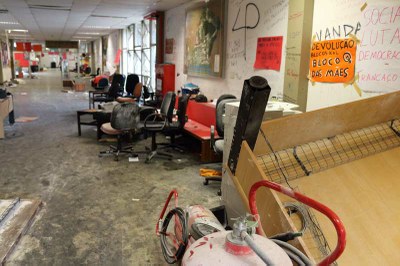
    <content:encoded xmlns:content="http://purl.org/rss/1.0/modules/content/"><![CDATA[<p style="text-align: justify; "><img src="https://www.iea.usp.br/imagens/depredacao-na-reitoria-e-no-iea-1/@@images/cb392b67-88ee-401b-96bd-f58727b8ef7e.jpeg" alt="Depredação na Reitoria e no IEA - 1" class="image-right" title="Depredação na Reitoria e no IEA - 1" />The feeling of all who entered the ensemble of buildings of USP’s central administration yesterday morning was of dismay and indignation. The IEA shares the place provisionally, since February 2011, with several sectors linked to the President, the provosts and other universitary units.</p>
<p style="text-align: justify; ">The invasion and occupation of the buildings by the students <span>ended after 42 days when the courts determined repossession. It all began on October 1, after an unsuccessful attempt by students to invade the meeting of the University Council (Co), which approved the <a href="https://www.iea.usp.br/en/news/changes-in-the-electoral-process-for-rector-and-deputy-rector-of-usp" class="external-link">new rules for the electoral process for President and Deputy President of USP</a>.</span></p>
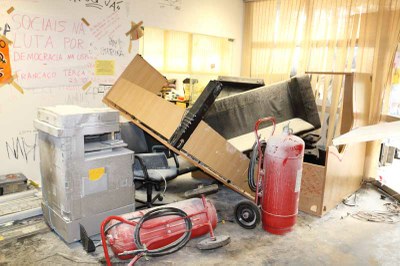
<p style="text-align: justify; ">Shortly after entering the lobby of the hall in which the Co holds its meetings, the scene was of utter devastation, including broken and piled furniture, walls and floors filled with <a class="external-link" href="http://en.wikipedia.org/wiki/Pixa%C3%A7%C3%A3o">“pichação”</a> (a sort of graffiti), broken glass, used fire extinguishers, destroyed models of USP’s future buildings – such as the one where IEA’s headquarters will be located - mattresses, clothes and shoes, plus lots of garbage. The situation was the same all over the ground level. Other spaces showed the violation of doors, cupboards and drawers, not to mention all the scattered official documents on the floor, most of which crushed and trampled.</p>
<p style="text-align: justify; ">When climbing the stairs to the 5th floor of buiding K, place of IEA’s headquarters, signs of further devastation were everywhere: more “pichação” in the lobbies of each floor, destroyed electronic devices and surveillance cameras, dirt and more scattered documents.</p>
<p style="text-align: justify; ">Upon arriving at the IEA, the worst expectations were confirmed. In a vase at the beginning of the floor, three modern keyboards were stacked among scattered computer memories. What was seen next was the result of the action of a band of criminals: doors broken into, equipment stolen, all cabinets and drawers open, papers on tables and the floor.</p>
<p style="text-align: justify; ">It is important to point out that not only material damage has happened. Leaders, researchers and the institute’s staff suffered moral damages by the degradation of their working environment and the violation of their private properties and computer content.</p>
<p style="text-align: justify; "><img src="https://www.iea.usp.br/imagens/depredacao-na-reitoria-e-no-iea-2/@@images/8a1d494c-2ae6-4dca-8230-401d545dcf35.jpeg" alt="Depredação na Reitoria e no IEA - 2" class="image-left" title="Depredação na Reitoria e no IEA - 2" />On this day after, the IEA is trying to return to normalcy, which will not happen anytime soon. It is time to organize whatever is possible and count for losses, including broken and stolen equipment, in order to make a police report and also to, once again, prepare an acquisition list to replace what has been destroyed and taken away. In the last 42 days we had to conduct our activities in disrepair and this way we will go on until we equip ourselves again and are able to use our main <a href="https://www.iea.usp.br/midiateca/foto/institucional/estrutura/" class="external-link">event room</a>, the most affected by theft and vandalism.</p>
<p style="text-align: justify; ">There is something very wrong, absurd and unacceptable when a university has to deal with losses such as stolen equipment and damaged assets due to events led by students.</p>
<p style="text-align: justify; ">The IEA vehemently repudiates everything that has happened and asks: how was this possible? Why? Until when will we be subject to facts like these?</p>
<p style="text-align: justify; "> </p>
<p style="text-align: justify; ">The IEA, as USP's platform for interdisciplinary scientific, institutional and socio-cultural <span>criticism, is at the disposal of the community and society at large to reflect, analyze and discuss the situation, wishing for dialogue, understanding and the stability of this university.</span></p>
<p style="text-align: center; "> </p>
<div id="_mcePaste" style="text-align: center; "></div>
<p style="text-align: right; "><i> USP, November 13, 2013</i></p>
<p style="text-align: right; "><i>Institute of Advanced Studies of the University of São Paulo</i></p>
<p style="text-align: left; "><strong>Related material</strong></p>
<table class="tabela-esquerda-400">
<tbody>
<tr>
<th style="text-align: justify; ">
<p style="text-align: left; "><a href="https://www.iea.usp.br/en/iea/green-room/un-effort-encore" class="external-link"><strong>'Un effort encore!!!" - </strong><span style="text-align: justify; ">Carlos Guilherme Mota</span></a></p>
</th>
</tr>
<tr>
<td><a style="text-align: justify; " href="https://www.iea.usp.br/en/iea/green-room/canevacci-issues-a-letter-to-students-who-occupied-the-rectory-1" class="external-link"><strong>Canevacci issues a letter to students who occupied USP's Central Administration building</strong></a></td>
</tr>
</tbody>
</table>
<table class="plain" style="text-align: center; ">
<tbody>
<tr>
<th>Photo Gallery 1</th><th>Photo Gallery 2</th><th>Photo Gallery 3</th>
</tr>
<tr>
<td>
<p><a href="https://www.iea.usp.br/en/media-library/photos/institutional/depredacao-do-iea" class="external-link">Damage to the IEA</a></p>
<p><a href="https://www.iea.usp.br/en/media-library/photos/institutional/depredacao-do-iea" class="external-link"><img src="https://www.iea.usp.br/en/media-library/photos/institutional/depredacao-do-iea/sala-da-secao-tecnica-de-informatica-1/@@images/392bfc72-9678-4e53-ad1f-3cbe43d1186d.jpeg" alt="Damage to the IEA 15" class="image-inline" title="Damage to the IEA 15" /></a></p>
</td>
<td>
<p><a href="https://www.iea.usp.br/en/media-library/photos/institutional/depredacao-do-predio-da-reitoria" class="external-link">Damage to the USP's Central Administration building</a></p>
<p><a href="https://www.iea.usp.br/en/media-library/photos/institutional/depredacao-do-predio-da-reitoria" class="external-link"><img src="https://www.iea.usp.br/en/media-library/photos/institutional/depredacao-do-predio-da-reitoria/recados/@@images/20b56934-8184-48bc-b3fa-2c25f2609e7c.jpeg" alt="Damage to the rectory's building 20" class="image-inline" title="Damage to the rectory's building 20" /></a></p>
</td>
<td>
<p><a href="https://www.iea.usp.br/en/media-library/photos/institutional/pichacoes" class="external-link">"Pichação" (graffiti-like inscriptions)</a></p>
<p><a href="https://www.iea.usp.br/en/media-library/photos/institutional/pichacoes" class="external-link"><img src="https://www.iea.usp.br/en/media-library/photos/institutional/pichacoes/parte-do-corredor-de-entrada-no-saguao-da-reitoria/@@images/f51449a4-ce15-40f6-93b5-3c5173603abf.jpeg" alt="Pichação 4" class="image-inline" title="Pichação 4" /></a></p>
</td>
</tr>
</tbody>
</table>]]></content:encoded>
    <dc:publisher>No publisher</dc:publisher>
    <dc:creator>Richard Meckien</dc:creator>
    <dc:rights></dc:rights>
    
      <dc:subject>Abstraction</dc:subject>
    
    
      <dc:subject>Violence</dc:subject>
    
    
      <dc:subject>Commons</dc:subject>
    
    
      <dc:subject>Glocal</dc:subject>
    
    
      <dc:subject>USP</dc:subject>
    
    
      <dc:subject>IEA</dc:subject>
    
    
      <dc:subject>Transformation</dc:subject>
    
    <dc:date>2013-11-13T20:10:00Z</dc:date>
    <dc:type>News Item</dc:type>
  </item>


  <item rdf:about="https://www.iea.usp.br/en/news/despite-the-invasion-of-the-rectory2019s-building-iea-remains-active">
    <title>Despite the invasion of the rectory’s building, IEA remains active</title>
    <link>https://www.iea.usp.br/en/news/despite-the-invasion-of-the-rectory2019s-building-iea-remains-active</link>
    <description>Since October 2 the IEA is unable to use its headquarters due to the invasion of the rectory’s building by students, a situation that causes huge losses to the academic and administrative activities of the institute. However, despite the difficulties, the IEA has been keeping a significant part of its work, thanks to the collaboration of other USP units, which have shared their facilites.</description>
    <content:encoded xmlns:content="http://purl.org/rss/1.0/modules/content/"><![CDATA[<p style="text-align: justify; ">From the day after the invasion of the rectory’s building by students, occurred on October 1 during the University Council's meeting which decided on the <a href="https://www.iea.usp.br/en/news/changes-in-the-electoral-process-for-rector-and-deputy-rector-of-usp" class="external-link">changes in the electoral process at USP</a>, the IEA has been unable to use its headquarters.</p>
<p style="text-align: justify; "><span>The damage to the academic and administrative activities of the institute has been immense. In addition to the deprivation of a workplace to visiting professors, study and research groups, and staff from all areas, there is no access to equipment, documents, files and other resources, be they physical or digital, all essential for the perfect functioning of the institute.</span></p>
<p style="text-align: justify; "><span>However, in spite of all these difficulties and in respect to its academic and institutional mission, the IEA has been keeping a significant part of its activities active by using borrowed facilities and auditoriums from other units at USP.</span></p>
<p style="text-align: justify; ">While this anomalous situation remains, all those who need to contact the institute should call +55 (11) 3091-4076, extension 24, or send an e-mail to the <a href="https://www.iea.usp.br/en/iea/organization/equipe" class="external-link">team</a> member deemed appropriate.</p>
<p style="text-align: justify; "><span>The IEA wishes that the current negotiations between the invaders and the university leaders come to fruition as soon as possible, so that academic life returns to normalcy in the benefit of everyone.</span></p>
<p style="text-align: justify; "><span><strong>Message of appreciation</strong></span></p>
<p style="text-align: justify; "><span>Were it not for the invaluable support of some people and units at USP during this period, most of the academic and administrative activities of the IEA would not have been held.</span></p>
<p style="text-align: justify; "><span>The IEA is grateful for the effort of the Department of Library Science and Documentation of USP’s School of Communication and Arts (ECA) to house most of its staff, and the professor <span>and member of IEA's Board </span></span><span>Guilherme Ary Plonski, who kindly shared his office in the Faculty of Economics, Administration and Accounting (FEA) to house IEA’s communication team.</span></p>
<p style="text-align: justify; "><span>The institute’s gratitude is extended to the following units and organizations that have put their auditoriums available for IEA’s public events: Electronic Computer Center, Sports Center, Institute of Mathematics and Statistics, University Center Maria Antonia, School of Communications and Arts, Faculty of Law, Institute of Astronomy, Geophysics and Atmospheric Sciences, Institute of Psychology, Institute of Biomedical Sciences and Museum of Contemporary Art.</span></p>]]></content:encoded>
    <dc:publisher>No publisher</dc:publisher>
    <dc:creator>Richard Meckien</dc:creator>
    <dc:rights></dc:rights>
    
      <dc:subject>Green Room</dc:subject>
    
    
      <dc:subject>IEA</dc:subject>
    
    
      <dc:subject>University</dc:subject>
    
    
      <dc:subject>USP</dc:subject>
    
    <dc:date>2013-10-27T14:30:00Z</dc:date>
    <dc:type>News Item</dc:type>
  </item>


  <item rdf:about="https://www.iea.usp.br/en/news/changes-in-the-electoral-process-for-rector-and-deputy-rector-of-usp">
    <title>Changes in the electoral process for President and Deputy President of USP</title>
    <link>https://www.iea.usp.br/en/news/changes-in-the-electoral-process-for-rector-and-deputy-rector-of-usp</link>
    <description>The choice of the list of three will now be made in a single round and from slates that should inscribe candidates for President and Deputy President.</description>
    <content:encoded xmlns:content="http://purl.org/rss/1.0/modules/content/"><![CDATA[<p style="text-align: justify; ">At a meeting on October 1, the University Council approved several changes in the electoral process for President and Deputy President of USP. The choice of a triple list of candidates will be made in a single round by the University Assembly, from slates consisting of the names of the candidates for both positions. The choice will be preceded by an informative consultation on the preference of the whole community (faculty, staff and students) between the inscribed slates.</p>
<p style="text-align: justify; ">The University Assembly, composed of the University Council, central councils, congregations of the units, and the deliberative councils of museums and specialized institutes (about two thousand representatives of the universitary community), will choose the slates that will constitute the triple list to be forwarded to the choice of the São Paulo state governor. The new President and his deputy will take office on January 25, 2014.</p>
<p style="text-align: justify; ">Previously, all professors were entitled to be voted without the need of inscribing. Now, candidates must be organized in slates, which should be inscribed with the names for President and Deputy President as wel as the presentation of their proposals for management programs. Moreover, once they inscribe, members of the slates should get off functions of leadership or direction they may carry.</p>
<p style="text-align: justify; ">For this year's elections, the slates must register from October 7 to 14. The Electoral Commission will disclose the list of enabled slates on October 15, at 2 pm, on the <a class="external-link" href="http://www.usp.br/secretaria/">General Secretariat</a>’s website.</p>
<p style="text-align: justify; ">The informative consultation with the universitary community will take place on December 10, the last day of the semester. The outcome of this consultation will be announced on December 12.</p>
<p style="text-align: justify; ">The election of the list of three slates by the University Assembly will be held on December 19.</p>
<p style="text-align: justify; ">The process of choosing of the triple-slate list will be coordinated by the Electoral Commission, composed of professors Wanderley Messias da Costa (Chairman), Francisco de Assis Leone (vice president), Carlos Eduardo Falavigna da Rocha, José Rogério Cruz e Tucci, Marisa Aparecida Bismara Regitano D'Arce and Waldyr Antonio Jorge.</p>
<p style="text-align: justify; "> </p>
<p style="text-align: justify; "><strong>Related news</strong></p>
<p style="text-align: justify; "><strong><a href="https://www.iea.usp.br/en/news/usps-rector-election-process-in-debate" class="external-link">IEA debates USP's President election process</a> - <a href="https://www.iea.usp.br/en/media-library/photos/events-2013/iea-debate-o-processo-eleitoral-da-usp-03-de-setembro-de-2013" class="external-link">Photos</a></strong></p>]]></content:encoded>
    <dc:publisher>No publisher</dc:publisher>
    <dc:creator>Richard Meckien</dc:creator>
    <dc:rights></dc:rights>
    
      <dc:subject>Transformation</dc:subject>
    
    
      <dc:subject>USP</dc:subject>
    
    <dc:date>2013-10-09T16:30:00Z</dc:date>
    <dc:type>News Item</dc:type>
  </item>


  <item rdf:about="https://www.iea.usp.br/en/media-library/photos/events-2013/iea-debate-o-processo-eleitoral-da-usp-03-de-setembro-de-2013">
    <title>IEA debates USP's president election process - September 3, 2013</title>
    <link>https://www.iea.usp.br/en/media-library/photos/events-2013/iea-debate-o-processo-eleitoral-da-usp-03-de-setembro-de-2013</link>
    <description></description>
    
    <dc:publisher>No publisher</dc:publisher>
    <dc:creator>Richard Meckien</dc:creator>
    <dc:rights></dc:rights>
    
      <dc:subject>Transformation</dc:subject>
    
    
      <dc:subject>USP</dc:subject>
    
    <dc:date>2013-09-03T03:00:00Z</dc:date>
    <dc:type>Folder</dc:type>
  </item>


  <item rdf:about="https://www.iea.usp.br/en/news/usps-rector-election-process-in-debate">
    <title>IEA debates USP's president election process</title>
    <link>https://www.iea.usp.br/en/news/usps-rector-election-process-in-debate</link>
    <description>Luiz Nunes de Oliveira, representative of the professors in USP's University Council (CO), and Ciro Teixeira Correia, president of the Association of Professors of USP (ADUSP), will be the exhibitors of the meeting 'IEA Debate o Processo Eleitoral da USP' ('IEA debates USP's Electoral Process'), to be held on September 3, at 3 pm. </description>
    <content:encoded xmlns:content="http://purl.org/rss/1.0/modules/content/"><![CDATA[<div id="_mcePaste">
<p class="MsoNormal" style="text-align: justify; "><img src="https://www.iea.usp.br/imagens/edificio-da-reitoria-da-usp" alt="Edifício da Reitoria da USP" class="image-right" title="Edifício da Reitoria da USP" /><a href="https://www.iea.usp.br/pessoas/pasta-pessoal/luiz-nunes-de-oliveria" class="external-link">Luiz Nunes de Oliveira</a>, representative of the full professors in USP's University Council (CO), and <a href="https://www.iea.usp.br/pessoas/pasta-pessoac/ciro-teixeira-correia" class="external-link">Ciro Teixeira Correia</a>, president of the Association of Professors of USP (ADUSP), will be the exhibitors of the meeting 'IEA Debate o Processo Eleitoral da USP' ('IEA debates USP's Electoral Process'), to be held on September 3, at 3 pm. The panelists will be professors <a href="https://www.iea.usp.br/pessoas/pasta-pessoaf/francisco-cesar-de-sa-barreto" class="external-link">Francisco César de Sá Barreto</a>, from UFMG, <a href="https://www.iea.usp.br/pessoas/pasta-pessoap/paulo-saldana" class="external-link">Paulo Saldaña</a>, from O Estado de S. Paulo, <a href="https://www.iea.usp.br/pessoas/pasta-pessoal/lisete-arelaro" class="external-link">Lisete Arelaro</a>, from the Faculty of Education (FD), <a href="https://www.iea.usp.br/pessoas/pasta-pessoar/renato-janine-ribeiro" class="external-link">Renato Janine Ribeiro</a>, from the Faculty of Philosophy, Letters and Human Sciences (FFLCH) and the IEA, and <a href="https://www.iea.usp.br/pessoas/pasta-pessoas/sergio-franca-adorno-de-abreu" class="external-link">Sergio Adorno</a>, also from FFLCH and IEA.</p>
<p class="MsoNormal" style="text-align: justify; "><span>The proposal to be submitted by Nunes was formulated by Renato Janine Ribeiro when he was the representative of the professors in the CO. It consists of a series of votes on the composition and function of the electoral college. The first one provides for the termination of the current second round of the process, leaving the University Assembly (composed of the CO, Central Councils and Units Congregations) of the current first turn responsible for choosing the president or components of a list of three to be presented to São Paulo's state governor.</span></p>
<p class="MsoNormal" style="text-align: justify; "><span>If this amendment is approved, successive proposals for the expansion of the University Assembly will be voted, beginning with the </span>inclusion of the Departmental Councils and the Technical and Administrative Councils (CTAs) and then the inclusion of the Committees for Research, Extension and Culture, Graduation and Postgraduation of the units. At last, the<span> adoption of direct election by teachers - which would account for 70% of the total of votes -, staff and students. </span>Since the goal is to reach the decision that gets most comprehensive in the University Council, the reform of the Statute would broaden the current system, but it would only be finished if and when any proposal was rejected. The resulting change from this last votation would then <span>be adopted for the next election, still this year.</span></p>
<p class="MsoNormal" style="text-align: justify; "><span>Correia will present the proposal prepared by ADUSP, the Central Directory of Students (DCE) and the Association of Post-graduates (APG), which advocates the introduction of two changes in the process: the extinction of the first phase and an equal voting involving professors, staff and students to choose from a list of three names to be set by the University Council and Central Councils.</span></p>
<p class="MsoNormal" style="text-align: justify; "><span>According to ADUSP, equal voting for choosing a candidate on the triple list would adopt the criterion of different weights to the votes of professors, staff and students, taking into account the total number of members of each of these three installments of the USP community.</span></p>
</div>
<p><span style="text-align: justify; ">The event will be broadcast live from IEA's Event Room at </span><a style="text-align: justify; " href="https://www.iea.usp.br/aovivo" target="_blank">www.iea.usp.br/aovivo</a><span style="text-align: justify; ">.</span></p>
<p style="text-align: justify; "> </p>
<p style="text-align: justify; "><b><a href="https://www.iea.usp.br/en/media-library/photos/events-2013/iea-debate-o-processo-eleitoral-da-usp-03-de-setembro-de-2013" class="external-link">Photos of the event</a></b></p>]]></content:encoded>
    <dc:publisher>No publisher</dc:publisher>
    <dc:creator>Richard Meckien</dc:creator>
    <dc:rights></dc:rights>
    
      <dc:subject>Transformation</dc:subject>
    
    
      <dc:subject>USP</dc:subject>
    
    <dc:date>2013-08-30T18:25:00Z</dc:date>
    <dc:type>News Item</dc:type>
  </item>


  <item rdf:about="https://www.iea.usp.br/en/media-library/photos/events-2011/i-worshop-estudos-avancados-e-a-universidade-31-de-outubro-de-2011">
    <title>1st National Meeting of Brazilian Institutes For Advanced Studies - Advanced Studies and University - October 31, 2011</title>
    <link>https://www.iea.usp.br/en/media-library/photos/events-2011/i-worshop-estudos-avancados-e-a-universidade-31-de-outubro-de-2011</link>
    <description></description>
    
    <dc:publisher>No publisher</dc:publisher>
    <dc:creator>Richard Meckien</dc:creator>
    <dc:rights></dc:rights>
    
      <dc:subject>IEA</dc:subject>
    
    
      <dc:subject>Universidade</dc:subject>
    
    
      <dc:subject>USP</dc:subject>
    
    <dc:date>2013-07-12T17:30:00Z</dc:date>
    <dc:type>Folder</dc:type>
  </item>


</rdf:RDF>