<?xml version="1.0" encoding="utf-8" ?>
<rdf:RDF xmlns:rdf="http://www.w3.org/1999/02/22-rdf-syntax-ns#" xmlns:dc="http://purl.org/dc/elements/1.1/" xmlns:syn="http://purl.org/rss/1.0/modules/syndication/" xmlns="http://purl.org/rss/1.0/">


<channel rdf:about="https://www.iea.usp.br/search_rss">
  <title>Instituto de Estudos Avançados da Universidade de São Paulo</title>
  <link>https://www.iea.usp.br</link>

  <description>
    
            These are the search results for the query, showing results 41 to 49.
        
  </description>


  <image rdf:resource="https://www.iea.usp.br/logo.png" />

  <items>
    <rdf:Seq>
      
        <rdf:li rdf:resource="https://www.iea.usp.br/en/news/conference-compares-scientific-and-mathematical-practices" />
      
      
        <rdf:li rdf:resource="https://www.iea.usp.br/en/news/book-addresses-intelligent-systems-based-on-non-classical-logics" />
      
      
        <rdf:li rdf:resource="https://www.iea.usp.br/en/news/fields-medal" />
      
      
        <rdf:li rdf:resource="https://www.iea.usp.br/en/news/art-and-hacktivism-in-debate" />
      
      
        <rdf:li rdf:resource="https://www.iea.usp.br/en/news/an-interdisciplinary-look-at-the-drought-in-sao-paulo" />
      
      
        <rdf:li rdf:resource="https://www.iea.usp.br/en/news/a-philosophical-perspective-on-new-utopias" />
      
      
        <rdf:li rdf:resource="https://www.iea.usp.br/en/media-library/photos/events-2014/como-convertir-la-fatiga-en-una-exposicion-08-de-setembro-de-2014" />
      
      
        <rdf:li rdf:resource="https://www.iea.usp.br/en/news/2014-agenda-foresees-discussion-of-historical-institutional-and-strategic-issues" />
      
      
        <rdf:li rdf:resource="https://www.iea.usp.br/en/news/estudos-avancados-journal-discusses-the-identity-of-brazilian-archeology" />
      
    </rdf:Seq>
  </items>

</channel>


  <item rdf:about="https://www.iea.usp.br/en/news/conference-compares-scientific-and-mathematical-practices">
    <title>Conference compares scientific and mathematical practices</title>
    <link>https://www.iea.usp.br/en/news/conference-compares-scientific-and-mathematical-practices</link>
    <description>Professor of philosophy at the University of Miami, Otávio Bueno will give a conference on May 26, at 2 pm, in IEA-USP's Event Room.</description>
    <content:encoded xmlns:content="http://purl.org/rss/1.0/modules/content/"><![CDATA[<p><img src="https://www.iea.usp.br/imagens/otavio-bueno-1/@@images/6d25123b-a6de-4ac7-81a6-a47c087b64c4.jpeg" style="text-align: justify; " title="Otávio Bueno" class="image-left" alt="Otávio Bueno" /></p>
<div id="_mcePaste" style="text-align: justify; ">
<p class="MsoNormal">Philosopher <a href="https://www.iea.usp.br/en/persons/exhibitors/otavio-bueno" class="external-link">Otávio Bueno</a>, a professor at the University of Miami, will examine similarities and differences between scientific practice and mathematical practice at the conference "Styles of Thought: Scientific and Mathematical", organized by <a href="https://www.iea.usp.br/en/research/research-groups/philosophy-history-sociology-of-science-and-technology" class="external-link">IEA-USP's Philosophy, History, and Sociology of Science and Technology Research Group</a> on May 26, at 2 pm, in the Institute's Event Room.</p>
<p class="MsoNormal"><span>According to Bueno, the notion of "style of scientific thinking" has been used as an analytical tool to understand the characteristics of different forms of conducting scientific investigations. Proposed by historian of science Alisteir Crombie, the concept originally referred to six styles which describe the specificities of the different perspectives adopted to problematize reality: deductive, experimental, hypothetical, taxonomic, statistical and evolutionary.</span></p>
<p class="MsoNormal"><span>At the conference, Bueno will present a particular interpretation of the notion of styles of scientific thinking, which allows to extend it to the field of mathematics, but differently from that made ​​by philosophers of science Ian Hacking and Gilles-Gaston Granger.</span></p>
<p class="MsoNormal">Bueno has graduated and holds a masters from USP's Faculty of Philosophy, Letters and Human Sciences (FFLCH), and a PhD from the University of Leeds. He is a professor and head of the Department of Philosophy at the University of Miami. His research focuses on the areas of philosophy of science, philosophy of logic, philosophy of mathematics and most recently aesthetics. He is one of the editors of the journal of epistemology and philosophy of science "<a class="external-link" href="http://www.springer.com/philosophy/epistemology+and+philosophy+of+science/journal/11229">Synthese</a>".</p>
<p class="MsoNormal"><span>The event will be broadcast live on the </span><a href="https://www.iea.usp.br/aovivo">web</a><span>.</span></p>
</div>]]></content:encoded>
    <dc:publisher>No publisher</dc:publisher>
    <dc:creator>Richard Meckien</dc:creator>
    <dc:rights></dc:rights>
    
      <dc:subject>Epistemology</dc:subject>
    
    
      <dc:subject>Abstraction</dc:subject>
    
    
      <dc:subject>Research Group: Philosophy, History, and Sociology of Science and Technology</dc:subject>
    
    
      <dc:subject>Philosophy of Science</dc:subject>
    
    <dc:date>2014-05-23T20:45:00Z</dc:date>
    <dc:type>Notícia</dc:type>
  </item>


  <item rdf:about="https://www.iea.usp.br/en/news/book-addresses-intelligent-systems-based-on-non-classical-logics">
    <title>Book addresses intelligent systems based on non-classical logics</title>
    <link>https://www.iea.usp.br/en/news/book-addresses-intelligent-systems-based-on-non-classical-logics</link>
    <description></description>
    <content:encoded xmlns:content="http://purl.org/rss/1.0/modules/content/"><![CDATA[<table class="tabela-direita">
<tbody>
<tr>
<th><a href="https://www.iea.usp.br/en/publicacoes/ebooks/topicos-de-sistemas-inteligentes-baseados-em-logicas-nao-classicas" class="external-link"><img src="https://www.iea.usp.br/imagens/topicos-de-sistemas-inteligentes-baseados-em-logicas-nao-classicas" style="float: left; " title="Tópicos de sistemas inteligentes baseados em lógicas não-clássicas" class="image-inline" alt="Tópicos de sistemas inteligentes baseados em lógicas não-clássicas" /></a></th>
</tr>
</tbody>
</table>
<p>The IEA launched the third e-book produced by the <a href="https://www.iea.usp.br/en/research/research-groups/logic-and-theory-of-science" class="external-link">Logic <span>and Theory of Science </span>Research Group</a> in February. The title of the work is "Topics of Intelligent Systems Based on Non-classical Logics". Interested parties can download the file for free <a href="https://www.iea.usp.br/en/publicacoes/ebooks/topicos-de-sistemas-inteligentes-baseados-em-logicas-nao-classicas" class="external-link">(in Portuguese)</a>.</p>
<p><span>The book contains works related with the <i>2nd Workshop on Intelligent Computational Systems (WICS-2014)</i>, held on March 17, 2014. The organizer is Jair Minoro Abe, a professor at the Universidade Paulista (UNIP) and coordinator of the research group.</span></p>
<p><span>The authors of the articles are professors and PhD students. The texts address current themes of intelligent computation, a discipline that "has been establishing itself solidly in the field of artificial intelligence and intelligent systems, coupled with non-classical logics, a background to topics of studies," said Abe, who also coordinated the workshop in 2014.</span></p>
<p><span>The WICS-2014 took place on a campus of the UNIP, sponsored by the Graduate Program in Production Engineering of that university. The initiative had the institutional support of the Provost for Research and Graduation of UNIP and of the IEA.</span></p>
<ul>
</ul>
<ul>
</ul>]]></content:encoded>
    <dc:publisher>No publisher</dc:publisher>
    <dc:creator>Richard Meckien</dc:creator>
    <dc:rights>Original version in Portuguese by Mauro Bellesa.</dc:rights>
    
      <dc:subject>Abstraction</dc:subject>
    
    
      <dc:subject>Research Group: Logic and Theory of Science</dc:subject>
    
    
      <dc:subject>Logic</dc:subject>
    
    <dc:date>2016-03-03T17:35:00Z</dc:date>
    <dc:type>Notícia</dc:type>
  </item>


  <item rdf:about="https://www.iea.usp.br/en/news/fields-medal">
    <title>Artur Ávila's Fields Medal and the Brazilian School of Mathematics </title>
    <link>https://www.iea.usp.br/en/news/fields-medal</link>
    <description></description>
    <content:encoded xmlns:content="http://purl.org/rss/1.0/modules/content/"><![CDATA[<table class="tabela-direita-300">
<tbody>
<tr>
<th><img src="https://www.iea.usp.br/imagens/artur-avila-medalha-fields-2" alt="Artur Ávila - Medalha Fields - 2" class="image-inline" title="Artur Ávila - Medalha Fields - 2" /></th>
</tr>
<tr>
<td style="text-align: right; "><strong>Mathematician Artur Ávila being awarded by South Korea's President, </strong><strong><span style="text-align: start; ">Park Geun-hye</span></strong></td>
</tr>
</tbody>
</table>
<p style="text-align: justify; ">Mathematician Artur Ávila, 35, a researcher at the <a class="external-link" href="http://www.impa.br/opencms/en/">National Institute of Pure and Applied Mathematics (IMPA)</a> and Director of Research at the <a class="external-link" href="http://www.cnrs.fr/index.php">National Council for Scientific Research (CNRS)</a> of France, was one of the four winners of the Fields Medal in 2014, being the first Latin American to receive the award, which is considered the Nobel Prize of mathematics. Thus, Ávila became the holder of the most important international scientific honor in any area ever granted to a Brazilian researcher.</p>
<p style="text-align: justify; ">In order to historically contextualize the achievement of Ávila and the Brazilian mathematics field, the IEA-USP and <a class="external-link" href="http://www.ime.usp.br/en">USP's Institute of Mathematics and Statistics (IME)</a>, with support from the <a class="external-link" href="http://www.icmc.usp.br/Portal/">Institute of Mathematics and Computer Sciences (ICMC)</a> of USP's campus in São Carlos, will hold the seminar <strong><i>Artur Ávila, the Fields Medal and the Brazilian School of Mathematics</i></strong> on <strong>October 15, at 2 pm, in IEA-USP's Event Room</strong>.</p>
<p style="text-align: justify; ">The exhibitors will be three researchers from the IMPA: Marcelo Viana, Maurício Peixoto and Welington de Melo. Moderation will be in charge of Edson de Faria (IME). Moderation will be in charge of Edson de Faria (IME). Before the seminar, from 11 am to 12 pm, at the IME, Welington de Melo, who has been the doctoral supervisor to Ávila, will give a lecture on the work of the medalist for undergraduates in mathematics.</p>
<p style="text-align: justify; ">Founded in 1936 and granted only to mathematicians under 40 years, the Fields Medal was handed to the winners of this year on August 13, during the <a class="external-link" href="http://www.icm2014.org/">International Congress of Mathematicians</a>, held in Seoul. The medal is only awarded every four years during the meetings of the International Mathematical Union. Rio de Janeiro will host the next congress in 2018. It will be the first time a country of the Southern Hemisphere becomes the host .</p>
<p style="text-align: justify; ">Ávila’s award is the crowning of a long path of struggle by Brazilian mathematics. Although the achievement is due to the merits and individual brilliance of the young mathematician, it should also be credited for his participating in a scientific context that can be defined as a Brazilian school of studies on dynamical systems, primarily established by IMPA, an institution that has played an important role in the world for several years and from which Ávila has graduated.</p>
<p style="text-align: justify; "><span style="text-align: justify; ">The event will be broadcast live on the </span><a style="text-align: justify; " href="https://www.iea.usp.br/aovivo">web</a><span style="text-align: justify; ">.</span></p>
<p style="text-align: right; "><span class="discreet">Photo: International Congress of Mathematicians</span></p>]]></content:encoded>
    <dc:publisher>No publisher</dc:publisher>
    <dc:creator>Richard Meckien</dc:creator>
    <dc:rights></dc:rights>
    
      <dc:subject>Mathematics</dc:subject>
    
    
      <dc:subject>Abstraction</dc:subject>
    
    
      <dc:subject>Event</dc:subject>
    
    <dc:date>2014-10-03T20:10:00Z</dc:date>
    <dc:type>Notícia</dc:type>
  </item>


  <item rdf:about="https://www.iea.usp.br/en/news/art-and-hacktivism-in-debate">
    <title>Art and hacktivism in debate</title>
    <link>https://www.iea.usp.br/en/news/art-and-hacktivism-in-debate</link>
    <description>The intersections of artistic practices, hacking and economy are the theme of the meeting 'Interrupção em Rede: Repensando Oposições em Arte, Hacktivismo e Negócios da Rede Social' (Interruption Network: Rethinking Oppositions in Art, Hacktivism and Social Network Business), to be held at IEA on May 23 at 3.00 pm in the Event Room.</description>
    <content:encoded xmlns:content="http://purl.org/rss/1.0/modules/content/"><![CDATA[<p style="text-align: justify; "><img src="https://www.iea.usp.br/imagens/tatiana1" alt="Tatiana1" class="image-left" title="Tatiana1" />The intersections of artistic practices, hacking and economy are the theme of the meeting <i>Interrupção em Rede: Repensando Oposições em Arte, Hacktivismo e Negócios da Rede Social</i> (Interruption Network: Rethinking Oppositions in Art, Hacktivism and Social Network <span style="text-align: justify; ">Business</span>), to be held at IEA on May 23 at 3.00 pm in the Event Room.</p>
<p style="text-align: justify; ">The exhibitor will be the Italian researcher Tatiana Bazzichelli, who studies the relationship between artistic manifestations and the business of social media. The conference will be held in Italian with consecutive translation by Massimo Canevacci, visiting Professor at IEA.</p>
<p style="text-align: justify; ">At the event, Bazzichelli will talk about the conditions for hacker and artistic practices on Web 2.0 and how social networks can develop and incorporate these digital culture practices. Examples of network art and hacking in California and Europe that challenge the notions of power and hegemony will also be presented.</p>
<p style="text-align: justify; ">Bazzichelli is a postdoctoral fellow at the Center of Digital Media’s Innovation Incubator of the Leuphana University of Lüneburg, Germany, and holds a PhD in Media Studies and Information from Aarhus University, Denmark. She is also a member of the curatorial team of <a href="http://www.transmediale.de/resource" target="_blank">Transmediale Festival Berlin</a> and author of <i><a href="http://networkingart.eu/pdf/Networking.pdf" target="_blank">Networking. La </a></i><a href="http://networkingart.eu/pdf/Networking.pdf" target="_blank"><i>rete come arte</i></a><i> </i>(2006) /<a href="http://darc.imv.au.dk/wp-content/files/networking_bazzichelli.pdf" target="_blank"><i>Networking. The Net as Artwork</i></a><i> </i>(2008).</p>
<p style="text-align: justify; ">Canevacci is Professor of Cultural Anthropology and of Digital Art and Culture at Università Degli Studi di Roma 'La Sapienza', Italy. His studies focus on ethnography, visual communication, art, and digital culture. The research he has been developing at IEA, situated among these themes, includes four main conceptual frameworks: self-representation, ubiquity, visual fetishism, and critical and experimental theory.</p>]]></content:encoded>
    <dc:publisher>No publisher</dc:publisher>
    <dc:creator>Richard Meckien</dc:creator>
    <dc:rights></dc:rights>
    
      <dc:subject>Abstraction</dc:subject>
    
    
      <dc:subject>Art</dc:subject>
    
    
      <dc:subject>Technology</dc:subject>
    
    
      <dc:subject>Culture</dc:subject>
    
    
      <dc:subject>Visiting Professors</dc:subject>
    
    <dc:date>2013-05-17T17:15:00Z</dc:date>
    <dc:type>Notícia</dc:type>
  </item>


  <item rdf:about="https://www.iea.usp.br/en/news/an-interdisciplinary-look-at-the-drought-in-sao-paulo">
    <title>An interdisciplinary look at the drought in São Paulo</title>
    <link>https://www.iea.usp.br/en/news/an-interdisciplinary-look-at-the-drought-in-sao-paulo</link>
    <description></description>
    <content:encoded xmlns:content="http://purl.org/rss/1.0/modules/content/"><![CDATA[<p style="text-align: justify; "><img src="https://www.iea.usp.br/imagens/evento-verao-2013-2014-e-cenarios-de-estresse-hidrico" alt="Evento &quot;Verão 2013/2014 e Cenários de Estresse Hídrico&quot;" class="image-right" title="Evento &quot;Verão 2013/2014 e Cenários de Estresse Hídrico&quot;" />The Metropolitan Region of São Paulo (RMSP) has been undergoing the bitter consequences of a prolonged drought, which led the Cantareira water reservoir to beat low levels records. The IEA-USP addressed this water shortage situation in the debate "Summer 2013/2014 and Scenarios of Water Stress" on March 19. The event was part of the celebrations of the Water Week 2014, prior to the World Water Day, celebrated on March 22.</p>
<p style="text-align: justify; ">The debate has been organized by a partnership between two of IEA-USP’s research groups: <a href="https://www.iea.usp.br/en/research/research-groups/environmental-sciences" class="external-link">Environment and Society</a>, and <a href="https://www.iea.usp.br/en/research/research-groups/philosophy-history-sociology-of-science-and-technology" class="external-link">Philosophy, History, and Sociology of Science and Technology</a>. They had the support of the Center for Studies in Social and Environmental Governance of USP’s Institute for Energy and Environment (IEE). The meeting has comprised two roundtables, both mediated by Pedro Jacobi, coordinator of IEA’s Environment and Society Research Group.</p>
<p style="text-align: justify; ">The exhibitors were Wagner Ribeiro Costa, professor at USP’s Faculty of Philosophy, Letters and Human Sciences (FFLCH), Maurício de Carvalho Ramos, also a professor at FFLCH, Daniela Libório Di Sarno, professor at PUC-SP’s Faculty of Law and vice president of the Brazilian Institute of Urban Law (IBDU), Marcio Automare, organizational development analyst at the Institute of Land of the State of São Paulo (ITESP), and Susana Prizendt, coordinator of the Paulista Committee of the Permanent Campaign Against Pesticides and for Living.</p>
<p style="text-align: justify; ">The meeting has addressed the water problem from an interdisciplinary perspective, considering environmental, legal, socio-political, philosophical and food safety aspects. According to Jacobi, the idea was to reflect on the problem of water in the RMSP, but covering broader issues involving, among others, inequalities in access to water, changes in rainfall rates caused by the phenomenon of climate change, institutional barriers and the posture of the government in relation to the prevention and remediation of the problem.</p>
<p style="text-align: justify; "><a href="https://www.iea.usp.br/en/media-library/photos/events-2014/verao-2013-14-e-cenarios-de-estresse-hidrico-19-de-marco-de-2014" class="external-link"><b>Photos of the event</b></a></p>
<p style="text-align: justify; "><strong>MEASURES OF THE STATE</strong></p>
<p style="text-align: justify; ">The debate has been heated up by recent measures that have been studied and taken by the state government of São Paulo in order to try to circumvent the critical situation of the Cantareira reservoir, which currently operates at approximately 15 % of its capacity. Among these measures is the proposal of using water from the Paraíba do Sul River reservoirs to supply the RMSP. When asked about the matter, Ribeiro said that he does not consider the proposal timely, since the suggested river is also undergoing a situation of water stress.</p>
<p style="text-align: justify; ">Ribeiro has criticized the emergency works of the state government, which began on March 14 to pump the volume of "dead water" from the bottom of the dams that form the Cantareira reservoir. According to him, this means "to remove the last drop of a water that has been stored for 40 years, stagnant, whose quality is questionable due to the unknown factors associated with it."</p>
<p style="text-align: justify; ">Besides, he said that it was a risky move, which can lead to resource depletion in the region. “That is because to saturate the soil again to the point for the dam to refill, much more than the average rainfall rates in the region will be needed, and those were not achieved this summer."</p>
<p style="text-align: justify; "><strong>FRAGMENTED MANAGEMENT</strong></p>
<p style="text-align: justify; ">Sarno has pointed out the incongruity of the Brazilian legal system in relation to water resources management as the top reason for the shortage in the country. According to her, although the Federal Constitution provides that the management should be shared between the federal government, the states and the municipalities, there is little dialogue between the parties and the administration of water resources ends up getting fragmented.</p>
<p style="text-align: justify; ">"To meet the challenge of shared management, the three [federal, state and municipal] parties need to sit down and discuss. But this step has still not been taken. There are neither vertically talks between the parties nor horizontally ones between institutions," she said.</p>
<p style="text-align: justify; ">This fragmentation gets compounded by the mismatch between the division of the federal system, that obeys political criteria, and the division of watersheds, which follows geographic criteria. The watersheds are important because they put another actor in the scene: the Watershed Committees, which comprise the National System for Water Resources Management. Composed of representatives of the various water user sectors, civil society and government organizations, the committees approve the Water Resources Plan for each watershed, arbitrate conflicts over water use, suggest values ​​for the charging of consumption, among others.</p>
<p style="text-align: justify; ">According to Sarno, the problem is that none of the management models adopted in the country - municipal management and state management by autarchies or contractors - is consistent with the watershed divisions. "The Committees even do part of the management, but who puts the distribution of water into practice is not them, but managing institutions.”</p>
<p style="text-align: justify; "><strong>PUBLIC X PRIVATE</strong></p>
<p style="text-align: justify; ">As for Ribeiro, the biggest obstacle to equate the issue of water in Brazil is the private management of water resources. In the RMSP, for example, the management is done by SABESP, a mixed economy company, publicly listed and traded on the stock exchange, which operates according to the logic of a private institution.</p>
<p style="text-align: justify; ">"Is it the function of the state to pay up, profit and speculate based on the commercialization of water resources? No, it is not the function of the state to make money from the water, as done by SABESP," warned Ribeiro, noting the lack of transparency in the management of the company. "Besides the water flows, there should be transparency in relation to financial flows," he pointed out.</p>
<p style="text-align: justify; ">As Ribeiro, Automare pondered that a government-linked company as SABESP should not behave like a private company, treating water as a product. He also cited the industry of water sold in gallons, whose growth was affecting groundwater, as an example of the commercial exploitation of water resources.</p>
<p style="text-align: justify; ">Sarno also addressed the conflict between public and private interests. According to her, Watershed Committees treat water as a commodity, whose distribution should be equal and the charging should happen only to regulate the consumption. The companies that put management into practice, such as SABESP, treat water as a product for sale.</p>
<p style="text-align: justify; ">According to the lawyer, the managers of metropolitan regions and municipalities do not take into consideration the willingness of the watershed in allowing, for example, the expansion of an industrial district that could endanger the water supply on site. "It takes measures to reconcile urban expansion and the infrastructure for distribution of water in terms of quality and quantity," he warned.</p>
<p style="text-align: justify; "><strong>ETHICAL DIMENSION</strong></p>
<p style="text-align: justify; ">Taking a philosophical approach, Carvalho said that the water can be considered from two sets of properties: material ones, linked to biochemical principles, and symbolic ones, related to its immeasurable value to life, making it a symbol of power.</p>
<p style="text-align: justify; ">According to him, when considering the symbolic properties, water can be conceived both as a resource - a product to be exploited economically -, as well as a good - something free and not marketable in any way. And it is this conception of a good that should be adopted to tackle the problem of water stress from an ethical perspective.</p>
<p style="text-align: justify; ">"Addressing the issue rationally and responsibly involves not putting into practice technoscientific possibilities related to water use that may jeopardize the availability or the material properties of water resources," he said. "If the ethical stance prevailed, there would be no need for rationing and an appeal to the conscience of people would be sufficient," he added.</p>
<p style="text-align: justify; "><strong>PARTICIPATION</strong></p>
<p style="text-align: justify; ">The panelists drew attention to the low involvement of society in discussions on the management of water resources. According to Automare, water has achieved the last place in the priority list of the citizens of the State of São Paulo: "We have been induced to credit the discussion on the subject to the representatives and forgot to get involved." He also emphasized that "the public has no forum for debate, so the situation is in the hands of technocrats."</p>
<p style="text-align: justify; ">Ribeiro has also warned about the paradox that involves the lack of popular participation on the one hand and excess of institutions to manage water on the other. For him, "we have more institutions dealing with water than water itself. There are too much institutions for very little water. And civil society is under-represented within them."</p>
<p style="text-align: justify; "><strong>FOOD SAFETY</strong></p>
<p style="text-align: justify; ">The water problem has also been addressed from the point of view of quality. Addressing the contamination of water resources by pesticides, Prizendt said that the issue should be discussed with a view to replacing the agribusiness, model of conventional production and based on intensive use of pesticides, by agroecology, an alternative model, whose practices intend to maintain the balance of ecosystems and preserve the sources of rivers and the water system as a whole.</p>
<p style="text-align: justify; ">According to her, pesticides are the second leading cause of contamination of rivers, a fact that becomes particularly worrying considering that Brazil is world champion in the use of these substances, accounting for one fifth of what is consumed in the world. Moreover, the agricultural sector accounts for about 70 % of freshwater consumption in Brazil, said the environmentalist.</p>]]></content:encoded>
    <dc:publisher>No publisher</dc:publisher>
    <dc:creator>Richard Meckien</dc:creator>
    <dc:rights></dc:rights>
    
      <dc:subject>Research Group: Environment and Society</dc:subject>
    
    
      <dc:subject>Abstraction</dc:subject>
    
    
      <dc:subject>Water</dc:subject>
    
    
      <dc:subject>Commons</dc:subject>
    
    
      <dc:subject>Environment</dc:subject>
    
    
      <dc:subject>Research Group: Philosophy, History, and Sociology of Science and Technology</dc:subject>
    
    <dc:date>2014-03-24T14:05:00Z</dc:date>
    <dc:type>Notícia</dc:type>
  </item>


  <item rdf:about="https://www.iea.usp.br/en/news/a-philosophical-perspective-on-new-utopias">
    <title>A philosophical perspective on new utopias</title>
    <link>https://www.iea.usp.br/en/news/a-philosophical-perspective-on-new-utopias</link>
    <description></description>
    <content:encoded xmlns:content="http://purl.org/rss/1.0/modules/content/"><![CDATA[<p style="text-align: justify; ">To analyze the current possibility of promoting unprecedented improvement in the quality of human life, as well as the consequences to realize this potential, is the goal of the new research group whose creation was approved by IEA-USP’s Board on April 4. The group is coordinated by philosopher Renato Janine Ribeiro, professor at USP’s Faculty of Philosophy, Letters and Human Sciences (FFLCH) and member of the Board.</p>
<p style="text-align: justify; ">From a philosophical point of view, the group will explore utopias aimed at building a world centered on leisure, free of scarcity and where work is not the most important aspect in daily life. It will also discuss the emergence of a more libertarian society, characterized by ease of changing identity, belief, profession, sexual orientation and nationality as well as breaking social ties and creating more free and flexible new ones.</p>
<p style="text-align: justify; ">The group will initially focus on eight themes of approach: the revolution of inventions, machines and computers, the extinction of scarcity, the end of history, violence in a world without misery, consumerism and conformism, the difference between happiness and pleasure, utopias and its principles, and harm reduction.</p>
<p style="text-align: justify; "><b>FOCUS</b></p>
<p style="text-align: justify; ">According to the group’s research project, technoscientific advances constitute a watershed in the realization of utopian scenarios as they make it possible to satisfy desires that used to be repressed by several limitations and reach the stage of happiness in which one can "extract the maximum of personal satisfaction from minimal external stimuli." Furthermore, the development of science and technology makes the increase of productivity and the reduce of workload possible from the technical or material point of view.</p>
<p style="text-align: justify; ">The prospect of producing more by working less raises a number of issues to be discussed by the group: the possibility to have more time for leisure than to work, the emergence of more malleable identities, which would not be based on occupation, the elimination of the deficiencies that marked the course of humanity, the weakening of social bonds and the liquidity of relationships, and the end of history - or, as the research project punctuates, the end of a story driven by economy and scarcity.</p>
<p style="text-align: justify; ">But, as highlighted by the project, to turn the new utopias into reality finds two aspects as obstacles: the need to contain consumerism behind the need to produce and work harder, and the continuity of violence, as this would not disappear even with the end of scarcity, given the longing to have what others have or want, inherent in human nature.</p>
<p style="text-align: justify; "><b>DYNAMICS</b></p>
<p style="text-align: justify; ">The group will start its activities with a core of five researchers, including the coordinator. The expansion in the number of members will be gradual, as external lecturers get interested in becoming members. Among these guests, anthropologist Massimo Canevacci, visiting professor at the IEA-USP, and philosopher Olgária Matos, professor at FFLCH-USP and coordinator of IEA-USP’s research group on Humanities and the Contemporary World (also newly created), have already been contacted.</p>
<p style="text-align: justify; ">The idea is that the group meets every 45 days during the academic semesters, with a minimum of six meetings per year. Open to all interested parties and with the participation of external researchers, these meetings will be focused on the development of theoretical issues and the debate about them in practical terms. The group's proposal also includes internal meetings, participation in congresses, conferences and publications, such as articles, books and blogs.</p>]]></content:encoded>
    <dc:publisher>No publisher</dc:publisher>
    <dc:creator>Richard Meckien</dc:creator>
    <dc:rights></dc:rights>
    
      <dc:subject>Abstraction</dc:subject>
    
    <dc:date>2014-04-30T21:00:55Z</dc:date>
    <dc:type>Notícia</dc:type>
  </item>


  <item rdf:about="https://www.iea.usp.br/en/media-library/photos/events-2014/como-convertir-la-fatiga-en-una-exposicion-08-de-setembro-de-2014">
    <title>¿Cómo Convertir la Fatiga en una Exposición? - September 8, 2014</title>
    <link>https://www.iea.usp.br/en/media-library/photos/events-2014/como-convertir-la-fatiga-en-una-exposicion-08-de-setembro-de-2014</link>
    <description></description>
    
    <dc:publisher>No publisher</dc:publisher>
    <dc:creator>Richard Meckien</dc:creator>
    <dc:rights></dc:rights>
    
      <dc:subject>Philosophy</dc:subject>
    
    
      <dc:subject>Abstraction</dc:subject>
    
    
      <dc:subject>Art</dc:subject>
    
    <dc:date>2014-09-08T03:00:00Z</dc:date>
    <dc:type>Pasta</dc:type>
  </item>


  <item rdf:about="https://www.iea.usp.br/en/news/2014-agenda-foresees-discussion-of-historical-institutional-and-strategic-issues">
    <title>2014 agenda foresees discussion of historical, institutional and strategic issues</title>
    <link>https://www.iea.usp.br/en/news/2014-agenda-foresees-discussion-of-historical-institutional-and-strategic-issues</link>
    <description>The preliminary schedule for 2014 has already been set. Highlights include analyzes of historical events that marked Brazil and the world in the 20th century, the debate on strategic issues for the country and reflection on institutional issues linked to the IEA-USP and USP, and the development of scientific cooperation projects with international institutions.</description>
    <content:encoded xmlns:content="http://purl.org/rss/1.0/modules/content/"><![CDATA[<p style="text-align: justify; ">Two important facts will receive special attention from historians and other Brazilian and foreign intellectuals in 2014: the centenary of the First World War outbreak and the 50th anniversary of the military coup in Brazil. Both issues will be addressed by the IEA: the first one in partnership with the <a class="external-link" href="http://www.ibe.usp.br/index.php/pt">Chair von Martius for German and European Studies</a> and <a class="external-link" href="http://www.iri.usp.br/">USP’s Institute of International Relations (IRI)</a>, and the second one through a special dossier in issue 80 of the “Estudos Avançados” journal, to be released in April, and a debate promoted by the <a href="https://www.iea.usp.br/en/research/chairs/unesco-chair-of-education-for-peace-human-rights-democracy-and-tolerance" class="external-link">UNESCO Chair on Education for Peace, Human Rights, Democracy and Tolerance</a>.</p>
<p style="text-align: justify; ">The analysis of the impacts of these facts is essential to the understanding of Brazilian and world history in the 20th century, but not less important are the activities scheduled to discuss dilemmas of the present and prospects for the coming decades in several areas.</p>
<p style="text-align: justify; ">Two initiatives will deal specifically with institutional aspects of USP and the IEA. One of them is the University Governance and Culture of Excellence programme proposed by former rector of USP and former director of the IEA Jacques Marcovitch. It will be a study on ten universities from ten different countries to which it is worth comparing USP.</p>
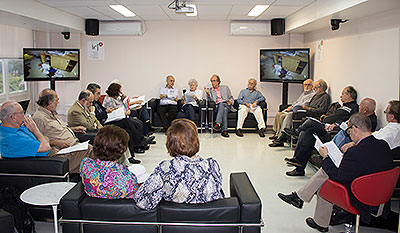
<p style="text-align: justify; "><img src="https://www.iea.usp.br/imagens/1a-reuniao-do-grupo-de-conjuntura-institucional" alt="1ª Reunião do Grupo de Conjuntura Institucional" class="image-right" title="1ª Reunião do Grupo de Conjuntura Institucional" />The other initiative is the creation of the Group for Institutional Situation to debate the most relevant aspects of academic and management policies of the university and the IEA. The first meeting of the group took place on November 19 with the participation of members and former members of IEA’s board and research groups of the institute. At the time, they gathered to discuss the effects of the invasion and occupation by students of USP's administrative complex where the IEA is located.</p>
<p style="text-align: justify; ">A series of discussions organized by IEA’s Direction and visiting professor <a href="https://www.iea.usp.br/en/persons/visiting-professors/bernardo-sorj-1" class="external-link">Bernardo Sorj</a> will deal with the production of meaning in the current sociocultural context, which transfers a constant decision-making process to the individual in an environment where he or she confronts multiple values, many of which are contradictory. The series is entitled ‘Em Busca do Sentido Perdido: Diálogos Interdisciplinares sobre Ciência e Transcendência’ (‘In Search of Lost Sense: Interdisciplinary Dialogues on Science and Transcendence’) and foresees five meetings to be hold throughout the year: ‘A Ciência e o Politeísmo de Valores’ (‘Science and the Polytheism of Values’), ‘O Indivíduo no Ocidente’ (‘The Individual in the West’), ‘O Ser Humano e a Natureza‘ (‘The Human Being and Nature’), ‘O Ser Humano e a Técnica’ (‘The Human Being and Technique’) and ‘O Lugar das Artes na Produção de Sentido’ (‘The Place of the Arts in the Production of Meaning’).</p>
<p style="text-align: justify; ">The issue of Brazilian industrial competitiveness, a sensitive topic to economic performance and development of the country, will be discussed in a cycle with a still undefined format. The proposal was brought up by IEA’s board in 2013 and will be coordinated by advisors Roberto Mendonça Faria, from IEA’s São Carlos Center, and Guilherme Ary Plonski, from USP’s Polytechnic School (POLI) and the Faculty of Economics, Business and Accounting (FEA).</p>
<p style="text-align: justify; "><img src="https://www.iea.usp.br/imagens/noam-chomsky-conferencia-no-iea-em-1996" alt="Noam Chomsky - conferência no IEA em 1996" class="image-left" title="Noam Chomsky - conferência no IEA em 1996" />Two initiatives involve partnerships with foreign IASs, both of them members of the <a class="external-link" href="http://www.ubias.net/">University-based Institute for Advanced Study network (UBIAS)</a>. Together with the <a class="external-link" href="http://www.iar.nagoya-u.ac.jp/">Institute for Advanced Research (IAR) of the University of Nagoya, Japan</a>, the IEA-USP will start the Intercontinental Academy project, which will bring together around 15 young researchers from different areas of knowledge and universities to a collaborative and interdisciplinary study, under the guidance of three senior scientists, with workshops in São Paulo and Nagoya in 2015. The laboratory ‘Interdisciplinary Approaches for Global Challenges: Transatlantic Dialogues’ will be a partnership between the IEA-USP and the <a class="external-link" href="http://www.birmingham.ac.uk/research/activity/ias/index.aspx">University of Birmingham’s Institute of Advanced Studies</a>. The project will bring together British and Brazilian experts in studies to identify possible solutions for the challenges that cities and their residents will face in the coming decades.</p>
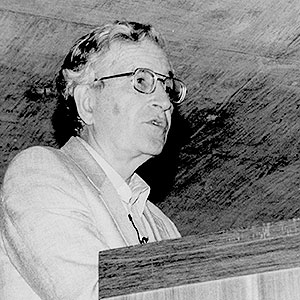
<p style="text-align: justify; ">Still in the international context, this summary of the agenda could not fail to highlight the possible presence of the renowned linguist and political activist Noam Chomsky, professor emeritus of the Massachusetts Institute of Technology (MIT), who has been invited to give a conference at the IEA in April. It could be the second visit of Chomsky. He participated in the celebrations of the institute’s 10th anniversary in 1996. Back then, he gave two conferences, one on Linguistics and another one on the application of the Washington Consensus in developing countries, published in issue 29 of ‘Estudos Avançados’.</p>
<p style="text-align: justify; ">The main scheduled activities for 2014 set by research groups, chairs, visiting professors and the journal are listed below.</p>
<p style="text-align: justify; "><strong>RESEARCH GROUPS</strong></p>
<p style="text-align: justify; "><span style="text-decoration: underline;">Amazon Transformation: History and Perspectives - Coordinator: Maritta Koch-Weser</span></p>
<p style="text-align: justify; ">In 2014 the group will continue to establish contacts with a view to developing the project of creating the Rainforest Continent Business School. The project schedule includes visits to the state of Amapá, after invitation by the state government, to the BNDES (national bank for development) in Rio de Janeiro, and to the Ministry of Science, Technology and Innovation, after invitation by Charles Noble, Secretary of Policy and Programmes for Research and Development at the ministry. The group will also continue the discussions originated in the meeting sponsored by FAPESP in North Carolina, as well as arrange meetings for the scientific committee and the work group of the project.</p>
<p style="text-align: justify; "><span style="text-decoration: underline;">Nuclear Astrophysics - Coordinator: Mahir Saleh Hussein</span></p>
<p style="text-align: justify; ">From April 14 to 16, the group will promote the ‘Neutrino and Nuclear Astrophysics Workshop’, with the participation of group members and guests. From the group, the participants will be Pierre Descouvemont (Université Libre de Bruxelles, Belgium), Carlos A. Bertulani (Texas A&amp;M University-Commerce, USA), Leandro Gasques (USP’s Institute of Physics - IF), Elcio Abdalla (IF), Michael Wiescher (University of Notre Dame, USA) and Ani Aprahamian (University of Notre Dame, USA). The guests will be Akif Baha Balantekin (University of Wisconsin-Madison, USA), Alexis Day-Torres (Università di Trento , Italy) and Beatriz Barbuy (USP's Institute of Astronomy, Geophysics and Atmospheric Sciences - IAG).</p>
<p style="text-align: justify; "><span style="text-decoration: underline;">Logic and Theory of Science - Coordinator: Jair Minoro Abe</span></p>
<p style="text-align: justify; ">The group will hold another edition of the ‘Intelligent Computing Systems Workshop’, in addition to continuing with monthly seminars on paraconsistent annotated logic in Biomedicine, Robotics and Automation at USP’s Faculty of Medicine Oscar Freire Institute.</p>
<p style="text-align: justify; "><span style="text-decoration: underline;">Quality of Democracy - Coordinator: José Álvaro Moisés</span></p>
<p style="text-align: justify; ">In February, the group will host Mino Vianello, from the Università degli Studi di Roma La Sapienza, Italy, who will give a lecture on Gender, Power and Quality of Democracy. In the second semester, an international seminar on Access to Justice, Public Security and Quality of Democracy will be hold in partnership with the University of North Carolina, USA. The group will continue to organize events on research topics and books of some of their participants, and to publish texts at www.qualidadedademocracia.com.br. Another activity that will continue in the website is the series of interviews ‘A Qualidade da Democracia em Questão’, which has already set several personalities to be interviewed 2014: Mino Vianello, Francisco Weffort, Fernando Henrique Cardoso, Celso Lafer, Bolívar Lamounier and Simão Schwartzman.</p>
<p style="text-align: justify; "><span style="text-decoration: underline;">Intercultural Dialogues - Coordinator: Sylvia Dantas</span></p>
<p style="text-align: justify; ">The group plans to hold a series of conferences on ‘Challenges of Multiculturalism: Reality and Perspectives’. The goal is to initiate dialogues in the interdisciplinary field of pursuit of dialogue, expansion and articulation of outbreaks, contextualizing and strategies that enable greater rapprochement regarding the complexity of the factors that result from the contact between cultures and the dynamics of increasing intercultural contact, addressing ethnic minorities in the university and among exchange students, migrants, refugees and descendants, and mobility and internationalization of Brazilian universities.</p>
<p style="text-align: justify; "><span style="text-decoration: underline;">Public Policies, Territoriality and Society - Coordinator: Neli Aparecida de Mello-Théry</span></p>
<p style="text-align: justify; ">The group will hold two international workshops in 2014: ‘Environment and Geomatics: Compared Studies France-Brazil’ in November 12-15 in Rennes, France, and ‘Climate Change, Energy Planning and Public Policy’, in partnership with the Latin American Council of Social Sciences (CLACSO) in October.</p>
<p style="text-align: justify; "><span style="text-decoration: underline;">Philosophy, History, and Sociology of Science and Technology - Coordinator: Pablo Rubén Mariconda</span></p>
<p style="text-align: justify; ">In 2014 the group will continue the activities of the FAPESP’s Thematic Project ‘Genesis and Meaning of Technoscience: the Relations between Science, Technology and Society’. Four seminars are already planned: ‘Humans and Animals: the Limits of Humanity’, under the coordination of Lorenzo Baravalle (UFABC) and Pablo Mariconda (IEA-USP); ‘Climate Change, Climate Panels and Economic Growth Model’, with six to eight meetings and coordination of Jose Correa Leite (IEA-USP) and Marcos Barbosa de Oliveira (IEA-USP); ‘Sustainable Forest Management and Stakeholder Values in the Relationship between Scientific Knowledge and Traditional Knowledge: the Value of Cooperation and Competition System’, with four to six meetings and coordination of Ana Teresa Reis da Silva (IEA-USP) and Pablo Mariconda (IEA-USP); and ‘Style of Scientific Thought’, having as coordinators Valter Alnis Bezerra (IEA-USP) and Otávio Bueno (University of Miami, USA). From March 10 to April 9, the group will host Helen Jerônimo, from the University of Lisbon, Portugal , who will give four conferences on Technological Risks: ‘Questioning Concepts of Risk and Uncertainty Regarding Issues of Scientific and Technological Base’, ‘The Scientific Examination: Specificities of Knowledge and Action’, ’When uncertainties are reduced to Risks: The Controversy Around the Hazardous Wastes in Portugal’ and ‘The Continuing Catastrophe: The Fukushima Accident and the uncertainties of Nuclear Power Plants’.</p>
<p style="text-align: justify; "><span style="text-decoration: underline;">Environment and Society - Coordinator: Peter Jacobi</span></p>
<p style="text-align: justify; ">The group has proposed the following research topics for 2014: ‘Solid Waste’ (in March) - discussions on the need to oppose the incineration responses; ‘Water Governance and Transparency’ - presentation of research results; ‘Environment and the Frontiers of Knowledge’ - interdisciplinary debates; ‘Environment and Post-Normal Science’ (in May) - visit of a researcher of the Dutch Environment Agency; ‘Climate Change’ - monitoring of the situation on controversial topics in Brazilian environment policy; ‘Innovation in Environmental Governance’ - various themes regarding government, productive sector and society; and meetings with authors of books on environmental issues.</p>
<p style="text-align: justify; "><span style="text-decoration: underline;">Nutrition and Poverty - Coordinator: Ana Lydia Sawaya</span></p>
<p style="text-align: justify; ">In 2014 the group will focus on the inclusion of content in their section on IEA's website. Another guideline is to deepen activities in partnerships with public bodies, in particular with São Paulo City Hall, whose first lady Ana Estela Haddad joined the group. Ana Estela is a professor of USP’s School of Dentistry and coordinator of the City Hall’s Early Childhood Policy. She has launched the ‘Cidade Carinhosa’ programme, aimed at children up to 6 years old.</p>
<p style="text-align: justify; "><span style="text-decoration: underline;">Innovation and Competitiveness Observatory – Coordinator: Mario Salerno</span></p>
<p style="text-align: justify; ">The activities that have already been planned by the group are the preparation of a new edition of the EngenhariaData report, and the planning and execution of the ‘Trajetória’ project, which aims to recover and systematize information on the trajectory of engineers in the labor market, from studying to current activities. Four events are intended to be hold: the release of the EngenhariaData report and the launch of a new website; a seminar on public and private funding for the productive sector and innovation; a seminar on evaluation criteria in bidding for funding; and a seminar with the new Provost for Research on management project.</p>
<p style="text-align: justify; "><strong>CHAIRS</strong></p>
<p style="text-align: justify; "><span style="text-decoration: underline;">UNESCO Chair on Education for Peace, Human Rights, Democracy and Tolerance</span></p>
<p style="text-align: justify; ">Throughout the year, the chair will hold the ‘City of Human Rights’ project in partnership with USP’s Maria Antonia Center. The project has been given a fund of R$ 180.000,00 after approval by the Provost for Culture and University Extension. In addition, the chair will hold discussions on three topics: Memory and Democracy, the 50th Anniversary of the Military Coup in Brazil, and Dignity and Intolerance.</p>
<p style="text-align: justify; "><span style="text-decoration: underline;">Bernardo O'Higgins Chair</span></p>
<p style="text-align: justify; ">The chair, newly restructured, has already scheduled a workshop on Memory, Society and Culture to be organized by the IEA-USP and the Center for Social Sciences of the Universidad de la Frontera (UFRO), Chilean partner of USP in the agreement of the chair.</p>
<p style="text-align: justify; "><strong>VISITING PROFESSORS</strong></p>
<p style="text-align: justify; "><a href="https://www.iea.usp.br/en/persons/visiting-professors/copy2_of_massimo-canevacci" class="external-link">Massimo Canevacci</a>, from the Università degli Studi di Roma La Sapienza, Italy, will continue his project ‘Self-representation’.</p>
<p style="text-align: justify; "><a href="https://www.iea.usp.br/en/persons/visiting-professors/hugh-matthew-lacey" class="external-link">Hugh Lacey</a>, professor emeritus from Swarthmore College, USA, will work on the conclusion of the dossier ‘Technoscience’ and the Model of Interaction between Science and Values​​.</p>
<p style="text-align: justify; "><a href="https://www.iea.usp.br/en/persons/visiting-professors/bernardo-sorj-1" class="external-link">Bernardo Sorj</a> will continue his research project ‘Middle East Conflict: Scope and Limits of Brazilian External Politics’ and will coordinate, together with the direction of the institute, the series of debates ‘Em Busca do Sentido Perdido: Diálogos Interdisciplinares sobre Ciência e Transcendência’ (‘In Search of Lost Sense: Interdisciplinary Dialogues on Science and Transcendence’).</p>
<p style="text-align: justify; ">‘ESTUDOS AVANÇADOS’ JOURNAL</p>
<p style="text-align: justify; ">In March, the launch event of issue 79 will take place. Its main dossier with be on public transport. In April, issue 80 will be released with a dossier on the 50th anniversary of the military coup in Brazil.</p>]]></content:encoded>
    <dc:publisher>No publisher</dc:publisher>
    <dc:creator>Richard Meckien</dc:creator>
    <dc:rights></dc:rights>
    
      <dc:subject>Abstraction</dc:subject>
    
    
      <dc:subject>Institutional</dc:subject>
    
    
      <dc:subject>Commons</dc:subject>
    
    
      <dc:subject>Glocal</dc:subject>
    
    
      <dc:subject>Research</dc:subject>
    
    
      <dc:subject>Transformation</dc:subject>
    
    
      <dc:subject>History</dc:subject>
    
    <dc:date>2013-12-19T19:10:00Z</dc:date>
    <dc:type>Notícia</dc:type>
  </item>


  <item rdf:about="https://www.iea.usp.br/en/news/estudos-avancados-journal-discusses-the-identity-of-brazilian-archeology">
    <title>'Estudos Avançados' Journal Discusses the Identity of Brazilian Archeology</title>
    <link>https://www.iea.usp.br/en/news/estudos-avancados-journal-discusses-the-identity-of-brazilian-archeology</link>
    <description></description>
    <content:encoded xmlns:content="http://purl.org/rss/1.0/modules/content/"><![CDATA[<p><img src="https://www.iea.usp.br/imagens/capa-revista-estudos-avancados-v-29-n-83/@@images/73a1a75f-1c7c-4c22-86fc-52dbc6c28a1a.jpeg" alt="Capa Revista Estudos Avançados V 29 N 83" class="image-right" title="Capa Revista Estudos Avançados V 29 N 83" /></p>
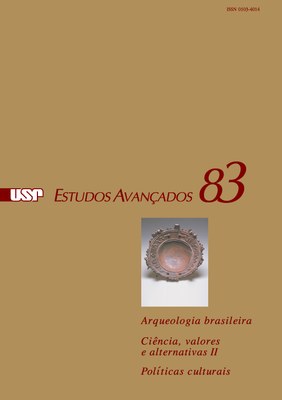
<p>“Is there an original theoretical contribution that Brazilian archeology can make to this discipline?” The author of the question is Eduardo Goes Neves, researcher at USP’s Museum of Archaeology and Ethnology (MAE) and organizer of the dossier “Aspects of Brazilian Archaeology” that opens the new edition (No. 83) of the <i>Estudos Avançados</i> journal. (<i>The digital edition is available at <i><a class="external-link" href="http://www.scielo.br/scielo.php?script=sci_issuetoc&amp;pid=0103-401420150001&amp;lng=pt&amp;nrm=iso">SciELO</a></i>.</i>)</p>
<p class="Text"><span>In addition to discussing the identity of Brazilian archeology, the dossier also brings articles on Amazonia, the Pantanal region, the ethylic practices of the Tupi-Guarani, early settlement of South America and the cultural landscapes of the southern Brazilian plateau.</span></p>
<p class="Sub1"><span><strong>History and temporality</strong></span></p>
<p>In the introductory article, <i>Is There Something We Can Call “Brazilian archeology”?</i>, Neves assesses whether there is a corpus of problems and specific data that are unique to, or at least a prerogative of, Brazilian archeology. Although he does not have a clear answer to the question, he is certain that it involves the concepts of history and temporality of South American indigenous societies.</p>
<p class="Text"><span>Neves’ article is discussed by Ulpiano Bezerra de Meneses, professor emeritus at the School of Philosophy, Literature and Human Sciences (FFLCH), and author of the essay <i>The Identity of the Brazilian Archaeology</i>.</span></p>
<p class="Text"><span>For Meneses, the conciliation of history and temporality advocated by Neves is exciting and ethnographically feasible, but archaeologically presents numerous difficulties because “from the point of view of the groups that we studied, we cannot assume the same kind of relationship we have with artifacts.”</span></p>
<p class="Text"><span>With regard to the framework of reference of Brazilian archaeologists, Meneses said it is necessary “to reiterate the warning made by Eduardo Neves: we must look less outside the continent for theoretical references, and conversely, more at the available local evidence.”</span></p>
<p class="Text"><span>The other articles of the dossier are: <i>Agricultural Determinism in Amazonian Archeology</i>, by </span><span>Claide de Paula Moraes; <i>Archeology and </i></span><i><span>Indigenous History </span></i><i><span>in the Pantanal </span><span>Region</span></i><span>, by Eduardo Bespalez; <i>The Archaeology of Fermented Brews: An Ethylic History of the Tupi-Guarani People</i></span><span>, by </span><span>Fernando Ozorio de Almeida; <i>Early Settlements in South America: Contributions of the Brazilian Milieu</i>, by Lucas Bueno and Adriana Dias; and <i>The Genesis of the Cultural Landscapes of the Southern Brazilian Plateau</i>, by Silvia Moehlecke Copé.</span></p>
<p><span><strong>Science and values</strong></span></p>
<p>In addition to the dossier on Brazilian archeology, issue no. 83 of <i>Estudos Avançados</i> publishes the second part of the dossier “Sciences, Values and Alternatives,” organized by the History, Philosophy and Sociology of Science and Technology research group, which brings the findings of studies made by the group under FAPESP’s thematic project “Genesis and Meaning of Technoscience: The Relationships Between Science, Technology and Values.”</p>
<p class="Text"><span>Whereas in the first part (published in <a class="external-link" href="http://www.scielo.br/scielo.php?script=sci_issuetoc&amp;pid=0103-401420140003&amp;lng=pt&amp;nrm=iso">issue 82</a>) the texts addressed methodological concerns of researches on the relationship between science and values, this time the articles examine three areas where attention to values is crucially important: agro-ecology, health and biodiversity.</span></p>
<p class="Text">The first topic is discussed by <a href="https://www.iea.usp.br/en/persons/visiting-professors/hugh-matthew-lacey" class="external-link">Hugh Lacey</a> in <i><span>Agroecology: An Illustration of the Fruitfulness of Multi-Strategy Research</span></i>, and by Rubens Onofre Nodari and Miguel Pedro Guerra in <i><span>Agroecology: Research Strategies and Values</span></i>. Lacey was visiting professor at the IEA in 2011 and 2013, and currently heads the Agroecology Workgroup of the <a href="https://www.iea.usp.br/en/research/research-groups/philosophy-history-sociology-of-science-and-technology" class="external-link">IEA-USP’s Philosophy, History, and Sociology of Science and Technology Research Group</a>.</p>
<p class="Text">The other two topics are covered by <a href="https://www.iea.usp.br/en/persons/visiting-professors/copy_of_nicolas-lechopier/nicolas-lechopier-a" class="external-link">Nicolas Lechopier</a>, visiting professor at the IEA in 2013, who contributes with <i>Four Tensions in Public Health</i>, and by Ana Tereza Reis da Silva, author of <i><span>The Conservation of Biodiversity Between Traditional Knowledge and Science</span></i>.</p>
<p class="Sub1"><span><strong>Other articles</strong></span></p>
<p>The journal also features articles on economics, orthographic changes, and anthropology.</p>
<p class="Text"><span>Economist Ladislau Dowbor, professor at PUC-SP, is the author of </span><i><span>The Current Financial System Hampers Economic Development</span></i><span>,</span><span> where he analyzes how the system of financial intermediation sterilizes a country’s assets by draining staggering amounts of resources that should be directed to productive and economic development.</span></p>
<p class="Text"><span>In </span><i><span>A Serene and Scientific View of the New Orthographic Agreement</span></i><span>, philologist Evanildo Bechara, from the Brazilian Academy of Letters, examines criticism of the 1990 Orthographic Agreement.</span></p>
<p class="Text"><span>In the article </span><i><span>The Occupation of Congress: What Are the Indigenous People Fighting Against?</span></i><span>,</span><span> anthropologists Artionka Capiberibe, from Unicamp, and Oiara Bonilla, from the Fluminense Federal University (UFF), address the clash between politics and the economic model that underlies the resistance of indigenous peoples to agribusiness and its representatives in Congress.</span></p>
<p class="Text"><span>The edition also includes reviews of the latest books by Nabil Bonduki, Ana Paula Koury, Marco Bobbio, Michael Löwy, Mauro Rosso (as organizer), and an essay by Lorenzo Mammi on the installation “Clara Clara,” by Laura Vinci.</span></p>]]></content:encoded>
    <dc:publisher>No publisher</dc:publisher>
    <dc:creator>Mauro Bellesa</dc:creator>
    <dc:rights>Original version in Portuguese by Mauro Bellesa and translation by Carlos Malferrari</dc:rights>
    
      <dc:subject>Abstraction</dc:subject>
    
    
      <dc:subject>Research Group: Philosophy, History, and Sociology of Science and Technology</dc:subject>
    
    
      <dc:subject>Social Sciences</dc:subject>
    
    
      <dc:subject>Transformation</dc:subject>
    
    <dc:date>2015-05-13T13:25:00Z</dc:date>
    <dc:type>Notícia</dc:type>
  </item>


</rdf:RDF>