<?xml version="1.0" encoding="utf-8" ?>
<rdf:RDF xmlns:rdf="http://www.w3.org/1999/02/22-rdf-syntax-ns#" xmlns:dc="http://purl.org/dc/elements/1.1/" xmlns:syn="http://purl.org/rss/1.0/modules/syndication/" xmlns="http://purl.org/rss/1.0/">


<channel rdf:about="https://www.iea.usp.br/search_rss">
  <title>Instituto de Estudos Avançados da Universidade de São Paulo</title>
  <link>https://www.iea.usp.br</link>

  <description>
    
            These are the search results for the query, showing results 1 to 15.
        
  </description>


  <image rdf:resource="https://www.iea.usp.br/logo.png" />

  <items>
    <rdf:Seq>
      
        <rdf:li rdf:resource="https://www.iea.usp.br/en/news/indigenous-women-take-ffice" />
      
      
        <rdf:li rdf:resource="https://www.iea.usp.br/en/media-library/photos/events-2022/inauguration-conceicao-evaristo-september-9-2022" />
      
      
        <rdf:li rdf:resource="https://www.iea.usp.br/en/news/iea-zif-promote-exhibition" />
      
      
        <rdf:li rdf:resource="https://www.iea.usp.br/en/news/journal-issue-104" />
      
      
        <rdf:li rdf:resource="https://www.iea.usp.br/en/news/antoni-muntadas-about-academia-i-ii-an-online-interpretation-2011-2017-2021" />
      
      
        <rdf:li rdf:resource="https://www.iea.usp.br/en/news/herkenhoff-nader-new-holders-olavo-setubal-chair-2019" />
      
      
        <rdf:li rdf:resource="https://www.iea.usp.br/en/news/93-estudos-avancados-reflects-on-the-teaching-of-humanities" />
      
      
        <rdf:li rdf:resource="https://www.iea.usp.br/en/news/eliana-sousa-silva-takes-on-olavo-setubal-chair" />
      
      
        <rdf:li rdf:resource="https://www.iea.usp.br/en/media-library/photos/events-2018/posse-eliana-sousa-silva-catedra-olavo-setubal-de-arte-cultura-e-ciencia-27-de-marco-de-2018" />
      
      
        <rdf:li rdf:resource="https://www.iea.usp.br/en/news/perspectives-of-culture-according-to-ricardo-ohtake" />
      
      
        <rdf:li rdf:resource="https://www.iea.usp.br/en/media-library/photos/events-2017/ricardo-ohtake-takes-office-chair-olavo-setubal-17-march-2017" />
      
      
        <rdf:li rdf:resource="https://www.iea.usp.br/en/news/museum-of-things-inbetween" />
      
      
        <rdf:li rdf:resource="https://www.iea.usp.br/en/news/researcher-shows-the-power-of-games-and-virtuality-in-science-and-museums" />
      
      
        <rdf:li rdf:resource="https://www.iea.usp.br/en/news/time-in-art" />
      
      
        <rdf:li rdf:resource="https://www.iea.usp.br/en/media-library/photos/events-2016/modernity-ambivalences" />
      
    </rdf:Seq>
  </items>

</channel>


  <item rdf:about="https://www.iea.usp.br/en/news/indigenous-women-take-ffice">
    <title>Indigenous women take office as holders of the Olavo Setubal Chair on March 1</title>
    <link>https://www.iea.usp.br/en/news/indigenous-women-take-ffice</link>
    <description></description>
    <content:encoded xmlns:content="http://purl.org/rss/1.0/modules/content/"><![CDATA[<table class="tabela-esquerda">
<tbody>
<tr>
<th><img src="https://www.iea.usp.br/imagens/arissana-pataxo-francy-baniwa-e-sandra-benites-janeiro-2024" alt="Arissana Pataxó, Francy Baniwa e Sandra Benites - janeiro/2024" class="image-inline" title="Arissana Pataxó, Francy Baniwa e Sandra Benites - janeiro/2024" /></th>
</tr>
<tr>
<td><span class="discreet">From left to right: Arissana Pataxó, Francy Baniwa, and Sandra Benites at the IEA in January</span></td>
</tr>
</tbody>
</table>
<p>Indigenous leaders Arissana Pataxó, Francy Baniwa, and Sandra Benites will take office as new holders of the Olavo Setubal Chair of Art, Culture, and Science on March 1, at 10:00 am. The Chair is a partnership between the IEA and Itaú Cultural. The ceremony will be open to the public and held in USP's Council Room. Live transmission will be provided. Those interested in attending the event in person must register in advance.</p>
<p>The trio will develop the research program "<i>Caminho da Cutia</i>: Territory and Knowledge of Indigenous Women," which will address the knowledge and activities of indigenous women based on experiences in different areas, from the work of midwives to the production of ceramics, the cultivation of fields to school education, as well as their activities in politics, academia, the arts, and other areas.</p>
<p>The idea is to provide spaces, interactions, and actions that contribute to a fruitful dialogue between the University and indigenous peoples regarding knowledge itself but also ways of getting to know and transmitting knowledge. Throughout 2024, the holders intend to provide both the sharing of knowledge and worldviews of their own ethnicities with non-indigenous people, as well as exchanges and rapprochements between different indigenous peoples.</p>
<p><strong>Profiles</strong></p>
<p>Visual artist, professor and researcher, Pataxó was born in Porto Seguro (State of Bahia) and is part of the Pataxó ethnic group. She holds a master's degree in ethnic and African studies from the Federal University of Bahia (UFBA), where she is carrying out doctoral research in visual arts, the area of her graduation from the same University. In her artistic work, she addresses indigenous reality and its interaction with other contemporary realities, making use of various techniques and supports.</p>
<p>Baniwa is an anthropologist, writer, photographer, filmmaker, and doctoral candidate in social anthropology at the Federal University of Rio de Janeiro (UFRJ), where she became a master in the same area after graduating in sociology from the Federal University of Amazonas (UFAM). She is part of the Wanaliana community, located in the Upper Negro River indigenous land in São Gabriel da Cachoeira (State of Amazonas), and has been active in the indigenous movement in the region for more than 10 years.</p>
<p dir="ltr">A PhD candidate in anthropology at (UFRJ), Benites is the director of visual arts at the Brazilian Foundation for the Arts (FUNARTE) and works as an art curator, educator, and activist for the Guarani Nhandeva people. Born in the Porto Lindo indigenous land in Japorã (State of Mato Grosso do Sul), she became a master in social anthropology through the postgraduate program at the National Museum of UFRJ. She has been deputy curator of Brazilian art at the <span>Assis Chateaubriand </span>São Paulo Museum of Art (MASP).</p>
<p><strong>Farewell</strong></p>
<p>The ceremony will also feature a farewell speech by writer and educator Conceição Evaristo, holder of the Chair in 2022 and 2023, and a presentation by educator Ana Maria Rabelo Gomes, from the Federal University of Minas Gerais (UFMG), paranymph of the three new holders.</p>
<p>The opening of the event will feature institutional speeches by Martin Grossmann, academic coordinator of the Chair; Roseli de Deus Lopes, deputy director of the IEA; Eduardo Saron, president of the Itaú Foundation; Maria Alice Setubal, representative of the Setubal family; and Maria Arminda do Nascimento Arruda, vice-president of USP.</p>
<p><i> </i></p>
<p style="text-align: right; "><span class="discreet"><i>Photo: Leonor Calasans. Edited by Tie Ito, both from the IEA.</i></span></p>]]></content:encoded>
    <dc:publisher>No publisher</dc:publisher>
    <dc:creator>Richard Meckien</dc:creator>
    <dc:rights>Original version in Portuguese by Mauro Bellesa.</dc:rights>
    
      <dc:subject>Art</dc:subject>
    
    
      <dc:subject>Olavo Setubal Chair</dc:subject>
    
    
      <dc:subject>Anthropology</dc:subject>
    
    
      <dc:subject>Culture</dc:subject>
    
    
      <dc:subject>Indigenous peoples</dc:subject>
    
    
      <dc:subject>Education</dc:subject>
    
    <dc:date>2024-02-20T15:20:00Z</dc:date>
    <dc:type>Notícia</dc:type>
  </item>


  <item rdf:about="https://www.iea.usp.br/en/media-library/photos/events-2022/inauguration-conceicao-evaristo-september-9-2022">
    <title>Inauguration of Conceição Evaristo - Olavo Setubal Chair of Art, Culture, and Science - September 9, 2022</title>
    <link>https://www.iea.usp.br/en/media-library/photos/events-2022/inauguration-conceicao-evaristo-september-9-2022</link>
    <description></description>
    
    <dc:publisher>No publisher</dc:publisher>
    <dc:creator>Richard Meckien</dc:creator>
    <dc:rights></dc:rights>
    
      <dc:subject>Culture</dc:subject>
    
    
      <dc:subject>Literature</dc:subject>
    
    
      <dc:subject>Art</dc:subject>
    
    
      <dc:subject>Olavo Setubal Chair</dc:subject>
    
    <dc:date>2022-09-08T13:25:00Z</dc:date>
    <dc:type>Pasta</dc:type>
  </item>


  <item rdf:about="https://www.iea.usp.br/en/news/iea-zif-promote-exhibition">
    <title>IEA and ZiF promote the exhibition "Grace at the boundary of knowledge" at the MariAntonia Center</title>
    <link>https://www.iea.usp.br/en/news/iea-zif-promote-exhibition</link>
    <description></description>
    <content:encoded xmlns:content="http://purl.org/rss/1.0/modules/content/"><![CDATA[<p><span id="docs-internal-guid-f2554a7e-7fff-30dd-3e24-80b53d0ddb03"> </span></p>
<p dir="ltr"><span><img src="https://www.iea.usp.br/imagens/banner_grace_500x243.png" alt="Banner Grace" class="image-right" title="Banner Grace" /></span><span>The exhibition <i>Grace at the boundary of knowledge</i>, by artist <a href="https://www.sandraboeschenstein.ch/">Sandra Boeschenstein</a>, will be inaugurated at the University of São Paulo's MariAntonia Cultural Center <span>on August 6, </span><span>at 11:00 am</span>. With free admission, it will run until November 20 and will be open to the public from Tuesday to Sunday and on holidays from 10:00 am to 6:00 pm. At the opening, at 12:00 pm, there will be a conversation between the artist and the Brazilian curator.</span></p>
<p dir="ltr"><span class="ChMk0b JLqJ4b"><span class="Q4iAWc">Curated by Martin Grossmann (Institute of Advanced Studies at USP) and Britta Padberg, former executive director at Bielefeld University's <a class="external-link" href="https://www.uni-bielefeld.de/ZiF/">Center for Interdisciplinary Research (ZiF)</a>, the exhibition showcases an "unregulated encounter of things, images, and words that unleashes the qualities and potentials of media."</span></span><span> <span>Boeschenstein</span></span><span class="ChMk0b JLqJ4b"><span class="Q4iAWc">'s attention is focused on these transitions and on the ways of experiencing them.</span></span><span> </span><span class="ChMk0b JLqJ4b"><span class="Q4iAWc">According to the organizers, "the exhibition is a continuum of intertwined gestures, placing the act of perception at the center and making visible the dynamic nature of meanings."</span></span></p>
<blockquote>
<div dir="ltr">
<div dir="ltr">
<div class="gmail_quote">
<div>
<div>
<div>
<div>"In this case, the MariAntonia Cultural Center becomes an interactive extension of this interdisciplinary platform that is the IEA-USP by providing the ambience and the necessary complementarity for its realization. This partnership, whether with MariAntonia or with the ZIF, further enhances this ambitious mission of fostering encounters of different cultures, knowledges, disciplines, and practices that the IEA has been carrying out throughout its 35 years of life," explains Grossmann.<br /><br />Whether for her singular investment in the language of drawing in expanded mode or for her remarkable participations in other institutes for advanced study in Europe, interacting in equivalence with scientists and intellectuals of different matrices, Sandra Boeschenstein provokes reactions and questionings of the most diverse forms <span>with her daring drawings</span>.<br /><br /><i>Grace at the boundary of knowledge</i> establishes a kind of game with the visitor. However, the pieces, the board (the spatiality), the rules, and the references are not objectively delineated. Warning: the experience causes strangeness, displacement, and questioning, all fundamental to the updating and expansion of knowledge.<br /><br />The activity is a cooperation between the ZiF and the IEA. Support is provided by the <a class="external-link" href="https://prohelvetia.ch/en/">Swiss Arts Council Pro Helvetia</a>, IEA's research group <a class="external-link" href="http://www.forumpermanente.org/en">Fórum Permanente</a>, and USP's <a class="external-link" href="https://prceu.usp.br/en/">Office of the Provost for Culture and Extension (PRCEU)</a>.</div>
<br /><span><span id="docs-internal-guid-d5be1f93-7fff-b64e-9857-05388d98ddf8">
<p dir="ltr"><span><strong>The artist</strong></span></p>
<p dir="ltr"><span>Sandra Boeschenstein</span><span> is a visual artist who lives and works in Zurich. She has studied Philosophy and Art History at the University of Zurich for a year and graduated as an artist from the University of Arts in Bern in 1995.</span></p>
<p dir="ltr"><span>Through drawing, she proposes to seek knowledge and analyze the interaction between perception and thought, exploring the border between tangible and intangible, between image and language, and between information and poetry. Over the past few years, Boeschenstein has expanded her drawing on paper to drawings on walls, in which she arranges real objects that relate to the images and lines in space.</span></p>
<blockquote>
<div dir="ltr">
<div dir="ltr">
<div class="gmail_quote">
<div>
<div>
<div>
<div></div>
</div>
</div>
</div>
</div>
</div>
</div>
</blockquote>
<p class="callout"><span id="docs-internal-guid-ccd6c880-7fff-39ae-94ad-0677b10c5023"><span>“When is something and how does it accrue meaning? How do the situation, the image, and language touch each other? What is the appearance of a knowledge beckoning between material, picture, and language and that cannot be further extracted? Bringing light into darkness is simpler than darkness into light. The boundary of knowledge forms in the hierarchy-free play of these two actions. This is work with both the constructing and the decaying energies of meanings” <br /><strong>Sandra Boeschenstein</strong><br /></span></span></p>
<p dir="ltr"><i><span><strong> </strong></span></i></p>
<hr />
<i><strong>Grace at the boundary of knowledge<br /></strong></i></span><i><span>August 6 - November 20<br /></span><span>Free of charge<br /></span><span>Tuesdays to Sundays and holidays, 10:00 am - 6:00 pm</span></i>
<p><i>MariAntonia Center - Joaquim Nabuco Building<br /></i><i>Address: Rua Maria Antônia, 258, Vila Buarque - São Paulo, SP<br /></i><i>Near subway stations: Higienópolis (Yellow line) and Santa Cecília (Red line)</i></p>
<p><i><img src="https://www.iea.usp.br/imagens/Regua_video_grace_branco_600x337.png" alt="Régua vídeo Grace branco - 600x337" class="image-inline" title="Régua vídeo Grace branco - 600x337" /></i></p>
</span></div>
</div>
</div>
</div>
</div>
</div>
</blockquote>]]></content:encoded>
    <dc:publisher>No publisher</dc:publisher>
    <dc:creator>Richard Meckien</dc:creator>
    <dc:rights>Original version in Portuguese by Beatriz Herminio</dc:rights>
    
      <dc:subject>Culture</dc:subject>
    
    
      <dc:subject>Research Group: Fórum Permanente: Cultural System Between Public and Private</dc:subject>
    
    
      <dc:subject>Art</dc:subject>
    
    
      <dc:subject>Exhibition</dc:subject>
    
    <dc:date>2022-07-06T19:10:00Z</dc:date>
    <dc:type>Notícia</dc:type>
  </item>


  <item rdf:about="https://www.iea.usp.br/en/news/journal-issue-104">
    <title>The centenary of the Modern Art Week and research universities are addressed in "Estudos Avançados" #104</title>
    <link>https://www.iea.usp.br/en/news/journal-issue-104</link>
    <description> </description>
    <content:encoded xmlns:content="http://purl.org/rss/1.0/modules/content/"><![CDATA[<p><img src="https://www.iea.usp.br/imagens/capa-revista-estudos-avancados-104" alt="Capa Revista Estudos Avançados - 104" class="image-right" title="Capa Revista Estudos Avançados - 104" /></p>
<p>The 104th issue of the journal <i><a href="https://www.iea.usp.br/en/journal" class="external-link">Estudos Avançados</a></i> brings the centenary of the 1922 Modern Art Week, the role of research at universities, and the 60 years of the creation of the São Paulo Research Foundation (FAPESP) <span>as its central themes</span><span>. The digital version is available on the </span><a class="external-link" href="https://www.scielo.br/j/ea/i/2022.v36n104/">SciELO</a><span> platform (Portuguese only).</span></p>
<p>The opening dossier, dedicated to the Modern Art Week, features articles that evaluate how timely this "complex and plural" movement still is, being "one of the most important movements in Brazilian culture," according to the publication's editor, <a href="https://www.iea.usp.br/en/persons/researchers/sergio-adorno" class="external-link">Sérgio Adorno</a>.</p>
<p>Regarding the landmark of the last century, "a lot has been written about the main events, the participants, the motivations, the reference works, the polemics that surrounded it, the noisy reception, and the nonconformity with the dominant traditionalism in the arts." <i>Estudos Avançados</i>, however, "did not intend to repeat what is already known, but to add new contributions," says Adorno.</p>
<p>In the article "Notes on Modernism," Eduardo Jardim exposes two different times in the 1920s as two ways of conceiving modernism between the incorporation of modern languages of European influence and the adoption of national traits in the art produced in the country.</p>
<p>The original myths about the rediscovery of Brazil and the resumption of colonial roots as achievements of modernism are themes present in the article "The Reinvention of the Week and the Myth of the Discovery of Brazil," by Rafael Cardoso. The author also brings up critical disputes around the Modern Art Week.</p>
<p>Further contributions explore Mário de Andrade's achievements in the movement, such as his way of thinking about Brazilian unity and the diversity of "Brazils." In this sense, the project of a country that invested in the ethnic and cultural mixture through art is analyzed. T<span>he article "Brazil and Mário de Andrade's Brazils: the End of the Apprentice Tourist?" points out how the country </span><span>was questioned due to the need to determine cultural differences to face internal inequalities.</span></p>
<p>The dossier also has articles addressing similarities and differences between Argentine and Brazilian avant-gardes in the 1920s, and the importance of clothing for Brazilian modernism.</p>
<p><span><strong>Research Universities</strong></span></p>
<p>The articles in the second dossier address the contribution of universities and research to the country's development in several areas, a "current and inexhaustible" issue that "raises polemics and divergent positions," as Adorno states.</p>
<p>According to the article that opens the dossier, "Research and Graduate Studies in Brazil: Two Sides of the Same Coin?," written by Simon Schwartzman, the distribution profile of researchers and graduate courses in Brazil started to follow the profile of enrollment in undergraduate courses from the 2000s onwards. With an analysis of the characteristics of the system and the occupation of graduate students, the author concludes that the expansion of the research system responded to the demands for titling of higher education professors in detriment of the country's research priorities.</p>
<p>The second article ("The Abandonment of the 'University Spirit' in the Construction of the Armando de Sales Oliveira Campus") brings the history of the foundation and the fundamentals of USP, and considers the absence of a university spirit. It highlights the lack of an integrating environment in the project by not taking the academic aspect <span>into account.</span></p>
<p>Closing the dossier, the article "The University as a Reliable Source for the Formulation and Improvement of Public Policies" evaluates the influence of USP on public policies. The analysis is based on the University's performance during the COVID-19 pandemic and its scientific production in various areas of knowledge during this period, which served as a source for the implementation and evaluation of public policies.</p>
<p><span><strong>60 Years of FAPESP</strong></span></p>
<p>To celebrate the 60th anniversary of the creation of the São Paulo Research Foundation (FAPESP,) the journal features articles that address the solid role of the institution in proposing decisive strategies for the development of the country based on knowledge. Despite facing repeated threats to its assets and budget, the Foundation stands out in the articles for its budgetary and administrative management, and for the execution of its activities.</p>
<p><span>The list below contains the names of the authors who have contributed with each one of the addressed themes:</span></p>
<p><strong>100 Years of the Modern Art Week</strong></p>
<p><i>Eduardo Jardim<br /></i><i>Rafael Cardoso<br /></i><i>Pedro Duarte<br /></i><i>Eduardo Coelho<br /></i><i>Ivan Francisco Marques<br /></i><i>Marcos Antônio de Moraes and</i><span> </span><i>Rodrigo de Albuquerque Marques<br /></i><i>Gênese Andrade<br /></i><i>Flávia Camargo Toni and </i><i>Camila Fresca<br /></i><i>Carolina Casarin<br /></i><i>Carlos Sandroni</i></p>
<p><strong>Research Universities</strong></p>
<p dir="ltr"><i>Simon Schwartzman<br />Caio Dantas<br />Vahan Agopyan and Glauco Arbix</i></p>
<p><strong>60 Years of FAPESP</strong></p>
<p dir="ltr"><i>Marco A. Zago and José R. Drugowich de Felício<br />Jacques Marcovitch<br />Hernán Chaimovich</i></p>
<div id="_mcePaste">
<div class="tlid-results-container results-container">
<div class="tlid-result result-dict-wrapper">
<div class="result tlid-copy-target">
<div class="text-wrap tlid-copy-target"></div>
</div>
</div>
</div>
</div>]]></content:encoded>
    <dc:publisher>No publisher</dc:publisher>
    <dc:creator>Richard Meckien</dc:creator>
    <dc:rights>Original version in Portuguese by Mauro Bellesa.</dc:rights>
    
      <dc:subject>Literature</dc:subject>
    
    
      <dc:subject>Art</dc:subject>
    
    
      <dc:subject>Journal</dc:subject>
    
    
      <dc:subject>Research</dc:subject>
    
    
      <dc:subject>Publications</dc:subject>
    
    <dc:date>2022-03-08T17:40:00Z</dc:date>
    <dc:type>Notícia</dc:type>
  </item>


  <item rdf:about="https://www.iea.usp.br/en/news/antoni-muntadas-about-academia-i-ii-an-online-interpretation-2011-2017-2021">
    <title>Antoni Muntadas: About Academia I-II, an Online Interpretation, 2011-2017 (2021)</title>
    <link>https://www.iea.usp.br/en/news/antoni-muntadas-about-academia-i-ii-an-online-interpretation-2011-2017-2021</link>
    <description></description>
    <content:encoded xmlns:content="http://purl.org/rss/1.0/modules/content/"><![CDATA[<p style="text-align: right; "><i><span style="text-align: right; ">from </span><a class="external-link" href="http://www.forumpermanente.org/event_pres/exposicoes/about-academia-i-ii-uma-interpretacao-online-2011-2017-2021/antoni-muntadas-about-academia-i-ii-an-online-interpretation-2011-2017-2021">www.forumpermanente.org<br /></a><a class="external-link" href="https://aboutacademia.iea.usp.br/">Visit the exhibition's website here</a></i></p>
<table class="tabela-direita-300">
<tbody>
<tr>
<th><img src="https://www.iea.usp.br/imagens/exposicao-sobre-academia-de-antoni-muntandas/@@images/11d40d59-c4c4-4720-9501-0994d63cab36.jpeg" alt="Exposição &quot;Sobre Academia&quot;, de Antoni Muntandas" class="image-inline" title="Exposição &quot;Sobre Academia&quot;, de Antoni Muntandas" /></th>
</tr>
<tr>
<td><span class="discreet">Video installation ''About Academia," by Antoni Muntadas, in 2017</span></td>
</tr>
</tbody>
</table>
<p dir="ltr">Based on his experience in American higher education, artist Antoni Muntadas inaugurates in Brazil an online interpretation of "About Academia." The project discusses the role and function of universities today, the place of art in this context, the relationship between public and private, tradition and contemporaneity, the future of universities and interdisciplinarity, based on interviews with professors and students.</p>
<p dir="ltr">"About Academia," a project originally presented at the Carpenter Center for the Visual Arts, invited by Harvard University, during Antoni Muntadas' last teaching period in the program in Art, Culture and Technology at the Massachusetts Institute of Technology (ACT MIT), in 2011, followed in different versions to cities like Boston, Vancouver, Amsterdam, Seville, among others.</p>
<p dir="ltr">The Brazilian version of the video installation "About Academia," which at first would occupy the Biblioteca Brasiliana at the University of São Paulo's (USP) Butantã Campus in São Paulo, translates as another work of the multimedia artist and professor, by creating a digital interpretation of the original installation, developed as a website, which can be accessed from April 30 at <a class="external-link" href="https://aboutacademia.iea.usp.br/"><strong>https://aboutacademia.iea.usp.br/</strong></a>. For the first time it is being shown in Latin America, with all its materials translated into Portuguese, in a bilingual version (Spanish), through a partnership between the Fórum Permanente, the Instituto de Estudos Avançados at USP, and the Biblioteca Brasiliana José and Guita Mindlin, with the support of the Government of the State of São Paulo, through the Secretariat of Culture and Creative Economy, and the Cultural Action Program (PROAC).</p>
<p dir="ltr">"About Academia" provokes a reflection through art about the American academic and university system, more specifically about the public/private duality, as well as the complex relationships that exist between the production of knowledge and the economic interests that influence education in its different forms of pedagogy. Muntadas' video installation considers the possible conflict between a faculty (and its values) and an administration (and its power). In order to have a fruitful circulation of the project in universities outside the US, Muntadas proposes round table discussions that contextualize the conflicts and difficulties peculiar to the university system that hosts it, confronting it with other models in different contexts and cultures.</p>
<table class="tabela-esquerda-300">
<tbody>
<tr>
<th><img src="https://www.iea.usp.br/imagens/croqui-para-videoinstalacao-about-academia/@@images/f6405eb1-cf9d-427f-9476-00b6656f15a6.jpeg" alt="Croqui para videoinstalação &quot;About Academia&quot;" class="image-inline" title="Croqui para videoinstalação &quot;About Academia&quot;" /></th>
</tr>
<tr>
<td><span class="discreet">Sketch by Antoni Muntadas for the video installation ''About Academia''</span></td>
</tr>
</tbody>
</table>
<p dir="ltr">The project is composed of two sets of screenings and publications. While "About Academia I" (2011) addresses these issues from the perspective of professors and academics, "About Academia II" (2017) delves into its themes exclusively from the students' point of view. Due to the pandemic of COVID-19, the first exhibition of this project in the Southern Hemisphere takes place through a virtual room, on a website where it is also possible to access the three roundtables that take place on April 30 and May 10, and where two bilingual publications are available with the complete transcripts of the speeches of the interviewees, among them Noam Chomsky, David Harvey, Carol Becker, Ute Meta Bauer, and the students.</p>
<p dir="ltr">The creation of the immersive, online, interactive video installation gives prominence to the two sets: "About Academia I" (2011) and "About Academia II" (2017). It thus respects the duration of the times of the videos originally developed by the artist for their existence in a real physical space.  Thus, despite the interactivity of navigation, it is not possible for the visitor to control the projected videos. The aesthetic experience in virtuality therefore has correspondence with the real time of the analog exhibition space.</p>
<p dir="ltr"><strong> Publications</strong></p>
<p dir="ltr">The publications in Spanish and Portuguese versions are partially available on the exhibition site. In order to have full access, it is necessary to buy them for a symbolic price. The link for this purchase is through the exhibition site.</p>
<p dir="ltr"><strong>Round tables</strong></p>
<p dir="ltr">The round tables will be broadcasted in the exhibition site and will be available later on this site and in the sites of the partners (IEA-USP, Biblioteca Brasiliana and Fórum Permanente).</p>
<p dir="ltr"><i>Which university do we want? </i>| <a class="external-link" href="https://youtu.be/pYjxL9te9pQ">Watch the recorded event</a></p>
<p dir="ltr">Friday, April 30th, from 2:00 pm to 5:00 pm (Brasília time)</p>
<ul>
<li dir="ltr" style="list-style-type: disc; ">
<p dir="ltr"><a href="https://www.iea.usp.br/en/persons/researchers/nestor-canclini" class="external-link">Néstor Garcia Canclini</a> - anthropologist, philosopher, chair holder at IEA-USP</p>
</li>
<li dir="ltr" style="list-style-type: disc; ">
<p dir="ltr"><a href="https://www.iea.usp.br/en/persons/researchers/eliana-sousa-silva" class="external-link">Eliana Sousa Silva</a> - educator, socio-cultural activist, former chair former at IEA-USP</p>
</li>
<li dir="ltr" style="list-style-type: disc; ">
<p dir="ltr">Macaé Evaristo - educator, former State Secretary of Minas Gerais</p>
</li>
<li dir="ltr" style="list-style-type: disc; ">
<p dir="ltr">Ailton Krenak - philosopher, environmentalist, indigenous leadership</p>
</li>
<li dir="ltr" style="list-style-type: disc; ">
<p dir="ltr">Antoni Muntadas - artist</p>
</li>
<li dir="ltr" style="list-style-type: disc; ">
<p dir="ltr"><a href="https://www.iea.usp.br/en/persons/researchers/martin-grossmann" class="external-link">Martin Grossmann</a> (moderation)</p>
</li>
</ul>
<p> </p>
<p dir="ltr"><i>Intercontinental academy </i>| <a class="external-link" href="https://youtu.be/Mi7K5cNo_oM">Watch the recorded event</a></p>
<p dir="ltr">Monday, May 10, from 9:00 am to 12:00 pm (Brasilia time)</p>
<ul>
<li dir="ltr" style="list-style-type: disc; ">
<p dir="ltr">Nikki Moore - art historian - Wake Forest University (ICA-UBIAS)</p>
</li>
<li dir="ltr" style="list-style-type: disc; ">
<p dir="ltr">Érica Peçanha - anthropologist and post-doctorate at the IEA-USP</p>
</li>
<li dir="ltr" style="list-style-type: disc; ">
<p dir="ltr">David Gange - historian - Birmingham University (ICA-UBIAS)</p>
</li>
<li dir="ltr" style="list-style-type: disc; ">
<p dir="ltr">Julia Buenaventura - art historian - Universidad de los Andes</p>
</li>
<li dir="ltr" style="list-style-type: disc; ">
<p dir="ltr">Mariko Murata - media and museum theorist - Kansai University</p>
</li>
<li dir="ltr" style="list-style-type: disc; ">
<p dir="ltr"><a href="https://www.iea.usp.br/en/persons/researchers/martin-grossmann" class="external-link">Martin Grossmann</a> (moderation)</p>
</li>
</ul>
<p> </p>
<p dir="ltr"><i>University and context </i>| <a class="external-link" href="https://youtu.be/I5ZovucWLkg">Watch the recorded event</a></p>
<p dir="ltr">Monday, May 10, from 1:30 pm to 4:00 pm (Brasilia time)</p>
<ul>
<li dir="ltr" style="list-style-type: disc; ">
<p dir="ltr"><a href="https://www.iea.usp.br/en/persons/researchers/naomar-filho" class="external-link">Naomar de Almeida Filho</a> - epidemiologist, former dean of UFBA, professor of IEA-USP</p>
</li>
<li dir="ltr" style="list-style-type: disc; ">
<p dir="ltr"><a href="https://www.iea.usp.br/en/persons/researchers/helena-nader" class="external-link">Helena Nader</a> - biomedical sciences, vice-president of ABC, Chair at IEA-USP</p>
</li>
<li dir="ltr" style="list-style-type: disc; ">
<p dir="ltr">Guilherme Wisnik - architect, curator, professor at FAU-USP</p>
</li>
<li dir="ltr" style="list-style-type: disc; ">
<p dir="ltr"><a href="https://www.iea.usp.br/en/persons/researchers/renato-janine-ribeiro" class="external-link">Renato Janine Ribeiro</a> (moderation) - philosopher, former Minister of Education (FFLCH-USP)</p>
</li>
</ul>
<p>____________________</p>
<p><strong>Antoni Muntadas (1942, Barcelona, Spain - lives and works in New York)</strong></p>
<table class="tabela-esquerda-300">
<tbody>
<tr>
<th><img src="https://www.iea.usp.br/imagens/antoni-muntadas-2017" alt="Antoni Muntadas - 2017" class="image-inline" title="Antoni Muntadas - 2017" /></th>
</tr>
<tr>
<td><span class="discreet">Antoni Muntadas during his conference at the IEA in 2017</span></td>
</tr>
</tbody>
</table>
<p>He studied at the Escuela Técnica Superior de Ingenieros Industriales in Barcelona and at the Pratt Graphic Center in New York. A pioneer in the use of video since the mid-seventies, his production has expanded to the use of various plastic languages, media, and supports, with intervention in public space being one of his most radical forms of cultural criticism.</p>
<p>Muntadas is an artist and teacher of proven recognition, having been invited to give courses, workshops and lectures in several of the most important art schools and museums in the world, such as the Massachusetts Institute of Technology - School of Architecture in Cambridge, Massachusetts, where he taught the discipline 'Seminar on Public Art' (early 2001); he is a regular lecturer at Cornell University Seminars in the program 'Dialogues Art and Architecture' (early 2006) and professor at the IUAV Venice, Italy, (early 2004). His work has been exhibited all over the world, in events such as the Venice Biennale (1976) where later in 2005 he occupied the entire Spanish pavilion; the Kassel Documenta (VI and X Editions); the 16th São Paulo Biennale and the Havana and Lyon Biennales. He has exhibited, among others, at the Museum of Modern Art in New York, the Berkeley Art Museum in California, the Museo Nacional Centro de Arte Reina Sofia in Madrid, and the MACBA in Barcelona. He is considered the father of Spanish net.art and defines himself as 'a translator of images of what is happening in the contemporary world'.</p>
<p>He has received numerous grants and awards, such as the 2005 National Prize of Plastic Arts, granted by the Ministry of Culture of Spain for his artistic trajectory and for being one of the most innovative artists of the Spanish panorama. Antoni Muntadas also has a long history of dialogue with South America, especially Brazil, a country that has been home to his work since the late sixties and where he has held exhibitions and taught courses in museums, biennials and institutions, including as a guest of the Department of Fine Arts at the School of Communications and Arts, USP, in 1996, 1987 and 1992. Among the lectures given in other institutions in Brazil, the highlights are those at the University of Brasilia in 2002 and 2003, at the Museum of Contemporary Art of Niterói in 2001, and at the public art event 'Artecidadezonaleste' in 1999, where he also developed an artistic proposal. He is an artist represented by Galeria Luisa Strina where, since 1970, he exhibits regularly.</p>
<p><strong>Fórum Permanente</strong></p>
<p>Fórum Permanente (FP) is a floating and ubiquitous platform for research, criticism, action / cultural mediation and cultural memory, acting, nationally and internationally, at different levels of the contemporary art and culture system. It has established itself in this scenario as a cultural interface, which constitutes itself, in a hybrid and simultaneous way, as an agora, a museum-laboratory, a multimedia magazine, a library, a living archive. In its national and international reference site <a class="external-link" href="http://www.forumpermanente.org">&lt;www.forumpermanente.org&gt;</a>, the FP, besides keeping the memory of the actions already carried out and in progress, hosts research projects in art and culture, makes available information and the memory of undergraduate and graduate courses in the area, dossiers from cultural institutions and organizations, as well as interviews and meetings held by its team and partners. The site's content is published under a free license, allowing full accessibility to its rich collection as well as reproduction for non-commercial purposes.</p>
<p><strong>Brasiliana Guita and José Mindlin Library</strong></p>
<p>Opened to the public in 2013, the Brasiliana Guita e José Mindlin Library (BBM) is an organ of the Pró-Reitoria de Cultura e Extensão Universitária of the University of São Paulo (USP). It was created in January 2005 to house and integrate the Brasiliana collection gathered over more than eighty years by bibliophile José Mindlin and his wife Guita. With its expressive set of books and manuscripts, the brasiliana collection assembled by Guita and José Mindlin is considered the most important collection of its kind formed by private individuals. There are about 32 thousand titles that correspond to 60 thousand volumes, approximately. Part of the donated collection belonged to bibliophile and librarian Rubens Borba de Moraes, in whom José Mindlin recognized "a kind of older brother", owner of "a love for books and reading very similar to mine". The library formed by José Mindlin throughout his life was organized in four main thematic areas: Brazilian issues, literature in general, art books, and books as art objects due to their typography, layout, illustration, binding, etc. The collection donated to USP in 2006 remains a living library, according to José Mindlin's ideals, acquiring new titles and collections that dialogue with the initial sections of the collection, gathering material about Brazil or that, having been written and/or published by Brazilians, are important to the understanding of the country's history and culture.</p>
<p dir="ltr">______________________________________</p>
<p dir="ltr"><strong>Antoni Muntadas: About Academia I-II, an Online Interpretation, 2011-2017 (2021)</strong></p>
<p dir="ltr">From April 30 to October 31, 2021</p>
<p dir="ltr">Culturator: Martin Grossmann (Fórum Permanente-FP)</p>
<p dir="ltr">Executive production (Brazil): Diego Kerchove (FP)</p>
<p dir="ltr">Executive production (Spain): Andrea Nacach</p>
<p dir="ltr">Digital project: Arthur Lauriano do Carmo (coordination - FP)</p>
<p dir="ltr">Design: Arthur Lauriano do Carmo (FP) and Raul Luna</p>
<p dir="ltr">Programming: Marcela Mancino</p>
<p dir="ltr">Website: <a class="external-link" href="https://aboutacademia.iea.usp.br/">https://aboutacademia.iea.usp.br/</a></p>]]></content:encoded>
    <dc:publisher>No publisher</dc:publisher>
    <dc:creator>Richard Meckien</dc:creator>
    <dc:rights>All rights reserved to Fórum Permanente.</dc:rights>
    
      <dc:subject>Higher Education</dc:subject>
    
    
      <dc:subject>Art</dc:subject>
    
    
      <dc:subject>University</dc:subject>
    
    
      <dc:subject>cover</dc:subject>
    
    
      <dc:subject>Research Group: Fórum Permanente: Cultural System Between Public and Private</dc:subject>
    
    
      <dc:subject>Event</dc:subject>
    
    <dc:date>2021-04-29T16:55:00Z</dc:date>
    <dc:type>Notícia</dc:type>
  </item>


  <item rdf:about="https://www.iea.usp.br/en/news/herkenhoff-nader-new-holders-olavo-setubal-chair-2019">
    <title>Paulo Herkenhoff and Helena Nader are the new holders of the Olavo Setubal Chair</title>
    <link>https://www.iea.usp.br/en/news/herkenhoff-nader-new-holders-olavo-setubal-chair-2019</link>
    <description></description>
    <content:encoded xmlns:content="http://purl.org/rss/1.0/modules/content/"><![CDATA[<table class="tabela-direita-400">
<tbody>
<tr>
<th><img src="https://www.iea.usp.br/imagens/paulo-herkenhoff-e-helena-nader" alt="Paulo Herkenhoff e Helena Nader" class="image-inline" title="Paulo Herkenhoff e Helena Nader" /></th>
</tr>
<tr>
<td><strong>Art curator Paulo Herkenhoff and biochemist Helena Nader</strong></td>
</tr>
</tbody>
</table>
<p>In 2019 the <a href="https://www.iea.usp.br/en/research/chairs/olavo-setubal-chair-of-arts-culture-and-science/catedra-olavo-setubal" class="external-link">Olavo Setubal Chair of Art, Culture, and Science</a> will have two holders who will address the visual arts and science, as well as the intersections between them.</p>
<p>The positions have been taken on by art critic, curator, and cultural manager <a href="https://www.iea.usp.br/en/persons/researchers/paulo-herkenhoff" class="external-link">Paulo Herkenhoff</a>, and by biochemist <a href="https://www.iea.usp.br/en/persons/researchers/helena-nader" class="external-link">Helena Nader</a>, a professor at the Federal University of São Paulo (UNIFESP) and former president of the Brazilian Society for the Advancement of Science (SBPC).</p>
<p>The inauguration took place on <strong>March 28</strong> during a ceremony in the University Council Room. Social, educational and cultural activist <a href="https://www.iea.usp.br/en/persons/researchers/eliana-sousa-silva" class="external-link">Eliana Sousa Silva</a>, t<span>he previous holder, </span>will continue to be linked to the Chair while coordinating the ongoing project Democracy, Arts and Knowledge.</p>
<p>The coordinator of the chair and former director of the IEA, <a href="https://www.iea.usp.br/en/persons/researchers/martin-grossmann" class="external-link">Martin Grossmann</a>, emphasizes that the initiative, as a result of an agreement between the IEA and <a class="external-link" href="http://www.itaucultural.org.br/">Itaú Cultural</a>, has an open configuration, both thematic and organizational, hence the possibility of simultaneously exploring two areas of knowledge.</p>
<p><span>For him, the choice of Paulo Herkenhoff and Helena Nader is due to the role of "curators" that both play in their areas of activity. "<span>Herkenhoff</span> has important institutional participation in the field of the arts and Nader acts almost as a diplomat to the world of science, science politics, technology and innovation."</span></p>
<p>It will not be the first time that science will be next to art in an activity of the chair. In 2016, holder <a href="https://www.iea.usp.br/en/persons/researchers/rouanet" class="external-link">Sérgio Paulo Rouanet</a> organized the seminar "Science and Its Borders."</p>
<p>At a preliminary meeting on March 8 to gather the IEA directors, the chair coordination, and the new members, Director <a href="https://www.iea.usp.br/en/persons/researchers/paulo-saldiva" class="external-link">Paulo Saldiva</a> said that choosing Herkenhoff and Nader will allow a reflection on the false duality between the creative process and the scientific one. In reference to Jacob Bronowski's book "Science and Human Values," he affirmed that there are "extremely intuitive things when you do science and very accurate ones when you paint a picture."</p>
<p>Still in relation to the dialogue between art and science, Herkenhoff cited the concept of a "black hole" applied to ghettos by artist Cildo Meirelles: "The energy trapped in the ghetto ends up growing and self-feeding, an example of which is <span>New York's</span> Harlem in the 1920s."</p>
<table class="tabela-esquerda-200-borda">
<tbody>
<tr>
<td><a href="https://www.iea.usp.br/en/@@search?Subject%3Alist=Olavo%20Setubal%20Chair" class="external-link">More on the Olavo Setubal Chair of Art, Culture, and Sc</a><a href="https://www.iea.usp.br/en/@@search?Subject%3Alist=Olavo%20Setubal%20Chair" class="external-link">ience</a></td>
</tr>
</tbody>
</table>
<p>Another aspect emphasized by Saldiva is the importance of the new holders' action so that the chair is a space of dissemination and clarification for art and science "at a time when both areas are under attack."</p>
<p>This is a crucial function in the current context of the country, according to Nader: "We must take advantage of this space to strengthen art, culture, and science." In that sense, she and Herkenhoff hope that their stay at the IEA will contribute to the development of scientific and artistic education.</p>
<p>Specifically referring to the role of art in this context, Herkenhoff sees it as a possibility of healing, of something that makes life possible: "As sculptor Louise Burgeois said, 'art is a guarantee of sanity.'"</p>
<p><strong>Paulo Herkenhoff</strong></p>
<p>In the 1970s Herkenhoff worked in a law firm and eventually participated in the reorganization of the Açude Museum and the Chácara do Céu Museum, both created by the Raymundo Ottoni de Castro Maya Foundation in 1964 and 1972, respectively.</p>
<p><span>In the following decade, he worked at the Brazilian Art Foundation (FUNARTE) and traveled to several cities in the country. He highlights two works from that period: a show in Curitiba, with the participation of 250 artists from the Americas, and a project in Belém about visuality and diversity of the Amazon.</span></p>
<p><span>He was the curator general of the 24th São Paulo Art Biennial, the so-called "Biennial of Anthropophagy," held in 1998. So that the exhibition could have a historiographic and critical character about the city, Herkenhoff considered the Brazilian Anthropophagic Movement as a representation of São Paulo and a response to it. The objective was to address the concept of anthropophagy as a "process of cultural formation with a view to autonomy." Also worthy of note is his curatorship of the Brazilian pavilion at the 47th Venice Biennale in 1997.</span></p>
<p>Herkenhoff has also been director of the Rio de Janeiro Museum of Fine Arts, chief curator of <span>Rio de Janeiro's </span>Museum of Modern Art (MAM), curator of the Eva Klabin Rapaport Foundation, adjunct curator at the Department of Painting and Sculpture at New York's MoMA, and cultural director of the Rio de Janeiro Art Museum (MAR).<span> </span></p>
<p>At MoMA, in 2002, he had three months to organize the exhibition "Tempo," in which artists from different countries addressed the phenomenological and fictional perceptions of time aspects. It was pointed out by The New York Times as a reference for directions to be taken by the museum.</p>
<p>Herkenhoff's bibliographic production includes works on various Brazilian artists, collections, artistic production in historical periods, and contemporary art in Brazil and Latin America.</p>
<p><strong>Helena Nader</strong></p>
<p>A professor of Molecular Biology at UNIFESP, Helena Nader has allied her teaching and research activities with the role of academic administrator, director of scientific entities and adviser of research support agencies.</p>
<p>Nader has graduated in biomedical sciences from UNIFESP and in biology from USP. She has performed postdoctoral research at the University of Southern California. She is a productivity fellow at the <span>National Council for Scientific and Technological Development (</span>CNPq), a member of the Brazilian Academy of Sciences (ABC) and of the São Paulo State Academy of Sciences (ACIESP), and participates in The World Academy of Sciences (TWAS).</p>
<p>She is an adviser to several national and international journals, and has been a visiting researcher in the United States (Loyola University Chicago Stritch School of Medicine (SSOM) and W. Alton Jones Cell Science Center) and in Italy (Ronzoni Institute for Chemical and Biochemical Research and Opocrin Research Laboratories).</p>
<p>Her main focuses of research are glycobiology, and cellular and molecular biology of proteoglycans, especially heparin and heparan sulfate. Her works are related to the involvement of these compounds in hemostasis, in the control of cell division and in cell transformation.</p>
<p>Helena served as president <span>of SBPC</span> for three terms (2011 to 2017), president of the Brazilian Society of Biochemistry and Molecular Biology (SBBq), provost for Undergraduation and provost for Postgraduation and Research at UNIFESP, coordinator of the Advisory Committee in Biophysics, Pharmacology, Physiology and Neurosciences (CABF) of CNPq, adjunct coordinator of the Biological Evaluation Area of the Coordination for the Improvement of Higher Education Personnel (CAPES), and member of the Biology Coordination of the São Paulo Research Foundation (FAPESP).</p>
<p>Nader received the National Order of Scientific Merit (Comendador class in 2002 and Grand Cross class in 2008), the Brazilian Navy's Tamandare Medal of Merit in 2013, and the 2007 Scopus Award by Elsevier and CAPES.</p>
<p style="text-align: right; "><span class="discreet">Photos: Leonor Calasans / IEA-USP</span></p>]]></content:encoded>
    <dc:publisher>No publisher</dc:publisher>
    <dc:creator>Richard Meckien</dc:creator>
    <dc:rights>Original version in Portuguese by Mauro Bellesa and Fernanda Rezende.</dc:rights>
    
      <dc:subject>Art</dc:subject>
    
    
      <dc:subject>Olavo Setubal Chair</dc:subject>
    
    
      <dc:subject>ST&amp;I</dc:subject>
    
    
      <dc:subject>Research</dc:subject>
    
    
      <dc:subject>Culture</dc:subject>
    
    <dc:date>2019-03-18T14:40:00Z</dc:date>
    <dc:type>Notícia</dc:type>
  </item>


  <item rdf:about="https://www.iea.usp.br/en/news/93-estudos-avancados-reflects-on-the-teaching-of-humanities">
    <title>"Estudos Avançados" #93 reflects on the teaching of humanities</title>
    <link>https://www.iea.usp.br/en/news/93-estudos-avancados-reflects-on-the-teaching-of-humanities</link>
    <description></description>
    <content:encoded xmlns:content="http://purl.org/rss/1.0/modules/content/"><![CDATA[<p><span id="docs-internal-guid-f9d48d4d-7fff-d22f-ce8f-49ea379f72fb"> </span></p>
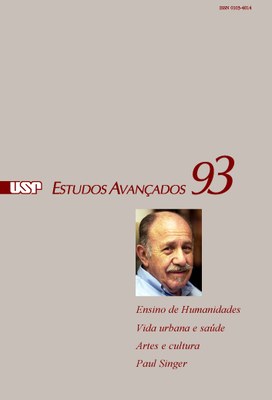
<p dir="ltr"><span><img src="https://www.iea.usp.br/imagens/capa-estudos-avancados-93/@@images/a264861c-632d-4ea5-9b50-5a6b15118a23.jpeg" alt="Capa Estudos Avançados 93" class="image-right" title="Capa Estudos Avançados 93" />The 93rd issue of the institutional journal "Estudos Avançados" inaugurates a series of publications focused on primary and secondary education. The main dossier of this issue brings a set of articles on the teaching of humanities, area of knowledge chosen to open the sequence. Besides reflections on the current conjuncture of Brazilian education, the texts present reflections on the teaching of philosophy, history, geography, music, literature and religion.</span></p>
<p dir="ltr">The journal also has three other sections, with different themes. In the first one, <i>Urban Life and Health</i>, four articles seek to understand how environmental and behavioral attributes of large cities affect the lives of their inhabitants. The second set of texts, <i>Arts and Culture</i>, brings comprehensive discussions on higher education in the arts and reflections on important works of the last century. The last section honors economist Paul Singer, who died in April, with a large and expressive interview in 2016.</p>
<p dir="ltr"><span>To editor Alfredo Bosi, the humanities face a paradoxical situation. "At the same time we have a reflection on the new methods proposed by pedagogy and specific didactics that open new directions for teaching, we face a depreciation of the same humanities by the technicist thinking that has been generalized in bureaucratic organs inside and outside the University," he points out. He believes that the intense demand for specialization generated by industrial and technological revolutions has hampered the balance between human and biological sciences.</span></p>
<p dir="ltr"><span>This context, according to Bosi, fuels the need to think about knowledge in a holistic and problematic way. A starting point, for him, would be to apply philosophy as a methodology of any and all modality of knowledge. "The reader will find articles by professors who experience this project both in public schools and in particular situations, such as teaching reading to inmates or the successful attempt to introduce Greek and Latin to elementary school students," he says.</span></p>
<p dir="ltr"><span>Bosi dedicates issue #93 to Paul Singer and Paulo Freire, who, according to him, "took their democratic ideals to the heart of the economy and pedagogy of the oppressed ones."</span></p>
<p dir="ltr"><span><strong>Dossier</strong></span></p>
<p dir="ltr">Between 2012 and 2013, Ana Vieira Pereira participated in a series of workshops on creative writing and reading mediation at the Romão Gomes Military Prison in São Paulo. Pereira's experiences and apprenticeships in the period are reported in the article <i>Sidelines - Literature Experiences with Imprisoned Persons</i>, which also composes the main dossier. According to her, the work made it possible to perceive literature and the telling of their own history as "powerful mechanisms for the personal reorganization and the discovery of new forms within the field of language".</p>
<p dir="ltr">In the article <i>The reform of secondary education and its questionable conception of quality of education</i>, Celso João Ferretti critically analyzes the reform promoted by the Ministry of Education in 2017. The political and economic interests of the restructuring, the ideological disputes that were presented and the official objectives <span>announced </span>by Michel Temer's government are some of the points dealt with by Ferretti. He further states that he has given "special attention to the curriculum flexibilization and the quality of education conception on which the reform is based."</p>
<p dir="ltr"><span>In the article <i>Latin and Greek in a municipal school of Elementary School</i>, Paula da Cunha Corrêa presents a successful pedagogical experience conducted from 2013 at the Desembargador Amorim Lima Municipal School of Elementary Education (EMEF.) Using the "Minimus" method, created by Barbara Bell, Corrêa has organized the implementation of classic language courses - Latin and Greek - for students in the 4th and 7th grades of the school, which is located in the city of São Paulo. According to her, in addition to language teaching, the project offers "diverse aspects of classical culture," to students, namely mythology, history, politics, theater, poetry, music, art and architecture." The "Minimus Project" is still in force and seeks new schools to expand its operation area.</span></p>
<p dir="ltr"><span><strong>Other themes</strong></span></p>
<p dir="ltr">The first two texts of the section <i>Urban Life and Health</i> show the consequences of violence and lack of basic sanitation for the health of the peripheral population. The latter two present comments on the last book authored by physician Paulo Saldiva, current director at the IEA-USP.</p>
<p dir="ltr">In <i>The metropolis and the health of its inhabitants</i>, Helena Ribeiro describes and analyzes the general themes addressed in Saldiva's work. According to her, the book clearly shows "the problems that urbanization has brought to physical and mental health" of the inhabitants of large cities.</p>
<p dir="ltr">Article writer Fabio Angeoletto emphasizes that the problems presented by Saldiva are not limited to São Paulo and other metropolises, but to all Brazilian cities, in <i>Urban life and health</i>. For him, the conclusion of the reading gives rise to a clear but not explicit message by the author: "Cities, in their complexity, demand planning, and multiple academic formations and social actors need to be involved in this work."</p>
<p dir="ltr">Among the seven authors in the <i>Arts and Culture</i> section are former IEA Director <a href="https://www.iea.usp.br/en/persons/researchers/martin-grossmann" class="external-link">Martin Grossmann</a> and two USP professors that participated in the first edition of the Institute's <a href="https://www.iea.usp.br/en/persons/sabbatical/sabbatical-professors" class="external-link">Sabbatical Year Program</a> in 2016: <a href="https://www.iea.usp.br/en/persons/researchers/daria" class="external-link">Dária Jaremtchuk</a> and <a href="https://www.iea.usp.br/en/persons/researchers/lucia-barbosa" class="external-link">Lúcia Maciel Barbosa de Oliveira</a>. The papers in this edition represent part of the results of their research at the Institute.</p>
<p dir="ltr">In the article <i>Abdias do Nascimento in the United States: a "black art painter,"</i> <span>Jaremtchuk </span>discusses the 10-year period that the Brazilian painter has spent in the United States. According to her, the time was fundamental for Nascimento to reaffirm "his commitment to the creation of works aligned with the African cultural heritage."</p>
<p dir="ltr">In Oliveira's <i>On Conquests and Tensions</i>, in turn, there is a discussion on the emergence of new cultural dynamics anchored in information and communication technologies. "The current moment demands a non-simplifying understanding of the innumerable representations, contradictions, voices and silences that vie for visibility in the public arena," she argues.</p>
<p dir="ltr"><span><strong>Paul Singer</strong></span></p>
<p dir="ltr"><span>The last article of the issue celebrates economist Paul Singer, who died April 16, 2018, at the age of 86. Singer was a full professor at USP's School of Economics, Business and Accounting (FEA,) and a member of the first composition of IEA's Board (1987-1992.) Born in Vienna, he was the creator and greatest advocate of the "Solidarity Economy."</span></p>
<p dir="ltr">The article <i>Paul Singer: a life of struggle and work for socialism and democratic participation</i>, by Cris Andrada and Egeu Esteves, presents an interview with the economist in the year 2016. Singer talks about his migration to Brazil, the youth in the Post-war São Paulo, his relationship with the union movement - with emphasis on the participation in the 300,000 Strike - and, notoriously, Solidarity Economy.</p>
<p dir="ltr"><span>"Only a few bring together intellectual greatness, genuine humility, and deep coherence between the writer and the practitioner," say the authors. "Paul Singer not only reflected on the violence of the world of work, but also devoted his studies to sharing it with workers, shoulder to shoulder, for years."</span></p>
<div><span>
<p>The list below contains the names of the authors who have contributed with each one of the addressed themes:</p>
<p><strong>The Teaching of Humanities</strong></p>
<p dir="ltr"><i>Franklin Leopoldo e Silva<br /></i><i>Celso de Rui Beiseigel<br /></i><i>Celso João Ferretti<br /></i><i>Marcus Sacrini and Valéria De Marco<br /></i><i>Ausonia Donato and Monique Borba Cerqueira<br /></i><i>Marcos Natali<br /></i><i>Neide Luzia de Rezende<br /></i><i style="text-align: justify; ">Ana Vieira Pereira<br /></i><i style="text-align: justify; ">Paula da Cunha Corrêa<br /></i><i>Circe Fernandes Bittencourt<br /></i><i>Antonia Terra de Calazans Fernandes<br /></i><i>Rafael Straforini<br /></i><i>Geraldo José de Paiva<br /></i><i>Antonio Carlos Moraes Dias Carrasqueira</i></p>
<p><strong>Urban Life and Health</strong></p>
<p dir="ltr"><i>Amélia Cohn<br /></i><i>Ana Lydia Sawaya, Maria Paula de Albuquerque and Semiramis Martins Álvares Domene<br /></i><i>Helena Ribeiro<br /></i><i style="text-align: justify; ">Fabio Angeoletto</i></p>
<p><strong>Arts and Culture</strong></p>
<p dir="ltr"><i>Dária Jaremtchuk<br /></i><i>Lúcia Maciel Barbosa de Oliveira<br /></i><i>Martha Ribeiro<br /></i><i>Isis Baldini, Martin Grossmann, Pamela Prado and Vinicius Spricigo<br /></i><i>Ana Mae Barbosa<br /></i><i>Martin Grossmann<br /></i><i>Paulo Roberto Ramos</i></p>
<p><strong>Paul Singer</strong></p>
<p><strong> </strong><i><i><i>Cris Andrada e Egeu Esteves</i></i></i></p>
</span></div>]]></content:encoded>
    <dc:publisher>No publisher</dc:publisher>
    <dc:creator>Richard Meckien</dc:creator>
    <dc:rights>Original version in Portuguese by Victor Matioli.</dc:rights>
    
      <dc:subject>Cities</dc:subject>
    
    
      <dc:subject>Art</dc:subject>
    
    
      <dc:subject>Humanities</dc:subject>
    
    
      <dc:subject>Journal</dc:subject>
    
    
      <dc:subject>Culture</dc:subject>
    
    
      <dc:subject>Health</dc:subject>
    
    
      <dc:subject>Education</dc:subject>
    
    <dc:date>2018-08-13T16:30:00Z</dc:date>
    <dc:type>Notícia</dc:type>
  </item>


  <item rdf:about="https://www.iea.usp.br/en/news/eliana-sousa-silva-takes-on-olavo-setubal-chair">
    <title>Eliana Sousa Silva, director of the Tide Networks, takes on the Olavo Setubal Chair of Art, Culture and Science</title>
    <link>https://www.iea.usp.br/en/news/eliana-sousa-silva-takes-on-olavo-setubal-chair</link>
    <description></description>
    <content:encoded xmlns:content="http://purl.org/rss/1.0/modules/content/"><![CDATA[<table class="tabela-direita-400">
<tbody>
<tr>
<th><img src="https://www.iea.usp.br/imagens/eliana-sousa-silva-27-3-2018" alt="Eliana Sousa Silva - 27/3/2018" class="image-inline" title="Eliana Sousa Silva - 27/3/2018" /></th>
</tr>
<tr>
<td>
<p><strong>Eliana Sousa Silva: "I think it is fundamental to think of my insertion at USP space from the recognition of the power that the peripheries and favelas bring as their essence"</strong></p>
</td>
</tr>
</tbody>
</table>
<p><span>"Together we will make </span><span>an opportunity out of </span><span>this experience at USP, which will </span><span>contribute to the university being more open, more democratic, more black and peripheral."</span><span> It was with this statement that educator and social activist </span><a href="https://www.iea.usp.br/en/persons/researchers/eliana-sousa-silva" class="external-link">Eliane Sousa Silva</a><span>, founder and director of the </span><a class="external-link" href="http://redesdamare.org.br/">Tide Development Network</a><span>, concluded her inaugural address as holder of the </span><a href="https://www.iea.usp.br/en/research/chairs/olavo-setubal-chair-of-arts-culture-and-science" class="external-link">Olavo Setubal Chair of Art, Culture and Science</a><span> in 2018, during a ceremony at USP's University Council Room on March 27. The chair is based at the IEA and is the result of a partnership between the Institute and Itaú Cultural.</span></p>
<p>Taken by emotion, <span>the professor recalled the death of her friend Marielle Franco, a city councilwoman brutally murdered on March 14 in Rio de Janeiro. For Silva, who like Franco grew up in the Favela da Maré, the chair is an opportunity to contribute to "the struggle for many other Marielles to emerge and to live in fullness, joy and freedom."</span></p>
<p>Franco has been a "forged" leadership from the work begun by Silva and her companions at Maré in the "most basic rights struggles." She was a pre-college student of a course created <span>by Silva's activist group</span> in the favela in 1997.</p>
<p>"She was, like many young people from Maré and from so many peripheries, someone who dared to take up flags of struggles that faced the inequalities that characterize us. Her choice was for the parliamentary path and in only one year she showed her strength and convictions. We have to engage as a society so that this crime is cleared up and the culprits blamed."</p>
<table class="tabela-direita-200-borda">
<tbody>
<tr>
<td>
<h3>Related material</h3>
<p><strong>Media library</strong></p>
<ul>
<li><a href="https://www.iea.usp.br/en/media-library/photos/events-2018/posse-eliana-sousa-silva-catedra-olavo-setubal-de-arte-cultura-e-ciencia-27-de-marco-de-2018" class="external-link">Photos<br /><br /></a></li>
</ul>
<hr />
<p><i><a href="https://www.iea.usp.br/en/pesquisa/catedras-e-convenios/catedra-olavo-setubal-de-arte-cultura-e-ciencia/noticias-1" class="external-link"><br /></a><a href="https://www.iea.usp.br/en/@@search?Subject%3Alist=Olavo%20Setubal%20Chair" class="external-link">More on the Olavo Setubal Chair of Art, Culture and Sc</a></i><i><a href="https://www.iea.usp.br/en/@@search?Subject%3Alist=Olavo%20Setubal%20Chair" class="external-link">ience</a></i></p>
</td>
</tr>
</tbody>
</table>
<p><strong>Academic insertion</strong></p>
<p>Silva said that the invitation t<span>o take on the chair </span>at the end of 2017 surprised her and came exactly<span> the year she retired from UFRJ after 30 years of work at the institution. "My last two activities are the ones that mostly synthesized the greater sense of my insertion in an academic space: the creation of an area within the Dean of Extension called the University-Community Integration Division, and the coordination of a specialization course in public security, aimed at professionals of the police apparatus."</span></p>
<p>These activities allowed her to "elucidate the political-pedagogical role that the university can fulfill in its engagement with the real demands of Brazilian society." This led her to consider that working in the chair could be an opportunity to think "the relationship of proximity that must exist between what is produced at USP and the demands of society, in particular the favelas and peripheries."</p>
<p>She affirmed that the peripheries bring "the capacity for inventiveness and resilience," in their essence, "being urgent to go beyond the traditional representations regarding these populations, which are recurrently focused on the idea of lack and absence."</p>
<p><span><strong>Axes for citizenship</strong></span></p>
<p>Before Silva's speech, dance critic and researcher Helena Katz, a professor at the Post-Graduation Program in Communication and Semiotics at PUC-SP, gave the address to the new chairholder.</p>
<p>Katz talked about Silva's life and militancy trajectory, and highlighted the five axes necessary for full citizenship formulated by the professor over the several years of work at Maré:</p>
<ul>
<li>education, "a fundamental component for autonomy, already present in that first pre-college course;"</li>
<li>art and culture, "in which I highlight the Maré Arts Center, a place created in partnership with choreographer Lia Rodrigues, who develops the forms of autonomy that dance can promote in communities such as that <span>with an improvingly palpable success</span>;"</li>
<li>communication, "such as the production of the newspaper 'Maré de Noticias,' distributed door-to-door and free of charge;"</li>
<li>territorial development: "the right to an address and a ZIP code, with the production of a street guide, bringing the possibility of an inhabitant of Maré to, for example, buy a refrigerator and have it delivered to their house;"</li>
<li>public security: "a taboo subject in a place where everyone is afraid of the police and the State."</li>
</ul>
<p> </p>
<table class="tabela-esquerda-400">
<tbody>
<tr>
<th><img src="https://www.iea.usp.br/imagens/vahan-agopyan-eliana-sousa-silva-e-maria-alice-setubal-27-3-2018" alt="Vahan Agopyan, Eliana Sousa Silva e Maria Alice Setubal - 27/3/2018" class="image-inline" title="Vahan Agopyan, Eliana Sousa Silva e Maria Alice Setubal - 27/3/2018" /></th>
</tr>
<tr>
<td><strong>USP's President Vahan Agopyan and Olavo Setubal's daughter Maria Alice Setubal (right) have honored the inauguration of the new chairholder</strong></td>
</tr>
</tbody>
</table>
<p>Silva's inauguration has been honored by educator Maria Alice Setubal, daughter of the chair's patron and president of the Tide Setubal Foundation. "Eliana is a person who can stand firmly and build bridges so that we can do things together to show the powers of the peripheries," she said.</p>
<p>The chair's general coordinator, <a href="https://www.iea.usp.br/en/persons/researchers/martin-grossmann" class="external-link">Martin Grossmann</a>, former director of the IEA, said that Silva's presence made USP approach Maré "to learn from those who have the experience of living in an area of permanent conflict." For him, although the university has another rhythm to work, according to the needs of research and analysis, "it can no longer be out of step with the demands of society."</p>
<p><strong>New leaderships</strong></p>
<p>Grossmann has emphasized the professors' concern to support new leaderships, an objective also present in another activity of the initiative: the support for young researchers. As sponsor of the chair, <a class="external-link" href="http://www.itaucultural.org.br/">Itaú Cultural</a> suppported the first <a class="external-link" href="http://www.ica.usp.br/">Intercontinental Academia</a> in 2015/2016, a project developed under <a class="external-link" href="http://www.ubias.net">UBIAS</a> network, which brings together institutes for advanced study linked to universities from all continents.</p>
<p>Eduardo Saron, director of Itaú Cultural, has affirmed that Silva's choice to take on the chair this year represents a special symbolic aspect due to the fact that 2018 marks the 70th anniversary of the Universal Declaration of Human Rights, "when, for the first time, culture was considered a right alongside health, education and other areas."</p>
<p>For him, one of the most striking features of Silva's cultural work is the dialogue between the production and internal interests of Maré with the external artistic production. "The democratization of access is important, but what is the most relevant is the exchange in which the contact to external repertoires matters more than the artistic making itself."</p>
<p>The inauguration of Silva also marked the closing of architect and graphic designer <a href="https://www.iea.usp.br/en/persons/researchers/ricardo-ohtake" class="external-link">Ricardo Ohtake</a> as chairholder. Having attended the ceremony, he said that the work that Silva helped to develop at Maré made "the cultural rise of the periphery" possible "and acquired political contours, leading to what happened with Marielle Franco."</p>
<p>Ohtake has briefly reported on the cycle of seminars and the course for cultural managers he coordinated throughout 2017. The focus of both activities was the process of creating cultural institutions from the post-war period, especially in São Paulo, the performance of outstanding cultural managers of the period, and outstanding exhibitions for the artistic renovation of the country. He said that the work will be concluded with the launch of a book on the seminars by the end of 2018.</p>
<p>The process of choosing who would hold the chair in 2018 was not easy, according to IEA's director <a href="https://www.iea.usp.br/en/iea/organization/direction" class="external-link">Paulo Saldiva</a>. "While thinking about the course we would give to the chair, we tried to think of some contribution that would make us better and give us the strenght to stimulate changes in society." The presence of Silva will reach young people, in his opinion.</p>
<p>At the ceremony closing, USP's President Vahan Agopyan said that Silva's generation is able to achieve greater progress than the previous generation's improvements to the country and said it is "an honor for USP to have a person with his capacity and conviction as a partner."</p>
<p>"Now, with Eliana's presence, we will see art and culture being disseminated throughout the urban context, showing that this is possible, and that we can improve the country through art and culture," he stated. Agopyan has also highlighted the fact that Silva considers education, and art and culture two of the priority axes for full citizenship: "Until these priorities are established, the country will not be what we want."</p>
<p style="text-align: right; "><span class="discreet">Photos: Leonor Calasans / IEA-USP</span></p>]]></content:encoded>
    <dc:publisher>No publisher</dc:publisher>
    <dc:creator>Richard Meckien</dc:creator>
    <dc:rights>Original version in Portuguese by Mauro Bellesa.</dc:rights>
    
      <dc:subject>Art</dc:subject>
    
    
      <dc:subject>Olavo Setubal Chair</dc:subject>
    
    
      <dc:subject>Culture</dc:subject>
    
    
      <dc:subject>Education</dc:subject>
    
    
      <dc:subject>Event</dc:subject>
    
    <dc:date>2018-03-28T17:10:00Z</dc:date>
    <dc:type>Notícia</dc:type>
  </item>


  <item rdf:about="https://www.iea.usp.br/en/media-library/photos/events-2018/posse-eliana-sousa-silva-catedra-olavo-setubal-de-arte-cultura-e-ciencia-27-de-marco-de-2018">
    <title>Eliana Sousa Silva taking over the Olavo Setubal Chair of Art, Culture and Science - March 27, 2018</title>
    <link>https://www.iea.usp.br/en/media-library/photos/events-2018/posse-eliana-sousa-silva-catedra-olavo-setubal-de-arte-cultura-e-ciencia-27-de-marco-de-2018</link>
    <description></description>
    
    <dc:publisher>No publisher</dc:publisher>
    <dc:creator>Richard Meckien</dc:creator>
    <dc:rights></dc:rights>
    
      <dc:subject>Institutional</dc:subject>
    
    
      <dc:subject>Culture</dc:subject>
    
    
      <dc:subject>Art</dc:subject>
    
    
      <dc:subject>Olavo Setubal Chair</dc:subject>
    
    <dc:date>2018-03-27T03:00:00Z</dc:date>
    <dc:type>Pasta</dc:type>
  </item>


  <item rdf:about="https://www.iea.usp.br/en/news/perspectives-of-culture-according-to-ricardo-ohtake">
    <title>The perspectives of culture according to Ricardo Ohtake</title>
    <link>https://www.iea.usp.br/en/news/perspectives-of-culture-according-to-ricardo-ohtake</link>
    <description></description>
    <content:encoded xmlns:content="http://purl.org/rss/1.0/modules/content/"><![CDATA[<table class="tabela-direita">
<tbody>
<tr>
<th><img src="https://www.iea.usp.br/imagens/ricardo-ohtake-posse" alt="Ricardo Ohtake - posse" class="image-inline" title="Ricardo Ohtake - posse" /></th>
</tr>
<tr>
<td>
<p><strong>Ricardo Ohtake, new holder of the Olavo Setubal Chair of Arts, Culture and Science.</strong></p>
</td>
</tr>
</tbody>
</table>
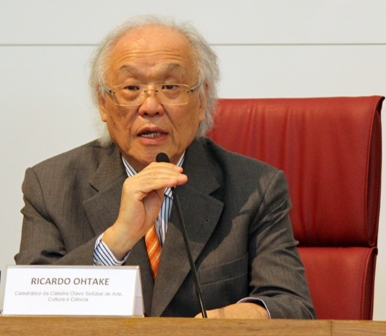
<p>To address the trajectory of art and culture in Brazil from the post-Second War period until the crisis of 2016, and to analyze the current situation of institutions and activities in the field with prospects for the future, are some of the goals of the new holder of the <a href="https://www.iea.usp.br/en/research/chairs/olavo-setubal-chair-of-arts-culture-and-science" class="external-link">Olavo Setubal Chair of Arts, Culture and Science</a>, created in 2015 and officially launched in February 2016 by the IEA in partnership with Itaú Cultural. Architect, graphic designer and cultural manager <a href="https://www.iea.usp.br/en/persons/researchers/ricardo-ohtake" class="external-link">Ricardo Ohtake</a> took office on March 17, in a ceremony in the University Council Room that was attended by authorities, sponsors of the Chair, artists and scientists.</p>
<p>"The discussion of the future is what matters most, mainly because of the new political, social, economic, administrative and institutional situation in Brazil, which we know has created a legal anomaly in the country, provoking insecurity for the population and certain insecurity in the cultural environment", said Ohtake.</p>
<p>While opening the ceremony, <a href="https://www.iea.usp.br/en/persons/researchers/martin-grossmann" class="external-link">Martin Grossmann</a>, academic coordinat<span>or of the Chair,</span> <span>professor at USP's S</span>chool of Communications and Arts (ECA), and former director of the IEA, welcomed the new holder and thanked the work done by <span>diplomat and essayist </span><a href="https://www.iea.usp.br/en/persons/researchers/rouanet" class="external-link">Sérgio Paulo Rouanet</a>, former national secretary of Culture and author of the bill to encourage culture that bears his name. During the inaugural year of the Chair, Rouanet developed the approximation between the borders of knowledge in the personal, institutional and scientific scopes, as he recalled in his speech.</p>
<table class="tabela-esquerda-borda">
<tbody>
<tr>
<th>
<h3>Related material</h3>
<p><a href="https://www.iea.usp.br/en/media-library/photos/events-2017/ricardo-ohtake-takes-office-chair-olavo-setubal-17-march-2017" class="external-link">Photos</a></p>
<p>News</p>
<p><a href="https://www.iea.usp.br/en/news/rouanet-inaugura-catedra-olavo-setubal-de-arte-cultura-e-ciencia" class="external-link">Sergio Rouanet inaugurates the Olavo Setubal Chair of Arts, Culture and Science</a></p>
</th>
</tr>
</tbody>
</table>
<p>The new activities will include the debate on the actions and the thinking of cultural leaders, and the participation of institutions in the development of the artistic and cultural field, in a reflection that will go back to the cultural history of Brazil, Grossmann showed.</p>
<p><span>Ohtake recalled the evolution of Brazilian society and mentality - including its typical contradictions and complexities with which "a modern and medieval country" was built - and related this trajectory to the steps taken by the country in the cultural and artistic fields.</span></p>
<p>He mentioned the beginnings of the cosmopolitanization of Brazil, especially in Rio de Janeiro and São Paulo, with the emergence of icons such as the <span>Vera Cruz </span>Cinematographic Company, the TBC Brazilian Theater of Comedy, art institutions, the Biennale and museums, among them the <span>São Paulo </span>Museum of Art (MASP), created by the coffee bourgeoisie.</p>
<p>To expose and develop his own trajectory as a cultural leader in the context of the city, the country and internationally <span>will be one of Ohtake's pursued goals. He will also i</span>nvite critics, cultural leaders, artists and historians to participate in debates and testimonials; approach the relationship between art and politics and the role of exhibitions in the art debate; and analyze the role of cultural leaders in the development of institutions and thinking.</p>
<p>The new holder intends to bring his experience of more than 50 years in this field. He has been Secretary of Culture of the State of São Paulo, Secretary of the Green and Environment of São Paulo, director of the São Paulo Cultural Center, and director of the Museum of Image and Sound and the Brazilian Cinematheque. He has lectured in several architecture, communications and plastic arts faculties and was curator of the Brazilian participation at the Architecture Biennale of Venice in 2010.</p>
<p>The Ohtake family is one of the most influential for the arts and architecture in Brazil. Ricardo Ohtake is son of artist Tomie Ohtake (1913-2015) and brother of architect Ruy Ohtake, who signs the project of the famous building that houses the Tomie Ohtake Institute. He has graduated from USP's Faculty of Architecture and Urbanism (FAU), and currently directs the Tomie Ohtake Institute.</p>
<p><span>"If, on the one hand, cultural activity is always provided by very limited resources, on the other hand it always requires a lot of imagination and daring for propositions to be solved. The leader does not have to be an intellectual, but he must know where the concepts, the variations of approaches, the artists, the history of art, and also the engineering of the activities take place. As the resource is never enough, knowing how to give priorities and alternatives is fundamental to make sense of everything that is done," he said. </span></p>
<p>While reviewing his own career, Ohtake recalled his childhood, when he invented things and plays on the street in the 'Mooca' neighborhood, in São Paulo. "I realized with surprise that I internalized what critic Mário Pedrosa said in the 1950s to my mother: 'The key is to be original.' I understood that I always had to be original, not only in artistic creation."</p>
<table class="tabela-direita">
<tbody>
<tr>
<th><img src="https://www.iea.usp.br/imagens/posse-ricardo-ohtake-mesa" alt="Posse Ricardo Ohtake - mesa" class="image-inline" title="Posse Ricardo Ohtake - mesa" /></th>
</tr>
<tr>
<td>
<p><strong>From the left: Eduardo Saron, Ricardo Ohtake, <span>José Roberto Sadek, Vahan Agopyan, Sérgio Paulo Rouanet, Roberto Setúbal and Paulo Saldiva.</span></strong></p>
</td>
</tr>
</tbody>
</table>
<p><strong> </strong></p>
<p><strong>Tributes</strong></p>
<p>The Olavo Setubal Chair of Arts, Culture and Science, created to foster interdisciplinary reflections on academic, artistic-cultural and social issues in the regional and global contexts, has been taking the form of an "experimental platform for freedom", according to Grossmann.</p>
<p>"If Rouanet practiced the permanent exercise of criticism by producers, and academic and cultural institutions during this period, Ricardo Ohtake intends to explore the experimental exercise of freedom, be it as a public figure, as a cultural manager, or through his wisdom and his constant thinking that produces an exemplary practice in the field of the arts and culture," said Grossmann.</p>
<p>In almost 12 months of activity as holder of the Chair, Rouanet has sought broad approximations and interactions in the epistemic, institutional or even personal fields, he showed. "The participation of so many colleagues in the effort to give prestige to other areas of knowledge, culture, arts, psychoanalysis, science and philosophy was an attempt to minimize the gap between the human sciences and other sciences," he said.</p>
<p>For Rouanet, the Chair has been a unique opportunity to deepen <span>the effort to unify science </span>a little more; an effort that was extended to the institutional field, with USP interacting with other institutions.</p>
<p>In the words of IEA's director Paulo Saldiva, the ceremony brings the symbolic sign of generosity and passion expressed in the "action of sponsors such as Itaú Cultural, or in the work of people like Ricardo Ohtake, who come to share their experience, teach and illuminate the spirit."</p>
<p><span>The Chair also celebrates the union between academia, artists, intellectuals and young people who could see the example of rare values such as leadership and enchantment, Saldiva said. "Values such as generosity, passion and enchantment for study are sorely lacking for our youth today. These are feelings that make things happen despite all the difficulties," he emphasized.</span></p>
<p>USP's Vice-President Vahan Agopyan has stressed the importance of interlocution between academia and external sectors provided by chairs and interdisciplinary instances as the IEA. "I often say that the IEA is the think tank of USP: a place for debates on cross-cutting themes and, as well as the chairs, capable of promoting interaction with society. Dialogue with society is a challenge of the 21st century for all universities, and with the support of Itaú Cultural we are managing to increase this interaction," said Agopyan.</p>
<p>Roberto Setúbal, executive president of Itaú bank, when speaking about the support for the Chair, preferred to recall his father's personality and his tradition of appreciation for culture, his career as an entrepreneur and an engineer graduated from USP's Polytechnic School (POLI). "Severe, firm and demanding, but always very open to dialogue and new ideas. A man of science and research - he has worked at the Institute of Technological Research (IPT). A mayor who created the <span>São Paulo </span>Secretariat of Culture, a gesture that made me very proud in my student days and that shows how he valued culture and was open to the new," he said.</p>
<p>Eduardo Saron, director of Itaú Cultural, recalled the important role of Ohtake in the democratization of culture and arts in Brazil. "The democratization of access to culture, so much discussed by managers in the country, is a theme that will remain for a long time. Art and culture are beyond the needs and rights of the citizen. If the artist thinks of art as a field of desires, managers and actors of cultural politics need to think about culture in this aspect. It is not a matter of democratizing access only. It is about autonomy and freedom of expression. Cultural democracy thinks and understands the individual as an actor of self; an autonomous citizen who has the right to freedom of expression; to see and experience all cultures," said Saron.</p>
<p>Professor <a href="https://www.iea.usp.br/en/persons/speakers/lilian-sch" class="external-link">Lilia Moritz Schwarcz</a>, from USP's Faculty of Philosophy, Languages and Literature, and Human Sciences (FFLCH), was invited to give the reception address to the honoree. She recalled the work done with Ohtake and the projects undertaken at the Tomie Ohtake Institute.</p>
<table class="tabela-direita">
<tbody>
<tr>
<th><img src="https://www.iea.usp.br/imagens/lilia-schwarcz" alt="Lilia Schwarcz - posse Ricardo Ohtake" class="image-inline" title="Lilia Schwarcz - posse Ricardo Ohtake" /></th>
</tr>
<tr>
<td><span><strong>Lilia Schwarcz, <span>from USP's Faculty of Philosophy, Languages and Literature, and Human Sciences (FFLCH)</span>: "Ricardo Ohtake has distributed gifts in the fields of art and culture".</strong></span></td>
</tr>
</tbody>
</table>
<p>"A visionary of the arts, an intellectual of culture, an academic of the world of museums, of the arts in the broad sense, he knows that culture is what it does. In Ricardo Ohtake's words, among the various ways of assessing the success of different art forms, there is a unifying question, which is the transformation that the viewer of art undergoes before a work, and the emotion that provides a new knowledge, a new sensitivity, and / or a new experience," said Schwarcz.</p>
<p>For Schwarcz, Ohtake has "distributed gifts": he has toured the fields of architecture, graphic arts, decoration, urbanism, drawing, theater, education, cinema, publishing, dance, photography and the plastic arts; he has made exhibitions, documentaries, film festivals; sponsored concerts; created drawings for many books. "He has inspired generations, having passed through numerous institutions until landing at the Tomie Ohtake Institute, which opened for all kinds of experimentation."</p>
<p>"It is impossible to meet Ricardo without being deeply affected by his history, his smile, his generosity, his<span> very noisy</span> silence, and his transforming affection. I congratulate USP for realizing that Ricardo is a born scholar in the sublime function of being a cultural multiplier, and thus an immense distributor of gifts, an intellectual open to diversity, plurality and equality in this unfortunately unequal country," said the professor.</p>
<p><span>The <span>State </span>Secretary for Culture of São Paulo, José Roberto Sadek, highlighted the important link <span>between the university and society </span>promoted by the Chair, and the promotion of non-polarized dialogue, treated with the complexity and nuances that the theme requires.</span></p>]]></content:encoded>
    <dc:publisher>No publisher</dc:publisher>
    <dc:creator>Richard Meckien</dc:creator>
    <dc:rights>Original version in Portuguese by Sylvia Miguel.</dc:rights>
    
      <dc:subject>Cultural Politics</dc:subject>
    
    
      <dc:subject>Education</dc:subject>
    
    
      <dc:subject>Art</dc:subject>
    
    
      <dc:subject>Citizenship</dc:subject>
    
    
      <dc:subject>Cinema</dc:subject>
    
    
      <dc:subject>Humanities</dc:subject>
    
    
      <dc:subject>Culture</dc:subject>
    
    
      <dc:subject>Design</dc:subject>
    
    
      <dc:subject>Architecture</dc:subject>
    
    
      <dc:subject>Olavo Setubal Chair</dc:subject>
    
    
      <dc:subject>Cities</dc:subject>
    
    
      <dc:subject>History</dc:subject>
    
    <dc:date>2017-03-27T10:25:00Z</dc:date>
    <dc:type>Notícia</dc:type>
  </item>


  <item rdf:about="https://www.iea.usp.br/en/media-library/photos/events-2017/ricardo-ohtake-takes-office-chair-olavo-setubal-17-march-2017">
    <title>Ricardo Ohtake takes office as new holder of the Olavo Setubal Chair of Arts, Culture and Science - March 17, 2017</title>
    <link>https://www.iea.usp.br/en/media-library/photos/events-2017/ricardo-ohtake-takes-office-chair-olavo-setubal-17-march-2017</link>
    <description></description>
    
    <dc:publisher>No publisher</dc:publisher>
    <dc:creator>Richard Meckien</dc:creator>
    <dc:rights></dc:rights>
    
      <dc:subject>Institutional</dc:subject>
    
    
      <dc:subject>Culture</dc:subject>
    
    
      <dc:subject>Art</dc:subject>
    
    
      <dc:subject>Olavo Setubal Chair</dc:subject>
    
    <dc:date>2017-03-17T03:00:00Z</dc:date>
    <dc:type>Pasta</dc:type>
  </item>


  <item rdf:about="https://www.iea.usp.br/en/news/museum-of-things-inbetween">
    <title>Roger Buergel proposes unclassified museums in a conference at the IEA</title>
    <link>https://www.iea.usp.br/en/news/museum-of-things-inbetween</link>
    <description></description>
    <content:encoded xmlns:content="http://purl.org/rss/1.0/modules/content/"><![CDATA[<table class="tabela-direita">
<tbody>
<tr>
<th><img src="https://www.iea.usp.br/imagens/Roger_M-_Buergel__Lidwien_van_de_Ven-_quadrada.jpg" alt="Roger M Buergel" class="image-inline" title="Roger M Buergel" /></th>
</tr>
<tr>
<td><span><strong><span>Roger Buergel, director of the </span><a class="external-link" href="http://www.johannjacobs.com/en/">Johann Jacobs Museum</a><span> in Zurich</span></strong></span></td>
</tr>
</tbody>
</table>
<p><a href="https://www.iea.usp.br/en/persons/speakers/roger-buergel" class="external-link">Roger Buergel</a>, director of the <a class="external-link" href="http://www.johannjacobs.com/en/">Johann Jacobs Museum</a> in Zurich and curator of the <a class="external-link" href="http://www.forumpermanente.org/event_pres/exposicoes/documenta-12-1">12th Documenta</a> in Kassel, will be at the IEA for the conference <i>The Museum of Things in-Between</i>. <span>The speech will be broadcast </span><a href="https://www.iea.usp.br/aovivo" target="_blank">live</a><span> on the Institute's website.</span></p>
<p><span>On </span><strong>February 9, at 2.30 pm</strong><span>, he will address the need to give more visibility and space to things that are now in an in-between condition in the field of culture. In Buergel's opinion, one must get rid of the museological categories, and of the distinctions between art and non-art, promoting the appreciation of the uniqueness of objects on display. The researcher believes that the existence of categories in museums leads to a restricted human perception about things.</span></p>
<p>According to <a href="https://www.iea.usp.br/en/persons/researchers/martin-grossmann/" class="external-link">Martin Grossmann</a>, coordinator of the <span><a href="https://www.iea.usp.br/en/research/research-groups/forum-permanente-cultural-system-between-public-and-private" class="external-link">Research Group Fórum Permanente: Cultural System Between Public and Private</a></span>, which organizes the meeting, the museum format proposed by Buergel operates in a post-colonial (transcultural) mode, critical to a museum model that was developed in Europe in the eighteenth and nineteenth centuries, but still very present today. "It is a museum that promotes a more horizontal relationship between cultures, languages and cosmologies, where the object - 'the thing' - can act 'in-between', whether in relation to museological or disciplinary categories, or in relation to different notions of space and time," he explains.</p>
<p>Grossmann recalls that the subject has already been explored <span>in Brazil, mainly in the fields of cultural theory and criticism.</span> Silviano Santiago's "The Space In-Between: Essays in Latin American Culture" (1971) and Roberto Schwartz's "<a class="external-link" href="https://www.amazon.com/Misplaced-Ideas-Brazilian-Critical-American/dp/086091576X">Misplaced Ideas: Essays on Brazilian Culture</a>" (1977) are two examples of works that address possibilities of action out of the European modern tradition.</p>
<p>The meeting at the IEA will feature a debate with the participation of <a href="https://www.iea.usp.br/en/persons/speakers/lisette-lagnado" class="external-link">Lisette Lagnado</a>, director of the School of Visual Arts Parque Lage; <a href="https://www.iea.usp.br/en/news/brandao-ibram" class="external-link">Carlos Roberto Brandão</a>, director of USP's Museum of Contemporary Art (MAC); <a href="https://www.iea.usp.br/en/persons/researchers/jose-teixeira-coelho-netto" class="external-link">José Teixeira Coelho Netto</a>, former director of MAC-USP and curator-general of MASP from 2006 to 2014; and the former director of the Museum of Modern Art of Bahia, curator and culture-<span>specialized </span>journalist <a href="https://www.iea.usp.br/en/persons/speakers/marcelo-rezende" class="external-link">Marcelo Rezende</a>. Moderation will be in charge of Grossmann.</p>]]></content:encoded>
    <dc:publisher>No publisher</dc:publisher>
    <dc:creator>Richard Meckien</dc:creator>
    <dc:rights>Original version in Portuguese by Fernanda Rezende.</dc:rights>
    
      <dc:subject>Museums</dc:subject>
    
    
      <dc:subject>Culture</dc:subject>
    
    
      <dc:subject>Research Group: Fórum Permanente: Cultural System Between Public and Private</dc:subject>
    
    
      <dc:subject>Art</dc:subject>
    
    <dc:date>2017-01-31T17:15:00Z</dc:date>
    <dc:type>Notícia</dc:type>
  </item>


  <item rdf:about="https://www.iea.usp.br/en/news/researcher-shows-the-power-of-games-and-virtuality-in-science-and-museums">
    <title>Researcher shows the power of games and virtuality in science and museums</title>
    <link>https://www.iea.usp.br/en/news/researcher-shows-the-power-of-games-and-virtuality-in-science-and-museums</link>
    <description></description>
    <content:encoded xmlns:content="http://purl.org/rss/1.0/modules/content/"><![CDATA[<p><img src="https://www.iea.usp.br/imagens/christian-stein-perfil" alt="Christian Stein - Perfil" class="image-right" title="Christian Stein - Perfil" /><a href="https://www.iea.usp.br/en/persons/speakers/christian-stein" class="external-link">Christian Stein</a>, founder of <a class="external-link" href="https://www.facebook.com/gamelab.berlin/">Gamelab.berlin</a>, will be at the IEA on <strong>February 2</strong>, at <strong>2.30 pm</strong>, to show projects that use virtuality, virtual reality and games as a cultural technique. He will present current research on "Knowledge Architectures," the core area of the <i><a class="external-link" href="https://www.interdisciplinary-laboratory.hu-berlin.de/en/bwg/" target="_blank">Excellence Cluster Image Knowledge Gestaltung</a></i>. The conference <span style="text-align: justify; "><i>Architectures of Knowledge: About Interdisciplinary Research on Games, Virtuality and the Global Museum</i></span> will be broadcast <a href="https://www.iea.usp.br/en/aovivo" class="external-link">live</a> in the IEA website.</p>
<p><span>According to the <span>conferencist</span>, science and research need to communicate with a new audience, so museums, exhibitions and open science labs are proving to be promising playgrounds to try new ways of communicating and translating into new media. By addressing these themes, Stein will also cite research in highly interdisciplinary teams and interdisciplinarity itself.</span></p>
<p>Moderation will be in charge of <a href="https://www.iea.usp.br/en/persons/researchers/martin-grossmann/" class="external-link">Martin Grossmann</a>, coordinator of the <a href="https://www.iea.usp.br/en/research/research-groups/forum-permanente-cultural-system-between-public-and-private" class="external-link">Research Group <i>Fórum Permanente</i>: Cultural System Between Public and Private</a>, which organizes the meeting. The comments will be made by <a href="https://www.iea.usp.br/en/persons/speakers/gilson-schwartz" class="external-link">Gilson Schwartz</a>, from USP's School of Communications and Arts (ECA), <a href="https://www.iea.usp.br/en/persons/speakers/copy_of_giselle-beiguelman" class="external-link">Giselle Beiguelman</a>, from USP's Faculty of Architecture and Urbanism (FAU), <span class="external-link"><a href="https://www.iea.usp.br/en/persons/speakers/davi-noboru" class="external-link">Davi Nakano</a></span>, from USP's Polytechnic School (EP), <span class="external-link"><a href="https://www.iea.usp.br/en/persons/speakers/wilson-mizutani" class="external-link">Wilson Mizutani</a></span>, from USP's Institute of Mathematics and Statistics (IME), and <a href="https://www.iea.usp.br/en/persons/speakers/ricardo-karman" class="external-link">Ricardo Karman</a>, from Kompanhia of Centro de Terra.</p>]]></content:encoded>
    <dc:publisher>No publisher</dc:publisher>
    <dc:creator>Richard Meckien</dc:creator>
    <dc:rights>Original version in Portuguese by Fernanda Rezende.</dc:rights>
    
      <dc:subject>Art</dc:subject>
    
    
      <dc:subject>Knowledge</dc:subject>
    
    
      <dc:subject>Digital Culture</dc:subject>
    
    
      <dc:subject>Museums</dc:subject>
    
    
      <dc:subject>Research Group: Fórum Permanente: Cultural System Between Public and Private</dc:subject>
    
    <dc:date>2017-01-30T16:20:00Z</dc:date>
    <dc:type>Notícia</dc:type>
  </item>


  <item rdf:about="https://www.iea.usp.br/en/news/time-in-art">
    <title>Transcendence and the incorporation of time by art</title>
    <link>https://www.iea.usp.br/en/news/time-in-art</link>
    <description></description>
    <content:encoded xmlns:content="http://purl.org/rss/1.0/modules/content/"><![CDATA[<table class="tabela-direita-400">
<tbody>
<tr>
<td><img src="https://www.iea.usp.br/imagens/satoro-kitago-e-akitoshi-edagawa" alt="Satoro Kitago e Akitoshi Edagawa" class="image-inline" title="Satoro Kitago e Akitoshi Edagawa" /></td>
</tr>
<tr>
<td style="text-align: right; "><strong>
<div id="_mcePaste">Sculptor and researcher Satoru Kitago (left), and</div>
<div>expert in cultural economics Akitoshi</div>
<div id="_mcePaste">Edagawa, both from the Tokyo University of the Arts</div>
</strong></td>
</tr>
</tbody>
</table>
<p>In addition to having a programme dedicated to the natural sciences, the <a class="external-link" href="http://intercontinental-academia.ubias.net/nagoya">second phase of the Intercontinental Academia in Nagoya</a> also had a workshop on arts, on March 15. The exhibitors were two members of the Tokyo University of the Arts: <a class="external-link" href="http://intercontinental-academia.ubias.net/nagoya/people/akitoshi-edagawa">Akitoshi Edagawa</a>, an expert in cultural economics expert, and professor of global art studies and curatorial practices, and <a class="external-link" href="http://intercontinental-academia.ubias.net/nagoya/people/satoru-kitago">Satoru Kitago</a>, sculptor and director of research.</p>
<p>In his presentation, Edagawa commented on the relations of the artistic act with the transcendence of time, the communicative role of art, and the difference between art and science.</p>
<p>He made a distinction - in relation to time - between the performing arts (performances, happenings, and music, dance and theater presentations) and those called fine arts (painting, printmaking, drawing, sculpture, photography, etc.).</p>
<p>To Edagawa, the performing arts can be called time arts once that the artist and the audience are in direct contact during the artistic act, while in the fine arts the public has contact with the artwork after its implementation.</p>
<p>But even music - considered under the aspect of composition - transcends time thanks to musical notation, although future executions can be distinguished from the original composer's intentions because "many ideas are incorporated by interpreters and passed on to subsequent generations", according to the researcher.</p>
<table class="tabela-direita-200">
<tbody>
<tr>
<th><img src="https://www.iea.usp.br/imagens/escultura-de-satoru-kitago" alt="&quot;Izanagi e Izanami&quot; (2012), de Satoru Kitago" class="image-inline" title="&quot;Izanagi e Izanami&quot; (2012), de Satoru Kitago" /></th>
</tr>
<tr>
<td style="text-align: right; ">
<p><strong><i>Izanagi and Izanami</i> (2012), by<br /></strong><strong>Satoru Kitago</strong></p>
</td>
</tr>
</tbody>
</table>
<p>He also stressed that one should consider the relative transcendence of time in aspects of the performing arts made possible by the technological capabilities of image and audio recording.</p>
<p><strong>Cultural differences</strong></p>
<p>The transcendence of time manifests itself differently in the artistic traditions of East and West. In the West, works and artistic procedures are transmitted in time through text, notations and other resources, which is not common in the East, according to Edagawa, citing the set of traditional Japanese arts called <i>gei-do</i>, where there are no records and new practitioners learn to perform from those who master them.</p>
<p>A work of art incorporates aspects of the time when it was produced, but it is understood and appreciated in the future from a new sensibility, said Edagawa. This is the reason to the fact that sometimes a past work of art is considered better than one of the present, which does not happen in science, "because it is believed that it qualitatively progresses with time".</p>
<p>He commented that English poet and philosopher William Hazlitt (1778-1830), when addressing this difference two hundred years ago, said that scientific studies evolve while art does not. Edagawa considers, however, that art can become more sophisticated over time through the incorporation of scientific and technological resources.</p>
<table class="tabela-esquerda-200">
<tbody>
<tr>
<th><img src="https://www.iea.usp.br/imagens/melencolia-1" alt="Melencolia 1" class="image-inline" title="Melencolia 1" /></th>
</tr>
<tr>
<td><strong><i>Melencolia 1</i>, by Albrecht Dürer</strong></td>
</tr>
</tbody>
</table>
<p><strong>Incorporation of time</strong></p>
<p>To Kitago, each work of art tells a story through spatial and temporal situations, thus expressing its attachment to past, present and future. "Moreover, when presented to the public in different places and times, it gives rise to new stories drawn from the experiences of the observers."</p>
<p>He illustrated his presentation with images of his own work as well as of German painter and printmaker Albrecht Dürer (1471-1528), Swiss sculptor and painter Alberto Giacometti (1901-1966), and Spanish painter and sculptor Antonio López.</p>
<p>Kitago commented on Dürer's <i>Melencolia 1</i>: "We can see a comet in the sky, a geometric shape, and a character that handles a compass with a melancholic expression. Interestingly, recent scientific articles report the presence of amino acids in comets. Amino acids are components in the origin of life and their crystallographic form is quite similar to the one observed in the picture. Perhaps the character was thinking about the future of humanity and life on Earth."</p>
<p>The sculptor related this interpretation with his concern to express "the question about where people came from and where they go" when producing sculptures with human forms.</p>
<p>Still on Dürer's piece, Kitago showed a picture of <i>Cube</i> (1934-35), one of the abstract sculptures of Giacometti: "It resembles a mask, a face and also the geometric shape present in the work by Dürer. I believe that Giacometti was interested in <i>Melencolia 1</i>."</p>
<p>When showing a photograph of another work by Giacometti, <i>Femme Leoni</i> (1947), Kitago said that he, as the Swiss artist, seeks to emphasize the space, the human figure and the passage of time in his sculptures.</p>
<table class="tabela-direita-300">
<tbody>
<tr>
<th><img src="https://www.iea.usp.br/imagens/o-cubo-e-mulher-leoni-obras-de-alberto-giacometti" alt="&quot;O Cubo&quot; e &quot;Mulher Leoni&quot;, obras de Alberto Giacometti" class="image-inline" title="&quot;O Cubo&quot; e &quot;Mulher Leoni&quot;, obras de Alberto Giacometti" /></th>
</tr>
<tr>
<td style="text-align: right; "><strong><i>Cube</i> (1934-5) and <i>Femme Leoni</i> (1947),<br />by Alberto Giacometti</strong></td>
</tr>
</tbody>
</table>
<p>As examples of explicit representation of the incorporation of time into works of art, Kitago cited López's works. The sculpture <i>Hombre y mujer</i> (1968-1994) represents a couple with young bodies and heads of aged people. The painting <i>Gran Vía</i> (1974-1981) shows the changes that occurred in a Madrid corner during the years it took to be painted. The painting <i>La Cena</i> (1971-1980) shows the changes in the face of a woman during the nine years in which the work was made.</p>
<p>Kitago said that the goal of having discussed the works of López and Giacometti in his presentation was to emphasize that the artwork has not only the economic side: "I believe that artists and researchers should not pursue only economic aspects. The main goal should be trying to express and pursue reality. What I tell my students is to create sculptures with a philosophy, so maybe in a hundred, two hundred years, people continue to receive their message."</p>
<p><strong>Communication</strong></p>
<p>Commenting on <span>Kitago's</span><span> exhibition, Edagawa said that "it is possible that the message of an artist is transmitted one hundred, two hundred years after their death, but society will have changed a lot and thus not always the real intentions of the artist will be understood."</span></p>
<p>He asked the opinion of Kitago on artworks done by teams in studios under the guidance of a master artist, as in the case of the works by Japanese artist <a class="external-link" href="http://english.kaikaikiki.co.jp/artists/list/C4/">Takashi Murakami</a>, by Raphael and Da Vinci in the Renaissance or those of when the <span>Buddhist culture</span><span> e</span><span>merged in Japan.</span></p>
<table class="tabela-esquerda-400">
<tbody>
<tr>
<th><img src="https://www.iea.usp.br/imagens/homem-e-mulher-grande-avenida-e-o-jantar-obras-de-antonio-lopez" alt="&quot;Homem e Mulher&quot;, &quot;Grande Avenida&quot; e &quot;O Jantar&quot;, obras de Antonio López" class="image-inline" title="&quot;Homem e Mulher&quot;, &quot;Grande Avenida&quot; e &quot;O Jantar&quot;, obras de Antonio López" /></th>
</tr>
<tr>
<td><strong><i>Hombre y mujer</i> (1968-94), <i>Gran Vía</i> (1974-81) and <i>La Cena</i> (1971-80), by Antonio López</strong></td>
</tr>
</tbody>
</table>
<p>Despite being a defender of an artist's personal and <span>manual</span><span> work, Kitago sees no problem in production teams if necessary: "The large works of the Buddhist culture necessarily had to be made that way."</span></p>
<p>At the time of the workshop a series of exhibitions took place in Japan, including Sandro Botticelli (1445-1510) and Michelangelo Merisi da Caravaggio (1571-1610). Kitago said that an interesting activity in both exhibitions was to try to find out which works had been produced by the artists themselves and which were of members of their studios.</p>
<p>Edagawa commented that the insight to this requires a certain capacity of the public and asked Kitago how artists could contribute to this. The important thing, according to Kitago, is that familiarity with art begins in childhood. "I do not think art is difficult to understand, but you need to interact with it from an early age to acquire an artistic sense that provides more pleasure with the works"</p>
<p><a class="external-link" href="http://intercontinental-academia.ubias.net/nagoya/people/martin-grossmann">Martin Grossmann</a>, former director of the IEA and member of the Intercontinental Academia's <a class="external-link" href="http://intercontinental-academia.ubias.net/nagoya/people/senior-committee">scientific committee</a>, said that the works by López commented by Kitago reminded him of <i>The Large Glass</i> (1915-23), a work that Marcel Duchamp took a long time to produce, incorporating the passage of time in it.</p>
<table class="tabela-direita-200">
<tbody>
<tr>
<th><img src="https://www.iea.usp.br/imagens/o-grande-vidro-de-marcel-duchamp" alt="&quot;O Grande Vidro&quot;, de Marcel Duchamp" class="image-inline" title="&quot;O Grande Vidro&quot;, de Marcel Duchamp" /></th>
</tr>
<tr>
<td style="text-align: right; "><i style="text-align: start; "><strong>The Large Glass</strong></i> <strong>(1915-23),</strong><br /><strong>by Marcel Duchamp</strong></td>
</tr>
</tbody>
</table>
<p>According to Grossmann, Duchamp has incorporated the viewer, including the non-specialist one, to the art system. "T<span>his is necessary i</span><span>n contemporary art. We need to think about the reception of art and how it affects one's sense." He wanted to know the opinion of Edagawa and Kitago on this issue in the Japanese context.</span></p>
<p>Kitago <span>agreed with </span><span>Grossmann on the change in the observer's role introduced by Duchamp and said that art has to stimulate the viewer to have new expectations. To Edagawa, the major issue in the artist-audience relationship is communication: "Although contemporary art is often </span><span>ambiguous about what it wants to express, </span><span>the artist must make an effort to communicate their thoughts and their philosophy. There must be the intention of trying to communicate."</span></p>
<p> </p>
<p> </p>
<p> </p>
<p> </p>
<p> </p>
<p> </p>
<p><span class="discreet">Photos (from the top): IAR / Nagoya University; Satoru Kitago; Reproduction; Alberto Giacometti Foundation; Fondation Alberto et Annette Giacometti; Antonio López; Philadelphia Museum of Art.</span></p>]]></content:encoded>
    <dc:publisher>No publisher</dc:publisher>
    <dc:creator>Richard Meckien</dc:creator>
    <dc:rights>Original version in Portuguese by Mauro Bellesa.</dc:rights>
    
      <dc:subject>Culture</dc:subject>
    
    
      <dc:subject>Art</dc:subject>
    
    
      <dc:subject>Event</dc:subject>
    
    
      <dc:subject>Intercontinental Academia</dc:subject>
    
    <dc:date>2016-06-08T15:50:00Z</dc:date>
    <dc:type>Notícia</dc:type>
  </item>


  <item rdf:about="https://www.iea.usp.br/en/media-library/photos/events-2016/modernity-ambivalences">
    <title>Modernity and its Ambivalences - Opening of the Olavo Setubal Chair of Arts, Culture and Science - May 17, 2016</title>
    <link>https://www.iea.usp.br/en/media-library/photos/events-2016/modernity-ambivalences</link>
    <description></description>
    
    <dc:publisher>No publisher</dc:publisher>
    <dc:creator>Richard Meckien</dc:creator>
    <dc:rights></dc:rights>
    
      <dc:subject>Institutional</dc:subject>
    
    
      <dc:subject>Culture</dc:subject>
    
    
      <dc:subject>Art</dc:subject>
    
    
      <dc:subject>Olavo Setubal Chair</dc:subject>
    
    <dc:date>2016-05-17T03:00:00Z</dc:date>
    <dc:type>Pasta</dc:type>
  </item>


</rdf:RDF>