<?xml version="1.0" encoding="utf-8" ?>
<rdf:RDF xmlns:rdf="http://www.w3.org/1999/02/22-rdf-syntax-ns#" xmlns:dc="http://purl.org/dc/elements/1.1/" xmlns:syn="http://purl.org/rss/1.0/modules/syndication/" xmlns="http://purl.org/rss/1.0/">


<channel rdf:about="https://www.iea.usp.br/search_rss">
  <title>Instituto de Estudos Avançados da Universidade de São Paulo</title>
  <link>https://www.iea.usp.br</link>

  <description>
    
            These are the search results for the query, showing results 1 to 14.
        
  </description>


  <image rdf:resource="https://www.iea.usp.br/logo.png" />

  <items>
    <rdf:Seq>
      
        <rdf:li rdf:resource="https://www.iea.usp.br/en/news/ica-4-bh-2022" />
      
      
        <rdf:li rdf:resource="https://www.iea.usp.br/en/events/why-we-shouldn2019t-want-to-be-the-pets-of-super-intelligent-machines" />
      
      
        <rdf:li rdf:resource="https://www.iea.usp.br/en/news/partnerships-ica-4-paris" />
      
      
        <rdf:li rdf:resource="https://www.iea.usp.br/en/events/research-meeting-scientific-education-risk-society-project" />
      
      
        <rdf:li rdf:resource="https://www.iea.usp.br/en/events/pro-pra-preoccupations" />
      
      
        <rdf:li rdf:resource="https://www.iea.usp.br/en/news/intercontinental-academia-4-call" />
      
      
        <rdf:li rdf:resource="https://www.iea.usp.br/en/news/ica-4" />
      
      
        <rdf:li rdf:resource="https://www.iea.usp.br/eventos/IA-Centrada-no-Ser-Humano" />
      
      
        <rdf:li rdf:resource="https://www.iea.usp.br/en/news/iea-hosts-conference-on-artificial-intelligence-and-machine-learning" />
      
      
        <rdf:li rdf:resource="https://www.iea.usp.br/en/events/democracy-latin-america-regression-resilience" />
      
      
        <rdf:li rdf:resource="https://www.iea.usp.br/en/news/journal-issue-101" />
      
      
        <rdf:li rdf:resource="https://www.iea.usp.br/en/events/building-equitable" />
      
      
        <rdf:li rdf:resource="https://www.iea.usp.br/en/events/brazil-achievement-gains" />
      
      
        <rdf:li rdf:resource="https://www.iea.usp.br/en/events/ai-sustainability-two-sides-of-the-coin" />
      
    </rdf:Seq>
  </items>

</channel>


  <item rdf:about="https://www.iea.usp.br/en/news/ica-4-bh-2022">
    <title>With the theme "Intelligence and Artificial Intelligence," ICA 4 has brought together researchers from different countries</title>
    <link>https://www.iea.usp.br/en/news/ica-4-bh-2022</link>
    <description></description>
    <content:encoded xmlns:content="http://purl.org/rss/1.0/modules/content/"><![CDATA[<table class="tabela-direita">
<tbody>
<tr>
<th><img src="https://www.iea.usp.br/imagens/WEB-Fellows_UFMG.jpg" alt="Fellows UFMG" class="image-right captioned" title="Fellows UFMG" /></th>
</tr>
<tr>
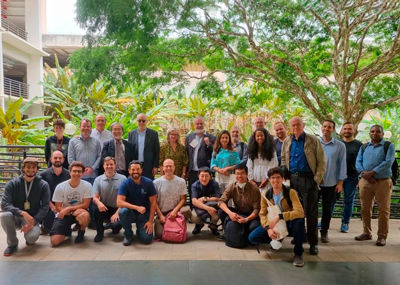
<td><span class="discreet">ICA 4 participants in Belo Horizonte</span></td>
</tr>
</tbody>
</table>
<p dir="ltr">In November, the second phase of the fourth edition of the Intercontinental Academia (ICA) took place in Belo Horizonte.</p>
<p dir="ltr">The ICA is an initiative of the international network of <a class="external-link" href="http://www.ubias.net">University-Based Institutes for Advanced Study (UBIAS)</a>. Each edition is organized by two IASs from different continents. In the case of ICA 4, which has explored key interdisciplinary issues at the intersection of cognitive science, neuroscience, and artificial intelligence (AI), the hosts have been the <a class="external-link" href="https://www.paris-iea.fr/fr/">Paris Institute for Advanced Study</a>, a member of the French Network of Institutes for Advanced Study (RFIEA), and the <a class="external-link" href="https://www.ufmg.br/ieat?lang=en">Institute of Advanced Transdisciplinary Studies (IEAT)</a> of the Federal University of Minas Gerais (UFMG).</p>
<p dir="ltr">Two of the Brazilian participants are professors at USP: André Fujita, from the Institute of Mathematics and Statistics (IME), who has been appointed by the IEA, and specialist in health technology assessment Patricia Coelho de Soárez, from the Medical School (FM), which has supported her. The third Brazilian is Evandro Cunha, a professor of computational linguistics at UFMG.</p>
<p dir="ltr">For Fujita, the term that best describes the experiences promoted by the encounters is "fantastic." They have allowed various exchanges among the 19 participating researchers and the fellows, collaborations with other institutions, and contact with mentors - including Nobel Prize laureates and directors of renowned centers - who have provided inspiration to everyone. "This has allowed thinking 'outside the box' and setting up a collaboration with fellow Laura Candiotto, a philosopher specializing in emotions," he points out.</p>
<p dir="ltr">Specialized in bioinformatics, Fujita works with the interaction between biological components and the way they create specific phenotypes, working with statistical methods to analyze biological data on a large scale. His contribution to ICA 4 has focused on his experience with biological network analysis, as well as the interdisciplinarity of his field.</p>
<table class="tabela-direita-200-borda">
<tbody>
<tr>
<th style="text-align: center; ">
<h3>Related material</h3>
</th>
</tr>
<tr>
<td><strong>News:</strong><br /> 
<ul>
<li><a href="https://www.iea.usp.br/en/news/4a-edicao-da-international-academia-paris-2021" class="external-link">Researchers establish partnerships and receive suggestions from mentors during ICA 4</a></li>
<li><a href="https://www.iea.usp.br/en/news/ica-4" class="external-link">Intercontinental Academia edition on intelligence and artificial intelligence starts on June 13</a></li>
</ul>
</td>
</tr>
</tbody>
</table>
<p dir="ltr">While the meeting in Paris has been split into eight days of seminars, activities in Belo Horizonte have prioritized the work among the researchers, with parallel meetings with mentors, and guests from academia and the productive sector.</p>
<p dir="ltr">For Fujita, two outstanding events have been the visit to the local neuroscience and robotics laboratories, as well as a meeting with <a href="https://www.iea.usp.br/en/persons/researchers/virgilio-almeida" class="external-link">Virgílio Almeida</a>, when he addressed the Center of Artificial Intelligence in Health. Almeida is professor emeritus from the Department of Computer Science at UFMG and current holder of the Oscar Sala Chair at the IEA. "The meeting with Professor Almeida has been a gateway to collaborations with UFMG's computer science and health personnel," Fujita states.</p>
<p dir="ltr">In addition to the Belo Horizonte stage of ICA 4, Fujita also participated in the first one, which took place in October 2021 in Paris, and in an intermediate meeting in Nagoya, held from August 31 to September 2, 2022, having robotics and artificial intelligence as main themes. On the latter occasion, he presented a seminar at the Nagoya University Graduate School of Medicine. Topics from the work of the ICA participants and professors who work with robotics at the institution were discussed. According to the researcher, the discussions were centered on how human-looking robots would fit into society besides robots that help humans in everyday activities. For him, one of the main impacts of his visit was the meeting with Toshio Fukuda, president of the Institute of Electrical and Electronics Engineers (IEEE) in Japan. Amongst criticisms and suggestions, the emeritus professor from Nagoya University offered a paid travel for Fujita to spend a few months working with his robotics group.</p>
<div>
<p dir="ltr">The first edition of ICA was held in 2015 in São Paulo, at the IEA, and in 2016 at Nagoya University's Institute for Advanced Research, having "Time" as the theme. In 2016, "Human Dignity" was the theme of the second edition, which took place in Jerusalem, Bielefeld (both main hosts cities), and Johannesburg (where an additional meeting took place). Between 2018 and 2019, the third edition addressed "Laws: Rigidity and Dynamics." Institutes in Singapore and Birmingham were the hosting partners.</p>
<p dir="ltr" style="text-align: right; "><span class="discreet">Photo: courtesy of André Fujita</span></p>
</div>]]></content:encoded>
    <dc:publisher>No publisher</dc:publisher>
    <dc:creator>Richard Meckien</dc:creator>
    <dc:rights>Original version in Portuguese by Beatriz Herminio.</dc:rights>
    
      <dc:subject>Ubias</dc:subject>
    
    
      <dc:subject>Intercontinental Academia</dc:subject>
    
    
      <dc:subject>cover</dc:subject>
    
    
      <dc:subject>Computer Science</dc:subject>
    
    
      <dc:subject>Artificial Intelligence</dc:subject>
    
    <dc:date>2022-11-21T18:55:00Z</dc:date>
    <dc:type>Notícia</dc:type>
  </item>


  <item rdf:about="https://www.iea.usp.br/en/events/why-we-shouldn2019t-want-to-be-the-pets-of-super-intelligent-machines">
    <title>Why we Shouldn’t Want to Be the Pets of Super-intelligent Machines</title>
    <link>https://www.iea.usp.br/en/events/why-we-shouldn2019t-want-to-be-the-pets-of-super-intelligent-machines</link>
    <description></description>
    <content:encoded xmlns:content="http://purl.org/rss/1.0/modules/content/"><![CDATA[<p><a href="https://www.iea.usp.br/eventos/super-intelligent-machines" class="external-link"><strong>Clique aqui para a versão em português</strong></a></p>
<p>When asked about humanity’s future relationship with computers, <a class="external-link" href="https://en.wikipedia.org/wiki/Marvin_Minsky">Marvin Minsky</a> famously replied “If we’re lucky, they might decide to keep us as pets”. A number of eminent authorities continue to argue that there is a real danger that “super-intelligent” machines will enslave — perhaps even destroy — humanity.</p>
<p><span>One might think that it would swiftly follow that we should abandon the </span><span>pursuit of AI. Instead, most of those who purport to be concerned about the existential threat posed </span><span>by AI default to worrying about what they call the “Friendly AI problem”. Roughly speaking this is the </span><span>question of how we might ensure that the AI’s that will develop from the first AI that we create will </span><span>remain sympathetic to humanity and continue to serve, or at least take account of, our interests.</span><br /><span> </span></p>
<p><span>In this talk Sparrow will draw on the “neo-republican” philosophy of <a class="external-link" href="https://en.wikipedia.org/wiki/Philip_Pettit" target="_blank">Philip Pettit</a> to argue that solving the </span><span>Friendly AI problem would not change the fact that the advent of super-intelligent AI would be </span><span>disastrous for humanity by virtue of rendering us the slaves of machines. A key insight of the </span><span>republican tradition is that freedom requires equality of a certain sort, which is clearly lacking </span><span>between pets and their owners. Benevolence is not enough. </span></p>
<p><span>As long as AI has the power to interfere </span><span>in humanity’s choices, and the capacity to do so without reference to our interests, then it will </span><span>dominate us and thereby render us unfree. </span></p>
<p><span>The pets of kind owners are still pets, which is not a </span><span>status which humanity should embrace. If we really think that there is a risk that research on AI will </span><span>lead to the emergence of a superintelligence then we need to think again about the wisdom of </span><span>researching AI at all.</span></p>
<p><strong>Opening remarks:</strong> <a href="https://www.iea.usp.br/pessoas/pasta-pessoav/virgilio-almeida" class="external-link">Virgílio Almeida</a><a href="https://www.iea.usp.br/pesquisa/catedras-e-convenios/catedra-oscar-sala/titular-catedra/titular-da-catedra" class="external-link"> </a>(Oscar Sala Chair)</p>
<p><strong>Presenter:</strong> <a href="https://www.iea.usp.br/pessoas/pasta-pessoar/rob-sparrow" class="external-link">Robert Sparrow</a> (Monash University)</p>
<p><strong>Moderation:</strong> <a href="https://www.iea.usp.br/pessoas/pasta-pessoae/elen-nas" class="external-link">Elen Nas</a> (IEA-USP)</p>
<p><strong><strong>Live transmission at</strong> <a href="https://www.iea.usp.br/aovivo" class="external-link">http://www.iea.usp.br/aovivo</a></strong></p>
<h3><strong>Organization</strong></h3>
<p><a href="https://www.iea.usp.br/home-por/pesquisa/catedras-e-convenios/catedra-oscar-sala/catedra-oscar-sala" class="external-link">Oscar Sala Chair</a></p>
<h3><strong>Partnership</strong></h3>
<p><a class="external-link" href="https://www.cgi.br/about/" target="_blank">Brazilian Internet Steering Committee (CGI.br)</a><br /><a class="external-link" href="https://www.nic.br/about-nic-br/" target="_blank">Brazilian Network Information Center (NIC.br)</a></p>
<h3>Support</h3>
<p><a class="external-link" href="https://c4ai.inova.usp.br/pt/sobre/" target="_blank">C4AI - Center for Artificial Intelligence</a></p>
<h3>Registration</h3>
<p><span>Free and public event </span><strong>|</strong><span> Registration is not required</span><br /><span>Online event </span><strong>|</strong><span> No attendance certification will be provided</span><br /><span>The event will be held in English and will be simultaneous translation into Portuguese</span></p>]]></content:encoded>
    <dc:publisher>No publisher</dc:publisher>
    <dc:creator>Richard Meckien</dc:creator>
    <dc:rights></dc:rights>
    
      <dc:subject>Oscar Sala Chair</dc:subject>
    
    
      <dc:subject>Online event</dc:subject>
    
    
      <dc:subject>Artificial Intelligence</dc:subject>
    
    
      <dc:subject>Public event</dc:subject>
    
    <dc:date>2024-02-08T16:25:00Z</dc:date>
    <dc:type>Evento</dc:type>
  </item>


  <item rdf:about="https://www.iea.usp.br/en/news/partnerships-ica-4-paris">
    <title>Researchers establish partnerships and receive suggestions from mentors during ICA 4</title>
    <link>https://www.iea.usp.br/en/news/partnerships-ica-4-paris</link>
    <description></description>
    <content:encoded xmlns:content="http://purl.org/rss/1.0/modules/content/"><![CDATA[<table class="tabela-direita-300">
<tbody>
<tr>
<th><img src="https://www.iea.usp.br/imagens/sessao-da-ica-4-paris-outubro-de-2021" alt="Sessão da ICA 4 - Paris - Outubro de 2021" class="image-inline" title="Sessão da ICA 4 - Paris - Outubro de 2021" /></th>
</tr>
<tr>
<td><span class="discreet">Session of the first phase of ICA 4, held at the Paris Institute for Advanced Study.</span></td>
</tr>
</tbody>
</table>
<p>Three Brazilians were among the 19 young researchers participating in the first phase of the <a class="external-link" href="https://www.intercontinental-academia.org/">4th Intercontinental Academia (ICA 4)</a>, held in Paris from October 18 to 27. The current edition addresses the theme "Intelligence and Artificial Intelligence" and the objective of the group is to explore fundamental interdisciplinary issues at the intersection of cognitive science, neuroscience, and artificial intelligence.</p>
<p>Two Brazilian participants are professors at USP: André Fujita, from the Institute of Mathematics and Statistics, who has been appointed by the IEA, and specialist in health technology assessment Patricia Coelho de Soárez, from the Medical School, which has supported her. The third Brazilian is Evandro Cunha, a professor of computational linguistics at the Federal University of Minas Gerais (UFMG).</p>
<table class="tabela-esquerda-300-borda">
<tbody>
<tr>
<td>
<h3>Related material</h3>
<p><strong>Previous editions of the Intercontinental Academia</strong></p>
<ul>
<li><a class="external-link" href="http://www.ica.usp.br" target="_blank">ICA 1</a> (2015-2016) - "Time"</li>
<li><a class="external-link" href="https://scholars.huji.ac.il/iahd" target="_blank">ICA 2</a> (2016) - "Human Dignity"</li>
<li><a class="external-link" href="https://www.icalaws.com/" target="_blank">ICA 3</a> (2018-2019) - "Laws: Rigidity and Dynamics</li>
</ul>
</td>
</tr>
<tr>
<td></td>
</tr>
</tbody>
</table>
<p>The ICA is an initiative of the international network of <a class="external-link" href="http://www.ubias.net">University-Based Institutes for Advanced Study (UBIAS)</a>. Each edition is organized by two IASs from different continents. In the case of ICA 4, the hosts are the <a class="external-link" href="https://www.paris-iea.fr/fr/">Paris Institute for Advanced Study</a> and UFMG's <a class="external-link" href="https://www.ufmg.br/ieat">Institute of Advanced Transdisciplinary Studies</a>. The second phase will be held in June 2022, in Belo Horizonte, Brazil.</p>
<p>During the eight days of seminars, several themes have been discussed in a comprehensive manner, according to Fujita and Soárez. The sessions were followed by meetings between participants and mentors, as well as by visits to universities in the French capital.</p>
<p>The Installation Theory, a new field dedicated to understanding, analyzing, and changing behavior has been one of the addressed topics, being discussed besides the concept of intelligence, philosophy of computing, ethical principles in AI, the future of AI and its challenges, relationships between humans and machines, consciousness and emotion, robots of the future, the impact of AI on economy, theoretical frameworks for the functioning of deep neural networks, and the issue of whether or not it is really necessary to develop intelligent machines that mimic humans and their usefulness.</p>
<table class="tabela-direita-300">
<tbody>
<tr>
<th><img src="https://www.iea.usp.br/imagens/andre-fujita-e-toshio-fukuda-ica4-2021" alt="André Fujita e Toshio Fukuda - ICA4 - 2021" class="image-inline" title="André Fujita e Toshio Fukuda - ICA4 - 2021" /></th>
</tr>
<tr>
<td><span class="discreet">André Fujita (left) and Toshio Fukuda during a meeting at the Paris-Saclay Normal School. Professor emeritus from Nagoya University, Fukuda is one of the world's leading authorities on robotics.</span></td>
</tr>
</tbody>
</table>
<p>Fujita has held individual meetings with Xiao-Jing Wang, Toshio Fukuda, Marc Mézard, Zaven Paré, Saadi Lahlou, Simon Luck, and Olivier Bouin, all mentors (senior researchers) of the ICA 4. At these, he has been able to describe his research projects and areas of work, and asked for criticism and suggestions.</p>
<p>Wang, Fukuda, and Mézard have praised the innovative aspects of Fujita's research projects in network statistics and in the use of heart rate variability (HRV) in the construction of a heart-machine interface, according to the Brazilian. They have also presented suggestions for a greater scope of work. Luck and Bouin have discussed possibilities for research grants at IASs in France and opportunities for funding Fujita's work in Europe.</p>
<p>He has also established connections for possible cooperation with Deshen Moodley and Surange Kasturi, two of the junior researchers participating in ICA 4. While Moodley could possibly become someone to work with in the area of HRV, Kasturi will potentially meet Fujita in the first semester of 2022 in the United States, where he works with the use of AI in data analysis in the health area.</p>
<p>Soárez has highlighted the exhibitions "In AI We Trust - Power, Illusion, and Control of Predictive Algorithms," given by Helga Nowotny, professor emeritus from the Swiss Federal Institute of Technology Zurich, and "Myths and Misunderstandings About Responsibility for the Unintended Impact of Artificial Intelligence," by Karen Yeung, a researcher of law, ethics, and informatics at the University of Birmingham. "Their speeches have sparked my interest in studying the economic, ethical, and social implications of the application of AI to health in the Brazilian context more deeply."</p>
<table class="tabela-esquerda-300">
<tbody>
<tr>
<th><img src="https://www.iea.usp.br/imagens/laura-candiotto-e-patricia-coelho-soarez-outubro-2021" alt="Laura Candiotto e Patricia Coelho Soárez - outubro/2021" class="image-inline" title="Laura Candiotto e Patricia Coelho Soárez - outubro/2021" /></th>
</tr>
<tr>
<td><span class="discreet">Patricia Soárez (right) with Laura Candiotto, from the Center for Ethics as Study in Human Value at the University of Pardubice</span></td>
</tr>
</tbody>
</table>
<p>Yeung was chosen by Soárez as her mentor during ICA 4. "She is actively involved in technology policy in the UK and has been dedicated to understanding the challenges associated with the regulation and governance of emerging technologies," said the Brazilian.</p>
<p>According to Soárez, Yeung's recent work is focused on the legal, ethical, and social implications of using these new technologies. "We have started a discussion on the development of a project tentatively named <i>An Interdisciplinary Approach to the Applications of Artificial Intelligence in Cancerology: Clinical Effectiveness and Social Implications</i>," she said.</p>
<p>As an offshoot of this initial collaboration and supported by Sue Gilligan, manager of interdisciplinary research projects at the University of Birmingham, Soárez is now working with a group of ICA 4 participants to organize a proposal for a mid-term meeting at the British institution in March 2022. The idea is to discuss individual projects before the second stage of ICA 4 in November.</p>
<p>Another initiative by the researchers, Fujita said, will be the production of an article about the different points of view regarding AI and what the field expects for the next 20 years.</p>
<p>It will be a kind of manifesto signed by everyone, he said. "To this end, we will meet virtually every two weeks. Initially, we are scheduling seminars so that each one can better understand the research projects carried out by the others. We will also read articles on AI chosen by each of us. It is worth noting that we are a very heterogeneous group, formed by specialists in computer science, engineering, biology, philosophy, economics, law, and neuroscience, among other areas. This will allow us to have a very broad idea on the subject."</p>
<p>For Soárez, participating in the ICA 4 has challenged her to inaugurate a new way of thinking, articulating, and doing her research: "The greatest learning have I gained was the awakening to the possibility of developing new research projects with an interdisciplinary approach. And the best product was the potential to establish a solid and diversified academic network of researchers around the world. I hope to experience the celebration of the excellence and impact of the research projects developed by this collaborative network <span>in the near future</span>."</p>
<p>She also highlights that the visits to the Paris-Saclay University, the Sorbonne Center for Artificial Intelligence, and the Paris-Saclay Normal School have expanded networking possibilities beyond the Paris Institute for Advanced Studies.</p>
<p style="text-align: right; "><span class="discreet">Photos: Paris Institute for Advanced Study</span></p>]]></content:encoded>
    <dc:publisher>No publisher</dc:publisher>
    <dc:creator>Richard Meckien</dc:creator>
    <dc:rights>Original version in Portuguese by Mauro Bellesa.</dc:rights>
    
      <dc:subject>Ubias</dc:subject>
    
    
      <dc:subject>Intercontinental Academia</dc:subject>
    
    
      <dc:subject>ICA</dc:subject>
    
    
      <dc:subject>cover</dc:subject>
    
    
      <dc:subject>Artificial Intelligence</dc:subject>
    
    
      <dc:subject>Researchers</dc:subject>
    
    <dc:date>2021-11-05T13:05:00Z</dc:date>
    <dc:type>Notícia</dc:type>
  </item>


  <item rdf:about="https://www.iea.usp.br/en/events/research-meeting-scientific-education-risk-society-project">
    <title>Research Meeting of the Scientific Education in the Risk Society Project</title>
    <link>https://www.iea.usp.br/en/events/research-meeting-scientific-education-risk-society-project</link>
    <description></description>
    <content:encoded xmlns:content="http://purl.org/rss/1.0/modules/content/"><![CDATA[<p>Today's society is increasingly the translation of scientific and technological innovations brought into people's daily routines. If in the past, science and technology only offered solutions to the problems faced by humanity, today they also contribute to the production of some of the most urgent problems to be resolved. The contemporary world is characterized by a scenario of uncertainty, characterizing a Risk Society. In this scenario, scientific education plays an important role, as living in a society that produces its own problems requires the ability to assess risk and make decisions.</p>
<p>Researchers from three Brazilian universities and two European universities will meet for an international work meeting. The group, which debates scientific education in the risk society, will meet between the February 20 and 22 in São Paulo (São Paulo), and on the 23rd in Vitória (Espírito Santo) and Brasília (DF).</p>
<p>In addition, seven other researchers from different Brazilian universities will be present at the meetings to exchange experiences and present projects.</p>
<h3>Support</h3>
<p>São Paulo Research Foundation (FAPESP)<br />National Council for Scientific and Technological Development (CNPq)</p>
<h3>Registration</h3>
<p><span>Free and public event </span><strong>|</strong><span> Registration is not required</span><br /><span>No attendance certification will be provided</span><br /><span>The event will be held in English and there will be no simultaneous translation into Portuguese</span></p>
<h3>Programme</h3>
<h3><strong>20/02</strong></h3>
<table class="plain">
<tbody>
<tr>
<td width="85">
<h3></h3>
</td>
<td width="481">
<p><strong>Morning – Location: UFABC (Av. dos Estados, 5001 - Bairro Santa Terezinha - Santo André/SP - Auditório A111-0, do Bloco A)</strong></p>
</td>
</tr>
<tr>
<td width="85">
<p>09h</p>
</td>
<td width="481">
<p>Reception of Participants</p>
</td>
</tr>
<tr>
<td width="85">
<p>09h30</p>
</td>
<td width="481">
<p><strong>Presentation of the Project </strong>- <a href="https://www.iea.usp.br/en/persons/researchers/mauricio-oliveira" class="external-link">Maurício Pietrocola</a> (FE e IEA/USP)</p>
</td>
</tr>
<tr>
<td width="85">
<p>10h30</p>
</td>
<td width="481">
<p>Presentation of  PHd Students - UFABC and USP</p>
</td>
</tr>
<tr>
<td width="85">
<p>12h</p>
</td>
<td width="481">
<p>Lunch</p>
</td>
</tr>
<tr>
<td width="85">
<p>14h30</p>
</td>
<td width="481">
<p><strong>Science Education and Social Justice: Why Should we Teach About them Together?</strong> - <a href="https://www.iea.usp.br/en/pessoas/pasta-pessoar/ralph-levinson">Ralph Levinson</a> (University College London, UK)</p>
</td>
</tr>
<tr>
<td width="85">
<p>16h30</p>
</td>
<td width="481">
<p>Break</p>
</td>
</tr>
<tr>
<td width="85">
<p>17h</p>
</td>
<td width="481">
<p>UFABC Visiting</p>
</td>
</tr>
</tbody>
</table>
<h3><strong>21/02 (Live transmission at <a href="https://www.iea.usp.br/aovivo" class="external-link">www.iea.usp.br/aovivo</a>)</strong></h3>
<table class="plain">
<tbody>
<tr>
<td width="85">
<h3></h3>
</td>
<td width="481">
<p><strong>Morning Location: IEA/USP- Alfredo Bosi Room (Rua Praça do Relógio, 109, térreo, Cidade Universitária, SP)</strong></p>
</td>
</tr>
<tr>
<td width="85">
<p>09h</p>
</td>
<td width="481">
<p>Reception of Participants</p>
</td>
</tr>
<tr>
<td width="85">
<p>10h</p>
</td>
<td width="481">
<p>Break</p>
</td>
</tr>
<tr>
<td width="85">
<p>10h30</p>
</td>
<td width="481">
<p>Work Meeting</p>
</td>
</tr>
<tr>
<td width="85">
<p>12h</p>
</td>
<td width="481">
<p>Lunch</p>
</td>
</tr>
<tr>
<td width="85">
<p>14h</p>
</td>
<td width="481">
<p><strong>Futurizing Science Education for the Society of Acceleration and Uncertainty</strong> - <a href="https://www.iea.usp.br/en/pessoas/pasta-pessoao/olivia-levrini">Olivia Levrini</a> (University of Bologna – Italy)</p>
</td>
</tr>
<tr>
<td width="85">
<p>16h</p>
</td>
<td width="481">
<p>Coffee Break</p>
</td>
</tr>
<tr>
<td width="85">
<p>16h30</p>
</td>
<td width="481">
<p>Working Group on Students Research Project</p>
</td>
</tr>
<tr>
<td width="85">
<p>17h30</p>
</td>
<td width="481">
<p>Closing</p>
</td>
</tr>
</tbody>
</table>
<h3><strong>22/02</strong></h3>
<table class="plain">
<tbody>
<tr>
<td width="85"></td>
<td width="481">
<p><strong>Morning Location: IEA/USP- Alfredo Bosi Room (Rua Praça do Relógio, 109, térreo, Cidade Universitária, SP)</strong></p>
</td>
</tr>
<tr>
<td width="85">
<p>09h</p>
</td>
<td width="481">
<p>Reception</p>
</td>
</tr>
<tr>
<td width="85">
<p>09h30</p>
</td>
<td width="481">
<p>Presentation of Actions and Projects - Polo UFES and UnB</p>
</td>
</tr>
<tr>
<td width="85">
<p>10h30</p>
</td>
<td width="481">
<p>Break</p>
</td>
</tr>
<tr>
<td width="85">
<p>11h</p>
</td>
<td width="481">
<p>Working Meeting</p>
</td>
</tr>
<tr>
<td width="85">
<p>12h</p>
</td>
<td width="481">
<p>Lunch</p>
</td>
</tr>
<tr>
<td width="85">
<p>14h</p>
</td>
<td width="481">
<p>Work Group of New Project Steps</p>
</td>
</tr>
<tr>
<td width="85">
<p>16h</p>
</td>
<td width="481">
<p>Break</p>
</td>
</tr>
<tr>
<td width="85">
<p>16h30</p>
</td>
<td width="481">
<p>Closing and Production of Minutes</p>
</td>
</tr>
</tbody>
</table>]]></content:encoded>
    <dc:publisher>No publisher</dc:publisher>
    <dc:creator>Richard Meckien</dc:creator>
    <dc:rights></dc:rights>
    
      <dc:subject>Oscar Sala Chair</dc:subject>
    
    
      <dc:subject>Online event</dc:subject>
    
    
      <dc:subject>Artificial Intelligence</dc:subject>
    
    
      <dc:subject>Public event</dc:subject>
    
    <dc:date>2024-02-14T16:25:00Z</dc:date>
    <dc:type>Evento</dc:type>
  </item>


  <item rdf:about="https://www.iea.usp.br/en/events/pro-pra-preoccupations">
    <title>Process, Practice, and Preoccupations</title>
    <link>https://www.iea.usp.br/en/events/pro-pra-preoccupations</link>
    <description></description>
    <content:encoded xmlns:content="http://purl.org/rss/1.0/modules/content/"><![CDATA[<p><strong><a href="https://www.iea.usp.br/eventos/process-practice-and-preoccupations" class="external-link">Clique aqui para a versão em Português</a></strong></p>
<p>Professor Jan Carson will discuss her writing and delve into her themes, writing style, and her journey as a Northern Irish writer. The event is part of the 2025 opening of the W.B. Yeats Chair of Irish Studies.</p>
<p>Carson is a writer based in Belfast. She has published three novels, three short story collections and two micro-fiction collections. Her novel The Fire Starters won the EU Prize for Literature for Ireland 2019. Her latest novel, The Raptures was published by Doubleday in early 2022 and was subsequently shortlisted for the An Post Irish Novel of the Year and Kerry Group Novel of the Year. Her short story collection Quickly, While They Still Have Horses was published by Doubleday (UK) in April 2024 and Scribner (US) in July 2024. Her writing has been aired on BBC Radio 3 and 4 and RTE. She is the Seamus Heaney Centre Fellow at Queen’s University Belfast 2025 and a Fellow of the Royal Society of Literature. Her first stage play, an adaptation of the children’s classic, The Velveteen Rabbit will be produced by Replay Theatre Company at the Lyric Theatre, Belfast in March 2025. Her next novel, Few and Far Between is forthcoming in early 2026.</p>
<h3>Registration</h3>
<p>Free and public event <strong>|</strong> Registration is not required<br />Online event (<a class="external-link" href="http://youtube.com/@iea-usp">http://youtube.com/@iea-usp</a>) <strong>|</strong> No attendance certification will be provided<br />The event will be held in English and no simultaneous translation into Portuguese will be provided</p>]]></content:encoded>
    <dc:publisher>No publisher</dc:publisher>
    <dc:creator>Richard Meckien</dc:creator>
    <dc:rights></dc:rights>
    
      <dc:subject>Oscar Sala Chair</dc:subject>
    
    
      <dc:subject>Online event</dc:subject>
    
    
      <dc:subject>Artificial Intelligence</dc:subject>
    
    
      <dc:subject>Public event</dc:subject>
    
    <dc:date>2025-03-12T17:25:00Z</dc:date>
    <dc:type>Evento</dc:type>
  </item>


  <item rdf:about="https://www.iea.usp.br/en/news/intercontinental-academia-4-call">
    <title>Intercontinental Academia selects young researchers to study "intelligence and artificial intelligence"</title>
    <link>https://www.iea.usp.br/en/news/intercontinental-academia-4-call</link>
    <description></description>
    <content:encoded xmlns:content="http://purl.org/rss/1.0/modules/content/"><![CDATA[<p style="text-align: left; "><i><span><span class="VIiyi"><span class="ChMk0b JLqJ4b"><span>With information from the Institute of Advanced Transdisciplinary Studies (IEAT)</span></span></span><span> </span></span></i></p>
<p style="text-align: left; ">The network of University-Based Institutes for Advanced Study (UBIAS) has opened the selection process for the 4th edition of the <a class="external-link" href="http://www.ica.usp.br">Intercontinental Academia (ICA)</a>, whose theme is "Intelligence and Artificial Intelligence." Early and mid-career researchers with a doctorate and fluency in English can apply. Applications from researchers linked to any academic institution or with links to industry, non-governmental organizations, artistic or other institutions are welcome, provided that they have a position equivalent to that of a professor or researcher.</p>
<p style="text-align: left; ">A virtual meeting will take place in June 2021, followed by two immersion meetings - the first in October 2021, in Paris, and the second in June 2022, in Belo Horizonte. The <a class="external-link" href="http://rfiea.fr/en/iea/french-network-institutes-advanced-study-missions">French Network of Institutes for Advanced Study (RFIEA)</a> and the <a class="external-link" href="https://www.ufmg.br/ieat/instituto/?lang=en">Institute of Advanced Transdisciplinary Studies (IEAT)</a> at the Federal University of Minas Gerais (UFMG) are the hosts.</p>
<p style="text-align: left; "><span id="docs-internal-guid-dad2b560-7fff-7884-29b4-7fc04b3e3d31">The Intercontinental Academia brings together young researchers from different countries and fields of study to study a single topic. In 2015, the IEA hosted the <a class="external-link" href="http://ica.usp.br/home-sao-paulo">first phase of the program's inaugural edition</a>, organized in partnership with the Institute for Advanced Research (IAR) at Nagoya University.</span></p>
<p style="text-align: left; "><strong>Applications</strong><br />Submissions must be made through <a class="mail-link" href="mailto:applications-ica4@rfiea.fr">applications-ica4@rfiea.fr</a> until March 31, 2021.</p>
<p style="text-align: left; "><strong>Mentors and fellows<br /></strong><span class="VIiyi"><span class="ChMk0b JLqJ4b"><span>At the meetings, selected participants will have the chance to discuss research topics with a notable group of mentors, who were previously invited to participate in this edition of the Intercontinental Academia.</span></span></span></p>
<p style="text-align: left; "><span class="VIiyi"><span class="ChMk0b JLqJ4b"><strong>Candidates affiliated to USP</strong> must undergo prior selection by the local scientific committee. If the University endorses the application and it is approved in the final selection, then USP will be responsible for supporting the participant for the immersive meetings. The sending of doubts and the complete documentation must be made through the address <a class="external-link" href="http://rkmeckien@usp.br">rkmeckien@usp.br</a> until March 11, 2021.</span></span></p>
<div class="afi-document" style="float: left; text-align: left; ">
<div class="afi-document-icon" style="text-align: center; float: left; "><img src="https://www.ufmg.br/ieat/wp-content/plugins/attachment-file-icons/mime/pdf-icon.png" /></div>
<div class="afi-document-link" style="padding-left: 5px; text-align: center; float: left; "><a class="external-link" href="http://www.ubias.net/march31">CALL for fellows – Intercontinental Academia</a></div>
</div>
<div class="afi-clear" style="text-align: left; "></div>
<p style="text-align: left; "> </p>
<p style="text-align: left; "><strong>UBIAS network</strong><br />Started in 2010, the Ubias network currently congregates around 50 institutes for advanced study around the world and has the proposal to promote an environment for the exchange of experiences between researchers from different areas, cultures, and backgrounds, creating a productive space for innovative research. One of the most successful initiatives of the Ubias network is the Intercontinental Academia (ICA), in which the scientific exchange between generations, disciplines, cultures, and continents takes place around a major theme. More at <a href="http://www.ubias.net/" target="_blank">www.ubias.net</a><strong>.</strong></p>]]></content:encoded>
    <dc:publisher>No publisher</dc:publisher>
    <dc:creator>Richard Meckien</dc:creator>
    <dc:rights>Original version in Portuguese by Letícia Tanaka.</dc:rights>
    
      <dc:subject>Ubias</dc:subject>
    
    
      <dc:subject>International Cooperation</dc:subject>
    
    
      <dc:subject>Intercontinental Academia</dc:subject>
    
    
      <dc:subject>ICA</dc:subject>
    
    
      <dc:subject>Research</dc:subject>
    
    
      <dc:subject>Interdisciplinarity</dc:subject>
    
    
      <dc:subject>Artificial Intelligence</dc:subject>
    
    <dc:date>2021-02-10T14:05:00Z</dc:date>
    <dc:type>Notícia</dc:type>
  </item>


  <item rdf:about="https://www.iea.usp.br/en/news/ica-4">
    <title>Intercontinental Academia edition on intelligence and artificial intelligence starts on June 13</title>
    <link>https://www.iea.usp.br/en/news/ica-4</link>
    <description></description>
    <content:encoded xmlns:content="http://purl.org/rss/1.0/modules/content/"><![CDATA[<p><img src="https://www.iea.usp.br/imagens/logo-da-4a-intercontinental-academia" alt="Logo da 4th Intercontinental Academia" class="image-right" title="Logo da 4th Intercontinental Academia" /></p>
<p>"Intelligence and Artificial Intelligence" is the theme of the fourth edition of the Intercontinental Academia (ICA 4), which will have its opening sessions virtually held from June 13 to 18. The face-to-face sessions will take place next October in Paris and in June 2022 in Belo Horizonte.</p>
<p>The ICA is a project by <a class="external-link" href="http://www.ubias.net">UBIAS</a>, an international network of institutes for advanced study linked to universities. Each edition is hosted by two institutes from different continents. ICA 4 has been organized by the <a class="external-link" href="https://www.ufmg.br/ieat/instituto/?lang=en">Institute of Advanced Transdisciplinary Studies (IEAT)</a> at the Federal University of Minas Gerais (UFMG) and the <a class="external-link" href="https://www.paris-iea.fr/en/presentation-of-the-institute/about-us">Paris Institute for Advanced Study (IAS)</a>, a member of the <a class="external-link" href="http://rfiea.fr/en/iea/french-network-institutes-advanced-study-missions">French Network of Institutes for Advanced Studies (RFIEA)</a>.</p>
<p>Since implementing the project in 2015, the objective of UBIAS has been to create global networks of future research leaders to work together on paradigm shifts and transdisciplinary research under the mentorship of eminent researchers from around the world.</p>
<table class="tabela-direita-400">
<tbody>
<tr>
<th><img src="https://www.iea.usp.br/imagens/andre-fujita-patricia-soarez-e-evandro-castro" alt="Andre Fujita, Patricia Soarez e Evandro Castro" class="image-inline" title="Andre Fujita, Patricia Soarez e Evandro Castro" /></th>
</tr>
<tr>
<td><span class="discreet">Brazilian participants of ICA 4: André Fujita, Patricia Coelho de Soárez, and Evandro Castro</span></td>
</tr>
</tbody>
</table>
<p>According to the ICA 4 organizers, the edition will explore key interdisciplinary issues at the intersection of cognitive science, neuroscience, and artificial intelligence (AI). By highlighting the importance of the topic, they point out that decisive advancements have taken place in recent decades regarding the analysis of brain activity and its behavioral counterpart, as well as the information processing sciences. "Complementarities between neuroscience/cognitive science and AI make it possible to explore synergies and raise ethical issues between these disciplines, which involve enormous challenges and opportunities for societal progress."</p>
<table class="tabela-direita-200-borda">
<tbody>
<tr>
<td>
<h3><strong>Previous editions</strong></h3>
<p><a class="external-link" href="http://ica.usp.br/home-sao-paulo">ICA 1</a> was held in 2015/16 and its theme was "Time." The hosts were the IEA and the Institute for Advanced Research at Nagoya University (IAR). From the debates of the edition, the participants produced the <span>massive open online course</span> <a class="external-link" href="https://www.coursera.org/learn/offtheclock?utm_campaign=opencourse.qDaZPFzDEeq2MgoCzrWDhw.launch&amp;utm_medium=email&amp;utm_source=other" target="_blank">Off the Clock: The Many Faces of Time</a>, available on the <a class="external-link" href="https://www.coursera.org/" target="_blank">Coursera</a> platform.</p>
<p>"Human Dignity" was the theme of the <a class="external-link" href="https://scholars.huji.ac.il/iahd">second edition</a> in 2016. The organizers for the initiative were the Center for Interdisciplinary Research at Bielefeld University and the Israel Institute for Advanced Studies at the Hebrew University of Jerusalem.</p>
<p><a class="external-link" href="https://www.icalaws.com/">ICA 3</a> took place in 2018/19 and addressed the theme "Laws: Rigidity and Dynamics." The organizers were the Institute of Advanced Studies at the Nanyang Technological University and the Institute of Advanced Studies at the University of Birmingham.</p>
</td>
</tr>
</tbody>
</table>
<table class="tabela-esquerda-300-borda">
<tbody>
<tr>
<td>
<h3>Some of the mentors</h3>
<p><dl class="image-inline captioned" style="width:300px;">
<dt><img src="https://www.iea.usp.br/imagens/ada-yonath/image" alt="Ada Yonath" title="Ada Yonath" height="300" width="300" /></dt>
 <dd class="image-caption" style="width:300px;">Ada Yonath</dd>
</dl></p>
<p><dl class="image-inline captioned" style="width:300px;">
<dt><img src="https://www.iea.usp.br/imagens/robert-aumann/image" alt="Robert Aumann" title="Robert Aumann" height="300" width="300" /></dt>
 <dd class="image-caption" style="width:300px;">Robert Aumann</dd>
</dl></p>
<p><dl class="image-inline captioned" style="width:300px;">
<dt><img src="https://www.iea.usp.br/imagens/martin-rees/image" alt="Martin Rees" title="Martin Rees" height="300" width="300" /></dt>
 <dd class="image-caption" style="width:300px;">Martin Rees</dd>
</dl></p>
<p><dl class="image-inline captioned" style="width:300px;">
<dt><img src="https://www.iea.usp.br/imagens/antonio-damasio/image" alt="António Damásio" title="António Damásio" height="300" width="300" /></dt>
 <dd class="image-caption" style="width:300px;">António Damásio</dd>
</dl></p>
<p><dl class="image-inline captioned" style="width:300px;">
<dt><img src="https://www.iea.usp.br/imagens/timnit-gebru/image" alt="Timnit Gebru" title="Timnit Gebru" height="300" width="300" /></dt>
 <dd class="image-caption" style="width:300px;">Timnit Gebru</dd>
</dl></p>
<p><dl class="image-inline captioned" style="width:300px;">
<dt><img src="https://www.iea.usp.br/imagens/zaven-pare/image" alt="Zaven Paré" title="Zaven Paré" height="300" width="300" /></dt>
 <dd class="image-caption" style="width:300px;">Zaven Paré</dd>
</dl></p>
</td>
</tr>
</tbody>
</table>
<p>In parallel to the second face-to-face session, scheduled for June 2022, a "satellite session" will be held at UFMG, with conferences and roundtables, and the participation of ICA 4 mentors and other guests from academia and the industry. There will be live streaming over the internet. Some of the topics covered in this session will be: "Fundamentals and Ethics of AI," "Intelligence and Rationality," "Cognition and Neurosciences," "Interdisciplinary Explorations of AI," and "AI and Health Sciences."</p>
<p><strong>Participants</strong></p>
<p><a class="external-link" href="https://www.intercontinental-academia.org/fellows/">19 researchers</a> working in universities and research institutes in Brazil, Germany, France, United Kingdom, Poland, United States, Japan, South Africa, Israel, and the Netherlands have been chosen out of the 60 candidates to participate in ICA 4 (23 of them Brazilians). The research areas of those selected include mathematics, computing, engineering, law, philosophy, linguistics, neuroscience, and history.</p>
<p>The representatives of Brazil are André Fujita (nominated by the IEA), from USP's Institute of Mathematics and Statistics (IME), Patricia Coelho de Soárez (independently enrolled), from USP's Medical School (FM), and Evandro Cunha (nominated by the IEAT), from UFMG's Faculty of Languages, Literature, and Linguistics (FALE).</p>
<p>Fujita's expectation is to participate in intense philosophical and scientific discussions with the other participants, and obtain "stimulus and inspiration" to make the Postgraduate Program in Bioinformatics at USP, which he coordinates, more vigorous. He emphasizes that bioinformatics is an interdisciplinary field integrated by researchers in mathematics, computer science, physics, chemistry, biology, medicine, and engineering, among others. "People usually define bioinformatics as the big data study of areas of biology using computational techniques. I think we could define bioinformatics as the field that uses artificial intelligence to discover how cells and beings learn or acquire intelligence."</p>
<p>Soárez, who is a member of IEA's Study Group on Science, Technology, and Innovation in Health, proposes the adoption of a holistic point of view in evaluating the contributions of AI in health care, including economic, ethical, and social impacts. More specifically, her interest is the implications of incorporating AI into health policies, decision-making processes, and equality in the Brazilian health system. One of her expectations in relation to ICA 4 is to obtain subsidies for the development of an interdisciplinary research project on the importance of AI for decision-making in health. She also hopes to learn about applicable procedures and tools needed to broaden the impact of her research and advance her career development as a research leader.</p>
<p>Cunha's main research interest is computer-mediated communication and the use of computational methods for solving linguistic problems, especially those related to historical linguistics, revitalization of endangered languages, and language neuroscience. At ICA 4 he intends to discuss the applications of language science in AI and the effects of technology on human communication, particularly with regard to manipulation, extremism, and dissemination of disinformation in the current scenario of pandemic and climate crisis.</p>
<p><strong>Mentoring</strong></p>
<p>The participants will have the support of <a class="external-link" href="https://www.intercontinental-academia.org/mentors/">17 mentors</a>, all renowned researchers with worldwide recognition in various scientific areas, philosophy, and arts. Among them are molecular biologist Ada Yonath, from the Weizmann Institute, winner of the 2009 Nobel Prize in Chemistry, economist Robert Aumann, winner of the 2005 Nobel Prize in Economics and a professor at the Hebrew University of Jerusalem, astrophysicist and cosmologist Martin Rees, Astronomer Royal and co-founder of the The Centre for the Study of Existential Risk at Cambridge University, neurologist and neuroscientist António Damásio, a specialist in the mental processes underlying emotions, feelings, and consciousness, computer scientist Timnit Gebru, co-founder of Black in AI, a support organization for black AI researchers and professionals, and one of the former leaders of Google's ethical artificial intelligence research team, and artist Zaven Paré, dedicated to new media and robotics, and a contributor to the <span>Postgraduate</span> Program in Arts, Culture, and Languages ​​at the Federal University of Juiz de Fora.</p>
<p>The <a class="external-link" href="https://www.intercontinental-academia.org/about/">coordinators</a> of ICA 4 are Guilherme Ary Plonski, director of the IEA and former coordinator of UBIAS, Estevam Barbosa de Las Casas, director of the IEAT, Eliezer Rabinovici, a professor at The Racah Institute of Physics at the Hebrew University of Jerusalem and proponent of the Intercontinental Academia project, and Olivier Bouin, director of the RFIEA and new coordinator of UBIAS.</p>
<p style="text-align: right; "><span class="discreet">Photos: Intercontinental Academia</span></p>]]></content:encoded>
    <dc:publisher>No publisher</dc:publisher>
    <dc:creator>Richard Meckien</dc:creator>
    <dc:rights>Original version in Portuguese by Mauro Bellesa.</dc:rights>
    
      <dc:subject>Ubias</dc:subject>
    
    
      <dc:subject>International Cooperation</dc:subject>
    
    
      <dc:subject>Cognition</dc:subject>
    
    
      <dc:subject>ICA</dc:subject>
    
    
      <dc:subject>cover</dc:subject>
    
    
      <dc:subject>Cognitive Science</dc:subject>
    
    
      <dc:subject>Computer Science</dc:subject>
    
    
      <dc:subject>Intercontinental Academia</dc:subject>
    
    
      <dc:subject>Neuroscience</dc:subject>
    
    
      <dc:subject>Artificial Intelligence</dc:subject>
    
    
      <dc:subject>Interdisciplinarity</dc:subject>
    
    <dc:date>2021-05-27T19:50:00Z</dc:date>
    <dc:type>Notícia</dc:type>
  </item>


  <item rdf:about="https://www.iea.usp.br/eventos/IA-Centrada-no-Ser-Humano">
    <title>Inteligência Artificial Centrada no Ser Humano: Garantindo o Controle Humano enquanto Avança a Automação</title>
    <link>https://www.iea.usp.br/eventos/IA-Centrada-no-Ser-Humano</link>
    <description></description>
    <content:encoded xmlns:content="http://purl.org/rss/1.0/modules/content/"><![CDATA[<p><a href="https://www.iea.usp.br/en/events/human-centered-ai" class="external-link"><strong>Click here for the English version</strong></a></p>
<p><a href="https://www.iea.usp.br/en/iea/events/human-centered-ai" class="external-link"></a><span>Está surgindo uma nova síntese que integra tecnologias de IA com Interação Humano-Computador para produzir IA Centrada no Homem (HCAI). Os defensores dessa nova síntese buscam ampliar, aumentar e aprimorar as habilidades humanas, de modo a capacitar as pessoas, construir sua autoeficácia, apoiar a criatividade, reconhecer responsabilidades e promover conexões sociais.</span></p>
<p>Pesquisadores, desenvolvedores, líderes de negócios, formuladores de políticas e outros estão expandindo o escopo centrado na tecnologia da Inteligência Artificial (IA) para incluir formas de pensamento de IA centrada no ser humano (HCAI). Essa expansão de uma visão focada em algoritmos para abraçar uma perspectiva centrada no ser humano pode moldar o futuro da tecnologia para melhor atender às necessidades humanas. Educadores, designers, engenheiros de software, gerentes de produto, avaliadores e funcionários de agências governamentais podem desenvolver tecnologias orientadas por IA para projetar produtos e serviços que melhorem a vida dos usuários. Esses produtos e serviços centrados no ser humano permitirão que as pessoas cuidem melhor umas das outras, construam comunidades sustentáveis ​​e restaurem o meio ambiente. Os defensores apaixonados da HCAI são dedicados a promover os valores humanos, direitos, justiça e dignidade, construindo sistemas seguros e confiáveis.</p>
<p>A palestra incluirá exemplos, referências a trabalhos futuros e tempo de discussão para perguntas. Essas ideias são extraídas do novo livro de Ben Shneiderman Human-Centered AI (Oxford University Press, fevereiro de 2022). Mais informações em  <a class="external-link" href="https://hcil.umd.edu/human-centered-ai" target="_blank">https://hcil.umd.edu/human-centered-ai</a></p>
<p><strong>Expositor:</strong></p>
<p><a href="https://www.iea.usp.br/pessoas/pasta-pessoab/ben-shneiderman" class="external-link">Ben Shneiderman</a> (UMIACS)</p>
<p><strong>Moderação:</strong></p>
<p><a href="https://www.iea.usp.br/pessoas/pasta-pessoav/virgilio-almeida" class="external-link">Virgílio Almeida</a> (Cátedra Oscar Sala)</p>]]></content:encoded>
    <dc:publisher>No publisher</dc:publisher>
    <dc:creator>Cláudia Regina</dc:creator>
    <dc:rights></dc:rights>
    
      <dc:subject>Cátedra Oscar Sala</dc:subject>
    
    
      <dc:subject>Evento público</dc:subject>
    
    
      <dc:subject>Evento online</dc:subject>
    
    
      <dc:subject>Artificial Intelligence</dc:subject>
    
    <dc:date>2022-08-09T12:25:00Z</dc:date>
    <dc:type>Evento</dc:type>
  </item>


  <item rdf:about="https://www.iea.usp.br/en/news/iea-hosts-conference-on-artificial-intelligence-and-machine-learning">
    <title>IEA hosts a conference on artificial intelligence and machine learning</title>
    <link>https://www.iea.usp.br/en/news/iea-hosts-conference-on-artificial-intelligence-and-machine-learning</link>
    <description></description>
    <content:encoded xmlns:content="http://purl.org/rss/1.0/modules/content/"><![CDATA[<table class="tabela-direita">
<tbody>
<tr>
<th><img src="https://www.iea.usp.br/imagens/andre-ponce-de-leon" alt="André Ponce de Leon" class="image-inline" title="André Ponce de Leon" /></th>
</tr>
<tr>
<td><strong>Professor André Ponce de Leon F. de Carvalho participated in an event with the same theme <span>at the IEA </span>in August 2017.</strong></td>
</tr>
</tbody>
</table>
<p><span id="docs-internal-guid-9752f628-d9e7-4385-7fe7-efe8cca75185">Digital revolution proposes a different model of society, deeply dependent on information and data. In almost any area of knowledge, managing, organizing and analyzing these data is critical to taking a prominent position. In order to meet this demand, mechanisms such as artificial intelligence and machine learning have gained relevance. The IEA will host the conference 'Artificial Intelligence and Machine Learning: Current State, Trends and Social Aspects' to discuss the advancement of these technologies on <strong>May 3</strong>, at <strong>10.00 am</strong>. There will be a <a href="https://www.iea.usp.br/en/aovivo" class="external-link">live webcast</a>.</span></p>
<p><span id="docs-internal-guid-9752f628-d9e7-4385-7fe7-efe8cca75185"><span></span>The lecturer will be Professor André Ponce de Leon F. de Carvalho, from USP's Institute of Mathematical and Computer Sciences (ICMC) at the São Carlos campus. Glauco Arbix, a professor of USP's Faculty of Philosophy, Languages and Literature, and Human Sciences (FFLCH), and coordinator of IEA's <a href="https://www.iea.usp.br/en/research/research-groups/innovation-and-competitiveness-observatory" class="external-link">Innovation and Competitiveness Observatory</a>, will be the moderator.</span></p>
<p><span id="docs-internal-guid-9752f628-d9e7-4385-7fe7-efe8cca75185"><span></span>The most remarkable aspects of machine learning as well as the main applications will be presented. Some of them allow social benefits in addition to obvious economic advantages. Nowadays, machine learning is being used to detect bank frauds, to improve search engines, to recognize faces, pupils and gestures in videos, to increase software security, to guide autonomous vehicles, to predict diseases in patients and to various other functions.</span></p>
<p><span id="docs-internal-guid-9752f628-d9e7-4385-7fe7-efe8cca75185"><span></span>The increasing use of these tools, however, makes the apprehension with the good use of their techniques also increase. The recent scandal surrounding Facebook and data policy has made this unease clear. According to the organizers of the event, "concerns such as transparency, privacy and respect for legislation need to be addressed and will do so in the speech."</span></p>]]></content:encoded>
    <dc:publisher>No publisher</dc:publisher>
    <dc:creator>Richard Meckien</dc:creator>
    <dc:rights>Original version in Portuguese by Victor Matioli.</dc:rights>
    
      <dc:subject>Technology</dc:subject>
    
    
      <dc:subject>Artificial Intelligence</dc:subject>
    
    
      <dc:subject>Innovation</dc:subject>
    
    <dc:date>2018-04-18T18:30:00Z</dc:date>
    <dc:type>Notícia</dc:type>
  </item>


  <item rdf:about="https://www.iea.usp.br/en/events/democracy-latin-america-regression-resilience">
    <title>Democracy in Latin America: Regression or Resilience?</title>
    <link>https://www.iea.usp.br/en/events/democracy-latin-america-regression-resilience</link>
    <description></description>
    <content:encoded xmlns:content="http://purl.org/rss/1.0/modules/content/"><![CDATA[<p><strong><a href="https://www.iea.usp.br/eventos/democracy-latin-america-regression-resilience" class="external-link">Clique aqui para a versão em Português</a></strong></p>
<p><span>For a long time, Latin America seemed to be one of the success stories of the “third wave” of democratization. Following democratic transitions in the 1980s and early 1990s, most countries in the region appeared to be on the path to democratic consolidation in the 2000s and early 2010s. In recent years, however, Latin America’s democratic consolidation has begun to unravel amid major populist challenges from both the left and the right. The global “polycrisis” with interlocking challenges such as the Covid-19 pandemic, economic recession, climate change, and the increasingly assertive role of autocratic powers like China and Russia is exerting further pressures on democratic regimes.</span></p>
<p><span>This workshop will study the current trends of democratic regression and autocratization, but also instances of resilience and possibilities to defend democracy in Latin America. It will explore the ambiguous relationship between populism and democracy as well as the connections between democracy and (economic and political) liberalism.</span></p>
<p><strong>Opening:</strong> <a href="https://www.iea.usp.br/en/persons/researchers/alvaro-moises" class="external-link">José Álvaro Moisés</a> (IEA)</p>
<p><strong>Presenters:</strong> <a href="https://www.iea.usp.br/en/persons/speakers/aaron-schneider" class="external-link">Aaron Schneider</a> (University of Denver), <a href="https://www.iea.usp.br/en/persons/speakers/carlos-melendez" class="external-link">Carlos Meléndez</a> and <a href="https://www.iea.usp.br/en/persons/speakers/lisa-zanotti" class="external-link">Lisa Zanotti</a> (Universidad Diego Portales), and <a href="https://www.iea.usp.br/en/persons/speakers/thomas-legler" class="external-link">Thomas Legler</a> (Universidad Iberoamericana).</p>
<p><strong>Chair:</strong> <a href="https://www.iea.usp.br/en/persons/speakers/brigitte-weiffen" class="external-link">Brigitte Weiffen</a> (The Open University)</p>
<p><strong><strong>Live transmission at</strong> <a href="https://www.iea.usp.br/aovivo" class="external-link">http://www.iea.usp.br/aovivo</a></strong></p>
<h3><strong>Organization</strong></h3>
<p>IPSA Research Committee 34 Quality of Democracy (<a class="external-link" href="https://www.ipsa.org/page/rc34-quality- democracy">https://www.ipsa.org/page/rc34-quality- democracy</a>)<br /><a href="https://www.iea.usp.br/en/research/research-groups/quality-of-democracy" class="external-link">Quality of Democracy Research Group at the IEA</a></p>
<h3>Registration</h3>
<p>Free and public event <strong>|</strong> Registration is not required<br />Online event (<a href="https://www.iea.usp.br/aovivo" class="external-link">http://www.iea.usp.br/aovivo</a>) <strong>|</strong> No attendance certification will be provided<br />The event will be held in English and will be no simultaneous translation into Portuguese</p>
<h3>Programme</h3>
<table class="plain">
<tbody>
<tr>
<td>2:00 pm</td>
<td><strong>Opening: </strong><a href="https://www.iea.usp.br/en/persons/researchers/guilherme-plonski" class="external-link">Guilherme Ary Plonski</a> (IEA) and José Álvaro Moisés (IEA)</td>
</tr>
<tr>
<td></td>
<td><strong>Coordenação: </strong>Brigitte Weiffen (The Open University, Reino Unido)</td>
</tr>
<tr>
<td width="111">
<p>2:10 pm - 5:00 pm</p>
</td>
<td width="465">
<p><strong>Presentations:</strong></p>
</td>
</tr>
<tr>
<td width="111">
<p> </p>
</td>
<td width="465">
<p><strong><i>Democracy, Dictatorship: Evolutionary Categories and Responses</i></strong> - Aaron Schneider (University of Denver)</p>
</td>
</tr>
<tr>
<td width="111">
<p> </p>
</td>
<td width="465">
<p><strong><i>"Comunismo o Libertad(es)" in the Iberosphere. Examining Far-Right Candidates’ Discourse</i></strong> - Carlos Meléndez e Lisa Zanotti (Universidad Diego Portales)</p>
</td>
</tr>
<tr>
<td width="111">
<p> </p>
</td>
<td width="465">
<p><strong><i>The Autocrats’ Manual and Defending Democracy in Latin America</i></strong> - Thomas Legler (Universidad Iberoamericana)</p>
</td>
</tr>
<tr>
<td width="111">
<p> </p>
</td>
<td width="465">
<p><strong>Comments by:</strong></p>
</td>
</tr>
<tr>
<td width="111">
<p> </p>
</td>
<td width="465">
<p>Lourdes Sola (USP's Faculty of Philosophy, Languages and Literature, and Human Sciences)</p>
</td>
</tr>
<tr>
<td width="111">
<p> </p>
</td>
<td width="465">
<p>Maria Hermínia Tavares de Almeida (<span>USP's Faculty of Philosophy, Languages and Literature, and Human Sciences, and the Brazilian Center of Analysis and Planning</span>)</p>
</td>
</tr>
<tr>
<td width="111">
<p> </p>
</td>
<td width="465">
<p>Camila Rocha (<span>Brazilian Center of Analysis and Planning</span>)</p>
</td>
</tr>
<tr>
<td>5:00 pm</td>
<td><strong>Closing</strong></td>
</tr>
</tbody>
</table>]]></content:encoded>
    <dc:publisher>No publisher</dc:publisher>
    <dc:creator>Richard Meckien</dc:creator>
    <dc:rights></dc:rights>
    
      <dc:subject>Oscar Sala Chair</dc:subject>
    
    
      <dc:subject>Online event</dc:subject>
    
    
      <dc:subject>Artificial Intelligence</dc:subject>
    
    
      <dc:subject>Public event</dc:subject>
    
    <dc:date>2024-02-25T17:25:00Z</dc:date>
    <dc:type>Evento</dc:type>
  </item>


  <item rdf:about="https://www.iea.usp.br/en/news/journal-issue-101">
    <title>Current status, perspectives, and challenges of artificial intelligence are the subject of "Estudos Avançados" #101</title>
    <link>https://www.iea.usp.br/en/news/journal-issue-101</link>
    <description> </description>
    <content:encoded xmlns:content="http://purl.org/rss/1.0/modules/content/"><![CDATA[<p><img src="https://www.iea.usp.br/imagens/capa-da-revista-estudos-avancados-101" alt="Capa da revista &quot;Estudos Avançados&quot; 101" class="image-right" title="Capa da revista &quot;Estudos Avançados&quot; 101" /></p>
<p><span>Algorithms of applications and social networks, autonomous vehicles, automatic translation, facial recognition, machine learning, artificial neural networks, medical diagnosis... There are many concepts, technologies, and uses of artificial intelligence (AI) increasingly present in everyday life, a result of the great development of the field in the last decades.</span></p>
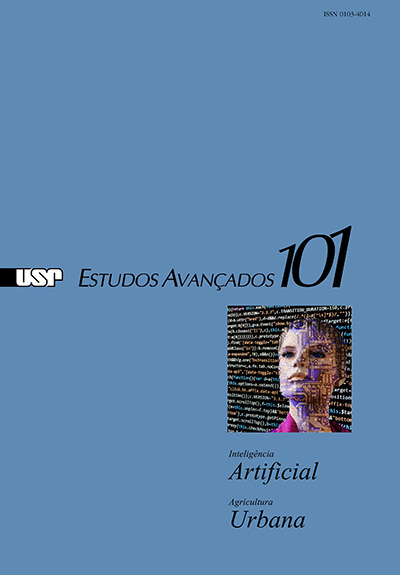
<p>In order to provide non-specialized audiences with a comprehensive view of this technological revolution, the 101st edition of the journal <i><a href="https://www.iea.usp.br/en/journal" class="external-link">Estudos Avançados</a></i> devotes its main dossier to the discussion of the current state, perspectives, and impacts of AI. The digital <span>version (Portuguese only) is available for free </span><span>at </span><a class="external-link" href="https://www.scielo.br/scielo.php?script=sci_issuetoc&amp;pid=0103-401420210001&amp;lng=en&amp;nrm=iso">SciELO</a>.</p>
<p>Composed of nine articles authored by 17 researchers from USP, University of Campinas (UNICAMP), Federal University of Rio Grande do Sul (UFRGS), and Federal University of Pernambuco (UFPE), the dossier "Artificial Intelligence" analyzes the development of the field since its origin in the 1950s, its numerous applications, and the debates it raises in the scientific and technological scenario. They do not neglect "the risks, the associated ethical care that its massive employment requires, and the social, political, cultural, and moral implications that rapidly transform contemporary societies," as summarized by the <span>publication's editor, sociologist </span><a href="https://www.iea.usp.br/en/persons/researchers/sergio-adorno" class="external-link">Sérgio Adorno</a>.</p>
<p>The opening of the dossier is dedicated to the methodological aspects of AI research, with an article by Fabio Gagliardi Cozman, from USP's Polytechnic School (EP). He explains that there are two "fundamentally different styles of approach to AI: on the one hand, the empirical style, strongly supported by observations about the biology and psychology of living beings and ready to embrace complicated architectures that emerge from the interaction of many disparate modules; on the other hand, an analytical style supported by general and organizing principles, interested in abstract conceptions of intelligence and assisted by mathematical and logical arguments."</p>
<p>According to Cozman, around 1980, the terms "scruffy" and "neat" were coined to <span>respectively</span><span> refer to these two styles of work in AI. This methodological divergence remains with the constant dilemma between "the search for rational artifacts based on clear principles or empirical artifacts that reproduce patterns," he says. His proposal is to invest in architectures based on principles of rationality that allow to </span><span>simultaneously </span><span>house several modules, many of which are based on massive data collection.</span></p>
<p><span>The concern with the form of AI development is shared by André Carlos Ponce de Leon Ferreira de Carvalho, from USP's Institute of Mathematics and Computer Science (ICMC): "What we have to decide now is no longer whether or not we will have AI, but how we will have it." To reduce possible risks "it is necessary to develop new AI algorithms or to use them in new and innovative ways, taking ethical, social, and legal issues</span><span> </span><span>into account</span><span>," </span><span>he points out</span><span>.</span></p>
<p><strong>Reasons for excitement</strong></p>
<p>This new period of euphoria in relation to the possible benefits of using AI is due to three factors, according to Jaime Simão Sichman, from EP: the current low cost of processing and memory, the emergence of new paradigms such as deep neural networks, and the huge amount of data available on the internet due to the large use of resources such as networks and social media.</p>
<p>Sichman warns that there are potential risks in this "technology, as in any other, which can be provoked if the actors involved in the production and regulation of its use do not create an adequate space for discussing these issues."</p>
<p>According to Teresa Bernarda Ludermir, from UFPE's Computer Center, the "extraordinary" advance of AI in recent years and its importance in solving technological and economic problems is mainly due to machine learning techniques, especially the use of neural networks. In addition to addressing the current status of the area, and its research challenges and opportunities, her article mentions social impacts and ethical issues arising from the uses of AI.</p>
<p>The changes that have occurred in AI since its emergence, especially regarding educational systems, are the object of the panorama presented by Rosa Maria Vicari, from UFRGS's Institute of Informatics. The researcher recalls that in 1980 and 1993 "the applications were interesting, but did not provide adequate answers in terms of language comprehension and medical diagnosis." In the last two decades, however, "the applications have remained, but there have been advancements in automatic translation, image recognition, cancer diagnosis. and autonomous cars."</p>
<p><strong>Some applications</strong></p>
<p>Nine researchers from UNICAMP's Institute of Computing are the authors of an article on digital forensic science, which is the use of scientific methods and techniques for investigating crimes in the digital world. A<span>ccording to them, the current importance reflects from the challenges resulting from the emergence of social media and the immense volume of data that they generate, intensified by the advances of AI. </span>Such amount of data is analyzed using AI techniques.<span> The article presents challenges and opportunities associated with the application of these techniques, and examples of their use in real situations.</span></p>
<p>A specific case in which AI plays a fundamental role is natural language processing (NLP), which is essential for analyzing large amounts of data contained in texts, among other uses. The topic is discussed by Marcelo Finger, from USP's Institute of Mathematics and Statistics (IME), in particular regarding the Portuguese language. He explains that the NLP is at the confluence of areas such as computer science, linguistics, logic, psychology, among others, and requires a multidisciplinary approach by nature.</p>
<p>However, all the advancements in NLP with the consequent generation of products and the facilitation of a series of services "seem to have brought no substantial information about the human process of reproducing and communicating through language," says the researcher. Following this line of reasoning, "natural language processing would have dissociated itself from language study." There are those who say that "technology will eventually kill the traditional study of language," he adds. For Finger, these two views are exaggerated: "Linguistics is absolutely fundamental for the area of language processing, since this computational task does not explain the language, and does not help to predict or explain the natural evolution of languages."</p>
<p>Ana Bazzan, from UFRGS's Informatics Institute, analyzes the use of AI to improve transportation systems. For her, the application of AI in the service can improve the use of the existing infrastructure in order to better meet the demand of displacement of people and goods. Her article addresses two tasks in which AI has relevant contributions in the sector: the control of traffic lights and the choice of routes.</p>
<p><strong>Impacts on labour</strong></p>
<p>The dossier ends with an article by Ricardo Abramovay, a senior professor at USP's Institute of Energy and Environment (IEE), on one of the issues that most concern society with regard to AI: the loss of job positions. The author states that, although the most advanced forms of the digital revolution (AI, machine learning, and the internet of things) are replacing a considerable part of the workforce, "this is not where its greatest threat lies." The problem is that this revolution "is strengthening a social polarization of the labour market that goes against the foundations of the welfare state in the 20th century," he says.</p>
<p>According to Abramovay, "the place of work in the cohesion of contemporary societies involves a fundamental philosophical discussion: what work is, what employment is, but more than that, how we can make our capacity for cooperation result in a better life for everyone in ways that are not unworthy and undervalued for the overwhelming majority, alongside creative and uplifting activities for a small minority."</p>
<p><strong>Other sections</strong></p>
<p><span>In addition to the main dossier, the issue includes an encouraging study on the diversity of higher education institutions in Brazil, a set of texts on urban agriculture, and reviews of five editorial releases.</span></p>
<p>In terms of pursued objectives and obtained results, this diversity requires an effort to classify the institutions by similarity of profile, establishing different evaluation criteria for each group. This is what the article "For a Typology of Brazilian Higher Education: Test of Conception," by Simon Schwartzman, Roberto Lobo Silva Filho, and Rooney Coelho, proposes.</p>
<p>According to the authors, the differences between the institutions are not recognized with all the implications by the legislation or by the evaluation system adopted by the Ministry of Education. The article presents a typology proposal that seeks to clearly identify these differences in order to serve as a basis for an information system and evaluation procedures.</p>
<p>To this end, the researchers propose to group institutions with similar profiles from the point of view of their size, legal nature, and involvement in teaching and postgraduate activities, in addition to verifying the extent to which this differentiation corresponds with the diversity of characteristics of professors, students, and their segment. The final part of the study discusses some of the implications of the typology for the higher education assessment system and for improving the quality and performance of higher education in the country.</p>
<p><strong>Urban agriculture</strong></p>
<p>According to the editor of <span><i>Estudos Avançados</i></span>, the articles on "Urban Agriculture" address specific issues connected with each other as modalities and alternatives for the promotion of food security.</p>
<p>The six texts discuss the multifunctionality, production, and commercialization of urban agriculture, its association with agroecology, the importance of community gardens and backyard gardens, and the contradictions of locavorism (food activism that emerged in the past decade and privileges the consumption of locally produced food) in the face of the experiences of urban agriculture in São Paulo.</p>
<p><strong>Reviews</strong></p>
<p><span>A set of six </span>reviews addresses works with varied themes, including geology, history, intellectual production, and literature. Ricardo Soares and Wilson Machado write about "The Anthropocene as a Geological Time Unit: A Guide to the Scientific Evidence and Current Debate," which gathers data from the 35th International Geological Congress, held in 2016. Camila Ferreira da Silva and Janderson Bragança Ribeiro review <span><i>Sobre o Autoritarismo Brasileiro</i> (</span><span>"About Brazilian Authoritarianism"), by Lilia Moritz Schwarcz. Fabio Mascaro Querido addresses </span><span><i>Seja como For: Entrevistas, Retratos e Documentos</i> ("</span>Whichever Way<span>: Interviews, Portraits, and Documents"), by Roberto Schwarz. Mariana Holms analyzes </span><span><i>O Homem que Aprendeu o Brasil</i></span><span> ("The Man Who Learned Brazil"), by Ana Cecília Impellizieri Martins (2020). Cecilia Marks writes about Franco Moretti's </span><span><i>O Romance de Formação</i></span><span> ("The Romance of Formation").</span></p>
<div id="_mcePaste">
<div class="tlid-results-container results-container">
<div class="tlid-result result-dict-wrapper">
<div class="result tlid-copy-target">
<div class="text-wrap tlid-copy-target"></div>
</div>
</div>
</div>
</div>]]></content:encoded>
    <dc:publisher>No publisher</dc:publisher>
    <dc:creator>Richard Meckien</dc:creator>
    <dc:rights>Original version in Portuguese by Mauro Bellesa.</dc:rights>
    
      <dc:subject>Higher Education</dc:subject>
    
    
      <dc:subject>Urban agriculture</dc:subject>
    
    
      <dc:subject>Food safety</dc:subject>
    
    
      <dc:subject>Journal</dc:subject>
    
    
      <dc:subject>Artificial Intelligence</dc:subject>
    
    
      <dc:subject>Publications</dc:subject>
    
    <dc:date>2021-05-02T17:40:00Z</dc:date>
    <dc:type>Notícia</dc:type>
  </item>


  <item rdf:about="https://www.iea.usp.br/en/events/building-equitable">
    <title>Building Equitable, Excellent, and Democratic Classrooms: Evidence-Based Programs for Educators in Various Subject Areas</title>
    <link>https://www.iea.usp.br/en/events/building-equitable</link>
    <description></description>
    <content:encoded xmlns:content="http://purl.org/rss/1.0/modules/content/"><![CDATA[<p><strong><a href="https://www.iea.usp.br/eventos/building-equitable-programs-educators" class="external-link">Clique aqui para a versão em Português</a></strong></p>
<p>Professor Rache Lotan will present the evidence-based pedagogical approach developed at Stanford University over five decades ago. Deepened and extended by the work of scholars, teachers, and researchers in numerous countries around the world to support equitable, excellent, and democratic classrooms for diverse student populations in heterogeneous classrooms. It emphasizes equal-status interactions among students and specifies the conditions under which teachers can establish and support such interactions.</p>
<p><strong>Mediation:</strong> <a href="https://www.iea.usp.br/en/persons/researchers/roseli-lopes" class="external-link">Roseli de Deus Lopes</a> (IEA)</p>
<p><strong>Presenter:</strong> <a class="external-link" href="https://ed.stanford.edu/faculty/rlotan">Rachel Lotan</a>, Professor Emerita and the former Director of the Stanford Teacher Education Program (STEP)</p>
<h3>Registration</h3>
<p>Free and public event <strong>|</strong> Registration is not required<br />Online event (<a href="https://www.iea.usp.br/aovivo" class="external-link">http://www.iea.usp.br/aovivo</a>) <strong>|</strong> No attendance certification will be provided<br />The event will be held in English and no simultaneous translation into Portuguese will be provided</p>]]></content:encoded>
    <dc:publisher>No publisher</dc:publisher>
    <dc:creator>Richard Meckien</dc:creator>
    <dc:rights></dc:rights>
    
      <dc:subject>Oscar Sala Chair</dc:subject>
    
    
      <dc:subject>Online event</dc:subject>
    
    
      <dc:subject>Artificial Intelligence</dc:subject>
    
    
      <dc:subject>Public event</dc:subject>
    
    <dc:date>2024-06-13T17:25:00Z</dc:date>
    <dc:type>Evento</dc:type>
  </item>


  <item rdf:about="https://www.iea.usp.br/en/events/brazil-achievement-gains">
    <title>Brazil: Achievement Gains in an Unequal Society</title>
    <link>https://www.iea.usp.br/en/events/brazil-achievement-gains</link>
    <description></description>
    <content:encoded xmlns:content="http://purl.org/rss/1.0/modules/content/"><![CDATA[<p><strong><a href="https://www.iea.usp.br/eventos/brazil-achievement-gains-in-an-unequal-society" class="external-link">Clique aqui para a versão em Português</a></strong></p>
<p><span>Professor Martin Carnoy will discuss unequal increases in Brazilian schools scores  since 2000. In the recent study, student achievement gains in Brazil among municipalities (2007–2017) is analyzed  with the goal of understanding the variation in these gains and the socioeconomic, race, and school resource correlates of that variation.</span></p>
<p><span>Carnoy is the Vida Jacks Professor of Education at Stanford University Graduate School of Education and former president of the Comparative and International Education Society and a fellow of the National Academy of Education and of the International Academy of Education. He has written forty books and more than 150 articles on the economic value of education, on the political economy of educational policy, on educational production, and on higher education. Much of his work is comparative and international and investigates the way educational systems are organized.</span></p>
<p><span>In Brazil, he has been supporting the Programa de Especialização Docente PED Brasil - a network of Brazilian Universities for  Teacher Education - since its inception.</span></p>
<h3>Registration</h3>
<p>Free and public event <strong>|</strong> Registration is not required<br />Online event (<a href="https://www.iea.usp.br/aovivo" class="external-link">http://www.iea.usp.br/aovivo</a>) <strong>|</strong> No attendance certification will be provided<br />The event will be held in English and no simultaneous translation into Portuguese will be provided</p>]]></content:encoded>
    <dc:publisher>No publisher</dc:publisher>
    <dc:creator>Richard Meckien</dc:creator>
    <dc:rights></dc:rights>
    
      <dc:subject>Oscar Sala Chair</dc:subject>
    
    
      <dc:subject>Online event</dc:subject>
    
    
      <dc:subject>Artificial Intelligence</dc:subject>
    
    
      <dc:subject>Public event</dc:subject>
    
    <dc:date>2024-07-31T17:25:00Z</dc:date>
    <dc:type>Evento</dc:type>
  </item>


  <item rdf:about="https://www.iea.usp.br/en/events/ai-sustainability-two-sides-of-the-coin">
    <title>AI and Sustainability: the Two Sides of the Coin</title>
    <link>https://www.iea.usp.br/en/events/ai-sustainability-two-sides-of-the-coin</link>
    <description></description>
    <content:encoded xmlns:content="http://purl.org/rss/1.0/modules/content/"><![CDATA[<div class="kssattr-target-parent-fieldname-text-69d0218562c643ad9cceea31ef7dd80d kssattr-macro-rich-field-view kssattr-templateId-widgets/rich kssattr-atfieldname-text " id="parent-fieldname-text-69d0218562c643ad9cceea31ef7dd80d">
<p><strong><a href="https://www.iea.usp.br/eventos/ai-two-sides-coin" class="external-link">Clique aqui para a versão em Português</a></strong></p>
<p>Artificial Intelligence (AI) can be useful in promoting sustainability in many ways. It can facilitate predicting climate events, identifying human activities capable of harming forests and environmental preservation areas, and optimizing production processes, thus reducing their environmental impacts.</p>
<p>However, the development and application of AI models are not free from environmental consequences.</p>
<p>There are growing discussions, for instance, on the carbon footprint of training machine learning models and the impacts of extractive activities necessary for producing equipment linked to AI. The seminar will address these two sides of the relationship between AI and sustainability.</p>
<p>This event is part of the "Challenges and Opportunities in AI - Sectoral Perspectives" seminar cycle.</p>
<p>This initiative intends to create spaces for exchanges between researchers and representatives of the private sector so that we can reflect on regulatory solutions in favour of maximizing the benefits of AI and minimizing its risks.</p>
<h3></h3>
<p><span><strong><strong>Presenter</strong></strong></span></p>
<p align="left"><a href="https://www.iea.usp.br/en/persons/speakers/carlos-silva">Carlos Silva</a> (Lead R&amp;D Science, Pachama)<br />Gustavo Pinheiro<span> (iCS)</span></p>
<a href="https://www.iea.usp.br/en/persons/speakers/carlos-silva" class="external-link"> </a>
<p align="left"><strong><strong>Debater</strong></strong></p>
<p align="left">Miriam Garcia (CDP Latin America)</p>
<p align="left"><strong><span>Moderator</span></strong></p>
<p align="left">Rodrigo Brandão (IEA-USP/NIC.br) e Veridiana Cordeiro (IEA-USP)</p>
<h3><span>Registration</span></h3>
<p>Free and public event <strong>|</strong> No registration required<br />Online event <strong>|</strong> No attendance certification will be provided<br />The event will be held in English and there will be no simultaneous translation into Portuguese <strong>|</strong> Live transmission at <a href="https://www.iea.usp.br/aovivo" class="external-link">http://www.iea.usp.br/aovivo</a></p>
<h3><strong>Organization</strong></h3>
<p><a href="https://www.iea.usp.br/en/research/research-groups/innovation-and-competitiveness-observatory" class="external-link"><span style="text-align: right; ">IEA Research Group on Innovation and Competitivene</span>ss</a></p>
<h3><strong>Support</strong></h3>
<p><a class="external-link" href="https://abes.com.br/en/">Brazilian Association of Software Companies (ABES)<br /></a><a class="external-link" href="https://www.portaldaindustria.com.br/cni/en/">Brazilian National Confederation of Industry (CNI)</a><br /><a class="external-link" href="https://www.nic.br/about-nic-br/">Brazilian Network Information Center (NIC.br)<br /></a><a class="external-link" href="https://c4ai.inova.usp.br/about/">Center for Artificial Intelligence (C4AI)</a></p>
</div>
<div></div>]]></content:encoded>
    <dc:publisher>No publisher</dc:publisher>
    <dc:creator>Richard Meckien</dc:creator>
    <dc:rights></dc:rights>
    
      <dc:subject>ST&amp;I</dc:subject>
    
    
      <dc:subject>Sustainability</dc:subject>
    
    
      <dc:subject>Research Group: Innovation and Competitiveness Observatory (OIC)</dc:subject>
    
    
      <dc:subject>Public event</dc:subject>
    
    
      <dc:subject>Artificial Intelligence</dc:subject>
    
    <dc:date>2023-09-25T18:50:00Z</dc:date>
    <dc:type>Evento</dc:type>
  </item>


</rdf:RDF>