<?xml version="1.0" encoding="utf-8" ?>
<rdf:RDF xmlns:rdf="http://www.w3.org/1999/02/22-rdf-syntax-ns#" xmlns:dc="http://purl.org/dc/elements/1.1/" xmlns:syn="http://purl.org/rss/1.0/modules/syndication/" xmlns="http://purl.org/rss/1.0/">


<channel rdf:about="https://www.iea.usp.br/search_rss">
  <title>Instituto de Estudos Avançados da Universidade de São Paulo</title>
  <link>https://www.iea.usp.br</link>

  <description>
    
            These are the search results for the query, showing results 1 to 5.
        
  </description>


  <image rdf:resource="https://www.iea.usp.br/logo.png" />

  <items>
    <rdf:Seq>
      
        <rdf:li rdf:resource="https://www.iea.usp.br/en/news/study-group-education" />
      
      
        <rdf:li rdf:resource="https://www.iea.usp.br/en/news/launch-chair-basic-education" />
      
      
        <rdf:li rdf:resource="https://www.iea.usp.br/en/news/science-education-risk-awareness" />
      
      
        <rdf:li rdf:resource="https://www.iea.usp.br/en/news/journal-issue-115" />
      
      
        <rdf:li rdf:resource="https://www.iea.usp.br/en/news/issue94" />
      
    </rdf:Seq>
  </items>

</channel>


  <item rdf:about="https://www.iea.usp.br/en/news/study-group-education">
    <title>New study group will make proposals for public basic education</title>
    <link>https://www.iea.usp.br/en/news/study-group-education</link>
    <description></description>
    <content:encoded xmlns:content="http://purl.org/rss/1.0/modules/content/"><![CDATA[<table class="tabela-direita">
<tbody>
<tr>
<th><img src="https://www.iea.usp.br/imagens/criancas-em-sala-de-aula" alt="Crianças em sala de aula" class="image-inline" title="Crianças em sala de aula" /></th>
</tr>
</tbody>
</table>
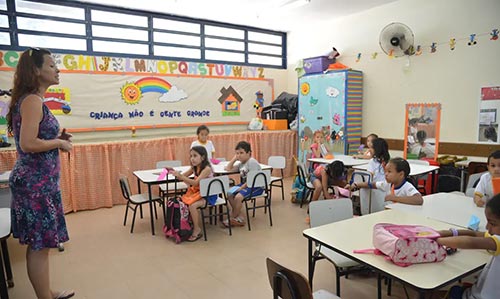
<p>Public basic education needs to improve in many ways, but the Brazilian educational system is not a complete failure, as many evaluate. This is the opinion of Nílson José Machado, a professor at USP's Faculty of Education (FE) and coordinator of the <span>recently created</span> Brazilian Public Basic Education Study Group: Apparent Difficulties, Actual Challenges.</p>
<p><span> </span><span>Among the actions he considers crucial for the improvement of the system, Machado defends: the elaboration of a state project for education; the improvement of the working conditions of teachers; the application of available resources in relevant projects and objectives; the emphasis on teaching the fundamental ideas of each discipline; and the formulation of strategies for the recognition of good schools and for their example to inspire other educational institutions.</span></p>
<p><span>The target of the new group is to produce documents with <span>public and private </span><span>partners that are </span>internal and external to the University in order to inspire and substantiate actions to meet these priorities. This work will be done from dedication to three lines of action:</span></p>
<ul>
<li>organization of debates and dialogues on the actual problems of Brazilian education, with the participation of professionals working <span>on different fronts </span>in the area of education, including the different levels of education, as well as the public and private sectors;</li>
<li>mapping of good Brazilian schools aiming to identify common characteristics despite the diversity of institutional projects, in order to propose conditions for the number of these schools to be expanded;</li>
<li>
<div id="_mcePaste">mapping of innovators, both in terms of used technologies and in terms of methodologies or management, with the objective of formulating practices for the dissemination of these experiences.</div>
</li>
</ul>
<p> </p>
<p>To achieve these goals, the group will promote a cycle of five seminars from August to December, 2017. At the end of the cycle, each line of action will present a document. The three papers will be a summary of the discussions and proposed actions to be submitted to educational decision-making bodies.</p>
<p>The topics of the monthly seminars are:</p>
<ul>
<li>August - Teaching in Public Basic Education: What is the Profile? What are the Working Conditions?</li>
<li>September - Quality of Public Basic Education: What Does it Really Mean?</li>
<li>October - Innovative Schools and Experiences: What Can Be Admired, in Spite of Everything?</li>
<li>November - Technologies, Distance Education, Integral School: At Which Point Are We?</li>
<li>December - Official Documents (Curricula, National Basis, Plans): Do They Impede or Prevent Educational Actions?</li>
</ul>
<p> </p>
<p>In addition to Machado, nine other researchers from USP are part of the group: Chao Wen, from the School of Medicine; Elie Ghanem, from the Faculty of Education; <a href="https://www.iea.usp.br/en/persons/researchers/guilherme-plonski" class="external-link">Guilherme Ary Plonski</a>, deputy director of the IEA; Helena Singer, from the IEA and director of the <span><i>Cidade Escola Aprendiz</i></span><span> Association; Hélio Dias and </span><span>Luiz Carlos de Menezes</span><span>, from the Institute of Physics; Lino de Macedo, from the Polytechnic School; Paulo Saldiva, director of the IEA, and Yvonne Mascarenhas, from the IEA and the Institute of Physics at São Carlos.</span></p>
<h3>Assumpted and actual reasons for the crisis</h3>
<p>"Proclaiming the existence of a crisis in Brazilian basic education is easy because there is no lack of data that supposedly characterize it and reasons considered as legitimate to justify it," according to Machado.</p>
<p>"However, some of the more seductive narratives on the subject place the roots of difficulties in apparent problems, shifting the focus from the attentions of the actual challenges to be overcome."</p>
<p>One of the false arguments is to attribute educational problems to the lack or poor preparation of teachers, says the coordinator of the group. "The lack of teachers in some areas is directly related to the working conditions offered; that is the problem to be faced."</p>
<p>He recalls that USP has had a postgraduate program in science and mathematics education for decades, responsible for training hundreds of professors and doctors, "however, a tiny percentage of such are in classrooms in the basic school".</p>
<p>"The better prepared they become, the more they move away from the basic school classroom, seeking better working conditions in other spaces."</p>
<p>In the opinion of Machado, the shortage of resources also can not be held responsible for the difficulties. For him, a country with so many needs can not aim to have sufficient resources for education and health. "The lack is the rule, but this does not deprive significant and transformative actions. The real problem to be faced, in this case, is the lack of well-founded projects with well-defined objectives at the various levels of education."</p>
<p>The country lacks a state project for education, according to Machado, who criticizes the excessive preoccupation with the improvement in indicators - "not always reliable or expressive of the actual situation of the country" - and initiatives in which the measures take the place of the targets: "Ambitious goals like providing a computer to each student may look like defensible actions, but they are just pseudo-projects."</p>
<p>"There are many examples where the <span>allocated</span><span> </span><span>resources are immense, without the counterpart of an effective improvement in educational practices. On the other hand, there are specific projects in progress or already completed in which, even with few resources, the effective mobilization and the expected transformations are fully recognized."</span></p>
<p>Another problem of basic education would be the excess of <span>taught </span><span>contents. Worse than that is the non-existance of an interdisciplinary and / or transdisciplinary vision, which results in the intention to </span><span>drastically </span><span>reduce the number of disciplines. For Machado, the actual problem to be faced is the presentation of each discipline in an "excessively fragmented way, including Portuguese language and mathematics."</span></p>
<p>He considers that the effective way to combat this excessive fragmentation is the recognition and appreciation of the fundamental ideas of each discipline, leaving aside the immense amount of detail present in each one of them.</p>
<p>Machado also questions the view that the Brazilian educational system is a complete failure, an erroneous conception reinforced after the dissemination of the results of periodic evaluations carried out by various national and international instances. "By giving more prominence to negative performance than to multiple examples of good schools at different levels of education, government programs fuel a chaotic environment policy, failing to stimulate important partners in the pursuit of improved education."</p>
<p>"The actual problem is to find ways and strategies for good schools to be recognized and ways of articulating collective actions designed so that their examples inspire other schools."</p>
<p>According to Machado, there are a number of other so-called solutions that do not effectively contribute to the improvement of teaching, among which:</p>
<ul>
<li>the expansion of vocational education "without a substantive discussion about the meaning of professionalism and what characterizes a good professional formation at the present time";</li>
<li>the search for the implementation of full-time schools, "instead of understanding what 'integral school' is, which deals with the total formation of the individual as a person and is effectively integrated with the community it serves";</li>
<li>the emphasis on encouraging the "protagonism" of the students, when "what really matters is a formation that will make them capable of any role that fits in society, whether the protagonist, the coadjuvant or even the mere character."</li>
</ul>
<p style="text-align: right; "><span class="discreet">Photo: Ludi/Pixabay.com</span></p>]]></content:encoded>
    <dc:publisher>No publisher</dc:publisher>
    <dc:creator>Richard Meckien</dc:creator>
    <dc:rights>Original version in Portuguese by Mauro Bellesa.</dc:rights>
    
      <dc:subject>Public Education</dc:subject>
    
    
      <dc:subject>Education</dc:subject>
    
    
      <dc:subject>Basic Education</dc:subject>
    
    <dc:date>2017-08-11T15:30:00Z</dc:date>
    <dc:type>Notícia</dc:type>
  </item>


  <item rdf:about="https://www.iea.usp.br/en/news/launch-chair-basic-education">
    <title>IEA and Itaú Social launch the Chair of Basic Education</title>
    <link>https://www.iea.usp.br/en/news/launch-chair-basic-education</link>
    <description></description>
    <content:encoded xmlns:content="http://purl.org/rss/1.0/modules/content/"><![CDATA[<table class="tabela-direita">
<tbody>
<tr>
<th><img src="https://www.iea.usp.br/imagens/catedra-de-educacao-1" alt="Cátedra de Educação - 1 " class="image-inline" title="Cátedra de Educação - 1 " /></th>
</tr>
<tr>
<td><span class="discreet">The director of the Institute of Advanced Studies, Paulo Saldiva, USP's president Vahan Agopyan, the superintendent of Itaú Social, Angela Dannemann, and the coordinator of the Chair, Nílson José Machado</span></td>
</tr>
</tbody>
</table>
<p>The main objective of the Chair of Basic Education, based at the IEA and launched on February 21, is to gather measures that foster policies for basic education focused on teacher education, starting from the analysis of innovative experiences, discussions with the players and field studies. The opening event was a ceremony at USP's Museum of Contemporary Art (MAC). The Chair is the result of an agreement signed by USP, the Itaú Social Foundation - sponsor of the initiative -, and the Foundation for the Support of the University of São Paulo (FUSP) at the end of 2018.</p>
<p><a href="https://www.iea.usp.br/en/media-library/photos/events-2019/launch-usp-chair-basic-education-february-2019" class="external-link">Photos of the event</a></p>
<p>Itaú Social has allocated R$ 5 million to the activities of the Chair, divided into five annual contributions. The amount will subsidize the activities during the five years of agreement, which may be renewed.</p>
<p>For the first semester, three seminars are planned. With the participation of specialists, the activities will enable the systematization of information based on specific experiences and educational policies at the three levels of government. Each presentation will result in a video of 15 minutes and a text. In the second half of the year, the Chair should take the specialists to the field in order to get a closer look at the most successful experiences in basic education. With the collected information, they will return to USP to continue the research project.</p>
<table class="tabela-esquerda">
<tbody>
<tr>
<th><img src="https://www.iea.usp.br/imagens/catedra-de-educacao-2" alt="Cátedra de Educação - 2 " class="image-inline" title="Cátedra de Educação - 2 " /></th>
</tr>
<tr>
<td><span class="discreet">Nílson José Machado</span></td>
</tr>
</tbody>
</table>
<p><br />"We do not want to have an effect on Brazilian education in 40 or 50 years. We want to see results in four or five years," said <a href="https://www.iea.usp.br/en/persons/researchers/nilson-machado" class="external-link">Nílson José Machado</a>, academic coordinator of the Chair. In 2017 and 2018, also at the IEA, he coordinated the <a href="https://www.iea.usp.br/en/news/study-group-education" class="external-link">Brazilian Public Basic Education Study Group: Apparent Difficulties, Actual Challenges</a>, which mapped the most relevant issues in the area and produced the document "Diagnosis and Proposals for Basic Education in Brazil." The work of the group has inspired the creation of the Chair.</p>
<p>It is based on the result of this previous study that Machado defends that the main problem of Brazilian education is the lack of a project. "If we had a project for education, even a lack of resources would be easier to manage."</p>
<p>For <a href="https://www.iea.usp.br/en/persons/researchers/paulo-saldiva" class="external-link">Paulo Saldiva</a>, director of the IEA, it is USP's role to be part of the solution package for the country, an idea shared by the university's president, Vahan Agopyan, who has also attended the ceremony. "The university is not meant to solve all problems, but it has an obligation to help by recommending solutions," he said.</p>
<ul>
</ul>
<p>Itaú Social's superintendent Angela Dannemann has highlighted the strategic character of the foundation's partnership with the IEA: "The union between researchers, and the professionals who daily work at schools and know the educational networks has, in itself, a transforming power."</p>
<table class="tabela-direita-400-borda">
<tbody>
<tr>
<td>
<h3><i>
<div id="_mcePaste">Convergence of</div>
<div id="_mcePaste">initiatives for education</div>
<br /></i></h3>
<p><i>Since the early 1990s, the IEA has been committed to reflect on Brazilian public basic education and to collaborate in the formulation of public policies for the area.</i></p>
<p><i>Three visiting professors have dedicated their time to the theme in different periods of those years: the academic coordinator of the new Chair, Nílson José Machado; educator Guiomar Namo de Mello, </i><i>a researcher at the Carlos Chagas Foundation, and education specialist at the World Bank and at the Inter-American Development Bank, </i><i>who has also been Municipal Secretary of Education in São Paulo; and physicist Sérgio Costa Ribeiro, whose studies have shown that failure rather than evasion was the main obstacle to improve education and cognitive competence of the country's young population during the second half of the 20th century.</i></p>
<p><i>Another initiative of the Institute has been the </i><i>Education for Citizenship Mobilizing </i><i>Program</i><i>, focused on collecting data on the Brazilian educational system. One of the results of the program has been a report </i><i>on public policies for education </i><i>coordinated by Guiomar Namo de Mello.</i></p>
<p><i>Diagnoses, challenges, public policies and successful experiences in basic education have been subjects of dossiers and articles in the </i><i>"<a href="https://www.iea.usp.br/en/journal" class="external-link">Estudos Avançados</a>"</i><i> journal, and of conferences and public seminars over the last 30 years of the IEA.</i></p>
<p><i>While running for director and deputy director of the IEA, the then-candidates and now holders of the respective positions professors Paulo Saldiva and Guilherme Ary Plonski included </i><i>the creation of a core of studies dedicated to elementary and secondary education</i><i> among the priorities of their 2016-2020 Management Plan.</i></p>
<p><i>The guideline was implemented in early 2017 with the Brazilian Public Basic Education Study Group: Apparent Difficulties, Actual Challenges, under the coordination of Nílson José Machado. In five seminars held in 2017 and 2018, USP professors, educators, and public managers analyzed teacher education, quality of education, the role of official documents, and innovative experiences. The conclusions of the group were released in July 2018 with the document "</i><span><i>Diagnosis and Proposals for Basic Education in Brazil</i></span><i>".</i></p>
<p><i>Since 1993, Itaú Social has been developing programs to improve Brazilian public education. Examples of this effort include the creation of the Itaú-UNICEF Prize, the Education Improvement Program in the Municipality, the Cycles of Debates in Educational Management, and the creation of the </i><i>program </i><i>Educational Territories Networks.</i></p>
<p><i>The signing of the agreement for the creation of the chair based at the IEA is one more step for Itaú Social in addition to the various partnerships with the public power, including cooperation agreements with the Municipal Funds for the Rights of Children and Adolescents in 44 municipalities of several states. The foundation also cooperates with the Ministry of Education and the Ministry of Social Development, with the Municipal Secretary of Education in Manaus, and with the states of the Interstate Development Consortium of Central Brazil (Tocantins, Rondônia, Mato Grosso do Sul, Mato Grosso, Goiás, and the Federal District).</i></p>
<p><i>Itaú Social has 17 institutional partners, including the United Nations Children's Fund (UNICEF), the National Institute of Pure and Applied Mathematics Association, the Lemann Foundation, the Ayrton Senna Institute, and the Roberto Marinho Foundation.</i></p>
</td>
</tr>
</tbody>
</table>
<p>According to Dannemann, the foundation's expectation is that "during the five-year term of the Chair there will be" an accumulation of knowledge production, innovative practices, and training sessions that promote significant advances" in the proposals for basic education." All this with a commitment that is different: the appreciation of the look and the voice of the attending teachers."</p>
<p><span><strong>Premises</strong></span></p>
<p>The Chair is based on three premises, according to the formulators of the proposal:</p>
<ol>
<li>quality education is the one that promotes the full development of the subject;</li>
<li>the training of the teaching staff requires a balanced relationship between theory and practice, recognizing each individual as a whole;</li>
<li>the training of the teaching staff and their professional performance find limits in structuring problems, involving variables that are internal and external to the school.</li>
</ol>
<p> </p>
<p>By linking quality education with its concern to promote the full development of the individual, the Chair emphasizes the need to recognize its different dimensions (cognitive, emotional, social, ethical and physical) and to value the diversity of interests, talents, and individual<span> and group </span>trajectories. By embracing this notion of full education, the Chair encourages complementarity among schools, families, and local and city organizations, and proposes to promote multidisciplinary collaboration, given the challenges of the 20th century.</p>
<p>The Chair considers that the systematic training of teachers should be permanent, centered on what is experienced at school, but ubiquitous, collaborative and hybrid (face-to-face and by digital means). The proposal adds that, just like every student, every teacher must have <span>his integrality and his <span>subject </span>character</span> recognized. Such training expands the capacity for observation and reflection from the articulation between the challenges, scientific theories, and research results.</p>
<p>The members of the Chair relate structural problems that limit the training and the performance of teachers: a high rate of changing school staff, the lack of autonomy of the school unit in selecting the teaching staff, the intense workload which does not involve collective pedagogical elaboration, the deficient infrastructure, the fragmented vision of educational management, and the <span>discouraging </span>remuneration and career plans. In this sense, research projects that point out solutions to these challenges, including previous experiences of school networks and communities, are considered fundamental.</p>
<p>For the first semester of 2019, the Chair has programmed three seminars with the general theme "Action / Teacher Training: The Disciplinary Fragmentation and its Antidotes." The dates, the themes, and the presenters are the following:</p>
<ul>
<li><span>March 16 – Teacher:  Professionalism and Competence</span></li>
<ul>
<li>The Teacher and the Idea of Professionalism – <i>Nílson José Machado (IEA and USP's School of Education / FE)</i></li>
<li>The Teacher and His / Her Competences – <i>Lino de Macedo <i>(IEA and USP's <span>Institute of Psychology / </span>IP)</i></i></li>
<li>The Teacher's Action as a Professional – <i>Luís Carlos de Menezes <i>(IEA and USP's <span>Institute of Physics / </span>IF)</i></i></li>
<li>Attractiveness and Teaching Career – <i>Caroline Tavares (Itaú Social)</i></li>
</ul>
<li><span>April 13 – <span>The Teacher's Action</span>: Planning and Evaluation</span> 
<ul>
<li>The Teacher's Action: Freedom, Responsibility, Tolerance – <i><i>Luís Carlos de Menezes <i>(IEA and USP's Institute of Physics / IF)</i></i></i></li>
<li>Planning: Conceptions of Knowledge and Teaching Actions – <i><i>Nílson José Machado (IEA and USP's School of Education / FE)</i></i></li>
<li>Evaluation: The Ideas of Measurement and Value, and the Meaning of Indicators – <i><i>Lino de Macedo <i>(IEA and USP's Institute of Psychology / IP)</i></i></i></li>
<li>Evaluation and Planning: Good Practices for Time Use / Self-Training Activity – <i>Itaú Social</i></li>
</ul>
</li>
<li><span>May 18 – Teacher Training: Innovative Experiences</span></li>
<ul>
<li>Teacher Training: A Panorama of Fundamental Questions – <i>Bernardete Angelina Gatti (São Paulo State Board of Education / </i><i>CEE-SP)</i></li>
<li>Integrated Training: The Experience of USP São Carlos – <i>Yvonne Mascarenhas (IEA and <i>USP's Institute of Physics in São Carlos / </i>IFSC-USP)</i></li>
<li>Training by Area: A Transdisciplinary Vision – <i><i>Luís Carlos de Menezes <i>(IEA and USP's Institute of Physics / IF)</i></i></i><i> and <i>Nílson José Machado (IEA and USP's School of Education / FE)</i></i></li>
<li>Itaú Social Foundation: Overview of Projects Relating to the Final Years of Elementary Education <i>– <i>Itaú Social</i></i></li>
</ul>
</ul>
<p> </p>
<p><span><strong>Governance</strong></span></p>
<p>In addition to yearly having a researcher or intellectual with a relevant role in the reflection on the challenges of basic education, the Chair has a Governance Committee, an Advisory Committee and an Executive Committee.</p>
<p>The members of the Governance Committee are:</p>
<ul>
<li>IEA's director (currently Paulo Saldiva), who is also president of the committee;</li>
<li>the superintendent of Itaú Social (currently Angela Dannemann);</li>
<li>the coordinator general of the Chair, Guilherme Ary Plonski, deputy director at the IEA;</li>
<li>academic coordinator Nílson José Machado, from USP's School of Education and former visiting professor at the IEA;</li>
<li>two representatives of Itaú Social, appointed by the superintendent: Patrícia Mota Guedes, R&amp;D manager, and Juliana Souza Mavoungou Yade, R&amp;D specialist</li>
<li>and the chair holder.</li>
</ul>
<p> </p>
<p>Five researchers nominated by the IEA and five others chosen by Itaú Social constitute the Advisory Committee, to be renewed according to the agreement between the partners.</p>
<table class="tabela-direita">
<tbody>
<tr>
<th><img src="https://www.iea.usp.br/imagens/catedra-educacao-4" alt="Cátedra Educação - 4" class="image-inline" title="Cátedra Educação - 4" /></th>
</tr>
<tr>
<td><span class="discreet">Members of the Chair of Basic Education</span></td>
</tr>
</tbody>
</table>
<p>The Executive Committee includes:</p>
<ul>
<li>the coordinator general;</li>
<li>the academic coordinator;</li>
<li>two associate coordinators nominated by the IEA: USP professors Luís Carlos Menezes, from the IF-USP, and Lino Macedo, from the IP-USP;</li>
<li>two researchers nominated by the coordinators of the IEA centers in São Carlos and in Ribeirão Preto (one of each)</li>
<li>and a secretary.</li>
</ul>
<p> </p>
<p><span>Also participating in the Chair are researchers: Hélio Dias, from IF-USP and a senior professor at the IEA; Helena Singer, from the NGO Ashoka Brasil; Yvonne Mascarenhas, scientific coordinator of IEA's São Carlos Center and honorary professor of the Institute; Bernardete Gatti, from the Carlos Chagas Foundation and former president of the CEE-SP; Elie Ghanem, from FE-USP; Guiomar Namo de Melo, president of the Brazilian School of Teachers and former visiting professor at the IEA; and Francisco Aparecido Cordão, director at Peabiru Educacional.</span></p>
<p>The Executive Committee will be in charge of detailing the scope of the research project and defining the thematic axes; determine the process of selection and final selection of projects; and defining the scheduling of seminar cycles and other meetings.</p>
<p style="text-align: right; "><span class="discreet">Photos: Cecília Bastos / USP Imagens</span></p>
<ul>
</ul>
<ul>
</ul>
<ul>
</ul>]]></content:encoded>
    <dc:publisher>No publisher</dc:publisher>
    <dc:creator>Richard Meckien</dc:creator>
    <dc:rights>Original version in Portuguese by Mauro Bellesa and Fernanda Rezende.</dc:rights>
    
      <dc:subject>Public Education</dc:subject>
    
    
      <dc:subject>Basic Education</dc:subject>
    
    
      <dc:subject>Public Policies</dc:subject>
    
    
      <dc:subject>Chair of Basic Education</dc:subject>
    
    
      <dc:subject>Education</dc:subject>
    
    <dc:date>2019-02-22T03:00:00Z</dc:date>
    <dc:type>Notícia</dc:type>
  </item>


  <item rdf:about="https://www.iea.usp.br/en/news/science-education-risk-awareness">
    <title>Awareness of global risks must be a component of scientific education, says researcher</title>
    <link>https://www.iea.usp.br/en/news/science-education-risk-awareness</link>
    <description></description>
    <content:encoded xmlns:content="http://purl.org/rss/1.0/modules/content/"><![CDATA[<p><dl class="image-right captioned" style="width:400px;">
<dt><img src="https://www.iea.usp.br/imagens/mauriciio-pietrocola-pinto-de-oliveira-10-5-19/image" alt="Maurício Pietrocola Pinto de Oliveira - 10/5/19" title="Maurício Pietrocola Pinto de Oliveira - 10/5/19" height="404" width="400" /></dt>
 <dd class="image-caption" style="width:400px;">Maurício Pietrocola: ''A conscientização sobre riscos deve passar do nível local para o global''</dd>
</dl></p>
<p>Despite the shortcomings and inequalities in many societies in accessing the benefits provided by scientific and technological development, large portions of humanity take advantage of significant improvements in the quality of life <span>to varying degrees</span>. Many of these improvements, however, come at high costs in environmental, social, and even cultural terms.</p>
<p>Research on the atomic nucleus and the consumption of fossil fuels, for example, led to two civilizing risks: the ever-present possibility of nuclear conflict and climate change due to global warming caused by greenhouse gases.</p>
<p>It is also clear that awareness of the negative implications of many consumption and behavior habits, such as the indiscriminate use of plastics and automobiles or the excessive consumption of meat, has grown in significant parts of the population in recent decades.</p>
<p>"The problem is that people are still basically concerned with the negative impacts at the individual and local level, without considering the interrelation of all factors on a global scale," says educator <a href="https://www.iea.usp.br/en/persons/researchers/mauricio-oliveira" class="external-link">Mauricio Pietrocola</a>, a professor at USP' School of Education (FE) and a participant in the 2019 <a href="https://www.iea.usp.br/en/persons/sabbatical" class="external-link">Sabbatical Year Program</a>.</p>
<p><strong>Scientific education</strong></p>
<p>At the IEA, Pietrocola is developing the project <span>"Scientific Education in the Risk Society."</span> The objective is to identify how students in basic education can be awakened to perceive the risks inherent in scientific and technological development, not only from a local point of view, but also in connection with global aspects. "Young people must be able to understand the risks, be aware of their causes and implications, and be able to take actions that contribute to minimizing these risks, not only at <span>individual or local </span>levels, but also globally. For this to be achieved, it will be necessary to adapt teacher training and curricula," says the researcher.</p>
<table class="tabela-esquerda-200-borda">
<tbody>
<tr>
<td>
<h3>Related material</h3>
<p><strong>News</strong></p>
<ul>
<li><a href="https://www.iea.usp.br/en/news/sabbatical-program-2019" class="external-link">Sabbatical Year Program chooses seven researchers for 2019</a></li>
<li><a href="https://www.iea.usp.br/en/news/research-project-analyzes-global-influence-fifa-world-cup-brics-members" class="external-link">Research project analyzes the use of the FIFA World Cup by three BRICS members in order to increase their global influence</a></li>
<li><a href="https://www.iea.usp.br/en/news/evolutionary-approaches-to-culture" class="external-link">New scientific field analyzes cultural transmission from an evolutionary point of view</a></li>
<li><a href="https://www.iea.usp.br/en/news/peripheral-cultural-collectives" class="external-link">Dennis de Oliveira analyzes peripheral cultural collectives in São Paulo</a></li>
</ul>
</td>
</tr>
</tbody>
</table>
<p>The sociological framework used by him to characterize the current period of humanity as that of a "risk society" is based, above all, on the formulations of sociologists Ulrich Beck (1944-2015) and Anthony Giddens.</p>
<p>In the preface to "<span>Reflexive Modernization: Politics, Tradition and Aesthetics in the Modern Social Order,"</span> published in 1995 in partnership with Scott Lash, they state that "as a species, we are no longer guaranteed our survival, even in the short term - and this is a consequence of our own actions, as a collective humanity." They warn that "new areas of unpredictability are often created by the very attempts to control them."</p>
<p>For <span>Beck, Giddens, and Lash</span>, the great relevance acquired by ecological issues "is due to the fact that the 'environment' is no longer something external to human social life, but completely impregnated and reordered by it. (...) What used to be is today so completely entangled with what is 'social' that, in this area, we can no longer take anything for granted."</p>
<p><strong>Late modernity</strong></p>
<p>In the conception of risk society formulated by Beck, he considers that globalization has played a fundamental process in the diffusion of risks on a global scale, including the diffusion of technologies and industrialization in addition to possibilities and consumption habits, in a context in which globalization is one of the engines that he, together with Giddens and Lash, calls late modernity or reflexive modernity.</p>
<p>We are a society that experiences post-nature, a reflection of how technoscience has transformed nature into technonature. In this type of modernity, the central concerns of society change from the development and implementation of new technologies to the management of risks associated with existing technologies," comments the researcher.</p>
<p>He explains that until the middle of the 20th century science education was thought almost exclusively as a kind of qualification for young people who wanted to pursue a profession of a scientific or technological nature, of a higher or technical level.</p>
<p>"After World War II, scientific education is understood as more than a training for scientists and technicians, and that science and technology are much more connected with society. Then, a movement emerges to think about the importance of science for the citizen who will not become a scientist or technician."</p>
<p>As a result, curricula are being reformulated to reflect scientific education as one of the aspects of citizenship training. "For the past 30 to 40 years we have been working on curricula and teacher training with this purpose." However, says Pietrocola, this concern still reflects orientation towards good practices, "about what should be done or not, with science being a grading tool of that scale."</p>
<p>In his studies, Beck begins to show that the relationship between science and society is so complex that it is no longer possible to distinguish where one or the other begins, explains the researcher. "Certain social practices only came into existence from science and technology. An example of this is communication. Until the invention of the telegraph, communication was linked to the speed of the fastest horses. Today it can happen in less than a second." Beck also showed that the globalization process started to generate several types of risks, different from those previously existing, "risks that the very science and technology create."</p>
<p><span>According to Pietrocola, school curricula are still very much focused on risks and individual or local needs, such as the importance of using sunscreen, for example. "But if someone decides to buy a car for greater mobility, they will not only contribute to the congestion and pollution of their city, but also to global warming, the melting of the polar ice caps, and the submersion of the Maldives Islands."</span></p>
<p>The nefarious consequences "are <span>more or less <span>evenly </span></span>distributed across the planet". The researcher explains that this goes against the logic of capitalism itself, which sought to produce wealth in one place and export <span>(environmental, above all)</span> risks to another. "Confined profit and risks used to be the pattern, including used tires, broken cell phones, and other discarded products and waste being sent to poor countries. This confinement of risk disappeared with late modernity."</p>
<p><strong>Methodology</strong></p>
<p>Pietrocola and his mentored students are working on two fronts. One of them is student-centered and will firstly map their perception of the risks arising from scientific and technological development. "The prospect is that the level of this perception is very low." Then, the project will raise awareness of the global scope of risks previously considered to have local impact only. The third phase will be dedicated to the identification of individual and group educational actions that can contribute to the reduction of risks at local and global levels.</p>
<p>"If we can get students to go through these three stages, we will also have to work on another front, which involves curricular additions and teacher training for methodological use." Australia, the United Kingdom, and the United States already deal with the risk <span>issue </span>in their curricula, "but I do not know to what extent civilizing risks are being addressed," he comments. In the Brazilian case, he considers that emphasis is placed only on risks in which local impact is perceived..</p>
<p>In the second semester, Pietrocola intends to start working with teachers from a public school in the municipality of Osasco and hold a cycle of seminars on the principle of precaution, inequality, global warming, and other topics with specialists from Brazil and the United States, Canada, and the United Kingdom. In 2020, fieldwork will take place in the schools, making it possible to see how much teachers and students are already aware of the issue of global risks.</p>
<p style="text-align: right; "><span class="discreet">Photo: Leonor Calasans / IEA-USP</span></p>]]></content:encoded>
    <dc:publisher>No publisher</dc:publisher>
    <dc:creator>Richard Meckien</dc:creator>
    <dc:rights>Original version in Portuguese by Mauro Bellesa.</dc:rights>
    
      <dc:subject>Sociology</dc:subject>
    
    
      <dc:subject>Basic Education</dc:subject>
    
    
      <dc:subject>Science</dc:subject>
    
    
      <dc:subject>ST&amp;I</dc:subject>
    
    
      <dc:subject>Research</dc:subject>
    
    
      <dc:subject>Sabbatical</dc:subject>
    
    
      <dc:subject>Education</dc:subject>
    
    <dc:date>2019-05-10T16:25:00Z</dc:date>
    <dc:type>Notícia</dc:type>
  </item>


  <item rdf:about="https://www.iea.usp.br/en/news/journal-issue-115">
    <title>"Estudos Avançados" #115 analyzes assessments, curricula, and performance in basic education</title>
    <link>https://www.iea.usp.br/en/news/journal-issue-115</link>
    <description> </description>
    <content:encoded xmlns:content="http://purl.org/rss/1.0/modules/content/"><![CDATA[<p><img src="https://www.iea.usp.br/imagens/capa-da-edicao-115-da-revista-estudos-avancados" alt="Capa da edição 115 da revista Estudos Avançados" class="image-right" title="Capa da edição 115 da revista Estudos Avançados" /><span> </span></p>
<p>Basic education has been one of IEA's priority topics since the early 1990s and has become increasingly prominent on the Institute's agenda as evidenced by the existence of three chairs currently dedicated to it. This focus is also reflected in the recurrence of related material in the journal <i><a href="https://www.iea.usp.br/en/journal" class="external-link">Estudos Avançados</a></i>, which now features one of the most comprehensive collections of articles on the subject ever presented by the publication.</p>
<div>
<p><span>The recently released issue #115 includes </span>two interrelated dossiers. <span>The opening section addresses educational assessment, curricular changes, learning restructuring, early childhood education, the inclusion of students with disabilities, and the appreciation of ethnic and racial diversity, while the second one </span>discusses various aspects affecting immigrant students or students of immigrant descent in São Paulo and other cities around the world, as well as the impacts of organized crime and further forms of violence on the education system in the city of Rio de Janeiro and in low-income neighborhoods of Buenos Aires.</p>
</div>
<p><strong>Assessment Systems</strong></p>
<p>Sociologist Maria Helena Guimarães de Castro, holder of the Ayrton Senna Institute Chair for Innovation in Educational Assessment, based at IEA's Ribeirão Preto Center (IEA-RP), is one of the authors of the dossier <span>"Basic Education," </span><span>participating with a summary of some of the main trends in innovations introduced in international large-scale educational assessment systems, considering the need to improve Brazilian systems, according to her.</span></p>
<p>She believes it is crucial to improve the Basic Education Assessment System (SAEB) and the National High School Exam (ENEM), aligning them with the curricular changes implemented by the National Common Curricular Base (BNCC). Her article also examines the expansion of educational assessment research centers in Brazil and the excellence of research, providing telling evidence to inform national assessments and update the country's public education policy agendas.</p>
<p>The researcher says that the SAEB has undergone significant improvements that have increased its capacity for monitoring and assessing learning in Brazil since its creation in 1990, "but it has not introduced conceptual and methodological changes in the last 20 years." On the other hand, the BNCC requires profound changes in the assessments conducted by both SAEB and ENEM, "so that the tests assess the competencies and skills expected throughout basic education as well as new formats, concepts, and methodologies for large-scale assessments aligned with technological advances such as observed in international assessments."</p>
<p>She emphasizes that the consequences of school closures during the COVID-19 pandemic still persist. Only 56% of children were literate at the appropriate age in December 2023, according to data released by the Brazilian Ministry of Education in 2024.</p>
<p>Data from the 2021 SAEB, conducted during the aforementioned pandemic and released in September 2022, confirm this impact: "Only 31% of high school students in public schools demonstrated adequate Portuguese language proficiency and 5% demonstrated adequate mathematics proficiency. Unfortunately, the performance was no better than in previous years. The vast majority of children finish fifth grade unable to read simple sentences, unable to recognize distinct opinions on the same subject, unable to convert more than a full hour into minutes, or unable to recognize that a number remains unchanged when multiplied by 1."</p>
<p>The sociologist states that data from the SAEB and Brazil's results in international assessments show that even before the pandemic most Brazilian schools were unable to offer the necessary learning for students to reach adequate proficiency levels.</p>
<p>For her, any future agenda for basic education must begin with a clear diagnosis to propose policies to overcome inequalities and improve learning. Brazil is competent to carry out this diagnosis, she states, as it "has numerous research centers and high-level experts in the area of ​​assessment and curriculum who produce studies and scientific evidence to improve large-scale assessment systems in the country."</p>
<p><strong>Inequality between Schools</strong></p>
<p>Several of the articles in <i>Estudos Avançados</i> #115 present examples of the expertise of Brazilian scholars in providing diagnostics in the area of ​​learning assessment. This is the case of the collaboration between the Sérgio Henrique Ferreira Chair, also based at the <span>IEA-RP, and the </span>municipal administrations<span> of Cubatão and Taquaritinga, two cities in the state of São Paulo. Chair holder Mozart Neves Ramos and his team have analyzed the performance inequality of municipal schools in both locations before the COVID-19 pandemic.</span></p>
<p>The analysis has considered five educational indicators for elementary school students in 2019: adequate <span>learning in</span><span> Portuguese and mathematics, school performance (pass rate), student performance on standardized assessments, and age-to-grade distortion. Only the last indicator is not one of the components considered in calculating the Brazilian Basic Education Development Index (IDEB).</span></p>
<p>The authors explain that the percentage of students with adequate learning corresponds to the proportion of students who have achieved academic proficiency above a certain number of points on the SAEB scale when compared to the total number of students assessed. This represents achieving a performance equal to or higher than 200 points in Portuguese and 225 points in mathematics for the fifth grade of elementary school. The standardized score, in turn, corresponds to the average score obtained by students on the SAEB's Portuguese and mathematics exams. School flow is the average pass rate of students at each stage of schooling, calculated by dividing the total number of students who have been approved by the total number of students enrolled in each grade. The age-to-grade distortion rate is defined as the proportion of students who have accumulated two or more years of academic delay, in line with data from the Brazilian School Census for a given year.</p>
<p>According to the researchers, the work shows that the use of the Principal Component Analysis (PCA) integrated into the construction of school georeferencing maps can be useful for managers and staff in understanding existing inequalities in <span>school </span><span>performance.</span></p>
<p>The analysis has revealed that the percentage of students with adequate Portuguese and mathematics proficiency are the most important factors explaining the variance in the data collected. The study recommends the adoption of specific measures to mitigate educational inequalities, including interventions to reinforce Portuguese and mathematics proficiency and targeted actions to support municipalities with high <span>age-to-grade distortion</span> rates.</p>
<p>Ramos and his team, however, recognize that the study has limitations, as the PCA is an exploratory technique and does not establish causal relationships between the <span>analyzed </span><span>variables, in addition to not fully portraying the range of factors that influence academic performance.</span></p>
<p><img src="https://www.iea.usp.br/imagens/menino-escrevendo-em-sala-de-aula" alt="Menino escrevendo em sala de aula" class="image-left" title="Menino escrevendo em sala de aula" /></p>
<p><strong>Reformulation</strong></p>
<p>The need to reformulate the SAEB, advocated by Guimarães de Castro in her article, has been analyzed by researchers from the São Paulo School of Economics at the Getúlio Vargas Foundation (EESP-FGV) and the Brazilian Industrial Social Services (SESI). The group conducted a systematic review of documents, interviews with experts, and an analysis of academic presentations. The study has identified the main consensuses and divergences regarding the objectives, format, structure, and governance of the new SAEB. The results indicate broad agreement on the need to update the assessment matrices to align them with the BNCC, but reveal disagreements regarding the scope of this update and the methods for implementing it. The authors state that, despite the extensive debate, there is a lack of practical actions and convergence between the different visions for the effective reformulation of the SAEB.</p>
<p>However, this alignment of assessment matrices with the BNCC must consider changes to the Brazilian Law of Guidelines and Bases of National Education (LDB), which guides the BNCC. Eduardo Deschamps, from the Regional University of Blumenau (FURB), explains that the 2017 high school assessments presented a worrying scenario in terms of learning in addition to a high dropout rate. These results have been attributed to problems in the curricula, which were aimed at preparing students for higher education even though 80% of students did not pursue this path. Given this situation, he states, Law No. 13.415/2017 inserted competency development, interdisciplinarity, curricular flexibility, greater coordination with vocational education, and full-time training into the curricula. Nonetheless, before the reforms were completed, the Ministry of Education proposed changes that resulted in Law No. 14.495/2024, Deschamps emphasizes. In the article, he discusses both the principles of the 2017 law and the impacts of the 2024 law on the way secondary education is offered in Brazil.</p>
<p>The set of articles also presents a pointed critique of the BNCC regarding the limited space given to literature, using the concept of "non-place" as a reference. The authors, who are members of institutions in the state of Tocantins, describe an environment where utilitarianism and transience prevail, existing as a physical structure but lacking identity construction or relational and/or historical value. For them, by confining literature to the "literary non-place," making "empty, controversial, and sometimes impractical recommendations for the artistic-literary field," the BNCC acts to deplete access to literature in the educational sphere and "contributes to covertly directing it toward market utility and other neoliberal ideals."</p>
<p>It is also important to consider the importance of expanding the focus of educational assessments beyond academic performance, incorporating other aspects of the students' comprehensive development, as advocated in an article by researchers from several universities and the Ayrton Senna Institute. They clarify that this is a guideline of the BNCC in accordance with the LDB. Contributing to this process, the authors propose an assessment protocol for the ten general competencies listed in the BNCC, intended for application in empirical research and educational diagnostics.</p>
<p>While improving assessments aims to provide substantive support for actions that promote improved learning levels in elementary schools, it is crucial to address current problems. Researchers from the Center for Public Policy and Education Assessment Foundation (CAEd), a support institution for the Federal University of Juiz de Fora (UFJF), have contributed to the journal with an article on the challenges of implementing learning recovery policies in Brazil in the post-pandemic context, focusing on student regrouping and formative assessment.</p>
<p>The discussion draws on the concept of learning reorganization and 2022-2023 research data from the CAEd and IMAGO Global Grassroots in partnership with the municipal education system of Recife, in the state of Pernambuco, to address the strategy of regrouping students based on learning levels. Case studies from schools in different regions of Brazil have also been considered. The researchers believe that the regrouping should take the specificities and contexts of education systems and their schools <span>into account</span><span>. At the same time, they consider formative assessment to be an indispensable tool for any action aimed at overcoming learning gaps.</span></p>
<p><strong>Early Childhood Education</strong></p>
<p>The latest issue of <i>Estudos Avançados</i> focuses on more than just elementary and secondary education. Two articles specifically center on early childhood education (ages 0 to 3). Two researchers from USP's Laboratory of Studies and Research in Education and Social Economy (LEPES) have addressed the challenges of this educational stage in Brazil and the importance of national quality standards. In October 2024, the National Board of Education (CNE) and the Basic Education Chamber (CEB) issued a resolution establishing the National Operational Guidelines for Quality and Equity for Early Childhood Education in Brazil. However, according to the authors, challenges remain to be overcome, such as the quality of early childhood education, the low political priority given to daycare, the impact of partnerships on service quality, and the need for intersectoral coordination to ensure comprehensive early childhood care.</p>
<p>Another study, authored by researchers at Fucape Business School, emphasizes that promoting equitable access to early childhood education is an effective public management strategy that requires priority on government agendas to achieve educational goals. The conclusion stems from an analysis that has found a positive correlation between enrollment in early childhood education and student performance at the end of the fifth grade considering data from <span>the 2019 SAEB.</span></p>
<p><img src="https://www.iea.usp.br/imagens/aula-para-criancas-pequenas" alt="Aula no ensino fundamental 1" class="image-right" title="Aula no ensino fundamental 1" /></p>
<p><strong>Diversity and Inclusion</strong></p>
<p>Other topics covered in the publication are not directly linked to assessments and curricula but are fundamental to the full educational support of children and adolescents. These include accessibility and inclusion for students with disabilities, and the recognition and appreciation of ethnic and racial diversity.</p>
<p>According to Ivan Cláudio Pereira Siqueira, from the Federal University of Bahia (UFBA), for accessibility and inclusion to be effective, people with disabilities need to be served by appropriately trained professionals, as inclusive education poses specific challenges for personalized learning. He states that generative artificial intelligence (GenAI) tools promise to facilitate productivity, which is feasible in administrative tasks and in the production of teaching resources, but learning objectives have not yet been demonstrated in studies correlating the use of GenAI and the achievement of educational goals. This is despite the fact that available technology already allows for the development of applications for specific audiences, the challenge being the availability of data for this audience, says Siqueira. Still, he sees GenAI as a window of opportunity for personalized learning.</p>
<p>Researchers from the DACOR Institute, an NGO dedicated to combating racism through data systematization and knowledge dissemination, present historical insights to understand the impact of colonialism and slavery on the social constructions of Black students today. They also discuss the importance of public policies on ethnic-racial relations that allow schools to recognize and value diversity, contributing to the formation and development of a well-rounded individual.</p>
<p><strong>Violence</strong></p>
<p>Attention must also be paid to the impacts of harmful social factors, which manifest themselves within schools and their environment. The increase in violence and other problems affecting student coexistence is one such issue. Researchers from the State University of Campinas (UNICAMP) and the São Paulo State University (UNESP) have addressed this topic. The discussion focuses on the final grades of elementary and high school, and explores the specificities and incidence of these problems. The paper also discusses the lessons learned from research conducted by the Study and Research Group on Moral Education (GEPEM), a partnership between UNICAMP and UNESP aimed at addressing and preventing violence, and contributing to improving coexistence in schools. The essay intends to inform those responsible for programs and interventions, as well as those developing assessments and studies on the topic.</p>
<p>Territorial violence and its effects on student life in the city of Rio de Janeiro and a municipality in the province of Buenos Aires are the subject of two articles. A group of researchers, primarily from institutions in the state of Rio de Janeiro, have investigated the effects of territorial control by drug trafficking factions and militias on learning in the examined urban center. The authors point out that there is evidence that crime and violence undermine educational opportunities and outcomes, but the impacts of organized crime are still poorly understood. In the other article, four researchers from Argentine universities have analyzed how the web of violence affects the daily lives of low-income youth who participate in youth centers in the country's capital. They state that "to understand the complex, heterogeneous, and ambiguous nature of violence, it is necessary to offer a more measured perspective that focuses on the smaller, everyday aspects of the games that create precariousness."</p>
<p><strong>Immigrants</strong></p>
<p><strong> </strong></p>
<p>In the field of intercultural studies, four articles analyze the schooling processes and performance of immigrant students or students of immigrant descent in Brazil, Argentina, Spain, and Portugal. Lineu Norio Kohatsu, a professor at USP's Institute of Psychology (IP) and a participant in IEA's Sabbatical Year Program in 2020, authors a paper on the academic performance of immigrant students in public schools in São Paulo. The study has indicated that immigrants have higher grade point averages and lower failure rates.</p>
<p>The schooling processes in the context of immigration have been characterized by two anthropologists from the University of Buenos Aires based on surveys in a locality of the capital including the engagement of a high number of Bolivians, trips to the places of origin of this population, and the collaborative experience of a radio station. The researchers have observed the strength of the allusions to community life in the places of origin and how it continues to be a parameter for life and schooling in the new place of residence.</p>
<p>In the case of the Spanish context, researchers from the Autonomous University of Barcelona have collected the life stories of 50 mothers of Moroccan origin over a period of five years. The data have allowed for the identification of the strategies developed in the processes of social integration, as well as the ways of supporting the children's schooling.</p>
<p>A study on the performance of immigrant students in Portugal has covered both basic and higher education. Affiliated with universities in the same country, the authors advocate for the adoption of measures related to the reception and integration of immigrants and their descendants in the educational sphere, the development of intercultural education in schools, the fight against academic failure and school dropout as well as against ethnic/cultural, religious, and gender discrimination, and the strengthening of teacher training.</p>
<p>This issue of the journal also includes an article that addresses literacy in the Portuguese language, presenting the history of the teaching method for children and adults created by António Feliciano de Castilho in 1849 on the island of São Miguel, in the Azores, and later disseminated and implemented in other parts of Portuguese territory. Another work, this one of philosophical nature, discusses the thought of French philosopher Paul Ricoeur (1913-2005) on educational matters. The reference is Ricoeur's article <i>La Parole est Mon Royaume</i> ("The Word is My Kingdom"), published in 1955. According to the authors, he considered the word shared between generations as the core of teaching.</p>
<p><strong>Reviews</strong></p>
<p><img src="https://www.iea.usp.br/imagens/capa-do-livro-o-primeiro-leitor" alt="Capa do livro &quot;O Primeiro Leitor&quot;" class="image-left" title="Capa do livro &quot;O Primeiro Leitor&quot;" /></p>
<p><img src="https://www.iea.usp.br/imagens/capa-do-livro-e-viva-a-vida" alt="Capa do livro &quot;E Viva a Vida!&quot;" class="image-right" title="Capa do livro &quot;E Viva a Vida!&quot;" /></p>
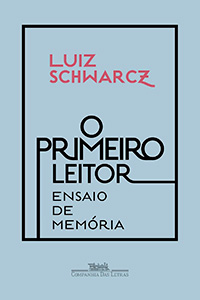
<p>Historian Tania Regina de Luca, a full professor at UNESP, has written about the book <i>Primeiro Leitor – Ensaio de Memória</i> ("The First Reader – An Essay on Memory"), by editor Luiz Schwarcz. At the beginning of the review, de Luca states that the book analyzes issues related to the social figure, role, and actions of a publisher. Half of the chapters are dedicated to the publishing world and its characters, and the other half address deceased writers who have been important to Schwarcz and to the publishing house he founded in 1986, Companhia das Letras.</p>
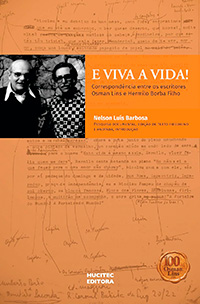
<p>Authored by writer and journalist Hugo Almeida, the other review is about the book <i>E Viva a Vida! – Correspondência entre os Escritores Osman Lins e Hermilo Borba Filho</i> ("And Long Live Life! – Correspondence between Writers Osman Lins and Hermilo Borba Filho"), published by Hucitec in 2024. The work features a faithful and annotated text edition, documentary research, and an introduction by Nelson Luís Barbosa, who carried out the work during his postdoctoral research at USP's Institute of Brazilian Studies (IEB). The book brings together, analyzes, and contextualizes 201 letters, including notes and telegrams, exchanged by the two authors from the state of Pernambuco from 1965 to 1976.</p>
<p>The list below contains the names of the authors who have contributed with each one of the addressed themes:</p>
<p><strong>Basic Education</strong></p>
<p>Artificial Intelligence and Inclusion of Students with Disabilities in Basic Education - <i>Ivan Cláudio Pereira Siqueira</i><br />The Trajectory of Blacks in Basic Education: Adversities and Coping Proposals - <i>Alexandre Dantas et al.<br /></i>Regrouping Students to Recompose Learning: Brazilian Experiences - <i>Lina Kátia Mesquita de Oliveira et al.<br /></i>An Analysis of Academic Performance in the City Schools of Cubatão (SP) and Taquaritinga (SP) - <i>Mozart Neves Ramos et al.<br /></i>A Proposal for Evaluating BNCC [Common Core] General Competencies in Basic Education - <i>Ricardo Primi et al.<br /></i>Socializing and Working Together in Schools: Challenges and Possibilities - <i>Telma P. Vinha et al.<br /></i>Proposals for the new Basic Education Evaluation System (SAEB): The Current Debate - <i>Priscilla Tavares and Mariah Morikawa<br /></i>Where are High Schools Going? An Analysis of the 2017 and 2024 Legal and Regulatory Frameworks - <i>Eduardo Deschamps<br /></i>Early Childhood Education: The Discussion of the National Quality and Equity Parameters (PNQEI) Starts in the Cradle - <i>Daniel Domingues dos Santos and Camila Martins de Souza Silva<br /></i>Reflections on the Future of Educational Assessment in Brazil - <i>Maria Helena Guimarães de Castro<br /></i>The Effect of Attending Early Childhood Education on Students' Academic Performance in Brazil - <i>Hellen Cristina Araujo Penha et al.<br /></i>A Literary Non-Place: The Provisional Space of Literature in the National Common Curricular Base (BNCC) - <i>Antonio Ismael Lopes de Souza et al.<br /></i>"Jupiter Vibrating the Ray" in Defense of the Portuguese Method by A.F. de Castilho - <i>Cesar Augusto Castro and Carlota Boto<br /></i>A Craft Governed by Words: Paul Ricoeur, Education, and Language - <i>Denizart Busto de Fazio et al.</i></p>
<p><strong>Immigration, Education, and Violence</strong></p>
<p>Immigrant Students in Public High Schools: Academic Performance in Question - <i>Lineu N. Kohatsu<br /></i>Schools in Bolivia and Argentina: Contributions from an Ethnographic Research, Two Trips and a Collaborative Experience - <i>Gabriela Novaro and María Laura Diez<br /></i>Invisible Educational Oversight: The Presence of Moroccan Mothers at a School in Catalonia (Spain) - <i>Fatiha El Mouali et al.<br /></i>Viewpoints and Perspectives on Education and Immigration in Portugal: From Basic to Higher Education - <i>Maria da Conceição Pereira Ramos and Natália Ramos<br /></i>State Violence and Schemes: The Daily Life of Children and Young People in Lower-Income Neighborhoods - <i>Valeria Llobet et al.<br /></i>Education under Siege: Impacts of Territorial Control by Militias and Drug-Trafficking Gangs on Academic Performance - <i>Rogério Jerônimo Barbosa et al.</i></p>
<p><strong>Reviews</strong></p>
<p>On the Art of Editing - <i>Tania Regina de Lucca<br /></i>"And Long Live Life!": The Dialectic of Letters - <i>Hugo Almeida</i></p>
<p style="text-align: right; "><span class="discreet">Photos by Elza Fiuza/Agência Brasil. Public domain.</span></p>
<ul>
</ul>
<ul>
</ul>
<ul>
</ul>
<ul>
</ul>
<ul>
</ul>
<ul>
</ul>
<ul>
</ul>
<div id="_mcePaste">
<div class="tlid-results-container results-container">
<div class="tlid-result result-dict-wrapper">
<div class="result tlid-copy-target">
<div class="text-wrap tlid-copy-target"></div>
</div>
</div>
</div>
</div>]]></content:encoded>
    <dc:publisher>No publisher</dc:publisher>
    <dc:creator>Richard Meckien</dc:creator>
    <dc:rights>Original version in Portuguese by Mauro Bellesa.</dc:rights>
    
      <dc:subject>Basic Education</dc:subject>
    
    
      <dc:subject>Journal</dc:subject>
    
    
      <dc:subject>Violence</dc:subject>
    
    
      <dc:subject>Immigration</dc:subject>
    
    
      <dc:subject>Publications</dc:subject>
    
    
      <dc:subject>IEA</dc:subject>
    
    
      <dc:subject>Education</dc:subject>
    
    
      <dc:subject>Childhood</dc:subject>
    
    <dc:date>2025-10-15T05:40:00Z</dc:date>
    <dc:type>Notícia</dc:type>
  </item>


  <item rdf:about="https://www.iea.usp.br/en/news/issue94">
    <title>"Estudos Avançados" #94 addresses the teaching of sciences</title>
    <link>https://www.iea.usp.br/en/news/issue94</link>
    <description></description>
    <content:encoded xmlns:content="http://purl.org/rss/1.0/modules/content/"><![CDATA[<p><img src="https://www.iea.usp.br/imagens/capa-da-revista-estudos-avancados-94" alt="Capa da revista 'Estudos Avançados' 94" class="image-right" title="Capa da revista 'Estudos Avançados' 94" />The teaching of natural sciences, mathematics and engineering is the subject of the main dossier of the latest issue of IEA's journal "<a href="https://www.iea.usp.br/en/journal/about-estudos-avancados" class="external-link">Estudos Avançados</a>," already available in printed and <a class="external-link" href="http://www.scielo.br/scielo.php?script=sci_issuetoc&amp;pid=0103-401420180003&amp;lng=en&amp;nrm=iso">digital</a> versions (Portuguese only).</p>
<p>The set of articles retakes the journal's project to deepen the knowledge about <span>primary and secondary education</span> when it comes to humanities (theme of the <a href="https://www.iea.usp.br/en/news/93-estudos-avancados-reflects-on-the-teaching-of-humanities" class="external-link">previous issue</a>), and to natural sciences and mathematics. According to editor Alfredo Bosi, "the complexity of the questions about what and how to teach is evident" when examining the published texts.</p>
<p>The dossier has 21 articles and the participation of 44 researchers. 15 texts are subdivided into shorter <span>dossiers </span>on chemistry, geology, mathematics, biology and physics, respectively elaborated with the collaboration of USP professors Hernan Chaimovich, Umberto Cordani, Flavio Ulhoa Coelho, Marcos Buckeridge and Yvonne Mascarenhas. There is also an article on engineering and five on general issues relating to high school.</p>
<p>Further covered topics are the role given to the natural sciences in the versions of the National Curricular Common Core, the teaching through a historical-investigative approach, the end of the positivist model in the history of the sciences, the use of mobile devices in learning and high school as a closure of education in crisis.</p>
<p>Three articles compose the dossier on the teaching of physics. The teaching and learning of the discipline in high school <span>are analyzed as well as </span>the training of its teachers, including continuing education, which still has "no adequate and effective procedures," according to the authors. The set is completed by a critical analysis of the current reality of teaching physics: "in crisis, outdated, minimized, devalued," according to the author.</p>
<p>Concerning biology, the dossier contains an article on the potential of research teaching in order to make it more meaningful for students. Therefore, the authors articulate aspects of the constructivist consensus with the axes of scientific literacy. The other article about the discipline addresses the peculiarities of teaching botany and the importance of contextualization for good quality teaching.</p>
<p>The principles for a chemistry curriculum as it has been approached in the last 38 editions of the FUVEST exams, one of the most competitive processes to select higher education students in the country, and how the training of its teachers takes place in Brazil and worldwide are the subjects of the dossier on the discipline.</p>
<p><span>The teaching of geosciences in the university and the importance of expanding the area in the training and qualification courses for basic<span> education </span>teachers</span><span> are discussed in two articles.</span></p>
<p>In relation to mathematics, the articles discuss the teaching of the discipline in the early years of learning, teacher training, curriculum materials, correlations of the history of algebra and algebraic thinking with teaching and, in a complementary way, how ethnomathematics can contribute to social justice and sustainability.</p>
<p>The text on engineering presents the engineering of complexity as a proposal to approach the area whether in its conception work of its operation, considering the assumptions of the complex thinking elaborated by French thinker Edgar Morin.</p>
<p><strong>Humanities</strong></p>
<p>Issue #94 also brings four other texts which in some way complement the previous issue's dossier "The Teaching of Humanities". Two of them are dedicated to theoretical thinking and to <span>Peruvian sociologist Aníbal Quijano, </span>a former visiting professor at the IEA who died in May 2018 at the age of 90.</p>
<p>Historian Carlos Guilherme Mota, first director of the IEA, reports the motivations for him and Adriana Lopez to write the book "History of Brazil. An Interpretation," launched in 2008 and already in its fifth edition.</p>
<p>The set also has a text <span>on traditional indigenous knowledge </span>by Gonzalo Aguillar Cavallo regarding the preservation of nature and environmental patrimony.</p>
<p><strong>Tribute</strong></p>
<p>The issue is dedicated to nuclear physicist Ernst Hamburger (1933-2018), "indefatigable diffuser of history and sciences inside and outside USP," according to Bosi. Hamburger was one of the creators of the Laboratory of Demonstrations at USP's Institute of Physics (IF) and director of the <i>Estação Ciência</i> (Science Station), a project of the Dean for Culture and University Extension which is currently under<span> reformulation</span>.</p>
<p>The list below contains the names of the authors who have contributed with each one of the addressed themes:</p>
<p><strong>Leading Article</strong></p>
<p dir="ltr"><i><i>Alfredo Bos</i>i</i></p>
<p><strong>The Teaching of Sciences</strong></p>
<p dir="ltr"><i><i>Suzana Ursi, Pércia Paiva Barbosa, Paulo Takeo Sano and</i><i> Flávio Augusto de Souza Berchez</i><br /></i><i><i>Daniela Lopes Scarpa and</i><i> Natália Ferreira Campos</i><br /></i><i><i>Anna Maria Pessoa de Carvalho and</i><i> Lúcia Helena Sasseron<br /></i></i><i style="text-align: justify; "><i>Jesuína Lopes de Almeida Pacca and</i><i> Alberto Villani<br /></i></i><i style="text-align: justify; ">Marco Antonio Moreira<br /><i>Marcelo Almeida Bairral<br /><i>Renata F. M. Batista and</i><i> Cibelle Cellestino<br /><i>Luis Carlos de Menezes<br /><i>Cármen Lúcia Brancaglion and </i><i>Adair Mendes Nacarato<br /><i>Jonei Cerqueira Barbosa</i> and <i>Andréia Maria Pereira de Oliveira<br /><i>Yuly Vanegas and Joaquín Giménez<br /><i>Flávio Ulhoa Coelho</i> and <i>Marcia Aguiar<br /><i>Ubiratan D'Ambrósio<br /><i>Carmen Fernandez<br /><i>Flavio Antonio Maximiano<br /><i>Paulo Alves Porto<br /><i>Maria Eunice Ribeiro Marcondes<br /><i>Astolfo Gomes de Mello Araujo<br /><i>Umberto G. Cordani, Marcia Ernesto, Maria Assunção F. da Silva Dias, Elisabete de Santis B. G. Saraiva, Fernando F. de Alkmim, Carlos Alberto Mendonça</i><span> and </span><i>Rachel Albrecht<br /><i>Marcia Ernesto, Umberto G. Cordani, Celso Dal Ré Carneiro, Maria Assunção F. da Silva Dias, Carlos Alberto Mendonça and Elisabete de Santis Braga<br /><i>Gildo Magalhães<br /><i>José Roberto Castilho Piqueira</i></i></i></i></i></i></i></i></i></i></i></i></i></i></i></i></i></i></p>
<p><strong>Reviews</strong></p>
<p dir="ltr"><i><i>Gonzalo Aguilar Cavallo</i><br /></i><i><i>Deni Alfaro Rubbo</i><br /></i><i><i>Enrique Amayo Zevallos</i><br /><i>Carlos Guilherme Mota</i></i></p>]]></content:encoded>
    <dc:publisher>No publisher</dc:publisher>
    <dc:creator>Richard Meckien</dc:creator>
    <dc:rights>Original version in Portuguese by Mauro Bellesa.</dc:rights>
    
      <dc:subject>Higher Education</dc:subject>
    
    
      <dc:subject>Natural sciences</dc:subject>
    
    
      <dc:subject>Basic Education</dc:subject>
    
    
      <dc:subject>Journal</dc:subject>
    
    
      <dc:subject>Publications</dc:subject>
    
    
      <dc:subject>Mathematics</dc:subject>
    
    
      <dc:subject>Education</dc:subject>
    
    <dc:date>2018-12-04T12:55:00Z</dc:date>
    <dc:type>Notícia</dc:type>
  </item>


</rdf:RDF>