<?xml version="1.0" encoding="utf-8" ?>
<rdf:RDF xmlns:rdf="http://www.w3.org/1999/02/22-rdf-syntax-ns#" xmlns:dc="http://purl.org/dc/elements/1.1/" xmlns:syn="http://purl.org/rss/1.0/modules/syndication/" xmlns="http://purl.org/rss/1.0/">


<channel rdf:about="https://www.iea.usp.br/search_rss">
  <title>Instituto de Estudos Avançados da Universidade de São Paulo</title>
  <link>https://www.iea.usp.br</link>

  <description>
    
            These are the search results for the query, showing results 1 to 4.
        
  </description>


  <image rdf:resource="https://www.iea.usp.br/logo.png" />

  <items>
    <rdf:Seq>
      
        <rdf:li rdf:resource="https://www.iea.usp.br/en/news/ica-4-bh-2022" />
      
      
        <rdf:li rdf:resource="https://www.iea.usp.br/en/news/ica-4" />
      
      
        <rdf:li rdf:resource="https://www.iea.usp.br/en/news/donald-peterson-discusses-challenge-leveraging-benefits-cognitive-technologies" />
      
      
        <rdf:li rdf:resource="https://www.iea.usp.br/en/news/life-in-the-cognitive-era-will-be-addressed-by-donald-peterson-a-visiting-professor-at-the-iea" />
      
    </rdf:Seq>
  </items>

</channel>


  <item rdf:about="https://www.iea.usp.br/en/news/ica-4-bh-2022">
    <title>With the theme "Intelligence and Artificial Intelligence," ICA 4 has brought together researchers from different countries</title>
    <link>https://www.iea.usp.br/en/news/ica-4-bh-2022</link>
    <description></description>
    <content:encoded xmlns:content="http://purl.org/rss/1.0/modules/content/"><![CDATA[<table class="tabela-direita">
<tbody>
<tr>
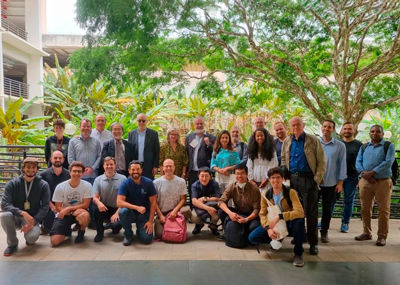
<th><img src="https://www.iea.usp.br/imagens/WEB-Fellows_UFMG.jpg" alt="Fellows UFMG" class="image-right captioned" title="Fellows UFMG" /></th>
</tr>
<tr>
<td><span class="discreet">ICA 4 participants in Belo Horizonte</span></td>
</tr>
</tbody>
</table>
<p dir="ltr">In November, the second phase of the fourth edition of the Intercontinental Academia (ICA) took place in Belo Horizonte.</p>
<p dir="ltr">The ICA is an initiative of the international network of <a class="external-link" href="http://www.ubias.net">University-Based Institutes for Advanced Study (UBIAS)</a>. Each edition is organized by two IASs from different continents. In the case of ICA 4, which has explored key interdisciplinary issues at the intersection of cognitive science, neuroscience, and artificial intelligence (AI), the hosts have been the <a class="external-link" href="https://www.paris-iea.fr/fr/">Paris Institute for Advanced Study</a>, a member of the French Network of Institutes for Advanced Study (RFIEA), and the <a class="external-link" href="https://www.ufmg.br/ieat?lang=en">Institute of Advanced Transdisciplinary Studies (IEAT)</a> of the Federal University of Minas Gerais (UFMG).</p>
<p dir="ltr">Two of the Brazilian participants are professors at USP: André Fujita, from the Institute of Mathematics and Statistics (IME), who has been appointed by the IEA, and specialist in health technology assessment Patricia Coelho de Soárez, from the Medical School (FM), which has supported her. The third Brazilian is Evandro Cunha, a professor of computational linguistics at UFMG.</p>
<p dir="ltr">For Fujita, the term that best describes the experiences promoted by the encounters is "fantastic." They have allowed various exchanges among the 19 participating researchers and the fellows, collaborations with other institutions, and contact with mentors - including Nobel Prize laureates and directors of renowned centers - who have provided inspiration to everyone. "This has allowed thinking 'outside the box' and setting up a collaboration with fellow Laura Candiotto, a philosopher specializing in emotions," he points out.</p>
<p dir="ltr">Specialized in bioinformatics, Fujita works with the interaction between biological components and the way they create specific phenotypes, working with statistical methods to analyze biological data on a large scale. His contribution to ICA 4 has focused on his experience with biological network analysis, as well as the interdisciplinarity of his field.</p>
<table class="tabela-direita-200-borda">
<tbody>
<tr>
<th style="text-align: center; ">
<h3>Related material</h3>
</th>
</tr>
<tr>
<td><strong>News:</strong><br /> 
<ul>
<li><a href="https://www.iea.usp.br/en/news/4a-edicao-da-international-academia-paris-2021" class="external-link">Researchers establish partnerships and receive suggestions from mentors during ICA 4</a></li>
<li><a href="https://www.iea.usp.br/en/news/ica-4" class="external-link">Intercontinental Academia edition on intelligence and artificial intelligence starts on June 13</a></li>
</ul>
</td>
</tr>
</tbody>
</table>
<p dir="ltr">While the meeting in Paris has been split into eight days of seminars, activities in Belo Horizonte have prioritized the work among the researchers, with parallel meetings with mentors, and guests from academia and the productive sector.</p>
<p dir="ltr">For Fujita, two outstanding events have been the visit to the local neuroscience and robotics laboratories, as well as a meeting with <a href="https://www.iea.usp.br/en/persons/researchers/virgilio-almeida" class="external-link">Virgílio Almeida</a>, when he addressed the Center of Artificial Intelligence in Health. Almeida is professor emeritus from the Department of Computer Science at UFMG and current holder of the Oscar Sala Chair at the IEA. "The meeting with Professor Almeida has been a gateway to collaborations with UFMG's computer science and health personnel," Fujita states.</p>
<p dir="ltr">In addition to the Belo Horizonte stage of ICA 4, Fujita also participated in the first one, which took place in October 2021 in Paris, and in an intermediate meeting in Nagoya, held from August 31 to September 2, 2022, having robotics and artificial intelligence as main themes. On the latter occasion, he presented a seminar at the Nagoya University Graduate School of Medicine. Topics from the work of the ICA participants and professors who work with robotics at the institution were discussed. According to the researcher, the discussions were centered on how human-looking robots would fit into society besides robots that help humans in everyday activities. For him, one of the main impacts of his visit was the meeting with Toshio Fukuda, president of the Institute of Electrical and Electronics Engineers (IEEE) in Japan. Amongst criticisms and suggestions, the emeritus professor from Nagoya University offered a paid travel for Fujita to spend a few months working with his robotics group.</p>
<div>
<p dir="ltr">The first edition of ICA was held in 2015 in São Paulo, at the IEA, and in 2016 at Nagoya University's Institute for Advanced Research, having "Time" as the theme. In 2016, "Human Dignity" was the theme of the second edition, which took place in Jerusalem, Bielefeld (both main hosts cities), and Johannesburg (where an additional meeting took place). Between 2018 and 2019, the third edition addressed "Laws: Rigidity and Dynamics." Institutes in Singapore and Birmingham were the hosting partners.</p>
<p dir="ltr" style="text-align: right; "><span class="discreet">Photo: courtesy of André Fujita</span></p>
</div>]]></content:encoded>
    <dc:publisher>No publisher</dc:publisher>
    <dc:creator>Richard Meckien</dc:creator>
    <dc:rights>Original version in Portuguese by Beatriz Herminio.</dc:rights>
    
      <dc:subject>Ubias</dc:subject>
    
    
      <dc:subject>Intercontinental Academia</dc:subject>
    
    
      <dc:subject>cover</dc:subject>
    
    
      <dc:subject>Computer Science</dc:subject>
    
    
      <dc:subject>Artificial Intelligence</dc:subject>
    
    <dc:date>2022-11-21T18:55:00Z</dc:date>
    <dc:type>Notícia</dc:type>
  </item>


  <item rdf:about="https://www.iea.usp.br/en/news/ica-4">
    <title>Intercontinental Academia edition on intelligence and artificial intelligence starts on June 13</title>
    <link>https://www.iea.usp.br/en/news/ica-4</link>
    <description></description>
    <content:encoded xmlns:content="http://purl.org/rss/1.0/modules/content/"><![CDATA[<p><img src="https://www.iea.usp.br/imagens/logo-da-4a-intercontinental-academia" alt="Logo da 4th Intercontinental Academia" class="image-right" title="Logo da 4th Intercontinental Academia" /></p>
<p>"Intelligence and Artificial Intelligence" is the theme of the fourth edition of the Intercontinental Academia (ICA 4), which will have its opening sessions virtually held from June 13 to 18. The face-to-face sessions will take place next October in Paris and in June 2022 in Belo Horizonte.</p>
<p>The ICA is a project by <a class="external-link" href="http://www.ubias.net">UBIAS</a>, an international network of institutes for advanced study linked to universities. Each edition is hosted by two institutes from different continents. ICA 4 has been organized by the <a class="external-link" href="https://www.ufmg.br/ieat/instituto/?lang=en">Institute of Advanced Transdisciplinary Studies (IEAT)</a> at the Federal University of Minas Gerais (UFMG) and the <a class="external-link" href="https://www.paris-iea.fr/en/presentation-of-the-institute/about-us">Paris Institute for Advanced Study (IAS)</a>, a member of the <a class="external-link" href="http://rfiea.fr/en/iea/french-network-institutes-advanced-study-missions">French Network of Institutes for Advanced Studies (RFIEA)</a>.</p>
<p>Since implementing the project in 2015, the objective of UBIAS has been to create global networks of future research leaders to work together on paradigm shifts and transdisciplinary research under the mentorship of eminent researchers from around the world.</p>
<table class="tabela-direita-400">
<tbody>
<tr>
<th><img src="https://www.iea.usp.br/imagens/andre-fujita-patricia-soarez-e-evandro-castro" alt="Andre Fujita, Patricia Soarez e Evandro Castro" class="image-inline" title="Andre Fujita, Patricia Soarez e Evandro Castro" /></th>
</tr>
<tr>
<td><span class="discreet">Brazilian participants of ICA 4: André Fujita, Patricia Coelho de Soárez, and Evandro Castro</span></td>
</tr>
</tbody>
</table>
<p>According to the ICA 4 organizers, the edition will explore key interdisciplinary issues at the intersection of cognitive science, neuroscience, and artificial intelligence (AI). By highlighting the importance of the topic, they point out that decisive advancements have taken place in recent decades regarding the analysis of brain activity and its behavioral counterpart, as well as the information processing sciences. "Complementarities between neuroscience/cognitive science and AI make it possible to explore synergies and raise ethical issues between these disciplines, which involve enormous challenges and opportunities for societal progress."</p>
<table class="tabela-direita-200-borda">
<tbody>
<tr>
<td>
<h3><strong>Previous editions</strong></h3>
<p><a class="external-link" href="http://ica.usp.br/home-sao-paulo">ICA 1</a> was held in 2015/16 and its theme was "Time." The hosts were the IEA and the Institute for Advanced Research at Nagoya University (IAR). From the debates of the edition, the participants produced the <span>massive open online course</span> <a class="external-link" href="https://www.coursera.org/learn/offtheclock?utm_campaign=opencourse.qDaZPFzDEeq2MgoCzrWDhw.launch&amp;utm_medium=email&amp;utm_source=other" target="_blank">Off the Clock: The Many Faces of Time</a>, available on the <a class="external-link" href="https://www.coursera.org/" target="_blank">Coursera</a> platform.</p>
<p>"Human Dignity" was the theme of the <a class="external-link" href="https://scholars.huji.ac.il/iahd">second edition</a> in 2016. The organizers for the initiative were the Center for Interdisciplinary Research at Bielefeld University and the Israel Institute for Advanced Studies at the Hebrew University of Jerusalem.</p>
<p><a class="external-link" href="https://www.icalaws.com/">ICA 3</a> took place in 2018/19 and addressed the theme "Laws: Rigidity and Dynamics." The organizers were the Institute of Advanced Studies at the Nanyang Technological University and the Institute of Advanced Studies at the University of Birmingham.</p>
</td>
</tr>
</tbody>
</table>
<table class="tabela-esquerda-300-borda">
<tbody>
<tr>
<td>
<h3>Some of the mentors</h3>
<p><dl class="image-inline captioned" style="width:300px;">
<dt><img src="https://www.iea.usp.br/imagens/ada-yonath/image" alt="Ada Yonath" title="Ada Yonath" height="300" width="300" /></dt>
 <dd class="image-caption" style="width:300px;">Ada Yonath</dd>
</dl></p>
<p><dl class="image-inline captioned" style="width:300px;">
<dt><img src="https://www.iea.usp.br/imagens/robert-aumann/image" alt="Robert Aumann" title="Robert Aumann" height="300" width="300" /></dt>
 <dd class="image-caption" style="width:300px;">Robert Aumann</dd>
</dl></p>
<p><dl class="image-inline captioned" style="width:300px;">
<dt><img src="https://www.iea.usp.br/imagens/martin-rees/image" alt="Martin Rees" title="Martin Rees" height="300" width="300" /></dt>
 <dd class="image-caption" style="width:300px;">Martin Rees</dd>
</dl></p>
<p><dl class="image-inline captioned" style="width:300px;">
<dt><img src="https://www.iea.usp.br/imagens/antonio-damasio/image" alt="António Damásio" title="António Damásio" height="300" width="300" /></dt>
 <dd class="image-caption" style="width:300px;">António Damásio</dd>
</dl></p>
<p><dl class="image-inline captioned" style="width:300px;">
<dt><img src="https://www.iea.usp.br/imagens/timnit-gebru/image" alt="Timnit Gebru" title="Timnit Gebru" height="300" width="300" /></dt>
 <dd class="image-caption" style="width:300px;">Timnit Gebru</dd>
</dl></p>
<p><dl class="image-inline captioned" style="width:300px;">
<dt><img src="https://www.iea.usp.br/imagens/zaven-pare/image" alt="Zaven Paré" title="Zaven Paré" height="300" width="300" /></dt>
 <dd class="image-caption" style="width:300px;">Zaven Paré</dd>
</dl></p>
</td>
</tr>
</tbody>
</table>
<p>In parallel to the second face-to-face session, scheduled for June 2022, a "satellite session" will be held at UFMG, with conferences and roundtables, and the participation of ICA 4 mentors and other guests from academia and the industry. There will be live streaming over the internet. Some of the topics covered in this session will be: "Fundamentals and Ethics of AI," "Intelligence and Rationality," "Cognition and Neurosciences," "Interdisciplinary Explorations of AI," and "AI and Health Sciences."</p>
<p><strong>Participants</strong></p>
<p><a class="external-link" href="https://www.intercontinental-academia.org/fellows/">19 researchers</a> working in universities and research institutes in Brazil, Germany, France, United Kingdom, Poland, United States, Japan, South Africa, Israel, and the Netherlands have been chosen out of the 60 candidates to participate in ICA 4 (23 of them Brazilians). The research areas of those selected include mathematics, computing, engineering, law, philosophy, linguistics, neuroscience, and history.</p>
<p>The representatives of Brazil are André Fujita (nominated by the IEA), from USP's Institute of Mathematics and Statistics (IME), Patricia Coelho de Soárez (independently enrolled), from USP's Medical School (FM), and Evandro Cunha (nominated by the IEAT), from UFMG's Faculty of Languages, Literature, and Linguistics (FALE).</p>
<p>Fujita's expectation is to participate in intense philosophical and scientific discussions with the other participants, and obtain "stimulus and inspiration" to make the Postgraduate Program in Bioinformatics at USP, which he coordinates, more vigorous. He emphasizes that bioinformatics is an interdisciplinary field integrated by researchers in mathematics, computer science, physics, chemistry, biology, medicine, and engineering, among others. "People usually define bioinformatics as the big data study of areas of biology using computational techniques. I think we could define bioinformatics as the field that uses artificial intelligence to discover how cells and beings learn or acquire intelligence."</p>
<p>Soárez, who is a member of IEA's Study Group on Science, Technology, and Innovation in Health, proposes the adoption of a holistic point of view in evaluating the contributions of AI in health care, including economic, ethical, and social impacts. More specifically, her interest is the implications of incorporating AI into health policies, decision-making processes, and equality in the Brazilian health system. One of her expectations in relation to ICA 4 is to obtain subsidies for the development of an interdisciplinary research project on the importance of AI for decision-making in health. She also hopes to learn about applicable procedures and tools needed to broaden the impact of her research and advance her career development as a research leader.</p>
<p>Cunha's main research interest is computer-mediated communication and the use of computational methods for solving linguistic problems, especially those related to historical linguistics, revitalization of endangered languages, and language neuroscience. At ICA 4 he intends to discuss the applications of language science in AI and the effects of technology on human communication, particularly with regard to manipulation, extremism, and dissemination of disinformation in the current scenario of pandemic and climate crisis.</p>
<p><strong>Mentoring</strong></p>
<p>The participants will have the support of <a class="external-link" href="https://www.intercontinental-academia.org/mentors/">17 mentors</a>, all renowned researchers with worldwide recognition in various scientific areas, philosophy, and arts. Among them are molecular biologist Ada Yonath, from the Weizmann Institute, winner of the 2009 Nobel Prize in Chemistry, economist Robert Aumann, winner of the 2005 Nobel Prize in Economics and a professor at the Hebrew University of Jerusalem, astrophysicist and cosmologist Martin Rees, Astronomer Royal and co-founder of the The Centre for the Study of Existential Risk at Cambridge University, neurologist and neuroscientist António Damásio, a specialist in the mental processes underlying emotions, feelings, and consciousness, computer scientist Timnit Gebru, co-founder of Black in AI, a support organization for black AI researchers and professionals, and one of the former leaders of Google's ethical artificial intelligence research team, and artist Zaven Paré, dedicated to new media and robotics, and a contributor to the <span>Postgraduate</span> Program in Arts, Culture, and Languages ​​at the Federal University of Juiz de Fora.</p>
<p>The <a class="external-link" href="https://www.intercontinental-academia.org/about/">coordinators</a> of ICA 4 are Guilherme Ary Plonski, director of the IEA and former coordinator of UBIAS, Estevam Barbosa de Las Casas, director of the IEAT, Eliezer Rabinovici, a professor at The Racah Institute of Physics at the Hebrew University of Jerusalem and proponent of the Intercontinental Academia project, and Olivier Bouin, director of the RFIEA and new coordinator of UBIAS.</p>
<p style="text-align: right; "><span class="discreet">Photos: Intercontinental Academia</span></p>]]></content:encoded>
    <dc:publisher>No publisher</dc:publisher>
    <dc:creator>Richard Meckien</dc:creator>
    <dc:rights>Original version in Portuguese by Mauro Bellesa.</dc:rights>
    
      <dc:subject>Ubias</dc:subject>
    
    
      <dc:subject>International Cooperation</dc:subject>
    
    
      <dc:subject>Cognition</dc:subject>
    
    
      <dc:subject>ICA</dc:subject>
    
    
      <dc:subject>cover</dc:subject>
    
    
      <dc:subject>Cognitive Science</dc:subject>
    
    
      <dc:subject>Computer Science</dc:subject>
    
    
      <dc:subject>Intercontinental Academia</dc:subject>
    
    
      <dc:subject>Neuroscience</dc:subject>
    
    
      <dc:subject>Artificial Intelligence</dc:subject>
    
    
      <dc:subject>Interdisciplinarity</dc:subject>
    
    <dc:date>2021-05-27T19:50:00Z</dc:date>
    <dc:type>Notícia</dc:type>
  </item>


  <item rdf:about="https://www.iea.usp.br/en/news/donald-peterson-discusses-challenge-leveraging-benefits-cognitive-technologies">
    <title>Donald Peterson discusses the challenge of leveraging the benefits of cognitive technology</title>
    <link>https://www.iea.usp.br/en/news/donald-peterson-discusses-challenge-leveraging-benefits-cognitive-technologies</link>
    <description></description>
    <content:encoded xmlns:content="http://purl.org/rss/1.0/modules/content/"><![CDATA[<p><img src="https://www.iea.usp.br/imagens/vida-na-era-cognitiva" alt="Vida na Era cognitiva" class="image-right" title="Vida na Era cognitiva" />The relationship between humans and machines in the age of cognitive technology, and its challenge of bringing more benefits than harm to areas such as education, work, business, and health will be the theme of <a href="https://www.iea.usp.br/en/persons/visiting-professors/donald-peterson" class="external-link">Donald Peterson</a>'s seminar <strong>on August 26</strong>, <strong>at 10:30 am</strong>, at the IEA. <i>Life in the Cognitive Era </i>will be moderated by engineer Antonio Mauro Saraiva, chairman of the Institute's research committee, and will be <a href="https://www.iea.usp.br/aovivo" class="external-link">broadcast live over the internet</a>.</p>
<p>The advance of connectivity, artificial intelligence, and robots, among others, has led to the need for a significant process of requalification and redefinition of the roles played in various sectors of society, explains Peterson, who has been a <a href="https://www.iea.usp.br/en/news/life-in-the-cognitive-era-will-be-addressed-by-donald-peterson-a-visiting-professor-at-the-iea" class="external-link">visiting professor at the IEA since June, 2019</a>. A general risk is that AI and robotics replace human jobs thus causing human unemployment. A particular risk is that this replacement is selective, e.g. replacing manual jobs which already mean low-income.</p>
<p>The researcher argues that all technologies are "ditropic" and can produce good and bad effects, or even both concomitantly, according to the way they are used. For his speech at the upcoming event, Peterson will use the analytical framework of "epiduction," a context-sensitive form of reasoning. The physical substrate of <span>"epiduction" </span>is the executive function primarily associated with the prefrontal cortex of the human brain.</p>
<p><span><span>Peterson's work and background are in logic, philosophy, psychology, and computer science</span>. Until last year, he was a full professor of Computer Science at Shantou University in China.</span></p>]]></content:encoded>
    <dc:publisher>No publisher</dc:publisher>
    <dc:creator>Richard Meckien</dc:creator>
    <dc:rights>Original version in Portuguese by Fernanda Rezende.</dc:rights>
    
      <dc:subject>Cognition</dc:subject>
    
    
      <dc:subject>Philosophy</dc:subject>
    
    
      <dc:subject>Computer Science</dc:subject>
    
    
      <dc:subject>Interdisciplinarity</dc:subject>
    
    
      <dc:subject>Visiting Professors</dc:subject>
    
    <dc:date>2019-08-19T20:35:00Z</dc:date>
    <dc:type>Notícia</dc:type>
  </item>


  <item rdf:about="https://www.iea.usp.br/en/news/life-in-the-cognitive-era-will-be-addressed-by-donald-peterson-a-visiting-professor-at-the-iea">
    <title>"Life in the Cognitive Era" will be addressed by Donald Peterson, a visiting professor at the IEA</title>
    <link>https://www.iea.usp.br/en/news/life-in-the-cognitive-era-will-be-addressed-by-donald-peterson-a-visiting-professor-at-the-iea</link>
    <description></description>
    <content:encoded xmlns:content="http://purl.org/rss/1.0/modules/content/"><![CDATA[<table class="tabela-direita-300">
<tbody>
<tr>
<th><img src="https://www.iea.usp.br/imagens/don-peterson-30-5-19" alt="Don Peterson - 30/5/19" class="image-inline" title="Don Peterson - 30/5/19" /></th>
</tr>
<tr>
<td><span class="discreet">Donald Peterson: "We need a critical understanding of the opportunities and risks in the cognitive era."</span></td>
</tr>
</tbody>
</table>
<p><span>British </span><span>cognitive scientist </span><span>Donald Peterson is the new visiting professor at the IEA. For an initial period of one year, he will develop the research project "Life in the Cognitive Era." Until last year, he was a full professor of Computer Science at Shantou University in China.</span></p>
<p>Peterson covers logic, philosophy, psychology, and computer science. During his stay, he will conduct seminar-series and prepare publications in the area of the project. People of all disciplines and at all levels will be welcome at the seminars. One seminar-series will be on <i>Cognitive Life</i>, concerning issues of welfare, work, health, and education in an era of AI, robotics, and 5G communications. Another will be on <i>Cognitive Computing</i>, concerning the architecture, applications, and significance of systems such as IBM Watson.</p>
<p>In research, Peterson will focus on his concept of "epiduction" (a form of practical reason), and its relation with modern data conditions, the human brain, machine augmentation, and welfare.</p>
<p><strong>Cogtech</strong></p>
<p>Cognitive technologies (cogtech) are influencing life and work, and "we need a critical understanding of their opportunities and risks," says Peterson. Examples of cogtech are artificial intelligence, adaptive systems, big data analytics, humanoid robotics, person recognition, personalizing learning systems, and virtual reality.</p>
<p>According to Peterson, cogtech is complemented by innovations in biometrics, nanotechnology, 3D-printing, quantum computing, and by systems such as cryptocurrency and blockchain. Regarding systems theory, the new era involves "a shift toward more open systems, and their positive and negative potential effects."</p>
<p>Conditions associated with this shift include mass data, rapid change, global connectivity, and the cyborg interdependence of humans and machines. "We are shifting our course toward new ways of living and working, and the social and cultural implications of this change are radical and immanent." In Peterson's view, the task of policy in the cognitive era is to direct the use of cogtech to beneficial effects, rather than to classify the relevant technologies as inherently good or bad.</p>
<p>Peterson explains that this field of study is necessarily interdisciplinary: requiring both technical and critical knowledge, as being both theoretical and practical. "It is theoretical because it requires analytical structures such as systems theory and context-modulated reasoning, and it is practical because its issues will impact employment, mental health, education, work, communication, and quality of life."</p>
<p><strong>Profile</strong></p>
<p>Peterson holds a PhD in Philosophy from University College London, a Master's degree in Foundations of Advanced Information Technology from Imperial College London, and a Master's degree in Philosophy and Psychology from the University of Edinburgh.</p>
<p>Before becoming a full professor of the Department of Computer Science at Shantou University, he was Associate Professor in Computer Science and Head of Division at the University of Nottingham Ningbo China. He was previously Senior Lecturer in Information and Communication Technology at the University of London, and Lecturer in Cognitive Science and then in the Psychology of E-learning at the University of Birmingham. <span>Peterson has previously inhabited two research labs: ECRC in Munich (The European Computer-Industry Research Center), and LKL (The London Knowledge Lab). He now joins an Institute of Advanced Study in the tradition established in Princeton in 1930 by Abraham Flexner. This tradition is deliberately multi-disciplinary, research-focussed, and, in the case of IEA-USP, oriented to social welfare as a practical outcome of research.</span></p>
<p><span></span><span>Peterson is the editor of "Forms of Representation: an Interdisciplinary Theme for Cognitive Science" (1996), which includes a chapter by Nobel Prize winner Herb Simon, co-editor of "Philosophy and Cognitive Science" (1993), and author of "Wittgenstein's Early Philosophy: Three Sides of the Mirror" (1990). He has also written 13 book chapters and published 10 articles in refereed journals.</span></p>
<p style="text-align: right; "><span class="discreet">Photo: Leonor Calasans / IEA-USP</span></p>]]></content:encoded>
    <dc:publisher>No publisher</dc:publisher>
    <dc:creator>Richard Meckien</dc:creator>
    <dc:rights>Original version in Portuguese by Mauro Bellesa.</dc:rights>
    
      <dc:subject>Psychology</dc:subject>
    
    
      <dc:subject>Philosophy</dc:subject>
    
    
      <dc:subject>Research</dc:subject>
    
    
      <dc:subject>Cognitive Science</dc:subject>
    
    
      <dc:subject>Computer Science</dc:subject>
    
    
      <dc:subject>Logic</dc:subject>
    
    
      <dc:subject>Visiting Professors</dc:subject>
    
    <dc:date>2019-05-31T12:55:00Z</dc:date>
    <dc:type>Notícia</dc:type>
  </item>


</rdf:RDF>
