<?xml version="1.0" encoding="utf-8" ?>
<rdf:RDF xmlns:rdf="http://www.w3.org/1999/02/22-rdf-syntax-ns#" xmlns:dc="http://purl.org/dc/elements/1.1/" xmlns:syn="http://purl.org/rss/1.0/modules/syndication/" xmlns="http://purl.org/rss/1.0/">


<channel rdf:about="https://www.iea.usp.br/search_rss">
  <title>Instituto de Estudos Avançados da Universidade de São Paulo</title>
  <link>https://www.iea.usp.br</link>

  <description>
    
            These are the search results for the query, showing results 1 to 3.
        
  </description>


  <image rdf:resource="https://www.iea.usp.br/logo.png" />

  <items>
    <rdf:Seq>
      
        <rdf:li rdf:resource="https://www.iea.usp.br/en/news/secretary-general-oecd" />
      
      
        <rdf:li rdf:resource="https://www.iea.usp.br/en/news/Dedemographic-profile-of-latin-america-needs-policies-for-development-indicates-panel" />
      
      
        <rdf:li rdf:resource="https://www.iea.usp.br/en/news/events-with-silvia-giorguli" />
      
    </rdf:Seq>
  </items>

</channel>


  <item rdf:about="https://www.iea.usp.br/en/news/secretary-general-oecd">
    <title>Meeting with OECD secretary-general inaugurates the organization's partnership with USP</title>
    <link>https://www.iea.usp.br/en/news/secretary-general-oecd</link>
    <description></description>
    <content:encoded xmlns:content="http://purl.org/rss/1.0/modules/content/"><![CDATA[<table class="tabela-direita-300">
<tbody>
<tr>
<th><img src="https://www.iea.usp.br/imagens/angel-gurria-6-5-2021/@@images/d52ac953-eb7d-48b4-8dbb-19ec9a56279a.jpeg" alt="Angel Gurría - 6/5/2021" class="image-inline" title="Angel Gurría - 6/5/2021" /></th>
</tr>
<tr>
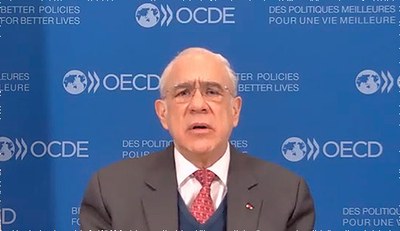
<td><span class="discreet">Angel Gurría, OECD secretary-general, during his presentation at the meeting</span></td>
</tr>
</tbody>
</table>
<p>Although not yet a member of the <a class="external-link" href="http://www.oecd.org/">Organisation for Economic Co-operation and Development (OECD)</a>, Brazil is like a "family member" and partnerships with Brazilian institutions allow the organization to work with and for the country in building a more inclusive and resilient society, said the secretary-general <a class="external-link" href="https://www.oecd.org/about/secretary-general/">Angel Gurría</a> during his participation in the online meeting "OECD and USP: Reconfiguring the World from Knowledge," on May 6.</p>
<p>Among the OECD partner countries, Brazil is the one that has made the most of this relationship and has invested in several areas of public policies to approach the organization's standards, according to Gurría. As an example, he cited a project launched in October that is helping to align Brazilian policies with OECD's environmental criteria.</p>
<p>The online meeting with Gurría, who will leave the OECD later this month after three consecutive five-year terms, celebrated the beginning of cooperation between the organization and USP. He will soon become an IEA researcher. In addition to the secretary-general, the Brazilian delegate with international economic organizations headquartered in Paris, ambassador <a class="external-link" href="http://agenciabrasil.ebc.com.br/en/internacional/noticia/2018-02/brazil-intensifies-talks-paris-join-oecd">Carlos Márcio Cozendey</a>, and the president of USP, Vahan Agopyan, gave presentations. Mediation was provided by the general coordinator of the International Economic Analysis Group (GACINT) of USP's Institute of International Relations (IRI), Alberto Pfeifer.</p>
<p><a href="https://www.iea.usp.br/en/iea/organization/direction" class="external-link">Guilherme Ary Plonski</a>, director of the IEA, opened the event by pointing out that the cooperation between USP and the OECD is based on the common concern of both institutions in promoting the production of knowledge "to move towards a prosperous human society in harmony with nature."</p>
<p>He highlighted the significance of OECD's slogan "Better Policies for Better Lives" and the organization's concern with formulating international evidence-based references in order to find solutions to economic, social, and environmental challenges.</p>
<p>"The IEA is available to collaborate in the production of knowledge based on this cooperation and to contribute to the initiatives for Brazil to become a member of the organization," he said.</p>
<table class="tabela-esquerda-300">
<tbody>
<tr>
<th><img src="https://www.iea.usp.br/imagens/carlos-marcio-conzenday-6-5-2021" alt="Carlos Márcio Cozendey - 6/5/2021" class="image-inline" title="Carlos Márcio Cozendey - 6/5/2021" /><br /><span class="discreet">Ambassador Carlos Márcio Cozendey</span></th>
</tr>
</tbody>
</table>
<p>"Even though not being a member of the organization, Brazil participates in almost all committees and working groups, and has already adhered to 99 OECD recommendations, according to Cozendey. "The country is interested in becoming a member to participate in all dimensions of the OECD, exchange experiences, and present public policies."</p>
<p>The partnership is part of this exchange of policy formulations, said the ambassador: "Having the University to establish and follow the interaction between public policies in Brazil and the OECD recommendations is an input for the organization's recommendations to also reflect the Brazilian reality."</p>
<p>For Agopyan, the internationalization present in the cooperation is a tool for USP to improve its levels of quality, "an essential search for all research universities."</p>
<p>In this century, all research universities seek to have ever greater interaction with society, he said. "USP is also doing this and it is natural that, for this purpose, universities seek partnerships with governments, entities, and international groups."</p>
<p>In June, at a meeting in Switzerland, Agopyan will defend the idea that universities are reliable sources of public policy. "If the OECD is concerned about this, USP and other research universities are at the disposal of the organization and national governments to develop proposals for public policies to be used by governments," concluded the president.</p>
<p><strong>Effects of the pandemic</strong></p>
<p>In his brief presentation followed by answers to questions from guests, Gurría commented that the COVID-19 pandemic reversed all the economic recovery achieved after the crisis that started in 2008, "but the prospects are improving and we expect a global economic growth of 5.6 %, with economy returning to pre-pandemic levels by the middle of this year." However, he warned that this projection depends on the rate of vaccination and the eventual spread of variants of the virus.</p>
<p>"Brazil was recovering from a recession when the pandemic a second recession came. The economic measures adopted by the government, such as emergency aid, supported millions of vulnerable families. Without these measures, the economic contraction would be even greater and the recovery in 2021 much slower than the projected GDP growth of 3.7%."</p>
<p>However, he stressed that the recovery must be guided by more just and sustainable growth. To that end, Gurría defended three lines of action, the first of which is to increase the effectiveness of social benefits to strengthen the population's first line of defense against economic shocks. "If well oriented, Brazil's conditional cash transfer system could be converted into a real social safety network," he said.</p>
<p>The second recommendation is to support professional qualification in order to allow workers to switch their jobs to better ones and for entrepreneurs to end unproductive and polluting activities. "In the long run, improving the quality and equity of vocational training reduces inequalities and poverty," according to the secretary-general.</p>
<p>His third suggestion is to link economic recovery measures to the sustainability agenda. "The most urgent task now is to vaccinate people quickly and protect us from further outbreaks of COVID-19, but the intergenerational commitment is to protect the planet," she said. For Gurría, the fact that the Amazon rainforest is the largest reserve of biodiversity in the world and 60% of it is in Brazil, makes the country a leader for the reshaping and reconstruction of the global economy in a more resilient way.</p>
<p><strong>Continuity and relations</strong></p>
<p>The questions from the guests to Gurría addressed the continuity of programs implemented in his management, mainly those related to environment and education, the organization's relationship with sub and supranational organizations, and prospects for Brazil's entry into the OECD.</p>
<table class="tabela-direita-300">
<tbody>
<tr>
<th><img src="https://www.iea.usp.br/imagens/vahan-agopyan-6-5-2021" alt="Vahan Agopyan - 6/5/2021" class="image-inline" title="Vahan Agopyan - 6/5/2021" /></th>
</tr>
<tr>
<td><span class="discreet">Vahan Agopyan, president of USP</span></td>
</tr>
</tbody>
</table>
<p>Jacques Marcovitch, former president of USP and former director of the IEA, asked whether OECD's emphasis on environmental issues will continue and what the weight of the environmental issue will be for Brazil's intentions to become one of the organization's members.</p>
<p>"Gurría said that the future secretary-general, a former finance minister in Australia, assured member countries that the OECD will continue its environmental policies. As for joining the organization, he said that Brazil has a huge advantage over the other five current candidates (Argentina, Peru, Romania, Croatia, and Bulgaria): "Brazil is already in the family, like a cousin who is already in the kitchen of the organization, because instead of waiting to be accepted, the work with the OECD has already started."</p>
<p>Cláudia Costin, a member of IEA's <a href="https://www.iea.usp.br/en/iea/organization/board" class="external-link">Board</a> and director of the Center for Excellence and Innovation in Education at the Getulio Vargas Foundation (FGV), expressed concern about the continuity in the new management of education programs, such as the Programme for International Student Assessment (PISA). There is no risk of interruption, according to Gurría: "The PISA is a brand of the organization and will constantly evolve. It is becoming not only a reference, but also an instrument for comparison and ranking, not to indicate who is better or worse, but to measure the fundamental issues, and indicate what is good or bad and what can be improved."</p>
<p>"Still in the field of education, <a href="https://www.iea.usp.br/en/iea/organization/direction" class="external-link">Roseli de Deus Lopes</a>, deputy director of the IEA, wanted to know what the OECD recommendations for Brazil are, since recent evaluations indicate a drop in school performance and greater inequality in education. The secretary-general argued that something very important is the acquisition of digital skills by young people. "We know that the future will be much more digital because we had to act almost entirely digitally due to the pandemic. To be able to reintegrate into the labour market, it is necessary to have digital competence, but only 50% of the countries' workforce has ability to act in a technological environment."</p>
<p>Vinicius Mota, editor in chief of the newspaper <i>Folha de S.Paulo</i>, asked if threats to democracy in Brazil could weigh on OECD's decision to accept the country as a member. Gurría said that problems with the quality of democracy are not on the agenda in relation to Brazil's entry. "I do not know anyone who says that Brazil is not a democracy. That is the great advantage of the country: to be recognized as a democracy". Problems with democracy "are no one's monopoly," he emphasized, recalling recent changes in electoral legislation in Georgia, USA, which make it difficult for some publics to participate in the local elections.</p>
<p>"The director of IRI, Janina Onuki, wanted to know what benefits can be expected from OECD partnerships with subnational governments, as in the case of the government of the state of São Paulo. These partnerships are increasingly important, said Gurría, "because everything is happening at the local level and it is necessary to go where the action takes place." He added that the OECD works with many states, provinces, and cities in many countries. "The world today is urbanized. Countries like Mexico and Brazil have become urban without becoming rich and all the problems arising from the growth of cities have arisen."</p>
<p>The relationship between the OECD and the World Trade Organization (WTO) was the subject of the question by USP professor emeritus <a href="https://www.iea.usp.br/en/persons/researchers/celso-lafer" class="external-link">Celso Lafer</a>, another member of IEA's Board and former Minister of Foreign Affairs. For the secretary-general, the organizations complement each other: "Although the WTO has a lot of technical capacity to deal with problems of jurisdictional systems and conflicts of interest, it does not have the technical capacity to carry out analyzes and comparisons, leading to the extraction of information for public policies."</p>
<p>"For him, there is a methodological problem, as the OECD has 37 members (soon 38 with the entry of Costa Rica) <span>and the WTO has 200 countries. "We work with almost every UN body. They know that we have 37 members, but they do not come to us for the sake of universality, yet rather because of the globalizing impact of the OECD recommendations."</span></p>
<p style="text-align: right; "><span class="discreet">Photos: IEA-USP</span></p>]]></content:encoded>
    <dc:publisher>No publisher</dc:publisher>
    <dc:creator>Richard Meckien</dc:creator>
    <dc:rights>Original version in Portuguese by Mauro Bellesa.</dc:rights>
    
      <dc:subject>Sustainable development</dc:subject>
    
    
      <dc:subject>International Cooperation</dc:subject>
    
    
      <dc:subject>Economic development</dc:subject>
    
    
      <dc:subject>Public Policies</dc:subject>
    
    
      <dc:subject>Environment</dc:subject>
    
    
      <dc:subject>OECD</dc:subject>
    
    
      <dc:subject>USP</dc:subject>
    
    
      <dc:subject>Event</dc:subject>
    
    <dc:date>2021-05-07T16:00:00Z</dc:date>
    <dc:type>Notícia</dc:type>
  </item>


  <item rdf:about="https://www.iea.usp.br/en/news/Dedemographic-profile-of-latin-america-needs-policies-for-development-indicates-panel">
    <title>Demographic profile of Latin America needs policies for development, indicates panel</title>
    <link>https://www.iea.usp.br/en/news/Dedemographic-profile-of-latin-america-needs-policies-for-development-indicates-panel</link>
    <description></description>
    <content:encoded xmlns:content="http://purl.org/rss/1.0/modules/content/"><![CDATA[<table class="tabela-direita-300">
<tbody>
<tr>
<th><img src="https://www.iea.usp.br/imagens/silvia-giorguli-13-6-2018" alt="Silvia Giorguli - 13/6/2018" class="image-inline" title="Silvia Giorguli - 13/6/2018" /></th>
</tr>
<tr>
<td><strong>Silvia Giorguli: "What happens in Latin American labor markets points to what lies ahead"</strong></td>
</tr>
</tbody>
</table>
<p>Latin American countries are experiencing the so-called demographic dividend, a situation in which the number of individuals under 15 years of age has grown, allowing the expansion of the economically active population, which may result in conditions for greater economic development.</p>
<p>However, "the demographic dividend is not automatic; it depends on labor market conditions, jobs that allow individual and social development, productivity, investment and also macroeconomic conditions," warned sociologist and demographer <a href="https://www.iea.usp.br/en/persons/speakers/silvia-giorguli" class="external-link">Silvia Elena Giorguli Saucedo</a>, president of <a class="external-link" href="https://www.colmex.mx/">El Colegio de México</a> (COLMEX.)</p>
<p>She stated this during the panel <i>Demographic Dividend in Latin America</i>, held on June 13. The event has also featured presentations by demographer <a href="https://www.iea.usp.br/en/persons/speakers/bernadette-waldvogel" class="external-link">Bernadette Waldvogel</a>, from the State System of Data Analysis Foundation (SEADE,) and economist <a href="https://www.iea.usp.br/en/persons/speakers/otaviano-canuto" class="external-link">Otaviano Canuto</a>, a member of the World Bank's Board of Executive Directors, who participated via Skype from his office in Washington.</p>
<p>It has been the second activity of the agreement signed between USP and COLMEX in December 2017, which has the IEA and <a class="external-link" href="http://www.usp.br/internationaloffice/en/" target="_blank">USP's International Cooperation Office</a> (AUCANI) as protagonists. On the day before, June 12, the Mexican researcher gave the conference <i>Migration and Education</i>. Both events have been supported by the Consulate General of Mexico in São Paulo.</p>
<p><strong><span>Uncertainties</span></strong></p>
<p>Giorguli has recalled what happened in Asian countries, "where there has been a good synergy between demographic changes and economic growth," and presented doubts about the Latin American process: "Will the region take advantage of the dividend or not? How to anticipate the financial needs and health care for a larger elderly population?"</p>
<table class="tabela-direita-200-borda">
<tbody>
<tr>
<td>
<h3>Related material</h3>
<p><strong><a href="https://www.iea.usp.br/en/media-library/photos/events-2018/bonus-demografico-na-america-latina-13-de-junho-de-2018" class="external-link">Photos</a> | <a href="https://www.iea.usp.br/en/media-library/video/bonus-demografico-na-america-latina" class="external-link">Video</a></strong> <span>(in Spanish and Portuguese)</span></p>
<p><strong><a href="https://www.iea.usp.br/en/news/seminar-on-migration-marks-the-beginning%20of-the-collaboration-between-usp-and-el-colegio-mexico" class="external-link">Migration and Education</a></strong><br />Conference with Silvia Giorguli on June 12, 2018</p>
</td>
</tr>
</tbody>
</table>
<p>According to her, Latin America has already reached its maximum population and the number of young people has also reached its peak, making the perspective of the rate of dependence in the next decade to be the lowest of the region in all its history. "With the end of growth in the number of young people, inequality in access to education is easier to solve. This will also increase the economically active population by 2030/2040."</p>
<p>Creating the synergy between the dividend and economic growth depends on how the population's economic participation will take place, she said. "Mexico is bad in that regard. One of the options is to encourage the insertion of women into the labor market and this has to do with promoting education, good living conditions, family-work relationships, flexible working hours and shared domestic responsibilities." For Giorguli, a "gender dividend" may reflect better conditions for the country than the demographic dividend itself in 2050.</p>
<p>She has explained that Latin America has a very peculiar behavior in relation to the occurrence of the dividend. "Uruguay has made the transition first, Mexico is on average in the region and Guatemala is in last, but in a more intense process than the other two. By 2030, the three countries will have a similar demographic profile." One of the Mexican problems is that part of the dividend goes to the United States. "Now the migration has decreased and we can take advantage of it."</p>
<p>Giorguli has commented that there are other factors that may interfere with the good use of the dividend, such as the universalization and improvement of education, but believes that the most important factor is the profile of the labor market in Latin America, characterized by the high level of informality and turnover in work stations. "What is happening in the labor markets today shows what is ahead."</p>
<p><span><strong>State of São Paulo</strong></span></p>
<p>In contrast to Giorguli's presentation on the demographic transition in Latin American countries, especially in Mexico, Waldvogel has presented studies on the perspectives of the demographic dynamics of the state of São Paulo by 2050, produced by the Demographic Group of the SEADE Foundation.</p>
<p>According to her, the foundation has statistical data produced since the end of the 19th century, when the Office of Statistics and State Archives was created. "We have received copies of all the birth and death certificates of São Paulo. From the data that have been available since the 1940s, we have been disaggregating the information that allow us to verify the vegetative balance [births minus deaths] and the migratory balance [immigrants minus emigrants]."</p>
<table class="tabela-esquerda-300">
<tbody>
<tr>
<th><img src="https://www.iea.usp.br/imagens/bernardette-waldvogel-15-6-2018" alt="Bernardette Waldvogel - 15/6/2018" class="image-inline" title="Bernardette Waldvogel - 15/6/2018" /></th>
</tr>
<tr>
<td><strong>Bernadette Waldvogel: "We are also in demographic dividend; we need to observe what society needs to do to benefit from it"</strong></td>
</tr>
</tbody>
</table>
<p>Waldvogel has said that the highest rates of <span>population </span>growth in São Paulo occurred in the 60s, 70s and 80s, "a period in which immigration had more weight." After the 1980s, the growth rate has dropped, reaching only 12% in the last decade." The current rate is only due to the vegetative balance, which has also been decreasing because of the drop in the number of births and the increase in mortality. "The decrease occurs in all administrative regions of the state."</p>
<p>As for the São Paulo fertility rate, which is now 1.5 per woman (less than the replacement rate), the drop was pronounced since 1970, when it was 4.2, but in a discontinuous way, with periods of small increase. In terms of life expectancy, the increase was also relevant in the state, with a nine-year increase, currently being 73 years for men and 79 years for women, according to the foundation's data.</p>
<p>According to Waldvogel, there was a sharp drop in infant mortality between 1975 and 2016, currently being of 10.7 deaths per thousand live births. Sanitation, and the decrease in parasitic infections and respiratory diseases have contributed to this, she explained. "In the beginning, the decline was mostly pronounced among postnatal cases [after four weeks to one year of age] and then there was an increase among neonates [first four weeks of life]." However, 30% of deaths occur in the first week of life. "Neonatal deaths indicate that health actions need to be taken."</p>
<p>The researchers' projections indicate that the state's population is expected to increase to 48 million <span>by 2040</span>, and then begin to decline as the number of deaths will outstrip births, with the population pyramid becoming increasingly narrow. By 2050, the fertility rate will be 1.5, with a life expectancy of 79.1 for men and 84.2 for women. The average age of the adult population will be 44 years.</p>
<p>According to Waldvogel, the number of individuals under the age of 15 has been declining since 2000 and will return to what it was in the 1970s. The population over 65 is expected to outgrow the under-15 in the next decade. The population between 15 and 64 is expected to grow and decline in the 2040s. This will make the 65 plus population reach its plateau before 2100.</p>
<p>She has said that the <span>under-15 <span>dependent</span></span> population of São Paulo reached its peak in 2015, so "we are in the middle of the demographic dividend. It is time to observe what society needs to do to benefit from it." Having reached the universalization of education, "it is necessary to improve its quality and the moment is important for society to look at it to prepare for the future."</p>
<p>Asked by Giorguli if poor fertility in the state of São Paulo is a problem or an opportunity, Waldvogel replied that "it is positive if it is used to reduce the problems, because it reduces pressures, especially in early childhood education, besides being able to solve problems as even though infant mortality is low, there are still many neonatal deaths."</p>
<p>Waldvogel has asked Giorguli about the fact that the Mexican population still has not reduced population growth and the fertility rate is still not so low. Giorguli has explained that the current fertility rate is 2.2 and that "there are problems that come from the past," with inequalities between rural and urban rates, and between indigenous and non-indigenous, as well as teenage pregnancy, which has increased over the last seven years.</p>
<p><strong>Retirement and health</strong></p>
<p>Based on a study on the demographic dividend in Latin America published by the World Bank two years ago, Canuto has addressed the fiscal implications of demographic changes in the region. The process of rapid aging of the population of Latin American countries exerts two pressures in the fiscal sphere according to him: the growth of the expenses with the health system and the cost of the pensions of the public sector.</p>
<p>He sees the fact that pensions are predefined and social security contributions are below international trends <span>in most countries of the region </span><span>as distortions</span>. "In terms of retirement age, countries are in line with the international reality, except Brazil." Even countries with predefined contributions, replacement rates are below what would be socially acceptable, putting pressure on the system."</p>
<p>Canuto has said that the Brazilian <span>total </span>pension spending already equals a percentage of the gross domestic product (GDP) similar to or higher than the percentages of the Scandinavian countries or Japan. "We spend the same as those who have, proportionally, twice the population over 65. Our system is very generous with privileged groups who are not old enough to retire. There are accumulations of pensions of various origins, including death, and other benefits."</p>
<p>For him, it is natural for retirement to be lower than the reference income, "because some expenses cease to exist for the retiree, such as transportation and care for dependents." In the average of OECD (Organisation for Economic Co-operation and Development) countries, the ratio of retirement to active salary is 53%, but in Brazil it is 93%, according to the economist.</p>
<p>In the case of the health system, he has said that spending is high compared to that of other emerging countries, but at the same time "pension and health care coverage is still limited, reflecting the low participation of women in labor force and the country's trademark: informality."</p>
<p>"Latin America must promote participation in the labor force, especially of women, and implement policies to reduce informal work."</p>
<p>Countries such as Chile and Mexico, which have predefined contributions and low replacement rates, will need to raise contributions to the social security system, he said. "It is also important to reduce the benefits in countries with very high rates of income, such as Venezuela, Ecuador and Paraguay."</p>
<p>He has pointed out that most Latin American countries would benefit from gradual increases in the retirement age - in parallel with the increase in life expectancy - accompanied by increased contributions, "especially in the acute cases of Nicaragua, Costa Rica, Honduras and Guatemala."</p>
<p>Giorguli has pointed out to Canuto that Latin America is very diversified in terms of social security contributions and access to public services. "Argentina and Uruguay have the most universalized services, while sectors in Brazil, Mexico and other countries have less access."</p>
<p>He has acknowledged that this diversity will require differentiated patterns of reform. "The agenda should focus on the adjustment of pensions and contributions according to the circumstances of each country. The challenge is the universalization of access to public services."</p>
<p>Still on Canuto's presentation, Waldvogel has also emphasized the importance of the formalization of labor market for the maintenance of the social security system, and has raised two impacts of the demographic dividend: lower pressure in children's hospitals and lower pressure on care for the elderly, which "tends to be more time-consuming and more expensive."</p>
<p>For Canuto, the dividend is potentially positive, but if it is not well used it can turn into a demographic liability. "In Brazil, half of the dividend is already behind us and we are not using it in the best way possible. If the quality of education was better, the youngest active population would be having a leap in productivity."</p>
<p style="text-align: right; "><span class="discreet">Photos: Leonor Calasans/IEA-USP</span></p>]]></content:encoded>
    <dc:publisher>No publisher</dc:publisher>
    <dc:creator>Richard Meckien</dc:creator>
    <dc:rights>Original version in Portuguese by Mauro Bellesa.</dc:rights>
    
      <dc:subject>Economic development</dc:subject>
    
    
      <dc:subject>cover</dc:subject>
    
    
      <dc:subject>Demography</dc:subject>
    
    
      <dc:subject>São Paulo</dc:subject>
    
    
      <dc:subject>Event</dc:subject>
    
    
      <dc:subject>Latin America</dc:subject>
    
    <dc:date>2018-06-19T15:20:00Z</dc:date>
    <dc:type>Notícia</dc:type>
  </item>


  <item rdf:about="https://www.iea.usp.br/en/news/events-with-silvia-giorguli">
    <title>Meetings discuss the effects of migration and demographic dividend in Latin America</title>
    <link>https://www.iea.usp.br/en/news/events-with-silvia-giorguli</link>
    <description></description>
    <content:encoded xmlns:content="http://purl.org/rss/1.0/modules/content/"><![CDATA[<table class="tabela-direita-300">
<tbody>
<tr>
<th><img src="https://www.iea.usp.br/imagens/silvia-giorguli-2018-2" alt="Silvia Giorguli - 2018 - 2" class="image-inline" title="Silvia Giorguli - 2018 - 2" /></th>
</tr>
<tr>
<td><strong>Sociologist and demographer Silvia Giorguli will participate in two events at the IEA</strong></td>
</tr>
</tbody>
</table>
<p>The impact of migration on the education of children and young people, and the possible consequences of changing the Mexican demographic profile with the reduction of the percentage of young people from now on will be addressed by sociologist and demographer <a href="https://www.iea.usp.br/en/persons/speakers/silvia-giorguli" class="external-link">Silvia Giorguli</a>, president of <a href="https://www.colmex.mx/">El Colegio de México</a>, at two exhibitions on <strong>June 12 and 13</strong>, both <strong>from 2.00 pm</strong>, at the IEA.</p>
<p>The talks and debates will be in Spanish and Portuguese. The organizers are the IEA and <a class="external-link" href="http://www.usp.br/internationaloffice/en/">USP's International Cooperation Office (AUCANI)</a>, with support from the Consulate General of Mexico in São Paulo. Both events will be broadcast <a href="https://www.iea.usp.br/aovivo" class="external-link">live</a> on the Institute website.</p>
<p><strong>Agreement</strong></p>
<p>The meetings inaugurate the activities of academic, scientific, and cultural cooperation between USP and El Colegio de México, under an agreement signed in December 2017. For a period of five years, it will provide for the exchange of professors, undergraduates, post-graduates and technical-administrative staff between the two institutions.</p>
<p>The coordination of the agreement is in charge of AUCANI's president Raul Machado Neto, IEA's deputy director Guilherme Ary Plonski and El Colegio de México's general academic coordinator Laura Flamand Gómez.</p>
<p><strong>Migration</strong></p>
<p>On June 12, the Mexican researcher will give the conference 'Migration and Education.' The commentators will be Rosana Baeninger, a professor at UNICAMP who has just published the book <i><a href="http://www.nepo.unicamp.br/simesp/Site/Atlas%20de%20migra%C3%A7%C3%A3o/atlasmigracaosp.pdf">Atlas de Migração do Estado de São Paulo</a> </i>(available in Portuguese only,) and José Renato de Campos Araújo, from USP's School of Arts, Sciences and Humanities (EACH). The moderator will be Alberto Pfeifer, a professor of USP's Institute of International Relations (IRI) and a member of the University's International Conjuncture Analysis Group (GACINT).</p>
<p>From research on Mexican and Central American realities, Giorguli will discuss the impacts of international migration on the lives of migrants and their families. An example of this, according to her, is the positive or negative changes in the educational trajectory of children as a function of their own mobility or that of their parents.</p>
<p>"Increasing family resources due to remittances from abroad or better school opportunities in the destination country can increase educational achievement," says the sociologist. However, she warns, changes in parental supervision, the emotional cost associated with migration, and competition between educational and migratory expectations" may result in poor performance and increased probability of dropping out of school."</p>
<p><strong>Demographic change</strong></p>
<p>On June 13, Giorguli will be one of the exhibitors in the panel 'Demographic Dividend in Latin America,' along with two specialists from the SEADE Foundation: Bernadette Cunha Waldvogel and Carlos Eugênio de Carvalho Ferreira, who will present a demographic panorama of the state of São Paulo.</p>
<p>Like most of Latin America, the rapid decline in fertility rates in Mexico over the last four decades has led to a change in the structure of age groups. "The youth population has reached its peak and will stop growing, causing Mexico to reach its lowest percentage of dependents in the next decade [in contrast to the total economically active population]," explains the researcher.</p>
<p>If specific economic and social conditions are met, this demographic dividend could "favor economic growth and result in a positive scenario for the overall development of the country." This expectation imposes some relevant issues, according to Giorguli:</p>
<ul>
<li>to what extent is Mexico prepared to capitalize on this demographic dividend?</li>
<li>what will be the main challenges resulting from the change in age composition given the context of prevalent inequality in the country?</li>
<li>what public policies are needed to anticipate these challenges and to reap the benefits of this demographic change before entering the stage of rapid aging of the population?</li>
</ul>
<p> </p>
<p><strong>State of São Paulo</strong></p>
<p>Also in the Brazilian case, and more specifically in the state of São Paulo, the process of demographic transition is causing a rapid change in the age structure of the population due to a sharp drop in fecundity at levels lower than replacement and progressive increase in survival at higher ages, explain the researchers from the SEADE Foundation.</p>
<p>"According to projections of the Foundation, the participation of younger-age groups in the total population of São Paulo is decreasing, while that of older ones has been expanding rapidly."</p>
<p>Waldvogel and Ferreira point out that the analysis of the population projection for the state of São Paulo is in line with the "increasingly broad debate on the demographic issue in Brazil, stimulated by the resulting problem from the profound changes related to the reduction of population growth, and changes in the inhabitants' age distribution."</p>
<p>According to research, population aging is a progressive process throughout the state. "While in the last demographic census the population under 15 years of age exceeded the quota of 65 years and over, by the year 2050 the landscape will be the reverse."</p>
<p>In this scenario, special attention needs to be paid to the current and future formulation of public policies, warn the researchers: "It is necessary to take the possible impacts of these transformations into account, as well as the social demands arising from the growth of the older segment of the population."</p>
<p style="text-align: right; "><span class="discreet">Photo: El Colegio de México</span></p>]]></content:encoded>
    <dc:publisher>No publisher</dc:publisher>
    <dc:creator>Richard Meckien</dc:creator>
    <dc:rights>Original version in Portuguese by Mauro Bellesa.</dc:rights>
    
      <dc:subject>Economic development</dc:subject>
    
    
      <dc:subject>El Colegio de México</dc:subject>
    
    
      <dc:subject>Migration</dc:subject>
    
    
      <dc:subject>Demography</dc:subject>
    
    
      <dc:subject>Education</dc:subject>
    
    
      <dc:subject>Event</dc:subject>
    
    <dc:date>2018-06-06T14:40:00Z</dc:date>
    <dc:type>Notícia</dc:type>
  </item>


</rdf:RDF>
