<?xml version="1.0" encoding="utf-8" ?>
<rdf:RDF xmlns:rdf="http://www.w3.org/1999/02/22-rdf-syntax-ns#" xmlns:dc="http://purl.org/dc/elements/1.1/" xmlns:syn="http://purl.org/rss/1.0/modules/syndication/" xmlns="http://purl.org/rss/1.0/">


<channel rdf:about="https://www.iea.usp.br/search_rss">
  <title>Instituto de Estudos Avançados da Universidade de São Paulo</title>
  <link>https://www.iea.usp.br</link>

  <description>
    
            These are the search results for the query, showing results 1 to 15.
        
  </description>


  <image rdf:resource="https://www.iea.usp.br/logo.png" />

  <items>
    <rdf:Seq>
      
        <rdf:li rdf:resource="https://www.iea.usp.br/eventos/dialogos-avancados-2024-as-ciencias-diante-do-antropoceno" />
      
      
        <rdf:li rdf:resource="https://www.iea.usp.br/en/news/journal-issue-102" />
      
      
        <rdf:li rdf:resource="https://www.iea.usp.br/en/news/biota" />
      
      
        <rdf:li rdf:resource="https://www.iea.usp.br/en/news/secretary-general-oecd" />
      
      
        <rdf:li rdf:resource="https://www.iea.usp.br/en/news/journal-issue-100" />
      
      
        <rdf:li rdf:resource="https://www.iea.usp.br/en/news/journal-issue-99" />
      
      
        <rdf:li rdf:resource="https://www.iea.usp.br/en/news/journal-issue-98" />
      
      
        <rdf:li rdf:resource="https://www.iea.usp.br/en/news/journal-95" />
      
      
        <rdf:li rdf:resource="https://www.iea.usp.br/en/news/research-verifies-the-perception-of-young-people-about-sustainability-components" />
      
      
        <rdf:li rdf:resource="https://www.iea.usp.br/en/news/science-of-food-due-to-new-challenges" />
      
      
        <rdf:li rdf:resource="https://www.iea.usp.br/en/news/journal-87" />
      
      
        <rdf:li rdf:resource="https://www.iea.usp.br/en/news/hub-sao-carlos-holds-debate-consequences-of-the-disaster-in-mariana" />
      
      
        <rdf:li rdf:resource="https://www.iea.usp.br/en/news/consequences-of-environmental-disaster-mariana" />
      
      
        <rdf:li rdf:resource="https://www.iea.usp.br/en/news/the-impact-of-climate-changes-in-megacities" />
      
      
        <rdf:li rdf:resource="https://www.iea.usp.br/en/news/metropolises-in-crisis-water-management-in-Mexico-and-Spain" />
      
    </rdf:Seq>
  </items>

</channel>


  <item rdf:about="https://www.iea.usp.br/eventos/dialogos-avancados-2024-as-ciencias-diante-do-antropoceno">
    <title>Diálogos Avançados 2024: as Ciências diante do Antropoceno </title>
    <link>https://www.iea.usp.br/eventos/dialogos-avancados-2024-as-ciencias-diante-do-antropoceno</link>
    <description></description>
    <content:encoded xmlns:content="http://purl.org/rss/1.0/modules/content/"><![CDATA[<p>O evento "<a class="external-link" href="https://dialogos-avancados.org/">Diálogos Avançados</a>" é uma iniciativa colaborativa do Instituto de Estudos Avançados da USP - Polo São Carlos e do Instituto de Estudos Avançados e Estratégicos da UFSCar, a ser realizado anualmente, e organizado a partir de temas estratégicos e transversais, colocando em diálogo pesquisadores das duas universidades. Em sua primeira edição, entre 15 e 17 de outubro, o evento discute "As Ciências diante do Antropoceno", em atividades que acontecem nos campi da USP e da UFSCar na cidade de São Carlos.</p>
<p>Ainda que o termo Antropoceno esteja em debate, a era atual vem sendo caracterizada por um novo regime climático resultante da influência significativa da atividade humana no planeta, apresentando desafios complexos e interdisciplinares, e exigindo novas abordagens e diálogos entre diversas áreas do conhecimento.</p>
<p>O evento reunirá especialistas renomados de diferentes campos para debater as implicações sociais, ambientais e éticas desta nova era. Ao longo dos dias do evento, em palestra e quatro mesas-redondas, os participantes explorarão temas como as mudanças climáticas, a perda de biodiversidade, a crise dos recursos naturais e as desigualdades socioeconômicas exacerbadas pelo impacto humano. A proposta é não apenas diagnosticar os problemas, mas também refletir sobre perspectivas que possam contribuir para um futuro mais sustentável e equitativo. A intersecção entre ciência, tecnologia e sociedade será um eixo central das discussões, enfatizando a necessidade de colaboração entre os saberes para enfrentar os desafios globais do Antropoceno.</p>
<p>"Diálogos Avançados 2024" se configura como um espaço de troca de conhecimentos e experiências, promovendo a integração entre pesquisadores, estudantes e a sociedade em geral. O evento pretende ampliar a compreensão sobre como as ciências podem responder às crises contemporâneas, oferecendo uma plataforma para a construção coletiva de estratégias que possam guiar a humanidade em tempos de mudanças profundas. A participação ativa do público será encorajada, fomentando um ambiente de diálogo aberto e crítico, essencial para o avanço das ciências no contexto do Antropoceno.</p>]]></content:encoded>
    <dc:publisher>No publisher</dc:publisher>
    <dc:creator>Letícia Campos Graciani</dc:creator>
    <dc:rights></dc:rights>
    
      <dc:subject>Evento público</dc:subject>
    
    
      <dc:subject>Polo São Carlos</dc:subject>
    
    
      <dc:subject>Antropoceno</dc:subject>
    
    
      <dc:subject>Ecossistemas</dc:subject>
    
    
      <dc:subject>Environment</dc:subject>
    
    
      <dc:subject>Ambiental</dc:subject>
    
    
      <dc:subject>Evento público</dc:subject>
    
    <dc:date>2024-09-25T17:35:00Z</dc:date>
    <dc:type>Evento</dc:type>
  </item>


  <item rdf:about="https://www.iea.usp.br/en/news/journal-issue-102">
    <title>The environment and cultural heritage are highlights of "Estudos Avançados" #102</title>
    <link>https://www.iea.usp.br/en/news/journal-issue-102</link>
    <description> </description>
    <content:encoded xmlns:content="http://purl.org/rss/1.0/modules/content/"><![CDATA[<p><img src="https://www.iea.usp.br/imagens/capa-da-revista-estudos-avancados-102" alt="Capa da revista Estudos Avançados 102" class="image-right" title="Capa da revista Estudos Avançados 102" /></p>
<p><span>Issue #102 of IEA's </span><span>quarterly publication, the journal </span><i><a class="external-link" href="https://www.scielo.br/j/ea/i/2020.v34n99/">Estudos Avançados</a>, </i><span>is now available </span><span>(Portuguese only) </span><span>for free download on the </span><a class="external-link" href="https://www.scielo.br/scielo.php?script=sci_issuetoc&amp;pid=0103-401420200002&amp;lng=pt&amp;nrm=iso">SciELO</a><span> platform, featuring the dossiers "Energy and Environment," "Hybrids of Knowledge," and "Religious Spaces."</span></p>
<p>According to the editor, <a href="https://www.iea.usp.br/en/persons/researchers/sergio-adorno" class="external-link">Sérgio Adorno</a><span>, the multiple facets of the dossier "Energy and Environment" pose strategic questions for sustainable development. "Regardless of the complexity that the relations between energy and environment raise, the dossier addresses problems that have been mobilizing the attention of the scientific community, at least of informed public opinion." Part of the articles deal with case studies, "suggestive of broader trends that are underway in the domain of these relations" between energy and environment, he says.</span></p>
<p><strong>Air quality</strong></p>
<p>According to the article that opens the dossier, "Analysis of Air Quality Monitoring in Brazil," written by researchers from the Health and Sustainability Institute, IEA, and USP's Medical School (FM), only ten states and the Federal District monitor air quality. This is carried out through 371 active stations, 80% of them in the Southeast Region. Five of these states communicate monitoring data <span>to the population</span><span> in real time. The authors emphasize that </span><span>the National Air Quality Network </span><span>is still incomplete</span><span> </span><span>30 years after its creation, "making it impossible for </span><span>environmental agencies</span><span> to adequately manage air quality."</span></p>
<p>Another article in the dossier, "Green Infrastructure to Monitor and Minimize the Impacts of Atmospheric Pollution," analyzes the role of trees in retaining particulate matter, one of the main air contaminants in cities, on their surface. The work has used samples of tree bark from five parks in the city of São Paulo.</p>
<p>The other five articles in the dossier address water integration on the Brazil-Uruguay border, the potential of the state of Rio Grande do Norte for the production of wind energy and the policies necessary for the production of this energy to be consolidated, the problems in the implementation of the Joint Urban Operation for the Port Region of Rio de Janeiro, the importance of biodiversity in the tropical forests of Africa and South America for the production of medicines, pesticides, and other products, and the approximation of the formulations of the Kaiowa and Guarani peoples of Mato Grosso do Sul to the reflections of political ecology.</p>
<p><strong>Climate Adaptation</strong></p>
<p>The second dossier, "Hybrids of Knowledge," brings together articles by members of IEA's research group <a href="https://www.iea.usp.br/en/research/research-groups/environmental-sciences" class="external-link">Environment and Society</a> and dialogues with the previous dossier by addressing issues such as climate adaptation at the local level (including a comparative study between Brazil and Portugal), and policies for water and water resources governance. The purpose of the dossier is "to promote the integration between different fields of knowledge from the perspectives of co-design, co-production, and co-dissemination," explains Adorno.</p>
<p>The article "Integrating Knowledge to Advance Climate Adaptation at the Local Level," written by researchers of USP, Ca' Foscari University of Venice, and Waikato University, warns that climate adaptation is a particularly urgent challenge for decision makers at the municipal and regional levels, considering the gaps in the development of local responses such as lack of data and political will or resources.</p>
<p>Are climate change adaptation policies, plans, and strategies adequately focused on achieving <span>justice,</span><span> reducing inequalities, and demanding rights? The issue is discussed in the article "Climate Justice and Adaptation Strategies to Climate Change in Brazil and Portugal." The study analyzes the scientific production </span><span>on climate justice </span><span>in both countries and discusses how their adaptation strategies and policies incorporate justice-related components.</span></p>
<p><span>The themes of the other three articles in the dossier are the challenges of water governance from the concept of hydrosocial territory, how this governance takes place in the Metropolitan Region of São Paulo, and the conflicts of water and sanitation policies as well as the universalization of these services as a common.</span></p>
<p>The approach to the themes of the dossier "focuses on the multiplicity of actors, interests, and disputes, which makes it possible to assess impacts on the aggravation of social inequalities and on the impasses in the guarantees of human rights for the greatest number of citizens," states the editor. In addition, the articles' methodological, systemic, and interactive approaches allow "knowing and evaluating ongoing experiments and innovations, pointing to a more sustainable future adapted to the scarcity of resources in the context of global environmental changes."</p>
<p><strong>Historical and artistic heritage</strong></p>
<p>The dossier "Religious Spaces" brings together texts presented at a seminar organized by IEA's research group <a href="https://www.iea.usp.br/en/news/time-memory-belonging" class="external-link">Time, Memory, and Belonging</a> in November 2019. The event took stock of current studies on historical and artistic heritage preserved in religious and institutional <span>Catholic </span><span>spaces in Brazil.</span></p>
<p><span>From the context of connected global/local histories, the text "Encrypted/Connected Paths: Jesuit Heritage between Rio de Janeiro and São Paulo" addresses the trajectories of destruction, dispersion, reconstruction, and preservation that marked the history of Jesuit heritage in the Southeast Region, particularly from the old schools in Rio de Janeiro and São Paulo, and from mission locations on the coast of these states.</span></p>
<p><span>In additional four articles, the dossier also discusses the decoration of the São Miguel Arcanjo Chapel, located in the East Zone of the city of São Paulo, the formation of the Jesuit Sacred Art Museum in Embu das Artes, the establishment of Catholic spaces by the black population of São Paulo in the 19th century, and the artistic aspect of the restoration of the Brazilian Benedictine Congregation, promoted by the Congregation of Beuron through the work of members of the Beuron Art School.</span></p>
<p><span>The list below contains the names of the authors who have contributed with each one of the addressed themes:</span></p>
<p><strong>Energy and Environment</strong></p>
<p><i>Evangelina da M. P. A. de Araújo Vormittag, Samirys Sara Rodrigues Cirqueira, Hélio W. Neto, and Paulo H. N. Saldiva<br /></i><i>Ana Paula G. Martins, Andreza P. Ribeiro, Maurício L. Ferreira, Marco Antonio G. Martins, Elnara M. Negri, Marcos Antônio Scapin, Anderson de Oliveira, Mitiko Saiki, Paulo H. N. Saldiva, and Raffaele Lafortezza<br />Fernanda de Moura Fernandes, Gilberto Loguercio Collares, and Rafael Corteletti<br />Gerbeson Carlos B. Dantas, Marcus V. S. Rodrigues, Leonardo M. X. Silva, Marisete D. de Aquino, and Antônio Clécio F. Thomaz<br />Eunice Helena S. Abascal and Carlos A. Bilbao<br />Paulo Roberto Feldmann<br />Spensy K. Pimentel</i></p>
<p><strong>Hybrids of Knowledge</strong></p>
<p dir="ltr"><i>Michele D. Fontana, Fabiano de A. Moreira, Silvia Serrao-Neumann, Giulia Lucertini, Denis Maragno, and Gabriela M. Di Giulio<br />Pedro Henrique Campello Torres, Alberto Matenhauer Urbinatti, Carla Gomes, Luísa Schmidt, Ana Lia Leonel, Sandra Momm, and Pedro Roberto Jacobi<br />Vanessa Lucena Empinotti, Natalia D. Tadeu, Maria Christina Fragkou, and Paulo Antonio de Almeida Sinisgalli<br />Mariana G. Arteiro da Paz, Ana Paula Fracalanza, Estela Macedo Alves, and Flávio J. Rocha da Silva<br />Pedro Roberto Jacobi, Marcos Buckeridge, and Wagner Costa Ribeiro</i></p>
<p><strong>Religious Spaces</strong></p>
<p dir="ltr"><i>Renata Maria de Almeida Martins<br />Thais Cristina Montanari<br />Angélica Brito Silva<br />Fabrício Forganes Santos<br />Klency Kakazu de Brito Yang</i></p>
<div id="_mcePaste">
<div class="tlid-results-container results-container">
<div class="tlid-result result-dict-wrapper">
<div class="result tlid-copy-target">
<div class="text-wrap tlid-copy-target"></div>
</div>
</div>
</div>
</div>]]></content:encoded>
    <dc:publisher>No publisher</dc:publisher>
    <dc:creator>Richard Meckien</dc:creator>
    <dc:rights>Original version in Portuguese by Mauro Bellesa.</dc:rights>
    
      <dc:subject>Water</dc:subject>
    
    
      <dc:subject>Biodiversity</dc:subject>
    
    
      <dc:subject>Energy</dc:subject>
    
    
      <dc:subject>Environment</dc:subject>
    
    
      <dc:subject>Design</dc:subject>
    
    
      <dc:subject>Publications</dc:subject>
    
    
      <dc:subject>Cultural and Historical Heritage</dc:subject>
    
    
      <dc:subject>Journal</dc:subject>
    
    <dc:date>2022-02-01T16:40:00Z</dc:date>
    <dc:type>Notícia</dc:type>
  </item>


  <item rdf:about="https://www.iea.usp.br/en/news/biota">
    <title>Biota-Synthesis calls for applications to select eight postdoctoral projects</title>
    <link>https://www.iea.usp.br/en/news/biota</link>
    <description></description>
    <content:encoded xmlns:content="http://purl.org/rss/1.0/modules/content/"><![CDATA[<table class="tabela-direita-300">
<tbody>
<tr>
<th><img src="https://www.iea.usp.br/imagens/agricultura-sustentavel" alt="Agricultura sustentável" class="image-inline" title="Agricultura sustentável" /></th>
</tr>
<tr>
<td><span class="discreet">Center will collaborate in the elaboration of public policies for sustainable agriculture and other areas</span></td>
</tr>
</tbody>
</table>
<p>The Biota-Synthesis, one of the centers of the <a class="external-link" href="https://fapesp.br/en/about">São Paulo Research Foundation</a> for problem-oriented projects, is calling for applications from those interested in competing for one of the eight vacancies to conduct postdoctoral research <strong>until 10:00 (UTC-3) am on March 14</strong>.</p>
<p>Although the postdoctoral positions are open to Brazilian and foreign researchers who have a PhD degree, fluency in Portuguese is desired to facilitate the discussion and dialogue with the different actors involved in the project. Candidates must present a project in the areas of modeling, ecosystem services, restoration, urban ecology, human health, climate change, nature-based solutions, and collaborative policy design. A same applicant can apply for more than one scholarship at the same time.</p>
<p>The desired profile for these postgraduates is of professionals with great ability to work collaboratively in teams, with high capacity for listening and dialogue with researchers and social actors with different backgrounds and professional experiences, in addition to the modeling and analysis capabilities that will be detailed for each profile. Each postdoctoral fellow will have a specific research project and supervisor, but it is expected that this group of fellows will work together, in close collaboration with the coordination team of the Biota-Synthesis.</p>
<table class="tabela-direita-300-borda">
<tbody>
<tr>
<td>
<h3><i>About the Center</i></h3>
<p><i>T<span>he "Center of Analysis and Synthesis of Nature-based Solutions" will be funded by FAPESP for a 5-year period (2022-2026) and brings together researchers from five universities, seven research institutes of the State of São Paulo and four NGOs, as well as technicians and decision makers from the State Secretariats of Infrastructure and Environment, Public Health, and Agriculture. The Center will be based at the IEA.</span></i></p>
<p><i>The goal of the Center is to support the State of São Paulo in the development of socio-environmental public policies related to agricultural sustainability, ecological restoration, zoonosis control, and disease prevention in urban areas, considering essentially nature-based solutions.</i></p>
<p><i>It will work following a "synthesis science" approach, with heterogeneous and collaborative working groups, which will meet periodically in an immersive way for brainstorming discussions. These meetings will be intercalated with the analysis and modeling of existing databases, where the active participation of postdoctoral fellows is expected.</i></p>
</td>
</tr>
</tbody>
</table>
<p>FAPESP postdoctoral fellowships are competitive (R$ 7,373.10 - approximately US$ 1,340.00) and granted for 24 months, with the possibility of extension for two additional years. The fellowships include a research contingency fund, equivalent to 10% of its annual value which should be spent on items directly related to the research activity.</p>
<p>Applications must be submitted through the following <a class="external-link" href="https://forms.gle/yVECcrK4eyq3Y5h16">form</a>. The necessary <span>documents are the following</span></p>
<p>• Curriculum Vitae following the FAPESP <a class="external-link" href="https://fapesp.br/6351/instructions-for-the-elaboration-of-a-curricular-summary">format</a>, including Lattes (for Brazilian candidates), ORCID, and Publon links, as well as citation indicators (e.g. number of publications and citations, H index); please indicate experience in teamwork and with the development of public policy, if applicable;</p>
<p>• Research statement specifying why the candidate is suitable for the fellowship position;</p>
<p>• Three reference persons who can be consulted if the candidate is selected for an interview.</p>
<p>For each of the 8 fellowships, 3-5 candidates will be selected for an interview (to be conducted virtually). The initial selection will consider the adequacy of the candidate to the fellowship profile, as well as the candidate's professional experience and publication records.</p>
<p>The interviews are expected to take place at the end of March/beginning of April, and the fellowship will begin in May, after validation of the selective process by FAPESP, according to the Foundations's <a class="external-link" href="https://fapesp.br/15095/norma-para-concessao-de-bolsas-de-pos-doutorado-vinculadas-a-projetos-tematicos">norms</a> (Portuguese only). All postdoctoral fellows will be formally linked to the <a class="external-link" href="https://prp.usp.br/pos-doutorado/">postdoctoral program</a> (Portuguese only) of the University of São Paulo.</p>
<p>More on each fellowship opportunity:</p>
<p>1 - <a href="https://www.iea.usp.br/en/research/research-opportunities/biota1" class="internal-link">Estimation and Prediction of Pollination and Associated Ecosystem in Agricultural Landscapes</a></p>
<p>2 - <a href="https://www.iea.usp.br/en/research/research-opportunities/biota-2" class="internal-link">Modeling Future Scenarios for Pollination and Associated Ecosystem Services in Face of Landscape and Climate Changes</a></p>
<p>3 - <a href="https://www.iea.usp.br/en/research/research-opportunities/biota3" class="internal-link">Supporting Decisions for Forest Ladscape Restoration and Forest-Based Economy</a></p>
<p>4 - <a href="https://www.iea.usp.br/en/research/research-opportunities/biota4" class="internal-link">Operationalizing Policies for Forest Landscape Restoration and Forest-Based Eonomy</a></p>
<p>5 - <a href="https://www.iea.usp.br/en/research/research-opportunities/biota5" class="internal-link">Regulation of Zoonotic Diseases in Urban and Rural Ladscapes</a></p>
<p>6 - <a href="https://www.iea.usp.br/en/research/research-opportunities/biota6" class="internal-link">Ecosystem Services Modeling and Human Weell-Being in Urban Landscapes</a></p>
<p>7 - <a href="https://www.iea.usp.br/en/research/research-opportunities/biota7" class="internal-link">Nature-Based Solutions (NBS) and Urban Interventions for Climate Adaptation in Urban Areas</a></p>
<p>8 - <a href="https://www.iea.usp.br/en/research/research-opportunities/biota8" class="internal-link">Collaborative Environmental Policy Design for the State of São Paulo</a></p>
<p><span>Should there be any questions, please send a message to </span><a class="mail-link" href="mailto:biotasintese@usp.br">biotasintese@usp.br</a><span>.</span></p>]]></content:encoded>
    <dc:publisher>No publisher</dc:publisher>
    <dc:creator>Richard Meckien</dc:creator>
    <dc:rights>Original version in Portuguese by Mauro Bellesa.</dc:rights>
    
      <dc:subject>Forestry</dc:subject>
    
    
      <dc:subject>Ecology</dc:subject>
    
    
      <dc:subject>Public Policies</dc:subject>
    
    
      <dc:subject>Bioeconomics</dc:subject>
    
    
      <dc:subject>Research</dc:subject>
    
    
      <dc:subject>Environment</dc:subject>
    
    
      <dc:subject>Sustainability</dc:subject>
    
    
      <dc:subject>Health</dc:subject>
    
    
      <dc:subject>Agro-ecology</dc:subject>
    
    
      <dc:subject>Biotechnology</dc:subject>
    
    <dc:date>2022-01-19T16:30:00Z</dc:date>
    <dc:type>Notícia</dc:type>
  </item>


  <item rdf:about="https://www.iea.usp.br/en/news/secretary-general-oecd">
    <title>Meeting with OECD secretary-general inaugurates the organization's partnership with USP</title>
    <link>https://www.iea.usp.br/en/news/secretary-general-oecd</link>
    <description></description>
    <content:encoded xmlns:content="http://purl.org/rss/1.0/modules/content/"><![CDATA[<table class="tabela-direita-300">
<tbody>
<tr>
<th><img src="https://www.iea.usp.br/imagens/angel-gurria-6-5-2021/@@images/d52ac953-eb7d-48b4-8dbb-19ec9a56279a.jpeg" alt="Angel Gurría - 6/5/2021" class="image-inline" title="Angel Gurría - 6/5/2021" /></th>
</tr>
<tr>
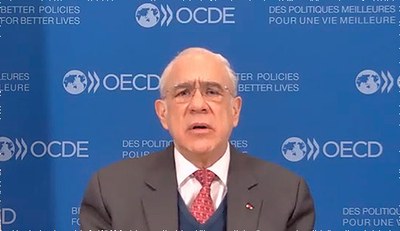
<td><span class="discreet">Angel Gurría, OECD secretary-general, during his presentation at the meeting</span></td>
</tr>
</tbody>
</table>
<p>Although not yet a member of the <a class="external-link" href="http://www.oecd.org/">Organisation for Economic Co-operation and Development (OECD)</a>, Brazil is like a "family member" and partnerships with Brazilian institutions allow the organization to work with and for the country in building a more inclusive and resilient society, said the secretary-general <a class="external-link" href="https://www.oecd.org/about/secretary-general/">Angel Gurría</a> during his participation in the online meeting "OECD and USP: Reconfiguring the World from Knowledge," on May 6.</p>
<p>Among the OECD partner countries, Brazil is the one that has made the most of this relationship and has invested in several areas of public policies to approach the organization's standards, according to Gurría. As an example, he cited a project launched in October that is helping to align Brazilian policies with OECD's environmental criteria.</p>
<p>The online meeting with Gurría, who will leave the OECD later this month after three consecutive five-year terms, celebrated the beginning of cooperation between the organization and USP. He will soon become an IEA researcher. In addition to the secretary-general, the Brazilian delegate with international economic organizations headquartered in Paris, ambassador <a class="external-link" href="http://agenciabrasil.ebc.com.br/en/internacional/noticia/2018-02/brazil-intensifies-talks-paris-join-oecd">Carlos Márcio Cozendey</a>, and the president of USP, Vahan Agopyan, gave presentations. Mediation was provided by the general coordinator of the International Economic Analysis Group (GACINT) of USP's Institute of International Relations (IRI), Alberto Pfeifer.</p>
<p><a href="https://www.iea.usp.br/en/iea/organization/direction" class="external-link">Guilherme Ary Plonski</a>, director of the IEA, opened the event by pointing out that the cooperation between USP and the OECD is based on the common concern of both institutions in promoting the production of knowledge "to move towards a prosperous human society in harmony with nature."</p>
<p>He highlighted the significance of OECD's slogan "Better Policies for Better Lives" and the organization's concern with formulating international evidence-based references in order to find solutions to economic, social, and environmental challenges.</p>
<p>"The IEA is available to collaborate in the production of knowledge based on this cooperation and to contribute to the initiatives for Brazil to become a member of the organization," he said.</p>
<table class="tabela-esquerda-300">
<tbody>
<tr>
<th><img src="https://www.iea.usp.br/imagens/carlos-marcio-conzenday-6-5-2021" alt="Carlos Márcio Cozendey - 6/5/2021" class="image-inline" title="Carlos Márcio Cozendey - 6/5/2021" /><br /><span class="discreet">Ambassador Carlos Márcio Cozendey</span></th>
</tr>
</tbody>
</table>
<p>"Even though not being a member of the organization, Brazil participates in almost all committees and working groups, and has already adhered to 99 OECD recommendations, according to Cozendey. "The country is interested in becoming a member to participate in all dimensions of the OECD, exchange experiences, and present public policies."</p>
<p>The partnership is part of this exchange of policy formulations, said the ambassador: "Having the University to establish and follow the interaction between public policies in Brazil and the OECD recommendations is an input for the organization's recommendations to also reflect the Brazilian reality."</p>
<p>For Agopyan, the internationalization present in the cooperation is a tool for USP to improve its levels of quality, "an essential search for all research universities."</p>
<p>In this century, all research universities seek to have ever greater interaction with society, he said. "USP is also doing this and it is natural that, for this purpose, universities seek partnerships with governments, entities, and international groups."</p>
<p>In June, at a meeting in Switzerland, Agopyan will defend the idea that universities are reliable sources of public policy. "If the OECD is concerned about this, USP and other research universities are at the disposal of the organization and national governments to develop proposals for public policies to be used by governments," concluded the president.</p>
<p><strong>Effects of the pandemic</strong></p>
<p>In his brief presentation followed by answers to questions from guests, Gurría commented that the COVID-19 pandemic reversed all the economic recovery achieved after the crisis that started in 2008, "but the prospects are improving and we expect a global economic growth of 5.6 %, with economy returning to pre-pandemic levels by the middle of this year." However, he warned that this projection depends on the rate of vaccination and the eventual spread of variants of the virus.</p>
<p>"Brazil was recovering from a recession when the pandemic a second recession came. The economic measures adopted by the government, such as emergency aid, supported millions of vulnerable families. Without these measures, the economic contraction would be even greater and the recovery in 2021 much slower than the projected GDP growth of 3.7%."</p>
<p>However, he stressed that the recovery must be guided by more just and sustainable growth. To that end, Gurría defended three lines of action, the first of which is to increase the effectiveness of social benefits to strengthen the population's first line of defense against economic shocks. "If well oriented, Brazil's conditional cash transfer system could be converted into a real social safety network," he said.</p>
<p>The second recommendation is to support professional qualification in order to allow workers to switch their jobs to better ones and for entrepreneurs to end unproductive and polluting activities. "In the long run, improving the quality and equity of vocational training reduces inequalities and poverty," according to the secretary-general.</p>
<p>His third suggestion is to link economic recovery measures to the sustainability agenda. "The most urgent task now is to vaccinate people quickly and protect us from further outbreaks of COVID-19, but the intergenerational commitment is to protect the planet," she said. For Gurría, the fact that the Amazon rainforest is the largest reserve of biodiversity in the world and 60% of it is in Brazil, makes the country a leader for the reshaping and reconstruction of the global economy in a more resilient way.</p>
<p><strong>Continuity and relations</strong></p>
<p>The questions from the guests to Gurría addressed the continuity of programs implemented in his management, mainly those related to environment and education, the organization's relationship with sub and supranational organizations, and prospects for Brazil's entry into the OECD.</p>
<table class="tabela-direita-300">
<tbody>
<tr>
<th><img src="https://www.iea.usp.br/imagens/vahan-agopyan-6-5-2021" alt="Vahan Agopyan - 6/5/2021" class="image-inline" title="Vahan Agopyan - 6/5/2021" /></th>
</tr>
<tr>
<td><span class="discreet">Vahan Agopyan, president of USP</span></td>
</tr>
</tbody>
</table>
<p>Jacques Marcovitch, former president of USP and former director of the IEA, asked whether OECD's emphasis on environmental issues will continue and what the weight of the environmental issue will be for Brazil's intentions to become one of the organization's members.</p>
<p>"Gurría said that the future secretary-general, a former finance minister in Australia, assured member countries that the OECD will continue its environmental policies. As for joining the organization, he said that Brazil has a huge advantage over the other five current candidates (Argentina, Peru, Romania, Croatia, and Bulgaria): "Brazil is already in the family, like a cousin who is already in the kitchen of the organization, because instead of waiting to be accepted, the work with the OECD has already started."</p>
<p>Cláudia Costin, a member of IEA's <a href="https://www.iea.usp.br/en/iea/organization/board" class="external-link">Board</a> and director of the Center for Excellence and Innovation in Education at the Getulio Vargas Foundation (FGV), expressed concern about the continuity in the new management of education programs, such as the Programme for International Student Assessment (PISA). There is no risk of interruption, according to Gurría: "The PISA is a brand of the organization and will constantly evolve. It is becoming not only a reference, but also an instrument for comparison and ranking, not to indicate who is better or worse, but to measure the fundamental issues, and indicate what is good or bad and what can be improved."</p>
<p>"Still in the field of education, <a href="https://www.iea.usp.br/en/iea/organization/direction" class="external-link">Roseli de Deus Lopes</a>, deputy director of the IEA, wanted to know what the OECD recommendations for Brazil are, since recent evaluations indicate a drop in school performance and greater inequality in education. The secretary-general argued that something very important is the acquisition of digital skills by young people. "We know that the future will be much more digital because we had to act almost entirely digitally due to the pandemic. To be able to reintegrate into the labour market, it is necessary to have digital competence, but only 50% of the countries' workforce has ability to act in a technological environment."</p>
<p>Vinicius Mota, editor in chief of the newspaper <i>Folha de S.Paulo</i>, asked if threats to democracy in Brazil could weigh on OECD's decision to accept the country as a member. Gurría said that problems with the quality of democracy are not on the agenda in relation to Brazil's entry. "I do not know anyone who says that Brazil is not a democracy. That is the great advantage of the country: to be recognized as a democracy". Problems with democracy "are no one's monopoly," he emphasized, recalling recent changes in electoral legislation in Georgia, USA, which make it difficult for some publics to participate in the local elections.</p>
<p>"The director of IRI, Janina Onuki, wanted to know what benefits can be expected from OECD partnerships with subnational governments, as in the case of the government of the state of São Paulo. These partnerships are increasingly important, said Gurría, "because everything is happening at the local level and it is necessary to go where the action takes place." He added that the OECD works with many states, provinces, and cities in many countries. "The world today is urbanized. Countries like Mexico and Brazil have become urban without becoming rich and all the problems arising from the growth of cities have arisen."</p>
<p>The relationship between the OECD and the World Trade Organization (WTO) was the subject of the question by USP professor emeritus <a href="https://www.iea.usp.br/en/persons/researchers/celso-lafer" class="external-link">Celso Lafer</a>, another member of IEA's Board and former Minister of Foreign Affairs. For the secretary-general, the organizations complement each other: "Although the WTO has a lot of technical capacity to deal with problems of jurisdictional systems and conflicts of interest, it does not have the technical capacity to carry out analyzes and comparisons, leading to the extraction of information for public policies."</p>
<p>"For him, there is a methodological problem, as the OECD has 37 members (soon 38 with the entry of Costa Rica) <span>and the WTO has 200 countries. "We work with almost every UN body. They know that we have 37 members, but they do not come to us for the sake of universality, yet rather because of the globalizing impact of the OECD recommendations."</span></p>
<p style="text-align: right; "><span class="discreet">Photos: IEA-USP</span></p>]]></content:encoded>
    <dc:publisher>No publisher</dc:publisher>
    <dc:creator>Richard Meckien</dc:creator>
    <dc:rights>Original version in Portuguese by Mauro Bellesa.</dc:rights>
    
      <dc:subject>Sustainable development</dc:subject>
    
    
      <dc:subject>International Cooperation</dc:subject>
    
    
      <dc:subject>Economic development</dc:subject>
    
    
      <dc:subject>Public Policies</dc:subject>
    
    
      <dc:subject>Environment</dc:subject>
    
    
      <dc:subject>OECD</dc:subject>
    
    
      <dc:subject>USP</dc:subject>
    
    
      <dc:subject>Event</dc:subject>
    
    <dc:date>2021-05-07T16:00:00Z</dc:date>
    <dc:type>Notícia</dc:type>
  </item>


  <item rdf:about="https://www.iea.usp.br/en/news/journal-issue-100">
    <title>"Estudos Avançados" reaches its 100th issue and resumes the dossier on the COVID-19 pandemic</title>
    <link>https://www.iea.usp.br/en/news/journal-issue-100</link>
    <description> </description>
    <content:encoded xmlns:content="http://purl.org/rss/1.0/modules/content/"><![CDATA[<p><img src="https://www.iea.usp.br/imagens/capa-de-estudos-avancados-100" alt="Capa de 'Estudos Avançados' 100" class="image-right" title="Capa de 'Estudos Avançados' 100" /></p>
<p>The impacts of the Covid-19 pandemic on economy, labor market, educational and <span>financial</span><span> </span><span>systems, environment, research on drugs, and agribusiness are analyzed in the dossier of the new </span><span>issue of the journal </span><i><a href="https://www.iea.usp.br/en/journal" class="external-link">Estudos Avançados</a>, </i><span>whose digital version (Portuguese only) is available for free </span><span>at </span><a class="external-link" href="https://www.scielo.br/scielo.php?script=sci_issuetoc&amp;pid=0103-401420200003&amp;lng=en&amp;nrm=iso">SciELO</a><span>.</span></p>
<p>The publication's editor, sociologist <a href="https://www.iea.usp.br/en/persons/researchers/sergio-adorno" class="external-link">Sérgio Adorno</a>, points out that the journal reaches its 100th issue without any interruption in the four-monthly periodicity, maintaining the editorial line defined from the beginning, which focuses on "our contemporaneity and the challenges that the present proposes for the consolidation of fairer societies with quality of life."</p>
<p>This harmony with the problems of the present is revealed with the continuity of the dossier on Covid-19, started in the <a href="https://www.iea.usp.br/en/news/journal-issue-99" class="external-link">previous issue</a>. Under the title "Impacts of the Pandemic," the set of texts includes 12 articles, of which five are the result of a cycle of virtual meetings on possible scenarios after the pandemic. It has been organized by the IEA, USP's Dean of Research, and the São Paulo State Academy of Sciences (ACIESP).</p>
<p>According to Adorno, the characteristics that stand out in the articles are the density of the <span>adopted </span><span>perspectives, their timeliness, the basis on solid updated bibliography and on documentary reference sources, and the choice of fundamental issues present in the public debate, including current questions in the common and everyday conversations.</span></p>
<p>Part of the dossier includes discussions on medicines and treatment, health, biodiversity, climate change, and policies to protect the Amazon. "There are also important reflections on economic impacts, especially in the productive chains of commodities and value, food, goods, and services," he highlights. "In social terms, reflections on the serious impacts on the labor market, as well as on education, stand out at all levels."</p>
<p>The issue also features texts commemorating the centenary of the births of sociologist Florestan Fernandes and economist Celso Furtado, and the 250th anniversary of Beethoven's birth, in addition to articles on the 100 years after the death of Max Weber.</p>
<p>Adorno also calls attention to a dialogue between Celso Furtado and Fernand Braudel, and to the audio of <span>Beethoven's </span><span>Piano Sonata No. 23 in F minor, Op. 57 </span><i>Appassionata</i><span> as interpreted by pianist Eduardo Monteiro.</span></p>
<p>At the end of the issue there is an essay on the origin and constitution of the institutes for advanced study existing in the world and their role in the production of cutting-edge knowledge.</p>
<p>Issue #100 is dedicated to the publication's previous editor, Alfredo Bosi, who, <span>in the words of Adorno,</span><span> "ensured the preservation of this heritage from USP and the IEA for three decades (January 1989 - August 2019)."</span></p>
<h3><strong>Dossier</strong></h3>
<p><strong>Medicines</strong></p>
<p>According to Leonardo Ferreira and Adriano Andricopulo, both from the <a class="external-link" href="https://www2.ifsc.usp.br/english/">São Carlos Institute of Physics (IFSC-USP)</a> and the Center for Research and Innovation in Biodiversity and Pharmaceuticals (CIBFar), there are about 2,000 records of clinical trials for investigating approved drugs and other possibilities against COVID-19, including small molecules and biological drugs, not counting vaccines.</p>
<p>However, "drug repositioning has not led to any new antiviral treatment against Covid-19." According to the researchers, the most realistic scenario comprises the development of specific antivirals against SARS-CoV-2 for the safe and effective treatment against the disease.</p>
<p><strong>Education</strong></p>
<p>The impacts on education are analyzed in an article by Bernardete Angelina Gatti, a member of the advisory committee to the Chair of Basic Education (a partnership between the IEA and the Itaú Social Foundation) and senior researcher at the Carlos Chagas Foundation. Gatti discusses the issue of students' learning during the pandemic, the diversity of social realities, the situation of teachers and managers, and curricular, relational and socio-emotional aspects related to isolation and return to schools. She also ponders about the changing possibilities in the educational offer in basic education networks.</p>
<p>Cláudia Costin, a member of IEA's Board and director of the Center for Excellence and Innovation in Educational Policies (CEIPE) at the Getúlio Vargas Foundation, addresses trends in basic education in Brazil in the face of the conditions imposed by the pandemic, of the commitments that Brazil assumed in 2015 in relation to sustainability and, in particular, to the Sustainable Development Goal 4 (to provide quality education) and the so-called Industry 4.0, which tends to rapidly eliminate jobs.</p>
<p><strong>Environment</strong></p>
<p>For physicist Paulo Artaxo, from USP's Institute of Physics (IF), the world and the humanity face three important crises: 1) that of health, intensified by the COVID-19 pandemic; 2) the loss of biodiversity; and 3) the climatic emergency. He points out that the three crises are linked despite having important differences, "but they all have strong social and economic impacts and affect the planet globally."</p>
<p><span class="VIiyi"><span class="JLqJ4b ChMk0b"><span>For him, the pandemic has revealed deficiencies in global governance and the climate crisis "has potential for very strong socio-economic damage, reflecting in effects that are already easily visible."</span></span> <span class="JLqJ4b ChMk0b"><span>As for the loss of biodiversity, he mentions the risk to food security and to the balance of the terrestrial system.</span></span> <span class="JLqJ4b ChMk0b"><span>"The Amazon, for example, contains thousands of viruses in its fauna and flora. The unrestrained process of the region's occupation will </span></span></span><span>possibly </span><span class="VIiyi"><span class="JLqJ4b ChMk0b"><span>make new viruses similar to <span>SARS-CoV-2</span> come into contact with our society."</span></span></span><span> </span></p>
<p>It is necessary to recognize the link between biodiversity, ecosystem services and human health, and thus join efforts in order to prevent the emergence of new pandemics, warn Carlos Alfredo Joly, from the University of Campinas's Institute of Biology, and Helder Lima de Queiroz, from the Mamirauá Instituto for Sustainable Development.</p>
<p>In line with Artaxo's warning, Joly and Queiroz point out that countries like Brazil, "with high levels of social vulnerability and environmental degradation, have a high probability that new pathogens living in wild species will be transferred to human hosts."</p>
<p><strong>Economy</strong></p>
<p>For Simão Davi Silber, a senior professor at USP's School of Economics, Business, and Accounting (FEA), the pandemic has demonstrated how "exogenous adverse shocks in the economic system" disorganize the economy and create a mismatch between the economic world and the possible actions of the State. In his opinion, these actions fail to reach all economic agents to preserve them from the crisis and the result is the "destruction of companies, and of physical and human capital" that will no longer be recovered.</p>
<p>For Camila Villard Duran, from USP's Faculty of Law (FD), however, the international financial market found a way to sustain itself during the pandemic thanks to the consolidation of a model of global monetary cooperation. According to the researcher, the hierarchical network of operations called foreign exchange swaps, headed by the American central bank Federal Reserve (the Fed), "was the legal arrangement structured to support the functioning of the global financial market and its currency par excellence: the Eurodollar."</p>
<p>The reconfiguration of global value chains is the theme of the article by Afonso Fleury, from USP's Polytechnic School (EP), and Maria Tereza Leme Fleury, from FEA-USP and the Getúlio Vargas Foundation (FGV). Both analyze the evolution of these chains - orchestrated by multinationals with the support of digital technologies -, how governments and companies are reacting to the difficulties imposed by the pandemic, and how the chains will be reconfigured.</p>
<p><strong>Labour</strong></p>
<p>If the financial market has found a way to preserve itself, the same does not apply to the labor market. According to sociologist Maria Aparecida Bridi, from the Federal University of Paraná, the health crisis caused by SARS-CoV-2 "has increased its fragility as it has been undergoing a rapid deterioration process in the last four years in Brazil."</p>
<p>In her article, she discusses the various aspects of the labor market scenario in the context of the pre-pandemic economic crisis, the indicators during the pandemic, and "the challenges imposed on unionism resulting from the intensification of the neoliberal agenda in the last four years."</p>
<p><strong>Agribusiness</strong></p>
<p>The scope and depth of the crisis resulting from the pandemic on agriculture and agribusiness in Brazil are discussed in the article written by Sergio Schneider, Abel Cassol, Alex Leonardi, and Marisson Marinho. They also look at the effects of the pandemic on family farming, the meat processing sector, and food distribution.</p>
<p>If, on the one hand, they point to the possibility of greater international insertion of Brazilian agribusiness, on the other hand they identify potential problems in domestic supply and possible price increases, as well as "food inflation, which results from both increased demand and production costs due to exchange devaluation, representing a stimulus to exports."</p>
<p>Food under the impact of SARS-CoV-2 is the subject of an article by three other researchers: Bernardete de Melo Franco, Mariza Landgraf, and Uelinton Manoel Pinto. The study is dedicated to answering whether food and its packaging can cause COVID-19, whether the industry and the food sector can be responsible for the spread of the virus, and what preventive measures consumers can take.</p>
<div id="_mcePaste">
<div class="tlid-results-container results-container">
<div class="tlid-result result-dict-wrapper">
<div class="result tlid-copy-target">
<div class="text-wrap tlid-copy-target"></div>
</div>
</div>
</div>
</div>]]></content:encoded>
    <dc:publisher>No publisher</dc:publisher>
    <dc:creator>Richard Meckien</dc:creator>
    <dc:rights>Original version in Portuguese by Mauro Bellesa.</dc:rights>
    
      <dc:subject>Agribusiness</dc:subject>
    
    
      <dc:subject>Journal</dc:subject>
    
    
      <dc:subject>Work</dc:subject>
    
    
      <dc:subject>Pandemic</dc:subject>
    
    
      <dc:subject>Covid-19</dc:subject>
    
    
      <dc:subject>Environment</dc:subject>
    
    
      <dc:subject>Music</dc:subject>
    
    
      <dc:subject>Publications</dc:subject>
    
    
      <dc:subject>Education</dc:subject>
    
    
      <dc:subject>Economy</dc:subject>
    
    <dc:date>2020-07-08T17:40:00Z</dc:date>
    <dc:type>Notícia</dc:type>
  </item>


  <item rdf:about="https://www.iea.usp.br/en/news/journal-issue-99">
    <title>"Estudos Avançados" #99 presents dossier on the COVID-19 pandemic</title>
    <link>https://www.iea.usp.br/en/news/journal-issue-99</link>
    <description> </description>
    <content:encoded xmlns:content="http://purl.org/rss/1.0/modules/content/"><![CDATA[<p><img src="https://www.iea.usp.br/imagens/capa-de-estudos-avancados-99" alt="Capa de &quot;Estudos Avançados&quot; 99" class="image-right" title="Capa de &quot;Estudos Avançados&quot; 99" /></p>
<p><span>Dedicated to the </span><span>COVID-19 </span><span>victims, the 99th </span><span>issue of the journal </span><i><a href="https://www.iea.usp.br/en/journal" class="external-link">Estudos Avançados</a></i><span> presents a dossier on the pandemic caused by the Sars-CoV-2 coronavirus. </span><span>The online version (Portuguese only) is available at </span><a class="external-link" href="https://www.scielo.br/scielo.php?script=sci_issuetoc&amp;pid=0103-401420200002&amp;lng=pt&amp;nrm=iso">SciELO</a>.</p>
<p>According to sociologist <a href="https://www.iea.usp.br/en/persons/researchers/sergio-adorno" class="external-link">Sérgio Adorno</a>, editor of the publication, the object of the dossier is the complexity of the pandemic, reflected in the 17 articles written by 47 researchers from two dozen universities and research institutions in several Brazilian states.</p>
<p><span>"</span>Its multiple aspects are addressed by experienced researchers through extensive investigations, some of which are produced in the effervescence of events, in the seemingly uninterrupted search for scientific responses, and by government plans to stop its natural course, fertilized by unfavorable social and political conditions," notes the editor.</p>
<p>He points out that the pandemic is above all a public health problem, involving different types of collectives, which are represented, for example, by groups with different degrees of vulnerability<span>.</span></p>
<p><span>"</span>Not without reason, the dossier addresses issues more properly situated in this domain, such as the norms of international and national regulatory bodies, and the race for the discovery of vaccines, the performance of tests, and consequent epidemiological modeling that enable the assessment of both scenarios and guidelines for prevention."</p>
<p>However, the pandemic also reveals the harsh social reality, accentuated by the "acute process of economic recession that, in societies like Brazil, means the worsening of social inequalities that are projected with greater intensity in the metropolises, as is the case of São Paulo," says Adorno.</p>
<p>He reinforces that the space studies of the dossier demonstrate how inequalities affect the poorest, the black population, and the residents of neighborhoods where populations with low education and income predominate, "the most vulnerable to contamination and deaths" by COVID-19.</p>
<p>Other topics addressed by the dossier have been highlighted by Adorno, such as issues regarding the right to privacy in the face of intense data tracking and monitoring, the dangers of spreading Sars-Cov-2 in Brazilian biomes, and the absence of government policies<span> </span><span>capable of containing the pandemic's progress </span><span>in the country</span><span>.</span></p>
<p>The dossier begins with an article by the collaborator in the organization of the journal's set of texts, José da Rocha Carvalheiro, a professor of social medicine at USP's School of Medicine in Ribeirão Preto (FMRP) and a member of <a href="https://www.iea.usp.br/en/research/research-groups/innovation-and-competitiveness-observatory" class="external-link">IEA's Innovation and Competitiveness Observatory</a>.</p>
<p>In the article, Carvalheiro states that COVID-19 in Brazil will not be a disease limited in time, but in space: "An endemic disease or, perhaps, a collection of endemic diseases with different characteristics spread across the national territory. Due to the diversity, the control proposals will inevitably have their own characteristics. This requires a coordination effort and political skill on the part of the leaders."</p>
<p>The effort of the journal to collaborate with the academic and public debate about COVID-19 and its consequences does not end in the current issue. Issue #100, to be launched in the next four months, will feature articles on the impact of the pandemic in areas such as <span>(national and international) </span><span>economy, international relations, education, labor market, agriculture, food, and engineering.</span></p>
<p><strong>Youth</strong></p>
<p>Another highlight of the issue is a set of articles on the Brazilian youth, a topic addressed <span>by </span><i>Estudos Avançados </i><span>for the first time</span><span>. Organized with the collaboration of Professor Marilia Pontes Sposito, from USP's School of Education (FE) and co-author of one of the articles, the section "Portrait of Youth" contains six texts written by a dozen education and sociology researchers from USP, the Federal University of ABC (UFABC), the Federal University of São Carlos (UFSCar), the Federal University of Ceará (UFC), the University of Brasília (UnB), </span><span>Pará State University (UEPA), UNISINOS, and the Federal University of Alfenas (UNIFAL).</span></p>
<p>According to Adorno, the section "deals with an issue that is always present in public debates: youth as a social matter." Despite the variety of topics covered, he identifies "t<span>he effort to review theses that seemed consolidated in the specialized literature </span><span>based on original investigations</span><span>" </span><span>as an axis that articulates all contributions.</span></p>
<p>With regard to the educational scope, there are articles on the participation of high school students in the institutional plan of schools (based on the results of research on the subject in urban centers in Brazil, Argentina, Mexico, and Spain), the difficulties for schooling of the Brazilian youth that emerged since the 1990s, and what <span>the occupation of schools in Rio Grande do Sul in May and June 2016 has </span><span>represented for its protagonists.</span></p>
<p>The section also features articles on public performance through the Facebook profiles of young conservatives, youth cultural production on the outskirts of Fortaleza, and the policies and proposals for the professional training of young people and their insertion in the labour market in the last three decades.</p>
<p>The list below contains the names of the authors who have contributed with each one of the addressed themes:</p>
<p><strong>Covid-19 Pandemic</strong></p>
<p><strong> </strong><i>José da Rocha Carvalheiro<br /></i><i>Cláudio Maierovitch Pessanha Henriques and Wa</i><i>gner Vasconcelos<br /></i><i>Paulo Marchiori Buss, Santiago Alcázar, and Luiz Augusto Galvão<br /></i><i>Glauco Arbix<br /></i><i>Carmen Phang Romero Casas, Julio Silva, Rodolfo Castro, Marcelo Ribeiro-Alves, and Carolina Mendes Franco<br /></i><i>Naomar de Almeida Filho<br /></i><i>Raul Borges Guimarães, Rafael de Castro Catão, Oséias da Silva Martinuci, Edmur Azevedo Pugliesi, and Patricia Sayuri Silvestre Matsumoto<br /></i><i>Marcos Silveira Buckeridge and Arlindo Philippi Jr.<br /></i><i>Vinicius Carvalho Jardim and Marcos Silveira Buckeridge<br /></i><i>Gabriela Capobianco Palhares, Alessandro Santiago dos Santos, Eduardo Altomare Ariente, and Jefferson de Oliveira Gomes<br /></i><i>André Luis Acosta, Fernando Xavier, Leonardo Suveges Moreira Chaves, Ester Cerdeira Sabino, Antonio Mauro Saraiva, and Maria Anice Murebe Sallum<br /></i><i>Sandra Caponi<br /></i><i>Márcia Pereira Alves dos Santos, Joilda Silva Nery, Emanuelle Freitas Goes, Alexandre da Silva, Andreia Beatriz Silva dos Santos, Luís Eduardo Batista, and Edna Maria de Araújo<br /></i><i>Eugênio Bucci<br /></i><i>Fernando Xavier, João Rodrigo Windischi Olenscki, André Luis Acosta, Maria Anice Mureb Sallum, and Antonio Mauro Saraiva<br /></i><i>Marcos Antônio Mattedi, Eduardo Augusto Werneck Ribeiro, Maiko Rafael Spiess, and Leandro Ludwig<br /></i><i>José Eli da Veiga</i></p>
<p><strong>Portrait of Youth</strong></p>
<p dir="ltr"><i>Marilia Pontes Sposito, Elmir de Almeida, and Felipe de Souza Tarábola<br /></i><i>Adriano Souza Senkevics and Marília Pinto de Carvalho<br /></i><i>Livia de Tommasi and Maria Carla Corrochano<br /></i><i>Glória Diógenes<br /></i><i>Wivian Weller and Lucélia de Moraes Braga Bassalo<br /></i><i>Luís Antonio Groppo and Rodrigo Manoel Dias da Silva</i></p>
<div id="_mcePaste">
<div class="tlid-results-container results-container">
<div class="tlid-result result-dict-wrapper">
<div class="result tlid-copy-target">
<div class="text-wrap tlid-copy-target"></div>
</div>
</div>
</div>
</div>]]></content:encoded>
    <dc:publisher>No publisher</dc:publisher>
    <dc:creator>Richard Meckien</dc:creator>
    <dc:rights>Original version in Portuguese by Mauro Bellesa.</dc:rights>
    
      <dc:subject>Literature</dc:subject>
    
    
      <dc:subject>Sustainable development</dc:subject>
    
    
      <dc:subject>Journal</dc:subject>
    
    
      <dc:subject>Work</dc:subject>
    
    
      <dc:subject>Public Policies</dc:subject>
    
    
      <dc:subject>Environment</dc:subject>
    
    
      <dc:subject>Culture</dc:subject>
    
    
      <dc:subject>Sociology</dc:subject>
    
    
      <dc:subject>Publications</dc:subject>
    
    <dc:date>2020-07-08T17:40:00Z</dc:date>
    <dc:type>Notícia</dc:type>
  </item>


  <item rdf:about="https://www.iea.usp.br/en/news/journal-issue-98">
    <title>"Estudos Avançados" #98 analyzes labor precariousness and transformations</title>
    <link>https://www.iea.usp.br/en/news/journal-issue-98</link>
    <description> </description>
    <content:encoded xmlns:content="http://purl.org/rss/1.0/modules/content/"><![CDATA[<p><img src="https://www.iea.usp.br/imagens/capa-de-estudos-avancados-98" alt="Capa de &quot;Estudos Avançados&quot; 98" class="image-right" title="Capa de &quot;Estudos Avançados&quot; 98" /></p>
<p>At a time of marked reduction in the possibility of work for a large number of workers as a result of restrictions on displacement and public contact due to the COVID-19 crisis, the <span>98th issue of the journal </span><i><a href="https://www.iea.usp.br/en/journal" class="external-link">Estudos Avançados</a></i><span>, released this month</span>, discusses two themes <span>already problematic </span>in Brazil before the pandemic: the still little recognition of care work, which is essential in view of the aging population, and the characteristics and impacts of new forms of work, including on workers' health. <span>The online version (Portuguese only) is available at </span><a class="external-link" href="https://www.scielo.br/scielo.php?script=sci_issuetoc&amp;pid=0103-401420200001&amp;lng=pt&amp;nrm=iso">SciELO</a>.</p>
<p>The content of the issue was defined before the World Health Organization (WHO) declared the pandemic caused by the international spread of the novel coronavirus SARS-CoV-2. Thus, rigorous analyses are not presented, as they could not have been produced in the early stages of the outbreak.</p>
<p>However, the issues addressed in the dossiers deserve extra attention as they are among those for which society must seek answers in the post-pandemic period in order to ensure decent and equal work for everyone, in addition to rights and health protection.</p>
<p>In "Work, Gender, and Care", the first dossier, care for people is analyzed in its various forms. An example is when care occurs as "help," without being characterized as a professional activity or as a parental obligation. The topic is discussed by sociologists Nadya Araujo Guimarães, a senior professor at USP's Faculty of Philosophy, Languages and Literature, and Human Sciences (FFLCH), and Priscila Pereira Faria Vieira, a researcher at the Brazilian Center of Analysis and Planning (CEBRAP).</p>
<p>Helena Hirata, former visiting professor at the IEA and director emeritus of research at the French National Center for Scientific Research (CNRS), addresses the main points of convergence and divergence in the activity of elderly caregivers in Brazil, Japan, and France, without neglecting the centrality of women in this work. The objective is to demonstrate how gender, race, and social class help to build the professional and personal trajectories of caregivers.</p>
<p>In the article "Care and Responsibility," Natacha Borgeaud-Garciandía discusses the work of immigrant caregivers for the elderly in Buenos Aires. A researcher at the Latin American Faculty of Social Sciences (FLACSO), Borgeaud-Garciandía focuses on responsibility as the assumption of a moral obligation towards a vulnerable person. One of the addressed aspects is the role of responsibility in the complexity of the <span>caregivers' </span>exploitation plots within the framework of unequal power relations.</p>
<p>The legal treatment of care in Brazil and public policies aimed at the socialization of social reproduction activities fall short of social demands, according to Regina Stela Corrêa Vieira, a researcher at CEBRAP and a professor of the graduate program in Law at the University of West Santa Catarina (UNOESC). To her, <span>labor law, which "historically ignores or neglects domestic work, whether paid or unpaid," has made some progress such as the Constitutional Amendment 72/2013 and the ratification of Convention C189 of the International Labor Organization (ILO), but currently sees labor reform as a "threat to the hard-won rights of domestic workers."</span></p>
<p>The struggle of these female workers for the enhancement of their professional activity is also analyzed in an article by Louisa Acciari, from the Federal University of Rio de Janeiro (UFRJ), and Tatiane Pinto, from the Federal Rural University of Rio de Janeiro (UFRRJ), who discuss informal negotiations with employers and union mobilization in the category. They propose a redefinition of the concept of work with the full inclusion of care work, something "indispensable to guarantee the dignity and equal rights."</p>
<p><strong>Labor precariousness</strong></p>
<p>The discussion on the lack of rights and dignity in the context of caregivers and domestic employees in general is extended in the second dossier of the isssue to address the characteristics and impacts of the transformations underway in the world of work, including health.</p>
<p>In his article, sanitary professional René Mendes, a collaborating researcher at the IEA, summarizes the concerns that led him to propose the development of the research project "Impacts of the New Morphologies of Contemporary Work on Life, Sickness, and Death."</p>
<p>Mendes starts from the perceptions of existing studies on the problem <span>mainly </span><span>carried out from a sociological perspective, but seeks to deepen the reflections on the nature and complexity of the pathogenesis mechanisms of the new morphologies of work on the workers' life and health </span><span>from the perspective of social epidemiology</span><span>.</span></p>
<p>One of these new forms of work is the "uberization," subject of the article by Ludmila Costhek Abílio, a researcher at the University of Campinas's Center for Union Studies and Labor Economics (CESIT-UNICAMP). Her study is based on empirical research with cosmetic dealers and motorcycle drivers, and on secondary data on Uber drivers and the so-called bike boys.</p>
<p>Abílio's analysis considers two theses: 1) uberization is an ongoing global trend to consolidate the worker as an available subordinate self-manager <span>defined as a just-in-time worker</span><span> devoid of guarantees and rights; 2) companies present themselves as mediators, when they actually operate forms of subordination and work control, in what can be called algorithmic work management.</span></p>
<p>The third article in the dossier, authored by <span>sociologist </span><span>Clemente Ganz Lúcio, a technician at the Inter-Union Department of Statistics and Socioeconomic Studies (DIEESE), presents a brief history and the current context of the debates </span><span>on union reform and the system of labor relations in the National Congress and in the Federal Government. </span>Lúcio points out that countless aspects of the world of work have undergone changes, such as jobs, occupations, labor dynamics, forms of hiring, working hours, and working conditions, among others.</p>
<p>For him, some guidelines should be considered in these changes. One of them is the development of an autonomous and effective system of self-regulation between workers and employers, which supports the union's restructuring of the labor relations system and resolves conflicts through instruments created by the parties.</p>
<p><strong>Bioeconomics, energy, and vegetation</strong></p>
<p>Themes related to the environment and sustainable development have had a regular presence throughout the journal's 33 years, and are present in this issue in three articles. André Luiz Willerding, a biotechnologist at the <span>Amazonas State Secretariat for Economic Development, Science, Technology, and Innovation (SEDECTI), and five other researchers from SEDECTI an </span>Amazonas State University<span>, present an overview of the state's reality regarding the development of bioeconomy strongly linked to the potential of natural resources. According to the authors, the discussion on this theme goes against the search for alternatives for the state's economy, still centralized around the Manaus Industrial Pole, which "becomes increasingly threatened year after year."</span></p>
<p>Another region addressed in this section is the Brazilian Northeast, in an article on the importance of integrating social, economic, and environmental policies around the supply of energy to the semiarid region. Based on the food-water-energy nexus, which seeks to examine the interrelationships of these three essential components of environmental and human quality, Marcel Burztyn, from <span>University of Brasília's</span><span> Center for Sustainable Development (CDS-UnB), proposes the promotion of photovoltaic energy generation by family farmers.</span></p>
<p>When studying issues such as the degree of complexity and diversification of the Brazilian landscape, it must be taken into account that a landscape may be the result of recent environmental changes or relics of much more remote conditions. This is what geologists Daniel Meira Arruda, from the Federal University of Minas Gerais (UFMG), and Carlos Ernesto Gonçalves Rynaud Schaefer, from the Federal University of Viçosa (UFV), point out in another article. They discuss the biogeographic theories formulated and modified over the past 60 years of studies on the reconstruction of Brazil's vegetation under the impact of the climatic changes of the Last Glacial Maximum (LGM), which occurred 18,000 years ago. According to both researchers, the recent advance of global climate models has provided new perspectives for a more faithful reconstruction of the conditions of that period.</p>
<p><strong>Literature and other cultural themes</strong></p>
<p><strong> </strong>The <span>"Culture" </span><span>section brings texts about works by writers Samuel Beckett, José de Alencar and Murilo Mendes, and about the costumes of the Brazilian Indians during the time of Johan Maurits van Nassau-Siegen's </span><span>government</span><span> (1637-1644) during the Dutch occupation in the country's Northeast. The set of articles also includes "The Impediments of Memory," by Jeanne Marie Gagnebin, and "Ideological Automata," by Benhur Bortolotto</span><i>.</i></p>
<p><i>Estudos Avançados</i> #98 also presents tributes for the ten years since the death of Portuguese writer José Saramago, winner of the 1998 Nobel Prize for Literature. There are three articles on some aspects of the author's work written by Jaime Bertoluci, Marcelo Lachat, and Jean-Pierre Chauvin.</p>
<p>Finally, the edition includes reviews of five books: "Reflection as Resistance: Homage to Alfredo Bosi," organized by Augusto Massi, Erwin Torralbo Gimenez, Marcus Vinicius Mazzari, and Murilo Marcondes de Moura; "The French School of Geography: a Contextual Approach," by Vincent Berdoulay; "The Double Night of Linden Trees," by Marcus Vinicius Mazzari; "Historia von D. Johann Fausten," translated, organized, and commented by Magali Moura; and "The Tragical History of the Life and Death of Doctor Faustus," by Christopher Marlowe, with translation and notes by Luís Bueno and Caetano Waldrigues Galindo.</p>
<p>The list below contains the names of the authors who have contributed with each one of the addressed themes:</p>
<p><strong><span>Work, Gender, and Care</span></strong></p>
<p dir="ltr"><i>Nadya Araujo Guimarães and</i><i> Priscila Pereira Faria Vieira<br /></i><i>Helena Hirata<br /></i><i>Natacha Borgeaud-Garciandía<br /></i><i>Regina Stela Corrêa Vieira<br /></i><i>Louisa Acciari and Tatiane Pinto</i></p>
<p><strong>Labor Issues</strong></p>
<p dir="ltr"><i>René Mendes<br /></i><i>Ludmila Costhek Abílio<br /></i><i>Clemente Ganz Lúcio</i></p>
<p><strong>Environment and Development</strong></p>
<p dir="ltr"><i>André Luis Willerding, Leonardo Rodrigo </i><i>da Silva, Roseana Pereira da Silva, Geison </i><i>Maicon Oliveira de Assis, and Estevão Vicente Cavalcanti Monteiro de Paula<br /></i><i>Marcel Bursztyn<br /></i><i>Daniel Meira Arruda and</i><i> Carlos Ernesto Gonçalves Reynaud Schaefer</i></p>
<p dir="ltr"><strong>Culture</strong></p>
<p><i>Jeanne Marie Gagnebin<br /></i><i>Luciano Gatti<br /></i><i>Fabiano Lemos and Ulysses Pinheiro<br /></i><i>Pablo Simpson<br /></i><i>Aline Leal Fernandes Barbosa<br /></i><i>Benhur Bortolotto<br /></i><i>Fausto Viana</i></p>
<p dir="ltr"><strong>José Saramago: Themes and Languages</strong></p>
<p><i>J</i><i>aime Bertoluci<br /></i><i>Marcelo Lachat<br /></i><i>Jean Pierre Chauvin</i></p>
<p dir="ltr"><strong>Reviews</strong></p>
<p><i>Alexandre Koji Shiguehara<br /></i><i>Nilson Cortez Crocia de Barros<br /></i><i>Klaus F. W. Eggensperger<br /></i><i>Rafael Rocca dos Santos</i></p>
<div id="_mcePaste">
<div class="tlid-results-container results-container">
<div class="tlid-result result-dict-wrapper">
<div class="result tlid-copy-target">
<div class="text-wrap tlid-copy-target"></div>
</div>
</div>
</div>
</div>]]></content:encoded>
    <dc:publisher>No publisher</dc:publisher>
    <dc:creator>Richard Meckien</dc:creator>
    <dc:rights>Original version in Portuguese by Mauro Bellesa.</dc:rights>
    
      <dc:subject>Literature</dc:subject>
    
    
      <dc:subject>Sustainable development</dc:subject>
    
    
      <dc:subject>Journal</dc:subject>
    
    
      <dc:subject>Work</dc:subject>
    
    
      <dc:subject>Public Policies</dc:subject>
    
    
      <dc:subject>Environment</dc:subject>
    
    
      <dc:subject>Culture</dc:subject>
    
    
      <dc:subject>Sociology</dc:subject>
    
    
      <dc:subject>Publications</dc:subject>
    
    <dc:date>2020-05-08T17:40:00Z</dc:date>
    <dc:type>Notícia</dc:type>
  </item>


  <item rdf:about="https://www.iea.usp.br/en/news/journal-95">
    <title>"Estudos Avançados" #95 addresses the future of universities, and urban and environmental degradation</title>
    <link>https://www.iea.usp.br/en/news/journal-95</link>
    <description></description>
    <content:encoded xmlns:content="http://purl.org/rss/1.0/modules/content/"><![CDATA[<p><img src="https://www.iea.usp.br/imagens/capa-da-revistas-estudos-avancados-95" alt="Capa da revista 'Estudos Avançados' 95" class="image-right" title="Capa da revista 'Estudos Avançados' 95" /></p>
<p>In addition to perspectives for universities, and urban and environmental concerns, the 95th issue of IEA's journal "<a href="https://www.iea.usp.br/en/journal/about-estudos-avancados" class="external-link">Estudos Avançados</a>," launched this month, also discusses the judicialization of health and the precautionary principle. According to editor Alfredo Bosi, "the current primacy of technology is one of the transversal themes that bring together articles about so diverse objects."</p>
<p>The issue also contains reviews of eight books on visual arts, literature, political science, economics, and globalization.</p>
<p>The opening section has "University" as theme and features an article by former president of USP Jacques Marcovitch. The professor, who has also been director of the IEA, analyzes three aspects: the Academic Performance and Evaluations <span>project</span>, coordinated by him; the transformations undergone by academic institutions; and the challenge of proposals that in his view would disqualify public universities, such as the implementation of tuition fees.</p>
<p>The need for universitary adaptation to a new reality dominated by information networks is analyzed by <a href="https://www.iea.usp.br/en/persons/researchers/luiz-bevilacqua" class="external-link">Luiz Bevilacqua</a>, a visiting professor at the IEA from 2017 to 2018, in the article "The Last Train to Alexandria".</p>
<p>The articles that are specifically focused on USP present studies conducted by researchers Ricardo Terra and Carlota Boto. While Terra brings up<span> a self-reflection on the institution, including its f</span><span>inancial imbalance, missions and overall evaluation, Boto shows how the concept and the project of USP appeared in the discourse and in the actions of <span>intellectuals in </span>São Paulo and abroad in the early 1930s.</span></p>
<p><strong>City and Environment</strong></p>
<p>The urban degradation of large cities and the deforestation of vast regions in Brazil are two of the addressed themes in this section. Bosi emphasizes the conflict between defenders of a more humane style of housing and the "violent deterioration of the space where the lower-middle class neighborhoods and the slums on the periphery of large cities are examples and victims," as discussed in the articles "End of Utopias, The City of São Paulo and the Discussion of Contemporary Urbanism," by urban planner Antonio Claudio Pinto da Fonseca and historian Carlos Guilherme Mota, and "The Conflict of Space: The Tense Port-City Relationship in Urban Planning," by João Mendes Rocha, a specialist in public policy and government management.</p>
<p>Regarding the articles on environmentalism, the editor highlights the concern with "economic interests that promote the wild deforestation," remembering that "after a short period of relative control, the anti-ecological threat that reaches entire regions of the Amazon and the Northeast has returned." The theme is present in "Territories and Political Alliances of Post-Environmentalism," by experts from various institutions, and "Characteristics and Provenance of Firewood Used for Cooking in Brazil<span>," by Adriana Gioda.</span></p>
<p>The other two sections are "Health," with two articles, and "The Precautionary Principle," with three collaborations. The first two texts discuss the guidelines of the National Council of Justice for the action of law professionals in the realization of the right to health, and techniques of welfare coaching in the change of lifestyle in the public health system.</p>
<p>In the article "The Adoption of Precautionary Measures Against Risks in the Use of Technoscientific Innovations," philosopher <a href="https://www.iea.usp.br/en/persons/visiting-professors/hugh-matthew-lacey" class="external-link">Hugh Lacey</a>, a former visiting professor at the IEA and current member of the research group <a href="https://www.iea.usp.br/en/research/research-groups/philosophy-history-sociology-of-science-and-technology" class="external-link">Philosophy, History, and Sociology of Science and Technology</a>, discusses the responsibilities of scientists and institutions in conducting the research needed to inform precautionary measures. Lacey's text is accompanied by two articles by other researchers: one revises the precautionary principle in the Brazilian legal system to international agreements while the other discusses the main arguments involved in the scientific debate on the principle of substantial equivalence, which states that genetically modified organisms, popularly known as transgenic, are chemically equivalent to organisms selected by traditional breeding techniques and thus would not require <span>additional</span> toxicological studies.</p>
<p>The list below contains the names of the authors who have contributed with each one of the addressed themes:</p>
<p><strong>Leading Article</strong></p>
<p dir="ltr"><i><i>Alfredo Bos</i>i</i></p>
<p><strong>University</strong></p>
<p dir="ltr"><i><i><i>Jacques Marcovitch<br /></i></i><i>Carlota Boto<br /><i>Ricardo Terra<br /><i>Luiz Bevilacqua</i></i></i></i></p>
<p><strong>City and Environment</strong></p>
<p dir="ltr"><i><i>Roberto Araújo, Ima Célia Guimarães Vieira, Peter Mann de Toledo, Andréa dos Santos Coelho, Eloi Dalla-Nora and Felipe Milanez</i><br /></i><i><i>João Mendes Rocha</i><br /></i><i><i>Thais da Silva Chedid and Edmilson Moutinho dos Santos</i><br /><i>Adriana Gioda<br /><i>Ranulfo Paiva Sobrinho, Junior Ruiz Garcia, Alexandre Gori Maia and Ademar Ribeiro Romero<br /><i>Candido Malta Campos<br /><i>Antonio Claudio Pinto da Fonseca and Carlos Guilherme Mota<br /><i>Marcos Cesar Weiss</i></i></i></i></i></i></p>
<p dir="ltr"><span><strong>Health</strong></span></p>
<p><i><i><i><i><i><i>Aline Marques, Carlos Rocha, Felipe Asensi and Diego Machado Monnerat</i><br /><i>Luciana Oquendo Pereira-Lancha, Danielle Kallas, Paula Helena Dayan and Antonio Herbert Lancha Jr.</i></i></i></i></i></i></p>
<p dir="ltr"><strong>The Precautionary Principle</strong></p>
<p><i><i>Hugh Lacey</i><br /><i>Fernanda Viegas Reichardt and Mayara Regina Araújo dos Santos<br /><i>Luciana Zaterka</i></i></i></p>
<ul>
</ul>
<p><strong>Reviews</strong></p>
<p><i><i><i><i><i><i>Leonardo Octavio Belinelli de Brito</i></i><br /><i><i>André Roncaglia de Carvalho</i><br /><i><i>Fabio Mascaro Querido<br /></i></i></i></i></i></i></i><i>Ricardo Ohtake<br /></i><i>Flávia Amparo<br /></i><i>Marcos Antonio de Moraes<br /></i><i>Ana Luiza Martins<br /></i><i>José Augusto Ribas Miranda</i></p>]]></content:encoded>
    <dc:publisher>No publisher</dc:publisher>
    <dc:creator>Richard Meckien</dc:creator>
    <dc:rights>Original version in Portuguese by Mauro Bellesa.</dc:rights>
    
      <dc:subject>University</dc:subject>
    
    
      <dc:subject>Journal</dc:subject>
    
    
      <dc:subject>Environment</dc:subject>
    
    
      <dc:subject>Sustainability</dc:subject>
    
    
      <dc:subject>USP</dc:subject>
    
    
      <dc:subject>Cities</dc:subject>
    
    
      <dc:subject>Public Health</dc:subject>
    
    <dc:date>2019-04-10T15:55:00Z</dc:date>
    <dc:type>Notícia</dc:type>
  </item>


  <item rdf:about="https://www.iea.usp.br/en/news/research-verifies-the-perception-of-young-people-about-sustainability-components">
    <title>Research verifies the perception of young people about sustainability components</title>
    <link>https://www.iea.usp.br/en/news/research-verifies-the-perception-of-young-people-about-sustainability-components</link>
    <description></description>
    <content:encoded xmlns:content="http://purl.org/rss/1.0/modules/content/"><![CDATA[<table class="tabela-direita">
<tbody>
<tr>
<th><img src="https://www.iea.usp.br/imagens/seminario-use-of-geographic-methods-to-characterize-social-inequalities-29-03-2017" alt="Seminário Use of Geographic Methods to Characterize Social Inequalities - 29/03/2017" class="image-inline" title="Seminário Use of Geographic Methods to Characterize Social Inequalities - 29/03/2017" /></th>
</tr>
<tr>
<td><strong>British and Brazilian seminar participants</strong></td>
</tr>
</tbody>
</table>
<p>A new concept for the analysis of the sustainability conditions of urban and rural areas has been used by researchers in recent years. It is the "food-water-energy nexus" test, which seeks to examine the interrelationships of these three essential components of environmental and human quality. The subject was addressed in a public event on March 29, at the seminar <i>Use of geographic methods to characterize social inequalities</i>.</p>
<p>The seminar was organized by the IEA in partnership with the <a class="external-link" href="http://www.birmingham.ac.uk/research/activity/ias/index.aspx">Institute of Advanced Studies</a> of the University of Birmingham (UoB). Both Institutes are members the network <a class="external-link" href="http://www.ubias.net">University-Based Institutes for Advanced Study</a> (UBIAS) and have been carrying out several activities together in recent years.</p>
<p>Researchers from the UoB, and the universities of Leicester and Northampton participated as exhibitors. The commentator was Thais Mauad, a professor at USP's School of Medicine and coordinator of IEA's <a href="https://www.iea.usp.br/en/news/new-study-groups-will-conduct-research-urban-agriculture-sao-paulo" class="external-link">Study Group on Urban Agriculture</a> (GEAU). The meeting was coordinated by <a href="https://www.iea.usp.br/en/persons/researchers/ligia-barrozo" class="external-link">Ligia Vizeu Barrozo</a>, a professor at USP's Faculty of Philosophy, Languages and Literature, and Human Sciences (FFLCH), and coordinator of IEA's <a href="https://www.iea.usp.br/en/news/study-group-will-address-links-between-health-and-the-geographic-context-of-cities" class="external-link">Study Group on Urban Space and Health</a>.</p>
<p><span>The first panel of the meeting addressed the research <i>(Re)Connect the Nexus: Young Brazilians' Experiences of and Learning about Food, Water and Energy</i>, developed by researchers from the three British universities and the São Paulo State University (UNESP).</span></p>
<table class="tabela-direita-200-borda">
<tbody>
<tr>
<td>
<h3>Related material</h3>
<p><strong>Seminar 'Use of geographic methods to characterize social inequalities'</strong></p>
<p>NEWS</p>
<ul>
<li><a href="https://www.iea.usp.br/en/news/birmingham-researchers-present-studies-on-social-inequalities-in-brazil-and-india" class="external-link">Birmingham researchers present studies on social inequalities in Brazil and India</a></li>
</ul>
<p> </p>
<p>MEDIA LIBRARY</p>
<ul>
<li><a href="https://www.iea.usp.br/en/media-library/video/use-of-geographic-methods-to-characterize-social-inequalities" class="external-link">Video</a> | <a href="https://www.iea.usp.br/en/media-library/photos/events-2017/use-of-geographic-methods-to-characterize-social-inequalities-march-29-2017" class="external-link">Photos</a></li>
</ul>
<hr />
<br />
<p class="documentFirstHeading kssattr-atfieldname-title kssattr-templateId-kss_generic_macros kssattr-macro-title-field-view"><strong>Other conferences held by the Birmingham IAS at the IEA:</strong></p>
<p class="documentFirstHeading kssattr-atfieldname-title kssattr-templateId-kss_generic_macros kssattr-macro-title-field-view"><a href="https://www.iea.usp.br/en/media-library/video/washing-without-water-and-other-stories-of-innovation-accelerating-research-into-societal-innovation" class="external-link">Washing without Water and other Stories of Innovation: Accelerating research into societal innovation</a></p>
<p class="documentFirstHeading kssattr-atfieldname-title kssattr-templateId-kss_generic_macros kssattr-macro-title-field-view"><a href="https://www.iea.usp.br/en/media-library/video/saulbecker" class="external-link">Children Who Care - Global Perspectives on Children’s Hidden Care-Giving Roles within their Families</a></p>
</td>
</tr>
</tbody>
</table>
<p><span>The research is underway and aims to analyze the experiences of young people (10 to 24 years) in the Paraíba River Valley and the North Coast of the State of São Paulo with questions related to food, water resources and energy sources, as well as to verify what they know about the relationship between these three factors.</span></p>
<table class="tabela-direita-300">
<tbody>
<tr>
<th><img src="https://www.iea.usp.br/imagens/peter-kraftl-29-03-2017" alt="Peter Kraftl - 29/03/2017" class="image-inline" title="Peter Kraftl - 29/03/2017" /></th>
</tr>
<tr>
<td><strong>Peter Kraftl</strong></td>
</tr>
</tbody>
</table>
<p>Project coordinator <a href="https://www.iea.usp.br/en/persons/speakers/peter-frankl" class="external-link">Peter Kraftl</a>, from the UoB, talked about the objectives and methodology of the research, the concept of food-water-energy nexus and the questioning of this approach. According to him, the notion of nexus has been advocated primarily by researchers and policy makers in the US and the UK. "One of the questions we want to evaluate is whether this idea is relevant to Brazil."</p>
<p><span>While nexus-based thinking may be useful for policy-making groups, "it involves creating connections and examining trade-offs that end up in an <span>imposed</span> holism, reducing <span>complex </span><span>social and material</span> processes to mere components of the nexus, such as food and water," commented Kraftl. In his view, many researches ignore the reality of life of individuals and communities, and how they engage in the nexus.</span></p>
<p><span><span>Kraftl</span> said that one of the main problems for formulating public policies from the nexus analysis is to minimize the trade-off as much as possible, such as in the dilemma between planting to produce food or biofuels. He asked: "Who makes these decisions? How are they made? What are the advantages and disadvantages of each option?"</span></p>
<p><span>However, he considers that examining how young people and policy makers see the interweaving of the components of the nexus influences people's lives and work, and can favor sustainability education.</span></p>
<p><span>Besides Kraftl, the research was commented by Catherine Walker, from the University of Leicester, who dealt with interviews with leaders and professionals, and Cristiana Zara, from the UoB, who talked about the interviews with young people from the <span>Paraíba River Valley</span>.</span></p>
<p><span>Detailed reference interviews with 5,000 <span>young people</span> in the region began in March. In the same period, qualitative interviews began with 50 young people. A mobile application has been provided to respondents to record their daily experiences regarding food, water, and energy. By June, 50 policy makers, including educators and representatives of the private sector and government agencies, will also be interviewed.</span></p>
<p><span>The project is also holding a video contest. Ten videos will be online on YouTube for young people around the world to vote for their favorites.</span></p>
<p><span>Walker said that the interviews with leaders and professionals is helpful in understanding the context in which young people are growing, their access to resources, restrictions on access, and what they know about natural resources. One of the highlights of these interviews, she says, is the issue of rural exodus. "The young do not find opportunities for development and education in the countryside, and are attracted to cities by a variety of factors. This is worrying, since there are already large concentrations of people in the <span>Paraíba River Valley</span>. And as small food producers move to the city, the land ends up being occupied by intensive agriculture, which demands more water."</span></p>
<p><span>Safety in regard to water has also appeared prominently in the interviews, with many references to the water crisis of 2014/2015. "Several respondents pointed out that people are aware of the importance of resources when they become scarce, but they end up reverting to pre-crisis consumption habits when the supply normalizes."</span></p>
<p>Zara, in turn, pointed out that in the interviews that are being held with 5,000 youngsters they reveal their strong cultural involvement with food, with great appreciation for the role of food in favor of sociability. In the case of water, she said that there is an expansion of concepts about the various uses of the resource (food, sanitation, agriculture, energy production and industrial use), with the incorporation of the theme in education for sustainability," although this does not happen uniformly in the education system."</p>
<p><span>According to Zara, young people show a strong sense of individual responsibility for the proper use of natural resources. "For many of them, if everyone does their small part, this will encourage sustainable practices in the community. At the same time there is a strong sense of the political dimension of the issue, with the demand that the state should also play its part."</span></p>
<p><span>The <span>project led by</span> Kraftl is funded by the National Council of the State Research Support Foundations (via FAPESP) and two UK institutions: the Economic and Social Research Council (ESRC) and the Newton Fund.</span></p>
<table class="tabela-esquerda-300">
<tbody>
<tr>
<th><img src="https://www.iea.usp.br/imagens/sophie-hadfield-hill-29-03-2017" alt="Sophie Hadfield-Hill - 29/03/2017" class="image-inline" title="Sophie Hadfield-Hill - 29/03/2017" /></th>
</tr>
<tr>
<td><strong>Sophie Hadfield-Hill</strong></td>
</tr>
</tbody>
</table>
<p><strong>Urbanism in India</strong></p>
<p>The second part of the event dealt indirectly with aspects related to the nexus, but in the specific context of the Indian urban growth. The theme was the project <i>New Urbanisms in India: Urban Life, Sustainability and Everyday Life</i>, <span>also supported by the ESRC.</span> The speaker was <span>coordinator </span><a href="https://www.iea.usp.br/en/persons/speakers/sophie-hill" class="external-link">Sophie Hadfield-Hill</a>, from the UoB.</p>
<p>According to her, 590 million Indians will be living in cities by 2030, with 91 million middle-class families and 61 cities with more than 1 million inhabitants." The demands for thi<span>s urban growth w</span><span>ill require an investment of US$ 1.2 trillion.</span></p>
<p>Hadfield-Hill spoke about new housing developments under construction on the outskirts of Indian cities and threats to urban areas. "There is the pressure of population growth and migration on urban services, access to sanitation, water and energy, as well as impacts on land and other consequences of social inequality."</p>
<p>The main challenges are the provision of quality water, sewage collection and electricity supply. "According to the World Bank, only 16% of households have sewage collection. No Indian city has 24-hour water supply and only 1/4 of the population has access to electricity."</p>
<p>Despite all these difficulties for urban life in India, Prime Minister Narendra Modi, upon taking office in May 2014, proposed the creation of 100 smart cities, with the adaptation of existing cities and construction of entirely new cities, commented <span>Hadfield-Hill</span>. The proposal received several criticisms, she said, but 20 cities have already been selected through a national competition.</p>
<p>The Indian government defines smart cities as those that "care first about their most pressing needs and the best opportunities for improving the quality of life." They should use a range of approaches that include "digital and information technologies, best practices in urban planning, public-private partnerships, political change and thinking of people first," <span>Hadfield-Hill</span> said.</p>
<p>Among other initiatives, proposals for Indian smart cities include paving that captures the energy of moving cars, online water connections systems and smart bus stops.</p>
<p>As a case study she spoke about the construction of the city of <a class="external-link" href="http://lavasa.com">Lavasa</a> by a private enterprise. It will have five hubs (the first one is ready), house 300,000 inhabitants and receive 2 million tourists a year.</p>
<p>According to her, Lavasa is being built following <span>the principles of new urbanism. Some of them are: sustainability; planned growth of density (population decreases as households move away from the center); mix of housing types, including income groups; ease of access to general services (10 minute-walk from home or work to most of them); architectural quality and urban design.</span></p>
<p style="text-align: right; "><strong><span class="discreet">Photos: Marcos Santos/Jornal da USP</span></strong></p>]]></content:encoded>
    <dc:publisher>No publisher</dc:publisher>
    <dc:creator>Richard Meckien</dc:creator>
    <dc:rights>Original version in Portuguese by Mauro Bellesa.</dc:rights>
    
      <dc:subject>Research</dc:subject>
    
    
      <dc:subject>Environment</dc:subject>
    
    
      <dc:subject>Sustainability</dc:subject>
    
    
      <dc:subject>Cities</dc:subject>
    
    
      <dc:subject>Event</dc:subject>
    
    <dc:date>2017-04-18T13:50:00Z</dc:date>
    <dc:type>Notícia</dc:type>
  </item>


  <item rdf:about="https://www.iea.usp.br/en/news/science-of-food-due-to-new-challenges">
    <title>The science of food due to new challenges</title>
    <link>https://www.iea.usp.br/en/news/science-of-food-due-to-new-challenges</link>
    <description></description>
    <content:encoded xmlns:content="http://purl.org/rss/1.0/modules/content/"><![CDATA[<table class="invisible">
<tbody>
<tr>
<th><img src="https://www.iea.usp.br/imagens/agricultura-leslie-firbank-2" alt="Agricultura - Leslie Firbank - 2" class="image-inline" title="Agricultura - Leslie Firbank - 2" /></th>
</tr>
</tbody>
</table>
<p>The first world is concerned about food quality of their population, and is increasingly investing in research and public policies aimed at healthy eating and sustainable food production. In England, for example, eight leading universities have joined forces to launch the <i>N8 Agrifood Programme</i>, a project focused on the sustainability of supply chains and food <span>health</span>. English agro-ecologist Leslie Firbank, a professor at the University of Leeds and one of the scientists leading the <i>N8 Agrifood</i>, has visited the IEA to speak precisely about sustainability in agriculture, an issue that he heads next to the international program.</p>
<p>At the conference <i><i>Can we achieve sustainable agriculture?</i></i>, given on September 5, Firbank advocated a concept derived from the famous definition of the Brundtland Report. For the scientist, sustainability in agriculture must meet today's needs without compromising the needs of the future.</p>
<table class="tabela-direita">
<tbody>
<tr>
<th><img src="https://www.iea.usp.br/imagens/agricultura-leslie-firbank-1" alt="Agricultura - Leslie Firbank 1" class="image-inline" title="Agricultura - Leslie Firbank 1" /></th>
</tr>
<tr>
<td>
<p><strong>Agro-ecologist Leslie Firbank, from the University of Leeds</strong></p>
</td>
</tr>
</tbody>
</table>
<p>"This involves the production of biomass and fiber, animal husbandry, the health of farmers and consumers, as well as the financial needs of the productive chains, and also the maintenance and conservation of ecosystem services. But there is always the danger of leaving the <span>track and forgetting that sustainability is also about looking at the needs of future generations," he said.</span></p>
<p>Future needs will depend on the natural capital that we conserve now, but the companies are not giving due respect to this assumption, Firbank showed. England faces a serious problem with land available for agriculture. Soil carbon has been reduced to drastic levels due to the intensive agricultural use for decades. "T<span>he soil is e</span>ither incredibly dry or totally wet, until the crops get decimated," he said.</p>
<p>Soil and climate conditions have led Britain to become an importer of wheat, one of its main crops in the past. The region is also facing new diseases of their livestock. "But people do not give due weight to it and do not even know where <span>food</span> comes from or how it is produced. There is a mindset that if we do not produce, we can buy from anything from any other country that does," he said.</p>
<p><span>Expert in animal bioscience </span><a href="https://www.iea.usp.br/en/persons/speakers/helen-miller" class="external-link">Helen Miller</a><span>, also from the University of Leeds, took part in the debate, which has been moderated by </span><a href="https://www.iea.usp.br/en/persons/researchers/pablo-mariconda" class="external-link">Pablo Mariconda</a><span>, a professor at USP's Faculty of Philosophy, Languages and Literature, and Human Sciences (FFLCH), and coordinator of the </span><a href="https://www.iea.usp.br/en/research/research-groups/philosophy-history-sociology-of-science-and-technology" class="external-link">IEA's Philosophy, History, and Sociology of Science and Technology Research Group</a><span>.</span></p>
<p><strong>Local solutions</strong></p>
<p>Unlike agriculture in the decades from 1970 to 1990, with the domination of an equal model for all types of farming, agricultural production of the new millennium will be characterized by the differentiation and diversity thanks to precision agriculture, according to Firbank's belief.</p>
<table class="tabela-esquerda">
<tbody>
<tr>
<th><img src="https://www.iea.usp.br/imagens/agricultura-leslie-firbank-4" alt="Agricultura - Leslie Firbank - 4" class="image-inline" title="Agricultura - Leslie Firbank - 4" /></th>
</tr>
<tr>
<td>
<p><strong>Precision agriculture: the needs of a varied diet</strong></p>
</td>
</tr>
</tbody>
</table>
<p>For the specialist, precision agriculture will gain great vitality, as it allows directing production according to demand. "We can think of local solutions for local needs using local expertise. Precision farming allows contemplating the differentiation and diversity <span>again, </span>and thus producing exactly what we want with the least possible impact on the landscape," he said.</p>
<p>Therefore, agricultural activities will need funding to develop. "Without funding, few will have access to cutting edge technologies. The fertilizers are much more accurate. Robotic systems allow determining the ideal diet for each animal. But all this innovation requires money. Then there is the danger that only large rural businesses will survive, or those with money to invest."</p>
<p>In addition, the rural sector has changed due to its own natural, social and economic conditions, with the advent of global climate change, increasing urbanization and new behaviors. "What used to work 20 or 30 years ago is no longer a solution because society has different needs," he says.</p>
<p><strong><span>Management of d</span>emand </strong></p>
<p>Firbank has noted that food production in 2009 tripled in comparison to the 1960s and thus the world has no problem of production but of food distribution. Nevertheless, there are still many unmet needs for agriculture, and even then, we are pushing the limits of the carrying capacity of terrestrial systems.</p>
<p>"We still have an unresolved issue about whether we can live safely operating only in the same land space already used and if it will be able to meet everyone fairly. This does not have to do with agriculture only but also with industries and other sectors, and with how wealth is distributed on the planet," he said.</p>
<p>For the specialist, the agriculture of the future will have to face the challenge of food demand management, reducing losses in the field, transportation and storage. Moreover, the quality of food supply at affordable prices is a matter of political decision. "In England, we have food banks that markets and distributors put available to the public when the product is close to expire," he said.</p>
<p>Food security will also involve the strengthening of productive chains so that they are able to get along with production and price shocks. But not only that. Public policies should promote healthy eating.</p>
<table class="tabela-direita">
<tbody>
<tr>
<th><img src="https://www.iea.usp.br/imagens/agricultura-leslie-firbank-3" alt="Agricultura - Leslie Firbank - 3" class="image-inline" title="Agricultura - Leslie Firbank - 3" /></th>
</tr>
<tr>
<td>
<p><strong>"People do not know the origin of food anymore. Milk comes in bottles and meat is a supermarket package," says Firbank</strong></p>
</td>
</tr>
</tbody>
</table>
<p>"In Leeds, life expectancy in the poorest places is five times lower than in the richest places and this has a close relationship with the quality of food. In this case, it is not about access to food, but food education and concern over what children eat," he said.</p>
<p><strong>Land value</strong></p>
<p>The availability of farmland is a widely debated issue in England, because the habitat have been destroyed over time and their preservation has been neglected. "Now, without the EU funding, it is likely that very little <span>of the natural habitat </span>will be left in England," he believes.</p>
<p>English cities are expanding and territory planning values the urban land to the detriment of rural areas. "The mentality is that we can buy food from other countries which are agricultural exporters, such as Brazil. But around the world, quality agricultural land is <span>increasingly </span>being found in the cities."</p>
<table class="tabela-esquerda-borda">
<tbody>
<tr>
<th>
<h3>Related material</h3>
<p><a href="https://www.iea.usp.br/en/media-library/video/can-we-achieve-sustainable-agriculture" class="external-link">Video </a>| <a href="https://www.iea.usp.br/en/media-library/photos/events-2016/can-we-achieve-sustainable-agriculture-september-5" class="external-link">Photos</a></p>
</th>
</tr>
</tbody>
</table>
<p>The labor market in rural areas is also neglected, said Firbank. "There is a lack of human capital in the countryside. It is increasingly rare to find people with skills, and committed to food and agriculture <span>in the area</span>. Young people do not see the agricultural area as a valuable career. A newly formed biologist would rather work with genetics, life sciences and related careers because they find them more attractive. "</p>
<p>The <i>N8 Agrifood Programme</i> and other public policies in Europe have been trying to change that. "People in general do not value the countryside. For them, milk comes from bottles and meat is a supermarket package. We are trying to get over this and one of the initiatives is <i>Farm Sunday</i>, an annual event in which hundreds of farms open their gates to the public and students can see how a farm is. Last year, 500,000 people attended the event," he said.</p>
<p><strong>More autonomous cities</strong></p>
<table class="tabela-direita">
<tbody>
<tr>
<th><img src="https://www.iea.usp.br/imagens/agricultura-leslie-firbank-5" alt="Agricultura - Leslie Firbank - 5" class="image-inline" title="Agricultura - Leslie Firbank - 5" /></th>
</tr>
<tr>
<td>
<p><strong>Community garden of USP's School of Public Health (above). Berlin-Tempelhof Airport, disabled in 2008 for community and leisure horticulture (below).</strong></p>
</td>
</tr>
<tr>
<td><img src="https://www.iea.usp.br/imagens/horta-berlim-1" alt="Horta Berlim - 1" class="image-inline" title="Horta Berlim - 1" /></td>
</tr>
</tbody>
</table>
<p>Facing the challenges, it is necessary to encourage the autonomy of cities as to the production of food, though many cities do not have space to produce food for everyone. "This is not about commodities. But instead of importing everything, we should encourage the production of vegetables and fruits for local consumption. In Leeds we do not have enough space to produce food for everyone. While it is desirable, I do not see urban agriculture as a political solution to food security problems," he says.</p>
<p>However, one can think of urban agriculture as an education movement, food culture and socialization more than one route of food supply. "We still have little statistics and it seems that urban agriculture still works more like a hobby or a supplement to the food that people already have. At the University of Leeds we have a vegetable garden as part of a research project. The place is really nice and at harvest times anyone can go there and get what they want. The area is twice this room here (IEA Events Room). But putting it in a broader context, would it be enough to feed all the people of the university?," asked Firbank.</p>
<p>Professor Thais Mauad, from USP's School of Medicine (FM), responsible for the community garden project of USP's School of Public Health (FSP) and coordinator of the <a href="https://www.iea.usp.br/en/news/new-study-groups-will-conduct-research-urban-agriculture-sao-paulo" class="external-link">IEA's Study Group on Urban Agriculture</a>, said that the urban gardens have indeed been fulfilling an important social role <span>in Brazil</span>.</p>
<p>"This is not to provide food in quantity for everyone, although many poor communities now have access to healthy and cheap food thanks to several projects of urban gardens. In fact, community gardens have been fulfilling a <span>relevant </span>social and educational role to all these populations," she said.</p>
<p style="text-align: right; "><span class="discreet">Photos: Pixabay; Leonor Calasans; Sylvia Miguel</span></p>]]></content:encoded>
    <dc:publisher>No publisher</dc:publisher>
    <dc:creator>Richard Meckien</dc:creator>
    <dc:rights>Original version in Portuguese by Sylvia Miguel.</dc:rights>
    
      <dc:subject>Agribusiness</dc:subject>
    
    
      <dc:subject>Urban agriculture</dc:subject>
    
    
      <dc:subject>Public Policies</dc:subject>
    
    
      <dc:subject>Environment</dc:subject>
    
    
      <dc:subject>Sustainability</dc:subject>
    
    
      <dc:subject>Engineering</dc:subject>
    
    
      <dc:subject>Research Group: Philosophy, History, and Sociology of Science and Technology</dc:subject>
    
    
      <dc:subject>Agro-ecology</dc:subject>
    
    
      <dc:subject>Biotechnology</dc:subject>
    
    <dc:date>2016-09-13T16:50:00Z</dc:date>
    <dc:type>Notícia</dc:type>
  </item>


  <item rdf:about="https://www.iea.usp.br/en/news/journal-87">
    <title>New issue of 'Estudos Avançados' analyzes the Brazilian labour market</title>
    <link>https://www.iea.usp.br/en/news/journal-87</link>
    <description></description>
    <content:encoded xmlns:content="http://purl.org/rss/1.0/modules/content/"><![CDATA[<p><img src="https://www.iea.usp.br/imagens/capa-da-revista-estudos-avancados-87" alt="Capa da revista 'Estudos Avançados' 87" class="image-right" title="Capa da revista 'Estudos Avançados' 87" />"Labour Market" is the theme of the main dossier of the 87th issue of the journal "Estudos Avançados", to be released in the last week of August. The issue contains other two thematic sections: "Energy and Environment" and "Culture and Politics".</p>
<p><span><span>The dossier resumes the discussion on <span>unemployment </span>begun in a previous issue w</span>ith seven articles by historians, sociologists and economists. The opening article, by Alexandre de Freitas Barbosa, from USP's Institute of Brazilian Studies (IEB), outlines the general characteristics of the labour market formation process in Brazil. The panorama analyzed by Barbosa addresses the colonial period up to the end of the process of industrialization (1930-80).</span></p>
<p><span>The set of texts also analyzes specific issues such as labour in the Northeast of Brazil, the effects of economic recession, the reduction of social protection of workers and inequality in the gender division of labour.</span></p>
<p>The section "Energy and Environment" contains five articles on national energy programs and shows that "conviviality is not always easy to ecological ideals and growth policies," according to the journal's editor, Alfredo Bosi.</p>
<p>This second aspect is discussed in an article by Helena Margarido Moreira and Wagner Costa Ribeiro on the position of China in the negotiations on climate change. The authors comment that China seeks to ensure the principle of differentiated responsibilities and be classified as a developing country, avoiding compromising its domestic goals of economic development. The same section presents texts on the interaction of botany and geography with anthropological and environmental bodies.</p>
<p>The articles of the section "Culture and Politics" address controversial issues of social sciences today: multiculturalism seen from the universal and the particular dialectic perspective; the analysis of the June 2013 demonstrations in Brazil from the perspective of the political culture of consumption; the debate on the relationship between science, expertise and democracy; and the treatment given by the media to the Quotas Act. The section also brings a history of the 25 years of work of the <i>Escola de Governo</i> (School of Government), an institution dedicated to explain the working mechanism of political institutions and to cooperate with the correction of the course of the Brazilian political life, according to one of its founders, jurist Fábio Konder Comparato.</p>
<p><span>Texts that address the indigenous people Arara Karo, computational complexity, and books on Walter Benjamin and Haiti complete the issue.</span></p>
<p>The list below contains the names of the authors who have contributed with each one of the addressed themes:</p>
<p><strong>Labour market</strong></p>
<p><i><i>Alexandre de Freitas Barbosa</i><br /></i><i><i>Monica Duarte Dantas<br /></i></i><i><i>Vivian Chieregati Costa<br /><i>Roberto Véras de Oliveira<br /><i>Magda Barros Biavaschi<br /><i>José Alcides Figueiredo Santos<br />Luiz Vicente Fonseca Ribeiro<br /><i>Maria Cristina Cacciamali<br />Fabio Tatei<br /><i>Luana Passos de Souza<br />Dyeggo Rocha Guedes</i> </i></i></i></i></i></i></p>
<p><strong>Energy and Environment</strong></p>
<p><i><i>Edgar Antonio Perlotti<br />Edmilson Moutinho dos Santos<br />Hirdan Katarina de Medeiros Costa<br /></i><i>Marcilei Andrea Pezenatto Vignatti<br />Luiz Fernando Scheibe<br /></i></i><i><i>Maria Assunta Busato<br /><i>Antonio Salatino<br />Marcos Buckeridge<br /><i>Raquel Dezidério Souto<br /><i>Helena Margarido Moreira<br />Wagner Costa Ribeiro</i> </i></i></i></i></p>
<p><span><strong>Culture and Politics</strong></span></p>
<p><i><i>Celso Frederico</i><br /></i><i><i>Isleide Fontenelle</i><br /></i><i><i>Maya Mitre</i><br /></i><i><i>Maria Salete Magnoni</i><br /></i><i>Fábio Konder Comparato</i></p>
<p><span><strong>Indigenism</strong></span></p>
<p><span> </span><i>Betty Mindlin</i></p>
<p><span> </span></p>
<p><strong><span> </span><span>Computation</span></strong></p>
<p><strong><span> </span></strong><i>José Roberto Castilho Piqueir</i><span>a</span></p>
<p><span> </span></p>
<p><strong><span> </span><span>Reviews</span></strong></p>
<p><strong><span> </span></strong><i>Fabio Mascaro Querido<br /></i><span><i>Cristine Koehler Zanella</i></span></p>
<p><span> </span></p>]]></content:encoded>
    <dc:publisher>No publisher</dc:publisher>
    <dc:creator>Richard Meckien</dc:creator>
    <dc:rights>Original version in Portuguese by Mauro Bellesa.</dc:rights>
    
      <dc:subject>Energy</dc:subject>
    
    
      <dc:subject>Work</dc:subject>
    
    
      <dc:subject>Environment</dc:subject>
    
    
      <dc:subject>Culture</dc:subject>
    
    
      <dc:subject>Politics</dc:subject>
    
    
      <dc:subject>Social Sciences</dc:subject>
    
    
      <dc:subject>Journal</dc:subject>
    
    <dc:date>2016-08-15T21:20:00Z</dc:date>
    <dc:type>Notícia</dc:type>
  </item>


  <item rdf:about="https://www.iea.usp.br/en/news/hub-sao-carlos-holds-debate-consequences-of-the-disaster-in-mariana">
    <title>IEA's São Carlos Center holds a debate on the consequences of the disaster in Mariana</title>
    <link>https://www.iea.usp.br/en/news/hub-sao-carlos-holds-debate-consequences-of-the-disaster-in-mariana</link>
    <description></description>
    <content:encoded xmlns:content="http://purl.org/rss/1.0/modules/content/"><![CDATA[<p><img src="https://www.iea.usp.br/polos/sao-carlos/debate_Mariana.jpg" alt="" class="image-left" title="" />Four months after the disruption of the Fundão tailings dam belonging to the mining company Samarco, the disaster that spread iron ore waste troughout the course of the Doce River is still in progress. Thousands of people of <span>the municipality of Mariana, where the catastrophe took place, and of other municipalities that depend on the affected river </span>have had their lives changed because of the toxic mud: coastal communities have lost their main livelihood and the water collection in several municipalities has been impaired.</p>
<p>To discuss the effects of the tragedy, which extends not only to environmental issues, <a href="https://www.iea.usp.br/en/hubs/sao-carlos-en" class="external-link">IEA's São Carlos Center</a> will hold the debate <i>The Doce River Valley: a Disaster in Progress </i>on <strong>March 31</strong>, at <strong>7.00 pm</strong>. The event will bring together four panelists and a moderator with different experiences on the subject. <span style="text-align: justify; ">The event will be broadcast live on the </span><a style="text-align: justify; " href="https://www.iea.usp.br/aovivo">web</a><span style="text-align: justify; ">.</span></p>
<p>Marcelo Tramontano and Luciano Costa, both professors at the USP's Institute of Architecture and Urbanism (IAU), will discuss the experience of traveling through <span>affected</span> areas. <span>Tramontano</span> took about ten days to travel from Mariana, <span>in the State of Minas Gerais, until Linhares, in the State of Espírito Santo, </span>where the mouth of Doce River is located. He has also visited the ports where the ore is shipped abroad: Camburi, in Vitória (the capital of Espírito Santo), where trains arrive after leaving the Doce River Valley; and Ubu, in the municipality of Anchieta, end point of the pipeline that brings the ore directly from Mariana.</p>
<p><span>During his trip, Tramontano interviewed experts, activists, politicians, researchers, environmentalists, and the inhabitants of the region, such as indians, people in riverine settlements and traders. The footage will be used in order to produce a documentary. "The disaster brought <span>the serious problems generated by mining activities</span> to light, an issue that is not restricted to Mariana. All populations <span>throughout the Doce River to the sea</span>, including fauna and flora, are in jeorpardy," said Tramontano.</span></p>
<p><span>Costa gave priority to small <span>cities and </span>local roads, trying to be as close to the Doce River <span>and its tributaries </span>as he could. Working with <span>Rafael Lazzarotto Simioni, a</span> professor at the Faculty of Law of Southern Minas Gerais (MSDS) and at the University of the Sapucaí Valley (UNIVÁS), he has visited two districts that have been completely destroyed by the mud (Camargos and Paracatu de Baixo), and further municipalities on the way to Linhares.</span></p>
<p><span>"Through the photographs that have been taken, our perspective is to bring a set of impressions on the local culture, on the Doce River Valley and on the economic corporations operating in the region beyond the disaster. The 'mud', in my view, has allowed the restoration of a forgotten link between the economic corporations and the<span> geographical space that the </span>Valley is, <span>often treated only as a resource,</span>" said Costa.</span></p>
<p><span>Professor <span>Reinaldo Duque Brasil, from </span>the Federal University of Juiz de Fora (UFJF), had a close experience with the problem. Besides being an expert in the Doce River Basin, he teaches at the UFJF campus of Governador Valadares, one of the cities that have suspended the water supply because of the contamination.</span></p>
<p><span>The group of debaters will be completed by Eduardo Mario Mendiondo, a professor at the USP's School of Engineering in São Carlos (EESC-USP), and general coordinator of the National Center for Monitoring and Natural Disaster Alerts of the Ministry of Science, Technology and Innovation (CEMADEN / MCTI). The moderator will be Marcel Fantin, a professor at the IAU and author of <i>Agregados Minerais, Meio Ambiente e Urbanização na Perspectiva das Políticas Públicas Canadenses: Províncias de Ontário e Québec</i> ("Mineral Aggregates, Environment and Urbanization in the Perspective of the Canadian Public Policy: Provinces of Ontario and Québec"), a book on Canadian public policy that addresses mineral aggregates and the insertion of the mining sector in the <span>process of </span>environmental, <span>urban and regional</span> planning.</span></p>
<p><span>The event is supported by the IAU and will be held in the Jorge Caron A<span>uditorium</span> on the USP's campus 1 in São Carlos.</span></p>]]></content:encoded>
    <dc:publisher>No publisher</dc:publisher>
    <dc:creator>Richard Meckien</dc:creator>
    <dc:rights>Original version in Portuguese by Thais Cardoso.</dc:rights>
    
      <dc:subject>Brazil</dc:subject>
    
    
      <dc:subject>Water</dc:subject>
    
    
      <dc:subject>São Carlos Center</dc:subject>
    
    
      <dc:subject>Environment</dc:subject>
    
    
      <dc:subject>Public event</dc:subject>
    
    <dc:date>2016-03-10T14:05:00Z</dc:date>
    <dc:type>Notícia</dc:type>
  </item>


  <item rdf:about="https://www.iea.usp.br/en/news/consequences-of-environmental-disaster-mariana">
    <title>The consequences of the environmental disaster in Mariana</title>
    <link>https://www.iea.usp.br/en/news/consequences-of-environmental-disaster-mariana</link>
    <description></description>
    <content:encoded xmlns:content="http://purl.org/rss/1.0/modules/content/"><![CDATA[<table class="tabela-direita">
<tbody>
<tr>
<th><img src="https://www.iea.usp.br/imagens/bento-rodrigues-devastado-pela-lama-da-samarco" alt="Bento Rodrigues devastado pela lama da Samarco" class="image-inline" title="Bento Rodrigues devastado pela lama da Samarco" /></th>
</tr>
<tr>
<td style="text-align: right; "><strong>
<div id="_mcePaste">Bento Rodrigues, a subdistrict of Mariana, ravaged</div>
<div id="_mcePaste">by the mud released by the disrupted dam of the miner Samarco</div>
</strong></td>
</tr>
</tbody>
</table>
<p class="mceContentBody documentContent">The disruption of a tailings dam in Mariana, in the State of Minas Gerais, on November 5, is the largest environmental disaster ever occurred in Brazil and one of the five largest in world history.</p>
<p class="mceContentBody documentContent">In addition to causing the death of 13 people (there are <span>still</span><span> </span><span>eight missing persons), destroying the homes of 250 families in the Mariana subdistricts, and several other social and economic impacts, the mudslide has affected water resources (especially the Doce River, until its mouth in the State of Espírito Santo), and terrestrial and marine ecosystems.</span></p>
<p class="mceContentBody documentContent">On <strong>December 7</strong>, <strong>at 2 pm</strong>, at the seminar <i>The Environmental Damage of Samarco - Impacts and Recovery</i>, five professors of USP, covering various disciplines, will explain the severity of the consequences of the disaster and what needs to be done for the environmental recovery of the affected areas.</p>
<p class="mceContentBody documentContent">The exhibitors and their topics will be:</p>
<p class="mceContentBody documentContent">Ana Paula Fracalanza (EACH and Procam-IEE-USP) - The Impacts on Water Resources</p>
<p class="mceContentBody documentContent">Luis Enrique Sánchez (EP-USP) - The recovery of degraded areas</p>
<p class="mceContentBody documentContent">Marcos Buckeridge (IB-USP) - The Impacts on Ecosystems</p>
<p class="mceContentBody documentContent">Pedro Luiz Cortês (ECA-USP) - The Dynamics of Tragedy</p>
<p class="mceContentBody documentContent"><a href="https://www.iea.usp.br/en/persons/researchers/pedro-roberto-jacobi" class="external-link">Pedro Jacobi</a> (IEA, FE and Procam-IEE-USP) - The Social Impacts</p>
<p class="mceContentBody documentContent">Moderation will be in charge of Jacobi, who coordinates the <a href="https://www.iea.usp.br/en/research/research-groups/environmental-sciences" class="external-link">IEA's Environment and Society Research Group</a>, organizer of the event.</p>
<p style="text-align: right; "><span class="discreet">Photo: Federal Senate</span></p>]]></content:encoded>
    <dc:publisher>No publisher</dc:publisher>
    <dc:creator>Richard Meckien</dc:creator>
    <dc:rights>Original version in Portuguese by Mauro Bellesa</dc:rights>
    
      <dc:subject>Water</dc:subject>
    
    
      <dc:subject>Research Group: Environment and Society</dc:subject>
    
    
      <dc:subject>Commons</dc:subject>
    
    
      <dc:subject>Environment</dc:subject>
    
    
      <dc:subject>Ecosystems</dc:subject>
    
    
      <dc:subject>Event</dc:subject>
    
    <dc:date>2015-12-01T11:25:00Z</dc:date>
    <dc:type>Notícia</dc:type>
  </item>


  <item rdf:about="https://www.iea.usp.br/en/news/the-impact-of-climate-changes-in-megacities">
    <title>The impact of climate changes in megacities</title>
    <link>https://www.iea.usp.br/en/news/the-impact-of-climate-changes-in-megacities</link>
    <description></description>
    <content:encoded xmlns:content="http://purl.org/rss/1.0/modules/content/"><![CDATA[<table class="tabela-direita-400">
<tbody>
<tr>
<th><img src="https://www.iea.usp.br/imagens/temperaturas-superficiais-em-atlanta" alt="Variação da temperatura superficial em Atlanta" class="image-inline" title="Variação da temperatura superficial em Atlanta" /></th>
</tr>
<tr>
<td style="text-align: right; "><strong>Image of NASA showing the superficial temperature variation in Atlanta</strong></td>
</tr>
</tbody>
</table>
<p>The impact of climate changes in megacities is the subject of the fourth meeting of the cycle <i style="text-align: justify; ">Towards COP 21: The Groundwork to Paris – Climate Change, Adaptation, Solutions and Opportunities</i>. The debate will take place on <strong>November 19</strong>, <strong>at 9.30 am</strong>, in the IEA Events Room.</p>
<p><span style="text-align: justify; ">The event will be broadcast live on the </span><a style="text-align: justify; " href="https://www.iea.usp.br/aovivo">web</a><span style="text-align: justify; ">.</span></p>
<p>The title of the meeting is <i>Climate change and Megacities: Sustainable Mobility, Public Health and Growth Planning</i>. The panelists will be Luiz Firmino Pereira, Metropolitan Planning Superintendent of the Secretariat of <span>Rio de Janeiro's</span> State Government, and Silvio Barros, Secretary of Planning and General Coordination of Paraná's State Government. Coordination will be in charge of Tomas Alvim and Marisa Moreira Salles, both from the <a class="external-link" href="http://arqfuturo.com.br/">Arquivos do Futuro</a> organization, supporter of the cycle.</p>
<p><span><strong>Goals</strong></span></p>
<p><span style="text-align: justify; ">The cycle </span><span style="text-align: justify; ">seeks to identify and discuss opportunities to change patterns of emission of greenhouse gases. Another goal is to make a contribution to the Brazilian government and to the negotiators who will participate in the <a class="external-link" href="http://unfccc.int/meetings/paris_nov_2015/meeting/8926.php">Conference of Parties on Climate Change Conference (COP 21)</a> to be held in Paris, from November 30 to December 11.</span></p>
<table class="tabela-esquerda-300-borda">
<tbody>
<tr>
<td>
<h3>Related material</h3>
<p><strong>Cycle<br />TOWARDS COP 21</strong></p>
<p><strong><i>1st debate — Climate Changes and Water Crisis</i></strong></p>
<p><a href="https://www.iea.usp.br/en/midiateca/video/videos-2015/as-mudancas-climaticas-e-a-crise-hidrica-ciclo-tematico" class="external-link">Video</a><span> (in Portuguese) | </span><a href="https://www.iea.usp.br/en/media-library/photos/events-2015/as-mudancas-climaticas-e-a-crise-hidrica-ciclo-tematico-30-de-setembro-de-2015" class="external-link">Photos</a></p>
<p><i><strong>2nd debate — Energy and Climate Changes</strong></i></p>
<p><a href="https://www.iea.usp.br/en/midiateca/video/videos-2015/esperando-video-as-mudancas-climaticas-e-a-matriz-energetica-ciclo-tematico" class="external-link">Video</a> (in Portuguese) | <a href="https://www.iea.usp.br/en/media-library/photos/events-2015/as-mudancas-climaticas-e-a-matriz-energetica-ciclo-tematico-08-de-outubro-de-2015" class="external-link">Photos</a></p>
<p><i><strong>3rd debate — <a href="https://www.iea.usp.br/en/news/the-challenges-to-agriculture-from-climate-change" class="external-link">Climate Change and Food Security</a></strong></i></p>
<p><a href="https://www.iea.usp.br/en/midiateca/video/videos-2015/as-mudancas-climaticas-e-a-seguranca-alimentar-ciclo-tematico" class="external-link">Video</a> (in Portuguese) | <a href="https://www.iea.usp.br/en/media-library/photos/events-2015/as-mudancas-climaticas-e-a-seguranca-alimentar-ciclo-tematico-14-de-outubro-de-2015" class="external-link">Photos</a></p>
<hr />
<br />
<p><strong><a href="https://www.iea.usp.br/midiateca/video/videos-2015/las-negociaciones-climaticas-de-paris-2015-y-el-futuro-del-clima-planetario" class="external-link">Las Negociaciones Climáticas de París 2015 y el Futuro del Clima Planetario</a><span> – conference in Spanish with José Luis Lezama (Colegio de México)</span></strong></p>
<ul>
<li><a href="https://www.iea.usp.br/en/media-library/photos/events-2015/las-negociaciones-climaticas-de-paris-2015-y-el-futuro-del-clima-planetario-17-de-setembro-de-2105" class="external-link">Photos</a></li>
</ul>
</td>
</tr>
</tbody>
</table>
<p><span>Each debate has one or two coordinators who also act as moderators of a discussion with the panelists. The format aims to prioritize the dialogue between the panelists and the audience (in person or via internet).</span></p>
<p><span><strong>Document</strong></span></p>
<p>The results of the discussions will be consolidated in a document to be delivered to the Brazilian government and presented in side events at COP 21. After the conference in Paris there will be a new event in which the <span>achieved </span>results will be presented in order to suggests actions to be taken by countries, companies and the society.</p>
<p><span style="text-align: justify; ">The organizers of the cycle are: University of São Paulo, the <a class="external-link" href="http://www.incline.iag.usp.br/data/index_USA.php"><span style="text-align: justify; ">Interdisciplinary Climate Investigation center</span><span style="text-align: justify; "> (INCLINE)</span></a> and the <a href="https://www.iea.usp.br/en/research/research-groups/environmental-sciences" class="external-link">IEA’s Environment and Society </a><a style="text-align: justify; " href="https://www.iea.usp.br/en/research/research-groups/environmental-sciences" class="external-link">Research Group</a>. The project has the support of the Brazilian Chapter of the <a class="external-link" href="http://www.worldwatercouncil.org/">World Water Council</a>, the <a class="external-link" href="http://www.pactoglobal.org.br/">Brazilian Network of the Global Compact (UNGC)</a>, Arquivos do Futuro and CPFL Energia. Three USP professors are in charge of the overall organization: Weber Amaral (Luiz de Queiroz School of Agriculture), Tércio Ambrizzi (Institute of Astronomy, Geophysics and Atmospheric Sciences) and <a href="https://www.iea.usp.br/en/persons/researchers/pedro-roberto-jacobi" class="external-link">Pedro Jacobi</a> (IEA, FE and Procam-IEE).</span></p>
<p style="text-align: right; "><span class="discreet">Photo: <a class="external-link" href="https://en.wikipedia.org/wiki/File:Atlanta_thermal.jpg#file">NASA/Wikipedia</a></span></p>]]></content:encoded>
    <dc:publisher>No publisher</dc:publisher>
    <dc:creator>Richard Meckien</dc:creator>
    <dc:rights>Original version in Portuguese by Mauro Bellesa.</dc:rights>
    
      <dc:subject>Research Group: Environment and Society</dc:subject>
    
    
      <dc:subject>Climate Change</dc:subject>
    
    
      <dc:subject>Commons</dc:subject>
    
    
      <dc:subject>Glocal</dc:subject>
    
    
      <dc:subject>Transformation</dc:subject>
    
    
      <dc:subject>Environment</dc:subject>
    
    
      <dc:subject>Cities</dc:subject>
    
    
      <dc:subject>Event</dc:subject>
    
    <dc:date>2015-11-13T16:30:00Z</dc:date>
    <dc:type>Notícia</dc:type>
  </item>


  <item rdf:about="https://www.iea.usp.br/en/news/metropolises-in-crisis-water-management-in-Mexico-and-Spain">
    <title>Water management in large cities</title>
    <link>https://www.iea.usp.br/en/news/metropolises-in-crisis-water-management-in-Mexico-and-Spain</link>
    <description></description>
    <content:encoded xmlns:content="http://purl.org/rss/1.0/modules/content/"><![CDATA[<p>The experiences of large cities regarding their governance of water resources will be presented at the IEA by experts who will be in Brazil for the <i>V GovAgua - Water Governance Meeting</i>.</p>
<table class="tabela-esquerda">
<tbody>
<tr>
<th><img src="https://www.iea.usp.br/imagens/Escassez-Hidrica-sylvia-Tim-J-Keegan-flickr-copia.jpg" alt="Escassez Hídrica" class="image-inline" title="Escassez Hídrica" /></th>
</tr>
<tr>
<td><br /></td>
</tr>
</tbody>
</table>
<p>Entitled <i>Water Scarcity, Governance and Environmental Justice</i>, the meeting will be held in Spanish. It will take place on <strong>November 10</strong>, <strong>from 9.30 am to 12.30 pm</strong>, in the IEA's Events Room, with moderation of Professor Pedro Jacobi, coordinator of the IEA's Environment and Society research group.</p>
<p>"Metropolitan areas are experiencing prolonged drought crises. The experience shows that the models prioritize the supply of water to the detriment of demand control. The management models also fail to offer low investment in sewage treatment and water-free consumption, a scarce resource," says Professor Jacobi.</p>
<p>The panelists will examine the contexts of water scarcity in the world, the emergence of conflicts, and the reactions and responses of social actors  from the perspective of environmental justice.</p>
<p> </p>
<p><strong>The conferencists</strong></p>
<p><span>Geographer and historian </span><a class="external-link" href="https://grupo.us.es/giest/es/node/299">Leandro del Moral Ituarte</a><span>, who currently heads the Department of Human Geography at the University of Sevilla, specializes in hydraulic works. He has studied the lower basin of the Guadalquivir river, which bathes the territories of Andaluzia, in southern Spain.</span></p>
<p><a href="http://www.centre-cired.fr/spip.php?article749&amp;lang=fr" target="_blank">Bernard Barraqué</a>, research director at the Centre International de Recherche sur l'Environnement et le Développement of Le Centre National de la Recherche Scientifique, in Paris, has focused his recent studies on the allocation of water resources, evaluation of sustainable policies and methods,  institutional and participatory approaches, and comparative analysis of the sustainability of water management in major European cities. He also works at Agro ParisTech - École Nationale du Génie Rural, des Eaux et des Fôrets.</p>
<p>The participation of <a href="http://ugto.academia.edu/AlexRicardoCalderaOrtega" target="_blank">Alex Ricardo Caldera Ortega</a><span>, from the Department of Public Management and Development of the University of Guanajuato, has been cancelled due to the speaker's agenda.</span></p>
<p style="text-align: right; "><span class="discreet">Photo: Tim J. Keegan/Flickr</span></p>]]></content:encoded>
    <dc:publisher>No publisher</dc:publisher>
    <dc:creator>Richard Meckien</dc:creator>
    <dc:rights>Original version in Portuguese by Sylvia Miguel </dc:rights>
    
      <dc:subject>Europe</dc:subject>
    
    
      <dc:subject>Research Group: Environment and Society</dc:subject>
    
    
      <dc:subject>Power</dc:subject>
    
    
      <dc:subject>Interdisciplinarity</dc:subject>
    
    
      <dc:subject>Water</dc:subject>
    
    
      <dc:subject>Capitalism</dc:subject>
    
    
      <dc:subject>Environment</dc:subject>
    
    
      <dc:subject>Sustainability</dc:subject>
    
    
      <dc:subject>Globalization</dc:subject>
    
    
      <dc:subject>Inequality</dc:subject>
    
    
      <dc:subject>Poverty</dc:subject>
    
    
      <dc:subject>Environmental Policy</dc:subject>
    
    
      <dc:subject>Cities</dc:subject>
    
    <dc:date>2015-10-27T17:55:00Z</dc:date>
    <dc:type>Notícia</dc:type>
  </item>


</rdf:RDF>