<?xml version="1.0" encoding="utf-8" ?>
<rdf:RDF xmlns:rdf="http://www.w3.org/1999/02/22-rdf-syntax-ns#" xmlns:dc="http://purl.org/dc/elements/1.1/" xmlns:syn="http://purl.org/rss/1.0/modules/syndication/" xmlns="http://purl.org/rss/1.0/">


<channel rdf:about="https://www.iea.usp.br/search_rss">
  <title>Instituto de Estudos Avançados da Universidade de São Paulo</title>
  <link>https://www.iea.usp.br</link>

  <description>
    
            These are the search results for the query, showing results 1 to 6.
        
  </description>


  <image rdf:resource="https://www.iea.usp.br/logo.png" />

  <items>
    <rdf:Seq>
      
        <rdf:li rdf:resource="https://www.iea.usp.br/en/news/metropolises-in-crisis-water-management-in-Mexico-and-Spain" />
      
      
        <rdf:li rdf:resource="https://www.iea.usp.br/en/media-library/photos/events-2015/o-desafio-do-nacionalismo-identitario-24-de-junho-de-2015" />
      
      
        <rdf:li rdf:resource="https://www.iea.usp.br/en/news/seminar-discusses-the-impacts-of-media-transformations-on-society" />
      
      
        <rdf:li rdf:resource="https://www.iea.usp.br/en/news/research-project-analyzes-global-influence-fifa-world-cup-brics-members" />
      
      
        <rdf:li rdf:resource="https://www.iea.usp.br/en/news/prejudices-and-stereotypes-impact-progression-of-women-in-science" />
      
      
        <rdf:li rdf:resource="https://www.iea.usp.br/en/events/car-wash" />
      
    </rdf:Seq>
  </items>

</channel>


  <item rdf:about="https://www.iea.usp.br/en/news/metropolises-in-crisis-water-management-in-Mexico-and-Spain">
    <title>Water management in large cities</title>
    <link>https://www.iea.usp.br/en/news/metropolises-in-crisis-water-management-in-Mexico-and-Spain</link>
    <description></description>
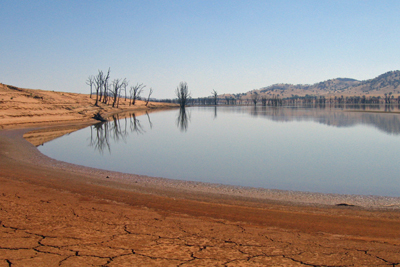
    <content:encoded xmlns:content="http://purl.org/rss/1.0/modules/content/"><![CDATA[<p>The experiences of large cities regarding their governance of water resources will be presented at the IEA by experts who will be in Brazil for the <i>V GovAgua - Water Governance Meeting</i>.</p>
<table class="tabela-esquerda">
<tbody>
<tr>
<th><img src="https://www.iea.usp.br/imagens/Escassez-Hidrica-sylvia-Tim-J-Keegan-flickr-copia.jpg" alt="Escassez Hídrica" class="image-inline" title="Escassez Hídrica" /></th>
</tr>
<tr>
<td><br /></td>
</tr>
</tbody>
</table>
<p>Entitled <i>Water Scarcity, Governance and Environmental Justice</i>, the meeting will be held in Spanish. It will take place on <strong>November 10</strong>, <strong>from 9.30 am to 12.30 pm</strong>, in the IEA's Events Room, with moderation of Professor Pedro Jacobi, coordinator of the IEA's Environment and Society research group.</p>
<p>"Metropolitan areas are experiencing prolonged drought crises. The experience shows that the models prioritize the supply of water to the detriment of demand control. The management models also fail to offer low investment in sewage treatment and water-free consumption, a scarce resource," says Professor Jacobi.</p>
<p>The panelists will examine the contexts of water scarcity in the world, the emergence of conflicts, and the reactions and responses of social actors  from the perspective of environmental justice.</p>
<p> </p>
<p><strong>The conferencists</strong></p>
<p><span>Geographer and historian </span><a class="external-link" href="https://grupo.us.es/giest/es/node/299">Leandro del Moral Ituarte</a><span>, who currently heads the Department of Human Geography at the University of Sevilla, specializes in hydraulic works. He has studied the lower basin of the Guadalquivir river, which bathes the territories of Andaluzia, in southern Spain.</span></p>
<p><a href="http://www.centre-cired.fr/spip.php?article749&amp;lang=fr" target="_blank">Bernard Barraqué</a>, research director at the Centre International de Recherche sur l'Environnement et le Développement of Le Centre National de la Recherche Scientifique, in Paris, has focused his recent studies on the allocation of water resources, evaluation of sustainable policies and methods,  institutional and participatory approaches, and comparative analysis of the sustainability of water management in major European cities. He also works at Agro ParisTech - École Nationale du Génie Rural, des Eaux et des Fôrets.</p>
<p>The participation of <a href="http://ugto.academia.edu/AlexRicardoCalderaOrtega" target="_blank">Alex Ricardo Caldera Ortega</a><span>, from the Department of Public Management and Development of the University of Guanajuato, has been cancelled due to the speaker's agenda.</span></p>
<p style="text-align: right; "><span class="discreet">Photo: Tim J. Keegan/Flickr</span></p>]]></content:encoded>
    <dc:publisher>No publisher</dc:publisher>
    <dc:creator>Richard Meckien</dc:creator>
    <dc:rights>Original version in Portuguese by Sylvia Miguel </dc:rights>
    
      <dc:subject>Europe</dc:subject>
    
    
      <dc:subject>Research Group: Environment and Society</dc:subject>
    
    
      <dc:subject>Power</dc:subject>
    
    
      <dc:subject>Interdisciplinarity</dc:subject>
    
    
      <dc:subject>Water</dc:subject>
    
    
      <dc:subject>Capitalism</dc:subject>
    
    
      <dc:subject>Environment</dc:subject>
    
    
      <dc:subject>Sustainability</dc:subject>
    
    
      <dc:subject>Globalization</dc:subject>
    
    
      <dc:subject>Inequality</dc:subject>
    
    
      <dc:subject>Poverty</dc:subject>
    
    
      <dc:subject>Environmental Policy</dc:subject>
    
    
      <dc:subject>Cities</dc:subject>
    
    <dc:date>2015-10-27T17:55:00Z</dc:date>
    <dc:type>Notícia</dc:type>
  </item>


  <item rdf:about="https://www.iea.usp.br/en/media-library/photos/events-2015/o-desafio-do-nacionalismo-identitario-24-de-junho-de-2015">
    <title>The Challenge of Identity-Based Nationalism - June 24, 2015</title>
    <link>https://www.iea.usp.br/en/media-library/photos/events-2015/o-desafio-do-nacionalismo-identitario-24-de-junho-de-2015</link>
    <description></description>
    
    <dc:publisher>No publisher</dc:publisher>
    <dc:creator>Richard Meckien</dc:creator>
    <dc:rights></dc:rights>
    
      <dc:subject>Citizenship</dc:subject>
    
    
      <dc:subject>Power</dc:subject>
    
    
      <dc:subject>Commons</dc:subject>
    
    
      <dc:subject>Democracy</dc:subject>
    
    
      <dc:subject>Political Science</dc:subject>
    
    
      <dc:subject>Politics</dc:subject>
    
    <dc:date>2015-06-24T03:00:00Z</dc:date>
    <dc:type>Pasta</dc:type>
  </item>


  <item rdf:about="https://www.iea.usp.br/en/news/seminar-discusses-the-impacts-of-media-transformations-on-society">
    <title>Seminar Discusses the Impacts of Media Transformations on Society</title>
    <link>https://www.iea.usp.br/en/news/seminar-discusses-the-impacts-of-media-transformations-on-society</link>
    <description></description>
    <content:encoded xmlns:content="http://purl.org/rss/1.0/modules/content/"><![CDATA[<p><span>Traditional mass media – e.g., television, radio, cinema and the press – provide collective communication experiences. The computer, through the Internet, provides an individualized experience, fragmenting not only the platform but also the direction of communication (i.e., where the message comes from and where it goes). Thus, it fragments the very experience of communication, which becomes not a collective, but individual and personal sentiment.</span></p>
<p><span> </span><span>“What kind of informative environment would we have in this totally fragmented scenario? What kind of impact can this have on information mediation and on public debate? How will democratic societies be impacted by this trend? And what can happen to the business models that support professional journalism?”</span></p>
<p class="Text">These are some questions raised by political scientist José Álvaro Moisés, coordinator of <a href="https://www.iea.usp.br/en/research/research-groups/quality-of-democracy" class="external-link">IEA’s Quality of Democracy Research Group</a> and <a class="external-link" href="http://nupps.usp.br/index.php">USP’s Public Policies Research Center (NUPPS)</a>, organizers of the symposium <i>Transformations and Fragmentation of the Structures of Traditional Media</i>, with journalist Ricardo Gandour, content director of the Estado Group.</p>
<p class="Text">The debate will take place on <strong>November 25</strong>, <strong>from 10 am to 12 pm</strong>, at the IEA’s Events Room, with commentary by political scientist Marco Aurélio Nogueira, professor at <a class="external-link" href="http://www.fclar.unesp.br/#!/instituicao/introduction/">São Paulo State University (UNESP)</a>, Araraquara campus, and by social scientist Marco Antônio Carvalho Teixeira, from <a class="external-link" href="http://eaesp.fgvsp.br/en">EAESP-FGV (São Paulo School of Business Administration of the Getúlio Vargas Foundation)</a>.</p>
<p><span style="text-align: justify; ">The event will be broadcast live on the </span><a style="text-align: justify; " href="https://www.iea.usp.br/aovivo">web</a><span style="text-align: justify; ">.</span></p>
<p class="Text"><span>The new digital world is transforming not only the form and the content of information, but also the production processes of communication and journalism, says Moisés. “The traditional organization of newsrooms may be waning, giving rise to scattered communication initiatives, such as blogs, groups, nuclei and other structures deemed alternative until recently,” in his view.</span></p>
<p><span><strong>The speaker</strong></span></p>
<p>Ricardo Gandour graduated in Journalism from Casper Líbero and in Civil Engineering from USP’s São Carlos School of Engineering (EESC). He has worked in several newsrooms of the mainstream press, including <i>Folha de S. Paulo</i>, Editora Globo and <i>Diário de S. Paulo</i>, before becoming content director of the Estado Group.</p>
<p class="Text"><span>He has remained associated with academic life and has worked in prestigious schools of communications, including USP’s School of Communications and Arts (ECA), Casper Líbero and Escola Superior de Propaganda e Marketing (ESPM).</span></p>
<p class="Text"><span><span>Recently, Gandour accepted an invitation by dean Ernest Sotomayor and will become a Visiting Research Fellow at Columbia University’s School of Journalism, taking leave from the Estado Group. At Columbia University, from January to June 2016, he will carry out a research project on the risks for democracy of the fragmentation of the press.</span></span></p>]]></content:encoded>
    <dc:publisher>No publisher</dc:publisher>
    <dc:creator>Richard Meckien</dc:creator>
    <dc:rights>Original version in Portuguese by Sylvia Miguel. Translation by Carlos Malferrari.</dc:rights>
    
      <dc:subject>Democracy</dc:subject>
    
    
      <dc:subject>Power</dc:subject>
    
    
      <dc:subject>Communication</dc:subject>
    
    
      <dc:subject>Human Sciences</dc:subject>
    
    
      <dc:subject>Journalism</dc:subject>
    
    
      <dc:subject>Interdisciplinarity</dc:subject>
    
    <dc:date>2015-11-16T17:15:00Z</dc:date>
    <dc:type>Notícia</dc:type>
  </item>


  <item rdf:about="https://www.iea.usp.br/en/news/research-project-analyzes-global-influence-fifa-world-cup-brics-members">
    <title>Research project analyzes the use of the FIFA World Cup by three BRICS members in order to increase their global influence</title>
    <link>https://www.iea.usp.br/en/news/research-project-analyzes-global-influence-fifa-world-cup-brics-members</link>
    <description></description>
    <content:encoded xmlns:content="http://purl.org/rss/1.0/modules/content/"><![CDATA[<table class="tabela-direita">
<tbody>
<tr>
<th><img src="https://www.iea.usp.br/imagens/copa-do-mundo-da-fifa" alt="Copa do Mundo da Fifa" class="image-inline" title="Copa do Mundo da Fifa" /></th>
</tr>
<tr>
<td>
<p><span class="discreet">Former FIFA President Joseph Blatter between Dilma Rousseff and Vladimir Putin, presidents of Brazil and Russia, during a ceremony in 2014 | Photo: Press Release / Kremlin</span></p>
</td>
</tr>
</tbody>
</table>
<p dir="ltr">Physical educator Marco Antonio Bettine, a professor at USP's School of Arts, Sciences and Humanities (EACH) since 2013, started the development of his research project on the geopolitical dynamics involved in the choice of host countries for the FIFA World Cup. He has been one of the selected researchers to participate in this year's <a href="https://www.iea.usp.br/en/persons/sabbatical" class="external-link">Sabbatical Year Program</a>.<br /><br />With "Soft Power: A Look at the Strategic Use of BRICS Hosting the FIFA World Cup - Analysis of South Africa, Brazil and Russia," Bettine will try to understand how FIFA has become an economic, political and legal power capable of governing a cultural asset such as football, the most popular and practiced sport in the world. At the same time, he intends to build relationships between the participation of three BRICS members - Brazil, Russia, and South Africa - as host countries of the World Cup and the variations in their soft power.</p>
<p dir="ltr">The concept of soft power has been developed by American political scientist Joseph Nye in contrast to hard power. According to Nye's definition, while hard power provides for the use of the economic and war power of a state to influence decisions of another state or political body, soft power presupposes the use of diplomacy and culture as instruments of influence. "Examples of hard power used by the USA government are the economic sanctions on Cuba and Venezuela, and the military actions in the Middle East," explains Bettine. "The American soft power, on the other hand, aims to reach other countries through persuasion, example and the film industry."</p>
<p dir="ltr">The researcher's analysis will focus on the World Cup editions held in South Africa (2010), Brazil (2014) and Russia (2018). News stories that were published during these events by some of the world's top media outlets will be the main source of information. With data from Google Trends, Bettine has compared the number of hits from eight outlets based in four countries to determine which ones would be analyzed. Le Monde (France), BBC (UK), and El Pais (Spain) have been chosen due to greater methodological adaptation.</p>
<p dir="ltr">Brazilian, Russian and South African outlets will not be considered for the project "because the objective of the work is the analysis of foreign visions on the BRICS. And who holds the power of international decisions in the political sphere are the foreign newspapers."</p>
<table class="tabela-esquerda">
<tbody>
<tr>
<th><img src="https://www.iea.usp.br/imagens/marco-antonio-bettine-de-almeida-1" alt="Marco Antonio Bettine de Almeida" class="image-inline" title="Marco Antonio Bettine de Almeida" /></th>
</tr>
<tr>
<td><span class="discreet">Researcher Marco Antonio Bettine | Photo: Personal archive</span></td>
</tr>
</tbody>
</table>
<p><strong>Mega-sport events and soft power</strong></p>
<p>Bettine understands that sport, because of its undeniable cultural and social influence, has become a powerful instrument of soft power. As a result, organizations such as FIFA and the International Olympic Committee (IOC) have acquired a great capacity for persuasion towards potential host countries for events such as the FIFA World Cup and the Olympics. From the perspective of the countries, these competitions are commonly seen as opportunities to spread their culture, infrastructure and sovereignty to the world, as well as to strengthen local trade and tourism. For the researcher, the interest is mutual: to FIFA, the financial gains and the increase of its political force is very attractive, while for the host countries there is a desire of increasing soft power and international influence.</p>
<p>South Africa saw the event as an opportunity to become the representative country of pan-Africanism - a movement that seeks the emancipation and socioeconomic development of the African continent -, explains the researcher. Brazil wanted to consolidate the national image abroad. Among other things, the Brazilian government sought a permanent member position in the United Nations Security Council, a more active participation in international relations, and the gain of relevance within BRICS and MERCOSUR.</p>
<p dir="ltr">According to Bettine, Brazil was seen with disrepute by the foreign press, which believed the country was unable to carry out a mega-sport event. He recalls, however, that a week after the start of the matches, the outlets declared themselves deceived: without major problems, Brazil conducted the World Cup in an efficient way. For him, in terms of soft power, "the Cup was a success for Brazil and Dilma Rousseff's government."</p>
<p dir="ltr">In a contrary movement by the time of the 2016 Olympics in Rio de Janeiro, Brazil had undergone a presidential impeachment process in addition to several economic and social fragilities which damaged the image of the event. The clear vulnerability of Brazilian democracy led international outlets to pay more attention to the malfunctions practiced during the Olympic Games.</p>
<p dir="ltr">"If the country is doing well internally and has a certain international strength, it is able to influence the ways and choices of the media," explains the researcher. "If it is destabilized, it can not create its own agendas for dissemination in international media."</p>
<table class="tabela-direita">
<tbody>
<tr>
<th><img src="https://www.iea.usp.br/imagens/copa-do-mundo-no-castelao" alt="Copa do Mundo" class="image-inline" title="Copa do Mundo" /></th>
</tr>
<tr>
<td><span class="discreet">Germany and Argentina face off in the final of the World Cup 2014 | Photo: Danilo Borges / Wikimedia Commons</span></td>
</tr>
</tbody>
</table>
<p dir="ltr"><strong>BRICS and the World Cup legacy</strong></p>
<p dir="ltr">The last three editions of the FIFA World Cup have been hosted by BRICS-member countries. According to Bettine, this is due to the fact that they are, in general, "nations with fragile democracies, but with great financial potentials and in search of greater international visibility". The democratic weakness of host countries is, according to him, a fundamental part of FIFA's decision-making process: "Jérôme Valcke, former FIFA secretary general who was dismissed on charges of corruption and misconduct in ticket sales for the 2010 and 2014 events, said that 'too much democracy hampers the holding of the World Cup.'"</p>
<p dir="ltr">One of the mechanisms of influence and co-optation used by FIFA to persuade countries to host the World Cup is the promise of structural reforms and the improvement of the country's infrastructure, according to the researcher. In the events hosted by BRICS members, however, the promises have been disregarded almost completely. The improvement of the regional HDI, public transport, and access to basic sanitation have been the main broken pacts. "Brazil and South Africa are countries that continue to have basic infrastructure problems, even around the big stadiums built for the matches," says Bettine.</p>
<p dir="ltr">The researcher points out that from 2015 FIFA's mistakes have come to an inflection point. Several high-ranking members of the organization started to be tried and convicted of crimes committed during the World Cups in 2010 and 2014, and in the choices of Russia and Qatar as host cities for 2018 and 2022, respectively. The convictions, however, were not motivated by noncompliance with promises made in the periods prior to the events, by frauds in ticket sales, or by gentrification processes influenced by sporting events, but by attempts at money laundering in shell companies In the USA.</p>
<p dir="ltr"><strong>Interdisciplinarity</strong></p>
<p dir="ltr">According to the professor, the interdisciplinary character of the project comes from the simultaneous approach of themes such as international relations, global governance, media influence, Brazilian culture, and the cultural importance of football.</p>
<p>For him, the main focus of the research is to understand how all of these news stories can help "to define the role of FIFA, of sociological theory, and of soft power's and hard power's political theory during the organization of the World Cup by the BRICS members."</p>]]></content:encoded>
    <dc:publisher>No publisher</dc:publisher>
    <dc:creator>Richard Meckien</dc:creator>
    <dc:rights>Original version in Portuguese by Victor Matioli.</dc:rights>
    
      <dc:subject>Brazil</dc:subject>
    
    
      <dc:subject>International Relations</dc:subject>
    
    
      <dc:subject>Power</dc:subject>
    
    
      <dc:subject>Pesquisa</dc:subject>
    
    
      <dc:subject>Sabbatical</dc:subject>
    
    
      <dc:subject>Sport</dc:subject>
    
    
      <dc:subject>Russia</dc:subject>
    
    <dc:date>2019-03-08T19:05:00Z</dc:date>
    <dc:type>Notícia</dc:type>
  </item>


  <item rdf:about="https://www.iea.usp.br/en/news/prejudices-and-stereotypes-impact-progression-of-women-in-science">
    <title>Prejudices and stereotypes impact progression of women in science</title>
    <link>https://www.iea.usp.br/en/news/prejudices-and-stereotypes-impact-progression-of-women-in-science</link>
    <description></description>
    <content:encoded xmlns:content="http://purl.org/rss/1.0/modules/content/"><![CDATA[<table class="tabela-direita">
<tbody>
<tr>
<th><img src="https://www.iea.usp.br/imagens/mulheres-na-ciencia-1" alt="Mulheres na Ciência - 1 " class="image-inline" title="Mulheres na Ciência - 1 " /></th>
</tr>
</tbody>
</table>
<p>In Brazil, half of the female university students has suffered harassment, and almost 30% of them have experienced sexual violence during the academic life. The alarming figures revealed by the 2015 survey by the Avon <span>Institute </span>/ Data Popular show only one side of a cultural model that is reproduced in an environment that should be the place of difference and diversity. Instead of being a plural space, the university also reveals to be the place of the implied <span>prejudice against </span>women with regard to progression in the academic and scientific career, as demonstrated by the debate <i>Women in University and Science: Challenges and Opportunities</i>, held on September 15 at the IEA.</p>
<p>"Much of this discussion is associated with the power of women or with the conflict of power in relation to men and its social, cultural and political implications. In the private and public contexts, women are not <span>willingly </span>admitted in power domains. Even in large democracies of<span> the 21st century</span>, power relates to men," said the lecturer Leila Saadé, president of the <span><a class="external-link" href="https://www.auf.org/les-services-de-l-auf/rayonnement-international/reseau-des-femmes/">RESUFF</a></span> (<span>Francophone Network of Women Responsible for Higher Education and Research</span>).</p>
<p>The RESUFF's mission is to educate leaders and academics to question male-female inequality at universities, especially in access to positions of responsibility. It has been developing teaching modules on gender that offer training tools for professional and institutional strategies. The agency has also opened a call for proposals for a gender observatory at universities, which will work with a representative of the network in each participating university with the aim of consolidating data and indicators on women's participation in academic life.</p>
<p>As an expert in law and president of the Doctoral School of Law of the Middle East, Saadé addressed experiences in Lebanon and France on the issue of gender in academia and science. She also explored affirmative actions created by the Francophone University Association (AUF), which has been consolidating initiatives to promote women's access to positions of responsibility. The association, founded in Canada, funds university projects of teaching and research, and its headquarters is located in an office of São Paulo State University (UNESP), in São Paulo.</p>
<table class="tabela-direita">
<tbody>
<tr>
<th><img src="https://www.iea.usp.br/imagens/mulheres-na-ciencia-3" alt="Mulheres na Ciência - 3" class="image-inline" title="Mulheres na Ciência - 3" /></th>
</tr>
<tr>
<td>
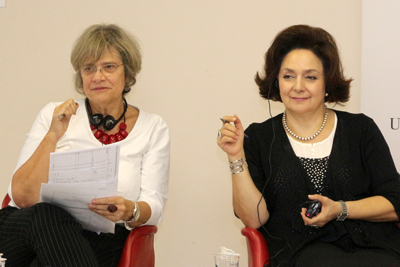
<p><strong>Vera Soares, from USP Mulheres (USP Women), and conferencist Leila Saadé </strong></p>
</td>
</tr>
</tbody>
</table>
<p>"We can not want a better world where half the population is in a hidden corner of the planet. If women are struggling to reach the summit of positions of responsibility we are offering a gift to democracy as we strive for the triumph of a set of values that have founded democracies, ie the principle of equal rights and opportunities," she said.</p>
<p>Physicist Caroline Carvalho dos Santos, a professor at the Federal University of Rio Grande do Sul (UFRGS) and coordinator of the university extension program <a class="external-link" href="https://www.ufrgs.br/meninasnaciencia/">Girls in Science</a>, participated as a panelist. Moderation was in charge of Vera Soares, from <a class="external-link" href="http://sites.usp.br/uspmulheres/">USP Mulheres</a> (USP Women).</p>
<p><strong> </strong></p>
<p style="text-align: justify; "><span>The meeting has been organized by </span><span>the</span> <span><a class="external-link" href="http://saopaulo.ambafrance-br.org/">Consulate General</a></span><a class="external-link" href="http://saopaulo.ambafrance-br.org/"> </a><span><a class="external-link" href="http://saopaulo.ambafrance-br.org/">of France in</a></span><a class="external-link" href="http://saopaulo.ambafrance-br.org/"> </a><span><a class="external-link" href="http://saopaulo.ambafrance-br.org/">São</a></span><a class="external-link" href="http://saopaulo.ambafrance-br.org/"> </a><span><a class="external-link" href="http://saopaulo.ambafrance-br.org/">Paulo</a>,</span> <span>the</span> <a href="http://www.institutfrancais.com/fr" target="_blank">Institut Français in Brazil</a><span>,</span> <span>USP</span> <span>Women</span> <span>and</span> <span>the</span> <span>IEA</span><span>.</span></p>
<p><strong>Shear effect</strong></p>
<p><span>According to</span> <span>Saadé</span><span>, </span><span>20</span><span>%</span> <span>of the presidents</span> <span>in</span> French <span>university positions</span> <span>were women in 2008 and</span> <span>recently</span> <span>this ratio</span> <span>has halved</span><span>.</span> Eight years ago there were <span>58%</span> <span>of</span> <span>women</span> <span>enrolled in</span> <span>master's and</span> <span>bachelor courses</span><span>,</span> as well as <span>48</span><span>% in PhD courses. Only </span><span>23</span><span>%</span> <span>reached the</span> <span>position of</span> <span>university professor</span><span>, showing that</span> <span>the higher the</span> <span>career level</span><span>, the greater the</span> <span>shear</span> <span>effect.</span> <span>"</span><span>Unfortunately</span><span>,</span> <span>academia</span> <span>is</span> <span>deeply</span> <span>discriminatory</span> <span>against women</span> <span>and cultivates</span> <span>women's</span> <span>discrimination</span><span>," she said</span><span>.</span></p>
<table class="tabela-esquerda-borda">
<tbody>
<tr>
<th>
<h3>Related material</h3>
<p><a href="https://www.iea.usp.br/en/media-library/video/les-femmes-dans-luniversite-et-sciences-defis-et-opportunites" class="external-link">Video </a>(in French)</p>
<p><a href="https://www.iea.usp.br/en/media-library/photos/events-2016/women-in-university-and-science-challenges-and-opportunities-september-15-2016" class="external-link">Photos</a></p>
</th>
</tr>
</tbody>
</table>
<p><span>The</span> <span>European average</span> <span>is no exception</span><span>:</span> <span>only 9% of</span> <span>research</span> <span>management positions</span> <span>are occupied by</span> <span>women</span> <span>and only 11</span><span>% of them are</span> <span>high</span> <span>academic responsibility</span> positions<span>.</span></p>
<p><span>In Lebanon</span><span>, women represent</span> <span>37% of</span> <span>academic researchers</span><span>, and 11</span><span>% of them work</span> <span>in </span><span>engineering and</span> <span>technology.</span> <span>"</span><span>We have asked for a</span> <span>national observatory</span> <span>in Lebanon</span> <span>to define</span> <span>gender</span> <span>indicators</span> <span>and structure</span> <span>inclusion strategies</span><span>,"</span> said <span>Saadé</span><span>.</span></p>
<p><span>The</span> <span>shear ef</span><span>fect</span> <span>has deep roots</span> <span>in</span> <span>stereotypes</span> in which <span>unfortunately</span> <span>even</span> <span>women themselves</span> <span>believe</span> <span>and reproduce,</span> <span>she said</span><span>.</span> <span>"</span><span>The</span> <span>L'Oreal</span> <span>Foundation</span> has <span>conducted a survey on</span> <span>the view</span> <span>that Europeans have</span> <span>of women in science</span> <span>and revealed that</span> <span>67%</span> <span>believe that women</span> <span>are not</span> <span>qualified</span> <span>to occupy</span> <span>high</span> <span>positions</span> <span>in science</span><span>.</span> <span>The reasons given</span> for having that thinking are the <span>lack of perseverance</span><span>,</span> <span>practical</span> <span>spirit</span><span>, rigor</span> <span>and</span> <span>scientific spirit, as well as </span><span>rational and</span> <span>analytical mind</span><span>.</span> Wo<span>men have</span> <span>the same view, which is the worst part</span><span>.</span> <span>It is a universal</span> <span>vision.</span> <span>The same</span> <span>survey has been conducted</span> <span>among the</span> <span>Chinese, who</span> <span>reproduced the</span> <span>same responses</span><span>.</span> <span>We are</span> <span>forced to</span> <span>admit that</span> <span>cultural factors</span> <span>and stereotypes</span> <span>play an important</span> <span>role in this</span> <span>view of women</span><span>", she showed</span><span>.</span></p>
<p>The researcher believes that it is possible to change that, even if a long way to go is necessary. First, one must create a network that encourages and supports female scientists <span> besides consolidating data and indicators</span>. "There is a lack of indicators. The figures are uncertain and often false. We need surveys on the real situation of women in science and academia so we can create action strategies," she said.</p>
<p>Besides consolidating indicators, the network proposed by Saadé will need to act to "break the vicious circle in which research projects are created and evaluated only by men, and in which only men are accepted."</p>
<p><span>A survey in France has shown that women coursing the last year of graduation in science had better terms than men and this proves that they have scientific spirit, Saadé explained. "So we need to leave solitude and silence by valuing women, their skills and their ego; give them the opportunity to fall in love with the sphere of science," she said.</span></p>
<p><strong>Segregation by area</strong></p>
<table class="tabela-direita">
<tbody>
<tr>
<th><img src="https://www.iea.usp.br/imagens/mulheres-na-ciencia-2" alt="Mulheres na Ciência - 2" class="image-inline" title="Mulheres na Ciência - 2" /></th>
</tr>
<tr>
<td>
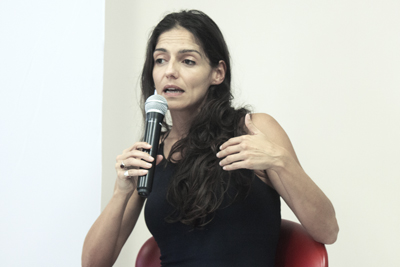
<p><strong>Carolina Brito: "There is a lack of female models in scientific <span>high </span>positions"</strong></p>
</td>
</tr>
</tbody>
</table>
<p>Physicist Carolina Brito, a professor at the Federal University of Rio Grande do Sul (UFRGS), said that women suffer both vertical and horizontal segregations <span>throughout their academic careers</span>. The first one relates to the shear effect, while the horizontal segregation concerns the areas in which women do <span>often </span>not seek for positions due to pre-existing prejudices in career choices.</p>
<p><span>Brito showed data of the 2006 School Census, in which women were the majority in high school both in enrollment (54%) and as graduates (58%). Women also represented most of the students in Brazilian universities according to <span>the <span>2012 data of the Anísio Teixeira</span></span> National Institute of Educational Studies (INEP). However, for each 100 graduate students, 15 graduated in engineering and mathematics, and only five women headed to the so-called hard sciences.</span></p>
<p>In the case of physics, segregation is even greater, showed Brito. If something like 30% of scientific initiation scholarships in physics go to women, only 15% of PhD scholarships and only 5% of <span>A-level </span>research scholarships remain with them.</p>
<p>Stereotypes, culture, and family and school influences play an important role so that women do not choose a scientific career, believes Brito, who also points to another important trend. "I insist on the lack of female models in scientific <span>high </span>positions. There are very few giving this example. Therefore, women do not see themselves in careers like that," she said.</p>
<p>Moreover, it is necessary to end scientific committees formed predominantly by men. The scientific committee of physics at the National Scientific and Technological Development Council (CNPq), for example, has only 10% of women in its composition. "The pharmacy case is even worse. Although the area has mostly women, the scientific committee at CNPq is 100% composed of men," she said.</p>
<p>The requirements for women are much higher. "In the Brazilian Academy of Sciences, the male presence on the chairs is very strong. But if we analyze the profile of the occupants by choosing the criterion members under 35 years studying PhD<span>, for example,</span> we notice that among men 15% do not have a Research Productivity scholarship (PQ), and only 1% of women do not have a PQ. This shows that the criteria are more restrictive for women," said Brito.</p>
<p>Professor Marcos Nogueira Martins, director of USP's Institute of Physics (IF), showed some figures from a foreign institution to confirm that gender segregation occurs worldwide.</p>
<p>"At the University of Chicago, men make up 87% of the academic body. This is a global phenomenon. But in my academic experience, I do not notice any difference in ability between men and women, and I agree that there is a loss of talent by leaving women out. But it is difficult for a person to get interested in what they do not know or do not understand. Unfortunately, you can not make miracles with the education we have in Brazil," said Martins.</p>
<p style="text-align: right; "><span class="discreet">Photos: Marcos Santos/Jornal da USP and Leonor Calasans/IEA</span></p>]]></content:encoded>
    <dc:publisher>No publisher</dc:publisher>
    <dc:creator>Richard Meckien</dc:creator>
    <dc:rights>Original version in Portuguese by Sylvia Miguel.</dc:rights>
    
      <dc:subject>Human Rights</dc:subject>
    
    
      <dc:subject>Exact sciences</dc:subject>
    
    
      <dc:subject>Citizenship</dc:subject>
    
    
      <dc:subject>Power</dc:subject>
    
    
      <dc:subject>Human Sciences</dc:subject>
    
    
      <dc:subject>Environmental Sciences</dc:subject>
    
    
      <dc:subject>Political Science</dc:subject>
    
    
      <dc:subject>Natural sciences</dc:subject>
    
    
      <dc:subject>Education</dc:subject>
    
    
      <dc:subject>Technology</dc:subject>
    
    
      <dc:subject>Social Sciences</dc:subject>
    
    
      <dc:subject>Inequality</dc:subject>
    
    <dc:date>2016-09-22T19:05:00Z</dc:date>
    <dc:type>Notícia</dc:type>
  </item>


  <item rdf:about="https://www.iea.usp.br/en/events/car-wash">
    <title>Closing Seminar of the Binational Research Project "Corporate Crime and Systemic Corruption in Brazil"</title>
    <link>https://www.iea.usp.br/en/events/car-wash</link>
    <description></description>
    <content:encoded xmlns:content="http://purl.org/rss/1.0/modules/content/"><![CDATA[<div class="kssattr-target-parent-fieldname-text-69d0218562c643ad9cceea31ef7dd80d kssattr-macro-rich-field-view kssattr-templateId-widgets/rich kssattr-atfieldname-text " id="parent-fieldname-text-69d0218562c643ad9cceea31ef7dd80d">
<p style="text-align: left; "><a href="https://www.iea.usp.br/eventos/seminario-projeto-crime-corporativo" class="external-link"><strong>Clique aqui para a versão em Português</strong></a></p>
<p>This project was carried out between 2018 and 2022 and financed by an international cooperation agreement between the São Paulo Research Foundation (FAPESP) and the German Research Foundation (DFG.) In this seminar we will discuss the relationship between money and politics in Brazil, showing it both as a cause of the judicialization of electoral processes in the country and as the main reason behind the Car Wash Operation (CWO), which will be submitted to a critical analysis eight years after its launch.</p>
<h3></h3>
<p><strong>Registration:</strong></p>
<p>Free and public event <strong>|</strong> No registration required<br />Online event <strong>|</strong> No attendance certification will be provided<br />Simultaneous translation from Portuguese into English and from English into Portuguese will be available throughout the event <strong>|</strong> Live Transmission at <a href="https://www.iea.usp.br/aovivo" class="external-link">http://www.iea.usp.br/aovivo</a></p>
<p><strong>Organization:</strong></p>
<p><a href="https://www.iea.usp.br/en/persons/sabbatical" class="external-link">IEA Sabbatical Year Program</a></p>
<p><strong>Coordination:</strong></p>
<p>Wagner Pralon Mancuso (USP)</p>
<p><strong>Financial support:</strong></p>
<p><a class="external-link" href="http://fapesp.br/en">São Paulo Research Foundation (FAPESP)</a></p>
<p><a class="external-link" href="https://www.dfg.de/en/dfg_profile/head_office/dfg_abroad/latin_america/index.html">German Research Foundation (DFG)</a></p>
<p><a class="external-link" href="https://sites.usp.br/nupps/">Center for Public Policy Research (NUPPs/USP)</a></p>
<p><strong>Programme:</strong></p>
<table class="plain">
<tbody>
<tr>
<td><strong>February 14</strong></td>
<td><br /></td>
</tr>
<tr>
<td><strong>9:00-09:15</strong></td>
<td><strong><i>Opening</i></strong></td>
</tr>
<tr>
<td><strong>9:15-9:55</strong></td>
<td>
<div id="_mcePaste"><strong><i>A Review of the Academic Literature on the Car Wash Operation</i></strong></div>
<div>Rodrigo Rossi Horochovski (Federal University of Paraná)</div>
<div>Wagner Pralon Mancuso (University of São Paulo)</div>
<div><strong><i>Discussant:</i></strong></div>
<div>Adriano Codato (<span>Federal University of Paraná</span>)</div>
</td>
</tr>
<tr>
<td><strong>9:55-10:35</strong></td>
<td>
<div id="_mcePaste"><strong><i>Construction Firms, Corruption, and the Functioning of Democracy in Brazil: the Car Wash Operation</i></strong></div>
<div></div>
<div id="_mcePaste">Paulo Roberto Neves Costa (<span>Federal University of Paraná</span>)</div>
<div></div>
<div></div>
<div id="_mcePaste">Marta Pontes de Campos (<span>Federal University of Paraná</span>)</div>
<div></div>
<div></div>
<div id="_mcePaste">Silvana Zulmira Ferreira (<span>Federal University of Paraná</span>)</div>
<div><i><strong>Discussant:</strong></i></div>
<div>Luciano da Ros (<span>Federal University of Paraná of Santa Catarina</span><span>)</span></div>
</td>
</tr>
<tr>
<td><strong>10:35-11:15</strong></td>
<td>
<div id="_mcePaste"><strong><i>Money, Politics, and the Judicialization of Electoral Processes in Brazil</i></strong></div>
<div><strong> </strong>Wagner Pralon Mancuso (USP)</div>
<div></div>
<div id="_mcePaste">Vanessa Elias de Oliveira (Federal University of ABC)</div>
<div></div>
<div></div>
<div id="_mcePaste">Bruno Wilhelm Speck (USP)</div>
<div></div>
<div></div>
<div id="_mcePaste">Rodrigo Rossi Horochovski (<span>Federal University of Paraná</span>)</div>
<div><i><strong>Discussant:</strong></i></div>
<div>Ranulfo Paranhos (<span>Federal University of Alagoas</span>)</div>
</td>
</tr>
<tr>
<td><strong>11:15-11:30</strong></td>
<td><strong><i>Break</i></strong></td>
</tr>
<tr>
<td><strong>11:30-13:00</strong></td>
<td><span id="docs-internal-guid-e32384e6-7fff-0b91-7122-01c5783d2d9d">
<div class="visualClear" dir="ltr"><strong><i>Debate: the Car Wash Operation, Eight Years After its Launch: a Critical Assessment<br /></i></strong>Adriano Teixeira Guimarães<span> (Getúlio Vargas Foundation)<br /></span>Caio Farah Rodriguez<span> (INSPER)<br /></span>Fabiana Alves Rodrigues<span> (USP)<br /></span>Fábio de Sá e Silva<span> (University of Oklahoma)<br /></span><i><strong>Discussant:</strong><br /></i>Matthew Taylor<span> (American University)</span></div>
</span></td>
</tr>
<tr>
<td><strong>February 15</strong></td>
<td><br /></td>
</tr>
<tr>
<td><span id="docs-internal-guid-36221a40-7fff-fb5f-14fd-7491bcbf45bd"><strong>9:00-9:15</strong></span></td>
<td><strong><i>Opening</i></strong></td>
</tr>
<tr>
<td><span id="docs-internal-guid-81b1e343-7fff-9642-d63d-f4a529452164"><strong>9:15-9:55</strong></span></td>
<td><span id="docs-internal-guid-5f7ff4f4-7fff-c0aa-8789-3bc43c3fd4fe">
<div class="visualClear" dir="ltr"><strong><i>How to Analyze Organizational Crime?</i><br /></strong>Markus Pohlmann (Heidelberg University)</div>
<div class="visualClear" dir="ltr"><i><strong>Discussant:</strong></i></div>
<div class="visualClear" dir="ltr">Jonathan Pinto (Imperial College London)</div>
</span></td>
</tr>
<tr>
<td><span id="docs-internal-guid-4469d0d9-7fff-014c-76b5-c57c2c63babd"><strong>9:55-10:35</strong></span></td>
<td><span id="docs-internal-guid-997316c5-7fff-28d2-dce2-e58003f5a6ad">
<div class="visualClear"><strong><i>Rational Executives and Selfish Politicians: the Cultural  Repertoires of Legal Experts</i><br /></strong>Maria Eugenia Trombini (Heidelberg University)</div>
<div class="visualClear">Elizângela Valarini (Heidelberg University)</div>
<div class="visualClear"><i><strong>Discussant: </strong></i></div>
<div class="visualClear">Fernando de Castro Fontainha, IESP-UERJ</div>
</span></td>
</tr>
<tr>
<td><span id="docs-internal-guid-77ebc3ea-7fff-5a42-c2cc-513a45a5ac96"><strong>10:35-11:15</strong></span></td>
<td><span id="docs-internal-guid-f3d881a0-7fff-86ba-f076-cbf5b82d23fc">
<div class="visualClear" dir="ltr"><strong><i>Compliance: an Overview of Odebrecht's CMS Before and After  Lava Jato</i><br /></strong>Mario H. Jorge Jr. (Heidelberg University)</div>
<div class="visualClear" dir="ltr"><i><strong>Discussant:</strong></i></div>
<div class="visualClear" dir="ltr">
<p>Laura Hauck (Heidelberg University)</p>
</div>
</span></td>
</tr>
<tr>
<td><span id="docs-internal-guid-68abce1a-7fff-c49c-a4f5-10db2e6076a0"><strong>11:15-11:30</strong></span></td>
<td><strong><i>Break</i></strong></td>
</tr>
<tr>
<td><span id="docs-internal-guid-23c95dab-7fff-fd4b-ea2f-a4878e0cc3b2"><strong>11:30-13:00</strong></span></td>
<td><span id="docs-internal-guid-0907daf3-7fff-2ae9-137e-a19f30ed1dec">
<div class="visualClear" dir="ltr"><strong><i>Debate: Corruption and Corporate Crime in Brazil: Balance and Prospects</i><br /></strong>Luciano da Ros (<span>Federal University of Paraná of Santa Catarina)<br /></span>Mariana Mota Prado<span> (University of Toronto)<br /></span>Sérgio Praça<span> (</span><span>Getúlio Vargas Foundation</span><span>)<br /></span><i><strong>Discussant:</strong><br /></i>Jonathan Mendilow<span> (Rider University)</span></div>
</span></td>
</tr>
</tbody>
</table>
</div>]]></content:encoded>
    <dc:publisher>No publisher</dc:publisher>
    <dc:creator>Richard Meckien</dc:creator>
    <dc:rights></dc:rights>
    
      <dc:subject>Power</dc:subject>
    
    
      <dc:subject>Online event</dc:subject>
    
    
      <dc:subject>Society</dc:subject>
    
    
      <dc:subject>Sabbatical</dc:subject>
    
    
      <dc:subject>Public event</dc:subject>
    
    
      <dc:subject>Politics</dc:subject>
    
    
      <dc:subject>Corruption</dc:subject>
    
    <dc:date>2021-06-11T18:50:00Z</dc:date>
    <dc:type>Evento</dc:type>
  </item>


</rdf:RDF>