<?xml version="1.0" encoding="utf-8" ?>
<rdf:RDF xmlns:rdf="http://www.w3.org/1999/02/22-rdf-syntax-ns#" xmlns:dc="http://purl.org/dc/elements/1.1/" xmlns:syn="http://purl.org/rss/1.0/modules/syndication/" xmlns="http://purl.org/rss/1.0/">


<channel rdf:about="https://www.iea.usp.br/search_rss">
  <title>Instituto de Estudos Avançados da Universidade de São Paulo</title>
  <link>https://www.iea.usp.br</link>

  <description>
    
            These are the search results for the query, showing results 1 to 15.
        
  </description>


  <image rdf:resource="https://www.iea.usp.br/logo.png" />

  <items>
    <rdf:Seq>
      
        <rdf:li rdf:resource="https://www.iea.usp.br/en/events/scientific-diversity-and-open-science" />
      
      
        <rdf:li rdf:resource="https://www.iea.usp.br/en/events/urban-green-sacrifice-climate-justice" />
      
      
        <rdf:li rdf:resource="https://www.iea.usp.br/en/news/consequences-of-environmental-disaster-mariana" />
      
      
        <rdf:li rdf:resource="https://www.iea.usp.br/en/news/the-impact-of-climate-changes-in-megacities" />
      
      
        <rdf:li rdf:resource="https://www.iea.usp.br/en/news/metropolises-in-crisis-water-management-in-Mexico-and-Spain" />
      
      
        <rdf:li rdf:resource="https://www.iea.usp.br/en/media-library/photos/events-2015/as-mudancas-climaticas-e-a-seguranca-alimentar-ciclo-tematico-14-de-outubro-de-2015" />
      
      
        <rdf:li rdf:resource="https://www.iea.usp.br/en/media-library/photos/events-2015/as-mudancas-climaticas-e-a-matriz-energetica-ciclo-tematico-08-de-outubro-de-2015" />
      
      
        <rdf:li rdf:resource="https://www.iea.usp.br/en/media-library/photos/events-2015/as-mudancas-climaticas-e-a-crise-hidrica-ciclo-tematico-30-de-setembro-de-2015" />
      
      
        <rdf:li rdf:resource="https://www.iea.usp.br/en/news/history-and-environment-necessary-dialogue" />
      
      
        <rdf:li rdf:resource="https://www.iea.usp.br/en/news/spanish-sociologist-discusses-dialectic-environment" />
      
      
        <rdf:li rdf:resource="https://www.iea.usp.br/en/news/cop20" />
      
      
        <rdf:li rdf:resource="https://www.iea.usp.br/en/news/hydroelectric-generation-in-the-amazon" />
      
      
        <rdf:li rdf:resource="https://www.iea.usp.br/en/news/an-interdisciplinary-look-at-the-drought-in-sao-paulo" />
      
      
        <rdf:li rdf:resource="https://www.iea.usp.br/en/media-library/photos/events-2014/verao-2013-14-e-cenarios-de-estresse-hidrico-19-de-marco-de-2014" />
      
      
        <rdf:li rdf:resource="https://www.iea.usp.br/en/media-library/photos/events-2013/prosperidade-sem-crescimento-2013-vida-boa-em-um-planeta-finito-30-de-outubro-de-2013" />
      
    </rdf:Seq>
  </items>

</channel>


  <item rdf:about="https://www.iea.usp.br/en/events/scientific-diversity-and-open-science">
    <title>Scientific Diversity and Open Science</title>
    <link>https://www.iea.usp.br/en/events/scientific-diversity-and-open-science</link>
    <description></description>
    <content:encoded xmlns:content="http://purl.org/rss/1.0/modules/content/"><![CDATA[<div class="kssattr-target-parent-fieldname-text-69d0218562c643ad9cceea31ef7dd80d kssattr-macro-rich-field-view kssattr-templateId-widgets/rich kssattr-atfieldname-text " id="parent-fieldname-text-69d0218562c643ad9cceea31ef7dd80d">
<p><strong><a href="https://www.iea.usp.br/eventos/diversidade-cientifica-ciencia-aberta" class="external-link">Clique aqui para a versão em Português</a></strong></p>
<p dir="ltr" id="docs-internal-guid-d0a3bb30-7fff-08ba-a56a-eac3b67b6e4f"><span><span>Philosopher of science Kevin C. Elliott will address two urgent topics in this event: scientific diversity and open science. Regarding the first, he will present the results of his recent collaborative research project, which has polled more than 3500 scientists to investigate the factors that hinder the presence of diversity in science. </span></span><span>During his presentation, the ethical and epistemic reasons for promoting diversity in the scientific community will also be discussed.</span></p>
<p dir="ltr"><span>Regarding open science, Elliott will discuss how it can better approach non-experts in addition to commenting on the multiple meanings, reasons, and limits that the value of transparency acquires in this context.</span></p>
<p dir="ltr"><span>After the lecture, guest professors will engage in a discussion to bring specific elements of such themes in Brazil. The audience will have the opportunity to dialogue with the main speaker.</span></p>
<p dir="ltr"><strong>Opening:</strong><span id="docs-internal-guid-604d4eda-7fff-4fc5-e33a-13ba5121a137"> </span></p>
<p dir="ltr"><a href="https://www.iea.usp.br/en/persons/researchers/pedro-bravo-de-souza" class="external-link">Pedro Bravo de Souza</a> (University of São Paulo)</p>
<p dir="ltr"><strong>Presenter:</strong><span id="docs-internal-guid-604d4eda-7fff-4fc5-e33a-13ba5121a137"> </span></p>
<p dir="ltr"><a href="https://www.iea.usp.br/en/persons/speakers/kevin-elliott" class="external-link">Kevin C. Elliott</a> (Michigan State University)</p>
<p dir="ltr"><span>Free and public event </span><strong>|</strong><span> No registration required<br /></span><span>(*) Online and on-site event </span><strong>|</strong><span> No attendance certification will be provided<br /></span><span>The event will be held in English and there will be no simultaneous translation into Portuguese </span><strong>|</strong><span> Live transmission at </span><a href="https://www.iea.usp.br/aovivo" class="external-link">http://www.iea.usp.br/aovivo</a></p>
<h3><strong>Organization</strong></h3>
<p><a href="https://www.iea.usp.br/en/research/research-groups/philosophy-history-sociology-of-science-and-technology" class="external-link">IEA's Research Group on Philosophy, History, and Sociology of Science and Technology</a></p>
<h3><strong>Programme</strong></h3>
<table class="plain">
<tbody>
<tr>
<td width="75">
<p>2:15 pm</p>
</td>
<td width="491"><strong>Opening and introduction to Kevin C. Elliott's research projects <strong>-</strong></strong> Pedro Bravo de Souza</td>
</tr>
<tr>
<td width="75">
<p>2:30 pm</p>
</td>
<td width="491">
<p><strong>Better Science through the Philosophy of Engaged Science: Reflecting on Open Science and Diversity Initiatives <strong>- </strong></strong><a href="https://www.iea.usp.br/en/pessoas/pasta-pessoak/kevin-c-elliott" class="external-link">Kevin C. Elliott</a></p>
</td>
</tr>
<tr>
<td width="75">
<p>3:30 pm</p>
</td>
<td width="491">
<p><strong>Debate with the audience</strong></p>
</td>
</tr>
<tr>
<td width="75">
<p>5:00 pm</p>
</td>
<td width="491">
<p><strong>Closing</strong></p>
</td>
</tr>
</tbody>
</table>
</div>
<div></div>]]></content:encoded>
    <dc:publisher>No publisher</dc:publisher>
    <dc:creator>Richard Meckien</dc:creator>
    <dc:rights></dc:rights>
    
      <dc:subject>Research Group: Environment and Society</dc:subject>
    
    
      <dc:subject>Climate</dc:subject>
    
    
      <dc:subject>Environmental Sciences</dc:subject>
    
    
      <dc:subject>Public event</dc:subject>
    
    <dc:date>2023-07-09T13:00:00Z</dc:date>
    <dc:type>Evento</dc:type>
  </item>


  <item rdf:about="https://www.iea.usp.br/en/events/urban-green-sacrifice-climate-justice">
    <title>From Urban Green Sacrifice Zones to Climate Justice</title>
    <link>https://www.iea.usp.br/en/events/urban-green-sacrifice-climate-justice</link>
    <description></description>
    <content:encoded xmlns:content="http://purl.org/rss/1.0/modules/content/"><![CDATA[<div class="kssattr-target-parent-fieldname-text-69d0218562c643ad9cceea31ef7dd80d kssattr-macro-rich-field-view kssattr-templateId-widgets/rich kssattr-atfieldname-text " id="parent-fieldname-text-69d0218562c643ad9cceea31ef7dd80d">
<p><strong><a href="https://www.iea.usp.br/eventos/green-sacrifice" class="external-link">Clique aqui para a versão em Português</a></strong></p>
<p dir="ltr" id="docs-internal-guid-d0a3bb30-7fff-08ba-a56a-eac3b67b6e4f"><span><span>Professor Isabella Anguelovski</span><span> has been dedicated to researching the interface between urban climate policies and planning, social inequality, development, environmental inequalities, and green gentrification. She is among the most cited scientists in the world (among the 2% most cited) in the field of urban studies and planning.</span></span></p>
<p dir="ltr"><span><span><span>In this lecture, she will present her most recent research on the theme of environmental and climate justice in the context of uneven urban development and the greening of cities.</span></span></span></p>
<p dir="ltr"><span>Anguelovski, from the Autonomous University of Barcelona (UAB), leads the BCNUEJ - Barcelona Lab for Urban Environmental Justice &amp; Sustainability - and will be <span>at the University of São Paulo (USP) </span>in July as a Visiting Researcher in the Graduate Program in Environmental Science (PROCAM) within the scope of the CAPESP-Print Program.</span></p>
<p dir="ltr"><strong>Opening:</strong><span id="docs-internal-guid-604d4eda-7fff-4fc5-e33a-13ba5121a137"> </span></p>
<p dir="ltr"><a href="https://www.iea.usp.br/en/persons/researchers/ana-sanches" class="external-link">Ana Sanches</a><span> (USP's School of Arts, Sciences, and Humanities, and Pólis Institute)</span></p>
<p dir="ltr"><strong>Presenter:</strong><span id="docs-internal-guid-604d4eda-7fff-4fc5-e33a-13ba5121a137"> </span></p>
<p dir="ltr"><span id="docs-internal-guid-604d4eda-7fff-4fc5-e33a-13ba5121a137"><span><a href="https://www.iea.usp.br/en/persons/speakers/isabelle-anguelovski" class="external-link">Isabella Anguelovski</a></span> (Autonomous University of Barcelona)<br /></span></p>
<ul id="docs-internal-guid-bf824f07-7fff-b90b-a64d-62489d94c7b7">
</ul>
<p><strong>Mediator:</strong></p>
<p><a href="https://www.iea.usp.br/en/persons/researchers/pedro-campello-torres" class="external-link">Pedro Henrique Campello Torres</a> (IEA)</p>
<p dir="ltr"><span>Free and public event </span><strong>|</strong><span> No registration required<br /></span><span>(*) Online and on-site event </span><strong>|</strong><span> No attendance certification will be provided<br /></span><span>The event will be held in English and there will be no simultaneous translation into Portuguese </span><strong>|</strong><span> Live transmission at </span><a href="https://www.iea.usp.br/aovivo" class="external-link">http://www.iea.usp.br/aovivo</a></p>
<h3><strong>Organization</strong></h3>
<p><span><a href="https://www.iea.usp.br/en/research/research-groups/environmental-sciences" class="external-link">IEA's Environment and Society Research Group</a></span></p>
<h3><strong>Support</strong></h3>
<p><a class="external-link" href="http://www.iee.usp.br/?q=pt-br/graduate-program-environmental-science-procam">Graduate Program in Environmental Science (PROCAM-USP)</a><br /><a class="external-link" href="https://polis.org.br/">Pólis Institute</a></p>
</div>
<div></div>]]></content:encoded>
    <dc:publisher>No publisher</dc:publisher>
    <dc:creator>Richard Meckien</dc:creator>
    <dc:rights></dc:rights>
    
      <dc:subject>Research Group: Environment and Society</dc:subject>
    
    
      <dc:subject>Climate</dc:subject>
    
    
      <dc:subject>Environmental Sciences</dc:subject>
    
    
      <dc:subject>Public event</dc:subject>
    
    <dc:date>2023-06-15T13:00:00Z</dc:date>
    <dc:type>Evento</dc:type>
  </item>


  <item rdf:about="https://www.iea.usp.br/en/news/consequences-of-environmental-disaster-mariana">
    <title>The consequences of the environmental disaster in Mariana</title>
    <link>https://www.iea.usp.br/en/news/consequences-of-environmental-disaster-mariana</link>
    <description></description>
    <content:encoded xmlns:content="http://purl.org/rss/1.0/modules/content/"><![CDATA[<table class="tabela-direita">
<tbody>
<tr>
<th><img src="https://www.iea.usp.br/imagens/bento-rodrigues-devastado-pela-lama-da-samarco" alt="Bento Rodrigues devastado pela lama da Samarco" class="image-inline" title="Bento Rodrigues devastado pela lama da Samarco" /></th>
</tr>
<tr>
<td style="text-align: right; "><strong>
<div id="_mcePaste">Bento Rodrigues, a subdistrict of Mariana, ravaged</div>
<div id="_mcePaste">by the mud released by the disrupted dam of the miner Samarco</div>
</strong></td>
</tr>
</tbody>
</table>
<p class="mceContentBody documentContent">The disruption of a tailings dam in Mariana, in the State of Minas Gerais, on November 5, is the largest environmental disaster ever occurred in Brazil and one of the five largest in world history.</p>
<p class="mceContentBody documentContent">In addition to causing the death of 13 people (there are <span>still</span><span> </span><span>eight missing persons), destroying the homes of 250 families in the Mariana subdistricts, and several other social and economic impacts, the mudslide has affected water resources (especially the Doce River, until its mouth in the State of Espírito Santo), and terrestrial and marine ecosystems.</span></p>
<p class="mceContentBody documentContent">On <strong>December 7</strong>, <strong>at 2 pm</strong>, at the seminar <i>The Environmental Damage of Samarco - Impacts and Recovery</i>, five professors of USP, covering various disciplines, will explain the severity of the consequences of the disaster and what needs to be done for the environmental recovery of the affected areas.</p>
<p class="mceContentBody documentContent">The exhibitors and their topics will be:</p>
<p class="mceContentBody documentContent">Ana Paula Fracalanza (EACH and Procam-IEE-USP) - The Impacts on Water Resources</p>
<p class="mceContentBody documentContent">Luis Enrique Sánchez (EP-USP) - The recovery of degraded areas</p>
<p class="mceContentBody documentContent">Marcos Buckeridge (IB-USP) - The Impacts on Ecosystems</p>
<p class="mceContentBody documentContent">Pedro Luiz Cortês (ECA-USP) - The Dynamics of Tragedy</p>
<p class="mceContentBody documentContent"><a href="https://www.iea.usp.br/en/persons/researchers/pedro-roberto-jacobi" class="external-link">Pedro Jacobi</a> (IEA, FE and Procam-IEE-USP) - The Social Impacts</p>
<p class="mceContentBody documentContent">Moderation will be in charge of Jacobi, who coordinates the <a href="https://www.iea.usp.br/en/research/research-groups/environmental-sciences" class="external-link">IEA's Environment and Society Research Group</a>, organizer of the event.</p>
<p style="text-align: right; "><span class="discreet">Photo: Federal Senate</span></p>]]></content:encoded>
    <dc:publisher>No publisher</dc:publisher>
    <dc:creator>Richard Meckien</dc:creator>
    <dc:rights>Original version in Portuguese by Mauro Bellesa</dc:rights>
    
      <dc:subject>Water</dc:subject>
    
    
      <dc:subject>Research Group: Environment and Society</dc:subject>
    
    
      <dc:subject>Commons</dc:subject>
    
    
      <dc:subject>Environment</dc:subject>
    
    
      <dc:subject>Ecosystems</dc:subject>
    
    
      <dc:subject>Event</dc:subject>
    
    <dc:date>2015-12-01T11:25:00Z</dc:date>
    <dc:type>Notícia</dc:type>
  </item>


  <item rdf:about="https://www.iea.usp.br/en/news/the-impact-of-climate-changes-in-megacities">
    <title>The impact of climate changes in megacities</title>
    <link>https://www.iea.usp.br/en/news/the-impact-of-climate-changes-in-megacities</link>
    <description></description>
    <content:encoded xmlns:content="http://purl.org/rss/1.0/modules/content/"><![CDATA[<table class="tabela-direita-400">
<tbody>
<tr>
<th><img src="https://www.iea.usp.br/imagens/temperaturas-superficiais-em-atlanta" alt="Variação da temperatura superficial em Atlanta" class="image-inline" title="Variação da temperatura superficial em Atlanta" /></th>
</tr>
<tr>
<td style="text-align: right; "><strong>Image of NASA showing the superficial temperature variation in Atlanta</strong></td>
</tr>
</tbody>
</table>
<p>The impact of climate changes in megacities is the subject of the fourth meeting of the cycle <i style="text-align: justify; ">Towards COP 21: The Groundwork to Paris – Climate Change, Adaptation, Solutions and Opportunities</i>. The debate will take place on <strong>November 19</strong>, <strong>at 9.30 am</strong>, in the IEA Events Room.</p>
<p><span style="text-align: justify; ">The event will be broadcast live on the </span><a style="text-align: justify; " href="https://www.iea.usp.br/aovivo">web</a><span style="text-align: justify; ">.</span></p>
<p>The title of the meeting is <i>Climate change and Megacities: Sustainable Mobility, Public Health and Growth Planning</i>. The panelists will be Luiz Firmino Pereira, Metropolitan Planning Superintendent of the Secretariat of <span>Rio de Janeiro's</span> State Government, and Silvio Barros, Secretary of Planning and General Coordination of Paraná's State Government. Coordination will be in charge of Tomas Alvim and Marisa Moreira Salles, both from the <a class="external-link" href="http://arqfuturo.com.br/">Arquivos do Futuro</a> organization, supporter of the cycle.</p>
<p><span><strong>Goals</strong></span></p>
<p><span style="text-align: justify; ">The cycle </span><span style="text-align: justify; ">seeks to identify and discuss opportunities to change patterns of emission of greenhouse gases. Another goal is to make a contribution to the Brazilian government and to the negotiators who will participate in the <a class="external-link" href="http://unfccc.int/meetings/paris_nov_2015/meeting/8926.php">Conference of Parties on Climate Change Conference (COP 21)</a> to be held in Paris, from November 30 to December 11.</span></p>
<table class="tabela-esquerda-300-borda">
<tbody>
<tr>
<td>
<h3>Related material</h3>
<p><strong>Cycle<br />TOWARDS COP 21</strong></p>
<p><strong><i>1st debate — Climate Changes and Water Crisis</i></strong></p>
<p><a href="https://www.iea.usp.br/en/midiateca/video/videos-2015/as-mudancas-climaticas-e-a-crise-hidrica-ciclo-tematico" class="external-link">Video</a><span> (in Portuguese) | </span><a href="https://www.iea.usp.br/en/media-library/photos/events-2015/as-mudancas-climaticas-e-a-crise-hidrica-ciclo-tematico-30-de-setembro-de-2015" class="external-link">Photos</a></p>
<p><i><strong>2nd debate — Energy and Climate Changes</strong></i></p>
<p><a href="https://www.iea.usp.br/en/midiateca/video/videos-2015/esperando-video-as-mudancas-climaticas-e-a-matriz-energetica-ciclo-tematico" class="external-link">Video</a> (in Portuguese) | <a href="https://www.iea.usp.br/en/media-library/photos/events-2015/as-mudancas-climaticas-e-a-matriz-energetica-ciclo-tematico-08-de-outubro-de-2015" class="external-link">Photos</a></p>
<p><i><strong>3rd debate — <a href="https://www.iea.usp.br/en/news/the-challenges-to-agriculture-from-climate-change" class="external-link">Climate Change and Food Security</a></strong></i></p>
<p><a href="https://www.iea.usp.br/en/midiateca/video/videos-2015/as-mudancas-climaticas-e-a-seguranca-alimentar-ciclo-tematico" class="external-link">Video</a> (in Portuguese) | <a href="https://www.iea.usp.br/en/media-library/photos/events-2015/as-mudancas-climaticas-e-a-seguranca-alimentar-ciclo-tematico-14-de-outubro-de-2015" class="external-link">Photos</a></p>
<hr />
<br />
<p><strong><a href="https://www.iea.usp.br/midiateca/video/videos-2015/las-negociaciones-climaticas-de-paris-2015-y-el-futuro-del-clima-planetario" class="external-link">Las Negociaciones Climáticas de París 2015 y el Futuro del Clima Planetario</a><span> – conference in Spanish with José Luis Lezama (Colegio de México)</span></strong></p>
<ul>
<li><a href="https://www.iea.usp.br/en/media-library/photos/events-2015/las-negociaciones-climaticas-de-paris-2015-y-el-futuro-del-clima-planetario-17-de-setembro-de-2105" class="external-link">Photos</a></li>
</ul>
</td>
</tr>
</tbody>
</table>
<p><span>Each debate has one or two coordinators who also act as moderators of a discussion with the panelists. The format aims to prioritize the dialogue between the panelists and the audience (in person or via internet).</span></p>
<p><span><strong>Document</strong></span></p>
<p>The results of the discussions will be consolidated in a document to be delivered to the Brazilian government and presented in side events at COP 21. After the conference in Paris there will be a new event in which the <span>achieved </span>results will be presented in order to suggests actions to be taken by countries, companies and the society.</p>
<p><span style="text-align: justify; ">The organizers of the cycle are: University of São Paulo, the <a class="external-link" href="http://www.incline.iag.usp.br/data/index_USA.php"><span style="text-align: justify; ">Interdisciplinary Climate Investigation center</span><span style="text-align: justify; "> (INCLINE)</span></a> and the <a href="https://www.iea.usp.br/en/research/research-groups/environmental-sciences" class="external-link">IEA’s Environment and Society </a><a style="text-align: justify; " href="https://www.iea.usp.br/en/research/research-groups/environmental-sciences" class="external-link">Research Group</a>. The project has the support of the Brazilian Chapter of the <a class="external-link" href="http://www.worldwatercouncil.org/">World Water Council</a>, the <a class="external-link" href="http://www.pactoglobal.org.br/">Brazilian Network of the Global Compact (UNGC)</a>, Arquivos do Futuro and CPFL Energia. Three USP professors are in charge of the overall organization: Weber Amaral (Luiz de Queiroz School of Agriculture), Tércio Ambrizzi (Institute of Astronomy, Geophysics and Atmospheric Sciences) and <a href="https://www.iea.usp.br/en/persons/researchers/pedro-roberto-jacobi" class="external-link">Pedro Jacobi</a> (IEA, FE and Procam-IEE).</span></p>
<p style="text-align: right; "><span class="discreet">Photo: <a class="external-link" href="https://en.wikipedia.org/wiki/File:Atlanta_thermal.jpg#file">NASA/Wikipedia</a></span></p>]]></content:encoded>
    <dc:publisher>No publisher</dc:publisher>
    <dc:creator>Richard Meckien</dc:creator>
    <dc:rights>Original version in Portuguese by Mauro Bellesa.</dc:rights>
    
      <dc:subject>Research Group: Environment and Society</dc:subject>
    
    
      <dc:subject>Climate Change</dc:subject>
    
    
      <dc:subject>Commons</dc:subject>
    
    
      <dc:subject>Glocal</dc:subject>
    
    
      <dc:subject>Transformation</dc:subject>
    
    
      <dc:subject>Environment</dc:subject>
    
    
      <dc:subject>Cities</dc:subject>
    
    
      <dc:subject>Event</dc:subject>
    
    <dc:date>2015-11-13T16:30:00Z</dc:date>
    <dc:type>Notícia</dc:type>
  </item>


  <item rdf:about="https://www.iea.usp.br/en/news/metropolises-in-crisis-water-management-in-Mexico-and-Spain">
    <title>Water management in large cities</title>
    <link>https://www.iea.usp.br/en/news/metropolises-in-crisis-water-management-in-Mexico-and-Spain</link>
    <description></description>
    <content:encoded xmlns:content="http://purl.org/rss/1.0/modules/content/"><![CDATA[<p>The experiences of large cities regarding their governance of water resources will be presented at the IEA by experts who will be in Brazil for the <i>V GovAgua - Water Governance Meeting</i>.</p>
<table class="tabela-esquerda">
<tbody>
<tr>
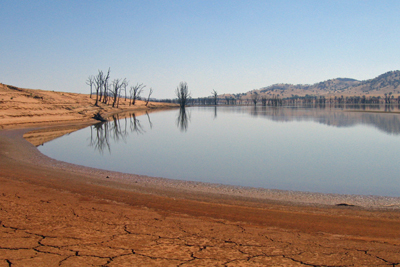
<th><img src="https://www.iea.usp.br/imagens/Escassez-Hidrica-sylvia-Tim-J-Keegan-flickr-copia.jpg" alt="Escassez Hídrica" class="image-inline" title="Escassez Hídrica" /></th>
</tr>
<tr>
<td><br /></td>
</tr>
</tbody>
</table>
<p>Entitled <i>Water Scarcity, Governance and Environmental Justice</i>, the meeting will be held in Spanish. It will take place on <strong>November 10</strong>, <strong>from 9.30 am to 12.30 pm</strong>, in the IEA's Events Room, with moderation of Professor Pedro Jacobi, coordinator of the IEA's Environment and Society research group.</p>
<p>"Metropolitan areas are experiencing prolonged drought crises. The experience shows that the models prioritize the supply of water to the detriment of demand control. The management models also fail to offer low investment in sewage treatment and water-free consumption, a scarce resource," says Professor Jacobi.</p>
<p>The panelists will examine the contexts of water scarcity in the world, the emergence of conflicts, and the reactions and responses of social actors  from the perspective of environmental justice.</p>
<p> </p>
<p><strong>The conferencists</strong></p>
<p><span>Geographer and historian </span><a class="external-link" href="https://grupo.us.es/giest/es/node/299">Leandro del Moral Ituarte</a><span>, who currently heads the Department of Human Geography at the University of Sevilla, specializes in hydraulic works. He has studied the lower basin of the Guadalquivir river, which bathes the territories of Andaluzia, in southern Spain.</span></p>
<p><a href="http://www.centre-cired.fr/spip.php?article749&amp;lang=fr" target="_blank">Bernard Barraqué</a>, research director at the Centre International de Recherche sur l'Environnement et le Développement of Le Centre National de la Recherche Scientifique, in Paris, has focused his recent studies on the allocation of water resources, evaluation of sustainable policies and methods,  institutional and participatory approaches, and comparative analysis of the sustainability of water management in major European cities. He also works at Agro ParisTech - École Nationale du Génie Rural, des Eaux et des Fôrets.</p>
<p>The participation of <a href="http://ugto.academia.edu/AlexRicardoCalderaOrtega" target="_blank">Alex Ricardo Caldera Ortega</a><span>, from the Department of Public Management and Development of the University of Guanajuato, has been cancelled due to the speaker's agenda.</span></p>
<p style="text-align: right; "><span class="discreet">Photo: Tim J. Keegan/Flickr</span></p>]]></content:encoded>
    <dc:publisher>No publisher</dc:publisher>
    <dc:creator>Richard Meckien</dc:creator>
    <dc:rights>Original version in Portuguese by Sylvia Miguel </dc:rights>
    
      <dc:subject>Europe</dc:subject>
    
    
      <dc:subject>Research Group: Environment and Society</dc:subject>
    
    
      <dc:subject>Power</dc:subject>
    
    
      <dc:subject>Interdisciplinarity</dc:subject>
    
    
      <dc:subject>Water</dc:subject>
    
    
      <dc:subject>Capitalism</dc:subject>
    
    
      <dc:subject>Environment</dc:subject>
    
    
      <dc:subject>Sustainability</dc:subject>
    
    
      <dc:subject>Globalization</dc:subject>
    
    
      <dc:subject>Inequality</dc:subject>
    
    
      <dc:subject>Poverty</dc:subject>
    
    
      <dc:subject>Environmental Policy</dc:subject>
    
    
      <dc:subject>Cities</dc:subject>
    
    <dc:date>2015-10-27T17:55:00Z</dc:date>
    <dc:type>Notícia</dc:type>
  </item>


  <item rdf:about="https://www.iea.usp.br/en/media-library/photos/events-2015/as-mudancas-climaticas-e-a-seguranca-alimentar-ciclo-tematico-14-de-outubro-de-2015">
    <title>Cycle "Towards COP 21": Climate Change and Food Security - October 14, 2015</title>
    <link>https://www.iea.usp.br/en/media-library/photos/events-2015/as-mudancas-climaticas-e-a-seguranca-alimentar-ciclo-tematico-14-de-outubro-de-2015</link>
    <description></description>
    
    <dc:publisher>No publisher</dc:publisher>
    <dc:creator>Richard Meckien</dc:creator>
    <dc:rights></dc:rights>
    
      <dc:subject>Research Group: Environment and Society</dc:subject>
    
    
      <dc:subject>Climate</dc:subject>
    
    
      <dc:subject>Natural Resources</dc:subject>
    
    
      <dc:subject>Hunger</dc:subject>
    
    
      <dc:subject>Climate Change</dc:subject>
    
    
      <dc:subject>Energy</dc:subject>
    
    
      <dc:subject>Water</dc:subject>
    
    
      <dc:subject>Environment</dc:subject>
    
    
      <dc:subject>World</dc:subject>
    
    
      <dc:subject>Cities</dc:subject>
    
    <dc:date>2015-10-26T16:05:00Z</dc:date>
    <dc:type>Pasta</dc:type>
  </item>


  <item rdf:about="https://www.iea.usp.br/en/media-library/photos/events-2015/as-mudancas-climaticas-e-a-matriz-energetica-ciclo-tematico-08-de-outubro-de-2015">
    <title>Cycle "Towards COP 21": Energy and Climate Changes - October 8, 2015</title>
    <link>https://www.iea.usp.br/en/media-library/photos/events-2015/as-mudancas-climaticas-e-a-matriz-energetica-ciclo-tematico-08-de-outubro-de-2015</link>
    <description></description>
    
    <dc:publisher>No publisher</dc:publisher>
    <dc:creator>Richard Meckien</dc:creator>
    <dc:rights></dc:rights>
    
      <dc:subject>Climate Change</dc:subject>
    
    
      <dc:subject>Commons</dc:subject>
    
    
      <dc:subject>Glocal</dc:subject>
    
    
      <dc:subject>Research Group: Environment and Society</dc:subject>
    
    <dc:date>2015-10-13T15:05:00Z</dc:date>
    <dc:type>Pasta</dc:type>
  </item>


  <item rdf:about="https://www.iea.usp.br/en/media-library/photos/events-2015/as-mudancas-climaticas-e-a-crise-hidrica-ciclo-tematico-30-de-setembro-de-2015">
    <title>Cycle "Towards COP 21": Climate Change and Water Crisis - September 30, 2015</title>
    <link>https://www.iea.usp.br/en/media-library/photos/events-2015/as-mudancas-climaticas-e-a-crise-hidrica-ciclo-tematico-30-de-setembro-de-2015</link>
    <description></description>
    
    <dc:publisher>No publisher</dc:publisher>
    <dc:creator>Richard Meckien</dc:creator>
    <dc:rights></dc:rights>
    
      <dc:subject>Research Group: Environment and Society</dc:subject>
    
    
      <dc:subject>Climate</dc:subject>
    
    
      <dc:subject>Natural Resources</dc:subject>
    
    
      <dc:subject>Energy</dc:subject>
    
    
      <dc:subject>Water</dc:subject>
    
    
      <dc:subject>Environment</dc:subject>
    
    
      <dc:subject>Environmental Sciences</dc:subject>
    
    
      <dc:subject>Cities</dc:subject>
    
    <dc:date>2015-10-07T20:05:00Z</dc:date>
    <dc:type>Pasta</dc:type>
  </item>


  <item rdf:about="https://www.iea.usp.br/en/news/history-and-environment-necessary-dialogue">
    <title>History and the Environment: A Necessary Dialogue</title>
    <link>https://www.iea.usp.br/en/news/history-and-environment-necessary-dialogue</link>
    <description></description>
    <content:encoded xmlns:content="http://purl.org/rss/1.0/modules/content/"><![CDATA[<p style="text-align: justify; ">The manner by which historians organize and analyze different approaches to the interlocution between history and the environment is the central axis of the seminar <i>Environment and Historical Dimension: Approach Perspectives</i>, which will take place on <strong>September 28</strong>, <strong>from 10 am to 6 pm</strong> in the IEA’s Events Room. Organized by the <a href="https://www.iea.usp.br/en/research/research-groups/environmental-sciences" class="external-link">IEA's Environment and Society Research Group</a> and by <a href="http://www.anpuhsp.org.br/conteudo/view?ID_CONTEUDO=715" target="_blank"><span>Work Group on Environmental History - ANPUH/SP</span></a>, the debate will bring together experts from various institutions.</p>
<p class="Text" style="text-align: justify; "><span>Brazilian historiography on the environment was structured as a field of thought and research in the late 20<sup>th</sup> century. According to Silvia Helena Zanirato, member of IEA Research Group and professor of Environmental Management at <a class="external-link" href="http://each.uspnet.usp.br/site/"><span>USP’s School of Arts, Sciences and Humanities (EACH)</span></a>, the challenges posed by major social and environmental changes have forced History, as a science, to find new explanatory arguments for the historically acquired habits of social players in their interaction with the physical environment.</span></p>
<p style="text-align: justify; "><span>“The environment is essentially an interdisciplinary field of study and only the sum total of knowledge can help us overcome the environmental crisis. History’s role, in this context, is to seek to understand and explain the processes that have contributed to this crisis, which we know is based on the production and consumption system of the Modern Age,” says Zanirato, one of the coordinators of the seminar, who will take part in the debates on “Historical Knowledge and the Environment: Epistemological Considerations.”</span></p>
<p class="Text" style="text-align: justify; "><span>She says that the academy has not been able to raise the awareness of the public at large of the severity of the socio-environmental problem. “More than discuss, we need to present other possibilities involving consumer habits, lifestyles and the means to move towards a less impacting society. I am aligned with the thought of Mercedes Pardo, for whom nature conservation condition is not mainly physical, but rather cultural,” explains Zanirato.</span></p>
<p class="Text" style="text-align: justify; "><span>“Undeniably, after World War II, with the vertiginous expansion of the mass consumer society, the perception and a growing awareness of a complex interconnected phenomenon of global dimensions began to take shape. The problems intrigued historians, policy makers, scientists, artists and the general population,” says Paulo Henrique Martinez, a professor at <a class="external-link" href="http://www.assis.unesp.br/"><span>Paulista State University (UNESP) in Assis</span></a>, who will also be at the seminar.</span></p>
<p class="Text" style="text-align: justify; "><span>Such phenomena, says Martinez, emerged in the industrialized countries of the northern hemisphere in the form of pollution, destruction of ecosystems and threats of extinction of the local fauna and flora. In poor countries, environmental problems arose in the form of epidemics, accelerated deforestation and degradation of environmental health in rural and urban areas – involving water resources and landfills, in particular – he says.</span></p>
<p class="Text" style="text-align: justify; "><span>For Martinez, environmental history opens communication channels and creates situations for interdisciplinary dialogue, e.g., in studies of urbanization, family farming and public policies. However, interdisciplinary research still needs to go further. “We talk insistently about interdisciplinary research, but operationally we still have a long way to go. Everything remains more in the realm of rhetoric than of effective and concrete experiences and practices,” he believes.</span></p>
<p class="Text" style="text-align: justify; "><span>For Janes Jorge, a professor at <a class="external-link" href="http://www.unifesp.br/campus/gua/">UNIFESP</a>, Brazilian historiography maintains a constant dialogue with other areas of knowledge and an intense debate about the place that historical production occupies in thinking about the environment. Yet, there is still plenty to do in environmental history research and in the dissemination of the knowledge produced in this field, she says.</span></p>
<p class="Text" style="text-align: justify; "><span>“I believe that public policies concerning water, waste, biodiversity, climate change and other environmental issues must converse with scientific knowledge. But the policies are still way too timid for the scale of the problem,” says Jorge.</span></p>
<p class="Text" style="text-align: justify; "><span>Besides Zanirato, Martinez and Jorge, the seminar will be attended by Roger Domenech Collacios (UNESP), Dora Shellard Correa (UNIFIEO), Nelson Aprobato Filho (USP) and José Jonas Almeida (USP).</span></p>]]></content:encoded>
    <dc:publisher>No publisher</dc:publisher>
    <dc:creator>Richard Meckien</dc:creator>
    <dc:rights>Original version in Portuguese by Sylvia Miguel. Translation by Carlos Malferrari.</dc:rights>
    
      <dc:subject>Brazil</dc:subject>
    
    
      <dc:subject>Environment</dc:subject>
    
    
      <dc:subject>Research Group: Environment and Society</dc:subject>
    
    
      <dc:subject>History</dc:subject>
    
    <dc:date>2015-09-15T13:30:00Z</dc:date>
    <dc:type>Notícia</dc:type>
  </item>


  <item rdf:about="https://www.iea.usp.br/en/news/spanish-sociologist-discusses-dialectic-environment">
    <title>Spanish Sociologist Discusses the Dialectic of Structure and the Environment at the IEA</title>
    <link>https://www.iea.usp.br/en/news/spanish-sociologist-discusses-dialectic-environment</link>
    <description></description>
    <content:encoded xmlns:content="http://purl.org/rss/1.0/modules/content/"><![CDATA[<p style="text-align: justify; ">The organization of modern societies around the idea of “unlimited” growth generates a steady accumulation of goods and materials, the consequence of which has been social exclusion and an environmental crisis. The social sciences have the vital role of questioning this model that shaped the way we see the world.</p>
<p class="Text" style="text-align: justify; ">To demonstrate some conclusions of his thoughts on this issue, <a href="https://www.iea.usp.br/en/persons/speakers/aledo-tur" class="external-link">Antonio Aledo Tur</a>, professor of Sociology of the Environment at the <a class="external-link" href="http://www.ua.es/en/index.html">Universidad de Alicante</a> (Spain), will hold in the IEA’s Events Room a debate and a discursive analysis of what has taken place in Brazil with regard to dams. <i>El Paradigma de la Modernidad y sus Impactos Socioambientales</i> [<i>The Paradigm of Modernity and its Socio-Environmental Impacts</i>] is the theme of the conference, which will be held on <strong>September 23</strong>, <strong>from 10 am to 12 pm</strong>. The lecture (given in Spanish, without translation) is organized by the <a href="https://www.iea.usp.br/en/research/research-groups/environmental-sciences" class="external-link">IEA’s Environment and Society Research Group</a>, coordinated by <a href="https://www.iea.usp.br/en/persons/researchers/pedro-roberto-jacobi" class="external-link">Pedro Jacobi</a>, from USP’s School of Education.</p>
<table class="tabela-direita" style="text-align: justify; ">
<tbody>
<tr>
<th><img src="https://www.iea.usp.br/imagens/antonio-aledo-tur-72.jpg" alt="Antonio Aledo Tur" class="image-inline" title="Antonio Aledo Tur" /></th>
</tr>
<tr>
<td style="text-align: right; "><strong>Antonio Aledo Tur, a specialist in sociology of tourism and environmental sociology</strong></td>
</tr>
</tbody>
</table>
<p class="Text" style="text-align: justify; "><span>Aledo Tur’s research focuses on the dialectic between the imposition of the structures and the human ability to adapt to them, regardless of whether they are environmental, social, economic, political or cultural.</span></p>
<p class="Text" style="text-align: justify; "><span>His master’s dissertation, <i>The Colonization of Yucatan through its Vernacular Architecture</i> (Louisiana State University, 1992), and his doctoral thesis, <i>El Entorno de Conquista</i> (University of Alicante, 1997), show how the structures of architecture and urbanism establish a dialogue with the structures of the process of conquest and colonization of Mayan lands in the Yucatan region.</span></p>
<p class="Text" style="text-align: justify; "><span>In recent studies, Aledo Tur has turned his attention to tourism, seen as an activity that transformed the region and the society of Alicante. Research on residential tourism on the Spanish coast unfolded into analyses of the same subject in Brazil’s northeastern seaboard. This type of tourism has been a driver of employment and income generation in several Spanish and Brazilian coastal towns. But it is also having serious social and environmental impacts, especially because of the lack of planning that characterizes the constructions of this kind of enterprise.</span></p>
<p class="Text" style="text-align: justify; "><span>In addition to studies in the Sociology of Tourism, Aledo Tur has also dedicated himself to a line of research in the field of Environmental Sociology, where he specialized in analyses of the social and environmental impacts of major public works, such as dams and reservoirs, using participatory methods to diagnose the impacts. In particular, he has focused on the social impacts of the Panama Canal Expansion Project (2005-2006). In the light of political ecology, he analyzed the impact of large hydroelectric plants in the Paraná River, Brazil.</span></p>
<p style="text-align: justify; "><span><strong>The conferencist</strong></span></p>
<p style="text-align: justify; ">Aledo Tur graduated in Geography and History from the University of Alicante. He holds a master’s degree in Anthropology from Louisiana State University and a Ph.D. in Sociology from the University of Alicante. He was professor of Anthropology at the Catholic University of Murcia and at the University of Alicante. He is currently responsible for the disciplines of Environment and Methods and Techniques of Social Research in Tourism at Alicante, where he also coordinates the doctoral program of the Sociology department. He is coordinator of the Society and Environment Group of the Spanish Federation of Sociology, and of the Network of Spanish Environmental Sociologists.</p>
<p class="Text" style="text-align: justify; "><span>On April 18, 2013, he took part in the IEA’s conference on the problems of the Spanish Mediterranean, when he gave the lecture <i><a href="https://www.iea.usp.br/en/eventos/eventos-gerais/201csobre-la-incuestionabilidad-del-riesgo-el-modelo-inmobiliario-espanol-y-la-gestion-politica-de-los-territorios-y-comunidades-costeras201d-1" class="external-link">L</a><span><a href="https://www.iea.usp.br/en/eventos/eventos-gerais/201csobre-la-incuestionabilidad-del-riesgo-el-modelo-inmobiliario-espanol-y-la-gestion-politica-de-los-territorios-y-comunidades-costeras201d-1" class="external-link">a Incuestionabilidad del Riesgo: El Modelo Inmobiliario Español y la Gestión Política de los Territorios y Comunidades Costeras</a></span></i>.</span></p>]]></content:encoded>
    <dc:publisher>No publisher</dc:publisher>
    <dc:creator>Richard Meckien</dc:creator>
    <dc:rights>Original version in Portuguese by Sylvia Miguel. Translation by Carlos Malferrari.</dc:rights>
    
      <dc:subject>Environment</dc:subject>
    
    
      <dc:subject>Research Group: Environment and Society</dc:subject>
    
    
      <dc:subject>Ecology</dc:subject>
    
    
      <dc:subject>Sociology</dc:subject>
    
    <dc:date>2015-09-04T19:15:00Z</dc:date>
    <dc:type>Notícia</dc:type>
  </item>


  <item rdf:about="https://www.iea.usp.br/en/news/cop20">
    <title>A Debate on the Contributions the COP 20 May Make to Climate Negotiations</title>
    <link>https://www.iea.usp.br/en/news/cop20</link>
    <description></description>
    <content:encoded xmlns:content="http://purl.org/rss/1.0/modules/content/"><![CDATA[<table class="tabela-direita-400">
<tbody>
<tr>
<th><img src="https://www.iea.usp.br/imagens/alteracoes-nas-precipitacoes-no-final-do-seculo-21" alt="Alterações nas precipitações no final do século 21" class="image-inline" title="Alterações nas precipitações no final do século 21" /></th>
</tr>
<tr>
<td style="text-align: right; "><strong>Changes in rainfall patterns at the end of 21st century according to projections from the US government’s National Oceanic and Atmospheric Administration (NOAA) (in inches of liquid water per year)</strong></td>
</tr>
</tbody>
</table>
<p style="text-align: justify; ">The <a class="external-link" href="http://www.cop20lima.org/">20<sup>th</sup> Conference of the Parties of the UN Framework Convention on Climate Change (COP 20)</a>, which will take place in Lima, Peru, over the first two weeks of December, is particularly important as part of the process of negotiating a new global climate agreement to be signed in Paris, France, in 2015.</p>
<p style="text-align: justify; "><span><span>It is expected that the conference will clarify the main challenges, roadblocks and opportunities available over the course of this complex negotiation process, which, if it reaches fruition, may lead to the realization of a global agreement with responses to the climate crisis.</span></span></p>
<p class="Text" style="text-align: justify; ">What can one truly expect from the COP 20? Will actual foundations be set forth for a new climate agreement that, from now on, engages and commits all actions devoted to reducing negative impacts on climate? These issues will be discussed in the debate “COP 20: What Can We Expect?” which <a href="https://www.iea.usp.br/en/research/research-groups/environmental-sciences" class="external-link">IEA-USP's Environment and Society Research Group</a>, with support from the <a class="external-link" href="http://www.incline.iag.usp.br/data/index_USA.php"><span style="text-align: justify; ">Interdisciplinary Climate Investigation center</span><span style="text-align: justify; "> (INCLINE)</span></a>, will hold on November 26, at 2 pm, at the IEA-USP.</p>
<p style="text-align: justify; "><span><span class="hps"><span>Panel members will include </span></span>Eduardo Felipe Pérez Matias (from Nogueira, Elias, Laskowski e Matias law firm), Ricardo Baitelo (Greenpeace Brazil) and Wagner Costa Ribeiro (from USP’s School of Philosophy, Languages and Literature, and Human Sciences, and IEA-USP). The discussion will be moderated by the research group coordinator, <a href="https://www.iea.usp.br/en/persons/researchers/pedro-roberto-jacobi" class="external-link">Pedro Roberto Jacobi</a> (USP’s School of Education and IEA-USP).</span></p>
<p style="text-align: justify; "><span><span>According to Jacobi, the obstacles and arguments that hinder the adoption of effective commitments by the parties can worsen the progressive withering of multilateral governance on climate change: “As the central controversy of the negotiating process, differentiation may create new foundations to advance actions that mitigate and enable adaptation to climate changes.”</span></span></p>
<p style="text-align: justify; "><span><span>Also according to Jacobi, the central controversies – which are related to the differences – are the degree of responsibility and the ability of each country to measure and acknowledge what it might do to contribute to the actions of adaptation to climate change, inasmuch as mitigation depends on global agreements. For him, the decarbonization agreement between the US and China signed on November 12 is insufficient, but signals changes in the position of the major players.</span></span></p>
<p style="text-align: justify; "><span><span><span style="text-align: justify; ">The event will be broadcast live on the </span><a style="text-align: justify; " href="https://www.iea.usp.br/aovivo">web</a><span style="text-align: justify; ">.</span></span></span></p>
<div>
<div class="kssattr-target-parent-fieldname-inscricao-cc9d4e4bd39d4cd68c7e0a573e48ab46 kssattr-macro-rich-field-view kssattr-templateId-widgets/rich kssattr-atfieldname-inscricao " id="parent-fieldname-inscricao-cc9d4e4bd39d4cd68c7e0a573e48ab46">
<div>
<div class="kssattr-atfieldname-programacao kssattr-templateId-widgets/rich kssattr-macro-rich-field-view kssattr-target-parent-fieldname-programacao-353b5b8bc739427eb693b2f69ac41085" id="parent-fieldname-programacao-353b5b8bc739427eb693b2f69ac41085"></div>
</div>
</div>
</div>
<div>
<h3></h3>
</div>
<div></div>]]></content:encoded>
    <dc:publisher>No publisher</dc:publisher>
    <dc:creator>Richard Meckien</dc:creator>
    <dc:rights>Carlos Malferrari (translator)</dc:rights>
    
      <dc:subject>Research Group: Environment and Society</dc:subject>
    
    
      <dc:subject>Climate Change</dc:subject>
    
    
      <dc:subject>Commons</dc:subject>
    
    
      <dc:subject>Environment</dc:subject>
    
    
      <dc:subject>Geopolitics</dc:subject>
    
    
      <dc:subject>Event</dc:subject>
    
    <dc:date>2014-11-13T17:10:00Z</dc:date>
    <dc:type>Notícia</dc:type>
  </item>


  <item rdf:about="https://www.iea.usp.br/en/news/hydroelectric-generation-in-the-amazon">
    <title>The many faces of the new era of hydroelectric generation in the Amazon</title>
    <link>https://www.iea.usp.br/en/news/hydroelectric-generation-in-the-amazon</link>
    <description></description>
    <content:encoded xmlns:content="http://purl.org/rss/1.0/modules/content/"><![CDATA[<p style="text-align: justify; "><img src="https://www.iea.usp.br/imagens/amazoniacapajpg.jpg" alt="Amazônia - capa" class="image-right" title="Amazônia - capa" />Wrapped in the triad that comprises the Amazon rainforest, climate and energy generation, economic, social and environmental aspects will be analyzed at the debate "Amazon: The Old and the New Brazilian Hydroelectric Frontier", to be held on May 14, at 2 pm, in the IEA-USP’s Event Room.</p>
<p style="text-align: justify; ">The panelists of the meeting will be Celio Bermann, professor at USP’s <a class="external-link" href="http://www.iee.usp.br/">Institute for Energy and Environment (IEE)</a> and who will be participating via Skype, Gustavo Tosello Pinheiro, coordinator of Intelligent Infrastructure at The Nature Conservancy (TNC) in Brazil, João Andrade, coordinator of the <i>Iniciativa Defensa Socioambiental</i> (an initiative for social and environmental defense) at the Center for Life Institute (ICV), and Pedro Bara Neto, researcher of the Federal University of Rio de Janeiro’s (UERJ) Study Group on the Electricity Sector (GESEL).</p>
<p style="text-align: justify; ">Organized by <a href="https://www.iea.usp.br/en/research/research-groups/environmental-sciences" class="external-link">IEA-USP’s Environment and Society Research Group</a> in partnership with the IEE, and the School of Arts, Sciences and Humanities’s (EACH) <a class="external-link" href="https://uspdigital.usp.br/tycho/gruposPesquisaObter?codigoGrupoPesquisa=0067605FOISZ9K">research group on Environmental Planning and Management (PLANGEA)</a>, both of USP, the meeting will focus on two central questions:</p>
<ul style="text-align: justify; ">
<li><span>What is the scenario of social and environmental conflicts and challenges to the intensification of planning hydroelectric dams in the Amazon?</span></li>
<li><span>Which existing experiences in local development, environmental protection and analyzes of extreme weather events represent opportunities for the inclusion of these topics in various scales of planning hydroelectric dams in the Amazon?</span></li>
</ul>
<p style="text-align: justify; "> </p>
<p style="text-align: justify; "><strong>THEMED DEVELOPMENTS</strong></p>
<p style="text-align: justify; ">The Brazilian Amazon accounts for 51 % of all the hydroelectric potential of the country. However, according to Evandro Moretto, professor of EACH-USP, only a small part of this potential is exploited, since most mills in the region have been built in the 1960s and the 1970s, and in the following two decades there has been a significant expansion in infrastructure for power generation.</p>
<p style="text-align: justify; "><span>Only in the 2000s Brazil started to invest massively in expansion of hydroelectric capacity in the Amazon again. As pointed by Moretto, who will mediate the debate, the installation of more than 150 dams in the region is planned. The highlights are Jirau and Santo Antonio, on the Madeira River, Belo Monte, on the Xingu River, and the project of the basins of the Tapajós and Negro rivers.</span></p>
<p style="text-align: justify; ">According to the professor, discussions around that recovery involve a series of thematic developments - such as weather events, environmental protection and socioeconomic development - which will be addressed at the meeting. As an example, the mediator cites the period of prolonged drought this summer in Brazil, which led to the shortage of large water reservoirs in the Southeast and the Midwest, "while the gates of the plants on the Madeira were opened to let through the highest flow of the river in history in the wake of thousands homeless upstream and downstream of the dams."</p>
<p style="text-align: justify; "><span>Moretto also mentions the particularity of the situation of the Amazon region. On the one hand, it suffers the environmental impacts of large infrastructure projects. On the other hand, it is favored by various actions of environmental protection and local development, "which should not be neglected in planning hydropower projects, under penalty of the new plants being much more impactful and conflictive than Belo Monte already is."</span></p>
<p style="text-align: justify; "><strong>EVENT</strong></p>
<p style="text-align: justify; ">The completion of the discussion is supported by FAPESP, IEE-USP’s Graduate Program in Environmental Science (PROCAM), TNC, Brazilian Association of Impact Assessment (ABAI) and ICV.</p>
<p style="text-align: justify; "><span style="text-align: justify; ">The event will be broadcast live on the </span><a style="text-align: justify; " href="https://www.iea.usp.br/aovivo">web</a><span style="text-align: justify; ">.</span></p>]]></content:encoded>
    <dc:publisher>No publisher</dc:publisher>
    <dc:creator>Richard Meckien</dc:creator>
    <dc:rights></dc:rights>
    
      <dc:subject>Research Group: Environment and Society</dc:subject>
    
    
      <dc:subject>Water</dc:subject>
    
    
      <dc:subject>Commons</dc:subject>
    
    
      <dc:subject>Environment</dc:subject>
    
    
      <dc:subject>Amazon</dc:subject>
    
    <dc:date>2014-05-09T18:10:00Z</dc:date>
    <dc:type>Notícia</dc:type>
  </item>


  <item rdf:about="https://www.iea.usp.br/en/news/an-interdisciplinary-look-at-the-drought-in-sao-paulo">
    <title>An interdisciplinary look at the drought in São Paulo</title>
    <link>https://www.iea.usp.br/en/news/an-interdisciplinary-look-at-the-drought-in-sao-paulo</link>
    <description></description>
    <content:encoded xmlns:content="http://purl.org/rss/1.0/modules/content/"><![CDATA[<p style="text-align: justify; "><img src="https://www.iea.usp.br/imagens/evento-verao-2013-2014-e-cenarios-de-estresse-hidrico" alt="Evento &quot;Verão 2013/2014 e Cenários de Estresse Hídrico&quot;" class="image-right" title="Evento &quot;Verão 2013/2014 e Cenários de Estresse Hídrico&quot;" />The Metropolitan Region of São Paulo (RMSP) has been undergoing the bitter consequences of a prolonged drought, which led the Cantareira water reservoir to beat low levels records. The IEA-USP addressed this water shortage situation in the debate "Summer 2013/2014 and Scenarios of Water Stress" on March 19. The event was part of the celebrations of the Water Week 2014, prior to the World Water Day, celebrated on March 22.</p>
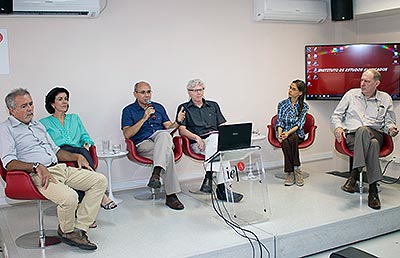
<p style="text-align: justify; ">The debate has been organized by a partnership between two of IEA-USP’s research groups: <a href="https://www.iea.usp.br/en/research/research-groups/environmental-sciences" class="external-link">Environment and Society</a>, and <a href="https://www.iea.usp.br/en/research/research-groups/philosophy-history-sociology-of-science-and-technology" class="external-link">Philosophy, History, and Sociology of Science and Technology</a>. They had the support of the Center for Studies in Social and Environmental Governance of USP’s Institute for Energy and Environment (IEE). The meeting has comprised two roundtables, both mediated by Pedro Jacobi, coordinator of IEA’s Environment and Society Research Group.</p>
<p style="text-align: justify; ">The exhibitors were Wagner Ribeiro Costa, professor at USP’s Faculty of Philosophy, Letters and Human Sciences (FFLCH), Maurício de Carvalho Ramos, also a professor at FFLCH, Daniela Libório Di Sarno, professor at PUC-SP’s Faculty of Law and vice president of the Brazilian Institute of Urban Law (IBDU), Marcio Automare, organizational development analyst at the Institute of Land of the State of São Paulo (ITESP), and Susana Prizendt, coordinator of the Paulista Committee of the Permanent Campaign Against Pesticides and for Living.</p>
<p style="text-align: justify; ">The meeting has addressed the water problem from an interdisciplinary perspective, considering environmental, legal, socio-political, philosophical and food safety aspects. According to Jacobi, the idea was to reflect on the problem of water in the RMSP, but covering broader issues involving, among others, inequalities in access to water, changes in rainfall rates caused by the phenomenon of climate change, institutional barriers and the posture of the government in relation to the prevention and remediation of the problem.</p>
<p style="text-align: justify; "><a href="https://www.iea.usp.br/en/media-library/photos/events-2014/verao-2013-14-e-cenarios-de-estresse-hidrico-19-de-marco-de-2014" class="external-link"><b>Photos of the event</b></a></p>
<p style="text-align: justify; "><strong>MEASURES OF THE STATE</strong></p>
<p style="text-align: justify; ">The debate has been heated up by recent measures that have been studied and taken by the state government of São Paulo in order to try to circumvent the critical situation of the Cantareira reservoir, which currently operates at approximately 15 % of its capacity. Among these measures is the proposal of using water from the Paraíba do Sul River reservoirs to supply the RMSP. When asked about the matter, Ribeiro said that he does not consider the proposal timely, since the suggested river is also undergoing a situation of water stress.</p>
<p style="text-align: justify; ">Ribeiro has criticized the emergency works of the state government, which began on March 14 to pump the volume of "dead water" from the bottom of the dams that form the Cantareira reservoir. According to him, this means "to remove the last drop of a water that has been stored for 40 years, stagnant, whose quality is questionable due to the unknown factors associated with it."</p>
<p style="text-align: justify; ">Besides, he said that it was a risky move, which can lead to resource depletion in the region. “That is because to saturate the soil again to the point for the dam to refill, much more than the average rainfall rates in the region will be needed, and those were not achieved this summer."</p>
<p style="text-align: justify; "><strong>FRAGMENTED MANAGEMENT</strong></p>
<p style="text-align: justify; ">Sarno has pointed out the incongruity of the Brazilian legal system in relation to water resources management as the top reason for the shortage in the country. According to her, although the Federal Constitution provides that the management should be shared between the federal government, the states and the municipalities, there is little dialogue between the parties and the administration of water resources ends up getting fragmented.</p>
<p style="text-align: justify; ">"To meet the challenge of shared management, the three [federal, state and municipal] parties need to sit down and discuss. But this step has still not been taken. There are neither vertically talks between the parties nor horizontally ones between institutions," she said.</p>
<p style="text-align: justify; ">This fragmentation gets compounded by the mismatch between the division of the federal system, that obeys political criteria, and the division of watersheds, which follows geographic criteria. The watersheds are important because they put another actor in the scene: the Watershed Committees, which comprise the National System for Water Resources Management. Composed of representatives of the various water user sectors, civil society and government organizations, the committees approve the Water Resources Plan for each watershed, arbitrate conflicts over water use, suggest values ​​for the charging of consumption, among others.</p>
<p style="text-align: justify; ">According to Sarno, the problem is that none of the management models adopted in the country - municipal management and state management by autarchies or contractors - is consistent with the watershed divisions. "The Committees even do part of the management, but who puts the distribution of water into practice is not them, but managing institutions.”</p>
<p style="text-align: justify; "><strong>PUBLIC X PRIVATE</strong></p>
<p style="text-align: justify; ">As for Ribeiro, the biggest obstacle to equate the issue of water in Brazil is the private management of water resources. In the RMSP, for example, the management is done by SABESP, a mixed economy company, publicly listed and traded on the stock exchange, which operates according to the logic of a private institution.</p>
<p style="text-align: justify; ">"Is it the function of the state to pay up, profit and speculate based on the commercialization of water resources? No, it is not the function of the state to make money from the water, as done by SABESP," warned Ribeiro, noting the lack of transparency in the management of the company. "Besides the water flows, there should be transparency in relation to financial flows," he pointed out.</p>
<p style="text-align: justify; ">As Ribeiro, Automare pondered that a government-linked company as SABESP should not behave like a private company, treating water as a product. He also cited the industry of water sold in gallons, whose growth was affecting groundwater, as an example of the commercial exploitation of water resources.</p>
<p style="text-align: justify; ">Sarno also addressed the conflict between public and private interests. According to her, Watershed Committees treat water as a commodity, whose distribution should be equal and the charging should happen only to regulate the consumption. The companies that put management into practice, such as SABESP, treat water as a product for sale.</p>
<p style="text-align: justify; ">According to the lawyer, the managers of metropolitan regions and municipalities do not take into consideration the willingness of the watershed in allowing, for example, the expansion of an industrial district that could endanger the water supply on site. "It takes measures to reconcile urban expansion and the infrastructure for distribution of water in terms of quality and quantity," he warned.</p>
<p style="text-align: justify; "><strong>ETHICAL DIMENSION</strong></p>
<p style="text-align: justify; ">Taking a philosophical approach, Carvalho said that the water can be considered from two sets of properties: material ones, linked to biochemical principles, and symbolic ones, related to its immeasurable value to life, making it a symbol of power.</p>
<p style="text-align: justify; ">According to him, when considering the symbolic properties, water can be conceived both as a resource - a product to be exploited economically -, as well as a good - something free and not marketable in any way. And it is this conception of a good that should be adopted to tackle the problem of water stress from an ethical perspective.</p>
<p style="text-align: justify; ">"Addressing the issue rationally and responsibly involves not putting into practice technoscientific possibilities related to water use that may jeopardize the availability or the material properties of water resources," he said. "If the ethical stance prevailed, there would be no need for rationing and an appeal to the conscience of people would be sufficient," he added.</p>
<p style="text-align: justify; "><strong>PARTICIPATION</strong></p>
<p style="text-align: justify; ">The panelists drew attention to the low involvement of society in discussions on the management of water resources. According to Automare, water has achieved the last place in the priority list of the citizens of the State of São Paulo: "We have been induced to credit the discussion on the subject to the representatives and forgot to get involved." He also emphasized that "the public has no forum for debate, so the situation is in the hands of technocrats."</p>
<p style="text-align: justify; ">Ribeiro has also warned about the paradox that involves the lack of popular participation on the one hand and excess of institutions to manage water on the other. For him, "we have more institutions dealing with water than water itself. There are too much institutions for very little water. And civil society is under-represented within them."</p>
<p style="text-align: justify; "><strong>FOOD SAFETY</strong></p>
<p style="text-align: justify; ">The water problem has also been addressed from the point of view of quality. Addressing the contamination of water resources by pesticides, Prizendt said that the issue should be discussed with a view to replacing the agribusiness, model of conventional production and based on intensive use of pesticides, by agroecology, an alternative model, whose practices intend to maintain the balance of ecosystems and preserve the sources of rivers and the water system as a whole.</p>
<p style="text-align: justify; ">According to her, pesticides are the second leading cause of contamination of rivers, a fact that becomes particularly worrying considering that Brazil is world champion in the use of these substances, accounting for one fifth of what is consumed in the world. Moreover, the agricultural sector accounts for about 70 % of freshwater consumption in Brazil, said the environmentalist.</p>]]></content:encoded>
    <dc:publisher>No publisher</dc:publisher>
    <dc:creator>Richard Meckien</dc:creator>
    <dc:rights></dc:rights>
    
      <dc:subject>Research Group: Environment and Society</dc:subject>
    
    
      <dc:subject>Abstraction</dc:subject>
    
    
      <dc:subject>Water</dc:subject>
    
    
      <dc:subject>Commons</dc:subject>
    
    
      <dc:subject>Environment</dc:subject>
    
    
      <dc:subject>Research Group: Philosophy, History, and Sociology of Science and Technology</dc:subject>
    
    <dc:date>2014-03-24T14:05:00Z</dc:date>
    <dc:type>Notícia</dc:type>
  </item>


  <item rdf:about="https://www.iea.usp.br/en/media-library/photos/events-2014/verao-2013-14-e-cenarios-de-estresse-hidrico-19-de-marco-de-2014">
    <title>Summer 2013/2014 and Scenarios of Water Stress - March 19, 2014</title>
    <link>https://www.iea.usp.br/en/media-library/photos/events-2014/verao-2013-14-e-cenarios-de-estresse-hidrico-19-de-marco-de-2014</link>
    <description></description>
    
    <dc:publisher>No publisher</dc:publisher>
    <dc:creator>Richard Meckien</dc:creator>
    <dc:rights></dc:rights>
    
      <dc:subject>Environment</dc:subject>
    
    
      <dc:subject>Research Group: Environment and Society</dc:subject>
    
    
      <dc:subject>Water</dc:subject>
    
    
      <dc:subject>Research Group: Philosophy, History, and Sociology of Science and Technology</dc:subject>
    
    <dc:date>2014-03-19T03:00:00Z</dc:date>
    <dc:type>Pasta</dc:type>
  </item>


  <item rdf:about="https://www.iea.usp.br/en/media-library/photos/events-2013/prosperidade-sem-crescimento-2013-vida-boa-em-um-planeta-finito-30-de-outubro-de-2013">
    <title>Publishing of 'Prosperity without Growth', by Tim Jackson - October 30 2013</title>
    <link>https://www.iea.usp.br/en/media-library/photos/events-2013/prosperidade-sem-crescimento-2013-vida-boa-em-um-planeta-finito-30-de-outubro-de-2013</link>
    <description></description>
    
    <dc:publisher>No publisher</dc:publisher>
    <dc:creator>Richard Meckien</dc:creator>
    <dc:rights>Mauro Bellesa</dc:rights>
    
      <dc:subject>Environment</dc:subject>
    
    
      <dc:subject>Research Group: Environment and Society</dc:subject>
    
    
      <dc:subject>Sustainability</dc:subject>
    
    <dc:date>2013-10-30T02:00:00Z</dc:date>
    <dc:type>Pasta</dc:type>
  </item>


</rdf:RDF>