<?xml version="1.0" encoding="utf-8" ?>
<rdf:RDF xmlns:rdf="http://www.w3.org/1999/02/22-rdf-syntax-ns#" xmlns:dc="http://purl.org/dc/elements/1.1/" xmlns:syn="http://purl.org/rss/1.0/modules/syndication/" xmlns="http://purl.org/rss/1.0/">


<channel rdf:about="https://www.iea.usp.br/search_rss">
  <title>Instituto de Estudos Avançados da Universidade de São Paulo</title>
  <link>https://www.iea.usp.br</link>

  <description>
    
            These are the search results for the query, showing results 1 to 12.
        
  </description>


  <image rdf:resource="https://www.iea.usp.br/logo.png" />

  <items>
    <rdf:Seq>
      
        <rdf:li rdf:resource="https://www.iea.usp.br/en/news/journal-issue-102" />
      
      
        <rdf:li rdf:resource="https://www.iea.usp.br/en/news/social-narratives-water-rights" />
      
      
        <rdf:li rdf:resource="https://www.iea.usp.br/en/news/hub-sao-carlos-holds-debate-consequences-of-the-disaster-in-mariana" />
      
      
        <rdf:li rdf:resource="https://www.iea.usp.br/en/news/consequences-of-environmental-disaster-mariana" />
      
      
        <rdf:li rdf:resource="https://www.iea.usp.br/en/news/metropolises-in-crisis-water-management-in-Mexico-and-Spain" />
      
      
        <rdf:li rdf:resource="https://www.iea.usp.br/en/media-library/photos/events-2015/as-mudancas-climaticas-e-a-seguranca-alimentar-ciclo-tematico-14-de-outubro-de-2015" />
      
      
        <rdf:li rdf:resource="https://www.iea.usp.br/en/media-library/photos/events-2015/as-mudancas-climaticas-e-a-crise-hidrica-ciclo-tematico-30-de-setembro-de-2015" />
      
      
        <rdf:li rdf:resource="https://www.iea.usp.br/en/news/seminar-presents-causes-impacts-and-solutions-to-climate-change" />
      
      
        <rdf:li rdf:resource="https://www.iea.usp.br/en/news/iea-creates-working-group-to-discuss-the-water-crisis-in-sao-paulo" />
      
      
        <rdf:li rdf:resource="https://www.iea.usp.br/en/news/hydroelectric-generation-in-the-amazon" />
      
      
        <rdf:li rdf:resource="https://www.iea.usp.br/en/news/an-interdisciplinary-look-at-the-drought-in-sao-paulo" />
      
      
        <rdf:li rdf:resource="https://www.iea.usp.br/en/media-library/photos/events-2014/verao-2013-14-e-cenarios-de-estresse-hidrico-19-de-marco-de-2014" />
      
    </rdf:Seq>
  </items>

</channel>


  <item rdf:about="https://www.iea.usp.br/en/news/journal-issue-102">
    <title>The environment and cultural heritage are highlights of "Estudos Avançados" #102</title>
    <link>https://www.iea.usp.br/en/news/journal-issue-102</link>
    <description> </description>
    <content:encoded xmlns:content="http://purl.org/rss/1.0/modules/content/"><![CDATA[<p><img src="https://www.iea.usp.br/imagens/capa-da-revista-estudos-avancados-102" alt="Capa da revista Estudos Avançados 102" class="image-right" title="Capa da revista Estudos Avançados 102" /></p>
<p><span>Issue #102 of IEA's </span><span>quarterly publication, the journal </span><i><a class="external-link" href="https://www.scielo.br/j/ea/i/2020.v34n99/">Estudos Avançados</a>, </i><span>is now available </span><span>(Portuguese only) </span><span>for free download on the </span><a class="external-link" href="https://www.scielo.br/scielo.php?script=sci_issuetoc&amp;pid=0103-401420200002&amp;lng=pt&amp;nrm=iso">SciELO</a><span> platform, featuring the dossiers "Energy and Environment," "Hybrids of Knowledge," and "Religious Spaces."</span></p>
<p>According to the editor, <a href="https://www.iea.usp.br/en/persons/researchers/sergio-adorno" class="external-link">Sérgio Adorno</a><span>, the multiple facets of the dossier "Energy and Environment" pose strategic questions for sustainable development. "Regardless of the complexity that the relations between energy and environment raise, the dossier addresses problems that have been mobilizing the attention of the scientific community, at least of informed public opinion." Part of the articles deal with case studies, "suggestive of broader trends that are underway in the domain of these relations" between energy and environment, he says.</span></p>
<p><strong>Air quality</strong></p>
<p>According to the article that opens the dossier, "Analysis of Air Quality Monitoring in Brazil," written by researchers from the Health and Sustainability Institute, IEA, and USP's Medical School (FM), only ten states and the Federal District monitor air quality. This is carried out through 371 active stations, 80% of them in the Southeast Region. Five of these states communicate monitoring data <span>to the population</span><span> in real time. The authors emphasize that </span><span>the National Air Quality Network </span><span>is still incomplete</span><span> </span><span>30 years after its creation, "making it impossible for </span><span>environmental agencies</span><span> to adequately manage air quality."</span></p>
<p>Another article in the dossier, "Green Infrastructure to Monitor and Minimize the Impacts of Atmospheric Pollution," analyzes the role of trees in retaining particulate matter, one of the main air contaminants in cities, on their surface. The work has used samples of tree bark from five parks in the city of São Paulo.</p>
<p>The other five articles in the dossier address water integration on the Brazil-Uruguay border, the potential of the state of Rio Grande do Norte for the production of wind energy and the policies necessary for the production of this energy to be consolidated, the problems in the implementation of the Joint Urban Operation for the Port Region of Rio de Janeiro, the importance of biodiversity in the tropical forests of Africa and South America for the production of medicines, pesticides, and other products, and the approximation of the formulations of the Kaiowa and Guarani peoples of Mato Grosso do Sul to the reflections of political ecology.</p>
<p><strong>Climate Adaptation</strong></p>
<p>The second dossier, "Hybrids of Knowledge," brings together articles by members of IEA's research group <a href="https://www.iea.usp.br/en/research/research-groups/environmental-sciences" class="external-link">Environment and Society</a> and dialogues with the previous dossier by addressing issues such as climate adaptation at the local level (including a comparative study between Brazil and Portugal), and policies for water and water resources governance. The purpose of the dossier is "to promote the integration between different fields of knowledge from the perspectives of co-design, co-production, and co-dissemination," explains Adorno.</p>
<p>The article "Integrating Knowledge to Advance Climate Adaptation at the Local Level," written by researchers of USP, Ca' Foscari University of Venice, and Waikato University, warns that climate adaptation is a particularly urgent challenge for decision makers at the municipal and regional levels, considering the gaps in the development of local responses such as lack of data and political will or resources.</p>
<p>Are climate change adaptation policies, plans, and strategies adequately focused on achieving <span>justice,</span><span> reducing inequalities, and demanding rights? The issue is discussed in the article "Climate Justice and Adaptation Strategies to Climate Change in Brazil and Portugal." The study analyzes the scientific production </span><span>on climate justice </span><span>in both countries and discusses how their adaptation strategies and policies incorporate justice-related components.</span></p>
<p><span>The themes of the other three articles in the dossier are the challenges of water governance from the concept of hydrosocial territory, how this governance takes place in the Metropolitan Region of São Paulo, and the conflicts of water and sanitation policies as well as the universalization of these services as a common.</span></p>
<p>The approach to the themes of the dossier "focuses on the multiplicity of actors, interests, and disputes, which makes it possible to assess impacts on the aggravation of social inequalities and on the impasses in the guarantees of human rights for the greatest number of citizens," states the editor. In addition, the articles' methodological, systemic, and interactive approaches allow "knowing and evaluating ongoing experiments and innovations, pointing to a more sustainable future adapted to the scarcity of resources in the context of global environmental changes."</p>
<p><strong>Historical and artistic heritage</strong></p>
<p>The dossier "Religious Spaces" brings together texts presented at a seminar organized by IEA's research group <a href="https://www.iea.usp.br/en/news/time-memory-belonging" class="external-link">Time, Memory, and Belonging</a> in November 2019. The event took stock of current studies on historical and artistic heritage preserved in religious and institutional <span>Catholic </span><span>spaces in Brazil.</span></p>
<p><span>From the context of connected global/local histories, the text "Encrypted/Connected Paths: Jesuit Heritage between Rio de Janeiro and São Paulo" addresses the trajectories of destruction, dispersion, reconstruction, and preservation that marked the history of Jesuit heritage in the Southeast Region, particularly from the old schools in Rio de Janeiro and São Paulo, and from mission locations on the coast of these states.</span></p>
<p><span>In additional four articles, the dossier also discusses the decoration of the São Miguel Arcanjo Chapel, located in the East Zone of the city of São Paulo, the formation of the Jesuit Sacred Art Museum in Embu das Artes, the establishment of Catholic spaces by the black population of São Paulo in the 19th century, and the artistic aspect of the restoration of the Brazilian Benedictine Congregation, promoted by the Congregation of Beuron through the work of members of the Beuron Art School.</span></p>
<p><span>The list below contains the names of the authors who have contributed with each one of the addressed themes:</span></p>
<p><strong>Energy and Environment</strong></p>
<p><i>Evangelina da M. P. A. de Araújo Vormittag, Samirys Sara Rodrigues Cirqueira, Hélio W. Neto, and Paulo H. N. Saldiva<br /></i><i>Ana Paula G. Martins, Andreza P. Ribeiro, Maurício L. Ferreira, Marco Antonio G. Martins, Elnara M. Negri, Marcos Antônio Scapin, Anderson de Oliveira, Mitiko Saiki, Paulo H. N. Saldiva, and Raffaele Lafortezza<br />Fernanda de Moura Fernandes, Gilberto Loguercio Collares, and Rafael Corteletti<br />Gerbeson Carlos B. Dantas, Marcus V. S. Rodrigues, Leonardo M. X. Silva, Marisete D. de Aquino, and Antônio Clécio F. Thomaz<br />Eunice Helena S. Abascal and Carlos A. Bilbao<br />Paulo Roberto Feldmann<br />Spensy K. Pimentel</i></p>
<p><strong>Hybrids of Knowledge</strong></p>
<p dir="ltr"><i>Michele D. Fontana, Fabiano de A. Moreira, Silvia Serrao-Neumann, Giulia Lucertini, Denis Maragno, and Gabriela M. Di Giulio<br />Pedro Henrique Campello Torres, Alberto Matenhauer Urbinatti, Carla Gomes, Luísa Schmidt, Ana Lia Leonel, Sandra Momm, and Pedro Roberto Jacobi<br />Vanessa Lucena Empinotti, Natalia D. Tadeu, Maria Christina Fragkou, and Paulo Antonio de Almeida Sinisgalli<br />Mariana G. Arteiro da Paz, Ana Paula Fracalanza, Estela Macedo Alves, and Flávio J. Rocha da Silva<br />Pedro Roberto Jacobi, Marcos Buckeridge, and Wagner Costa Ribeiro</i></p>
<p><strong>Religious Spaces</strong></p>
<p dir="ltr"><i>Renata Maria de Almeida Martins<br />Thais Cristina Montanari<br />Angélica Brito Silva<br />Fabrício Forganes Santos<br />Klency Kakazu de Brito Yang</i></p>
<div id="_mcePaste">
<div class="tlid-results-container results-container">
<div class="tlid-result result-dict-wrapper">
<div class="result tlid-copy-target">
<div class="text-wrap tlid-copy-target"></div>
</div>
</div>
</div>
</div>]]></content:encoded>
    <dc:publisher>No publisher</dc:publisher>
    <dc:creator>Richard Meckien</dc:creator>
    <dc:rights>Original version in Portuguese by Mauro Bellesa.</dc:rights>
    
      <dc:subject>Water</dc:subject>
    
    
      <dc:subject>Biodiversity</dc:subject>
    
    
      <dc:subject>Energy</dc:subject>
    
    
      <dc:subject>Environment</dc:subject>
    
    
      <dc:subject>Design</dc:subject>
    
    
      <dc:subject>Publications</dc:subject>
    
    
      <dc:subject>Cultural and Historical Heritage</dc:subject>
    
    
      <dc:subject>Journal</dc:subject>
    
    <dc:date>2022-02-01T16:40:00Z</dc:date>
    <dc:type>Notícia</dc:type>
  </item>


  <item rdf:about="https://www.iea.usp.br/en/news/social-narratives-water-rights">
    <title>Social narratives about water, citizenship and public policies</title>
    <link>https://www.iea.usp.br/en/news/social-narratives-water-rights</link>
    <description></description>
    <content:encoded xmlns:content="http://purl.org/rss/1.0/modules/content/"><![CDATA[<table class="tabela-direita">
<tbody>
<tr>
<th><img src="https://www.iea.usp.br/imagens/agua-narrativas-sociais-1" alt="Água narrativas sociais 1" class="image-inline" title="Água narrativas sociais 1" /></th>
</tr>
<tr>
<td>
<p><strong>The construction of narratives on the symbology of environmental themes will be discussed on April 17</strong></p>
</td>
</tr>
</tbody>
</table>
<p><a class="external-link" href="https://www2.warwick.ac.uk/fac/arts/theatre_s/cp/staff/garde-hansen/">Joanne Garde-Hansen</a>, director of the Center for Cultural and Media Policy Studies at the University of Warwick, UK, will be at the IEA on <strong>April 17</strong>, <strong>from 3.00 pm to 6.00 pm</strong>, to discuss the theme <span><i>Water: Nostalgia and Trauma - Narratives, Rights and Policies in England</i>. At the meeting, to take place in the former University Council Room, she will suggest a reflection on diversity related to issues that deserve more attention in scientific terminology and public policy.</span></p>
<p><span>Garde-Hansen has been working with Brazilian researchers in order to construct social narratives linked to water and public policies, and argues that seeking connections and convergences between terms such as "drought" (which assumes different meanings in Brazil and in Europe) may favor dialogue between nations and cultures. The event will be held in English and broadcast <a href="https://www.iea.usp.br/en/aovivo" class="external-link">live</a> on the IEA's website.</span></p>
<p>Moderation will be in charge of professors <a href="https://www.iea.usp.br/en/persons/researchers/pedro-roberto-jacobi" class="external-link">Pedro Jacobi</a>, from USP's School of Education (FE), Danilo Rothberg, from the São Paulo State University (UNESP), Antonio Almeida, from USP's Luiz de Queiroz School of Agriculture (ESALQ), and <a href="https://www.iea.usp.br/en/persons/speakers/gilson-schwartz" class="external-link">Gilson Schwartz</a>, from USP's School of Communications of Arts (ECA) and a participant of <a href="https://www.iea.usp.br/en/persons/sabbatical" class="external-link">IEA's Sabbatical Year Program</a> in 2017. <span>Schwartz is also </span>coordinating the event.</p>
<p>The fluid theme relating water, cultural sharing and memory invites for a dialogue on concepts between cultures, social narratives, rights and public policies. "The term 'drought', for example, <span>assumes a meaning </span>in Europe that does not coincide with the perception of the fact in Brazil or in other countries," says the researcher. "<span>There is no universal definition of terms that only theoretically have the same value or meaning."</span></p>
<p>Organized by the IEA, the debate is supported by USP's Center for Research in Technology of Architecture and Urbanism (NUTAU), the <span>São Paulo <span>Research </span></span>Foundation (FAPESP), UNESP and the University of Warwick.</p>
<p><strong> </strong></p>
<p><strong>The speaker</strong></p>
<p>Joanne Garde-Hansen is a lecturer in the field of Culture, Media and Communication, responsible for the Master's course in Global Media and Communication, and director of the Center for Cultural and Media Policy Studies at the University of Warwick. She conducts researches on media, memory, archives and patrimony, and keeps multidisciplinary collaborations with scientists of the most diverse areas, among them geography, natural resources, computation, history, besides communication and culture.</p>
<table class="tabela-direita">
<tbody>
<tr>
<th><img src="https://www.iea.usp.br/imagens/agua-narrativas-sociais-2" alt="Água narrativas sociais 2" class="image-inline" title="Água narrativas sociais 2" /></th>
</tr>
<tr>
<td>
<p><strong>In Crateús, in the dry region of the Brazilian State of Ceará, residents pay R$ 0.50 for 20 liters of non-potable water</strong></p>
</td>
</tr>
</tbody>
</table>
<p>Some of her latest books are <i>Emotion Online: Theorizing Affect in the Internet</i> (Palgrave Macmillan, 2013), with Kristyn Gorton; <i>Media and Memory</i> (Edinburgh University Press, 2011), with Andrew Hoskins and Anna Reading, and <i>Social Memory Technology: Theory, Practice, Action </i>(Routledge 2016).</p>
<p>Since 2012, she has been working on projects funded by FAPESP, the British Council and the Warwick Brazil Partnership.</p>
<p>She is the co-investigator of the project <i>Developing a Drought Narrative Resource in a Multi-Stakeholder Decision-Making Utility for Drought Risk Management</i>, or <a href="http://www1.uwe.ac.uk/et/research/dry.aspx" target="_parent">DRY (Drought Risk and You)</a>, from 2014 to 2019.</p>
<p>Since 2016, she has been visiting the city of Bauru, in the countryside of the State of São Paulo, exploring the theme "Narratives on Water and Digital Hydrocity", a research carried out with Professor Danilo Rothberg, from UNESP, with funding from FAPESP and the <span>University of Warwick</span>.</p>
<p style="text-align: right; "><span class="discreet">Images: Fernanda Carvalho/Fotos Públicas; Fernando Frazão/Agência Brasil</span></p>]]></content:encoded>
    <dc:publisher>No publisher</dc:publisher>
    <dc:creator>Richard Meckien</dc:creator>
    <dc:rights>Original version in Portuguese by Sylvia Miguel.</dc:rights>
    
      <dc:subject>Human Rights</dc:subject>
    
    
      <dc:subject>Epistemology</dc:subject>
    
    
      <dc:subject>Abstraction</dc:subject>
    
    
      <dc:subject>Citizenship</dc:subject>
    
    
      <dc:subject>Digital Culture</dc:subject>
    
    
      <dc:subject>Public Policies</dc:subject>
    
    
      <dc:subject>Water</dc:subject>
    
    
      <dc:subject>Culture</dc:subject>
    
    
      <dc:subject>Ecology</dc:subject>
    
    
      <dc:subject>Memory</dc:subject>
    
    <dc:date>2017-03-28T13:30:00Z</dc:date>
    <dc:type>Notícia</dc:type>
  </item>


  <item rdf:about="https://www.iea.usp.br/en/news/hub-sao-carlos-holds-debate-consequences-of-the-disaster-in-mariana">
    <title>IEA's São Carlos Center holds a debate on the consequences of the disaster in Mariana</title>
    <link>https://www.iea.usp.br/en/news/hub-sao-carlos-holds-debate-consequences-of-the-disaster-in-mariana</link>
    <description></description>
    <content:encoded xmlns:content="http://purl.org/rss/1.0/modules/content/"><![CDATA[<p><img src="https://www.iea.usp.br/polos/sao-carlos/debate_Mariana.jpg" alt="" class="image-left" title="" />Four months after the disruption of the Fundão tailings dam belonging to the mining company Samarco, the disaster that spread iron ore waste troughout the course of the Doce River is still in progress. Thousands of people of <span>the municipality of Mariana, where the catastrophe took place, and of other municipalities that depend on the affected river </span>have had their lives changed because of the toxic mud: coastal communities have lost their main livelihood and the water collection in several municipalities has been impaired.</p>
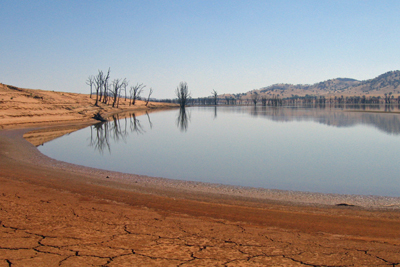
<p>To discuss the effects of the tragedy, which extends not only to environmental issues, <a href="https://www.iea.usp.br/en/hubs/sao-carlos-en" class="external-link">IEA's São Carlos Center</a> will hold the debate <i>The Doce River Valley: a Disaster in Progress </i>on <strong>March 31</strong>, at <strong>7.00 pm</strong>. The event will bring together four panelists and a moderator with different experiences on the subject. <span style="text-align: justify; ">The event will be broadcast live on the </span><a style="text-align: justify; " href="https://www.iea.usp.br/aovivo">web</a><span style="text-align: justify; ">.</span></p>
<p>Marcelo Tramontano and Luciano Costa, both professors at the USP's Institute of Architecture and Urbanism (IAU), will discuss the experience of traveling through <span>affected</span> areas. <span>Tramontano</span> took about ten days to travel from Mariana, <span>in the State of Minas Gerais, until Linhares, in the State of Espírito Santo, </span>where the mouth of Doce River is located. He has also visited the ports where the ore is shipped abroad: Camburi, in Vitória (the capital of Espírito Santo), where trains arrive after leaving the Doce River Valley; and Ubu, in the municipality of Anchieta, end point of the pipeline that brings the ore directly from Mariana.</p>
<p><span>During his trip, Tramontano interviewed experts, activists, politicians, researchers, environmentalists, and the inhabitants of the region, such as indians, people in riverine settlements and traders. The footage will be used in order to produce a documentary. "The disaster brought <span>the serious problems generated by mining activities</span> to light, an issue that is not restricted to Mariana. All populations <span>throughout the Doce River to the sea</span>, including fauna and flora, are in jeorpardy," said Tramontano.</span></p>
<p><span>Costa gave priority to small <span>cities and </span>local roads, trying to be as close to the Doce River <span>and its tributaries </span>as he could. Working with <span>Rafael Lazzarotto Simioni, a</span> professor at the Faculty of Law of Southern Minas Gerais (MSDS) and at the University of the Sapucaí Valley (UNIVÁS), he has visited two districts that have been completely destroyed by the mud (Camargos and Paracatu de Baixo), and further municipalities on the way to Linhares.</span></p>
<p><span>"Through the photographs that have been taken, our perspective is to bring a set of impressions on the local culture, on the Doce River Valley and on the economic corporations operating in the region beyond the disaster. The 'mud', in my view, has allowed the restoration of a forgotten link between the economic corporations and the<span> geographical space that the </span>Valley is, <span>often treated only as a resource,</span>" said Costa.</span></p>
<p><span>Professor <span>Reinaldo Duque Brasil, from </span>the Federal University of Juiz de Fora (UFJF), had a close experience with the problem. Besides being an expert in the Doce River Basin, he teaches at the UFJF campus of Governador Valadares, one of the cities that have suspended the water supply because of the contamination.</span></p>
<p><span>The group of debaters will be completed by Eduardo Mario Mendiondo, a professor at the USP's School of Engineering in São Carlos (EESC-USP), and general coordinator of the National Center for Monitoring and Natural Disaster Alerts of the Ministry of Science, Technology and Innovation (CEMADEN / MCTI). The moderator will be Marcel Fantin, a professor at the IAU and author of <i>Agregados Minerais, Meio Ambiente e Urbanização na Perspectiva das Políticas Públicas Canadenses: Províncias de Ontário e Québec</i> ("Mineral Aggregates, Environment and Urbanization in the Perspective of the Canadian Public Policy: Provinces of Ontario and Québec"), a book on Canadian public policy that addresses mineral aggregates and the insertion of the mining sector in the <span>process of </span>environmental, <span>urban and regional</span> planning.</span></p>
<p><span>The event is supported by the IAU and will be held in the Jorge Caron A<span>uditorium</span> on the USP's campus 1 in São Carlos.</span></p>]]></content:encoded>
    <dc:publisher>No publisher</dc:publisher>
    <dc:creator>Richard Meckien</dc:creator>
    <dc:rights>Original version in Portuguese by Thais Cardoso.</dc:rights>
    
      <dc:subject>Brazil</dc:subject>
    
    
      <dc:subject>Water</dc:subject>
    
    
      <dc:subject>São Carlos Center</dc:subject>
    
    
      <dc:subject>Environment</dc:subject>
    
    
      <dc:subject>Public event</dc:subject>
    
    <dc:date>2016-03-10T14:05:00Z</dc:date>
    <dc:type>Notícia</dc:type>
  </item>


  <item rdf:about="https://www.iea.usp.br/en/news/consequences-of-environmental-disaster-mariana">
    <title>The consequences of the environmental disaster in Mariana</title>
    <link>https://www.iea.usp.br/en/news/consequences-of-environmental-disaster-mariana</link>
    <description></description>
    <content:encoded xmlns:content="http://purl.org/rss/1.0/modules/content/"><![CDATA[<table class="tabela-direita">
<tbody>
<tr>
<th><img src="https://www.iea.usp.br/imagens/bento-rodrigues-devastado-pela-lama-da-samarco" alt="Bento Rodrigues devastado pela lama da Samarco" class="image-inline" title="Bento Rodrigues devastado pela lama da Samarco" /></th>
</tr>
<tr>
<td style="text-align: right; "><strong>
<div id="_mcePaste">Bento Rodrigues, a subdistrict of Mariana, ravaged</div>
<div id="_mcePaste">by the mud released by the disrupted dam of the miner Samarco</div>
</strong></td>
</tr>
</tbody>
</table>
<p class="mceContentBody documentContent">The disruption of a tailings dam in Mariana, in the State of Minas Gerais, on November 5, is the largest environmental disaster ever occurred in Brazil and one of the five largest in world history.</p>
<p class="mceContentBody documentContent">In addition to causing the death of 13 people (there are <span>still</span><span> </span><span>eight missing persons), destroying the homes of 250 families in the Mariana subdistricts, and several other social and economic impacts, the mudslide has affected water resources (especially the Doce River, until its mouth in the State of Espírito Santo), and terrestrial and marine ecosystems.</span></p>
<p class="mceContentBody documentContent">On <strong>December 7</strong>, <strong>at 2 pm</strong>, at the seminar <i>The Environmental Damage of Samarco - Impacts and Recovery</i>, five professors of USP, covering various disciplines, will explain the severity of the consequences of the disaster and what needs to be done for the environmental recovery of the affected areas.</p>
<p class="mceContentBody documentContent">The exhibitors and their topics will be:</p>
<p class="mceContentBody documentContent">Ana Paula Fracalanza (EACH and Procam-IEE-USP) - The Impacts on Water Resources</p>
<p class="mceContentBody documentContent">Luis Enrique Sánchez (EP-USP) - The recovery of degraded areas</p>
<p class="mceContentBody documentContent">Marcos Buckeridge (IB-USP) - The Impacts on Ecosystems</p>
<p class="mceContentBody documentContent">Pedro Luiz Cortês (ECA-USP) - The Dynamics of Tragedy</p>
<p class="mceContentBody documentContent"><a href="https://www.iea.usp.br/en/persons/researchers/pedro-roberto-jacobi" class="external-link">Pedro Jacobi</a> (IEA, FE and Procam-IEE-USP) - The Social Impacts</p>
<p class="mceContentBody documentContent">Moderation will be in charge of Jacobi, who coordinates the <a href="https://www.iea.usp.br/en/research/research-groups/environmental-sciences" class="external-link">IEA's Environment and Society Research Group</a>, organizer of the event.</p>
<p style="text-align: right; "><span class="discreet">Photo: Federal Senate</span></p>]]></content:encoded>
    <dc:publisher>No publisher</dc:publisher>
    <dc:creator>Richard Meckien</dc:creator>
    <dc:rights>Original version in Portuguese by Mauro Bellesa</dc:rights>
    
      <dc:subject>Water</dc:subject>
    
    
      <dc:subject>Research Group: Environment and Society</dc:subject>
    
    
      <dc:subject>Commons</dc:subject>
    
    
      <dc:subject>Environment</dc:subject>
    
    
      <dc:subject>Ecosystems</dc:subject>
    
    
      <dc:subject>Event</dc:subject>
    
    <dc:date>2015-12-01T11:25:00Z</dc:date>
    <dc:type>Notícia</dc:type>
  </item>


  <item rdf:about="https://www.iea.usp.br/en/news/metropolises-in-crisis-water-management-in-Mexico-and-Spain">
    <title>Water management in large cities</title>
    <link>https://www.iea.usp.br/en/news/metropolises-in-crisis-water-management-in-Mexico-and-Spain</link>
    <description></description>
    <content:encoded xmlns:content="http://purl.org/rss/1.0/modules/content/"><![CDATA[<p>The experiences of large cities regarding their governance of water resources will be presented at the IEA by experts who will be in Brazil for the <i>V GovAgua - Water Governance Meeting</i>.</p>
<table class="tabela-esquerda">
<tbody>
<tr>
<th><img src="https://www.iea.usp.br/imagens/Escassez-Hidrica-sylvia-Tim-J-Keegan-flickr-copia.jpg" alt="Escassez Hídrica" class="image-inline" title="Escassez Hídrica" /></th>
</tr>
<tr>
<td><br /></td>
</tr>
</tbody>
</table>
<p>Entitled <i>Water Scarcity, Governance and Environmental Justice</i>, the meeting will be held in Spanish. It will take place on <strong>November 10</strong>, <strong>from 9.30 am to 12.30 pm</strong>, in the IEA's Events Room, with moderation of Professor Pedro Jacobi, coordinator of the IEA's Environment and Society research group.</p>
<p>"Metropolitan areas are experiencing prolonged drought crises. The experience shows that the models prioritize the supply of water to the detriment of demand control. The management models also fail to offer low investment in sewage treatment and water-free consumption, a scarce resource," says Professor Jacobi.</p>
<p>The panelists will examine the contexts of water scarcity in the world, the emergence of conflicts, and the reactions and responses of social actors  from the perspective of environmental justice.</p>
<p> </p>
<p><strong>The conferencists</strong></p>
<p><span>Geographer and historian </span><a class="external-link" href="https://grupo.us.es/giest/es/node/299">Leandro del Moral Ituarte</a><span>, who currently heads the Department of Human Geography at the University of Sevilla, specializes in hydraulic works. He has studied the lower basin of the Guadalquivir river, which bathes the territories of Andaluzia, in southern Spain.</span></p>
<p><a href="http://www.centre-cired.fr/spip.php?article749&amp;lang=fr" target="_blank">Bernard Barraqué</a>, research director at the Centre International de Recherche sur l'Environnement et le Développement of Le Centre National de la Recherche Scientifique, in Paris, has focused his recent studies on the allocation of water resources, evaluation of sustainable policies and methods,  institutional and participatory approaches, and comparative analysis of the sustainability of water management in major European cities. He also works at Agro ParisTech - École Nationale du Génie Rural, des Eaux et des Fôrets.</p>
<p>The participation of <a href="http://ugto.academia.edu/AlexRicardoCalderaOrtega" target="_blank">Alex Ricardo Caldera Ortega</a><span>, from the Department of Public Management and Development of the University of Guanajuato, has been cancelled due to the speaker's agenda.</span></p>
<p style="text-align: right; "><span class="discreet">Photo: Tim J. Keegan/Flickr</span></p>]]></content:encoded>
    <dc:publisher>No publisher</dc:publisher>
    <dc:creator>Richard Meckien</dc:creator>
    <dc:rights>Original version in Portuguese by Sylvia Miguel </dc:rights>
    
      <dc:subject>Europe</dc:subject>
    
    
      <dc:subject>Research Group: Environment and Society</dc:subject>
    
    
      <dc:subject>Power</dc:subject>
    
    
      <dc:subject>Interdisciplinarity</dc:subject>
    
    
      <dc:subject>Water</dc:subject>
    
    
      <dc:subject>Capitalism</dc:subject>
    
    
      <dc:subject>Environment</dc:subject>
    
    
      <dc:subject>Sustainability</dc:subject>
    
    
      <dc:subject>Globalization</dc:subject>
    
    
      <dc:subject>Inequality</dc:subject>
    
    
      <dc:subject>Poverty</dc:subject>
    
    
      <dc:subject>Environmental Policy</dc:subject>
    
    
      <dc:subject>Cities</dc:subject>
    
    <dc:date>2015-10-27T17:55:00Z</dc:date>
    <dc:type>Notícia</dc:type>
  </item>


  <item rdf:about="https://www.iea.usp.br/en/media-library/photos/events-2015/as-mudancas-climaticas-e-a-seguranca-alimentar-ciclo-tematico-14-de-outubro-de-2015">
    <title>Cycle "Towards COP 21": Climate Change and Food Security - October 14, 2015</title>
    <link>https://www.iea.usp.br/en/media-library/photos/events-2015/as-mudancas-climaticas-e-a-seguranca-alimentar-ciclo-tematico-14-de-outubro-de-2015</link>
    <description></description>
    
    <dc:publisher>No publisher</dc:publisher>
    <dc:creator>Richard Meckien</dc:creator>
    <dc:rights></dc:rights>
    
      <dc:subject>Research Group: Environment and Society</dc:subject>
    
    
      <dc:subject>Climate</dc:subject>
    
    
      <dc:subject>Natural Resources</dc:subject>
    
    
      <dc:subject>Hunger</dc:subject>
    
    
      <dc:subject>Climate Change</dc:subject>
    
    
      <dc:subject>Energy</dc:subject>
    
    
      <dc:subject>Water</dc:subject>
    
    
      <dc:subject>Environment</dc:subject>
    
    
      <dc:subject>World</dc:subject>
    
    
      <dc:subject>Cities</dc:subject>
    
    <dc:date>2015-10-26T16:05:00Z</dc:date>
    <dc:type>Pasta</dc:type>
  </item>


  <item rdf:about="https://www.iea.usp.br/en/media-library/photos/events-2015/as-mudancas-climaticas-e-a-crise-hidrica-ciclo-tematico-30-de-setembro-de-2015">
    <title>Cycle "Towards COP 21": Climate Change and Water Crisis - September 30, 2015</title>
    <link>https://www.iea.usp.br/en/media-library/photos/events-2015/as-mudancas-climaticas-e-a-crise-hidrica-ciclo-tematico-30-de-setembro-de-2015</link>
    <description></description>
    
    <dc:publisher>No publisher</dc:publisher>
    <dc:creator>Richard Meckien</dc:creator>
    <dc:rights></dc:rights>
    
      <dc:subject>Research Group: Environment and Society</dc:subject>
    
    
      <dc:subject>Climate</dc:subject>
    
    
      <dc:subject>Natural Resources</dc:subject>
    
    
      <dc:subject>Energy</dc:subject>
    
    
      <dc:subject>Water</dc:subject>
    
    
      <dc:subject>Environment</dc:subject>
    
    
      <dc:subject>Environmental Sciences</dc:subject>
    
    
      <dc:subject>Cities</dc:subject>
    
    <dc:date>2015-10-07T20:05:00Z</dc:date>
    <dc:type>Pasta</dc:type>
  </item>


  <item rdf:about="https://www.iea.usp.br/en/news/seminar-presents-causes-impacts-and-solutions-to-climate-change">
    <title>Seminar presents causes, impacts and solutions to climate change</title>
    <link>https://www.iea.usp.br/en/news/seminar-presents-causes-impacts-and-solutions-to-climate-change</link>
    <description></description>
    <content:encoded xmlns:content="http://purl.org/rss/1.0/modules/content/"><![CDATA[<p>The impacts of climate change in the state of São Paulo will be discussed by national and international experts at the seminar <i>Climate Change in São Paulo: Causes, Impacts and Solutions</i>, to be held on October 14-16, <strong>daily from 9.00 am to 5.00 pm</strong>, in the auditorium of the Brasiliana Guita e José Mindlin Library, at the USP. The event will be broadcast live on the <a href="https://www.iea.usp.br/aovivo" class="external-link">IEA's website</a>.</p>
<p>The meeting, sponsored by the ACIESP (São Paulo State Academy of Science), by the USP's Institute of Biosciences (IB) and by the INCLINE (Interdisciplinary Climate Investigation Center), and supported by the IEA, will be divided into thematic panels: Water, the 21st Conference of the Parties (COP-21), Biodiversity, Cities and Health, and Public Policies. USP researchers and science journalists will mediate the discussions.</p>
<p>In the late afternoon of the last day there will be the inauguration ceremony for the new members of the ACIESP.</p>
<p> </p>
<p><span><strong>Programme:</strong></span></p>
<p><strong>October 14 (morning)</strong></p>
<p>Moderator: Marcos Buckeridge (President of ACIESP and professor at the IB)<br /><span><strong>Opening session</strong><br /></span><span>9.30 am Marco Antonio Zago (President of USP)<br /></span><span>9.40 am José E. Krieger (Provost for Research at USP)<br /></span><span>9.50 am Gilberto Xavier (IB)<br /></span><span>10.00 am Marcos Buckeridge <br /></span><span>10.30 am – 12.00 pm <strong>Impacts of the global climate changes in São Paulo</strong><br /></span><span>With Jose Antonio Marengo Orsini (National Institute for Space Research)</span></p>
<p><strong>October 14 (afternoon)</strong></p>
<p>Moderator: Herton Scobar (<i>O Estado de S. Paulo </i>newspaper)<br /><strong>Panel 1 – Water<br /></strong><span>2.00 pm <strong> The drought of 2014 in the source of the Cantareira System</strong><br /></span><span>With Humberto Ribeiro da Rocha (USP's Institute of Astronomy, Geophysics and Astmospheric Sciences - IAG)<br /></span><span>2.30 pm <strong>Water and Agriculture - The New Challenges</strong><br /></span><span>Orivaldo Brunini (Agronomic Institute)<br /></span><span>3.00 pm <strong>Human right to water: relative scarcity and application challenges</strong><br /></span><span>Wagner Costa Ribeiro (USP's Faculty of Philosophy, Languages and Literature, and Social Sciences (FFLCH), and IEA)<br /></span><span>3.30 pm Break<br /></span><span>3.50 pm Q&amp;A</span></p>
<p><strong>October 15 (morning)</strong></p>
<p>Moderator: Tércio Ambrizzi (IAG/USP)<br /><span><strong>Panel 2 – COP-21</strong><br /></span><span>9.00 am <strong>The COP-21 and the science of the global climate changes</strong><br /></span><span>With Paulo Eduardo Artaxo Netto (USP's Institute of Physics - IF)<br /></span><span>9.30 am <strong>Bioenergy as a <span>global warming</span> gas mitigation strategy and its contribution to sustainable development</strong><br /></span><span>With Glaucia Mendes Souza (USP's Institute of Chemistry - IQ)<br /></span><span>10.00 am – 12.00 pm Q&amp;A</span></p>
<p><strong>October 15 (afternoon)</strong></p>
<p>Moderator: Marcos Pivetta (FAPESP Research Journal)<br /><span><strong>Panel 3 – Biodiversity</strong><br /></span><span>2.00 pm <strong>Global climate changes and biodiversity: introduction to the problem</strong><br /></span><span>With Carlos A. Navas Iannini (IB)<br /></span><span>2.30 pm <strong>The sixth mass extinction is underway: the reptile and amphibian biodiversity crisis</strong><br /></span><span>Barry Sinervo (University of California)<br /></span><span>3.30 pm Break<br /></span><span>3.50 pm Q&amp;A</span></p>
<p><strong>October 16 (morning)</strong></p>
<p>Moderator: Eduardo Geraque (<i>Folha de S. Paulo</i> newspaper)<br /><span><strong>Panel 4 – Cities and Health</strong><br /></span><span>9.00 am<strong> <span>Impacts of the global climate changes in Ciudad de México</span></strong><br /></span><span>With Víctor Orlando Magaña Rueda (Universidad Nacional Autónoma de México - UNAM)<br /></span><span>9.40 am <strong>Global climate changes and their effects in Paulista citizens' health</strong><br /></span><span>With Paulo Hilário Nascimento Saldiva (deputy director of the IEA and professor at the USP's School of Medicine - FM)<br /></span><span>10.20 am <strong>Using computer games to raise the awareness of climate changes and neglected tropical diseases</strong><br /></span><span>With Manuel Cesário (Academia Magdalena)<br /></span><span>11.00 am – 12.00 pm Q&amp;A</span></p>
<p><strong>October 16 (afternoon)</strong></p>
<p>Moderator: Pedro Roberto Jacobi (IEA and professor at the USP's Institute of Energy and Environment - IEE)<br /><span><strong>Panel 5 – Public Policies</strong><br /></span><span>2.00 pm <strong>Reviewing public policies to deal with the water crisis in a scenario of climate change</strong><br /></span><span>With Pedro Roberto Jacobi (IEA and IEE)<br /></span><span>2.20 pm Patrícia Faga Iglecias Lemos (São Paulo State Secretary for the Environment)<br /></span><span>2.40 pm <strong>Science Diplomacy: Communicating Science in Society</strong><br /></span><span>With Julia Knights (Director of the Science Innovation Network - British Embassy in Brazil)<br /></span><span>3.00 pm – 4.00 pm Q&amp;A<br />4.15 pm <span>–</span> 5.15 pm <span><strong>Climate Change and the Earth System</strong><br /></span></span><span>With Carlos Afonso Nobre</span></p>
<p><strong>Inauguration ceremony for the new members of ACIESP</strong><br />Opening<br />5.30 pm - <span>José Goldemberg (</span><span>President of FAPESP/USP)<br />6.00 pm -<strong> </strong></span><span>Carlos Henrique de Brito Cruz (</span><span>Scientific Director of FAPESP/UNICAMP) - <i>to be confirmed</i><br />6.30 pm - José Roberto Krieger (former President of ACIESP)<br />6.45 pm - </span><span>Marcos Buckeridge (President of ACIESP and professor at the IB)</span></p>]]></content:encoded>
    <dc:publisher>No publisher</dc:publisher>
    <dc:creator>Richard Meckien</dc:creator>
    <dc:rights>Original version in Portuguese by Fernanda Rezende</dc:rights>
    
      <dc:subject>Climate</dc:subject>
    
    
      <dc:subject>Biodiversity</dc:subject>
    
    
      <dc:subject>Climate Change</dc:subject>
    
    
      <dc:subject>Water</dc:subject>
    
    
      <dc:subject>Environmental Sciences</dc:subject>
    
    
      <dc:subject>Environmental Policy</dc:subject>
    
    
      <dc:subject>Cities</dc:subject>
    
    <dc:date>2015-09-30T21:10:00Z</dc:date>
    <dc:type>Notícia</dc:type>
  </item>


  <item rdf:about="https://www.iea.usp.br/en/news/iea-creates-working-group-to-discuss-the-water-crisis-in-sao-paulo">
    <title>IEA creates working group to discuss the water crisis in São Paulo</title>
    <link>https://www.iea.usp.br/en/news/iea-creates-working-group-to-discuss-the-water-crisis-in-sao-paulo</link>
    <description></description>
    <content:encoded xmlns:content="http://purl.org/rss/1.0/modules/content/"><![CDATA[<table class="tabela-direita-200">
<tbody>
<tr>
<th><img src="https://www.iea.usp.br/midiateca/foto/reunioes-internas/reuniao-sobre-agua-19-de-fevereiro-de-2015/agua-33.jpg/@@images/0892b498-15ec-4465-853b-824e9f18cda4.jpeg" alt="Visão Geral" class="image-right" title="Visão Geral" /></th>
</tr>
<tr>
<td style="text-align: right; ">
<p><strong>First meeting of the working group on<br /></strong><span><strong>water crisis at the IEA</strong></span></p>
</td>
</tr>
</tbody>
</table>
<p>In order to contribute to discussions about the water crisis affecting the Southeast of Brazil and manifesting more severely in São Paulo, where the water supply is at risk, the IEA has created a working group to reflect critically on the causes of the problem and propose solutions.</p>
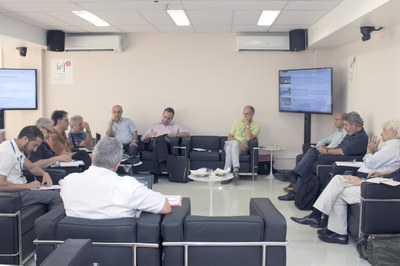
<p>The group is composed of researchers from the IEA and professors of the USP, all specialized in the field of water resources. The coordinators are Wagner Costa Ribeiro, a member of the IEA's research group on <a href="https://www.iea.usp.br/en/research/research-groups/environmental-sciences" class="external-link">Environment and Society</a>, and Marcos Buckeridge, a professor at the USP's Institute of Biosciences. The group met for the first time on February 19. Besides <a href="https://www.iea.usp.br/en/persons/researchers/martin-grossmann" class="external-link">Martin Grossmann</a>, director of the IEA, the attendants were professors Renato Luiz Anelli, Hamilton Varela, José Carvalheiro, <span class="external-link"><a href="https://www.iea.usp.br/en/persons/researchers/jean-paul-walter-metzger" class="external-link">Jean Paul Metzer</a></span>, José Pedro Costa, Marcio Automare and <a href="https://www.iea.usp.br/en/persons/researchers/pedro-roberto-jacobi" class="external-link">Pedro Jacobi</a>.</p>
<p><span>The meeting has resulted in the definition of priority axes of analysis and discussion, which will serve as guidelines in the preparation of an action plan aimed at mitigating the consequences of prolonged drought and to prevent water shortage scenarios to occur in the future:</span></p>
<div id="_mcePaste"></div>
<div id="_mcePaste">
<ul>
<li><span>Adoption of a</span> rather <span><span><span>preventive </span>than curative</span> logic in water resources management;</span></li>
<li><span>Multi and <span>transdisciplinary c</span>hallenges in the analysis of key issues;</span></li>
<li><span>Feasibility of the private model of water management in São Paulo;</span></li>
<li><span>Houses and environmental conservation in watershed areas;</span></li>
<li><span>Reforestation and tree planting;</span></li>
<li><span>Global reality in the field of public health;</span></li>
<li><span>Legislation and the new forest code;</span></li>
<li><span>Population clarification (scientific communication);</span></li>
<li><span>Human rights;</span></li>
<li><span>Climate changes;</span></li>
<li><span>Economy aspects;</span></li>
<li><span>Complex systems approach.</span></li>
</ul>
</div>
<ul>
</ul>
<p style="text-align: right; "><span class="discreet">Photo: Sandra Codo/IEA-USP</span></p>]]></content:encoded>
    <dc:publisher>No publisher</dc:publisher>
    <dc:creator>Richard Meckien</dc:creator>
    <dc:rights>Original version in Portuguese by Flávia Dourado</dc:rights>
    
      <dc:subject>Climate</dc:subject>
    
    
      <dc:subject>Natural Resources</dc:subject>
    
    
      <dc:subject>Institutional</dc:subject>
    
    
      <dc:subject>Commons</dc:subject>
    
    
      <dc:subject>Water</dc:subject>
    
    <dc:date>2015-03-06T21:20:00Z</dc:date>
    <dc:type>Notícia</dc:type>
  </item>


  <item rdf:about="https://www.iea.usp.br/en/news/hydroelectric-generation-in-the-amazon">
    <title>The many faces of the new era of hydroelectric generation in the Amazon</title>
    <link>https://www.iea.usp.br/en/news/hydroelectric-generation-in-the-amazon</link>
    <description></description>
    <content:encoded xmlns:content="http://purl.org/rss/1.0/modules/content/"><![CDATA[<p style="text-align: justify; "><img src="https://www.iea.usp.br/imagens/amazoniacapajpg.jpg" alt="Amazônia - capa" class="image-right" title="Amazônia - capa" />Wrapped in the triad that comprises the Amazon rainforest, climate and energy generation, economic, social and environmental aspects will be analyzed at the debate "Amazon: The Old and the New Brazilian Hydroelectric Frontier", to be held on May 14, at 2 pm, in the IEA-USP’s Event Room.</p>
<p style="text-align: justify; ">The panelists of the meeting will be Celio Bermann, professor at USP’s <a class="external-link" href="http://www.iee.usp.br/">Institute for Energy and Environment (IEE)</a> and who will be participating via Skype, Gustavo Tosello Pinheiro, coordinator of Intelligent Infrastructure at The Nature Conservancy (TNC) in Brazil, João Andrade, coordinator of the <i>Iniciativa Defensa Socioambiental</i> (an initiative for social and environmental defense) at the Center for Life Institute (ICV), and Pedro Bara Neto, researcher of the Federal University of Rio de Janeiro’s (UERJ) Study Group on the Electricity Sector (GESEL).</p>
<p style="text-align: justify; ">Organized by <a href="https://www.iea.usp.br/en/research/research-groups/environmental-sciences" class="external-link">IEA-USP’s Environment and Society Research Group</a> in partnership with the IEE, and the School of Arts, Sciences and Humanities’s (EACH) <a class="external-link" href="https://uspdigital.usp.br/tycho/gruposPesquisaObter?codigoGrupoPesquisa=0067605FOISZ9K">research group on Environmental Planning and Management (PLANGEA)</a>, both of USP, the meeting will focus on two central questions:</p>
<ul style="text-align: justify; ">
<li><span>What is the scenario of social and environmental conflicts and challenges to the intensification of planning hydroelectric dams in the Amazon?</span></li>
<li><span>Which existing experiences in local development, environmental protection and analyzes of extreme weather events represent opportunities for the inclusion of these topics in various scales of planning hydroelectric dams in the Amazon?</span></li>
</ul>
<p style="text-align: justify; "> </p>
<p style="text-align: justify; "><strong>THEMED DEVELOPMENTS</strong></p>
<p style="text-align: justify; ">The Brazilian Amazon accounts for 51 % of all the hydroelectric potential of the country. However, according to Evandro Moretto, professor of EACH-USP, only a small part of this potential is exploited, since most mills in the region have been built in the 1960s and the 1970s, and in the following two decades there has been a significant expansion in infrastructure for power generation.</p>
<p style="text-align: justify; "><span>Only in the 2000s Brazil started to invest massively in expansion of hydroelectric capacity in the Amazon again. As pointed by Moretto, who will mediate the debate, the installation of more than 150 dams in the region is planned. The highlights are Jirau and Santo Antonio, on the Madeira River, Belo Monte, on the Xingu River, and the project of the basins of the Tapajós and Negro rivers.</span></p>
<p style="text-align: justify; ">According to the professor, discussions around that recovery involve a series of thematic developments - such as weather events, environmental protection and socioeconomic development - which will be addressed at the meeting. As an example, the mediator cites the period of prolonged drought this summer in Brazil, which led to the shortage of large water reservoirs in the Southeast and the Midwest, "while the gates of the plants on the Madeira were opened to let through the highest flow of the river in history in the wake of thousands homeless upstream and downstream of the dams."</p>
<p style="text-align: justify; "><span>Moretto also mentions the particularity of the situation of the Amazon region. On the one hand, it suffers the environmental impacts of large infrastructure projects. On the other hand, it is favored by various actions of environmental protection and local development, "which should not be neglected in planning hydropower projects, under penalty of the new plants being much more impactful and conflictive than Belo Monte already is."</span></p>
<p style="text-align: justify; "><strong>EVENT</strong></p>
<p style="text-align: justify; ">The completion of the discussion is supported by FAPESP, IEE-USP’s Graduate Program in Environmental Science (PROCAM), TNC, Brazilian Association of Impact Assessment (ABAI) and ICV.</p>
<p style="text-align: justify; "><span style="text-align: justify; ">The event will be broadcast live on the </span><a style="text-align: justify; " href="https://www.iea.usp.br/aovivo">web</a><span style="text-align: justify; ">.</span></p>]]></content:encoded>
    <dc:publisher>No publisher</dc:publisher>
    <dc:creator>Richard Meckien</dc:creator>
    <dc:rights></dc:rights>
    
      <dc:subject>Research Group: Environment and Society</dc:subject>
    
    
      <dc:subject>Water</dc:subject>
    
    
      <dc:subject>Commons</dc:subject>
    
    
      <dc:subject>Environment</dc:subject>
    
    
      <dc:subject>Amazon</dc:subject>
    
    <dc:date>2014-05-09T18:10:00Z</dc:date>
    <dc:type>Notícia</dc:type>
  </item>


  <item rdf:about="https://www.iea.usp.br/en/news/an-interdisciplinary-look-at-the-drought-in-sao-paulo">
    <title>An interdisciplinary look at the drought in São Paulo</title>
    <link>https://www.iea.usp.br/en/news/an-interdisciplinary-look-at-the-drought-in-sao-paulo</link>
    <description></description>
    <content:encoded xmlns:content="http://purl.org/rss/1.0/modules/content/"><![CDATA[<p style="text-align: justify; "><img src="https://www.iea.usp.br/imagens/evento-verao-2013-2014-e-cenarios-de-estresse-hidrico" alt="Evento &quot;Verão 2013/2014 e Cenários de Estresse Hídrico&quot;" class="image-right" title="Evento &quot;Verão 2013/2014 e Cenários de Estresse Hídrico&quot;" />The Metropolitan Region of São Paulo (RMSP) has been undergoing the bitter consequences of a prolonged drought, which led the Cantareira water reservoir to beat low levels records. The IEA-USP addressed this water shortage situation in the debate "Summer 2013/2014 and Scenarios of Water Stress" on March 19. The event was part of the celebrations of the Water Week 2014, prior to the World Water Day, celebrated on March 22.</p>
<p style="text-align: justify; ">The debate has been organized by a partnership between two of IEA-USP’s research groups: <a href="https://www.iea.usp.br/en/research/research-groups/environmental-sciences" class="external-link">Environment and Society</a>, and <a href="https://www.iea.usp.br/en/research/research-groups/philosophy-history-sociology-of-science-and-technology" class="external-link">Philosophy, History, and Sociology of Science and Technology</a>. They had the support of the Center for Studies in Social and Environmental Governance of USP’s Institute for Energy and Environment (IEE). The meeting has comprised two roundtables, both mediated by Pedro Jacobi, coordinator of IEA’s Environment and Society Research Group.</p>
<p style="text-align: justify; ">The exhibitors were Wagner Ribeiro Costa, professor at USP’s Faculty of Philosophy, Letters and Human Sciences (FFLCH), Maurício de Carvalho Ramos, also a professor at FFLCH, Daniela Libório Di Sarno, professor at PUC-SP’s Faculty of Law and vice president of the Brazilian Institute of Urban Law (IBDU), Marcio Automare, organizational development analyst at the Institute of Land of the State of São Paulo (ITESP), and Susana Prizendt, coordinator of the Paulista Committee of the Permanent Campaign Against Pesticides and for Living.</p>
<p style="text-align: justify; ">The meeting has addressed the water problem from an interdisciplinary perspective, considering environmental, legal, socio-political, philosophical and food safety aspects. According to Jacobi, the idea was to reflect on the problem of water in the RMSP, but covering broader issues involving, among others, inequalities in access to water, changes in rainfall rates caused by the phenomenon of climate change, institutional barriers and the posture of the government in relation to the prevention and remediation of the problem.</p>
<p style="text-align: justify; "><a href="https://www.iea.usp.br/en/media-library/photos/events-2014/verao-2013-14-e-cenarios-de-estresse-hidrico-19-de-marco-de-2014" class="external-link"><b>Photos of the event</b></a></p>
<p style="text-align: justify; "><strong>MEASURES OF THE STATE</strong></p>
<p style="text-align: justify; ">The debate has been heated up by recent measures that have been studied and taken by the state government of São Paulo in order to try to circumvent the critical situation of the Cantareira reservoir, which currently operates at approximately 15 % of its capacity. Among these measures is the proposal of using water from the Paraíba do Sul River reservoirs to supply the RMSP. When asked about the matter, Ribeiro said that he does not consider the proposal timely, since the suggested river is also undergoing a situation of water stress.</p>
<p style="text-align: justify; ">Ribeiro has criticized the emergency works of the state government, which began on March 14 to pump the volume of "dead water" from the bottom of the dams that form the Cantareira reservoir. According to him, this means "to remove the last drop of a water that has been stored for 40 years, stagnant, whose quality is questionable due to the unknown factors associated with it."</p>
<p style="text-align: justify; ">Besides, he said that it was a risky move, which can lead to resource depletion in the region. “That is because to saturate the soil again to the point for the dam to refill, much more than the average rainfall rates in the region will be needed, and those were not achieved this summer."</p>
<p style="text-align: justify; "><strong>FRAGMENTED MANAGEMENT</strong></p>
<p style="text-align: justify; ">Sarno has pointed out the incongruity of the Brazilian legal system in relation to water resources management as the top reason for the shortage in the country. According to her, although the Federal Constitution provides that the management should be shared between the federal government, the states and the municipalities, there is little dialogue between the parties and the administration of water resources ends up getting fragmented.</p>
<p style="text-align: justify; ">"To meet the challenge of shared management, the three [federal, state and municipal] parties need to sit down and discuss. But this step has still not been taken. There are neither vertically talks between the parties nor horizontally ones between institutions," she said.</p>
<p style="text-align: justify; ">This fragmentation gets compounded by the mismatch between the division of the federal system, that obeys political criteria, and the division of watersheds, which follows geographic criteria. The watersheds are important because they put another actor in the scene: the Watershed Committees, which comprise the National System for Water Resources Management. Composed of representatives of the various water user sectors, civil society and government organizations, the committees approve the Water Resources Plan for each watershed, arbitrate conflicts over water use, suggest values ​​for the charging of consumption, among others.</p>
<p style="text-align: justify; ">According to Sarno, the problem is that none of the management models adopted in the country - municipal management and state management by autarchies or contractors - is consistent with the watershed divisions. "The Committees even do part of the management, but who puts the distribution of water into practice is not them, but managing institutions.”</p>
<p style="text-align: justify; "><strong>PUBLIC X PRIVATE</strong></p>
<p style="text-align: justify; ">As for Ribeiro, the biggest obstacle to equate the issue of water in Brazil is the private management of water resources. In the RMSP, for example, the management is done by SABESP, a mixed economy company, publicly listed and traded on the stock exchange, which operates according to the logic of a private institution.</p>
<p style="text-align: justify; ">"Is it the function of the state to pay up, profit and speculate based on the commercialization of water resources? No, it is not the function of the state to make money from the water, as done by SABESP," warned Ribeiro, noting the lack of transparency in the management of the company. "Besides the water flows, there should be transparency in relation to financial flows," he pointed out.</p>
<p style="text-align: justify; ">As Ribeiro, Automare pondered that a government-linked company as SABESP should not behave like a private company, treating water as a product. He also cited the industry of water sold in gallons, whose growth was affecting groundwater, as an example of the commercial exploitation of water resources.</p>
<p style="text-align: justify; ">Sarno also addressed the conflict between public and private interests. According to her, Watershed Committees treat water as a commodity, whose distribution should be equal and the charging should happen only to regulate the consumption. The companies that put management into practice, such as SABESP, treat water as a product for sale.</p>
<p style="text-align: justify; ">According to the lawyer, the managers of metropolitan regions and municipalities do not take into consideration the willingness of the watershed in allowing, for example, the expansion of an industrial district that could endanger the water supply on site. "It takes measures to reconcile urban expansion and the infrastructure for distribution of water in terms of quality and quantity," he warned.</p>
<p style="text-align: justify; "><strong>ETHICAL DIMENSION</strong></p>
<p style="text-align: justify; ">Taking a philosophical approach, Carvalho said that the water can be considered from two sets of properties: material ones, linked to biochemical principles, and symbolic ones, related to its immeasurable value to life, making it a symbol of power.</p>
<p style="text-align: justify; ">According to him, when considering the symbolic properties, water can be conceived both as a resource - a product to be exploited economically -, as well as a good - something free and not marketable in any way. And it is this conception of a good that should be adopted to tackle the problem of water stress from an ethical perspective.</p>
<p style="text-align: justify; ">"Addressing the issue rationally and responsibly involves not putting into practice technoscientific possibilities related to water use that may jeopardize the availability or the material properties of water resources," he said. "If the ethical stance prevailed, there would be no need for rationing and an appeal to the conscience of people would be sufficient," he added.</p>
<p style="text-align: justify; "><strong>PARTICIPATION</strong></p>
<p style="text-align: justify; ">The panelists drew attention to the low involvement of society in discussions on the management of water resources. According to Automare, water has achieved the last place in the priority list of the citizens of the State of São Paulo: "We have been induced to credit the discussion on the subject to the representatives and forgot to get involved." He also emphasized that "the public has no forum for debate, so the situation is in the hands of technocrats."</p>
<p style="text-align: justify; ">Ribeiro has also warned about the paradox that involves the lack of popular participation on the one hand and excess of institutions to manage water on the other. For him, "we have more institutions dealing with water than water itself. There are too much institutions for very little water. And civil society is under-represented within them."</p>
<p style="text-align: justify; "><strong>FOOD SAFETY</strong></p>
<p style="text-align: justify; ">The water problem has also been addressed from the point of view of quality. Addressing the contamination of water resources by pesticides, Prizendt said that the issue should be discussed with a view to replacing the agribusiness, model of conventional production and based on intensive use of pesticides, by agroecology, an alternative model, whose practices intend to maintain the balance of ecosystems and preserve the sources of rivers and the water system as a whole.</p>
<p style="text-align: justify; ">According to her, pesticides are the second leading cause of contamination of rivers, a fact that becomes particularly worrying considering that Brazil is world champion in the use of these substances, accounting for one fifth of what is consumed in the world. Moreover, the agricultural sector accounts for about 70 % of freshwater consumption in Brazil, said the environmentalist.</p>]]></content:encoded>
    <dc:publisher>No publisher</dc:publisher>
    <dc:creator>Richard Meckien</dc:creator>
    <dc:rights></dc:rights>
    
      <dc:subject>Research Group: Environment and Society</dc:subject>
    
    
      <dc:subject>Abstraction</dc:subject>
    
    
      <dc:subject>Water</dc:subject>
    
    
      <dc:subject>Commons</dc:subject>
    
    
      <dc:subject>Environment</dc:subject>
    
    
      <dc:subject>Research Group: Philosophy, History, and Sociology of Science and Technology</dc:subject>
    
    <dc:date>2014-03-24T14:05:00Z</dc:date>
    <dc:type>Notícia</dc:type>
  </item>


  <item rdf:about="https://www.iea.usp.br/en/media-library/photos/events-2014/verao-2013-14-e-cenarios-de-estresse-hidrico-19-de-marco-de-2014">
    <title>Summer 2013/2014 and Scenarios of Water Stress - March 19, 2014</title>
    <link>https://www.iea.usp.br/en/media-library/photos/events-2014/verao-2013-14-e-cenarios-de-estresse-hidrico-19-de-marco-de-2014</link>
    <description></description>
    
    <dc:publisher>No publisher</dc:publisher>
    <dc:creator>Richard Meckien</dc:creator>
    <dc:rights></dc:rights>
    
      <dc:subject>Environment</dc:subject>
    
    
      <dc:subject>Research Group: Environment and Society</dc:subject>
    
    
      <dc:subject>Water</dc:subject>
    
    
      <dc:subject>Research Group: Philosophy, History, and Sociology of Science and Technology</dc:subject>
    
    <dc:date>2014-03-19T03:00:00Z</dc:date>
    <dc:type>Pasta</dc:type>
  </item>


</rdf:RDF>