<?xml version="1.0" encoding="utf-8" ?>
<rdf:RDF xmlns:rdf="http://www.w3.org/1999/02/22-rdf-syntax-ns#" xmlns:dc="http://purl.org/dc/elements/1.1/" xmlns:syn="http://purl.org/rss/1.0/modules/syndication/" xmlns="http://purl.org/rss/1.0/">


<channel rdf:about="https://www.iea.usp.br/en/search_rss">
  <title>en</title>
  <link>https://www.iea.usp.br</link>

  <description>
    
            These are the search results for the query, showing results 1 to 15.
        
  </description>


  <image rdf:resource="https://www.iea.usp.br/logo.png" />

  <items>
    <rdf:Seq>
      
        <rdf:li rdf:resource="https://www.iea.usp.br/en/news/ubias-directors-conference-ghana" />
      
      
        <rdf:li rdf:resource="https://www.iea.usp.br/en/news/indigenous-museums-decolonisation-japan-emergence-brazil" />
      
      
        <rdf:li rdf:resource="https://www.iea.usp.br/en/news/japanese-museums" />
      
      
        <rdf:li rdf:resource="https://www.iea.usp.br/en/news/avanced-school-science-innovation-diplomacy" />
      
      
        <rdf:li rdf:resource="https://www.iea.usp.br/en/news/ica-4-bh-2022" />
      
      
        <rdf:li rdf:resource="https://www.iea.usp.br/en/news/conceicao-evaristo-takes-office" />
      
      
        <rdf:li rdf:resource="https://www.iea.usp.br/en/news/74th-sbpc" />
      
      
        <rdf:li rdf:resource="https://www.iea.usp.br/en/news/partnerships-ica-4-paris" />
      
      
        <rdf:li rdf:resource="https://www.iea.usp.br/en/news/ica-4" />
      
      
        <rdf:li rdf:resource="https://www.iea.usp.br/en/news/antoni-muntadas-about-academia-i-ii-an-online-interpretation-2011-2017-2021" />
      
      
        <rdf:li rdf:resource="https://www.iea.usp.br/en/news/outcomes-international-research-ubias" />
      
      
        <rdf:li rdf:resource="https://www.iea.usp.br/en/news/ubias-zif-essays" />
      
      
        <rdf:li rdf:resource="https://www.iea.usp.br/en/news/new-democratic-mechanisms-public-engagement" />
      
      
        <rdf:li rdf:resource="https://www.iea.usp.br/en/media-library/photos/events-2019/primate-archaeology-humans-and-non-humans-may-28-2019" />
      
      
        <rdf:li rdf:resource="https://www.iea.usp.br/en/news/Dedemographic-profile-of-latin-america-needs-policies-for-development-indicates-panel" />
      
    </rdf:Seq>
  </items>

</channel>


  <item rdf:about="https://www.iea.usp.br/en/news/ubias-directors-conference-ghana">
    <title>IASs from all continents discuss strategies for cooperation and their influence in international research</title>
    <link>https://www.iea.usp.br/en/news/ubias-directors-conference-ghana</link>
    <description></description>
    <content:encoded xmlns:content="http://purl.org/rss/1.0/modules/content/"><![CDATA[<table class="tabela-direita">
<tbody>
<tr>
<th><img src="https://www.iea.usp.br/imagens/mesa-da-1a-sessao-do-encontro-de-diretores-de-ieas" alt="Mesa da 1ª sessão do encontro de diretores de IEAs" class="image-inline" title="Mesa da 1ª sessão do encontro de diretores de IEAs" /><br /></th>
</tr>
<tr>
<td><span class="discreet">Director of the IEA/USP, Roseli de Deus Lopes (left) spoke at one of the sessions of the meeting.</span></td>
</tr>
</tbody>
</table>
<p>The role of institutes for advanced study (IASs) based at universities, the preservation of their academic autonomy, the guarantee of funding, and the increase of their influence on the global scientific agenda were the main themes debated at the Directors' Conference of the international network of <a class="external-link" href="http://www.ubias.net">University-Based Institutes for Advanced Study (UBIAS)</a>, held from November 4 to 6. The event was hosted by the <a class="external-link" href="https://miasa.ug.edu.gh/">Maria Sibylla Merian Institute for Advanced Studies in Africa (MIASA)</a>, located at the University of Ghana, in Accra.</p>
<p>The IEA/USP, one of the founding members of UBIAS, was represented by director <a href="https://www.iea.usp.br/en/persons/researchers/roseli-lopes" class="external-link">Roseli de Deus Lopes</a> and former director <a href="https://www.iea.usp.br/en/persons/researchers/guilherme-plonski" class="external-link">Guilherme Ary Plonski</a>, currently a senior professor at the Institute. The gathering marked the 15th anniversary of the network, created at a meeting promoted by the Freiburg Institute for Advanced Studies (FRIAS) in October 2010.</p>
<p><strong>Relevance</strong></p>
<p>Plonski, who has already coordinated UBIAS's steering committee for three years, considered the conference very well-organized and relevant for the following main reasons.</p>
<table class="tabela-esquerda-300-borda">
<tbody>
<tr>
<td>
<h3>Up next</h3>
<p>Three meetings of directors from UBIAS member institutes are scheduled to take place online in May and November 2026, and in May 2027. The next in-person conference will be held in November 2027.</p>
<p><strong>Intercontinental Academia</strong></p>
<p>The 5th <a class="external-link" href="http://ica.usp.br/">Intercontinental Academia (ICA)</a> will be conducted by the Institute for Advanced Transdisciplinary Studies (IEAT) at the Federal University of Minas Gerais and by the Max Weber Centre for Advanced Cultural and Social Studies (Max-Weber-Kolleg) at the University of Erfurt. The theme "Pluralities of Resonant Relationships" will be explored in two immersive meetings of the researchers involved: in June 2026 in Germany, and in March 2027 in Brazil. The choice of study topic refers to the theoretical proposal of sociologist Hartmut Rosa, director of the Max Weber-Kolleg. In elaborating a theory of the "good," he defines "resonance" as a relationship of mutual influence between the subject and the world, where both are transformed through an encounter based on affect, emotion, and perceived self-efficacy.</p>
<p>The first edition of the ICA was organized by the IEA/USP and by Nagoya University's Institute for Advanced Research (IAR), having "Time" as its theme. The immersive meetings took place in April 2015 in Brazil and in March 2016 in Japan.</p>
</td>
</tr>
</tbody>
</table>
<p><strong>• </strong>It was the first event of its kind held in Africa, reinforcing the global nature of the network. In the Americas, the milestone occurred in 2018. In Oceania, the last continent yet to be covered, it will happen in 2027.</p>
<p><strong>• </strong>During the first two days of activities it was possible to delve into crucial themes in a rapidly transitioning world, such as knowledge production in the so-called Global South (with particular emphasis on Lopes' participation) and the challenge of boosting IASs by adding intersectorality to the basic characteristic of interdisciplinary studies and research.</p>
<p><strong>• </strong>The quality of interactions between leaders of member institutes has strengthened ties that encourage collaborative actions over the next two years.</p>
<p><strong>Global South</strong></p>
<ul>
</ul>
<p>The theme of the first session of the conference was "Knowledge Production in the Global South: The Role of IASs in Shaping Regional and Global Research Agendas." According to Lopes, one of the speakers, the importance of IASs lies in the fact that they are spaces for independent, interdisciplinary, and risk-tolerant research with the time and freedom to cross scientific boundaries.</p>
<p>However, she observed that transposing the socioeconomic divide between the Global North and the Global South to the context of knowledge production can lead to distortions in the evaluation of the scientific contribution of developing countries. Feminist and decolonial intellectual currents consider that this results in the marginalization of scientific perspectives from the Global South, which has been called an epistemic injustice, with theories from the North being seen as universal.</p>
<p>Lopes cited several factors that prevent the fair participation of developing countries in international epistemological frameworks: the advantage of countries with English as their native language, the high cost of publishing in high-impact journals, restrictive criteria for measuring impact, barriers arising from compliance requirements in South-South collaborations, and unequal access to intellectual property and data.</p>
<p>Given these obstacles, she recommended three actions to the IASs: sharing legal models, ethical data governance, and microfinancing prior to granting research scholarships for South-South and South-North collaborations.</p>
<p>It is not enough for researchers from the Global South to participate in the international research system. They also need to be involved in setting the agendas of this system by proposing questions and methods, Lopes stated. Another need is the redefinition of scientometric criteria for evaluating preliminary, multilingual, and politically relevant results, she added.</p>
<p>From the perspective of the integration structure of researchers and research institutions from countries in the Global South, Lopes sees three levels to be considered: 1) agendas based on regional issues but with global reference points; 2) plural epistemologies and multilingual knowledge; 3) infrastructures for recognition and scaling up.</p>
<p>Some examples for level 1 are the resilience of tropical megacities, bioeconomy and biodiversity, and informal economy platforms. For level 2, Lopes mentions integrating the knowledge of indigenous peoples/traditional communities into academic methods and considering the translation of results into multiple languages ​​as part of academic activity. Open access to datasets produced in the Global South and fair evaluation of public policy labs, prototypes, and multilingual results apply to level 3.</p>
<table class="tabela-esquerda">
<tbody>
<tr>
<th><img src="https://www.iea.usp.br/imagens/sede-do-instituto-merian-de-estudos-avancados" alt="Sede do Instituto Merian de Estudos Avançados" class="image-inline" title="Sede do Instituto Merian de Estudos Avançados" /><br /></th>
</tr>
<tr>
<td><span class="discreet">Maria Sibylla Merian Institute for Advanced Studies in Africa (MIASA), located at the University of Ghana, in Accra.</span></td>
</tr>
</tbody>
</table>
<p><strong>Contributions of the IASs</strong></p>
<p>Lopes said that there are characteristics and functions that only IASs can provide for encouraging inclusion in the international agenda: the offering of an interdisciplinary environment for experimentation by researchers and small research groups, and acting as a multifaceted bridge connecting universities, civil society, and the public and private sectors.</p>
<p>During the conference, Lopes and the directors of four other IASs were chosen to form the UBIAS Coordination Team. The concrete proposals for the network that she presented in the first session of the program somehow already foresee part of her future role in the team. They include the creation of a circuit of co-sponsored research stays at IASs in the Global South, the implementation of a multilingual platform with open access to abstracts and methodologies, public policy laboratories based on research results, mobility and microfinance programs, and a registration system for open methodologies and prototypes.</p>
<p><strong>Intersectoriality</strong></p>
<p>The sixth session of the conference was themed "Advancing the Advanced Institutes: Intersectorality Practices Around the World." Intersectorality was explored as a key path to growth in the complex social context. According to the organizers, IASs occupy a delicate position, oscillating between the pursuit of knowledge and being the link that unites the university and the wider world in which it is embedded.</p>
<p>Plonski participated in the session by presenting two IEA/USP initiatives involving Brazilian indigenous peoples, demonstrating that intersectorality is a regular practice of the Institute. One initiative was the appointment of indigenous leaders Arissana Pataxó, Francy Baniwa, and Sandra Benites as holders of the Olavo Setubal Chair - Transversalities: Art, Culture, Science, and Education in 2024. They developed the program "<i>Caminho da Cutia</i>: Territories and Knowledge of Indigenous Women." Computer scientist Claudio Pinhanez, a visiting professor at the Institute from May 2023 to May 2025, led his projects of applying digital technologies and artificial intelligence to produce tools for the use of Guarani and Nheengatu languages ​​in the digital environment by the peoples who speak them.</p>
<p><img src="https://www.iea.usp.br/imagens/capa-do-livro-advanced-in-what-300px" alt="Capa do livro &quot;Advanced in What?&quot; - 300px" class="image-right" title="Capa do livro &quot;Advanced in What?&quot; - 300px" /></p>
<p>In addition to the sessions in which Lopes and Plonski were speakers, four other sessions took place throughout the conference. They had the following themes:</p>
<p><strong>• </strong>AI and the Future of Knowledge Production;</p>
<p><strong>• </strong>University-Based IASs, Institutional Autonomy, and Academic Freedom;</p>
<p><strong>• </strong>IASs Impact;</p>
<p><strong>• </strong>Funding Institutes of Advanced Study.</p>
<ul>
</ul>
<p><strong>Trajectory of the IEA/USP</strong></p>
<p>The launch of the book "Advanced in What? The Pioneering Trajectory of the Institute of Advanced Studies of the University of São Paulo" also took place during the conference in Accra. It is the English version of the work that narrates the trajectory of the IEA/USP from its creation until 2023. The publication was presented by Plonski and Lopes, who brought copies for all the participants of the meeting. "We talked about the motivation, the production process, and the structure of the work. The book launched by our Institute is the pioneer among the publications associated with the 15 years of UBIAS, an opportune moment to take stock of the past and strategically rethink the continuity of the network," commented Plonski.</p>
<p style="text-align: right; "><span class="discreet">Photos: Guilherme Ary Plonski</span></p>]]></content:encoded>
    <dc:publisher>No publisher</dc:publisher>
    <dc:creator>Richard Meckien</dc:creator>
    <dc:rights>Original version in Portuguese by Mauro Bellesa.</dc:rights>
    
      <dc:subject>Ubias</dc:subject>
    
    
      <dc:subject>Intercontinental Academia</dc:subject>
    
    
      <dc:subject>ICA</dc:subject>
    
    
      <dc:subject>cover</dc:subject>
    
    
      <dc:subject>ST&amp;I</dc:subject>
    
    
      <dc:subject>IEA</dc:subject>
    
    
      <dc:subject>Event</dc:subject>
    
    <dc:date>2025-12-01T14:30:00Z</dc:date>
    <dc:type>News Item</dc:type>
  </item>


  <item rdf:about="https://www.iea.usp.br/en/news/indigenous-museums-decolonisation-japan-emergence-brazil">
    <title>Indigenous museums: the necessary decolonisation in Japan and the emergence in Brazil</title>
    <link>https://www.iea.usp.br/en/news/indigenous-museums-decolonisation-japan-emergence-brazil</link>
    <description></description>
    <content:encoded xmlns:content="http://purl.org/rss/1.0/modules/content/"><![CDATA[<table class="tabela-direita">
<tbody>
<tr>
<th><img src="https://www.iea.usp.br/imagens/parque-e-museu-nacional-ainu-upopoy" alt="Parque e Museu Nacional Ainu Upopoy" class="image-inline" title="Parque e Museu Nacional Ainu Upopoy" /></th>
</tr>
<tr>
<td><span class="discreet">Upopoy National Ainu Museum and Park in Hokkaido, northern Japan</span></td>
</tr>
</tbody>
</table>
<p>The appreciation that Japanese culture has given to an alleged ethnic homogeneity of its population for centuries is well known. However, this conception has weakened in this century, especially since 2013, when Tokyo was chosen to host the 2020 Olympics and Paralympics (held in 2021, due to the COVID-19 pandemic). The government's intention became to present a new Japan to the world, in tune with the emphasis on diversity and inclusion that permeates many societies today.</p>
<p>One of the ways that the Japanese government found for this purpose was to promote a growing appreciation of the Ainu culture. The indigenous people from the North of the country currently number 13,000 individuals according to official data. The contingent must be much larger if one considers the people who have refused to recognize themselves as Ainu due to rejection.</p>
<p>With policies that value the culture of these people, they are now trying to redefine themselves. This is the opinion of sociologist <a href="https://www.iea.usp.br/en/persons/speakers/mariko-murata" class="external-link">Mariko Murata</a>, a professor at the Department of Sociology at Kansai University. "Museums can be a space for carrying out this redefinition process. Nonetheless, they are very colonial, which makes us think about how we can decolonise them."</p>
<table class="tabela-esquerda">
<tbody>
<tr>
<th><img src="https://www.iea.usp.br/imagens/mariko-murata-29-5-23" alt="Mariko Murata - 29/5/23" class="image-inline" title="Mariko Murata - 29/5/23" /></th>
</tr>
<tr>
<td><span class="discreet">Sociologist Mariko Murata (Kansai University)</span></td>
</tr>
</tbody>
</table>
<p>On May 29, Murata spoke at the seminar <a href="https://www.iea.usp.br/en/events/between-diversity-decolonisation">Decolonising Museums and Exhibitions on the Indigenous Ainu in Japan</a>, organized by <a class="external-link" href="http://www.forumpermanente.org/en" target="_blank">IEA's Research Group Fórum Permanente: Cultural System Between Public and Private</a> and the <a href="https://www.iea.usp.br/en/research/chairs/olavo-setubal-chair-of-arts-culture-and-science" class="external-link">Olavo Setubal Chair of Art, Culture, and Science</a>.</p>
<p>As part of the governmental action to value Ainu culture the Upopoy National Ainu Museum and Park was inaugurated in Hokkaido in 2020. However, despite the importance of the initiative, there were many criticisms about the way the museum was structured and presented the Ainu culture, according to the sociologist.</p>
<p>Murata explained that the Japanese central government began taking land from the Ainu in the 19th century. The Matsumae clan, which had been responsible for the northern border of Japan since the end of the 16th century, forbade them to engage in trade on their own. "In the following period, the government created a land reconnaissance agency. In 1863, the island was named Hokkaido, and this marks the beginning of the policy of Ainu assimilation."</p>
<p>In the late 19th and early 20th centuries, the Ainu were even shown at industrial exhibitions, said the researcher. "After World War II, they were ignored as if they did not exist, and their culture was practically extinct. Only in 2008 did the government recognize them as an indigenous people of Japan."</p>
<table class="tabela-direita">
<tbody>
<tr>
<th><img src="https://www.iea.usp.br/imagens/exposicao-permanente-do-museu-e-parque-ainu-nacional-upopoy" alt="Exposição permanente do Museu e Parque Ainu Nacional Upopoy" class="image-inline" title="Exposição permanente do Museu e Parque Ainu Nacional Upopoy" /></th>
</tr>
<tr>
<td><span class="discreet">Permanent exhibition at the Upopoy National Ainu Museum and Park</span></td>
</tr>
</tbody>
</table>
<p>With the choice of Tokyo for the last editions of the Olympics and Paralympics, Ainu culture suddenly came to the fore. "The government wanted to make their culture a symbol of Japan's diversity, something important for tourism and global political relations," said the Murata.</p>
<p>According to her, when the Upopoy was inaugurated, there were about 20 small museums with collections established by the Ainu or formed by researchers, governments, or traders. The Ainu had also previously engaged in tourist activities for income.</p>
<p><span>In 1984, the Ainu built a museum which was improved and now forms part of Upopoy.</span></p>
<table class="tabela-esquerda">
<tbody>
<tr>
<th><img src="https://www.iea.usp.br/imagens/museu-nacional-ainu-upopoy-lareira-digital" alt="Museu Nacional Ainu Upopoy - Lareira digital" class="image-inline" title="Museu Nacional Ainu Upopoy - Lareira digital" /></th>
</tr>
<tr>
<td><span class="discreet">Fireplace simulation: the use of too many digital resources is criticized</span></td>
</tr>
</tbody>
</table>
<p><span>In addition to objects and records from the ethnic group's past, the Upopoy also shows how the Ainu live today: their activities as fishermen, traders, cooks, forest explorers, among other aspects. The biggest criticism of how the museum presents the Ainu culture lies in the controversial narrative, said the researcher. "The Ainu are agraphers. The panels are in Japanese and four other languages. The pronoun 'we' is used, as in 'our land.' Using 'we' for an exhibition does not explain everything, such as the case of the relationship with the colonisers and the process of colonisation. We rarely use the first person pronoun in a sentence for historical descriptions."</span></p>
<p>Murata said that new types of exhibitions avoid representing the Ainu culture as pre-modern, showing people in their current lives and with an excess of digital resources. "One of the criticisms is that the museum ignores the tragic history of the Ainu over the last 150 years. Their culture is explained from the Japanese point of view and, moreover, ignores the spirituality of the people.</p>
<table class="tabela-direita">
<tbody>
<tr>
<th><img src="https://www.iea.usp.br/imagens/ponto-de-cultura-memorial-museu-indigena-kaninde-de-aratuba" alt="Ponto de Cultura: Memorial Museu Indígena Kanindé de Aratuba" class="image-inline" title="Ponto de Cultura: Memorial Museu Indígena Kanindé de Aratuba" /></th>
</tr>
<tr>
<td><span class="discreet">Kanindé Indigenous Museum Memorial in Aratuba (Ceará, Brazil)</span></td>
</tr>
</tbody>
</table>
<p>However, despite all the critical comments, the situation raised by Upopoy has sparked a discussion that had never happened before, said Murata. "The decolonisation of museums in Japan is a controversial issue. We are starting to create this space to think of Japan as non-homogeneous".</p>
<p>For her, Japan needs to recognize its diversity, which includes Koreans, Okinawans, Ainu, and immigrants who went there to work, like Brazilians. "Foreigners are 2% of the population, a number that should increase. Diversity is crucial for a country like Japan to continue to exist," she pointed out.</p>
<p><strong>Decolonisation in Brazil</strong></p>
<p>The meeting also opened space for the Brazilian reality regarding decolonisation, with presentations on museums created by indigenous peoples and on the <a class="external-link" href="http://http//www.museuafrobrasil.org.br/en/o-museu/introduction">Emanoel Araújo Afro Brasil Museu</a>. The indigenous participants were: Kaingang shaman assistant <a href="https://www.iea.usp.br/en/persons/speakers/susilene-melo" class="external-link">Susilene Elias de Melo</a>, one of the persons in charge of the <a class="external-link" href="https://periodicos.unb.br/index.php/museologia/article/view/36180">Worikg Museum</a>, created from the collection of her grandmother, Jandira Ubelino, of the Vanuíre Indigenous Land in the municipality of Arco-Íris (São Paulo), and <a href="https://www.iea.usp.br/en/persons/speakers/suzenalson-kaninde" class="external-link">Suzenalson da Silva Santos</a>, a doctoral student in social history at the Federal University of Ceará (UFC) and coordinator of the <a class="external-link" href="https://povokaninde.wixsite.com/historiandokanindes/museu-kaninde">Kanindé Indigenous Museum Memorial</a>, located in Aratuba (Ceará).</p>
<p><a href="https://www.iea.usp.br/en/persons/speakers/sandra-salles" class="external-link">Sandra Mara Salles</a> spoke on behalf of the Afro Brasil Museum. A parallel theme to the meeting, but also involving ethnic issues, was the presentation on Japanese-Brazilian visual artists given by semiotician <a href="https://www.iea.usp.br/en/persons/speakers/michiko-okano" class="external-link">Michiko Okano</a>, from the School of Philosophy, Languages, and Human Sciences at the Federal University of São Paulo (UNIFESP).</p>
<p><dl class="image-left captioned" style="width:300px;">
<dt><img src="https://www.iea.usp.br/imagens/suzenalson-da-silva-santos/image" alt="Suzenalson da Silva Santos" title="Suzenalson da Silva Santos" height="300" width="300" /></dt>
 <dd class="image-caption" style="width:300px;">Suzenalson da Silva Santos</dd>
</dl></p>
<p>During his speech, Suzenalson da Silva Santos said that there was a movement in the 1990s for the rebirth of indigenous cultures in Ceará: "There was an appropriation of a format from the colonisers, the so-called museum, and spaces called museums began to emerge."</p>
<p>In 1995, his father Sotero, chief and master of Kanindé culture, created a small space to show the history of his people in society. "Other stages and actions of the process were born from this initiative," he said.</p>
<p>"We did not have a school when the museum was created. We were one of the peoples to conquer schools very late, only in 2006. The museum presents objects in the context that universities have called decolonisation, another perspective to talk about this indigenous movement."</p>
<p>According to him, the implementation of the museum brought a lot of training to the community, covering several generations, from master Sotero to the youngest members, formed in the perspective of heritage education and living with the master. "The museum's activities relate to indigenous education. It is located next to the school and is part of the school curriculum," he said.</p>
<table class="tabela-direita">
<tbody>
<tr>
<th><img src="https://www.iea.usp.br/imagens/museu-worikg" alt="Museu Worikg" class="image-inline" title="Museu Worikg" /><br /><br /></th>
</tr>
<tr>
<td><span class="discreet">From the top: headdresses, ceramics, and dance performance at the Worikg Museum in the Vanuíre Indigenous Land (São Paulo, Brazil)</span></td>
</tr>
</tbody>
</table>
<p>Santos stated that the museum's relationships with other indigenous peoples have grown: "In 2014, a network of memory and museology was created, engaging indigenous communities from all states of the country. They are spaces, points of culture, and houses of memory. In Ceará alone there are 17 locations. At the last meeting of the network there were representatives of 32 initiatives from various parts of Brazil."</p>
<p>He highlighted that these initiatives have been organized autonomously or in partnership with various actors, such as universities. He added that there are villages that work with community tourism.</p>
<p>According to Santos, the emergence of indigenous museums does not only mean an effort for self-affirmation but also a movement to build the communities' own memory in dynamic processes following the peculiarities of each people.</p>
<p><dl class="image-left captioned" style="width:300px;">
<dt><img src="https://www.iea.usp.br/imagens/susilene-elias-de-melo/image" alt="Susilene Elias de Melo" title="Susilene Elias de Melo" height="300" width="300" /></dt>
 <dd class="image-caption" style="width:300px;">Susilene Elias de Melo</dd>
</dl></p>
<p>Susilene Elias de Melo said that the desire to build a museum to record the Kaingang culture was born in 2015 as a wish of her grandmother Jandira Ubelina, a shaman who died the following year. "We were left with the need to put the museum on its feet, as she wanted. In 2017, we held the first exhibition at the Worikg Museum,” she reported.</p>
<p>Now, Melo continues the work with her mother, the new shaman, of which she is an assistant just as her mother was to her grandmother. "Singing, dancing, eating... I learned everything from both of them," she said.</p>
<p>The museum stays open year-round and has several school visits per week. "We do not have much help. We took a little from here, a little from there," said Melo.</p>
<p>For a long time, the Kaingang culture in the Tupã region "was dormant, even to protect our territory," she said. "It was common to say that the Kaingang were extinct. We are firm and strong in the center-west of the state of São Paulo. We are a living museum."</p>
<p>In Tupã there is the Índia Vanuíre Historical and Pedagogical Museum, owned by the state government, dedicated to the memory of the indigenous peoples of western São Paulo. Melo said she had no complaints about the museum, Worikg's partner. "If we have our museum today, it was because of my mother's trip to the Tupã museum. She wanted to know why non-indigenous people talk so much about indigenous people." She also mentioned a partnership with USP's Museum of Archeology and Ethnology (MAE).</p>
<p>The museum is not just about material culture. There is a spiritual side, as a place of healing and empowerment, she said. "People think they are going to see a museum like the one in the city. But the museum is the territory, it is everything you experience. I am a museum, my mother is a museum. There is a bonfire inside the museum and the visit includes singing, dancing, and walking on the trail. We are also building our clay house."</p>
<table class="tabela-esquerda">
<tbody>
<tr>
<th><img src="https://www.iea.usp.br/imagens/museu-afro-brasil-emanoel-araujo" alt="Museu Afro Brasil Emanoel Araújo" class="image-inline" title="Museu Afro Brasil Emanoel Araújo" /></th>
</tr>
<tr>
<td><span class="discreet">Emanoel Araújo Afro Brasil Museum</span></td>
</tr>
</tbody>
</table>
<p>According to the executive director of the Emanoel Araújo Afro Brasil Museum, the institution is experiencing a moment of transition with a new reflection on the formation of the collection and on the cultural program.</p>
<p>Sandra Salles recalled that the museum was created from the private collection of artist, curator, and cultural manager Emanoel Araújo, who founded it in 2004 and stayed for 18 years as its director and curator. His <span>name was added to the institution's original name after his death in 2022</span></p>
<p>The museum contains items related to religiosity of African origin and popular Catholicism, objects from work and life on farms, sculptures, paintings, among other items. The collection includes photographs and information about black people from different areas of arts and knowledge.</p>
<p>For Salles, the museum is decolonial in its narrative construction and perspective by talking about unofficial history. "However, being the narrative of a single man, its creator and leader, it is necessary to make room for other voices to be heard <span>as a decolonial practice</span>," she said.</p>
<p><dl class="image-right captioned" style="width:300px;">
<dt><img src="https://www.iea.usp.br/imagens/sandra-mara-salles-2021/image" alt="Sandra Mara Salles - 2021" title="Sandra Mara Salles - 2021" height="255" width="300" /></dt>
 <dd class="image-caption" style="width:300px;">Sandra Mara Salles</dd>
</dl></p>
<p>"Since last year, the museum has been trying to build a network of Afro-Brazilian collections, to connect with other spaces, including private collections, in order to have another vision of its own collection," she said.</p>
<p>An example of these connections is the dialogue initiated in 2018 with Quilombo de São Pedro, in the Ribeira Valley (São Paulo), with the aim of creating a memory center to promote tourism and cultural practices. The local residents also participate in the Afro Brasil Museum, as in the case of the exhibition <i>Roça É Vida</i>, which will open on June 24, curated jointly with a working group from the Quilombo.</p>
<p>The museological plan is being rethought with the participation of all the institution's professionals, said Salles. There will be external participation in this discussion, with conversation circles and working groups. "We are going to send invitations to different sectors of society to participate in this, so that they can say which museum they want. I think this is the moment for the black movement to participate in redefining the museum's model," she added.</p>
<p style="text-align: right; "><span class="discreet">Photos (from the top): 1, 3, and 4 - Upopoy National Ainu Museum and Park; 2 - Leonor Calasans/IEA-USP; 5 - Kanindé Indigenous Museum Memorial; 6 - personal archive of Susenalson da Silva Santos; 7 - Worikg Museum; 8 - Índia Vanuíre Historical and Pedagogical Museum; 9 - Emanoel Araújo Afro Brasil Museum; 10 - IEA-USP.</span></p>]]></content:encoded>
    <dc:publisher>No publisher</dc:publisher>
    <dc:creator>Richard Meckien</dc:creator>
    <dc:rights>Original version in Portuguese by Mauro Bellesa.</dc:rights>
    
      <dc:subject>Indigenous people</dc:subject>
    
    
      <dc:subject>Olavo Setubal Chair</dc:subject>
    
    
      <dc:subject>Black people</dc:subject>
    
    
      <dc:subject>cover</dc:subject>
    
    
      <dc:subject>Culture</dc:subject>
    
    
      <dc:subject>Decolonisation</dc:subject>
    
    
      <dc:subject>Japan</dc:subject>
    
    
      <dc:subject>Research Group: Fórum Permanente: Cultural System Between Public and Private</dc:subject>
    
    
      <dc:subject>Event</dc:subject>
    
    <dc:date>2023-06-02T16:10:00Z</dc:date>
    <dc:type>News Item</dc:type>
  </item>


  <item rdf:about="https://www.iea.usp.br/en/news/japanese-museums">
    <title>Mariko Murata addresses the issues and possibilities of decolonising museums in Japan</title>
    <link>https://www.iea.usp.br/en/news/japanese-museums</link>
    <description></description>
    <content:encoded xmlns:content="http://purl.org/rss/1.0/modules/content/"><![CDATA[<table class="tabela-direita">
<tbody>
<tr>
<th><img src="https://www.iea.usp.br/imagens/exposicao-permanente-do-museu-e-parque-ainu-nacional-upopoy" alt="Exposição permanente do Museu e Parque Ainu Nacional Upopoy" class="image-inline" title="Exposição permanente do Museu e Parque Ainu Nacional Upopoy" /></th>
</tr>
<tr>
<td><span class="discreet">Permanent exhibition of Ainu artifacts at the Upopoy National Ainu Museumnd Park</span></td>
</tr>
</tbody>
</table>
<p dir="ltr">The practice of museum decolonisation will be examined by Japanese sociologist <a href="https://www.iea.usp.br/en/persons/speakers/mariko-murata" class="external-link">Mariko Murata</a> (Kansai University) on May 29, at 10:00 am, when she will give the conference <span>"Decolonising Museums and Exhibitions on the Indigenous Ainu in Japan."</span></p>
<p dir="ltr">The debaters will be <a href="https://www.iea.usp.br/en/persons/speakers/michiko-okano" class="external-link">Michiko Okano</a> (Federal University of São Paulo), <a href="https://www.iea.usp.br/en/persons/speakers/sandra-salles" class="external-link">Sandra Mara Salles</a> (Afro Brasil Museum), <a href="https://www.iea.usp.br/en/persons/speakers/susilene-melo" class="external-link">Susilene Elias de Melo</a> (Worikg Museum), and <a href="https://www.iea.usp.br/en/persons/speakers/suzenalson-kaninde" class="external-link">Suzenalson da Silva Santos</a> (Kanindé Museum). The mediator will be <a href="https://www.iea.usp.br/en/persons/speakers/ilana-goldstein" class="external-link">Ilana Goldstein</a> (Federal University of São Paulo).</p>
<p dir="ltr">The activity has been organized by <a class="external-link" href="http://www.forumpermanente.org/en">IEA's Research Group Fórum Permanente: Cultural System Between Public and Private</a> in partnership with the <a href="https://www.iea.usp.br/research/chairs/olavo-setubal-chair-of-arts-culture-and-science" class="external-link">Olavo Setubal Chair of Art, Culture, and Science</a>. It will be held in English with simultaneous translation into Portuguese, taking place in the Alfredo Bosi Room, at the IEA. There will be a live transmission over the internet.</p>
<table class="tabela-esquerda">
<tbody>
<tr>
<th><img src="https://www.iea.usp.br/imagens/mariko-murata" alt="Mariko Murata" class="image-inline" title="Mariko Murata" /></th>
</tr>
<tr>
<td><span class="discreet">Sociologist Mariko Murata</span></td>
</tr>
</tbody>
</table>
<p><span><span>Ainu, the earliest settlers of northern Japan, have been colonised and marginalised by the Japanese for centuries</span>, according to Murata. <span>They were also collected, exhibited, and subjected to othering in expositions and museum exhibitions</span>. <span>Meanwhile, the Ainu people themselves created some collections as part of their ethnic movement, also organizing ethnic tourism in their settlements.</span></span><br /><br />In 2020, the <a class="external-link" href="https://ainu-upopoy.jp/en/facility/museum/">Upopoy National Ainu Museum and Park</a> was opened in Hokkaido <span>as the first national museum specialising in Ainu culture. <span>While the movement to establish a national museum had started earlier, it became part of the government’s campaign to showcase the diversity of Japanese culture to the international audience only after Japan’s bid for the Tokyo 2020/2021 Olympic and Paralympic Games.</span></span><br /><br /><span>The museum adopted various methods to decolonise the earlier representation of Ainu culture. However, since its opening, the museum received much criticism, especially due to its approach to storytelling from a first-person perspective of the Ainu.</span></p>
<p><span>For Murata, m<span>useum exhibitions are media that convey the museums’ messages directly to the audience; they are also sites of tension, negotiation, and contestation among the stakeholders.</span></span></p>
<p> </p>
<hr />
<p><i><strong><span>Decolonising Museums and Exhibitions on the Indigenous Ainu in Japan</span></strong><br />May 29, at 10:00 am<br />The event will be held in English and there will be simultaneous translation into Portuguese<br />Venue: Alfredo Bosi Room (IEA - 109, Rua da Praça do Relógio, ground floor, Cidade Universitária, São Paulo, SP)<br />Live transmission at <a href="https://www.iea.usp.br/aovivo" class="external-link">http://www.iea.usp.br/aovivo</a><br />More information with Sandra Sedini (<a class="mail-link" href="mailto:sedini@usp.br">sedini@usp.br</a>) or by phone (+55 11 3091 1687)<br /><a href="https://www.iea.usp.br/en/iea/events/between-diversity-decolonisation" class="external-link">http://www.iea.usp.br/en/iea/events/between-diversity-decolonisation</a></i></p>
<p style="text-align: right; "><span class="discreet">Photos (from the top): Upopoy National Ainu Museum and Park and Kansai University</span></p>]]></content:encoded>
    <dc:publisher>No publisher</dc:publisher>
    <dc:creator>Richard Meckien</dc:creator>
    <dc:rights>Original version in Portuguese by Mauro Bellesa.</dc:rights>
    
      <dc:subject>Olavo Setubal Chair</dc:subject>
    
    
      <dc:subject>cover</dc:subject>
    
    
      <dc:subject>Museums</dc:subject>
    
    
      <dc:subject>Culture</dc:subject>
    
    
      <dc:subject>Decolonisation</dc:subject>
    
    
      <dc:subject>Research Group: Fórum Permanente: Cultural System Between Public and Private</dc:subject>
    
    
      <dc:subject>Event</dc:subject>
    
    <dc:date>2023-05-17T14:05:00Z</dc:date>
    <dc:type>News Item</dc:type>
  </item>


  <item rdf:about="https://www.iea.usp.br/en/news/avanced-school-science-innovation-diplomacy">
    <title>Advanced School on Science and Innovation Diplomacy accepts applications until May 31</title>
    <link>https://www.iea.usp.br/en/news/avanced-school-science-innovation-diplomacy</link>
    <description></description>
    <content:encoded xmlns:content="http://purl.org/rss/1.0/modules/content/"><![CDATA[<p>The Advanced School on Science and Innovation Diplomacy (InnScid) will have a new edition in 2023, between July 24 and August 4. The event is linked to the program São Paulo School of Advanced Science (<a class="external-link" href="https://espca.fapesp.br/home/">ESPCA</a>), being a spin-off of its <a class="external-link" href="https://espca.fapesp.br/school/sao_paulo_school_of_advanced_science_on_science_diplomacy_and_innovation_diplomacy/82/">2019 edition</a>, <a class="external-link" href="https://bv.fapesp.br/en/auxilios/102267/sao-paulo-school-of-advanced-science-on-science-diplomacy-and-innovation-diplomacy/">funded</a> by the São Paulo Research Foundation (FAPESP).</p>
<p>InnScid will bring together representatives from the private sector, governments, universities, and international organizations who will present theoretical and case studies on innovation and science diplomacy.</p>
<p>The main topics that will be addressed at the event are: scientific diplomacy, innovation diplomacy, scientific data, data through social networks, innovation ecosystem, global dissemination of research data, general circulation of data, academic databases, open science and management data, data economics, and related topics.</p>
<p>The target audience consists of students enrolled in master's, doctoral, or post-doctoral programs with an interest in the topics covered by the School. If there are several candidates with similar skills, the InnScid selection committee will seek to diversify/balance those selected by gender and geographic origin.</p>
<p>Postgraduate students of any nationality and field of knowledge can apply through this <a href="https://docs.google.com/forms/d/e/1FAIpQLSfsN4BXJdINWuEA3tOnH3yuxbUwp2LvGY8UE1gnSrPLgjNPSg/viewform" target="_blank">online form</a> until May 21. Up to 80 participants will be selected, with 40 vacancies for Brazilians and 40 for foreigners.</p>
<p>The School is co-organized by the Institute of Advanced Studies (IEA) and the Department of Political Science at USP's Faculty of Philosophy, Languages and Literature, and Human Sciences (FFLCH). The activities will take place at the University's main campus in São Paulo.</p>
<p>Further information at <a href="https://2023.innscidsp.com/" target="_blank">https://2023.innscidsp.com/</a>.<iframe height="1" src="https://agencia.fapesp.br/republicacao_frame?url=https://agencia.fapesp.br/escola-avancada-de-diplomacia-cientifica-e-da-inovacao-recebe-inscricoes-ate-21-de-maio/41324/&amp;utm_source=republish&amp;utm_medium=republish&amp;utm_content=https://agencia.fapesp.br/escola-avancada-de-diplomacia-cientifica-e-da-inovacao-recebe-inscricoes-ate-21-de-maio/41324/" width="1"></iframe></p>]]></content:encoded>
    <dc:publisher>No publisher</dc:publisher>
    <dc:creator>Richard Meckien</dc:creator>
    <dc:rights>Original versin in Portuguese by Agência FAPESP.</dc:rights>
    
      <dc:subject>Science</dc:subject>
    
    
      <dc:subject>International Relations</dc:subject>
    
    
      <dc:subject>cover</dc:subject>
    
    
      <dc:subject>Diplomacy</dc:subject>
    
    <dc:date>2023-05-09T12:10:00Z</dc:date>
    <dc:type>News Item</dc:type>
  </item>


  <item rdf:about="https://www.iea.usp.br/en/news/ica-4-bh-2022">
    <title>With the theme "Intelligence and Artificial Intelligence," ICA 4 has brought together researchers from different countries</title>
    <link>https://www.iea.usp.br/en/news/ica-4-bh-2022</link>
    <description></description>
    <content:encoded xmlns:content="http://purl.org/rss/1.0/modules/content/"><![CDATA[<table class="tabela-direita">
<tbody>
<tr>
<th><img src="https://www.iea.usp.br/imagens/WEB-Fellows_UFMG.jpg" alt="Fellows UFMG" class="image-right captioned" title="Fellows UFMG" /></th>
</tr>
<tr>
<td><span class="discreet">ICA 4 participants in Belo Horizonte</span></td>
</tr>
</tbody>
</table>
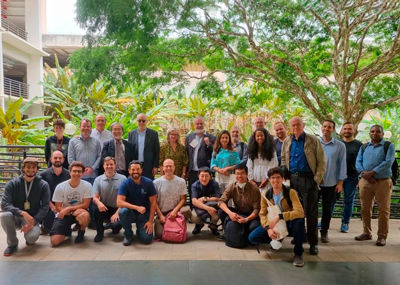
<p dir="ltr">In November, the second phase of the fourth edition of the Intercontinental Academia (ICA) took place in Belo Horizonte.</p>
<p dir="ltr">The ICA is an initiative of the international network of <a class="external-link" href="http://www.ubias.net">University-Based Institutes for Advanced Study (UBIAS)</a>. Each edition is organized by two IASs from different continents. In the case of ICA 4, which has explored key interdisciplinary issues at the intersection of cognitive science, neuroscience, and artificial intelligence (AI), the hosts have been the <a class="external-link" href="https://www.paris-iea.fr/fr/">Paris Institute for Advanced Study</a>, a member of the French Network of Institutes for Advanced Study (RFIEA), and the <a class="external-link" href="https://www.ufmg.br/ieat?lang=en">Institute of Advanced Transdisciplinary Studies (IEAT)</a> of the Federal University of Minas Gerais (UFMG).</p>
<p dir="ltr">Two of the Brazilian participants are professors at USP: André Fujita, from the Institute of Mathematics and Statistics (IME), who has been appointed by the IEA, and specialist in health technology assessment Patricia Coelho de Soárez, from the Medical School (FM), which has supported her. The third Brazilian is Evandro Cunha, a professor of computational linguistics at UFMG.</p>
<p dir="ltr">For Fujita, the term that best describes the experiences promoted by the encounters is "fantastic." They have allowed various exchanges among the 19 participating researchers and the fellows, collaborations with other institutions, and contact with mentors - including Nobel Prize laureates and directors of renowned centers - who have provided inspiration to everyone. "This has allowed thinking 'outside the box' and setting up a collaboration with fellow Laura Candiotto, a philosopher specializing in emotions," he points out.</p>
<p dir="ltr">Specialized in bioinformatics, Fujita works with the interaction between biological components and the way they create specific phenotypes, working with statistical methods to analyze biological data on a large scale. His contribution to ICA 4 has focused on his experience with biological network analysis, as well as the interdisciplinarity of his field.</p>
<table class="tabela-direita-200-borda">
<tbody>
<tr>
<th style="text-align: center; ">
<h3>Related material</h3>
</th>
</tr>
<tr>
<td><strong>News:</strong><br /> 
<ul>
<li><a href="https://www.iea.usp.br/en/news/4a-edicao-da-international-academia-paris-2021" class="external-link">Researchers establish partnerships and receive suggestions from mentors during ICA 4</a></li>
<li><a href="https://www.iea.usp.br/en/news/ica-4" class="external-link">Intercontinental Academia edition on intelligence and artificial intelligence starts on June 13</a></li>
</ul>
</td>
</tr>
</tbody>
</table>
<p dir="ltr">While the meeting in Paris has been split into eight days of seminars, activities in Belo Horizonte have prioritized the work among the researchers, with parallel meetings with mentors, and guests from academia and the productive sector.</p>
<p dir="ltr">For Fujita, two outstanding events have been the visit to the local neuroscience and robotics laboratories, as well as a meeting with <a href="https://www.iea.usp.br/en/persons/researchers/virgilio-almeida" class="external-link">Virgílio Almeida</a>, when he addressed the Center of Artificial Intelligence in Health. Almeida is professor emeritus from the Department of Computer Science at UFMG and current holder of the Oscar Sala Chair at the IEA. "The meeting with Professor Almeida has been a gateway to collaborations with UFMG's computer science and health personnel," Fujita states.</p>
<p dir="ltr">In addition to the Belo Horizonte stage of ICA 4, Fujita also participated in the first one, which took place in October 2021 in Paris, and in an intermediate meeting in Nagoya, held from August 31 to September 2, 2022, having robotics and artificial intelligence as main themes. On the latter occasion, he presented a seminar at the Nagoya University Graduate School of Medicine. Topics from the work of the ICA participants and professors who work with robotics at the institution were discussed. According to the researcher, the discussions were centered on how human-looking robots would fit into society besides robots that help humans in everyday activities. For him, one of the main impacts of his visit was the meeting with Toshio Fukuda, president of the Institute of Electrical and Electronics Engineers (IEEE) in Japan. Amongst criticisms and suggestions, the emeritus professor from Nagoya University offered a paid travel for Fujita to spend a few months working with his robotics group.</p>
<div>
<p dir="ltr">The first edition of ICA was held in 2015 in São Paulo, at the IEA, and in 2016 at Nagoya University's Institute for Advanced Research, having "Time" as the theme. In 2016, "Human Dignity" was the theme of the second edition, which took place in Jerusalem, Bielefeld (both main hosts cities), and Johannesburg (where an additional meeting took place). Between 2018 and 2019, the third edition addressed "Laws: Rigidity and Dynamics." Institutes in Singapore and Birmingham were the hosting partners.</p>
<p dir="ltr" style="text-align: right; "><span class="discreet">Photo: courtesy of André Fujita</span></p>
</div>]]></content:encoded>
    <dc:publisher>No publisher</dc:publisher>
    <dc:creator>Richard Meckien</dc:creator>
    <dc:rights>Original version in Portuguese by Beatriz Herminio.</dc:rights>
    
      <dc:subject>Ubias</dc:subject>
    
    
      <dc:subject>Intercontinental Academia</dc:subject>
    
    
      <dc:subject>cover</dc:subject>
    
    
      <dc:subject>Computer Science</dc:subject>
    
    
      <dc:subject>Artificial Intelligence</dc:subject>
    
    <dc:date>2022-11-21T18:55:00Z</dc:date>
    <dc:type>News Item</dc:type>
  </item>


  <item rdf:about="https://www.iea.usp.br/en/news/conceicao-evaristo-takes-office">
    <title>Writer Conceição Evaristo takes office at the Olavo Setubal Chair of Art, Culture, and Science</title>
    <link>https://www.iea.usp.br/en/news/conceicao-evaristo-takes-office</link>
    <description></description>
    <content:encoded xmlns:content="http://purl.org/rss/1.0/modules/content/"><![CDATA[<table class="tabela-direita-300">
<tbody>
<tr>
<th><img src="https://www.iea.usp.br/imagens/conceicao-evaristo-5-9-2022" alt="Conceição Evaristo - 5/9/2022" class="image-inline" title="Conceição Evaristo - 5/9/2022" /></th>
</tr>
<tr>
<td><span class="discreet">Conceição Evaristo: ''I fill in the gaps in memories with fiction."</span></td>
</tr>
</tbody>
</table>
<p>During a ceremony that moved everyone present in the University Council Room on September 5, writer Conceição Evaristo took office as holder of the <a href="https://www.iea.usp.br/en/research/chairs/olavo-setubal-chair-of-arts-culture-and-science" class="external-link">Olavo Setubal Chair of Art, Culture, and Science</a>, a partnership between the IEA and the Itaú Cultural Institute.</p>
<p>The inauguration was attended by representatives of black collectives, black women from the fields of culture and politics, Evaristo's colleagues from the Fluminense Federal University (UFF), USP's deans and professors, among other outstanding figures from academia, black cultural movements, and the anti-racism struggle.</p>
<p>For the Chair's academic coordinator and former director at the IEA, Martin Grossmann, Evaristo's tenure further enhances the objectives of the project Democracy, Arts, and Plural Knowledge (DASP), implemented by social, cultural, and educational activist Eliana Sousa Silva when she was the chairholder in 2018.</p>
<p>He said that USP has taken a while to engage in the affirmative policies implemented in the country in recent decades, adopting racial quotas only in 2018. For him, the choice of the new chairholder is part of the continuity of the efforts by the new governance of USP aimed at diversity and inclusion, marked by the creation of the Dean of Inclusion and Belonging (PRIP).</p>
<table class="tabela-direita-200-borda">
<tbody>
<tr>
<th>Related material</th>
</tr>
<tr>
<td>
<p><a href="https://www.iea.usp.br/en/media-library/photos/events-2022/inauguration-conceicao-evaristo-september-9-2022" class="external-link">Photos</a></p>
</td>
</tr>
</tbody>
</table>
<p><strong>Democratic participation</strong></p>
<p>The director of the Itaú Cultural Institute, Eduardo Saron, stated that one of the issues present in the cultural area for a long time is access to culture. For him, the new frontier is that of democratic participation in the cultural world. He considers that Evaristo means "the synthesis of what it means to fight for democratization."</p>
<p>Representing the Chair's patron family, educator Maria Alice Setubal said that her father's entire history was committed to the country's development: "He has idealized Itaú Cultural, being a pioneer in cultural innovation through the private sector, always with an eye on cultural plurality and engagement in the country's public policies."</p>
<table class="tabela-esquerda-300">
<tbody>
<tr>
<th><img src="https://www.iea.usp.br/imagens/participantes-da-mesa-na-posse-de-conceicao-evaristo" alt="Participantes da mesa na posse de Conceição Evaristo" class="image-left captioned" title="Participantes da mesa na posse de Conceição Evaristo" /></th>
</tr>
<tr>
<td><span class="discreet">From left: Eduardo Saron, Sueli Carneiro, Conceição Evaristo, Maria Alice Setubal, Martin Grossmann, and Guilherme Ary Plonski. In the lower right corner: Maria Arminda do Nascimento Arruda.</span></td>
</tr>
</tbody>
</table>
<p>For Setubal, Brazilian society is building a plural country as indicated by "the diversity we are seeing within USP." These are important steps, she said, "in a slower process than what we would like, but bringing the possibility of a fairer, more democratic country that fights racism."</p>
<p><strong>Inclusion and belonging </strong></p>
<p>For vice-president Maria Arminda do Nascimento Arruda, the "happy choice of Conceição Evaristo for the Chair marks an important turning point for USP. The University is moving towards redirecting and deepening the paths in terms of recognizing the diversity, inclusion, and belonging." Without these changes in society it will be difficult for us to recognize it as democratic and civilized," she said.</p>
<p>"The choice has an even greater significance for bringing a writer linked to collective memory and the need to assert it to build another place in the narrative. Evaristo's literature expresses the redemptive character of the memory that has built Brazil. It is a literature about time, on the multiplicity of times, whose combination can produce the redemption of the country," said Arruda.</p>
<p><strong><i>Escrevivência</i></strong></p>
<p>In greeting the new chairholder, writer and anti-racism activist Sueli Carneiro highlighted that <i>escrevivência</i>, a concept of Evaristo's creative process, has been forming a school, "echoing new cries for freedom inspired by her insurgent literature." She said that this new literature is producing new imaginaries, narratives, and characters "through which consecrated images about black women are resized, reconstructed, and resignified by those who granted themselves the legitimacy of speech and writing." She cited a comment by Evaristo herself in her writings: "In the Brazilian literary milieu, one type of author persists: a white man, resident of large urban centers, and belonging to the middle class. It is from within this social perspective that most of the characters and their representations are born."</p>
<p>For Carneiro, the writer's presence at the University and on the Chair "confronts the 'epistemicide' that evades black history and resistance." Evaristo's great theme is how, despite all exclusionary strategies, "black people remain, assert themselves, and refuse the reduction of their humanity, persistently denied by racism," she said.</p>
<table class="tabela-direita-300">
<tbody>
<tr>
<th><img src="https://www.iea.usp.br/imagens/sueli-carneiro-e-conceicao-evaristo" alt="Sueli Carneiro e Conceição Evaristo" class="image-right captioned" title="Sueli Carneiro e Conceição Evaristo" /></th>
</tr>
<tr>
<td><span class="discreet">Writer Sueli Carneiro (left) has been Conceição Evaristo's patron.</span></td>
</tr>
</tbody>
</table>
<p>Evaristo's literature faces the challenge of decolonization, said Carneiro, "updating what it is to be black in the present and giving a new meaning to the representation of their human potential." This is because the fixed images of black men and women hide what is extraordinary in the process of black subalternization, which entails a resistance capable of producing unfathomable human types, improbable due to the conditions that originated them and which would be an inspiring source for a powerful dramaturgy, which only would make blacks and Brazilians better in general.</p>
<p>At the end of the greeting, Carneiro said that <i>Casa Sueli Carneiro</i> (installed in the house where she has lived for 40 years and dedicated to articulating her thoughts with black expressions and languages of continuity of memory and resistance) and the Geledés Black Women's Institute, of which she is one of the coordinators, are available for a dialogue with Evaristo's project on the Chair.</p>
<p><strong>Memory</strong></p>
<p>In her inauguration speech, Conceição Evaristo asked everyone, especially the black movement members, not to leave her alone: "Don't let me break through the siege alone. One can't achieve anything alone. They get lost along the way. Learning is always a collective struggle, even more so on a Chair."</p>
<p>Throughout her speech, she paid tribute to her writing and the fact that she became a professor to everything she experienced within her family and in the community where she grew up in Belo Horizonte, to the stories she heard from the relatives she lived with, and to what the family experienced from her great-grandparents.</p>
<p>She compared her reverence for these memories to the figure of the mythical bird <i>Sancofa</i>, from the Acan culture of West Africa, whose representation has an egg in its beak and the head turned backwards, representing the concept of "returning to the past to reframe the present and build the future," according to Abdias do Nascimento.</p>
<p>"I fill in the gaps in memories with fiction. It is a fiction of memory. There have been relatives I have never met and ancestral women who have never picked up a pencil or notebook. We are used to thinking of <i>griots</i> (male storytellers in many African countries), but female <i>griots</i> also give birth to memories, sometimes in silent resistance," she said.</p>
<p>She emphasized that she was not born surrounded by books, but by words: "Since I was a child, I learned to collect words: those inscribed on bodies, those that spoke through the bodies of my mother and the people around us. Through the few pieces of furniture, adobe walls, broken tiles, and few belongings, everything spoke. I grew up possessed by orality. The cloth and grass dolls that my mother made for her daughters were born with names and history. Everything was narrative. Everything was the subject of prose and poetry."</p>
<p>She stated that in African culture "everything is words, everything helps to communicate, everything is uttered in sounds and signs. You have to listen, because everything speaks, everything is words."</p>
<table class="tabela-esquerda-300">
<tbody>
<tr>
<th><img src="https://www.iea.usp.br/imagens/discurso-de-posse-de-conceicao-evaristo" alt="Discurso de Posse de Conceição Evaristo" class="image-left captioned" title="Discurso de Posse de Conceição Evaristo" /></th>
</tr>
<tr>
<td><span class="discreet">The audience that filled the University Council Room applauded Conceição Evaristo at the end of her inaugural speech.</span></td>
</tr>
</tbody>
</table>
<p>Evaristo said that her project on the Chair foresees a very dynamic performance. "The idea is to translate academic knowledge to the public outside the walls of USP and vice versa, promoting an interdisciplinary investigation and also acting in the training of professors in the production of new texts and new readings."</p>
<p>The object, she said, is to stimulate a dialogic relationship with knowledge produced outside academia, "seeking to incorporate new modes and places of knowledge production so that the training of researchers can cover the widest possible field of teaching and conducting research."</p>
<p>According to her, the work to be carried out should involve researchers in the areas of linguistics, literary theory, and psychology in order to think about the issue of subjectivity and how "creation from painful experiences such as exclusion explodes in literary art." Seminars are also planned for different audiences in order to democratize knowledge.</p>
<p><strong>Institutionality of culture</strong></p>
<p>Evaristo's inauguration also marked the end of the tenure of cultural anthropologist Néstor García Canclini, who participated in the ceremony by teleconference from Mexico City. Since September 2020 he has developed the project "The Institutionality of Culture in the Current Context of Sociocultural Changes," which has emphasized the reality of Brazilian and Mexican cultural institutions.</p>
<p>Canclini informed that the book "Latin American Cultural Emergencies" will be published <span>by the end of the year. It</span> brings together the results of research conducted by him and post-doctoral fellows Sharine Melo and Juan Brizuela, as well as by his assistant in Mexico, Mariana Martínez Matadamas.</p>
<p>He stated that the binational team has managed to carry out a certain amount of field work despite the pandemic. This period has "resignified what it is to do research," according to Canclini, since most cultural institutions were closed, such as cinemas, theaters, museums, and universities.</p>
<p>Much of the research activities had to be virtual, such as interviews and document searches. Researchers, workers in Culture, and managers of social and public organizations in both countries have been interviewed.</p>
<p style="text-align: right; "><span class="discreet">Photos: Marcos Santos/Jornal da USP</span></p>]]></content:encoded>
    <dc:publisher>No publisher</dc:publisher>
    <dc:creator>Richard Meckien</dc:creator>
    <dc:rights>Original version in Portuguese by Mauro Bellesa.</dc:rights>
    
      <dc:subject>Evento</dc:subject>
    
    
      <dc:subject>Memória</dc:subject>
    
    
      <dc:subject>Literatura</dc:subject>
    
    
      <dc:subject>cover</dc:subject>
    
    
      <dc:subject>Mulher</dc:subject>
    
    
      <dc:subject>Negros</dc:subject>
    
    
      <dc:subject>Cátedra Olavo Setubal</dc:subject>
    
    <dc:date>2022-09-08T19:55:00Z</dc:date>
    <dc:type>News Item</dc:type>
  </item>


  <item rdf:about="https://www.iea.usp.br/en/news/74th-sbpc">
    <title>74th Annual Meeting of the Brazilian Society for the Advancement of Science (SBPC) includes a panel on the impacts and challenges of IASs</title>
    <link>https://www.iea.usp.br/en/news/74th-sbpc</link>
    <description></description>
    <content:encoded xmlns:content="http://purl.org/rss/1.0/modules/content/"><![CDATA[<p>The panel "Institute for Advanced Study – Impacts and Challenges," coordinated by the director of the IEA-USP, Guilherme Ary Plonski, is part of the program of the <a class="external-link" href="https://ra.sbpcnet.org.br/74RA/"><span>74th Annu<span>al Meeting of the SBPC</span></span></a>, which began this Sunday, 24, in Brasília, and runs until July 30.</p>
<p>The activity will take place on the <strong>28th</strong>, <strong>from 4:00 pm to 6:00 pm</strong>, featuring lectures by Ana Célia Castro, director of the Federal University of Rio de Janeiro's Brazilian College of Advanced Studies (CBAE-UFRJ), Estevam Barbosa de Las Casas, director of the <span>Federal University of Minas Gerais'</span> Institute of Transdisciplinary Advanced Studies (IEAT-UFMG), Britta Padberg, director of the Academy of International Affairs NRW, and Luisa Veras de Sandes-Guimarães, a researcher of USP's Alfredo Bosi Chair in Basic Education, based at the IEA.</p>
<p>This and other activities of the annual meeting can be followed on the <a class="external-link" href="https://www.youtube.com/canalsbpc"><span>SBPC YouTube channel</span></a> (content mainly in Portuguese).</p>
<p>The <a class="external-link" href="http://portal.sbpcnet.org.br/en/">SBPC</a> is a civil entity dedicated to the defense of scientific and technological advancements, as well as to the educational and cultural development of Brazil. Founded in 1948, it represents more than 160 affiliated scientific societies and more than 5,000 active members, including researchers, professors, students, and Brazilian citizens interested in science and technology. The current president is philosopher Renato Janine Ribeiro, an honorary professor at the IEA and former Minister of Education.</p>]]></content:encoded>
    <dc:publisher>No publisher</dc:publisher>
    <dc:creator>Richard Meckien</dc:creator>
    <dc:rights>Original version in Portuguese by Fernanda Rezende.</dc:rights>
    
      <dc:subject>Institutional</dc:subject>
    
    
      <dc:subject>cover</dc:subject>
    
    
      <dc:subject>Ubias</dc:subject>
    
    <dc:date>2022-07-25T14:05:00Z</dc:date>
    <dc:type>Page</dc:type>
  </item>


  <item rdf:about="https://www.iea.usp.br/en/news/partnerships-ica-4-paris">
    <title>Researchers establish partnerships and receive suggestions from mentors during ICA 4</title>
    <link>https://www.iea.usp.br/en/news/partnerships-ica-4-paris</link>
    <description></description>
    <content:encoded xmlns:content="http://purl.org/rss/1.0/modules/content/"><![CDATA[<table class="tabela-direita-300">
<tbody>
<tr>
<th><img src="https://www.iea.usp.br/imagens/sessao-da-ica-4-paris-outubro-de-2021" alt="Sessão da ICA 4 - Paris - Outubro de 2021" class="image-inline" title="Sessão da ICA 4 - Paris - Outubro de 2021" /></th>
</tr>
<tr>
<td><span class="discreet">Session of the first phase of ICA 4, held at the Paris Institute for Advanced Study.</span></td>
</tr>
</tbody>
</table>
<p>Three Brazilians were among the 19 young researchers participating in the first phase of the <a class="external-link" href="https://www.intercontinental-academia.org/">4th Intercontinental Academia (ICA 4)</a>, held in Paris from October 18 to 27. The current edition addresses the theme "Intelligence and Artificial Intelligence" and the objective of the group is to explore fundamental interdisciplinary issues at the intersection of cognitive science, neuroscience, and artificial intelligence.</p>
<p>Two Brazilian participants are professors at USP: André Fujita, from the Institute of Mathematics and Statistics, who has been appointed by the IEA, and specialist in health technology assessment Patricia Coelho de Soárez, from the Medical School, which has supported her. The third Brazilian is Evandro Cunha, a professor of computational linguistics at the Federal University of Minas Gerais (UFMG).</p>
<table class="tabela-esquerda-300-borda">
<tbody>
<tr>
<td>
<h3>Related material</h3>
<p><strong>Previous editions of the Intercontinental Academia</strong></p>
<ul>
<li><a class="external-link" href="http://www.ica.usp.br" target="_blank">ICA 1</a> (2015-2016) - "Time"</li>
<li><a class="external-link" href="https://scholars.huji.ac.il/iahd" target="_blank">ICA 2</a> (2016) - "Human Dignity"</li>
<li><a class="external-link" href="https://www.icalaws.com/" target="_blank">ICA 3</a> (2018-2019) - "Laws: Rigidity and Dynamics</li>
</ul>
</td>
</tr>
<tr>
<td></td>
</tr>
</tbody>
</table>
<p>The ICA is an initiative of the international network of <a class="external-link" href="http://www.ubias.net">University-Based Institutes for Advanced Study (UBIAS)</a>. Each edition is organized by two IASs from different continents. In the case of ICA 4, the hosts are the <a class="external-link" href="https://www.paris-iea.fr/fr/">Paris Institute for Advanced Study</a> and UFMG's <a class="external-link" href="https://www.ufmg.br/ieat">Institute of Advanced Transdisciplinary Studies</a>. The second phase will be held in June 2022, in Belo Horizonte, Brazil.</p>
<p>During the eight days of seminars, several themes have been discussed in a comprehensive manner, according to Fujita and Soárez. The sessions were followed by meetings between participants and mentors, as well as by visits to universities in the French capital.</p>
<p>The Installation Theory, a new field dedicated to understanding, analyzing, and changing behavior has been one of the addressed topics, being discussed besides the concept of intelligence, philosophy of computing, ethical principles in AI, the future of AI and its challenges, relationships between humans and machines, consciousness and emotion, robots of the future, the impact of AI on economy, theoretical frameworks for the functioning of deep neural networks, and the issue of whether or not it is really necessary to develop intelligent machines that mimic humans and their usefulness.</p>
<table class="tabela-direita-300">
<tbody>
<tr>
<th><img src="https://www.iea.usp.br/imagens/andre-fujita-e-toshio-fukuda-ica4-2021" alt="André Fujita e Toshio Fukuda - ICA4 - 2021" class="image-inline" title="André Fujita e Toshio Fukuda - ICA4 - 2021" /></th>
</tr>
<tr>
<td><span class="discreet">André Fujita (left) and Toshio Fukuda during a meeting at the Paris-Saclay Normal School. Professor emeritus from Nagoya University, Fukuda is one of the world's leading authorities on robotics.</span></td>
</tr>
</tbody>
</table>
<p>Fujita has held individual meetings with Xiao-Jing Wang, Toshio Fukuda, Marc Mézard, Zaven Paré, Saadi Lahlou, Simon Luck, and Olivier Bouin, all mentors (senior researchers) of the ICA 4. At these, he has been able to describe his research projects and areas of work, and asked for criticism and suggestions.</p>
<p>Wang, Fukuda, and Mézard have praised the innovative aspects of Fujita's research projects in network statistics and in the use of heart rate variability (HRV) in the construction of a heart-machine interface, according to the Brazilian. They have also presented suggestions for a greater scope of work. Luck and Bouin have discussed possibilities for research grants at IASs in France and opportunities for funding Fujita's work in Europe.</p>
<p>He has also established connections for possible cooperation with Deshen Moodley and Surange Kasturi, two of the junior researchers participating in ICA 4. While Moodley could possibly become someone to work with in the area of HRV, Kasturi will potentially meet Fujita in the first semester of 2022 in the United States, where he works with the use of AI in data analysis in the health area.</p>
<p>Soárez has highlighted the exhibitions "In AI We Trust - Power, Illusion, and Control of Predictive Algorithms," given by Helga Nowotny, professor emeritus from the Swiss Federal Institute of Technology Zurich, and "Myths and Misunderstandings About Responsibility for the Unintended Impact of Artificial Intelligence," by Karen Yeung, a researcher of law, ethics, and informatics at the University of Birmingham. "Their speeches have sparked my interest in studying the economic, ethical, and social implications of the application of AI to health in the Brazilian context more deeply."</p>
<table class="tabela-esquerda-300">
<tbody>
<tr>
<th><img src="https://www.iea.usp.br/imagens/laura-candiotto-e-patricia-coelho-soarez-outubro-2021" alt="Laura Candiotto e Patricia Coelho Soárez - outubro/2021" class="image-inline" title="Laura Candiotto e Patricia Coelho Soárez - outubro/2021" /></th>
</tr>
<tr>
<td><span class="discreet">Patricia Soárez (right) with Laura Candiotto, from the Center for Ethics as Study in Human Value at the University of Pardubice</span></td>
</tr>
</tbody>
</table>
<p>Yeung was chosen by Soárez as her mentor during ICA 4. "She is actively involved in technology policy in the UK and has been dedicated to understanding the challenges associated with the regulation and governance of emerging technologies," said the Brazilian.</p>
<p>According to Soárez, Yeung's recent work is focused on the legal, ethical, and social implications of using these new technologies. "We have started a discussion on the development of a project tentatively named <i>An Interdisciplinary Approach to the Applications of Artificial Intelligence in Cancerology: Clinical Effectiveness and Social Implications</i>," she said.</p>
<p>As an offshoot of this initial collaboration and supported by Sue Gilligan, manager of interdisciplinary research projects at the University of Birmingham, Soárez is now working with a group of ICA 4 participants to organize a proposal for a mid-term meeting at the British institution in March 2022. The idea is to discuss individual projects before the second stage of ICA 4 in November.</p>
<p>Another initiative by the researchers, Fujita said, will be the production of an article about the different points of view regarding AI and what the field expects for the next 20 years.</p>
<p>It will be a kind of manifesto signed by everyone, he said. "To this end, we will meet virtually every two weeks. Initially, we are scheduling seminars so that each one can better understand the research projects carried out by the others. We will also read articles on AI chosen by each of us. It is worth noting that we are a very heterogeneous group, formed by specialists in computer science, engineering, biology, philosophy, economics, law, and neuroscience, among other areas. This will allow us to have a very broad idea on the subject."</p>
<p>For Soárez, participating in the ICA 4 has challenged her to inaugurate a new way of thinking, articulating, and doing her research: "The greatest learning have I gained was the awakening to the possibility of developing new research projects with an interdisciplinary approach. And the best product was the potential to establish a solid and diversified academic network of researchers around the world. I hope to experience the celebration of the excellence and impact of the research projects developed by this collaborative network <span>in the near future</span>."</p>
<p>She also highlights that the visits to the Paris-Saclay University, the Sorbonne Center for Artificial Intelligence, and the Paris-Saclay Normal School have expanded networking possibilities beyond the Paris Institute for Advanced Studies.</p>
<p style="text-align: right; "><span class="discreet">Photos: Paris Institute for Advanced Study</span></p>]]></content:encoded>
    <dc:publisher>No publisher</dc:publisher>
    <dc:creator>Richard Meckien</dc:creator>
    <dc:rights>Original version in Portuguese by Mauro Bellesa.</dc:rights>
    
      <dc:subject>Ubias</dc:subject>
    
    
      <dc:subject>Intercontinental Academia</dc:subject>
    
    
      <dc:subject>ICA</dc:subject>
    
    
      <dc:subject>cover</dc:subject>
    
    
      <dc:subject>Artificial Intelligence</dc:subject>
    
    
      <dc:subject>Researchers</dc:subject>
    
    <dc:date>2021-11-05T13:05:00Z</dc:date>
    <dc:type>News Item</dc:type>
  </item>


  <item rdf:about="https://www.iea.usp.br/en/news/ica-4">
    <title>Intercontinental Academia edition on intelligence and artificial intelligence starts on June 13</title>
    <link>https://www.iea.usp.br/en/news/ica-4</link>
    <description></description>
    <content:encoded xmlns:content="http://purl.org/rss/1.0/modules/content/"><![CDATA[<p><img src="https://www.iea.usp.br/imagens/logo-da-4a-intercontinental-academia" alt="Logo da 4th Intercontinental Academia" class="image-right" title="Logo da 4th Intercontinental Academia" /></p>
<p>"Intelligence and Artificial Intelligence" is the theme of the fourth edition of the Intercontinental Academia (ICA 4), which will have its opening sessions virtually held from June 13 to 18. The face-to-face sessions will take place next October in Paris and in June 2022 in Belo Horizonte.</p>
<p>The ICA is a project by <a class="external-link" href="http://www.ubias.net">UBIAS</a>, an international network of institutes for advanced study linked to universities. Each edition is hosted by two institutes from different continents. ICA 4 has been organized by the <a class="external-link" href="https://www.ufmg.br/ieat/instituto/?lang=en">Institute of Advanced Transdisciplinary Studies (IEAT)</a> at the Federal University of Minas Gerais (UFMG) and the <a class="external-link" href="https://www.paris-iea.fr/en/presentation-of-the-institute/about-us">Paris Institute for Advanced Study (IAS)</a>, a member of the <a class="external-link" href="http://rfiea.fr/en/iea/french-network-institutes-advanced-study-missions">French Network of Institutes for Advanced Studies (RFIEA)</a>.</p>
<p>Since implementing the project in 2015, the objective of UBIAS has been to create global networks of future research leaders to work together on paradigm shifts and transdisciplinary research under the mentorship of eminent researchers from around the world.</p>
<table class="tabela-direita-400">
<tbody>
<tr>
<th><img src="https://www.iea.usp.br/imagens/andre-fujita-patricia-soarez-e-evandro-castro" alt="Andre Fujita, Patricia Soarez e Evandro Castro" class="image-inline" title="Andre Fujita, Patricia Soarez e Evandro Castro" /></th>
</tr>
<tr>
<td><span class="discreet">Brazilian participants of ICA 4: André Fujita, Patricia Coelho de Soárez, and Evandro Castro</span></td>
</tr>
</tbody>
</table>
<p>According to the ICA 4 organizers, the edition will explore key interdisciplinary issues at the intersection of cognitive science, neuroscience, and artificial intelligence (AI). By highlighting the importance of the topic, they point out that decisive advancements have taken place in recent decades regarding the analysis of brain activity and its behavioral counterpart, as well as the information processing sciences. "Complementarities between neuroscience/cognitive science and AI make it possible to explore synergies and raise ethical issues between these disciplines, which involve enormous challenges and opportunities for societal progress."</p>
<table class="tabela-direita-200-borda">
<tbody>
<tr>
<td>
<h3><strong>Previous editions</strong></h3>
<p><a class="external-link" href="http://ica.usp.br/home-sao-paulo">ICA 1</a> was held in 2015/16 and its theme was "Time." The hosts were the IEA and the Institute for Advanced Research at Nagoya University (IAR). From the debates of the edition, the participants produced the <span>massive open online course</span> <a class="external-link" href="https://www.coursera.org/learn/offtheclock?utm_campaign=opencourse.qDaZPFzDEeq2MgoCzrWDhw.launch&amp;utm_medium=email&amp;utm_source=other" target="_blank">Off the Clock: The Many Faces of Time</a>, available on the <a class="external-link" href="https://www.coursera.org/" target="_blank">Coursera</a> platform.</p>
<p>"Human Dignity" was the theme of the <a class="external-link" href="https://scholars.huji.ac.il/iahd">second edition</a> in 2016. The organizers for the initiative were the Center for Interdisciplinary Research at Bielefeld University and the Israel Institute for Advanced Studies at the Hebrew University of Jerusalem.</p>
<p><a class="external-link" href="https://www.icalaws.com/">ICA 3</a> took place in 2018/19 and addressed the theme "Laws: Rigidity and Dynamics." The organizers were the Institute of Advanced Studies at the Nanyang Technological University and the Institute of Advanced Studies at the University of Birmingham.</p>
</td>
</tr>
</tbody>
</table>
<table class="tabela-esquerda-300-borda">
<tbody>
<tr>
<td>
<h3>Some of the mentors</h3>
<p><dl class="image-inline captioned" style="width:300px;">
<dt><img src="https://www.iea.usp.br/imagens/ada-yonath/image" alt="Ada Yonath" title="Ada Yonath" height="300" width="300" /></dt>
 <dd class="image-caption" style="width:300px;">Ada Yonath</dd>
</dl></p>
<p><dl class="image-inline captioned" style="width:300px;">
<dt><img src="https://www.iea.usp.br/imagens/robert-aumann/image" alt="Robert Aumann" title="Robert Aumann" height="300" width="300" /></dt>
 <dd class="image-caption" style="width:300px;">Robert Aumann</dd>
</dl></p>
<p><dl class="image-inline captioned" style="width:300px;">
<dt><img src="https://www.iea.usp.br/imagens/martin-rees/image" alt="Martin Rees" title="Martin Rees" height="300" width="300" /></dt>
 <dd class="image-caption" style="width:300px;">Martin Rees</dd>
</dl></p>
<p><dl class="image-inline captioned" style="width:300px;">
<dt><img src="https://www.iea.usp.br/imagens/antonio-damasio/image" alt="António Damásio" title="António Damásio" height="300" width="300" /></dt>
 <dd class="image-caption" style="width:300px;">António Damásio</dd>
</dl></p>
<p><dl class="image-inline captioned" style="width:300px;">
<dt><img src="https://www.iea.usp.br/imagens/timnit-gebru/image" alt="Timnit Gebru" title="Timnit Gebru" height="300" width="300" /></dt>
 <dd class="image-caption" style="width:300px;">Timnit Gebru</dd>
</dl></p>
<p><dl class="image-inline captioned" style="width:300px;">
<dt><img src="https://www.iea.usp.br/imagens/zaven-pare/image" alt="Zaven Paré" title="Zaven Paré" height="300" width="300" /></dt>
 <dd class="image-caption" style="width:300px;">Zaven Paré</dd>
</dl></p>
</td>
</tr>
</tbody>
</table>
<p>In parallel to the second face-to-face session, scheduled for June 2022, a "satellite session" will be held at UFMG, with conferences and roundtables, and the participation of ICA 4 mentors and other guests from academia and the industry. There will be live streaming over the internet. Some of the topics covered in this session will be: "Fundamentals and Ethics of AI," "Intelligence and Rationality," "Cognition and Neurosciences," "Interdisciplinary Explorations of AI," and "AI and Health Sciences."</p>
<p><strong>Participants</strong></p>
<p><a class="external-link" href="https://www.intercontinental-academia.org/fellows/">19 researchers</a> working in universities and research institutes in Brazil, Germany, France, United Kingdom, Poland, United States, Japan, South Africa, Israel, and the Netherlands have been chosen out of the 60 candidates to participate in ICA 4 (23 of them Brazilians). The research areas of those selected include mathematics, computing, engineering, law, philosophy, linguistics, neuroscience, and history.</p>
<p>The representatives of Brazil are André Fujita (nominated by the IEA), from USP's Institute of Mathematics and Statistics (IME), Patricia Coelho de Soárez (independently enrolled), from USP's Medical School (FM), and Evandro Cunha (nominated by the IEAT), from UFMG's Faculty of Languages, Literature, and Linguistics (FALE).</p>
<p>Fujita's expectation is to participate in intense philosophical and scientific discussions with the other participants, and obtain "stimulus and inspiration" to make the Postgraduate Program in Bioinformatics at USP, which he coordinates, more vigorous. He emphasizes that bioinformatics is an interdisciplinary field integrated by researchers in mathematics, computer science, physics, chemistry, biology, medicine, and engineering, among others. "People usually define bioinformatics as the big data study of areas of biology using computational techniques. I think we could define bioinformatics as the field that uses artificial intelligence to discover how cells and beings learn or acquire intelligence."</p>
<p>Soárez, who is a member of IEA's Study Group on Science, Technology, and Innovation in Health, proposes the adoption of a holistic point of view in evaluating the contributions of AI in health care, including economic, ethical, and social impacts. More specifically, her interest is the implications of incorporating AI into health policies, decision-making processes, and equality in the Brazilian health system. One of her expectations in relation to ICA 4 is to obtain subsidies for the development of an interdisciplinary research project on the importance of AI for decision-making in health. She also hopes to learn about applicable procedures and tools needed to broaden the impact of her research and advance her career development as a research leader.</p>
<p>Cunha's main research interest is computer-mediated communication and the use of computational methods for solving linguistic problems, especially those related to historical linguistics, revitalization of endangered languages, and language neuroscience. At ICA 4 he intends to discuss the applications of language science in AI and the effects of technology on human communication, particularly with regard to manipulation, extremism, and dissemination of disinformation in the current scenario of pandemic and climate crisis.</p>
<p><strong>Mentoring</strong></p>
<p>The participants will have the support of <a class="external-link" href="https://www.intercontinental-academia.org/mentors/">17 mentors</a>, all renowned researchers with worldwide recognition in various scientific areas, philosophy, and arts. Among them are molecular biologist Ada Yonath, from the Weizmann Institute, winner of the 2009 Nobel Prize in Chemistry, economist Robert Aumann, winner of the 2005 Nobel Prize in Economics and a professor at the Hebrew University of Jerusalem, astrophysicist and cosmologist Martin Rees, Astronomer Royal and co-founder of the The Centre for the Study of Existential Risk at Cambridge University, neurologist and neuroscientist António Damásio, a specialist in the mental processes underlying emotions, feelings, and consciousness, computer scientist Timnit Gebru, co-founder of Black in AI, a support organization for black AI researchers and professionals, and one of the former leaders of Google's ethical artificial intelligence research team, and artist Zaven Paré, dedicated to new media and robotics, and a contributor to the <span>Postgraduate</span> Program in Arts, Culture, and Languages ​​at the Federal University of Juiz de Fora.</p>
<p>The <a class="external-link" href="https://www.intercontinental-academia.org/about/">coordinators</a> of ICA 4 are Guilherme Ary Plonski, director of the IEA and former coordinator of UBIAS, Estevam Barbosa de Las Casas, director of the IEAT, Eliezer Rabinovici, a professor at The Racah Institute of Physics at the Hebrew University of Jerusalem and proponent of the Intercontinental Academia project, and Olivier Bouin, director of the RFIEA and new coordinator of UBIAS.</p>
<p style="text-align: right; "><span class="discreet">Photos: Intercontinental Academia</span></p>]]></content:encoded>
    <dc:publisher>No publisher</dc:publisher>
    <dc:creator>Richard Meckien</dc:creator>
    <dc:rights>Original version in Portuguese by Mauro Bellesa.</dc:rights>
    
      <dc:subject>Ubias</dc:subject>
    
    
      <dc:subject>International Cooperation</dc:subject>
    
    
      <dc:subject>Cognition</dc:subject>
    
    
      <dc:subject>ICA</dc:subject>
    
    
      <dc:subject>cover</dc:subject>
    
    
      <dc:subject>Cognitive Science</dc:subject>
    
    
      <dc:subject>Computer Science</dc:subject>
    
    
      <dc:subject>Intercontinental Academia</dc:subject>
    
    
      <dc:subject>Neuroscience</dc:subject>
    
    
      <dc:subject>Artificial Intelligence</dc:subject>
    
    
      <dc:subject>Interdisciplinarity</dc:subject>
    
    <dc:date>2021-05-27T19:50:00Z</dc:date>
    <dc:type>News Item</dc:type>
  </item>


  <item rdf:about="https://www.iea.usp.br/en/news/antoni-muntadas-about-academia-i-ii-an-online-interpretation-2011-2017-2021">
    <title>Antoni Muntadas: About Academia I-II, an Online Interpretation, 2011-2017 (2021)</title>
    <link>https://www.iea.usp.br/en/news/antoni-muntadas-about-academia-i-ii-an-online-interpretation-2011-2017-2021</link>
    <description></description>
    <content:encoded xmlns:content="http://purl.org/rss/1.0/modules/content/"><![CDATA[<p style="text-align: right; "><i><span style="text-align: right; ">from </span><a class="external-link" href="http://www.forumpermanente.org/event_pres/exposicoes/about-academia-i-ii-uma-interpretacao-online-2011-2017-2021/antoni-muntadas-about-academia-i-ii-an-online-interpretation-2011-2017-2021">www.forumpermanente.org<br /></a><a class="external-link" href="https://aboutacademia.iea.usp.br/">Visit the exhibition's website here</a></i></p>
<table class="tabela-direita-300">
<tbody>
<tr>
<th><img src="https://www.iea.usp.br/imagens/exposicao-sobre-academia-de-antoni-muntandas/@@images/11d40d59-c4c4-4720-9501-0994d63cab36.jpeg" alt="Exposição &quot;Sobre Academia&quot;, de Antoni Muntandas" class="image-inline" title="Exposição &quot;Sobre Academia&quot;, de Antoni Muntandas" /></th>
</tr>
<tr>
<td><span class="discreet">Video installation ''About Academia," by Antoni Muntadas, in 2017</span></td>
</tr>
</tbody>
</table>
<p dir="ltr">Based on his experience in American higher education, artist Antoni Muntadas inaugurates in Brazil an online interpretation of "About Academia." The project discusses the role and function of universities today, the place of art in this context, the relationship between public and private, tradition and contemporaneity, the future of universities and interdisciplinarity, based on interviews with professors and students.</p>
<p dir="ltr">"About Academia," a project originally presented at the Carpenter Center for the Visual Arts, invited by Harvard University, during Antoni Muntadas' last teaching period in the program in Art, Culture and Technology at the Massachusetts Institute of Technology (ACT MIT), in 2011, followed in different versions to cities like Boston, Vancouver, Amsterdam, Seville, among others.</p>
<p dir="ltr">The Brazilian version of the video installation "About Academia," which at first would occupy the Biblioteca Brasiliana at the University of São Paulo's (USP) Butantã Campus in São Paulo, translates as another work of the multimedia artist and professor, by creating a digital interpretation of the original installation, developed as a website, which can be accessed from April 30 at <a class="external-link" href="https://aboutacademia.iea.usp.br/"><strong>https://aboutacademia.iea.usp.br/</strong></a>. For the first time it is being shown in Latin America, with all its materials translated into Portuguese, in a bilingual version (Spanish), through a partnership between the Fórum Permanente, the Instituto de Estudos Avançados at USP, and the Biblioteca Brasiliana José and Guita Mindlin, with the support of the Government of the State of São Paulo, through the Secretariat of Culture and Creative Economy, and the Cultural Action Program (PROAC).</p>
<p dir="ltr">"About Academia" provokes a reflection through art about the American academic and university system, more specifically about the public/private duality, as well as the complex relationships that exist between the production of knowledge and the economic interests that influence education in its different forms of pedagogy. Muntadas' video installation considers the possible conflict between a faculty (and its values) and an administration (and its power). In order to have a fruitful circulation of the project in universities outside the US, Muntadas proposes round table discussions that contextualize the conflicts and difficulties peculiar to the university system that hosts it, confronting it with other models in different contexts and cultures.</p>
<table class="tabela-esquerda-300">
<tbody>
<tr>
<th><img src="https://www.iea.usp.br/imagens/croqui-para-videoinstalacao-about-academia/@@images/f6405eb1-cf9d-427f-9476-00b6656f15a6.jpeg" alt="Croqui para videoinstalação &quot;About Academia&quot;" class="image-inline" title="Croqui para videoinstalação &quot;About Academia&quot;" /></th>
</tr>
<tr>
<td><span class="discreet">Sketch by Antoni Muntadas for the video installation ''About Academia''</span></td>
</tr>
</tbody>
</table>
<p dir="ltr">The project is composed of two sets of screenings and publications. While "About Academia I" (2011) addresses these issues from the perspective of professors and academics, "About Academia II" (2017) delves into its themes exclusively from the students' point of view. Due to the pandemic of COVID-19, the first exhibition of this project in the Southern Hemisphere takes place through a virtual room, on a website where it is also possible to access the three roundtables that take place on April 30 and May 10, and where two bilingual publications are available with the complete transcripts of the speeches of the interviewees, among them Noam Chomsky, David Harvey, Carol Becker, Ute Meta Bauer, and the students.</p>
<p dir="ltr">The creation of the immersive, online, interactive video installation gives prominence to the two sets: "About Academia I" (2011) and "About Academia II" (2017). It thus respects the duration of the times of the videos originally developed by the artist for their existence in a real physical space.  Thus, despite the interactivity of navigation, it is not possible for the visitor to control the projected videos. The aesthetic experience in virtuality therefore has correspondence with the real time of the analog exhibition space.</p>
<p dir="ltr"><strong> Publications</strong></p>
<p dir="ltr">The publications in Spanish and Portuguese versions are partially available on the exhibition site. In order to have full access, it is necessary to buy them for a symbolic price. The link for this purchase is through the exhibition site.</p>
<p dir="ltr"><strong>Round tables</strong></p>
<p dir="ltr">The round tables will be broadcasted in the exhibition site and will be available later on this site and in the sites of the partners (IEA-USP, Biblioteca Brasiliana and Fórum Permanente).</p>
<p dir="ltr"><i>Which university do we want? </i>| <a class="external-link" href="https://youtu.be/pYjxL9te9pQ">Watch the recorded event</a></p>
<p dir="ltr">Friday, April 30th, from 2:00 pm to 5:00 pm (Brasília time)</p>
<ul>
<li dir="ltr" style="list-style-type: disc; ">
<p dir="ltr"><a href="https://www.iea.usp.br/en/persons/researchers/nestor-canclini" class="external-link">Néstor Garcia Canclini</a> - anthropologist, philosopher, chair holder at IEA-USP</p>
</li>
<li dir="ltr" style="list-style-type: disc; ">
<p dir="ltr"><a href="https://www.iea.usp.br/en/persons/researchers/eliana-sousa-silva" class="external-link">Eliana Sousa Silva</a> - educator, socio-cultural activist, former chair former at IEA-USP</p>
</li>
<li dir="ltr" style="list-style-type: disc; ">
<p dir="ltr">Macaé Evaristo - educator, former State Secretary of Minas Gerais</p>
</li>
<li dir="ltr" style="list-style-type: disc; ">
<p dir="ltr">Ailton Krenak - philosopher, environmentalist, indigenous leadership</p>
</li>
<li dir="ltr" style="list-style-type: disc; ">
<p dir="ltr">Antoni Muntadas - artist</p>
</li>
<li dir="ltr" style="list-style-type: disc; ">
<p dir="ltr"><a href="https://www.iea.usp.br/en/persons/researchers/martin-grossmann" class="external-link">Martin Grossmann</a> (moderation)</p>
</li>
</ul>
<p> </p>
<p dir="ltr"><i>Intercontinental academy </i>| <a class="external-link" href="https://youtu.be/Mi7K5cNo_oM">Watch the recorded event</a></p>
<p dir="ltr">Monday, May 10, from 9:00 am to 12:00 pm (Brasilia time)</p>
<ul>
<li dir="ltr" style="list-style-type: disc; ">
<p dir="ltr">Nikki Moore - art historian - Wake Forest University (ICA-UBIAS)</p>
</li>
<li dir="ltr" style="list-style-type: disc; ">
<p dir="ltr">Érica Peçanha - anthropologist and post-doctorate at the IEA-USP</p>
</li>
<li dir="ltr" style="list-style-type: disc; ">
<p dir="ltr">David Gange - historian - Birmingham University (ICA-UBIAS)</p>
</li>
<li dir="ltr" style="list-style-type: disc; ">
<p dir="ltr">Julia Buenaventura - art historian - Universidad de los Andes</p>
</li>
<li dir="ltr" style="list-style-type: disc; ">
<p dir="ltr">Mariko Murata - media and museum theorist - Kansai University</p>
</li>
<li dir="ltr" style="list-style-type: disc; ">
<p dir="ltr"><a href="https://www.iea.usp.br/en/persons/researchers/martin-grossmann" class="external-link">Martin Grossmann</a> (moderation)</p>
</li>
</ul>
<p> </p>
<p dir="ltr"><i>University and context </i>| <a class="external-link" href="https://youtu.be/I5ZovucWLkg">Watch the recorded event</a></p>
<p dir="ltr">Monday, May 10, from 1:30 pm to 4:00 pm (Brasilia time)</p>
<ul>
<li dir="ltr" style="list-style-type: disc; ">
<p dir="ltr"><a href="https://www.iea.usp.br/en/persons/researchers/naomar-filho" class="external-link">Naomar de Almeida Filho</a> - epidemiologist, former dean of UFBA, professor of IEA-USP</p>
</li>
<li dir="ltr" style="list-style-type: disc; ">
<p dir="ltr"><a href="https://www.iea.usp.br/en/persons/researchers/helena-nader" class="external-link">Helena Nader</a> - biomedical sciences, vice-president of ABC, Chair at IEA-USP</p>
</li>
<li dir="ltr" style="list-style-type: disc; ">
<p dir="ltr">Guilherme Wisnik - architect, curator, professor at FAU-USP</p>
</li>
<li dir="ltr" style="list-style-type: disc; ">
<p dir="ltr"><a href="https://www.iea.usp.br/en/persons/researchers/renato-janine-ribeiro" class="external-link">Renato Janine Ribeiro</a> (moderation) - philosopher, former Minister of Education (FFLCH-USP)</p>
</li>
</ul>
<p>____________________</p>
<p><strong>Antoni Muntadas (1942, Barcelona, Spain - lives and works in New York)</strong></p>
<table class="tabela-esquerda-300">
<tbody>
<tr>
<th><img src="https://www.iea.usp.br/imagens/antoni-muntadas-2017" alt="Antoni Muntadas - 2017" class="image-inline" title="Antoni Muntadas - 2017" /></th>
</tr>
<tr>
<td><span class="discreet">Antoni Muntadas during his conference at the IEA in 2017</span></td>
</tr>
</tbody>
</table>
<p>He studied at the Escuela Técnica Superior de Ingenieros Industriales in Barcelona and at the Pratt Graphic Center in New York. A pioneer in the use of video since the mid-seventies, his production has expanded to the use of various plastic languages, media, and supports, with intervention in public space being one of his most radical forms of cultural criticism.</p>
<p>Muntadas is an artist and teacher of proven recognition, having been invited to give courses, workshops and lectures in several of the most important art schools and museums in the world, such as the Massachusetts Institute of Technology - School of Architecture in Cambridge, Massachusetts, where he taught the discipline 'Seminar on Public Art' (early 2001); he is a regular lecturer at Cornell University Seminars in the program 'Dialogues Art and Architecture' (early 2006) and professor at the IUAV Venice, Italy, (early 2004). His work has been exhibited all over the world, in events such as the Venice Biennale (1976) where later in 2005 he occupied the entire Spanish pavilion; the Kassel Documenta (VI and X Editions); the 16th São Paulo Biennale and the Havana and Lyon Biennales. He has exhibited, among others, at the Museum of Modern Art in New York, the Berkeley Art Museum in California, the Museo Nacional Centro de Arte Reina Sofia in Madrid, and the MACBA in Barcelona. He is considered the father of Spanish net.art and defines himself as 'a translator of images of what is happening in the contemporary world'.</p>
<p>He has received numerous grants and awards, such as the 2005 National Prize of Plastic Arts, granted by the Ministry of Culture of Spain for his artistic trajectory and for being one of the most innovative artists of the Spanish panorama. Antoni Muntadas also has a long history of dialogue with South America, especially Brazil, a country that has been home to his work since the late sixties and where he has held exhibitions and taught courses in museums, biennials and institutions, including as a guest of the Department of Fine Arts at the School of Communications and Arts, USP, in 1996, 1987 and 1992. Among the lectures given in other institutions in Brazil, the highlights are those at the University of Brasilia in 2002 and 2003, at the Museum of Contemporary Art of Niterói in 2001, and at the public art event 'Artecidadezonaleste' in 1999, where he also developed an artistic proposal. He is an artist represented by Galeria Luisa Strina where, since 1970, he exhibits regularly.</p>
<p><strong>Fórum Permanente</strong></p>
<p>Fórum Permanente (FP) is a floating and ubiquitous platform for research, criticism, action / cultural mediation and cultural memory, acting, nationally and internationally, at different levels of the contemporary art and culture system. It has established itself in this scenario as a cultural interface, which constitutes itself, in a hybrid and simultaneous way, as an agora, a museum-laboratory, a multimedia magazine, a library, a living archive. In its national and international reference site <a class="external-link" href="http://www.forumpermanente.org">&lt;www.forumpermanente.org&gt;</a>, the FP, besides keeping the memory of the actions already carried out and in progress, hosts research projects in art and culture, makes available information and the memory of undergraduate and graduate courses in the area, dossiers from cultural institutions and organizations, as well as interviews and meetings held by its team and partners. The site's content is published under a free license, allowing full accessibility to its rich collection as well as reproduction for non-commercial purposes.</p>
<p><strong>Brasiliana Guita and José Mindlin Library</strong></p>
<p>Opened to the public in 2013, the Brasiliana Guita e José Mindlin Library (BBM) is an organ of the Pró-Reitoria de Cultura e Extensão Universitária of the University of São Paulo (USP). It was created in January 2005 to house and integrate the Brasiliana collection gathered over more than eighty years by bibliophile José Mindlin and his wife Guita. With its expressive set of books and manuscripts, the brasiliana collection assembled by Guita and José Mindlin is considered the most important collection of its kind formed by private individuals. There are about 32 thousand titles that correspond to 60 thousand volumes, approximately. Part of the donated collection belonged to bibliophile and librarian Rubens Borba de Moraes, in whom José Mindlin recognized "a kind of older brother", owner of "a love for books and reading very similar to mine". The library formed by José Mindlin throughout his life was organized in four main thematic areas: Brazilian issues, literature in general, art books, and books as art objects due to their typography, layout, illustration, binding, etc. The collection donated to USP in 2006 remains a living library, according to José Mindlin's ideals, acquiring new titles and collections that dialogue with the initial sections of the collection, gathering material about Brazil or that, having been written and/or published by Brazilians, are important to the understanding of the country's history and culture.</p>
<p dir="ltr">______________________________________</p>
<p dir="ltr"><strong>Antoni Muntadas: About Academia I-II, an Online Interpretation, 2011-2017 (2021)</strong></p>
<p dir="ltr">From April 30 to October 31, 2021</p>
<p dir="ltr">Culturator: Martin Grossmann (Fórum Permanente-FP)</p>
<p dir="ltr">Executive production (Brazil): Diego Kerchove (FP)</p>
<p dir="ltr">Executive production (Spain): Andrea Nacach</p>
<p dir="ltr">Digital project: Arthur Lauriano do Carmo (coordination - FP)</p>
<p dir="ltr">Design: Arthur Lauriano do Carmo (FP) and Raul Luna</p>
<p dir="ltr">Programming: Marcela Mancino</p>
<p dir="ltr">Website: <a class="external-link" href="https://aboutacademia.iea.usp.br/">https://aboutacademia.iea.usp.br/</a></p>]]></content:encoded>
    <dc:publisher>No publisher</dc:publisher>
    <dc:creator>Richard Meckien</dc:creator>
    <dc:rights>All rights reserved to Fórum Permanente.</dc:rights>
    
      <dc:subject>Higher Education</dc:subject>
    
    
      <dc:subject>Art</dc:subject>
    
    
      <dc:subject>University</dc:subject>
    
    
      <dc:subject>cover</dc:subject>
    
    
      <dc:subject>Research Group: Fórum Permanente: Cultural System Between Public and Private</dc:subject>
    
    
      <dc:subject>Event</dc:subject>
    
    <dc:date>2021-04-29T16:55:00Z</dc:date>
    <dc:type>News Item</dc:type>
  </item>


  <item rdf:about="https://www.iea.usp.br/en/news/outcomes-international-research-ubias">
    <title>Outcomes of internationally conducted research project offer global overview of institutes for advanced study</title>
    <link>https://www.iea.usp.br/en/news/outcomes-international-research-ubias</link>
    <description></description>
    <content:encoded xmlns:content="http://purl.org/rss/1.0/modules/content/"><![CDATA[<p><img src="https://www.iea.usp.br/imagens/Britta-Padberg_perfil.jpg" alt="Britta Padberg - Perfil" class="image-right" title="Britta Padberg - Perfil" /><span> </span>After visiting more than 30 institutes for advanced study in recent years, Professor Britta Padberg published the article <a class="external-link" href="https://sociologica.unibo.it/article/view/9839/10968">The Global Diversity of Institutes for Advanced Study</a> in the Italian journal <a class="external-link" href="https://sociologica.unibo.it">Sociologica</a> last May. The analyzed institutes are linked to the global network of University-Based Institutes for Advanced Study (<a class="external-link" href="http://www.ubias.net">UBIAS</a>), currently coordinated by the IEA-USP, which was one of several Latin American places visited during Padberg's worldwide tour. She has also traveled to Asia, Europe, Australia, and the United States of America.</p>
<p>Managing director of the <a class="external-link" href="https://www.uni-bielefeld.de/ZiF/">Center for Interdisciplinary Research</a> (ZiF) at Bielefeld University since 2008, Padberg has a background in history and biological anthropology. Her main research interests are related to interdisciplinarity and the development of universities and science.</p>
<p>By talking to directors and employees about the institutes' strategies, missions, and values, she has brought together aspects related to their functioning and autonomy in relation to the universities where they are based, in addition to their contribution to research. "Institutes for advanced study have played a notable role in the development of universities and sciences," she says in the article. Padberg also addresses the future challenges of these research centers.</p>
<p>With regard to Latin America, the researcher has reinforced that the institutes have a "special responsibility" concerning the political and social development of their countries, democracy, and the mediation between science and society. When highlighting the IEA-USP as the largest and oldest institute in the region, Padberg cited the intention outlined in its foundation, in 1986, to be an area of academic and intellectual freedom. "With the end of the military dictatorship in 1985, Brazilian universities were looking for a new beginning and endeavored to develop international relations in academia," she wrote.</p>]]></content:encoded>
    <dc:publisher>No publisher</dc:publisher>
    <dc:creator>Richard Meckien</dc:creator>
    <dc:rights>Original version in Portuguese by Nelson Niero Neto.</dc:rights>
    
      <dc:subject>IEA</dc:subject>
    
    
      <dc:subject>Interdisciplinarity</dc:subject>
    
    
      <dc:subject>cover</dc:subject>
    
    
      <dc:subject>Research</dc:subject>
    
    <dc:date>2020-06-16T17:20:00Z</dc:date>
    <dc:type>News Item</dc:type>
  </item>


  <item rdf:about="https://www.iea.usp.br/en/news/ubias-zif-essays">
    <title>UBIAS and ZiF start publishing essays on the post-pandemic world</title>
    <link>https://www.iea.usp.br/en/news/ubias-zif-essays</link>
    <description></description>
    <content:encoded xmlns:content="http://purl.org/rss/1.0/modules/content/"><![CDATA[<table class="tabela-direita-200-borda">
<tbody>
<tr>
<th>
<h3 class="kssattr-macro-title-field-view kssattr-templateId-kss_generic_macros kssattr-atfieldname-title documentFirstHeading" id="parent-fieldname-title" style="text-align: center; "><i><a href="https://www.iea.usp.br/en/iea/networks/call-for-essays-on-the-post-covid-19-world" class="external-link">Essays on the Post-COVID-19 World</a></i></h3>
</th>
</tr>
<tr>
<td></td>
</tr>
</tbody>
</table>
<p>The blog <a class="external-link" href="https://zif.hypotheses.org/">Interdisciplinarity</a> has started to publish essays on the post-coronavirus world, received after a <a class="external-link" href="http://www.ubias.net/call-essays-covid19">call opened</a> in April. The inaugural article, <a class="external-link" href="https://zif.hypotheses.org/634">Science and its Public after the Pandemic</a>, by Lorraine Daston, from the Max Planck Institute for Human Development in Berlin, addresses the public's greatest interest in the scientific content produced during the COVID-19 pandemic. Daston has analyzed the future prospects for the dissemination of science and its relationship with people.</p>
<p>Created by the partnership between the <a class="external-link" href="https://www.uni-bielefeld.de/ZiF/">Center for Interdisciplinary Research</a><span> (Z</span>iF) at Bielefeld Univertity, which manages the blog, and the network of University-Based Institutes for Advanced Study (<a class="external-link" href="http://www.ubias.net">UBIAS</a>), the initiative has launched the question <i>How will/should the world change? The corona crisis as an interdisciplinary challenge</i>. In addition to the blog, the selected essays will be published on the websites of UBIAS and the <a href="https://www.iea.usp.br/en/iea/networks-1/call-for-essays-on-the-post-covid-19-world" class="external-link">IEA-USP</a>, which supports the call. The next selected works will <span>continuously </span>be published in the coming weeks<span>.</span></p>
<p><span></span><span>The call is still open to interested parties from all areas and countries. The texts must address the impacts and challenges of the post-coronavirus world for society.</span></p>
<p><span></span><span>"There are growing indicators that the world will be different after this crisis and that globalization will be questioned in many areas. According to these observations, the corona crisis should mark a turning point. In times of great uncertainty, science is asked to look to the future and offer a rational discourse on how to react to the situation," evaluates the letter of the call.</span></p>
<p><span></span>Essays must be written in English and have a maximum of 10,000 characters, including spaces. The receiving addresses are <a class="mail-link" href="mailto:zif@uni-bielefeld.de">zif@uni-bielefeld.de</a> or <a class="mail-link" href="mailto:ubiasnetwork@gmail.com">ubiasnetwork@gmail.com</a>.</p>]]></content:encoded>
    <dc:publisher>No publisher</dc:publisher>
    <dc:creator>Richard Meckien</dc:creator>
    <dc:rights>Original version in Portuguese by Nelson Niero Neto.</dc:rights>
    
      <dc:subject>Ubias</dc:subject>
    
    
      <dc:subject>Science</dc:subject>
    
    
      <dc:subject>cover</dc:subject>
    
    
      <dc:subject>Covid-19</dc:subject>
    
    
      <dc:subject>Research</dc:subject>
    
    
      <dc:subject>Coronavirus</dc:subject>
    
    <dc:date>2020-06-10T18:15:00Z</dc:date>
    <dc:type>News Item</dc:type>
  </item>


  <item rdf:about="https://www.iea.usp.br/en/news/new-democratic-mechanisms-public-engagement">
    <title>New democratic mechanisms of public engagement will be discussed at a seminar</title>
    <link>https://www.iea.usp.br/en/news/new-democratic-mechanisms-public-engagement</link>
    <description></description>
    <content:encoded xmlns:content="http://purl.org/rss/1.0/modules/content/"><![CDATA[<p>The challenges that various democracies have experienced over the past decade have stimulated the creation of innovative mechanisms for public engagement, such as mini-publics and citizen juries. They have been used to seek solutions to complex problems and to strengthen democratic values among citizens and elected politicians, as well as to create more inclusive democracies.</p>
<p><a href="https://www.iea.usp.br/en/persons/speakers/iain_walker" class="external-link">Iain Walker</a>, executive director at the <a class="external-link" href="https://www.newdemocracy.com.au/">newDemocracy Foundation</a>, will address the issue at the seminar <i>Democracies and Democratic Innovations</i>, which will take place on <strong>September 19</strong>, <strong>from 2:00 pm to 5:00 pm</strong>. The moderators will be political scientists José Álvaro Moisés, coordinator of <a href="https://www.iea.usp.br/en/research/research-groups/quality-of-democracy" class="external-link">IEA's research group on the Quality of Democracy</a>, and Sergio Fausto, superintendent at the Fernando Henrique Cardoso Foundation. There will be <a href="https://www.iea.usp.br/aovivo" class="external-link">live streaming on the Institute's website.</a></p>
<p><span>Walker cites the Arab Spring and the June of 2013 in Brazil, the election of populist leaders, and the political positions like the Brexit as "good, but not exhaustive, examples on how democratic regimes are being confronted."</span></p>
<p>"Making democracies more inclusive means to strengthen democratic values like tolerance and political trust between the citizens, but also to introduce practices of accountability and responsiveness inside governments practices. It also requires innovative reforms to include minorities into the political system and to addressing the contemporary problem of the 'crisis of the representatives,' that take apart political and economic elites from the mass of the citizens."</p>]]></content:encoded>
    <dc:publisher>No publisher</dc:publisher>
    <dc:creator>Richard Meckien</dc:creator>
    <dc:rights></dc:rights>
    
      <dc:subject>Research Group: Quality of Democracy</dc:subject>
    
    
      <dc:subject>cover</dc:subject>
    
    
      <dc:subject>Citizenship</dc:subject>
    
    
      <dc:subject>Democracia</dc:subject>
    
    <dc:date>2019-09-06T20:55:00Z</dc:date>
    <dc:type>News Item</dc:type>
  </item>


  <item rdf:about="https://www.iea.usp.br/en/media-library/photos/events-2019/primate-archaeology-humans-and-non-humans-may-28-2019">
    <title>Primate Archaeology: Humans and Non-Humans - May 28, 2019</title>
    <link>https://www.iea.usp.br/en/media-library/photos/events-2019/primate-archaeology-humans-and-non-humans-may-28-2019</link>
    <description></description>
    
    <dc:publisher>No publisher</dc:publisher>
    <dc:creator>Richard Meckien</dc:creator>
    <dc:rights></dc:rights>
    
      <dc:subject>cover</dc:subject>
    
    
      <dc:subject>Archaeology</dc:subject>
    
    
      <dc:subject>Sabbatical</dc:subject>
    
    <dc:date>2019-05-28T03:00:00Z</dc:date>
    <dc:type>Folder</dc:type>
  </item>


  <item rdf:about="https://www.iea.usp.br/en/news/Dedemographic-profile-of-latin-america-needs-policies-for-development-indicates-panel">
    <title>Demographic profile of Latin America needs policies for development, indicates panel</title>
    <link>https://www.iea.usp.br/en/news/Dedemographic-profile-of-latin-america-needs-policies-for-development-indicates-panel</link>
    <description></description>
    <content:encoded xmlns:content="http://purl.org/rss/1.0/modules/content/"><![CDATA[<table class="tabela-direita-300">
<tbody>
<tr>
<th><img src="https://www.iea.usp.br/imagens/silvia-giorguli-13-6-2018" alt="Silvia Giorguli - 13/6/2018" class="image-inline" title="Silvia Giorguli - 13/6/2018" /></th>
</tr>
<tr>
<td><strong>Silvia Giorguli: "What happens in Latin American labor markets points to what lies ahead"</strong></td>
</tr>
</tbody>
</table>
<p>Latin American countries are experiencing the so-called demographic dividend, a situation in which the number of individuals under 15 years of age has grown, allowing the expansion of the economically active population, which may result in conditions for greater economic development.</p>
<p>However, "the demographic dividend is not automatic; it depends on labor market conditions, jobs that allow individual and social development, productivity, investment and also macroeconomic conditions," warned sociologist and demographer <a href="https://www.iea.usp.br/en/persons/speakers/silvia-giorguli" class="external-link">Silvia Elena Giorguli Saucedo</a>, president of <a class="external-link" href="https://www.colmex.mx/">El Colegio de México</a> (COLMEX.)</p>
<p>She stated this during the panel <i>Demographic Dividend in Latin America</i>, held on June 13. The event has also featured presentations by demographer <a href="https://www.iea.usp.br/en/persons/speakers/bernadette-waldvogel" class="external-link">Bernadette Waldvogel</a>, from the State System of Data Analysis Foundation (SEADE,) and economist <a href="https://www.iea.usp.br/en/persons/speakers/otaviano-canuto" class="external-link">Otaviano Canuto</a>, a member of the World Bank's Board of Executive Directors, who participated via Skype from his office in Washington.</p>
<p>It has been the second activity of the agreement signed between USP and COLMEX in December 2017, which has the IEA and <a class="external-link" href="http://www.usp.br/internationaloffice/en/" target="_blank">USP's International Cooperation Office</a> (AUCANI) as protagonists. On the day before, June 12, the Mexican researcher gave the conference <i>Migration and Education</i>. Both events have been supported by the Consulate General of Mexico in São Paulo.</p>
<p><strong><span>Uncertainties</span></strong></p>
<p>Giorguli has recalled what happened in Asian countries, "where there has been a good synergy between demographic changes and economic growth," and presented doubts about the Latin American process: "Will the region take advantage of the dividend or not? How to anticipate the financial needs and health care for a larger elderly population?"</p>
<table class="tabela-direita-200-borda">
<tbody>
<tr>
<td>
<h3>Related material</h3>
<p><strong><a href="https://www.iea.usp.br/en/media-library/photos/events-2018/bonus-demografico-na-america-latina-13-de-junho-de-2018" class="external-link">Photos</a> | <a href="https://www.iea.usp.br/en/media-library/video/bonus-demografico-na-america-latina" class="external-link">Video</a></strong> <span>(in Spanish and Portuguese)</span></p>
<p><strong><a href="https://www.iea.usp.br/en/news/seminar-on-migration-marks-the-beginning%20of-the-collaboration-between-usp-and-el-colegio-mexico" class="external-link">Migration and Education</a></strong><br />Conference with Silvia Giorguli on June 12, 2018</p>
</td>
</tr>
</tbody>
</table>
<p>According to her, Latin America has already reached its maximum population and the number of young people has also reached its peak, making the perspective of the rate of dependence in the next decade to be the lowest of the region in all its history. "With the end of growth in the number of young people, inequality in access to education is easier to solve. This will also increase the economically active population by 2030/2040."</p>
<p>Creating the synergy between the dividend and economic growth depends on how the population's economic participation will take place, she said. "Mexico is bad in that regard. One of the options is to encourage the insertion of women into the labor market and this has to do with promoting education, good living conditions, family-work relationships, flexible working hours and shared domestic responsibilities." For Giorguli, a "gender dividend" may reflect better conditions for the country than the demographic dividend itself in 2050.</p>
<p>She has explained that Latin America has a very peculiar behavior in relation to the occurrence of the dividend. "Uruguay has made the transition first, Mexico is on average in the region and Guatemala is in last, but in a more intense process than the other two. By 2030, the three countries will have a similar demographic profile." One of the Mexican problems is that part of the dividend goes to the United States. "Now the migration has decreased and we can take advantage of it."</p>
<p>Giorguli has commented that there are other factors that may interfere with the good use of the dividend, such as the universalization and improvement of education, but believes that the most important factor is the profile of the labor market in Latin America, characterized by the high level of informality and turnover in work stations. "What is happening in the labor markets today shows what is ahead."</p>
<p><span><strong>State of São Paulo</strong></span></p>
<p>In contrast to Giorguli's presentation on the demographic transition in Latin American countries, especially in Mexico, Waldvogel has presented studies on the perspectives of the demographic dynamics of the state of São Paulo by 2050, produced by the Demographic Group of the SEADE Foundation.</p>
<p>According to her, the foundation has statistical data produced since the end of the 19th century, when the Office of Statistics and State Archives was created. "We have received copies of all the birth and death certificates of São Paulo. From the data that have been available since the 1940s, we have been disaggregating the information that allow us to verify the vegetative balance [births minus deaths] and the migratory balance [immigrants minus emigrants]."</p>
<table class="tabela-esquerda-300">
<tbody>
<tr>
<th><img src="https://www.iea.usp.br/imagens/bernardette-waldvogel-15-6-2018" alt="Bernardette Waldvogel - 15/6/2018" class="image-inline" title="Bernardette Waldvogel - 15/6/2018" /></th>
</tr>
<tr>
<td><strong>Bernadette Waldvogel: "We are also in demographic dividend; we need to observe what society needs to do to benefit from it"</strong></td>
</tr>
</tbody>
</table>
<p>Waldvogel has said that the highest rates of <span>population </span>growth in São Paulo occurred in the 60s, 70s and 80s, "a period in which immigration had more weight." After the 1980s, the growth rate has dropped, reaching only 12% in the last decade." The current rate is only due to the vegetative balance, which has also been decreasing because of the drop in the number of births and the increase in mortality. "The decrease occurs in all administrative regions of the state."</p>
<p>As for the São Paulo fertility rate, which is now 1.5 per woman (less than the replacement rate), the drop was pronounced since 1970, when it was 4.2, but in a discontinuous way, with periods of small increase. In terms of life expectancy, the increase was also relevant in the state, with a nine-year increase, currently being 73 years for men and 79 years for women, according to the foundation's data.</p>
<p>According to Waldvogel, there was a sharp drop in infant mortality between 1975 and 2016, currently being of 10.7 deaths per thousand live births. Sanitation, and the decrease in parasitic infections and respiratory diseases have contributed to this, she explained. "In the beginning, the decline was mostly pronounced among postnatal cases [after four weeks to one year of age] and then there was an increase among neonates [first four weeks of life]." However, 30% of deaths occur in the first week of life. "Neonatal deaths indicate that health actions need to be taken."</p>
<p>The researchers' projections indicate that the state's population is expected to increase to 48 million <span>by 2040</span>, and then begin to decline as the number of deaths will outstrip births, with the population pyramid becoming increasingly narrow. By 2050, the fertility rate will be 1.5, with a life expectancy of 79.1 for men and 84.2 for women. The average age of the adult population will be 44 years.</p>
<p>According to Waldvogel, the number of individuals under the age of 15 has been declining since 2000 and will return to what it was in the 1970s. The population over 65 is expected to outgrow the under-15 in the next decade. The population between 15 and 64 is expected to grow and decline in the 2040s. This will make the 65 plus population reach its plateau before 2100.</p>
<p>She has said that the <span>under-15 <span>dependent</span></span> population of São Paulo reached its peak in 2015, so "we are in the middle of the demographic dividend. It is time to observe what society needs to do to benefit from it." Having reached the universalization of education, "it is necessary to improve its quality and the moment is important for society to look at it to prepare for the future."</p>
<p>Asked by Giorguli if poor fertility in the state of São Paulo is a problem or an opportunity, Waldvogel replied that "it is positive if it is used to reduce the problems, because it reduces pressures, especially in early childhood education, besides being able to solve problems as even though infant mortality is low, there are still many neonatal deaths."</p>
<p>Waldvogel has asked Giorguli about the fact that the Mexican population still has not reduced population growth and the fertility rate is still not so low. Giorguli has explained that the current fertility rate is 2.2 and that "there are problems that come from the past," with inequalities between rural and urban rates, and between indigenous and non-indigenous, as well as teenage pregnancy, which has increased over the last seven years.</p>
<p><strong>Retirement and health</strong></p>
<p>Based on a study on the demographic dividend in Latin America published by the World Bank two years ago, Canuto has addressed the fiscal implications of demographic changes in the region. The process of rapid aging of the population of Latin American countries exerts two pressures in the fiscal sphere according to him: the growth of the expenses with the health system and the cost of the pensions of the public sector.</p>
<p>He sees the fact that pensions are predefined and social security contributions are below international trends <span>in most countries of the region </span><span>as distortions</span>. "In terms of retirement age, countries are in line with the international reality, except Brazil." Even countries with predefined contributions, replacement rates are below what would be socially acceptable, putting pressure on the system."</p>
<p>Canuto has said that the Brazilian <span>total </span>pension spending already equals a percentage of the gross domestic product (GDP) similar to or higher than the percentages of the Scandinavian countries or Japan. "We spend the same as those who have, proportionally, twice the population over 65. Our system is very generous with privileged groups who are not old enough to retire. There are accumulations of pensions of various origins, including death, and other benefits."</p>
<p>For him, it is natural for retirement to be lower than the reference income, "because some expenses cease to exist for the retiree, such as transportation and care for dependents." In the average of OECD (Organisation for Economic Co-operation and Development) countries, the ratio of retirement to active salary is 53%, but in Brazil it is 93%, according to the economist.</p>
<p>In the case of the health system, he has said that spending is high compared to that of other emerging countries, but at the same time "pension and health care coverage is still limited, reflecting the low participation of women in labor force and the country's trademark: informality."</p>
<p>"Latin America must promote participation in the labor force, especially of women, and implement policies to reduce informal work."</p>
<p>Countries such as Chile and Mexico, which have predefined contributions and low replacement rates, will need to raise contributions to the social security system, he said. "It is also important to reduce the benefits in countries with very high rates of income, such as Venezuela, Ecuador and Paraguay."</p>
<p>He has pointed out that most Latin American countries would benefit from gradual increases in the retirement age - in parallel with the increase in life expectancy - accompanied by increased contributions, "especially in the acute cases of Nicaragua, Costa Rica, Honduras and Guatemala."</p>
<p>Giorguli has pointed out to Canuto that Latin America is very diversified in terms of social security contributions and access to public services. "Argentina and Uruguay have the most universalized services, while sectors in Brazil, Mexico and other countries have less access."</p>
<p>He has acknowledged that this diversity will require differentiated patterns of reform. "The agenda should focus on the adjustment of pensions and contributions according to the circumstances of each country. The challenge is the universalization of access to public services."</p>
<p>Still on Canuto's presentation, Waldvogel has also emphasized the importance of the formalization of labor market for the maintenance of the social security system, and has raised two impacts of the demographic dividend: lower pressure in children's hospitals and lower pressure on care for the elderly, which "tends to be more time-consuming and more expensive."</p>
<p>For Canuto, the dividend is potentially positive, but if it is not well used it can turn into a demographic liability. "In Brazil, half of the dividend is already behind us and we are not using it in the best way possible. If the quality of education was better, the youngest active population would be having a leap in productivity."</p>
<p style="text-align: right; "><span class="discreet">Photos: Leonor Calasans/IEA-USP</span></p>]]></content:encoded>
    <dc:publisher>No publisher</dc:publisher>
    <dc:creator>Richard Meckien</dc:creator>
    <dc:rights>Original version in Portuguese by Mauro Bellesa.</dc:rights>
    
      <dc:subject>Economic development</dc:subject>
    
    
      <dc:subject>cover</dc:subject>
    
    
      <dc:subject>Demography</dc:subject>
    
    
      <dc:subject>São Paulo</dc:subject>
    
    
      <dc:subject>Event</dc:subject>
    
    
      <dc:subject>Latin America</dc:subject>
    
    <dc:date>2018-06-19T15:20:00Z</dc:date>
    <dc:type>News Item</dc:type>
  </item>


</rdf:RDF>