<?xml version="1.0" encoding="utf-8" ?>
<rdf:RDF xmlns:rdf="http://www.w3.org/1999/02/22-rdf-syntax-ns#" xmlns:dc="http://purl.org/dc/elements/1.1/" xmlns:syn="http://purl.org/rss/1.0/modules/syndication/" xmlns="http://purl.org/rss/1.0/">


<channel rdf:about="https://www.iea.usp.br/search_rss">
  <title>Instituto de Estudos Avançados da Universidade de São Paulo</title>
  <link>https://www.iea.usp.br</link>

  <description>
    
            These are the search results for the query, showing results 11 to 25.
        
  </description>


  <image rdf:resource="https://www.iea.usp.br/logo.png" />

  <items>
    <rdf:Seq>
      
        <rdf:li rdf:resource="https://www.iea.usp.br/en/news/estudos-avancados-journal-discusses-the-identity-of-brazilian-archeology" />
      
      
        <rdf:li rdf:resource="https://www.iea.usp.br/en/news/closing-report" />
      
      
        <rdf:li rdf:resource="https://www.iea.usp.br/en/news/consciousness-self" />
      
      
        <rdf:li rdf:resource="https://www.iea.usp.br/en/news/arrow-time" />
      
      
        <rdf:li rdf:resource="https://www.iea.usp.br/en/news/descendant-cisis" />
      
      
        <rdf:li rdf:resource="https://www.iea.usp.br/en/news/fields-medal" />
      
      
        <rdf:li rdf:resource="https://www.iea.usp.br/en/news/human-and-technique" />
      
      
        <rdf:li rdf:resource="https://www.iea.usp.br/en/news/exploring-animal-subjectivity" />
      
      
        <rdf:li rdf:resource="https://www.iea.usp.br/en/media-library/photos/events-2014/como-convertir-la-fatiga-en-una-exposicion-08-de-setembro-de-2014" />
      
      
        <rdf:li rdf:resource="https://www.iea.usp.br/en/news/fatigue-and-exhibition" />
      
      
        <rdf:li rdf:resource="https://www.iea.usp.br/en/news/conference-compares-scientific-and-mathematical-practices" />
      
      
        <rdf:li rdf:resource="https://www.iea.usp.br/en/news/a-philosophical-perspective-on-new-utopias" />
      
      
        <rdf:li rdf:resource="https://www.iea.usp.br/en/news/new-research-group-will-examine-the-effects-of-time-acceleration-in-culture" />
      
      
        <rdf:li rdf:resource="https://www.iea.usp.br/noticias/humanidades-e-mundo-contemporaneo" />
      
      
        <rdf:li rdf:resource="https://www.iea.usp.br/en/news/performative-meeting-marks-launch-of-the-book-201csincretika201d-by-massimo-canevacci" />
      
    </rdf:Seq>
  </items>

</channel>


  <item rdf:about="https://www.iea.usp.br/en/news/estudos-avancados-journal-discusses-the-identity-of-brazilian-archeology">
    <title>'Estudos Avançados' Journal Discusses the Identity of Brazilian Archeology</title>
    <link>https://www.iea.usp.br/en/news/estudos-avancados-journal-discusses-the-identity-of-brazilian-archeology</link>
    <description></description>
    <content:encoded xmlns:content="http://purl.org/rss/1.0/modules/content/"><![CDATA[<p><img src="https://www.iea.usp.br/imagens/capa-revista-estudos-avancados-v-29-n-83/@@images/73a1a75f-1c7c-4c22-86fc-52dbc6c28a1a.jpeg" alt="Capa Revista Estudos Avançados V 29 N 83" class="image-right" title="Capa Revista Estudos Avançados V 29 N 83" /></p>
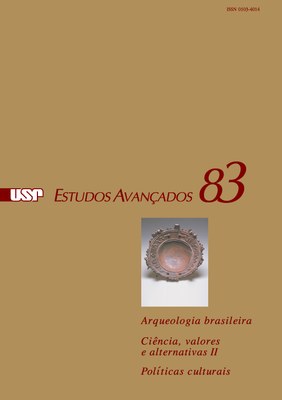
<p>“Is there an original theoretical contribution that Brazilian archeology can make to this discipline?” The author of the question is Eduardo Goes Neves, researcher at USP’s Museum of Archaeology and Ethnology (MAE) and organizer of the dossier “Aspects of Brazilian Archaeology” that opens the new edition (No. 83) of the <i>Estudos Avançados</i> journal. (<i>The digital edition is available at <i><a class="external-link" href="http://www.scielo.br/scielo.php?script=sci_issuetoc&amp;pid=0103-401420150001&amp;lng=pt&amp;nrm=iso">SciELO</a></i>.</i>)</p>
<p class="Text"><span>In addition to discussing the identity of Brazilian archeology, the dossier also brings articles on Amazonia, the Pantanal region, the ethylic practices of the Tupi-Guarani, early settlement of South America and the cultural landscapes of the southern Brazilian plateau.</span></p>
<p class="Sub1"><span><strong>History and temporality</strong></span></p>
<p>In the introductory article, <i>Is There Something We Can Call “Brazilian archeology”?</i>, Neves assesses whether there is a corpus of problems and specific data that are unique to, or at least a prerogative of, Brazilian archeology. Although he does not have a clear answer to the question, he is certain that it involves the concepts of history and temporality of South American indigenous societies.</p>
<p class="Text"><span>Neves’ article is discussed by Ulpiano Bezerra de Meneses, professor emeritus at the School of Philosophy, Literature and Human Sciences (FFLCH), and author of the essay <i>The Identity of the Brazilian Archaeology</i>.</span></p>
<p class="Text"><span>For Meneses, the conciliation of history and temporality advocated by Neves is exciting and ethnographically feasible, but archaeologically presents numerous difficulties because “from the point of view of the groups that we studied, we cannot assume the same kind of relationship we have with artifacts.”</span></p>
<p class="Text"><span>With regard to the framework of reference of Brazilian archaeologists, Meneses said it is necessary “to reiterate the warning made by Eduardo Neves: we must look less outside the continent for theoretical references, and conversely, more at the available local evidence.”</span></p>
<p class="Text"><span>The other articles of the dossier are: <i>Agricultural Determinism in Amazonian Archeology</i>, by </span><span>Claide de Paula Moraes; <i>Archeology and </i></span><i><span>Indigenous History </span></i><i><span>in the Pantanal </span><span>Region</span></i><span>, by Eduardo Bespalez; <i>The Archaeology of Fermented Brews: An Ethylic History of the Tupi-Guarani People</i></span><span>, by </span><span>Fernando Ozorio de Almeida; <i>Early Settlements in South America: Contributions of the Brazilian Milieu</i>, by Lucas Bueno and Adriana Dias; and <i>The Genesis of the Cultural Landscapes of the Southern Brazilian Plateau</i>, by Silvia Moehlecke Copé.</span></p>
<p><span><strong>Science and values</strong></span></p>
<p>In addition to the dossier on Brazilian archeology, issue no. 83 of <i>Estudos Avançados</i> publishes the second part of the dossier “Sciences, Values and Alternatives,” organized by the History, Philosophy and Sociology of Science and Technology research group, which brings the findings of studies made by the group under FAPESP’s thematic project “Genesis and Meaning of Technoscience: The Relationships Between Science, Technology and Values.”</p>
<p class="Text"><span>Whereas in the first part (published in <a class="external-link" href="http://www.scielo.br/scielo.php?script=sci_issuetoc&amp;pid=0103-401420140003&amp;lng=pt&amp;nrm=iso">issue 82</a>) the texts addressed methodological concerns of researches on the relationship between science and values, this time the articles examine three areas where attention to values is crucially important: agro-ecology, health and biodiversity.</span></p>
<p class="Text">The first topic is discussed by <a href="https://www.iea.usp.br/en/persons/visiting-professors/hugh-matthew-lacey" class="external-link">Hugh Lacey</a> in <i><span>Agroecology: An Illustration of the Fruitfulness of Multi-Strategy Research</span></i>, and by Rubens Onofre Nodari and Miguel Pedro Guerra in <i><span>Agroecology: Research Strategies and Values</span></i>. Lacey was visiting professor at the IEA in 2011 and 2013, and currently heads the Agroecology Workgroup of the <a href="https://www.iea.usp.br/en/research/research-groups/philosophy-history-sociology-of-science-and-technology" class="external-link">IEA-USP’s Philosophy, History, and Sociology of Science and Technology Research Group</a>.</p>
<p class="Text">The other two topics are covered by <a href="https://www.iea.usp.br/en/persons/visiting-professors/copy_of_nicolas-lechopier/nicolas-lechopier-a" class="external-link">Nicolas Lechopier</a>, visiting professor at the IEA in 2013, who contributes with <i>Four Tensions in Public Health</i>, and by Ana Tereza Reis da Silva, author of <i><span>The Conservation of Biodiversity Between Traditional Knowledge and Science</span></i>.</p>
<p class="Sub1"><span><strong>Other articles</strong></span></p>
<p>The journal also features articles on economics, orthographic changes, and anthropology.</p>
<p class="Text"><span>Economist Ladislau Dowbor, professor at PUC-SP, is the author of </span><i><span>The Current Financial System Hampers Economic Development</span></i><span>,</span><span> where he analyzes how the system of financial intermediation sterilizes a country’s assets by draining staggering amounts of resources that should be directed to productive and economic development.</span></p>
<p class="Text"><span>In </span><i><span>A Serene and Scientific View of the New Orthographic Agreement</span></i><span>, philologist Evanildo Bechara, from the Brazilian Academy of Letters, examines criticism of the 1990 Orthographic Agreement.</span></p>
<p class="Text"><span>In the article </span><i><span>The Occupation of Congress: What Are the Indigenous People Fighting Against?</span></i><span>,</span><span> anthropologists Artionka Capiberibe, from Unicamp, and Oiara Bonilla, from the Fluminense Federal University (UFF), address the clash between politics and the economic model that underlies the resistance of indigenous peoples to agribusiness and its representatives in Congress.</span></p>
<p class="Text"><span>The edition also includes reviews of the latest books by Nabil Bonduki, Ana Paula Koury, Marco Bobbio, Michael Löwy, Mauro Rosso (as organizer), and an essay by Lorenzo Mammi on the installation “Clara Clara,” by Laura Vinci.</span></p>]]></content:encoded>
    <dc:publisher>No publisher</dc:publisher>
    <dc:creator>Mauro Bellesa</dc:creator>
    <dc:rights>Original version in Portuguese by Mauro Bellesa and translation by Carlos Malferrari</dc:rights>
    
      <dc:subject>Abstraction</dc:subject>
    
    
      <dc:subject>Research Group: Philosophy, History, and Sociology of Science and Technology</dc:subject>
    
    
      <dc:subject>Social Sciences</dc:subject>
    
    
      <dc:subject>Transformation</dc:subject>
    
    <dc:date>2015-05-13T13:25:00Z</dc:date>
    <dc:type>Notícia</dc:type>
  </item>


  <item rdf:about="https://www.iea.usp.br/en/news/closing-report">
    <title>Participants of the Intercontinental Academia present results of the event</title>
    <link>https://www.iea.usp.br/en/news/closing-report</link>
    <description></description>
    <content:encoded xmlns:content="http://purl.org/rss/1.0/modules/content/"><![CDATA[<p>The detailed thematic structure of a MOOC (Massive Open Online Course) on time and the prospect of several scientific papers resulting from partnerships between the young researchers that have <a class="external-link" href="http://intercontinental-academia.ubias.net/people/candidates">participated</a> in the <a class="external-link" href="http://ica.usp.br/">Intercontinental Academia</a> are the main outcomes of the first immersion period of the project, held at the IEA-USP from April 17 to April 29.</p>
<p><a class="external-link" href="http://intercontinental-academia.ubias.net/people/candidates/david-gange">David Gange</a><span> (U</span><span>niversity of Birmingham), </span><a class="external-link" href="http://intercontinental-academia.ubias.net/people/candidates/nikki-moore">Nikki Moore</a><span> (</span><span>Rice University) and <a class="external-link" href="http://intercontinental-academia.ubias.net/people/candidates/helder-nakaya">Helder Nakaya</a> (USP), three of the participants, presented the Closing Report to the members of the project's </span><span><a class="external-link" href="http://intercontinental-academia.ubias.net/people/senior-committee">Senior Committee</a> during the last session of the encounter.</span></p>
<table class="tabela-direita-300-borda">
<tbody>
<tr>
<td>
<h3><i>INTERDISCIPLINARITY<br />AND COOPERATION</i></h3>
<p><i>The results presented during the Closing Report show that the first immersion period of the Intercontinental Academia (the second one will be held in Nagoya in March, 2016) was extremely productive, consolidating an initiative of the IEA-USP and the <a class="external-link" href="http://www.iar.nagoya-u.ac.jp/~iar/?lang=en">Institute for Advanced Research of the Nagoya University</a> which began to be conceived in March, 2012, during a meeting of the <i><a class="external-link" href="http://www.ubias.net/">UBIAS network</a>'s</i> Steering Committee at the Institute for Advanced Studies Jawaharlal Nehru, in India.</i></p>
<p><i><i>Nikki Moore and </i>David Gange highlighted the atmosphere of everyone's disciplinary "lack of knowledge", which enabled an intense interaction between experts from various fields.</i></p>
<p><i>They said that even the logistics of the meeting, with meals in common, lodging at the same hotel and social activities together, was an important factor for establishing links between the participants. Gange said it has been the academic gathering of most sociability he has ever participated in and that he has laughed a lot thanks to the good mood of everyone involved.</i></p>
<p><i>The fact is that the friendly and cooperative atmosphere played a key role for the high productivity of the meeting, which involved more than two dozen conferences and seminars with senior researchers, and numerous work meetings with the 13 young researchers of the project.</i></p>
<p><i><strong>On the way to Nagoya</strong></i></p>
<p><i>After the presentation, a <a class="external-link" href="http://ica.usp.br/media-center/videos/intercontinental-academia-welcome-from-nagoya">video</a> with a greeting from the director of the <i>Nagoya University's </i>IAR, <i><a class="external-link" href="http://ica.usp.br/people/senior-committee/hisanori-shinohara">Hisanori Shinohara</a></i>, was shown to all members of the Intercontinental Academia, congratulating them on their work during the two weeks in São Paulo and wishing them a good stay in Nagoya in March, 2016, for the project's <i>second </i>period of immersion.</i></p>
</td>
</tr>
</tbody>
</table>
<p><strong>Goals of the MOOC</strong></p>
<p>According to them, the MOOC to be produced will be a kind of interactive online guide for students and researchers who want to develop or expand their interest in the concept of time. For now, there are three name options for the course: "On Time", "Thinking with Time" and "What Time Is It?".</p>
<p><span>The expectation is that the users of the MOOC acquire skills to synthesize arguments from large areas of knowledge, learn to analyze evidence in order to form their own ideas on the raised issues, develop the ability to deal with conceptual materials and think transversely to the disciplines involved.</span></p>
<p><span>Students should <span>collaborate</span> in the construction of scientific knowledge <span>at the same time as they develop their framework of knowledge</span></span></p>
<p><span><strong>Course structure</strong></span></p>
<p>The young researchers have in mind a MOOC with four central themes chosen after a group evaluation on the key subdivisions of the concept of time.</p>
<p><span>All content will be studied from 14 topics, 13 of them related to at least one of the four core subjects and involving various disciplines, both the sciences and the humanities. The completion of the course will have an additional topic which will focus on the future of the concept of time.</span></p>
<p><span><strong>Core subjects</strong></span></p>
<p>Is time essential or a cognitive phenomenon? Does it require change? What exists in time? Is time an independent entity as suggested by physics and philosophy? Is it absolute or relative? These questions will try to answer the question of the first central theme: "What is time?".</p>
<p><span>“How is time perceived?” is the question that defines the second central theme. It raises a number of issues to be studied, including the following:</span></p>
<ul>
<li><span>Can we perceive time?</span></li>
<li><span>Is it possible to make reliable judgments about temporal properties?</span></li>
<li><span>Can one perceive time without change?</span></li>
<li><span>What is the relationship between experienced time and neural time?</span></li>
<li><span>How is it possible to experience events that last in time (movement, change, succession, melodies) as something extended in time?</span></li>
</ul>
<p> </p>
<p><span>The functional concept, the mutant concept and the standardization of time, the mental time travel (chronesthesia), the opposition between linear time and cyclical time, and (in anthropology) between deictic time and sequential time will be analyzed in the third central theme: "How is time conceptualised?".</span></p>
<p><span>The question that defines the fourth central theme is "How is time used?". The issues to be discussed approach time as something relevant to subjects such as astronomy, biology, chemistry and medicine as well as how narratives use it creating linearity, circularity or even its fractionation. The importance of time in social interaction (time management, punctuality, working and leisure hours), history, traditions and other aspects also deserve attention.</span></p>
<p><span><strong>Topics of study</strong></span></p>
<p>The 14 topics of the course have been established through specific questions which are broken down into sub-questions:</p>
<ul>
<li>How is time measured?</li>
<li>What traces does time leave?</li>
<li>Is there a relationship between time and causality?</li>
<li>Is time relative?</li>
<li>What are temporal illusions and what can we learn from them?</li>
<li>Does time have a history?</li>
<li>Why is the present special?</li>
<li>Can we predict the future?</li>
<li>How do different rhythms interact?</li>
<li>What does symbolic representation do for human understanding of time?</li>
<li>Do non-humans have individual time?</li>
<li>Is time running out? </li>
<li>How do we value time?</li>
<li>What is the future of the time concept?</li>
</ul>
<p> </p>
<table class="tabela-esquerda-200-borda">
<tbody>
<tr>
<td>
<h3>Related material</h3>
<p><strong>INTERCONTINENTAL ACADEMIA</strong></p>
<p><i><strong>Conclusion report by the participants</strong></i></p>
<ul>
<li><a href="https://www.iea.usp.br/en/midiateca/video/videos-2015/intercontinental-academia-presentation" class="external-link">Video</a> / <a class="external-link" href="http://ica.usp.br/media-center/photos/closing-report-april-29">Photos</a></li>
</ul>
<p> </p>
<p><strong>News</strong></p>
<p>"<a class="external-link" href="http://ica.usp.br/news/intercontinental-academia-conference-proposes-philosophical-reflection-on-time-and-eternity">Intercontinental Academia Conference Proposes Philosophical Reflection on Time and Eternity</a>"</p>
<p style="text-align: right; "><strong><i><a class="external-link" href="http://ica.usp.br/news">more news</a></i></strong></p>
<p><strong><i><a class="external-link" href="http://intercontinental-academia.ubias.net/docs/reports">Critical reports</a></i></strong></p>
<p><strong><i><a class="external-link" href="http://intercontinental-academia.ubias.net">More information</a></i><br /></strong></p>
</td>
</tr>
</tbody>
</table>
<p><strong>Means</strong></p>
<p>Each topic will be covered in a class which will feature videotaped speeches, animations, questions and 5-8 films of 7-15 minutes each.</p>
<p>There will be a discussion forum in which the students will be encouraged to provide answers on questions raised by the course and other students.</p>
<p>There are also plans for a multimedia reading list, a kind of database with links and relevant content separated by levels of complexity. The idea is that students can write short comments on the presented material's <span>support </span><span>itself</span>.</p>
<p><span><strong>Target audience</strong></span></p>
<p>The MOOC will be designed at a level of scientific complexity that should be "suitable for intellectually ambitious graduates." However, it will not be necessary that the students have previous specific qualifications as this would not match the diverse academic profile of those responsible for the initiative, who do not have an area of common knowledge to everyone. It would also be incoherent w<span>ith the general spirit of this type of course.</span></p>
<p><span>The introduction of complex ideas will be made from the basic concepts domain, since each student is a beginner in at least some of the subjects comprised in the MOOC.</span></p>
<p><span><strong>Additional results</strong></span></p>
<p>Biologist Helder Nakaya presented the potential additional results that the Intercontinental Academia can provide besides the MOOC.</p>
<p><span>The first one is to send a "letter to the editor" of some interdisciplinary journal of world prestige. This contribution will address the importance, the key features and the project's results.</span></p>
<p><span>Even the contact of the young researchers throughout the project should result in interdisciplinary scientific articles, which might also be possible from the processing of the data to be collected through questionnaires answered by the students of the MOOC.</span></p>
<p><span> </span><span>The production of </span><span>a video with various multimedia features on all the work being developed in the Intercontinental Academia will be considered.</span></p>]]></content:encoded>
    <dc:publisher>No publisher</dc:publisher>
    <dc:creator>Richard Meckien</dc:creator>
    <dc:rights>Original version in Portuguese by Mauro Bellesa</dc:rights>
    
      <dc:subject>Abstraction</dc:subject>
    
    
      <dc:subject>Intercontinental Academia</dc:subject>
    
    
      <dc:subject>Event</dc:subject>
    
    
      <dc:subject>Time</dc:subject>
    
    
      <dc:subject>Transformation</dc:subject>
    
    <dc:date>2015-05-11T18:30:00Z</dc:date>
    <dc:type>Notícia</dc:type>
  </item>


  <item rdf:about="https://www.iea.usp.br/en/news/consciousness-self">
    <title>The Relationship between Consciousness of Self and Perception of Time</title>
    <link>https://www.iea.usp.br/en/news/consciousness-self</link>
    <description></description>
    <content:encoded xmlns:content="http://purl.org/rss/1.0/modules/content/"><![CDATA[<p><img src="https://www.iea.usp.br/imagens/conferencia-leopoldo-nosek/@@images/55aa8e1f-7d47-487e-ac10-5866e7241855.jpeg" alt="Conferência Leopoldo Nosek" class="image-right" title="Conferência Leopoldo Nosek" /></p>
<p>What is the relationship between discerning the consciousness of self – in the sense of an individual’s apprehension of his own existence – and the perception of time? Psychoanalyst <a class="external-link" href="http://intercontinental-academia.ubias.net/people/speakers/leopold-nosek">Leopold Nosek</a> devoted his conference on April 25 at the <a class="external-link" href="http://intercontinental-academia.ubias.net/">Intercontinental Academia</a> to an analysis of this matter.</p>
<p class="Text"><span>He said that, given the fact that consciousness of self includes temporality and that humanization presupposes perception of time, one cannot but wonder how time presents itself to, and is perceived by, human beings.</span></p>
<p class="Text"><span>In his reasoning, Nosek made use of analogies with works by “two writers who addressed the relativity of time from within the rationalist tradition:”  <i>The Magic Mountain</i> (1924) and <i>Doctor Faustus</i> (1947), both by German-born Thomas Mann (1875-1955); and <i>The Leopard</i> (1958), by Italian author Tomasi di Lampedusa (1896-1957).</span></p>
<p class="Text"><span>In the passage from <i>The Magic Mountain</i> quoted by Nosek, Hans Castorp, the main character, has just reached the conclusion that, for the mind, time does not flow uniformly; the mind only assumes it does so to maintain the proper order of things. Therefore, all measurements of time are no more than conventions.</span></p>
<table class="tabela-esquerda-200-borda">
<tbody>
<tr>
<td>
<h3>Related material</h3>
<p><b>INTERCONTINENTAL ACADEMIA</b></p>
<p><i><b>Thematic axis: Time</b></i></p>
<p><b>Leopold Nosek's conference</b></p>
<ul>
<li><span><a href="https://www.iea.usp.br/noticias/documentos/tempo-e-subjetividade" class="external-link">Complete text of the conference</a> (in Portuguese)</span></li>
<li><a href="https://www.iea.usp.br/midiateca/video/videos-2015/talk-with-leopold-nosek" class="external-link">Video</a> / <a class="external-link" href="http://ica.usp.br/media-center/photos/talks">Photos</a></li>
</ul>
<p> </p>
<p><b>News</b></p>
<p>"<a href="https://www.iea.usp.br/en/news/concepcao-de-tempo-em-diferentes-sociedades-e-tema-de-conferencia-da-ica" class="external-link">Conception of time in different societies</a>"</p>
<p style="text-align: right; "><b><i><a href="https://www.iea.usp.br/en/news/ica-news" class="external-link">more news</a></i></b></p>
<p> </p>
<p><b><i><a class="external-link" href="http://intercontinental-academia.ubias.net/">More information</a></i><br /></b></p>
</td>
</tr>
</tbody>
</table>
<p class="Text"><span>According to Nosek, time and consciousness of self are contemporary themes. He mentioned Freud’s <i>The Interpretation of Dreams</i> (1900) as one of the landmarks, from the viewpoint of perception, for most texts that discuss Modernity.</span></p>
<p class="Text"><span>He said that in this work by Freud one can see the loss of our naïve trust in the conscious mind and the inexorable breach between the conscious and the unconscious. For Nosek, we could speak of Modernity as the awareness of disruption.</span></p>
<p class="Text"><span>Addressing the emergence of this disruption, Nosek said we must remember how brief the Renaissance actually was, “with its glorious view of the individual as part of circumstances over which he had control.” However, it did not take long for Mannerism to come about, “with its distorted figures, its suffering subjectivity.”</span></p>
<p class="Text"><span>He said that art historian Arnold Hauser (1992-1978) saw Mannerism as the onset of the perception of modern man, “the perception of a shattered unity, of a broken harmony.”</span></p>
<p class="Text"><span>As for <i>The Leopard</i>, Nosek noted that the novel is set in the mid-19<sup>th</sup> century, the time of Italy’s reunification and modernization. The main character, Don Fabrizio, prince of Salina, after a dance, realizes that he, unlike others, captures the passage of time, which is accompanied by “progress, destruction of old structures, creation of new wealth and new desolations.”</span></p>
<p class="Text"><span>According to Nosek, “the prince of Salina, in a sudden glimmer of his own skin, grasps his circumstances, his historical destiny and his subjective self; his own place is revealed to him. What more could he obtain?”</span></p>
<p class="Text"><span>For Nosek, grappling one’s circumstances and one’s time blends in with the apprehension of the limits and the space of human existence: “We continue, therefore, within our theme: the interconnection between the consciousness of self, the awareness of one’s ‘proper place,’ and the image of time defined by frustration and limitation.”</span></p>
<p class="Text"><span>In <i>Doctor Faustus</i>, the main character, the musician Adrian Leverkühn, makes a pact with the devil, Mephistopheles, giving his soul in exchange for 24 years of genius as a composer. Nosek noted how Mephistopheles warns the musician to pay attention to the hourglass.</span></p>
<p class="Text"><span>For Nosek, Mephistopheles’ warning means Leverkühn should remain aware of life. As a result of the pact, Lerverkühn becomes part of Modernity, “through atonal spaces, the spatial expansion of musical contradiction, accompanied by scientific inquiries and by the theory of uncertainty and chance.”</span></p>
<p class="Text"><span>He finished his presentation with some propositions by psychoanalyst Donald Meltzer (1922-2004) in his book <i>Explorations in Autism</i> (1975), where he organizes the space of life in a “geography of fantasy" that moves along in time.</span></p>
<p class="Text"><span>According to Meltzer, experienced time can be a cloister where events are not available to memory and to thought (as happens in autism); it can be circular, undeveloping, where there is no death; or it can be oscillating, moving from within to outside the object and vice-versa, a continuous operation of omnipotence that makes the differentiation of self from object reversible, and also makes the direction of time itself reversible.</span></p>
<p class="Text"><span>According to Nosek, remaining unidirectional and linear, from birth to death, requires a painful process, never completed, of renouncing the fusion between the self and the object, of struggling against narcissism, of assuaging omnipotence.</span></p>
<p style="text-align: right; "><span class="discreet"><i>Photo: Leonor Calasans/IEA</i></span></p>]]></content:encoded>
    <dc:publisher>No publisher</dc:publisher>
    <dc:creator>Richard Meckien</dc:creator>
    <dc:rights>Original version in Portuguese by Mauro Bellesa and translation by Carlos Malferrari</dc:rights>
    
      <dc:subject>Intercontinental Academia</dc:subject>
    
    
      <dc:subject>Abstraction</dc:subject>
    
    
      <dc:subject>Event</dc:subject>
    
    
      <dc:subject>Time</dc:subject>
    
    <dc:date>2015-04-28T20:50:00Z</dc:date>
    <dc:type>Notícia</dc:type>
  </item>


  <item rdf:about="https://www.iea.usp.br/en/news/arrow-time">
    <title>Matthew Kleban discusses the arrow of time and the evolution of the universe</title>
    <link>https://www.iea.usp.br/en/news/arrow-time</link>
    <description></description>
    <content:encoded xmlns:content="http://purl.org/rss/1.0/modules/content/"><![CDATA[<table class="tabela-direita-400">
<tbody>
<tr>
<th><img src="https://www.iea.usp.br/imagens/matthew-kleban/@@images/1b7871bb-5778-4a1c-b855-03c3f83f8566.jpeg" alt="Matthew Kleban" class="image-inline" title="Matthew Kleban" /></th>
</tr>
<tr>
<td style="text-align: right; "><strong>Theoretical physicist Matthew Kleban, from NYU</strong></td>
</tr>
</tbody>
</table>
<p>The first conference of the <a class="external-link" href="http://intercontinental-academia.ubias.net/">Intercontinental Academia</a><span> </span>on the subject of “Time”, on April 21, addressed what is known about the history and the possible future of the universe, as well as the concept of “arrow of time,” which posits only one direction for the flow of time, and considers that past and future are different, a notion closely related to cosmology.</p>
<p class="Text"><span>The lecturer was theoretical physicist <a class="external-link" href="http://intercontinental-academia.ubias.net/people/speakers/matthew-kleban">Matthew Kleban</a>, from NYU, who dedicates himself to the study of string theory and the early history of the universe.</span></p>
<table class="tabela-esquerda-200-borda">
<tbody>
<tr>
<td>
<h3>Related material</h3>
<p><strong>INTERCONTINENTAL<br />ACADEMIA<br /><i> </i></strong></p>
<p><strong><i>Thematic axis: Time</i></strong></p>
<p><strong>Matthew Kleban's conference</strong></p>
<ul>
<li><a href="https://www.iea.usp.br/en/midiateca/video/videos-2015/intercontinental-academia-talk-with-matthew-kleban" class="external-link">Video</a> / <a class="external-link" href="http://intercontinental-academia.ubias.net/media-center/photos/talks">Photos</a></li>
</ul>
<p> </p>
<p><span><strong>News</strong></span></p>
<ul>
<li><a href="https://www.iea.usp.br/en/news/attempts-physics-build-time" class="external-link">The Attempts of Physics to Build Time</a></li>
</ul>
<p style="text-align: right; "><strong><i><a class="external-link" href="http://intercontinental-academia.ubias.net/news">More news</a></i></strong></p>
<p><strong><a class="external-link" href="http://intercontinental-academia.ubias.net/docs/reports" target="_blank">Critical reports</a></strong></p>
<p><strong><a class="external-link" href="http://intercontinental-academia.ubias.net">More information</a><br /></strong></p>
<strong><i> </i></strong></td>
</tr>
</tbody>
</table>
<p class="Text"><span>He noted that, contrary to what is assumed by the arrow of time, there are physical laws that posit dual direction, i.e., symmetry between past and future, although he stressed that this idea is still very confusing to physicists.</span></p>
<p><span><strong>Entropy</strong></span></p>
<p>According to Kleban, if this idea is correct, then the difference between past and future must be related “to an ‘environmental’ aspect, to an accident of history, such as the difference between North and South Americas, albeit universal, applicable anywhere and anytime.”</p>
<p class="Text"><span>When entropy (“disorder”) is low, it tends to increase and the direction of its increase defines the future, said Kleban. Thus, entropy, which was very slight in the early universe, is the “environmental” factor that distinguishes the past from the future. “However, nothing prevents the arrow of time from having a reverse movement due to some other ‘environmental’ aspect.”</span></p>
<p><span><strong>Cosmology</strong></span></p>
<p>With regard to cosmology, he first defined what this science is: “The branch of astrophysics that studies the structure of the universe in the largest accessible scale; this includes the study of the birth, death (or future) and evolution of the Universe over time.”</p>
<p class="Text"><span>However, because the universe is 14 billion years, we can only see a portion of it, although quite vast, corresponding to the distance traveled by light in these 14 billion years, he said. “Looking at the past, we see that the universe was hotter and opaque 14 billion years ago, so we cannot see (at least directly) its birth.”</span></p>
<p class="Text"><span>Continuing with his presentation, Kleban addressed the current contents of the universe. He said there are about 100 billion galaxies, each with hundreds of billions of stars. The Milky Way has nearly 300 billion stars and a colossal black hole exists in the center of the galaxy, called Sagittarius A*, with mass equivalent to 4 million Suns, but with radius (at least in theory) only 17 times the size of the Sun. The solar system also orbits the galactic center, but the orbit lasts 200 million years.</span></p>
<p><span><strong>Hubble's Law</strong></span></p>
<p>The panel on galaxies was used by Kleban to introduce his comments about the expansion of the universe. The central figure here was American astronomer Edwin Hubble (1989-1953), whose telescope in the 1920s was able to observe approximately 50 galaxies (the Hubble Telescope, orbiting the Earth for 25 years, allows us to observe 10,000 galaxies when aimed at each 10/1,000,000 slit of the heavens).</p>
<p class="Text"><span>Kleban explained that Edwin Hubble noticed something odd in the galaxies: the farther away they were, the faster they moved away from Earth. This observation led to the so-called Hubble’s Law: v = Hd, where H is a constant with units of 1/time. With this law, it became possible to calculate when the entire content of the universe was bundled together, so to speak: 14 billion years ago.</span></p>
<p class="Text"><span>Kleban then reversed the arrow of time, as if the history of the universe moved backward, from when galaxies were just gas, through the increased warming, the opacity, the nucleosynthesis of protons and neutrons of helium and lithium, the inflation (when the volume of the universe spiked dramatically in a tiny fraction of a second), until reaching what is known as the singularity, “where even mere speculation collapses.”</span></p>
<p class="Text"><span>He pointed out that each of these phases of the universe produced enormous entropy and that, even today, entropy is increasing. “Life can be seen as a process that accelerates the production of entropy, as stars and black holes do even more so.”</span></p>
<p class="Text"><span>Hubble’s observations about the expansion of the universe created a profoundly strange idea, namely, the notion of the Earth as the center from which everything moves away, a kind of resumption of Ptolemy’s geocentrism.</span></p>
<p><span><strong>Relativity</strong></span></p>
<p>Kleban explained that in 1916, ten years before Hubble’s observations, Albert Einstein (1879-1955) developed the General Theory of Relativity, a sequence to the Special Theory of Relativity (1905), which had unified space and time (and energy and momentum). “In Einstein’s Theory of Relativity, time is relative, elapsing slower for an object moving at high speed or immersed in a gravitational field. Even in relativity, however, time does not flow in reverse.”</p>
<p class="Text"><span>According Kleban, general relativity is a theory of gravity and also a radical reformulation of the nature of space and time that establishes their intimate and dynamic connection. Thus, the apparent force of gravity ceases to be a common force and becomes something like a “pseudoforce” or “fictitious force.”</span></p>
<p class="Text"><span>After detailing some implications of this scenario, including the curvature of space-time, Kleban explained why Hubble’s Law works: “It is because the universe is expanding, and this has implications for the past and for the future.”</span></p>
<p class="Text"><span>With regard to the future, some believe that the expansion will continue infinitely; the speed of expansion will decrease gradually, but will never cease. According to this hypothesis, Kleban explained, stars will eventually consume all their fuel and the universe will become cold and dead, even though this would probably not be the end, which would occur later.</span></p>
<p class="Text"><span>Other researchers think the expansion will reach a maximum level and the universe will then begin to contract. After a finite span of time, density will be infinite, a singularity that is called “Big Crunch” (major collapse).</span></p>
<p class="Text"><span>There are also those who consider that a threshold situation is possible between these two scenarios.</span></p>
<p class="Text"><span>However, Kleban explained, these hypotheses hold two surprises: the first is that over the last billion years the expansion of the universe has accelerated because of dark energy. The second is that the speed of the expansion seems to be very close to the threshold speed. This would mean that the universe will continue to expand forever and will never reach zero degree or undergo an actual “hot death.”</span></p>
<p><span><strong>Multiverse</strong></span></p>
<p>And how about the beginning of everything, the Big Bang? Kleban said, “some well-intentioned additions to the laws of physics can dramatically affect the nature of the Big Bang and remove the singularity without altering any experiment carried out on Earth.”</p>
<p class="Text"><span>One of his main interests is the so-called “multiverse” of string theory. “In string theory, the Big Bang was not a singularity or the beginning of time. It was the birth of a ‘bubble’ of a new ‘phase’.” The multiverse could harbor the emergence of numerous such bubbles.</span></p>
<p class="Text"><span>String theory allows us to understand what existed before the Big Bang and what exists “beyond the universe” (or rather, what exists outside the visible bubble where the observable part of the universe is inserted), according to Kleban. However, he cautioned that the theory does not work with regard to “big crunches” (due to the arrow of time, actually) that the theory itself envisages. “Likewise, the theory does not work in low entropy situations.”</span></p>
<p class="Text"><span>In conclusion, Kleban said that, for him, the most attractive idea is an overall timeless universe, where almost all of time in a state of balance with near‑maximum entropy – only rare fluctuations of reduced entropy, which would produce a local arrow of time. However, “this idea does not seem to work, but rather predicts miracles.”</span></p>
<p style="text-align: right; "><span style="text-align: right; "><span class="discreet">Photo: Sandra Sedini/IEA-USP</span></span></p>]]></content:encoded>
    <dc:publisher>No publisher</dc:publisher>
    <dc:creator>Richard Meckien</dc:creator>
    <dc:rights>Original version in Portuguese by Mauro Bellesa and translation by Carlos Malferrari</dc:rights>
    
      <dc:subject>Abstraction</dc:subject>
    
    
      <dc:subject>Intercontinental Academia</dc:subject>
    
    
      <dc:subject>Glocal</dc:subject>
    
    
      <dc:subject>Time</dc:subject>
    
    
      <dc:subject>Event</dc:subject>
    
    <dc:date>2015-04-23T17:05:00Z</dc:date>
    <dc:type>Notícia</dc:type>
  </item>


  <item rdf:about="https://www.iea.usp.br/en/news/descendant-cisis">
    <title>Subjectivity and suffering in contemporary life (POSTPONED EVENT)</title>
    <link>https://www.iea.usp.br/en/news/descendant-cisis</link>
    <description></description>
    <content:encoded xmlns:content="http://purl.org/rss/1.0/modules/content/"><![CDATA[<div class="kssattr-target-parent-fieldname-text-f9790e9df30f48c8b7726336aac5bd19 kssattr-macro-rich-field-view kssattr-templateId-widgets/rich kssattr-atfieldname-text " id="parent-fieldname-text-f9790e9df30f48c8b7726336aac5bd19">
<p style="text-align: justify; "><a href="https://www.iea.usp.br/en/research/research-groups/humanidades-e-mundo-contemporaneo" class="external-link">IEA-USP's Humanities and the Contemporary World Research Group</a> will hold the seminar <i>Filiation's Crisis: Subjectivity and Suffering</i> on <strong>November 28</strong>, at <strong>2 pm (this event has been postponed to February, 2015)</strong>, at USP's Institute of International Relations (IRI). According to the organizers, the event aims to reflect on "the 'time of agression', which once accelerated prevents the formation of the identity experience in its heterogeneous layers, and of bonds of belonging and memory, replaced by successive traumas in the spectacle of pain according to the markets of advertising and politics."</p>
<p style="text-align: justify; "><span>Exhibitors will be Cynthia A. Sarti and <span>Tales Ab'Sáber</span>, both professors at UNIFESP, and Maria Inês Assumpção <span>Fernandes</span>, a professor at USP's Institute of Psychology. Moderation will be in charge of the research group's <span>coordinator</span> Olgária Matos, a professor of USP's Faculty of Philosophy, Letters and Human Sciences (FFLCH).</span></p>
<p style="text-align: justify; ">Sarti will talk about <i>Memory and Forgetfulness</i>, making a reflection on the role of memories in the establishment of a common shared memory on the threshold between narrative, and <span>psychic </span>healing, trauma and resilience of contemporary politicians.</p>
<p style="text-align: justify; "><i>Filiation's Rupture</i> will be the theme of Fernandes. She will examine the sense of loss of psychic transmission and its consequences in the constitution of subjectivity across generations, allowing family, and symbolic and identity <span>belonging </span><span>narratives</span>.</p>
<p style="text-align: justify; ">Ab'Sáber called his exhibition <i>The Music of Infinite Time</i>. He will discuss the uses of time by the young controlled by the rules of drug consumption and the market in its relations with the processes of depersonalization and unfulfillment both in terms of group performances and celebrations, and in their daily lives.</p>
<div>
<div class="kssattr-atfieldname-programacao kssattr-templateId-widgets/rich kssattr-macro-rich-field-view kssattr-target-parent-fieldname-programacao-353b5b8bc739427eb693b2f69ac41085" id="parent-fieldname-programacao-353b5b8bc739427eb693b2f69ac41085"></div>
</div>
</div>
<div>
<div class="kssattr-target-parent-fieldname-organizacao-f9790e9df30f48c8b7726336aac5bd19 kssattr-macro-rich-field-view kssattr-templateId-widgets/rich kssattr-atfieldname-organizacao " id="parent-fieldname-organizacao-f9790e9df30f48c8b7726336aac5bd19"></div>
</div>]]></content:encoded>
    <dc:publisher>No publisher</dc:publisher>
    <dc:creator>Richard Meckien</dc:creator>
    <dc:rights></dc:rights>
    
      <dc:subject>Abstraction</dc:subject>
    
    
      <dc:subject>Event</dc:subject>
    
    
      <dc:subject>Research Group: Humanities and the Contemporary World</dc:subject>
    
    <dc:date>2014-11-14T16:30:00Z</dc:date>
    <dc:type>Notícia</dc:type>
  </item>


  <item rdf:about="https://www.iea.usp.br/en/news/fields-medal">
    <title>Artur Ávila's Fields Medal and the Brazilian School of Mathematics </title>
    <link>https://www.iea.usp.br/en/news/fields-medal</link>
    <description></description>
    <content:encoded xmlns:content="http://purl.org/rss/1.0/modules/content/"><![CDATA[<table class="tabela-direita-300">
<tbody>
<tr>
<th><img src="https://www.iea.usp.br/imagens/artur-avila-medalha-fields-2" alt="Artur Ávila - Medalha Fields - 2" class="image-inline" title="Artur Ávila - Medalha Fields - 2" /></th>
</tr>
<tr>
<td style="text-align: right; "><strong>Mathematician Artur Ávila being awarded by South Korea's President, </strong><strong><span style="text-align: start; ">Park Geun-hye</span></strong></td>
</tr>
</tbody>
</table>
<p style="text-align: justify; ">Mathematician Artur Ávila, 35, a researcher at the <a class="external-link" href="http://www.impa.br/opencms/en/">National Institute of Pure and Applied Mathematics (IMPA)</a> and Director of Research at the <a class="external-link" href="http://www.cnrs.fr/index.php">National Council for Scientific Research (CNRS)</a> of France, was one of the four winners of the Fields Medal in 2014, being the first Latin American to receive the award, which is considered the Nobel Prize of mathematics. Thus, Ávila became the holder of the most important international scientific honor in any area ever granted to a Brazilian researcher.</p>
<p style="text-align: justify; ">In order to historically contextualize the achievement of Ávila and the Brazilian mathematics field, the IEA-USP and <a class="external-link" href="http://www.ime.usp.br/en">USP's Institute of Mathematics and Statistics (IME)</a>, with support from the <a class="external-link" href="http://www.icmc.usp.br/Portal/">Institute of Mathematics and Computer Sciences (ICMC)</a> of USP's campus in São Carlos, will hold the seminar <strong><i>Artur Ávila, the Fields Medal and the Brazilian School of Mathematics</i></strong> on <strong>October 15, at 2 pm, in IEA-USP's Event Room</strong>.</p>
<p style="text-align: justify; ">The exhibitors will be three researchers from the IMPA: Marcelo Viana, Maurício Peixoto and Welington de Melo. Moderation will be in charge of Edson de Faria (IME). Moderation will be in charge of Edson de Faria (IME). Before the seminar, from 11 am to 12 pm, at the IME, Welington de Melo, who has been the doctoral supervisor to Ávila, will give a lecture on the work of the medalist for undergraduates in mathematics.</p>
<p style="text-align: justify; ">Founded in 1936 and granted only to mathematicians under 40 years, the Fields Medal was handed to the winners of this year on August 13, during the <a class="external-link" href="http://www.icm2014.org/">International Congress of Mathematicians</a>, held in Seoul. The medal is only awarded every four years during the meetings of the International Mathematical Union. Rio de Janeiro will host the next congress in 2018. It will be the first time a country of the Southern Hemisphere becomes the host .</p>
<p style="text-align: justify; ">Ávila’s award is the crowning of a long path of struggle by Brazilian mathematics. Although the achievement is due to the merits and individual brilliance of the young mathematician, it should also be credited for his participating in a scientific context that can be defined as a Brazilian school of studies on dynamical systems, primarily established by IMPA, an institution that has played an important role in the world for several years and from which Ávila has graduated.</p>
<p style="text-align: justify; "><span style="text-align: justify; ">The event will be broadcast live on the </span><a style="text-align: justify; " href="https://www.iea.usp.br/aovivo">web</a><span style="text-align: justify; ">.</span></p>
<p style="text-align: right; "><span class="discreet">Photo: International Congress of Mathematicians</span></p>]]></content:encoded>
    <dc:publisher>No publisher</dc:publisher>
    <dc:creator>Richard Meckien</dc:creator>
    <dc:rights></dc:rights>
    
      <dc:subject>Mathematics</dc:subject>
    
    
      <dc:subject>Abstraction</dc:subject>
    
    
      <dc:subject>Event</dc:subject>
    
    <dc:date>2014-10-03T20:10:00Z</dc:date>
    <dc:type>Notícia</dc:type>
  </item>


  <item rdf:about="https://www.iea.usp.br/en/news/human-and-technique">
    <title>The impacts of biotechnological advances in the human condition </title>
    <link>https://www.iea.usp.br/en/news/human-and-technique</link>
    <description></description>
    <content:encoded xmlns:content="http://purl.org/rss/1.0/modules/content/"><![CDATA[<div class="kssattr-target-parent-fieldname-text-eaddfc15c29043a7a562a9a516ebc83c kssattr-macro-rich-field-view kssattr-templateId-widgets/rich kssattr-atfieldname-text " id="parent-fieldname-text-eaddfc15c29043a7a562a9a516ebc83c">
<table class="tabela-direita-200-borda">
<tbody>
<tr>
<td>
<h3>Related material</h3>
<h3><span>News</span></h3>
<ul>
<li><span><a href="https://www.iea.usp.br/en/news/science-and-the-meaning-of-life-in-a-time-of-disenchantment" class="external-link">Science and the meaning of life in a time of disenchantment</a></span></li>
<li><span><a href="https://www.iea.usp.br/en/news/seminar-examines-the-experience-of-public-space-in-modernity" class="external-link">Seminar analyzes the experience of public space in modernity</a></span></li>
<li><a href="https://www.iea.usp.br/en/news/conference-addresses-changes-in-the-relationship-between-man-and-nature" class="external-link">Conference addresses changes in the relationship between man and nature</a></li>
</ul>
<p><strong> Photos</strong></p>
<ul>
<li><a href="https://www.iea.usp.br/en/media-library/photos/events-2014/em-busca-do-sentido-perdido-a-ciencia-e-o-politeismo-de-valores-08-de-abril-de-2014" class="external-link">First seminar - <span style="text-align: justify; ">Science and the Polytheism </span><span style="text-align: justify; ">of Values</span></a></li>
<li><a href="https://www.iea.usp.br/en/media-library/photos/events-2014/em-busca-do-sentido-perdido-o-individuo-e-o-espaco-publico-29-de-maio-de-2014" class="external-link">Second seminar - <span style="text-align: justify; ">The Individual and Public Space</span></a></li>
<li><a href="https://www.iea.usp.br/en/media-library/photos/events-2014/em-busca-do-sentido-perdido-o-ser-humano-e-a-natureza-03-de-setembro-de-2014" class="external-link">Third seminar - The Human Being and Nature</a><a href="https://www.iea.usp.br/en/media-library/photos/events-2014/em-busca-do-sentido-perdido-o-ser-humano-e-a-natureza-03-de-setembro-de-2014" class="external-link"><br /><br /></a></li>
</ul>
<p><strong>Text</strong></p>
<ul>
<li><a href="https://www.iea.usp.br/en/publicacoes/textos/el-individuo-el-amor-y-el-sentido" class="internal-link">El Individuo, el Amor y el Sentido de la Vida en las Sociedades Contemporáneas</a></li>
</ul>
</td>
</tr>
</tbody>
</table>
<table class="tabela-direita-300">
<tbody>
<tr>
<th><img src="https://www.iea.usp.br/imagens/claudio-cohen" alt="Claudio Cohen" class="image-inline" title="Claudio Cohen" /></th>
</tr>
<tr>
<td style="text-align: right; "><strong>Psychoanalyst and psychiatrist Claudio Cohen, a professor at USP's Faculty of Medicine, will be the exhibitor</strong></td>
</tr>
</tbody>
</table>
<p style="text-align: justify; ">How will new genetic technologies affect the production of meaning in the lives of human beings? If humanity became a civilization of cyborgs (humans with bio-mechatronic components), how would that affect the human condition? What is the role of the university in thinking about these issues and in establishing (or not) limits to the transformations in the human being?</p>
<p style="text-align: justify; ">These issues will be discussed at the seminar <i><strong>The Human Being and Technique</strong></i>, on <strong>October 8, at 3 pm, in IEA-USP's Event Room</strong>. It will be the fourth meeting of the cycle <i>In Search of Lost Meaning</i>. The speaker will be psychoanalyst and psychiatrist Claudio Cohen, a professor at USP's Faculty of Medicine, who is an expert in bioethics and clinical bioethics.</p>
<p style="text-align: justify; ">The debaters will be economist Gilson Schwartz, a professor of the Department of Film, Radio and Television at USP's School of Communications and Arts (ECA), and political scientist Maya Mitre, a researcher at the Federal University of Minas Gerais and a specialist in political theory, and social studies of science and technology. Moderation will be in charge of political scientist Bernardo Sorj, a visiting professor at the IEA-USP and coordinator of the cycle.</p>
<p style="text-align: justify; ">The event will be broadcast live on the <a href="https://www.iea.usp.br/aovivo">web</a>.</p>
<p style="text-align: justify; "><span><strong>CYCLE</strong></span></p>
<p style="text-align: justify; "><i>In Search of Lost Meaning: Interdisciplinary Dialogues on Science and Transcendence</i>, coordinated by Sorj, has planned four meetings. The goal is to address the changes caused by the decline of the great political ideologies and to discuss the production of meaning in this new sociocultural context.</p>
<p style="text-align: justify; ">According to Sorj, the political ideologies of modernity - as the Enlightenment liberalism, fascism, communism and nationalism – have maintained from religious monotheism the notion that values ​​can be organized around universal principles and that there is a single truth. With the decline of the "secular religions" a world of "polytheism of values ​, which transfers to the individual the right and responsibility to choose between often conflicting and mutually exclusionary beliefs and values" has arisen.</p>
<p style="text-align: justify; ">This polytheism of values ​​is the main feature of today in the opinion of Sorj, for whom "the challenge of democratic societies is to assume this position, completing the process of secularization that began in the Renaissance."</p>
<p style="text-align: right; "><span class="discreet">Photo: Marcos Santos/USP Imagens</span></p>
</div>]]></content:encoded>
    <dc:publisher>No publisher</dc:publisher>
    <dc:creator>Richard Meckien</dc:creator>
    <dc:rights></dc:rights>
    
      <dc:subject>Abstraction</dc:subject>
    
    
      <dc:subject>Social Sciences</dc:subject>
    
    
      <dc:subject>Culture</dc:subject>
    
    
      <dc:subject>Ethics</dc:subject>
    
    
      <dc:subject>Technology</dc:subject>
    
    
      <dc:subject>Event</dc:subject>
    
    <dc:date>2014-10-01T18:20:00Z</dc:date>
    <dc:type>Notícia</dc:type>
  </item>


  <item rdf:about="https://www.iea.usp.br/en/news/exploring-animal-subjectivity">
    <title>Exploring animal subjectivity</title>
    <link>https://www.iea.usp.br/en/news/exploring-animal-subjectivity</link>
    <description></description>
    <content:encoded xmlns:content="http://purl.org/rss/1.0/modules/content/"><![CDATA[<p style="text-align: justify; ">The sixth meeting of the cycle of conferences and debates <i>Humans and Animals: The Limits of Mankind</i> will address animal subjectivity. Organized by <a href="https://www.iea.usp.br/en/research/research-groups/philosophy-history-sociology-of-science-and-technology" class="external-link">IEA-USP's Philosophy, History, and Sociology of Science and Technology Research Group</a>, the event will include two roundtables, taking place on September 29-30, both at 9.30 am, in the Auditorium of USP's Museum of Contemporary Art (MAC).</p>
<p style="text-align: justify; ">The subject will be addressed from an interdisciplinary perspective, centered in philosophy but also considering anthropology, biology, linguistics, psychology and law. According to the coordinator of the meeting, Lorenzo Baravalle, a post-doctoral student in Philosophy at USP and member of the research group, "the main objective is to define questions and to sketch lines of response rather than reaching definitive conclusions."</p>
<p style="text-align: justify; "><span>Some of the issues to be addressed are: </span></p>
<ul style="text-align: justify; ">
<li><span>What are the manifestations of animal subjectivity?</span></li>
<li><span>Does time have the same unifying function of "I" in some animals, that some authors consider central to human subjectivity and individuality?</span></li>
<li><span>Is it possible to speak of an awareness of death in animals?</span></li>
<li><span>Can the concept of "autonomy", taken from political philosophy and law, be used to characterize animal subjectivity?</span></li>
</ul>
<p style="text-align: justify; "> </p>
<p style="text-align: justify; "><span>The debate will bring together some of the researchers who participated in the previous meetings of the cycle. The roundtable on the 29th will be moderated by Baravalle and will feature three panelists. Hernán Neira, a professor of political philosophy at the Universidad de Santiago de Chile (USC), will speak about the awareness of time by animals. His exhibition will focus on the criticism against the philosophical and biological thought of Jakob von Uexküll, particularly with regard to the distinction between the human temporality, considered objective, and the animal one, seen as subjective. <span>Gustavo Andrés Caponi, a p</span></span><span>rofessor at the Department of Philosophy of the Federal University of Santa Catarina (UFSC), will examine the heterogeneity of the cognitive faculties of human beings and other animals in the context of the ideas of French naturalist Georger-Lous Leclerc, Comte de Buffon. Anthropologist Eliane Sebeika Rapchan, professor at the State University of Maringá (UEM), will discuss the existence of an "animal subjectivity" from the results of researches that have explored aspects related to emotions and feelings, conscience, symbolic capacity, among others, in wild and laboratory chimpanzees.</span></p>
<p style="text-align: justify; "><span>Moderated by Caponi, the roundtable on the 30th will also have three discussants. Stelio Marras, a professor at USP's Institute of Brazilian Studies (IEB), will address the topic of human-animal correspondence. For this, he will address a classical issue of anthropology: "the Bororo are macaws" - a reference to the symbolic thinking of a tribe of Brazilian Indians, the Bororo, who have the macaws as totem and do not make an ontological distinction between themselves and those birds. </span><span>Baravalle, now as an exhibitor, will reflect on the ability of animals to perceive the uniqueness of the experience - that is, the existence of a 'self' with its own identity - and, from there, he will explore the potential of a theoretical model that enables a better understanding of the phenomenology of animal life. <span style="text-align: justify; ">Davide Vecchi, a p</span></span><span>rofessor at the Institute of Philosophy and Sciences of Complexity (IFICC), Chile, will discuss whether subjectivity is a primitive property of all living beings or conditional upon certain biological capabilities, such as cognition. In the exhibition, he will address two specific cases: the immune system and a colony of bacteria.</span></p>
<p><span style="text-align: justify; "><strong>CYCLE</strong></span></p>
<p style="text-align: justify; ">Inaugurated in 2013, the cycle <i>Humans and Animals: The Limits of Mankind </i>covers the origins, legitimacy, and ethical-political consequences of differentiation of living beings in humans, animals and sub​​-humans (this last case defined by the prejudiced view of certain groups of individuals of certain ethnicities, body types or gender, considered inferior humans).</p>
<p style="text-align: justify; ">The aim is to discuss the most relevant philosophical and epistemological fundamentals to what is meant by human from an interdisciplinary approach, encompassing various perspectives, including those of anthropology, biology, and ethics.</p>
<p style="text-align: justify; ">The organization is from <a href="https://www.iea.usp.br/en/research/research-groups/philosophy-history-sociology-of-science-and-technology" class="external-link">IEA’s Philosophy, History, and Sociology of Science and Technology Research Group</a>, the Philosophical Scientiae Studia Association and Fapesp’s Thematic Project ‘Genesis and Meaning of Technoscience: On the Relationship between Science, Technology, and Society’.</p>
<p style="text-align: justify; "><span style="text-align: justify; ">The event will be broadcast live on the </span><a style="text-align: justify; " href="https://www.iea.usp.br/aovivo">web</a><span style="text-align: justify; ">.</span></p>]]></content:encoded>
    <dc:publisher>No publisher</dc:publisher>
    <dc:creator>Richard Meckien</dc:creator>
    <dc:rights></dc:rights>
    
      <dc:subject>Abstraction</dc:subject>
    
    
      <dc:subject>Animals</dc:subject>
    
    
      <dc:subject>Humans</dc:subject>
    
    
      <dc:subject>Research Group: Philosophy, History, and Sociology of Science and Technology</dc:subject>
    
    
      <dc:subject>Philosophy of Science</dc:subject>
    
    <dc:date>2014-09-12T17:50:00Z</dc:date>
    <dc:type>Notícia</dc:type>
  </item>


  <item rdf:about="https://www.iea.usp.br/en/media-library/photos/events-2014/como-convertir-la-fatiga-en-una-exposicion-08-de-setembro-de-2014">
    <title>¿Cómo Convertir la Fatiga en una Exposición? - September 8, 2014</title>
    <link>https://www.iea.usp.br/en/media-library/photos/events-2014/como-convertir-la-fatiga-en-una-exposicion-08-de-setembro-de-2014</link>
    <description></description>
    
    <dc:publisher>No publisher</dc:publisher>
    <dc:creator>Richard Meckien</dc:creator>
    <dc:rights></dc:rights>
    
      <dc:subject>Philosophy</dc:subject>
    
    
      <dc:subject>Abstraction</dc:subject>
    
    
      <dc:subject>Art</dc:subject>
    
    <dc:date>2014-09-08T03:00:00Z</dc:date>
    <dc:type>Pasta</dc:type>
  </item>


  <item rdf:about="https://www.iea.usp.br/en/news/fatigue-and-exhibition">
    <title>Martí Peran talks about how to transform the feeling of fatigue in an art exhibition </title>
    <link>https://www.iea.usp.br/en/news/fatigue-and-exhibition</link>
    <description></description>
    <content:encoded xmlns:content="http://purl.org/rss/1.0/modules/content/"><![CDATA[<div class="kssattr-target-parent-fieldname-text-069decfc518b4883b16b5fb92991e91a kssattr-macro-rich-field-view kssattr-templateId-widgets/rich kssattr-atfieldname-text " id="parent-fieldname-text-069decfc518b4883b16b5fb92991e91a">
<table class="tabela-direita">
<tbody>
<tr>
<th><img src="https://www.iea.usp.br/imagens/MartPeranRafart.jpg" alt="Martí Peran Rafart" class="image-inline" title="Martí Peran Rafart" /></th>
</tr>
<tr>
<td style="text-align: right; "><strong>Martí Peran</strong></td>
</tr>
</tbody>
</table>
<p style="text-align: justify; ">Is it possible to produce an art exhibition that reflects the feeling of fatigue that contemporary life causes on individuals? How would that be possible? And why do it if its realization would be another causing act of fatigue? These questions will be explored at the conference “How to Convert Fatigue in an Art Exhibition?”, that art theorist <a href="https://www.iea.usp.br/en/persons/exhibitors/marti-peran" class="external-link">Martí Peran</a>, a professor at Universidad de Barcelona, ​​will give on September 8 at 3 pm.</p>
<p style="text-align: justify; ">The event has been organized by <a href="https://www.iea.usp.br/en/research/research-groups/forum-permanente-cultural-system-between-public-and-private" class="external-link">IEA-USP’s Forum Permanente: Cultural System between Public and Private Research Group</a> and will be held in Ruy Leme Room at USP’s Faculty of Economics, Administration and Accounting (FEA).</p>
<p style="text-align: justify; "><strong>SELF-PRODUCTION OF IDENTITY</strong></p>
<p style="text-align: justify; ">In the opinion of Peran, if industrial capitalism used to produce commodities with exchange value and the post-Fordist capitalism has shifted to the production of subjectivity, the gain today focuses on self-production of identity: "The logic of the subject of self-exploration has been imposed. The rhetoric of entrepreneurship and ideological advertising is unequivocal: 'Do it yourself', 'I am what I am.'"</p>
<p style="text-align: justify; ">From this ideas, Peran identifies the existence of a new productive motto, the "make thyself", causing a widespread nervous hyperactivity, once the individual is required to make small but constant and endless decisions in all spheres of his life (professionally, emotionally, socially, etc.), which have become the new force at work: "They do not contain anything and ensure the benefit generated by the constant action of the ‘restlessness’. The individual has been confused by the incessant movement of their own alienation."</p>
<p style="text-align: justify; ">To Peran, this hyperactivity is a paradigm of "poverty of experience" since it leads to a deficit surplus, because the individual has many experiences but almost all of them are banal. He remembers that the consequence of this has been recognized in the statements of several authors: bare life (Giorgio Agamben), damaged life (S. López Pequeño), tiredness society (Byung-Chul Han), corrosion of character (Richard Sennett), factory of unhappiness (Franco Berardi) and depressive society (Alain Ehrenberg).</p>
<p style="text-align: justify; "><strong>PRAISE OF FATIGUE</strong></p>
<p style="text-align: justify; ">This self-exploration makes the pain of fatigue inevitable. However, according to the speaker, instead of representing a pathological condition that must be corrected in order to return to the senseless spiral of production, fatigue may represent an opportunity for the awakening of consciousness, the inflection point from which a process of emancipation begins. "Fatigue is the point of arrest and break, the moment of 'capable tiredness’, in the words of Peter Handke, with which sabotage begins. Fatigue thus becomes - as the molecular revolution - the beginning of a gap that politicizes the malaise.”</p>
<p style="text-align: justify; ">While for engineers fatigue refers to the resistance decrease of materials subjected to repetitive stress, in the sphere of social engineering, Peran defines it through a phrase from Roland Barthes: "The claim of the individual exhausted body that claims the right to social rest."</p>
<p style="text-align: justify; ">With fatigue, explains Peran, hyperactivity merely changes in production of detention, and there lies the emancipatory principle of miseducation while its neutrality rests on the still promise of all the possible diversity. He believes that this praise of fatigue (similar to apologies of laziness, anonymity, disappearance and inaction) occupies a similar position - "perhaps inverted" – to the one previously occupied by melancholy in the contemporary experience.</p>
<p style="text-align: justify; ">Peran, who is also an art critic and curator asks how to convert this argument into an art exhibition, how to articulate a situation to transfer these contents, and take this to the limit by asking if "these little challenges, characteristic of a increasingly depleted disciplinary field lead to the question: why organize an exhibition"?</p>
<p style="text-align: justify; "><strong>PROFILE</strong></p>
<p style="text-align: justify; ">Professor of art theory at the Universidad de Barcelona, ​​Peran is the director of the Roundabout Encounter Program, which promotes exchanges between Barcelona and other world cities such as Bangkok, Jerusalem, Istanbul and Santiago. He also contributes to several books and catalogs on contemporary art, writing regularly for newspapers and magazines, both printed and electronic, such as BBC and Exitexpres.</p>
<p style="text-align: justify; ">He joined the editorial board of "Transversal - Journal of Contemporary Culture" (1996-2002) and was co-editor of "Gypsy". His most recent projects as a curator include: "Post-it city Occasional Cities." (CCCB, Barcelona, 2008; MAC, Santiago de Chile, Centro Cultural São Paulo, 2009); "After Architecture" (Arts Santa Monica, Barcelona, ​​2009); "Glaskultur. ¿Qué pasó con la transparence " (Koldo Mitxelena, San Sebastián, 2006).</p>
<p style="text-align: justify; "><span style="text-align: justify; ">The event will be broadcast live on the </span><a style="text-align: justify; " href="https://www.iea.usp.br/aovivo">web</a><span style="text-align: justify; ">.</span></p>
</div>]]></content:encoded>
    <dc:publisher>No publisher</dc:publisher>
    <dc:creator>Richard Meckien</dc:creator>
    <dc:rights></dc:rights>
    
      <dc:subject>Abstraction</dc:subject>
    
    
      <dc:subject>Art</dc:subject>
    
    <dc:date>2014-08-27T19:55:00Z</dc:date>
    <dc:type>Notícia</dc:type>
  </item>


  <item rdf:about="https://www.iea.usp.br/en/news/conference-compares-scientific-and-mathematical-practices">
    <title>Conference compares scientific and mathematical practices</title>
    <link>https://www.iea.usp.br/en/news/conference-compares-scientific-and-mathematical-practices</link>
    <description>Professor of philosophy at the University of Miami, Otávio Bueno will give a conference on May 26, at 2 pm, in IEA-USP's Event Room.</description>
    <content:encoded xmlns:content="http://purl.org/rss/1.0/modules/content/"><![CDATA[<p><img src="https://www.iea.usp.br/imagens/otavio-bueno-1/@@images/6d25123b-a6de-4ac7-81a6-a47c087b64c4.jpeg" style="text-align: justify; " title="Otávio Bueno" class="image-left" alt="Otávio Bueno" /></p>
<div id="_mcePaste" style="text-align: justify; ">
<p class="MsoNormal">Philosopher <a href="https://www.iea.usp.br/en/persons/exhibitors/otavio-bueno" class="external-link">Otávio Bueno</a>, a professor at the University of Miami, will examine similarities and differences between scientific practice and mathematical practice at the conference "Styles of Thought: Scientific and Mathematical", organized by <a href="https://www.iea.usp.br/en/research/research-groups/philosophy-history-sociology-of-science-and-technology" class="external-link">IEA-USP's Philosophy, History, and Sociology of Science and Technology Research Group</a> on May 26, at 2 pm, in the Institute's Event Room.</p>
<p class="MsoNormal"><span>According to Bueno, the notion of "style of scientific thinking" has been used as an analytical tool to understand the characteristics of different forms of conducting scientific investigations. Proposed by historian of science Alisteir Crombie, the concept originally referred to six styles which describe the specificities of the different perspectives adopted to problematize reality: deductive, experimental, hypothetical, taxonomic, statistical and evolutionary.</span></p>
<p class="MsoNormal"><span>At the conference, Bueno will present a particular interpretation of the notion of styles of scientific thinking, which allows to extend it to the field of mathematics, but differently from that made ​​by philosophers of science Ian Hacking and Gilles-Gaston Granger.</span></p>
<p class="MsoNormal">Bueno has graduated and holds a masters from USP's Faculty of Philosophy, Letters and Human Sciences (FFLCH), and a PhD from the University of Leeds. He is a professor and head of the Department of Philosophy at the University of Miami. His research focuses on the areas of philosophy of science, philosophy of logic, philosophy of mathematics and most recently aesthetics. He is one of the editors of the journal of epistemology and philosophy of science "<a class="external-link" href="http://www.springer.com/philosophy/epistemology+and+philosophy+of+science/journal/11229">Synthese</a>".</p>
<p class="MsoNormal"><span>The event will be broadcast live on the </span><a href="https://www.iea.usp.br/aovivo">web</a><span>.</span></p>
</div>]]></content:encoded>
    <dc:publisher>No publisher</dc:publisher>
    <dc:creator>Richard Meckien</dc:creator>
    <dc:rights></dc:rights>
    
      <dc:subject>Epistemology</dc:subject>
    
    
      <dc:subject>Abstraction</dc:subject>
    
    
      <dc:subject>Research Group: Philosophy, History, and Sociology of Science and Technology</dc:subject>
    
    
      <dc:subject>Philosophy of Science</dc:subject>
    
    <dc:date>2014-05-23T20:45:00Z</dc:date>
    <dc:type>Notícia</dc:type>
  </item>


  <item rdf:about="https://www.iea.usp.br/en/news/a-philosophical-perspective-on-new-utopias">
    <title>A philosophical perspective on new utopias</title>
    <link>https://www.iea.usp.br/en/news/a-philosophical-perspective-on-new-utopias</link>
    <description></description>
    <content:encoded xmlns:content="http://purl.org/rss/1.0/modules/content/"><![CDATA[<p style="text-align: justify; ">To analyze the current possibility of promoting unprecedented improvement in the quality of human life, as well as the consequences to realize this potential, is the goal of the new research group whose creation was approved by IEA-USP’s Board on April 4. The group is coordinated by philosopher Renato Janine Ribeiro, professor at USP’s Faculty of Philosophy, Letters and Human Sciences (FFLCH) and member of the Board.</p>
<p style="text-align: justify; ">From a philosophical point of view, the group will explore utopias aimed at building a world centered on leisure, free of scarcity and where work is not the most important aspect in daily life. It will also discuss the emergence of a more libertarian society, characterized by ease of changing identity, belief, profession, sexual orientation and nationality as well as breaking social ties and creating more free and flexible new ones.</p>
<p style="text-align: justify; ">The group will initially focus on eight themes of approach: the revolution of inventions, machines and computers, the extinction of scarcity, the end of history, violence in a world without misery, consumerism and conformism, the difference between happiness and pleasure, utopias and its principles, and harm reduction.</p>
<p style="text-align: justify; "><b>FOCUS</b></p>
<p style="text-align: justify; ">According to the group’s research project, technoscientific advances constitute a watershed in the realization of utopian scenarios as they make it possible to satisfy desires that used to be repressed by several limitations and reach the stage of happiness in which one can "extract the maximum of personal satisfaction from minimal external stimuli." Furthermore, the development of science and technology makes the increase of productivity and the reduce of workload possible from the technical or material point of view.</p>
<p style="text-align: justify; ">The prospect of producing more by working less raises a number of issues to be discussed by the group: the possibility to have more time for leisure than to work, the emergence of more malleable identities, which would not be based on occupation, the elimination of the deficiencies that marked the course of humanity, the weakening of social bonds and the liquidity of relationships, and the end of history - or, as the research project punctuates, the end of a story driven by economy and scarcity.</p>
<p style="text-align: justify; ">But, as highlighted by the project, to turn the new utopias into reality finds two aspects as obstacles: the need to contain consumerism behind the need to produce and work harder, and the continuity of violence, as this would not disappear even with the end of scarcity, given the longing to have what others have or want, inherent in human nature.</p>
<p style="text-align: justify; "><b>DYNAMICS</b></p>
<p style="text-align: justify; ">The group will start its activities with a core of five researchers, including the coordinator. The expansion in the number of members will be gradual, as external lecturers get interested in becoming members. Among these guests, anthropologist Massimo Canevacci, visiting professor at the IEA-USP, and philosopher Olgária Matos, professor at FFLCH-USP and coordinator of IEA-USP’s research group on Humanities and the Contemporary World (also newly created), have already been contacted.</p>
<p style="text-align: justify; ">The idea is that the group meets every 45 days during the academic semesters, with a minimum of six meetings per year. Open to all interested parties and with the participation of external researchers, these meetings will be focused on the development of theoretical issues and the debate about them in practical terms. The group's proposal also includes internal meetings, participation in congresses, conferences and publications, such as articles, books and blogs.</p>]]></content:encoded>
    <dc:publisher>No publisher</dc:publisher>
    <dc:creator>Richard Meckien</dc:creator>
    <dc:rights></dc:rights>
    
      <dc:subject>Abstraction</dc:subject>
    
    <dc:date>2014-04-30T21:00:55Z</dc:date>
    <dc:type>Notícia</dc:type>
  </item>


  <item rdf:about="https://www.iea.usp.br/en/news/new-research-group-will-examine-the-effects-of-time-acceleration-in-culture">
    <title>New research group will examine the effects of time acceleration in culture</title>
    <link>https://www.iea.usp.br/en/news/new-research-group-will-examine-the-effects-of-time-acceleration-in-culture</link>
    <description></description>
    <content:encoded xmlns:content="http://purl.org/rss/1.0/modules/content/"><![CDATA[<p style="text-align: justify; ">"Time Acceleration and Post-Democracy: Violence and Communication" is the theme to be explored by IEA-USP’s new research group on Humanities and the Contemporary World, approved by the Board in a meeting held on April 4.</p>
<p style="text-align: justify; ">Coordinated by Olgária Matos, Senior Professor at the Department of Philosophy of USP’s Faculty of Philosophy, Letters and Human Sciences (FFLCH), the new group will be focused on the influence of accelerated temporality in contemporary culture. According to the research project, the goal is to analyze "the relationship between time acceleration, culture of innovation and war against the urban phenomena of communication, information and knowledge society."</p>
<p style="text-align: justify; ">The project has been written around four themes: the culture of excess, the distance to the forms of sociability of the Enlightenment tradition, contemporary capitalism and the impact of contemporary socio-cultural changes in the psychic apparatus of the human being.</p>
<p style="text-align: justify; ">These topics will be investigated from a broad perspective, covering ethics, politics, science and aesthetics, and focusing on theme cores such as the crisis of values ​​and identity, the rupture with tradition, the decline of notions of democracy and republic, the increase of violence, contemporary capitalism, the advent of technoscience and the obsolescence of taste.</p>
<p style="text-align: justify; ">Among the key issues to be addressed by the group are the increasing disintegration of the political community, the struggles for hegemony, the weakening of the universal rights ideals, public space and common life, the emergence of individualism, the cooling of guilt and concern for others, the intensification of different forms of incivility, and the disappearance of symbolism and transcendence as structures of social and cultural life.</p>
<p style="text-align: justify; "><strong>RESEARCHERS</strong></p>
<p style="text-align: justify; ">Multidisciplinary, the new group is composed of researchers from diverse fields, including philosophy, history, literature, anthropology and psychoanalysis. The idea is that each member focuses on a sub-theme of the project linked to their research and knowledge domain. Every two months the group will meet so that members can submit partial results, reporting on what stage of the research they are and talking to other members.</p>
<p style="text-align: justify; ">Besides having professors from the faculties of USP, UNIFESP (Federal University de São Paulo), UFMG (Federal University of Minas Gerais) and the Pontifical Catholic University of São Paulo (PUC-SP), the group will feature invited speakers from the Accademia Di Belle Arti Di Frosinone, Italy, the Centre National de la Recherche Scientifique (CNRS), France, and the State University of Campinas (UNICAMP).</p>]]></content:encoded>
    <dc:publisher>No publisher</dc:publisher>
    <dc:creator>Richard Meckien</dc:creator>
    <dc:rights></dc:rights>
    
      <dc:subject>Institutional</dc:subject>
    
    
      <dc:subject>Violence</dc:subject>
    
    
      <dc:subject>Abstraction</dc:subject>
    
    <dc:date>2014-04-29T20:50:00Z</dc:date>
    <dc:type>Notícia</dc:type>
  </item>


  <item rdf:about="https://www.iea.usp.br/noticias/humanidades-e-mundo-contemporaneo">
    <title>Novo grupo de pesquisa analisará os reflexos da aceleração do tempo na cultura</title>
    <link>https://www.iea.usp.br/noticias/humanidades-e-mundo-contemporaneo</link>
    <description>Em reunião do Conselho Deliberativo realizada no dia 4 de abril, foi aprovada a criação do Grupo de Pesquisa Humanidades e Mundo Contemporâneo, que ficará sob a coordenação da filósofa Olgária Matos.  
</description>
    <content:encoded xmlns:content="http://purl.org/rss/1.0/modules/content/"><![CDATA[<p>"Aceleração do Tempo e Pós-Democracia: Violência e Comunicação" é o tema a ser explorado pelo Grupo de Pesquisa Humanidades e Mundo Contemporâneo do IEA-USP, aprovado pelo Conselho Deliberativo (CD) em reunião realizada no dia 4 de abril.</p>
<p>Coordenado por<a href="https://www.iea.usp.br/pessoas/pesquisadores/olgaria-chain-feres-matos" class="external-link"> Olgária Matos</a>, professora sênior do Departamento de Filosofia da Faculdade de Filosofia, Letras e Ciências Humanas (FFLCH) da USP, o novo grupo será voltado para a influência da temporalidade acelerada na cultura contemporânea. De acordo com o projeto de pesquisa, o objetivo é analisar "as relações entre a aceleração do tempo, a cultura da inovação e a guerra com o fenômeno urbano como sociedade da comunicação, da informação e do saber".</p>
<p>O projeto é construído em torno de quatro eixos: a cultura do excesso; o distanciamento com as formas de sociabilidade da tradição iluminista; o capitalismo contemporâneo; e a incidência das transformações socioculturais da contemporaneidade no aparelho psíquico do ser humano.</p>
<p>Esses eixos serão investigados a partir de uma perspectiva ampla, que abrange a ética, a política, a ciência e a estética, com foco em núcleos temáticos, como a crise de valores e de identidade, a ruptura com a tradição, o declínio das noções de democracia e de república; o aumento da violência; o capitalismo contemporâneo; o advento da tecnociência; e a obsolescência do gosto.</p>
<p>Entre as questões-chave a serem abordadas pelo grupo estão a crescente desagregação da comunidade política; as lutas por hegemonia; o enfraquecimento dos ideais de direitos universais, espaço público e vida em comum; a emergência do individualismo; o arrefecimento do sentimento de culpa e da preocupação com o outro; a intensificação de diferentes formas de incivilidade; e o desaparecimento do simbólico e do transcendente como estruturantes da vida social e cultural.</p>
<p><b> </b></p>
<p><b>PESQUISADORES</b></p>
<p>De caráter multidisciplinar, o novo grupo é composto por pesquisadores de diversas áreas, entre as quais filosofia, história, literatura, antropologia e psicanálise. A ideia é que cada integrante se dedique a um subtema do projeto, relacionado à sua linha de investigação e a seu domínio de conhecimento. De dois em dois meses, o grupo se reunirá para que os integrantes possam apresentar os resultados parciais, relatar em que estágio da pesquisa se encontram e dialogar com os outros integrantes.<span> </span></p>
<p>Além de ter como integrantes permanentes professores da USP, da Universidade Federal de São Paulo (Unifesp), da Universidade Federal de Minas Gerais (UFMG) e da Pontifícia Universidade Católica de São Paulo (PUC-SP), o grupo contará com pesquisadores convidados da Accademia de Belle Arti Di Frosinone, Itália, do Centre National de la Recherche Scientifique (CNRS), França, e da Universidade Estadual de Campinas (Unicamp).</p>]]></content:encoded>
    <dc:publisher>No publisher</dc:publisher>
    <dc:creator>Flávia Dourado</dc:creator>
    <dc:rights></dc:rights>
    
      <dc:subject>Abstraction</dc:subject>
    
    
      <dc:subject>Violência</dc:subject>
    
    
      <dc:subject>Institutional</dc:subject>
    
    
      <dc:subject>Grupos de Pesquisa</dc:subject>
    
    
      <dc:subject>Humanidades</dc:subject>
    
    
      <dc:subject>Filosofia</dc:subject>
    
    <dc:date>2014-04-14T20:35:00Z</dc:date>
    <dc:type>Notícia</dc:type>
  </item>


  <item rdf:about="https://www.iea.usp.br/en/news/performative-meeting-marks-launch-of-the-book-201csincretika201d-by-massimo-canevacci">
    <title>Performative meeting marks launch of the book “SincrétiKa”, by Massimo Canevacci</title>
    <link>https://www.iea.usp.br/en/news/performative-meeting-marks-launch-of-the-book-201csincretika201d-by-massimo-canevacci</link>
    <description></description>
    <content:encoded xmlns:content="http://purl.org/rss/1.0/modules/content/"><![CDATA[<p style="text-align: justify; "><img src="https://www.iea.usp.br/imagens/capa-do-livro-sincretika-2" alt="Capa do livro &quot;SincretiKa&quot; - 2" class="image-right" title="Capa do livro &quot;SincretiKa&quot; - 2" />The book "SincrétiKa - Ethnographic Explorations of Contemporary Arts", by Anthropologist <a href="https://www.iea.usp.br/en/persons/visiting-professors/copy2_of_massimo-canevacci" class="external-link">Massimo Canevacci</a>, from the Università degli Studi di Roma La Sapienza and a visiting professor at the IEA-USP, will be released during a performative meeting on April 16, at 17 am, at USP’s <i><a class="external-link" href="http://prceu.usp.br/tendaculturalortegaygasset/">Tenda Cultural Ortega Y Gasset</a></i> (an open space on campus). At the event, artist Néle Azevedo will present her project for urban action "Minimum Monument".</p>
<p style="text-align: justify; ">According to Canevacci, "the event aims to try an innovative way to present a book that develops an ethnographic research on contemporary arts and therefore it will merge languages ​​and narrative forms in a compositional polyphony." Specialists in art, philosophy and anthropology will present reflections on the work.</p>
<p style="text-align: justify; "><span style="text-align: justify; "><strong><img src="https://www.iea.usp.br/imagens/monumento-minimo-de-nele-azevedo-santiago-chile-2012" alt="'Monumento Mínimo', de Néle Azevedo, Santiago, Chile, 2012" class="image-left" title="'Monumento Mínimo', de Néle Azevedo, Santiago, Chile, 2012" />Minimum Monument</strong></span></p>
<p style="text-align: justify; "><span style="text-align: justify; "></span>Azevedo’s project has been presented in cities of different countries and cultures. The work is described in the artist's <a class="external-link" href="http://neleazevedo.com.br/">website</a> as below:</p>
<p style="text-align: justify; ">"<i>There are numerous ice sculptures placed to melt in public spaces where they attract the attention of passersby, causing a suspension of their everyday path. Acting in a few minutes, the work subverts the official canons of the memory record in public monuments, reducing the size of the monument to eight inches high, making it mobile and fleeting and honoring ordinary people instead of leaders and heroes. It carries with it a concrete, poetic and political seizure of space, of the body within the city and of the monument in the collective space.</i>"</p>
<p style="text-align: justify; ">During the launch, the book "SincrétiKa - Ethnographic Explorations of Contemporary Arts" (Studio Nobel, 2013, 296 pages) will be for sale at promotional price. The meeting has been organized by the IEA- USP and by USP’s <i>Tenda Cultural Ortega Y Gasset</i>, linked to PRCEU, Dean of Culture and University Extension.</p>
<p style="text-align: right; "><span class="discreet">Photo: Néle Azevedo</span></p>]]></content:encoded>
    <dc:publisher>No publisher</dc:publisher>
    <dc:creator>Richard Meckien</dc:creator>
    <dc:rights></dc:rights>
    
      <dc:subject>Anthropology</dc:subject>
    
    
      <dc:subject>Abstraction</dc:subject>
    
    
      <dc:subject>Art</dc:subject>
    
    <dc:date>2014-04-14T19:55:00Z</dc:date>
    <dc:type>Notícia</dc:type>
  </item>


</rdf:RDF>