<?xml version="1.0" encoding="utf-8" ?>
<rdf:RDF xmlns:rdf="http://www.w3.org/1999/02/22-rdf-syntax-ns#" xmlns:dc="http://purl.org/dc/elements/1.1/" xmlns:syn="http://purl.org/rss/1.0/modules/syndication/" xmlns="http://purl.org/rss/1.0/">


<channel rdf:about="https://www.iea.usp.br/search_rss">
  <title>Instituto de Estudos Avançados da Universidade de São Paulo</title>
  <link>https://www.iea.usp.br</link>

  <description>
    
            These are the search results for the query, showing results 1 to 15.
        
  </description>


  <image rdf:resource="https://www.iea.usp.br/logo.png" />

  <items>
    <rdf:Seq>
      
        <rdf:li rdf:resource="https://www.iea.usp.br/en/news/metropolises-in-crisis-water-management-in-Mexico-and-Spain" />
      
      
        <rdf:li rdf:resource="https://www.iea.usp.br/en/news/saldiva-fapesp" />
      
      
        <rdf:li rdf:resource="https://www.iea.usp.br/en/media-library/photos/events-2017/use-of-geographic-methods-to-characterize-social-inequalities-march-29-2017" />
      
      
        <rdf:li rdf:resource="https://www.iea.usp.br/en/news/ubias-chooses-migrations-as-common-theme-for-the-member-institutes-in-2019" />
      
      
        <rdf:li rdf:resource="https://www.iea.usp.br/en/news/perspectives-of-culture-according-to-ricardo-ohtake" />
      
      
        <rdf:li rdf:resource="https://www.iea.usp.br/en/news/the-impact-of-climate-changes-in-megacities" />
      
      
        <rdf:li rdf:resource="https://www.iea.usp.br/en/news/dynamics-laws-impact-city-development-artificial-intelligence" />
      
      
        <rdf:li rdf:resource="https://www.iea.usp.br/en/news/the-contribution-of-good-management-to-the-quality-of-life-in-cities" />
      
      
        <rdf:li rdf:resource="https://www.iea.usp.br/en/news/seminar-reflects-on-a-balanced-relationship-between-humans-and-the-environment" />
      
      
        <rdf:li rdf:resource="https://www.iea.usp.br/en/news/seminar-presents-causes-impacts-and-solutions-to-climate-change" />
      
      
        <rdf:li rdf:resource="https://www.iea.usp.br/en/news/research-verifies-the-perception-of-young-people-about-sustainability-components" />
      
      
        <rdf:li rdf:resource="https://www.iea.usp.br/en/news/new-study-groups-will-conduct-research-urban-agriculture-sao-paulo" />
      
      
        <rdf:li rdf:resource="https://www.iea.usp.br/en/media-library/photos/events-2016/launch-of-the-usp-global-cities-program" />
      
      
        <rdf:li rdf:resource="https://www.iea.usp.br/en/news/issue-86-estudos-avancados" />
      
      
        <rdf:li rdf:resource="https://www.iea.usp.br/en/news/how-becoming-sick-became-forbidden-expression-in-the-modern-world" />
      
    </rdf:Seq>
  </items>

</channel>


  <item rdf:about="https://www.iea.usp.br/en/news/metropolises-in-crisis-water-management-in-Mexico-and-Spain">
    <title>Water management in large cities</title>
    <link>https://www.iea.usp.br/en/news/metropolises-in-crisis-water-management-in-Mexico-and-Spain</link>
    <description></description>
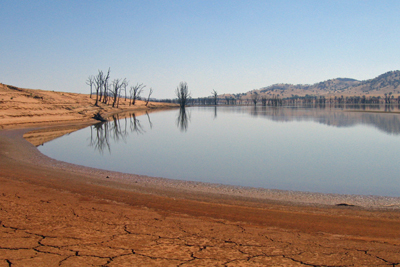
    <content:encoded xmlns:content="http://purl.org/rss/1.0/modules/content/"><![CDATA[<p>The experiences of large cities regarding their governance of water resources will be presented at the IEA by experts who will be in Brazil for the <i>V GovAgua - Water Governance Meeting</i>.</p>
<table class="tabela-esquerda">
<tbody>
<tr>
<th><img src="https://www.iea.usp.br/imagens/Escassez-Hidrica-sylvia-Tim-J-Keegan-flickr-copia.jpg" alt="Escassez Hídrica" class="image-inline" title="Escassez Hídrica" /></th>
</tr>
<tr>
<td><br /></td>
</tr>
</tbody>
</table>
<p>Entitled <i>Water Scarcity, Governance and Environmental Justice</i>, the meeting will be held in Spanish. It will take place on <strong>November 10</strong>, <strong>from 9.30 am to 12.30 pm</strong>, in the IEA's Events Room, with moderation of Professor Pedro Jacobi, coordinator of the IEA's Environment and Society research group.</p>
<p>"Metropolitan areas are experiencing prolonged drought crises. The experience shows that the models prioritize the supply of water to the detriment of demand control. The management models also fail to offer low investment in sewage treatment and water-free consumption, a scarce resource," says Professor Jacobi.</p>
<p>The panelists will examine the contexts of water scarcity in the world, the emergence of conflicts, and the reactions and responses of social actors  from the perspective of environmental justice.</p>
<p> </p>
<p><strong>The conferencists</strong></p>
<p><span>Geographer and historian </span><a class="external-link" href="https://grupo.us.es/giest/es/node/299">Leandro del Moral Ituarte</a><span>, who currently heads the Department of Human Geography at the University of Sevilla, specializes in hydraulic works. He has studied the lower basin of the Guadalquivir river, which bathes the territories of Andaluzia, in southern Spain.</span></p>
<p><a href="http://www.centre-cired.fr/spip.php?article749&amp;lang=fr" target="_blank">Bernard Barraqué</a>, research director at the Centre International de Recherche sur l'Environnement et le Développement of Le Centre National de la Recherche Scientifique, in Paris, has focused his recent studies on the allocation of water resources, evaluation of sustainable policies and methods,  institutional and participatory approaches, and comparative analysis of the sustainability of water management in major European cities. He also works at Agro ParisTech - École Nationale du Génie Rural, des Eaux et des Fôrets.</p>
<p>The participation of <a href="http://ugto.academia.edu/AlexRicardoCalderaOrtega" target="_blank">Alex Ricardo Caldera Ortega</a><span>, from the Department of Public Management and Development of the University of Guanajuato, has been cancelled due to the speaker's agenda.</span></p>
<p style="text-align: right; "><span class="discreet">Photo: Tim J. Keegan/Flickr</span></p>]]></content:encoded>
    <dc:publisher>No publisher</dc:publisher>
    <dc:creator>Richard Meckien</dc:creator>
    <dc:rights>Original version in Portuguese by Sylvia Miguel </dc:rights>
    
      <dc:subject>Europe</dc:subject>
    
    
      <dc:subject>Research Group: Environment and Society</dc:subject>
    
    
      <dc:subject>Power</dc:subject>
    
    
      <dc:subject>Interdisciplinarity</dc:subject>
    
    
      <dc:subject>Water</dc:subject>
    
    
      <dc:subject>Capitalism</dc:subject>
    
    
      <dc:subject>Environment</dc:subject>
    
    
      <dc:subject>Sustainability</dc:subject>
    
    
      <dc:subject>Globalization</dc:subject>
    
    
      <dc:subject>Inequality</dc:subject>
    
    
      <dc:subject>Poverty</dc:subject>
    
    
      <dc:subject>Environmental Policy</dc:subject>
    
    
      <dc:subject>Cities</dc:subject>
    
    <dc:date>2015-10-27T17:55:00Z</dc:date>
    <dc:type>Notícia</dc:type>
  </item>


  <item rdf:about="https://www.iea.usp.br/en/news/saldiva-fapesp">
    <title>Video presents the research of Paulo Saldiva on air pollution</title>
    <link>https://www.iea.usp.br/en/news/saldiva-fapesp</link>
    <description></description>
    <content:encoded xmlns:content="http://purl.org/rss/1.0/modules/content/"><![CDATA[<p>The work on the effects of air pollution on human health that has been carried out for years by the director of the IEA, <a href="https://www.iea.usp.br/en/iea/organization/direction" class="external-link">Paulo Saldiva</a>, has been presented in a video by <a class="external-link" href="http://revistapesquisa.fapesp.br/en/2016/10/20/profile-paulo-saldiva/?cat=videos-en">Pesquisa Fapesp</a>.</p>
<p>Saldiva remembers that "air pollution can not be solved with medication or health campaigns." It involves urban planning, issues related to mobility, studies on land use and occupation.</p>
<p>According to the researcher, while cigarette smoking is seen as a public health issue, air pollution is still not, even though about 14,000 people die early because of it only the city of São Paulo every year.</p>
<p>Saldiva's research integrates the <a href="https://www.iea.usp.br/en/news/scientific-look-at-the-complexity-of-sao-paulo" class="external-link">USP Global Cities <span>Program</span></a>, which aims to draw scientifically sound proposals that can improve the quality of life in cities.</p>
<p><iframe frameborder="0" height="480" src="https://www.youtube.com/embed/80CmuYmxYOE" width="854"></iframe></p>]]></content:encoded>
    <dc:publisher>No publisher</dc:publisher>
    <dc:creator>Richard Meckien</dc:creator>
    <dc:rights></dc:rights>
    
      <dc:subject>Climate</dc:subject>
    
    
      <dc:subject>Fapesp</dc:subject>
    
    
      <dc:subject>Research</dc:subject>
    
    
      <dc:subject>Urban mobility</dc:subject>
    
    
      <dc:subject>USP Global Cities Program</dc:subject>
    
    
      <dc:subject>Medicine</dc:subject>
    
    
      <dc:subject>Cities</dc:subject>
    
    
      <dc:subject>Pollution</dc:subject>
    
    <dc:date>2016-11-01T16:55:00Z</dc:date>
    <dc:type>Notícia</dc:type>
  </item>


  <item rdf:about="https://www.iea.usp.br/en/media-library/photos/events-2017/use-of-geographic-methods-to-characterize-social-inequalities-march-29-2017">
    <title>Use of Geographic Methods to Characterize Social Inequalities - March 29, 2017</title>
    <link>https://www.iea.usp.br/en/media-library/photos/events-2017/use-of-geographic-methods-to-characterize-social-inequalities-march-29-2017</link>
    <description></description>
    
    <dc:publisher>No publisher</dc:publisher>
    <dc:creator>Richard Meckien</dc:creator>
    <dc:rights></dc:rights>
    
      <dc:subject>Sustainability</dc:subject>
    
    
      <dc:subject>Cities</dc:subject>
    
    
      <dc:subject>Inequality</dc:subject>
    
    <dc:date>2017-03-29T03:00:00Z</dc:date>
    <dc:type>Pasta</dc:type>
  </item>


  <item rdf:about="https://www.iea.usp.br/en/news/ubias-chooses-migrations-as-common-theme-for-the-member-institutes-in-2019">
    <title>UBIAS chooses "Migrations" as the common theme for the member institutes in 2019</title>
    <link>https://www.iea.usp.br/en/news/ubias-chooses-migrations-as-common-theme-for-the-member-institutes-in-2019</link>
    <description></description>
    <content:encoded xmlns:content="http://purl.org/rss/1.0/modules/content/"><![CDATA[<table class="tabela-direita">
<tbody>
<tr>
<th><img src="https://www.iea.usp.br/imagens/migracao-venezuelanos" alt="migração-venezuelanos" class="image-inline" title="migração-venezuelanos" /></th>
</tr>
</tbody>
</table>
<p dir="ltr">"Migrations" has been chosen as Topic of the Year by the international network of University-Based Institutes for Advanced Study (<a class="external-link" href="http://www.ubias.net">UBIAS</a>) for 2019. The definition took place during the last meeting of the network's Steering Committee in Bielefeld, last November. Despite the recent definition, the topic had already been discussed at the <a href="https://www.iea.usp.br/en/news/directors-conference-ubias" class="external-link">5th Directors' Conference</a>, held at the headquarters of the IEA-USP in March this year.</p>
<p>The purpose of choosing annual themes is to encourage researchers linked to the network's 44 members to turn their attention to important global issues. UBIAS expects that each of the institutes will carry out activities related to the recent global migratory flows in various formats, such as creating study and research groups, holding events and organizing thematic exhibitions.</p>
<p>In the <a href="https://www.iea.usp.br/en/migra/" class="external-link">document</a> that justifies the choice of topic, the Steering Committee argues that "the migratory issue is not only politically and culturally timely but also challenges established social research methods." Thus, research on the subject may not only illuminate one of the great challenges of the 21st century but also develop new methods for interdisciplinary <span>advanced </span>study in general.</p>
<p dir="ltr"><strong>Migration and climate change</strong></p>
<p dir="ltr">In addition to the ongoing migratory and refugee crises in the world, the Steering Committee suggests that researchers look at their relation to climate change. "Would two of the greatest challenges of our time be indelibly interconnected?" There is "mounting evidence" that climate change and natural disasters are a relevant component of the current flow of migration.</p>
<p dir="ltr">The Committee indicates possible lines of research and initial questions: "How did desertification, droughts, floods and sea level rise impact the movement of human populations, and what can we expect in the near future?"</p>
<p dir="ltr">Another aspect to be addressed is the impact that mass migrations and the expected increase in population density in urban areas can cause in the public health of the receiving regions. A<span>ccording to the Committee, t</span>he issue becomes more evident when one takes into account that migrant populations generally represent the most vulnerable components of societies. "Strict theoretical and empirical studies of health, demographics, and behavioral ecology of migrants are therefore urgently needed not only for academic purposes but also to guide health policies for these populations," the text argues.</p>
<p dir="ltr">In 2018, the Topic of the Year was "<a href="https://www.iea.usp.br/en/news/ubias-chooses-aging-common-theme-member-institutes-2018" class="external-link">Aging - Life, Culture, Civilizations</a>," and in 2017, "<a href="https://www.iea.usp.br/en/news/fear-ubias-topic-of-the-year" class="external-link">Fear</a>." The first theme chosen by the network was "Media and Data Control," in 2016.</p>
<p dir="ltr" style="text-align: right; "><span class="discreet">Photo: Archive / EBC</span></p>]]></content:encoded>
    <dc:publisher>No publisher</dc:publisher>
    <dc:creator>Richard Meckien</dc:creator>
    <dc:rights>Original version in Portuguese by Victor Matioli.</dc:rights>
    
      <dc:subject>Ubias</dc:subject>
    
    
      <dc:subject>Climate Change</dc:subject>
    
    
      <dc:subject>Migration</dc:subject>
    
    
      <dc:subject>Interdisciplinarity</dc:subject>
    
    
      <dc:subject>Cities</dc:subject>
    
    <dc:date>2018-12-13T19:20:00Z</dc:date>
    <dc:type>Notícia</dc:type>
  </item>


  <item rdf:about="https://www.iea.usp.br/en/news/perspectives-of-culture-according-to-ricardo-ohtake">
    <title>The perspectives of culture according to Ricardo Ohtake</title>
    <link>https://www.iea.usp.br/en/news/perspectives-of-culture-according-to-ricardo-ohtake</link>
    <description></description>
    <content:encoded xmlns:content="http://purl.org/rss/1.0/modules/content/"><![CDATA[<table class="tabela-direita">
<tbody>
<tr>
<th><img src="https://www.iea.usp.br/imagens/ricardo-ohtake-posse" alt="Ricardo Ohtake - posse" class="image-inline" title="Ricardo Ohtake - posse" /></th>
</tr>
<tr>
<td>
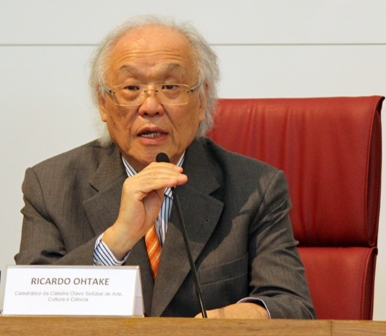
<p><strong>Ricardo Ohtake, new holder of the Olavo Setubal Chair of Arts, Culture and Science.</strong></p>
</td>
</tr>
</tbody>
</table>
<p>To address the trajectory of art and culture in Brazil from the post-Second War period until the crisis of 2016, and to analyze the current situation of institutions and activities in the field with prospects for the future, are some of the goals of the new holder of the <a href="https://www.iea.usp.br/en/research/chairs/olavo-setubal-chair-of-arts-culture-and-science" class="external-link">Olavo Setubal Chair of Arts, Culture and Science</a>, created in 2015 and officially launched in February 2016 by the IEA in partnership with Itaú Cultural. Architect, graphic designer and cultural manager <a href="https://www.iea.usp.br/en/persons/researchers/ricardo-ohtake" class="external-link">Ricardo Ohtake</a> took office on March 17, in a ceremony in the University Council Room that was attended by authorities, sponsors of the Chair, artists and scientists.</p>
<p>"The discussion of the future is what matters most, mainly because of the new political, social, economic, administrative and institutional situation in Brazil, which we know has created a legal anomaly in the country, provoking insecurity for the population and certain insecurity in the cultural environment", said Ohtake.</p>
<p>While opening the ceremony, <a href="https://www.iea.usp.br/en/persons/researchers/martin-grossmann" class="external-link">Martin Grossmann</a>, academic coordinat<span>or of the Chair,</span> <span>professor at USP's S</span>chool of Communications and Arts (ECA), and former director of the IEA, welcomed the new holder and thanked the work done by <span>diplomat and essayist </span><a href="https://www.iea.usp.br/en/persons/researchers/rouanet" class="external-link">Sérgio Paulo Rouanet</a>, former national secretary of Culture and author of the bill to encourage culture that bears his name. During the inaugural year of the Chair, Rouanet developed the approximation between the borders of knowledge in the personal, institutional and scientific scopes, as he recalled in his speech.</p>
<table class="tabela-esquerda-borda">
<tbody>
<tr>
<th>
<h3>Related material</h3>
<p><a href="https://www.iea.usp.br/en/media-library/photos/events-2017/ricardo-ohtake-takes-office-chair-olavo-setubal-17-march-2017" class="external-link">Photos</a></p>
<p>News</p>
<p><a href="https://www.iea.usp.br/en/news/rouanet-inaugura-catedra-olavo-setubal-de-arte-cultura-e-ciencia" class="external-link">Sergio Rouanet inaugurates the Olavo Setubal Chair of Arts, Culture and Science</a></p>
</th>
</tr>
</tbody>
</table>
<p>The new activities will include the debate on the actions and the thinking of cultural leaders, and the participation of institutions in the development of the artistic and cultural field, in a reflection that will go back to the cultural history of Brazil, Grossmann showed.</p>
<p><span>Ohtake recalled the evolution of Brazilian society and mentality - including its typical contradictions and complexities with which "a modern and medieval country" was built - and related this trajectory to the steps taken by the country in the cultural and artistic fields.</span></p>
<p>He mentioned the beginnings of the cosmopolitanization of Brazil, especially in Rio de Janeiro and São Paulo, with the emergence of icons such as the <span>Vera Cruz </span>Cinematographic Company, the TBC Brazilian Theater of Comedy, art institutions, the Biennale and museums, among them the <span>São Paulo </span>Museum of Art (MASP), created by the coffee bourgeoisie.</p>
<p>To expose and develop his own trajectory as a cultural leader in the context of the city, the country and internationally <span>will be one of Ohtake's pursued goals. He will also i</span>nvite critics, cultural leaders, artists and historians to participate in debates and testimonials; approach the relationship between art and politics and the role of exhibitions in the art debate; and analyze the role of cultural leaders in the development of institutions and thinking.</p>
<p>The new holder intends to bring his experience of more than 50 years in this field. He has been Secretary of Culture of the State of São Paulo, Secretary of the Green and Environment of São Paulo, director of the São Paulo Cultural Center, and director of the Museum of Image and Sound and the Brazilian Cinematheque. He has lectured in several architecture, communications and plastic arts faculties and was curator of the Brazilian participation at the Architecture Biennale of Venice in 2010.</p>
<p>The Ohtake family is one of the most influential for the arts and architecture in Brazil. Ricardo Ohtake is son of artist Tomie Ohtake (1913-2015) and brother of architect Ruy Ohtake, who signs the project of the famous building that houses the Tomie Ohtake Institute. He has graduated from USP's Faculty of Architecture and Urbanism (FAU), and currently directs the Tomie Ohtake Institute.</p>
<p><span>"If, on the one hand, cultural activity is always provided by very limited resources, on the other hand it always requires a lot of imagination and daring for propositions to be solved. The leader does not have to be an intellectual, but he must know where the concepts, the variations of approaches, the artists, the history of art, and also the engineering of the activities take place. As the resource is never enough, knowing how to give priorities and alternatives is fundamental to make sense of everything that is done," he said. </span></p>
<p>While reviewing his own career, Ohtake recalled his childhood, when he invented things and plays on the street in the 'Mooca' neighborhood, in São Paulo. "I realized with surprise that I internalized what critic Mário Pedrosa said in the 1950s to my mother: 'The key is to be original.' I understood that I always had to be original, not only in artistic creation."</p>
<table class="tabela-direita">
<tbody>
<tr>
<th><img src="https://www.iea.usp.br/imagens/posse-ricardo-ohtake-mesa" alt="Posse Ricardo Ohtake - mesa" class="image-inline" title="Posse Ricardo Ohtake - mesa" /></th>
</tr>
<tr>
<td>
<p><strong>From the left: Eduardo Saron, Ricardo Ohtake, <span>José Roberto Sadek, Vahan Agopyan, Sérgio Paulo Rouanet, Roberto Setúbal and Paulo Saldiva.</span></strong></p>
</td>
</tr>
</tbody>
</table>
<p><strong> </strong></p>
<p><strong>Tributes</strong></p>
<p>The Olavo Setubal Chair of Arts, Culture and Science, created to foster interdisciplinary reflections on academic, artistic-cultural and social issues in the regional and global contexts, has been taking the form of an "experimental platform for freedom", according to Grossmann.</p>
<p>"If Rouanet practiced the permanent exercise of criticism by producers, and academic and cultural institutions during this period, Ricardo Ohtake intends to explore the experimental exercise of freedom, be it as a public figure, as a cultural manager, or through his wisdom and his constant thinking that produces an exemplary practice in the field of the arts and culture," said Grossmann.</p>
<p>In almost 12 months of activity as holder of the Chair, Rouanet has sought broad approximations and interactions in the epistemic, institutional or even personal fields, he showed. "The participation of so many colleagues in the effort to give prestige to other areas of knowledge, culture, arts, psychoanalysis, science and philosophy was an attempt to minimize the gap between the human sciences and other sciences," he said.</p>
<p>For Rouanet, the Chair has been a unique opportunity to deepen <span>the effort to unify science </span>a little more; an effort that was extended to the institutional field, with USP interacting with other institutions.</p>
<p>In the words of IEA's director Paulo Saldiva, the ceremony brings the symbolic sign of generosity and passion expressed in the "action of sponsors such as Itaú Cultural, or in the work of people like Ricardo Ohtake, who come to share their experience, teach and illuminate the spirit."</p>
<p><span>The Chair also celebrates the union between academia, artists, intellectuals and young people who could see the example of rare values such as leadership and enchantment, Saldiva said. "Values such as generosity, passion and enchantment for study are sorely lacking for our youth today. These are feelings that make things happen despite all the difficulties," he emphasized.</span></p>
<p>USP's Vice-President Vahan Agopyan has stressed the importance of interlocution between academia and external sectors provided by chairs and interdisciplinary instances as the IEA. "I often say that the IEA is the think tank of USP: a place for debates on cross-cutting themes and, as well as the chairs, capable of promoting interaction with society. Dialogue with society is a challenge of the 21st century for all universities, and with the support of Itaú Cultural we are managing to increase this interaction," said Agopyan.</p>
<p>Roberto Setúbal, executive president of Itaú bank, when speaking about the support for the Chair, preferred to recall his father's personality and his tradition of appreciation for culture, his career as an entrepreneur and an engineer graduated from USP's Polytechnic School (POLI). "Severe, firm and demanding, but always very open to dialogue and new ideas. A man of science and research - he has worked at the Institute of Technological Research (IPT). A mayor who created the <span>São Paulo </span>Secretariat of Culture, a gesture that made me very proud in my student days and that shows how he valued culture and was open to the new," he said.</p>
<p>Eduardo Saron, director of Itaú Cultural, recalled the important role of Ohtake in the democratization of culture and arts in Brazil. "The democratization of access to culture, so much discussed by managers in the country, is a theme that will remain for a long time. Art and culture are beyond the needs and rights of the citizen. If the artist thinks of art as a field of desires, managers and actors of cultural politics need to think about culture in this aspect. It is not a matter of democratizing access only. It is about autonomy and freedom of expression. Cultural democracy thinks and understands the individual as an actor of self; an autonomous citizen who has the right to freedom of expression; to see and experience all cultures," said Saron.</p>
<p>Professor <a href="https://www.iea.usp.br/en/persons/speakers/lilian-sch" class="external-link">Lilia Moritz Schwarcz</a>, from USP's Faculty of Philosophy, Languages and Literature, and Human Sciences (FFLCH), was invited to give the reception address to the honoree. She recalled the work done with Ohtake and the projects undertaken at the Tomie Ohtake Institute.</p>
<table class="tabela-direita">
<tbody>
<tr>
<th><img src="https://www.iea.usp.br/imagens/lilia-schwarcz" alt="Lilia Schwarcz - posse Ricardo Ohtake" class="image-inline" title="Lilia Schwarcz - posse Ricardo Ohtake" /></th>
</tr>
<tr>
<td><span><strong>Lilia Schwarcz, <span>from USP's Faculty of Philosophy, Languages and Literature, and Human Sciences (FFLCH)</span>: "Ricardo Ohtake has distributed gifts in the fields of art and culture".</strong></span></td>
</tr>
</tbody>
</table>
<p>"A visionary of the arts, an intellectual of culture, an academic of the world of museums, of the arts in the broad sense, he knows that culture is what it does. In Ricardo Ohtake's words, among the various ways of assessing the success of different art forms, there is a unifying question, which is the transformation that the viewer of art undergoes before a work, and the emotion that provides a new knowledge, a new sensitivity, and / or a new experience," said Schwarcz.</p>
<p>For Schwarcz, Ohtake has "distributed gifts": he has toured the fields of architecture, graphic arts, decoration, urbanism, drawing, theater, education, cinema, publishing, dance, photography and the plastic arts; he has made exhibitions, documentaries, film festivals; sponsored concerts; created drawings for many books. "He has inspired generations, having passed through numerous institutions until landing at the Tomie Ohtake Institute, which opened for all kinds of experimentation."</p>
<p>"It is impossible to meet Ricardo without being deeply affected by his history, his smile, his generosity, his<span> very noisy</span> silence, and his transforming affection. I congratulate USP for realizing that Ricardo is a born scholar in the sublime function of being a cultural multiplier, and thus an immense distributor of gifts, an intellectual open to diversity, plurality and equality in this unfortunately unequal country," said the professor.</p>
<p><span>The <span>State </span>Secretary for Culture of São Paulo, José Roberto Sadek, highlighted the important link <span>between the university and society </span>promoted by the Chair, and the promotion of non-polarized dialogue, treated with the complexity and nuances that the theme requires.</span></p>]]></content:encoded>
    <dc:publisher>No publisher</dc:publisher>
    <dc:creator>Richard Meckien</dc:creator>
    <dc:rights>Original version in Portuguese by Sylvia Miguel.</dc:rights>
    
      <dc:subject>Cultural Politics</dc:subject>
    
    
      <dc:subject>Education</dc:subject>
    
    
      <dc:subject>Art</dc:subject>
    
    
      <dc:subject>Citizenship</dc:subject>
    
    
      <dc:subject>Cinema</dc:subject>
    
    
      <dc:subject>Humanities</dc:subject>
    
    
      <dc:subject>Culture</dc:subject>
    
    
      <dc:subject>Design</dc:subject>
    
    
      <dc:subject>Architecture</dc:subject>
    
    
      <dc:subject>Olavo Setubal Chair</dc:subject>
    
    
      <dc:subject>Cities</dc:subject>
    
    
      <dc:subject>History</dc:subject>
    
    <dc:date>2017-03-27T10:25:00Z</dc:date>
    <dc:type>Notícia</dc:type>
  </item>


  <item rdf:about="https://www.iea.usp.br/en/news/the-impact-of-climate-changes-in-megacities">
    <title>The impact of climate changes in megacities</title>
    <link>https://www.iea.usp.br/en/news/the-impact-of-climate-changes-in-megacities</link>
    <description></description>
    <content:encoded xmlns:content="http://purl.org/rss/1.0/modules/content/"><![CDATA[<table class="tabela-direita-400">
<tbody>
<tr>
<th><img src="https://www.iea.usp.br/imagens/temperaturas-superficiais-em-atlanta" alt="Variação da temperatura superficial em Atlanta" class="image-inline" title="Variação da temperatura superficial em Atlanta" /></th>
</tr>
<tr>
<td style="text-align: right; "><strong>Image of NASA showing the superficial temperature variation in Atlanta</strong></td>
</tr>
</tbody>
</table>
<p>The impact of climate changes in megacities is the subject of the fourth meeting of the cycle <i style="text-align: justify; ">Towards COP 21: The Groundwork to Paris – Climate Change, Adaptation, Solutions and Opportunities</i>. The debate will take place on <strong>November 19</strong>, <strong>at 9.30 am</strong>, in the IEA Events Room.</p>
<p><span style="text-align: justify; ">The event will be broadcast live on the </span><a style="text-align: justify; " href="https://www.iea.usp.br/aovivo">web</a><span style="text-align: justify; ">.</span></p>
<p>The title of the meeting is <i>Climate change and Megacities: Sustainable Mobility, Public Health and Growth Planning</i>. The panelists will be Luiz Firmino Pereira, Metropolitan Planning Superintendent of the Secretariat of <span>Rio de Janeiro's</span> State Government, and Silvio Barros, Secretary of Planning and General Coordination of Paraná's State Government. Coordination will be in charge of Tomas Alvim and Marisa Moreira Salles, both from the <a class="external-link" href="http://arqfuturo.com.br/">Arquivos do Futuro</a> organization, supporter of the cycle.</p>
<p><span><strong>Goals</strong></span></p>
<p><span style="text-align: justify; ">The cycle </span><span style="text-align: justify; ">seeks to identify and discuss opportunities to change patterns of emission of greenhouse gases. Another goal is to make a contribution to the Brazilian government and to the negotiators who will participate in the <a class="external-link" href="http://unfccc.int/meetings/paris_nov_2015/meeting/8926.php">Conference of Parties on Climate Change Conference (COP 21)</a> to be held in Paris, from November 30 to December 11.</span></p>
<table class="tabela-esquerda-300-borda">
<tbody>
<tr>
<td>
<h3>Related material</h3>
<p><strong>Cycle<br />TOWARDS COP 21</strong></p>
<p><strong><i>1st debate — Climate Changes and Water Crisis</i></strong></p>
<p><a href="https://www.iea.usp.br/en/midiateca/video/videos-2015/as-mudancas-climaticas-e-a-crise-hidrica-ciclo-tematico" class="external-link">Video</a><span> (in Portuguese) | </span><a href="https://www.iea.usp.br/en/media-library/photos/events-2015/as-mudancas-climaticas-e-a-crise-hidrica-ciclo-tematico-30-de-setembro-de-2015" class="external-link">Photos</a></p>
<p><i><strong>2nd debate — Energy and Climate Changes</strong></i></p>
<p><a href="https://www.iea.usp.br/en/midiateca/video/videos-2015/esperando-video-as-mudancas-climaticas-e-a-matriz-energetica-ciclo-tematico" class="external-link">Video</a> (in Portuguese) | <a href="https://www.iea.usp.br/en/media-library/photos/events-2015/as-mudancas-climaticas-e-a-matriz-energetica-ciclo-tematico-08-de-outubro-de-2015" class="external-link">Photos</a></p>
<p><i><strong>3rd debate — <a href="https://www.iea.usp.br/en/news/the-challenges-to-agriculture-from-climate-change" class="external-link">Climate Change and Food Security</a></strong></i></p>
<p><a href="https://www.iea.usp.br/en/midiateca/video/videos-2015/as-mudancas-climaticas-e-a-seguranca-alimentar-ciclo-tematico" class="external-link">Video</a> (in Portuguese) | <a href="https://www.iea.usp.br/en/media-library/photos/events-2015/as-mudancas-climaticas-e-a-seguranca-alimentar-ciclo-tematico-14-de-outubro-de-2015" class="external-link">Photos</a></p>
<hr />
<br />
<p><strong><a href="https://www.iea.usp.br/midiateca/video/videos-2015/las-negociaciones-climaticas-de-paris-2015-y-el-futuro-del-clima-planetario" class="external-link">Las Negociaciones Climáticas de París 2015 y el Futuro del Clima Planetario</a><span> – conference in Spanish with José Luis Lezama (Colegio de México)</span></strong></p>
<ul>
<li><a href="https://www.iea.usp.br/en/media-library/photos/events-2015/las-negociaciones-climaticas-de-paris-2015-y-el-futuro-del-clima-planetario-17-de-setembro-de-2105" class="external-link">Photos</a></li>
</ul>
</td>
</tr>
</tbody>
</table>
<p><span>Each debate has one or two coordinators who also act as moderators of a discussion with the panelists. The format aims to prioritize the dialogue between the panelists and the audience (in person or via internet).</span></p>
<p><span><strong>Document</strong></span></p>
<p>The results of the discussions will be consolidated in a document to be delivered to the Brazilian government and presented in side events at COP 21. After the conference in Paris there will be a new event in which the <span>achieved </span>results will be presented in order to suggests actions to be taken by countries, companies and the society.</p>
<p><span style="text-align: justify; ">The organizers of the cycle are: University of São Paulo, the <a class="external-link" href="http://www.incline.iag.usp.br/data/index_USA.php"><span style="text-align: justify; ">Interdisciplinary Climate Investigation center</span><span style="text-align: justify; "> (INCLINE)</span></a> and the <a href="https://www.iea.usp.br/en/research/research-groups/environmental-sciences" class="external-link">IEA’s Environment and Society </a><a style="text-align: justify; " href="https://www.iea.usp.br/en/research/research-groups/environmental-sciences" class="external-link">Research Group</a>. The project has the support of the Brazilian Chapter of the <a class="external-link" href="http://www.worldwatercouncil.org/">World Water Council</a>, the <a class="external-link" href="http://www.pactoglobal.org.br/">Brazilian Network of the Global Compact (UNGC)</a>, Arquivos do Futuro and CPFL Energia. Three USP professors are in charge of the overall organization: Weber Amaral (Luiz de Queiroz School of Agriculture), Tércio Ambrizzi (Institute of Astronomy, Geophysics and Atmospheric Sciences) and <a href="https://www.iea.usp.br/en/persons/researchers/pedro-roberto-jacobi" class="external-link">Pedro Jacobi</a> (IEA, FE and Procam-IEE).</span></p>
<p style="text-align: right; "><span class="discreet">Photo: <a class="external-link" href="https://en.wikipedia.org/wiki/File:Atlanta_thermal.jpg#file">NASA/Wikipedia</a></span></p>]]></content:encoded>
    <dc:publisher>No publisher</dc:publisher>
    <dc:creator>Richard Meckien</dc:creator>
    <dc:rights>Original version in Portuguese by Mauro Bellesa.</dc:rights>
    
      <dc:subject>Research Group: Environment and Society</dc:subject>
    
    
      <dc:subject>Climate Change</dc:subject>
    
    
      <dc:subject>Commons</dc:subject>
    
    
      <dc:subject>Glocal</dc:subject>
    
    
      <dc:subject>Transformation</dc:subject>
    
    
      <dc:subject>Environment</dc:subject>
    
    
      <dc:subject>Cities</dc:subject>
    
    
      <dc:subject>Event</dc:subject>
    
    <dc:date>2015-11-13T16:30:00Z</dc:date>
    <dc:type>Notícia</dc:type>
  </item>


  <item rdf:about="https://www.iea.usp.br/en/news/dynamics-laws-impact-city-development-artificial-intelligence">
    <title>The dynamics of laws and their impact on city development and artificial intelligence</title>
    <link>https://www.iea.usp.br/en/news/dynamics-laws-impact-city-development-artificial-intelligence</link>
    <description></description>
    <content:encoded xmlns:content="http://purl.org/rss/1.0/modules/content/"><![CDATA[<p><img src="https://www.iea.usp.br/imagens/ica-3" alt="ICA 3" class="image-right" title="ICA 3" />The dynamics of laws and their impact on cities and artificial intelligence were addressed by <a href="https://www.iea.usp.br/en/news/trd-edition-of-the-ica-will-have-researcher-selected-by-iea" class="external-link">Professor Carla Ventura</a> at the third edition of the <a class="external-link" href="http://www.ica.usp.br">Intercontinental Academia (ICA)</a>, held in Singapore and in Birmingham, in March 2018 and in March 2019, respectively.</p>
<p>As a representative of the IEA in this international interdisciplinary research project, Ventura will be at the Institute on June 17, from 2:00 pm, to talk about the topic she has been working on for two years and to share her experience of participating in the ICA. There will be a discussion of the learned lessons, including a reflection on the ways the team of participating research fellows have found to overcome the challenges of interdisciplinary work. The various possibilities for collaboration will also be approached, as well as the definition of some work fronts, the motivation to take part in the project, and the innovative format of the edition's workshops.</p>
<p>There will be a live broadcast on <a href="https://www.iea.usp.br/aovivo" class="external-link">IEA's website</a>.</p>
<p><span><strong>The project</strong></span></p>
<p>The ICA is an initiative of the <a class="external-link" href="http://www.ubias.net">UBIAS</a> network that brings together young and senior researchers to study a single subject from different perspectives during two extensive meetings. The first edition, centered around "Time", was organized by the IEA and the Institute for Advanced Research at Nagoya University in 2015 and 2016. The second edition, on "Human Dignity," was promoted by the Hebrew University of Jerusalem's Institute for Advanced Studies and the Center for Interdisciplinary Research at Bielefeld University in 2016.</p>
<p><span>The institutes for advanced study at the Nanyang Technological University and the University of Birmingham have beenthe hosts of the third and so far last edition of the project. 18 researchers with different academic backgrounds and nationalities were selected to study the different perspectives of the theme "Laws: Rigidity and Dynamics" between 2018 and 2019.</span></p>
<p><strong><img src="https://www.iea.usp.br/imagens/cala-ventura-Perfil-Escola-de-Enfermagem-de-Ribeirao-Preto-da-USP.jpg" alt="Carla Ventura - Perfil" class="image-left" title="Carla Ventura - Perfil" />Profile</strong></p>
<p><span>Carla Ventura holds a degree in International Relations from the University of Brasília (UnB) and a Law degree from the São Paulo State University (UNESP), where she has also obtained her Masters in International Law. In addition to these, she holds a PhD in Administration from USP.</span></p>
<p dir="ltr">She is currently a professor of the Department of Psychiatric Nursing and Human Sciences at USP's School of Nursing at Ribeirão Preto, where she teaches about human rights, health, development, mental health, bioethics and nursing legislation, among others. She also coordinates a global health research group, leading a team of undergraduates, masters, doctors and postdocs.</p>]]></content:encoded>
    <dc:publisher>No publisher</dc:publisher>
    <dc:creator>Richard Meckien</dc:creator>
    <dc:rights>Original version in Portuguese by Fernanda Rezende.</dc:rights>
    
      <dc:subject>Intercontinental Academia</dc:subject>
    
    
      <dc:subject>Cities</dc:subject>
    
    
      <dc:subject>Health</dc:subject>
    
    
      <dc:subject>Law</dc:subject>
    
    <dc:date>2019-06-11T19:15:00Z</dc:date>
    <dc:type>Notícia</dc:type>
  </item>


  <item rdf:about="https://www.iea.usp.br/en/news/the-contribution-of-good-management-to-the-quality-of-life-in-cities">
    <title>The contribution of good management to the quality of life in cities</title>
    <link>https://www.iea.usp.br/en/news/the-contribution-of-good-management-to-the-quality-of-life-in-cities</link>
    <description></description>
    <content:encoded xmlns:content="http://purl.org/rss/1.0/modules/content/"><![CDATA[<table class="tabela-direita">
<tbody>
<tr>
<th><img src="https://www.iea.usp.br/en/imagens/parque-ibirapuera" alt="Parque Ibirapuera" title="Parque Ibirapuera" /></th>
</tr>
<tr>
<td>
<p><strong>Ibirapuera Park</strong></p>
</td>
</tr>
</tbody>
</table>
<p>The planning of public policies, legislation and city master plans suffer from a well-known cultural malaise in Brazilian society: the deviation from their original functions aiming at attending minor or particular interests at the time of their implementation. Likewise, administration suffers from deviations when the management of the public issue is distributed among political parties. "Many problems are not solved by a political issue and the obstacles of the cities end up becoming a political platform, so there is no interest in solving them. We are impregnated with political behaviour. We bring political-partisan issues to the context of public policy discussion in a very <span>exaggerated way</span>," says Professor <a href="https://www.iea.usp.br/en/persons/researchers/arlindo-philippi" class="external-link">Arlindo Philippi Jr.</a>, who is participating in the <a href="https://www.iea.usp.br/en/persons/sabbatical" class="external-link">2017 Sabbatical Year Program</a> at the IEA and develops the <a href="https://www.iea.usp.br/publicacoes/projeto-arlindo-philippi-jr-sabatico-2017" class="external-link">project '<span>Urban Experiences in the Perspective of New Ideas and Sustainable Solutions for the City</span></a>.'</p>
<p>The ongoing work at the IEA will lead to proposals for public managers and urban researchers in the form of a book. The volume 'Urban Management and Sustainability' is due to be launched in early 2018 as part of the Manole Publishing House Environmental Collection, which Philippi Jr. has been developing for more than 10 years. The collection includes dozens of titles focusing on environmental issues, social issues, sustainable development, natural resources and public management. The present volume will count on the contribution of dozens of specialists in urban issues, including housing, sanitation, mobility, violence and management, among other topics.</p>
<table class="tabela-esquerda">
<tbody>
<tr>
<th><img src="https://www.iea.usp.br/midiateca/foto/eventos-2017/encontro-academico-interdisciplinaridade-e-inovacao-em-universidades-de-excelencia-15-de-maio-de-2017/arlindo-philippi-jr-abre-o-painel-2/@@images/7da0e9ec-b79d-48a3-b99b-499466163ce9.jpeg" alt="Arlindo Philippi Jr abre o Painel 2" class="image-inline" title="Arlindo Philippi Jr abre o Painel 2" /></th>
</tr>
<tr>
<td><strong>Arlindo Philippi Jr: "<span>Many problems are not solved by a political issue and the obstacles of the cities end up becoming a political platform</span>"</strong></td>
</tr>
</tbody>
</table>
<p>According to Philippi Jr., the kind of management practiced in Brazilian cities has been exhausted for a long time. "The city does not deliver what the citizen needs in terms of service provision, land ownership and other issues. In general, planning includes good things and good ideas, but it is subverted in its implementation by contemplating minor issues to the detriment of what would be best for the citizen," says the professor.</p>
<p>The governability of the cities is also flawed, according to the researcher. "The huge Brazilian political spectrum appears and the mayor ends up distributing the functions of city administration between the parties. Thus, he uses only a little of the knowledge sedimented in the very structure of the public service, which are the effective employees, who should be ahead of the administration," he says.</p>
<p>For him, when some innovation is presented in public management, it is generally received with much criticism, but it is up to the administrator to demonstrate that the measures will provide well-being to the citizens. "When I was the mayor of USP's campus in the Butantã neighbourhood, we received a lot of criticism due to the implementation of the exclusive bus and bicycle lanes. But through the website of our administration we were showing the reasons for the change. Today, the vast majority of people respect these lanes," he exemplifies.</p>
<p>Citizen participation is another important issue for good public administration, recalls the professor. "There is no solution for anything including democracy if there is no participation of people. Citizen participation presupposes that citizens have access to management information. The term 'transparency' has been used as a word of effect and so we need to remember that transparency in public management means providing data and technical knowledge through a reliable system," he emphasizes.</p>
<p>Information systems are fundamental management tools. Many of them have been created and deployed, but fail because it is often not in the interest of the government to inform citizens, according to the professor. Likewise, indicators of sustainability and effective communication of public facts are ways of promoting citizenship, he recalls.</p>
<p>According to Philippi Jr., the book to be published will be sent to city managers with the intention of presenting innovations and successful experiments in public management. It may also serve as a basis for the training of professionals who want to work with the urban issue, as well as contribute to the submission of new research on the <span>discussed </span>topics.</p>
<p><span><strong>Activities</strong></span></p>
<p>Three seminars, a technical meeting, partnerships with new research groups and the publication of academic articles are activities included in the goals of the sabbatical project. Through the set of <span>proposed </span>experiments, discussions and reflections, the study will seek to contribute with ideas and solutions that respond to the daily needs of people in changing urban environment in view of the principles of sustainability and interdisciplinary articulation.</p>
<p>The meeting 'Urban Experiments, New Ideas and Sustainable Solutions for Cities', held in April, focused on the visions of various segments and brought the successful experiences of cities in fields such as energy, urban mobility, housing, urban agriculture and inclusive culture. "São Paulo, for example, has an information system, called PRODAM, which makes it possible to follow the most diverse demands of citizens. And managers can benefit from this database to improve management," exemplifies Philippi Jr.</p>
<p>In May, the 'Academic Meeting on Interdisciplinarity and Innovation in Universities of Excellence' brought researchers from the most prestigious universities and research institutions in Brazil to deal with knowledge frontier topics that require the interface between disciplines to solve complex problems.</p>
<p>"The practice of interdisciplinarity in teaching, research and extension requires innovative approaches. It is a form of knowledge production that implies theoretical and methodological exchanges that make the professional and the researcher leave their comfort zone. This type of approach is increasingly widespread in the world, and in Brazil there are excellent groups working on this issue. There are universities that have been <span>entirely</span> created from the presuppositions of interdisciplinarity, such as USP' School of Arts, Sciences and Humanities (EACH), the Federal University of Southern Bahia, the Federal University of the Southern Border and others," says the professor, who has already served as director of evaluation of the Coordination of Improvement of Higher Education Personnel (CAPES), and has been the coordinator of the Interdisciplinary and Environmental Sciences areas of the institution.</p>
<p><span></span>The business management dealt with during the 'National Business &amp; Sustainability Colloquium', held in June, concerns entrepreneurship and innovation, not necessarily private companies. The venture may refer to companies or public management, explains Philippi Jr. The event brought together public, private and civil society organizations that showed management models focused on good practices based on sustainability.</p>
<p>According to the professor, the next step will be to seek interaction between the various <span>research groups of the </span>IEA that work on issues related to the urban issue. "The idea is to bring together the coordinators of these research groups to an initial meeting in order to identify common objectives and areas of action, as well as new research fields and new partnerships," he says. The prospect is to hold the technical meeting in August.</p>
<p>The professor will also participate in the <i><a class="external-link" href="http://www.icuh2017.org/">14th International Conference on Urban Health</a></i>, which will take place from <span>September</span> 24 to 28 in Coimbra, Portugal, as an activity planned for his sabbatical year at the IEA. Philippi Jr. will participate on September 25, attending the pre-conference 'Shaping policies to promote urban health equity: a socio-technical approach. Evidence from the EURO-HEALTHY case studies', having been invited by the EURO-HEALTHY project coordinator.</p>
<p>Organized by the International Society for Urban Health Secretariat, a part of The New York Academy of Medicine, the international meeting will address 'Equity in Health: The New Urban Agenda and the Goals of Sustainable Development.' The International Society of Urban Health (ISUH) is a global organization created in 2002 that brings together academics, governments, NGOs and companies to improve the health of cities.</p>
<p style="text-align: right; "><span class="discreet">Photos: Allan White and Leonor Calasans</span></p>]]></content:encoded>
    <dc:publisher>No publisher</dc:publisher>
    <dc:creator>Richard Meckien</dc:creator>
    <dc:rights>Original version in Portuguese by Sylvia Miguel                                                                                                                      </dc:rights>
    
      <dc:subject>Citizenship</dc:subject>
    
    
      <dc:subject>Democracy</dc:subject>
    
    
      <dc:subject>Government</dc:subject>
    
    
      <dc:subject>Interdisciplinarity</dc:subject>
    
    
      <dc:subject>Public Policies</dc:subject>
    
    
      <dc:subject>Sustainability</dc:subject>
    
    
      <dc:subject>Sabbatical</dc:subject>
    
    
      <dc:subject>Innovation</dc:subject>
    
    
      <dc:subject>Cities</dc:subject>
    
    
      <dc:subject>Public Management</dc:subject>
    
    <dc:date>2017-06-20T17:55:00Z</dc:date>
    <dc:type>Notícia</dc:type>
  </item>


  <item rdf:about="https://www.iea.usp.br/en/news/seminar-reflects-on-a-balanced-relationship-between-humans-and-the-environment">
    <title>Seminar reflects on a balanced relationship between humans and the environment</title>
    <link>https://www.iea.usp.br/en/news/seminar-reflects-on-a-balanced-relationship-between-humans-and-the-environment</link>
    <description></description>
    <content:encoded xmlns:content="http://purl.org/rss/1.0/modules/content/"><![CDATA[<p style="text-align: justify; "><img src="https://www.iea.usp.br/imagens/paisagem-no-rio-grande-do-sul" alt="Paisagem no Rio Grande do Sul" class="image-right" title="Paisagem no Rio Grande do Sul" />The <a href="https://www.iea.usp.br/en/research/research-groups/environmental-politics" class="external-link">IEA's Environmental Politics research group</a> will hold the international seminar <i>Landscapes: Home, Path and Water</i> <strong>from October 22 to 29</strong>, in three different venues. Researchers from Brazil, Italy and Portugal will reflect on the fundamental conditions for the establishment of a balanced relationship between humans and the environment.</p>
<p style="text-align: justify; "><span>According to Eda Tassara, coordinator of the research group, by addressing the presence and representation of home, path and water in the landscape and in the city, the seminar aims to "contribute to the intentional, poetic and shared construction of a more balanced social environment in the future in comparison to nowadays". She explains that the seminar's title is inspired in a statement by French geographer Jean Brunhes (1869-1930): "There are three key things to start a human community: home, path and water." She adds that psychologist Omar Ardans, from the Federal University of Santa Maria, by commenting on Brunhes's statement, said that its content "is in no way contradicted by the current state of life on the planet. On the contrary, it is even more modern than at the time of his writing."</span></p>
<p style="text-align: justify; "><span>However, there is one condition for the establishment of this balance, as Ardans's comment cited by the researcher: "That balance does not exist in (or to) a single individual, in a vacuum. Instead, the spaces of coexistence of this individual, and the participation in community and societal contexts define <span>the particular form of conquered balance (or, at worst, desired).</span>along with the physical environment and objects built by humans."</span></p>
<p style="text-align: justify; "><span>That's why, he said, "the first word for the proposed reflection should be 'city', privileged form of organization of the man on the grounds that he dwells." In support of this choice, Tassara points out that American urban planner and thinker Lewis Mumford (1895-1990) opened his book "The Culture of Cities" with a statement saying that the city "is the point of maximum concentration of force and culture in a community."</span></p>
<p style="text-align: justify; "><span>She also recalls that Italian philosopher Rosario Assunto (1915-1994) argued that "the concrete environment, the environment we live in and of which we live, is always the environment as a way of territory: a landscape". It follows that "landscape" is the second word of the seminar, "understood as the way that nature and man gave to the territory as they organized it on the basis of life."</span></p>
<p style="text-align: justify; "><span>Viewed from these perspectives, landscape and city can be understood as "more-than-spaces" inextricably linked, with the balance of the assembly having crucial importance for human life, but not just for it, according to Tassara. "Both our organic existence as the persistence of the very way of life of our community / society depend on this balance. Recognizing this mobilizes our reflection on the essential aspects of the human-environment relationship that is expressed in the countryside and in the cities."</span></p>
<p style="text-align: right; "><span class="discreet">Photo: <a class="external-link" href="http://www.flickr.com/photos/dpfeiffercardoso">Douglas Pfeiffer Cardoso/Flickr</a></span></p>]]></content:encoded>
    <dc:publisher>No publisher</dc:publisher>
    <dc:creator>Richard Meckien</dc:creator>
    <dc:rights>Original version in Portuguese by Mauro Bellesa</dc:rights>
    
      <dc:subject>Sociology</dc:subject>
    
    
      <dc:subject>Commons</dc:subject>
    
    
      <dc:subject>Research Group: Environmental Politics</dc:subject>
    
    
      <dc:subject>Environment</dc:subject>
    
    
      <dc:subject>Cities</dc:subject>
    
    
      <dc:subject>Event</dc:subject>
    
    <dc:date>2015-10-15T13:35:00Z</dc:date>
    <dc:type>Notícia</dc:type>
  </item>


  <item rdf:about="https://www.iea.usp.br/en/news/seminar-presents-causes-impacts-and-solutions-to-climate-change">
    <title>Seminar presents causes, impacts and solutions to climate change</title>
    <link>https://www.iea.usp.br/en/news/seminar-presents-causes-impacts-and-solutions-to-climate-change</link>
    <description></description>
    <content:encoded xmlns:content="http://purl.org/rss/1.0/modules/content/"><![CDATA[<p>The impacts of climate change in the state of São Paulo will be discussed by national and international experts at the seminar <i>Climate Change in São Paulo: Causes, Impacts and Solutions</i>, to be held on October 14-16, <strong>daily from 9.00 am to 5.00 pm</strong>, in the auditorium of the Brasiliana Guita e José Mindlin Library, at the USP. The event will be broadcast live on the <a href="https://www.iea.usp.br/aovivo" class="external-link">IEA's website</a>.</p>
<p>The meeting, sponsored by the ACIESP (São Paulo State Academy of Science), by the USP's Institute of Biosciences (IB) and by the INCLINE (Interdisciplinary Climate Investigation Center), and supported by the IEA, will be divided into thematic panels: Water, the 21st Conference of the Parties (COP-21), Biodiversity, Cities and Health, and Public Policies. USP researchers and science journalists will mediate the discussions.</p>
<p>In the late afternoon of the last day there will be the inauguration ceremony for the new members of the ACIESP.</p>
<p> </p>
<p><span><strong>Programme:</strong></span></p>
<p><strong>October 14 (morning)</strong></p>
<p>Moderator: Marcos Buckeridge (President of ACIESP and professor at the IB)<br /><span><strong>Opening session</strong><br /></span><span>9.30 am Marco Antonio Zago (President of USP)<br /></span><span>9.40 am José E. Krieger (Provost for Research at USP)<br /></span><span>9.50 am Gilberto Xavier (IB)<br /></span><span>10.00 am Marcos Buckeridge <br /></span><span>10.30 am – 12.00 pm <strong>Impacts of the global climate changes in São Paulo</strong><br /></span><span>With Jose Antonio Marengo Orsini (National Institute for Space Research)</span></p>
<p><strong>October 14 (afternoon)</strong></p>
<p>Moderator: Herton Scobar (<i>O Estado de S. Paulo </i>newspaper)<br /><strong>Panel 1 – Water<br /></strong><span>2.00 pm <strong> The drought of 2014 in the source of the Cantareira System</strong><br /></span><span>With Humberto Ribeiro da Rocha (USP's Institute of Astronomy, Geophysics and Astmospheric Sciences - IAG)<br /></span><span>2.30 pm <strong>Water and Agriculture - The New Challenges</strong><br /></span><span>Orivaldo Brunini (Agronomic Institute)<br /></span><span>3.00 pm <strong>Human right to water: relative scarcity and application challenges</strong><br /></span><span>Wagner Costa Ribeiro (USP's Faculty of Philosophy, Languages and Literature, and Social Sciences (FFLCH), and IEA)<br /></span><span>3.30 pm Break<br /></span><span>3.50 pm Q&amp;A</span></p>
<p><strong>October 15 (morning)</strong></p>
<p>Moderator: Tércio Ambrizzi (IAG/USP)<br /><span><strong>Panel 2 – COP-21</strong><br /></span><span>9.00 am <strong>The COP-21 and the science of the global climate changes</strong><br /></span><span>With Paulo Eduardo Artaxo Netto (USP's Institute of Physics - IF)<br /></span><span>9.30 am <strong>Bioenergy as a <span>global warming</span> gas mitigation strategy and its contribution to sustainable development</strong><br /></span><span>With Glaucia Mendes Souza (USP's Institute of Chemistry - IQ)<br /></span><span>10.00 am – 12.00 pm Q&amp;A</span></p>
<p><strong>October 15 (afternoon)</strong></p>
<p>Moderator: Marcos Pivetta (FAPESP Research Journal)<br /><span><strong>Panel 3 – Biodiversity</strong><br /></span><span>2.00 pm <strong>Global climate changes and biodiversity: introduction to the problem</strong><br /></span><span>With Carlos A. Navas Iannini (IB)<br /></span><span>2.30 pm <strong>The sixth mass extinction is underway: the reptile and amphibian biodiversity crisis</strong><br /></span><span>Barry Sinervo (University of California)<br /></span><span>3.30 pm Break<br /></span><span>3.50 pm Q&amp;A</span></p>
<p><strong>October 16 (morning)</strong></p>
<p>Moderator: Eduardo Geraque (<i>Folha de S. Paulo</i> newspaper)<br /><span><strong>Panel 4 – Cities and Health</strong><br /></span><span>9.00 am<strong> <span>Impacts of the global climate changes in Ciudad de México</span></strong><br /></span><span>With Víctor Orlando Magaña Rueda (Universidad Nacional Autónoma de México - UNAM)<br /></span><span>9.40 am <strong>Global climate changes and their effects in Paulista citizens' health</strong><br /></span><span>With Paulo Hilário Nascimento Saldiva (deputy director of the IEA and professor at the USP's School of Medicine - FM)<br /></span><span>10.20 am <strong>Using computer games to raise the awareness of climate changes and neglected tropical diseases</strong><br /></span><span>With Manuel Cesário (Academia Magdalena)<br /></span><span>11.00 am – 12.00 pm Q&amp;A</span></p>
<p><strong>October 16 (afternoon)</strong></p>
<p>Moderator: Pedro Roberto Jacobi (IEA and professor at the USP's Institute of Energy and Environment - IEE)<br /><span><strong>Panel 5 – Public Policies</strong><br /></span><span>2.00 pm <strong>Reviewing public policies to deal with the water crisis in a scenario of climate change</strong><br /></span><span>With Pedro Roberto Jacobi (IEA and IEE)<br /></span><span>2.20 pm Patrícia Faga Iglecias Lemos (São Paulo State Secretary for the Environment)<br /></span><span>2.40 pm <strong>Science Diplomacy: Communicating Science in Society</strong><br /></span><span>With Julia Knights (Director of the Science Innovation Network - British Embassy in Brazil)<br /></span><span>3.00 pm – 4.00 pm Q&amp;A<br />4.15 pm <span>–</span> 5.15 pm <span><strong>Climate Change and the Earth System</strong><br /></span></span><span>With Carlos Afonso Nobre</span></p>
<p><strong>Inauguration ceremony for the new members of ACIESP</strong><br />Opening<br />5.30 pm - <span>José Goldemberg (</span><span>President of FAPESP/USP)<br />6.00 pm -<strong> </strong></span><span>Carlos Henrique de Brito Cruz (</span><span>Scientific Director of FAPESP/UNICAMP) - <i>to be confirmed</i><br />6.30 pm - José Roberto Krieger (former President of ACIESP)<br />6.45 pm - </span><span>Marcos Buckeridge (President of ACIESP and professor at the IB)</span></p>]]></content:encoded>
    <dc:publisher>No publisher</dc:publisher>
    <dc:creator>Richard Meckien</dc:creator>
    <dc:rights>Original version in Portuguese by Fernanda Rezende</dc:rights>
    
      <dc:subject>Climate</dc:subject>
    
    
      <dc:subject>Biodiversity</dc:subject>
    
    
      <dc:subject>Climate Change</dc:subject>
    
    
      <dc:subject>Water</dc:subject>
    
    
      <dc:subject>Environmental Sciences</dc:subject>
    
    
      <dc:subject>Environmental Policy</dc:subject>
    
    
      <dc:subject>Cities</dc:subject>
    
    <dc:date>2015-09-30T21:10:00Z</dc:date>
    <dc:type>Notícia</dc:type>
  </item>


  <item rdf:about="https://www.iea.usp.br/en/news/research-verifies-the-perception-of-young-people-about-sustainability-components">
    <title>Research verifies the perception of young people about sustainability components</title>
    <link>https://www.iea.usp.br/en/news/research-verifies-the-perception-of-young-people-about-sustainability-components</link>
    <description></description>
    <content:encoded xmlns:content="http://purl.org/rss/1.0/modules/content/"><![CDATA[<table class="tabela-direita">
<tbody>
<tr>
<th><img src="https://www.iea.usp.br/imagens/seminario-use-of-geographic-methods-to-characterize-social-inequalities-29-03-2017" alt="Seminário Use of Geographic Methods to Characterize Social Inequalities - 29/03/2017" class="image-inline" title="Seminário Use of Geographic Methods to Characterize Social Inequalities - 29/03/2017" /></th>
</tr>
<tr>
<td><strong>British and Brazilian seminar participants</strong></td>
</tr>
</tbody>
</table>
<p>A new concept for the analysis of the sustainability conditions of urban and rural areas has been used by researchers in recent years. It is the "food-water-energy nexus" test, which seeks to examine the interrelationships of these three essential components of environmental and human quality. The subject was addressed in a public event on March 29, at the seminar <i>Use of geographic methods to characterize social inequalities</i>.</p>
<p>The seminar was organized by the IEA in partnership with the <a class="external-link" href="http://www.birmingham.ac.uk/research/activity/ias/index.aspx">Institute of Advanced Studies</a> of the University of Birmingham (UoB). Both Institutes are members the network <a class="external-link" href="http://www.ubias.net">University-Based Institutes for Advanced Study</a> (UBIAS) and have been carrying out several activities together in recent years.</p>
<p>Researchers from the UoB, and the universities of Leicester and Northampton participated as exhibitors. The commentator was Thais Mauad, a professor at USP's School of Medicine and coordinator of IEA's <a href="https://www.iea.usp.br/en/news/new-study-groups-will-conduct-research-urban-agriculture-sao-paulo" class="external-link">Study Group on Urban Agriculture</a> (GEAU). The meeting was coordinated by <a href="https://www.iea.usp.br/en/persons/researchers/ligia-barrozo" class="external-link">Ligia Vizeu Barrozo</a>, a professor at USP's Faculty of Philosophy, Languages and Literature, and Human Sciences (FFLCH), and coordinator of IEA's <a href="https://www.iea.usp.br/en/news/study-group-will-address-links-between-health-and-the-geographic-context-of-cities" class="external-link">Study Group on Urban Space and Health</a>.</p>
<p><span>The first panel of the meeting addressed the research <i>(Re)Connect the Nexus: Young Brazilians' Experiences of and Learning about Food, Water and Energy</i>, developed by researchers from the three British universities and the São Paulo State University (UNESP).</span></p>
<table class="tabela-direita-200-borda">
<tbody>
<tr>
<td>
<h3>Related material</h3>
<p><strong>Seminar 'Use of geographic methods to characterize social inequalities'</strong></p>
<p>NEWS</p>
<ul>
<li><a href="https://www.iea.usp.br/en/news/birmingham-researchers-present-studies-on-social-inequalities-in-brazil-and-india" class="external-link">Birmingham researchers present studies on social inequalities in Brazil and India</a></li>
</ul>
<p> </p>
<p>MEDIA LIBRARY</p>
<ul>
<li><a href="https://www.iea.usp.br/en/media-library/video/use-of-geographic-methods-to-characterize-social-inequalities" class="external-link">Video</a> | <a href="https://www.iea.usp.br/en/media-library/photos/events-2017/use-of-geographic-methods-to-characterize-social-inequalities-march-29-2017" class="external-link">Photos</a></li>
</ul>
<hr />
<br />
<p class="documentFirstHeading kssattr-atfieldname-title kssattr-templateId-kss_generic_macros kssattr-macro-title-field-view"><strong>Other conferences held by the Birmingham IAS at the IEA:</strong></p>
<p class="documentFirstHeading kssattr-atfieldname-title kssattr-templateId-kss_generic_macros kssattr-macro-title-field-view"><a href="https://www.iea.usp.br/en/media-library/video/washing-without-water-and-other-stories-of-innovation-accelerating-research-into-societal-innovation" class="external-link">Washing without Water and other Stories of Innovation: Accelerating research into societal innovation</a></p>
<p class="documentFirstHeading kssattr-atfieldname-title kssattr-templateId-kss_generic_macros kssattr-macro-title-field-view"><a href="https://www.iea.usp.br/en/media-library/video/saulbecker" class="external-link">Children Who Care - Global Perspectives on Children’s Hidden Care-Giving Roles within their Families</a></p>
</td>
</tr>
</tbody>
</table>
<p><span>The research is underway and aims to analyze the experiences of young people (10 to 24 years) in the Paraíba River Valley and the North Coast of the State of São Paulo with questions related to food, water resources and energy sources, as well as to verify what they know about the relationship between these three factors.</span></p>
<table class="tabela-direita-300">
<tbody>
<tr>
<th><img src="https://www.iea.usp.br/imagens/peter-kraftl-29-03-2017" alt="Peter Kraftl - 29/03/2017" class="image-inline" title="Peter Kraftl - 29/03/2017" /></th>
</tr>
<tr>
<td><strong>Peter Kraftl</strong></td>
</tr>
</tbody>
</table>
<p>Project coordinator <a href="https://www.iea.usp.br/en/persons/speakers/peter-frankl" class="external-link">Peter Kraftl</a>, from the UoB, talked about the objectives and methodology of the research, the concept of food-water-energy nexus and the questioning of this approach. According to him, the notion of nexus has been advocated primarily by researchers and policy makers in the US and the UK. "One of the questions we want to evaluate is whether this idea is relevant to Brazil."</p>
<p><span>While nexus-based thinking may be useful for policy-making groups, "it involves creating connections and examining trade-offs that end up in an <span>imposed</span> holism, reducing <span>complex </span><span>social and material</span> processes to mere components of the nexus, such as food and water," commented Kraftl. In his view, many researches ignore the reality of life of individuals and communities, and how they engage in the nexus.</span></p>
<p><span><span>Kraftl</span> said that one of the main problems for formulating public policies from the nexus analysis is to minimize the trade-off as much as possible, such as in the dilemma between planting to produce food or biofuels. He asked: "Who makes these decisions? How are they made? What are the advantages and disadvantages of each option?"</span></p>
<p><span>However, he considers that examining how young people and policy makers see the interweaving of the components of the nexus influences people's lives and work, and can favor sustainability education.</span></p>
<p><span>Besides Kraftl, the research was commented by Catherine Walker, from the University of Leicester, who dealt with interviews with leaders and professionals, and Cristiana Zara, from the UoB, who talked about the interviews with young people from the <span>Paraíba River Valley</span>.</span></p>
<p><span>Detailed reference interviews with 5,000 <span>young people</span> in the region began in March. In the same period, qualitative interviews began with 50 young people. A mobile application has been provided to respondents to record their daily experiences regarding food, water, and energy. By June, 50 policy makers, including educators and representatives of the private sector and government agencies, will also be interviewed.</span></p>
<p><span>The project is also holding a video contest. Ten videos will be online on YouTube for young people around the world to vote for their favorites.</span></p>
<p><span>Walker said that the interviews with leaders and professionals is helpful in understanding the context in which young people are growing, their access to resources, restrictions on access, and what they know about natural resources. One of the highlights of these interviews, she says, is the issue of rural exodus. "The young do not find opportunities for development and education in the countryside, and are attracted to cities by a variety of factors. This is worrying, since there are already large concentrations of people in the <span>Paraíba River Valley</span>. And as small food producers move to the city, the land ends up being occupied by intensive agriculture, which demands more water."</span></p>
<p><span>Safety in regard to water has also appeared prominently in the interviews, with many references to the water crisis of 2014/2015. "Several respondents pointed out that people are aware of the importance of resources when they become scarce, but they end up reverting to pre-crisis consumption habits when the supply normalizes."</span></p>
<p>Zara, in turn, pointed out that in the interviews that are being held with 5,000 youngsters they reveal their strong cultural involvement with food, with great appreciation for the role of food in favor of sociability. In the case of water, she said that there is an expansion of concepts about the various uses of the resource (food, sanitation, agriculture, energy production and industrial use), with the incorporation of the theme in education for sustainability," although this does not happen uniformly in the education system."</p>
<p><span>According to Zara, young people show a strong sense of individual responsibility for the proper use of natural resources. "For many of them, if everyone does their small part, this will encourage sustainable practices in the community. At the same time there is a strong sense of the political dimension of the issue, with the demand that the state should also play its part."</span></p>
<p><span>The <span>project led by</span> Kraftl is funded by the National Council of the State Research Support Foundations (via FAPESP) and two UK institutions: the Economic and Social Research Council (ESRC) and the Newton Fund.</span></p>
<table class="tabela-esquerda-300">
<tbody>
<tr>
<th><img src="https://www.iea.usp.br/imagens/sophie-hadfield-hill-29-03-2017" alt="Sophie Hadfield-Hill - 29/03/2017" class="image-inline" title="Sophie Hadfield-Hill - 29/03/2017" /></th>
</tr>
<tr>
<td><strong>Sophie Hadfield-Hill</strong></td>
</tr>
</tbody>
</table>
<p><strong>Urbanism in India</strong></p>
<p>The second part of the event dealt indirectly with aspects related to the nexus, but in the specific context of the Indian urban growth. The theme was the project <i>New Urbanisms in India: Urban Life, Sustainability and Everyday Life</i>, <span>also supported by the ESRC.</span> The speaker was <span>coordinator </span><a href="https://www.iea.usp.br/en/persons/speakers/sophie-hill" class="external-link">Sophie Hadfield-Hill</a>, from the UoB.</p>
<p>According to her, 590 million Indians will be living in cities by 2030, with 91 million middle-class families and 61 cities with more than 1 million inhabitants." The demands for thi<span>s urban growth w</span><span>ill require an investment of US$ 1.2 trillion.</span></p>
<p>Hadfield-Hill spoke about new housing developments under construction on the outskirts of Indian cities and threats to urban areas. "There is the pressure of population growth and migration on urban services, access to sanitation, water and energy, as well as impacts on land and other consequences of social inequality."</p>
<p>The main challenges are the provision of quality water, sewage collection and electricity supply. "According to the World Bank, only 16% of households have sewage collection. No Indian city has 24-hour water supply and only 1/4 of the population has access to electricity."</p>
<p>Despite all these difficulties for urban life in India, Prime Minister Narendra Modi, upon taking office in May 2014, proposed the creation of 100 smart cities, with the adaptation of existing cities and construction of entirely new cities, commented <span>Hadfield-Hill</span>. The proposal received several criticisms, she said, but 20 cities have already been selected through a national competition.</p>
<p>The Indian government defines smart cities as those that "care first about their most pressing needs and the best opportunities for improving the quality of life." They should use a range of approaches that include "digital and information technologies, best practices in urban planning, public-private partnerships, political change and thinking of people first," <span>Hadfield-Hill</span> said.</p>
<p>Among other initiatives, proposals for Indian smart cities include paving that captures the energy of moving cars, online water connections systems and smart bus stops.</p>
<p>As a case study she spoke about the construction of the city of <a class="external-link" href="http://lavasa.com">Lavasa</a> by a private enterprise. It will have five hubs (the first one is ready), house 300,000 inhabitants and receive 2 million tourists a year.</p>
<p>According to her, Lavasa is being built following <span>the principles of new urbanism. Some of them are: sustainability; planned growth of density (population decreases as households move away from the center); mix of housing types, including income groups; ease of access to general services (10 minute-walk from home or work to most of them); architectural quality and urban design.</span></p>
<p style="text-align: right; "><strong><span class="discreet">Photos: Marcos Santos/Jornal da USP</span></strong></p>]]></content:encoded>
    <dc:publisher>No publisher</dc:publisher>
    <dc:creator>Richard Meckien</dc:creator>
    <dc:rights>Original version in Portuguese by Mauro Bellesa.</dc:rights>
    
      <dc:subject>Research</dc:subject>
    
    
      <dc:subject>Environment</dc:subject>
    
    
      <dc:subject>Sustainability</dc:subject>
    
    
      <dc:subject>Cities</dc:subject>
    
    
      <dc:subject>Event</dc:subject>
    
    <dc:date>2017-04-18T13:50:00Z</dc:date>
    <dc:type>Notícia</dc:type>
  </item>


  <item rdf:about="https://www.iea.usp.br/en/news/new-study-groups-will-conduct-research-urban-agriculture-sao-paulo">
    <title>New study group will conduct research on urban agriculture in São Paulo</title>
    <link>https://www.iea.usp.br/en/news/new-study-groups-will-conduct-research-urban-agriculture-sao-paulo</link>
    <description></description>
    <content:encoded xmlns:content="http://purl.org/rss/1.0/modules/content/"><![CDATA[<table class="tabela-direita">
<tbody>
<tr>
<th><img src="https://www.iea.usp.br/imagens/horta-da-faculdade-de-medicina-da-usp" alt="Horta da Faculdade de Medicina da USP" class="image-inline" title="Horta da Faculdade de Medicina da USP" /></th>
</tr>
<tr>
<td>
<p><strong>Community garden: the project has managed to involve students, staff and professors of the FM.</strong></p>
</td>
</tr>
</tbody>
</table>
<p><span>The Study Group on Urban Agriculture (GEAU) will hold debates and conduct studies on the theme "Urban and Peri-urban Agriculture in São Paulo: Possibilities, Connections and Contemporaneity". Approved by the IEA's Board on May 9, it will be coordinated by Professor Thais Mauad, from the USP's School of Medicine (FM), an expert in urban health and founder of the community garden at the FM.</span></p>
<p><span> </span>The GEAU will be hosted at the IEA for two years, producing scientific studies on Urban and Peri-urban Agriculture (UPA) with emphasis on the city of São Paulo and its metropolitan region (RMSP).</p>
<p><span>Among the activities that have already been planned is a seminar with the participation of professors and researchers from the University of Melbourne to be held <span>in August</span>. The debate will address the research topic of Professor Mauad: "Achieving sustainable food production and irrigation in São Paulo and Melbourne," which seeks to understand, improve and promote the resilience of urban food production systems in these two cities.</span></p>
<p><span>The schedule for 2017 includes the presentation of the studies' results, as well as the publication of articles and the participation of group members in conferences and seminars.</span></p>
<table class="tabela-esquerda">
<tbody>
<tr>
<th><img src="https://www.iea.usp.br/imagens/horta-do-iee" alt="Horta do IEE" class="image-inline" title="Horta do IEE" /></th>
</tr>
<tr>
<td>
<p><strong>The <span>garden </span>of the IEE is the result of the project <i>Criando Terra no IEE</i> ("Creating Earth at the IEE"), an example of urban gardening in an academic environment.<br /></strong></p>
</td>
</tr>
</tbody>
</table>
<p><span><span>The GEAU has six members and two collaborating researchers from different areas. Given its interdisciplinary approach, the group brings together experts from the FM, the USP's Faculty of Philosophy, Languages and Literature, and Human Sciences (FFLCH), the Graduation Program in Environmental Sciences (PROCAM) of the USP's Institute for Energy and Environment (IEE), the Getúlio Vargas Foundation and the Université Rennes 2.</span></span></p>
<p><span>The research team was the winner in the academic category of the 5th Fecomércio Sustainability Award in 2015, with the project "Urban Agriculture: Production, Retail and Food Consumption." For the members of the GEAU, the award is "a great step forward in spreading the importance of urban agriculture in Brazil and São Paulo."</span></p>
<p><span>The studies should contribute to the debate about the nature of actors, social relations, socio-spatial dynamics and impacts generated by the <span>UPA</span>. The understanding of the new socio-spatial configurations generated by this branch are important to foster the academic debate on the contemporary urban world, according to the project's proponents.</span></p>
<p><span>In addition to establishing partnerships and disseminating the concept of urban agriculture, the studies aim at contributing with theoretical and methodological frameworks to explain urban phenomena, especially regarding the situation of the city of São Paulo and Latin America.</span></p>
<table class="tabela-direita">
<tbody>
<tr>
<th><img src="https://www.iea.usp.br/imagens/horta-berlim-1" alt="Horta Berlim - 1" class="image-inline" title="Horta Berlim - 1" /></th>
</tr>
<tr>
<td>
<p><strong><span>The Berlin-Tempelhof airport was di</span>sabled in 2008 and turned into an horticulture and leisure space after the claiming of civil movements.</strong></p>
</td>
</tr>
</tbody>
</table>
<p> </p>
<p><strong><span>Study Group on Urban Agriculture </span>(GEAU)</strong></p>
<p><strong>Coordination</strong>: Thais Mauad (FM-USP)</p>
<p><strong>Vice-coordination</strong>: Valéria de Marcos (FFLCH-USP)</p>
<p><strong>Permanent members:</strong></p>
<p>Angélica Campos Nakamura, <span>Giulia Giacchè, </span><span>Guilherme Reis Ranieri, </span><span>Gustavo Nagib, </span><span>Luís Fernando Amato Lourenço and L</span><span>ya Cynthia Porto de Oliveira.</span></p>
<p><strong><span> </span><span>Collaborating researchers:</span></strong></p>
<p>Mário Aquino Alves and <span>Amalia Inés Geraiges de Lemos.</span></p>
<p> </p>
<p style="text-align: right; "> </p>
<p style="text-align: right; "><span class="discreet">Photos: HortaFSPUSP.blogspot.com.br / Cecília Bastos and Marcos Santos (JornalUSP)/ Sylvia Miguel (personal archive)</span></p>]]></content:encoded>
    <dc:publisher>No publisher</dc:publisher>
    <dc:creator>Richard Meckien</dc:creator>
    <dc:rights>Original version in Portuguese by Sylvia Miguel.</dc:rights>
    
      <dc:subject>Education</dc:subject>
    
    
      <dc:subject>Agro-ecology</dc:subject>
    
    
      <dc:subject>Sustainability</dc:subject>
    
    
      <dc:subject>Interdisciplinarity</dc:subject>
    
    
      <dc:subject>Society</dc:subject>
    
    
      <dc:subject>Food safety</dc:subject>
    
    
      <dc:subject>Environmental Policy</dc:subject>
    
    
      <dc:subject>Cities</dc:subject>
    
    <dc:date>2016-05-19T19:50:00Z</dc:date>
    <dc:type>Notícia</dc:type>
  </item>


  <item rdf:about="https://www.iea.usp.br/en/media-library/photos/events-2016/launch-of-the-usp-global-cities-program">
    <title>Launch of the USP Global Cities Program - July 13, 2016</title>
    <link>https://www.iea.usp.br/en/media-library/photos/events-2016/launch-of-the-usp-global-cities-program</link>
    <description></description>
    
    <dc:publisher>No publisher</dc:publisher>
    <dc:creator>Richard Meckien</dc:creator>
    <dc:rights></dc:rights>
    
      <dc:subject>Climate</dc:subject>
    
    
      <dc:subject>Climate Change</dc:subject>
    
    
      <dc:subject>USP Global Cities Program</dc:subject>
    
    
      <dc:subject>Research</dc:subject>
    
    
      <dc:subject>Sustainability</dc:subject>
    
    
      <dc:subject>São Paulo</dc:subject>
    
    
      <dc:subject>Cities</dc:subject>
    
    <dc:date>2016-07-13T03:00:00Z</dc:date>
    <dc:type>Pasta</dc:type>
  </item>


  <item rdf:about="https://www.iea.usp.br/en/news/issue-86-estudos-avancados">
    <title>Issue #86 of the journal 'Estudos Avançados' brings a dossier on metropolises and health</title>
    <link>https://www.iea.usp.br/en/news/issue-86-estudos-avancados</link>
    <description></description>
    <content:encoded xmlns:content="http://purl.org/rss/1.0/modules/content/"><![CDATA[<p><img src="https://www.iea.usp.br/imagens/cidade-neblina-foto-marcos-santos-001.jpg" alt="São Paulo Poluída" class="image-right" title="São Paulo Poluída" /><span>The relationship between the spread of diseases and the lifestyle of big cities is finally getting significant attention of a branch of medicine a</span>fter decades of investment in hospital technology and drug development. T<span>he risk of contracting infectious diseases increases with the presence of factors such as </span>air pollution, lack of green space in urban areas, low quality of public transport and poor housing conditions.</p>
<p><span>In order to explore this topic and to encourage changes, issue #86 of the Institute's journal 'Estudos Avançados' brings a dossier of seven articles on metropolises and health. "This dossier takes up one of the journal's goals: the combination of the objective study of Brazilian social problems with <span>consistent and responsible </span>public policy proposals," explains Alfredo Bosi, editor of the publication. The full content is already available at <a class="external-link" href="http://www.scielo.br/scielo.php?script=sci_issues&amp;pid=0103-4014&amp;lng=pt&amp;nrm=iso">SciELO</a>. To purchase a printed version (Portuguese only), please write to <a href="mailto:estavan@usp.br">estavan@usp.br</a>.</span></p>
<p><img src="https://www.iea.usp.br/imagens/Capa-Revista-Estudos-Avancados-v.30-n.86-web.jpg/@@images/e5e0de69-dbba-482b-a9c9-4daa4395239b.jpeg" alt="Capa Revista Estudos Avançados v.30 n.86" class="image-left" title="Capa Revista Estudos Avançados v.30 n.86" /><a href="https://www.iea.usp.br/en/iea/organization/directorship" class="external-link">Paulo Saldiva</a>, director of the IEA and a professor at the USP's School of Medicine, has closely worked with this issue, both with the publication of an article and with editorial advice. For years he has led research seeking to trace potential ways to improve the quality of life in cities. In the new issue's opening article, Saldiva, together with <span>Laís Fajerstajn</span> and Mariana Veras, gives concrete examples to <span>answer how cities can improve or hinder the health of their residents.</span></p>
<p><span>"The anti-smoking law, which banned smoking in collective <span>indoor spaces</span> in the State of São Paulo in 2009, has reduced the exposure of nonsmokers to tobacco smoke. This law has also resulted in the decrease of the <span>cigarettes / day </span>rate among smokers," say the authors, completing with an opposite example: "The mobility crisis [in São Paulo] affects health not only because of the time lost in traffic and the adverse impacts of exposure to air pollution but also for its contribution to obesity, emotional stress, among others. In a congested city, children do not play in the street and adults do not return home for lunch", they argue.</span></p>
<p><span>In addition to this first article, six others make up the dossier "Metropolises and health". The authors are </span><span>Aluisio Cotrim Segurado, Alex Jones Cassenote, Expedito de Albuquerque Luna, </span><span>Suzana Pasternak, </span><span>Helena Ribeiro, Célia Regina Pesquero, Micheline de Sousa Zanotti S. Coelho, S</span><span>teffani Nikoli Dapper, Caroline Spohr, Roselaine Ruviaro Zanini, </span><span>Emílio Telesi Júnior, </span><span>Luís Fernando Amato-Lourenço, Tiana Carla Lopes Moreira, Bruna Lara de Arantes, Demóstenes Ferreira da Silva Filho and Thais Mauad.</span></p>
<p>The new issue of the journal also features a set of articles on literature, with readings of poetry and fictional works, and social sciences. Bernardo Sorj, a former visiting professor at the IEA, contributes with a text on democratic coexistence as polytheism of values. There are also essays on the Brazilian truth commission (by journalist <a href="https://www.iea.usp.br/en/persons/researchers/eugenio-bucci-1" class="external-link">Eugênio Bucci</a>), on the Brazilian Civil Rights Framework for the Internet, on the political construction of Brazil, and on the public university in neoliberal times. The list below contains the names of the authors who have contributed with each one of the addressed themes:</p>
<p><span><strong>Social sciences and the search for a meaning</strong></span></p>
<p><span> </span><i>Bernardo Sorj<br /></i><i>Danilo Martuccelli<br /></i><i>Ricardo Abramovay</i></p>
<p><span><strong>Literature</strong></span></p>
<p><span> </span><i>Alfredo Bosi<br /></i><i>José Feres Sabino<br /></i><i>André Luis Rodrigues<br /></i><i>Diego A. Molina<br /></i><i>Alessandra Matias Querido</i></p>
<p><span><strong>Current affairs</strong></span></p>
<p><span> </span><i>Eduardo Tomasevicius Filho<br /></i><i>Jacques Marcovitch</i></p>
<p><span><strong>Comments</strong></span></p>
<p><span> </span><i>Eugênio Bucci<br /></i><i>Rubens R. Sawaya<br /></i><i>Samuel Araújo<br /></i><i>Bernardo Parodi Svartman<br /></i><i>Matheus Cardoso da Silva</i></p>
<p> </p>
<p style="text-align: right; "><span class="discreet">Photo: Marcos Santos/USP Imagens </span></p>]]></content:encoded>
    <dc:publisher>No publisher</dc:publisher>
    <dc:creator>Richard Meckien</dc:creator>
    <dc:rights>Original version in Portuguese by Fernanda Rezende.</dc:rights>
    
      <dc:subject>Climate</dc:subject>
    
    
      <dc:subject>Literature</dc:subject>
    
    
      <dc:subject>Climate Change</dc:subject>
    
    
      <dc:subject>Journal</dc:subject>
    
    
      <dc:subject>Public Policies</dc:subject>
    
    
      <dc:subject>Urbanism</dc:subject>
    
    
      <dc:subject>Medicine</dc:subject>
    
    
      <dc:subject>Cities</dc:subject>
    
    <dc:date>2016-04-27T15:20:00Z</dc:date>
    <dc:type>Notícia</dc:type>
  </item>


  <item rdf:about="https://www.iea.usp.br/en/news/how-becoming-sick-became-forbidden-expression-in-the-modern-world">
    <title>How becoming sick became a forbidden expression in the modern world</title>
    <link>https://www.iea.usp.br/en/news/how-becoming-sick-became-forbidden-expression-in-the-modern-world</link>
    <description></description>
    <content:encoded xmlns:content="http://purl.org/rss/1.0/modules/content/"><![CDATA[<table class="tabela-direita">
<tbody>
<tr>
<th><img src="https://www.iea.usp.br/imagens/frederico-azevedo-da-costa-pinto" alt="Frederico Azevedo da Costa Pinto" class="image-inline" title="Frederico Azevedo da Costa Pinto" /></th>
</tr>
<tr>
<td>
<p><strong>Frederico Azevedo da Costa Pinto, one of IEA's sabbatical researchers in 2017</strong></p>
</td>
</tr>
</tbody>
</table>
<p>As natural as demonstrating joy and sadness is the expression of being sick. Among the vast repertoire of animal manifestations, "sick behavior" - as it is called among specialists - is the demonstration of discouragement, prostration, lack of appetite and the will to do nothing. These are clear signs that animals emit when they do not want social contact because they are sick. "It is the way to give the body time to recover and even preserve the social group from getting sick. But this behavior is being increasingly repressed in modern societies by the way workers' productivity is viewed," says Professor <a href="https://www.iea.usp.br/en/persons/researchers/fred-pinto" class="external-link">Frederico Azevedo da Costa Pinto</a>, a specialist in experimental pathology and animal behavior, and participant in the <a href="https://www.iea.usp.br/en/persons/sabbatical/sabbatical-professors" class="external-link">IEA Sabbatical Year Program</a> in 2017.</p>
<p>With the research project "Modern Man: An Animal Socially Deprived of the Right to Become Sick," the pathologist will go through the historical evolution of how the behaviors of sick individuals used to be viewed and how this behavior has been perceived in modern societies. In parallel, he will search for data in the related literature on the expression of this behavior among humans, relating them to the behavior of experimental animals.</p>
<p>The historical evaluation will allow to confront changes in the working day with the productivity expectations of the modern worker, he believes.</p>
<p>If in modern societies becoming ill becomes prohibitive, the counterpoint to "camouflage" disease is the increasingly common use of medicines. "Expressing unhealthy behavior would incur absences at work and therefore we are encouraged to take medication, often self-medication, in order to maintain the expected work day. Associated with this is the fact that the <span>most prescribed and consumed </span>classes of drugs in modern societies are precisely the palliative medicines for pains, colds and allergies, for example," he says.</p>
<p>The project will evaluate investments in research and dissemination of drugs aimed at the temporary relief of the malaise of certain diseases. "They are medicines that do not necessarily shorten the course of the disease; nor do they actually improve health conditions," says Costa Pinto.</p>
<p>"Let's not be purists. Taking medicine helps you getting through illness without suffering. But this does not prevent the individual from also staying in comfort at home. In reality, what we are trying to discuss is the fact that the individual takes medication to force themselves to continue working," he says.</p>
<p>In addition, there is the problem of <span>excess</span> and self-medication. In some countries, legislation allows drugs to be offered on gondolas, making <span>access</span> easier. But there are health systems, as in Canada, for example, where there is no excess or self-medication because there is no such facility of access, he compares.</p>
<p><strong> </strong></p>
<p><strong>Culture and legislation</strong></p>
<p>Cultural differences also influence how the patient behaves. Even legislation can vary as a reflection of the cultural aspect, says the scientist. "Countries with more consistent social protection allow people to get sick, because the legislation provides for a longer sick leave. Even the longer maternity and paternity leave denote this kind of respect for the worker," he recalls.</p>
<p>On the contrary, countries that tend to work longer and with outsourced work place workers at increasingly absurd pressures, suppressing the individual's right to become ill, he says. "The right to get sick tends to become unacceptable in these societies, because they serve a logic that makes individuals expendable," he says.</p>
<p>But what is the problem in not allowing yourself to express the disease? "One of them, the most obvious one, is to take the disease to the social group, in the case of an individual who camouflages an infectious disease, for example," he says. Another problem in not manifesting the disease is the individual becoming increasingly subject to uncured diseases and that may have recurrences or become chronic. "We are talking about everyday diseases, not serious diseases. I have no doubt that not allowing yourself to fall ill will lead to a worse or incomplete recovery, since palliative medicines offer a momentary response to the symptoms of the disease," he says.</p>
<p>In addition, there are long-term emotional changes that seem to be associated with the fact that the person does not stop when they need to. "Not giving yourself this time can generate disorders, including psychological ones," says the pathologist.</p>
<p>All these cultural and legal aspects denote how much each society cares about the health of their citizens, he believes.</p>
<p><strong>Similarities</strong></p>
<p>We are more like animals than we imagine. Bizarre things that we assumed to be exclusive to humans have been observed among bugs. "For example, unplanned copulation, performed simply for the demonstration of power and hierarchical superiority. Hierarchy is key to understanding the behavior of getting sick. A senior executive and a doorman demonstrate different ways to get sick," he says.</p>
<p>The immune system has a lot to do with hierarchy, says the pathologist. "Some people do not demonstrate unhealthy behavior simply because they are more resilient, or because the hierarchical position in a company prevents it. They may not want to show vulnerability. Others do not express unhealthy behavior because they can not lose their jobs," he says.</p>
<table class="tabela-direita">
<tbody>
<tr>
<th><img src="https://www.iea.usp.br/imagens/prurigo-nodularis-doenca-autoimune" alt="Prurigo nodularis doença autoimune" class="image-inline" title="Prurigo nodularis doença autoimune" /></th>
</tr>
<tr>
<td>
<p class="kssattr-macro-title-field-view kssattr-templateId-kss_generic_macros kssattr-atfieldname-title documentFirstHeading" id="parent-fieldname-title"><strong>Prurigo nodularis, an autoimmune disease of unknown cause</strong></p>
</td>
</tr>
</tbody>
</table>
<p>More and more research projects show that things that happen in the nervous system have physical connections. This includes the immune response, which is a protective response to infections. The same response that prepares the body for an immediate response, such as running away from a thug, is also the kind of response that modulates immunity, he compares. "Stress, for example, is an adaptive protective response described 80 years ago that works with this same mechanism," he says.</p>
<p>Subordination and immune response in animals have been studied to also evaluate how a "submissive" animal behaves in face of the disease. A research model, which injects bacteria to simulate disease in a rat pair, showed that the subordinate animal's pressures were different from the dominant's pressures, he says. "In this case, the dominant is allowed to demonstrate disease. The subordinate lends attention to the dominant and <span>demonstrates </span>to be socially submissive <span>all the time</span>, without being concerned with manifesting the unhealthy behavior", compares the scientist.</p>
<p>The most positive effects expected of his research is that it can subsidize public policies, says the researcher. "In a country with social, economic and political problems, it is utopian to think <span>that these aspects of health are even considered. But in practice, I hope at the very least to raise a discussion about where industrial society is pushing the individual. It does not make sense to have an economy growing at the expense of the loss of individual freedom and the health of the individual. In fact, we need to rethink the culture of growth, industrialization, the consumer market, and profit. Growing up is a charge in all social groups and at all levels. But what grows without stopping is a tumor; is cancer," he says.</span></p>
<p style="text-align: right; "><span class="discreet">Images: Leonor Calasans; Michael Katotomichelakis, Dimitrios G Balatsouras, Konstantinos Bassioukas,<br />Nikolaos Kontogiannis, Konstantinos Simopoulos, Vassilios Danielides.</span></p>]]></content:encoded>
    <dc:publisher>No publisher</dc:publisher>
    <dc:creator>Richard Meckien</dc:creator>
    <dc:rights>Original version in Portuguese by Sylvia Miguel.</dc:rights>
    
      <dc:subject>Cognition</dc:subject>
    
    
      <dc:subject>Public Health</dc:subject>
    
    
      <dc:subject>Work</dc:subject>
    
    
      <dc:subject>Humans</dc:subject>
    
    
      <dc:subject>Capitalism</dc:subject>
    
    
      <dc:subject>Sabbatical</dc:subject>
    
    
      <dc:subject>Cities</dc:subject>
    
    <dc:date>2017-05-09T15:05:00Z</dc:date>
    <dc:type>Notícia</dc:type>
  </item>


</rdf:RDF>