<?xml version="1.0" encoding="utf-8" ?>
<rdf:RDF xmlns:rdf="http://www.w3.org/1999/02/22-rdf-syntax-ns#" xmlns:dc="http://purl.org/dc/elements/1.1/" xmlns:syn="http://purl.org/rss/1.0/modules/syndication/" xmlns="http://purl.org/rss/1.0/">


<channel rdf:about="https://www.iea.usp.br/search_rss">
  <title>Instituto de Estudos Avançados da Universidade de São Paulo</title>
  <link>https://www.iea.usp.br</link>

  <description>
    
            These are the search results for the query, showing results 1 to 15.
        
  </description>


  <image rdf:resource="https://www.iea.usp.br/logo.png" />

  <items>
    <rdf:Seq>
      
        <rdf:li rdf:resource="https://www.iea.usp.br/en/news/journal-issue-115" />
      
      
        <rdf:li rdf:resource="https://www.iea.usp.br/en/news/indigenous-women-take-ffice" />
      
      
        <rdf:li rdf:resource="https://www.iea.usp.br/noticias/claudia-costin-analisa-desafios-para-o-brasil-na-educacao-do-futuro" />
      
      
        <rdf:li rdf:resource="https://www.iea.usp.br/noticias/rede-iea/roseli-de-deus-lopes-fala-sobre-educacao-4-0-em-podcast" />
      
      
        <rdf:li rdf:resource="https://www.iea.usp.br/en/news/journal-issue-105" />
      
      
        <rdf:li rdf:resource="https://www.iea.usp.br/en/news/journal-issue-100" />
      
      
        <rdf:li rdf:resource="https://www.iea.usp.br/noticias/evento-debate-desafios-da-educacao-no-brasil" />
      
      
        <rdf:li rdf:resource="https://www.iea.usp.br/en/news/science-education-risk-awareness" />
      
      
        <rdf:li rdf:resource="https://www.iea.usp.br/en/news/naomar-de-almeida-filho-new-visiting-professor" />
      
      
        <rdf:li rdf:resource="https://www.iea.usp.br/en/news/launch-chair-basic-education" />
      
      
        <rdf:li rdf:resource="https://www.iea.usp.br/en/media-library/photos/events-2019/launch-usp-chair-basic-education-february-2019" />
      
      
        <rdf:li rdf:resource="https://www.iea.usp.br/en/news/issue94" />
      
      
        <rdf:li rdf:resource="https://www.iea.usp.br/en/news/93-estudos-avancados-reflects-on-the-teaching-of-humanities" />
      
      
        <rdf:li rdf:resource="https://www.iea.usp.br/en/news/project-analyzes-the-impact-of-rankings-in-brazilian%20research-universities" />
      
      
        <rdf:li rdf:resource="https://www.iea.usp.br/en/news/seminar-on-migration-marks-the-beginning%20of-the-collaboration-between-usp-and-el-colegio-mexico" />
      
    </rdf:Seq>
  </items>

</channel>


  <item rdf:about="https://www.iea.usp.br/en/news/journal-issue-115">
    <title>"Estudos Avançados" #115 analyzes assessments, curricula, and performance in basic education</title>
    <link>https://www.iea.usp.br/en/news/journal-issue-115</link>
    <description> </description>
    <content:encoded xmlns:content="http://purl.org/rss/1.0/modules/content/"><![CDATA[<p><img src="https://www.iea.usp.br/imagens/capa-da-edicao-115-da-revista-estudos-avancados" alt="Capa da edição 115 da revista Estudos Avançados" class="image-right" title="Capa da edição 115 da revista Estudos Avançados" /><span> </span></p>
<p>Basic education has been one of IEA's priority topics since the early 1990s and has become increasingly prominent on the Institute's agenda as evidenced by the existence of three chairs currently dedicated to it. This focus is also reflected in the recurrence of related material in the journal <i><a href="https://www.iea.usp.br/en/journal" class="external-link">Estudos Avançados</a></i>, which now features one of the most comprehensive collections of articles on the subject ever presented by the publication.</p>
<div>
<p><span>The recently released issue #115 includes </span>two interrelated dossiers. <span>The opening section addresses educational assessment, curricular changes, learning restructuring, early childhood education, the inclusion of students with disabilities, and the appreciation of ethnic and racial diversity, while the second one </span>discusses various aspects affecting immigrant students or students of immigrant descent in São Paulo and other cities around the world, as well as the impacts of organized crime and further forms of violence on the education system in the city of Rio de Janeiro and in low-income neighborhoods of Buenos Aires.</p>
</div>
<p><strong>Assessment Systems</strong></p>
<p>Sociologist Maria Helena Guimarães de Castro, holder of the Ayrton Senna Institute Chair for Innovation in Educational Assessment, based at IEA's Ribeirão Preto Center (IEA-RP), is one of the authors of the dossier <span>"Basic Education," </span><span>participating with a summary of some of the main trends in innovations introduced in international large-scale educational assessment systems, considering the need to improve Brazilian systems, according to her.</span></p>
<p>She believes it is crucial to improve the Basic Education Assessment System (SAEB) and the National High School Exam (ENEM), aligning them with the curricular changes implemented by the National Common Curricular Base (BNCC). Her article also examines the expansion of educational assessment research centers in Brazil and the excellence of research, providing telling evidence to inform national assessments and update the country's public education policy agendas.</p>
<p>The researcher says that the SAEB has undergone significant improvements that have increased its capacity for monitoring and assessing learning in Brazil since its creation in 1990, "but it has not introduced conceptual and methodological changes in the last 20 years." On the other hand, the BNCC requires profound changes in the assessments conducted by both SAEB and ENEM, "so that the tests assess the competencies and skills expected throughout basic education as well as new formats, concepts, and methodologies for large-scale assessments aligned with technological advances such as observed in international assessments."</p>
<p>She emphasizes that the consequences of school closures during the COVID-19 pandemic still persist. Only 56% of children were literate at the appropriate age in December 2023, according to data released by the Brazilian Ministry of Education in 2024.</p>
<p>Data from the 2021 SAEB, conducted during the aforementioned pandemic and released in September 2022, confirm this impact: "Only 31% of high school students in public schools demonstrated adequate Portuguese language proficiency and 5% demonstrated adequate mathematics proficiency. Unfortunately, the performance was no better than in previous years. The vast majority of children finish fifth grade unable to read simple sentences, unable to recognize distinct opinions on the same subject, unable to convert more than a full hour into minutes, or unable to recognize that a number remains unchanged when multiplied by 1."</p>
<p>The sociologist states that data from the SAEB and Brazil's results in international assessments show that even before the pandemic most Brazilian schools were unable to offer the necessary learning for students to reach adequate proficiency levels.</p>
<p>For her, any future agenda for basic education must begin with a clear diagnosis to propose policies to overcome inequalities and improve learning. Brazil is competent to carry out this diagnosis, she states, as it "has numerous research centers and high-level experts in the area of ​​assessment and curriculum who produce studies and scientific evidence to improve large-scale assessment systems in the country."</p>
<p><strong>Inequality between Schools</strong></p>
<p>Several of the articles in <i>Estudos Avançados</i> #115 present examples of the expertise of Brazilian scholars in providing diagnostics in the area of ​​learning assessment. This is the case of the collaboration between the Sérgio Henrique Ferreira Chair, also based at the <span>IEA-RP, and the </span>municipal administrations<span> of Cubatão and Taquaritinga, two cities in the state of São Paulo. Chair holder Mozart Neves Ramos and his team have analyzed the performance inequality of municipal schools in both locations before the COVID-19 pandemic.</span></p>
<p>The analysis has considered five educational indicators for elementary school students in 2019: adequate <span>learning in</span><span> Portuguese and mathematics, school performance (pass rate), student performance on standardized assessments, and age-to-grade distortion. Only the last indicator is not one of the components considered in calculating the Brazilian Basic Education Development Index (IDEB).</span></p>
<p>The authors explain that the percentage of students with adequate learning corresponds to the proportion of students who have achieved academic proficiency above a certain number of points on the SAEB scale when compared to the total number of students assessed. This represents achieving a performance equal to or higher than 200 points in Portuguese and 225 points in mathematics for the fifth grade of elementary school. The standardized score, in turn, corresponds to the average score obtained by students on the SAEB's Portuguese and mathematics exams. School flow is the average pass rate of students at each stage of schooling, calculated by dividing the total number of students who have been approved by the total number of students enrolled in each grade. The age-to-grade distortion rate is defined as the proportion of students who have accumulated two or more years of academic delay, in line with data from the Brazilian School Census for a given year.</p>
<p>According to the researchers, the work shows that the use of the Principal Component Analysis (PCA) integrated into the construction of school georeferencing maps can be useful for managers and staff in understanding existing inequalities in <span>school </span><span>performance.</span></p>
<p>The analysis has revealed that the percentage of students with adequate Portuguese and mathematics proficiency are the most important factors explaining the variance in the data collected. The study recommends the adoption of specific measures to mitigate educational inequalities, including interventions to reinforce Portuguese and mathematics proficiency and targeted actions to support municipalities with high <span>age-to-grade distortion</span> rates.</p>
<p>Ramos and his team, however, recognize that the study has limitations, as the PCA is an exploratory technique and does not establish causal relationships between the <span>analyzed </span><span>variables, in addition to not fully portraying the range of factors that influence academic performance.</span></p>
<p><img src="https://www.iea.usp.br/imagens/menino-escrevendo-em-sala-de-aula" alt="Menino escrevendo em sala de aula" class="image-left" title="Menino escrevendo em sala de aula" /></p>
<p><strong>Reformulation</strong></p>
<p>The need to reformulate the SAEB, advocated by Guimarães de Castro in her article, has been analyzed by researchers from the São Paulo School of Economics at the Getúlio Vargas Foundation (EESP-FGV) and the Brazilian Industrial Social Services (SESI). The group conducted a systematic review of documents, interviews with experts, and an analysis of academic presentations. The study has identified the main consensuses and divergences regarding the objectives, format, structure, and governance of the new SAEB. The results indicate broad agreement on the need to update the assessment matrices to align them with the BNCC, but reveal disagreements regarding the scope of this update and the methods for implementing it. The authors state that, despite the extensive debate, there is a lack of practical actions and convergence between the different visions for the effective reformulation of the SAEB.</p>
<p>However, this alignment of assessment matrices with the BNCC must consider changes to the Brazilian Law of Guidelines and Bases of National Education (LDB), which guides the BNCC. Eduardo Deschamps, from the Regional University of Blumenau (FURB), explains that the 2017 high school assessments presented a worrying scenario in terms of learning in addition to a high dropout rate. These results have been attributed to problems in the curricula, which were aimed at preparing students for higher education even though 80% of students did not pursue this path. Given this situation, he states, Law No. 13.415/2017 inserted competency development, interdisciplinarity, curricular flexibility, greater coordination with vocational education, and full-time training into the curricula. Nonetheless, before the reforms were completed, the Ministry of Education proposed changes that resulted in Law No. 14.495/2024, Deschamps emphasizes. In the article, he discusses both the principles of the 2017 law and the impacts of the 2024 law on the way secondary education is offered in Brazil.</p>
<p>The set of articles also presents a pointed critique of the BNCC regarding the limited space given to literature, using the concept of "non-place" as a reference. The authors, who are members of institutions in the state of Tocantins, describe an environment where utilitarianism and transience prevail, existing as a physical structure but lacking identity construction or relational and/or historical value. For them, by confining literature to the "literary non-place," making "empty, controversial, and sometimes impractical recommendations for the artistic-literary field," the BNCC acts to deplete access to literature in the educational sphere and "contributes to covertly directing it toward market utility and other neoliberal ideals."</p>
<p>It is also important to consider the importance of expanding the focus of educational assessments beyond academic performance, incorporating other aspects of the students' comprehensive development, as advocated in an article by researchers from several universities and the Ayrton Senna Institute. They clarify that this is a guideline of the BNCC in accordance with the LDB. Contributing to this process, the authors propose an assessment protocol for the ten general competencies listed in the BNCC, intended for application in empirical research and educational diagnostics.</p>
<p>While improving assessments aims to provide substantive support for actions that promote improved learning levels in elementary schools, it is crucial to address current problems. Researchers from the Center for Public Policy and Education Assessment Foundation (CAEd), a support institution for the Federal University of Juiz de Fora (UFJF), have contributed to the journal with an article on the challenges of implementing learning recovery policies in Brazil in the post-pandemic context, focusing on student regrouping and formative assessment.</p>
<p>The discussion draws on the concept of learning reorganization and 2022-2023 research data from the CAEd and IMAGO Global Grassroots in partnership with the municipal education system of Recife, in the state of Pernambuco, to address the strategy of regrouping students based on learning levels. Case studies from schools in different regions of Brazil have also been considered. The researchers believe that the regrouping should take the specificities and contexts of education systems and their schools <span>into account</span><span>. At the same time, they consider formative assessment to be an indispensable tool for any action aimed at overcoming learning gaps.</span></p>
<p><strong>Early Childhood Education</strong></p>
<p>The latest issue of <i>Estudos Avançados</i> focuses on more than just elementary and secondary education. Two articles specifically center on early childhood education (ages 0 to 3). Two researchers from USP's Laboratory of Studies and Research in Education and Social Economy (LEPES) have addressed the challenges of this educational stage in Brazil and the importance of national quality standards. In October 2024, the National Board of Education (CNE) and the Basic Education Chamber (CEB) issued a resolution establishing the National Operational Guidelines for Quality and Equity for Early Childhood Education in Brazil. However, according to the authors, challenges remain to be overcome, such as the quality of early childhood education, the low political priority given to daycare, the impact of partnerships on service quality, and the need for intersectoral coordination to ensure comprehensive early childhood care.</p>
<p>Another study, authored by researchers at Fucape Business School, emphasizes that promoting equitable access to early childhood education is an effective public management strategy that requires priority on government agendas to achieve educational goals. The conclusion stems from an analysis that has found a positive correlation between enrollment in early childhood education and student performance at the end of the fifth grade considering data from <span>the 2019 SAEB.</span></p>
<p><img src="https://www.iea.usp.br/imagens/aula-para-criancas-pequenas" alt="Aula no ensino fundamental 1" class="image-right" title="Aula no ensino fundamental 1" /></p>
<p><strong>Diversity and Inclusion</strong></p>
<p>Other topics covered in the publication are not directly linked to assessments and curricula but are fundamental to the full educational support of children and adolescents. These include accessibility and inclusion for students with disabilities, and the recognition and appreciation of ethnic and racial diversity.</p>
<p>According to Ivan Cláudio Pereira Siqueira, from the Federal University of Bahia (UFBA), for accessibility and inclusion to be effective, people with disabilities need to be served by appropriately trained professionals, as inclusive education poses specific challenges for personalized learning. He states that generative artificial intelligence (GenAI) tools promise to facilitate productivity, which is feasible in administrative tasks and in the production of teaching resources, but learning objectives have not yet been demonstrated in studies correlating the use of GenAI and the achievement of educational goals. This is despite the fact that available technology already allows for the development of applications for specific audiences, the challenge being the availability of data for this audience, says Siqueira. Still, he sees GenAI as a window of opportunity for personalized learning.</p>
<p>Researchers from the DACOR Institute, an NGO dedicated to combating racism through data systematization and knowledge dissemination, present historical insights to understand the impact of colonialism and slavery on the social constructions of Black students today. They also discuss the importance of public policies on ethnic-racial relations that allow schools to recognize and value diversity, contributing to the formation and development of a well-rounded individual.</p>
<p><strong>Violence</strong></p>
<p>Attention must also be paid to the impacts of harmful social factors, which manifest themselves within schools and their environment. The increase in violence and other problems affecting student coexistence is one such issue. Researchers from the State University of Campinas (UNICAMP) and the São Paulo State University (UNESP) have addressed this topic. The discussion focuses on the final grades of elementary and high school, and explores the specificities and incidence of these problems. The paper also discusses the lessons learned from research conducted by the Study and Research Group on Moral Education (GEPEM), a partnership between UNICAMP and UNESP aimed at addressing and preventing violence, and contributing to improving coexistence in schools. The essay intends to inform those responsible for programs and interventions, as well as those developing assessments and studies on the topic.</p>
<p>Territorial violence and its effects on student life in the city of Rio de Janeiro and a municipality in the province of Buenos Aires are the subject of two articles. A group of researchers, primarily from institutions in the state of Rio de Janeiro, have investigated the effects of territorial control by drug trafficking factions and militias on learning in the examined urban center. The authors point out that there is evidence that crime and violence undermine educational opportunities and outcomes, but the impacts of organized crime are still poorly understood. In the other article, four researchers from Argentine universities have analyzed how the web of violence affects the daily lives of low-income youth who participate in youth centers in the country's capital. They state that "to understand the complex, heterogeneous, and ambiguous nature of violence, it is necessary to offer a more measured perspective that focuses on the smaller, everyday aspects of the games that create precariousness."</p>
<p><strong>Immigrants</strong></p>
<p><strong> </strong></p>
<p>In the field of intercultural studies, four articles analyze the schooling processes and performance of immigrant students or students of immigrant descent in Brazil, Argentina, Spain, and Portugal. Lineu Norio Kohatsu, a professor at USP's Institute of Psychology (IP) and a participant in IEA's Sabbatical Year Program in 2020, authors a paper on the academic performance of immigrant students in public schools in São Paulo. The study has indicated that immigrants have higher grade point averages and lower failure rates.</p>
<p>The schooling processes in the context of immigration have been characterized by two anthropologists from the University of Buenos Aires based on surveys in a locality of the capital including the engagement of a high number of Bolivians, trips to the places of origin of this population, and the collaborative experience of a radio station. The researchers have observed the strength of the allusions to community life in the places of origin and how it continues to be a parameter for life and schooling in the new place of residence.</p>
<p>In the case of the Spanish context, researchers from the Autonomous University of Barcelona have collected the life stories of 50 mothers of Moroccan origin over a period of five years. The data have allowed for the identification of the strategies developed in the processes of social integration, as well as the ways of supporting the children's schooling.</p>
<p>A study on the performance of immigrant students in Portugal has covered both basic and higher education. Affiliated with universities in the same country, the authors advocate for the adoption of measures related to the reception and integration of immigrants and their descendants in the educational sphere, the development of intercultural education in schools, the fight against academic failure and school dropout as well as against ethnic/cultural, religious, and gender discrimination, and the strengthening of teacher training.</p>
<p>This issue of the journal also includes an article that addresses literacy in the Portuguese language, presenting the history of the teaching method for children and adults created by António Feliciano de Castilho in 1849 on the island of São Miguel, in the Azores, and later disseminated and implemented in other parts of Portuguese territory. Another work, this one of philosophical nature, discusses the thought of French philosopher Paul Ricoeur (1913-2005) on educational matters. The reference is Ricoeur's article <i>La Parole est Mon Royaume</i> ("The Word is My Kingdom"), published in 1955. According to the authors, he considered the word shared between generations as the core of teaching.</p>
<p><strong>Reviews</strong></p>
<p><img src="https://www.iea.usp.br/imagens/capa-do-livro-o-primeiro-leitor" alt="Capa do livro &quot;O Primeiro Leitor&quot;" class="image-left" title="Capa do livro &quot;O Primeiro Leitor&quot;" /></p>
<p><img src="https://www.iea.usp.br/imagens/capa-do-livro-e-viva-a-vida" alt="Capa do livro &quot;E Viva a Vida!&quot;" class="image-right" title="Capa do livro &quot;E Viva a Vida!&quot;" /></p>
<p>Historian Tania Regina de Luca, a full professor at UNESP, has written about the book <i>Primeiro Leitor – Ensaio de Memória</i> ("The First Reader – An Essay on Memory"), by editor Luiz Schwarcz. At the beginning of the review, de Luca states that the book analyzes issues related to the social figure, role, and actions of a publisher. Half of the chapters are dedicated to the publishing world and its characters, and the other half address deceased writers who have been important to Schwarcz and to the publishing house he founded in 1986, Companhia das Letras.</p>
<p>Authored by writer and journalist Hugo Almeida, the other review is about the book <i>E Viva a Vida! – Correspondência entre os Escritores Osman Lins e Hermilo Borba Filho</i> ("And Long Live Life! – Correspondence between Writers Osman Lins and Hermilo Borba Filho"), published by Hucitec in 2024. The work features a faithful and annotated text edition, documentary research, and an introduction by Nelson Luís Barbosa, who carried out the work during his postdoctoral research at USP's Institute of Brazilian Studies (IEB). The book brings together, analyzes, and contextualizes 201 letters, including notes and telegrams, exchanged by the two authors from the state of Pernambuco from 1965 to 1976.</p>
<p>The list below contains the names of the authors who have contributed with each one of the addressed themes:</p>
<p><strong>Basic Education</strong></p>
<p>Artificial Intelligence and Inclusion of Students with Disabilities in Basic Education - <i>Ivan Cláudio Pereira Siqueira</i><br />The Trajectory of Blacks in Basic Education: Adversities and Coping Proposals - <i>Alexandre Dantas et al.<br /></i>Regrouping Students to Recompose Learning: Brazilian Experiences - <i>Lina Kátia Mesquita de Oliveira et al.<br /></i>An Analysis of Academic Performance in the City Schools of Cubatão (SP) and Taquaritinga (SP) - <i>Mozart Neves Ramos et al.<br /></i>A Proposal for Evaluating BNCC [Common Core] General Competencies in Basic Education - <i>Ricardo Primi et al.<br /></i>Socializing and Working Together in Schools: Challenges and Possibilities - <i>Telma P. Vinha et al.<br /></i>Proposals for the new Basic Education Evaluation System (SAEB): The Current Debate - <i>Priscilla Tavares and Mariah Morikawa<br /></i>Where are High Schools Going? An Analysis of the 2017 and 2024 Legal and Regulatory Frameworks - <i>Eduardo Deschamps<br /></i>Early Childhood Education: The Discussion of the National Quality and Equity Parameters (PNQEI) Starts in the Cradle - <i>Daniel Domingues dos Santos and Camila Martins de Souza Silva<br /></i>Reflections on the Future of Educational Assessment in Brazil - <i>Maria Helena Guimarães de Castro<br /></i>The Effect of Attending Early Childhood Education on Students' Academic Performance in Brazil - <i>Hellen Cristina Araujo Penha et al.<br /></i>A Literary Non-Place: The Provisional Space of Literature in the National Common Curricular Base (BNCC) - <i>Antonio Ismael Lopes de Souza et al.<br /></i>"Jupiter Vibrating the Ray" in Defense of the Portuguese Method by A.F. de Castilho - <i>Cesar Augusto Castro and Carlota Boto<br /></i>A Craft Governed by Words: Paul Ricoeur, Education, and Language - <i>Denizart Busto de Fazio et al.</i></p>
<p><strong>Immigration, Education, and Violence</strong></p>
<p>Immigrant Students in Public High Schools: Academic Performance in Question - <i>Lineu N. Kohatsu<br /></i>Schools in Bolivia and Argentina: Contributions from an Ethnographic Research, Two Trips and a Collaborative Experience - <i>Gabriela Novaro and María Laura Diez<br /></i>Invisible Educational Oversight: The Presence of Moroccan Mothers at a School in Catalonia (Spain) - <i>Fatiha El Mouali et al.<br /></i>Viewpoints and Perspectives on Education and Immigration in Portugal: From Basic to Higher Education - <i>Maria da Conceição Pereira Ramos and Natália Ramos<br /></i>State Violence and Schemes: The Daily Life of Children and Young People in Lower-Income Neighborhoods - <i>Valeria Llobet et al.<br /></i>Education under Siege: Impacts of Territorial Control by Militias and Drug-Trafficking Gangs on Academic Performance - <i>Rogério Jerônimo Barbosa et al.</i></p>
<p><strong>Reviews</strong></p>
<p>On the Art of Editing - <i>Tania Regina de Lucca<br /></i>"And Long Live Life!": The Dialectic of Letters - <i>Hugo Almeida</i></p>
<p style="text-align: right; "><span class="discreet">Photos by Elza Fiuza/Agência Brasil. Public domain.</span></p>
<ul>
</ul>
<ul>
</ul>
<ul>
</ul>
<ul>
</ul>
<ul>
</ul>
<ul>
</ul>
<ul>
</ul>
<div id="_mcePaste">
<div class="tlid-results-container results-container">
<div class="tlid-result result-dict-wrapper">
<div class="result tlid-copy-target">
<div class="text-wrap tlid-copy-target"></div>
</div>
</div>
</div>
</div>]]></content:encoded>
    <dc:publisher>No publisher</dc:publisher>
    <dc:creator>Richard Meckien</dc:creator>
    <dc:rights>Original version in Portuguese by Mauro Bellesa.</dc:rights>
    
      <dc:subject>Basic Education</dc:subject>
    
    
      <dc:subject>Journal</dc:subject>
    
    
      <dc:subject>Violence</dc:subject>
    
    
      <dc:subject>Immigration</dc:subject>
    
    
      <dc:subject>Publications</dc:subject>
    
    
      <dc:subject>IEA</dc:subject>
    
    
      <dc:subject>Education</dc:subject>
    
    
      <dc:subject>Childhood</dc:subject>
    
    <dc:date>2025-10-15T05:40:00Z</dc:date>
    <dc:type>Notícia</dc:type>
  </item>


  <item rdf:about="https://www.iea.usp.br/en/news/indigenous-women-take-ffice">
    <title>Indigenous women take office as holders of the Olavo Setubal Chair on March 1</title>
    <link>https://www.iea.usp.br/en/news/indigenous-women-take-ffice</link>
    <description></description>
    <content:encoded xmlns:content="http://purl.org/rss/1.0/modules/content/"><![CDATA[<table class="tabela-esquerda">
<tbody>
<tr>
<th><img src="https://www.iea.usp.br/imagens/arissana-pataxo-francy-baniwa-e-sandra-benites-janeiro-2024" alt="Arissana Pataxó, Francy Baniwa e Sandra Benites - janeiro/2024" class="image-inline" title="Arissana Pataxó, Francy Baniwa e Sandra Benites - janeiro/2024" /></th>
</tr>
<tr>
<td><span class="discreet">From left to right: Arissana Pataxó, Francy Baniwa, and Sandra Benites at the IEA in January</span></td>
</tr>
</tbody>
</table>
<p>Indigenous leaders Arissana Pataxó, Francy Baniwa, and Sandra Benites will take office as new holders of the Olavo Setubal Chair of Art, Culture, and Science on March 1, at 10:00 am. The Chair is a partnership between the IEA and Itaú Cultural. The ceremony will be open to the public and held in USP's Council Room. Live transmission will be provided. Those interested in attending the event in person must register in advance.</p>
<p>The trio will develop the research program "<i>Caminho da Cutia</i>: Territory and Knowledge of Indigenous Women," which will address the knowledge and activities of indigenous women based on experiences in different areas, from the work of midwives to the production of ceramics, the cultivation of fields to school education, as well as their activities in politics, academia, the arts, and other areas.</p>
<p>The idea is to provide spaces, interactions, and actions that contribute to a fruitful dialogue between the University and indigenous peoples regarding knowledge itself but also ways of getting to know and transmitting knowledge. Throughout 2024, the holders intend to provide both the sharing of knowledge and worldviews of their own ethnicities with non-indigenous people, as well as exchanges and rapprochements between different indigenous peoples.</p>
<p><strong>Profiles</strong></p>
<p>Visual artist, professor and researcher, Pataxó was born in Porto Seguro (State of Bahia) and is part of the Pataxó ethnic group. She holds a master's degree in ethnic and African studies from the Federal University of Bahia (UFBA), where she is carrying out doctoral research in visual arts, the area of her graduation from the same University. In her artistic work, she addresses indigenous reality and its interaction with other contemporary realities, making use of various techniques and supports.</p>
<p>Baniwa is an anthropologist, writer, photographer, filmmaker, and doctoral candidate in social anthropology at the Federal University of Rio de Janeiro (UFRJ), where she became a master in the same area after graduating in sociology from the Federal University of Amazonas (UFAM). She is part of the Wanaliana community, located in the Upper Negro River indigenous land in São Gabriel da Cachoeira (State of Amazonas), and has been active in the indigenous movement in the region for more than 10 years.</p>
<p dir="ltr">A PhD candidate in anthropology at (UFRJ), Benites is the director of visual arts at the Brazilian Foundation for the Arts (FUNARTE) and works as an art curator, educator, and activist for the Guarani Nhandeva people. Born in the Porto Lindo indigenous land in Japorã (State of Mato Grosso do Sul), she became a master in social anthropology through the postgraduate program at the National Museum of UFRJ. She has been deputy curator of Brazilian art at the <span>Assis Chateaubriand </span>São Paulo Museum of Art (MASP).</p>
<p><strong>Farewell</strong></p>
<p>The ceremony will also feature a farewell speech by writer and educator Conceição Evaristo, holder of the Chair in 2022 and 2023, and a presentation by educator Ana Maria Rabelo Gomes, from the Federal University of Minas Gerais (UFMG), paranymph of the three new holders.</p>
<p>The opening of the event will feature institutional speeches by Martin Grossmann, academic coordinator of the Chair; Roseli de Deus Lopes, deputy director of the IEA; Eduardo Saron, president of the Itaú Foundation; Maria Alice Setubal, representative of the Setubal family; and Maria Arminda do Nascimento Arruda, vice-president of USP.</p>
<p><i> </i></p>
<p style="text-align: right; "><span class="discreet"><i>Photo: Leonor Calasans. Edited by Tie Ito, both from the IEA.</i></span></p>]]></content:encoded>
    <dc:publisher>No publisher</dc:publisher>
    <dc:creator>Richard Meckien</dc:creator>
    <dc:rights>Original version in Portuguese by Mauro Bellesa.</dc:rights>
    
      <dc:subject>Art</dc:subject>
    
    
      <dc:subject>Olavo Setubal Chair</dc:subject>
    
    
      <dc:subject>Anthropology</dc:subject>
    
    
      <dc:subject>Culture</dc:subject>
    
    
      <dc:subject>Indigenous peoples</dc:subject>
    
    
      <dc:subject>Education</dc:subject>
    
    <dc:date>2024-02-20T15:20:00Z</dc:date>
    <dc:type>Notícia</dc:type>
  </item>


  <item rdf:about="https://www.iea.usp.br/noticias/claudia-costin-analisa-desafios-para-o-brasil-na-educacao-do-futuro">
    <title>Claudia Costin analisa desafios para o Brasil na educação do futuro</title>
    <link>https://www.iea.usp.br/noticias/claudia-costin-analisa-desafios-para-o-brasil-na-educacao-do-futuro</link>
    <description>Especialista em educação, ela acredita que o país deve fazer mudanças em seu sistema educacional</description>
    <content:encoded xmlns:content="http://purl.org/rss/1.0/modules/content/"><![CDATA[<p><span id="docs-internal-guid-4b0476c5-7fff-19bf-4da4-1a08de3b32c7"> </span></p>
<table class="tabela-esquerda-200">
<tbody>
<tr>
<th><img src="https://www.iea.usp.br/imagens/Claudia-Costin19-05.jpg" alt="Claudia Costin 19/05/2023" class="image-inline" title="Claudia Costin 19/05/2023" /></th>
</tr>
<tr>
<td style="text-align: left; "><i>Claudia Costin</i></td>
</tr>
</tbody>
</table>
<p dir="ltr" style="text-align: left; ">A Inteligência Artificial (IA) impõe desafios para a educação no mundo, ao passo que, no caso brasileiro, o sistema educacional ainda enfrenta problemas como analfabetismo, evasão escolar e indisciplina. “Estamos falando de uma educação do futuro enquanto temos problemas do século 20”, afirmou <a href="https://www.iea.usp.br/pessoas/pasta-pessoac/claudia-costin" class="external-link">Claudia Costin</a>, CEO do Instituto Singularidades. Para a professora, o único caminho para a educação do país é encarar os desafios do passado e do futuro ao mesmo tempo.</p>
<p dir="ltr">Costin participou do seminário “Educação para o Futuro ou Poderemos Competir com os Algoritmos?”, organizado pela Cátedra Oscar Sala no dia 19 de maio. O evento teve mediação de <a href="https://www.iea.usp.br/pessoas/pasta-pessoav/virgilio-almeida" class="external-link">Virgílio Almeida</a>, titular da cátedra.</p>
<p dir="ltr"><span>Os recentes avanços da IA ameaçam uma grande quantidade de empregos. Segundo a Conferência das Nações Unidas sobre Comércio e Desenvolvimento, aproximadamente dois terços dos postos de trabalho dos países em desenvolvimento podem estar ameaçados pela computadorização e robotização. Para Costin, profissões como jornalismo e advocacia são algumas das quais podem rapidamente sofrer perdas de empregos com o uso da Inteligência Artificial. Essa redução deve acontecer em ondas e acompanhada da criação de novos empregos que vão requerer, segundo a especialista, habilidades “muito mais sofisticadas do que nós usamos hoje”.</span></p>
<p dir="ltr"><span>Ex-diretora Global de Educação do Banco Mundial, Costin destacou que o sistema educacional deve passar por mudanças para conseguir desenvolver essas capacidades nos alunos e superar os novos desafios dessa realidade. Mas o Brasil ainda não tem tido êxito em problemas já superados por outras nações, como os altos níveis de analfabetismo. Segundo ela, o país não tem tempo para enfrentar cada desafio de uma vez e deve oferecer uma educação que contemple tanto as competências básicas quanto as mais sofisticadas. “Nós somos a décima terceira economia em termos de PIB, não somos um país pobre, temos que fazer as duas coisas ao mesmo tempo”, argumentou.</span></p>
<p dir="ltr"><span>Para superar esse desafio, a IA pode ser uma grande aliada do professor. As novas tecnologias podem auxiliar na avaliação diagnóstica dos alunos e ajudar a personalizar o processo de ensino, defende. </span></p>
<p dir="ltr"><span>Costin sugere o modelo de ensino com sala de aula invertida, em que o pedagogo produz ou seleciona materiais didáticos — como vídeos, jogos e textos — para os alunos consumirem e aprenderem o conteúdo em casa. Assim, as salas de aula seriam um espaço voltado para o debate sobre o que foi aprendido com a mediação do professor. Ela acredita que soluções gamificadas não substituem o educador, mas servem como mais uma ferramenta de aprendizagem.</span></p>
<p dir="ltr"><span>No evento, ela também avaliou que não se deve lidar com IAs como o Chat GPT como um tipo de “cola”. Ela sugere uma abordagem que oriente os alunos a perguntarem algo para o </span><span>chat</span><span>, ler a resposta, refletir e fazer elaborações e críticas em cima desse resultado. Costin acredita que tecnologias como essa podem ser uma “oportunidade de ouro” para os educadores.</span></p>
<p dir="ltr"><span>Sobre os colégios militares que prometem resolver problemas disciplinares, ela se mostrou receosa. Não acredita que os problemas de falta de disciplina se resolvam robotizando os alunos, mas dando a eles protagonismo. "Nós somos bons em sermos humanos e não em sermos robôs”, defendeu. </span></p>
<p> </p>
<p dir="ltr"><span><strong>Alfabetização</strong></span></p>
<p dir="ltr"><span>Costin acredita que é necessário revisar a estratégia de alfabetização usada no Brasil. Há 30 anos, os Estados Unidos abandonou a forma como alfabetizava, chamada de método global, que começava com a palavra inteira e tinha por pressuposto que aprender a ler é inato no ser humano, como aprender a falar. Segundo ela, todas as pesquisas do cérebro discordam disso. Antes da mudança, o país norte-americano tinha índices de alfabetização semelhantes aos atuais brasileiros, contou, ao defender que o Brasil siga na mesma direção: “É necessário ensinar com intencionalidade pedagógica o código letrado, o som das letras e o nome das letras, para que a criança possa se alfabetizar”.</span></p>
<p dir="ltr"><span>Outro problema enfrentado pela educação brasileira é a pouca prática da escrita nas salas de aula. A especialista argumenta que é necessário uma “revolução da escrita”. Ela explica que existem duas maneiras de comunicar pensamentos no contexto educativo: por meio oral e por meio escrito. Mas os professores não fazem com que os alunos escrevam em todas as disciplinas — apenas em matérias como português, história e geografia — o que, segundo Costin, prejudica o desenvolvimento do raciocínio.</span></p>
<div><span><br /></span></div>]]></content:encoded>
    <dc:publisher>No publisher</dc:publisher>
    <dc:creator>Matheus Nistal</dc:creator>
    <dc:rights></dc:rights>
    
      <dc:subject>Cátedra Oscar Sala</dc:subject>
    
    
      <dc:subject>Education</dc:subject>
    
    
      <dc:subject>Educação</dc:subject>
    
    <dc:date>2023-06-07T18:10:00Z</dc:date>
    <dc:type>Notícia</dc:type>
  </item>


  <item rdf:about="https://www.iea.usp.br/noticias/rede-iea/roseli-de-deus-lopes-fala-sobre-educacao-4-0-em-podcast">
    <title>Roseli de Deus Lopes fala sobre educação 4.0 em podcast </title>
    <link>https://www.iea.usp.br/noticias/rede-iea/roseli-de-deus-lopes-fala-sobre-educacao-4-0-em-podcast</link>
    <description></description>
    <content:encoded xmlns:content="http://purl.org/rss/1.0/modules/content/"><![CDATA[<p><span id="docs-internal-guid-eee75de9-7fff-6206-4dac-d675397ea7c6"> </span></p>
<p dir="ltr">Em uma era acelerada e ultraconectada, os novos desafios da educação foram tratados por <a href="https://www.iea.usp.br/pessoas/pasta-pessoar/roseli-de-deus-lopes" class="external-link">Roseli de Deus Lopes</a>, vice-diretora do IEA, em <a class="external-link" href="https://www.institutoclaro.org.br/educacao/nossas-novidades/podcasts/educacao-4-0-o-que-e-e-quais-oportunidades-traz-um-aprendizado-hiperconectado/">podcast</a> do Instituto Claro. O episódio abordou a educação 4.0 e as possibilidades e desafios que as novas tecnologias trazem para professores e alunos. O termo remete à quarta revolução industrial que se baseia em tecnologias digitais, sistemas inteligentes e conectividade.</p>
<p dir="ltr"><img src="https://www.iea.usp.br/midiateca/foto/pessoas/roseli-de-deus-lopes/roseli-de-deus-lopes-2/@@images/65171187-e0d9-4565-8693-bc1f14e618f9.jpeg" style="float: right; " title="Roseli de Deus Lopes" class="image-inline" alt="Roseli de Deus Lopes" /></p>
<p dir="ltr"><span>Para a coordenadora da Cátedra Alfredo Bosi de Educação Básica, uma das principais oportunidades que a educação 4.0 já traz é não ser mais necessário estar no lugar certo e na hora certa para se desenvolver em algumas áreas do conhecimento. “Hoje, muitos desses aprendizados podem estar disponíveis em qualquer lugar, desde que se tenha acesso a dispositivos e conectividade”, afirma a professora.</span></p>
<p dir="ltr"><span>A tendência demográfica de aumento da expectativa de vida vem mudando também o mercado de trabalho, fazendo com que seja cada vez mais comum pessoas exercitarem funções diferentes durante sua trajetória profissional. Por isso, é também necessário que a educação 4.0 incentive a flexibilidade e adaptabilidade dos seus alunos, defende Roseli.</span></p>
<p dir="ltr"><span><span> </span></span><span>Contudo, ela também considera que o esforço para conectar cada vez mais pessoas tem que ser acompanhado de trabalhos de aprendizagem e de estratégias que façam com que “os professores percebam que o mundo que a gente tem hoje é diferente”. Roseli acredita que a educação precisa se adaptar aos novos tempos hiperconectados e acelerados.</span></p>
<p dir="ltr"><span><span> </span></span><span>"Muito mais do que decorar algumas coisas, eu preciso aprender como é o processo de criar, para que essas crianças, esses professores aprendam a fazer principalmente boas perguntas”, defende Roseli.</span></p>
<div><span><br /></span></div>]]></content:encoded>
    <dc:publisher>No publisher</dc:publisher>
    <dc:creator>Matheus Nistal</dc:creator>
    <dc:rights></dc:rights>
    
      <dc:subject>Cátedra de Educação Básica</dc:subject>
    
    
      <dc:subject>Education</dc:subject>
    
    
      <dc:subject>capa</dc:subject>
    
    
      <dc:subject>Educação</dc:subject>
    
    <dc:date>2023-01-19T17:35:00Z</dc:date>
    <dc:type>Página</dc:type>
  </item>


  <item rdf:about="https://www.iea.usp.br/en/news/journal-issue-105">
    <title>Dossier of "Estudos Avançados" #105 discusses challenges and impasses of independent Brazil</title>
    <link>https://www.iea.usp.br/en/news/journal-issue-105</link>
    <description> </description>
    <content:encoded xmlns:content="http://purl.org/rss/1.0/modules/content/"><![CDATA[<p><img src="https://www.iea.usp.br/imagens/capa-da-edicao-105-da-revista-estudos-avancados" alt="Capa da edição 105 da revista Estudos Avançados" class="image-right" title="Capa da edição 105 da revista Estudos Avançados" /></p>
<p>The analysis of relevant themes of the Brazilian social and political life in the last two centuries is the central aspect of the dossier "Bicentennial of Independence," present in the latest issue of the journal <i><a href="https://www.iea.usp.br/en/journal" class="external-link">Estudos Avançados</a></i>, a four-monthly publication of the IEA. The online version of issue #105 is now available, free of charge, at the<span> </span><a class="external-link" href="https://www.scielo.br/j/ea/i/2022.v36n105/">Scientific Electronic Library Online</a><span> (Portuguese only)</span><span>.</span></p>
<p><span>Although the set of texts is not intended to review the historiography of Independence or to fill gaps pointed out by historians and other social scientists, aspects of this type are also present in the articles, says the editor of the publication, sociologist </span><a href="https://www.iea.usp.br/en/persons/researchers/sergio-adorno" class="external-link">Sérgio Adorno</a><span>.</span></p>
<p><span>The dossier is curated by three USP professors: Carlos Zeron, from the Faculty of Philosophy, Languages and Literature, and Human Sciences (FFLCH), Alexandre Macchione Saes, from the School of Economics, Management, Accounting, and Actuarial Sciences (FEA), and Antônio David, from the School of Communications and Arts (ECA). They are authors of the opening article "</span><span>3 times 22: Ideas of a Modern and Sovereign Brazil Circa 1822, 1922, and 2022</span><span>," which questions the revisions of the ideas of sovereignty and modernization in essayism and historical-economic thought.</span></p>
<p><span>Two main questions have motivated the curators in composing the set of texts: What makes the ideas of sovereignty and modernity unique in Brazilian society? How did the dialectic between modernity and tradition materialize in actions, government plans, public policies, social thought, science, culture, and education, and what are its consequences?</span></p>
<p>Based on these questions, the dossier explores "challenges and impasses, especially in the contributions that focus on paradoxes and antinomies of social thought in Brazil," explains Adorno. With this perspective, the essays address "the tensions between memory, politics, and the writing of history by highlighting different narratives about Independence as a fact and historical process." One of the texts with this concern is "<span>Memory, Historiography, and Politics: The Independence of Brazil, 200 Years Later,</span>" by Cecilia Helena de Salles Oliveira, from USP's Paulista Museum.</p>
<p>In the article "<span>State and Society in Brazil: A Deferred Meeting with Democracy,</span>" Andre Botelho, from the Federal University of Rio de Janeiro (UFRJ), and Grabriela Nunes Ferreira, from the Federal University of São Paulo (UNIFESP), discuss decisive moments in which the relations between State and society were problematized, highlighting themes such as political centralization and decentralization, the adequacy of political institutions to the characteristics of society, and the confrontation of the democratic issue.</p>
<p>Close to the present, "<span>2022: The Pact of 1988 under the Sword of Damocles,</span>" by Camila Rocha, from FFLCH, and Jonas Medeiros, from the Brazilian Center of Analysis and Planning (CEBRAP), points out how the "crisis of the democratic pact of 1988 originated from new dynamics fostered by the Brazilian post-bourgeois public sphere itself, which developed in the midst of the national redemocratization process."</p>
<p>Commenting on the Brazilian reality of the last 20 years, Kabengele Munanga, a professor retired from FFLCH, reflects on issues regarding diversity. He highlights that conflicts are notably translated into racist and xenophobic practices that engender the violation of the human rights of different people and the resulting social inequalities. The question that arises, he says, is how to establish equity and equality of treatment "without first recognizing the collective existence of the bearers of differences and their identities."</p>
<p>The role of science in the constitution of the Nation and the contribution of the arts in the conformation of the so-called "late modernisms" are analyzed in the articles "<span>The Sciences in the Formation of Brazil from 1822 to 2022: History and Reflections on the Future,</span>" by three researchers from the Oswaldo Cruz Foundation (FIOCRUZ), and "<span>The Modernist Legacy: Reception and Developments in the 1960s and 1970s,</span>" by Ivan Francisco Marques, from FFLCH.</p>
<p>Among the texts that discuss post-Independence historiography, the editor cites the "stimulating overview of reference works" present in the interview given to the curators by historian Carlos Guilherme Mota, also retired from FFLCH, and founder and first director of the IEA.</p>
<p>The dossier also brings together analyzes of facts and social processes relevant to the understanding of the Bicentennial. Among them, Adorno lists:</p>
<ul>
<li>the construction of the public sphere since 1822 and its current crises,</li>
<li>the social dynamics that establish the existence of armed groups with hegemonic ambitions over territories, populations, and illegal markets,</li>
<li>the destruction and degradation of national biomes, beckoning an environmental catastrophe,</li>
<li>and the patterns of socio-spatial accumulation and segregation in São Paulo, leveraged by large-scale real estate operations.</li>
</ul>
<p> </p>
<p><span><strong>Education</strong></span></p>
<p>"Classics of Education" is the dossier that complements issue #105. According to Adorno, the articles address problems and dilemmas of contemporary education from a specific angle: "Books and authors that, when becoming 'classics' in this field, guided strategic themes for understanding relationships between actors, everyday school life, changing values, challenges in unique periods such as those of pandemics, and, above all, for the formulation of <span>educational</span><span> public policies."</span></p>
<p>The texts analyze aspects of works by Israel Scheffler, Maria Helena Souza Patto, Pierre Bourdieu, Jean-Claude Passeron, José Mário Pires Azanha, John Goodlad, Michel Foucault, Herbert Spencer, Émile Durkheim, and Roger Chartier. The authors of the articles are researchers from <span>UNIFESP, UFRJ, </span><span>USP's School of Education (FE), the Lisbon University Institute (</span><span>ISCTE)</span><span>, </span>Rio de Janeiro State University (UERJ), and the Federal University of Uberlândia (<span>UFU).</span></p>
<p><span>The list below contains the names of the authors who have contributed with each one of the addressed themes:</span></p>
<p><strong>Bicentennial of Independence</strong></p>
<p>3 times 22: Ideas of a Modern and Sovereign Brazil Circa 1822, 1922, and 2022 - <i>Antônio David, Alexandre Macchione Saes, and Carlos A. de M. R. Zeron<br /></i>Memory, Historiography, and Politics: The Independence of Brazil, 200 Years Later - <i>Cecilia Helena de Salles Oliveira</i><br />State and Society in Brazil: A Deferred Meeting with Democracy - <i>André Botelho and Gabriela Nunes Ferreira</i><br />2022: The Pact of 1988 under the Sword of Damocles - <i>Camila Rocha and Jonas Medeiros</i><br />Country of the Future? Time Conflicts and Historicity in Contemporary Brazil - <i>Rodrigo Turin</i><br />On "Misplaced" Concepts, Historiography, and Ideas - <i>Carlos Guilherme Mota</i><br />The World and Diversity: Issues in Debate - <i>Kabengele Munanga</i><br />Armed Domains and Their Criminal Governments: A Non-phantasmic Approach to "Organized Crime" - <i>Jacqueline de Oliveira Muniz and Camila Nunes Dias</i><br />The Modernist Legacy: Reception and Developments in the 1960s and 1970s - <i>Ivan Francisco Marques</i><br />Brazil, 200 Years of Devastation: What Will Remain of the Country after 2022? - <i>Luiz Marques<br /></i>São Paulo: One Hundred Years of an urban Growth Machine - <i>Mariana Fix and Pedro Fiori Arantes</i><br />The Sciences in the Formation of Brazil from 1822 to 2022: History and Reflections on the Future - <i>Nísia Trindade Lima, Dominichi Miranda de Sá, Ingrid Casazza, and Carolina Arouca</i></p>
<p><span><strong>Classics of Education</strong></span></p>
<p>Convergences: Thinking about Teaching and Inequality with Scheffler, Patto, Bourdieu, and Passeron<span> - </span><i>Juliana de Souza Silva, Katiene Nogueira da Silva, and Renata Marcílio Cândido</i><br />“Thinking with” José Mário Pires Azanha about Elaborating Brazil’s Educational Future<span> - </span><i>Patrícia Aparecida do Amparo, Ana Laura Godinho Lima, and Denice Barbara Catani</i><br />Education, Society, and Democracy: John Goodlad’s Legacy<span> - </span><i>Domingos Fernandes</i><br />Michel Foucault in (De)formations: On the Classics and their Uses in the History of Education<span> - </span><i>José Cláudio Sooma Silva e José Gonçalves Gondra</i><br />Science, Evolution, and Education in Herbert Spencer<span> - </span><i>Décio Gatti Junior e Leonardo Batista dos Santos</i><br />Teaching Away from School: Essay on the Representations in E. Durkheim and R. Chartier<span> - </span><i>Roni Cleber Dias de Menezes e Vivian Batista da Silva</i></p>
<ul>
</ul>
<div id="_mcePaste">
<div class="tlid-results-container results-container">
<div class="tlid-result result-dict-wrapper">
<div class="result tlid-copy-target">
<div class="text-wrap tlid-copy-target"></div>
</div>
</div>
</div>
</div>]]></content:encoded>
    <dc:publisher>No publisher</dc:publisher>
    <dc:creator>Richard Meckien</dc:creator>
    <dc:rights>Original version in Portuguese by Mauro Bellesa.</dc:rights>
    
      <dc:subject>Brazil</dc:subject>
    
    
      <dc:subject>Journal</dc:subject>
    
    
      <dc:subject>Research</dc:subject>
    
    
      <dc:subject>Publications</dc:subject>
    
    
      <dc:subject>Political Science</dc:subject>
    
    
      <dc:subject>Education</dc:subject>
    
    
      <dc:subject>Economy</dc:subject>
    
    
      <dc:subject>Social Sciences</dc:subject>
    
    
      <dc:subject>History</dc:subject>
    
    <dc:date>2022-07-08T17:40:00Z</dc:date>
    <dc:type>Notícia</dc:type>
  </item>


  <item rdf:about="https://www.iea.usp.br/en/news/journal-issue-100">
    <title>"Estudos Avançados" reaches its 100th issue and resumes the dossier on the COVID-19 pandemic</title>
    <link>https://www.iea.usp.br/en/news/journal-issue-100</link>
    <description> </description>
    <content:encoded xmlns:content="http://purl.org/rss/1.0/modules/content/"><![CDATA[<p><img src="https://www.iea.usp.br/imagens/capa-de-estudos-avancados-100" alt="Capa de 'Estudos Avançados' 100" class="image-right" title="Capa de 'Estudos Avançados' 100" /></p>
<p>The impacts of the Covid-19 pandemic on economy, labor market, educational and <span>financial</span><span> </span><span>systems, environment, research on drugs, and agribusiness are analyzed in the dossier of the new </span><span>issue of the journal </span><i><a href="https://www.iea.usp.br/en/journal" class="external-link">Estudos Avançados</a>, </i><span>whose digital version (Portuguese only) is available for free </span><span>at </span><a class="external-link" href="https://www.scielo.br/scielo.php?script=sci_issuetoc&amp;pid=0103-401420200003&amp;lng=en&amp;nrm=iso">SciELO</a><span>.</span></p>
<p>The publication's editor, sociologist <a href="https://www.iea.usp.br/en/persons/researchers/sergio-adorno" class="external-link">Sérgio Adorno</a>, points out that the journal reaches its 100th issue without any interruption in the four-monthly periodicity, maintaining the editorial line defined from the beginning, which focuses on "our contemporaneity and the challenges that the present proposes for the consolidation of fairer societies with quality of life."</p>
<p>This harmony with the problems of the present is revealed with the continuity of the dossier on Covid-19, started in the <a href="https://www.iea.usp.br/en/news/journal-issue-99" class="external-link">previous issue</a>. Under the title "Impacts of the Pandemic," the set of texts includes 12 articles, of which five are the result of a cycle of virtual meetings on possible scenarios after the pandemic. It has been organized by the IEA, USP's Dean of Research, and the São Paulo State Academy of Sciences (ACIESP).</p>
<p>According to Adorno, the characteristics that stand out in the articles are the density of the <span>adopted </span><span>perspectives, their timeliness, the basis on solid updated bibliography and on documentary reference sources, and the choice of fundamental issues present in the public debate, including current questions in the common and everyday conversations.</span></p>
<p>Part of the dossier includes discussions on medicines and treatment, health, biodiversity, climate change, and policies to protect the Amazon. "There are also important reflections on economic impacts, especially in the productive chains of commodities and value, food, goods, and services," he highlights. "In social terms, reflections on the serious impacts on the labor market, as well as on education, stand out at all levels."</p>
<p>The issue also features texts commemorating the centenary of the births of sociologist Florestan Fernandes and economist Celso Furtado, and the 250th anniversary of Beethoven's birth, in addition to articles on the 100 years after the death of Max Weber.</p>
<p>Adorno also calls attention to a dialogue between Celso Furtado and Fernand Braudel, and to the audio of <span>Beethoven's </span><span>Piano Sonata No. 23 in F minor, Op. 57 </span><i>Appassionata</i><span> as interpreted by pianist Eduardo Monteiro.</span></p>
<p>At the end of the issue there is an essay on the origin and constitution of the institutes for advanced study existing in the world and their role in the production of cutting-edge knowledge.</p>
<p>Issue #100 is dedicated to the publication's previous editor, Alfredo Bosi, who, <span>in the words of Adorno,</span><span> "ensured the preservation of this heritage from USP and the IEA for three decades (January 1989 - August 2019)."</span></p>
<h3><strong>Dossier</strong></h3>
<p><strong>Medicines</strong></p>
<p>According to Leonardo Ferreira and Adriano Andricopulo, both from the <a class="external-link" href="https://www2.ifsc.usp.br/english/">São Carlos Institute of Physics (IFSC-USP)</a> and the Center for Research and Innovation in Biodiversity and Pharmaceuticals (CIBFar), there are about 2,000 records of clinical trials for investigating approved drugs and other possibilities against COVID-19, including small molecules and biological drugs, not counting vaccines.</p>
<p>However, "drug repositioning has not led to any new antiviral treatment against Covid-19." According to the researchers, the most realistic scenario comprises the development of specific antivirals against SARS-CoV-2 for the safe and effective treatment against the disease.</p>
<p><strong>Education</strong></p>
<p>The impacts on education are analyzed in an article by Bernardete Angelina Gatti, a member of the advisory committee to the Chair of Basic Education (a partnership between the IEA and the Itaú Social Foundation) and senior researcher at the Carlos Chagas Foundation. Gatti discusses the issue of students' learning during the pandemic, the diversity of social realities, the situation of teachers and managers, and curricular, relational and socio-emotional aspects related to isolation and return to schools. She also ponders about the changing possibilities in the educational offer in basic education networks.</p>
<p>Cláudia Costin, a member of IEA's Board and director of the Center for Excellence and Innovation in Educational Policies (CEIPE) at the Getúlio Vargas Foundation, addresses trends in basic education in Brazil in the face of the conditions imposed by the pandemic, of the commitments that Brazil assumed in 2015 in relation to sustainability and, in particular, to the Sustainable Development Goal 4 (to provide quality education) and the so-called Industry 4.0, which tends to rapidly eliminate jobs.</p>
<p><strong>Environment</strong></p>
<p>For physicist Paulo Artaxo, from USP's Institute of Physics (IF), the world and the humanity face three important crises: 1) that of health, intensified by the COVID-19 pandemic; 2) the loss of biodiversity; and 3) the climatic emergency. He points out that the three crises are linked despite having important differences, "but they all have strong social and economic impacts and affect the planet globally."</p>
<p><span class="VIiyi"><span class="JLqJ4b ChMk0b"><span>For him, the pandemic has revealed deficiencies in global governance and the climate crisis "has potential for very strong socio-economic damage, reflecting in effects that are already easily visible."</span></span> <span class="JLqJ4b ChMk0b"><span>As for the loss of biodiversity, he mentions the risk to food security and to the balance of the terrestrial system.</span></span> <span class="JLqJ4b ChMk0b"><span>"The Amazon, for example, contains thousands of viruses in its fauna and flora. The unrestrained process of the region's occupation will </span></span></span><span>possibly </span><span class="VIiyi"><span class="JLqJ4b ChMk0b"><span>make new viruses similar to <span>SARS-CoV-2</span> come into contact with our society."</span></span></span><span> </span></p>
<p>It is necessary to recognize the link between biodiversity, ecosystem services and human health, and thus join efforts in order to prevent the emergence of new pandemics, warn Carlos Alfredo Joly, from the University of Campinas's Institute of Biology, and Helder Lima de Queiroz, from the Mamirauá Instituto for Sustainable Development.</p>
<p>In line with Artaxo's warning, Joly and Queiroz point out that countries like Brazil, "with high levels of social vulnerability and environmental degradation, have a high probability that new pathogens living in wild species will be transferred to human hosts."</p>
<p><strong>Economy</strong></p>
<p>For Simão Davi Silber, a senior professor at USP's School of Economics, Business, and Accounting (FEA), the pandemic has demonstrated how "exogenous adverse shocks in the economic system" disorganize the economy and create a mismatch between the economic world and the possible actions of the State. In his opinion, these actions fail to reach all economic agents to preserve them from the crisis and the result is the "destruction of companies, and of physical and human capital" that will no longer be recovered.</p>
<p>For Camila Villard Duran, from USP's Faculty of Law (FD), however, the international financial market found a way to sustain itself during the pandemic thanks to the consolidation of a model of global monetary cooperation. According to the researcher, the hierarchical network of operations called foreign exchange swaps, headed by the American central bank Federal Reserve (the Fed), "was the legal arrangement structured to support the functioning of the global financial market and its currency par excellence: the Eurodollar."</p>
<p>The reconfiguration of global value chains is the theme of the article by Afonso Fleury, from USP's Polytechnic School (EP), and Maria Tereza Leme Fleury, from FEA-USP and the Getúlio Vargas Foundation (FGV). Both analyze the evolution of these chains - orchestrated by multinationals with the support of digital technologies -, how governments and companies are reacting to the difficulties imposed by the pandemic, and how the chains will be reconfigured.</p>
<p><strong>Labour</strong></p>
<p>If the financial market has found a way to preserve itself, the same does not apply to the labor market. According to sociologist Maria Aparecida Bridi, from the Federal University of Paraná, the health crisis caused by SARS-CoV-2 "has increased its fragility as it has been undergoing a rapid deterioration process in the last four years in Brazil."</p>
<p>In her article, she discusses the various aspects of the labor market scenario in the context of the pre-pandemic economic crisis, the indicators during the pandemic, and "the challenges imposed on unionism resulting from the intensification of the neoliberal agenda in the last four years."</p>
<p><strong>Agribusiness</strong></p>
<p>The scope and depth of the crisis resulting from the pandemic on agriculture and agribusiness in Brazil are discussed in the article written by Sergio Schneider, Abel Cassol, Alex Leonardi, and Marisson Marinho. They also look at the effects of the pandemic on family farming, the meat processing sector, and food distribution.</p>
<p>If, on the one hand, they point to the possibility of greater international insertion of Brazilian agribusiness, on the other hand they identify potential problems in domestic supply and possible price increases, as well as "food inflation, which results from both increased demand and production costs due to exchange devaluation, representing a stimulus to exports."</p>
<p>Food under the impact of SARS-CoV-2 is the subject of an article by three other researchers: Bernardete de Melo Franco, Mariza Landgraf, and Uelinton Manoel Pinto. The study is dedicated to answering whether food and its packaging can cause COVID-19, whether the industry and the food sector can be responsible for the spread of the virus, and what preventive measures consumers can take.</p>
<div id="_mcePaste">
<div class="tlid-results-container results-container">
<div class="tlid-result result-dict-wrapper">
<div class="result tlid-copy-target">
<div class="text-wrap tlid-copy-target"></div>
</div>
</div>
</div>
</div>]]></content:encoded>
    <dc:publisher>No publisher</dc:publisher>
    <dc:creator>Richard Meckien</dc:creator>
    <dc:rights>Original version in Portuguese by Mauro Bellesa.</dc:rights>
    
      <dc:subject>Agribusiness</dc:subject>
    
    
      <dc:subject>Journal</dc:subject>
    
    
      <dc:subject>Work</dc:subject>
    
    
      <dc:subject>Pandemic</dc:subject>
    
    
      <dc:subject>Covid-19</dc:subject>
    
    
      <dc:subject>Environment</dc:subject>
    
    
      <dc:subject>Music</dc:subject>
    
    
      <dc:subject>Publications</dc:subject>
    
    
      <dc:subject>Education</dc:subject>
    
    
      <dc:subject>Economy</dc:subject>
    
    <dc:date>2020-07-08T17:40:00Z</dc:date>
    <dc:type>Notícia</dc:type>
  </item>


  <item rdf:about="https://www.iea.usp.br/noticias/evento-debate-desafios-da-educacao-no-brasil">
    <title>Evento debate desafios da educação no Brasil</title>
    <link>https://www.iea.usp.br/noticias/evento-debate-desafios-da-educacao-no-brasil</link>
    <description>Mozart Neves Ramos, diretor de Articulação e Inovação do Instituto Ayrton Senna, será o palestrante</description>
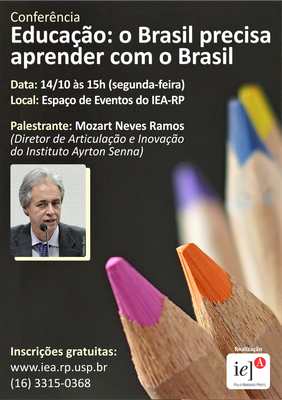
    <content:encoded xmlns:content="http://purl.org/rss/1.0/modules/content/"><![CDATA[<p><img src="https://www.iea.usp.br/polos/ribeirao-preto/noticias/Cartazeducacao1.png/@@images/a8e5191d-38d9-4c57-8ef0-54d7c4c26318.png" alt="" class="image-left" title="" />O artigo 205 da Constituição Brasileira determina como dever do Estado oferecer a todos os estudantes uma educação plena e que prepare para o exercício da cidadania. Mas será que o país sabe, de fato, os rumos para concretizar esse objetivo? Para debater esse assunto, o Instituto de Estudos Avançados Polo Ribeirão Preto (IEA-RP) promove no dia <span>14 de outubro, </span>a partir das<span> 15h, </span>no<span> Espaço de Eventos do IEA-RP</span> a palestra <span><i>Educação: O Brasil precisa aprender com o Brasil</i></span>.</p>
<p>As inscrições são gratuitas e devem ser feitas <a href="https://docs.google.com/forms/d/e/1FAIpQLSetMzFwYJzg2KBhHgv9GxGAeYHeMiqv5F9zW282WESAZT_Qng/viewform"><span>clicando aqui.</span></a></p>
<p>No evento, o diretor de Articulação e Inovação do Instituto Ayrton Senna Mozart Neves Ramos vai discutir dois grandes desafios do Brasil: resolver problemas que datam do século XIX, como alfabetizar as nossas crianças na idade certa, e trazer os novos conhecimentos produzidos pelas ciências na perspectiva de uma escola para o século XXI.</p>
<p>Mozart Neves Ramos é doutor em Química pela Unicamp e tem pós-doutorado em Química pela Politécnica de Milão, Itália. Foi reitor da Universidade Federal de Pernambuco (UFPE), presidente executivo da organização Todos pela Educação e membro do Conselho Nacional de Educação.</p>
<p>Mais informações: <a>iearp@usp.br</a> ou (16) 3315 0368.</p>
<p> </p>
<hr />
<p><b>Educação: O Brasil precisa aprender com o Brasil</b><br /><i>14 de outubro, 15h<br />Espaço de Eventos do IEA-RP<br /><a class="external-link" href="https://docs.google.com/forms/d/e/1FAIpQLSetMzFwYJzg2KBhHgv9GxGAeYHeMiqv5F9zW282WESAZT_Qng/viewform">Inscrições gratuitas</a><br /><a href="https://www.iea.usp.br/eventos/educacao-o-brasil-precisa-aprender-com-o-brasil" class="external-link">Página do evento</a></i></p>
<p> </p>]]></content:encoded>
    <dc:publisher>No publisher</dc:publisher>
    <dc:creator>Thais Cardoso</dc:creator>
    <dc:rights></dc:rights>
    
      <dc:subject>Education</dc:subject>
    
    
      <dc:subject>Polo Ribeirão Preto</dc:subject>
    
    <dc:date>2019-10-04T17:23:46Z</dc:date>
    <dc:type>Notícia</dc:type>
  </item>


  <item rdf:about="https://www.iea.usp.br/en/news/science-education-risk-awareness">
    <title>Awareness of global risks must be a component of scientific education, says researcher</title>
    <link>https://www.iea.usp.br/en/news/science-education-risk-awareness</link>
    <description></description>
    <content:encoded xmlns:content="http://purl.org/rss/1.0/modules/content/"><![CDATA[<p><dl class="image-right captioned" style="width:400px;">
<dt><img src="https://www.iea.usp.br/imagens/mauriciio-pietrocola-pinto-de-oliveira-10-5-19/image" alt="Maurício Pietrocola Pinto de Oliveira - 10/5/19" title="Maurício Pietrocola Pinto de Oliveira - 10/5/19" height="404" width="400" /></dt>
 <dd class="image-caption" style="width:400px;">Maurício Pietrocola: ''A conscientização sobre riscos deve passar do nível local para o global''</dd>
</dl></p>
<p>Despite the shortcomings and inequalities in many societies in accessing the benefits provided by scientific and technological development, large portions of humanity take advantage of significant improvements in the quality of life <span>to varying degrees</span>. Many of these improvements, however, come at high costs in environmental, social, and even cultural terms.</p>
<p>Research on the atomic nucleus and the consumption of fossil fuels, for example, led to two civilizing risks: the ever-present possibility of nuclear conflict and climate change due to global warming caused by greenhouse gases.</p>
<p>It is also clear that awareness of the negative implications of many consumption and behavior habits, such as the indiscriminate use of plastics and automobiles or the excessive consumption of meat, has grown in significant parts of the population in recent decades.</p>
<p>"The problem is that people are still basically concerned with the negative impacts at the individual and local level, without considering the interrelation of all factors on a global scale," says educator <a href="https://www.iea.usp.br/en/persons/researchers/mauricio-oliveira" class="external-link">Mauricio Pietrocola</a>, a professor at USP' School of Education (FE) and a participant in the 2019 <a href="https://www.iea.usp.br/en/persons/sabbatical" class="external-link">Sabbatical Year Program</a>.</p>
<p><strong>Scientific education</strong></p>
<p>At the IEA, Pietrocola is developing the project <span>"Scientific Education in the Risk Society."</span> The objective is to identify how students in basic education can be awakened to perceive the risks inherent in scientific and technological development, not only from a local point of view, but also in connection with global aspects. "Young people must be able to understand the risks, be aware of their causes and implications, and be able to take actions that contribute to minimizing these risks, not only at <span>individual or local </span>levels, but also globally. For this to be achieved, it will be necessary to adapt teacher training and curricula," says the researcher.</p>
<table class="tabela-esquerda-200-borda">
<tbody>
<tr>
<td>
<h3>Related material</h3>
<p><strong>News</strong></p>
<ul>
<li><a href="https://www.iea.usp.br/en/news/sabbatical-program-2019" class="external-link">Sabbatical Year Program chooses seven researchers for 2019</a></li>
<li><a href="https://www.iea.usp.br/en/news/research-project-analyzes-global-influence-fifa-world-cup-brics-members" class="external-link">Research project analyzes the use of the FIFA World Cup by three BRICS members in order to increase their global influence</a></li>
<li><a href="https://www.iea.usp.br/en/news/evolutionary-approaches-to-culture" class="external-link">New scientific field analyzes cultural transmission from an evolutionary point of view</a></li>
<li><a href="https://www.iea.usp.br/en/news/peripheral-cultural-collectives" class="external-link">Dennis de Oliveira analyzes peripheral cultural collectives in São Paulo</a></li>
</ul>
</td>
</tr>
</tbody>
</table>
<p>The sociological framework used by him to characterize the current period of humanity as that of a "risk society" is based, above all, on the formulations of sociologists Ulrich Beck (1944-2015) and Anthony Giddens.</p>
<p>In the preface to "<span>Reflexive Modernization: Politics, Tradition and Aesthetics in the Modern Social Order,"</span> published in 1995 in partnership with Scott Lash, they state that "as a species, we are no longer guaranteed our survival, even in the short term - and this is a consequence of our own actions, as a collective humanity." They warn that "new areas of unpredictability are often created by the very attempts to control them."</p>
<p>For <span>Beck, Giddens, and Lash</span>, the great relevance acquired by ecological issues "is due to the fact that the 'environment' is no longer something external to human social life, but completely impregnated and reordered by it. (...) What used to be is today so completely entangled with what is 'social' that, in this area, we can no longer take anything for granted."</p>
<p><strong>Late modernity</strong></p>
<p>In the conception of risk society formulated by Beck, he considers that globalization has played a fundamental process in the diffusion of risks on a global scale, including the diffusion of technologies and industrialization in addition to possibilities and consumption habits, in a context in which globalization is one of the engines that he, together with Giddens and Lash, calls late modernity or reflexive modernity.</p>
<p>We are a society that experiences post-nature, a reflection of how technoscience has transformed nature into technonature. In this type of modernity, the central concerns of society change from the development and implementation of new technologies to the management of risks associated with existing technologies," comments the researcher.</p>
<p>He explains that until the middle of the 20th century science education was thought almost exclusively as a kind of qualification for young people who wanted to pursue a profession of a scientific or technological nature, of a higher or technical level.</p>
<p>"After World War II, scientific education is understood as more than a training for scientists and technicians, and that science and technology are much more connected with society. Then, a movement emerges to think about the importance of science for the citizen who will not become a scientist or technician."</p>
<p>As a result, curricula are being reformulated to reflect scientific education as one of the aspects of citizenship training. "For the past 30 to 40 years we have been working on curricula and teacher training with this purpose." However, says Pietrocola, this concern still reflects orientation towards good practices, "about what should be done or not, with science being a grading tool of that scale."</p>
<p>In his studies, Beck begins to show that the relationship between science and society is so complex that it is no longer possible to distinguish where one or the other begins, explains the researcher. "Certain social practices only came into existence from science and technology. An example of this is communication. Until the invention of the telegraph, communication was linked to the speed of the fastest horses. Today it can happen in less than a second." Beck also showed that the globalization process started to generate several types of risks, different from those previously existing, "risks that the very science and technology create."</p>
<p><span>According to Pietrocola, school curricula are still very much focused on risks and individual or local needs, such as the importance of using sunscreen, for example. "But if someone decides to buy a car for greater mobility, they will not only contribute to the congestion and pollution of their city, but also to global warming, the melting of the polar ice caps, and the submersion of the Maldives Islands."</span></p>
<p>The nefarious consequences "are <span>more or less <span>evenly </span></span>distributed across the planet". The researcher explains that this goes against the logic of capitalism itself, which sought to produce wealth in one place and export <span>(environmental, above all)</span> risks to another. "Confined profit and risks used to be the pattern, including used tires, broken cell phones, and other discarded products and waste being sent to poor countries. This confinement of risk disappeared with late modernity."</p>
<p><strong>Methodology</strong></p>
<p>Pietrocola and his mentored students are working on two fronts. One of them is student-centered and will firstly map their perception of the risks arising from scientific and technological development. "The prospect is that the level of this perception is very low." Then, the project will raise awareness of the global scope of risks previously considered to have local impact only. The third phase will be dedicated to the identification of individual and group educational actions that can contribute to the reduction of risks at local and global levels.</p>
<p>"If we can get students to go through these three stages, we will also have to work on another front, which involves curricular additions and teacher training for methodological use." Australia, the United Kingdom, and the United States already deal with the risk <span>issue </span>in their curricula, "but I do not know to what extent civilizing risks are being addressed," he comments. In the Brazilian case, he considers that emphasis is placed only on risks in which local impact is perceived..</p>
<p>In the second semester, Pietrocola intends to start working with teachers from a public school in the municipality of Osasco and hold a cycle of seminars on the principle of precaution, inequality, global warming, and other topics with specialists from Brazil and the United States, Canada, and the United Kingdom. In 2020, fieldwork will take place in the schools, making it possible to see how much teachers and students are already aware of the issue of global risks.</p>
<p style="text-align: right; "><span class="discreet">Photo: Leonor Calasans / IEA-USP</span></p>]]></content:encoded>
    <dc:publisher>No publisher</dc:publisher>
    <dc:creator>Richard Meckien</dc:creator>
    <dc:rights>Original version in Portuguese by Mauro Bellesa.</dc:rights>
    
      <dc:subject>Sociology</dc:subject>
    
    
      <dc:subject>Basic Education</dc:subject>
    
    
      <dc:subject>Science</dc:subject>
    
    
      <dc:subject>ST&amp;I</dc:subject>
    
    
      <dc:subject>Research</dc:subject>
    
    
      <dc:subject>Sabbatical</dc:subject>
    
    
      <dc:subject>Education</dc:subject>
    
    <dc:date>2019-05-10T16:25:00Z</dc:date>
    <dc:type>Notícia</dc:type>
  </item>


  <item rdf:about="https://www.iea.usp.br/en/news/naomar-de-almeida-filho-new-visiting-professor">
    <title>Naomar de Almeida Filho is IEA's new visiting professor</title>
    <link>https://www.iea.usp.br/en/news/naomar-de-almeida-filho-new-visiting-professor</link>
    <description></description>
    <content:encoded xmlns:content="http://purl.org/rss/1.0/modules/content/"><![CDATA[<table class="tabela-direita">
<tbody>
<tr>
<th><img src="https://www.iea.usp.br/imagens/naomar-de-almeida-filho-luiz-bevilacqua-e-carlos-alberto-barbosa-dantas" alt="Naomar de Almeida Filho, Luiz Bevilacqua e Carlos Alberto Barbosa Dantas" class="image-inline" title="Naomar de Almeida Filho, Luiz Bevilacqua e Carlos Alberto Barbosa Dantas" /></th>
</tr>
<tr>
<td><span class="discreet">Naomar de Almeida Filho (left) with Luiz Bevilacqua and Carlos Alberto Barbosa Dantas during an event at the IEA | Photo: Leonor Calasans / IEA-USP</span></td>
</tr>
</tbody>
</table>
<p><a href="https://www.iea.usp.br/en/persons/researchers/naomar-filho" class="external-link">Naomar Monteiro de Almeida Filho</a>, a professor of epidemiology and former president of the Federal University of Bahia (UFBA), is the new visiting professor at the IEA-USP. Almeida, whose participation in the program was endorsed by the Institute's Board on April 5, will work on his project "Development of Innovative Models in Higher Education: Focus on General University Training in Health" until February 2021.</p>
<p>According to the presented proposal, the project has two main objectives: to identify, evaluate and disseminate innovative proposals for higher education capable of promoting general university education in the Brazilian public system, aiming at the incorporation of crucial humanistic and scientific values to face the challenges of the 21st century; and to promote innovative ways of organizing knowledge, curricular structure and pedagogical practice at USP, contributing to the ongoing internationalization process and consolidating the institutional leadership in the context of higher education.</p>
<p>Almeida is one of the coordinators of IEA's Study Group "<a href="https://www.iea.usp.br/en/news/study-group-will-present-proposals-for-the-usp-of-the-21st-century" class="external-link">USP facing the challenges of the 21st century</a>" along with <a href="https://www.iea.usp.br/en/persons/researchers/luiz-bevilacqua" class="external-link">Luiz Bevilacqua</a>. The group was created last year to propose actions for academic and administrative restructuring that potentially fit USP to the current demands of higher education. After a year of debates and research conducting, the group has published a document which concludes that the Univeristy should initiate studies on more appropriate education options. For the researchers, progress should preferably take place "by adopting new modalities of curricular organization, updating of thematic contents, revision of the pedagogical structure, and integration of training levels."</p>
<p><strong>Training for the future</strong></p>
<p>According to the study group's interpretation, Almeida suggests that the persistent advance of automation and information technologies - such as Artificial Intelligence and Machine Learning - should update the required competencies of system operators, policies, programs, and services. According to him, this possible new scenario will require an "inter / transdisciplinary, interprofessional, multi-referenced, ethical and politically responsible, culturally sensitive and quality-enhancing" stance.</p>
<p>But to achieve this goal, the researcher believes that it is necessary to answer the following questions: "What socio-political and vocational profile will define this new professional? What knowledge, skills and abilities will be needed? What principles, values and attitudes will we need to develop and cultivate so that the practice is effective, resolutive and creative? How can the University respond to these new demands?"</p>
<p>About the new paradigm that the technological revolution imposes on education, Almeida quotes Israeli historian Yuval Harari, author of the bestselling <i>Sapiens: A Brief History of Humankind</i>: "For the first time in history, we have no idea what to teach children at school or students at university. On the contrary, most of what today's children learn in school will be irrelevant by 2050," argues the historian.</p>
<p>Almeida argues that in today's world - "globalized, complex and diverse, interconnected, increasingly accelerated, lacking in solidarity and sensitivity" - it may be necessary to recover the concept of general education in higher education. For him, institutions should commit themselves mainly to the transmission of five competences (<i>pentavium</i>):</p>
<p dir="ltr"><strong>1.</strong> <i>Linguistic competence</i> - complete knowledge of the vernacular and of at least one foreign language, defined by the area of professional activity;<br /><strong>2.</strong> <i>Research training</i> - analytical reasoning and interpretation skills to produce knowledge;<br /><strong>3.</strong> <i>Pedagogical competence</i> - didactic skills necessary to share knowledge;<br /><strong>4.</strong> <i>Sensitivity to social inequalities</i> - empathy and ability to listen sensibly, with ethics and respect for human diversity;<br /><strong>5.</strong> <i>Critical technological competence</i> - mastery of the means of practice and its implications.</p>
<p dir="ltr">Almeida maintains that the present moment demands another kind of pedagogy, distinct from that which has formed the contemporary generation of mature adults. "Conventional modes of efficient and resolute knowledge transmission through educational processes based on content and protocols in order to develop skills and abilities are outdated," he says.</p>
<table class="tabela-esquerda">
<tbody>
<tr>
<th><img src="https://www.iea.usp.br/imagens/naomar-de-almeida-filho" alt="Naomar de Almeida Filho" class="image-inline" title="Naomar de Almeida Filho" /></th>
</tr>
<tr>
<td><span class="discreet">Naomar de Almeida Filho: ''By neglecting the diversity of focuses and experiences arising from interprofessionalism, the impoverishment of practices is inevitable.'' | Photo: Leonor Calasans / IEA-USP</span></td>
</tr>
</tbody>
</table>
<p dir="ltr"><strong>Training in health</strong></p>
<p dir="ltr">The educational gap in the workforce (especially in Brazil) has particularly severe impacts on public health, says the new visiting professor. He believes that the Brazilian state has a social debt with the population, which will not be overcome" while there are citizens excluded from the coverage of health promotion and protection programs, and discriminated by quality and resolution differentials."</p>
<p dir="ltr">"The strength of social processes in health and education is widely recognized, but unfortunately the <span>collective </span>synergy <span>has been little achieved in spite of being </span>much promoted," he argues. For Almeida, the teaching models are still too individualistic. "The training of health professionals needs to include <span>more powerful and more critical </span>technological competence, not only for utilitarian reasons, but also to enable a greater reach of care practices," he says. "By neglecting the diversity of focuses and experiences arising from interprofessionalism, the impoverishment of practices is inevitable."</p>
<p dir="ltr">In this perspective, the professor believes that it is urgent to adopt innovative approaches in higher education in health so that both the educational gap and the advance of scientific borders are overcome in the near future: "Therefore, it is necessary and pertinent to advance in the planning, implementation, monitoring, and evaluation of innovative training models, with teaching-learning practices aimed at overcoming inequalities in health, deconstructing social, generational, gender, ethnic and political biases; and to re-signify elements of differentiation and distinction of subjects before the right to health."</p>
<p dir="ltr"><strong>Planning and activities</strong></p>
<p dir="ltr">The outcomes and the scientific publications of the project will be transmitted mainly by IEA's website, with the aim of democratizing the access of knowledge to academic managers, professionals and citizens. But the professor emphasizes that mass media, such as public television stations and community radio stations should be used to disseminate the results, as well as to offer dialogue opportunities to the population.</p>
<p dir="ltr">In order to guarantee the effective diffusion of the acquired knowledge, extension courses will be promoted in classrooms, and at semi-distance and / or distance learning, through participatory strategies for the exchange of knowledge such as seminars, science fairs and community workshops.</p>
<p dir="ltr"><span>As a tangible legacy of the project, two initiatives should be implemented:</span></p>
<p dir="ltr"><strong>1.</strong> Courses on thematic axes / problem-themes / vectors of knowledge, coherent with the new organization of scientific knowledge in inter / transdisciplinary bases. This project will be coordinated by Luiz Bevilacqua.<br /><strong>2.</strong> An interdisciplinary bachelor's degree program in science at the University of São Paulo, focusing on sciences and technologies in health. The course should be conducted on an experimental basis, following the model of the molecular sciences course at USP.</p>
<p dir="ltr">Almeida also intends to publish at least four books and eight scientific articles during his stay.</p>]]></content:encoded>
    <dc:publisher>No publisher</dc:publisher>
    <dc:creator>Richard Meckien</dc:creator>
    <dc:rights>Original version in Portuguese by Vitor Matioli.</dc:rights>
    
      <dc:subject>Higher Education</dc:subject>
    
    
      <dc:subject>Research</dc:subject>
    
    
      <dc:subject>Health</dc:subject>
    
    
      <dc:subject>Education</dc:subject>
    
    
      <dc:subject>Visiting Professors</dc:subject>
    
    <dc:date>2019-04-08T21:10:00Z</dc:date>
    <dc:type>Notícia</dc:type>
  </item>


  <item rdf:about="https://www.iea.usp.br/en/news/launch-chair-basic-education">
    <title>IEA and Itaú Social launch the Chair of Basic Education</title>
    <link>https://www.iea.usp.br/en/news/launch-chair-basic-education</link>
    <description></description>
    <content:encoded xmlns:content="http://purl.org/rss/1.0/modules/content/"><![CDATA[<table class="tabela-direita">
<tbody>
<tr>
<th><img src="https://www.iea.usp.br/imagens/catedra-de-educacao-1" alt="Cátedra de Educação - 1 " class="image-inline" title="Cátedra de Educação - 1 " /></th>
</tr>
<tr>
<td><span class="discreet">The director of the Institute of Advanced Studies, Paulo Saldiva, USP's president Vahan Agopyan, the superintendent of Itaú Social, Angela Dannemann, and the coordinator of the Chair, Nílson José Machado</span></td>
</tr>
</tbody>
</table>
<p>The main objective of the Chair of Basic Education, based at the IEA and launched on February 21, is to gather measures that foster policies for basic education focused on teacher education, starting from the analysis of innovative experiences, discussions with the players and field studies. The opening event was a ceremony at USP's Museum of Contemporary Art (MAC). The Chair is the result of an agreement signed by USP, the Itaú Social Foundation - sponsor of the initiative -, and the Foundation for the Support of the University of São Paulo (FUSP) at the end of 2018.</p>
<p><a href="https://www.iea.usp.br/en/media-library/photos/events-2019/launch-usp-chair-basic-education-february-2019" class="external-link">Photos of the event</a></p>
<p>Itaú Social has allocated R$ 5 million to the activities of the Chair, divided into five annual contributions. The amount will subsidize the activities during the five years of agreement, which may be renewed.</p>
<p>For the first semester, three seminars are planned. With the participation of specialists, the activities will enable the systematization of information based on specific experiences and educational policies at the three levels of government. Each presentation will result in a video of 15 minutes and a text. In the second half of the year, the Chair should take the specialists to the field in order to get a closer look at the most successful experiences in basic education. With the collected information, they will return to USP to continue the research project.</p>
<table class="tabela-esquerda">
<tbody>
<tr>
<th><img src="https://www.iea.usp.br/imagens/catedra-de-educacao-2" alt="Cátedra de Educação - 2 " class="image-inline" title="Cátedra de Educação - 2 " /></th>
</tr>
<tr>
<td><span class="discreet">Nílson José Machado</span></td>
</tr>
</tbody>
</table>
<p><br />"We do not want to have an effect on Brazilian education in 40 or 50 years. We want to see results in four or five years," said <a href="https://www.iea.usp.br/en/persons/researchers/nilson-machado" class="external-link">Nílson José Machado</a>, academic coordinator of the Chair. In 2017 and 2018, also at the IEA, he coordinated the <a href="https://www.iea.usp.br/en/news/study-group-education" class="external-link">Brazilian Public Basic Education Study Group: Apparent Difficulties, Actual Challenges</a>, which mapped the most relevant issues in the area and produced the document "Diagnosis and Proposals for Basic Education in Brazil." The work of the group has inspired the creation of the Chair.</p>
<p>It is based on the result of this previous study that Machado defends that the main problem of Brazilian education is the lack of a project. "If we had a project for education, even a lack of resources would be easier to manage."</p>
<p>For <a href="https://www.iea.usp.br/en/persons/researchers/paulo-saldiva" class="external-link">Paulo Saldiva</a>, director of the IEA, it is USP's role to be part of the solution package for the country, an idea shared by the university's president, Vahan Agopyan, who has also attended the ceremony. "The university is not meant to solve all problems, but it has an obligation to help by recommending solutions," he said.</p>
<ul>
</ul>
<p>Itaú Social's superintendent Angela Dannemann has highlighted the strategic character of the foundation's partnership with the IEA: "The union between researchers, and the professionals who daily work at schools and know the educational networks has, in itself, a transforming power."</p>
<table class="tabela-direita-400-borda">
<tbody>
<tr>
<td>
<h3><i>
<div id="_mcePaste">Convergence of</div>
<div id="_mcePaste">initiatives for education</div>
<br /></i></h3>
<p><i>Since the early 1990s, the IEA has been committed to reflect on Brazilian public basic education and to collaborate in the formulation of public policies for the area.</i></p>
<p><i>Three visiting professors have dedicated their time to the theme in different periods of those years: the academic coordinator of the new Chair, Nílson José Machado; educator Guiomar Namo de Mello, </i><i>a researcher at the Carlos Chagas Foundation, and education specialist at the World Bank and at the Inter-American Development Bank, </i><i>who has also been Municipal Secretary of Education in São Paulo; and physicist Sérgio Costa Ribeiro, whose studies have shown that failure rather than evasion was the main obstacle to improve education and cognitive competence of the country's young population during the second half of the 20th century.</i></p>
<p><i>Another initiative of the Institute has been the </i><i>Education for Citizenship Mobilizing </i><i>Program</i><i>, focused on collecting data on the Brazilian educational system. One of the results of the program has been a report </i><i>on public policies for education </i><i>coordinated by Guiomar Namo de Mello.</i></p>
<p><i>Diagnoses, challenges, public policies and successful experiences in basic education have been subjects of dossiers and articles in the </i><i>"<a href="https://www.iea.usp.br/en/journal" class="external-link">Estudos Avançados</a>"</i><i> journal, and of conferences and public seminars over the last 30 years of the IEA.</i></p>
<p><i>While running for director and deputy director of the IEA, the then-candidates and now holders of the respective positions professors Paulo Saldiva and Guilherme Ary Plonski included </i><i>the creation of a core of studies dedicated to elementary and secondary education</i><i> among the priorities of their 2016-2020 Management Plan.</i></p>
<p><i>The guideline was implemented in early 2017 with the Brazilian Public Basic Education Study Group: Apparent Difficulties, Actual Challenges, under the coordination of Nílson José Machado. In five seminars held in 2017 and 2018, USP professors, educators, and public managers analyzed teacher education, quality of education, the role of official documents, and innovative experiences. The conclusions of the group were released in July 2018 with the document "</i><span><i>Diagnosis and Proposals for Basic Education in Brazil</i></span><i>".</i></p>
<p><i>Since 1993, Itaú Social has been developing programs to improve Brazilian public education. Examples of this effort include the creation of the Itaú-UNICEF Prize, the Education Improvement Program in the Municipality, the Cycles of Debates in Educational Management, and the creation of the </i><i>program </i><i>Educational Territories Networks.</i></p>
<p><i>The signing of the agreement for the creation of the chair based at the IEA is one more step for Itaú Social in addition to the various partnerships with the public power, including cooperation agreements with the Municipal Funds for the Rights of Children and Adolescents in 44 municipalities of several states. The foundation also cooperates with the Ministry of Education and the Ministry of Social Development, with the Municipal Secretary of Education in Manaus, and with the states of the Interstate Development Consortium of Central Brazil (Tocantins, Rondônia, Mato Grosso do Sul, Mato Grosso, Goiás, and the Federal District).</i></p>
<p><i>Itaú Social has 17 institutional partners, including the United Nations Children's Fund (UNICEF), the National Institute of Pure and Applied Mathematics Association, the Lemann Foundation, the Ayrton Senna Institute, and the Roberto Marinho Foundation.</i></p>
</td>
</tr>
</tbody>
</table>
<p>According to Dannemann, the foundation's expectation is that "during the five-year term of the Chair there will be" an accumulation of knowledge production, innovative practices, and training sessions that promote significant advances" in the proposals for basic education." All this with a commitment that is different: the appreciation of the look and the voice of the attending teachers."</p>
<p><span><strong>Premises</strong></span></p>
<p>The Chair is based on three premises, according to the formulators of the proposal:</p>
<ol>
<li>quality education is the one that promotes the full development of the subject;</li>
<li>the training of the teaching staff requires a balanced relationship between theory and practice, recognizing each individual as a whole;</li>
<li>the training of the teaching staff and their professional performance find limits in structuring problems, involving variables that are internal and external to the school.</li>
</ol>
<p> </p>
<p>By linking quality education with its concern to promote the full development of the individual, the Chair emphasizes the need to recognize its different dimensions (cognitive, emotional, social, ethical and physical) and to value the diversity of interests, talents, and individual<span> and group </span>trajectories. By embracing this notion of full education, the Chair encourages complementarity among schools, families, and local and city organizations, and proposes to promote multidisciplinary collaboration, given the challenges of the 20th century.</p>
<p>The Chair considers that the systematic training of teachers should be permanent, centered on what is experienced at school, but ubiquitous, collaborative and hybrid (face-to-face and by digital means). The proposal adds that, just like every student, every teacher must have <span>his integrality and his <span>subject </span>character</span> recognized. Such training expands the capacity for observation and reflection from the articulation between the challenges, scientific theories, and research results.</p>
<p>The members of the Chair relate structural problems that limit the training and the performance of teachers: a high rate of changing school staff, the lack of autonomy of the school unit in selecting the teaching staff, the intense workload which does not involve collective pedagogical elaboration, the deficient infrastructure, the fragmented vision of educational management, and the <span>discouraging </span>remuneration and career plans. In this sense, research projects that point out solutions to these challenges, including previous experiences of school networks and communities, are considered fundamental.</p>
<p>For the first semester of 2019, the Chair has programmed three seminars with the general theme "Action / Teacher Training: The Disciplinary Fragmentation and its Antidotes." The dates, the themes, and the presenters are the following:</p>
<ul>
<li><span>March 16 – Teacher:  Professionalism and Competence</span></li>
<ul>
<li>The Teacher and the Idea of Professionalism – <i>Nílson José Machado (IEA and USP's School of Education / FE)</i></li>
<li>The Teacher and His / Her Competences – <i>Lino de Macedo <i>(IEA and USP's <span>Institute of Psychology / </span>IP)</i></i></li>
<li>The Teacher's Action as a Professional – <i>Luís Carlos de Menezes <i>(IEA and USP's <span>Institute of Physics / </span>IF)</i></i></li>
<li>Attractiveness and Teaching Career – <i>Caroline Tavares (Itaú Social)</i></li>
</ul>
<li><span>April 13 – <span>The Teacher's Action</span>: Planning and Evaluation</span> 
<ul>
<li>The Teacher's Action: Freedom, Responsibility, Tolerance – <i><i>Luís Carlos de Menezes <i>(IEA and USP's Institute of Physics / IF)</i></i></i></li>
<li>Planning: Conceptions of Knowledge and Teaching Actions – <i><i>Nílson José Machado (IEA and USP's School of Education / FE)</i></i></li>
<li>Evaluation: The Ideas of Measurement and Value, and the Meaning of Indicators – <i><i>Lino de Macedo <i>(IEA and USP's Institute of Psychology / IP)</i></i></i></li>
<li>Evaluation and Planning: Good Practices for Time Use / Self-Training Activity – <i>Itaú Social</i></li>
</ul>
</li>
<li><span>May 18 – Teacher Training: Innovative Experiences</span></li>
<ul>
<li>Teacher Training: A Panorama of Fundamental Questions – <i>Bernardete Angelina Gatti (São Paulo State Board of Education / </i><i>CEE-SP)</i></li>
<li>Integrated Training: The Experience of USP São Carlos – <i>Yvonne Mascarenhas (IEA and <i>USP's Institute of Physics in São Carlos / </i>IFSC-USP)</i></li>
<li>Training by Area: A Transdisciplinary Vision – <i><i>Luís Carlos de Menezes <i>(IEA and USP's Institute of Physics / IF)</i></i></i><i> and <i>Nílson José Machado (IEA and USP's School of Education / FE)</i></i></li>
<li>Itaú Social Foundation: Overview of Projects Relating to the Final Years of Elementary Education <i>– <i>Itaú Social</i></i></li>
</ul>
</ul>
<p> </p>
<p><span><strong>Governance</strong></span></p>
<p>In addition to yearly having a researcher or intellectual with a relevant role in the reflection on the challenges of basic education, the Chair has a Governance Committee, an Advisory Committee and an Executive Committee.</p>
<p>The members of the Governance Committee are:</p>
<ul>
<li>IEA's director (currently Paulo Saldiva), who is also president of the committee;</li>
<li>the superintendent of Itaú Social (currently Angela Dannemann);</li>
<li>the coordinator general of the Chair, Guilherme Ary Plonski, deputy director at the IEA;</li>
<li>academic coordinator Nílson José Machado, from USP's School of Education and former visiting professor at the IEA;</li>
<li>two representatives of Itaú Social, appointed by the superintendent: Patrícia Mota Guedes, R&amp;D manager, and Juliana Souza Mavoungou Yade, R&amp;D specialist</li>
<li>and the chair holder.</li>
</ul>
<p> </p>
<p>Five researchers nominated by the IEA and five others chosen by Itaú Social constitute the Advisory Committee, to be renewed according to the agreement between the partners.</p>
<table class="tabela-direita">
<tbody>
<tr>
<th><img src="https://www.iea.usp.br/imagens/catedra-educacao-4" alt="Cátedra Educação - 4" class="image-inline" title="Cátedra Educação - 4" /></th>
</tr>
<tr>
<td><span class="discreet">Members of the Chair of Basic Education</span></td>
</tr>
</tbody>
</table>
<p>The Executive Committee includes:</p>
<ul>
<li>the coordinator general;</li>
<li>the academic coordinator;</li>
<li>two associate coordinators nominated by the IEA: USP professors Luís Carlos Menezes, from the IF-USP, and Lino Macedo, from the IP-USP;</li>
<li>two researchers nominated by the coordinators of the IEA centers in São Carlos and in Ribeirão Preto (one of each)</li>
<li>and a secretary.</li>
</ul>
<p> </p>
<p><span>Also participating in the Chair are researchers: Hélio Dias, from IF-USP and a senior professor at the IEA; Helena Singer, from the NGO Ashoka Brasil; Yvonne Mascarenhas, scientific coordinator of IEA's São Carlos Center and honorary professor of the Institute; Bernardete Gatti, from the Carlos Chagas Foundation and former president of the CEE-SP; Elie Ghanem, from FE-USP; Guiomar Namo de Melo, president of the Brazilian School of Teachers and former visiting professor at the IEA; and Francisco Aparecido Cordão, director at Peabiru Educacional.</span></p>
<p>The Executive Committee will be in charge of detailing the scope of the research project and defining the thematic axes; determine the process of selection and final selection of projects; and defining the scheduling of seminar cycles and other meetings.</p>
<p style="text-align: right; "><span class="discreet">Photos: Cecília Bastos / USP Imagens</span></p>
<ul>
</ul>
<ul>
</ul>
<ul>
</ul>]]></content:encoded>
    <dc:publisher>No publisher</dc:publisher>
    <dc:creator>Richard Meckien</dc:creator>
    <dc:rights>Original version in Portuguese by Mauro Bellesa and Fernanda Rezende.</dc:rights>
    
      <dc:subject>Public Education</dc:subject>
    
    
      <dc:subject>Basic Education</dc:subject>
    
    
      <dc:subject>Public Policies</dc:subject>
    
    
      <dc:subject>Chair of Basic Education</dc:subject>
    
    
      <dc:subject>Education</dc:subject>
    
    <dc:date>2019-02-22T03:00:00Z</dc:date>
    <dc:type>Notícia</dc:type>
  </item>


  <item rdf:about="https://www.iea.usp.br/en/media-library/photos/events-2019/launch-usp-chair-basic-education-february-2019">
    <title>Launch of USP's Chair of Basic Education - February 21, 2019</title>
    <link>https://www.iea.usp.br/en/media-library/photos/events-2019/launch-usp-chair-basic-education-february-2019</link>
    <description></description>
    
    <dc:publisher>No publisher</dc:publisher>
    <dc:creator>Richard Meckien</dc:creator>
    <dc:rights></dc:rights>
    
      <dc:subject>Education</dc:subject>
    
    
      <dc:subject>Chair of Basic Education</dc:subject>
    
    <dc:date>2019-02-21T03:00:00Z</dc:date>
    <dc:type>Pasta</dc:type>
  </item>


  <item rdf:about="https://www.iea.usp.br/en/news/issue94">
    <title>"Estudos Avançados" #94 addresses the teaching of sciences</title>
    <link>https://www.iea.usp.br/en/news/issue94</link>
    <description></description>
    <content:encoded xmlns:content="http://purl.org/rss/1.0/modules/content/"><![CDATA[<p><img src="https://www.iea.usp.br/imagens/capa-da-revista-estudos-avancados-94" alt="Capa da revista 'Estudos Avançados' 94" class="image-right" title="Capa da revista 'Estudos Avançados' 94" />The teaching of natural sciences, mathematics and engineering is the subject of the main dossier of the latest issue of IEA's journal "<a href="https://www.iea.usp.br/en/journal/about-estudos-avancados" class="external-link">Estudos Avançados</a>," already available in printed and <a class="external-link" href="http://www.scielo.br/scielo.php?script=sci_issuetoc&amp;pid=0103-401420180003&amp;lng=en&amp;nrm=iso">digital</a> versions (Portuguese only).</p>
<p>The set of articles retakes the journal's project to deepen the knowledge about <span>primary and secondary education</span> when it comes to humanities (theme of the <a href="https://www.iea.usp.br/en/news/93-estudos-avancados-reflects-on-the-teaching-of-humanities" class="external-link">previous issue</a>), and to natural sciences and mathematics. According to editor Alfredo Bosi, "the complexity of the questions about what and how to teach is evident" when examining the published texts.</p>
<p>The dossier has 21 articles and the participation of 44 researchers. 15 texts are subdivided into shorter <span>dossiers </span>on chemistry, geology, mathematics, biology and physics, respectively elaborated with the collaboration of USP professors Hernan Chaimovich, Umberto Cordani, Flavio Ulhoa Coelho, Marcos Buckeridge and Yvonne Mascarenhas. There is also an article on engineering and five on general issues relating to high school.</p>
<p>Further covered topics are the role given to the natural sciences in the versions of the National Curricular Common Core, the teaching through a historical-investigative approach, the end of the positivist model in the history of the sciences, the use of mobile devices in learning and high school as a closure of education in crisis.</p>
<p>Three articles compose the dossier on the teaching of physics. The teaching and learning of the discipline in high school <span>are analyzed as well as </span>the training of its teachers, including continuing education, which still has "no adequate and effective procedures," according to the authors. The set is completed by a critical analysis of the current reality of teaching physics: "in crisis, outdated, minimized, devalued," according to the author.</p>
<p>Concerning biology, the dossier contains an article on the potential of research teaching in order to make it more meaningful for students. Therefore, the authors articulate aspects of the constructivist consensus with the axes of scientific literacy. The other article about the discipline addresses the peculiarities of teaching botany and the importance of contextualization for good quality teaching.</p>
<p>The principles for a chemistry curriculum as it has been approached in the last 38 editions of the FUVEST exams, one of the most competitive processes to select higher education students in the country, and how the training of its teachers takes place in Brazil and worldwide are the subjects of the dossier on the discipline.</p>
<p><span>The teaching of geosciences in the university and the importance of expanding the area in the training and qualification courses for basic<span> education </span>teachers</span><span> are discussed in two articles.</span></p>
<p>In relation to mathematics, the articles discuss the teaching of the discipline in the early years of learning, teacher training, curriculum materials, correlations of the history of algebra and algebraic thinking with teaching and, in a complementary way, how ethnomathematics can contribute to social justice and sustainability.</p>
<p>The text on engineering presents the engineering of complexity as a proposal to approach the area whether in its conception work of its operation, considering the assumptions of the complex thinking elaborated by French thinker Edgar Morin.</p>
<p><strong>Humanities</strong></p>
<p>Issue #94 also brings four other texts which in some way complement the previous issue's dossier "The Teaching of Humanities". Two of them are dedicated to theoretical thinking and to <span>Peruvian sociologist Aníbal Quijano, </span>a former visiting professor at the IEA who died in May 2018 at the age of 90.</p>
<p>Historian Carlos Guilherme Mota, first director of the IEA, reports the motivations for him and Adriana Lopez to write the book "History of Brazil. An Interpretation," launched in 2008 and already in its fifth edition.</p>
<p>The set also has a text <span>on traditional indigenous knowledge </span>by Gonzalo Aguillar Cavallo regarding the preservation of nature and environmental patrimony.</p>
<p><strong>Tribute</strong></p>
<p>The issue is dedicated to nuclear physicist Ernst Hamburger (1933-2018), "indefatigable diffuser of history and sciences inside and outside USP," according to Bosi. Hamburger was one of the creators of the Laboratory of Demonstrations at USP's Institute of Physics (IF) and director of the <i>Estação Ciência</i> (Science Station), a project of the Dean for Culture and University Extension which is currently under<span> reformulation</span>.</p>
<p>The list below contains the names of the authors who have contributed with each one of the addressed themes:</p>
<p><strong>Leading Article</strong></p>
<p dir="ltr"><i><i>Alfredo Bos</i>i</i></p>
<p><strong>The Teaching of Sciences</strong></p>
<p dir="ltr"><i><i>Suzana Ursi, Pércia Paiva Barbosa, Paulo Takeo Sano and</i><i> Flávio Augusto de Souza Berchez</i><br /></i><i><i>Daniela Lopes Scarpa and</i><i> Natália Ferreira Campos</i><br /></i><i><i>Anna Maria Pessoa de Carvalho and</i><i> Lúcia Helena Sasseron<br /></i></i><i style="text-align: justify; "><i>Jesuína Lopes de Almeida Pacca and</i><i> Alberto Villani<br /></i></i><i style="text-align: justify; ">Marco Antonio Moreira<br /><i>Marcelo Almeida Bairral<br /><i>Renata F. M. Batista and</i><i> Cibelle Cellestino<br /><i>Luis Carlos de Menezes<br /><i>Cármen Lúcia Brancaglion and </i><i>Adair Mendes Nacarato<br /><i>Jonei Cerqueira Barbosa</i> and <i>Andréia Maria Pereira de Oliveira<br /><i>Yuly Vanegas and Joaquín Giménez<br /><i>Flávio Ulhoa Coelho</i> and <i>Marcia Aguiar<br /><i>Ubiratan D'Ambrósio<br /><i>Carmen Fernandez<br /><i>Flavio Antonio Maximiano<br /><i>Paulo Alves Porto<br /><i>Maria Eunice Ribeiro Marcondes<br /><i>Astolfo Gomes de Mello Araujo<br /><i>Umberto G. Cordani, Marcia Ernesto, Maria Assunção F. da Silva Dias, Elisabete de Santis B. G. Saraiva, Fernando F. de Alkmim, Carlos Alberto Mendonça</i><span> and </span><i>Rachel Albrecht<br /><i>Marcia Ernesto, Umberto G. Cordani, Celso Dal Ré Carneiro, Maria Assunção F. da Silva Dias, Carlos Alberto Mendonça and Elisabete de Santis Braga<br /><i>Gildo Magalhães<br /><i>José Roberto Castilho Piqueira</i></i></i></i></i></i></i></i></i></i></i></i></i></i></i></i></i></i></p>
<p><strong>Reviews</strong></p>
<p dir="ltr"><i><i>Gonzalo Aguilar Cavallo</i><br /></i><i><i>Deni Alfaro Rubbo</i><br /></i><i><i>Enrique Amayo Zevallos</i><br /><i>Carlos Guilherme Mota</i></i></p>]]></content:encoded>
    <dc:publisher>No publisher</dc:publisher>
    <dc:creator>Richard Meckien</dc:creator>
    <dc:rights>Original version in Portuguese by Mauro Bellesa.</dc:rights>
    
      <dc:subject>Higher Education</dc:subject>
    
    
      <dc:subject>Natural sciences</dc:subject>
    
    
      <dc:subject>Basic Education</dc:subject>
    
    
      <dc:subject>Journal</dc:subject>
    
    
      <dc:subject>Publications</dc:subject>
    
    
      <dc:subject>Mathematics</dc:subject>
    
    
      <dc:subject>Education</dc:subject>
    
    <dc:date>2018-12-04T12:55:00Z</dc:date>
    <dc:type>Notícia</dc:type>
  </item>


  <item rdf:about="https://www.iea.usp.br/en/news/93-estudos-avancados-reflects-on-the-teaching-of-humanities">
    <title>"Estudos Avançados" #93 reflects on the teaching of humanities</title>
    <link>https://www.iea.usp.br/en/news/93-estudos-avancados-reflects-on-the-teaching-of-humanities</link>
    <description></description>
    <content:encoded xmlns:content="http://purl.org/rss/1.0/modules/content/"><![CDATA[<p><span id="docs-internal-guid-f9d48d4d-7fff-d22f-ce8f-49ea379f72fb"> </span></p>
<p dir="ltr"><span><img src="https://www.iea.usp.br/imagens/capa-estudos-avancados-93/@@images/a264861c-632d-4ea5-9b50-5a6b15118a23.jpeg" alt="Capa Estudos Avançados 93" class="image-right" title="Capa Estudos Avançados 93" />The 93rd issue of the institutional journal "Estudos Avançados" inaugurates a series of publications focused on primary and secondary education. The main dossier of this issue brings a set of articles on the teaching of humanities, area of knowledge chosen to open the sequence. Besides reflections on the current conjuncture of Brazilian education, the texts present reflections on the teaching of philosophy, history, geography, music, literature and religion.</span></p>
<p dir="ltr">The journal also has three other sections, with different themes. In the first one, <i>Urban Life and Health</i>, four articles seek to understand how environmental and behavioral attributes of large cities affect the lives of their inhabitants. The second set of texts, <i>Arts and Culture</i>, brings comprehensive discussions on higher education in the arts and reflections on important works of the last century. The last section honors economist Paul Singer, who died in April, with a large and expressive interview in 2016.</p>
<p dir="ltr"><span>To editor Alfredo Bosi, the humanities face a paradoxical situation. "At the same time we have a reflection on the new methods proposed by pedagogy and specific didactics that open new directions for teaching, we face a depreciation of the same humanities by the technicist thinking that has been generalized in bureaucratic organs inside and outside the University," he points out. He believes that the intense demand for specialization generated by industrial and technological revolutions has hampered the balance between human and biological sciences.</span></p>
<p dir="ltr"><span>This context, according to Bosi, fuels the need to think about knowledge in a holistic and problematic way. A starting point, for him, would be to apply philosophy as a methodology of any and all modality of knowledge. "The reader will find articles by professors who experience this project both in public schools and in particular situations, such as teaching reading to inmates or the successful attempt to introduce Greek and Latin to elementary school students," he says.</span></p>
<p dir="ltr"><span>Bosi dedicates issue #93 to Paul Singer and Paulo Freire, who, according to him, "took their democratic ideals to the heart of the economy and pedagogy of the oppressed ones."</span></p>
<p dir="ltr"><span><strong>Dossier</strong></span></p>
<p dir="ltr">Between 2012 and 2013, Ana Vieira Pereira participated in a series of workshops on creative writing and reading mediation at the Romão Gomes Military Prison in São Paulo. Pereira's experiences and apprenticeships in the period are reported in the article <i>Sidelines - Literature Experiences with Imprisoned Persons</i>, which also composes the main dossier. According to her, the work made it possible to perceive literature and the telling of their own history as "powerful mechanisms for the personal reorganization and the discovery of new forms within the field of language".</p>
<p dir="ltr">In the article <i>The reform of secondary education and its questionable conception of quality of education</i>, Celso João Ferretti critically analyzes the reform promoted by the Ministry of Education in 2017. The political and economic interests of the restructuring, the ideological disputes that were presented and the official objectives <span>announced </span>by Michel Temer's government are some of the points dealt with by Ferretti. He further states that he has given "special attention to the curriculum flexibilization and the quality of education conception on which the reform is based."</p>
<p dir="ltr"><span>In the article <i>Latin and Greek in a municipal school of Elementary School</i>, Paula da Cunha Corrêa presents a successful pedagogical experience conducted from 2013 at the Desembargador Amorim Lima Municipal School of Elementary Education (EMEF.) Using the "Minimus" method, created by Barbara Bell, Corrêa has organized the implementation of classic language courses - Latin and Greek - for students in the 4th and 7th grades of the school, which is located in the city of São Paulo. According to her, in addition to language teaching, the project offers "diverse aspects of classical culture," to students, namely mythology, history, politics, theater, poetry, music, art and architecture." The "Minimus Project" is still in force and seeks new schools to expand its operation area.</span></p>
<p dir="ltr"><span><strong>Other themes</strong></span></p>
<p dir="ltr">The first two texts of the section <i>Urban Life and Health</i> show the consequences of violence and lack of basic sanitation for the health of the peripheral population. The latter two present comments on the last book authored by physician Paulo Saldiva, current director at the IEA-USP.</p>
<p dir="ltr">In <i>The metropolis and the health of its inhabitants</i>, Helena Ribeiro describes and analyzes the general themes addressed in Saldiva's work. According to her, the book clearly shows "the problems that urbanization has brought to physical and mental health" of the inhabitants of large cities.</p>
<p dir="ltr">Article writer Fabio Angeoletto emphasizes that the problems presented by Saldiva are not limited to São Paulo and other metropolises, but to all Brazilian cities, in <i>Urban life and health</i>. For him, the conclusion of the reading gives rise to a clear but not explicit message by the author: "Cities, in their complexity, demand planning, and multiple academic formations and social actors need to be involved in this work."</p>
<p dir="ltr">Among the seven authors in the <i>Arts and Culture</i> section are former IEA Director <a href="https://www.iea.usp.br/en/persons/researchers/martin-grossmann" class="external-link">Martin Grossmann</a> and two USP professors that participated in the first edition of the Institute's <a href="https://www.iea.usp.br/en/persons/sabbatical/sabbatical-professors" class="external-link">Sabbatical Year Program</a> in 2016: <a href="https://www.iea.usp.br/en/persons/researchers/daria" class="external-link">Dária Jaremtchuk</a> and <a href="https://www.iea.usp.br/en/persons/researchers/lucia-barbosa" class="external-link">Lúcia Maciel Barbosa de Oliveira</a>. The papers in this edition represent part of the results of their research at the Institute.</p>
<p dir="ltr">In the article <i>Abdias do Nascimento in the United States: a "black art painter,"</i> <span>Jaremtchuk </span>discusses the 10-year period that the Brazilian painter has spent in the United States. According to her, the time was fundamental for Nascimento to reaffirm "his commitment to the creation of works aligned with the African cultural heritage."</p>
<p dir="ltr">In Oliveira's <i>On Conquests and Tensions</i>, in turn, there is a discussion on the emergence of new cultural dynamics anchored in information and communication technologies. "The current moment demands a non-simplifying understanding of the innumerable representations, contradictions, voices and silences that vie for visibility in the public arena," she argues.</p>
<p dir="ltr"><span><strong>Paul Singer</strong></span></p>
<p dir="ltr"><span>The last article of the issue celebrates economist Paul Singer, who died April 16, 2018, at the age of 86. Singer was a full professor at USP's School of Economics, Business and Accounting (FEA,) and a member of the first composition of IEA's Board (1987-1992.) Born in Vienna, he was the creator and greatest advocate of the "Solidarity Economy."</span></p>
<p dir="ltr">The article <i>Paul Singer: a life of struggle and work for socialism and democratic participation</i>, by Cris Andrada and Egeu Esteves, presents an interview with the economist in the year 2016. Singer talks about his migration to Brazil, the youth in the Post-war São Paulo, his relationship with the union movement - with emphasis on the participation in the 300,000 Strike - and, notoriously, Solidarity Economy.</p>
<p dir="ltr"><span>"Only a few bring together intellectual greatness, genuine humility, and deep coherence between the writer and the practitioner," say the authors. "Paul Singer not only reflected on the violence of the world of work, but also devoted his studies to sharing it with workers, shoulder to shoulder, for years."</span></p>
<div><span>
<p>The list below contains the names of the authors who have contributed with each one of the addressed themes:</p>
<p><strong>The Teaching of Humanities</strong></p>
<p dir="ltr"><i>Franklin Leopoldo e Silva<br /></i><i>Celso de Rui Beiseigel<br /></i><i>Celso João Ferretti<br /></i><i>Marcus Sacrini and Valéria De Marco<br /></i><i>Ausonia Donato and Monique Borba Cerqueira<br /></i><i>Marcos Natali<br /></i><i>Neide Luzia de Rezende<br /></i><i style="text-align: justify; ">Ana Vieira Pereira<br /></i><i style="text-align: justify; ">Paula da Cunha Corrêa<br /></i><i>Circe Fernandes Bittencourt<br /></i><i>Antonia Terra de Calazans Fernandes<br /></i><i>Rafael Straforini<br /></i><i>Geraldo José de Paiva<br /></i><i>Antonio Carlos Moraes Dias Carrasqueira</i></p>
<p><strong>Urban Life and Health</strong></p>
<p dir="ltr"><i>Amélia Cohn<br /></i><i>Ana Lydia Sawaya, Maria Paula de Albuquerque and Semiramis Martins Álvares Domene<br /></i><i>Helena Ribeiro<br /></i><i style="text-align: justify; ">Fabio Angeoletto</i></p>
<p><strong>Arts and Culture</strong></p>
<p dir="ltr"><i>Dária Jaremtchuk<br /></i><i>Lúcia Maciel Barbosa de Oliveira<br /></i><i>Martha Ribeiro<br /></i><i>Isis Baldini, Martin Grossmann, Pamela Prado and Vinicius Spricigo<br /></i><i>Ana Mae Barbosa<br /></i><i>Martin Grossmann<br /></i><i>Paulo Roberto Ramos</i></p>
<p><strong>Paul Singer</strong></p>
<p><strong> </strong><i><i><i>Cris Andrada e Egeu Esteves</i></i></i></p>
</span></div>]]></content:encoded>
    <dc:publisher>No publisher</dc:publisher>
    <dc:creator>Richard Meckien</dc:creator>
    <dc:rights>Original version in Portuguese by Victor Matioli.</dc:rights>
    
      <dc:subject>Cities</dc:subject>
    
    
      <dc:subject>Art</dc:subject>
    
    
      <dc:subject>Humanities</dc:subject>
    
    
      <dc:subject>Journal</dc:subject>
    
    
      <dc:subject>Culture</dc:subject>
    
    
      <dc:subject>Health</dc:subject>
    
    
      <dc:subject>Education</dc:subject>
    
    <dc:date>2018-08-13T16:30:00Z</dc:date>
    <dc:type>Notícia</dc:type>
  </item>


  <item rdf:about="https://www.iea.usp.br/en/news/project-analyzes-the-impact-of-rankings-in-brazilian%20research-universities">
    <title>Project analyzes the impact of rankings in Brazilian research universities</title>
    <link>https://www.iea.usp.br/en/news/project-analyzes-the-impact-of-rankings-in-brazilian%20research-universities</link>
    <description></description>
    <content:encoded xmlns:content="http://purl.org/rss/1.0/modules/content/"><![CDATA[<table class="tabela-direita-300-borda">
<tbody>
<tr>
<td>
<p><img src="https://www.iea.usp.br/imagens/gladys-beatriz-barreyro-2018" alt="Gladys Beatriz Barreyro - 2018" class="image-inline" title="Gladys Beatriz Barreyro - 2018" /></p>
<p><i>In addition to being a professor at EACH-USP, Barreyro also works in two postgraduate programs at the University: Education and Integration in Latin America. Her main research focus is on policies and evaluation of higher education at the global, regional and national scales.</i></p>
</td>
</tr>
</tbody>
</table>
<p><span>In these first decades of the 21st century, there is a phase within the process of globalization in which national states are increasingly less autonomous towards other institutions that make up the global governance of higher education, such as the World Trade Organization (WTO,) the Organisation for Economic Co-operation and Development (OECD,) the World Bank, UNESCO, NGOs and various foundations.</span></p>
<p><span> </span>This evaluation belongs to educator <a href="https://www.iea.usp.br/en/persons/researchers/gladys-barreyro" class="external-link">Gladys Beatriz Barreyro</a>, a professor at USP's School of Arts, Sciences and Humanities (EACH,) and currently a participant of IEA's <a href="https://www.iea.usp.br/en/persons/sabbatical/sabbatical-professors" class="external-link">Sabbatical Year Program</a>. She is developing a study on the impact of international university rankings on the institutional identity, and teaching, research and extension purposes of Brazilian research universities, having USP and UNICAMP as references.</p>
<p><span>Entitled "Internationalization of Higher Education: Use of Rankings," the research project aims to reduce the lack of studies on the subject in Brazil and disseminate the international literature on it.</span></p>
<p><span>Among the educational policies of this phase of globalization, Barreyro identifies the emergence of international university rankings as a new way of dealing with quality on a global scale <span>in the first decade of the century</span>, impacting regional and national scales. There is also a role model of the "world-class university," institutions dedicated to "applied and (if possible) profitable research."</span></p>
<p><span><span>For her, rankings have introduced the logic of competition between institutions in a global perspective and generated impacts on national and institutional policies, "despite their methodological limitations."</span></span></p>
<p>Part of the project was developed in the first half of this year, when she was at the IEA on sabbatical leave. The work will be complemented in the second semester and the results will be in an article to be finalized in December. She also intends to present them at a public event.</p>
<p><span>As it is an exploratory research, Barreyro is analyzing the material published by USP's Journal and UNICAMP's Portal from 2013 to 2017 on the positions occupied by both universities in the rankings. From this examination she will try to answer four questions:</span></p>
<p><span> </span></p>
<ul>
<li>What is the use of the rankings at USP and Unicamp, and for what reasons?</li>
<li>What changes <span>in the identity and policies of these institutions</span> have been produced by the use of these rankings, and what are the justifications for it?</li>
<li>If institutional policies based on rankings have emerged, what are they?</li>
<li>If the rankings are affecting the purposes of teaching, research and extension of both universities, what are the <span>affected</span> aspects?</li>
</ul>
<p> </p>
<p><span>The material is being studied from the critical analysis of the discourse oriented by categories, to be detected in the course of examining the texts.</span></p>
<p>In parallel to the survey and analysis of the materials published by the media of both universities, Barreyro has been dedicating to two complementary activities: the bibliographic review on international rankings in national and international literature, and on world-class universities; and the systematization of the place occupied by both institutions in international and Latin American rankings, and in the list of BRIC universities.</p>
<table class="tabela-esquerda-200-borda">
<tbody>
<tr>
<td>
<h3><i>Evaluation trend </i></h3>
<p><i>The March issue of UNICAMP's journal on higher education evaluation ("<i>Revista de Avaliação do Ensino Superior"</i>) published the article "<a class="external-link" href="http://www.scielo.br/scielo.php?script=sci_arttext&amp;pid=S1414-40772018000100005&amp;lng=en&amp;nrm=iso&amp;tlng=pt">Global higher education evaluation: on accreditation, rankings and learning outcomes</a>," by Gladys Beatriz Barreyro.</i></p>
<p><i>Abstract in English. Complete material available in Portuguese only.</i></p>
</td>
</tr>
</tbody>
</table>
<p><strong>Globalization</strong></p>
<p>In the final decades of the 20th century, the impact of globalization on educational policies began, creating an internationally structured agenda for the area, according to the researcher. "In the national education systems, there was concern about evaluation. In the case of higher education in the 1980s, policies to measure its quality began, initiating the first phase of the 'Evaluating State,' an expression coined by British sociologist Guy Neave in 2012."</p>
<p><span>She states that the reduction of expenditures since the 1980s, due to the crisis of the welfare state, "have motivated the adoption of accountability policies, such as evaluations in national education systems started in the 1980s and 1990s in Latin America, stemming from neoliberal reforms."</span></p>
<p>Two other aspects of globalization have influenced vocational training, according to Barreyro: the processes of flexible accumulation (also called toyotism, which provides for flexibilization of production according to demand) and the emergence of the knowledge society. "They have resulted in the need to train professionals for the so-called knowledge economy," which "put higher education in the spotlight."</p>
<p>"Once considered a public good for the purpose of reproducing values and training human resources, higher education has become a private good, a commodity subject to the rules of commerce," says the researcher. She highlights the contributions to that change provided by the General Agreement on Tariffs and Trade (GATT,) which was in force until 1994, and by the World Trade Organization negotiations for the inclusion of education in the liberalization of trade in goods and services.</p>
<p><span>The international movement of professionals in the face of globalization, centered not on brain drain but on competition for them, is another feature of the process, according to Barreyro. On this competition, she cites the evaluation of two authors, Rahul Choudana and Hans de Wit, who assert that the knowledge economies of the OECD countries require highly qualified professionals and must resort to immigrants with this profile, since their population is aging and has diminished the interest of their young people in the hard sciences.</span></p>
<p>In the global education agenda, quality and its assessment are one of the political priorities, says Barreyro. "In higher education, quality assessment began to be developed in the 1980s and 1990s in European and Latin American countries with the creation of accreditation systems and agencies." She says that these countries have transformed the US accreditation model - "regardless of government" - in the so-called Evaluating State, mentioned by Guy Neave.</p>
<p>Later, these national policies became of concern at the global level, which "establishes relations of scale with the national and regional levels." According to her, Portuguese education sociologist Almerindo Janela Afonso sees a later stage, called by him "Post-<span>Evaluating State,</span>" in which the decision is increasingly shunned by the decision of the national states, especially in the peripheral countries.</p>]]></content:encoded>
    <dc:publisher>No publisher</dc:publisher>
    <dc:creator>Richard Meckien</dc:creator>
    <dc:rights>Original version in Portuguese by Mauro Bellesa.</dc:rights>
    
      <dc:subject>Higher Education</dc:subject>
    
    
      <dc:subject>University</dc:subject>
    
    
      <dc:subject>Globalization</dc:subject>
    
    
      <dc:subject>Sabbatical</dc:subject>
    
    
      <dc:subject>USP</dc:subject>
    
    
      <dc:subject>Education</dc:subject>
    
    <dc:date>2018-06-28T12:15:00Z</dc:date>
    <dc:type>Notícia</dc:type>
  </item>


  <item rdf:about="https://www.iea.usp.br/en/news/seminar-on-migration-marks-the-beginning%20of-the-collaboration-between-usp-and-el-colegio-mexico">
    <title>Seminar on migration marks the beginning of the collaboration between USP and El Colegio de México</title>
    <link>https://www.iea.usp.br/en/news/seminar-on-migration-marks-the-beginning%20of-the-collaboration-between-usp-and-el-colegio-mexico</link>
    <description></description>
    <content:encoded xmlns:content="http://purl.org/rss/1.0/modules/content/"><![CDATA[<table class="tabela-direita">
<tbody>
<tr>
<th><img src="https://www.iea.usp.br/imagens/silvia-giorguli" alt="Silvia Giorguli " class="image-inline" title="Silvia Giorguli " /></th>
</tr>
<tr>
<td>
<p><strong>Silvia G</strong><strong><strong>iorguli: "Mexico is </strong>missing schools with more inclusive policies"</strong></p>
</td>
</tr>
</tbody>
</table>
<p>"Research and public policies on migration have been focusing on adults, leaving children and young people behind." The criticism of the invisibility of young migrants opened the exhibition of Professor <a href="https://www.iea.usp.br/en/persons/speakers/silvia-giorguli" class="external-link">Silvia Elena Giorguli Saucedo</a>, president of <a class="external-link" href="https://www.colmex.mx/">El Colegio de México</a> (COLMEX,) during the seminar <i>Migration and Education</i>, held at the IEA on June 12.</p>
<p>The meeting has marked the beginning of the academic cooperation between the University of São Paulo and COLMEX, an institution of excellence in studies of social sciences and humanities. Signaling the support given by the <a class="external-link" href="https://consulmex.sre.gob.mx/saopaulo/">Consulate General of Mexico in São Paulo</a> to the partnership, Consul General Margarita Pérez Villaseñor and Deputy Consul Luis Geraldo Hernández Madrigal have both attended the event organized by the IEA in partnership with <a class="external-link" href="http://www.usp.br/internationaloffice/en/">USP's International Cooperation Office</a> (AUCANI) and COLMEX.</p>
<p dir="ltr"><strong>Mexican context</strong></p>
<p dir="ltr">Giorguli has organized her speech around the research carried out by COLMEX's Center for Demographic, Urban and Environmental Studies, in which she actively participates. According to her, three main groups of young migrants have been instrumental in understanding the ongoing demographic restructuring in Mexico.</p>
<table class="tabela-esquerda-200-borda">
<tbody>
<tr>
<td>
<h3>Related material</h3>
<p><strong><a href="https://www.iea.usp.br/en/media-library/photos/events-2018/migracao-e-educacao-12-de-junho-de-2018" class="external-link">Photos</a> | <a href="https://www.iea.usp.br/en/media-library/video/migration-and-education" class="external-link">Video</a></strong> (in Spanish and Portuguese)</p>
<p><strong><a href="https://www.iea.usp.br/en/news/Dedemographic-profile-of-latin-america-needs-policies-for-development-indicates-panel" class="external-link">Demographic Dividend in Latin America</a></strong><br /><span>Panel with Silvia Giorguli on June 13, 2018</span></p>
</td>
</tr>
</tbody>
</table>
<p dir="ltr">The first is composed of internal migrants, individuals who transit within their own country in search of better living conditions. The second is represented by returning migrants, who left the country in the early years of childhood, and then returned to Mexico in their early adolescence with few cultural references and no Spanish skills. The last group is formed by young immigrants, who mainly leave the United States to live in Mexico. According to Giorguli, of the nearly 1 million immigrants living in the country, 460,000 are underage and were born in the United States.</p>
<table class="tabela-direita-400-borda">
<tbody>
<tr>
<td>
<p><strong>The agreement between the COLMEX and USP</strong></p>
<p dir="ltr">During the seminar, IEA's Deputy Director Guilherme Ary Plonski made clear that his expectation is to develop a center for Mexican studies at USP as well as a Brazilian study center at COLMEX. Professor Giorguli endorsed Plonski's wishes and assured that the meeting was a start for a much closer relationship between the institutions: "We have much knowledge to exchange, experiences to discuss and debates to do around the role of the university in the creation of public policies."</p>
<p dir="ltr">Giorguli attended a meeting with USP's President Vahan Agopyan to plan future collaborations between the institutions on June 11. Among the discussed projects there are the possible creation of a chair and joint graduate programs. Further attendees of the meeting were the president of USP's International Cooperation Office (AUCANI,) Raul Machado Neto, Guilherme Ary Plonski, Consul General of Mexico in São Paulo Margarita Pérez Villaseñor, Deputy Consul General Luis Gerardo Hernández Madrigal, and the coordinator of USP's International Conjuncture Analysis Group (GACINT,) linked to the Institute of International Relations (IRI,) Alberto Pfeifer.</p>
</td>
</tr>
</tbody>
</table>
<p dir="ltr">Regarding the impact that migration has on the educational development of children, the president of COLMEX has avoided being categorical: "One part of the literature describes positive effects and another part, negative effects." According to her, everything depends on the bias by which the situation is analyzed. "Migration can cause a young person to go to school as well as to abandon it earlier than usual," she argued.</p>
<p>She has pointed out that these complex effects are basically moderated due to two factors: the family dynamics of each individual and the ability of schools to integrate persons with different characteristics and trajectories. "Migration may result in greater financial resources for the family, but there is also a change in the adult learning and supervision environment," she said. And it is precisely in this type of situation that the performance of schools becomes more important: "When parents can not supervise the academic tasks of their children, the school needs to think about other work mechanics."</p>
<p dir="ltr">Another challenge that must be faced by young Mexicans is the deadlock between migrating and studying. According to Giorguli, 45% of Mexicans leaving the country are less than 18 years old. "At the moment, they have to decide if they want to stay in the country or migrate to find better conditions of study and work," she said. "And they rarely believe that continuing their studies in Mexico will give them a better chance of finding a good job in the United States."</p>
<p dir="ltr">Despite the high numbers of emigration, Giorguli has higlighted that the country is currently experiencing a "zero balance," where the number of immigrants and emigrants is equalized. "Every year about 140,000 Mexicans leave the country, but another 140,000 return to Mexico," she explained.</p>
<p dir="ltr"><strong>Internal migration<br /></strong><br class="kix-line-break" />The internal flow of people was much more intense during the rural exodus that occurred in the 1970s and 1980s, according to Professor Giorguli. But it is still a recurrent phenomenon that has considerable consequences for the education of children. "Imagine what migration, even within the country, means for a young man who has to leave his home, his school habits and his friends," she instigated.</p>
<p dir="ltr">The research projects developed by Giorguli's group show that migrations are more disruptive - making young people drop out of school - when they take place during the early stages of education. After the age of 16, the effects are lower because "the migrations may be related to the search for better conditions of study." However, the professor has pointed out that the reverse path is also quite common: "When, for some reason, a young person leaves school, migration seems like a solution to get on with their life."</p>
<p dir="ltr">The group has also concluded that despite the difficulties encountered in adapting to the new environment, young people born in the United States are the ones who remain the most in Mexican schools. Non-migrants and Mexican (internal) migrants tend to stop attending school considerably earlier. "One of the justifications is that the parents of these children born in the USA also have a higher level of schooling," explained Giorguli.</p>
<table class="tabela-direita">
<tbody>
<tr>
<th><img src="https://www.iea.usp.br/imagens/jose-renato-de-campos-araujo" alt="José Renato de Campos Araújo " class="image-inline" title="José Renato de Campos Araújo " /></th>
</tr>
<tr>
<td><strong>José Renato Araújo: "When I arrived in Mexico, I was surprised to realize that the 'problem' was not on the northern border, but on the southern one"</strong></td>
</tr>
</tbody>
</table>
<p dir="ltr"><strong>The Central American issue<br /><br /></strong>Of all the groups that make up the Mexican urban society, the one that undergoes the most serious social fragility is that of Central American migrants. According to Professor Giorguli, Mexico is a transitional shelter for most of these families, who have the United States as their final destination.</p>
<p dir="ltr">Research from COLMEX's Center for Demographic, Urban and Environmental Studies have concluded that while 95 percent of Mexican children aged 8 to 12 are absorbed into the educational system, only 65 percent of the Central American ones of the same age are incorporated. As for young people aged 16 to 18, only 13% of students from Central American countries attend schools in Mexico. For the natives, the index is 65%. "This shows that these families and these young people do not have the same resilience as migrants from the United States," said Giorguli.</p>
<p dir="ltr">The difficulties faced by Central American people who migrate to Mexico are not limited to the educational field. Professor Giorguli has reported that these people, because they are from a population in transit, rarely have access to all kinds of social assistance. One of the guest speakers, <a href="https://www.iea.usp.br/en/persons/speakers/jose-renato-campos-araujo" class="external-link">José Renato de Campos Araújo</a>, a professor at USP's School of Arts, Sciences and Humanities (EACH), has spent a period as a researcher in Mexico and reiterated Giorguli's speech: "When I arrived in Mexico, I realized that the 'problem' was not on the northern border, but on the southern one, where Central Americans were trying to reach the United States."</p>
<table class="tabela-esquerda">
<tbody>
<tr>
<th><img src="https://www.iea.usp.br/imagens/rosana-aparecida-baeninger" alt="Rosana Aparecida Baeninger" class="image-inline" title="Rosana Aparecida Baeninger" /></th>
</tr>
<tr>
<td>
<p><strong>Rosana Baeninger: "As the countries of the North close their borders, the nationalities in the southern schools get more diverse"<br /></strong></p>
</td>
</tr>
</tbody>
</table>
<p dir="ltr"><strong>Education and inequality<br /><br /></strong><a href="https://www.iea.usp.br/en/persons/speakers/rosana-baeninger" class="external-link">Rosana Aparecida Baeninger</a>, a professor at the Department of Demography of the State University of Campinas (UNICAMP,) who has also taken part in the debate, questioned Giorguli about how the Mexican educational system is preparing to deal with inequalities of origin, culture and students.</p>
<p>The president of COLMEX believes that the differences of opportunity begin in the origin of the children, since Mexicans born in the countryside will never have an education comparable to the young people born in the cities. This segregation has increased with the implementation of basic distance education in the country: "Income differences between a child who studies in a regular school and a child who studies at a distance are enormous."</p>
<p>In this context, if the damages caused to the young Mexicans are great, those caused to the migrants are even greater. "Imagine how the education of a young Central American migrant in a rural community is, being a user of distance education. There are many inequalities that accumulate on this individual," explained Giorguli.</p>
<p>Another challenge faced by many of the migrants, especially the inmates, is the language. As inconsistent as it may seem, language barriers are harder to bridge for children born in indigenous communities who migrate to large cities than to American migrants. Giorguli has reported that many Mexican teachers still complain about the learning pace of the indigenous youth. "What they do not understand is that Spanish is not the first language of these children," she said. "This shows that what is lacking in Mexico is schools with more inclusive policies."</p>
<p style="text-align: right; "><span class="discreet">Photos: Leonor Calasans/IEA-USP</span></p>]]></content:encoded>
    <dc:publisher>No publisher</dc:publisher>
    <dc:creator>Richard Meckien</dc:creator>
    <dc:rights>Original version in Portuguese by Victor Matioli.</dc:rights>
    
      <dc:subject>International Cooperation</dc:subject>
    
    
      <dc:subject>El Colegio de México</dc:subject>
    
    
      <dc:subject>Migration</dc:subject>
    
    
      <dc:subject>Public event</dc:subject>
    
    
      <dc:subject>Education</dc:subject>
    
    <dc:date>2018-06-15T16:50:00Z</dc:date>
    <dc:type>Notícia</dc:type>
  </item>


</rdf:RDF>