<?xml version="1.0" encoding="utf-8" ?>
<rdf:RDF xmlns:rdf="http://www.w3.org/1999/02/22-rdf-syntax-ns#" xmlns:dc="http://purl.org/dc/elements/1.1/" xmlns:syn="http://purl.org/rss/1.0/modules/syndication/" xmlns="http://purl.org/rss/1.0/">


<channel rdf:about="https://www.iea.usp.br/search_rss">
  <title>Instituto de Estudos Avançados da Universidade de São Paulo</title>
  <link>https://www.iea.usp.br</link>

  <description>
    
            These are the search results for the query, showing results 1 to 15.
        
  </description>


  <image rdf:resource="https://www.iea.usp.br/logo.png" />

  <items>
    <rdf:Seq>
      
        <rdf:li rdf:resource="https://www.iea.usp.br/en/news/ubias-directors-conference-ghana" />
      
      
        <rdf:li rdf:resource="https://www.iea.usp.br/en/news/indigenous-museums-decolonisation-japan-emergence-brazil" />
      
      
        <rdf:li rdf:resource="https://www.iea.usp.br/en/news/japanese-museums" />
      
      
        <rdf:li rdf:resource="https://www.iea.usp.br/en/news/secretary-general-oecd" />
      
      
        <rdf:li rdf:resource="https://www.iea.usp.br/en/news/antoni-muntadas-about-academia-i-ii-an-online-interpretation-2011-2017-2021" />
      
      
        <rdf:li rdf:resource="https://www.iea.usp.br/en/news/researcher-analyzes-actions-perception-health-in-bom-retiro" />
      
      
        <rdf:li rdf:resource="https://www.iea.usp.br/en/news/workshop-presents-new-methods-cure-diseases" />
      
      
        <rdf:li rdf:resource="https://www.iea.usp.br/en/news/nazifascism" />
      
      
        <rdf:li rdf:resource="https://www.iea.usp.br/en/events/between-diversity-decolonisation" />
      
      
        <rdf:li rdf:resource="https://www.iea.usp.br/en/news/Dedemographic-profile-of-latin-america-needs-policies-for-development-indicates-panel" />
      
      
        <rdf:li rdf:resource="https://www.iea.usp.br/en/news/events-with-silvia-giorguli" />
      
      
        <rdf:li rdf:resource="https://www.iea.usp.br/en/news/linking-landscape-structure-to-ecosystem-services" />
      
      
        <rdf:li rdf:resource="https://www.iea.usp.br/en/news/study-group-will-present-proposals-for-the-usp-of-the-21st-century" />
      
      
        <rdf:li rdf:resource="https://www.iea.usp.br/en/news/directors-conference-ubias" />
      
      
        <rdf:li rdf:resource="https://www.iea.usp.br/en/news/eliana-sousa-silva-takes-on-olavo-setubal-chair" />
      
    </rdf:Seq>
  </items>

</channel>


  <item rdf:about="https://www.iea.usp.br/en/news/ubias-directors-conference-ghana">
    <title>IASs from all continents discuss strategies for cooperation and their influence in international research</title>
    <link>https://www.iea.usp.br/en/news/ubias-directors-conference-ghana</link>
    <description></description>
    <content:encoded xmlns:content="http://purl.org/rss/1.0/modules/content/"><![CDATA[<table class="tabela-direita">
<tbody>
<tr>
<th><img src="https://www.iea.usp.br/imagens/mesa-da-1a-sessao-do-encontro-de-diretores-de-ieas" alt="Mesa da 1ª sessão do encontro de diretores de IEAs" class="image-inline" title="Mesa da 1ª sessão do encontro de diretores de IEAs" /><br /></th>
</tr>
<tr>
<td><span class="discreet">Director of the IEA/USP, Roseli de Deus Lopes (left) spoke at one of the sessions of the meeting.</span></td>
</tr>
</tbody>
</table>
<p>The role of institutes for advanced study (IASs) based at universities, the preservation of their academic autonomy, the guarantee of funding, and the increase of their influence on the global scientific agenda were the main themes debated at the Directors' Conference of the international network of <a class="external-link" href="http://www.ubias.net">University-Based Institutes for Advanced Study (UBIAS)</a>, held from November 4 to 6. The event was hosted by the <a class="external-link" href="https://miasa.ug.edu.gh/">Maria Sibylla Merian Institute for Advanced Studies in Africa (MIASA)</a>, located at the University of Ghana, in Accra.</p>
<p>The IEA/USP, one of the founding members of UBIAS, was represented by director <a href="https://www.iea.usp.br/en/persons/researchers/roseli-lopes" class="external-link">Roseli de Deus Lopes</a> and former director <a href="https://www.iea.usp.br/en/persons/researchers/guilherme-plonski" class="external-link">Guilherme Ary Plonski</a>, currently a senior professor at the Institute. The gathering marked the 15th anniversary of the network, created at a meeting promoted by the Freiburg Institute for Advanced Studies (FRIAS) in October 2010.</p>
<p><strong>Relevance</strong></p>
<p>Plonski, who has already coordinated UBIAS's steering committee for three years, considered the conference very well-organized and relevant for the following main reasons.</p>
<table class="tabela-esquerda-300-borda">
<tbody>
<tr>
<td>
<h3>Up next</h3>
<p>Three meetings of directors from UBIAS member institutes are scheduled to take place online in May and November 2026, and in May 2027. The next in-person conference will be held in November 2027.</p>
<p><strong>Intercontinental Academia</strong></p>
<p>The 5th <a class="external-link" href="http://ica.usp.br/">Intercontinental Academia (ICA)</a> will be conducted by the Institute for Advanced Transdisciplinary Studies (IEAT) at the Federal University of Minas Gerais and by the Max Weber Centre for Advanced Cultural and Social Studies (Max-Weber-Kolleg) at the University of Erfurt. The theme "Pluralities of Resonant Relationships" will be explored in two immersive meetings of the researchers involved: in June 2026 in Germany, and in March 2027 in Brazil. The choice of study topic refers to the theoretical proposal of sociologist Hartmut Rosa, director of the Max Weber-Kolleg. In elaborating a theory of the "good," he defines "resonance" as a relationship of mutual influence between the subject and the world, where both are transformed through an encounter based on affect, emotion, and perceived self-efficacy.</p>
<p>The first edition of the ICA was organized by the IEA/USP and by Nagoya University's Institute for Advanced Research (IAR), having "Time" as its theme. The immersive meetings took place in April 2015 in Brazil and in March 2016 in Japan.</p>
</td>
</tr>
</tbody>
</table>
<p><strong>• </strong>It was the first event of its kind held in Africa, reinforcing the global nature of the network. In the Americas, the milestone occurred in 2018. In Oceania, the last continent yet to be covered, it will happen in 2027.</p>
<p><strong>• </strong>During the first two days of activities it was possible to delve into crucial themes in a rapidly transitioning world, such as knowledge production in the so-called Global South (with particular emphasis on Lopes' participation) and the challenge of boosting IASs by adding intersectorality to the basic characteristic of interdisciplinary studies and research.</p>
<p><strong>• </strong>The quality of interactions between leaders of member institutes has strengthened ties that encourage collaborative actions over the next two years.</p>
<p><strong>Global South</strong></p>
<ul>
</ul>
<p>The theme of the first session of the conference was "Knowledge Production in the Global South: The Role of IASs in Shaping Regional and Global Research Agendas." According to Lopes, one of the speakers, the importance of IASs lies in the fact that they are spaces for independent, interdisciplinary, and risk-tolerant research with the time and freedom to cross scientific boundaries.</p>
<p>However, she observed that transposing the socioeconomic divide between the Global North and the Global South to the context of knowledge production can lead to distortions in the evaluation of the scientific contribution of developing countries. Feminist and decolonial intellectual currents consider that this results in the marginalization of scientific perspectives from the Global South, which has been called an epistemic injustice, with theories from the North being seen as universal.</p>
<p>Lopes cited several factors that prevent the fair participation of developing countries in international epistemological frameworks: the advantage of countries with English as their native language, the high cost of publishing in high-impact journals, restrictive criteria for measuring impact, barriers arising from compliance requirements in South-South collaborations, and unequal access to intellectual property and data.</p>
<p>Given these obstacles, she recommended three actions to the IASs: sharing legal models, ethical data governance, and microfinancing prior to granting research scholarships for South-South and South-North collaborations.</p>
<p>It is not enough for researchers from the Global South to participate in the international research system. They also need to be involved in setting the agendas of this system by proposing questions and methods, Lopes stated. Another need is the redefinition of scientometric criteria for evaluating preliminary, multilingual, and politically relevant results, she added.</p>
<p>From the perspective of the integration structure of researchers and research institutions from countries in the Global South, Lopes sees three levels to be considered: 1) agendas based on regional issues but with global reference points; 2) plural epistemologies and multilingual knowledge; 3) infrastructures for recognition and scaling up.</p>
<p>Some examples for level 1 are the resilience of tropical megacities, bioeconomy and biodiversity, and informal economy platforms. For level 2, Lopes mentions integrating the knowledge of indigenous peoples/traditional communities into academic methods and considering the translation of results into multiple languages ​​as part of academic activity. Open access to datasets produced in the Global South and fair evaluation of public policy labs, prototypes, and multilingual results apply to level 3.</p>
<table class="tabela-esquerda">
<tbody>
<tr>
<th><img src="https://www.iea.usp.br/imagens/sede-do-instituto-merian-de-estudos-avancados" alt="Sede do Instituto Merian de Estudos Avançados" class="image-inline" title="Sede do Instituto Merian de Estudos Avançados" /><br /></th>
</tr>
<tr>
<td><span class="discreet">Maria Sibylla Merian Institute for Advanced Studies in Africa (MIASA), located at the University of Ghana, in Accra.</span></td>
</tr>
</tbody>
</table>
<p><strong>Contributions of the IASs</strong></p>
<p>Lopes said that there are characteristics and functions that only IASs can provide for encouraging inclusion in the international agenda: the offering of an interdisciplinary environment for experimentation by researchers and small research groups, and acting as a multifaceted bridge connecting universities, civil society, and the public and private sectors.</p>
<p>During the conference, Lopes and the directors of four other IASs were chosen to form the UBIAS Coordination Team. The concrete proposals for the network that she presented in the first session of the program somehow already foresee part of her future role in the team. They include the creation of a circuit of co-sponsored research stays at IASs in the Global South, the implementation of a multilingual platform with open access to abstracts and methodologies, public policy laboratories based on research results, mobility and microfinance programs, and a registration system for open methodologies and prototypes.</p>
<p><strong>Intersectoriality</strong></p>
<p>The sixth session of the conference was themed "Advancing the Advanced Institutes: Intersectorality Practices Around the World." Intersectorality was explored as a key path to growth in the complex social context. According to the organizers, IASs occupy a delicate position, oscillating between the pursuit of knowledge and being the link that unites the university and the wider world in which it is embedded.</p>
<p>Plonski participated in the session by presenting two IEA/USP initiatives involving Brazilian indigenous peoples, demonstrating that intersectorality is a regular practice of the Institute. One initiative was the appointment of indigenous leaders Arissana Pataxó, Francy Baniwa, and Sandra Benites as holders of the Olavo Setubal Chair - Transversalities: Art, Culture, Science, and Education in 2024. They developed the program "<i>Caminho da Cutia</i>: Territories and Knowledge of Indigenous Women." Computer scientist Claudio Pinhanez, a visiting professor at the Institute from May 2023 to May 2025, led his projects of applying digital technologies and artificial intelligence to produce tools for the use of Guarani and Nheengatu languages ​​in the digital environment by the peoples who speak them.</p>
<p><img src="https://www.iea.usp.br/imagens/capa-do-livro-advanced-in-what-300px" alt="Capa do livro &quot;Advanced in What?&quot; - 300px" class="image-right" title="Capa do livro &quot;Advanced in What?&quot; - 300px" /></p>
<p>In addition to the sessions in which Lopes and Plonski were speakers, four other sessions took place throughout the conference. They had the following themes:</p>
<p><strong>• </strong>AI and the Future of Knowledge Production;</p>
<p><strong>• </strong>University-Based IASs, Institutional Autonomy, and Academic Freedom;</p>
<p><strong>• </strong>IASs Impact;</p>
<p><strong>• </strong>Funding Institutes of Advanced Study.</p>
<ul>
</ul>
<p><strong>Trajectory of the IEA/USP</strong></p>
<p>The launch of the book "Advanced in What? The Pioneering Trajectory of the Institute of Advanced Studies of the University of São Paulo" also took place during the conference in Accra. It is the English version of the work that narrates the trajectory of the IEA/USP from its creation until 2023. The publication was presented by Plonski and Lopes, who brought copies for all the participants of the meeting. "We talked about the motivation, the production process, and the structure of the work. The book launched by our Institute is the pioneer among the publications associated with the 15 years of UBIAS, an opportune moment to take stock of the past and strategically rethink the continuity of the network," commented Plonski.</p>
<p style="text-align: right; "><span class="discreet">Photos: Guilherme Ary Plonski</span></p>]]></content:encoded>
    <dc:publisher>No publisher</dc:publisher>
    <dc:creator>Richard Meckien</dc:creator>
    <dc:rights>Original version in Portuguese by Mauro Bellesa.</dc:rights>
    
      <dc:subject>Ubias</dc:subject>
    
    
      <dc:subject>Intercontinental Academia</dc:subject>
    
    
      <dc:subject>ICA</dc:subject>
    
    
      <dc:subject>cover</dc:subject>
    
    
      <dc:subject>ST&amp;I</dc:subject>
    
    
      <dc:subject>IEA</dc:subject>
    
    
      <dc:subject>Event</dc:subject>
    
    <dc:date>2025-12-01T14:30:00Z</dc:date>
    <dc:type>Notícia</dc:type>
  </item>


  <item rdf:about="https://www.iea.usp.br/en/news/indigenous-museums-decolonisation-japan-emergence-brazil">
    <title>Indigenous museums: the necessary decolonisation in Japan and the emergence in Brazil</title>
    <link>https://www.iea.usp.br/en/news/indigenous-museums-decolonisation-japan-emergence-brazil</link>
    <description></description>
    <content:encoded xmlns:content="http://purl.org/rss/1.0/modules/content/"><![CDATA[<table class="tabela-direita">
<tbody>
<tr>
<th><img src="https://www.iea.usp.br/imagens/parque-e-museu-nacional-ainu-upopoy" alt="Parque e Museu Nacional Ainu Upopoy" class="image-inline" title="Parque e Museu Nacional Ainu Upopoy" /></th>
</tr>
<tr>
<td><span class="discreet">Upopoy National Ainu Museum and Park in Hokkaido, northern Japan</span></td>
</tr>
</tbody>
</table>
<p>The appreciation that Japanese culture has given to an alleged ethnic homogeneity of its population for centuries is well known. However, this conception has weakened in this century, especially since 2013, when Tokyo was chosen to host the 2020 Olympics and Paralympics (held in 2021, due to the COVID-19 pandemic). The government's intention became to present a new Japan to the world, in tune with the emphasis on diversity and inclusion that permeates many societies today.</p>
<p>One of the ways that the Japanese government found for this purpose was to promote a growing appreciation of the Ainu culture. The indigenous people from the North of the country currently number 13,000 individuals according to official data. The contingent must be much larger if one considers the people who have refused to recognize themselves as Ainu due to rejection.</p>
<p>With policies that value the culture of these people, they are now trying to redefine themselves. This is the opinion of sociologist <a href="https://www.iea.usp.br/en/persons/speakers/mariko-murata" class="external-link">Mariko Murata</a>, a professor at the Department of Sociology at Kansai University. "Museums can be a space for carrying out this redefinition process. Nonetheless, they are very colonial, which makes us think about how we can decolonise them."</p>
<table class="tabela-esquerda">
<tbody>
<tr>
<th><img src="https://www.iea.usp.br/imagens/mariko-murata-29-5-23" alt="Mariko Murata - 29/5/23" class="image-inline" title="Mariko Murata - 29/5/23" /></th>
</tr>
<tr>
<td><span class="discreet">Sociologist Mariko Murata (Kansai University)</span></td>
</tr>
</tbody>
</table>
<p>On May 29, Murata spoke at the seminar <a href="https://www.iea.usp.br/en/events/between-diversity-decolonisation">Decolonising Museums and Exhibitions on the Indigenous Ainu in Japan</a>, organized by <a class="external-link" href="http://www.forumpermanente.org/en" target="_blank">IEA's Research Group Fórum Permanente: Cultural System Between Public and Private</a> and the <a href="https://www.iea.usp.br/en/research/chairs/olavo-setubal-chair-of-arts-culture-and-science" class="external-link">Olavo Setubal Chair of Art, Culture, and Science</a>.</p>
<p>As part of the governmental action to value Ainu culture the Upopoy National Ainu Museum and Park was inaugurated in Hokkaido in 2020. However, despite the importance of the initiative, there were many criticisms about the way the museum was structured and presented the Ainu culture, according to the sociologist.</p>
<p>Murata explained that the Japanese central government began taking land from the Ainu in the 19th century. The Matsumae clan, which had been responsible for the northern border of Japan since the end of the 16th century, forbade them to engage in trade on their own. "In the following period, the government created a land reconnaissance agency. In 1863, the island was named Hokkaido, and this marks the beginning of the policy of Ainu assimilation."</p>
<p>In the late 19th and early 20th centuries, the Ainu were even shown at industrial exhibitions, said the researcher. "After World War II, they were ignored as if they did not exist, and their culture was practically extinct. Only in 2008 did the government recognize them as an indigenous people of Japan."</p>
<table class="tabela-direita">
<tbody>
<tr>
<th><img src="https://www.iea.usp.br/imagens/exposicao-permanente-do-museu-e-parque-ainu-nacional-upopoy" alt="Exposição permanente do Museu e Parque Ainu Nacional Upopoy" class="image-inline" title="Exposição permanente do Museu e Parque Ainu Nacional Upopoy" /></th>
</tr>
<tr>
<td><span class="discreet">Permanent exhibition at the Upopoy National Ainu Museum and Park</span></td>
</tr>
</tbody>
</table>
<p>With the choice of Tokyo for the last editions of the Olympics and Paralympics, Ainu culture suddenly came to the fore. "The government wanted to make their culture a symbol of Japan's diversity, something important for tourism and global political relations," said the Murata.</p>
<p>According to her, when the Upopoy was inaugurated, there were about 20 small museums with collections established by the Ainu or formed by researchers, governments, or traders. The Ainu had also previously engaged in tourist activities for income.</p>
<p><span>In 1984, the Ainu built a museum which was improved and now forms part of Upopoy.</span></p>
<table class="tabela-esquerda">
<tbody>
<tr>
<th><img src="https://www.iea.usp.br/imagens/museu-nacional-ainu-upopoy-lareira-digital" alt="Museu Nacional Ainu Upopoy - Lareira digital" class="image-inline" title="Museu Nacional Ainu Upopoy - Lareira digital" /></th>
</tr>
<tr>
<td><span class="discreet">Fireplace simulation: the use of too many digital resources is criticized</span></td>
</tr>
</tbody>
</table>
<p><span>In addition to objects and records from the ethnic group's past, the Upopoy also shows how the Ainu live today: their activities as fishermen, traders, cooks, forest explorers, among other aspects. The biggest criticism of how the museum presents the Ainu culture lies in the controversial narrative, said the researcher. "The Ainu are agraphers. The panels are in Japanese and four other languages. The pronoun 'we' is used, as in 'our land.' Using 'we' for an exhibition does not explain everything, such as the case of the relationship with the colonisers and the process of colonisation. We rarely use the first person pronoun in a sentence for historical descriptions."</span></p>
<p>Murata said that new types of exhibitions avoid representing the Ainu culture as pre-modern, showing people in their current lives and with an excess of digital resources. "One of the criticisms is that the museum ignores the tragic history of the Ainu over the last 150 years. Their culture is explained from the Japanese point of view and, moreover, ignores the spirituality of the people.</p>
<table class="tabela-direita">
<tbody>
<tr>
<th><img src="https://www.iea.usp.br/imagens/ponto-de-cultura-memorial-museu-indigena-kaninde-de-aratuba" alt="Ponto de Cultura: Memorial Museu Indígena Kanindé de Aratuba" class="image-inline" title="Ponto de Cultura: Memorial Museu Indígena Kanindé de Aratuba" /></th>
</tr>
<tr>
<td><span class="discreet">Kanindé Indigenous Museum Memorial in Aratuba (Ceará, Brazil)</span></td>
</tr>
</tbody>
</table>
<p>However, despite all the critical comments, the situation raised by Upopoy has sparked a discussion that had never happened before, said Murata. "The decolonisation of museums in Japan is a controversial issue. We are starting to create this space to think of Japan as non-homogeneous".</p>
<p>For her, Japan needs to recognize its diversity, which includes Koreans, Okinawans, Ainu, and immigrants who went there to work, like Brazilians. "Foreigners are 2% of the population, a number that should increase. Diversity is crucial for a country like Japan to continue to exist," she pointed out.</p>
<p><strong>Decolonisation in Brazil</strong></p>
<p>The meeting also opened space for the Brazilian reality regarding decolonisation, with presentations on museums created by indigenous peoples and on the <a class="external-link" href="http://http//www.museuafrobrasil.org.br/en/o-museu/introduction">Emanoel Araújo Afro Brasil Museu</a>. The indigenous participants were: Kaingang shaman assistant <a href="https://www.iea.usp.br/en/persons/speakers/susilene-melo" class="external-link">Susilene Elias de Melo</a>, one of the persons in charge of the <a class="external-link" href="https://periodicos.unb.br/index.php/museologia/article/view/36180">Worikg Museum</a>, created from the collection of her grandmother, Jandira Ubelino, of the Vanuíre Indigenous Land in the municipality of Arco-Íris (São Paulo), and <a href="https://www.iea.usp.br/en/persons/speakers/suzenalson-kaninde" class="external-link">Suzenalson da Silva Santos</a>, a doctoral student in social history at the Federal University of Ceará (UFC) and coordinator of the <a class="external-link" href="https://povokaninde.wixsite.com/historiandokanindes/museu-kaninde">Kanindé Indigenous Museum Memorial</a>, located in Aratuba (Ceará).</p>
<p><a href="https://www.iea.usp.br/en/persons/speakers/sandra-salles" class="external-link">Sandra Mara Salles</a> spoke on behalf of the Afro Brasil Museum. A parallel theme to the meeting, but also involving ethnic issues, was the presentation on Japanese-Brazilian visual artists given by semiotician <a href="https://www.iea.usp.br/en/persons/speakers/michiko-okano" class="external-link">Michiko Okano</a>, from the School of Philosophy, Languages, and Human Sciences at the Federal University of São Paulo (UNIFESP).</p>
<p><dl class="image-left captioned" style="width:300px;">
<dt><img src="https://www.iea.usp.br/imagens/suzenalson-da-silva-santos/image" alt="Suzenalson da Silva Santos" title="Suzenalson da Silva Santos" height="300" width="300" /></dt>
 <dd class="image-caption" style="width:300px;">Suzenalson da Silva Santos</dd>
</dl></p>
<p>During his speech, Suzenalson da Silva Santos said that there was a movement in the 1990s for the rebirth of indigenous cultures in Ceará: "There was an appropriation of a format from the colonisers, the so-called museum, and spaces called museums began to emerge."</p>
<p>In 1995, his father Sotero, chief and master of Kanindé culture, created a small space to show the history of his people in society. "Other stages and actions of the process were born from this initiative," he said.</p>
<p>"We did not have a school when the museum was created. We were one of the peoples to conquer schools very late, only in 2006. The museum presents objects in the context that universities have called decolonisation, another perspective to talk about this indigenous movement."</p>
<p>According to him, the implementation of the museum brought a lot of training to the community, covering several generations, from master Sotero to the youngest members, formed in the perspective of heritage education and living with the master. "The museum's activities relate to indigenous education. It is located next to the school and is part of the school curriculum," he said.</p>
<table class="tabela-direita">
<tbody>
<tr>
<th><img src="https://www.iea.usp.br/imagens/museu-worikg" alt="Museu Worikg" class="image-inline" title="Museu Worikg" /><br /><br /></th>
</tr>
<tr>
<td><span class="discreet">From the top: headdresses, ceramics, and dance performance at the Worikg Museum in the Vanuíre Indigenous Land (São Paulo, Brazil)</span></td>
</tr>
</tbody>
</table>
<p>Santos stated that the museum's relationships with other indigenous peoples have grown: "In 2014, a network of memory and museology was created, engaging indigenous communities from all states of the country. They are spaces, points of culture, and houses of memory. In Ceará alone there are 17 locations. At the last meeting of the network there were representatives of 32 initiatives from various parts of Brazil."</p>
<p>He highlighted that these initiatives have been organized autonomously or in partnership with various actors, such as universities. He added that there are villages that work with community tourism.</p>
<p>According to Santos, the emergence of indigenous museums does not only mean an effort for self-affirmation but also a movement to build the communities' own memory in dynamic processes following the peculiarities of each people.</p>
<p><dl class="image-left captioned" style="width:300px;">
<dt><img src="https://www.iea.usp.br/imagens/susilene-elias-de-melo/image" alt="Susilene Elias de Melo" title="Susilene Elias de Melo" height="300" width="300" /></dt>
 <dd class="image-caption" style="width:300px;">Susilene Elias de Melo</dd>
</dl></p>
<p>Susilene Elias de Melo said that the desire to build a museum to record the Kaingang culture was born in 2015 as a wish of her grandmother Jandira Ubelina, a shaman who died the following year. "We were left with the need to put the museum on its feet, as she wanted. In 2017, we held the first exhibition at the Worikg Museum,” she reported.</p>
<p>Now, Melo continues the work with her mother, the new shaman, of which she is an assistant just as her mother was to her grandmother. "Singing, dancing, eating... I learned everything from both of them," she said.</p>
<p>The museum stays open year-round and has several school visits per week. "We do not have much help. We took a little from here, a little from there," said Melo.</p>
<p>For a long time, the Kaingang culture in the Tupã region "was dormant, even to protect our territory," she said. "It was common to say that the Kaingang were extinct. We are firm and strong in the center-west of the state of São Paulo. We are a living museum."</p>
<p>In Tupã there is the Índia Vanuíre Historical and Pedagogical Museum, owned by the state government, dedicated to the memory of the indigenous peoples of western São Paulo. Melo said she had no complaints about the museum, Worikg's partner. "If we have our museum today, it was because of my mother's trip to the Tupã museum. She wanted to know why non-indigenous people talk so much about indigenous people." She also mentioned a partnership with USP's Museum of Archeology and Ethnology (MAE).</p>
<p>The museum is not just about material culture. There is a spiritual side, as a place of healing and empowerment, she said. "People think they are going to see a museum like the one in the city. But the museum is the territory, it is everything you experience. I am a museum, my mother is a museum. There is a bonfire inside the museum and the visit includes singing, dancing, and walking on the trail. We are also building our clay house."</p>
<table class="tabela-esquerda">
<tbody>
<tr>
<th><img src="https://www.iea.usp.br/imagens/museu-afro-brasil-emanoel-araujo" alt="Museu Afro Brasil Emanoel Araújo" class="image-inline" title="Museu Afro Brasil Emanoel Araújo" /></th>
</tr>
<tr>
<td><span class="discreet">Emanoel Araújo Afro Brasil Museum</span></td>
</tr>
</tbody>
</table>
<p>According to the executive director of the Emanoel Araújo Afro Brasil Museum, the institution is experiencing a moment of transition with a new reflection on the formation of the collection and on the cultural program.</p>
<p>Sandra Salles recalled that the museum was created from the private collection of artist, curator, and cultural manager Emanoel Araújo, who founded it in 2004 and stayed for 18 years as its director and curator. His <span>name was added to the institution's original name after his death in 2022</span></p>
<p>The museum contains items related to religiosity of African origin and popular Catholicism, objects from work and life on farms, sculptures, paintings, among other items. The collection includes photographs and information about black people from different areas of arts and knowledge.</p>
<p>For Salles, the museum is decolonial in its narrative construction and perspective by talking about unofficial history. "However, being the narrative of a single man, its creator and leader, it is necessary to make room for other voices to be heard <span>as a decolonial practice</span>," she said.</p>
<p><dl class="image-right captioned" style="width:300px;">
<dt><img src="https://www.iea.usp.br/imagens/sandra-mara-salles-2021/image" alt="Sandra Mara Salles - 2021" title="Sandra Mara Salles - 2021" height="255" width="300" /></dt>
 <dd class="image-caption" style="width:300px;">Sandra Mara Salles</dd>
</dl></p>
<p>"Since last year, the museum has been trying to build a network of Afro-Brazilian collections, to connect with other spaces, including private collections, in order to have another vision of its own collection," she said.</p>
<p>An example of these connections is the dialogue initiated in 2018 with Quilombo de São Pedro, in the Ribeira Valley (São Paulo), with the aim of creating a memory center to promote tourism and cultural practices. The local residents also participate in the Afro Brasil Museum, as in the case of the exhibition <i>Roça É Vida</i>, which will open on June 24, curated jointly with a working group from the Quilombo.</p>
<p>The museological plan is being rethought with the participation of all the institution's professionals, said Salles. There will be external participation in this discussion, with conversation circles and working groups. "We are going to send invitations to different sectors of society to participate in this, so that they can say which museum they want. I think this is the moment for the black movement to participate in redefining the museum's model," she added.</p>
<p style="text-align: right; "><span class="discreet">Photos (from the top): 1, 3, and 4 - Upopoy National Ainu Museum and Park; 2 - Leonor Calasans/IEA-USP; 5 - Kanindé Indigenous Museum Memorial; 6 - personal archive of Susenalson da Silva Santos; 7 - Worikg Museum; 8 - Índia Vanuíre Historical and Pedagogical Museum; 9 - Emanoel Araújo Afro Brasil Museum; 10 - IEA-USP.</span></p>]]></content:encoded>
    <dc:publisher>No publisher</dc:publisher>
    <dc:creator>Richard Meckien</dc:creator>
    <dc:rights>Original version in Portuguese by Mauro Bellesa.</dc:rights>
    
      <dc:subject>Indigenous people</dc:subject>
    
    
      <dc:subject>Olavo Setubal Chair</dc:subject>
    
    
      <dc:subject>Black people</dc:subject>
    
    
      <dc:subject>cover</dc:subject>
    
    
      <dc:subject>Culture</dc:subject>
    
    
      <dc:subject>Decolonisation</dc:subject>
    
    
      <dc:subject>Japan</dc:subject>
    
    
      <dc:subject>Research Group: Fórum Permanente: Cultural System Between Public and Private</dc:subject>
    
    
      <dc:subject>Event</dc:subject>
    
    <dc:date>2023-06-02T16:10:00Z</dc:date>
    <dc:type>Notícia</dc:type>
  </item>


  <item rdf:about="https://www.iea.usp.br/en/news/japanese-museums">
    <title>Mariko Murata addresses the issues and possibilities of decolonising museums in Japan</title>
    <link>https://www.iea.usp.br/en/news/japanese-museums</link>
    <description></description>
    <content:encoded xmlns:content="http://purl.org/rss/1.0/modules/content/"><![CDATA[<table class="tabela-direita">
<tbody>
<tr>
<th><img src="https://www.iea.usp.br/imagens/exposicao-permanente-do-museu-e-parque-ainu-nacional-upopoy" alt="Exposição permanente do Museu e Parque Ainu Nacional Upopoy" class="image-inline" title="Exposição permanente do Museu e Parque Ainu Nacional Upopoy" /></th>
</tr>
<tr>
<td><span class="discreet">Permanent exhibition of Ainu artifacts at the Upopoy National Ainu Museumnd Park</span></td>
</tr>
</tbody>
</table>
<p dir="ltr">The practice of museum decolonisation will be examined by Japanese sociologist <a href="https://www.iea.usp.br/en/persons/speakers/mariko-murata" class="external-link">Mariko Murata</a> (Kansai University) on May 29, at 10:00 am, when she will give the conference <span>"Decolonising Museums and Exhibitions on the Indigenous Ainu in Japan."</span></p>
<p dir="ltr">The debaters will be <a href="https://www.iea.usp.br/en/persons/speakers/michiko-okano" class="external-link">Michiko Okano</a> (Federal University of São Paulo), <a href="https://www.iea.usp.br/en/persons/speakers/sandra-salles" class="external-link">Sandra Mara Salles</a> (Afro Brasil Museum), <a href="https://www.iea.usp.br/en/persons/speakers/susilene-melo" class="external-link">Susilene Elias de Melo</a> (Worikg Museum), and <a href="https://www.iea.usp.br/en/persons/speakers/suzenalson-kaninde" class="external-link">Suzenalson da Silva Santos</a> (Kanindé Museum). The mediator will be <a href="https://www.iea.usp.br/en/persons/speakers/ilana-goldstein" class="external-link">Ilana Goldstein</a> (Federal University of São Paulo).</p>
<p dir="ltr">The activity has been organized by <a class="external-link" href="http://www.forumpermanente.org/en">IEA's Research Group Fórum Permanente: Cultural System Between Public and Private</a> in partnership with the <a href="https://www.iea.usp.br/research/chairs/olavo-setubal-chair-of-arts-culture-and-science" class="external-link">Olavo Setubal Chair of Art, Culture, and Science</a>. It will be held in English with simultaneous translation into Portuguese, taking place in the Alfredo Bosi Room, at the IEA. There will be a live transmission over the internet.</p>
<table class="tabela-esquerda">
<tbody>
<tr>
<th><img src="https://www.iea.usp.br/imagens/mariko-murata" alt="Mariko Murata" class="image-inline" title="Mariko Murata" /></th>
</tr>
<tr>
<td><span class="discreet">Sociologist Mariko Murata</span></td>
</tr>
</tbody>
</table>
<p><span><span>Ainu, the earliest settlers of northern Japan, have been colonised and marginalised by the Japanese for centuries</span>, according to Murata. <span>They were also collected, exhibited, and subjected to othering in expositions and museum exhibitions</span>. <span>Meanwhile, the Ainu people themselves created some collections as part of their ethnic movement, also organizing ethnic tourism in their settlements.</span></span><br /><br />In 2020, the <a class="external-link" href="https://ainu-upopoy.jp/en/facility/museum/">Upopoy National Ainu Museum and Park</a> was opened in Hokkaido <span>as the first national museum specialising in Ainu culture. <span>While the movement to establish a national museum had started earlier, it became part of the government’s campaign to showcase the diversity of Japanese culture to the international audience only after Japan’s bid for the Tokyo 2020/2021 Olympic and Paralympic Games.</span></span><br /><br /><span>The museum adopted various methods to decolonise the earlier representation of Ainu culture. However, since its opening, the museum received much criticism, especially due to its approach to storytelling from a first-person perspective of the Ainu.</span></p>
<p><span>For Murata, m<span>useum exhibitions are media that convey the museums’ messages directly to the audience; they are also sites of tension, negotiation, and contestation among the stakeholders.</span></span></p>
<p> </p>
<hr />
<p><i><strong><span>Decolonising Museums and Exhibitions on the Indigenous Ainu in Japan</span></strong><br />May 29, at 10:00 am<br />The event will be held in English and there will be simultaneous translation into Portuguese<br />Venue: Alfredo Bosi Room (IEA - 109, Rua da Praça do Relógio, ground floor, Cidade Universitária, São Paulo, SP)<br />Live transmission at <a href="https://www.iea.usp.br/aovivo" class="external-link">http://www.iea.usp.br/aovivo</a><br />More information with Sandra Sedini (<a class="mail-link" href="mailto:sedini@usp.br">sedini@usp.br</a>) or by phone (+55 11 3091 1687)<br /><a href="https://www.iea.usp.br/en/iea/events/between-diversity-decolonisation" class="external-link">http://www.iea.usp.br/en/iea/events/between-diversity-decolonisation</a></i></p>
<p style="text-align: right; "><span class="discreet">Photos (from the top): Upopoy National Ainu Museum and Park and Kansai University</span></p>]]></content:encoded>
    <dc:publisher>No publisher</dc:publisher>
    <dc:creator>Richard Meckien</dc:creator>
    <dc:rights>Original version in Portuguese by Mauro Bellesa.</dc:rights>
    
      <dc:subject>Olavo Setubal Chair</dc:subject>
    
    
      <dc:subject>cover</dc:subject>
    
    
      <dc:subject>Museums</dc:subject>
    
    
      <dc:subject>Culture</dc:subject>
    
    
      <dc:subject>Decolonisation</dc:subject>
    
    
      <dc:subject>Research Group: Fórum Permanente: Cultural System Between Public and Private</dc:subject>
    
    
      <dc:subject>Event</dc:subject>
    
    <dc:date>2023-05-17T14:05:00Z</dc:date>
    <dc:type>Notícia</dc:type>
  </item>


  <item rdf:about="https://www.iea.usp.br/en/news/secretary-general-oecd">
    <title>Meeting with OECD secretary-general inaugurates the organization's partnership with USP</title>
    <link>https://www.iea.usp.br/en/news/secretary-general-oecd</link>
    <description></description>
    <content:encoded xmlns:content="http://purl.org/rss/1.0/modules/content/"><![CDATA[<table class="tabela-direita-300">
<tbody>
<tr>
<th><img src="https://www.iea.usp.br/imagens/angel-gurria-6-5-2021/@@images/d52ac953-eb7d-48b4-8dbb-19ec9a56279a.jpeg" alt="Angel Gurría - 6/5/2021" class="image-inline" title="Angel Gurría - 6/5/2021" /></th>
</tr>
<tr>
<td><span class="discreet">Angel Gurría, OECD secretary-general, during his presentation at the meeting</span></td>
</tr>
</tbody>
</table>
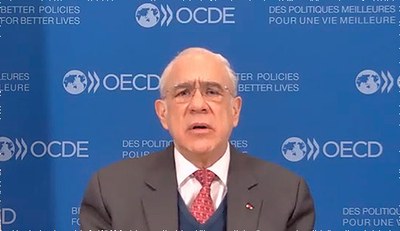
<p>Although not yet a member of the <a class="external-link" href="http://www.oecd.org/">Organisation for Economic Co-operation and Development (OECD)</a>, Brazil is like a "family member" and partnerships with Brazilian institutions allow the organization to work with and for the country in building a more inclusive and resilient society, said the secretary-general <a class="external-link" href="https://www.oecd.org/about/secretary-general/">Angel Gurría</a> during his participation in the online meeting "OECD and USP: Reconfiguring the World from Knowledge," on May 6.</p>
<p>Among the OECD partner countries, Brazil is the one that has made the most of this relationship and has invested in several areas of public policies to approach the organization's standards, according to Gurría. As an example, he cited a project launched in October that is helping to align Brazilian policies with OECD's environmental criteria.</p>
<p>The online meeting with Gurría, who will leave the OECD later this month after three consecutive five-year terms, celebrated the beginning of cooperation between the organization and USP. He will soon become an IEA researcher. In addition to the secretary-general, the Brazilian delegate with international economic organizations headquartered in Paris, ambassador <a class="external-link" href="http://agenciabrasil.ebc.com.br/en/internacional/noticia/2018-02/brazil-intensifies-talks-paris-join-oecd">Carlos Márcio Cozendey</a>, and the president of USP, Vahan Agopyan, gave presentations. Mediation was provided by the general coordinator of the International Economic Analysis Group (GACINT) of USP's Institute of International Relations (IRI), Alberto Pfeifer.</p>
<p><a href="https://www.iea.usp.br/en/iea/organization/direction" class="external-link">Guilherme Ary Plonski</a>, director of the IEA, opened the event by pointing out that the cooperation between USP and the OECD is based on the common concern of both institutions in promoting the production of knowledge "to move towards a prosperous human society in harmony with nature."</p>
<p>He highlighted the significance of OECD's slogan "Better Policies for Better Lives" and the organization's concern with formulating international evidence-based references in order to find solutions to economic, social, and environmental challenges.</p>
<p>"The IEA is available to collaborate in the production of knowledge based on this cooperation and to contribute to the initiatives for Brazil to become a member of the organization," he said.</p>
<table class="tabela-esquerda-300">
<tbody>
<tr>
<th><img src="https://www.iea.usp.br/imagens/carlos-marcio-conzenday-6-5-2021" alt="Carlos Márcio Cozendey - 6/5/2021" class="image-inline" title="Carlos Márcio Cozendey - 6/5/2021" /><br /><span class="discreet">Ambassador Carlos Márcio Cozendey</span></th>
</tr>
</tbody>
</table>
<p>"Even though not being a member of the organization, Brazil participates in almost all committees and working groups, and has already adhered to 99 OECD recommendations, according to Cozendey. "The country is interested in becoming a member to participate in all dimensions of the OECD, exchange experiences, and present public policies."</p>
<p>The partnership is part of this exchange of policy formulations, said the ambassador: "Having the University to establish and follow the interaction between public policies in Brazil and the OECD recommendations is an input for the organization's recommendations to also reflect the Brazilian reality."</p>
<p>For Agopyan, the internationalization present in the cooperation is a tool for USP to improve its levels of quality, "an essential search for all research universities."</p>
<p>In this century, all research universities seek to have ever greater interaction with society, he said. "USP is also doing this and it is natural that, for this purpose, universities seek partnerships with governments, entities, and international groups."</p>
<p>In June, at a meeting in Switzerland, Agopyan will defend the idea that universities are reliable sources of public policy. "If the OECD is concerned about this, USP and other research universities are at the disposal of the organization and national governments to develop proposals for public policies to be used by governments," concluded the president.</p>
<p><strong>Effects of the pandemic</strong></p>
<p>In his brief presentation followed by answers to questions from guests, Gurría commented that the COVID-19 pandemic reversed all the economic recovery achieved after the crisis that started in 2008, "but the prospects are improving and we expect a global economic growth of 5.6 %, with economy returning to pre-pandemic levels by the middle of this year." However, he warned that this projection depends on the rate of vaccination and the eventual spread of variants of the virus.</p>
<p>"Brazil was recovering from a recession when the pandemic a second recession came. The economic measures adopted by the government, such as emergency aid, supported millions of vulnerable families. Without these measures, the economic contraction would be even greater and the recovery in 2021 much slower than the projected GDP growth of 3.7%."</p>
<p>However, he stressed that the recovery must be guided by more just and sustainable growth. To that end, Gurría defended three lines of action, the first of which is to increase the effectiveness of social benefits to strengthen the population's first line of defense against economic shocks. "If well oriented, Brazil's conditional cash transfer system could be converted into a real social safety network," he said.</p>
<p>The second recommendation is to support professional qualification in order to allow workers to switch their jobs to better ones and for entrepreneurs to end unproductive and polluting activities. "In the long run, improving the quality and equity of vocational training reduces inequalities and poverty," according to the secretary-general.</p>
<p>His third suggestion is to link economic recovery measures to the sustainability agenda. "The most urgent task now is to vaccinate people quickly and protect us from further outbreaks of COVID-19, but the intergenerational commitment is to protect the planet," she said. For Gurría, the fact that the Amazon rainforest is the largest reserve of biodiversity in the world and 60% of it is in Brazil, makes the country a leader for the reshaping and reconstruction of the global economy in a more resilient way.</p>
<p><strong>Continuity and relations</strong></p>
<p>The questions from the guests to Gurría addressed the continuity of programs implemented in his management, mainly those related to environment and education, the organization's relationship with sub and supranational organizations, and prospects for Brazil's entry into the OECD.</p>
<table class="tabela-direita-300">
<tbody>
<tr>
<th><img src="https://www.iea.usp.br/imagens/vahan-agopyan-6-5-2021" alt="Vahan Agopyan - 6/5/2021" class="image-inline" title="Vahan Agopyan - 6/5/2021" /></th>
</tr>
<tr>
<td><span class="discreet">Vahan Agopyan, president of USP</span></td>
</tr>
</tbody>
</table>
<p>Jacques Marcovitch, former president of USP and former director of the IEA, asked whether OECD's emphasis on environmental issues will continue and what the weight of the environmental issue will be for Brazil's intentions to become one of the organization's members.</p>
<p>"Gurría said that the future secretary-general, a former finance minister in Australia, assured member countries that the OECD will continue its environmental policies. As for joining the organization, he said that Brazil has a huge advantage over the other five current candidates (Argentina, Peru, Romania, Croatia, and Bulgaria): "Brazil is already in the family, like a cousin who is already in the kitchen of the organization, because instead of waiting to be accepted, the work with the OECD has already started."</p>
<p>Cláudia Costin, a member of IEA's <a href="https://www.iea.usp.br/en/iea/organization/board" class="external-link">Board</a> and director of the Center for Excellence and Innovation in Education at the Getulio Vargas Foundation (FGV), expressed concern about the continuity in the new management of education programs, such as the Programme for International Student Assessment (PISA). There is no risk of interruption, according to Gurría: "The PISA is a brand of the organization and will constantly evolve. It is becoming not only a reference, but also an instrument for comparison and ranking, not to indicate who is better or worse, but to measure the fundamental issues, and indicate what is good or bad and what can be improved."</p>
<p>"Still in the field of education, <a href="https://www.iea.usp.br/en/iea/organization/direction" class="external-link">Roseli de Deus Lopes</a>, deputy director of the IEA, wanted to know what the OECD recommendations for Brazil are, since recent evaluations indicate a drop in school performance and greater inequality in education. The secretary-general argued that something very important is the acquisition of digital skills by young people. "We know that the future will be much more digital because we had to act almost entirely digitally due to the pandemic. To be able to reintegrate into the labour market, it is necessary to have digital competence, but only 50% of the countries' workforce has ability to act in a technological environment."</p>
<p>Vinicius Mota, editor in chief of the newspaper <i>Folha de S.Paulo</i>, asked if threats to democracy in Brazil could weigh on OECD's decision to accept the country as a member. Gurría said that problems with the quality of democracy are not on the agenda in relation to Brazil's entry. "I do not know anyone who says that Brazil is not a democracy. That is the great advantage of the country: to be recognized as a democracy". Problems with democracy "are no one's monopoly," he emphasized, recalling recent changes in electoral legislation in Georgia, USA, which make it difficult for some publics to participate in the local elections.</p>
<p>"The director of IRI, Janina Onuki, wanted to know what benefits can be expected from OECD partnerships with subnational governments, as in the case of the government of the state of São Paulo. These partnerships are increasingly important, said Gurría, "because everything is happening at the local level and it is necessary to go where the action takes place." He added that the OECD works with many states, provinces, and cities in many countries. "The world today is urbanized. Countries like Mexico and Brazil have become urban without becoming rich and all the problems arising from the growth of cities have arisen."</p>
<p>The relationship between the OECD and the World Trade Organization (WTO) was the subject of the question by USP professor emeritus <a href="https://www.iea.usp.br/en/persons/researchers/celso-lafer" class="external-link">Celso Lafer</a>, another member of IEA's Board and former Minister of Foreign Affairs. For the secretary-general, the organizations complement each other: "Although the WTO has a lot of technical capacity to deal with problems of jurisdictional systems and conflicts of interest, it does not have the technical capacity to carry out analyzes and comparisons, leading to the extraction of information for public policies."</p>
<p>"For him, there is a methodological problem, as the OECD has 37 members (soon 38 with the entry of Costa Rica) <span>and the WTO has 200 countries. "We work with almost every UN body. They know that we have 37 members, but they do not come to us for the sake of universality, yet rather because of the globalizing impact of the OECD recommendations."</span></p>
<p style="text-align: right; "><span class="discreet">Photos: IEA-USP</span></p>]]></content:encoded>
    <dc:publisher>No publisher</dc:publisher>
    <dc:creator>Richard Meckien</dc:creator>
    <dc:rights>Original version in Portuguese by Mauro Bellesa.</dc:rights>
    
      <dc:subject>Sustainable development</dc:subject>
    
    
      <dc:subject>International Cooperation</dc:subject>
    
    
      <dc:subject>Economic development</dc:subject>
    
    
      <dc:subject>Public Policies</dc:subject>
    
    
      <dc:subject>Environment</dc:subject>
    
    
      <dc:subject>OECD</dc:subject>
    
    
      <dc:subject>USP</dc:subject>
    
    
      <dc:subject>Event</dc:subject>
    
    <dc:date>2021-05-07T16:00:00Z</dc:date>
    <dc:type>Notícia</dc:type>
  </item>


  <item rdf:about="https://www.iea.usp.br/en/news/antoni-muntadas-about-academia-i-ii-an-online-interpretation-2011-2017-2021">
    <title>Antoni Muntadas: About Academia I-II, an Online Interpretation, 2011-2017 (2021)</title>
    <link>https://www.iea.usp.br/en/news/antoni-muntadas-about-academia-i-ii-an-online-interpretation-2011-2017-2021</link>
    <description></description>
    <content:encoded xmlns:content="http://purl.org/rss/1.0/modules/content/"><![CDATA[<p style="text-align: right; "><i><span style="text-align: right; ">from </span><a class="external-link" href="http://www.forumpermanente.org/event_pres/exposicoes/about-academia-i-ii-uma-interpretacao-online-2011-2017-2021/antoni-muntadas-about-academia-i-ii-an-online-interpretation-2011-2017-2021">www.forumpermanente.org<br /></a><a class="external-link" href="https://aboutacademia.iea.usp.br/">Visit the exhibition's website here</a></i></p>
<table class="tabela-direita-300">
<tbody>
<tr>
<th><img src="https://www.iea.usp.br/imagens/exposicao-sobre-academia-de-antoni-muntandas/@@images/11d40d59-c4c4-4720-9501-0994d63cab36.jpeg" alt="Exposição &quot;Sobre Academia&quot;, de Antoni Muntandas" class="image-inline" title="Exposição &quot;Sobre Academia&quot;, de Antoni Muntandas" /></th>
</tr>
<tr>
<td><span class="discreet">Video installation ''About Academia," by Antoni Muntadas, in 2017</span></td>
</tr>
</tbody>
</table>
<p dir="ltr">Based on his experience in American higher education, artist Antoni Muntadas inaugurates in Brazil an online interpretation of "About Academia." The project discusses the role and function of universities today, the place of art in this context, the relationship between public and private, tradition and contemporaneity, the future of universities and interdisciplinarity, based on interviews with professors and students.</p>
<p dir="ltr">"About Academia," a project originally presented at the Carpenter Center for the Visual Arts, invited by Harvard University, during Antoni Muntadas' last teaching period in the program in Art, Culture and Technology at the Massachusetts Institute of Technology (ACT MIT), in 2011, followed in different versions to cities like Boston, Vancouver, Amsterdam, Seville, among others.</p>
<p dir="ltr">The Brazilian version of the video installation "About Academia," which at first would occupy the Biblioteca Brasiliana at the University of São Paulo's (USP) Butantã Campus in São Paulo, translates as another work of the multimedia artist and professor, by creating a digital interpretation of the original installation, developed as a website, which can be accessed from April 30 at <a class="external-link" href="https://aboutacademia.iea.usp.br/"><strong>https://aboutacademia.iea.usp.br/</strong></a>. For the first time it is being shown in Latin America, with all its materials translated into Portuguese, in a bilingual version (Spanish), through a partnership between the Fórum Permanente, the Instituto de Estudos Avançados at USP, and the Biblioteca Brasiliana José and Guita Mindlin, with the support of the Government of the State of São Paulo, through the Secretariat of Culture and Creative Economy, and the Cultural Action Program (PROAC).</p>
<p dir="ltr">"About Academia" provokes a reflection through art about the American academic and university system, more specifically about the public/private duality, as well as the complex relationships that exist between the production of knowledge and the economic interests that influence education in its different forms of pedagogy. Muntadas' video installation considers the possible conflict between a faculty (and its values) and an administration (and its power). In order to have a fruitful circulation of the project in universities outside the US, Muntadas proposes round table discussions that contextualize the conflicts and difficulties peculiar to the university system that hosts it, confronting it with other models in different contexts and cultures.</p>
<table class="tabela-esquerda-300">
<tbody>
<tr>
<th><img src="https://www.iea.usp.br/imagens/croqui-para-videoinstalacao-about-academia/@@images/f6405eb1-cf9d-427f-9476-00b6656f15a6.jpeg" alt="Croqui para videoinstalação &quot;About Academia&quot;" class="image-inline" title="Croqui para videoinstalação &quot;About Academia&quot;" /></th>
</tr>
<tr>
<td><span class="discreet">Sketch by Antoni Muntadas for the video installation ''About Academia''</span></td>
</tr>
</tbody>
</table>
<p dir="ltr">The project is composed of two sets of screenings and publications. While "About Academia I" (2011) addresses these issues from the perspective of professors and academics, "About Academia II" (2017) delves into its themes exclusively from the students' point of view. Due to the pandemic of COVID-19, the first exhibition of this project in the Southern Hemisphere takes place through a virtual room, on a website where it is also possible to access the three roundtables that take place on April 30 and May 10, and where two bilingual publications are available with the complete transcripts of the speeches of the interviewees, among them Noam Chomsky, David Harvey, Carol Becker, Ute Meta Bauer, and the students.</p>
<p dir="ltr">The creation of the immersive, online, interactive video installation gives prominence to the two sets: "About Academia I" (2011) and "About Academia II" (2017). It thus respects the duration of the times of the videos originally developed by the artist for their existence in a real physical space.  Thus, despite the interactivity of navigation, it is not possible for the visitor to control the projected videos. The aesthetic experience in virtuality therefore has correspondence with the real time of the analog exhibition space.</p>
<p dir="ltr"><strong> Publications</strong></p>
<p dir="ltr">The publications in Spanish and Portuguese versions are partially available on the exhibition site. In order to have full access, it is necessary to buy them for a symbolic price. The link for this purchase is through the exhibition site.</p>
<p dir="ltr"><strong>Round tables</strong></p>
<p dir="ltr">The round tables will be broadcasted in the exhibition site and will be available later on this site and in the sites of the partners (IEA-USP, Biblioteca Brasiliana and Fórum Permanente).</p>
<p dir="ltr"><i>Which university do we want? </i>| <a class="external-link" href="https://youtu.be/pYjxL9te9pQ">Watch the recorded event</a></p>
<p dir="ltr">Friday, April 30th, from 2:00 pm to 5:00 pm (Brasília time)</p>
<ul>
<li dir="ltr" style="list-style-type: disc; ">
<p dir="ltr"><a href="https://www.iea.usp.br/en/persons/researchers/nestor-canclini" class="external-link">Néstor Garcia Canclini</a> - anthropologist, philosopher, chair holder at IEA-USP</p>
</li>
<li dir="ltr" style="list-style-type: disc; ">
<p dir="ltr"><a href="https://www.iea.usp.br/en/persons/researchers/eliana-sousa-silva" class="external-link">Eliana Sousa Silva</a> - educator, socio-cultural activist, former chair former at IEA-USP</p>
</li>
<li dir="ltr" style="list-style-type: disc; ">
<p dir="ltr">Macaé Evaristo - educator, former State Secretary of Minas Gerais</p>
</li>
<li dir="ltr" style="list-style-type: disc; ">
<p dir="ltr">Ailton Krenak - philosopher, environmentalist, indigenous leadership</p>
</li>
<li dir="ltr" style="list-style-type: disc; ">
<p dir="ltr">Antoni Muntadas - artist</p>
</li>
<li dir="ltr" style="list-style-type: disc; ">
<p dir="ltr"><a href="https://www.iea.usp.br/en/persons/researchers/martin-grossmann" class="external-link">Martin Grossmann</a> (moderation)</p>
</li>
</ul>
<p> </p>
<p dir="ltr"><i>Intercontinental academy </i>| <a class="external-link" href="https://youtu.be/Mi7K5cNo_oM">Watch the recorded event</a></p>
<p dir="ltr">Monday, May 10, from 9:00 am to 12:00 pm (Brasilia time)</p>
<ul>
<li dir="ltr" style="list-style-type: disc; ">
<p dir="ltr">Nikki Moore - art historian - Wake Forest University (ICA-UBIAS)</p>
</li>
<li dir="ltr" style="list-style-type: disc; ">
<p dir="ltr">Érica Peçanha - anthropologist and post-doctorate at the IEA-USP</p>
</li>
<li dir="ltr" style="list-style-type: disc; ">
<p dir="ltr">David Gange - historian - Birmingham University (ICA-UBIAS)</p>
</li>
<li dir="ltr" style="list-style-type: disc; ">
<p dir="ltr">Julia Buenaventura - art historian - Universidad de los Andes</p>
</li>
<li dir="ltr" style="list-style-type: disc; ">
<p dir="ltr">Mariko Murata - media and museum theorist - Kansai University</p>
</li>
<li dir="ltr" style="list-style-type: disc; ">
<p dir="ltr"><a href="https://www.iea.usp.br/en/persons/researchers/martin-grossmann" class="external-link">Martin Grossmann</a> (moderation)</p>
</li>
</ul>
<p> </p>
<p dir="ltr"><i>University and context </i>| <a class="external-link" href="https://youtu.be/I5ZovucWLkg">Watch the recorded event</a></p>
<p dir="ltr">Monday, May 10, from 1:30 pm to 4:00 pm (Brasilia time)</p>
<ul>
<li dir="ltr" style="list-style-type: disc; ">
<p dir="ltr"><a href="https://www.iea.usp.br/en/persons/researchers/naomar-filho" class="external-link">Naomar de Almeida Filho</a> - epidemiologist, former dean of UFBA, professor of IEA-USP</p>
</li>
<li dir="ltr" style="list-style-type: disc; ">
<p dir="ltr"><a href="https://www.iea.usp.br/en/persons/researchers/helena-nader" class="external-link">Helena Nader</a> - biomedical sciences, vice-president of ABC, Chair at IEA-USP</p>
</li>
<li dir="ltr" style="list-style-type: disc; ">
<p dir="ltr">Guilherme Wisnik - architect, curator, professor at FAU-USP</p>
</li>
<li dir="ltr" style="list-style-type: disc; ">
<p dir="ltr"><a href="https://www.iea.usp.br/en/persons/researchers/renato-janine-ribeiro" class="external-link">Renato Janine Ribeiro</a> (moderation) - philosopher, former Minister of Education (FFLCH-USP)</p>
</li>
</ul>
<p>____________________</p>
<p><strong>Antoni Muntadas (1942, Barcelona, Spain - lives and works in New York)</strong></p>
<table class="tabela-esquerda-300">
<tbody>
<tr>
<th><img src="https://www.iea.usp.br/imagens/antoni-muntadas-2017" alt="Antoni Muntadas - 2017" class="image-inline" title="Antoni Muntadas - 2017" /></th>
</tr>
<tr>
<td><span class="discreet">Antoni Muntadas during his conference at the IEA in 2017</span></td>
</tr>
</tbody>
</table>
<p>He studied at the Escuela Técnica Superior de Ingenieros Industriales in Barcelona and at the Pratt Graphic Center in New York. A pioneer in the use of video since the mid-seventies, his production has expanded to the use of various plastic languages, media, and supports, with intervention in public space being one of his most radical forms of cultural criticism.</p>
<p>Muntadas is an artist and teacher of proven recognition, having been invited to give courses, workshops and lectures in several of the most important art schools and museums in the world, such as the Massachusetts Institute of Technology - School of Architecture in Cambridge, Massachusetts, where he taught the discipline 'Seminar on Public Art' (early 2001); he is a regular lecturer at Cornell University Seminars in the program 'Dialogues Art and Architecture' (early 2006) and professor at the IUAV Venice, Italy, (early 2004). His work has been exhibited all over the world, in events such as the Venice Biennale (1976) where later in 2005 he occupied the entire Spanish pavilion; the Kassel Documenta (VI and X Editions); the 16th São Paulo Biennale and the Havana and Lyon Biennales. He has exhibited, among others, at the Museum of Modern Art in New York, the Berkeley Art Museum in California, the Museo Nacional Centro de Arte Reina Sofia in Madrid, and the MACBA in Barcelona. He is considered the father of Spanish net.art and defines himself as 'a translator of images of what is happening in the contemporary world'.</p>
<p>He has received numerous grants and awards, such as the 2005 National Prize of Plastic Arts, granted by the Ministry of Culture of Spain for his artistic trajectory and for being one of the most innovative artists of the Spanish panorama. Antoni Muntadas also has a long history of dialogue with South America, especially Brazil, a country that has been home to his work since the late sixties and where he has held exhibitions and taught courses in museums, biennials and institutions, including as a guest of the Department of Fine Arts at the School of Communications and Arts, USP, in 1996, 1987 and 1992. Among the lectures given in other institutions in Brazil, the highlights are those at the University of Brasilia in 2002 and 2003, at the Museum of Contemporary Art of Niterói in 2001, and at the public art event 'Artecidadezonaleste' in 1999, where he also developed an artistic proposal. He is an artist represented by Galeria Luisa Strina where, since 1970, he exhibits regularly.</p>
<p><strong>Fórum Permanente</strong></p>
<p>Fórum Permanente (FP) is a floating and ubiquitous platform for research, criticism, action / cultural mediation and cultural memory, acting, nationally and internationally, at different levels of the contemporary art and culture system. It has established itself in this scenario as a cultural interface, which constitutes itself, in a hybrid and simultaneous way, as an agora, a museum-laboratory, a multimedia magazine, a library, a living archive. In its national and international reference site <a class="external-link" href="http://www.forumpermanente.org">&lt;www.forumpermanente.org&gt;</a>, the FP, besides keeping the memory of the actions already carried out and in progress, hosts research projects in art and culture, makes available information and the memory of undergraduate and graduate courses in the area, dossiers from cultural institutions and organizations, as well as interviews and meetings held by its team and partners. The site's content is published under a free license, allowing full accessibility to its rich collection as well as reproduction for non-commercial purposes.</p>
<p><strong>Brasiliana Guita and José Mindlin Library</strong></p>
<p>Opened to the public in 2013, the Brasiliana Guita e José Mindlin Library (BBM) is an organ of the Pró-Reitoria de Cultura e Extensão Universitária of the University of São Paulo (USP). It was created in January 2005 to house and integrate the Brasiliana collection gathered over more than eighty years by bibliophile José Mindlin and his wife Guita. With its expressive set of books and manuscripts, the brasiliana collection assembled by Guita and José Mindlin is considered the most important collection of its kind formed by private individuals. There are about 32 thousand titles that correspond to 60 thousand volumes, approximately. Part of the donated collection belonged to bibliophile and librarian Rubens Borba de Moraes, in whom José Mindlin recognized "a kind of older brother", owner of "a love for books and reading very similar to mine". The library formed by José Mindlin throughout his life was organized in four main thematic areas: Brazilian issues, literature in general, art books, and books as art objects due to their typography, layout, illustration, binding, etc. The collection donated to USP in 2006 remains a living library, according to José Mindlin's ideals, acquiring new titles and collections that dialogue with the initial sections of the collection, gathering material about Brazil or that, having been written and/or published by Brazilians, are important to the understanding of the country's history and culture.</p>
<p dir="ltr">______________________________________</p>
<p dir="ltr"><strong>Antoni Muntadas: About Academia I-II, an Online Interpretation, 2011-2017 (2021)</strong></p>
<p dir="ltr">From April 30 to October 31, 2021</p>
<p dir="ltr">Culturator: Martin Grossmann (Fórum Permanente-FP)</p>
<p dir="ltr">Executive production (Brazil): Diego Kerchove (FP)</p>
<p dir="ltr">Executive production (Spain): Andrea Nacach</p>
<p dir="ltr">Digital project: Arthur Lauriano do Carmo (coordination - FP)</p>
<p dir="ltr">Design: Arthur Lauriano do Carmo (FP) and Raul Luna</p>
<p dir="ltr">Programming: Marcela Mancino</p>
<p dir="ltr">Website: <a class="external-link" href="https://aboutacademia.iea.usp.br/">https://aboutacademia.iea.usp.br/</a></p>]]></content:encoded>
    <dc:publisher>No publisher</dc:publisher>
    <dc:creator>Richard Meckien</dc:creator>
    <dc:rights>All rights reserved to Fórum Permanente.</dc:rights>
    
      <dc:subject>Higher Education</dc:subject>
    
    
      <dc:subject>Art</dc:subject>
    
    
      <dc:subject>University</dc:subject>
    
    
      <dc:subject>cover</dc:subject>
    
    
      <dc:subject>Research Group: Fórum Permanente: Cultural System Between Public and Private</dc:subject>
    
    
      <dc:subject>Event</dc:subject>
    
    <dc:date>2021-04-29T16:55:00Z</dc:date>
    <dc:type>Notícia</dc:type>
  </item>


  <item rdf:about="https://www.iea.usp.br/en/news/researcher-analyzes-actions-perception-health-in-bom-retiro">
    <title>Researcher analyzes actions and the perception of health in the history of "Bom Retiro"</title>
    <link>https://www.iea.usp.br/en/news/researcher-analyzes-actions-perception-health-in-bom-retiro</link>
    <description></description>
    <content:encoded xmlns:content="http://purl.org/rss/1.0/modules/content/"><![CDATA[<div class="kssattr-target-parent-fieldname-text-eaf34cf2c4fc4ee1a2969a74f05d5f16 kssattr-macro-rich-field-view kssattr-templateId-widgets/rich kssattr-atfieldname-text " id="parent-fieldname-text-eaf34cf2c4fc4ee1a2969a74f05d5f16">
<table class="tabela-direita-200">
<tbody>
<tr>
<th><img src="https://www.iea.usp.br/imagens/rua-alagada-no-bom-retiro" alt="Rua alagada no Bom Retiro" class="image-inline" title="Rua alagada no Bom Retiro" /></th>
</tr>
<tr>
<td><span class="discreet">Flooded street in Bom Retiro, a neighborhood in São Paulo with a large presence of immigrants since the end of the 19th century and always considered of poor health</span></td>
</tr>
</tbody>
</table>
<p>Bom Retiro, a neighborhood near the center of São Paulo, is considered a region where it is possible to live and work to achieve a better life. On the other hand, it has always been seen as a place with poor health, according to historian <a href="https://www.iea.usp.br/en/persons/visiting-professors/jeffrey-lesser" class="external-link">Jeffrey Lesser</a> (Emory University), who will give the conference <i>Life and Death in the 'Worst' Neighborhood of São Paulo</i> <strong>on August 5</strong>, <strong>at 2:00 pm</strong>.</p>
<p>A visiting professor at the IEA since 2015 and a member of the Institute's <a href="https://www.iea.usp.br/en/research/research-groups/intercultural-dialogues" class="external-link">Intercultural Dialogues Research Group</a>, Lesser will analyze the relationship between public health (as well as a series of formal policies reinforced by trained actors) and the "public's health" (how residents of the neighborhood understand their own health conditions). The reference information have been obtained by a project that analyzes data of a neighborhood's block from the 1880s until today.</p>
<p>This study is developed by the Lesser Research Collective, which uses archival and observational methods to analyze the practices of residents and health professionals, and the stories they tell about what happens during the residents' course of life and death regarding health.</p>
<p>The conference will be broadcast <a href="https://www.iea.usp.br/en/aovivo" class="external-link">live</a> on IEA's website.</p>
<p><strong>The neighborhood</strong></p>
<p>With a strong connection to the working class since the 19th century, Bom Retiro has become a textile pole in the last decades. Its history is marked by the presence of immigrants (from other countries and regions of Brazil) and descendants of slaves.</p>
<p>While the cultural background of the neighborhood was influenced by Italian, Spanish, and Portuguese catholic immigrants at the end of the 19th century, this mosaic changed with the large presence of East-European jews and christians from South Korea, Paraguay, and Bolivia in the late 20th century.</p>
<p>"However, even though the place is still considered a 'neighborhood of immigrants,' this is not demographically correct, since most of the residents have always been Brazilians," says Lesser.</p>
<div class="kssattr-target-parent-fieldname-text-eaf34cf2c4fc4ee1a2969a74f05d5f16 kssattr-macro-rich-field-view kssattr-templateId-widgets/rich kssattr-atfieldname-text " id="parent-fieldname-text-eaf34cf2c4fc4ee1a2969a74f05d5f16"><i><i><i> </i></i></i></div>
<div class="kssattr-target-parent-fieldname-text-eaf34cf2c4fc4ee1a2969a74f05d5f16 kssattr-macro-rich-field-view kssattr-templateId-widgets/rich kssattr-atfieldname-text "></div>
<div class="kssattr-target-parent-fieldname-text-eaf34cf2c4fc4ee1a2969a74f05d5f16 kssattr-macro-rich-field-view kssattr-templateId-widgets/rich kssattr-atfieldname-text " style="text-align: right; "><span class="discreet">Photo: <a class="external-link" href="https://www.flickr.com/photos/cbnsp/5346418832">Catia Toffoletto / CBN SP</a></span></div>
<div class="kssattr-target-parent-fieldname-text-eaf34cf2c4fc4ee1a2969a74f05d5f16 kssattr-macro-rich-field-view kssattr-templateId-widgets/rich kssattr-atfieldname-text "><i><i><i><br /></i></i></i></div>
</div>]]></content:encoded>
    <dc:publisher>No publisher</dc:publisher>
    <dc:creator>Richard Meckien</dc:creator>
    <dc:rights>Original version in Portuguese by Mauro Bellesa.</dc:rights>
    
      <dc:subject>Public Health</dc:subject>
    
    
      <dc:subject>São Paulo</dc:subject>
    
    
      <dc:subject>Event</dc:subject>
    
    
      <dc:subject>Immigration</dc:subject>
    
    <dc:date>2019-06-27T16:35:00Z</dc:date>
    <dc:type>Notícia</dc:type>
  </item>


  <item rdf:about="https://www.iea.usp.br/en/news/workshop-presents-new-methods-cure-diseases">
    <title>Workshop presents new methods that can cure complex diseases</title>
    <link>https://www.iea.usp.br/en/news/workshop-presents-new-methods-cure-diseases</link>
    <description></description>
    <content:encoded xmlns:content="http://purl.org/rss/1.0/modules/content/"><![CDATA[<table class="tabela-direita">
<tbody>
<tr>
<th><img src="https://www.iea.usp.br/imagens/dna" alt="DNA" class="image-inline" title="DNA" /></th>
</tr>
</tbody>
</table>
<p dir="ltr">In the universe of modern medicine, the focus is shifting from just offering treatment to curing diseases. Innovative approaches, such as gene therapies, have gained space and relevance. This type of method seeks results by editing the genetic code of individuals and can potentially revolutionize the treatment of serious diseases such as cancer.</p>
<p dir="ltr">On <strong>December 13</strong>, <strong>from 4:00 pm to 6:00 pm</strong>, representatives from two organizations linked to the development of effective gene therapies will participate in a workshop at the IEA-USP. Geoff MacKay, president of <a href="http://www.avrobio.com/">AVROBIO</a>, and Matthew Kane, president of <a href="http://precisionbiosciences.com/">Precision Biosciences</a>, will present their oncology and enzyme replacement therapy projects at the event <i>Gene Therapy in Oncology and Enzyme Replacement</i>. Silvano Raia, a professor at USP's School of Medicine (FM) and a member of the National Academy of Medicine (ANM), will be the mediator of the meeting.</p>
<p>There will be <a href="https://www.iea.usp.br/en/aovivo">live</a> webcast</p>
<p style="text-align: right; "><span class="discreet">Photo: Max Pixel</span></p>]]></content:encoded>
    <dc:publisher>No publisher</dc:publisher>
    <dc:creator>Richard Meckien</dc:creator>
    <dc:rights>Original version in Portuguese by Victor Matioli.</dc:rights>
    
      <dc:subject>Health</dc:subject>
    
    
      <dc:subject>Medicine</dc:subject>
    
    
      <dc:subject>Biotechnology</dc:subject>
    
    
      <dc:subject>Technology</dc:subject>
    
    
      <dc:subject>Event</dc:subject>
    
    <dc:date>2018-12-03T11:30:00Z</dc:date>
    <dc:type>Notícia</dc:type>
  </item>


  <item rdf:about="https://www.iea.usp.br/en/news/nazifascism">
    <title>A reflection on the far-right ideology of the past and now</title>
    <link>https://www.iea.usp.br/en/news/nazifascism</link>
    <description></description>
    <content:encoded xmlns:content="http://purl.org/rss/1.0/modules/content/"><![CDATA[<table class="tabela-direita-400">
<tbody>
<tr>
<th><img src="https://www.iea.usp.br/imagens/marcio-seligmann-silva-juliana-perez-e-brigitte-weiffel-8-11-18" alt="Márcio Seligmann-Silva, Juliana Perez e Brigitte Weiffel - 8/11/18" class="image-inline" title="Márcio Seligmann-Silva, Juliana Perez e Brigitte Weiffel - 8/11/18" /></th>
</tr>
<tr>
<td><strong>A seminar with exhibitions and a debate marked the 80th anniversary of the <i>Kristallnacht</i></strong></td>
</tr>
</tbody>
</table>
<p>The theoretical discussion about fascism, the pacific but life-threatening resistance to Nazism in Germany during World War II and the ideals of the far-right parties and right-wing populism that emerged in the last decades, especially in Europe, were addressed on November 8, in a seminar with the participation of political scientists and specialists in German studies.</p>
<p><i> </i>Organized by <a href="https://www.iea.usp.br/en/research/research-groups/quality-of-democracy" class="external-link">IEA's <span>Research Group on Quality of </span>Democracy Quality</a> and the <a class="external-link" href="https://www.daad.org.br/pt/quem-somos/catedra-martius-de-estudos-alemaes-e-europeus/">Martius Chair of German and European Studies</a>, the meeting "Memory, Democracy and Resistance: Reflections on Nazi-fascism in Germany" marked the 80th anniversary of the <i>Kristallnacht</i><span>, occurred between November 9 and 10, 1938, when Nazi paramilitary militias and other sympathizers of the regime murdered dozens of Jews, depreagating synagogues, houses and shops of the Jewish community in various parts of Germany.</span></p>
<p><strong> </strong>Márcio Seligmann-Silva, from the Institute of Language Studies at UNICAMP and a member of IEA's Research Group on Human Rights, Democracy, Politics and Memory, started the discussion on the main theories about fascism, especially from the psychoanalytic point of view. The peaceful resistance of German groups against Nazism was the theme of Juliana Perez, from USP's Faculty of Philosophy, Languages and Literature, and Human Sciences (FFLCH). German political scientist Brigitte Weiffen, head of the Martius Chair, moderated the meeting and also commented on the presentation by her colleague Barbara Laubenthal, from the University of Texas.</p>
<table class="tabela-esquerda-200-borda">
<tbody>
<tr>
<td>
<h3>Related material</h3>
<p><strong>Media library</strong></p>
<ul>
<li><a href="https://www.iea.usp.br/en/midiateca/video/videos-2018/memoria-democracia-e-resistencia-reflexoes-sobre-o-nazifascismo-na-alemanha" class="external-link">Video</a> (in Portuguese) </li>
<li><a href="https://www.iea.usp.br/en/media-library/photos/events-2018/memory-democracy-resistance-reflections-nazifascismo-in-germany" class="external-link">Photos</a></li>
</ul>
</td>
</tr>
</tbody>
</table>
<p><strong>Theories</strong></p>
<p>According to Seligmann-Silva, some theories about fascism have been "originated from the historical experience of Nazi-fascism, and their ideas are surprisingly current." He took <span>the analysis by Sigmund Freud in the essay "Group Psychology and The Analysis of The Ego," of 1921, </span>as an initial reference. For him, Freud appropriated the thesis expressed by Gustave Le Bon in the book "Mass Psychology", of 1895, <span>to disassemble it. "Le Bon's work was </span>praised by Mussolini and Hitler. If he was concerned about how one can tame the blind and manipulative masses, <span>Freud </span><span>on the other hand would show that there was </span><span>an authoritarian thought</span><span> behind this political conception," said </span><span>Seligmann-Silva.</span></p>
<p>For the speaker, Freud's text is a treatise on the 20th-century totalitarianism "even before one could glimpse that these regimes would change the face of the century." The essay "also helps us think critically about the current rise of fascism here and in the world," he added.</p>
<p>Another aspect of Le Bon's analysis that interested Freud has been the prestige that is projected on a leader, either by a magnetic charm or based on a name, goods and reputation, explained the exhibitor. "Freud also made a critical analysis of the ideas of William MacDougall and his book "The Group Mind," of 1920. For him, the mass would come from the 'principle of direct induction of emotion through the primitive sympathetic response'."</p>
<table class="tabela-direita-300">
<tbody>
<tr>
<th><img src="https://www.iea.usp.br/imagens/marcio-seligmann-silva-8-11-18" alt="Márcio Seligmann-Silva - 8/11/18" class="image-inline" title="Márcio Seligmann-Silva - 8/11/18" /></th>
</tr>
<tr>
<td><strong>Márcio Seligmann-Silva: "A<span>ll fascist dictators stem from the milieu of the little reactionary man.</span>"</strong></td>
</tr>
</tbody>
</table>
<p>Seligmann-Silva said that Freud saw a false explanation of the mass phenomenon based on a misleading notion of suggestion <span>in both Le Bon and MacDougall</span>. Freud posits the hypothesis that behind the collective soul there are the love relations: "As for Plato, for Freud it is love, Eros, who keeps the mass together." But outsiders, strangers "are not worthy of love or compassion." He cites Freud, for whom the "social feeling rests [...] in the reversal of a hostile feeling in a positive tone loop," and such inversion "seems to occur under the influence of an affectionate bond common to a person who is outside of the mass": the leader.</p>
<p>According to the speaker, Freud resumed his thesis of primeval horde that he had developed in "Totem and Taboo" in his essay. The almighty father of this horde would be an absolutely narcissistic figure, who only loved himself, said Seligmann-Silva. "On the other hand, the children who lived in sexual abstinence by imposition of the father created bonds with each other. The mass psychology, or the affective ties that linked these brothers, originated in the sexual jealousy."</p>
<p>Ten years after the essay by the founder of psychoanalysis, Wilhelm Reich published the essay "The Mass Psychology of Fascism." Seligmann-Silva commented that for Freud's "rebellious disciple," fascism is nothing more than the politically organized expression of the character structure of the average man. The regime is, in Reich's words, "the basic emotional attitude of the man oppressed by the machine's authoritarian civilization, with its mystical and mechanistic way of facing life."</p>
<p>Another point highlighted by the presenter is that for Reich the racial theory is not a product of fascism: on the contrary, fascism is a product of racial hatred and its politically organized expression.</p>
<p>Seligmann-Silva also quoted from Reich's 1942 text: "Fascist mentality is the mentality of the subjugated 'little man' who craves authority and rebels against it at the same time. It is not by accident that all fascist dictators stem from the milieu of the little reactionary man."</p>
<p>He explained that Reich associates the need for sexual repression to class divisions and the emergence of patriarchy. "Sexual policies respond to the interests of a minority by instituting the patriarchal family and marriage. The reproduction of society is associated with its socioeconomic and sexual structure. The family is the core of this construct. Hence in fascism we always witness this obsession with the family. It is the microstate. It is the basis of all ideology."</p>
<p>For Reich, the church only gives continuity to the work of the family, "hence its additional importance in the fascist states," added Seligmann-Silva.</p>
<p><span><span>The Geman middle class began to be studied by leftists</span> after the crisis of 1929-32 and the 1933 elections, he commented. "National Socialism is nothing more than a middle-class movement, and its reactionary conservatism is hardly open to a policy of opposition."</span></p>
<p>In his effort to differentiate himself from the worker, the middle-class man can only rely on his family and sexual life, according to the Austrian psychoanalyst. "Their economic deprivation has to be compensated by sexual moralism," Reich wrote.</p>
<p>Seligmann-Silva added: "Moralism, a product of <span>control </span>biopolitics that makes the bodies docile, acts both in the material compensation of the middle class, which is empowered by an authoritarian moralism, and as a technique of dispersion of the opposition to the <span>political and economic</span> maneuvers."</p>
<table class="tabela-esquerda-300">
<tbody>
<tr>
<th><img src="https://www.iea.usp.br/imagens/juliana-pasquarelli-perez-8-11-18" alt="Juliana Pasquarelli Perez - 8/11/18" class="image-inline" title="Juliana Pasquarelli Perez - 8/11/18" /></th>
</tr>
<tr>
<td><strong>Juliana Perez: "The full awareness of the <strong>White Rose </strong>members that their life was at risk precludes any banalization of the movement"</strong></td>
</tr>
</tbody>
</table>
<p><strong>Resistance</strong></p>
<p>However, anyone who imagines that there was no contest of Nazism among the Germans during the regime's very existence is misleading. In her exposition, Perez recalled some of the main resistance movements. She detailed the performance of the White Rose, <span>mainly </span>made up of students from the University of Munich.</p>
<p><span>Perez has coordinated <span>the translation of the book "The White Rose: Munich, 1942-1943</span><span>", by Inge Scholl, </span>with Tinka Heichmann, also a professor at FFLCH-USP. The release in Brazil was in 2013. The book presents letters, excerpts from the diaries and photographs of her brothers Hans and Sophia, members of the movement, as well as transcripts of the pamphlets produced by the group and reports on the trial and execution of the main activists.</span></p>
<p>The work on the translation led Perez "to think about the meaning of resisting and how this was possible in the Nazi context." She recalled that British historian Ian Kershaw, a specialist in Nazism, uses the term "dissent" to designate the least spectacular forms of resistance, but points out that "even actions that, from the current point of view, would not be characterized as resistance, were fought as such by the Gestapo, in a growing radicalization of violence."</p>
<p>Juliana said that it is important not to idealize the participants of the various resistance movements that emerged during the Nazi regime. "They included conciliators, heirs to the Weimar Republic principles, members of the military elite and people who today would be considered conservative." There are even references to a patriotic ideology similar to that of the National Socialist Party."</p>
<p>In the case of the White Rose, the participants were around 24 years old and had the "ingenuity in betting on the human freedom and the subjectivity of the human being". The core of the group, executed in February 1943, was constituted by four students and a professor of philosophy.</p>
<p>The group published seven pamphlets between June 1942 and January 1943, all of them with criticism of the Nazi regime and appeals to the moral conscience of the Germans. The language of the publications was determined by three factors: multiple authorship, recipients, and external circumstances. The seventh pamphlet was not even distributed and was used as proof for the death sentence of the movement's <span>core</span>.</p>
<p>"These students took full and complete responsibility for their actions and for their parents. It was a path of years of reflection, strong emotional bonds, and determining experiences, like the boys on the Russian front and Sophia as a nurse. The much they were risking their own life precludes any banalization of their movement."</p>
<table class="tabela-direita-300">
<tbody>
<tr>
<th><img src="https://www.iea.usp.br/imagens/brigitte-weiffen" alt="Brigitte Weiffen" class="image-inline" title="Brigitte Weiffen" /></th>
</tr>
<tr>
<td><strong>Brigitte Weiffen: "It is not always easy to define the border between populism and extremism"</strong></td>
</tr>
</tbody>
</table>
<p><strong>Current reality</strong></p>
<p>The theme of Barbara Laubenthal's presentation, exposed by Weiffen with added personal comments, was "Right-wing populism after the Holocaust. The <i>Alternative für Deutschland</i> and the role of the past in German asylum policies."</p>
<p>According to the two researchers, right-wing populism has three main characteristics:</p>
<ul>
<li>anti-elitism: "political class" (considered as corrupt), "elite" or "establishment" versus "the people," whose only true voice is the populist movement / leader;</li>
<li>antipluralism: populist actors claim to be the genuine representatives of a non-institutionalized, homogeneous, authentic, and (above all) moral population;</li>
<li>building of the image of the enemy: identity and interests of the culturally homogeneous "people" versus the "others," usually minorities and immigrants, who would be favored by "corrupt" elites.</li>
</ul>
<ul>
</ul>
<p> </p>
<p><span>According to them, t</span>he assertion of these principles is based on the following strategies:</p>
<ul>
<li>breaking of taboos in discourse, calculated provocations, disregard of formal and informal rules (targeting the "politically correct") and personal insults;</li>
<li>emotional appeals and exaggerations, alarmism;</li>
<li>conspiracy theories;</li>
<li>biologism or violent metaphors;</li>
<li>
<div id="_mcePaste">use of rigid generalizations, distinction between "us" and "them";</div>
</li>
<li><span>simplifications</span>;</li>
<li>demand for radical solutions.</li>
</ul>
<p> </p>
<p>Weiffen emphasized, however, that a distinction between populism and extremism <span>must be made</span><span>: "Certain populist positions fit into democratic freedoms, but when there is a devaluation of minorities and immigrants, when there is a call to violence, then the discourse is clearly crossed by </span><span>extremism. </span><span>It is not always easy to define the border between populism and extremism. </span></p>
<p>The presentation also discussed the presence of right-wing populism in the parliaments and governments of several European countries, and the profile of extreme right-wing parties on the continent, with an emphasis on the Alternative for Germany (AfD). According to Weiffen and Laubenthal, they use a reinterpretation of the Nazi period and distortions on national socialist actions to promote anti-immigration and Islamophobic ideas.</p>
<p style="text-align: right; "><span class="discreet">Photos: Leonor Calasans / IEA-USP</span></p>]]></content:encoded>
    <dc:publisher>No publisher</dc:publisher>
    <dc:creator>Richard Meckien</dc:creator>
    <dc:rights>Original version in Portuguese by Mauro Bellesa.</dc:rights>
    
      <dc:subject>Research Group: Quality of Democracy</dc:subject>
    
    
      <dc:subject>Fascism</dc:subject>
    
    
      <dc:subject>Nazism</dc:subject>
    
    
      <dc:subject>Event</dc:subject>
    
    
      <dc:subject>History</dc:subject>
    
    <dc:date>2018-11-14T12:30:00Z</dc:date>
    <dc:type>Notícia</dc:type>
  </item>


  <item rdf:about="https://www.iea.usp.br/en/events/between-diversity-decolonisation">
    <title>Decolonising Museums and Exhibitions on the Indigenous Ainu in Japan</title>
    <link>https://www.iea.usp.br/en/events/between-diversity-decolonisation</link>
    <description></description>
    <content:encoded xmlns:content="http://purl.org/rss/1.0/modules/content/"><![CDATA[<div class="kssattr-target-parent-fieldname-text-69d0218562c643ad9cceea31ef7dd80d kssattr-macro-rich-field-view kssattr-templateId-widgets/rich kssattr-atfieldname-text " id="parent-fieldname-text-69d0218562c643ad9cceea31ef7dd80d">
<p><strong><a href="https://www.iea.usp.br/eventos/representacao-ainu-japao/" class="external-link">Clique aqui para a versão em Português</a></strong></p>
<p dir="ltr" id="docs-internal-guid-d0a3bb30-7fff-08ba-a56a-eac3b67b6e4f">This presentation examines the practice of decolonising museums. It particularly focuses on the museum exhibits related to the Indigenous Ainu and promotes museal consciousness towards the issue of decolonising Ainu culture.</p>
<p dir="ltr">Ainu, the earliest settlers of northern Japan, had been colonised and marginalised by the Japanese for centuries. They were also collected, exhibited, and subjected to othering in expositions and museum exhibitions. Meanwhile, the Ainu people themselves created some collections as part of their ethnic movement. The Ainu hosts also organised ethnic tourism in the Ainu settlements.</p>
<p dir="ltr">In 2020, the <a class="external-link" href="https://ainu-upopoy.jp/en/facility/museum/">Upopoy National Ainu Museum and Park</a> opened as the first national museum specialising in Ainu culture. While the movement to establish a national museum had started earlier, it became part of the government’s campaign to showcase the diversity of Japanese culture to the international audience only after Japan’s bid for the Tokyo 2020 Olympic and Paralympic Games. The museum adopted various methods to decolonise the earlier representation of Ainu culture. However, since its opening, the museum received much criticism, especially due to its approach to storytelling from a first-person perspective of the Ainu. Museum exhibitions are media that convey the museums’ messages directly to the audience; they are also sites of tension, negotiation, and contestation among the stakeholders.</p>
<p dir="ltr">Accordingly, this presentation aims to analyse the aforementioned process in which the complexity of decolonising museums is at stake. It will also assess other museum exhibits on Ainu culture for comparison and measure how museum practices have changed over time.</p>
<p dir="ltr"><strong>Presenter:</strong><span id="docs-internal-guid-604d4eda-7fff-4fc5-e33a-13ba5121a137"> </span></p>
<p dir="ltr"><span id="docs-internal-guid-604d4eda-7fff-4fc5-e33a-13ba5121a137"><a href="https://www.iea.usp.br/en/persons/speakers/mariko-murata" class="external-link">Mariko Murata</a> (Kansai University)<br /></span></p>
<ul id="docs-internal-guid-bf824f07-7fff-b90b-a64d-62489d94c7b7">
</ul>
<p><strong>Mediator:</strong></p>
<p><a href="https://www.iea.usp.br/en/persons/speakers/ilana-goldstein" class="external-link">Ilana Goldstein</a> (Federal University of São Paulo)</p>
<p><strong>Debaters:</strong></p>
<p><a href="https://www.iea.usp.br/en/persons/speakers/michiko-okano" class="external-link">Michiko Okano</a> (<span>Federal University of São Paulo</span>)<br /><a href="https://www.iea.usp.br/en/persons/speakers/sandra-salles" class="external-link">Sandra Mara Salles</a> (Afro Brasil Museum)<br /><a href="https://www.iea.usp.br/en/persons/speakers/susilene-melo" class="external-link">Susilene Elias de Melo</a><span> (Worikg Museum)<br /></span><a href="https://www.iea.usp.br/en/persons/speakers/suzenalson-kaninde" class="external-link">Suzenalson da Silva Santos</a><span> (Kanindé Museum)</span></p>
<p dir="ltr"><span>Free and public event </span><strong>|</strong><span> No registration required<br /></span><span>Online and on-site event </span><strong>|</strong><span> No attendance certification will be provided<br /></span><span>The event will be held in English and there will be simultaneous translation into Portuguese </span><strong>|</strong><span> Live transmission at </span><a href="https://www.iea.usp.br/aovivo" class="external-link">http://www.iea.usp.br/aovivo</a></p>
<h3><strong>Organization</strong></h3>
<p><a class="external-link" href="http://www.forumpermanente.org/en"><span>IEA's Research Group </span>Fórum Permanente: Cultural System Between Public and Private</a></p>
<h3><strong>Partner</strong></h3>
<p><span><a href="https://www.iea.usp.br/en/research/chairs/olavo-setubal-chair-of-arts-culture-and-science" class="external-link">Olavo Setubal Chair of Art, Culture, and Science</a></span></p>
</div>
<div></div>]]></content:encoded>
    <dc:publisher>No publisher</dc:publisher>
    <dc:creator>Richard Meckien</dc:creator>
    <dc:rights></dc:rights>
    
      <dc:subject>Olavo Setubal Chair</dc:subject>
    
    
      <dc:subject>Museums</dc:subject>
    
    
      <dc:subject>Culture</dc:subject>
    
    
      <dc:subject>Decolonisation</dc:subject>
    
    
      <dc:subject>Research Group: Fórum Permanente: Cultural System Between Public and Private</dc:subject>
    
    
      <dc:subject>Event</dc:subject>
    
    <dc:date>2018-07-30T18:50:00Z</dc:date>
    <dc:type>Evento</dc:type>
  </item>


  <item rdf:about="https://www.iea.usp.br/en/news/Dedemographic-profile-of-latin-america-needs-policies-for-development-indicates-panel">
    <title>Demographic profile of Latin America needs policies for development, indicates panel</title>
    <link>https://www.iea.usp.br/en/news/Dedemographic-profile-of-latin-america-needs-policies-for-development-indicates-panel</link>
    <description></description>
    <content:encoded xmlns:content="http://purl.org/rss/1.0/modules/content/"><![CDATA[<table class="tabela-direita-300">
<tbody>
<tr>
<th><img src="https://www.iea.usp.br/imagens/silvia-giorguli-13-6-2018" alt="Silvia Giorguli - 13/6/2018" class="image-inline" title="Silvia Giorguli - 13/6/2018" /></th>
</tr>
<tr>
<td><strong>Silvia Giorguli: "What happens in Latin American labor markets points to what lies ahead"</strong></td>
</tr>
</tbody>
</table>
<p>Latin American countries are experiencing the so-called demographic dividend, a situation in which the number of individuals under 15 years of age has grown, allowing the expansion of the economically active population, which may result in conditions for greater economic development.</p>
<p>However, "the demographic dividend is not automatic; it depends on labor market conditions, jobs that allow individual and social development, productivity, investment and also macroeconomic conditions," warned sociologist and demographer <a href="https://www.iea.usp.br/en/persons/speakers/silvia-giorguli" class="external-link">Silvia Elena Giorguli Saucedo</a>, president of <a class="external-link" href="https://www.colmex.mx/">El Colegio de México</a> (COLMEX.)</p>
<p>She stated this during the panel <i>Demographic Dividend in Latin America</i>, held on June 13. The event has also featured presentations by demographer <a href="https://www.iea.usp.br/en/persons/speakers/bernadette-waldvogel" class="external-link">Bernadette Waldvogel</a>, from the State System of Data Analysis Foundation (SEADE,) and economist <a href="https://www.iea.usp.br/en/persons/speakers/otaviano-canuto" class="external-link">Otaviano Canuto</a>, a member of the World Bank's Board of Executive Directors, who participated via Skype from his office in Washington.</p>
<p>It has been the second activity of the agreement signed between USP and COLMEX in December 2017, which has the IEA and <a class="external-link" href="http://www.usp.br/internationaloffice/en/" target="_blank">USP's International Cooperation Office</a> (AUCANI) as protagonists. On the day before, June 12, the Mexican researcher gave the conference <i>Migration and Education</i>. Both events have been supported by the Consulate General of Mexico in São Paulo.</p>
<p><strong><span>Uncertainties</span></strong></p>
<p>Giorguli has recalled what happened in Asian countries, "where there has been a good synergy between demographic changes and economic growth," and presented doubts about the Latin American process: "Will the region take advantage of the dividend or not? How to anticipate the financial needs and health care for a larger elderly population?"</p>
<table class="tabela-direita-200-borda">
<tbody>
<tr>
<td>
<h3>Related material</h3>
<p><strong><a href="https://www.iea.usp.br/en/media-library/photos/events-2018/bonus-demografico-na-america-latina-13-de-junho-de-2018" class="external-link">Photos</a> | <a href="https://www.iea.usp.br/en/media-library/video/bonus-demografico-na-america-latina" class="external-link">Video</a></strong> <span>(in Spanish and Portuguese)</span></p>
<p><strong><a href="https://www.iea.usp.br/en/news/seminar-on-migration-marks-the-beginning%20of-the-collaboration-between-usp-and-el-colegio-mexico" class="external-link">Migration and Education</a></strong><br />Conference with Silvia Giorguli on June 12, 2018</p>
</td>
</tr>
</tbody>
</table>
<p>According to her, Latin America has already reached its maximum population and the number of young people has also reached its peak, making the perspective of the rate of dependence in the next decade to be the lowest of the region in all its history. "With the end of growth in the number of young people, inequality in access to education is easier to solve. This will also increase the economically active population by 2030/2040."</p>
<p>Creating the synergy between the dividend and economic growth depends on how the population's economic participation will take place, she said. "Mexico is bad in that regard. One of the options is to encourage the insertion of women into the labor market and this has to do with promoting education, good living conditions, family-work relationships, flexible working hours and shared domestic responsibilities." For Giorguli, a "gender dividend" may reflect better conditions for the country than the demographic dividend itself in 2050.</p>
<p>She has explained that Latin America has a very peculiar behavior in relation to the occurrence of the dividend. "Uruguay has made the transition first, Mexico is on average in the region and Guatemala is in last, but in a more intense process than the other two. By 2030, the three countries will have a similar demographic profile." One of the Mexican problems is that part of the dividend goes to the United States. "Now the migration has decreased and we can take advantage of it."</p>
<p>Giorguli has commented that there are other factors that may interfere with the good use of the dividend, such as the universalization and improvement of education, but believes that the most important factor is the profile of the labor market in Latin America, characterized by the high level of informality and turnover in work stations. "What is happening in the labor markets today shows what is ahead."</p>
<p><span><strong>State of São Paulo</strong></span></p>
<p>In contrast to Giorguli's presentation on the demographic transition in Latin American countries, especially in Mexico, Waldvogel has presented studies on the perspectives of the demographic dynamics of the state of São Paulo by 2050, produced by the Demographic Group of the SEADE Foundation.</p>
<p>According to her, the foundation has statistical data produced since the end of the 19th century, when the Office of Statistics and State Archives was created. "We have received copies of all the birth and death certificates of São Paulo. From the data that have been available since the 1940s, we have been disaggregating the information that allow us to verify the vegetative balance [births minus deaths] and the migratory balance [immigrants minus emigrants]."</p>
<table class="tabela-esquerda-300">
<tbody>
<tr>
<th><img src="https://www.iea.usp.br/imagens/bernardette-waldvogel-15-6-2018" alt="Bernardette Waldvogel - 15/6/2018" class="image-inline" title="Bernardette Waldvogel - 15/6/2018" /></th>
</tr>
<tr>
<td><strong>Bernadette Waldvogel: "We are also in demographic dividend; we need to observe what society needs to do to benefit from it"</strong></td>
</tr>
</tbody>
</table>
<p>Waldvogel has said that the highest rates of <span>population </span>growth in São Paulo occurred in the 60s, 70s and 80s, "a period in which immigration had more weight." After the 1980s, the growth rate has dropped, reaching only 12% in the last decade." The current rate is only due to the vegetative balance, which has also been decreasing because of the drop in the number of births and the increase in mortality. "The decrease occurs in all administrative regions of the state."</p>
<p>As for the São Paulo fertility rate, which is now 1.5 per woman (less than the replacement rate), the drop was pronounced since 1970, when it was 4.2, but in a discontinuous way, with periods of small increase. In terms of life expectancy, the increase was also relevant in the state, with a nine-year increase, currently being 73 years for men and 79 years for women, according to the foundation's data.</p>
<p>According to Waldvogel, there was a sharp drop in infant mortality between 1975 and 2016, currently being of 10.7 deaths per thousand live births. Sanitation, and the decrease in parasitic infections and respiratory diseases have contributed to this, she explained. "In the beginning, the decline was mostly pronounced among postnatal cases [after four weeks to one year of age] and then there was an increase among neonates [first four weeks of life]." However, 30% of deaths occur in the first week of life. "Neonatal deaths indicate that health actions need to be taken."</p>
<p>The researchers' projections indicate that the state's population is expected to increase to 48 million <span>by 2040</span>, and then begin to decline as the number of deaths will outstrip births, with the population pyramid becoming increasingly narrow. By 2050, the fertility rate will be 1.5, with a life expectancy of 79.1 for men and 84.2 for women. The average age of the adult population will be 44 years.</p>
<p>According to Waldvogel, the number of individuals under the age of 15 has been declining since 2000 and will return to what it was in the 1970s. The population over 65 is expected to outgrow the under-15 in the next decade. The population between 15 and 64 is expected to grow and decline in the 2040s. This will make the 65 plus population reach its plateau before 2100.</p>
<p>She has said that the <span>under-15 <span>dependent</span></span> population of São Paulo reached its peak in 2015, so "we are in the middle of the demographic dividend. It is time to observe what society needs to do to benefit from it." Having reached the universalization of education, "it is necessary to improve its quality and the moment is important for society to look at it to prepare for the future."</p>
<p>Asked by Giorguli if poor fertility in the state of São Paulo is a problem or an opportunity, Waldvogel replied that "it is positive if it is used to reduce the problems, because it reduces pressures, especially in early childhood education, besides being able to solve problems as even though infant mortality is low, there are still many neonatal deaths."</p>
<p>Waldvogel has asked Giorguli about the fact that the Mexican population still has not reduced population growth and the fertility rate is still not so low. Giorguli has explained that the current fertility rate is 2.2 and that "there are problems that come from the past," with inequalities between rural and urban rates, and between indigenous and non-indigenous, as well as teenage pregnancy, which has increased over the last seven years.</p>
<p><strong>Retirement and health</strong></p>
<p>Based on a study on the demographic dividend in Latin America published by the World Bank two years ago, Canuto has addressed the fiscal implications of demographic changes in the region. The process of rapid aging of the population of Latin American countries exerts two pressures in the fiscal sphere according to him: the growth of the expenses with the health system and the cost of the pensions of the public sector.</p>
<p>He sees the fact that pensions are predefined and social security contributions are below international trends <span>in most countries of the region </span><span>as distortions</span>. "In terms of retirement age, countries are in line with the international reality, except Brazil." Even countries with predefined contributions, replacement rates are below what would be socially acceptable, putting pressure on the system."</p>
<p>Canuto has said that the Brazilian <span>total </span>pension spending already equals a percentage of the gross domestic product (GDP) similar to or higher than the percentages of the Scandinavian countries or Japan. "We spend the same as those who have, proportionally, twice the population over 65. Our system is very generous with privileged groups who are not old enough to retire. There are accumulations of pensions of various origins, including death, and other benefits."</p>
<p>For him, it is natural for retirement to be lower than the reference income, "because some expenses cease to exist for the retiree, such as transportation and care for dependents." In the average of OECD (Organisation for Economic Co-operation and Development) countries, the ratio of retirement to active salary is 53%, but in Brazil it is 93%, according to the economist.</p>
<p>In the case of the health system, he has said that spending is high compared to that of other emerging countries, but at the same time "pension and health care coverage is still limited, reflecting the low participation of women in labor force and the country's trademark: informality."</p>
<p>"Latin America must promote participation in the labor force, especially of women, and implement policies to reduce informal work."</p>
<p>Countries such as Chile and Mexico, which have predefined contributions and low replacement rates, will need to raise contributions to the social security system, he said. "It is also important to reduce the benefits in countries with very high rates of income, such as Venezuela, Ecuador and Paraguay."</p>
<p>He has pointed out that most Latin American countries would benefit from gradual increases in the retirement age - in parallel with the increase in life expectancy - accompanied by increased contributions, "especially in the acute cases of Nicaragua, Costa Rica, Honduras and Guatemala."</p>
<p>Giorguli has pointed out to Canuto that Latin America is very diversified in terms of social security contributions and access to public services. "Argentina and Uruguay have the most universalized services, while sectors in Brazil, Mexico and other countries have less access."</p>
<p>He has acknowledged that this diversity will require differentiated patterns of reform. "The agenda should focus on the adjustment of pensions and contributions according to the circumstances of each country. The challenge is the universalization of access to public services."</p>
<p>Still on Canuto's presentation, Waldvogel has also emphasized the importance of the formalization of labor market for the maintenance of the social security system, and has raised two impacts of the demographic dividend: lower pressure in children's hospitals and lower pressure on care for the elderly, which "tends to be more time-consuming and more expensive."</p>
<p>For Canuto, the dividend is potentially positive, but if it is not well used it can turn into a demographic liability. "In Brazil, half of the dividend is already behind us and we are not using it in the best way possible. If the quality of education was better, the youngest active population would be having a leap in productivity."</p>
<p style="text-align: right; "><span class="discreet">Photos: Leonor Calasans/IEA-USP</span></p>]]></content:encoded>
    <dc:publisher>No publisher</dc:publisher>
    <dc:creator>Richard Meckien</dc:creator>
    <dc:rights>Original version in Portuguese by Mauro Bellesa.</dc:rights>
    
      <dc:subject>Economic development</dc:subject>
    
    
      <dc:subject>cover</dc:subject>
    
    
      <dc:subject>Demography</dc:subject>
    
    
      <dc:subject>São Paulo</dc:subject>
    
    
      <dc:subject>Event</dc:subject>
    
    
      <dc:subject>Latin America</dc:subject>
    
    <dc:date>2018-06-19T15:20:00Z</dc:date>
    <dc:type>Notícia</dc:type>
  </item>


  <item rdf:about="https://www.iea.usp.br/en/news/events-with-silvia-giorguli">
    <title>Meetings discuss the effects of migration and demographic dividend in Latin America</title>
    <link>https://www.iea.usp.br/en/news/events-with-silvia-giorguli</link>
    <description></description>
    <content:encoded xmlns:content="http://purl.org/rss/1.0/modules/content/"><![CDATA[<table class="tabela-direita-300">
<tbody>
<tr>
<th><img src="https://www.iea.usp.br/imagens/silvia-giorguli-2018-2" alt="Silvia Giorguli - 2018 - 2" class="image-inline" title="Silvia Giorguli - 2018 - 2" /></th>
</tr>
<tr>
<td><strong>Sociologist and demographer Silvia Giorguli will participate in two events at the IEA</strong></td>
</tr>
</tbody>
</table>
<p>The impact of migration on the education of children and young people, and the possible consequences of changing the Mexican demographic profile with the reduction of the percentage of young people from now on will be addressed by sociologist and demographer <a href="https://www.iea.usp.br/en/persons/speakers/silvia-giorguli" class="external-link">Silvia Giorguli</a>, president of <a href="https://www.colmex.mx/">El Colegio de México</a>, at two exhibitions on <strong>June 12 and 13</strong>, both <strong>from 2.00 pm</strong>, at the IEA.</p>
<p>The talks and debates will be in Spanish and Portuguese. The organizers are the IEA and <a class="external-link" href="http://www.usp.br/internationaloffice/en/">USP's International Cooperation Office (AUCANI)</a>, with support from the Consulate General of Mexico in São Paulo. Both events will be broadcast <a href="https://www.iea.usp.br/aovivo" class="external-link">live</a> on the Institute website.</p>
<p><strong>Agreement</strong></p>
<p>The meetings inaugurate the activities of academic, scientific, and cultural cooperation between USP and El Colegio de México, under an agreement signed in December 2017. For a period of five years, it will provide for the exchange of professors, undergraduates, post-graduates and technical-administrative staff between the two institutions.</p>
<p>The coordination of the agreement is in charge of AUCANI's president Raul Machado Neto, IEA's deputy director Guilherme Ary Plonski and El Colegio de México's general academic coordinator Laura Flamand Gómez.</p>
<p><strong>Migration</strong></p>
<p>On June 12, the Mexican researcher will give the conference 'Migration and Education.' The commentators will be Rosana Baeninger, a professor at UNICAMP who has just published the book <i><a href="http://www.nepo.unicamp.br/simesp/Site/Atlas%20de%20migra%C3%A7%C3%A3o/atlasmigracaosp.pdf">Atlas de Migração do Estado de São Paulo</a> </i>(available in Portuguese only,) and José Renato de Campos Araújo, from USP's School of Arts, Sciences and Humanities (EACH). The moderator will be Alberto Pfeifer, a professor of USP's Institute of International Relations (IRI) and a member of the University's International Conjuncture Analysis Group (GACINT).</p>
<p>From research on Mexican and Central American realities, Giorguli will discuss the impacts of international migration on the lives of migrants and their families. An example of this, according to her, is the positive or negative changes in the educational trajectory of children as a function of their own mobility or that of their parents.</p>
<p>"Increasing family resources due to remittances from abroad or better school opportunities in the destination country can increase educational achievement," says the sociologist. However, she warns, changes in parental supervision, the emotional cost associated with migration, and competition between educational and migratory expectations" may result in poor performance and increased probability of dropping out of school."</p>
<p><strong>Demographic change</strong></p>
<p>On June 13, Giorguli will be one of the exhibitors in the panel 'Demographic Dividend in Latin America,' along with two specialists from the SEADE Foundation: Bernadette Cunha Waldvogel and Carlos Eugênio de Carvalho Ferreira, who will present a demographic panorama of the state of São Paulo.</p>
<p>Like most of Latin America, the rapid decline in fertility rates in Mexico over the last four decades has led to a change in the structure of age groups. "The youth population has reached its peak and will stop growing, causing Mexico to reach its lowest percentage of dependents in the next decade [in contrast to the total economically active population]," explains the researcher.</p>
<p>If specific economic and social conditions are met, this demographic dividend could "favor economic growth and result in a positive scenario for the overall development of the country." This expectation imposes some relevant issues, according to Giorguli:</p>
<ul>
<li>to what extent is Mexico prepared to capitalize on this demographic dividend?</li>
<li>what will be the main challenges resulting from the change in age composition given the context of prevalent inequality in the country?</li>
<li>what public policies are needed to anticipate these challenges and to reap the benefits of this demographic change before entering the stage of rapid aging of the population?</li>
</ul>
<p> </p>
<p><strong>State of São Paulo</strong></p>
<p>Also in the Brazilian case, and more specifically in the state of São Paulo, the process of demographic transition is causing a rapid change in the age structure of the population due to a sharp drop in fecundity at levels lower than replacement and progressive increase in survival at higher ages, explain the researchers from the SEADE Foundation.</p>
<p>"According to projections of the Foundation, the participation of younger-age groups in the total population of São Paulo is decreasing, while that of older ones has been expanding rapidly."</p>
<p>Waldvogel and Ferreira point out that the analysis of the population projection for the state of São Paulo is in line with the "increasingly broad debate on the demographic issue in Brazil, stimulated by the resulting problem from the profound changes related to the reduction of population growth, and changes in the inhabitants' age distribution."</p>
<p>According to research, population aging is a progressive process throughout the state. "While in the last demographic census the population under 15 years of age exceeded the quota of 65 years and over, by the year 2050 the landscape will be the reverse."</p>
<p>In this scenario, special attention needs to be paid to the current and future formulation of public policies, warn the researchers: "It is necessary to take the possible impacts of these transformations into account, as well as the social demands arising from the growth of the older segment of the population."</p>
<p style="text-align: right; "><span class="discreet">Photo: El Colegio de México</span></p>]]></content:encoded>
    <dc:publisher>No publisher</dc:publisher>
    <dc:creator>Richard Meckien</dc:creator>
    <dc:rights>Original version in Portuguese by Mauro Bellesa.</dc:rights>
    
      <dc:subject>Economic development</dc:subject>
    
    
      <dc:subject>El Colegio de México</dc:subject>
    
    
      <dc:subject>Migration</dc:subject>
    
    
      <dc:subject>Demography</dc:subject>
    
    
      <dc:subject>Education</dc:subject>
    
    
      <dc:subject>Event</dc:subject>
    
    <dc:date>2018-06-06T14:40:00Z</dc:date>
    <dc:type>Notícia</dc:type>
  </item>


  <item rdf:about="https://www.iea.usp.br/en/news/linking-landscape-structure-to-ecosystem-services">
    <title>Linking Landscape Structure to Ecosystem Services</title>
    <link>https://www.iea.usp.br/en/news/linking-landscape-structure-to-ecosystem-services</link>
    <description></description>
    <content:encoded xmlns:content="http://purl.org/rss/1.0/modules/content/"><![CDATA[<p><span id="docs-internal-guid-27f1505e-deba-b4e4-4e44-d4d85d88923e"> </span></p>
<table class="tabela-direita">
<tbody>
<tr>
<th><img src="https://www.iea.usp.br/imagens/martine-maron-e-jonathan-rodhes-2018" alt="Martine Maron e Jonathan Rodhes - 2018" class="image-inline" title="Martine Maron e Jonathan Rodhes - 2018" /></th>
</tr>
<tr>
<td><strong>Professors Martine Maron and Jonathan Rhodes</strong></td>
</tr>
</tbody>
</table>
<p dir="ltr">The so-called "ecosystem services" represent the set of (both material and abstract) goods and services offered by ecosystems. The quantity, quality and diversity of these services can be influenced by the dynamics of space, called "landscape structures". In order to discuss the relations between these two concepts, the IEA will host the seminar <i>Linking Landscape Structure to Ecosystem Services</i> <strong>on April 26</strong>, <strong>at 9.00 am</strong>. There will be a <a href="https://www.iea.usp.br/en/aovivo" class="external-link">live</a> webcast.</p>
<p dir="ltr"><span> </span>The seminar will feature presentations by professors <a href="https://www.iea.usp.br/en/en/persons/speakers/martine-maron" class="external-link">Martine Maron</a> and <a href="https://www.iea.usp.br/en/en/persons/speakers/jonathan-rhodes" class="external-link">Jonathan Rhodes</a>, both from the University of Queensland's <a href="https://sees.uq.edu.au/">School of Earth and Environmental Sciences</a> (SEES). It has been organized by <a href="https://www.iea.usp.br/en/research/research-groups/ecosystem-services" class="external-link">IEA's Ecosystem Services Research Group</a>, under the coordination of <a href="https://www.iea.usp.br/en/persons/researchers/jean-paul-walter-metzger" class="external-link">Jean Paul Walter Metzger</a>, a professor at USP's Institute of Biosciences (IB).</p>
<p dir="ltr">Rhodes will present the paper <i>The role of landscape structure for the provision of ecosystem services</i>, in which he aims to develop a new conceptual framework that explicitly considers the links between landscape fragmentation, supply and service flow for people. According to him, the fragmentation of the landscape can have both positive and negative effects on the flow of ecosystem services. These effects will be analyzed during the seminar through testable hypotheses constructed from Rhodes's conceptual framework.</p>
<p dir="ltr"><span> </span>In the exhibition <i>The many meanings of no net loss in environmental policy</i>, Maron will examine NNL policies and related objectives, and identify three main forms of baseline scenario. In addition, she intends to categorize NNL policies as related to broad policy goals or to responses to specific impacts, and to increase transparency about which of them are actually designed to achieve.</p>]]></content:encoded>
    <dc:publisher>No publisher</dc:publisher>
    <dc:creator>Richard Meckien</dc:creator>
    <dc:rights>Original version in Portuguese by Victor Matioli.</dc:rights>
    
      <dc:subject>Ecosystems</dc:subject>
    
    
      <dc:subject>Ecology</dc:subject>
    
    
      <dc:subject>Event</dc:subject>
    
    
      <dc:subject>Research Group: Ecosystem Services</dc:subject>
    
    <dc:date>2018-04-19T17:25:00Z</dc:date>
    <dc:type>Notícia</dc:type>
  </item>


  <item rdf:about="https://www.iea.usp.br/en/news/study-group-will-present-proposals-for-the-usp-of-the-21st-century">
    <title>New study group will present proposals for the 21st-century USP</title>
    <link>https://www.iea.usp.br/en/news/study-group-will-present-proposals-for-the-usp-of-the-21st-century</link>
    <description></description>
    <content:encoded xmlns:content="http://purl.org/rss/1.0/modules/content/"><![CDATA[<table class="tabela-direita-400">
<tbody>
<tr>
<th><img src="https://www.iea.usp.br/imagens/reitoria" alt="Reitoria" class="image-inline" title="Reitoria" /></th>
</tr>
<tr>
<td><strong><span>Undergraduate courses at USP must undergo an academic and organizational transition, according the study group</span></strong></td>
</tr>
</tbody>
</table>
<p>"The advance of knowledge in recent decades has accelerated in such a way that it has generated a true cultural shock: one becomes aware of its impact after it has already happened and gone," says the coordinator of the Study Group "USP facing the challenges of the 21st century," <a href="https://www.iea.usp.br/en/news/luiz-bevilacqua-new-iea-visiting-professor" class="external-link">Luiz Bevilacqua</a>, a visiting professor at the IEA and former president of the ABC Federal University.</p>
<p>He believes there has never been a time like the present. "There is no prior experience, and there are no models or ready and unique solutions." And the university is not immune to this process: "Being a traditionally conservative institution, USP is subject to grave perplexities, which block the actions that are necessary to survive this shock wave."</p>
<p>Acting properly is an unquestionable need, according to Bevilacqua. "Given the uncertainties of the future, the best strategy is to loosen the ties, flexibilize, and broaden the spectrum of influences on university identity."</p>
<p>To survive the cultural shock it is indispensable to take risks, says the researcher. "It is within this framework that we intend to propose some changes that facilitate the passage through the turmoil of our times." Created at the end of 2007, the group is taking care to limit itself to plausible ("but not inconclusive") proposals, conscious of the "conservatism which imprisons Brazilian universities," according to Bevilacqua.</p>
<p>In his assessment, it is essential to reform undergraduate courses: "They need to undergo an academic and organizational transition. The idea is to offer them in interdisciplinary centers, new units structured from the thematic axes resulting from the convergence and articulation of the classic disciplines.</p>
<p>For the group, postgraduation and research already absorb the various forms of disciplinary convergence without difficulty, but the organization of undergraduation "remains petrified in the form of departments that often no longer respond to current challenges." The objective is to propose actions that allow the academic and administrative restructuring of USP, so the demands of higher education of this century can be met.</p>
<p>"It is necessary to reorganize the main themes, showing the interrelation between them, which was conquered with the recent scientific and technological development." In addition, undergraduation should be directed to the formation of people "with intellectual independence and low aversion to risks, so that the university is a place where learning prevails over teaching."</p>
<p>These changes should not only address the restructuring needs of academic management for professional training purposes. The group see this undergraduation reform as one of the components of a broad framework of changes that Brazilian universities must undergo in order to survive the radical changes that are underway, and continue to contribute to the development of the country.</p>
<p>Based on the identification of the obstacles that make it difficult for the institution to reform, the intention of the researchers is to find the solutions with greater viability - and less internal resistance - that can eliminate or circumvent them. The proposals will be discussed with various sectors of USP and forwarded to the pertinent instances.</p>
<p>The work has been developed in six modules:</p>
<ul>
<li>Cultural context of the 21st century: the cultural shock wave era</li>
<li>International context - Impact on higher education</li>
<li>Historical aspects of the Brazilian university</li>
<li> The Brazilian university in face of the challenges of the 21st century</li>
<li>Critical points of the Brazilian university and USP in particular</li>
<li>Desirable, plausible and feasible proposals</li>
</ul>
<p> </p>
<table class="tabela-esquerda-300">
<tbody>
<tr>
<th><img src="https://www.iea.usp.br/imagens/luiz-bevilacqua-5" alt="Luiz Bevilacqua - 5" class="image-inline" title="Luiz Bevilacqua - 5" /></th>
</tr>
<tr>
<td><strong>Luiz Bevilacqua: "At university, learning must prevail over teaching"</strong></td>
</tr>
</tbody>
</table>
<p>In addition to Bevilacqua, other members of the study group are: <a href="https://www.iea.usp.br/en/persons/researchers/arlindo-philippi" class="external-link">Arlindo Philippi Jr.</a>, from USP's School of Public Health (FSP), Carlos Alberto Barbosa Dantas and Henrique von Dreifus, both from USP's Institute of Mathematics and Statistics (IME), Elizabeth Balbachevsky, from USP's Faculty of Philosophy, Languages and Literature, and Human Sciences (FFLCH), <a href="https://www.iea.usp.br/en/persons/researchers/eugenio-bucci-1" class="external-link">Eugênio Bucci</a>, from USP's School of Communications and Arts (ECA), <a href="https://www.iea.usp.br/en/persons/researchers/guilherme-plonski" class="external-link">Guilherme Ary Plonski</a>, deputy director of the IEA, and a professor at USP's Polytechnic School (POLI) and at USP's Faculty of Economics, Administration and Accounting (FEA), <a href="https://www.iea.usp.br/en/persons/researchers/naomar-filho" class="external-link">Naomar de Almeida Filho</a>, former president of UFBA and UFSB, <a href="https://www.iea.usp.br/en/persons/researchers/paulo-saldiva" class="external-link">Paulo Saldiva</a>, director of the IEA and a professor at USP's School of Medicine (FM), and Roseli de Deus Lopes, a professor at POLI.</p>
<p> </p>
<p><strong>International context</strong></p>
<p>According to the coordinator, although the academic world is partially responsible for the cultural revolution brought by digital technologies, universities do not evolve in the same speed as the contemporary context.</p>
<p>"Only three decades separate the invention of the world wide web and the virtually universal use of digital communication." For him, the speed of transformation reveals that it is not one more common evolutionary process, but a "shock wave" with the resulting discontinuity.</p>
<p>"It is clear that we are not facing a rapid evolution, but a leap into the future, in which sociocultural transformations also take place rapidly, which makes universities subject to discontinuity as well."</p>
<p>Another aspect of worldwide scope to be considered is the globalization-polarization dynamics of today, which "affects the evolution of scientific, technological, social and artistic ways," says Bevilacqua.</p>
<p>He points out that the main economic blocs have been promoting innovations in higher education, aiming to maintain leadership in scientific and technological production." Since 1999, the European Union has implemented a common model of curricular architecture, creating a network of cooperation between the countries that came to be known with the Bologna Process. The USA government and scientific organizations have recently launched several major university reform initiatives, especially at research universities. It is also necessary to consider the challenges that transnational university networks bring to national higher education systems in countries such as Brazil."</p>
<p>The huge contingent of Brazilians seeking access to higher education makes the country the target of initiatives that treat higher education as a business opportunity, he says. "This makes education a major national strategic issue. This framework has to be taken into account when planning the direction of university education, with academia taking a more proactive rather than responsive role."</p>
<p>The group believes that internationalization in the industry will influence interaction with the business sector in general and industry in particular, forcing the university to leave its walls and discuss the priorities of national development policy with government and business.</p>
<p>USP also needs to be more present in decision-making positions in international education institutions and organizations, as well as offer more programs that are capable of attracting students from all over the world, researchers argue. This presence must be accompanied by larger commitments for the expansion of technical, scientific and social exchange, and the mobility of human resources. This "requires a change of attitude that is not always considered."</p>
<p>"The external mobility of professors and students is intensifying. For the process to be effective, we must also stimulate internal mobility, still incipient in our universities."</p>
<p><strong>Challenging projects</strong></p>
<p>Brazilian universities have evolved faster than the industrial sector and this causes an imbalance between supply and demand of qualified personnel, particularly of masters and doctors, stresses the coordinator. "It is therefore urgent to revise the State's economic-industrial development policy in order to allow the original technological advances to be achieved and new horizons for graduate students to be opened."</p>
<p>In his opinion, USP must question the direction of state and federal development policies, which currently bring difficulties for graduates: "We should approach representative bodies of the business sector, and representatives of the Legislative and Executive Powers to formulate policies stimulating national development from major challenging projects."</p>
<p>"USP needs to be involved in this dimension of development policy for its own survival and for the good of its students." He emphasizes that it is also necessary to follow this line of action in relation to the social and human sciences by stimulating cultural projects.</p>
<p>The classification of universities by performance as a reference for priorities and investments is another issue to be analyzed. This can not be done without careful critique of the evaluation criteria, according to Bevilacqua.</p>
<p>"USP must interact with the State to discuss these criteria and standards of performance measurement. In addition, when analyzing the procedures of the various agencies, it must check how they interfere in its internal policy."</p>
<div id="_mcePaste"></div>]]></content:encoded>
    <dc:publisher>No publisher</dc:publisher>
    <dc:creator>Richard Meckien</dc:creator>
    <dc:rights>Original version in Portuguese by Mauro Bellesa.</dc:rights>
    
      <dc:subject>Study group</dc:subject>
    
    
      <dc:subject>Higher Education</dc:subject>
    
    
      <dc:subject>Interdisciplinarity</dc:subject>
    
    
      <dc:subject>University</dc:subject>
    
    
      <dc:subject>USP</dc:subject>
    
    
      <dc:subject>Visiting Professors</dc:subject>
    
    
      <dc:subject>Event</dc:subject>
    
    <dc:date>2018-04-19T15:20:00Z</dc:date>
    <dc:type>Notícia</dc:type>
  </item>


  <item rdf:about="https://www.iea.usp.br/en/news/directors-conference-ubias">
    <title>Directors of institutes for advanced study define international network guidelines for the next two years</title>
    <link>https://www.iea.usp.br/en/news/directors-conference-ubias</link>
    <description></description>
    <content:encoded xmlns:content="http://purl.org/rss/1.0/modules/content/"><![CDATA[<table class="tabela-direita-400">
<tbody>
<tr>
<th><img src="https://www.iea.usp.br/imagens/diretores-de-ieas-participantes-de-reuniao-da-ubias-no-iea-usp-21-3-2018" alt="Diretores de IEAs participantes de reunião da Ubias no IEA-USP - 21/3/2018" class="image-inline" title="Diretores de IEAs participantes de reunião da Ubias no IEA-USP - 21/3/2018" /></th>
</tr>
<tr>
<td><strong>Directors and representatives of the member institutes of the international network UBIAS during the meeting at the IEA-USP</strong></td>
</tr>
</tbody>
</table>
<p><strong><a href="https://www.iea.usp.br/en/media-library/photos/events-2018/destaque-encontro-de-diretores-ubias-19-a-23-de-marco-de-2018-1" class="external-link">Photos</a><span> | </span><a href="https://www.iea.usp.br/en/media-library/video/ubias-director-meeting" class="external-link">Video</a></strong></p>
<p>Meeting at the IEA-USP and for the first time in the American continent, directors of the member institutes of the international network <a class="external-link" href="http://www.ubias.net">UBIAS </a>(University-Based Institutes for Advanced Study) analyzed the activities carried out within the entity in the last two years and set administrative and academic issues for the 2018/2020 biennium. One of the decisions was the choice of IEA-USP's deputy director, <a href="https://www.iea.usp.br/en/persons/researchers/guilherme-plonski" class="external-link">Guilherme Ary Plonski</a>, as the new coordinator of the network, which was expanded during the meeting with the entry of five more institutes, totalizing 44.</p>
<p>The conference, held from March 19 to 23, addressed the statutes of UBIAS, and the initial analysis of topics for the next <a class="external-link" href="http://ica.usp.br/">Intercontinental Academia</a> <span>- a project that brings together two member institutes from different continents to study a common theme - and the IEA Topic of the Year in 2019. </span>Among the subjects under discussion for these two projects there are: false and fact, water, conscious machines, and knowledge and freedom. The work of detailing, analyzing and choosing the definitive themes will continue online.</p>
<p>At the opening ceremony, USP's Provost for Research Sylvio Roberto Accioly Canuto highlighted the importance of holding the conference and the coordination of the Dean of Research with the IEA-USP. Therefore, also with UBIAS in the promotion of interdisciplinary studies. Canuto explained that this is done through the support to the <a href="https://www.iea.usp.br/en/persons/sabbatical" class="external-link">Sabbatical Year Program</a> and the hiring of visiting professors by the Institute, as well as the partnership in the realization of the <a class="external-link" href="http://prp.usp.br/strategic-workshops/">Strategic Workshops</a> (also supported by the São Paulo State Academy of Sciences), which have already addressed issues such as nanotechnology, bioeconomics, biotechnology, innovation, research ethics and various environmental science topics.</p>
<table class="tabela-direita-200-borda">
<tbody>
<tr>
<td>
<h3>Related material</h3>
<p><strong><a href="https://www.iea.usp.br/en/media-library/photos/events-2018/destaque-encontro-de-diretores-ubias-19-a-23-de-marco-de-2018-1" class="external-link">Photos</a> | <a href="https://www.iea.usp.br/en/media-library/video/ubias-director-meeting" class="external-link">Video</a></strong></p>
<p><strong>Document</strong></p>
<p><strong> </strong></p>
<ul>
<li><a href="https://www.iea.usp.br/noticias/documentos/why-ubias-morten-kyndrup" class="external-link">"Why Ubias? - Purposes and Challenges for the Network" - Morten Kyndrup's presentation at the business meeting<br /><br /></a></li>
</ul>
<p><a href="https://www.iea.usp.br/en/midiateca/foto/eventos-2018/destaque-encontro-de-diretores-ubias-19-a-23-de-marco-de-2018-1" class="external-link"></a><i>Read more news on <a href="https://www.iea.usp.br/en/@@search?Subject%3Alist=Ubias" class="external-link">UBIAS network</a> and the <a href="https://www.iea.usp.br/en/@@search?Subject%3Alist=Intercontinental%20Academia" class="external-link">Intercontinental Academia</a></i></p>
</td>
</tr>
</tbody>
</table>
<p>"To benefit humanity we need to understand the need for science, the logical explanations it provides, and deal with the principles of people and nations. That is the reason for the existence of the institutes for advanced study," said IEA-USP's director <a href="https://www.iea.usp.br/en/persons/researchers/paulo-saldiva" class="external-link">Paulo Saldiva</a>. He has stressed the importance of obtaining a cross-disciplinary view, "because the world is complex and complicated, and we end up artificially separating knowledge in domains in order to have a clearer vision of areas that can benefit humanity."</p>
<table class="tabela-esquerda-300">
<tbody>
<tr>
<th><img src="https://www.iea.usp.br/imagens/morten-kyndrup-e-guilherme-ary-plonski-20-3-2018" alt="Morten Kyndrup e Guilherme Ary Plonski - 20/3/2018" class="image-inline" title="Morten Kyndrup e Guilherme Ary Plonski - 20/3/2018" /></th>
</tr>
<tr>
<td><strong>Guilherme Ary Plonski (right), new UBIAS coordinator, is greeted by his predecessor, Morten Kyndrup</strong></td>
</tr>
</tbody>
</table>
<p>Also at the opening, the director of the University of Aarhus's IAS and <span>coordinator of UBIAS in the last two years</span><span>, Morten Kyndrup, discussed the reason for the existence of the network and the very concept of institutes for advanced study.</span></p>
<p>For him, to allow the exchange of experiences is a fundamental reason. "Most IASs are relatively young, which makes the exchanging of best practices extremely useful." But it is not just an exchange of academic experiences. Kyndrup also considers the dialogue on the characteristics and difficulties of the relationship between the institutes and their host universities to be relevant.</p>
<p>Alongside the sharing of part of the university structure, institutes need to have a certain level of autonomy, Kyndrup said, which "makes a sort of ambivalence between dependency and independence inevitable." Another issue that brings some vulnerability to the IASs is funding, he said. "In times of financial hardship, universities need to have some flexibility with the institutes."</p>
<p>Kyndrup said it is of great relevance for UBIAS to build and develop the IAS concept. "Historically, this concept is tied to a symbolic value: prestige. This is important in attracting the best researchers." However, dealing with the IAS concept poses a strong dilemma even for UBIAS: "How do we negotiate the desire to be inclusive in the evaluation of IASs interested in participating in the network and at the same time maintain certain standards in line with the concept?"</p>
<table class="tabela-direita-300-borda">
<tbody>
<tr>
<td>
<h3><i>Criteria for an institute to integrate UBIAS:</i></h3>
<div id="_mcePaste">
<ul>
<li><i>to have a program with a selective process to grant scholarships to foreign researchers;</i></li>
<li><i>to integrate an internationally recognized research university;</i></li>
<li><i><span>to have </span>programs that promote interdisciplinarity<span>;</span></i></li>
<li><i>to interact with the whole university and therefore not being bound only to a discipline, department or unit (this is assessed in function of the mission, organizational structure and leadership of the institute).</i></li>
</ul>
</div>
</td>
</tr>
</tbody>
</table>
<p>The practical solution adopted by UBIAS is to have different levels of association, he explained. "We have agreed on a policy of welcoming all those interested in the meetings and topics under discussion, but maintaining criteria for a complete association with the network, that is, keeping us closed, but completely open."</p>
<p>In order to collaborate with Guilherme Ary Plonski in the coordination of the network, two new deputy coordinators have been chosen: Raouf Boucekkine, director of IMéRA (one of the four members of the French Network of IASs), at Aix-Marseille University, and Hisanori Shinohara, director of the Institute for Advanced Research (IAR) at <span>Nagoya U</span><span>niversity. </span><i>(Update: for personal reasons, Shinohara has not been able to take over the deputy coordination and has been replaced by Clarissa Ball, Director of the Institute of Advanced Studies at the University of Western Australia.)</i></p>
<p>Besides the three members of the coordination, other seven members for the Steering Committee have been chosen: Clarissa Ball, from the IAS at the University of Western Australia; Bernd Kortmann, from the IAS at the University of Freiburg; Michal Linial, from the IAS at the Hebrew University of Jerusalem; Morten Kyndrup, from the IAS at the University of Aarhus; Jane Ohlmeyer, from the Trinity Long Room Hub at the Trinity College Dublin; and Véronique Zanetti, from the Center for Interdisciplinary Research at the University of Bielefeld. <i>(Update: Clarissa Ball has been replaced by </i><i>Yoshiyuki Suto, from the IAR at Nagoya University.)</i></p>
<p>Another organizational decision was the <span>membership</span><span> </span><span>approval for five IASs into the network, among them the IEAT-UFMG, Institute of Advanced Transdisciplinary Studies at the Federal University of Minas Gerais, which is now part of the network's Brazilian representation alongside the IEA-USP and the Institute of Advanced Studies at UNICAMP (IDEA), recreated in December 2017. The other new members of UBIAS are: the Zukunftskolleg at the University of Konstanz; the IAS at the University of Cergy-Pontoise; the IAS at the University of Warwick; and the IAS at the University of Amsterdam.</span></p>
<p style="text-align: right; "><span class="discreet">Photos: Leonor Calasans / IEA-USP</span></p>]]></content:encoded>
    <dc:publisher>No publisher</dc:publisher>
    <dc:creator>Richard Meckien</dc:creator>
    <dc:rights>Original version in Portuguese by Mauro Bellesa.</dc:rights>
    
      <dc:subject>Ubias</dc:subject>
    
    
      <dc:subject>Interdisciplinarity</dc:subject>
    
    
      <dc:subject>Research</dc:subject>
    
    
      <dc:subject>IEA</dc:subject>
    
    
      <dc:subject>Event</dc:subject>
    
    <dc:date>2018-04-02T17:45:00Z</dc:date>
    <dc:type>Notícia</dc:type>
  </item>


  <item rdf:about="https://www.iea.usp.br/en/news/eliana-sousa-silva-takes-on-olavo-setubal-chair">
    <title>Eliana Sousa Silva, director of the Tide Networks, takes on the Olavo Setubal Chair of Art, Culture and Science</title>
    <link>https://www.iea.usp.br/en/news/eliana-sousa-silva-takes-on-olavo-setubal-chair</link>
    <description></description>
    <content:encoded xmlns:content="http://purl.org/rss/1.0/modules/content/"><![CDATA[<table class="tabela-direita-400">
<tbody>
<tr>
<th><img src="https://www.iea.usp.br/imagens/eliana-sousa-silva-27-3-2018" alt="Eliana Sousa Silva - 27/3/2018" class="image-inline" title="Eliana Sousa Silva - 27/3/2018" /></th>
</tr>
<tr>
<td>
<p><strong>Eliana Sousa Silva: "I think it is fundamental to think of my insertion at USP space from the recognition of the power that the peripheries and favelas bring as their essence"</strong></p>
</td>
</tr>
</tbody>
</table>
<p><span>"Together we will make </span><span>an opportunity out of </span><span>this experience at USP, which will </span><span>contribute to the university being more open, more democratic, more black and peripheral."</span><span> It was with this statement that educator and social activist </span><a href="https://www.iea.usp.br/en/persons/researchers/eliana-sousa-silva" class="external-link">Eliane Sousa Silva</a><span>, founder and director of the </span><a class="external-link" href="http://redesdamare.org.br/">Tide Development Network</a><span>, concluded her inaugural address as holder of the </span><a href="https://www.iea.usp.br/en/research/chairs/olavo-setubal-chair-of-arts-culture-and-science" class="external-link">Olavo Setubal Chair of Art, Culture and Science</a><span> in 2018, during a ceremony at USP's University Council Room on March 27. The chair is based at the IEA and is the result of a partnership between the Institute and Itaú Cultural.</span></p>
<p>Taken by emotion, <span>the professor recalled the death of her friend Marielle Franco, a city councilwoman brutally murdered on March 14 in Rio de Janeiro. For Silva, who like Franco grew up in the Favela da Maré, the chair is an opportunity to contribute to "the struggle for many other Marielles to emerge and to live in fullness, joy and freedom."</span></p>
<p>Franco has been a "forged" leadership from the work begun by Silva and her companions at Maré in the "most basic rights struggles." She was a pre-college student of a course created <span>by Silva's activist group</span> in the favela in 1997.</p>
<p>"She was, like many young people from Maré and from so many peripheries, someone who dared to take up flags of struggles that faced the inequalities that characterize us. Her choice was for the parliamentary path and in only one year she showed her strength and convictions. We have to engage as a society so that this crime is cleared up and the culprits blamed."</p>
<table class="tabela-direita-200-borda">
<tbody>
<tr>
<td>
<h3>Related material</h3>
<p><strong>Media library</strong></p>
<ul>
<li><a href="https://www.iea.usp.br/en/media-library/photos/events-2018/posse-eliana-sousa-silva-catedra-olavo-setubal-de-arte-cultura-e-ciencia-27-de-marco-de-2018" class="external-link">Photos<br /><br /></a></li>
</ul>
<hr />
<p><i><a href="https://www.iea.usp.br/en/pesquisa/catedras-e-convenios/catedra-olavo-setubal-de-arte-cultura-e-ciencia/noticias-1" class="external-link"><br /></a><a href="https://www.iea.usp.br/en/@@search?Subject%3Alist=Olavo%20Setubal%20Chair" class="external-link">More on the Olavo Setubal Chair of Art, Culture and Sc</a></i><i><a href="https://www.iea.usp.br/en/@@search?Subject%3Alist=Olavo%20Setubal%20Chair" class="external-link">ience</a></i></p>
</td>
</tr>
</tbody>
</table>
<p><strong>Academic insertion</strong></p>
<p>Silva said that the invitation t<span>o take on the chair </span>at the end of 2017 surprised her and came exactly<span> the year she retired from UFRJ after 30 years of work at the institution. "My last two activities are the ones that mostly synthesized the greater sense of my insertion in an academic space: the creation of an area within the Dean of Extension called the University-Community Integration Division, and the coordination of a specialization course in public security, aimed at professionals of the police apparatus."</span></p>
<p>These activities allowed her to "elucidate the political-pedagogical role that the university can fulfill in its engagement with the real demands of Brazilian society." This led her to consider that working in the chair could be an opportunity to think "the relationship of proximity that must exist between what is produced at USP and the demands of society, in particular the favelas and peripheries."</p>
<p>She affirmed that the peripheries bring "the capacity for inventiveness and resilience," in their essence, "being urgent to go beyond the traditional representations regarding these populations, which are recurrently focused on the idea of lack and absence."</p>
<p><span><strong>Axes for citizenship</strong></span></p>
<p>Before Silva's speech, dance critic and researcher Helena Katz, a professor at the Post-Graduation Program in Communication and Semiotics at PUC-SP, gave the address to the new chairholder.</p>
<p>Katz talked about Silva's life and militancy trajectory, and highlighted the five axes necessary for full citizenship formulated by the professor over the several years of work at Maré:</p>
<ul>
<li>education, "a fundamental component for autonomy, already present in that first pre-college course;"</li>
<li>art and culture, "in which I highlight the Maré Arts Center, a place created in partnership with choreographer Lia Rodrigues, who develops the forms of autonomy that dance can promote in communities such as that <span>with an improvingly palpable success</span>;"</li>
<li>communication, "such as the production of the newspaper 'Maré de Noticias,' distributed door-to-door and free of charge;"</li>
<li>territorial development: "the right to an address and a ZIP code, with the production of a street guide, bringing the possibility of an inhabitant of Maré to, for example, buy a refrigerator and have it delivered to their house;"</li>
<li>public security: "a taboo subject in a place where everyone is afraid of the police and the State."</li>
</ul>
<p> </p>
<table class="tabela-esquerda-400">
<tbody>
<tr>
<th><img src="https://www.iea.usp.br/imagens/vahan-agopyan-eliana-sousa-silva-e-maria-alice-setubal-27-3-2018" alt="Vahan Agopyan, Eliana Sousa Silva e Maria Alice Setubal - 27/3/2018" class="image-inline" title="Vahan Agopyan, Eliana Sousa Silva e Maria Alice Setubal - 27/3/2018" /></th>
</tr>
<tr>
<td><strong>USP's President Vahan Agopyan and Olavo Setubal's daughter Maria Alice Setubal (right) have honored the inauguration of the new chairholder</strong></td>
</tr>
</tbody>
</table>
<p>Silva's inauguration has been honored by educator Maria Alice Setubal, daughter of the chair's patron and president of the Tide Setubal Foundation. "Eliana is a person who can stand firmly and build bridges so that we can do things together to show the powers of the peripheries," she said.</p>
<p>The chair's general coordinator, <a href="https://www.iea.usp.br/en/persons/researchers/martin-grossmann" class="external-link">Martin Grossmann</a>, former director of the IEA, said that Silva's presence made USP approach Maré "to learn from those who have the experience of living in an area of permanent conflict." For him, although the university has another rhythm to work, according to the needs of research and analysis, "it can no longer be out of step with the demands of society."</p>
<p><strong>New leaderships</strong></p>
<p>Grossmann has emphasized the professors' concern to support new leaderships, an objective also present in another activity of the initiative: the support for young researchers. As sponsor of the chair, <a class="external-link" href="http://www.itaucultural.org.br/">Itaú Cultural</a> suppported the first <a class="external-link" href="http://www.ica.usp.br/">Intercontinental Academia</a> in 2015/2016, a project developed under <a class="external-link" href="http://www.ubias.net">UBIAS</a> network, which brings together institutes for advanced study linked to universities from all continents.</p>
<p>Eduardo Saron, director of Itaú Cultural, has affirmed that Silva's choice to take on the chair this year represents a special symbolic aspect due to the fact that 2018 marks the 70th anniversary of the Universal Declaration of Human Rights, "when, for the first time, culture was considered a right alongside health, education and other areas."</p>
<p>For him, one of the most striking features of Silva's cultural work is the dialogue between the production and internal interests of Maré with the external artistic production. "The democratization of access is important, but what is the most relevant is the exchange in which the contact to external repertoires matters more than the artistic making itself."</p>
<p>The inauguration of Silva also marked the closing of architect and graphic designer <a href="https://www.iea.usp.br/en/persons/researchers/ricardo-ohtake" class="external-link">Ricardo Ohtake</a> as chairholder. Having attended the ceremony, he said that the work that Silva helped to develop at Maré made "the cultural rise of the periphery" possible "and acquired political contours, leading to what happened with Marielle Franco."</p>
<p>Ohtake has briefly reported on the cycle of seminars and the course for cultural managers he coordinated throughout 2017. The focus of both activities was the process of creating cultural institutions from the post-war period, especially in São Paulo, the performance of outstanding cultural managers of the period, and outstanding exhibitions for the artistic renovation of the country. He said that the work will be concluded with the launch of a book on the seminars by the end of 2018.</p>
<p>The process of choosing who would hold the chair in 2018 was not easy, according to IEA's director <a href="https://www.iea.usp.br/en/iea/organization/direction" class="external-link">Paulo Saldiva</a>. "While thinking about the course we would give to the chair, we tried to think of some contribution that would make us better and give us the strenght to stimulate changes in society." The presence of Silva will reach young people, in his opinion.</p>
<p>At the ceremony closing, USP's President Vahan Agopyan said that Silva's generation is able to achieve greater progress than the previous generation's improvements to the country and said it is "an honor for USP to have a person with his capacity and conviction as a partner."</p>
<p>"Now, with Eliana's presence, we will see art and culture being disseminated throughout the urban context, showing that this is possible, and that we can improve the country through art and culture," he stated. Agopyan has also highlighted the fact that Silva considers education, and art and culture two of the priority axes for full citizenship: "Until these priorities are established, the country will not be what we want."</p>
<p style="text-align: right; "><span class="discreet">Photos: Leonor Calasans / IEA-USP</span></p>]]></content:encoded>
    <dc:publisher>No publisher</dc:publisher>
    <dc:creator>Richard Meckien</dc:creator>
    <dc:rights>Original version in Portuguese by Mauro Bellesa.</dc:rights>
    
      <dc:subject>Art</dc:subject>
    
    
      <dc:subject>Olavo Setubal Chair</dc:subject>
    
    
      <dc:subject>Culture</dc:subject>
    
    
      <dc:subject>Education</dc:subject>
    
    
      <dc:subject>Event</dc:subject>
    
    <dc:date>2018-03-28T17:10:00Z</dc:date>
    <dc:type>Notícia</dc:type>
  </item>


</rdf:RDF>