<?xml version="1.0" encoding="utf-8" ?>
<rdf:RDF xmlns:rdf="http://www.w3.org/1999/02/22-rdf-syntax-ns#" xmlns:dc="http://purl.org/dc/elements/1.1/" xmlns:syn="http://purl.org/rss/1.0/modules/syndication/" xmlns="http://purl.org/rss/1.0/">


<channel rdf:about="https://www.iea.usp.br/search_rss">
  <title>Instituto de Estudos Avançados da Universidade de São Paulo</title>
  <link>https://www.iea.usp.br</link>

  <description>
    
            These are the search results for the query, showing results 1 to 11.
        
  </description>


  <image rdf:resource="https://www.iea.usp.br/logo.png" />

  <items>
    <rdf:Seq>
      
        <rdf:li rdf:resource="https://www.iea.usp.br/en/events/brain-health" />
      
      
        <rdf:li rdf:resource="https://www.iea.usp.br/en/events/integrated-care-older-people" />
      
      
        <rdf:li rdf:resource="https://www.iea.usp.br/en/news/biota" />
      
      
        <rdf:li rdf:resource="https://www.iea.usp.br/en/news/dynamics-laws-impact-city-development-artificial-intelligence" />
      
      
        <rdf:li rdf:resource="https://www.iea.usp.br/en/news/naomar-de-almeida-filho-new-visiting-professor" />
      
      
        <rdf:li rdf:resource="https://www.iea.usp.br/en/news/new-study-group-seek-to-reconcile-recent-biotechnology-and-traditional-medicine" />
      
      
        <rdf:li rdf:resource="https://www.iea.usp.br/en/news/workshop-presents-new-methods-cure-diseases" />
      
      
        <rdf:li rdf:resource="https://www.iea.usp.br/en/news/93-estudos-avancados-reflects-on-the-teaching-of-humanities" />
      
      
        <rdf:li rdf:resource="https://www.iea.usp.br/eventos/arnaldo-vieira-carvalho" />
      
      
        <rdf:li rdf:resource="https://www.iea.usp.br/en/news/dsds" />
      
      
        <rdf:li rdf:resource="https://www.iea.usp.br/en/news/study-group-will-address-links-between-health-and-the-geographic-context-of-cities" />
      
    </rdf:Seq>
  </items>

</channel>


  <item rdf:about="https://www.iea.usp.br/en/events/brain-health">
    <title>Optimizing Brain Health Across the Lifecourse</title>
    <link>https://www.iea.usp.br/en/events/brain-health</link>
    <description></description>
    <content:encoded xmlns:content="http://purl.org/rss/1.0/modules/content/"><![CDATA[<p><strong><a href="https://www.iea.usp.br/eventos/brain-health" class="external-link">Clique aqui para a versão em Português</a></strong></p>
<p>This lecture will explore key factors influencing brain health throughout life, focusing on the impact of nutrition, lifestyle, and preventive strategies on cognitive well-being. MSc. Estevez will present the latest scientific insights on the framework of brain health optimization and future directions for brain health policy, research and data.</p>
<p><strong>Lecturer</strong></p>
<p>Diana Estevez (WHO)</p>
<p>Nutritionist graduated from the University of São Paulo (2011) and holder of a MSc in Applied Human Nutrition from the Interunits programme PRONUT, a joint masters program from USP's economy, pharmacy, and public health schools. Estevez has experience in Nutrition, acting on the following subjects: noncommunicable diseases, cardiovascular risk, public health and policies.</p>
<p><strong><strong>Coordination and moderation</strong></strong></p>
<p>Elizabeth Torres (USP's School of Public Health and IEA)</p>
<h3>Registration</h3>
<p>Free and public event | Prior registration required<br /><span>Online event (</span><a class="external-link" href="http://youtube.com/@iea-usp">http://youtube.com/@iea-usp</a><span>) <span>|</span> </span>No attendance certification will be provided<br />The event will be held in English and no simultaneous translation into Portuguese will be provided</p>
<h3>Programme</h3>
<p>9:00 am | Welcome session<br />9:30 am | Lecture<br />10:20 am | Discussion and reflections<br />11:00 am | Closure</p>]]></content:encoded>
    <dc:publisher>No publisher</dc:publisher>
    <dc:creator>Richard Meckien</dc:creator>
    <dc:rights></dc:rights>
    
      <dc:subject>Nutrition</dc:subject>
    
    
      <dc:subject>Mental health</dc:subject>
    
    
      <dc:subject>Online event</dc:subject>
    
    
      <dc:subject>Health</dc:subject>
    
    
      <dc:subject>Public event</dc:subject>
    
    <dc:date>2025-03-12T17:25:00Z</dc:date>
    <dc:type>Evento</dc:type>
  </item>


  <item rdf:about="https://www.iea.usp.br/en/events/integrated-care-older-people">
    <title>Integrated Care for Older People: Paving the Way for Sustainable Aging and Planetary Health</title>
    <link>https://www.iea.usp.br/en/events/integrated-care-older-people</link>
    <description></description>
    <content:encoded xmlns:content="http://purl.org/rss/1.0/modules/content/"><![CDATA[<div class="kssattr-target-parent-fieldname-text-69d0218562c643ad9cceea31ef7dd80d kssattr-macro-rich-field-view kssattr-templateId-widgets/rich kssattr-atfieldname-text " id="parent-fieldname-text-69d0218562c643ad9cceea31ef7dd80d">
<p><strong><a href="https://www.iea.usp.br/eventos/integrated-care-older-people" class="external-link">Clique aqui para a versão em Português</a></strong></p>
<p dir="ltr" style="text-align: justify; "><strong>1st International Symposium on Sustainable Aging and Planetary Health, and 1st NAPENV International Meeting on Intrinsic Capacity</strong></p>
<p dir="ltr" style="text-align: justify; "><span>Sustainable Aging is a complex process. Understanding the factors that favor or limit it is mandatory so that strategies to achieve the Sustainable Development Goals (SDGs) can be implemented. Intrinsic capacity is one of these factors. Although it is a determinant of successful aging, the translation of this knowledge to sustainable aging and planetary health is still scarce. This symposium aims to bring together researchers from different regions of the world to promote a debate on the intrinsic capacity and health care strategy for older people in order to promote actions that contribute to achieving the SDGs and planetary health. It is linked to IEA's Sabbatical Year Program.</span></p>
<h3><span>Registration</span></h3>
<p>Free and public event <strong>|</strong> Registration required<br />Online event <strong>|</strong> No attendance certification will be provided<br />The event will be held in English and there will be no simultaneous translation into Portuguese <strong>|</strong> Live transmission at <a href="https://www.iea.usp.br/aovivo" class="external-link">http://www.iea.usp.br/aovivo</a></p>
<h3><strong>Organization</strong></h3>
<p><a href="https://www.iea.usp.br/en/persons/sabbatical" class="external-link">Sabbatical Year Program</a> (IEA-USP)<br /><a class="external-link" href="https://napenv.fmrp.usp.br/apresentacao/">Núcleo de Pesquisas sobre o Envelhecimento e o Idoso</a><span> (NAPENV)</span></p>
<h3><strong>Programme</strong></h3>
<table>
<tbody>
<tr>
<td width="66">
<p align="left"> </p>
</td>
<td width="595">
<p><span><strong>November 27 – Global aging and its challenges</strong></span></p>
</td>
</tr>
<tr>
<td width="66">
<p align="left">8:15 am</p>
</td>
<td width="595">
<p><strong>Opening</strong></p>
</td>
</tr>
<tr>
<td width="66">
<p align="left">8:30 am</p>
</td>
<td width="595">
<p><strong>Opening conference</strong></p>
<p><i>Global aging and its challenges</i></p>
</td>
</tr>
<tr>
<td width="66">
<p align="left">9:30 am</p>
</td>
<td width="595">
<p align="left"><strong>Section 1: Sustainable aging and planetary health</strong></p>
<p><i> </i></p>
<p align="left"><i>Sustainable aging</i><i> </i></p>
<p><i> </i></p>
<p><i>Aging and the sustainable development goals</i></p>
</td>
</tr>
<tr>
<td width="66">
<p align="left">10:30 am</p>
</td>
<td width="595">
<p><strong>Break</strong></p>
</td>
</tr>
<tr>
<td width="66">
<p align="left">10:50 am</p>
</td>
<td width="595">
<p align="left"><strong>Conference</strong></p>
<p><i>Aging in low- and middle-income countries</i></p>
</td>
</tr>
<tr>
<td width="66">
<p align="left">12:00 pm</p>
</td>
<td width="595">
<p><strong>Lunch time</strong></p>
</td>
</tr>
<tr>
<td width="66">
<p align="left">2:00 pm</p>
</td>
<td width="595">
<p align="left"><strong><span>Section 2: Intrinsic capacity and its relation to sustainable aging</span></strong></p>
<p><i> </i></p>
<p align="left"><i>Intrinsic capacity – from concept to assessment</i></p>
<p><i> </i></p>
<p><i>Intrinsic capacity – shifting paradigm in the perception of aging</i></p>
</td>
</tr>
<tr>
<td width="66">
<p align="left">3:30 pm</p>
</td>
<td width="595">
<p align="left"><strong>Break</strong></p>
</td>
</tr>
<tr>
<td width="66">
<p align="left">3:50 pm</p>
</td>
<td width="595">
<p align="left"><strong><span>Section 3: Assessment of intrinsic capacity</span></strong></p>
<p><i> </i></p>
<p align="left"><i>Good practices for the development and validation of instruments to assess intrinsic capacity</i></p>
</td>
</tr>
<tr>
<td width="66">
<p align="left"> </p>
</td>
<td width="595">
<p align="left"><strong><span>November 28 – Integrated care for older people (ICOPE)</span></strong></p>
</td>
</tr>
<tr>
<td width="66">
<p align="left">8:30 am</p>
</td>
<td width="595">
<p align="left"><strong>Quick-talk</strong></p>
<p><i> </i></p>
<p align="left"><i>The ICOPE strategy: what it is and what it is not</i><strong> </strong></p>
</td>
</tr>
<tr>
<td width="66">
<p align="left">8:50 am</p>
</td>
<td width="595">
<p align="left"><strong>Conference</strong></p>
<p><i> </i></p>
<p align="left"><i>ICOPE in France: a model of implementation</i><strong> </strong></p>
</td>
</tr>
<tr>
<td width="66">
<p align="left">9:30 am</p>
</td>
<td width="595">
<p align="left"><strong><span>Section 4: Successful experiences on ICOPE implementation</span></strong></p>
<p><i>The implementation of the ICOPE strategy on France – STEP 1 auto screening</i></p>
<p><i> </i></p>
<p align="left"><i>The implementation of the ICOPE strategy on México</i><strong> </strong></p>
</td>
</tr>
<tr>
<td width="66">
<p align="left">10:30 am</p>
</td>
<td width="595">
<p align="left"><strong>Break</strong></p>
</td>
</tr>
<tr>
<td width="66">
<p align="left">10:50 am</p>
</td>
<td width="595">
<p align="left"><strong><span>Section 5: Research on ICOPE</span></strong></p>
<p><i> </i></p>
<p align="left"><i>Research on ICOPE around the world</i></p>
<p><i> </i></p>
<p align="left"><i>ICOPE-Brazil: translating results into practice</i><strong> </strong></p>
</td>
</tr>
<tr>
<td width="66">
<p align="left">12:00 pm</p>
</td>
<td width="595">
<p align="left"><strong><span>Lunch time</span></strong></p>
</td>
</tr>
<tr>
<td width="66">
<p align="left">2:00 pm</p>
</td>
<td width="595">
<p><strong><span>Section 6: ICOPE on primary care</span></strong></p>
<p><i> </i></p>
<p align="left"><i>ICOPE strategy on primary care and its contribution to planetary health</i><strong> </strong></p>
</td>
</tr>
<tr>
<td width="66">
<p align="left">3:00 pm</p>
</td>
<td width="595">
<p align="left"><strong>Break</strong></p>
</td>
</tr>
<tr>
<td width="66">
<p align="left">3:30 pm</p>
</td>
<td width="595">
<p align="left"><strong>Scientific meeting</strong></p>
<p align="left"><i>Oral communication and discussion</i><strong> </strong></p>
</td>
</tr>
<tr>
<td width="66">
<p align="left"> </p>
</td>
<td width="595">
<p align="left"><strong><span>November 29 – Community activation for sustainable aging and planetary health</span></strong><strong> </strong></p>
</td>
</tr>
<tr>
<td width="66">
<p align="left">8:30 am</p>
</td>
<td width="595">
<p align="left"><strong><span>Quick-talk</span></strong></p>
<p><i> </i></p>
<p align="left"><i>Successful aging can be sustainable. Can it?</i><strong> </strong></p>
</td>
</tr>
<tr>
<td width="66">
<p align="left">9:00 am</p>
</td>
<td width="595">
<p align="left"><strong><span>Section 7: Community activation in health care systems</span></strong></p>
<p><i> </i></p>
<p><i>Engaging the health care community for the use and reuse of resources in the sustainable care of older adults</i></p>
<p><i> </i></p>
<p align="left"><i>Engaging the health care community towards the reduction on the impact of aging in care expenses</i><strong> </strong></p>
</td>
</tr>
<tr>
<td width="66">
<p align="left">10:15 am</p>
</td>
<td width="595">
<p align="left"><strong>Break</strong></p>
</td>
</tr>
<tr>
<td width="66">
<p align="left">10:30 am</p>
</td>
<td width="595">
<p align="left"><b><span>Section 8: Community activation by health education</span></b></p>
<p><i> </i></p>
<p><i>Educational strategies for sustainable aging</i></p>
<p><i> </i></p>
<p align="left"><i>The contribution of Ambassador Programs for Planetary Health</i></p>
</td>
</tr>
<tr>
<td width="66">
<p align="left">11:30 am</p>
</td>
<td width="595">
<p align="left"><strong>Launch of the Program "Senior Ambassadors for Planetary Health"</strong></p>
</td>
</tr>
<tr>
<td width="66">
<p align="left">12:00 pm</p>
</td>
<td width="595">
<p align="left"><strong><span>Lunch time</span></strong></p>
</td>
</tr>
<tr>
<td width="66">
<p align="left">2:00 pm</p>
</td>
<td width="595">
<p align="left"><strong>Closing conference</strong></p>
<p><i> </i></p>
<p align="left"><i>Approaches to creating an age-inclusive city</i><strong> </strong></p>
</td>
</tr>
<tr>
<td width="66">
<p align="left">3:30 pm</p>
</td>
<td width="595">
<p align="left"><strong>Break</strong></p>
</td>
</tr>
<tr>
<td width="66">
<p align="left">3:50 pm</p>
</td>
<td width="595">
<p align="left"><strong>Manifesto for sustainable aging and planetary health</strong></p>
</td>
</tr>
<tr>
<td width="66">
<p align="left"> </p>
</td>
<td width="595">
<p><strong>November 30 – Research Meeting – NAPENV members only</strong><strong> </strong></p>
</td>
</tr>
</tbody>
</table>
</div>
<div></div>]]></content:encoded>
    <dc:publisher>No publisher</dc:publisher>
    <dc:creator>Richard Meckien</dc:creator>
    <dc:rights></dc:rights>
    
      <dc:subject>Research</dc:subject>
    
    
      <dc:subject>Sustainability</dc:subject>
    
    
      <dc:subject>Health</dc:subject>
    
    
      <dc:subject>Sabbatical</dc:subject>
    
    
      <dc:subject>Public event</dc:subject>
    
    <dc:date>2023-11-10T17:50:00Z</dc:date>
    <dc:type>Evento</dc:type>
  </item>


  <item rdf:about="https://www.iea.usp.br/en/news/biota">
    <title>Biota-Synthesis calls for applications to select eight postdoctoral projects</title>
    <link>https://www.iea.usp.br/en/news/biota</link>
    <description></description>
    <content:encoded xmlns:content="http://purl.org/rss/1.0/modules/content/"><![CDATA[<table class="tabela-direita-300">
<tbody>
<tr>
<th><img src="https://www.iea.usp.br/imagens/agricultura-sustentavel" alt="Agricultura sustentável" class="image-inline" title="Agricultura sustentável" /></th>
</tr>
<tr>
<td><span class="discreet">Center will collaborate in the elaboration of public policies for sustainable agriculture and other areas</span></td>
</tr>
</tbody>
</table>
<p>The Biota-Synthesis, one of the centers of the <a class="external-link" href="https://fapesp.br/en/about">São Paulo Research Foundation</a> for problem-oriented projects, is calling for applications from those interested in competing for one of the eight vacancies to conduct postdoctoral research <strong>until 10:00 (UTC-3) am on March 14</strong>.</p>
<p>Although the postdoctoral positions are open to Brazilian and foreign researchers who have a PhD degree, fluency in Portuguese is desired to facilitate the discussion and dialogue with the different actors involved in the project. Candidates must present a project in the areas of modeling, ecosystem services, restoration, urban ecology, human health, climate change, nature-based solutions, and collaborative policy design. A same applicant can apply for more than one scholarship at the same time.</p>
<p>The desired profile for these postgraduates is of professionals with great ability to work collaboratively in teams, with high capacity for listening and dialogue with researchers and social actors with different backgrounds and professional experiences, in addition to the modeling and analysis capabilities that will be detailed for each profile. Each postdoctoral fellow will have a specific research project and supervisor, but it is expected that this group of fellows will work together, in close collaboration with the coordination team of the Biota-Synthesis.</p>
<table class="tabela-direita-300-borda">
<tbody>
<tr>
<td>
<h3><i>About the Center</i></h3>
<p><i>T<span>he "Center of Analysis and Synthesis of Nature-based Solutions" will be funded by FAPESP for a 5-year period (2022-2026) and brings together researchers from five universities, seven research institutes of the State of São Paulo and four NGOs, as well as technicians and decision makers from the State Secretariats of Infrastructure and Environment, Public Health, and Agriculture. The Center will be based at the IEA.</span></i></p>
<p><i>The goal of the Center is to support the State of São Paulo in the development of socio-environmental public policies related to agricultural sustainability, ecological restoration, zoonosis control, and disease prevention in urban areas, considering essentially nature-based solutions.</i></p>
<p><i>It will work following a "synthesis science" approach, with heterogeneous and collaborative working groups, which will meet periodically in an immersive way for brainstorming discussions. These meetings will be intercalated with the analysis and modeling of existing databases, where the active participation of postdoctoral fellows is expected.</i></p>
</td>
</tr>
</tbody>
</table>
<p>FAPESP postdoctoral fellowships are competitive (R$ 7,373.10 - approximately US$ 1,340.00) and granted for 24 months, with the possibility of extension for two additional years. The fellowships include a research contingency fund, equivalent to 10% of its annual value which should be spent on items directly related to the research activity.</p>
<p>Applications must be submitted through the following <a class="external-link" href="https://forms.gle/yVECcrK4eyq3Y5h16">form</a>. The necessary <span>documents are the following</span></p>
<p>• Curriculum Vitae following the FAPESP <a class="external-link" href="https://fapesp.br/6351/instructions-for-the-elaboration-of-a-curricular-summary">format</a>, including Lattes (for Brazilian candidates), ORCID, and Publon links, as well as citation indicators (e.g. number of publications and citations, H index); please indicate experience in teamwork and with the development of public policy, if applicable;</p>
<p>• Research statement specifying why the candidate is suitable for the fellowship position;</p>
<p>• Three reference persons who can be consulted if the candidate is selected for an interview.</p>
<p>For each of the 8 fellowships, 3-5 candidates will be selected for an interview (to be conducted virtually). The initial selection will consider the adequacy of the candidate to the fellowship profile, as well as the candidate's professional experience and publication records.</p>
<p>The interviews are expected to take place at the end of March/beginning of April, and the fellowship will begin in May, after validation of the selective process by FAPESP, according to the Foundations's <a class="external-link" href="https://fapesp.br/15095/norma-para-concessao-de-bolsas-de-pos-doutorado-vinculadas-a-projetos-tematicos">norms</a> (Portuguese only). All postdoctoral fellows will be formally linked to the <a class="external-link" href="https://prp.usp.br/pos-doutorado/">postdoctoral program</a> (Portuguese only) of the University of São Paulo.</p>
<p>More on each fellowship opportunity:</p>
<p>1 - <a href="https://www.iea.usp.br/en/research/research-opportunities/biota1" class="internal-link">Estimation and Prediction of Pollination and Associated Ecosystem in Agricultural Landscapes</a></p>
<p>2 - <a href="https://www.iea.usp.br/en/research/research-opportunities/biota-2" class="internal-link">Modeling Future Scenarios for Pollination and Associated Ecosystem Services in Face of Landscape and Climate Changes</a></p>
<p>3 - <a href="https://www.iea.usp.br/en/research/research-opportunities/biota3" class="internal-link">Supporting Decisions for Forest Ladscape Restoration and Forest-Based Economy</a></p>
<p>4 - <a href="https://www.iea.usp.br/en/research/research-opportunities/biota4" class="internal-link">Operationalizing Policies for Forest Landscape Restoration and Forest-Based Eonomy</a></p>
<p>5 - <a href="https://www.iea.usp.br/en/research/research-opportunities/biota5" class="internal-link">Regulation of Zoonotic Diseases in Urban and Rural Ladscapes</a></p>
<p>6 - <a href="https://www.iea.usp.br/en/research/research-opportunities/biota6" class="internal-link">Ecosystem Services Modeling and Human Weell-Being in Urban Landscapes</a></p>
<p>7 - <a href="https://www.iea.usp.br/en/research/research-opportunities/biota7" class="internal-link">Nature-Based Solutions (NBS) and Urban Interventions for Climate Adaptation in Urban Areas</a></p>
<p>8 - <a href="https://www.iea.usp.br/en/research/research-opportunities/biota8" class="internal-link">Collaborative Environmental Policy Design for the State of São Paulo</a></p>
<p><span>Should there be any questions, please send a message to </span><a class="mail-link" href="mailto:biotasintese@usp.br">biotasintese@usp.br</a><span>.</span></p>]]></content:encoded>
    <dc:publisher>No publisher</dc:publisher>
    <dc:creator>Richard Meckien</dc:creator>
    <dc:rights>Original version in Portuguese by Mauro Bellesa.</dc:rights>
    
      <dc:subject>Forestry</dc:subject>
    
    
      <dc:subject>Ecology</dc:subject>
    
    
      <dc:subject>Public Policies</dc:subject>
    
    
      <dc:subject>Bioeconomics</dc:subject>
    
    
      <dc:subject>Research</dc:subject>
    
    
      <dc:subject>Environment</dc:subject>
    
    
      <dc:subject>Sustainability</dc:subject>
    
    
      <dc:subject>Health</dc:subject>
    
    
      <dc:subject>Agro-ecology</dc:subject>
    
    
      <dc:subject>Biotechnology</dc:subject>
    
    <dc:date>2022-01-19T16:30:00Z</dc:date>
    <dc:type>Notícia</dc:type>
  </item>


  <item rdf:about="https://www.iea.usp.br/en/news/dynamics-laws-impact-city-development-artificial-intelligence">
    <title>The dynamics of laws and their impact on city development and artificial intelligence</title>
    <link>https://www.iea.usp.br/en/news/dynamics-laws-impact-city-development-artificial-intelligence</link>
    <description></description>
    <content:encoded xmlns:content="http://purl.org/rss/1.0/modules/content/"><![CDATA[<p><img src="https://www.iea.usp.br/imagens/ica-3" alt="ICA 3" class="image-right" title="ICA 3" />The dynamics of laws and their impact on cities and artificial intelligence were addressed by <a href="https://www.iea.usp.br/en/news/trd-edition-of-the-ica-will-have-researcher-selected-by-iea" class="external-link">Professor Carla Ventura</a> at the third edition of the <a class="external-link" href="http://www.ica.usp.br">Intercontinental Academia (ICA)</a>, held in Singapore and in Birmingham, in March 2018 and in March 2019, respectively.</p>
<p>As a representative of the IEA in this international interdisciplinary research project, Ventura will be at the Institute on June 17, from 2:00 pm, to talk about the topic she has been working on for two years and to share her experience of participating in the ICA. There will be a discussion of the learned lessons, including a reflection on the ways the team of participating research fellows have found to overcome the challenges of interdisciplinary work. The various possibilities for collaboration will also be approached, as well as the definition of some work fronts, the motivation to take part in the project, and the innovative format of the edition's workshops.</p>
<p>There will be a live broadcast on <a href="https://www.iea.usp.br/aovivo" class="external-link">IEA's website</a>.</p>
<p><span><strong>The project</strong></span></p>
<p>The ICA is an initiative of the <a class="external-link" href="http://www.ubias.net">UBIAS</a> network that brings together young and senior researchers to study a single subject from different perspectives during two extensive meetings. The first edition, centered around "Time", was organized by the IEA and the Institute for Advanced Research at Nagoya University in 2015 and 2016. The second edition, on "Human Dignity," was promoted by the Hebrew University of Jerusalem's Institute for Advanced Studies and the Center for Interdisciplinary Research at Bielefeld University in 2016.</p>
<p><span>The institutes for advanced study at the Nanyang Technological University and the University of Birmingham have beenthe hosts of the third and so far last edition of the project. 18 researchers with different academic backgrounds and nationalities were selected to study the different perspectives of the theme "Laws: Rigidity and Dynamics" between 2018 and 2019.</span></p>
<p><strong><img src="https://www.iea.usp.br/imagens/cala-ventura-Perfil-Escola-de-Enfermagem-de-Ribeirao-Preto-da-USP.jpg" alt="Carla Ventura - Perfil" class="image-left" title="Carla Ventura - Perfil" />Profile</strong></p>
<p><span>Carla Ventura holds a degree in International Relations from the University of Brasília (UnB) and a Law degree from the São Paulo State University (UNESP), where she has also obtained her Masters in International Law. In addition to these, she holds a PhD in Administration from USP.</span></p>
<p dir="ltr">She is currently a professor of the Department of Psychiatric Nursing and Human Sciences at USP's School of Nursing at Ribeirão Preto, where she teaches about human rights, health, development, mental health, bioethics and nursing legislation, among others. She also coordinates a global health research group, leading a team of undergraduates, masters, doctors and postdocs.</p>]]></content:encoded>
    <dc:publisher>No publisher</dc:publisher>
    <dc:creator>Richard Meckien</dc:creator>
    <dc:rights>Original version in Portuguese by Fernanda Rezende.</dc:rights>
    
      <dc:subject>Intercontinental Academia</dc:subject>
    
    
      <dc:subject>Cities</dc:subject>
    
    
      <dc:subject>Health</dc:subject>
    
    
      <dc:subject>Law</dc:subject>
    
    <dc:date>2019-06-11T19:15:00Z</dc:date>
    <dc:type>Notícia</dc:type>
  </item>


  <item rdf:about="https://www.iea.usp.br/en/news/naomar-de-almeida-filho-new-visiting-professor">
    <title>Naomar de Almeida Filho is IEA's new visiting professor</title>
    <link>https://www.iea.usp.br/en/news/naomar-de-almeida-filho-new-visiting-professor</link>
    <description></description>
    <content:encoded xmlns:content="http://purl.org/rss/1.0/modules/content/"><![CDATA[<table class="tabela-direita">
<tbody>
<tr>
<th><img src="https://www.iea.usp.br/imagens/naomar-de-almeida-filho-luiz-bevilacqua-e-carlos-alberto-barbosa-dantas" alt="Naomar de Almeida Filho, Luiz Bevilacqua e Carlos Alberto Barbosa Dantas" class="image-inline" title="Naomar de Almeida Filho, Luiz Bevilacqua e Carlos Alberto Barbosa Dantas" /></th>
</tr>
<tr>
<td><span class="discreet">Naomar de Almeida Filho (left) with Luiz Bevilacqua and Carlos Alberto Barbosa Dantas during an event at the IEA | Photo: Leonor Calasans / IEA-USP</span></td>
</tr>
</tbody>
</table>
<p><a href="https://www.iea.usp.br/en/persons/researchers/naomar-filho" class="external-link">Naomar Monteiro de Almeida Filho</a>, a professor of epidemiology and former president of the Federal University of Bahia (UFBA), is the new visiting professor at the IEA-USP. Almeida, whose participation in the program was endorsed by the Institute's Board on April 5, will work on his project "Development of Innovative Models in Higher Education: Focus on General University Training in Health" until February 2021.</p>
<p>According to the presented proposal, the project has two main objectives: to identify, evaluate and disseminate innovative proposals for higher education capable of promoting general university education in the Brazilian public system, aiming at the incorporation of crucial humanistic and scientific values to face the challenges of the 21st century; and to promote innovative ways of organizing knowledge, curricular structure and pedagogical practice at USP, contributing to the ongoing internationalization process and consolidating the institutional leadership in the context of higher education.</p>
<p>Almeida is one of the coordinators of IEA's Study Group "<a href="https://www.iea.usp.br/en/news/study-group-will-present-proposals-for-the-usp-of-the-21st-century" class="external-link">USP facing the challenges of the 21st century</a>" along with <a href="https://www.iea.usp.br/en/persons/researchers/luiz-bevilacqua" class="external-link">Luiz Bevilacqua</a>. The group was created last year to propose actions for academic and administrative restructuring that potentially fit USP to the current demands of higher education. After a year of debates and research conducting, the group has published a document which concludes that the Univeristy should initiate studies on more appropriate education options. For the researchers, progress should preferably take place "by adopting new modalities of curricular organization, updating of thematic contents, revision of the pedagogical structure, and integration of training levels."</p>
<p><strong>Training for the future</strong></p>
<p>According to the study group's interpretation, Almeida suggests that the persistent advance of automation and information technologies - such as Artificial Intelligence and Machine Learning - should update the required competencies of system operators, policies, programs, and services. According to him, this possible new scenario will require an "inter / transdisciplinary, interprofessional, multi-referenced, ethical and politically responsible, culturally sensitive and quality-enhancing" stance.</p>
<p>But to achieve this goal, the researcher believes that it is necessary to answer the following questions: "What socio-political and vocational profile will define this new professional? What knowledge, skills and abilities will be needed? What principles, values and attitudes will we need to develop and cultivate so that the practice is effective, resolutive and creative? How can the University respond to these new demands?"</p>
<p>About the new paradigm that the technological revolution imposes on education, Almeida quotes Israeli historian Yuval Harari, author of the bestselling <i>Sapiens: A Brief History of Humankind</i>: "For the first time in history, we have no idea what to teach children at school or students at university. On the contrary, most of what today's children learn in school will be irrelevant by 2050," argues the historian.</p>
<p>Almeida argues that in today's world - "globalized, complex and diverse, interconnected, increasingly accelerated, lacking in solidarity and sensitivity" - it may be necessary to recover the concept of general education in higher education. For him, institutions should commit themselves mainly to the transmission of five competences (<i>pentavium</i>):</p>
<p dir="ltr"><strong>1.</strong> <i>Linguistic competence</i> - complete knowledge of the vernacular and of at least one foreign language, defined by the area of professional activity;<br /><strong>2.</strong> <i>Research training</i> - analytical reasoning and interpretation skills to produce knowledge;<br /><strong>3.</strong> <i>Pedagogical competence</i> - didactic skills necessary to share knowledge;<br /><strong>4.</strong> <i>Sensitivity to social inequalities</i> - empathy and ability to listen sensibly, with ethics and respect for human diversity;<br /><strong>5.</strong> <i>Critical technological competence</i> - mastery of the means of practice and its implications.</p>
<p dir="ltr">Almeida maintains that the present moment demands another kind of pedagogy, distinct from that which has formed the contemporary generation of mature adults. "Conventional modes of efficient and resolute knowledge transmission through educational processes based on content and protocols in order to develop skills and abilities are outdated," he says.</p>
<table class="tabela-esquerda">
<tbody>
<tr>
<th><img src="https://www.iea.usp.br/imagens/naomar-de-almeida-filho" alt="Naomar de Almeida Filho" class="image-inline" title="Naomar de Almeida Filho" /></th>
</tr>
<tr>
<td><span class="discreet">Naomar de Almeida Filho: ''By neglecting the diversity of focuses and experiences arising from interprofessionalism, the impoverishment of practices is inevitable.'' | Photo: Leonor Calasans / IEA-USP</span></td>
</tr>
</tbody>
</table>
<p dir="ltr"><strong>Training in health</strong></p>
<p dir="ltr">The educational gap in the workforce (especially in Brazil) has particularly severe impacts on public health, says the new visiting professor. He believes that the Brazilian state has a social debt with the population, which will not be overcome" while there are citizens excluded from the coverage of health promotion and protection programs, and discriminated by quality and resolution differentials."</p>
<p dir="ltr">"The strength of social processes in health and education is widely recognized, but unfortunately the <span>collective </span>synergy <span>has been little achieved in spite of being </span>much promoted," he argues. For Almeida, the teaching models are still too individualistic. "The training of health professionals needs to include <span>more powerful and more critical </span>technological competence, not only for utilitarian reasons, but also to enable a greater reach of care practices," he says. "By neglecting the diversity of focuses and experiences arising from interprofessionalism, the impoverishment of practices is inevitable."</p>
<p dir="ltr">In this perspective, the professor believes that it is urgent to adopt innovative approaches in higher education in health so that both the educational gap and the advance of scientific borders are overcome in the near future: "Therefore, it is necessary and pertinent to advance in the planning, implementation, monitoring, and evaluation of innovative training models, with teaching-learning practices aimed at overcoming inequalities in health, deconstructing social, generational, gender, ethnic and political biases; and to re-signify elements of differentiation and distinction of subjects before the right to health."</p>
<p dir="ltr"><strong>Planning and activities</strong></p>
<p dir="ltr">The outcomes and the scientific publications of the project will be transmitted mainly by IEA's website, with the aim of democratizing the access of knowledge to academic managers, professionals and citizens. But the professor emphasizes that mass media, such as public television stations and community radio stations should be used to disseminate the results, as well as to offer dialogue opportunities to the population.</p>
<p dir="ltr">In order to guarantee the effective diffusion of the acquired knowledge, extension courses will be promoted in classrooms, and at semi-distance and / or distance learning, through participatory strategies for the exchange of knowledge such as seminars, science fairs and community workshops.</p>
<p dir="ltr"><span>As a tangible legacy of the project, two initiatives should be implemented:</span></p>
<p dir="ltr"><strong>1.</strong> Courses on thematic axes / problem-themes / vectors of knowledge, coherent with the new organization of scientific knowledge in inter / transdisciplinary bases. This project will be coordinated by Luiz Bevilacqua.<br /><strong>2.</strong> An interdisciplinary bachelor's degree program in science at the University of São Paulo, focusing on sciences and technologies in health. The course should be conducted on an experimental basis, following the model of the molecular sciences course at USP.</p>
<p dir="ltr">Almeida also intends to publish at least four books and eight scientific articles during his stay.</p>]]></content:encoded>
    <dc:publisher>No publisher</dc:publisher>
    <dc:creator>Richard Meckien</dc:creator>
    <dc:rights>Original version in Portuguese by Vitor Matioli.</dc:rights>
    
      <dc:subject>Higher Education</dc:subject>
    
    
      <dc:subject>Research</dc:subject>
    
    
      <dc:subject>Health</dc:subject>
    
    
      <dc:subject>Education</dc:subject>
    
    
      <dc:subject>Visiting Professors</dc:subject>
    
    <dc:date>2019-04-08T21:10:00Z</dc:date>
    <dc:type>Notícia</dc:type>
  </item>


  <item rdf:about="https://www.iea.usp.br/en/news/new-study-group-seek-to-reconcile-recent-biotechnology-and-traditional-medicine">
    <title>New study group will seek to reconcile recent biotechnology and traditional medicine</title>
    <link>https://www.iea.usp.br/en/news/new-study-group-seek-to-reconcile-recent-biotechnology-and-traditional-medicine</link>
    <description></description>
    <content:encoded xmlns:content="http://purl.org/rss/1.0/modules/content/"><![CDATA[<table class="tabela-direita">
<tbody>
<tr>
<th><img src="https://www.iea.usp.br/imagens/transplante-de-figado" alt="Transplante de fígado" class="image-inline" title="Transplante de fígado" /></th>
</tr>
<tr>
<td><strong>Silvano Raia believes that the compatibility of methods is more urgent in the area of transplants</strong></td>
</tr>
</tbody>
</table>
<p dir="ltr">IEA-USP's Board approved the creation of a study group on Recent Therapeutic Biotechnology and Traditional Medicine<span> during their 190th meeting, held on December 12. The proposal had been submitted by physician Silvano Raia, a professor at the School of Medicine (FM-USP), who will coordinate the group. The deputy coordinator will be geneticist Mayana Zatz, a professor at the Institute of Biosciences (IB-USP).</span></p>
<p dir="ltr">A<span>ccording to the project, t</span>he aim of the group<span> is "to discuss the compatibility of new therapeutic methods based on recent biotechnology with traditional medicine's therapeutic methods, focusing on ethical, religious, legal and medical aspects." The group's activities are scheduled for the 2019/20 biennium.</span></p>
<p dir="ltr">Raia, who conducted the first liver transplant in Latin America in 1985, argues that the harmony between methods is most urgently needed in the area of transplants.</p>
<p><strong>Justification</strong></p>
<p dir="ltr">According to him, the good results obtained <span>with organ transplants</span> in recent years have created an unattainable demand for the health system, which can not handle the increasingly long queues. The development of the living-donor transplant has remedied the organ shortage, but did not bring the definitive solution, since the transplant often causes the death of the donor.</p>
<p dir="ltr">One of the most serious cases, says Raia, is waiting for kidney transplants. "In Brazil, in 2017, 150,000 patients were on dialysis, of which 21,059 were indicated for transplants," stated the doctor in the presentation document of the group. "Of these, 1,176 died for lack of organs." Raia also recalled that only in the last year dialysis patients cost two billion reais to the Unified Health System (SUS).</p>
<table class="tabela-esquerda">
<tbody>
<tr>
<th><img src="https://www.iea.usp.br/imagens/silvano-raia" alt="Silvano Raia" class="image-inline" title="Silvano Raia" /></th>
</tr>
<tr>
<td><strong>Silvano Raia</strong></td>
</tr>
</tbody>
</table>
<p dir="ltr">In an attempt to overcome the shortage of transplanted kidneys, Zatz and Raia conduct a project to enable kidney xenotransplantation at USP's Center for Human Genome and Stem Cell Studies (CEGH-Cel). The method consists of the use of swine organs in transplants in humans. According to Raia, the rejection of the organ can be prevented through genetic engineering, specifically by the CRISPR-Cas9 method.</p>
<p dir="ltr">Raia states that the procedure would be capable of "radically altering the scenario of solid organ transplants in Brazil and abroad." However, he points out that the use of animal organs in humans will prompt ethical, religious, legal and medical discussions in society. "Efforts will have to be directed towards reconciling this new approach with the principles of traditional medicine," he says. "It is this compatibility that is being addressed by the future study group."</p>
<p> </p>
<p><strong>Members and methodology</strong></p>
<p dir="ltr">In addition to the coordinators, the group will have four other permanent members, namely <span>geneticist </span><span>Maria Rita dos Santos e Passos Bueno,</span><span> a professor at the IB-USP, and physicians </span>Jorge Elias Kalil Filho, a professor at FM-USP, Rodrigo Vianna, a professor at the University of Miami, and Jorge Alberto Costa e Silva, president of the Brazilian Brain Institute (INBRACER).</p>
<table class="tabela-direita">
<tbody>
<tr>
<th><img src="https://www.iea.usp.br/imagens/mayana-zatz" alt="Mayana Zatz" class="image-inline" title="Mayana Zatz" /></th>
</tr>
<tr>
<td><strong>Mayana Zatz</strong></td>
</tr>
</tbody>
</table>
<p dir="ltr">Five collaborating researchers will also be part of the group: Luiz Carlos de Caires Júnior, Ernesto da Silveira Goulart Guimarães and Luciano Abreu Brito, all from the IB-USP, Fr. Mário Marcelo Coelho, a zoologist and PhD-holder in moral theology from the Accademia Alfonsiana, and Roberto Romano da Silva, a professor at the State University of Campinas (UNICAMP).</p>
<p dir="ltr">The activities will be developed through bimonthly meetings and semiannual thematic seminars, which will have an expanded audience and invited experts. In the presentation document, the group demonstrates interest in developing a research project that will be submitted to development agencies "in order to strengthen the activities and production of the study group".</p>
<p dir="ltr"><span>In addition, the group assignments include the delimitation of subtopics and topics to be discussed, a survey on bibliographic references and specialists who can contribute with the addressed subjects, and the elaboration of a term of reference to guide each of the thematic seminars. The group also showed interest in developing their activities concomitantly with those that have been carried out at the <a class="external-link" href="http://www.anm.org.br/index.asp">National Academy of Medicine (ANM)</a>. According to Raia, who is also a member of the ANM, parallel studies have already been approved by the Academy's board of directors at a meeting held on March 22, 2018.</span></p>
<p dir="ltr" style="text-align: right; "><span class="discreet">Photo 1: Gabriel Borda / Flickr<br />Photos 2 and 3: Victor Matioli / IEA-USP</span></p>]]></content:encoded>
    <dc:publisher>No publisher</dc:publisher>
    <dc:creator>Richard Meckien</dc:creator>
    <dc:rights>Original version in Portuguese by Victor Matioli.</dc:rights>
    
      <dc:subject>Study group</dc:subject>
    
    
      <dc:subject>Genetics</dc:subject>
    
    
      <dc:subject>Health</dc:subject>
    
    
      <dc:subject>Board</dc:subject>
    
    
      <dc:subject>Medicine</dc:subject>
    
    <dc:date>2018-12-17T17:55:00Z</dc:date>
    <dc:type>Notícia</dc:type>
  </item>


  <item rdf:about="https://www.iea.usp.br/en/news/workshop-presents-new-methods-cure-diseases">
    <title>Workshop presents new methods that can cure complex diseases</title>
    <link>https://www.iea.usp.br/en/news/workshop-presents-new-methods-cure-diseases</link>
    <description></description>
    <content:encoded xmlns:content="http://purl.org/rss/1.0/modules/content/"><![CDATA[<table class="tabela-direita">
<tbody>
<tr>
<th><img src="https://www.iea.usp.br/imagens/dna" alt="DNA" class="image-inline" title="DNA" /></th>
</tr>
</tbody>
</table>
<p dir="ltr">In the universe of modern medicine, the focus is shifting from just offering treatment to curing diseases. Innovative approaches, such as gene therapies, have gained space and relevance. This type of method seeks results by editing the genetic code of individuals and can potentially revolutionize the treatment of serious diseases such as cancer.</p>
<p dir="ltr">On <strong>December 13</strong>, <strong>from 4:00 pm to 6:00 pm</strong>, representatives from two organizations linked to the development of effective gene therapies will participate in a workshop at the IEA-USP. Geoff MacKay, president of <a href="http://www.avrobio.com/">AVROBIO</a>, and Matthew Kane, president of <a href="http://precisionbiosciences.com/">Precision Biosciences</a>, will present their oncology and enzyme replacement therapy projects at the event <i>Gene Therapy in Oncology and Enzyme Replacement</i>. Silvano Raia, a professor at USP's School of Medicine (FM) and a member of the National Academy of Medicine (ANM), will be the mediator of the meeting.</p>
<p>There will be <a href="https://www.iea.usp.br/en/aovivo">live</a> webcast</p>
<p style="text-align: right; "><span class="discreet">Photo: Max Pixel</span></p>]]></content:encoded>
    <dc:publisher>No publisher</dc:publisher>
    <dc:creator>Richard Meckien</dc:creator>
    <dc:rights>Original version in Portuguese by Victor Matioli.</dc:rights>
    
      <dc:subject>Health</dc:subject>
    
    
      <dc:subject>Medicine</dc:subject>
    
    
      <dc:subject>Biotechnology</dc:subject>
    
    
      <dc:subject>Technology</dc:subject>
    
    
      <dc:subject>Event</dc:subject>
    
    <dc:date>2018-12-03T11:30:00Z</dc:date>
    <dc:type>Notícia</dc:type>
  </item>


  <item rdf:about="https://www.iea.usp.br/en/news/93-estudos-avancados-reflects-on-the-teaching-of-humanities">
    <title>"Estudos Avançados" #93 reflects on the teaching of humanities</title>
    <link>https://www.iea.usp.br/en/news/93-estudos-avancados-reflects-on-the-teaching-of-humanities</link>
    <description></description>
    <content:encoded xmlns:content="http://purl.org/rss/1.0/modules/content/"><![CDATA[<p><span id="docs-internal-guid-f9d48d4d-7fff-d22f-ce8f-49ea379f72fb"> </span></p>
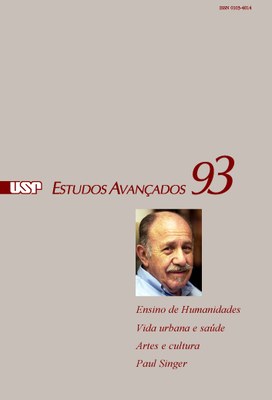
<p dir="ltr"><span><img src="https://www.iea.usp.br/imagens/capa-estudos-avancados-93/@@images/a264861c-632d-4ea5-9b50-5a6b15118a23.jpeg" alt="Capa Estudos Avançados 93" class="image-right" title="Capa Estudos Avançados 93" />The 93rd issue of the institutional journal "Estudos Avançados" inaugurates a series of publications focused on primary and secondary education. The main dossier of this issue brings a set of articles on the teaching of humanities, area of knowledge chosen to open the sequence. Besides reflections on the current conjuncture of Brazilian education, the texts present reflections on the teaching of philosophy, history, geography, music, literature and religion.</span></p>
<p dir="ltr">The journal also has three other sections, with different themes. In the first one, <i>Urban Life and Health</i>, four articles seek to understand how environmental and behavioral attributes of large cities affect the lives of their inhabitants. The second set of texts, <i>Arts and Culture</i>, brings comprehensive discussions on higher education in the arts and reflections on important works of the last century. The last section honors economist Paul Singer, who died in April, with a large and expressive interview in 2016.</p>
<p dir="ltr"><span>To editor Alfredo Bosi, the humanities face a paradoxical situation. "At the same time we have a reflection on the new methods proposed by pedagogy and specific didactics that open new directions for teaching, we face a depreciation of the same humanities by the technicist thinking that has been generalized in bureaucratic organs inside and outside the University," he points out. He believes that the intense demand for specialization generated by industrial and technological revolutions has hampered the balance between human and biological sciences.</span></p>
<p dir="ltr"><span>This context, according to Bosi, fuels the need to think about knowledge in a holistic and problematic way. A starting point, for him, would be to apply philosophy as a methodology of any and all modality of knowledge. "The reader will find articles by professors who experience this project both in public schools and in particular situations, such as teaching reading to inmates or the successful attempt to introduce Greek and Latin to elementary school students," he says.</span></p>
<p dir="ltr"><span>Bosi dedicates issue #93 to Paul Singer and Paulo Freire, who, according to him, "took their democratic ideals to the heart of the economy and pedagogy of the oppressed ones."</span></p>
<p dir="ltr"><span><strong>Dossier</strong></span></p>
<p dir="ltr">Between 2012 and 2013, Ana Vieira Pereira participated in a series of workshops on creative writing and reading mediation at the Romão Gomes Military Prison in São Paulo. Pereira's experiences and apprenticeships in the period are reported in the article <i>Sidelines - Literature Experiences with Imprisoned Persons</i>, which also composes the main dossier. According to her, the work made it possible to perceive literature and the telling of their own history as "powerful mechanisms for the personal reorganization and the discovery of new forms within the field of language".</p>
<p dir="ltr">In the article <i>The reform of secondary education and its questionable conception of quality of education</i>, Celso João Ferretti critically analyzes the reform promoted by the Ministry of Education in 2017. The political and economic interests of the restructuring, the ideological disputes that were presented and the official objectives <span>announced </span>by Michel Temer's government are some of the points dealt with by Ferretti. He further states that he has given "special attention to the curriculum flexibilization and the quality of education conception on which the reform is based."</p>
<p dir="ltr"><span>In the article <i>Latin and Greek in a municipal school of Elementary School</i>, Paula da Cunha Corrêa presents a successful pedagogical experience conducted from 2013 at the Desembargador Amorim Lima Municipal School of Elementary Education (EMEF.) Using the "Minimus" method, created by Barbara Bell, Corrêa has organized the implementation of classic language courses - Latin and Greek - for students in the 4th and 7th grades of the school, which is located in the city of São Paulo. According to her, in addition to language teaching, the project offers "diverse aspects of classical culture," to students, namely mythology, history, politics, theater, poetry, music, art and architecture." The "Minimus Project" is still in force and seeks new schools to expand its operation area.</span></p>
<p dir="ltr"><span><strong>Other themes</strong></span></p>
<p dir="ltr">The first two texts of the section <i>Urban Life and Health</i> show the consequences of violence and lack of basic sanitation for the health of the peripheral population. The latter two present comments on the last book authored by physician Paulo Saldiva, current director at the IEA-USP.</p>
<p dir="ltr">In <i>The metropolis and the health of its inhabitants</i>, Helena Ribeiro describes and analyzes the general themes addressed in Saldiva's work. According to her, the book clearly shows "the problems that urbanization has brought to physical and mental health" of the inhabitants of large cities.</p>
<p dir="ltr">Article writer Fabio Angeoletto emphasizes that the problems presented by Saldiva are not limited to São Paulo and other metropolises, but to all Brazilian cities, in <i>Urban life and health</i>. For him, the conclusion of the reading gives rise to a clear but not explicit message by the author: "Cities, in their complexity, demand planning, and multiple academic formations and social actors need to be involved in this work."</p>
<p dir="ltr">Among the seven authors in the <i>Arts and Culture</i> section are former IEA Director <a href="https://www.iea.usp.br/en/persons/researchers/martin-grossmann" class="external-link">Martin Grossmann</a> and two USP professors that participated in the first edition of the Institute's <a href="https://www.iea.usp.br/en/persons/sabbatical/sabbatical-professors" class="external-link">Sabbatical Year Program</a> in 2016: <a href="https://www.iea.usp.br/en/persons/researchers/daria" class="external-link">Dária Jaremtchuk</a> and <a href="https://www.iea.usp.br/en/persons/researchers/lucia-barbosa" class="external-link">Lúcia Maciel Barbosa de Oliveira</a>. The papers in this edition represent part of the results of their research at the Institute.</p>
<p dir="ltr">In the article <i>Abdias do Nascimento in the United States: a "black art painter,"</i> <span>Jaremtchuk </span>discusses the 10-year period that the Brazilian painter has spent in the United States. According to her, the time was fundamental for Nascimento to reaffirm "his commitment to the creation of works aligned with the African cultural heritage."</p>
<p dir="ltr">In Oliveira's <i>On Conquests and Tensions</i>, in turn, there is a discussion on the emergence of new cultural dynamics anchored in information and communication technologies. "The current moment demands a non-simplifying understanding of the innumerable representations, contradictions, voices and silences that vie for visibility in the public arena," she argues.</p>
<p dir="ltr"><span><strong>Paul Singer</strong></span></p>
<p dir="ltr"><span>The last article of the issue celebrates economist Paul Singer, who died April 16, 2018, at the age of 86. Singer was a full professor at USP's School of Economics, Business and Accounting (FEA,) and a member of the first composition of IEA's Board (1987-1992.) Born in Vienna, he was the creator and greatest advocate of the "Solidarity Economy."</span></p>
<p dir="ltr">The article <i>Paul Singer: a life of struggle and work for socialism and democratic participation</i>, by Cris Andrada and Egeu Esteves, presents an interview with the economist in the year 2016. Singer talks about his migration to Brazil, the youth in the Post-war São Paulo, his relationship with the union movement - with emphasis on the participation in the 300,000 Strike - and, notoriously, Solidarity Economy.</p>
<p dir="ltr"><span>"Only a few bring together intellectual greatness, genuine humility, and deep coherence between the writer and the practitioner," say the authors. "Paul Singer not only reflected on the violence of the world of work, but also devoted his studies to sharing it with workers, shoulder to shoulder, for years."</span></p>
<div><span>
<p>The list below contains the names of the authors who have contributed with each one of the addressed themes:</p>
<p><strong>The Teaching of Humanities</strong></p>
<p dir="ltr"><i>Franklin Leopoldo e Silva<br /></i><i>Celso de Rui Beiseigel<br /></i><i>Celso João Ferretti<br /></i><i>Marcus Sacrini and Valéria De Marco<br /></i><i>Ausonia Donato and Monique Borba Cerqueira<br /></i><i>Marcos Natali<br /></i><i>Neide Luzia de Rezende<br /></i><i style="text-align: justify; ">Ana Vieira Pereira<br /></i><i style="text-align: justify; ">Paula da Cunha Corrêa<br /></i><i>Circe Fernandes Bittencourt<br /></i><i>Antonia Terra de Calazans Fernandes<br /></i><i>Rafael Straforini<br /></i><i>Geraldo José de Paiva<br /></i><i>Antonio Carlos Moraes Dias Carrasqueira</i></p>
<p><strong>Urban Life and Health</strong></p>
<p dir="ltr"><i>Amélia Cohn<br /></i><i>Ana Lydia Sawaya, Maria Paula de Albuquerque and Semiramis Martins Álvares Domene<br /></i><i>Helena Ribeiro<br /></i><i style="text-align: justify; ">Fabio Angeoletto</i></p>
<p><strong>Arts and Culture</strong></p>
<p dir="ltr"><i>Dária Jaremtchuk<br /></i><i>Lúcia Maciel Barbosa de Oliveira<br /></i><i>Martha Ribeiro<br /></i><i>Isis Baldini, Martin Grossmann, Pamela Prado and Vinicius Spricigo<br /></i><i>Ana Mae Barbosa<br /></i><i>Martin Grossmann<br /></i><i>Paulo Roberto Ramos</i></p>
<p><strong>Paul Singer</strong></p>
<p><strong> </strong><i><i><i>Cris Andrada e Egeu Esteves</i></i></i></p>
</span></div>]]></content:encoded>
    <dc:publisher>No publisher</dc:publisher>
    <dc:creator>Richard Meckien</dc:creator>
    <dc:rights>Original version in Portuguese by Victor Matioli.</dc:rights>
    
      <dc:subject>Cities</dc:subject>
    
    
      <dc:subject>Art</dc:subject>
    
    
      <dc:subject>Humanities</dc:subject>
    
    
      <dc:subject>Journal</dc:subject>
    
    
      <dc:subject>Culture</dc:subject>
    
    
      <dc:subject>Health</dc:subject>
    
    
      <dc:subject>Education</dc:subject>
    
    <dc:date>2018-08-13T16:30:00Z</dc:date>
    <dc:type>Notícia</dc:type>
  </item>


  <item rdf:about="https://www.iea.usp.br/eventos/arnaldo-vieira-carvalho">
    <title>Arnaldo Vieira de Carvalho e a Produção de Vacina Antivariólica em São Paulo</title>
    <link>https://www.iea.usp.br/eventos/arnaldo-vieira-carvalho</link>
    <description></description>
    <content:encoded xmlns:content="http://purl.org/rss/1.0/modules/content/"><![CDATA[<p dir="ltr" style="text-align: left; "><span>Arnaldo Vieira de Carvalho foi o primeiro diretor da Faculdade de Medicina e Cirurgia de São Paulo. No entanto, pouco se conhece das muitas outras atividades nas quais esteve envolvido, como ter sido diretor clínico do Hospital Central da Santa Casa de Misericórdia do Estado, presidente da Sociedade de Medicina e Cirurgia paulista, ou ainda, diretor do Instituto Vacinogênico de São Paulo desde sua criação em 1893 até 1912, quando saiu para assumir a direção da nova faculdade.</span></p>
<p dir="ltr" style="text-align: left; "><span>O objetivo desta conferência é analisar sua atuação na produção de vacinas antivariólicas em um período em que o combate às epidemias de varíola era uma das prioridades das autoridades sanitárias paulistas. Além de acompanhar as inovações científicas e técnicas e participar de debates, Arnaldo foi responsável pela montagem do laboratório que, na época, era considerado modelo. Durante os anos de sua direção, o Instituto Vacinogênico deu suporte às campanhas de vacinação nas várias regiões do estado de São Paulo.</span></p>
<p dir="ltr" style="text-align: left; "><strong>Expositora</strong></p>
<p dir="ltr" style="text-align: left; "><a href="https://www.iea.usp.br/pessoas/pasta-pessoam/maria-amelia-mascarenhas-dantes" class="external-link">Maria Amélia Dantes</a> (FFLCH-USP)</p>
<p><strong>Moderador</strong></p>
<p><a href="https://www.iea.usp.br/pessoas/pasta-pessoag/gildo-magalhaes-dos-santos" class="external-link">Gildo Magalhães dos Santos</a> (FFLCH e IEA/USP)</p>]]></content:encoded>
    <dc:publisher>No publisher</dc:publisher>
    <dc:creator>Heloisa Marcondes</dc:creator>
    <dc:rights></dc:rights>
    
      <dc:subject>Medicina</dc:subject>
    
    
      <dc:subject>Evento público</dc:subject>
    
    
      <dc:subject>Health</dc:subject>
    
    
      <dc:subject>Grupo de Pesquisa Khronos: História da Ciência, Epistemologia e Medicina</dc:subject>
    
    <dc:date>2017-07-11T17:15:00Z</dc:date>
    <dc:type>Evento</dc:type>
  </item>


  <item rdf:about="https://www.iea.usp.br/en/news/dsds">
    <title>A project to broaden the understanding about sexual development disorders</title>
    <link>https://www.iea.usp.br/en/news/dsds</link>
    <description></description>
    <content:encoded xmlns:content="http://purl.org/rss/1.0/modules/content/"><![CDATA[<table class="tabela-direita-300">
<tbody>
<tr>
<th><img src="https://www.iea.usp.br/imagens/berenice-milharinho-de-mendonca" alt="Berenice Bilharinho de Mendonça" class="image-inline" title="Berenice Bilharinho de Mendonça" /></th>
</tr>
<tr>
<td><strong>Berenice Bilharinho de Mendonça</strong></td>
</tr>
</tbody>
</table>
<p style="text-align: left; "><span>Genital malformation is a congenital condition that affects one in every 2,500 individuals, according to estimates. It is currently considered one of the Disorders of Sex Development (DSDs). Disorders of this nature are due to chromosomal compositions different from those that define gender, alterations or nonexistence of the gonads (ovary and testicles) and alteration in the production or action of male hormones. These manifestations may occur isolated or associated with other congenital diseases.</span></p>
<p>The lack of information about the <span>DSDs</span> and their proper treatment are sources of social stigma and suffering for the patients, who can actually have a normal quality of life if they have the necessary assistance and follow-up.</p>
<p>According to endocrinologist <a href="https://www.iea.usp.br/en/persons/researchers/berenice" class="external-link">Berenice Bilharinho de Mendonça</a>, a professor at USP's School of Medicine who is spending her <a href="https://www.iea.usp.br/en/persons/sabbatical" class="external-link">sabbatical leave</a> at the IEA, the lack of adequate information about the <span>DSDs </span>is not exclusive to the public, also reaching a considerable part of health professionals, which harms diagnosis and investigation of the causes of the disease, essential factors for the treatment of patients.</p>
<p>Since March, she is conducting her research project entitled "<span>Development and Dissemination of Educational Material to Improve the Diagnosis and Treatment of Disorders of Sex Development (DSDs) in Brazil".</span></p>
<p>Mendonça has dedicated effort to the study of <span>DSDs</span> and to the follow-up of people affected by them for 40 years, a period during which the popular denomination of the patients, especially in the case of atypical genitalia, went from inadequate and stigmatizing terms, such as "hermaphrodite", to the imprecision of the term "intersexual", common for some years. She said that the patients themselves reject those terms and so the concept of sexual development disorder was adopted in the so-called Chicago Consensus, which was drawn up from a medical congress held in the city in 2006.</p>
<p>The researcher argues that a child should begin to be treated as soon as possible, including accurate reconstructive plastic surgeries when appropriate for the definition of their social sex. "This is independent of future gender identification or sexual preference and it is essential for the child not to feel discriminated and stigmatized."</p>
<p>"Certain sectors, such as groups of <span>DSDs</span> carriers, deal with the issue as if there was something like a 'third sex', when in fact the changes are the result of an illness. It is naturally accepted that a child may be born with malformation of the heart to be corrected, but one can not see that the same can occur with the genitalia and that this alteration does not correspond to a natural variation'.</p>
<p>Mendonça questions the groups that <span>advocate that</span> the <span>carriers of an </span>atypical genitalia should choose which social sex they wish via surgery <span>as adults</span>: "These groups are usually people traumatized by malpractice surgeries in childhood."</p>
<p><strong>Risk of death</strong></p>
<p>An early diagnosis becomes a life-or-death case when it comes to infants with <span>DSDs</span> associated with a congenital deficiency of <span>hormones that are </span>essential to life and produced by the adrenal glands: the congenital adrenal hyperplasia (CAH). In the manifestation of the disease there is salt-wasting (60% of cases).</p>
<p><span>In the CAH there is the production of male hormone in girls, which causes the virilization of the external genitalia. "Even in important centers such as São Paulo, 55% of the girls with virilized genitalia are attributed to the CAH <span>because of lack of knowledge by the medical teams</span>." But it is the boys who are at greater risk of death, since the CAH does not alter their genitalia and, therefore, it is not hypothesized that they are carriers of hyperplasia.</span></p>
<p>During her stay at the IEA, Medonça will develop actions to accelerate the diagnosis of this type of CAH, whose incidence is one in 10 thousand births. As the episodes of salt-wasting occur during the first 15 days of the baby's life, it is essential to run <span>confirmatory </span>biochemical tests in specialized centers as soon as a possibility of the disease is identified by the Guthrie test (done soon after birth). "Only this way it will be possible to <span>immediately </span>start treatment with medicines to ensure the survival of the child, who will have to take them for a lifetime."</p>
<p>There are <span>DSDs</span> that are not evident at birth or throughout early childhood, according to Mendonça. It may happen that at puberty a girl does not start menstruating and ends up finding out that she has no ovaries, but internal dysfunctional testicles. "It is a case where, instead of having <span>XX </span>sex chromosomes, the girl has <span>XY </span>sex chromosomes, which are male definers. These chromosomal differences happen in two of every 50 thousand individuals on average, that is, of every 25 thousand women, one will have XY sex chromosomes instead of XX sex chromosomes, the same happening in every 25,000 men, where one will have XX sex chromosomes and not XY ones."</p>
<p>This chromosomal alteration has happened to Belgian top model <a class="external-link" href="http://www.independent.co.uk/life-style/health-and-families/hanne-gaby-odiele-intersex-model-doctors-gender-change-child-belgian-fashion-lifestyle-a7698796.html">Hanne Gaby Odiele</a>, who has already paraded for several <span>haute couture </span>designer brands (currently she is the "face" of the French Balanciaga). She has XY chromosomes associated with androgen insensitivity syndrome due to a mutant gene that encodes the androgenic receptor located on the X chromosome. At the age of 10, she had the internal testicles removed and at the age of 18 she underwent surgery for the adequacy of the size of her vagina.</p>
<p><strong>Dissemination</strong></p>
<p>The objective of Mendonça's project at the IEA is to develop and disseminate protocols for health professionals and instructive materials on clinical, laboratory and molecular diagnosis for parents, family members and teachers of children with <span>DSDs</span>. The intention is to collaborate with the diagnosis and appropriate treatment of these children in Brazil.</p>
<p>Her first activity will be the development of a <span>proposal <span>for patients with atypical genitalia to have a </span></span>national registration. They would be registered after their <span>and / or their parents' </span>consent, being ensured of their absolute secrecy of identity. Another concern is to publicize the use of the emergency medical card to warn of the risk of salt-wasting crises in CAH patients with this implication.</p>
<p>She will also provide studies to define the molecular causes of <span>DSDs</span> in the multi-user Large Scale Sequencing (SELA) laboratory of FM-USP. This will be done when the molecular study shows itself important to ascribing the patients' social sex.</p>
<p>One of the books to be produced will be elaborated in the form of questions and answers, and directed to the orientation of relatives of children with atypical genitalia. The other book will be on sexual education of children and adolescents with DSDs.</p>
<p>In parallel to this all, Mendonça will continue to provide online counseling to physicians who treat children with atypical genitalia throughout the country. This will be done through the website <a class="external-link" href="http://www.endocrinologiausp.com.br">www.endocrinologiausp.com.br</a> and by means of other internet resources, such as YouTube and Skype. In the latter case it is necessary to evaluate the observable characteristics of the child.</p>
<p>In addition, she will develop teaching material to be made available online and will provide face-to-face classes to health professionals (nurses, social workers, doctors and biologists) in university centers in other states. In these classes, the researcher will disclose clinical protocols for the care of children with atypical genitalia, and inform parents and relatives of these children about the issue.</p>
<p>In the therapeutic field, Mendonça intends to make efforts for the <span>São Paulo <span>State </span></span>Health Department to develop actions to make <span>hydrocortisone and fludrocortisone </span>available for the treatment of salt-wasting CAH in Brazil.</p>
<p>She said that meeting this demand is in line with the principles of the Brazilian law <span>which deals with therapeutic care and the incorporation of health technology within the scope of the Unified Health System (SUS). "What is important is that these medicines are available either through the production of public laboratories or through the purchase of domestic or foreign private suppliers."</span></p>
<p>Mendonça also wants to work together with the Association of Parents and Friends of the Exceptional (APAE) and the São Paulo <span>State </span>Secretary of Health to reduce the time of convocation of the children screened for CAH through the <span>Guthrie test. This should lower </span>the incidence of dehydration and hospitalization of affected children. According to the researcher, currently 65% of children undergoing confirmatory exams at Hospital das Clínicas, owned by the FM-USP, show dehydration. "This indicates that the neonatal screening still does not prevent the child from reaching this state due to the delay in their referral for specific tests."</p>
<p>At the end of the project, Mendonça will write a scientific paper in which she will report the results of the actions taken during the sabbatical year at the IEA.</p>
<p style="text-align: right; "><span class="discreet">Photo: Leonor Calasans/IEA-USP</span></p>]]></content:encoded>
    <dc:publisher>No publisher</dc:publisher>
    <dc:creator>Richard Meckien</dc:creator>
    <dc:rights>Original version in Portuguese by Mauro Bellesa.</dc:rights>
    
      <dc:subject>Biomedicine</dc:subject>
    
    
      <dc:subject>Genetics</dc:subject>
    
    
      <dc:subject>Research</dc:subject>
    
    
      <dc:subject>Health</dc:subject>
    
    
      <dc:subject>Sabbatical</dc:subject>
    
    <dc:date>2017-04-25T17:55:00Z</dc:date>
    <dc:type>Notícia</dc:type>
  </item>


  <item rdf:about="https://www.iea.usp.br/en/news/study-group-will-address-links-between-health-and-the-geographic-context-of-cities">
    <title>Study group will address links between health and the geographic context of cities</title>
    <link>https://www.iea.usp.br/en/news/study-group-will-address-links-between-health-and-the-geographic-context-of-cities</link>
    <description></description>
    <content:encoded xmlns:content="http://purl.org/rss/1.0/modules/content/"><![CDATA[<table class="tabela-direita">
<tbody>
<tr>
<th><img src="https://www.iea.usp.br/imagens/Ligia-Vizeu-Barrozo-perfil.jpg" alt="Ligia Vizeu Barrozo - Perfil" class="image-inline" title="Ligia Vizeu Barrozo - Perfil" /></th>
</tr>
<tr>
<td><strong><span>Geographer Ligia Vizeu Barrozo, coordinator of the new study group</span></strong></td>
</tr>
</tbody>
</table>
<p>A new study group will analyze the health inequities and their relation to the geographical context of cities. The proposal of its creation was approved by the IEA's Board in a meeting held on August 16.</p>
<p>The group <i>Urban Space and Health</i> will be coordinated by geographer <a href="https://www.iea.usp.br/en/persons/researchers/ligia-barrozo" class="external-link">Ligia Vizeu Barrozo</a>, a professor at the Department of Geography of USP's Faculty of Philosophy, Languages and Literature, and Human Sciences (FFLCH). The forecast is that the activities will last four years starting from August 2016. In addition to geography, the transdisciplinary group has members from areas such as urban planning, cartography, epidemiology, physical activity and health.</p>
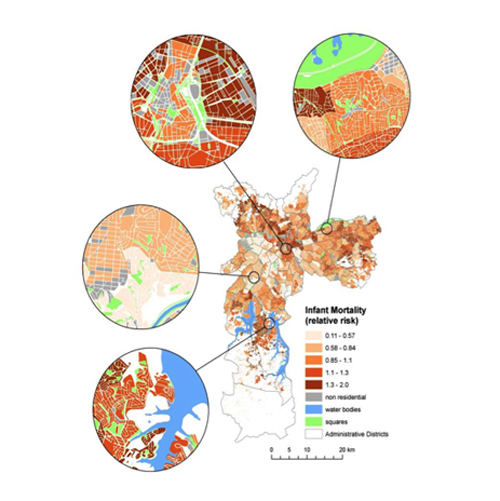
<p>According to the research project, the power of maps will be used to identify and highlight health inequities <span>mainly</span> related to socio-economic conditions and urban morphology. The goal is to have evidence to base policy recommendations in order to reduce inequities in health.</p>
<table class="tabela-esquerda">
<tbody>
<tr>
<th><img src="https://www.iea.usp.br/imagens/Mapa-Grupo-de-estudos-espaco-urbano-e-saude-web.jpg" alt="Mapa publicado no Journal of Maps, v. 11, 2015 - Barrozo, L. V. et al. " class="image-inline" title="Mapa publicado no Journal of Maps, v. 11, 2015 - Barrozo, L. V. et al. " /></th>
</tr>
<tr>
<td>
<p><span><strong>The dasymetric representation of the relative risk of child mortality between 2006 and 2009 in the city of São Paulo is an example of how maps can help showing inequality<br /></strong></span></p>
</td>
</tr>
</tbody>
</table>
<p>The group plans to use indicators such as life expectancy at birth and Potential Years of Life Lost (PYLL), evaluating how each of them appears in certain areas of cities. The first indicator "reflects the cumulative effect of the impact of risk factors, the occurrence and severity of diseases, and the effectiveness of interventions and treatment", and identifies when inequality becomes iniquity. In turn, the PYLL measures premature mortality (currently, the reference age is 70), focusing on the social and economic consequences of mortality. To observe the geographical variations in the results of this indicator can help in the planning of local health, according to the research project.</p>
<p>"The maps potentiate the investigation of the influence of the geographical context and the social determinants of health, particularly for allowing the visualization of spatial relationships, identifying iniquitous areas and the development of hypotheses," justify the researchers.</p>
<p>An example of the studies to be carried out is the evaluation of urban morphology, which can promote or hinder the daily practice of displacement, favoring physical inactivity in certain locations <span>or not</span>. Therefore, the researchers take <span>aspects such as topography, length of blocks, population density, urban sprawl, and density connections between streets, street lighting and paving </span>into account. According to the project, there are studies that raise the possibility that people living in more dense areas with well-connected streets and a <span>more diverse </span>use of the soil tend to be more physically active.</p>
<p>"The population is <span>unequally </span>exposed to urban infrastructure in terms of their morphology with regard to the pattern of the streets, to the cover of pavements, presence of bicycle paths, availability and accessibility to public transportation and aesthetics and safety, as p<span>leasant and safe</span> locations are more used and promote the practice of physical activity," they evaluate.</p>]]></content:encoded>
    <dc:publisher>No publisher</dc:publisher>
    <dc:creator>Richard Meckien</dc:creator>
    <dc:rights>Original version in Portuguese by Fernanda Rezende.</dc:rights>
    
      <dc:subject>Human Rights</dc:subject>
    
    
      <dc:subject>Study group</dc:subject>
    
    
      <dc:subject>Society</dc:subject>
    
    
      <dc:subject>Inequality</dc:subject>
    
    
      <dc:subject>Health</dc:subject>
    
    
      <dc:subject>Geography</dc:subject>
    
    <dc:date>2016-09-01T16:55:00Z</dc:date>
    <dc:type>Notícia</dc:type>
  </item>


</rdf:RDF>