<?xml version="1.0" encoding="utf-8" ?>
<rdf:RDF xmlns:rdf="http://www.w3.org/1999/02/22-rdf-syntax-ns#" xmlns:dc="http://purl.org/dc/elements/1.1/" xmlns:syn="http://purl.org/rss/1.0/modules/syndication/" xmlns="http://purl.org/rss/1.0/">


<channel rdf:about="https://www.iea.usp.br/en/news/news-collection/RSS">
  <title>News</title>
  <link>https://www.iea.usp.br</link>

  <description>


  </description>


            <syn:updatePeriod>daily</syn:updatePeriod>
            <syn:updateFrequency>1</syn:updateFrequency>
            <syn:updateBase>2012-08-22T17:57:47Z</syn:updateBase>
        

  <image rdf:resource="https://www.iea.usp.br/logo.png" />

  <items>
    <rdf:Seq>
      
        <rdf:li rdf:resource="https://www.iea.usp.br/en/news/ubias-directors-conference-ghana" />
      
      
        <rdf:li rdf:resource="https://www.iea.usp.br/en/news/journal-issue-115" />
      
      
        <rdf:li rdf:resource="https://www.iea.usp.br/en/news/journal-issue-114" />
      
      
        <rdf:li rdf:resource="https://www.iea.usp.br/en/news/journal-issue-113" />
      
      
        <rdf:li rdf:resource="https://www.iea.usp.br/en/news/book-history-iea-english-version" />
      
      
        <rdf:li rdf:resource="https://www.iea.usp.br/en/news/journal-issue-112" />
      
      
        <rdf:li rdf:resource="https://www.iea.usp.br/en/news/journal-issue-111" />
      
      
        <rdf:li rdf:resource="https://www.iea.usp.br/en/news/journal-issue-110" />
      
      
        <rdf:li rdf:resource="https://www.iea.usp.br/en/news/indigenous-women-take-ffice" />
      
      
        <rdf:li rdf:resource="https://www.iea.usp.br/en/news/journal-issue-109" />
      
      
        <rdf:li rdf:resource="https://www.iea.usp.br/en/news/iea-hosts-center-study-international-negotiations" />
      
      
        <rdf:li rdf:resource="https://www.iea.usp.br/en/news/journal-issue-108" />
      
      
        <rdf:li rdf:resource="https://www.iea.usp.br/en/news/indigenous-museums-decolonisation-japan-emergence-brazil" />
      
      
        <rdf:li rdf:resource="https://www.iea.usp.br/en/news/japanese-museums" />
      
      
        <rdf:li rdf:resource="https://www.iea.usp.br/en/news/avanced-school-science-innovation-diplomacy" />
      
    </rdf:Seq>
  </items>

</channel>


  <item rdf:about="https://www.iea.usp.br/en/news/ubias-directors-conference-ghana">
    <title>IASs from all continents discuss strategies for cooperation and their influence in international research</title>
    <link>https://www.iea.usp.br/en/news/ubias-directors-conference-ghana</link>
    <description></description>
    <content:encoded xmlns:content="http://purl.org/rss/1.0/modules/content/"><![CDATA[<table class="tabela-direita">
<tbody>
<tr>
<th><img src="https://www.iea.usp.br/imagens/mesa-da-1a-sessao-do-encontro-de-diretores-de-ieas" alt="Mesa da 1ª sessão do encontro de diretores de IEAs" class="image-inline" title="Mesa da 1ª sessão do encontro de diretores de IEAs" /><br /></th>
</tr>
<tr>
<td><span class="discreet">Director of the IEA/USP, Roseli de Deus Lopes (left) spoke at one of the sessions of the meeting.</span></td>
</tr>
</tbody>
</table>
<p>The role of institutes for advanced study (IASs) based at universities, the preservation of their academic autonomy, the guarantee of funding, and the increase of their influence on the global scientific agenda were the main themes debated at the Directors' Conference of the international network of <a class="external-link" href="http://www.ubias.net">University-Based Institutes for Advanced Study (UBIAS)</a>, held from November 4 to 6. The event was hosted by the <a class="external-link" href="https://miasa.ug.edu.gh/">Maria Sibylla Merian Institute for Advanced Studies in Africa (MIASA)</a>, located at the University of Ghana, in Accra.</p>
<p>The IEA/USP, one of the founding members of UBIAS, was represented by director <a href="https://www.iea.usp.br/en/persons/researchers/roseli-lopes" class="external-link">Roseli de Deus Lopes</a> and former director <a href="https://www.iea.usp.br/en/persons/researchers/guilherme-plonski" class="external-link">Guilherme Ary Plonski</a>, currently a senior professor at the Institute. The gathering marked the 15th anniversary of the network, created at a meeting promoted by the Freiburg Institute for Advanced Studies (FRIAS) in October 2010.</p>
<p><strong>Relevance</strong></p>
<p>Plonski, who has already coordinated UBIAS's steering committee for three years, considered the conference very well-organized and relevant for the following main reasons.</p>
<table class="tabela-esquerda-300-borda">
<tbody>
<tr>
<td>
<h3>Up next</h3>
<p>Three meetings of directors from UBIAS member institutes are scheduled to take place online in May and November 2026, and in May 2027. The next in-person conference will be held in November 2027.</p>
<p><strong>Intercontinental Academia</strong></p>
<p>The 5th <a class="external-link" href="http://ica.usp.br/">Intercontinental Academia (ICA)</a> will be conducted by the Institute for Advanced Transdisciplinary Studies (IEAT) at the Federal University of Minas Gerais and by the Max Weber Centre for Advanced Cultural and Social Studies (Max-Weber-Kolleg) at the University of Erfurt. The theme "Pluralities of Resonant Relationships" will be explored in two immersive meetings of the researchers involved: in June 2026 in Germany, and in March 2027 in Brazil. The choice of study topic refers to the theoretical proposal of sociologist Hartmut Rosa, director of the Max Weber-Kolleg. In elaborating a theory of the "good," he defines "resonance" as a relationship of mutual influence between the subject and the world, where both are transformed through an encounter based on affect, emotion, and perceived self-efficacy.</p>
<p>The first edition of the ICA was organized by the IEA/USP and by Nagoya University's Institute for Advanced Research (IAR), having "Time" as its theme. The immersive meetings took place in April 2015 in Brazil and in March 2016 in Japan.</p>
</td>
</tr>
</tbody>
</table>
<p><strong>• </strong>It was the first event of its kind held in Africa, reinforcing the global nature of the network. In the Americas, the milestone occurred in 2018. In Oceania, the last continent yet to be covered, it will happen in 2027.</p>
<p><strong>• </strong>During the first two days of activities it was possible to delve into crucial themes in a rapidly transitioning world, such as knowledge production in the so-called Global South (with particular emphasis on Lopes' participation) and the challenge of boosting IASs by adding intersectorality to the basic characteristic of interdisciplinary studies and research.</p>
<p><strong>• </strong>The quality of interactions between leaders of member institutes has strengthened ties that encourage collaborative actions over the next two years.</p>
<p><strong>Global South</strong></p>
<ul>
</ul>
<p>The theme of the first session of the conference was "Knowledge Production in the Global South: The Role of IASs in Shaping Regional and Global Research Agendas." According to Lopes, one of the speakers, the importance of IASs lies in the fact that they are spaces for independent, interdisciplinary, and risk-tolerant research with the time and freedom to cross scientific boundaries.</p>
<p>However, she observed that transposing the socioeconomic divide between the Global North and the Global South to the context of knowledge production can lead to distortions in the evaluation of the scientific contribution of developing countries. Feminist and decolonial intellectual currents consider that this results in the marginalization of scientific perspectives from the Global South, which has been called an epistemic injustice, with theories from the North being seen as universal.</p>
<p>Lopes cited several factors that prevent the fair participation of developing countries in international epistemological frameworks: the advantage of countries with English as their native language, the high cost of publishing in high-impact journals, restrictive criteria for measuring impact, barriers arising from compliance requirements in South-South collaborations, and unequal access to intellectual property and data.</p>
<p>Given these obstacles, she recommended three actions to the IASs: sharing legal models, ethical data governance, and microfinancing prior to granting research scholarships for South-South and South-North collaborations.</p>
<p>It is not enough for researchers from the Global South to participate in the international research system. They also need to be involved in setting the agendas of this system by proposing questions and methods, Lopes stated. Another need is the redefinition of scientometric criteria for evaluating preliminary, multilingual, and politically relevant results, she added.</p>
<p>From the perspective of the integration structure of researchers and research institutions from countries in the Global South, Lopes sees three levels to be considered: 1) agendas based on regional issues but with global reference points; 2) plural epistemologies and multilingual knowledge; 3) infrastructures for recognition and scaling up.</p>
<p>Some examples for level 1 are the resilience of tropical megacities, bioeconomy and biodiversity, and informal economy platforms. For level 2, Lopes mentions integrating the knowledge of indigenous peoples/traditional communities into academic methods and considering the translation of results into multiple languages ​​as part of academic activity. Open access to datasets produced in the Global South and fair evaluation of public policy labs, prototypes, and multilingual results apply to level 3.</p>
<table class="tabela-esquerda">
<tbody>
<tr>
<th><img src="https://www.iea.usp.br/imagens/sede-do-instituto-merian-de-estudos-avancados" alt="Sede do Instituto Merian de Estudos Avançados" class="image-inline" title="Sede do Instituto Merian de Estudos Avançados" /><br /></th>
</tr>
<tr>
<td><span class="discreet">Maria Sibylla Merian Institute for Advanced Studies in Africa (MIASA), located at the University of Ghana, in Accra.</span></td>
</tr>
</tbody>
</table>
<p><strong>Contributions of the IASs</strong></p>
<p>Lopes said that there are characteristics and functions that only IASs can provide for encouraging inclusion in the international agenda: the offering of an interdisciplinary environment for experimentation by researchers and small research groups, and acting as a multifaceted bridge connecting universities, civil society, and the public and private sectors.</p>
<p>During the conference, Lopes and the directors of four other IASs were chosen to form the UBIAS Coordination Team. The concrete proposals for the network that she presented in the first session of the program somehow already foresee part of her future role in the team. They include the creation of a circuit of co-sponsored research stays at IASs in the Global South, the implementation of a multilingual platform with open access to abstracts and methodologies, public policy laboratories based on research results, mobility and microfinance programs, and a registration system for open methodologies and prototypes.</p>
<p><strong>Intersectoriality</strong></p>
<p>The sixth session of the conference was themed "Advancing the Advanced Institutes: Intersectorality Practices Around the World." Intersectorality was explored as a key path to growth in the complex social context. According to the organizers, IASs occupy a delicate position, oscillating between the pursuit of knowledge and being the link that unites the university and the wider world in which it is embedded.</p>
<p>Plonski participated in the session by presenting two IEA/USP initiatives involving Brazilian indigenous peoples, demonstrating that intersectorality is a regular practice of the Institute. One initiative was the appointment of indigenous leaders Arissana Pataxó, Francy Baniwa, and Sandra Benites as holders of the Olavo Setubal Chair - Transversalities: Art, Culture, Science, and Education in 2024. They developed the program "<i>Caminho da Cutia</i>: Territories and Knowledge of Indigenous Women." Computer scientist Claudio Pinhanez, a visiting professor at the Institute from May 2023 to May 2025, led his projects of applying digital technologies and artificial intelligence to produce tools for the use of Guarani and Nheengatu languages ​​in the digital environment by the peoples who speak them.</p>
<p><img src="https://www.iea.usp.br/imagens/capa-do-livro-advanced-in-what-300px" alt="Capa do livro &quot;Advanced in What?&quot; - 300px" class="image-right" title="Capa do livro &quot;Advanced in What?&quot; - 300px" /></p>
<p>In addition to the sessions in which Lopes and Plonski were speakers, four other sessions took place throughout the conference. They had the following themes:</p>
<p><strong>• </strong>AI and the Future of Knowledge Production;</p>
<p><strong>• </strong>University-Based IASs, Institutional Autonomy, and Academic Freedom;</p>
<p><strong>• </strong>IASs Impact;</p>
<p><strong>• </strong>Funding Institutes of Advanced Study.</p>
<ul>
</ul>
<p><strong>Trajectory of the IEA/USP</strong></p>
<p>The launch of the book "Advanced in What? The Pioneering Trajectory of the Institute of Advanced Studies of the University of São Paulo" also took place during the conference in Accra. It is the English version of the work that narrates the trajectory of the IEA/USP from its creation until 2023. The publication was presented by Plonski and Lopes, who brought copies for all the participants of the meeting. "We talked about the motivation, the production process, and the structure of the work. The book launched by our Institute is the pioneer among the publications associated with the 15 years of UBIAS, an opportune moment to take stock of the past and strategically rethink the continuity of the network," commented Plonski.</p>
<p style="text-align: right; "><span class="discreet">Photos: Guilherme Ary Plonski</span></p>]]></content:encoded>
    <dc:publisher>No publisher</dc:publisher>
    <dc:creator>Richard Meckien</dc:creator>
    <dc:rights>Original version in Portuguese by Mauro Bellesa.</dc:rights>
    
      <dc:subject>Ubias</dc:subject>
    
    
      <dc:subject>Intercontinental Academia</dc:subject>
    
    
      <dc:subject>ICA</dc:subject>
    
    
      <dc:subject>cover</dc:subject>
    
    
      <dc:subject>ST&amp;I</dc:subject>
    
    
      <dc:subject>IEA</dc:subject>
    
    
      <dc:subject>Event</dc:subject>
    
    <dc:date>2025-12-01T14:30:00Z</dc:date>
    <dc:type>News Item</dc:type>
  </item>


  <item rdf:about="https://www.iea.usp.br/en/news/journal-issue-115">
    <title>"Estudos Avançados" #115 analyzes assessments, curricula, and performance in basic education</title>
    <link>https://www.iea.usp.br/en/news/journal-issue-115</link>
    <description> </description>
    <content:encoded xmlns:content="http://purl.org/rss/1.0/modules/content/"><![CDATA[<p><img src="https://www.iea.usp.br/imagens/capa-da-edicao-115-da-revista-estudos-avancados" alt="Capa da edição 115 da revista Estudos Avançados" class="image-right" title="Capa da edição 115 da revista Estudos Avançados" /><span> </span></p>
<p>Basic education has been one of IEA's priority topics since the early 1990s and has become increasingly prominent on the Institute's agenda as evidenced by the existence of three chairs currently dedicated to it. This focus is also reflected in the recurrence of related material in the journal <i><a href="https://www.iea.usp.br/en/journal" class="external-link">Estudos Avançados</a></i>, which now features one of the most comprehensive collections of articles on the subject ever presented by the publication.</p>
<div>
<p><span>The recently released issue #115 includes </span>two interrelated dossiers. <span>The opening section addresses educational assessment, curricular changes, learning restructuring, early childhood education, the inclusion of students with disabilities, and the appreciation of ethnic and racial diversity, while the second one </span>discusses various aspects affecting immigrant students or students of immigrant descent in São Paulo and other cities around the world, as well as the impacts of organized crime and further forms of violence on the education system in the city of Rio de Janeiro and in low-income neighborhoods of Buenos Aires.</p>
</div>
<p><strong>Assessment Systems</strong></p>
<p>Sociologist Maria Helena Guimarães de Castro, holder of the Ayrton Senna Institute Chair for Innovation in Educational Assessment, based at IEA's Ribeirão Preto Center (IEA-RP), is one of the authors of the dossier <span>"Basic Education," </span><span>participating with a summary of some of the main trends in innovations introduced in international large-scale educational assessment systems, considering the need to improve Brazilian systems, according to her.</span></p>
<p>She believes it is crucial to improve the Basic Education Assessment System (SAEB) and the National High School Exam (ENEM), aligning them with the curricular changes implemented by the National Common Curricular Base (BNCC). Her article also examines the expansion of educational assessment research centers in Brazil and the excellence of research, providing telling evidence to inform national assessments and update the country's public education policy agendas.</p>
<p>The researcher says that the SAEB has undergone significant improvements that have increased its capacity for monitoring and assessing learning in Brazil since its creation in 1990, "but it has not introduced conceptual and methodological changes in the last 20 years." On the other hand, the BNCC requires profound changes in the assessments conducted by both SAEB and ENEM, "so that the tests assess the competencies and skills expected throughout basic education as well as new formats, concepts, and methodologies for large-scale assessments aligned with technological advances such as observed in international assessments."</p>
<p>She emphasizes that the consequences of school closures during the COVID-19 pandemic still persist. Only 56% of children were literate at the appropriate age in December 2023, according to data released by the Brazilian Ministry of Education in 2024.</p>
<p>Data from the 2021 SAEB, conducted during the aforementioned pandemic and released in September 2022, confirm this impact: "Only 31% of high school students in public schools demonstrated adequate Portuguese language proficiency and 5% demonstrated adequate mathematics proficiency. Unfortunately, the performance was no better than in previous years. The vast majority of children finish fifth grade unable to read simple sentences, unable to recognize distinct opinions on the same subject, unable to convert more than a full hour into minutes, or unable to recognize that a number remains unchanged when multiplied by 1."</p>
<p>The sociologist states that data from the SAEB and Brazil's results in international assessments show that even before the pandemic most Brazilian schools were unable to offer the necessary learning for students to reach adequate proficiency levels.</p>
<p>For her, any future agenda for basic education must begin with a clear diagnosis to propose policies to overcome inequalities and improve learning. Brazil is competent to carry out this diagnosis, she states, as it "has numerous research centers and high-level experts in the area of ​​assessment and curriculum who produce studies and scientific evidence to improve large-scale assessment systems in the country."</p>
<p><strong>Inequality between Schools</strong></p>
<p>Several of the articles in <i>Estudos Avançados</i> #115 present examples of the expertise of Brazilian scholars in providing diagnostics in the area of ​​learning assessment. This is the case of the collaboration between the Sérgio Henrique Ferreira Chair, also based at the <span>IEA-RP, and the </span>municipal administrations<span> of Cubatão and Taquaritinga, two cities in the state of São Paulo. Chair holder Mozart Neves Ramos and his team have analyzed the performance inequality of municipal schools in both locations before the COVID-19 pandemic.</span></p>
<p>The analysis has considered five educational indicators for elementary school students in 2019: adequate <span>learning in</span><span> Portuguese and mathematics, school performance (pass rate), student performance on standardized assessments, and age-to-grade distortion. Only the last indicator is not one of the components considered in calculating the Brazilian Basic Education Development Index (IDEB).</span></p>
<p>The authors explain that the percentage of students with adequate learning corresponds to the proportion of students who have achieved academic proficiency above a certain number of points on the SAEB scale when compared to the total number of students assessed. This represents achieving a performance equal to or higher than 200 points in Portuguese and 225 points in mathematics for the fifth grade of elementary school. The standardized score, in turn, corresponds to the average score obtained by students on the SAEB's Portuguese and mathematics exams. School flow is the average pass rate of students at each stage of schooling, calculated by dividing the total number of students who have been approved by the total number of students enrolled in each grade. The age-to-grade distortion rate is defined as the proportion of students who have accumulated two or more years of academic delay, in line with data from the Brazilian School Census for a given year.</p>
<p>According to the researchers, the work shows that the use of the Principal Component Analysis (PCA) integrated into the construction of school georeferencing maps can be useful for managers and staff in understanding existing inequalities in <span>school </span><span>performance.</span></p>
<p>The analysis has revealed that the percentage of students with adequate Portuguese and mathematics proficiency are the most important factors explaining the variance in the data collected. The study recommends the adoption of specific measures to mitigate educational inequalities, including interventions to reinforce Portuguese and mathematics proficiency and targeted actions to support municipalities with high <span>age-to-grade distortion</span> rates.</p>
<p>Ramos and his team, however, recognize that the study has limitations, as the PCA is an exploratory technique and does not establish causal relationships between the <span>analyzed </span><span>variables, in addition to not fully portraying the range of factors that influence academic performance.</span></p>
<p><img src="https://www.iea.usp.br/imagens/menino-escrevendo-em-sala-de-aula" alt="Menino escrevendo em sala de aula" class="image-left" title="Menino escrevendo em sala de aula" /></p>
<p><strong>Reformulation</strong></p>
<p>The need to reformulate the SAEB, advocated by Guimarães de Castro in her article, has been analyzed by researchers from the São Paulo School of Economics at the Getúlio Vargas Foundation (EESP-FGV) and the Brazilian Industrial Social Services (SESI). The group conducted a systematic review of documents, interviews with experts, and an analysis of academic presentations. The study has identified the main consensuses and divergences regarding the objectives, format, structure, and governance of the new SAEB. The results indicate broad agreement on the need to update the assessment matrices to align them with the BNCC, but reveal disagreements regarding the scope of this update and the methods for implementing it. The authors state that, despite the extensive debate, there is a lack of practical actions and convergence between the different visions for the effective reformulation of the SAEB.</p>
<p>However, this alignment of assessment matrices with the BNCC must consider changes to the Brazilian Law of Guidelines and Bases of National Education (LDB), which guides the BNCC. Eduardo Deschamps, from the Regional University of Blumenau (FURB), explains that the 2017 high school assessments presented a worrying scenario in terms of learning in addition to a high dropout rate. These results have been attributed to problems in the curricula, which were aimed at preparing students for higher education even though 80% of students did not pursue this path. Given this situation, he states, Law No. 13.415/2017 inserted competency development, interdisciplinarity, curricular flexibility, greater coordination with vocational education, and full-time training into the curricula. Nonetheless, before the reforms were completed, the Ministry of Education proposed changes that resulted in Law No. 14.495/2024, Deschamps emphasizes. In the article, he discusses both the principles of the 2017 law and the impacts of the 2024 law on the way secondary education is offered in Brazil.</p>
<p>The set of articles also presents a pointed critique of the BNCC regarding the limited space given to literature, using the concept of "non-place" as a reference. The authors, who are members of institutions in the state of Tocantins, describe an environment where utilitarianism and transience prevail, existing as a physical structure but lacking identity construction or relational and/or historical value. For them, by confining literature to the "literary non-place," making "empty, controversial, and sometimes impractical recommendations for the artistic-literary field," the BNCC acts to deplete access to literature in the educational sphere and "contributes to covertly directing it toward market utility and other neoliberal ideals."</p>
<p>It is also important to consider the importance of expanding the focus of educational assessments beyond academic performance, incorporating other aspects of the students' comprehensive development, as advocated in an article by researchers from several universities and the Ayrton Senna Institute. They clarify that this is a guideline of the BNCC in accordance with the LDB. Contributing to this process, the authors propose an assessment protocol for the ten general competencies listed in the BNCC, intended for application in empirical research and educational diagnostics.</p>
<p>While improving assessments aims to provide substantive support for actions that promote improved learning levels in elementary schools, it is crucial to address current problems. Researchers from the Center for Public Policy and Education Assessment Foundation (CAEd), a support institution for the Federal University of Juiz de Fora (UFJF), have contributed to the journal with an article on the challenges of implementing learning recovery policies in Brazil in the post-pandemic context, focusing on student regrouping and formative assessment.</p>
<p>The discussion draws on the concept of learning reorganization and 2022-2023 research data from the CAEd and IMAGO Global Grassroots in partnership with the municipal education system of Recife, in the state of Pernambuco, to address the strategy of regrouping students based on learning levels. Case studies from schools in different regions of Brazil have also been considered. The researchers believe that the regrouping should take the specificities and contexts of education systems and their schools <span>into account</span><span>. At the same time, they consider formative assessment to be an indispensable tool for any action aimed at overcoming learning gaps.</span></p>
<p><strong>Early Childhood Education</strong></p>
<p>The latest issue of <i>Estudos Avançados</i> focuses on more than just elementary and secondary education. Two articles specifically center on early childhood education (ages 0 to 3). Two researchers from USP's Laboratory of Studies and Research in Education and Social Economy (LEPES) have addressed the challenges of this educational stage in Brazil and the importance of national quality standards. In October 2024, the National Board of Education (CNE) and the Basic Education Chamber (CEB) issued a resolution establishing the National Operational Guidelines for Quality and Equity for Early Childhood Education in Brazil. However, according to the authors, challenges remain to be overcome, such as the quality of early childhood education, the low political priority given to daycare, the impact of partnerships on service quality, and the need for intersectoral coordination to ensure comprehensive early childhood care.</p>
<p>Another study, authored by researchers at Fucape Business School, emphasizes that promoting equitable access to early childhood education is an effective public management strategy that requires priority on government agendas to achieve educational goals. The conclusion stems from an analysis that has found a positive correlation between enrollment in early childhood education and student performance at the end of the fifth grade considering data from <span>the 2019 SAEB.</span></p>
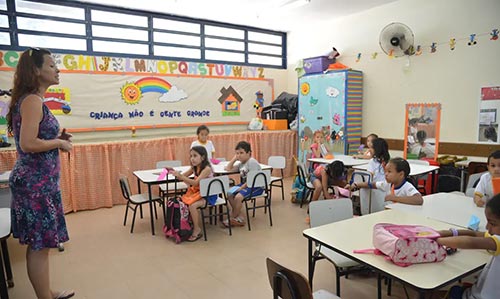
<p><img src="https://www.iea.usp.br/imagens/aula-para-criancas-pequenas" alt="Aula no ensino fundamental 1" class="image-right" title="Aula no ensino fundamental 1" /></p>
<p><strong>Diversity and Inclusion</strong></p>
<p>Other topics covered in the publication are not directly linked to assessments and curricula but are fundamental to the full educational support of children and adolescents. These include accessibility and inclusion for students with disabilities, and the recognition and appreciation of ethnic and racial diversity.</p>
<p>According to Ivan Cláudio Pereira Siqueira, from the Federal University of Bahia (UFBA), for accessibility and inclusion to be effective, people with disabilities need to be served by appropriately trained professionals, as inclusive education poses specific challenges for personalized learning. He states that generative artificial intelligence (GenAI) tools promise to facilitate productivity, which is feasible in administrative tasks and in the production of teaching resources, but learning objectives have not yet been demonstrated in studies correlating the use of GenAI and the achievement of educational goals. This is despite the fact that available technology already allows for the development of applications for specific audiences, the challenge being the availability of data for this audience, says Siqueira. Still, he sees GenAI as a window of opportunity for personalized learning.</p>
<p>Researchers from the DACOR Institute, an NGO dedicated to combating racism through data systematization and knowledge dissemination, present historical insights to understand the impact of colonialism and slavery on the social constructions of Black students today. They also discuss the importance of public policies on ethnic-racial relations that allow schools to recognize and value diversity, contributing to the formation and development of a well-rounded individual.</p>
<p><strong>Violence</strong></p>
<p>Attention must also be paid to the impacts of harmful social factors, which manifest themselves within schools and their environment. The increase in violence and other problems affecting student coexistence is one such issue. Researchers from the State University of Campinas (UNICAMP) and the São Paulo State University (UNESP) have addressed this topic. The discussion focuses on the final grades of elementary and high school, and explores the specificities and incidence of these problems. The paper also discusses the lessons learned from research conducted by the Study and Research Group on Moral Education (GEPEM), a partnership between UNICAMP and UNESP aimed at addressing and preventing violence, and contributing to improving coexistence in schools. The essay intends to inform those responsible for programs and interventions, as well as those developing assessments and studies on the topic.</p>
<p>Territorial violence and its effects on student life in the city of Rio de Janeiro and a municipality in the province of Buenos Aires are the subject of two articles. A group of researchers, primarily from institutions in the state of Rio de Janeiro, have investigated the effects of territorial control by drug trafficking factions and militias on learning in the examined urban center. The authors point out that there is evidence that crime and violence undermine educational opportunities and outcomes, but the impacts of organized crime are still poorly understood. In the other article, four researchers from Argentine universities have analyzed how the web of violence affects the daily lives of low-income youth who participate in youth centers in the country's capital. They state that "to understand the complex, heterogeneous, and ambiguous nature of violence, it is necessary to offer a more measured perspective that focuses on the smaller, everyday aspects of the games that create precariousness."</p>
<p><strong>Immigrants</strong></p>
<p><strong> </strong></p>
<p>In the field of intercultural studies, four articles analyze the schooling processes and performance of immigrant students or students of immigrant descent in Brazil, Argentina, Spain, and Portugal. Lineu Norio Kohatsu, a professor at USP's Institute of Psychology (IP) and a participant in IEA's Sabbatical Year Program in 2020, authors a paper on the academic performance of immigrant students in public schools in São Paulo. The study has indicated that immigrants have higher grade point averages and lower failure rates.</p>
<p>The schooling processes in the context of immigration have been characterized by two anthropologists from the University of Buenos Aires based on surveys in a locality of the capital including the engagement of a high number of Bolivians, trips to the places of origin of this population, and the collaborative experience of a radio station. The researchers have observed the strength of the allusions to community life in the places of origin and how it continues to be a parameter for life and schooling in the new place of residence.</p>
<p>In the case of the Spanish context, researchers from the Autonomous University of Barcelona have collected the life stories of 50 mothers of Moroccan origin over a period of five years. The data have allowed for the identification of the strategies developed in the processes of social integration, as well as the ways of supporting the children's schooling.</p>
<p>A study on the performance of immigrant students in Portugal has covered both basic and higher education. Affiliated with universities in the same country, the authors advocate for the adoption of measures related to the reception and integration of immigrants and their descendants in the educational sphere, the development of intercultural education in schools, the fight against academic failure and school dropout as well as against ethnic/cultural, religious, and gender discrimination, and the strengthening of teacher training.</p>
<p>This issue of the journal also includes an article that addresses literacy in the Portuguese language, presenting the history of the teaching method for children and adults created by António Feliciano de Castilho in 1849 on the island of São Miguel, in the Azores, and later disseminated and implemented in other parts of Portuguese territory. Another work, this one of philosophical nature, discusses the thought of French philosopher Paul Ricoeur (1913-2005) on educational matters. The reference is Ricoeur's article <i>La Parole est Mon Royaume</i> ("The Word is My Kingdom"), published in 1955. According to the authors, he considered the word shared between generations as the core of teaching.</p>
<p><strong>Reviews</strong></p>
<p><img src="https://www.iea.usp.br/imagens/capa-do-livro-o-primeiro-leitor" alt="Capa do livro &quot;O Primeiro Leitor&quot;" class="image-left" title="Capa do livro &quot;O Primeiro Leitor&quot;" /></p>
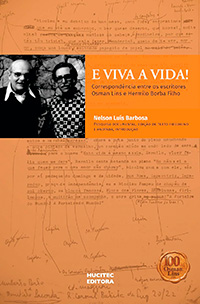
<p><img src="https://www.iea.usp.br/imagens/capa-do-livro-e-viva-a-vida" alt="Capa do livro &quot;E Viva a Vida!&quot;" class="image-right" title="Capa do livro &quot;E Viva a Vida!&quot;" /></p>
<p>Historian Tania Regina de Luca, a full professor at UNESP, has written about the book <i>Primeiro Leitor – Ensaio de Memória</i> ("The First Reader – An Essay on Memory"), by editor Luiz Schwarcz. At the beginning of the review, de Luca states that the book analyzes issues related to the social figure, role, and actions of a publisher. Half of the chapters are dedicated to the publishing world and its characters, and the other half address deceased writers who have been important to Schwarcz and to the publishing house he founded in 1986, Companhia das Letras.</p>
<p>Authored by writer and journalist Hugo Almeida, the other review is about the book <i>E Viva a Vida! – Correspondência entre os Escritores Osman Lins e Hermilo Borba Filho</i> ("And Long Live Life! – Correspondence between Writers Osman Lins and Hermilo Borba Filho"), published by Hucitec in 2024. The work features a faithful and annotated text edition, documentary research, and an introduction by Nelson Luís Barbosa, who carried out the work during his postdoctoral research at USP's Institute of Brazilian Studies (IEB). The book brings together, analyzes, and contextualizes 201 letters, including notes and telegrams, exchanged by the two authors from the state of Pernambuco from 1965 to 1976.</p>
<p>The list below contains the names of the authors who have contributed with each one of the addressed themes:</p>
<p><strong>Basic Education</strong></p>
<p>Artificial Intelligence and Inclusion of Students with Disabilities in Basic Education - <i>Ivan Cláudio Pereira Siqueira</i><br />The Trajectory of Blacks in Basic Education: Adversities and Coping Proposals - <i>Alexandre Dantas et al.<br /></i>Regrouping Students to Recompose Learning: Brazilian Experiences - <i>Lina Kátia Mesquita de Oliveira et al.<br /></i>An Analysis of Academic Performance in the City Schools of Cubatão (SP) and Taquaritinga (SP) - <i>Mozart Neves Ramos et al.<br /></i>A Proposal for Evaluating BNCC [Common Core] General Competencies in Basic Education - <i>Ricardo Primi et al.<br /></i>Socializing and Working Together in Schools: Challenges and Possibilities - <i>Telma P. Vinha et al.<br /></i>Proposals for the new Basic Education Evaluation System (SAEB): The Current Debate - <i>Priscilla Tavares and Mariah Morikawa<br /></i>Where are High Schools Going? An Analysis of the 2017 and 2024 Legal and Regulatory Frameworks - <i>Eduardo Deschamps<br /></i>Early Childhood Education: The Discussion of the National Quality and Equity Parameters (PNQEI) Starts in the Cradle - <i>Daniel Domingues dos Santos and Camila Martins de Souza Silva<br /></i>Reflections on the Future of Educational Assessment in Brazil - <i>Maria Helena Guimarães de Castro<br /></i>The Effect of Attending Early Childhood Education on Students' Academic Performance in Brazil - <i>Hellen Cristina Araujo Penha et al.<br /></i>A Literary Non-Place: The Provisional Space of Literature in the National Common Curricular Base (BNCC) - <i>Antonio Ismael Lopes de Souza et al.<br /></i>"Jupiter Vibrating the Ray" in Defense of the Portuguese Method by A.F. de Castilho - <i>Cesar Augusto Castro and Carlota Boto<br /></i>A Craft Governed by Words: Paul Ricoeur, Education, and Language - <i>Denizart Busto de Fazio et al.</i></p>
<p><strong>Immigration, Education, and Violence</strong></p>
<p>Immigrant Students in Public High Schools: Academic Performance in Question - <i>Lineu N. Kohatsu<br /></i>Schools in Bolivia and Argentina: Contributions from an Ethnographic Research, Two Trips and a Collaborative Experience - <i>Gabriela Novaro and María Laura Diez<br /></i>Invisible Educational Oversight: The Presence of Moroccan Mothers at a School in Catalonia (Spain) - <i>Fatiha El Mouali et al.<br /></i>Viewpoints and Perspectives on Education and Immigration in Portugal: From Basic to Higher Education - <i>Maria da Conceição Pereira Ramos and Natália Ramos<br /></i>State Violence and Schemes: The Daily Life of Children and Young People in Lower-Income Neighborhoods - <i>Valeria Llobet et al.<br /></i>Education under Siege: Impacts of Territorial Control by Militias and Drug-Trafficking Gangs on Academic Performance - <i>Rogério Jerônimo Barbosa et al.</i></p>
<p><strong>Reviews</strong></p>
<p>On the Art of Editing - <i>Tania Regina de Lucca<br /></i>"And Long Live Life!": The Dialectic of Letters - <i>Hugo Almeida</i></p>
<p style="text-align: right; "><span class="discreet">Photos by Elza Fiuza/Agência Brasil. Public domain.</span></p>
<ul>
</ul>
<ul>
</ul>
<ul>
</ul>
<ul>
</ul>
<ul>
</ul>
<ul>
</ul>
<ul>
</ul>
<div id="_mcePaste">
<div class="tlid-results-container results-container">
<div class="tlid-result result-dict-wrapper">
<div class="result tlid-copy-target">
<div class="text-wrap tlid-copy-target"></div>
</div>
</div>
</div>
</div>]]></content:encoded>
    <dc:publisher>No publisher</dc:publisher>
    <dc:creator>Richard Meckien</dc:creator>
    <dc:rights>Original version in Portuguese by Mauro Bellesa.</dc:rights>
    
      <dc:subject>Basic Education</dc:subject>
    
    
      <dc:subject>Journal</dc:subject>
    
    
      <dc:subject>Violence</dc:subject>
    
    
      <dc:subject>Immigration</dc:subject>
    
    
      <dc:subject>Publications</dc:subject>
    
    
      <dc:subject>IEA</dc:subject>
    
    
      <dc:subject>Education</dc:subject>
    
    
      <dc:subject>Childhood</dc:subject>
    
    <dc:date>2025-10-15T05:40:00Z</dc:date>
    <dc:type>News Item</dc:type>
  </item>


  <item rdf:about="https://www.iea.usp.br/en/news/journal-issue-114">
    <title>"Estudos Avançados" #114 highlights the challenges for COP30</title>
    <link>https://www.iea.usp.br/en/news/journal-issue-114</link>
    <description> </description>
    <content:encoded xmlns:content="http://purl.org/rss/1.0/modules/content/"><![CDATA[<p><img src="https://www.iea.usp.br/imagens/capa-da-edicao-114-da-revista-estudos-avancados" alt="Capa da edição 114 da revista Estudos Avançados" class="image-right" title="Capa da edição 114 da revista Estudos Avançados" /></p>
<div>
<p>In 2022, fossil fuels accounted for 81.9% of all energy consumed worldwide. To combat global warming, it is necessary to reduce the consumption of these fuels and find substitutes for them. However, this energy transition requires solutions to two problems, according to physicist <a href="https://www.iea.usp.br/en/persons/researchers/jose-goldemberg" class="external-link">José Goldemberg</a>: the depletion of oil reserves exploitable with current technologies and costs by 2050 (other reserves should extend this timeframe, but at higher costs), and the reduction of carbon (CO<sub>2</sub>) emissions resulting from the burning of fossil fuels through the use of more efficient technologies.</p>
</div>
<div>
<p>This point of view is reflected in Goldemberg's article "Expectations for COP30 in Belém," which opens the dossier "COP30 Challenges," published in issue #114 of the journal <i><a href="https://www.iea.usp.br/en/journal" class="external-link">Estudos Avançados</a></i>, released this month. Featuring nine papers by 37 researchers from various USP units and six federal universities, the dossier discusses the impacts and ways to fight the climate crisis, addressing topics such as the risks to the Amazon, the effects of climate change on human health, the role that agriculture can play in reducing emissions, CO<sub>2</sub> storage, and the carbon market.</p>
</div>
<p><strong>Climate Negotiations</strong></p>
<p>Goldemberg states that emissions increased globally by 33% between 1992 and 2022, with a 78% increase from developing countries (including China), which in 1991 were already responsible for more than 50% of the emissions. "Therefore, it is clear that the <a class="external-link" href="https://unfccc.int/">United Nations Framework Convention on Climate Change (UNFCCC)</a>, established at the <a class="external-link" href="https://www.un.org/en/conferences/environment/rio1992">1992 Earth Summit</a>, and the <a class="external-link" href="https://unfccc.int/process-and-meetings/the-kyoto-protocol/what-is-the-kyoto-protocol/kyoto-protocol-targets-for-the-first-commitment-period">Kyoto Protocol</a>, adopted in 1997, did not achieve the expected success," says the physicist.</p>
<p>He traces the climate negotiations back to a decision made at the 2009 United Nations Climate Change Conference (COP15) in Copenhagen for developed countries to allocate US$ 100 billion annually until 2020 to meet the needs of developing countries. "Bitter discussions on this topic took place over the years and it was decided that COP29 (Baku, 2024) would be dedicated to finance and review the 2009 decision under the <a class="external-link" href="https://unfccc.int/process-and-meetings/the-paris-agreement">Paris Agreement</a> of 2015."</p>
<p>The physicist highlights that at the closing session of COP29, faced with the imminent risk of failure, the president of the Conference presented a final decision "without consulting the plenary": to adopt the anual target of at least US$ 300 billion in climate finance from various public and private, bilateral, and multilateral sources, including alternative ones, until 2035. Goldemberg explains that this happened despite the fact that UNFCCC's <a class="external-link" href="https://unfccc.int/SCF">Standing Committee on Finance</a> estimates that US$ 5 to US$ 7 trillion (approximately US$ 455-485 billion per year) will be needed from 2022 to 2030.</p>
<p>He remembers that several countries questioned the COP29 decision and lamented the lack of a minimum allocation of resources for least developed countries, as well as the absence of guidelines for advancing the energy transition, in addition to arguing that China and Saudi Arabia should also contribute to climate finance.</p>
<p>"What we hope is that COP30, under the Brazilian presidency, will improve this situation." However, Goldemberg considers it unlikely that the anual US$ 300 billion allocated for climate finance until 2035 will increase, since "Trump's election will reduce the United States' participation in the process." Additionally, there is the impact of global inflation on the amount. "What can be improved is trying to increase the share of concessional resources that will come from public resources," he ponders, citing examples such as the Marshall Plan, created in 1948 by the USA for the European reconstruction, and the Inflation Reduction Act (IRA), adopted in 2022, which "can actually be considered a Marshall Plan to help North American industry face the energy transition."</p>
<p>Nonetheless, he states that climate finance from industrialized countries to developing countries is only part of the effort to reduce emissions: "Internal actions taken by governments can play an important role depending on the right public policy choices." Among these actions, Goldemberg mentions taxes on carbon emissions or the regulation of the emissions market by setting a maximum emission level per sector (or enterprise) and the creation of a market for buying and selling carbon credits like the one created by Brazil in 2024.</p>
<table class="tabela-esquerda">
<tbody>
<tr>
<th><img src="https://www.iea.usp.br/imagens/energia-solar-fotovoltaica" alt="Energia solar fotovoltaica" class="image-inline" title="Energia solar fotovoltaica" /><br /></th>
</tr>
<tr>
<td><span class="discreet">Emphasis on renewable energy: a more ambitious strategy that developing countries could adopt, according to Goldemberg</span></td>
</tr>
</tbody>
</table>
<p>A more ambitious strategy for developing countries is trying to guide their growth using more efficient technologies and renewable energy sources, the physicist adds.</p>
<p>In the Brazilian case, he comments that the federal government is, "at least rhetorically", taking this path through the <a class="external-link" href="https://www.gov.br/planalto/en/latest-news/2023/08/novo-pac-is-to-invest-brl-1-7-trillion-across-all-brazilian-states">New Growth Acceleration Program</a> (<i>Novo Programa de Aceleração do Crescimento/PAC</i>), which should invest a total amount of R$ 1.7 trillion: R$ 1.3 trillion by the end of 2025 and R$ 400 billion after 2026. "Due to the economic vicissitudes the country is going through and the low investment, the implementation of the <i>Novo PAC</i> is occurring slowly, but still paving the way through indispensable legislative measures to attract 'green' investments."</p>
<p>Goldemberg concludes by saying that holding COP30 in Belém will place a greater emphasis on preserving the Amazon rainforest, even considering that Brazil's contribution to global greenhouse gas emissions is modest (4.43% in 2022). "The success in reducing deforestation in the Amazon and the adoption of a law creating a carbon market in Brazil, which has only occurred in a few developing countries to date, will enable us to lead the way," he says.</p>
<p><strong>Sustainable Society</strong></p>
<p>Physicist Paulo Artaxo, coordinator of USP's Center for Studies on Sustainability of the Amazon Rainforest, also believes that COP30 will be an opportunity for Brazil to regain global leadership on issues related to climate change. He is the author of the article "COP30 and the Worsening Climate Crisis – Pathways to Build a Sustainable Society."</p>
<p>Some of the strategies he cited for adapting to climate change are: improving water resource management; protecting and restoring ecosystems by conserving natural areas; developing sustainable agricultural systems by developing plant varieties more resistant to extreme weather conditions such as droughts and floods; strengthening the health system to address heat-related and vector-borne diseases; disaster resilience planning with contingency plans that include community empowerment and the improvement of infrastructure to protect populations; and implementing educational programs on climate change and sustainability to increase public awareness and engagement.</p>
<p>However, Artaxo warns that the international landscape in which the Conference is taking place is unfavorable to the intensification of global governance. "We need to chart a course for the world to wean itself off fossil fuels, which are the root of the climate problems we face. We also need to structure policies for adapting to the new climate, particularly in the most vulnerable countries. In this task, implementing financing mechanisms is crucial so that less developed countries can implement their energy transition and adapt to the new climate."</p>
<p>According to him, although Brazil accounted for 4.5% of global emissions in 2023, it is not yet among the countries that price greenhouse gas emissions. "This creates difficulties in implementing regulatory policies for the so-called carbon market."</p>
<p>Artaxo emphasizes that the externalities of carbon emissions are not taken into account, adding that zeroing out net emissions (the difference between gross emissions and removals) can boost economies due to the investments needed to enable reductions and damage control. "Obviously, this transition to a low-carbon society must be carried out gradually and in a coordinated manner, also considering the reduction of social inequalities."</p>
<table class="tabela-direita">
<tbody>
<tr>
<th><img src="https://www.iea.usp.br/imagens/regeneracao-natural-assistida-cotriguacu-mt" alt="Regeneração natural assistida - Cotriguaçu/MT" class="image-inline" title="Regeneração natural assistida - Cotriguaçu/MT" /><br /></th>
</tr>
<tr>
<td><span class="discreet">Assisted natural regeneration (RNA) project in the region of Cotriguaçu, in the state of Mato Grosso</span></td>
</tr>
</tbody>
</table>
<p>He lists a series of measures aimed at reducing Brazilian emissions: reducing deforestation and restoring forest areas; increasing the use of renewable energy; promoting sustainable agriculture with the implementation of agroecological practices; and investing in quality public transportation and urban mobility with low greenhouse gas emissions, having an added benefit of reducing urban air pollution, which affects the health of millions of Brazilians.</p>
<p><strong>Risks for the Amazon</strong></p>
<p>"Amazon at Risk and COP30 as a Critical Opportunity to Avoid the Point of No Return" is an article authored by climatologist <a href="https://www.iea.usp.br/en/persons/researchers/carlos-nobre" class="external-link">Carlos Nobre</a>, a visiting professor at the IEA and holder of the Climate &amp; Sustainability Chair (a partnership between the Institute and USP's President's Office), and researchers Julia Arieira and Diego Oliveira Brandão, both members of the Scientific-Technical Secretariat of the <a class="external-link" href="https://www.sp-amazon.org/">Science Panel for the Amazon</a>. For them, the Conference represents a key opportunity to discuss and develop solutions for "preserving the ecological limits that sustain the integrity of the Amazon rainforest and the well-being of its people."</p>
<p>For this to happen, the authors consider it essential that dialogue between governments, civil society, local communities, the private sector, and academia be anchored in both science and local knowledge. Thus, "COP30 will be decisive in building pathways that reconcile sustainable development and a climate justice that recognizes that the impacts of climate change affect different social groups unequally, both in intensity and vulnerability."</p>
<p>The article analyzes the main threats pushing the Amazon towards its critical thresholds, the tipping points, and discusses governance and nature-based strategies that can halt its destruction and boost its regeneration and sustainable use.</p>
<p>Currently, 23% of the Brazilian Amazon is deforested, an area equivalent to 1 million km<sup>2</sup>, according to the study. Although there has been a reduction in deforestation in recent years, forest fires intensified by the historic drought of 2023-2024 have generated an alarming increase in greenhouse gas emissions, as pointed out by the authors.</p>
<p>The Amazon is also suffering from global warming. Some regions have already exceeded the 1.5°C increase limit (compared to the second half of the 19th century) established by the Paris Agreement: "In 2023, record temperature values were recorded in Manaus and Monte Alegre with annual averages of 28.8°C and 27.9°C, respectively, which were surpassed in 2024. Compared to the average for 1990-2010, these values represented an increase of 1.7°C in Manaus and 0.9°C in Monte Alegre in 2023, and an increase of 1.8°C in both Manaus and Monte Alegre in 2024."</p>
<p>Extreme droughts in the region have become more frequent. Previously, they occurred once every 20 years, but this century the recurrence interval was shortened to 5 years. An extreme drought event is a natural phenomenon associated with rising ocean surface temperatures in the North Tropical Atlantic and the Equatorial Pacific, but it has intensified and become more frequent due to human-induced global warming, the researchers comment. The consequence is a drastic reduction in the water levels of many important rivers in the region. The study explains that global warming above 2°C could further intensify the warming of surface waters in both oceans and, consequently, increase the occurrence of droughts in the Amazon.</p>
<table class="tabela-esquerda">
<tbody>
<tr>
<th><img src="https://www.iea.usp.br/imagens/seca-do-lago-do-aleixo-2023" alt="Seca do Lago do Aleixo - 2023" class="image-inline" title="Seca do Lago do Aleixo - 2023" /><br /></th>
</tr>
<tr>
<td><span class="discreet">Floating houses based on the bottom of Lake Aleixo, near Manaus, during the drought of 2023</span></td>
</tr>
</tbody>
</table>
<p>A synergistic combination of deforestation between 20% and 25%, and global warming of 2°C to 2.5°C could push more than half of the region into a state of irreversible degradation, according to the authors. The interaction between deforestation, forest degradation, fires, and global warming is associated with five potential tipping points: 1) a 2°C increase in average global temperature compared to pre-industrial levels; 2) local annual precipitation below 1,000 mm; 3) accumulated water deficit greater than -400 mm; 4) a dry season lasting more than six months; and 5) a cumulative<span> </span><span>forest cover</span><span> loss of 20%. "Some telling evidence of these processes include prolonged dry season, increased atmospheric vapor pressure deficit, and increased tree mortality rates."</span></p>
<p>The article warns that exceeding the point of no return will jeopardize greenhouse gas emissions control, alter rainfall patterns, and reduce agricultural and forestry productivity (both within and outside the Amazon). Other consequences will include the worsening of social inequalities, and losses in biological and cultural diversity, fueling a cycle of environmental degradation and social injustice.</p>
<p>Given these risks, the researchers emphasize that large-scale forest restoration, the implementation of sustainable infrastructure, regenerative livestock and agriculture practices, and bioindustrialization are essential nature-based solutions to keep the Amazon from environmental and social collapse in addition to curbing destruction. They add that the inclusion of Indigenous peoples and other communities of the region in the discussions is crucial to promoting social justice, sharing <span>benefits</span><span>, and reducing inequalities.</span></p>
<p><strong>Other articles</strong></p>
<p>The dossier includes five additional articles analyzing the consequences of climate change for Brazil in various areas and presenting proposals for minimizing and/or adapting to them. Some of the authors are pathologist <a href="https://www.iea.usp.br/en/persons/researchers/paulo-saldiva" class="external-link">Paulo Saldiva</a>, a full professor at USP's School of Medicine and former director of the IEA; soil specialist Carlos Eduardo Pellegrino Cerri, a professor at the Luiz de Queiroz College of Agriculture (ESALQ/USP) and a researcher at the <a class="external-link" href="https://ccarbon.usp.br/">Center for Carbon Research in Tropical Agriculture</a> (CCARBON/USP); and economic and social development specialist Marcel Burztyn, a full professor at the Center for Sustainable Development at the University of Brasília (UnB).</p>
<p>"Municipal Health Systems and Climate Change: Infrastructure and Resilience Challenges in Brazil," which addresses the harmful effects of climate change on human health, proposes a conceptual, operational, and budgetary transformation for building resilient systems in the country, emphasizing the integration between levels of care, the strengthening of regional governance, and the valuing of community social capital.</p>
<p>Crop and livestock farming is a major contributor to greenhouse gas emissions, but it is also one of the most vulnerable activities to climate change. A paper dedicated to the sector's role in addressing climate change presents information on some agricultural management practices considered options for adaption and mitigation of effects.</p>
<p>Socio-environmental protection is also addressed in the dossier. Researchers from UnB have analyzed the evolution of social protection instruments and present a proposal for integrating public policies to combat poverty and sustainable development. In this proposal, the abundant sunlight in Brazil's semiarid region becomes a solution intstead of a problem due to its use in clean energy generation, resulting in an income for vulnerable communities.</p>
<p>Legal aspects related to greenhouse gases are the subject of two further articles. One of them addresses the monitoring of the integrity and safety of CO<sub>2</sub> storage facilities, while the other is a comparative study of the legislative landscape for this area in Brazil, the United States, the United Kingdom, Norway, Canada, Australia, Japan, and the European Union. A third paper focuses on the creation of a regulated carbon market in Brazil. After analyzing international and national experiences, and legislative initiatives such as bills and the establishment of the Brazilian Greenhouse Gas Emissions Trading System by Law 15.042/24, the authors conclude that fundamental issues remain to be resolved, including those related to the agricultural sector.</p>
<p>The dossier ends with a review of "The Empire of Climate: A History of an Idea," a book by David Livingstone published in 2024 by Princeton University Press. Nilson Cortez Crocia de Barros, a tenured professor at the Federal University of Pernambuco (UFPE), comments that given the evidence of the severe effects of climate change, "Livingstone recovers the broad spectrum of considerations regarding the influence of climate on the human species. This spectrum is mapped along four paths: the medical path, the path of soul-searching, the economic path, and, finally, the military path."</p>
<p><strong>Related themes</strong></p>
<table class="tabela-direita">
<tbody>
<tr>
<th><img src="https://www.iea.usp.br/imagens/caca-diegues" alt="Cacá Diegues" class="image-inline" title="Cacá Diegues" /><br /></th>
</tr>
<tr>
<td><span class="discreet">A<span>n interview with f</span>ilmmaker Cacá Diegues (1940-2025) in 2021 is one of the highlights of issue #114</span></td>
</tr>
</tbody>
</table>
<p>In addition to the opening dossier, issue #114 contains <span>a second set of texts entitled "Society and the Environment." Although it covers a variety of topics, the section is equally connected to those to be discussed at COP30, according to the journal's editor, </span><a href="https://www.iea.usp.br/en/persons/researchers/sergio-adorno" class="external-link">Sérgio Adorno</a><span>. The themes range from natural resources (forests, water, and natural gas) to land issues. The proposal for citizen science and the concept of urban commons are also addressed.</span></p>
<p>The third section of the issue is dedicated to arts and culture. The operetta "Abel, Helena," by Artur Azevedo, the religious influence on artistic production, and the promotion of culture and the arts in Brazil are some of the covered subjects. There is also an interview with filmmaker Cacá Diegues, who died last February at the age of 84. Conducted in 2021 by Noel dos Santos Carvalho, a professor of Brazilian Cinema at the State University of Campinas (UNICAMP), it focuses on public policy, the film market, and attempts to institutionalize film production in the country.</p>
<p>The list below contains the names of the authors who have contributed with each one of the addressed themes:</p>
<p><strong>COP30 Challenges</strong></p>
<p>Expectations for COP30 in Belém - <i>José Goldemberg</i><br />COP30 and the Worsening Climate Crisis – Pathways to Build a Sustainable Society - <i>Paulo Artaxo<br /></i>Amazon at Risk and COP30 as a Critical Opportunity to Avoid the Point of No Return - <i>Carlos Afonso Nobre et al.<br /></i>Municipal Health Systems and Climate Change: Infrastructure and Resilience Challenges in Brazil - <i>Flavio Pinheiro Martins et al.<br /></i>Crop and Livestock Farming as Part of the Solution to Tackle Global Climate Change - <i>Carlos Eduardo Pellegrino Cerri et al.<br /></i>From Social to Socio-Environmental Protection in Times of Climate Change: A Retrospective and a Proposal - <i>Marcel Bursztyn et al.<br /></i>Legal Comparative Analysis of CO<sub>2</sub> Storage Monitoring in Selected Countries - <i>Thaiz da Silva Vescovi Chedid et al.<br /></i>The Regulated Carbon Market in Brazil - <i>Adriana Carvalho Pinto Vieira et al.<br /></i>The Climate Change Apocalypse and the Echoes of the Classical Geographic Mindset - <i>Nilson Cortez Crocia de Barros</i></p>
<p><strong>Society and the Environment</strong></p>
<p>Ecological-Economic Zoning: Overview and Interface with Planning and Public Policies - <i>Marcia Renata Itani et al.<br /></i>The Challenge of the Water/City Dyad in the Management of Urban Aquifers - <i>Filipe da Silva Peixoto and Itabaraci Nazareno Cavalcante<br /></i>A Genealogy of Urban Common Good - <i>Ana Rosa Chagas Cavalcanti and Leandro Silva Medrano<br /></i>Private Management of Public Forests in Brazil: Analysis of Concession Contracts - <i>Victor Pegoraro et al.<br /></i>The Brazilian Academic Milieu and the Application of Citizen Science to Ecological Research - <i>Eduardo Roberto Alexandrino et al.<br /></i>Santa Catarina’s Natural Gas Adhesion to Ascher’s Neo-Urbanism - <i>Leonardo Mosimann Estrella et al.</i><br />From Royal Land Grants to Latifundia: Reconstituting the Chain of Ownership in a Rural Settlement in Goiás - <i>Graciella Corcioli et al.<br /></i>Land Ownership Regularization in the Context of Agrarian Reform: The Case of the Santa Monica Rural Settlement in Terenos, MS - <i>Luciane Cleonice Durante et al.<br /></i>Unfinished Discussions: Disaster and Complex Systems - <i>Leandro Roberto Neves</i></p>
<p><strong>Arts and Culture</strong></p>
<p>Artur Azevedo and the Operetta: "Abel, Helena" - <i>João Roberto Faria<br /></i>Film Production, Cinema Novo, and Brazilian Modernity – Interview with Filmmaker Cacá Diegues - <i>Noel dos Santos Carvalho<br /></i>In the Colors of Creation: Living Religion and Regional Culture in Antônio Poteiro - <i>José Reinaldo F. Martins Filho<br /></i>Towards a Policy of Encounters: Reflections on the Advancement of Culture and Arts in Brazil - <i>Sharine Machado Cabral Melo</i></p>
<ul>
</ul>
<p style="text-align: right; "><span class="discreet">Photos (from the top): Science in HD/Unsplash; HD Mídia/WRI Brasil; Alberto César/Amazônia Real; and personal archive of Cacá Diegues</span></p>
<ul>
</ul>
<ul>
</ul>
<ul>
</ul>
<ul>
</ul>
<ul>
</ul>
<ul>
</ul>
<div id="_mcePaste">
<div class="tlid-results-container results-container">
<div class="tlid-result result-dict-wrapper">
<div class="result tlid-copy-target">
<div class="text-wrap tlid-copy-target"></div>
</div>
</div>
</div>
</div>]]></content:encoded>
    <dc:publisher>No publisher</dc:publisher>
    <dc:creator>Richard Meckien</dc:creator>
    <dc:rights>Original version in Portuguese by Mauro Bellesa.</dc:rights>
    
      <dc:subject>Climate</dc:subject>
    
    
      <dc:subject>Anthropocene</dc:subject>
    
    
      <dc:subject>Greenhouse Gases</dc:subject>
    
    
      <dc:subject>Energy</dc:subject>
    
    
      <dc:subject>Carbon Market</dc:subject>
    
    
      <dc:subject>Cinematography</dc:subject>
    
    
      <dc:subject>Amazon</dc:subject>
    
    
      <dc:subject>Environmental Sciences</dc:subject>
    
    
      <dc:subject>Journal</dc:subject>
    
    <dc:date>2025-07-28T05:40:00Z</dc:date>
    <dc:type>News Item</dc:type>
  </item>


  <item rdf:about="https://www.iea.usp.br/en/news/journal-issue-113">
    <title>"Estudos Avançados" #113 addresses democratic crisis, denialism, and journalism under pressure</title>
    <link>https://www.iea.usp.br/en/news/journal-issue-113</link>
    <description> </description>
    <content:encoded xmlns:content="http://purl.org/rss/1.0/modules/content/"><![CDATA[<p><img src="https://www.iea.usp.br/imagens/capa-da-revista-estudos-avancados-113" alt="Capa da revista Estudos Avançados 113" class="image-right" title="Capa da revista Estudos Avançados 113" /></p>
<p>Issue #113 of the journal <i><a href="https://www.iea.usp.br/en/journal" class="external-link">Estudos Avançados</a></i>, corresponding to the first four months of 2025, focuses on the setbacks and disruptions that democracy has faced both in Brazil and in other countries. It consists of three dossiers: "Democracy," "Denialism and Authoritarianism," and "Disinformation and Democracy," which total 19 articles written by 34 researchers from several Brazilian universities.</p>
<p>The publication's editor, sociologist <a href="https://www.iea.usp.br/en/persons/researchers/sergio-adorno" class="external-link">Sérgio Adorno</a>, points out the convergence of the three sets of texts and highlights that the first of them, "Democracy," explores the current dilemmas of this government regime, "many of which are manifested in the decline in levels of trust in political institutions and the emergence of populist political projects."</p>
<p>The topic is discussed in the opening article of the dossier, "Does Democracy Have a Future?," by Elisa Reis, from the Federal University of Rio de Janeiro (UFRJ). She argues that, although its intrinsically expansive nature does not guarantee the survival of democracy by itself, it can provide the basis for the development of political strategies that, by combining human and technological resources, manage to "foster innovative ways to promote justice, inclusion, and participation, the elements that give life to democratic coexistence".</p>
<p>The debate on the principle of equality, one of the pillars of democracy, is essential in an era in which "social inequalities of all kinds are deepening," as the editor points out. The issue is addressed in an article by José Reinaldo de Lima Lopes, from USP's Law School, based on the concept of equality as belonging defended by Aristotle. For the professor, democratic and republican legitimacy depends on the idea of ​​general justice in which equality means belonging and indifference to it constitutes fertile ground for distrust and authoritarian solutions.</p>
<p><strong>The Brazilian case</strong></p>
<p><span>Bringing the discussion about democracy to the Brazilian situation, political scientist Bruno Reis, from the Federal University of Minas Gerais (UFMG), analyzes the political crisis experienced by the country from 2013 to 2022. His work seeks a synthesis of the components present in the period, examining topics such as institutional dynamics and their conditions of stability, dysfunctionalities in the regulation of electoral campaign financing, the drift towards a government hostile to the constitutional order, the interaction of the Brazilian crisis with the international framework of democratic erosion, and the prospects for overcoming the "destructive drift."</span></p>
<p>The crisis of Brazilian democracy is also discussed in a study by seven researchers from USP, the São Paulo State University (UNESP), the Federal University of ABC (UFABC), and the Federal University of São Paulo (UNIFESP). The work reflects on the legal and institutional dimension of this crisis and its specificities in the global context. The authors state that "it is necessary to consider the problem of democracy from a legal and institutional perspective in a systematic way and in all its complexity, and not in a manner restricted to the themes usually explored: the party-electoral and government systems, and the role of the Judiciary."</p>
<p><strong>Intelligences</strong></p>
<p><span>The dossier also addresses changes that impact the dynamics of democratic regimes today, such as the emergence of artificial intelligence (AI). Researchers from UFMG and the Federal University of Goiás (UFG) point out that the coexistence of individual, collective, and artificial intelligences poses new challenges for democratic theory in the context of human-machine interaction.</span></p>
<p>They state that there is no a priori determination about how humans will reconstruct their forms of learning in the layers of individual and collective intelligences when feeding on feedback produced in the AI ​​layer: "The challenges are enormous and human centrality is central to the future of democracy."</p>
<table class="tabela-esquerda">
<tbody>
<tr>
<th><img src="https://www.iea.usp.br/imagens/obra-de-elian-almeida-1" alt="Obra de Elian Almeida" class="image-inline" title="Obra de Elian Almeida" /><br /></th>
</tr>
<tr>
<td><span class="discreet">Reproduction of <i>O Mais Importante É Inventar o Brasil que Nós Queremos</i> (2021), by Elian Almeida, image that illustrates issue #113</span></td>
</tr>
</tbody>
</table>
<p><strong>Claims</strong></p>
<p>Another topic addressed by the dossier is the unfulfilled promises of liberal-democratic traditions regarding feminist and anti-racist demands. The article by Luciana Tatagiba, from the State University of Campinas (UNICAMP), and Flávia Biroli, from the Univeristy of Brasília (UnB), provides an interpretation of what is at stake in the normality and in the crisis of democracies based on interviews conducted with Brazilian feminist and anti-racist leaders <span>in 2023</span><span>.</span></p>
<p>The dossier concludes with a case study by Jefferson Nascimento, a doctoral student at the Rio de Janeiro State University (UERJ). He analyzes the process of militarization and dedemocratization in Venezuela during the governments of Hugo Chávez and Nicolás Maduro. Nascimento comments that during Chávez's term the military received incentives to participate in politics at institutional levels. The relationship with the government deepened under Maduro's administration, ensuring their survival in power amid the economic crisis and attacks by opponents, but contributing to the erosion of the country's democratic system.</p>
<p>The decline of the democratic system in various parts of the world is accentuated directly or indirectly by several factors. One of them is denialism, the belief in a supposed loss of legitimacy of science from different perspectives.</p>
<p><strong>Denialism</strong></p>
<p>The second dossier in issue #113, "Denialism and Authoritarianism," discusses the topic from different perspectives. Among them, the journal’s editor cites the absence of a denialist movement in Brazil on the scale of those occurring in other countries, the predominance of denialist attacks on public policy issues (vaccines, universities, and social policies), the assumption of epistemic denialism, and clashes between epistemic authority and the uses of science based on the debates that took place in the COVID-19 Parliamentary Investigation Commission.</p>
<p>Adorno adds that denialism "is equally present, active, and strong in the public and political sphere, especially in this era of polarization and right-wing extremism." This is revealed in the articles that address anti-intellectualism, the cultivation of masculinity, and the elimination of gender perspectives in the policies of the Ministry of Women, Family, and Human Rights during the Bolsonaro government. The closing of the set of texts is a review of the book <i>Dicionário de Negacionismos no Brasil</i> ("Dictionary of Negacionisms in Brazil"), organized by José Szwako and José Luiz Ratton.</p>
<p><strong>Disinformation</strong></p>
<p>But denialism is not an isolated phenomenon that erodes the credibility of information available to the public, a fundamental resource for the full exercise of citizenship in a democratic society. In this context of deteriorating public debate, the dossier "Disinformation and Democracy" completes the analysis of the complex contemporary situation with articles written by members and guests of IEA's research group on Journalism, Law, and Freedom.</p>
<p>The articles discuss topics such as the need to deepen the concept of disinformation, the trends in transnational journalism with its data validation processes by information agencies, the risks to journalism and democracy represented by digital platforms, the curtailment of freedom of the press and expression promoted and encouraged by the federal government, especially under the Bolsonaro administration, and the role of social media in disrupting democracy.</p>
<p>The list below contains the names of the authors who have contributed with each one of the addressed themes:</p>
<p><strong>Democracy</strong></p>
<p>Does Democracy Have a Future? - <i>Elisa Reis</i><br />Equality and Justice Today, on the Steps of Aristotle - <i>José Reinaldo de Lima Lopes<br /></i>Institutional Dynamics and International Ballast: Toward a Diagnosis of the Brazilian Political Crisis (2013-2022) - <i>Bruno Pinheiro Wanderley Reis<br /></i>Crisis of Brazilian Democracy and Legal-Institutional Arrangements - <i>Murilo Gaspardo, Maria Paula Dallari Bucci, Vanessa Corsetti Gonçalves Teixeira, Carolina Gabas Stuchi, José Duarte Neto, Rubens Beçak, and Daniel Campos de Carvalho<br /></i>Artificial Intelligence and Democracy: Humans, Machines, and Algorithmic Institutions - <i>Fernando Filgueiras, Ricardo Fabrino Mendonça, and Virgílio Almeida<br /></i>Feminist Critiques of Democracy in Brazil: Analysis of the Crisis and the Limits of Normality - <i>Luciana Tatagiba and Flávia Biroli<br /></i>Militarization and De-Democratization During the Chavista Governments in Venezuela - <i>Jefferson Nascimento</i></p>
<p><strong>Denialism and Authoritarianism</strong></p>
<p>The Meanings of the Crisis or Reflective Manifesto on Denialism and Science - <i>José Szwako<br /></i>Epistemic Denialism - <i>Renan Springer de Freitas<br /></i>The Public Life of Scientific Facts: Science and Politics at the Parliamentary Inquiry Commission on the Pandemic in Brazil - <i>Daniel Edler Duarte, Pedro Benetti, and Marcos César Alvarez<br /></i>"Good War, Boy(s)!": Bolsonarism, "Anti-Intellectualism," and Masculinity - <i>Maria Caramez Carlotto<br /></i>"Woman" and "Family": Conventional Wisdom as Public Policy in the Bolsonaro Government - <i>Marília Moschkovich<br /></i>The Past, Intermittency, and Future of an Illusion - <i>Daniel Afonso da Silva</i><br />From A to Z: a Guide to Understanding Denialism - <i>Guilherme Queiroz Alves</i></p>
<p><strong>Disinformation and Democracy</strong></p>
<p>Disinformation, Democracy, and Regulation - <i>Vitor Blotta and Eugênio Bucci<br /></i>From Transnational Journalism to Blockchain Experiments in the Struggle Against Disinformation - <i>Ben Hur Damenek and Magaly Prado<br /></i>Threats to Journalism from Digital Platforms: Contributions to Regulation - <i>Rogério Christofoletti<br /></i>Shut up, Journalist: Intimidation and Disinformation as State Policies - <i>Camilo Vannuchi, João Gabriel de Lima and Taís Gasparian<br /></i>Social Media and Disruptions of Democracy - <i>Clifford Griffin and Vitor Blottar</i></p>
<ul>
</ul>
<ul>
</ul>
<ul>
</ul>
<ul>
</ul>
<ul>
</ul>
<ul>
</ul>
<div id="_mcePaste">
<div class="tlid-results-container results-container">
<div class="tlid-result result-dict-wrapper">
<div class="result tlid-copy-target">
<div class="text-wrap tlid-copy-target"></div>
</div>
</div>
</div>
</div>]]></content:encoded>
    <dc:publisher>No publisher</dc:publisher>
    <dc:creator>Richard Meckien</dc:creator>
    <dc:rights>Original version in Portuguese by Mauro Bellesa.</dc:rights>
    
      <dc:subject>Democracy</dc:subject>
    
    
      <dc:subject>Denialism</dc:subject>
    
    
      <dc:subject>Journal</dc:subject>
    
    
      <dc:subject>Journalism</dc:subject>
    
    
      <dc:subject>Authoritarianism</dc:subject>
    
    
      <dc:subject>Exhibition</dc:subject>
    
    
      <dc:subject>IEA</dc:subject>
    
    
      <dc:subject>Publications</dc:subject>
    
    <dc:date>2025-04-05T17:40:00Z</dc:date>
    <dc:type>News Item</dc:type>
  </item>


  <item rdf:about="https://www.iea.usp.br/en/news/book-history-iea-english-version">
    <title>Book about the history of the IEA now has an English version</title>
    <link>https://www.iea.usp.br/en/news/book-history-iea-english-version</link>
    <description></description>
    <content:encoded xmlns:content="http://purl.org/rss/1.0/modules/content/"><![CDATA[<table class="tabela-esquerda">
<tbody>
<tr>
<th><img src="https://www.iea.usp.br/imagens/lancamento-do-livro-do-iea-ingles-gana" alt=" Lançamento do livro do IEA inglês - Gana" class="image-inline" title=" Lançamento do livro do IEA inglês - Gana" /></th>
</tr>
<tr>
<td><span class="discreet">Roseli de Deus Lopes, director of the IEA, speaks during the directors' conference of the UBIAS network.</span></td>
</tr>
</tbody>
</table>
<p><span>A year after the launch of "Advanced in What? The Pioneering Trajectory of the Institute of Advanced Studies of the University of São Paulo," the publication is now available in English. The version of the book, authored by former Director <a href="https://www.iea.usp.br/en/persons/researchers/guilherme-plonski" class="external-link">Guilherme Ary Plonski</a> and historian Roney Cytrynowicz, was presented to the public during the directors' conference of the <a class="external-link" href="http://www.ubias.net">University-Based Institutes for Advanced Study (UBIAS)</a> network, hosted by the Maria Sibylla Merian Institute for Advanced Studies in Africa (MIASA) in Ghana, from November 4 to 6. The content can be accessed on the <a class="external-link" href="https://www.livrosabertos.abcd.usp.br/portaldelivrosUSP/catalog/book/1741">USP Open Books Portal</a>.</span></p>
<p><span>"Making the account of IEA’s journey in the contemporary <i>lingua franca</i> intertwines two closely related historical milestones: the almost four decades since the creation of our Institute and the 15 years since the establishment of the global network. It also substantially contributes to the process of prospective reflection within the community of IASs, as agreed upon in Accra," said Plonski after having joined the interinstitutional meeting.</span></p>
<p><span>Words by him make up the introductory note to the volume, as do those of Professor Roseli de Deus Lopes. Together, they directed the IEA from April 2020 to April 2024. Both recall that the President of USP at the time of the Institute's creation, Professor José Goldemberg, to whom the book is dedicated, had firsthand knowledge of the Institute for Advanced Study in Princeton, in the USA, and "understood that it was the strategic model to revitalize the University after the dramatic period experienced under an authoritarian regime," referring to the military dictatorship in Brazil. According to them, this is the reason why Goldemberg assigned the IEA the mission of "fostering new ideas resulting from the coexistence, confrontation, and interaction between the various areas of intellectual work," as described by its founder 39 years ago.</span></p>
<p><span>The book delves into the cultural context that has led to the creation of the IEA and presents its trajectory based on research and interviews conducted by Cytrynowics, a work made possible by partners Itaú Foundation and the Brazilian Internet Steering Committee (CGI.br), as pointed out by Plonski and Lopes. For them, the Institute owes the reported <span>advances</span> largely "to the fact that it is integrated into the vibrant community of USP," which is why the launch of the original Portuguese version has been included in the celebrations of the University's 90th anniversary.</span></p>
<p>The current President of USP, Carlos Gilberto Carlotti Júnior, has been one of the people to write for the book's introduction, in which he highlights the role played by the Institute throughout its history in promoting the academic excellence of the University, "incessantly seeking to extend the boundaries of knowledge in various areas of learning." In addition to emphasizing IEA's focus on interdisciplinarity and intellectual collaboration, Carlotti Júnior has noted that several of the Institute's works have informed public policies in areas essential to Brazil, such as education and health.</p>
<p>The President has highlighted that even without having its own faculty and student body, the IEA manages to bring together professors and students from 80% of USP's teaching units, museums, and specialized institutes in its research teams in addition to contributing to academic exchange with other Brazilian and foreign institutions. Furthermore, he has praised the fact that the IEA is a founding member (2010) and integrated the coordination (2019-2021) of UBIAS, which brings together 47 IASs linked to universities on the five continents, something that "has enhanced the international projection of USP."</p>
<p>The Vice-President of USP, Maria Arminda do Nascimento Arruda, has contributed to the publication by addressing the context of the Brazilian redemocratization in which the IEA was created: "It has been envisioned as a place where researchers, scientists, intellectuals, artists, journalists, and public figures could coexist and design a renewed University in line with the new times." She has stated that the IEA collaborated in the democratic construction of the country, "insofar as it reflected on our issues, gave voice to those who opposed obscurantism, and, in short, embraced the enlightened role of a contemporary University of its time."</p>
<p>"This enlightened spirit that was at the origin of the IEA has not been lost, as can be seen in the Institute's actions, aimed at welcoming and reflecting on the new directions of an inclusive, differentiated, and socially democratic University while not abandoning the advanced agenda of knowledge and science," wrote Arruda.</p>
<p><strong><img src="https://www.iea.usp.br/imagens/capa-do-livro-do-iea-en" alt="Capa do livro do IEA - EN" class="image-right" title="Capa do livro do IEA - EN" /><span> </span>Support</strong></p>
<p>Representatives of the partners, who provided financial support for the production and publication of the book, have also enriched the material. Eduardo Saron, President of the Itaú Foundation, has stated that the partnership with USP was born through the IEA and from the "mutual desire to develop strategic, lasting, and impactful initiatives." The objective has always been "to contribute to emancipatory public policies that facilitate structural changes in education and culture."</p>
<p>Saron has mentioned the two initiatives that received the most attention from the partnership. The Alfredo Bosi Chair of Basic Education, inaugurated in 2019 to study innovative practices and training programs that promote significant advances in proposals for basic education, got support during its first five years. The Olavo Setubal Chair – Transversalities: Art, Culture, Science, and Education, in turn, has been fostered since its implementation in 2016 to enable the construction of a "vast legacy based on studies that encompass cultural management, the role of culture in society, and transversal discussions on art and science."</p>
<p>The executive secretary of CGI.br, Hartmut Richard Glaser, has said that the Oscar Sala Chair, a result of the partnership between the Committee and the IEA, enables multidisciplinary exchange between knowledge from diverse areas. In the first semester of 2025 it offered the postgraduate course "Economics, Culture and Power on the Internet" in the pursuit of strengthening and cultivating expertise about the internet, its impact, functioning, applications, and tools. "In this way, USP and CGI.br expand the horizon of digital technologies that favor technological advancement, innovation, and the fundamental right of access to information and communication."</p>]]></content:encoded>
    <dc:publisher>No publisher</dc:publisher>
    <dc:creator>Richard Meckien</dc:creator>
    <dc:rights>Original version in Portuguese by Mauro Bellesa.</dc:rights>
    
      <dc:subject>Institutional</dc:subject>
    
    <dc:date>2024-11-04T20:50:00Z</dc:date>
    <dc:type>News Item</dc:type>
  </item>


  <item rdf:about="https://www.iea.usp.br/en/news/journal-issue-112">
    <title>"Estudos Avançados" #112 presents the opposition of the peoples of the Amazon to the Anthropocene</title>
    <link>https://www.iea.usp.br/en/news/journal-issue-112</link>
    <description> </description>
    <content:encoded xmlns:content="http://purl.org/rss/1.0/modules/content/"><![CDATA[<p><img src="https://www.iea.usp.br/imagens/capa-da-revista-estudos-avancados-112" alt="Capa da revista Estudos Avançados 112" class="image-right" title="Capa da revista Estudos Avançados 112" /></p>
<p><span>The studies and essays in the dossier "Amazonia Against the Anthropocene" in issue #112 of the journal </span><i><a href="https://www.iea.usp.br/en/journal" class="external-link">Estudos Avançados</a></i><span> "highlight the complexity of the relationships between nature and culture, and the voices of those often silenced in colonial and official narratives," according to the publication's editor, sociologist </span><a href="https://www.iea.usp.br/en/persons/researchers/sergio-adorno" class="external-link">Sérgio Adorno</a><span>, a member of IEA's Board. The articles are available for free download from </span><a class="external-link" href="https://www.scielo.br/j/ea/i/2024.v38n112/">Scientific Electronic Library Online</a><span> (Portuguese only)</span><span>.</span></p>
<p>"Recurrent scenarios of territorial plundering of indigenous peoples, <i>quilombolas</i>, and traditional peoples and communities have stimulated the search for a common political identity and the implementation of actions aimed at environmental conservation and the defense of collective territorial rights, which leads to the formulation of an archaeology of resistance in the Anthropocene," he states.</p>
<p><strong>Coexistence</strong></p>
<p>With ten papers authored by researchers from Brazilian and foreign universities and institutes, most of them from institutions in the states of Pará and Amazonas, the dossier begins with the article "<span>Amazonia in Symbiosis: Traces of Humankinds Facing the Anthropocene</span>," by an anthropologist and three archaeologists from the Federal University of Western Pará (UFOPA). They propose a critical discussion on some definitions of the Anthropocene. According to them, the indigenous marks in the Amazon rainforest are the result of forms of coexistence between humans and the landscape that contrast with the new marks of the Anthropocene.</p>
<p>"If the villages, <i>terreiros</i>, paths, farms, and other places promoted by the Amazonian peoples project connections between species, human collectives, political forms, languages, technologies, and worldviews in flows of constant interaction, Western initiatives develop disconnections between people, territories, and cultures, and interrupt multiple interspecies flows."</p>
<p>However, they emphasize that the criteria for identifying the Anthropocene are being constructed based on exceptionalist and universalist parameters, while "the 'forest-land' does not emerge as a passive place" where the impacts of the new geological epoch occur. "By making their differences in the ways of inhabiting the land count, humans and more-than-humans in the Amazon face the Anthropocene."</p>
<p>This thesis is reinforced in the following text, "<span>An Archaeology of Forest Peoples</span>," by two other researchers from UFOPA. For them, the Anthropocene, understood from the perspective of mercantilism and colonialism or the emergence of industrial capitalism, has been made possible by the "spoliation of traditionally occupied territories transformed into places for the extraction of raw materials and labor. Therefore, the countercolonial resistance of the forest peoples through the defense of their territories and ways of life are examples of an 'Amazon against the Anthropocene.'"</p>
<p>The authors state that archaeology, by providing historical understanding from material remains, "presents itself as a powerful tool for telling the history of these peoples, which has always been written from documents produced by outsiders." In the article they seek to demonstrate that the Amazon is a web of socio-ecological interactions as a result of the domestication of landscapes and populations of species.</p>
<p><strong>Landscapes</strong></p>
<p>The domestication of landscapes is the subject of an article by researchers from the National Institute for Amazonian Research (INPA), the Juruá Institute, and the State University of Campinas (UNICAMP)<span>. </span>They comment that the Amazon is a natural biome in the popular imagination, which "denies the existence and agency of indigenous peoples, who arrived at least 13,000 years ago." This myth of the virgin forests ends up having repercussions on public policies for conservation and regional development, they note.</p>
<p>The researchers explain that indigenous peoples combine horticulture and domestication of landscapes, as well as sedentarism and mobility. According to them, it is widely accepted that the most intensely domesticated landscapes are more common where indigenous populations were largest. Along rivers, for example.</p>
<p>Regarding the debate about domestication in areas between rivers, they state that the objection to this having occurred is due to the lack of evidence in these regions. Studies are mainly carried out in areas close to large rivers due to their ease of access. The assumption that highly mobile peoples have not domesticated landscapes intensively is a thesis that has proven to be erroneous, according to the article.</p>
<p><strong>Food production</strong></p>
<p>The dossier also addresses specific aspects of indigenous cultures, such as food production techniques. The topic is addressed in an article by anthropologists from the Federal University of Amazonas (UFAM) and the Federal University of Santa Catarina (UFSC). Built over time and connected to cosmological formulations, the wealth of food preparation and consumption techniques “was and is used in the transformation of plants in a broad sense, cultivated or not, domesticated or wild, from agriculture or foraging, native or exotic, from the countryside, the forest, or the scrubland,” they say.</p>
<p>The study considers three plant species (<i>açaí</i>, <i>mairá</i> potato, and <i>umari</i>), observing the ways of obtaining fundamental ingredients (gum and paste) or altering the state of the plant matter (smoking, fermentation). Understood "as cosmotechnics, the ways of transforming plants are a clear example of anti-anthropocene practices, since their orientation is based on an indigenous equistatutory episteme between species and other subjects inhabiting the Earth."</p>
<p>Countercolonial autonomy in the face of the capitalocene. This is how two researchers, one from the University of Brasília (UnB) and the other from Lancaster University, define the indigenous movement in the Lower Tapajós River in their article. According to them, this countercolonial autonomy is manifested in the cultivation of cassava, worldview, and political self-organization. The focus of the text is on the Tupinambá people. To address the problem of conflicts between indigenous and non-indigenous people, the researchers propose four possibilities: a new universal approach to recognition; the idea of ​​insurgent universality; the idea of ​​traditionally occupied lands; and territories of common use.</p>
<p>Archaeologists from USP, UFOPA, the Max Planck Institute, and the University of Exeter present research findings based on data from four regions of the Amazon: 1) the geoglyphs of the state of Acre, in Brazil; 2) the raised fields of French Guiana; 3) the Amazonian dark earth of the Lower Tapajós River; and 4) the zanja sites (sets of ditches) in Iténez, Bolivia. The study has sought to answer several outstanding questions about the nature of the Anthropocene, including the role of deforestation in indigenous practices in the past, the extent to which black earths have been produced for cultivation, and the extent to which the Amazon rainforest has recovered after the demographic collapse.</p>
<p>According to the authors, the period that began 4,500 years ago "marked one of the largest-scale environmental transformations, with an abrupt increase starting 2,000 years ago." For them, considering this second period as the beginning of an Amazonian Anthropocene "is a topic open to debate." However, they state that paleoecological data suggest that such transformations, instead of causing negative ruptures in existing ecosystems, have managed to maintain vital ecosystem services by maintaining vegetation cover with the construction of new relationships between people and other beings in the forest. However, they point out that the most intense and destructive anthropogenic impacts occurred <span>in several regions of the Amazon </span><span>after the European invasion, especially during the 20th century.</span></p>
<p><strong>Cosmological Aspects</strong></p>
<p>Two social scientists from the Federal University of Espírito Santo (UFES) are the authors of a paper on issues related to the Anthropocene based on indigenous epistemologies and ontologies, which according to them "disarrange non-indigenous understandings about humanity, nature, supernature, and consequently about life, death, and extinction."</p>
<p>From an ethnographic perspective, the article focuses on indigenous ways of thinking, inhabiting, and transforming the relationship between the consumption of natural resources and the capacity for environmental regeneration through the contact with beings other than humans, living and non-living, regulated by a series of precautions. The researchers' hypothesis is that multispecies kinship allows us to understand both the creation and sustainability of the fertility/vitality of coexistence networks as well as their depredation/extinction in terms of the rupture of relationships between beings through separation and abandonment, configuring what they call the cosmopolitics of care.</p>
<p>An article by a postgraduate student in anthropology at UFAM who is a member of the Tuyuka people presents the vision of the Amazon territory as <i>tõkowiseri</i>: "a ceremonial house that makes life bubble up." He reports that this vision comes from the ancient understanding of the cosmo experience by the "specialists (<i>kumua</i>, <i>baya</i>, and, <i>yaiwa</i>) who care for the cosmic levels and all their inhabitants."</p>
<p>Faced with any action that will affect the inhabitants of another house (forest, water, air, etc.), these "experts" from the northwest Amazon ask for permission through the performance of ritual ceremonies with the aim of obtaining fruits, fish, game, and offering protection, tranquility, understanding, and invitations to the ceremonial party, explains the author.</p>
<p>Another indigenous researcher, from the Waiwai ethnic group, joins the dossier with an article about moments that have significantly transformed the trajectory of his people in the Wayamu Territory, including the contact with missionaries. The author also addresses his discovery of archaeology and how this made it possible to reconnect with an important part of the Waiwai history. This contact with history made him think about the "need to talk about indigenous archaeology and change a little of what has been said about the past of the Amazon."</p>
<p>The dossier is completed by a review of the book <span><i>Sob os Tempos do Equinócio: Oito Mil Anos de História na Amazônia Central </i>(2022), </span><span>by archaeologist Eduardo Goés Neves, director of USP's Museum of Archaeology and Ethnology.</span></p>
<p><strong>Other sections</strong></p>
<p>The issue also includes three other sets of articles. The first, “Climate Change,” includes analyses of the climate disaster in the state of Rio Grande do Sul in 2024, the influence of deforestation on climate refuges in the Amazon, the impacts of climate change on the Amazonian sociobioeconomy, and the effects of climate change on agriculture.</p>
<p>Two articles comprise a section dedicated to the work of German philosopher Hans Jonas (1903-1993), one of Martin Heidegger's (1889-1976) disciples but a strong critic of the latter's adherence to Nazism. One of the texts addresses Jonas's critique of the dualism that led to the separation between human beings and nature, and how this is the basis of the "wave of innovations in the current agri-food system, whose technological frontier seeks precisely to emancipate human nutrition from its dependence on soil, climate, and animals." The other article discusses the current relevance of Jonas's thinking based on the three axes that characterize his philosophical concerns: gnosis, life, and the relationship between technology and ethics.</p>
<p>The final set of texts in issue #112 brings three complementary articles to the dossier "Municipal Elections in São Paulo: Problems and Challenges," published in Estudos Avançados #111. They are studies about the performance of elementary school students in the city and the management of educational policies, the challenges for public cultural policies in São Paulo, and a discussion about the possible profile of an ideal voter who investigates candidacies in a multifaceted way and not just based on a single criterion.</p>
<p>The list below contains the names of the authors who have contributed with each one of the addressed themes:</p>
<p><strong>Amazonia Against the Anthropocene</strong></p>
<p>Amazonia in Symbiosis: Traces of Humankinds Facing the Anthropocene<span> - </span><i>Miguel Aparício, Claide de Paula Moraes, Anne Rapp Py-Daniel, and Eduardo Góes Neves</i><br />An Archaeology of Forest Peoples<span> - </span><span><i>Vinicius Honorato and Bruna Rocha<br /></i></span>Domestication of Amazonian Landscapes<span> - </span><span><i>Charles R. Clement, Maria Julia Ferreira, Mariana Franco Cassino, and Juliano Franco de Moraes<br /></i></span>Forest Cuisine – Indigenous Techniques in Amazonian Food Production<span> - </span><span><i>Gilton Mendes dos Santos and Lorena França<br /></i></span>Tõkowiseri: Kumuánica, Bayaroánica, and Yaiwánica Cosmovivences<span> - </span><span><i>Justino Sarmento Rezende<br /></i></span><span>Countercolonial Autonomies Against the Capitalocene in Amazonia: the Lower Tapajós Indigenous Movement - </span><span><i>Raquel Tupinambá and James A. Fraser<br /></i></span><span>A History of How the Waiwai of Amazonia Have Been Building and Now Telling Their Archaeologies </span><span>- </span><i>Jaime Xamen Wai Wai<br /></i>What do Paleoecological Data Tell Us About the Amazon Anthropocene?<span> - </span><i>Jennifer Watling, S. Yoshi Maezumi, Myrtle P. Shock, and José Iriarte<br /></i>Kinship With the Land and Indigenous Cosmopolitics of Care<span> - </span><i>Ana Gabriela Morim de Lima and Nicole Soares-Pinto<br /></i>Archaeology to Live in the Future<span> - </span><i>Marcia Bezerra</i></p>
<p><strong>Climate Change</strong></p>
<p>Brazil’s Worst Climate Disaster: Rainstorms and Flooding in the State of Rio Grande do Sul in April-May 2024<span> - </span><span><i>Jose A. Marengo et al.<br /></i></span>Deforestation Restricts Climate Havens in Amazonia<span> - </span><span><i>Calil Torres-Amaral, Luciano Jorge Serejo dos Anjos, Everaldo Barreiros de Souza, and Ima Célia Guimarães Vieira<br /></i></span>Impacts of Climate Change on the Sociobioeconomy of Amazonia<span> - </span><span><i>Diego Oliveira Brandão, Julia Arieira, and Carlos A. Nobre<br /></i></span>Climate Change, Agriculture, and Cattle Farming: Impacts, Mitigation, and Adaptation. Challenges and Opportunities<span> - </span><i>Eduardo Delgado Assad and Maria Leonor Ribeiro Casimiro Lopes Assad</i></p>
<p><strong>Hans Jonas</strong></p>
<p><span>The Agrifood System Through the Lens of Hans Jonas' Philosophical Biology - </span><i>Ricardo Abramovay<br /></i>Hans Jonas, a Philosopher of Our Time<span> - </span><i>Jelson Oliveira</i></p>
<p><strong>Municipal Elections in São Paulo: Problems and Challenges II</strong></p>
<p><span>The Issue of Elementary Education in the City of São Paulo - </span><i>Bernardete A. Gatti<br /></i>Contemporary Challenges for Cultural <span>Public </span><span>Policies in the City of São Paulo</span><span> - </span><i>Lia Calabre and Ana Paula do Val<br /></i><span>How to Be a Demanding Voter and an Ideal Candidate</span><span> </span><span>-</span><span> </span><i>Marcos S. Buckeridge and Arlindo Philippi Júnior</i></p>
<ul>
</ul>
<ul>
</ul>
<ul>
</ul>
<ul>
</ul>
<ul>
</ul>
<ul>
</ul>
<div id="_mcePaste">
<div class="tlid-results-container results-container">
<div class="tlid-result result-dict-wrapper">
<div class="result tlid-copy-target">
<div class="text-wrap tlid-copy-target"></div>
</div>
</div>
</div>
</div>]]></content:encoded>
    <dc:publisher>No publisher</dc:publisher>
    <dc:creator>Richard Meckien</dc:creator>
    <dc:rights>Original version in Portuguese by Mauro Bellesa.</dc:rights>
    
    <dc:date>2024-09-10T17:40:00Z</dc:date>
    <dc:type>News Item</dc:type>
  </item>


  <item rdf:about="https://www.iea.usp.br/en/news/journal-issue-111">
    <title>"Estudos Avançados" #111 highlights priorities for the next administration of the city of São Paulo</title>
    <link>https://www.iea.usp.br/en/news/journal-issue-111</link>
    <description> </description>
    <content:encoded xmlns:content="http://purl.org/rss/1.0/modules/content/"><![CDATA[<p><span><span><a class="external-link" href="https://www.scielo.br/j/ea/i/2024.v38n111/"><img src="https://www.iea.usp.br/imagens/capa-da-revista-estudos-avancados-111" alt="Capa da revista Estudos Avançados 111" class="image-right" title="Capa da revista Estudos Avançados 111" /></a></span></span></p>
<p>In the midst of the campaign for this year's municipal elections, when candidates are expected to present an agenda of proposals, issue #111 of IEA's journal <i><a href="https://www.iea.usp.br/en/journal" class="external-link">Estudos Avançados</a></i> brings a wide range of analyses and proposals on the main problems of the city of São Paulo in order to contribute to the public debate on the priorities to be addressed by the next municipal administration. <span>The </span><span>digital version is now available, free of charge, at the <a class="external-link" href="https://www.scielo.br/j/ea/i/2024.v38n111/">Scientific Electronic Library Online</a> (Portuguese only)</span><span>.</span></p>
<p>The publication's editor, <a href="https://www.iea.usp.br/en/persons/researchers/sergio-adorno" class="external-link">Sérgio Adorno</a>, emphasizes that in a city where complex networks of social and institutional relations are established "the main challenge to governance lies precisely in promoting sustainable development with equity and social justice, with respect for the environment, with the participation of the most diverse social groups in decision-making that affects the lives of the greatest number of people, and with the promotion of a culture of respect for human rights".</p>
<p>These challenges have guided the composition of the dossier "Municipal Elections in São Paulo: Problems and Challenges," with 15 articles authored by 40 researchers from different institutions in areas such as urban planning, public health, education, sociology, economics, administration, and management of <span>public policies</span><span>.</span></p>
<p><span>A fundamental factor in meeting the demands of the people of São Paulo - as long as political decisions are made and procedures are established - is the appropriate allocation of budgetary resources. This is the concern of the article that opens the dossier: "</span><span>Reassessing São Paulo’s Budget Management Post-2014: From Resource Scarcity to Surplus,"</span><span> by Ursula Dias Peres, from USP's School of Arts, Sciences, and Humanities (EACH) at USP.</span></p>
<p>She defends "the need for greater pressure and control" for the effective use of budget resources. According to her, this is important to avoid the repetition of what happened between 2018 and 2022, when a set of factors led to the accumulation of a cash balance of more than R$20 billion, which "remained idle, despite the unmet demands of the population."</p>
<p>The work is the result of the analysis of a set of revenue, expenditure, and personnel structure data collected for the period of 2003 to 2023, in addition to interviews with key players in budgetary governance. Peres explains the factors that led to the municipality's surplus and indicates ways for the governance of the São Paulo budget to stop being characterized by a "significant increase in the political discretion of the head of the Executive."</p>
<p><strong>Security, health, and education</strong></p>
<p>A recent survey by Datafolha, one of the most important and complete research institutes in Brazil, indicates that 20% of São Paulo residents point to security as their main concern. Health and education are tied in second place, both cited as the main problems by 18% of the group surveyed. The importance of security as an issue in the São Paulo elections is addressed in an article by four researchers from the Brazilian Public Security Forum. They reflect on the shift in this agenda, "transferred from a predominantly state-level agenda to a central part of the city’s mayoral electoral strategies."</p>
<p>The hypothesis developed by the researchers is that homicides were given the status of "the city’s main public safety problem between the 1990s and 2000s." However, "there has been a change in the scenario with their reduction. The focus has become <span><i>Cracolândia </i>(literally "Crackland" in Portuguese, </span><span>a popular denomination for a region in São Paulo</span><span>) as well as the </span><span>sharp increase in property crimes, especially cell phone thefts and robberies. These factors have led to the "construction of an acute scenario of fear and insecurity among the population of São Paulo."</span></p>
<p>They warn that "deciphering the sphinx of public security" in São Paulo and other municipalities in Brazil "is still a risky and violent challenge for significant portions of the population, even more so in a time of social 'cultural war.'" The unknown arises from the doubt of whether "the new protagonism of municipalities in public security will be accompanied by reforms in the institutional architecture and organizational cultures of public security forces or if it is just a way of dissipating social demands and pressures for social justice, violence prevention, and citizenship."</p>
<p>The challenges of public health are the subject of an article by six researchers from USP's School of Public Health (FSP). They believe that the multiplicity of health service providers that operate under contract with the municipal government creates difficulties in state regulatory processes. "It is imperative to improve these regulatory processes of the public-private relationship in order to ensure the intentionality and public control of the health system," they state.</p>
<p>The authors also advocate strengthening governance structures, especially in relation to the state government, which has a "<span>large and strategic installed capacity for health services</span><span>," unlike what occurs in most Brazilian states.</span></p>
<p>Rounding out the trio of main concerns for the people of São Paulo, the issue of education in the city is addressed from the perspective of the challenges for the municipality and the state arising from the relationship between the aging population and adult education (EJA). The article by Marcelo Dante Pereira, from the Municipal Education Network, and Maria Clara Di Pierro, a senior professor at USP's School of Education (FE), is the result of a demographic and educational diagnosis of the elderly population in São Paulo and a comparative case study in the state and municipal education networks of the city.</p>
<p>The authors list four recommendations for São Paulo's future management. The first is to strengthen the public provision of EJA to meet the potential demand of elderly people with low levels of education, especially in the outskirts. This provision should be accompanied by guidance processes for the adaptation to school by elderly people, who feel many impacts when returning to EJA. The third recommendation is that education networks seek technical advisory support for the development of normative guidelines and the implementation of ongoing training on topics that address overcoming ageism and the promotion of educational practices with elderly people.</p>
<p>Finally, they recommend the production of intersectoral policies involving Education and other state and municipal departments, and the State and Municipal Councils for the Elderly, in order to encourage the active search for elderly people with low levels of education in addition to include the issue of aging in the continuing education of teachers and technicians.</p>
<p><strong>Labour and mobility</strong></p>
<p>Despite the recent reduction in the unemployment rate, the supply of jobs and their quality remain a relevant concern for a significant portion of São Paulo residents, especially in light of the city's economic transformations. These issues are present in an analysis of the city's labour market over the last decade by researchers from USP's Institute of Brazilian Studies (IEB), the Brazilian Center of Analysis and Planning (CEBRAP), and the Federal University of ABC (UFABC). They highlight how trends in the workforce, unemployment, and occupational patterns affect income inequality and poverty.</p>
<p>The article discusses the recent period based on data from 2012 to 2023 raised by the Continuous National Household Sample Survey (<i>PNAD Contínua</i>) of the Brazilian Institute of Geography and Statistics (IBGE). The main convergences and divergences in terms of occupational polarization, income distribution, and poverty in the São Paulo and national scenarios are addressed. Some dynamics related to the intersectionality of race and gender are also presented.</p>
<p>According to the researchers, everything indicates that the labour market in São Paulo tends to become more unequal and polarized, diminishing its role as the center of the country's social transformations "even when it combined 'growth and poverty.'" In light of this scenario, they point to two strategic vectors for new opportunities: incorporating social inclusion as a goal, including taking its capacity to generate jobs and income into account, through the expansion of public policies (health, education, and social assistance); and investing in new productive conglomerates based on high productivity and employment potential, given the city's continued prominence on the national level.</p>
<p>"These technological leadership actions in new sectors and segments – in a context of 'new industrialization' as advocated by the federal government – ​​could even be developed with a view to reversing the city’s current spatial hierarchy," they conclude.</p>
<p>Largely associated with the labour market issue are mobility problems in the city, where a large part of the population lives far from their workplaces. "There are many economic, political, and social problems affecting transportation and urban mobility that will await the next elected mayor of the city of São Paulo and will require courage to innovate," state the three researchers of <span>UFABC</span><span> in the synopsis of their article on the necessary transformations in urban mobility in São Paulo.</span></p>
<p>They consider it essential to implement an "unorthodox policy" to transform the current scenario of urban mobility in São Paulo. Among the changes they highlight "the most comprehensive and systemic ones, proposed by the Triple Zero Mobility coalition – zero fares, zero emissions, and zero traffic deaths." The researchers mention another proposal by the coalition: the creation of a Unified Mobility System (SUM) with interfederative management based on principles such as equity, accessibility, and sustainability.</p>
<p>They also advocate an "effective break with the public transport pricing model, which has already been innovated in the city of São Paulo with the Zero Fare model." They associate this action with the urgency of rethinking the sector’s financing, "considering the fair distribution of resources, and overcoming political and technological challenges to achieve a fairer and more sustainable mobility."</p>
<p><strong>Housing and zoning</strong></p>
<p>Nabil Bonduki, a professor at USP's <span>Faculty of Architecture, Urbanism, and Design (FAU), former city councilman and former Secretary of Culture for the city of São Paulo, is the author of the article "</span>Balancing Population Density and Verticalization: Preserving São Paulo’s Heritage and Environment<span>." The study reflects on the regulation of land use and occupation in São Paulo, taking the guidelines of the Strategic Master Plan and the implementation of the instruments provided for therein </span><span>as references</span><span>, in addition to the need to adjust complementary legislation.</span></p>
<p>The article seeks to show that the population density of São Paulo is absolutely necessary to meet the current and future housing needs of the Metropolitan Region, but that verticalization and the real estate transformations essential to accommodate more people in the same space must have limits and cannot destroy the city's cultural, environmental, and urban references.</p>
<p>Other articles in the dossier on land use and occupation in the city discuss the management of territorial planning instruments based on the idea of ​​urban design as a new level of zoning prevalence, the predominance of corporate urbanism to the detriment of a redistributive and cooperative one, and the role of urbanization in history and its contemporary transformations.</p>
<p>The dossier is completed with works on sustainability, the reduction of inequalities, the financial situation of the elderly, the privatization of the Anhangabaú Valley, and the patterns of spatial distribution of votes for São Paulo city councilors in the 2020 elections.</p>
<p><strong>Impacts of Artificial Intelligence</strong></p>
<p>The second set of texts contains five of the papers presented at the 1st International Seminar on Artificial Intelligence: Democracy and Social Impacts, held by the Center for Artificial Intelligence, a partnership between USP, IBM, and the São Paulo Research Foundation (FAPESP). One of the articles presents tools developed by researchers and professionals in computing, engineering, and mathematics for processing public political documents to make the information more accessible to citizens.</p>
<p>In another article, written by computer science and law researchers, they propose a path to a new paradigm of fair and ethical use of artificial intelligence (AI) in content moderation on the internet, in which the State and platforms play a relevant role. According to the authors, this path involves the adoption of explainable AI associated with transparent and legitimate criteria defined by society.</p>
<p>Three computer science professionals use their article to present a project aimed at reviewing several training and testing databases with the purpose of mitigating and reducing personal biases in a multimodal model for classifying urban-social categories. In the foundation of the project, they used theoretical references from discursive linguistics, the construction of morality, and analytical approaches to bias/variance. They state that this allowed the work to assertively achieve the objective of bias mitigation, which, "although being a laborious task, is of algorithmic-social importance to maintain plurality and robustness in public data."</p>
<p>Based on studies of the recent promotion of Big Data and AI for the production of official statistics for the United Nations, two researchers from the Federal University of Ceará (UFC) present an analysis of some transformations in public statistics produced by national statistical institutes around the world. The analysis was carried out through empirical research based on theoretical contributions from the sociology of quantification, and science and technology studies.</p>
<p>The use of AI in the private sector is also addressed. Researchers in the area of ​​management examine decisions made or supported by AI in organizations. The article summarizes a study based on secondary data, analyzing 128 cases of AI use in order to understand how it has contributed to organizational decision-making. According to the authors, it was possible to identify a greater representation of AI adoption in the areas of operations and marketing, predominantly at the operational decision-making level and as a support for decision-making.</p>
<p>The list below contains the names of the authors who have contributed with each one of the addressed themes:</p>
<p><strong>Municipal Elections in São Paulo: Problems and Challenges</strong></p>
<p>Reassessing São Paulo’s Budget Management Post-2014: From Resource Scarcity to Surplus<span> - </span><i>Ursula Dias Peres</i><br />Challenges in Municipal Management of the Unified Health System in São Paulo<span> - </span><span><i>Aylene Bousquat et al.<br /></i></span>Polarization, Inequality, and Poverty: Dilemmas and Challenges of São Paulo’s Labor Market<span> - </span><span><i>Alexandre de Freitas Barbosa, Ian Prates, Ângela Cristina Tepassê, and Levi Cristiano Oliveira<br /></i></span>Addressing Youth and Adult Education Amidst São Paulo’s Aging Population<span> - </span><span><i>Marcelo Dante Pereira and Maria Clara Di Pierro<br /></i></span>The Financialization of Old Age and the Convergence of State and Market Interests<span> - </span><span><i>Guita Grin Debert and Jorge Félix<br /></i></span><span>Drastic Measures for Urban Mobility in São Paulo - </span><span><i>Silvana Zioni, Thiago Von Zeidler Gomes, and Priscila da Mota Moraes<br /></i></span><span>Balancing Population Density and Verticalization: Preserving São Paulo’s Heritage and Environment </span><span>- </span><i>Nabil Bonduki<br /></i>São Paulo in the 21st Century: Instruments for Urban Management and Territorial Challenges<span> - </span><i>Sarah Feldman<br /></i>Pursuing Sustainability and Reducing Inequalities in São Paulo: A Unified Process<span> - </span><i>Claudio Salvadori Dedecca and Cassiano José Bezerra Marques Trovão<br /></i>Corporate Vs. Cooperative Urbanism: Is Responsible Management Possible in São Paulo?<span> - </span><i>Nadia Somekh, Bruna Fregonezi, and Guilherme Del’Arco<br /></i>The Political Economy of Urbanization: A Reinterpretation in Light of Municipal Elections<span> - </span><i>Ricardo Carlos Gaspar<br /></i>Critical Perceptions on the Privatization of Vale do Anhangabaú Since 2021<span> - </span><i>André Biselli Sauaia and Anália Maria Marinho de Carvalho Amorim<br /></i><span>Fear, Violence, and Politics in São Paulo: Who Should Decipher the Public Security Sphinx?</span><span> - </span><i>Renato Sérgio de Lima, Guaracy Mingardi, David Marques, and Thais Carvalho<br /></i><span>Challenges in Municipal Management to Reduce Inequality in São Paulo</span><span> - </span><i>Jorge Abrahão and Igor Pantoja<br /></i><span>Spatial Voting Patterns for the São Paulo City Council: A Study Based on the 2020 Elections</span><span> - </span><i>Lucas de Oliveira Gelape, Joyce Luz, and Débora Thomé</i></p>
<p><strong>Artificial Intelligence: Democracy and Social Impacts</strong></p>
<p>Decision-Making in Organizations: What Changes with Artificial intelligence?<span> - </span><span><i>Abraham Sin Oih Yu et al.<br /></i></span>Public Statistics, Big Data and Artificial Intelligence: The Case of the UN Global Platform<span> - </span><span><i>Oscar Arruda d’Alva and Edemilson Paraná<br /></i></span>Bias Mitigation of Multimodal Datasets in an Urban-Social Category Classifier<span> - </span><span><i>Luciano C. Lugli, Daniel Abujabra Merege, and Rafael Pillon Almeida<br /></i></span>Explainable AI to Mitigate the Lack of Transparency and Legitimacy in Internet Moderation<span> - </span><span><i>Thomas Palmeira Ferraz et al.<br /></i></span>Augmented Democracy: Artificial Intelligenc as a Tool to Fight Disinformation  - <i>Alexandre Alcoforado et al.</i></p>
<ul>
</ul>
<ul>
</ul>
<ul>
</ul>
<ul>
</ul>
<ul>
</ul>
<div id="_mcePaste">
<div class="tlid-results-container results-container">
<div class="tlid-result result-dict-wrapper">
<div class="result tlid-copy-target">
<div class="text-wrap tlid-copy-target"></div>
</div>
</div>
</div>
</div>]]></content:encoded>
    <dc:publisher>No publisher</dc:publisher>
    <dc:creator>Richard Meckien</dc:creator>
    <dc:rights>Original version in Portuguese by Mauro Bellesa.</dc:rights>
    
    <dc:date>2024-09-10T17:40:00Z</dc:date>
    <dc:type>News Item</dc:type>
  </item>


  <item rdf:about="https://www.iea.usp.br/en/news/journal-issue-110">
    <title>Impacts of Digital Technology on Society are addressed by "Estudos Avançados" #110</title>
    <link>https://www.iea.usp.br/en/news/journal-issue-110</link>
    <description> </description>
    <content:encoded xmlns:content="http://purl.org/rss/1.0/modules/content/"><![CDATA[<p><a href="https://www.iea.usp.br/en/revista" class="external-link"><img src="https://www.iea.usp.br/imagens/capa-da-revista-estudos-avancados-110" alt="Capa da revista Estudos Avançados 110" class="image-right" title="Capa da revista Estudos Avançados 110" /></a></p>
<p><span>"The current levels of technological development place the old dilemmas between the positive or perverse effects of the use of technologies in all fields of social existence under new perspectives," says sociologist </span><a href="https://www.iea.usp.br/en/persons/researchers/sergio-adorno" class="external-link">Sérgio Adorno</a><span>, editor of IEA's journal </span><i><a href="https://www.iea.usp.br/en/journal" class="external-link">Estudos Avançados</a></i><span>, when presenting the dossier "Human Implications of Technosciences," the main one of its 110th issue. </span><span>The </span><span>digital version is now available, free of charge, at the <a class="external-link" href="https://www.scielo.br/j/ea/i/2024.v38n110/">Scientific Electronic Library Online</a> (Portuguese only)</span><span>.</span></p>
<p><span>Adorno emphasizes that the opening article of the dossier, "Diagnostics of Contemporaneity," by semiologist Lucia Santaella, former holder of the Oscar Sala Chair (a partnership of the IEA with the </span>Brazilian Internet Steering Committee),<span> highlights the characteristics of the so-called second era of the internet, "characterized by big data, the explosion of data, and datafication." The author identifies five attributes of this era: hybridity, temporal entanglement, omnipresent interactivity, acceleration, and discursive shattering.</span></p>
<p><strong>Fragmentation</strong></p>
<p>According to Santaella, "the political, cultural, and psychic consequences of these disruptions are many and profound, including the fragmentation and dispersion of old concepts of people, populism, public space, public debate, etc." For her, "ill-informed, rhetorical, and nostalgic sensationalism does nothing to help facing the challenges." As a militant for the advancement of knowledge throughout her entire career, she defends the motto "to understand well to act better, even though this implies engagement in the ethics of the intellect that costs time, dedication, and a lot of study of what counts against the intellectual farces that breed in self-indulgent gregariousness."</p>
<p><strong>Consumption and hypervigilance</strong></p>
<p><span>Adorno states that the other six articles in the dossier seek to dialogue with Santaella's theoretical-empirical perspective through the analysis of various themes. One of them is the articulation between the experience of consumption as subjectivity and the transformations in global markets over the last 40 years, the subject of “Data Capitalism and Aesthetic Wars,” by Abel Reis and Silvia Piva.</span></p>
<p><span>In "</span><span>Sociotechnical Silencing and the Limits of <i>Instrumental Power</i></span><span>," Alcides Peron and Anderson Röhe discuss how electronic resources enable not only hypervigilance, but also risk classification and predictive devices. They warn that these systems, despite acting in crime prediction and risk management, provide the State with a non-violent form of power focused on shaping individuals' behaviors and decisions.</span></p>
<p><span>However, digital technologies also enable innovative educational perspectives. An example of this is discussed in the article "</span><span>Aesthetics, Playability, and Narrative for the Anthropocene</span><span>," in which Clayton Policarpo, Guilherme Cestari, and Luiz Napole study two video games that, through immersion, premises, and </span><span>proposed </span><span>critical scenarios, relate environmental impacts and dystopian perspectives to the future of the human species, a perspective in which "some of the epistemological, ethical, and identity challenges of the Anthropocene are present."</span></p>
<p><span><strong>Flying car</strong></span></p>
<p><span>A matter of the moment is the technological context of development of the so-called flying car, whose already developed and future models tend to be autonomous (without a pilot). Magaly Prado and Gustavo Galbiatti are the authors of "A Lot of Hot Air? A Feasibility Analysis of Flying Cars as Emission-Free Autonomous Machines." Based on interviews with experts and related bibliography, they analyze technical issues, environmental sustainability, and economic viability of the new vehicle.</span></p>
<p>Adorno comments that the dossier also revisits "old questions regarding the impact of digital technology in the Brazilian context, focusing on its virtues arising from the expansion of sharing and access to information for a greater number of citizens, but also its dangers in terms of possible effects of domination."</p>
<p>The final article in the dossier, "<span>Technototalitarianism and the Risks for Democracy and Individuals</span><span>," by Eder Van Pelt, addresses the risks of legitimacy in the exercise of power with the use of new technologies in a possible technocracy that makes the political use of technologies as instruments for controlling individuals' activities. He defends the need to think about effective means for the integration between specialized technology systems and democracy, which leads to concrete possibilities for a more consistent and participatory public debate, especially with the inclusion of all those affected by these new control devices.</span></p>
<p><strong>Literature</strong></p>
<p><span>The issue also contains two sets of texts. One of them is the "Presences" section, a collection of "suggestive and rich essays on literary criticism," according to Adorno, as well as articles on gender issues. The essays on literature address the following themes: a self-criticism by Euclides da Cunha regarding the meaning of the War of Canudos; precariousness and memory in the fiction of Nélida Piñon and Ana Teresa Torres; the edition of an unpublished poem by Caldas Barbosa; the decomposition of the detective novel genre into a short story by Machado de Assis; the origins of poetry in French by Sérgio Milliet; and the theatrical scene in Bahia in 1551/1552 produced by a Jesuit group linked to Father Manuel da Nóbrega.</span></p>
<p><strong>Women's participation</strong></p>
<p>The meanings and psychological transformations that accompany women's political participation are discussed based on the life trajectory of one of the participants in the World March of Women (a movement started in 2000), feminist and anti-racist activist Helena Nogueira, who died in 2020. Based on <i>Das Kapital</i>, by Karl Marx, and "Fetishism – Colonizing the Other," by Vladimir Safatle, a further text discusses the "fetishism of the equal, one of the ramifications of commodity fetishism," based on the relationships between the characters from the film "The Second Mother," directed by Anna Muylaert. The section ends with an article about the emancipation of women and the presence of science and mathematics in the newspaper <i>O Quinze de Novembro do Sexo Feminino</i>, a "fortnightly, literary, recreational, news, and political journal" published in Rio de Janeiro in 1889 and 1890 by Francisca Senhorinha de Motta Diniz.</p>
<p><strong>Human evolution</strong></p>
<p><span>The section "Evolution, Nemory, and Discrimination" presents three articles. The first, with the participation of paleoanthropologist Walter Neves, a senior professor at the IEA, provides a synthesis of human evolution with special attention to issues of the Middle Pleistocene (the period when </span><i>Homo sapiens</i><span> emerged), advances in the area, and the Brazilian contribution to the topic. The second critically analyzes how the legacy of the professors of the French Mission at the former Faculty of Philosophy, Sciences, and Languages and Literature at USP became a relevant aspect of memorialistics among participants in the history course. The third theme of the section is the scarcity of conservatives in American academia, with an assessment of the relative strength of four hypotheses for this: meritocracy (less academic aptitude), discrimination, conversion (the environment inducing to the left), and self-selection (voluntary option in not joining the academy).</span></p>
<p>The issue is completed with reviews of four books: "Arrabalde: In Search of the Amazon," by João Moreira Salles; "The Whiteness Pact," by Cida Bento; "The Margins of Fiction," by Jacques Rancière; and "Conflict Management and Justice: Small Claims in a US Court," by Ann Arbor.</p>
<p>The list below contains the names of the authors who have contributed with each one of the addressed themes:</p>
<p><strong>Human implications of the technosciences</strong></p>
<p>A Diagnosis of Contemporaneity<span> - </span><i>Lucia Santaella</i><br />Data Capitalism and Aesthetic Wars<span> - </span><span><i>Abel Reis and Silvia Piva<br /></i></span>Sociotechnical Silencing and the Limits of "Instrumental Power"<span> - </span><span><i>Alcides Eduardo dos Reis Peron and Anderson Röhe<br /></i></span>Aesthetics, Playability, and Narrative for the Anthropocene<span> - </span><span><i>Clayton Policarpo, Guilherme Henrique de Oliveira Cestari, and Luiz Felipe Napole<br /></i></span>A Lot of Hot Air? A Feasibility Analysis of Flying Cars  as Emission-Free Autonomous Machines<span> - </span><span><i>Magaly Prado and Gustavo Galbiatti<br /></i></span><span>Consumerism, Citizenship, and Surveillance:  Refections on Technological Expansion and its Impact on the Brazilian Context</span><span> - </span><span><i>Bruno Pompeu, Eneus Trindade, and Silvio Koiti Sato<br /></i></span><span>Technototalitarianism and the Risks for Democracy  and Individuals </span><span>- </span><span><i>Eder Van Pelt</i></span></p>
<p><strong>Presences</strong></p>
<p>The "Madness of Crowds." Criticism and Self-Criticism in Euclides da Cunha<span> - </span><span><i>Ulysses Pinheiro<br /></i></span>Fictions of the Spoils. Precariousness and Memory  in the Writings of Nélida Piñon and Ana Teresa Torres<span> - </span><span><i>Jesús Arellano<br /></i></span>An Unpublished Poem by Caldas Barbosa:  Introduction, Edition, and Commentary<span> - </span><span><i>Caio Cesar Esteves de Souza and Leonardo Zuccaro<br /></i></span>Machado de Assis and His Parody of the Detective Novel<span> - </span><span><i>Cleber Vinicius do Amaral Felipe<br /></i></span>In the Beginning it Was Serge: Sérgio Milliet’s Poetry in French - <i>Valter Cesar Pinheiro<br /></i>Manuel da Nóbrega and the Performance of Merchandise - <i>Sérgio de Carvalho<br /></i>Taking the Floor: Helena Nogueira and the Spoken Word as a Political and Psychological Achievement - <i>Mariana Luciano Afonso<br /></i>The Mechanism of the "Fetishism of the Equal" and its Revelations in the Film "The Second Mother," by Anna Muylaert - <i>Camila Franquini Pereira<br /></i>The Emancipation of Women and the Presence  of Science and Mathematics in the Fortnightly Journal "O Quinze de Novembro do Sexo Feminino" - <i>Zaqueu Vieira Oliveira and Victoria Maria Lopes Corrêa</i></p>
<p><strong>Evolution, memory, and discrimination</strong></p>
<p><i> </i></p>
<p>The Middle Pleistocene in Human Evolution<span> - </span><i>Walter Neves and Gabriel Rocha<br /></i><span>The French Mission in USP’s History  Department: Inaugural Report and Monumentalization (1949-1971)</span><span> - </span><i>Diego José Fernandes Freire<br /></i><span>Four Hypotheses for the Conservative Dearth in North American Academia</span><span> - </span><i>Pedro Franco</i></p>
<p><strong>Reviews</strong></p>
<p><i> </i></p>
<p><span>New Words in Amazonian Literature - </span><i>Jacques Marcovitch<br /></i>Pact of Whiteness: Institutional Racism and Inequalities in the Workplace<span> </span><span>-</span><span> </span><i>Raul Gomes de Almeida<br /></i>The Space-Time of Contemporary Literature: on Jacques Rancière’s "The Edges of Fiction"<span> - </span><i>João Arthur Macieira<br /></i>On Fairness, Legal Rites, and Bargaining: An Anthropological Reading of the United States’ Small Claims Courts<span> </span><span>-</span><span> </span><i>Eduardo C.B. Bittar</i></p>
<ul>
</ul>
<ul>
</ul>
<ul>
</ul>
<ul>
</ul>
<div id="_mcePaste">
<div class="tlid-results-container results-container">
<div class="tlid-result result-dict-wrapper">
<div class="result tlid-copy-target">
<div class="text-wrap tlid-copy-target"></div>
</div>
</div>
</div>
</div>]]></content:encoded>
    <dc:publisher>No publisher</dc:publisher>
    <dc:creator>Richard Meckien</dc:creator>
    <dc:rights>Original version in Portuguese by Mauro Bellesa.</dc:rights>
    
      <dc:subject>Nutrition</dc:subject>
    
    
      <dc:subject>Research Group: Nutrition and Poverty</dc:subject>
    
    
      <dc:subject>Journal</dc:subject>
    
    
      <dc:subject>Urbanism</dc:subject>
    
    
      <dc:subject>Public Health</dc:subject>
    
    
      <dc:subject>Smart Cities</dc:subject>
    
    
      <dc:subject>Publications</dc:subject>
    
    
      <dc:subject>IEA</dc:subject>
    
    
      <dc:subject>Planetary Health</dc:subject>
    
    <dc:date>2024-04-28T17:40:00Z</dc:date>
    <dc:type>News Item</dc:type>
  </item>


  <item rdf:about="https://www.iea.usp.br/en/news/indigenous-women-take-ffice">
    <title>Indigenous women take office as holders of the Olavo Setubal Chair on March 1</title>
    <link>https://www.iea.usp.br/en/news/indigenous-women-take-ffice</link>
    <description></description>
    <content:encoded xmlns:content="http://purl.org/rss/1.0/modules/content/"><![CDATA[<table class="tabela-esquerda">
<tbody>
<tr>
<th><img src="https://www.iea.usp.br/imagens/arissana-pataxo-francy-baniwa-e-sandra-benites-janeiro-2024" alt="Arissana Pataxó, Francy Baniwa e Sandra Benites - janeiro/2024" class="image-inline" title="Arissana Pataxó, Francy Baniwa e Sandra Benites - janeiro/2024" /></th>
</tr>
<tr>
<td><span class="discreet">From left to right: Arissana Pataxó, Francy Baniwa, and Sandra Benites at the IEA in January</span></td>
</tr>
</tbody>
</table>
<p>Indigenous leaders Arissana Pataxó, Francy Baniwa, and Sandra Benites will take office as new holders of the Olavo Setubal Chair of Art, Culture, and Science on March 1, at 10:00 am. The Chair is a partnership between the IEA and Itaú Cultural. The ceremony will be open to the public and held in USP's Council Room. Live transmission will be provided. Those interested in attending the event in person must register in advance.</p>
<p>The trio will develop the research program "<i>Caminho da Cutia</i>: Territory and Knowledge of Indigenous Women," which will address the knowledge and activities of indigenous women based on experiences in different areas, from the work of midwives to the production of ceramics, the cultivation of fields to school education, as well as their activities in politics, academia, the arts, and other areas.</p>
<p>The idea is to provide spaces, interactions, and actions that contribute to a fruitful dialogue between the University and indigenous peoples regarding knowledge itself but also ways of getting to know and transmitting knowledge. Throughout 2024, the holders intend to provide both the sharing of knowledge and worldviews of their own ethnicities with non-indigenous people, as well as exchanges and rapprochements between different indigenous peoples.</p>
<p><strong>Profiles</strong></p>
<p>Visual artist, professor and researcher, Pataxó was born in Porto Seguro (State of Bahia) and is part of the Pataxó ethnic group. She holds a master's degree in ethnic and African studies from the Federal University of Bahia (UFBA), where she is carrying out doctoral research in visual arts, the area of her graduation from the same University. In her artistic work, she addresses indigenous reality and its interaction with other contemporary realities, making use of various techniques and supports.</p>
<p>Baniwa is an anthropologist, writer, photographer, filmmaker, and doctoral candidate in social anthropology at the Federal University of Rio de Janeiro (UFRJ), where she became a master in the same area after graduating in sociology from the Federal University of Amazonas (UFAM). She is part of the Wanaliana community, located in the Upper Negro River indigenous land in São Gabriel da Cachoeira (State of Amazonas), and has been active in the indigenous movement in the region for more than 10 years.</p>
<p dir="ltr">A PhD candidate in anthropology at (UFRJ), Benites is the director of visual arts at the Brazilian Foundation for the Arts (FUNARTE) and works as an art curator, educator, and activist for the Guarani Nhandeva people. Born in the Porto Lindo indigenous land in Japorã (State of Mato Grosso do Sul), she became a master in social anthropology through the postgraduate program at the National Museum of UFRJ. She has been deputy curator of Brazilian art at the <span>Assis Chateaubriand </span>São Paulo Museum of Art (MASP).</p>
<p><strong>Farewell</strong></p>
<p>The ceremony will also feature a farewell speech by writer and educator Conceição Evaristo, holder of the Chair in 2022 and 2023, and a presentation by educator Ana Maria Rabelo Gomes, from the Federal University of Minas Gerais (UFMG), paranymph of the three new holders.</p>
<p>The opening of the event will feature institutional speeches by Martin Grossmann, academic coordinator of the Chair; Roseli de Deus Lopes, deputy director of the IEA; Eduardo Saron, president of the Itaú Foundation; Maria Alice Setubal, representative of the Setubal family; and Maria Arminda do Nascimento Arruda, vice-president of USP.</p>
<p><i> </i></p>
<p style="text-align: right; "><span class="discreet"><i>Photo: Leonor Calasans. Edited by Tie Ito, both from the IEA.</i></span></p>]]></content:encoded>
    <dc:publisher>No publisher</dc:publisher>
    <dc:creator>Richard Meckien</dc:creator>
    <dc:rights>Original version in Portuguese by Mauro Bellesa.</dc:rights>
    
      <dc:subject>Art</dc:subject>
    
    
      <dc:subject>Olavo Setubal Chair</dc:subject>
    
    
      <dc:subject>Anthropology</dc:subject>
    
    
      <dc:subject>Culture</dc:subject>
    
    
      <dc:subject>Indigenous peoples</dc:subject>
    
    
      <dc:subject>Education</dc:subject>
    
    <dc:date>2024-02-20T15:20:00Z</dc:date>
    <dc:type>News Item</dc:type>
  </item>


  <item rdf:about="https://www.iea.usp.br/en/news/journal-issue-109">
    <title>Health, nutrition, and cities are the themes of "Estudos Avançados" #109</title>
    <link>https://www.iea.usp.br/en/news/journal-issue-109</link>
    <description> </description>
    <content:encoded xmlns:content="http://purl.org/rss/1.0/modules/content/"><![CDATA[<p><a href="https://www.iea.usp.br/en/revista" class="external-link"><img src="https://www.iea.usp.br/imagens/capa-de-estudos-avancados-109" alt="Capa de 'Estudos Avançados' 109" class="image-right" title="Capa de 'Estudos Avançados' 109" /></a></p>
<p><span>T</span>he three dossiers that make up <i><a href="https://www.iea.usp.br/en/journal" class="external-link">Estudos Avançados</a></i> #109, launched last month, maintain the journal's tradition of "addressing current themes of social relevance, combining the communication of research results with public debate," in the words of editor <a href="https://www.iea.usp.br/en/persons/researchers/sergio-adorno" class="external-link">Sérgio Adorno</a>. The themes covered by this issue are "Health Promotion", "Food Security," and "Cities and Technologies". The intention, as always, is to collaborate with the "formulation and implementation of government policies aimed at overcoming problems that affect quality of life and reducing social inequalities." The <span>digital version is now available, free of charge, at the <a class="external-link" href="https://www.scielo.br/j/ea/i/2023.v37n109/">Scientific Electronic Library Online</a> (Portuguese only).</span></p>
<p>The interdisciplinarity of the analyzes is demonstrated in the opening article of the first dossier, entitled "<span>Cardiovascular Health and Housing: An Important Dialogue Held in Precarious Settlements in São Paulo."</span> Authored by experts in geography, urbanism, and pathology, the study analyzed data from residents of São Paulo who died due to diseases of the circulatory system <span>from 2010 to 2016 </span><span>or were hospitalized through the Brazilian public health service (SUS) due to the same </span><span>illnesses </span><span>from 2011 to 2016</span><span>. The type of housing settlement of individuals (subnormal, precarious, or regular), age, and sex have been taken into account.</span></p>
<p>The difference in cardiovascular health between the three types of settlements assessed through the proportions of hospital admissions and mortality rates has shown that almost 1.7 million people in São Paulo are at a great disadvantage in relation to the remaining 85% of the population .</p>
<p>Although precarious housing is "the cause or a determining factor of many physical and mental pathologies," another study in the dossier demonstrates that "the legal health framework in Brazil restricts or even prohibits the use of health resources in housing issues, delimits the composition of health teams to medical-hospital professions, as well as does not consider the use of resources from other budgetary functions in the provision of housing for specific health purposes."</p>
<p>Such delimitations should be removed in situations where there is scientific evidence that the housing issue is a social determinant of health, according to the recommendation of the article "<span>Why Investment and Focus on Housing Issues are Also a Measure of Health</span>."</p>
<p><strong>Vulnerability</strong></p>
<p>One must also consider the multiple vulnerabilities of peripheral territories, which makes intervention in these spaces a challenge that needs to be faced from the logic of complex problems, as "they do not have a single, linear solution to overcome them," warns a third study. Based on work developed by the Tide Setubal Foundation on the outskirts of São Miguel Paulista, in São Paulo, the article "<span>Intersectoriality and Urban Improvements in the Outskirts of São Paulo: The Case of São Miguel Paulista"</span> proposes that intersectorality should be promoted from the public budget, impact measurement, and community protagonism.</p>
<p>The dossier also presents a study on the history of ideas regarding the conditions for the development of individuals. The article "<span>Education, Health, and Progress: Discussions on Environmental Effects on Child Development (1930-1980)"</span> shows how there was a "strong association between promoting the development of individuals and social progress" in the covered period.</p>
<p>"It was understood that public investments in creating better health and education conditions for children would favor the country’s advancement." School was seen as "an environment conducive to the healthy development and civilization of children."</p>
<p>In terms of health, this development perspective has become vulnerability in many peripheral areas where the control of the territory is exercised by organized crime. The situation is exemplified in a study of a basic health unit located in an area dominated by drug trafficking.</p>
<p>Based on a field diary and open interviews with different interlocutors in the territory of a peripheral health unit in a medium-sized municipality in the state of São Paulo, the work pointed out that, "given the absence or insufficiency of the State in territories of social vulnerability, trafficking can function both as an agent of precarious working relationships between health teams and the community, and as a provider of support and protection mechanisms for the population, mediation, and management of the population's daily relationships, including their relationship with health equipment.</p>
<p dir="ltr"><span><strong>Health Promotion</strong></span></p>
<p>Even in the face of countless social vulnerabilities, it is necessary to find ways to promote health. It becomes relevant to understand the different interpretations of health promotion, despite the fact that the field is going through a process of institutionalization and strengthening. An article by public health experts discusses these interpretations, whose diversity demonstrates the need to delve deeper into some topics, such as the role of the health sector, behavioral change, and individual approaches, according to the researchers.</p>
<p>In their study, they present other ways of understanding these themes through the contribution of workers, primary care managers, and experts on the issue. The idea is to "expand the possibilities of practicing health promotion in primary care".</p>
<p>The work methodology has included semi-structured interviews with experts and consultation with municipal managers and workers in primary care using the electronic form FormSUS. 13 experts were interviewed between November 2017 and February 2018. The interviewees joined the Working Group on Health Promotion and Sustainable Development (GTPSDS), linked to the Brazilian Public Health Association (ABRASCO), "a group that defends action in social determination and does not restrict itself to risk and protective factors for chronic non-communicable diseases (NCDs)".</p>
<p>Another study in the dossier has analyzed the impact of the implementation of cycle paths in the city of São Paulo on the practice of leisure-time physical activities and the correlations of this practice with high blood pressure rates. A group of 1,431 people have been evaluated, living within a maximum of 1 km of cycle paths. The work highlights the need to improve environmental conditions (implementation of cycle paths, for example) in areas of greatest socioeconomic need in the city in order to generate greater opportunities to practice physical activity and the consequent reduction in rates of high blood pressure and other chronic diseases.</p>
<p><strong>Well-being</strong></p>
<p>Improving quality of life is also the subject of another article, which brings together notions of well-being in four main matrices: that of indigenous worldviews, that of the Latin Americanist utopian thought, the state-owned one, and the socio-environmental one. According to the authors, these matrices "hold convergent aspects among themselves, forming a common core that emulates new philosophical, economic, and political proposals as alternatives to the model of life, work, and relationship with the environment produced by neoliberal capitalism."</p>
<p>The autonomy of people under guardianship is also discussed in the dossier. A study by researchers in the field of law examines the possibility of substitute consent in the context of health in cases of people in a guardianship situation to determine whether the legal representative of people with disabilities would also be allowed to decide on existential aspects.</p>
<p><span>The dossier ends with an article on the socio-environmental reality of implementing reverse medication logistics to minimize drug contamination and achieve the relevant Sustainable Development Goal. The study highlights control, monitoring, and environmental education actions to reduce the impacts of pharmaceutical waste and promote sustainability.</span></p>
<p><strong>Nutrition</strong></p>
<p>The first article in the dossier entitled "Food Security" aims to contribute to the analysis of the current scenario on food insecurity in Brazil, based on studies carried out by two IEA research groups (Nutrition and Poverty, and Planetary Health) in partnership with the AgriBio Axis of the Center for Artificial Intelligence (C4AI) at USP.</p>
<p>The contribution of agricultural production to improving this scenario <span>in cities </span><span>is explained in an article about the results of the debate Urban Agriculture and Food and Nutritional Security: Organic Food in School Food, which took place at the 11th Service, Research, and Public Policy Seminar. The event was organized by the Nutrition and Poverty Research Group and the Urban Agriculture Study Group, both based at the IEA.</span></p>
<p>The set of texts includes the analysis of a practical health and food care project for families with children and adolescents in situations of malnutrition. The work dealt with the "short production-commercialization chain" of food to support project actions involving families with children and adolescents served by the Nutritional Recovery and Education Center (CREN).</p>
<p>A recent topic in the spectrum of eating habits, flexitarianism, is also present in the dossier, with a study on the factors that lead flexitarians to different levels of reduction in meat consumption.</p>
<p><span><strong>Urbanism</strong></span></p>
<p>Through a 2009 municipal law, strategies for adapting to climate change and disaster management were established in the city of São Paulo. The initial article in the dossier entitled "Cities and Technologies" analyzes the effectiveness of the legal framework of this policy, its articulation with other relevant standards and environmental law, and how its governance has been constructed.</p>
<p>Climate change and other factors, such as <i>El Niño</i>, have a direct impact on water availability, as demonstrated by the current drought affecting several municipalities in the Amazon, which lack policies and structures to face the problem. Hence the importance of municipalities having greater participation in the National Water Resources Management System (SINGREH), warn the authors of the article "<span>Water Governance in Brazil: What is the Role of City Governments?</span>".</p>
<p>In addition to weak participation in the system, researchers indicate that municipalities do not have a policy on water resources. Another problem highlighted is the fact that legal reforms regarding water resources tend to further weaken the role of municipalities in the SINGREH.</p>
<p>Nature-based solutions are also present in the dossier, for instance in an article that addresses the integration of this type of solution in a brownfield revitalization project. Brownfield is an underutilized and degraded urban area whose transformation provides benefits to the population.</p>
<p>The evolutionary process of cities is approached in a philosophical and technological way. An article discusses some concepts created by French philosopher Michel Foucault (1926-1984), such as discipline and biopower, and applies them to the history of Brazilian urbanism, especially in the cases of Rio de Janeiro and São Paulo. Another text examines the technologies that have led to an urban revolution with the emergence of smart cities, due to the proliferation of continuously connected electronic equipment, which allows managing the urban structure in a more efficient and optimized way, say the authors.</p>
<p>The list below contains the names of the authors who have contributed with each one of the addressed themes:</p>
<p><strong>Health Promotion</strong></p>
<p>Cardiovascular Health and Housing: An Important Dialogue Held in Precarious Settlements in São Paulo<span> - </span><i>Ligia Vizeu Barrozo, Carlos Leite, Edson Amaro Jr., and Paulo Hilário Nascimento Saldiva</i><br /><span>Why Investment and Focus on Housing Issues are Also a Measure of Health - </span><i>Eduardo Castelã Nascimento, Wesllay Carlos Ribeiro, and Suzana Pasternak</i><br /><span>Intersectoriality and Urban Improvements in the Outskirts of São Paulo: The Case of São Miguel Paulista - </span><i>Mariana Almeida</i><br /><span>Education, Health, and Progress: Discussions on Environmental Effects on Child Development (1930-1980) - </span><i>Ana Laura Godinho Lima</i><br /><span>Basic Healthcare in a Scenario of Vulnerability: Health Production and the Informal Governance of Drug Traffickers - </span><i>Amanda Dourado Souza Akahosi Fernandes, Sabrina Helena Ferigato, Massimiliano Minelli, and Thelma Simões Matsukura</i><br /><span>Health Promotion in Primary Care: The Role of the Healthcare Sector, Behavioral Change, and Individual Approaches - </span><i>Fabio Fortunato Brasil de Carvalho, Marco Akerman e Simone Cynamon Cohen<br /></i>Bike Paths, Leisure-Time Physical Activity and High Blood Pressure: A Longitudinal S<span>tudy</span><span> - </span><i>Alex Antonio Florindo, Guilherme Stefano Goulardins, and Inaian Pignatti Teixeira<br /></i>Between Desirable Utopias and Possible Realities: Contemporary Notions of Living Well<span> - </span><i>Gabriel Castro Siqueira, Bruno Simões Gonçalves, and Alessandro de Oliveira dos Santos</i><br />The Limits of Guardianship, and the Free and Informed Consent of People With Disabilities<span> - </span><i>Jussara Maria Leal de Meirelles and Ana Paula Vasconcelos</i><br />Reverse Medication Logistics in Brazil: A Socio-Environmental Analysis<span> - </span><i>Sara Raquel L. B. de Lima, Viviane Souza do Amaral, and Julio Alejandro Navoni</i></p>
<p><strong>Food Security</strong></p>
<p>Food Security: Reflections on a Complex Problem<span> - </span><i>Semíramis Martins Álvares Domene et al.</i><br /><span>Healthy Diets, and Urban and Family Farming - </span><i>Ana Lydia Sawaya et al.</i><br /><span>In the Gaps of Everyday Life: Reflections on Professional Practices and Insights Based on Local Foodstuffs - </span><i>Giulia de Arruda Maluf, Maria Paula de Albuquerque, Maria Fernanda Petroli Frutuoso, and Bernardo Teixeira Cury</i><br /><span>What Influences Flexitarians to Reduce Meat Consumption in Brazil? - </span><i>Mariele Boscardin, Andrea Cristina Dorr, Raquel Breitenbach, and Janaína Balk Brandão</i></p>
<p><strong>Cities and Technologies</strong></p>
<p><i> </i></p>
<p>Adaptation to Climate Change and Disaster Prevention in the City of São Paulo<span> - </span><i>Ana Maria de Oliveira Nusdeo, Andresa Tatiana da Silva, and Fernanda dos Santos Rotta</i><br /><span>Water Governance in Brazil: What is the Role of City Governments? - </span><i>Valérie Nicollier, Asher Kiperstok, and Marcos Eduardo Cordeiro Bernardes</i><br /><span>Nature-Based Solutions in Urban Brownfield Revitalization Projects: New Paradigms for Urban Problems - </span><i>Evandro Nogueira Kaam and Amarilis Lucia Casteli Figueiredo Gallardo</i><i><br /></i><span>On Foucault and Brazilian Urbanism: A Genealogy of Planning (c. 1850s-1945) - </span><i>Joel Outtes</i><br /><span>Cognitive Cities: Technological Utopia or Urban Revolution? - </span><i>Marcio Lobo Netto and João Francisco Justo</i><br /><span>Intrapreneurship and Innovation in Public Organizations: The Case of Brazil’s Census - </span><i>Roberto Kern Gomes and Magnus Luiz Emmendoerfer</i></p>
<ul>
</ul>
<ul>
</ul>
<ul>
</ul>
<div id="_mcePaste">
<div class="tlid-results-container results-container">
<div class="tlid-result result-dict-wrapper">
<div class="result tlid-copy-target">
<div class="text-wrap tlid-copy-target"></div>
</div>
</div>
</div>
</div>]]></content:encoded>
    <dc:publisher>No publisher</dc:publisher>
    <dc:creator>Richard Meckien</dc:creator>
    <dc:rights>Original version in Portuguese by Mauro Bellesa.</dc:rights>
    
      <dc:subject>Nutrition</dc:subject>
    
    
      <dc:subject>Research Group: Nutrition and Poverty</dc:subject>
    
    
      <dc:subject>Journal</dc:subject>
    
    
      <dc:subject>Urbanism</dc:subject>
    
    
      <dc:subject>Public Health</dc:subject>
    
    
      <dc:subject>Smart Cities</dc:subject>
    
    
      <dc:subject>Publications</dc:subject>
    
    
      <dc:subject>IEA</dc:subject>
    
    
      <dc:subject>Planetary Health</dc:subject>
    
    <dc:date>2023-11-06T16:40:00Z</dc:date>
    <dc:type>News Item</dc:type>
  </item>


  <item rdf:about="https://www.iea.usp.br/en/news/iea-hosts-center-study-international-negotiations">
    <title>IEA hosts the Center for the Study of International Negotiations</title>
    <link>https://www.iea.usp.br/en/news/iea-hosts-center-study-international-negotiations</link>
    <description></description>
    <content:encoded xmlns:content="http://purl.org/rss/1.0/modules/content/"><![CDATA[<table class="tabela-direita">
<tbody>
<tr>
<th><img src="https://www.iea.usp.br/imagens/vacina-covid-19-fiocruz" alt="Vacina - Covid-19 - Fiocruz" class="image-inline" title="Vacina - Covid-19 - Fiocruz" /></th>
</tr>
<tr>
<td><span class="discreet">The Oxford/AstraZeneca vaccine, produced by FIOCRUZ: success in the fast development and production of vaccines against Sars-CoV-2 has demonstrated the relevance of scientific diplomacy and innovation, one of the thematic areas of CAENI</span></td>
</tr>
</tbody>
</table>
<p>Studies on South-South international relations, and science and innovation diplomacy are now more organically a part of IEA's research agenda. This became possible with the entry of the Center for the Study of International Negotiations (CAENI) - a research support center (NAP) of USP's Dean of Research and Innovation (PRPI) - to the academic structure of the Institute, after approval of the proposal of membership by IEA's Board.</p>
<p>Initially a research laboratory of the Department of Political Science (DCP) at USP's Faculty of Philosophy, Languages and Literature, and Human Sciences (FFLCH), the CAENI became a NAP in 2012. Having South-South trade relations as its central theme, the Center began to study the dynamics of the constitution and functioning of coalitions of countries considered to be sub-regional leaders.</p>
<p>In this initial phase, the emphasis of the work was given to studies on IBAS (India, Brazil, and South Africa) and BRICS (Brazil, Russia, India, China, and South Africa). Within this context, some works have been dedicated to the analysis of Brazilian foreign policy focused on South-South relations.</p>
<p>As of 2019, without abandoning these themes on country coalitions and Brazilian foreign policy, the Center began to <span>more systematically </span>focus on studies about scientific diplomacy and innovation. That year, it organized the first Advanced School on Science and Innovation Diplomacy (InnScid), whose fifth edition took place this month. The IEA has hosted the initiative for three years. The InnScid is linked to the program São Paulo School of Advanced Science (ESPCA), funded by the São Paulo Research Foundation (FAPESP).</p>
<p>In the last two years, the researchers of the CAENI have been developing projects on gender equality in science, technology, and innovation in the context of multi- and bilateral negotiations, global circulation of research data, the role of international networks in the advancement of science, and digital cooperation, among other topics. In 2022, the Center joined an international research network on data diplomacy, a research branch of science and innovation diplomacy.</p>
<p>The research projects carried out by the Center are financed by national and international funding agencies. In addition to these projects, the CAENI conducts extension courses on international negotiations, international relations, and science and innovation diplomacy.</p>
<p>In addition to the support from the President's Office at USP and the deans for Research and Innovation, Undergraduation, and Culture and University Extension, CAENI's projects also receive funding from FAPESP, the National Council for Scientific and Technological Development in Brazil (CNPq), the Inter-American Institute for Global Change Research, and the European Research Council.</p>
<p>With a multidisciplinary structure, the Center brings together professors, researchers, and undergraduate and graduate students from different units at USP, as well as collaborating researchers from other Brazilian and foreign institutions.</p>
<p>The CAENI is coordinated by Amâncio Jorge Silva Nunes de Oliveira, a full professor at USP's Institute of International Relations (IRI) and vice-director of the Paulista Museum. The deputy scientific coordinator is Janina Onuki, a full professor at the <span>DCP-FFLCH</span>, former director at IRI, and a participant in IEA's Sabbatical Year Program. The board is made up of four professors: Cristiane Lucena Carneiro and Pedro Feliú Ribeiro, both from IRI, and João Paulo Candia Veiga and Manoel Galdino, both from the DCP-FFLCH.</p>
<p>The Center's current research agenda focuses on two themes: Scientific and Innovation Diplomacy, and Brazilian Foreign Policy and International Cooperation. In addition to carrying out the annual editions of InnScid, the CAENI will keep several other projects until 2026, which marks the deadline for the current renovation of the Center as a NAP. Some highlights are:</p>
<ul>
<li>Gender STI: an analysis of women's participation in the various areas related to science, technology and innovation, with funding from FAPESP and the European Union.</li>
<li>Science Diplomacy 2.0: carried out in partnership with the University of Manchester and funded by the Horizon Europe program of the European Union, it aims to map the main databases considered one of the main assets for science diplomacy.</li>
<li>Multilateralism and Global Challenges: Past, Present, and Future: a project in partnership with the Federal University of Pernambuco (UFPE) and funded by CNPq aimed at identifying the main topics under debate in multilateral arenas, the role of the states in these forums, and their capacity to produce results.</li>
</ul>
<p> </p>
<p>Throughout its 11 years of operation, the CAENI has carried out an intense training and qualification program aimed at a broad spectrum of the public, from high school students to members of high public administration positions.</p>
<p>The courses mainly address aspects of international negotiations in the context of South-South relations. The coordination highlights that the participation of personnel engaged in international negotiation processes, both in the private and governmental fields, subsidizes the research agenda, thus creating a feedback process between research and teaching.</p>]]></content:encoded>
    <dc:publisher>No publisher</dc:publisher>
    <dc:creator>Richard Meckien</dc:creator>
    <dc:rights>Original version in Portuguese by Mauro Bellesa.</dc:rights>
    
      <dc:subject>International Relations</dc:subject>
    
    
      <dc:subject>Diplomacy</dc:subject>
    
    
      <dc:subject>Caeni</dc:subject>
    
    
      <dc:subject>ST&amp;I</dc:subject>
    
    
      <dc:subject>Research</dc:subject>
    
    
      <dc:subject>Researchers</dc:subject>
    
    <dc:date>2023-07-26T16:10:00Z</dc:date>
    <dc:type>News Item</dc:type>
  </item>


  <item rdf:about="https://www.iea.usp.br/en/news/journal-issue-108">
    <title>The precariousness of labor and Alfredo Bosi's thinking are themes of "Estudos Avançados" #108</title>
    <link>https://www.iea.usp.br/en/news/journal-issue-108</link>
    <description> </description>
    <content:encoded xmlns:content="http://purl.org/rss/1.0/modules/content/"><![CDATA[<p><img src="https://www.iea.usp.br/imagens/capa-de-estudos-avancados-108/@@images/18bd9f82-2b90-493b-b1ad-7409e4ef3f67.jpeg" alt="Capa de Estudos Avançados 108" class="image-right" title="Capa de Estudos Avançados 108" /></p>
<p><span>The new professional and occupational requirements, the precariousness of employment, and the suppression of rights and guarantees are the central themes of the dossier "Work and Exclusion," part of </span><i><a href="https://www.iea.usp.br/en/journal" class="external-link">Estudos Avançados</a></i><span> #108</span><span>, whose digital version is now available, free of charge, at the </span><a class="external-link" href="https://www.scielo.br/j/ea/i/2023.v37n108/">Scientific Electronic Library Online</a><span> (Portuguese only)</span><span>.</span></p>
<p>The issue also features a set of 11 articles on the activity of <a href="https://www.iea.usp.br/en/persons/researchers/alfredo-bosi" class="external-link">Alfredo Bosi</a> (1936-2021) as a literary critic and engaged thinker. Professor emeritus from the University of São Paulo's Faculty of Philosophy, Languages and Literature, and Human Sciences (FFLCH), and a member of the Brazilian Academy of Letters, Bosi has been director of the IEA and editor of the journal <i>Estudos Avançados</i> for 30 years.</p>
<p><span><strong>Paradox</strong></span></p>
<p><span>In the editorial,</span> the journal's editor, <a href="https://www.iea.usp.br/en/persons/researchers/sergio-adorno" class="external-link">Sérgio Adorno</a>, points out that, "in a parallel and paradoxical way, the advanced forms of work organization represented by the complex digitization of industrial production are articulated and coexist with the reinvention of slavery, which was believed to be banished with the emergence of modern society."</p>
<p>An example of the dynamics of this hateful practice is reported in an article with the main results of research on contemporary slave labor carried out in Açailândia, in the Brazilian state of Maranhão, based on the narratives of workers rescued from this condition.</p>
<p>Another extremely relevant issue addressed in the dossier is the analysis of the discussions that have led to the ratification <span>of Convention no. 189 of the International Labor Organization (ILO)</span><span> by Brazil in 2018. It refers to the establishment of dignified working conditions for domestic workers, a category that brings together more than 7 million workers in the country.</span></p>
<p><span> </span><span>Two articles address the socioeconomic impacts of infrastructure works and distortions in the production chain. The first case is discussed in a study on the adequacy of residents of a beach on the coast of the state of Pará to the construction of a highway on the site. Another article adresses the maintenance of injustices in the production chain of Brazil nuts in quilombos in the region of Alto Trombetas, also in Pará.</span></p>
<p dir="ltr"><strong>Literature and Society</strong></p>
<p>The essays on Bosi especially examine aspects of his work as a literary critic, articulated with social and political concerns that have always been present in his trajectory. The composition of a dossier on "an outstanding humanist, who has denounced violence and the abusive use of power to seek solutions that reconciled the conflict, typical of human relations, with the solidarity inherent in the lives of common men and women," <span>in the words of Adorno,</span><span> could not be different.</span></p>
<p>He highlights three concepts present in Bosi's works that are discussed in the dossier: resistance, ideology, and dialectic. The first focuses on the analysis of the poem <span>"The Machine of the World,"</span><span> by Carlos Drummond de Andrade, and on Bosi’s reflections since the 1970s, when he wrote the essay <i>Poesia e Resistência</i> ("Poetry and Resistance").</span></p>
<p>The topic is taken up again in a text that articulates literature and cinema, using films by Roberto Rosselini and Pier Paolo Pasolini, and is also present in an essay on <i>candomblé</i> featured both in the novel "Tent of Miracles," by Jorge Amado, and in its respective cinematographic adaptation by Nelson Pereira dos Santos.</p>
<p>Traits of Bosi's personality and his passion for poetry are recalled in an article that comments on his book <i>O Ser e o Tempo da Poesia</i> ("The Being and the Time of Poetry"). There is also the identification of a psychoanalytic approach of the critic in his analysis of "Counselor Ayres’ Memorial," by Machado de Assis.</p>
<p>The reflections of Bosi and other critics are addressed in a study on the critical position of Graciliano Ramos in relation to the so-called <i>Romance de 30</i>, a set of literary works produced in the second phase of Brazilian Modernism, between 1930 and 1945.</p>
<p>The meaning and functioning of the concept of dialectic expressed by Bosi in the book "Brazil and the Dialectic of Colonization" are discussed in a dense article that articulates several aspects, such as the reception of the work by critic Roberto Schwartz and "a certain affinity of interests and procedures" with spectropoetics, a philosophical and critical approach developed by Jacques Derrida.</p>
<p>Other essays address Bosi's work on the short story as a literary form and on the poet's position as an intellectual in the face of war, with reference to the poem "The Rose of the People," by Carlos Drummond de Andrade, and <span><i>España, Aparta de Mí este Cáliz</i></span>, by César Vallejo.</p>
<p><strong>Reviews</strong></p>
<p>Issue #108 also features reviews of five books: <span><i>Dar Corpo ao Impossível: O Sentido da Dialética a Partir de Theodor Adorno</i></span><span> ("Giving Body to the Impossible: The Sense of Dialectic from Theodor Adorno" (Autêntica, 2019), by Vladimir Safatle; the translation to Theodor Adorno's "</span>Aspects of the New Right-Wing Extremism" <span>(Editora Unesp, 2020); <i>Teatro Legislativo</i> ("Legislative Theater") (Editora 34, 2020), by Augusto Boal; </span><span><i>Imaginação como Presença: O Corpo e seus Afetos na Experiência Literária</i></span><span> ("Imagination as Presence: The Body and its Affections in Literary Experience," (Editora UFPR, 2020), by Lígia Gonçalves Diniz; and <i>Conversa Comigo</i> ("Talk to Me") (Penalux, 2019), by Ricardo Ramos Filho.</span></p>
<p>The list below contains the names of the authors who have contributed with each one of the addressed themes:</p>
<p><strong>Work and Exclusion</strong></p>
<p>In the Webs of Slavery: Perceptions of Workers Rescued from Situations of Slave Labor in the state of Maranhão<span> - </span><i>Luciano Rodrigues Costa, Alessandra Gomes Mendes Tostes, Ana Pereira dos Santos, and</i><i> Bráulio Figueiredo Alves da Silva</i><br /><span>Memories from the Construction of the PA-458 Highway Connecting Bragança to Ajuruteua in Northeastern Pará on Brazil’s Amazon Coast - </span><i>Zenúbia Oliveira Silva, Francisco Pereira de Oliveira, and César Martins de Souza</i><br /><span>Brazil nut Farming and Quilombos in Alto Trombetas (State of Pará): A Proposal for Socio-Environmental Justice - </span><i>Felipe Souto Alves and Patrícia Chaves de Oliveira</i><br /><span>ILO Convention no. 189: Notes on the Ratification Process in Brazil - </span><i>Thays Monticelli and Alexandre Barbosa Fraga</i><br /><span>Agricultural Policy for Agribusiness: The Use of Taxpayers’ Money to Indirectly Benefit Foreign Multinational Corporations - </span><i>Graciella Corcioli and Gabriel da Silva Medina</i><br /><span>Indigenous Peoples of the Desert: The Bedouins of the Negev. Congress in Beer Sheva, 2000: The Future of Indigenous Peoples - </span><i>Betty Mindlin</i></p>
<p><strong>Alfredo Bosi</strong></p>
<p>Faustian Pact and Resistance in the Poem "The Machine of the World"<span> - </span><i>Marcus Vinicius Mazzari</i><br /><span>Alfredo Bosi: Two Approaches - </span><i>Alcides Villaça</i><br /><span>Traits of Psychoanalysis "in Two Figures from Machado de Assis" - </span><i>Cleusa Rios P. Passos</i><br /><span>Times of Insomnia: Graciliano Ramos and the Inflections of the Neorealistic Novels of the 1930s - </span><i>Erwin Torralbo Gimenez</i><br /><span>Poetry and War: Action and Melancholy in Vallejo and Drummond - </span><i>Pedro Meira Monteiro</i><br /><span>Different Forms of Resistance Poetry - </span><i>Fernando Baião Viotti</i><br />Dialectics and Alteritarian Politics in Brazil and the "Dialectic of Colonization"<i> - Ravel Giordano Paz</i><br /><span>Alfredo Bosi and the Short Forms - </span><i>Diego A. Molina</i><br /><span>Libertarian Christianity and Redemption in Roberto Rossellini and Pier Paolo Pasolini - </span><i>Paulo Roberto Ramos</i><br /><span>Aganju, Xangô, Alapalá: Religious Racism, Resistance and Justice in "Tent of Miracles" (the Novel and the Film) - </span><i>Soleni Biscouto Fressato</i><br /><span>Women’s Cinema as Resistance to Dictatorship: Readings from a Research Source - </span><i>Ana Maria Veiga</i></p>
<p><strong>Reviews</strong></p>
<p><i> </i></p>
<p>Dialectics and Political Action: On <i>Dar Corpo ao Impossível</i>, by Vladimir Safatle<span> - </span><i>Ronaldo Tadeu de Souza</i><br /><span>Adorno, Fascism, and the Aporias of Reason - </span><i>Fabio Mascaro Querido</i><br /><span>What Makes Representative Government Democratic? - </span><i>Gustavo Hessmann Dalaqua</i><br /><span>Reflections on Heideggerian Aspects of Lígia Gonçalves Diniz’s Essay - </span><i>Rafael Fava Belúzio</i><br /><span>Understanding Made of Dialogues and Silences - </span><i>Ieda Lebensztayn</i></p>
<p style="text-align: right; "><span class="discreet">Photo: Leonor Calasans/IEA-USP</span></p>
<ul>
</ul>
<ul>
</ul>
<div id="_mcePaste">
<div class="tlid-results-container results-container">
<div class="tlid-result result-dict-wrapper">
<div class="result tlid-copy-target">
<div class="text-wrap tlid-copy-target"></div>
</div>
</div>
</div>
</div>]]></content:encoded>
    <dc:publisher>No publisher</dc:publisher>
    <dc:creator>Richard Meckien</dc:creator>
    <dc:rights>Original version in Portuguese by Mauro Bellesa.</dc:rights>
    
      <dc:subject>Literature</dc:subject>
    
    
      <dc:subject>Journal</dc:subject>
    
    
      <dc:subject>Work</dc:subject>
    
    
      <dc:subject>Sociology</dc:subject>
    
    
      <dc:subject>Publications</dc:subject>
    
    
      <dc:subject>IEA</dc:subject>
    
    <dc:date>2023-07-20T17:40:00Z</dc:date>
    <dc:type>News Item</dc:type>
  </item>


  <item rdf:about="https://www.iea.usp.br/en/news/indigenous-museums-decolonisation-japan-emergence-brazil">
    <title>Indigenous museums: the necessary decolonisation in Japan and the emergence in Brazil</title>
    <link>https://www.iea.usp.br/en/news/indigenous-museums-decolonisation-japan-emergence-brazil</link>
    <description></description>
    <content:encoded xmlns:content="http://purl.org/rss/1.0/modules/content/"><![CDATA[<table class="tabela-direita">
<tbody>
<tr>
<th><img src="https://www.iea.usp.br/imagens/parque-e-museu-nacional-ainu-upopoy" alt="Parque e Museu Nacional Ainu Upopoy" class="image-inline" title="Parque e Museu Nacional Ainu Upopoy" /></th>
</tr>
<tr>
<td><span class="discreet">Upopoy National Ainu Museum and Park in Hokkaido, northern Japan</span></td>
</tr>
</tbody>
</table>
<p>The appreciation that Japanese culture has given to an alleged ethnic homogeneity of its population for centuries is well known. However, this conception has weakened in this century, especially since 2013, when Tokyo was chosen to host the 2020 Olympics and Paralympics (held in 2021, due to the COVID-19 pandemic). The government's intention became to present a new Japan to the world, in tune with the emphasis on diversity and inclusion that permeates many societies today.</p>
<p>One of the ways that the Japanese government found for this purpose was to promote a growing appreciation of the Ainu culture. The indigenous people from the North of the country currently number 13,000 individuals according to official data. The contingent must be much larger if one considers the people who have refused to recognize themselves as Ainu due to rejection.</p>
<p>With policies that value the culture of these people, they are now trying to redefine themselves. This is the opinion of sociologist <a href="https://www.iea.usp.br/en/persons/speakers/mariko-murata" class="external-link">Mariko Murata</a>, a professor at the Department of Sociology at Kansai University. "Museums can be a space for carrying out this redefinition process. Nonetheless, they are very colonial, which makes us think about how we can decolonise them."</p>
<table class="tabela-esquerda">
<tbody>
<tr>
<th><img src="https://www.iea.usp.br/imagens/mariko-murata-29-5-23" alt="Mariko Murata - 29/5/23" class="image-inline" title="Mariko Murata - 29/5/23" /></th>
</tr>
<tr>
<td><span class="discreet">Sociologist Mariko Murata (Kansai University)</span></td>
</tr>
</tbody>
</table>
<p>On May 29, Murata spoke at the seminar <a href="https://www.iea.usp.br/en/events/between-diversity-decolonisation">Decolonising Museums and Exhibitions on the Indigenous Ainu in Japan</a>, organized by <a class="external-link" href="http://www.forumpermanente.org/en" target="_blank">IEA's Research Group Fórum Permanente: Cultural System Between Public and Private</a> and the <a href="https://www.iea.usp.br/en/research/chairs/olavo-setubal-chair-of-arts-culture-and-science" class="external-link">Olavo Setubal Chair of Art, Culture, and Science</a>.</p>
<p>As part of the governmental action to value Ainu culture the Upopoy National Ainu Museum and Park was inaugurated in Hokkaido in 2020. However, despite the importance of the initiative, there were many criticisms about the way the museum was structured and presented the Ainu culture, according to the sociologist.</p>
<p>Murata explained that the Japanese central government began taking land from the Ainu in the 19th century. The Matsumae clan, which had been responsible for the northern border of Japan since the end of the 16th century, forbade them to engage in trade on their own. "In the following period, the government created a land reconnaissance agency. In 1863, the island was named Hokkaido, and this marks the beginning of the policy of Ainu assimilation."</p>
<p>In the late 19th and early 20th centuries, the Ainu were even shown at industrial exhibitions, said the researcher. "After World War II, they were ignored as if they did not exist, and their culture was practically extinct. Only in 2008 did the government recognize them as an indigenous people of Japan."</p>
<table class="tabela-direita">
<tbody>
<tr>
<th><img src="https://www.iea.usp.br/imagens/exposicao-permanente-do-museu-e-parque-ainu-nacional-upopoy" alt="Exposição permanente do Museu e Parque Ainu Nacional Upopoy" class="image-inline" title="Exposição permanente do Museu e Parque Ainu Nacional Upopoy" /></th>
</tr>
<tr>
<td><span class="discreet">Permanent exhibition at the Upopoy National Ainu Museum and Park</span></td>
</tr>
</tbody>
</table>
<p>With the choice of Tokyo for the last editions of the Olympics and Paralympics, Ainu culture suddenly came to the fore. "The government wanted to make their culture a symbol of Japan's diversity, something important for tourism and global political relations," said the Murata.</p>
<p>According to her, when the Upopoy was inaugurated, there were about 20 small museums with collections established by the Ainu or formed by researchers, governments, or traders. The Ainu had also previously engaged in tourist activities for income.</p>
<p><span>In 1984, the Ainu built a museum which was improved and now forms part of Upopoy.</span></p>
<table class="tabela-esquerda">
<tbody>
<tr>
<th><img src="https://www.iea.usp.br/imagens/museu-nacional-ainu-upopoy-lareira-digital" alt="Museu Nacional Ainu Upopoy - Lareira digital" class="image-inline" title="Museu Nacional Ainu Upopoy - Lareira digital" /></th>
</tr>
<tr>
<td><span class="discreet">Fireplace simulation: the use of too many digital resources is criticized</span></td>
</tr>
</tbody>
</table>
<p><span>In addition to objects and records from the ethnic group's past, the Upopoy also shows how the Ainu live today: their activities as fishermen, traders, cooks, forest explorers, among other aspects. The biggest criticism of how the museum presents the Ainu culture lies in the controversial narrative, said the researcher. "The Ainu are agraphers. The panels are in Japanese and four other languages. The pronoun 'we' is used, as in 'our land.' Using 'we' for an exhibition does not explain everything, such as the case of the relationship with the colonisers and the process of colonisation. We rarely use the first person pronoun in a sentence for historical descriptions."</span></p>
<p>Murata said that new types of exhibitions avoid representing the Ainu culture as pre-modern, showing people in their current lives and with an excess of digital resources. "One of the criticisms is that the museum ignores the tragic history of the Ainu over the last 150 years. Their culture is explained from the Japanese point of view and, moreover, ignores the spirituality of the people.</p>
<table class="tabela-direita">
<tbody>
<tr>
<th><img src="https://www.iea.usp.br/imagens/ponto-de-cultura-memorial-museu-indigena-kaninde-de-aratuba" alt="Ponto de Cultura: Memorial Museu Indígena Kanindé de Aratuba" class="image-inline" title="Ponto de Cultura: Memorial Museu Indígena Kanindé de Aratuba" /></th>
</tr>
<tr>
<td><span class="discreet">Kanindé Indigenous Museum Memorial in Aratuba (Ceará, Brazil)</span></td>
</tr>
</tbody>
</table>
<p>However, despite all the critical comments, the situation raised by Upopoy has sparked a discussion that had never happened before, said Murata. "The decolonisation of museums in Japan is a controversial issue. We are starting to create this space to think of Japan as non-homogeneous".</p>
<p>For her, Japan needs to recognize its diversity, which includes Koreans, Okinawans, Ainu, and immigrants who went there to work, like Brazilians. "Foreigners are 2% of the population, a number that should increase. Diversity is crucial for a country like Japan to continue to exist," she pointed out.</p>
<p><strong>Decolonisation in Brazil</strong></p>
<p>The meeting also opened space for the Brazilian reality regarding decolonisation, with presentations on museums created by indigenous peoples and on the <a class="external-link" href="http://http//www.museuafrobrasil.org.br/en/o-museu/introduction">Emanoel Araújo Afro Brasil Museu</a>. The indigenous participants were: Kaingang shaman assistant <a href="https://www.iea.usp.br/en/persons/speakers/susilene-melo" class="external-link">Susilene Elias de Melo</a>, one of the persons in charge of the <a class="external-link" href="https://periodicos.unb.br/index.php/museologia/article/view/36180">Worikg Museum</a>, created from the collection of her grandmother, Jandira Ubelino, of the Vanuíre Indigenous Land in the municipality of Arco-Íris (São Paulo), and <a href="https://www.iea.usp.br/en/persons/speakers/suzenalson-kaninde" class="external-link">Suzenalson da Silva Santos</a>, a doctoral student in social history at the Federal University of Ceará (UFC) and coordinator of the <a class="external-link" href="https://povokaninde.wixsite.com/historiandokanindes/museu-kaninde">Kanindé Indigenous Museum Memorial</a>, located in Aratuba (Ceará).</p>
<p><a href="https://www.iea.usp.br/en/persons/speakers/sandra-salles" class="external-link">Sandra Mara Salles</a> spoke on behalf of the Afro Brasil Museum. A parallel theme to the meeting, but also involving ethnic issues, was the presentation on Japanese-Brazilian visual artists given by semiotician <a href="https://www.iea.usp.br/en/persons/speakers/michiko-okano" class="external-link">Michiko Okano</a>, from the School of Philosophy, Languages, and Human Sciences at the Federal University of São Paulo (UNIFESP).</p>
<p><dl class="image-left captioned" style="width:300px;">
<dt><img src="https://www.iea.usp.br/imagens/suzenalson-da-silva-santos/image" alt="Suzenalson da Silva Santos" title="Suzenalson da Silva Santos" height="300" width="300" /></dt>
 <dd class="image-caption" style="width:300px;">Suzenalson da Silva Santos</dd>
</dl></p>
<p>During his speech, Suzenalson da Silva Santos said that there was a movement in the 1990s for the rebirth of indigenous cultures in Ceará: "There was an appropriation of a format from the colonisers, the so-called museum, and spaces called museums began to emerge."</p>
<p>In 1995, his father Sotero, chief and master of Kanindé culture, created a small space to show the history of his people in society. "Other stages and actions of the process were born from this initiative," he said.</p>
<p>"We did not have a school when the museum was created. We were one of the peoples to conquer schools very late, only in 2006. The museum presents objects in the context that universities have called decolonisation, another perspective to talk about this indigenous movement."</p>
<p>According to him, the implementation of the museum brought a lot of training to the community, covering several generations, from master Sotero to the youngest members, formed in the perspective of heritage education and living with the master. "The museum's activities relate to indigenous education. It is located next to the school and is part of the school curriculum," he said.</p>
<table class="tabela-direita">
<tbody>
<tr>
<th><img src="https://www.iea.usp.br/imagens/museu-worikg" alt="Museu Worikg" class="image-inline" title="Museu Worikg" /><br /><br /></th>
</tr>
<tr>
<td><span class="discreet">From the top: headdresses, ceramics, and dance performance at the Worikg Museum in the Vanuíre Indigenous Land (São Paulo, Brazil)</span></td>
</tr>
</tbody>
</table>
<p>Santos stated that the museum's relationships with other indigenous peoples have grown: "In 2014, a network of memory and museology was created, engaging indigenous communities from all states of the country. They are spaces, points of culture, and houses of memory. In Ceará alone there are 17 locations. At the last meeting of the network there were representatives of 32 initiatives from various parts of Brazil."</p>
<p>He highlighted that these initiatives have been organized autonomously or in partnership with various actors, such as universities. He added that there are villages that work with community tourism.</p>
<p>According to Santos, the emergence of indigenous museums does not only mean an effort for self-affirmation but also a movement to build the communities' own memory in dynamic processes following the peculiarities of each people.</p>
<p><dl class="image-left captioned" style="width:300px;">
<dt><img src="https://www.iea.usp.br/imagens/susilene-elias-de-melo/image" alt="Susilene Elias de Melo" title="Susilene Elias de Melo" height="300" width="300" /></dt>
 <dd class="image-caption" style="width:300px;">Susilene Elias de Melo</dd>
</dl></p>
<p>Susilene Elias de Melo said that the desire to build a museum to record the Kaingang culture was born in 2015 as a wish of her grandmother Jandira Ubelina, a shaman who died the following year. "We were left with the need to put the museum on its feet, as she wanted. In 2017, we held the first exhibition at the Worikg Museum,” she reported.</p>
<p>Now, Melo continues the work with her mother, the new shaman, of which she is an assistant just as her mother was to her grandmother. "Singing, dancing, eating... I learned everything from both of them," she said.</p>
<p>The museum stays open year-round and has several school visits per week. "We do not have much help. We took a little from here, a little from there," said Melo.</p>
<p>For a long time, the Kaingang culture in the Tupã region "was dormant, even to protect our territory," she said. "It was common to say that the Kaingang were extinct. We are firm and strong in the center-west of the state of São Paulo. We are a living museum."</p>
<p>In Tupã there is the Índia Vanuíre Historical and Pedagogical Museum, owned by the state government, dedicated to the memory of the indigenous peoples of western São Paulo. Melo said she had no complaints about the museum, Worikg's partner. "If we have our museum today, it was because of my mother's trip to the Tupã museum. She wanted to know why non-indigenous people talk so much about indigenous people." She also mentioned a partnership with USP's Museum of Archeology and Ethnology (MAE).</p>
<p>The museum is not just about material culture. There is a spiritual side, as a place of healing and empowerment, she said. "People think they are going to see a museum like the one in the city. But the museum is the territory, it is everything you experience. I am a museum, my mother is a museum. There is a bonfire inside the museum and the visit includes singing, dancing, and walking on the trail. We are also building our clay house."</p>
<table class="tabela-esquerda">
<tbody>
<tr>
<th><img src="https://www.iea.usp.br/imagens/museu-afro-brasil-emanoel-araujo" alt="Museu Afro Brasil Emanoel Araújo" class="image-inline" title="Museu Afro Brasil Emanoel Araújo" /></th>
</tr>
<tr>
<td><span class="discreet">Emanoel Araújo Afro Brasil Museum</span></td>
</tr>
</tbody>
</table>
<p>According to the executive director of the Emanoel Araújo Afro Brasil Museum, the institution is experiencing a moment of transition with a new reflection on the formation of the collection and on the cultural program.</p>
<p>Sandra Salles recalled that the museum was created from the private collection of artist, curator, and cultural manager Emanoel Araújo, who founded it in 2004 and stayed for 18 years as its director and curator. His <span>name was added to the institution's original name after his death in 2022</span></p>
<p>The museum contains items related to religiosity of African origin and popular Catholicism, objects from work and life on farms, sculptures, paintings, among other items. The collection includes photographs and information about black people from different areas of arts and knowledge.</p>
<p>For Salles, the museum is decolonial in its narrative construction and perspective by talking about unofficial history. "However, being the narrative of a single man, its creator and leader, it is necessary to make room for other voices to be heard <span>as a decolonial practice</span>," she said.</p>
<p><dl class="image-right captioned" style="width:300px;">
<dt><img src="https://www.iea.usp.br/imagens/sandra-mara-salles-2021/image" alt="Sandra Mara Salles - 2021" title="Sandra Mara Salles - 2021" height="255" width="300" /></dt>
 <dd class="image-caption" style="width:300px;">Sandra Mara Salles</dd>
</dl></p>
<p>"Since last year, the museum has been trying to build a network of Afro-Brazilian collections, to connect with other spaces, including private collections, in order to have another vision of its own collection," she said.</p>
<p>An example of these connections is the dialogue initiated in 2018 with Quilombo de São Pedro, in the Ribeira Valley (São Paulo), with the aim of creating a memory center to promote tourism and cultural practices. The local residents also participate in the Afro Brasil Museum, as in the case of the exhibition <i>Roça É Vida</i>, which will open on June 24, curated jointly with a working group from the Quilombo.</p>
<p>The museological plan is being rethought with the participation of all the institution's professionals, said Salles. There will be external participation in this discussion, with conversation circles and working groups. "We are going to send invitations to different sectors of society to participate in this, so that they can say which museum they want. I think this is the moment for the black movement to participate in redefining the museum's model," she added.</p>
<p style="text-align: right; "><span class="discreet">Photos (from the top): 1, 3, and 4 - Upopoy National Ainu Museum and Park; 2 - Leonor Calasans/IEA-USP; 5 - Kanindé Indigenous Museum Memorial; 6 - personal archive of Susenalson da Silva Santos; 7 - Worikg Museum; 8 - Índia Vanuíre Historical and Pedagogical Museum; 9 - Emanoel Araújo Afro Brasil Museum; 10 - IEA-USP.</span></p>]]></content:encoded>
    <dc:publisher>No publisher</dc:publisher>
    <dc:creator>Richard Meckien</dc:creator>
    <dc:rights>Original version in Portuguese by Mauro Bellesa.</dc:rights>
    
      <dc:subject>Indigenous people</dc:subject>
    
    
      <dc:subject>Olavo Setubal Chair</dc:subject>
    
    
      <dc:subject>Black people</dc:subject>
    
    
      <dc:subject>cover</dc:subject>
    
    
      <dc:subject>Culture</dc:subject>
    
    
      <dc:subject>Decolonisation</dc:subject>
    
    
      <dc:subject>Japan</dc:subject>
    
    
      <dc:subject>Research Group: Fórum Permanente: Cultural System Between Public and Private</dc:subject>
    
    
      <dc:subject>Event</dc:subject>
    
    <dc:date>2023-06-02T16:10:00Z</dc:date>
    <dc:type>News Item</dc:type>
  </item>


  <item rdf:about="https://www.iea.usp.br/en/news/japanese-museums">
    <title>Mariko Murata addresses the issues and possibilities of decolonising museums in Japan</title>
    <link>https://www.iea.usp.br/en/news/japanese-museums</link>
    <description></description>
    <content:encoded xmlns:content="http://purl.org/rss/1.0/modules/content/"><![CDATA[<table class="tabela-direita">
<tbody>
<tr>
<th><img src="https://www.iea.usp.br/imagens/exposicao-permanente-do-museu-e-parque-ainu-nacional-upopoy" alt="Exposição permanente do Museu e Parque Ainu Nacional Upopoy" class="image-inline" title="Exposição permanente do Museu e Parque Ainu Nacional Upopoy" /></th>
</tr>
<tr>
<td><span class="discreet">Permanent exhibition of Ainu artifacts at the Upopoy National Ainu Museumnd Park</span></td>
</tr>
</tbody>
</table>
<p dir="ltr">The practice of museum decolonisation will be examined by Japanese sociologist <a href="https://www.iea.usp.br/en/persons/speakers/mariko-murata" class="external-link">Mariko Murata</a> (Kansai University) on May 29, at 10:00 am, when she will give the conference <span>"Decolonising Museums and Exhibitions on the Indigenous Ainu in Japan."</span></p>
<p dir="ltr">The debaters will be <a href="https://www.iea.usp.br/en/persons/speakers/michiko-okano" class="external-link">Michiko Okano</a> (Federal University of São Paulo), <a href="https://www.iea.usp.br/en/persons/speakers/sandra-salles" class="external-link">Sandra Mara Salles</a> (Afro Brasil Museum), <a href="https://www.iea.usp.br/en/persons/speakers/susilene-melo" class="external-link">Susilene Elias de Melo</a> (Worikg Museum), and <a href="https://www.iea.usp.br/en/persons/speakers/suzenalson-kaninde" class="external-link">Suzenalson da Silva Santos</a> (Kanindé Museum). The mediator will be <a href="https://www.iea.usp.br/en/persons/speakers/ilana-goldstein" class="external-link">Ilana Goldstein</a> (Federal University of São Paulo).</p>
<p dir="ltr">The activity has been organized by <a class="external-link" href="http://www.forumpermanente.org/en">IEA's Research Group Fórum Permanente: Cultural System Between Public and Private</a> in partnership with the <a href="https://www.iea.usp.br/research/chairs/olavo-setubal-chair-of-arts-culture-and-science" class="external-link">Olavo Setubal Chair of Art, Culture, and Science</a>. It will be held in English with simultaneous translation into Portuguese, taking place in the Alfredo Bosi Room, at the IEA. There will be a live transmission over the internet.</p>
<table class="tabela-esquerda">
<tbody>
<tr>
<th><img src="https://www.iea.usp.br/imagens/mariko-murata" alt="Mariko Murata" class="image-inline" title="Mariko Murata" /></th>
</tr>
<tr>
<td><span class="discreet">Sociologist Mariko Murata</span></td>
</tr>
</tbody>
</table>
<p><span><span>Ainu, the earliest settlers of northern Japan, have been colonised and marginalised by the Japanese for centuries</span>, according to Murata. <span>They were also collected, exhibited, and subjected to othering in expositions and museum exhibitions</span>. <span>Meanwhile, the Ainu people themselves created some collections as part of their ethnic movement, also organizing ethnic tourism in their settlements.</span></span><br /><br />In 2020, the <a class="external-link" href="https://ainu-upopoy.jp/en/facility/museum/">Upopoy National Ainu Museum and Park</a> was opened in Hokkaido <span>as the first national museum specialising in Ainu culture. <span>While the movement to establish a national museum had started earlier, it became part of the government’s campaign to showcase the diversity of Japanese culture to the international audience only after Japan’s bid for the Tokyo 2020/2021 Olympic and Paralympic Games.</span></span><br /><br /><span>The museum adopted various methods to decolonise the earlier representation of Ainu culture. However, since its opening, the museum received much criticism, especially due to its approach to storytelling from a first-person perspective of the Ainu.</span></p>
<p><span>For Murata, m<span>useum exhibitions are media that convey the museums’ messages directly to the audience; they are also sites of tension, negotiation, and contestation among the stakeholders.</span></span></p>
<p> </p>
<hr />
<p><i><strong><span>Decolonising Museums and Exhibitions on the Indigenous Ainu in Japan</span></strong><br />May 29, at 10:00 am<br />The event will be held in English and there will be simultaneous translation into Portuguese<br />Venue: Alfredo Bosi Room (IEA - 109, Rua da Praça do Relógio, ground floor, Cidade Universitária, São Paulo, SP)<br />Live transmission at <a href="https://www.iea.usp.br/aovivo" class="external-link">http://www.iea.usp.br/aovivo</a><br />More information with Sandra Sedini (<a class="mail-link" href="mailto:sedini@usp.br">sedini@usp.br</a>) or by phone (+55 11 3091 1687)<br /><a href="https://www.iea.usp.br/en/iea/events/between-diversity-decolonisation" class="external-link">http://www.iea.usp.br/en/iea/events/between-diversity-decolonisation</a></i></p>
<p style="text-align: right; "><span class="discreet">Photos (from the top): Upopoy National Ainu Museum and Park and Kansai University</span></p>]]></content:encoded>
    <dc:publisher>No publisher</dc:publisher>
    <dc:creator>Richard Meckien</dc:creator>
    <dc:rights>Original version in Portuguese by Mauro Bellesa.</dc:rights>
    
      <dc:subject>Olavo Setubal Chair</dc:subject>
    
    
      <dc:subject>cover</dc:subject>
    
    
      <dc:subject>Museums</dc:subject>
    
    
      <dc:subject>Culture</dc:subject>
    
    
      <dc:subject>Decolonisation</dc:subject>
    
    
      <dc:subject>Research Group: Fórum Permanente: Cultural System Between Public and Private</dc:subject>
    
    
      <dc:subject>Event</dc:subject>
    
    <dc:date>2023-05-17T14:05:00Z</dc:date>
    <dc:type>News Item</dc:type>
  </item>


  <item rdf:about="https://www.iea.usp.br/en/news/avanced-school-science-innovation-diplomacy">
    <title>Advanced School on Science and Innovation Diplomacy accepts applications until May 31</title>
    <link>https://www.iea.usp.br/en/news/avanced-school-science-innovation-diplomacy</link>
    <description></description>
    <content:encoded xmlns:content="http://purl.org/rss/1.0/modules/content/"><![CDATA[<p>The Advanced School on Science and Innovation Diplomacy (InnScid) will have a new edition in 2023, between July 24 and August 4. The event is linked to the program São Paulo School of Advanced Science (<a class="external-link" href="https://espca.fapesp.br/home/">ESPCA</a>), being a spin-off of its <a class="external-link" href="https://espca.fapesp.br/school/sao_paulo_school_of_advanced_science_on_science_diplomacy_and_innovation_diplomacy/82/">2019 edition</a>, <a class="external-link" href="https://bv.fapesp.br/en/auxilios/102267/sao-paulo-school-of-advanced-science-on-science-diplomacy-and-innovation-diplomacy/">funded</a> by the São Paulo Research Foundation (FAPESP).</p>
<p>InnScid will bring together representatives from the private sector, governments, universities, and international organizations who will present theoretical and case studies on innovation and science diplomacy.</p>
<p>The main topics that will be addressed at the event are: scientific diplomacy, innovation diplomacy, scientific data, data through social networks, innovation ecosystem, global dissemination of research data, general circulation of data, academic databases, open science and management data, data economics, and related topics.</p>
<p>The target audience consists of students enrolled in master's, doctoral, or post-doctoral programs with an interest in the topics covered by the School. If there are several candidates with similar skills, the InnScid selection committee will seek to diversify/balance those selected by gender and geographic origin.</p>
<p>Postgraduate students of any nationality and field of knowledge can apply through this <a href="https://docs.google.com/forms/d/e/1FAIpQLSfsN4BXJdINWuEA3tOnH3yuxbUwp2LvGY8UE1gnSrPLgjNPSg/viewform" target="_blank">online form</a> until May 21. Up to 80 participants will be selected, with 40 vacancies for Brazilians and 40 for foreigners.</p>
<p>The School is co-organized by the Institute of Advanced Studies (IEA) and the Department of Political Science at USP's Faculty of Philosophy, Languages and Literature, and Human Sciences (FFLCH). The activities will take place at the University's main campus in São Paulo.</p>
<p>Further information at <a href="https://2023.innscidsp.com/" target="_blank">https://2023.innscidsp.com/</a>.<iframe height="1" src="https://agencia.fapesp.br/republicacao_frame?url=https://agencia.fapesp.br/escola-avancada-de-diplomacia-cientifica-e-da-inovacao-recebe-inscricoes-ate-21-de-maio/41324/&amp;utm_source=republish&amp;utm_medium=republish&amp;utm_content=https://agencia.fapesp.br/escola-avancada-de-diplomacia-cientifica-e-da-inovacao-recebe-inscricoes-ate-21-de-maio/41324/" width="1"></iframe></p>]]></content:encoded>
    <dc:publisher>No publisher</dc:publisher>
    <dc:creator>Richard Meckien</dc:creator>
    <dc:rights>Original versin in Portuguese by Agência FAPESP.</dc:rights>
    
      <dc:subject>Science</dc:subject>
    
    
      <dc:subject>International Relations</dc:subject>
    
    
      <dc:subject>cover</dc:subject>
    
    
      <dc:subject>Diplomacy</dc:subject>
    
    <dc:date>2023-05-09T12:10:00Z</dc:date>
    <dc:type>News Item</dc:type>
  </item>


</rdf:RDF>