<?xml version="1.0" encoding="utf-8" ?>
<rdf:RDF xmlns:rdf="http://www.w3.org/1999/02/22-rdf-syntax-ns#" xmlns:dc="http://purl.org/dc/elements/1.1/" xmlns:syn="http://purl.org/rss/1.0/modules/syndication/" xmlns="http://purl.org/rss/1.0/">


<channel rdf:about="https://www.iea.usp.br/en/search_rss">
  <title>en</title>
  <link>https://www.iea.usp.br</link>

  <description>
    
            These are the search results for the query, showing results 1 to 12.
        
  </description>


  <image rdf:resource="https://www.iea.usp.br/logo.png" />

  <items>
    <rdf:Seq>
      
        <rdf:li rdf:resource="https://www.iea.usp.br/en/events/educating-planetary-health" />
      
      
        <rdf:li rdf:resource="https://www.iea.usp.br/en/news/93-estudos-avancados-reflects-on-the-teaching-of-humanities" />
      
      
        <rdf:li rdf:resource="https://www.iea.usp.br/en/news/perspectives-of-culture-according-to-ricardo-ohtake" />
      
      
        <rdf:li rdf:resource="https://www.iea.usp.br/en/media-library/photos/events-2016/women-in-university-and-science-challenges-and-opportunities-september-15-2016" />
      
      
        <rdf:li rdf:resource="https://www.iea.usp.br/en/news/fusion-different-kinds-of-knowledge-towards-more-humane-science" />
      
      
        <rdf:li rdf:resource="https://www.iea.usp.br/en/news/researchers-of-the-intercontinental-academia-detail-course-on-time" />
      
      
        <rdf:li rdf:resource="https://www.iea.usp.br/en/news/digital-publishing-expands-audience-and-changes-procedures-in-the-humanities" />
      
      
        <rdf:li rdf:resource="https://www.iea.usp.br/en/media-library/photos/events-2016/the-humanities-and-its-publics-19-de-abril-de-2016" />
      
      
        <rdf:li rdf:resource="https://www.iea.usp.br/en/news/time-of-consciousness-and-nonconsciousness" />
      
      
        <rdf:li rdf:resource="https://www.iea.usp.br/en/news/humanities" />
      
      
        <rdf:li rdf:resource="https://www.iea.usp.br/en/news/how-we-began-to-count-years-months-days-and-hou" />
      
      
        <rdf:li rdf:resource="https://www.iea.usp.br/en/news/technology-acceleration-of-time" />
      
    </rdf:Seq>
  </items>

</channel>


  <item rdf:about="https://www.iea.usp.br/en/events/educating-planetary-health">
    <title>Educating for a Healthy Planet: Advancing Planetary Health Literacy on the Road to COP30</title>
    <link>https://www.iea.usp.br/en/events/educating-planetary-health</link>
    <description></description>
    <content:encoded xmlns:content="http://purl.org/rss/1.0/modules/content/"><![CDATA[<p><strong><a href="https://www.iea.usp.br/eventos/educating-planetary-health-cop30" class="external-link">Clique aqui para a versão em Português</a></strong></p>
<p>As humanity faces converging crises—from climate change and biodiversity loss to pandemics and food insecurity—it is increasingly clear that the health of people is inseparable from the health of the planet. Planetary Health offers an integrated, transdisciplinary framework that addresses these interconnected challenges by placing human well-being within the context of Earth’s natural systems.</p>
<p>While COP30 (to be held in Belém, Brazil in 2025) represents a critical political moment to advance climate action globally, education remains a powerful yet underleveraged lever for long-term transformation. Embedding Planetary Health into education systems - from primary schools to professional training - can empower citizens, leaders, and communities with the knowledge, values, and skills necessary to co-create a sustainable and equitable future.</p>
<p>This event seeks to explore the role of <strong>Planetary Health education</strong> in preparing societies for the urgent transitions demanded by the climate crisis, aligning with COP30’s agenda and the broader Sustainable Development Goals (SDGs), and building upon Planetary Health Educational Framework, developed by the Planetary Health Alliance. The participants, organized into panels, will address Planetary Health education initiatives at different scales, ages, contexts, and geographies, discussing success factors and challenges.</p>
<p><span>Important: Brasília time (GMT-3) is being considered on this page, referring to the in-person activities. The program below includes EST and GMT besides the Brazilian time.</span></p>
<h3>Registration</h3>
<p>Free and public event <strong>|</strong> Registration is mandatory<br />For in-person attendance please send a message to <a class="mail-link" href="mailto:contatosaudeplanetaria@usp.br">contatosaudeplanetaria@usp.br</a> (limited seats available)<br />For online access please <a class="external-link" href="https://www.eventbrite.com/e/educating-for-a-healthy-planet-and-people-on-the-road-to-cop30-tickets-1849674178259">register here</a><br />Online event via (<a class="external-link" href="https://www.youtube.com/@saudeplanetaria">https://www.youtube.com/@saudeplanetaria</a>)</p>
<h3>Organization</h3>
<p><a class="external-link" href="https://saudeplanetaria.iea.usp.br/pt/">Planetary Health Brazil</a> (IEA/USP)</p>
<h3><a href="https://www.iea.usp.br/en/events/road-to-cop30" class="external-link">Program</a></h3>]]></content:encoded>
    <dc:publisher>No publisher</dc:publisher>
    <dc:creator>Richard Meckien</dc:creator>
    <dc:rights></dc:rights>
    
      <dc:subject>Planetary Health</dc:subject>
    
    
      <dc:subject>Public event</dc:subject>
    
    
      <dc:subject>Humanities</dc:subject>
    
    <dc:date>2025-10-21T17:25:00Z</dc:date>
    <dc:type>Event</dc:type>
  </item>


  <item rdf:about="https://www.iea.usp.br/en/news/93-estudos-avancados-reflects-on-the-teaching-of-humanities">
    <title>"Estudos Avançados" #93 reflects on the teaching of humanities</title>
    <link>https://www.iea.usp.br/en/news/93-estudos-avancados-reflects-on-the-teaching-of-humanities</link>
    <description></description>
    <content:encoded xmlns:content="http://purl.org/rss/1.0/modules/content/"><![CDATA[<p><span id="docs-internal-guid-f9d48d4d-7fff-d22f-ce8f-49ea379f72fb"> </span></p>
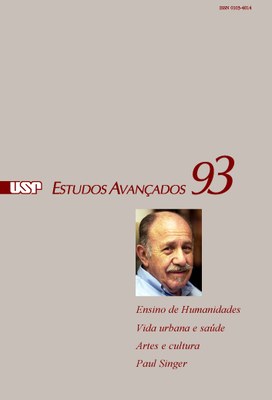
<p dir="ltr"><span><img src="https://www.iea.usp.br/imagens/capa-estudos-avancados-93/@@images/a264861c-632d-4ea5-9b50-5a6b15118a23.jpeg" alt="Capa Estudos Avançados 93" class="image-right" title="Capa Estudos Avançados 93" />The 93rd issue of the institutional journal "Estudos Avançados" inaugurates a series of publications focused on primary and secondary education. The main dossier of this issue brings a set of articles on the teaching of humanities, area of knowledge chosen to open the sequence. Besides reflections on the current conjuncture of Brazilian education, the texts present reflections on the teaching of philosophy, history, geography, music, literature and religion.</span></p>
<p dir="ltr">The journal also has three other sections, with different themes. In the first one, <i>Urban Life and Health</i>, four articles seek to understand how environmental and behavioral attributes of large cities affect the lives of their inhabitants. The second set of texts, <i>Arts and Culture</i>, brings comprehensive discussions on higher education in the arts and reflections on important works of the last century. The last section honors economist Paul Singer, who died in April, with a large and expressive interview in 2016.</p>
<p dir="ltr"><span>To editor Alfredo Bosi, the humanities face a paradoxical situation. "At the same time we have a reflection on the new methods proposed by pedagogy and specific didactics that open new directions for teaching, we face a depreciation of the same humanities by the technicist thinking that has been generalized in bureaucratic organs inside and outside the University," he points out. He believes that the intense demand for specialization generated by industrial and technological revolutions has hampered the balance between human and biological sciences.</span></p>
<p dir="ltr"><span>This context, according to Bosi, fuels the need to think about knowledge in a holistic and problematic way. A starting point, for him, would be to apply philosophy as a methodology of any and all modality of knowledge. "The reader will find articles by professors who experience this project both in public schools and in particular situations, such as teaching reading to inmates or the successful attempt to introduce Greek and Latin to elementary school students," he says.</span></p>
<p dir="ltr"><span>Bosi dedicates issue #93 to Paul Singer and Paulo Freire, who, according to him, "took their democratic ideals to the heart of the economy and pedagogy of the oppressed ones."</span></p>
<p dir="ltr"><span><strong>Dossier</strong></span></p>
<p dir="ltr">Between 2012 and 2013, Ana Vieira Pereira participated in a series of workshops on creative writing and reading mediation at the Romão Gomes Military Prison in São Paulo. Pereira's experiences and apprenticeships in the period are reported in the article <i>Sidelines - Literature Experiences with Imprisoned Persons</i>, which also composes the main dossier. According to her, the work made it possible to perceive literature and the telling of their own history as "powerful mechanisms for the personal reorganization and the discovery of new forms within the field of language".</p>
<p dir="ltr">In the article <i>The reform of secondary education and its questionable conception of quality of education</i>, Celso João Ferretti critically analyzes the reform promoted by the Ministry of Education in 2017. The political and economic interests of the restructuring, the ideological disputes that were presented and the official objectives <span>announced </span>by Michel Temer's government are some of the points dealt with by Ferretti. He further states that he has given "special attention to the curriculum flexibilization and the quality of education conception on which the reform is based."</p>
<p dir="ltr"><span>In the article <i>Latin and Greek in a municipal school of Elementary School</i>, Paula da Cunha Corrêa presents a successful pedagogical experience conducted from 2013 at the Desembargador Amorim Lima Municipal School of Elementary Education (EMEF.) Using the "Minimus" method, created by Barbara Bell, Corrêa has organized the implementation of classic language courses - Latin and Greek - for students in the 4th and 7th grades of the school, which is located in the city of São Paulo. According to her, in addition to language teaching, the project offers "diverse aspects of classical culture," to students, namely mythology, history, politics, theater, poetry, music, art and architecture." The "Minimus Project" is still in force and seeks new schools to expand its operation area.</span></p>
<p dir="ltr"><span><strong>Other themes</strong></span></p>
<p dir="ltr">The first two texts of the section <i>Urban Life and Health</i> show the consequences of violence and lack of basic sanitation for the health of the peripheral population. The latter two present comments on the last book authored by physician Paulo Saldiva, current director at the IEA-USP.</p>
<p dir="ltr">In <i>The metropolis and the health of its inhabitants</i>, Helena Ribeiro describes and analyzes the general themes addressed in Saldiva's work. According to her, the book clearly shows "the problems that urbanization has brought to physical and mental health" of the inhabitants of large cities.</p>
<p dir="ltr">Article writer Fabio Angeoletto emphasizes that the problems presented by Saldiva are not limited to São Paulo and other metropolises, but to all Brazilian cities, in <i>Urban life and health</i>. For him, the conclusion of the reading gives rise to a clear but not explicit message by the author: "Cities, in their complexity, demand planning, and multiple academic formations and social actors need to be involved in this work."</p>
<p dir="ltr">Among the seven authors in the <i>Arts and Culture</i> section are former IEA Director <a href="https://www.iea.usp.br/en/persons/researchers/martin-grossmann" class="external-link">Martin Grossmann</a> and two USP professors that participated in the first edition of the Institute's <a href="https://www.iea.usp.br/en/persons/sabbatical/sabbatical-professors" class="external-link">Sabbatical Year Program</a> in 2016: <a href="https://www.iea.usp.br/en/persons/researchers/daria" class="external-link">Dária Jaremtchuk</a> and <a href="https://www.iea.usp.br/en/persons/researchers/lucia-barbosa" class="external-link">Lúcia Maciel Barbosa de Oliveira</a>. The papers in this edition represent part of the results of their research at the Institute.</p>
<p dir="ltr">In the article <i>Abdias do Nascimento in the United States: a "black art painter,"</i> <span>Jaremtchuk </span>discusses the 10-year period that the Brazilian painter has spent in the United States. According to her, the time was fundamental for Nascimento to reaffirm "his commitment to the creation of works aligned with the African cultural heritage."</p>
<p dir="ltr">In Oliveira's <i>On Conquests and Tensions</i>, in turn, there is a discussion on the emergence of new cultural dynamics anchored in information and communication technologies. "The current moment demands a non-simplifying understanding of the innumerable representations, contradictions, voices and silences that vie for visibility in the public arena," she argues.</p>
<p dir="ltr"><span><strong>Paul Singer</strong></span></p>
<p dir="ltr"><span>The last article of the issue celebrates economist Paul Singer, who died April 16, 2018, at the age of 86. Singer was a full professor at USP's School of Economics, Business and Accounting (FEA,) and a member of the first composition of IEA's Board (1987-1992.) Born in Vienna, he was the creator and greatest advocate of the "Solidarity Economy."</span></p>
<p dir="ltr">The article <i>Paul Singer: a life of struggle and work for socialism and democratic participation</i>, by Cris Andrada and Egeu Esteves, presents an interview with the economist in the year 2016. Singer talks about his migration to Brazil, the youth in the Post-war São Paulo, his relationship with the union movement - with emphasis on the participation in the 300,000 Strike - and, notoriously, Solidarity Economy.</p>
<p dir="ltr"><span>"Only a few bring together intellectual greatness, genuine humility, and deep coherence between the writer and the practitioner," say the authors. "Paul Singer not only reflected on the violence of the world of work, but also devoted his studies to sharing it with workers, shoulder to shoulder, for years."</span></p>
<div><span>
<p>The list below contains the names of the authors who have contributed with each one of the addressed themes:</p>
<p><strong>The Teaching of Humanities</strong></p>
<p dir="ltr"><i>Franklin Leopoldo e Silva<br /></i><i>Celso de Rui Beiseigel<br /></i><i>Celso João Ferretti<br /></i><i>Marcus Sacrini and Valéria De Marco<br /></i><i>Ausonia Donato and Monique Borba Cerqueira<br /></i><i>Marcos Natali<br /></i><i>Neide Luzia de Rezende<br /></i><i style="text-align: justify; ">Ana Vieira Pereira<br /></i><i style="text-align: justify; ">Paula da Cunha Corrêa<br /></i><i>Circe Fernandes Bittencourt<br /></i><i>Antonia Terra de Calazans Fernandes<br /></i><i>Rafael Straforini<br /></i><i>Geraldo José de Paiva<br /></i><i>Antonio Carlos Moraes Dias Carrasqueira</i></p>
<p><strong>Urban Life and Health</strong></p>
<p dir="ltr"><i>Amélia Cohn<br /></i><i>Ana Lydia Sawaya, Maria Paula de Albuquerque and Semiramis Martins Álvares Domene<br /></i><i>Helena Ribeiro<br /></i><i style="text-align: justify; ">Fabio Angeoletto</i></p>
<p><strong>Arts and Culture</strong></p>
<p dir="ltr"><i>Dária Jaremtchuk<br /></i><i>Lúcia Maciel Barbosa de Oliveira<br /></i><i>Martha Ribeiro<br /></i><i>Isis Baldini, Martin Grossmann, Pamela Prado and Vinicius Spricigo<br /></i><i>Ana Mae Barbosa<br /></i><i>Martin Grossmann<br /></i><i>Paulo Roberto Ramos</i></p>
<p><strong>Paul Singer</strong></p>
<p><strong> </strong><i><i><i>Cris Andrada e Egeu Esteves</i></i></i></p>
</span></div>]]></content:encoded>
    <dc:publisher>No publisher</dc:publisher>
    <dc:creator>Richard Meckien</dc:creator>
    <dc:rights>Original version in Portuguese by Victor Matioli.</dc:rights>
    
      <dc:subject>Cities</dc:subject>
    
    
      <dc:subject>Art</dc:subject>
    
    
      <dc:subject>Humanities</dc:subject>
    
    
      <dc:subject>Journal</dc:subject>
    
    
      <dc:subject>Culture</dc:subject>
    
    
      <dc:subject>Health</dc:subject>
    
    
      <dc:subject>Education</dc:subject>
    
    <dc:date>2018-08-13T16:30:00Z</dc:date>
    <dc:type>News Item</dc:type>
  </item>


  <item rdf:about="https://www.iea.usp.br/en/news/perspectives-of-culture-according-to-ricardo-ohtake">
    <title>The perspectives of culture according to Ricardo Ohtake</title>
    <link>https://www.iea.usp.br/en/news/perspectives-of-culture-according-to-ricardo-ohtake</link>
    <description></description>
    <content:encoded xmlns:content="http://purl.org/rss/1.0/modules/content/"><![CDATA[<table class="tabela-direita">
<tbody>
<tr>
<th><img src="https://www.iea.usp.br/imagens/ricardo-ohtake-posse" alt="Ricardo Ohtake - posse" class="image-inline" title="Ricardo Ohtake - posse" /></th>
</tr>
<tr>
<td>
<p><strong>Ricardo Ohtake, new holder of the Olavo Setubal Chair of Arts, Culture and Science.</strong></p>
</td>
</tr>
</tbody>
</table>
<p>To address the trajectory of art and culture in Brazil from the post-Second War period until the crisis of 2016, and to analyze the current situation of institutions and activities in the field with prospects for the future, are some of the goals of the new holder of the <a href="https://www.iea.usp.br/en/research/chairs/olavo-setubal-chair-of-arts-culture-and-science" class="external-link">Olavo Setubal Chair of Arts, Culture and Science</a>, created in 2015 and officially launched in February 2016 by the IEA in partnership with Itaú Cultural. Architect, graphic designer and cultural manager <a href="https://www.iea.usp.br/en/persons/researchers/ricardo-ohtake" class="external-link">Ricardo Ohtake</a> took office on March 17, in a ceremony in the University Council Room that was attended by authorities, sponsors of the Chair, artists and scientists.</p>
<p>"The discussion of the future is what matters most, mainly because of the new political, social, economic, administrative and institutional situation in Brazil, which we know has created a legal anomaly in the country, provoking insecurity for the population and certain insecurity in the cultural environment", said Ohtake.</p>
<p>While opening the ceremony, <a href="https://www.iea.usp.br/en/persons/researchers/martin-grossmann" class="external-link">Martin Grossmann</a>, academic coordinat<span>or of the Chair,</span> <span>professor at USP's S</span>chool of Communications and Arts (ECA), and former director of the IEA, welcomed the new holder and thanked the work done by <span>diplomat and essayist </span><a href="https://www.iea.usp.br/en/persons/researchers/rouanet" class="external-link">Sérgio Paulo Rouanet</a>, former national secretary of Culture and author of the bill to encourage culture that bears his name. During the inaugural year of the Chair, Rouanet developed the approximation between the borders of knowledge in the personal, institutional and scientific scopes, as he recalled in his speech.</p>
<table class="tabela-esquerda-borda">
<tbody>
<tr>
<th>
<h3>Related material</h3>
<p><a href="https://www.iea.usp.br/en/media-library/photos/events-2017/ricardo-ohtake-takes-office-chair-olavo-setubal-17-march-2017" class="external-link">Photos</a></p>
<p>News</p>
<p><a href="https://www.iea.usp.br/en/news/rouanet-inaugura-catedra-olavo-setubal-de-arte-cultura-e-ciencia" class="external-link">Sergio Rouanet inaugurates the Olavo Setubal Chair of Arts, Culture and Science</a></p>
</th>
</tr>
</tbody>
</table>
<p>The new activities will include the debate on the actions and the thinking of cultural leaders, and the participation of institutions in the development of the artistic and cultural field, in a reflection that will go back to the cultural history of Brazil, Grossmann showed.</p>
<p><span>Ohtake recalled the evolution of Brazilian society and mentality - including its typical contradictions and complexities with which "a modern and medieval country" was built - and related this trajectory to the steps taken by the country in the cultural and artistic fields.</span></p>
<p>He mentioned the beginnings of the cosmopolitanization of Brazil, especially in Rio de Janeiro and São Paulo, with the emergence of icons such as the <span>Vera Cruz </span>Cinematographic Company, the TBC Brazilian Theater of Comedy, art institutions, the Biennale and museums, among them the <span>São Paulo </span>Museum of Art (MASP), created by the coffee bourgeoisie.</p>
<p>To expose and develop his own trajectory as a cultural leader in the context of the city, the country and internationally <span>will be one of Ohtake's pursued goals. He will also i</span>nvite critics, cultural leaders, artists and historians to participate in debates and testimonials; approach the relationship between art and politics and the role of exhibitions in the art debate; and analyze the role of cultural leaders in the development of institutions and thinking.</p>
<p>The new holder intends to bring his experience of more than 50 years in this field. He has been Secretary of Culture of the State of São Paulo, Secretary of the Green and Environment of São Paulo, director of the São Paulo Cultural Center, and director of the Museum of Image and Sound and the Brazilian Cinematheque. He has lectured in several architecture, communications and plastic arts faculties and was curator of the Brazilian participation at the Architecture Biennale of Venice in 2010.</p>
<p>The Ohtake family is one of the most influential for the arts and architecture in Brazil. Ricardo Ohtake is son of artist Tomie Ohtake (1913-2015) and brother of architect Ruy Ohtake, who signs the project of the famous building that houses the Tomie Ohtake Institute. He has graduated from USP's Faculty of Architecture and Urbanism (FAU), and currently directs the Tomie Ohtake Institute.</p>
<p><span>"If, on the one hand, cultural activity is always provided by very limited resources, on the other hand it always requires a lot of imagination and daring for propositions to be solved. The leader does not have to be an intellectual, but he must know where the concepts, the variations of approaches, the artists, the history of art, and also the engineering of the activities take place. As the resource is never enough, knowing how to give priorities and alternatives is fundamental to make sense of everything that is done," he said. </span></p>
<p>While reviewing his own career, Ohtake recalled his childhood, when he invented things and plays on the street in the 'Mooca' neighborhood, in São Paulo. "I realized with surprise that I internalized what critic Mário Pedrosa said in the 1950s to my mother: 'The key is to be original.' I understood that I always had to be original, not only in artistic creation."</p>
<table class="tabela-direita">
<tbody>
<tr>
<th><img src="https://www.iea.usp.br/imagens/posse-ricardo-ohtake-mesa" alt="Posse Ricardo Ohtake - mesa" class="image-inline" title="Posse Ricardo Ohtake - mesa" /></th>
</tr>
<tr>
<td>
<p><strong>From the left: Eduardo Saron, Ricardo Ohtake, <span>José Roberto Sadek, Vahan Agopyan, Sérgio Paulo Rouanet, Roberto Setúbal and Paulo Saldiva.</span></strong></p>
</td>
</tr>
</tbody>
</table>
<p><strong> </strong></p>
<p><strong>Tributes</strong></p>
<p>The Olavo Setubal Chair of Arts, Culture and Science, created to foster interdisciplinary reflections on academic, artistic-cultural and social issues in the regional and global contexts, has been taking the form of an "experimental platform for freedom", according to Grossmann.</p>
<p>"If Rouanet practiced the permanent exercise of criticism by producers, and academic and cultural institutions during this period, Ricardo Ohtake intends to explore the experimental exercise of freedom, be it as a public figure, as a cultural manager, or through his wisdom and his constant thinking that produces an exemplary practice in the field of the arts and culture," said Grossmann.</p>
<p>In almost 12 months of activity as holder of the Chair, Rouanet has sought broad approximations and interactions in the epistemic, institutional or even personal fields, he showed. "The participation of so many colleagues in the effort to give prestige to other areas of knowledge, culture, arts, psychoanalysis, science and philosophy was an attempt to minimize the gap between the human sciences and other sciences," he said.</p>
<p>For Rouanet, the Chair has been a unique opportunity to deepen <span>the effort to unify science </span>a little more; an effort that was extended to the institutional field, with USP interacting with other institutions.</p>
<p>In the words of IEA's director Paulo Saldiva, the ceremony brings the symbolic sign of generosity and passion expressed in the "action of sponsors such as Itaú Cultural, or in the work of people like Ricardo Ohtake, who come to share their experience, teach and illuminate the spirit."</p>
<p><span>The Chair also celebrates the union between academia, artists, intellectuals and young people who could see the example of rare values such as leadership and enchantment, Saldiva said. "Values such as generosity, passion and enchantment for study are sorely lacking for our youth today. These are feelings that make things happen despite all the difficulties," he emphasized.</span></p>
<p>USP's Vice-President Vahan Agopyan has stressed the importance of interlocution between academia and external sectors provided by chairs and interdisciplinary instances as the IEA. "I often say that the IEA is the think tank of USP: a place for debates on cross-cutting themes and, as well as the chairs, capable of promoting interaction with society. Dialogue with society is a challenge of the 21st century for all universities, and with the support of Itaú Cultural we are managing to increase this interaction," said Agopyan.</p>
<p>Roberto Setúbal, executive president of Itaú bank, when speaking about the support for the Chair, preferred to recall his father's personality and his tradition of appreciation for culture, his career as an entrepreneur and an engineer graduated from USP's Polytechnic School (POLI). "Severe, firm and demanding, but always very open to dialogue and new ideas. A man of science and research - he has worked at the Institute of Technological Research (IPT). A mayor who created the <span>São Paulo </span>Secretariat of Culture, a gesture that made me very proud in my student days and that shows how he valued culture and was open to the new," he said.</p>
<p>Eduardo Saron, director of Itaú Cultural, recalled the important role of Ohtake in the democratization of culture and arts in Brazil. "The democratization of access to culture, so much discussed by managers in the country, is a theme that will remain for a long time. Art and culture are beyond the needs and rights of the citizen. If the artist thinks of art as a field of desires, managers and actors of cultural politics need to think about culture in this aspect. It is not a matter of democratizing access only. It is about autonomy and freedom of expression. Cultural democracy thinks and understands the individual as an actor of self; an autonomous citizen who has the right to freedom of expression; to see and experience all cultures," said Saron.</p>
<p>Professor <a href="https://www.iea.usp.br/en/persons/speakers/lilian-sch" class="external-link">Lilia Moritz Schwarcz</a>, from USP's Faculty of Philosophy, Languages and Literature, and Human Sciences (FFLCH), was invited to give the reception address to the honoree. She recalled the work done with Ohtake and the projects undertaken at the Tomie Ohtake Institute.</p>
<table class="tabela-direita">
<tbody>
<tr>
<th><img src="https://www.iea.usp.br/imagens/lilia-schwarcz" alt="Lilia Schwarcz - posse Ricardo Ohtake" class="image-inline" title="Lilia Schwarcz - posse Ricardo Ohtake" /></th>
</tr>
<tr>
<td><span><strong>Lilia Schwarcz, <span>from USP's Faculty of Philosophy, Languages and Literature, and Human Sciences (FFLCH)</span>: "Ricardo Ohtake has distributed gifts in the fields of art and culture".</strong></span></td>
</tr>
</tbody>
</table>
<p>"A visionary of the arts, an intellectual of culture, an academic of the world of museums, of the arts in the broad sense, he knows that culture is what it does. In Ricardo Ohtake's words, among the various ways of assessing the success of different art forms, there is a unifying question, which is the transformation that the viewer of art undergoes before a work, and the emotion that provides a new knowledge, a new sensitivity, and / or a new experience," said Schwarcz.</p>
<p>For Schwarcz, Ohtake has "distributed gifts": he has toured the fields of architecture, graphic arts, decoration, urbanism, drawing, theater, education, cinema, publishing, dance, photography and the plastic arts; he has made exhibitions, documentaries, film festivals; sponsored concerts; created drawings for many books. "He has inspired generations, having passed through numerous institutions until landing at the Tomie Ohtake Institute, which opened for all kinds of experimentation."</p>
<p>"It is impossible to meet Ricardo without being deeply affected by his history, his smile, his generosity, his<span> very noisy</span> silence, and his transforming affection. I congratulate USP for realizing that Ricardo is a born scholar in the sublime function of being a cultural multiplier, and thus an immense distributor of gifts, an intellectual open to diversity, plurality and equality in this unfortunately unequal country," said the professor.</p>
<p><span>The <span>State </span>Secretary for Culture of São Paulo, José Roberto Sadek, highlighted the important link <span>between the university and society </span>promoted by the Chair, and the promotion of non-polarized dialogue, treated with the complexity and nuances that the theme requires.</span></p>]]></content:encoded>
    <dc:publisher>No publisher</dc:publisher>
    <dc:creator>Richard Meckien</dc:creator>
    <dc:rights>Original version in Portuguese by Sylvia Miguel.</dc:rights>
    
      <dc:subject>Cultural Politics</dc:subject>
    
    
      <dc:subject>Education</dc:subject>
    
    
      <dc:subject>Art</dc:subject>
    
    
      <dc:subject>Citizenship</dc:subject>
    
    
      <dc:subject>Cinema</dc:subject>
    
    
      <dc:subject>Humanities</dc:subject>
    
    
      <dc:subject>Culture</dc:subject>
    
    
      <dc:subject>Design</dc:subject>
    
    
      <dc:subject>Architecture</dc:subject>
    
    
      <dc:subject>Olavo Setubal Chair</dc:subject>
    
    
      <dc:subject>Cities</dc:subject>
    
    
      <dc:subject>History</dc:subject>
    
    <dc:date>2017-03-27T10:25:00Z</dc:date>
    <dc:type>News Item</dc:type>
  </item>


  <item rdf:about="https://www.iea.usp.br/en/media-library/photos/events-2016/women-in-university-and-science-challenges-and-opportunities-september-15-2016">
    <title>Women in University and Science: Challenges and Opportunities - September 15, 2016</title>
    <link>https://www.iea.usp.br/en/media-library/photos/events-2016/women-in-university-and-science-challenges-and-opportunities-september-15-2016</link>
    <description></description>
    
    <dc:publisher>No publisher</dc:publisher>
    <dc:creator>Richard Meckien</dc:creator>
    <dc:rights></dc:rights>
    
      <dc:subject>Public Education</dc:subject>
    
    
      <dc:subject>Higher Education</dc:subject>
    
    
      <dc:subject>Humanities</dc:subject>
    
    
      <dc:subject>University</dc:subject>
    
    
      <dc:subject>France</dc:subject>
    
    
      <dc:subject>Social Inclusion</dc:subject>
    
    
      <dc:subject>Women</dc:subject>
    
    <dc:date>2016-09-15T03:00:00Z</dc:date>
    <dc:type>Folder</dc:type>
  </item>


  <item rdf:about="https://www.iea.usp.br/en/news/fusion-different-kinds-of-knowledge-towards-more-humane-science">
    <title>The fusion of different kinds of knowledge towards a more humane science</title>
    <link>https://www.iea.usp.br/en/news/fusion-different-kinds-of-knowledge-towards-more-humane-science</link>
    <description></description>
    <content:encoded xmlns:content="http://purl.org/rss/1.0/modules/content/"><![CDATA[<table class="tabela-direita">
<tbody>
<tr>
<th><img src="https://www.iea.usp.br/imagens/till-roenneberg-1" alt="Till Roenneberg" class="image-inline" title="Till Roenneberg" /></th>
</tr>
<tr>
<td>
<p><strong>Chronobiologist Till Roenneberg talked about interdisciplinarity and the humanities on July 19</strong></p>
</td>
</tr>
</tbody>
</table>
<p>"Certain issues in the academic environment must be considered when we think about promoting interdisciplinarity. There is a political decision to be taken by development agencies. We need to finance those wishing to work with those who do not belong to the natural sciences. Hence we will have a new world." The comment by chronobiologist <a class="external-link" href="http://intercontinental-academia.ubias.net/nagoya/media-center/people/copy_of_till-roenneberg">Till Roenneberg</a> closed the conference <i>Why Science needs more than Interdisciplinarity</i>, held by the IEA on <strong>July 19</strong>.</p>
<p><span>Trained in medicine, biology and physics, Roenneberg has shown his concern when talking about the lack of communication and mutual understanding between the natural sciences and the humanities. "All the resentment and arrogance among disciplines have only brought confusion. We know we should start talking. Philosophy and science were together in the beginning but then split apart. We must go back to the beginning, to the basic questions," he said. <span>"We only know ourselves from criticism by others. So if we get rid of the human sciences, as many universities are doing, natural scientists will increase the </span><span>ignorance of what they are doing.</span></span><span>"</span></p>
<p><span>Roenneberg</span> lamented the fact that many humanists have no knowledge about crucial issues of biology, such as advances in molecular biology or the evolution of living beings. "Unfortunately, without a minimum knowledge about the importance of all this one can not build criticism about it. The biological sciences dominate science <span>today </span>and, therefore, we must understand this field if we want to put their scientists where they should be," he said.</p>
<p><span>"We need the humanities back into the science boat, but not in the way as it is currently happening. It has to be more communicative and more critical regarding other areas.</span><span>“ <span>Roenneberg, a p</span>rofessor and vice-president of the <span>Institute of Medical Psychology at Ludwig-Maximilians University (LMU)</span>, said that the term 'interdisciplinarity' has not been used properly.</span></p>
<table class="tabela-esquerda">
<tbody>
<tr>
<th><img src="https://www.iea.usp.br/imagens/atomium-de-bruxelas" alt="Atomium de Bruxelas" class="image-inline" title="Atomium de Bruxelas" /></th>
</tr>
<tr>
<td>
<p><strong>Atomium, in Brussels. The structure is analogous to the interdisciplinarity as practiced in science, says the scientist</strong></p>
</td>
</tr>
</tbody>
</table>
<p>"The word reminds me of the <span>Atomium in </span>Brussels, where the spheres are connected to each other but nothing happens. It is as if we were hand in hand without getting anywhere. I like to think of interdisciplinarity when I think of what bacteria do. They exchange information and actually become infected. We have to change this word if we expect something more from interdisciplinarity. We have to think of a fusion of different kinds of knowledge," he said.</p>
<p>But the proposed fusion would not mean the abandonment of disciplinary fields. "It is not possible for everyone to be purely interdisciplinary, as this would result in bad science. I believe that everyone should have their specialties but also learn to understand and interact with other fields," he said.</p>
<p>Roenneberg is a disciple of physicist, biologist and physiologist Jürgen Walther Ludwig Aschoff (1913 - 1998), one of the founders of chronobiology, which<span> studies the circadian rhythm, also called biological clock or circadian cycle. It is the period of about 24 hours which the <span>life cycle of almost all living beings</span> is based on. So it is a cycle influenced by variations of light, temperature, tides and winds between day and night.</span></p>
<p>The professor has spent<span> two weeks in Brazil developing activities related to research on the quality of sleep in <span><i>quilombolas</i></span>. The studies should cover remote communities in several states. The aim is to deepen the findings on the influence of the external environment and artificial light on sleep quality.</span></p>
<p>According to the scientist, the modern man lives with little light during the day by getting locked in offices and is exposed to many stimuli at night due to artificial light. This not only changes the quality of sleep but also produces what he calls "social jet lag", or a physical and mental strain caused by the disagreement between the biological clock and the social clock. Sleep disorders are responsible for most of the diseases of modernity. "People smoke more, drink more coffee, suffer more from depression, anxiety, metabolic problems and diabetes," he said.</p>
<p><strong>On science, gender and brain</strong></p>
<table class="tabela-direita">
<tbody>
<tr>
<th><img src="https://www.iea.usp.br/imagens/publico-till-roenneberg" alt="Público Till Roenneberg" class="image-inline" title="Público Till Roenneberg" /></th>
</tr>
<tr>
<td>
<p><strong>Audience at the conference <i>Why Science needs more than Interdisciplinary</i></strong></p>
</td>
</tr>
</tbody>
</table>
<p>Roenneberg resumed the topics discussed during the workshops <i>In Search of Interdisciplinary Dialogue</i>, held by the Waseda Institute for Advanced Studies (WIAS) at Waseda University on <strong>March 14</strong>, during the <a class="external-link" href="http://intercontinental-academia.ubias.net/nagoya">second phase of the Intercontinental Academia</a>.</p>
<p>He noted that regardless of the "knowledge box" or area that we deal with the entire academic enterprise relates to human beings. On the one hand we have the Holocaust, the atomic bomb, Fukushima, the terrorist events of 2011, while on the other hand there is penicillin, the abolition of slavery, equal rights, photovoltaic cells, immunization. In short, the good and the bad. "So all the products of each one of the disciplines we know will impact humans. So science must always be attentive to the direction it is taking and it seems that lately we have not given due attention to this," he said.</p>
<table class="tabela-esquerda-borda">
<tbody>
<tr>
<th>
<h3>Related material</h3>
<p><span><a href="https://www.iea.usp.br/en/media-library/video/why-science-needs-more-than-interdisciplinarity" class="external-link">Video </a>| <a href="https://www.iea.usp.br/en/media-library/photos/events-2016/why-science-needs-more-than-interdisciplinarity/" class="external-link">Photos</a></span></p>
<p>News:<br /><a href="https://www.iea.usp.br/en/news/humanidades-pela-evolucao-dos-metodos-disciplinares" class="external-link"></a></p>
<p><a href="https://www.iea.usp.br/en/news/humanidades-pela-evolucao-dos-metodos-disciplinares" class="external-link">Humanities to promote the evolution of disciplinary methods</a></p>
<p><a href="https://www.iea.usp.br/en/news/social-jet-lag" class="external-link">Conference of the Intercontinental Academia discusses the social jet lag syndrome</a></p>
</th>
</tr>
</tbody>
</table>
<p><span><span>To understand the phenomena produced by science requires a kind of thinking "outside the box", he said. "What is central in everything we do is our brain. He is the microscope, the principle of our thinking. The world is full of data and everything is processed in our brain according to our personal experiences. The reflection on the future of science leads to questions about the actors that drive science. The understanding of the world is done by the brain and science is dominated by male brains."</span></span></p>
<p><span><span></span>The issue of gender and equity is relevant because all science, in general, has been done by men, he said. "And men like big and expensive toys. Perhaps this explains our tendency to invest in large, expensive machines. But this way we will produce more and more data we are not yet able to analyze properly. Therefore, we should invest in young brains capable of inventing algorithms and intelligent mathematical strategies that allow us to analyze gene networks, brain cell networks or other interactive elements. The brain is the most interactive instrument that exists," he said.</span></p>
<p><span>Roenneberg compared the Brazilian behaviou</span><span>r with the attitude of scientists who insist on staying in their comfort zone. "I do not understand why this huge country refuses to speak English. I went to a big bank and had difficulties because not even the manager spoke English. Many do know but are shy or do not want to leave the comfort zone because it generates anguish. People in general and scientists need to leave the comfort zone and dare to make mistakes," he said.</span></p>]]></content:encoded>
    <dc:publisher>No publisher</dc:publisher>
    <dc:creator>Richard Meckien</dc:creator>
    <dc:rights>Original version in Portuguese by Sylvia Miguel.</dc:rights>
    
      <dc:subject>Natural sciences</dc:subject>
    
    
      <dc:subject>Humanities</dc:subject>
    
    
      <dc:subject>Intercontinental Academia</dc:subject>
    
    
      <dc:subject>Research</dc:subject>
    
    
      <dc:subject>Interdisciplinarity</dc:subject>
    
    
      <dc:subject>Philosophy of Science</dc:subject>
    
    <dc:date>2016-07-22T20:50:00Z</dc:date>
    <dc:type>News Item</dc:type>
  </item>


  <item rdf:about="https://www.iea.usp.br/en/news/researchers-of-the-intercontinental-academia-detail-course-on-time">
    <title>Researchers of the Intercontinental Academia detail course on Time</title>
    <link>https://www.iea.usp.br/en/news/researchers-of-the-intercontinental-academia-detail-course-on-time</link>
    <description></description>
    <content:encoded xmlns:content="http://purl.org/rss/1.0/modules/content/"><![CDATA[<table class="tabela-direita-400">
<tbody>
<tr>
<th><img src="https://www.iea.usp.br/imagens/apresentacao-final-do-participantes-da-fase-nagoya-da-intercontinental-academia" alt="Apresentação Final do participantes da Fase Nagoya da Intercontinental Academia" class="image-inline" title="Apresentação Final do participantes da Fase Nagoya da Intercontinental Academia" /></th>
</tr>
<tr>
<td style="text-align: right; "><strong>Presentation of the MOOC's details<br /></strong></td>
</tr>
</tbody>
</table>
<p>At the end of the <a class="external-link" href="http://intercontinental-academia.ubias.net/nagoya">second phase of the Intercontinental Academia (ICA) in Nagoya</a>, on March 18, the 13 participants presented the details of th<span>e Massive Open Online Course (MOOC) on "Time" they have been working on since the <a href="http://intercontinental-academia.ubias.net/home-sao-paulo">first phase of the project in São Paulo</a>.</span></p>
<p>The MOOC is the practical activity that has been asked to the participants as outcome of the ICA and was inspired by conferences, debates and workshops on the subject "Time", held both in São Paulo and in Nagoya.</p>
<p>The MOOC will be called 'Frontiers of Time: Exploring the Last Great Mystery' and will be hosted at <a class="external-link" href="https://www.coursera.org">Coursera</a>'s database, an online course platform created by five major American universities, of which USP is a partner.</p>
<table class="tabela-esquerda-200-borda">
<tbody>
<tr>
<td>
<h3>Related material</h3>
<p><strong>Final presentation by the participants in Nagoya<br /><i>March 18, 2016</i></strong></p>
<p><strong>Media library</strong></p>
<ul>
<li><a class="external-link" href="http://intercontinental-academia.ubias.net/nagoya/media-center/videos/intercontinental-academnia-second-phase-nagoya-friday-march-18-workshop-by-the-participants-final-presentation">Video</a> | <a class="external-link" href="http://intercontinental-academia.ubias.net/nagoya/media-center/photos">Photos</a></li>
</ul>
<hr />
<p> </p>
<p><strong><span>Final presentation by the participants in São Paulo</span><br /><i>April 29, 2015</i></strong></p>
<p><strong>Media library</strong></p>
<ul>
<li><a class="external-link" href="http://intercontinental-academia.ubias.net/media-center/videos/intercontinental-academia-closing-report">Video</a> | <a class="external-link" href="http://intercontinental-academia.ubias.net/media-center/photos">Photos</a></li>
</ul>
<p><i> </i></p>
<hr />
<p><i> </i></p>
<p><span style="text-align: center; "><strong><span><br /><span>More information on the second phase of the Intercontinental Academia:</span></span></strong></span></p>
<p><a href="http://intercontinental-academia.ubias.net/nagoya/programme" target="_blank"><br />Full programme</a></p>
<p><a class="external-link" href="http://intercontinental-academia.ubias.net/nagoya/news">All the news</a></p>
</td>
</tr>
</tbody>
</table>
<p><span>There will be five lessons plus a video about the production of the course. Each lesson will take about one hour and have a text with approximately 7,000 words. The topics of the classes will be:</span></p>
<p>1. Introduction: Aspects of Time</p>
<p>2. Is the Present Special?</p>
<p>3. Time, Change and Cultural Differences</p>
<p>4. Is Time Different for Humans and Non-Humans?</p>
<p>5. How Do We Evaluate Time?</p>
<p>Each class will be divided into thematic sections. The first of them (Introduction: Aspects of Time), for example, will have four sections: 1) What is Time? 2) How do we perceive time? 3) How Do We Think About Time? 4) How do we use Time?.</p>
<p><span>The scripts will be ready in June and the filming is scheduled for August. One of the proposals is that the filming - with the performance of some of the participants - occurs at the research base of USP's Oceanographic Institute in Ubatuba, on the north coast of the State of São Paulo. Other alternative locations for the class production will still be considered.</span></p>
<p style="text-align: right; "><span class="discreet">Photo: IAR / Nagoya University</span></p>]]></content:encoded>
    <dc:publisher>No publisher</dc:publisher>
    <dc:creator>Richard Meckien</dc:creator>
    <dc:rights>Original version in Portuguese by Mauro Bellesa.</dc:rights>
    
      <dc:subject>Natural sciences</dc:subject>
    
    
      <dc:subject>Humanities</dc:subject>
    
    
      <dc:subject>Intercontinental Academia</dc:subject>
    
    
      <dc:subject>Ubias</dc:subject>
    
    
      <dc:subject>Research</dc:subject>
    
    
      <dc:subject>Social Sciences</dc:subject>
    
    
      <dc:subject>Scientific Disclosure</dc:subject>
    
    
      <dc:subject>Event</dc:subject>
    
    <dc:date>2016-06-10T16:30:00Z</dc:date>
    <dc:type>News Item</dc:type>
  </item>


  <item rdf:about="https://www.iea.usp.br/en/news/digital-publishing-expands-audience-and-changes-procedures-in-the-humanities">
    <title>Digital publishing expands audience and changes procedures in the humanities, says historian</title>
    <link>https://www.iea.usp.br/en/news/digital-publishing-expands-audience-and-changes-procedures-in-the-humanities</link>
    <description></description>
    <content:encoded xmlns:content="http://purl.org/rss/1.0/modules/content/"><![CDATA[<table class="tabela-direita-300">
<tbody>
<tr>
<th><img src="https://www.iea.usp.br/imagens/michael-elliott" alt="MIchael Elliott" class="image-inline" title="MIchael Elliott" /></th>
</tr>
<tr>
<td style="text-align: right; "><strong>Michael Elliott: "Digital edition will change the way how humanists do their job"</strong></td>
</tr>
</tbody>
</table>
<p>The humanities seem to experience an existential dilemma: while researchers are charged to engage in public debates on major challenges of the contemporary world, such as global changes and the manipulation of genomes, departments suffer from a lack of resources and humanists have the form of expression of their ideas questioned by scientists, journalists and other audiences.</p>
<p>There is also the difficulty for the dissemination of academic work by traditional means due to the high costs of printed editions and subscriptions to j<span>ournals</span>.</p>
<p>For historian <a href="https://www.iea.usp.br/en/persons/speakers/michael-elliot" class="external-link">Michael Elliott</a>, from Emory University, the digital publication of humanistic production should change this scenario with all the technological possibilities already available, allowing the academic dialogue with audiences external to the university and even influencing the form of the knowledge production of the area. Elliott discussed these issues at the conference <i>The Humanities and their Publics</i>, held on April 19.</p>
<p>Two editorial events of 1996 in the United States illustrate the reduction an expansion dynamics of the public of the humanities in the last 20 years, he said:</p>
<ul>
<li>the publication of the article <a href="http://www.physics.nyu.edu/sokal/transgress_v2/transgress_v2_singlefile.html">Transgressing the Boundaries: Toward a Transformative Hermeneutics of Quantum Gravity</a>, by physicist Alan Sokal in the journal <i>Social Text</i>; </li>
</ul>
<ul>
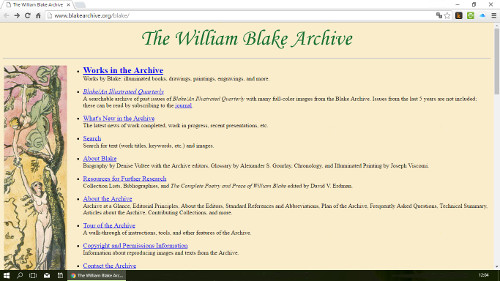
<li>the launch of an <a href="http://www.blakearchive.org/">online archive</a> dedicated to English romantic poet William Blake.</li>
</ul>
<p><br />"Sokal's article was a hoax and argued that achievements of the natural sciences such as quantum mechanics and the theory of relativity are social constructions, citing the icons of the humanities at the end of the 20th century, as Jacques Derrida and Bruno Latour. He was concerned about the lack of rigor of the humanists when they speak of objective reality", he said.</p>
<p>Sokal's article received considerable attention of the international press. Some have accused him of being anti-academic and anti-intellectual, but most intellectuals have supported him, Elliot said. "By attacking the humanities when they speak of nature, he delineated his space and put them in their place. The humanities became more humble and no longer wanted to focus on other audiences."</p>
<p>In the case of the William Blake Archive, motivation and results were the opposite, Elliott said: "It was one of the first electronic text repositories on the Internet and provided everything one expects from an online archive, containing poetry and images of manuscripts, illustrations, pictures and watercolors by Blake, as well as essays on him”.</p>
<table class="tabela-esquerda-200-borda">
<tbody>
<tr>
<td>
<h3>Related material</h3>
<p><strong>The Humanities and their Publics<br /><i>April 19, 2016</i></strong></p>
<p><strong>News</strong></p>
<ul>
<li><a href="https://www.iea.usp.br/en/news/humanities" class="external-link">Humanists and the new communication patterns of the digital age</a></li>
</ul>
<p> </p>
<ul>
<li><a href="https://www.iea.usp.br/en/media-library/video/the-humanities-and-its-publics" class="external-link">Video</a> | <a href="https://www.iea.usp.br/en/media-library/photos/events-2016/the-humanities-and-its-publics-19-de-abril-de-2016" class="external-link">Photos</a></li>
</ul>
</td>
</tr>
</tbody>
</table>
<p>The archive has been designed as a resource for research by postgraduate students, undergraduate and postgraduate professors, high school teachers and enthusiasts of William Blake's work. For Elliott, the archive has all the <span>expected </span>requirements for a work of the humanities: support of a foundation, approval of a university, and participation of experts and technical personnel.</p>
<p>For Elliot, the two publications have quite different views of academic work in the humanities: "Sokal's article criticized the humanities and pushed them back to the ivory tower; the archive on Blake, in turn, had a fairly new and fascinating format, but at the bottom it contained a traditional vision of learning”.</p>
<p><strong><strong>Tradition vs. to be advanced</strong></strong></p>
<p>He said he read in a text by Martin Grossmann that one of the important issues for the IEA is the contrast between tradition and to be advanced, adding that these two forces were closely related in the United States of the 80’s and 90’s.</p>
<p><span>At the time, the National Endowment for the Humanities, a government funding agency, complained of the intellectuals' inability to speak to non-academics and their overly critical tone towards American culture, he said. "That has changed a bit, but still persists". A few months ago, according to Elliott, William Adams, the new director of the agency, said that "there is a lot of skepticism in the public sphere on the value of the humanities to understand the political, economic and social context of today."</span></p>
<p>In reaction to this, Adams suggests that academics review the curricula of undergraduation and collaborate with scientists instead of criticizing them, according to Elliot. He cited Adam’s statement: "We must re-engage in the public environment in a whole new way and need to talk more affordably when we do our work".</p>
<table class="tabela-direita-400-borda">
<tbody>
<tr>
<th><img src="https://www.iea.usp.br/imagens/alan-sokal-e-jean-bricmont" alt="Alan Sokal e Jean Bricmont" class="image-inline" title="Alan Sokal e Jean Bricmont" /></th>
</tr>
<tr>
<td>
<h3><i>Intellectual impostures</i></h3>
<p><i>Two years after the false article by Alan Sokal was published in the journal "Social Text", he and fellow physicist Jean Bricmont published the book "Impostures Intelectuelles", which criticizes the use of concepts of natural science by thinkers and post-modern <i>philosophers</i>, <i> incorrect according to </i><i>their view</i>. On April 27 and 28, 1998, both attended the symposium "Visions of Science: Encounters with Sokal and Bricmont" (photo), organized by the IEA, in which researchers from different fields discussed the ideas presented in the book, which had just come out in France.</i></p>
</td>
</tr>
</tbody>
</table>
<p>There is also criticism in the American press. Elliott said journalists complain that there are no more public intellectuals as there were in the past, capable of talking about challenges such as the manipulation of the human genome, climate change and racial disparities. "Journalists like when an intellectual speaks in a way so they can understand".</p>
<p><strong>Conflict</strong></p>
<p>Given this scenario, Elliott believes that the human sciences in the United States are in a sui generis position: "They are haunted by the ridicule public to which they were subjected in the past [Sokal's article] and at the same time have to engage in public debates with the help of new technologies".</p>
<p>With the credentials of being a historian of American culture of the 19th century, Elliott pointed out that this kind of conflict situation is not new in the United States.</p>
<p>American higher education in the 19th century was dominated by small colleges that had the teaching of liberal arts and the humanities orientation as their mission, he said. "They were just a step away from becoming religious schools. They were aimed at training from the imported English idea that universities exist to teach knowledge, not to create it".</p>
<p>This system was challenged, he said, by the creation of research universities, first in Germany and then in the US. "This led to the creation of new universities, such as Chicago and John Hopkins, and to the change of orientation in others".</p>
<p>The university model concerned with the liberal arts and the training of professionals, and the model dedicated to postgraduation and research competed for a while, until the universities began to rely on the two lines of action, he said. "The University of Chicago, for example, has created relevant degree models, and at the same time laboratories for research and important areas of postgraduation".</p>
<table class="tabela-esquerda">
<tbody>
<tr>
<th><a class="external-link" href="http://www.blakearchive.org/blake/"><img src="https://www.iea.usp.br/imagens/william-blake-archive" alt="William Blake Archive" class="image-inline" title="William Blake Archive" /></a></th>
</tr>
<tr>
<td><strong>Homepage of the <span>William Blake Archive's </span><a class="external-link" href="http://www.blakearchive.org/blake/">website</a>, created in 1996</strong></td>
</tr>
</tbody>
</table>
<p>With the adoption of this mixed model, the liberal arts became popular, according to Elliott. The result is that undergraduate students in the United States are generalists. "There are many courses for training in liberal arts and this helps to create a more democratic citizenship, which is the result of a very broad education. If a professor teaches English literature he will teach in a room where people become lawyers, physicians, architects or financiers. Then, in research seminars, they will teach to anyone who will specialize in a profession. As professors they should reach both audiences. This model worked well until recently".</p>
<p><strong>Model <strong>in jeopardy</strong></strong></p>
<p>Elliott’s hypothesis is that this model is now in jeopardy in all areas, with a more pronounced crisis in the humanities, because a broader education based on them no longer has the support they had. According to him, the main reasons for this are:</p>
<ul>
<li>the lack of consensus on what a general education is;</li>
</ul>
<ul>
<li>the high tuition prices, due to which students want the graduation disciplines to be more targeted for the vocational training they wish;</li>
</ul>
<ul>
<li>reservations about the political stance of humanities’ professors, often critical of American institutions;</li>
</ul>
<ul>
<li>the idea that undergraduate students are no longer representatives of the general public ("This is curious, because the current diversity of students in terms of ethnicity, social class, gender and others is greater than ever before").</li>
</ul>
<p><br />Elliott believes that there is also a crisis of the production of the researchers. "In the US, the journals are not of free access and subscriptions are very expensive. To subscribe to journals, libraries need to reduce the purchase of books and other publications."</p>
<p>This situation will lead to a new organization in the way how academics do their work and address to the public, increasingly multiple due to the features of digital publishing, evaluates Elliot. Thus, in his opinion, the format of academic publications will change because of new publishing and distribution technologies. "These changes will change the concept of what it means to be a scholar in contemporary society."</p>
<p>He said that researchers from the humanities perform many works on environment, climate change, health, education and "that such works are consequential because authors must engage in public debates to address to non-academic audiences too."</p>
<p>"In the US, printed monograph has a kind of aura [as the unique work of art, according to Walter Benjamin], in spite of being mechanically reproduced, and it is worshiped by a small audience. Will the academic work lose its aura by moving to digital formats? Will academic sites, side by side to common sites, become less numerous? I do not think so. We will be seeking audiences engaged with the academic content and this will be good for academia and the rest of society".</p>
<table class="tabela-direita">
<tbody>
<tr>
<th><a class="external-link" href="http://http//www.edickinson.org/"><img src="https://www.iea.usp.br/imagens/emily-dickinson-archive" alt="Emily Dickinson Archive" class="image-inline" title="Emily Dickinson Archive" /></a></th>
</tr>
<tr>
<td><strong>The <a class="external-link" href="http://http//www.edickinson.org/">Emily Dickinson Arquive</a> brings together facsimiles of the manuscripts of the poet</strong></td>
</tr>
</tbody>
</table>
<p><strong>Experiments</strong></p>
<p>For Elliott, the William Blake Archive is a standard digital project, with the parameters of the editing work approved by the Modern Language Association of America, an institution that brings together academics of Letters.</p>
<p>He commented on three projects that go beyond the standard formalism. One of them is the <a href="http://www.edickinson.org/">Emily Dickinson Archive</a>, dedicated to the American poet of the 19th century. "She has not published any poetry while alive, so her manuscripts are very important, but are stored at Harvard University and the access to them is almost impossible. The alternative is to access the digitized material".</p>
<p>A different project for its public outreach is the <a href="http://www.slavevoyages.org/">Voyages – Trans-Atlantic Slave Trade Databse</a>. "It is designed for scholars studying slavery, but as soon as it was published it was found that there was interest from other publics, such as genealogists and black Americans, the Caribbean and Brazil, who wanted to trace their origins. To serve them, the website owners have changed the presentation of the information".</p>
<p>Recently posted on Internet by Stanford University, the project <a href="http://www.enchantingthedesert.com/">Enchanting the Desert</a> has been highlighted by Elliott as a multimedia-mode monograph. The project produced by geographer Nicholas Bauch deals with the history of the photographic record of the Grand Canyon. It contains a text of about 80,000 words, photographs, geographic information and audio clips, and can be appreciated in different ways. "One can imagine a printed book of the project, with texts and photographs, but there would be an extreme lack of data, restricting possibilities".</p>
<table class="tabela-esquerda">
<tbody>
<tr>
<th><a class="external-link" href="http://www.slavevoyages.org/"><img src="https://www.iea.usp.br/imagens/voyages" alt="Voyages - The Trans-Atlantic Slave Trade Database" class="image-inline" title="Voyages - The Trans-Atlantic Slave Trade Database" /></a></th>
</tr>
<tr>
<td><strong><a class="external-link" href="http://www.slavevoyages.org/">Voayages</a>, a project on <span>slavery</span></strong></td>
</tr>
</tbody>
</table>
<p><span><strong>Debate</strong></span></p>
<p>In the debate that followed the conference, <a href="https://www.iea.usp.br/en/persons/researchers/martin-grossmann" class="external-link">Martin Grossmann</a>, former director of the IEA and coordinator of the IEA's <a href="https://www.iea.usp.br/en/research/research-groups/forum-permanente-cultural-system-between-public-and-private" class="external-link">Research Group Fórum Permanente: Cultural System Between Public and Private</a>, said it is important to analyze the situation of human sciences from the political point of view and that at USP there are also difficulties for what is public to be used by society: "We have museums with very important collections and whose mission goes beyond teaching and research, because we have a duty to keep these collections and make them accessible to the general public".</p>
<p>Grossmann also commented that the model for the public university deployed in Brazil generates a strange situation, with public money funding sophisticated and expensive public universities for privileged people, leaving to private universities the function of absorbing a large part of high school graduates.</p>
<p>Elliott replied that it is increasingly difficult to distinguish public and private universities in the US, because "the public ones are less and less based on government resources, and more in annuities and private sponsorship and funding agencies". According to him, one of the reasons for this is the existing anxiety about the difficulties of students to have access to higher education due to the increase in the tuition price.</p>
<p><a href="https://www.iea.usp.br/en/persons/visiting-professors/jeffrey-lesser" class="external-link">Jeffrey Lesser</a>, a visiting professor at IEA, said that in his work as a historian and anthropologist he is increasingly working with computer scientists, and that the expansion of the public for the humanities also includes the expansion of the public that the researchers have to work with. He wondered how Elliott sees the future of this articulation of different publics within the university regarding the production of knowledge.</p>
<p>For Elliott, something peculiar of digital projects is that they tend to be more collaborative because they require more people and skills. Two outcomes are desirable in this dialogue, in his view: the increase of critical thinking, "not to be softened by humanists" and the multiplication of the number of projects from the dialogue between researchers from several areas.</p>
<p><strong>Utilita<strong>rianism</strong></strong></p>
<p>Grossmann asked Elliott if the restriction of the resources for the humanities due to being more questioning is an international conservative movement or a reflex of a specific historical moment.</p>
<table class="tabela-direita">
<tbody>
<tr>
<th><a class="external-link" href="http://www.enchantingthedesert.com/home/"><img src="https://www.iea.usp.br/imagens/enchanting-the-desert" alt="Enchanting the Desert" class="image-inline" title="Enchanting the Desert" /></a></th>
</tr>
<tr>
<td><strong><a class="external-link" href="http://www.enchantingthedesert.com/home/">Enchanting the Desert</a>: digital monograph by geographer Nicholas Bauch</strong></td>
</tr>
</tbody>
</table>
<p>Elliott disagreed. For him, the contraction of the humanities in the US is not the result of conservative policies: "These policies have existed for a long time. What has changed in higher education is that things with practical uses are considered more important and the humanities are seen as less useful".</p>
<p>"What I see is not a specific attack on the humanities, but a lack of funding to them, which are organized into smaller and more vulnerable departments when there are cuts in the resources."</p>
<p>According to him, it is the liberal [left-winged, in the American sense of the term] and not the conservatives who like to deride universities, criticizing concerns about political correctness and politicies of identity.</p>
<p>Claudia Bauzer Medeiros, a professor at UNICAMP and a member of the coordination of FAPESP’s Program for Research on e-science, commented that engineering researchers often say that humanists take too long to produce knowledge and that this increases the barrier between areas. She wanted to know from Elliott how this can be reduced and also how to deal with the diversity of funding policies for each area.</p>
<p>Elliott said that the cautious interpretation of the data is one of the things that define the humanities, but that digital publishing significantly reduces the time between the production of knowledge and access to it for all. On the issue of bureaucracy in funding, he said that it is a more difficult problem to solve and that the difficulty also exists in the US, with different protocols and analysis, even if carried out by the same department.</p>
<p>Asked by Abel Packer, coordinator of the SciELO-FAPESP Program, on the apparent difficulty of humanists to establish networks for the production of knowledge, unlike natural scientists, whose articles usually have a few pages and several authors, Elliott said that the issue of networking in the US has to do with how scholars in the humanities are trained, so digital publication will not solve it. "The expectation is that the graduate student sets a topic of independent research from the beginning. This independence is a cultural value of the humanities. The researcher is assessed in terms of their preparation to act independently in their area. On the other hand, natural scientists work in a laboratory with a staff from the start".</p>
<table class="tabela-esquerda-400">
<tbody>
<tr>
<th><img src="https://www.iea.usp.br/imagens/michael-elliott-jeffrey-lesser-e-martin-grossmann-1" alt="Michael Elliott, Jeffrey Lesser e Martin Grossmann" class="image-inline" title="Michael Elliott, Jeffrey Lesser e Martin Grossmann" /></th>
</tr>
<tr>
<td><strong>Michael Elliott, Jeffrey Lesser and Martin Grossmann</strong></td>
</tr>
</tbody>
</table>
<p><strong>Professionals and amateurs</strong></p>
<p>Luis Ferla, from UNIFESP, asked Elliot on peer review in digital edition and commented on the issue of aura cited by him, "an ironic paradox, because at a time when our social role is being questioned the solution can be losing our aura. In the digital world, the barrier between producers and consumers is disappearing and we are becoming similar to amateurs".</p>
<p>For Elliott, not all editorial experience will work in digital media. "There will be failures and we have to accept it. I also have some concerns about the loss of knowledge when we enter the digital world, where an academic work can stand side by side with something done without the desirable professionalism". Moreover, he believes that there will still be works of interest to academics in the field <span>only</span>.</p>
<p>"We are entering an era in which academics will work in many different things. This will change the way how we do our work and train our students, and it will create both risks and rewards".</p>
<p>Regarding peer review, he said that the university presses will continue to demand such an assessment for digital projects. "And one should be careful with what is put in digital circulation, because there is no longer the private environment of the academic world. Any student can immediately send something that was just published to the whole world by phone ".</p>
<p style="text-align: right; "><span class="discreet">Photos: Leonor Calasans/IEA-USP</span></p>]]></content:encoded>
    <dc:publisher>No publisher</dc:publisher>
    <dc:creator>Richard Meckien</dc:creator>
    <dc:rights>Original version in Portuguese by Mauro Bellesa. Translation by Artemis Romano.</dc:rights>
    
      <dc:subject>Transformation</dc:subject>
    
    
      <dc:subject>Publications</dc:subject>
    
    
      <dc:subject>Event</dc:subject>
    
    
      <dc:subject>Humanities</dc:subject>
    
    <dc:date>2016-05-13T17:00:00Z</dc:date>
    <dc:type>News Item</dc:type>
  </item>


  <item rdf:about="https://www.iea.usp.br/en/media-library/photos/events-2016/the-humanities-and-its-publics-19-de-abril-de-2016">
    <title>The Humanities and their Publics - April 19, 2016</title>
    <link>https://www.iea.usp.br/en/media-library/photos/events-2016/the-humanities-and-its-publics-19-de-abril-de-2016</link>
    <description></description>
    
    <dc:publisher>No publisher</dc:publisher>
    <dc:creator>Richard Meckien</dc:creator>
    <dc:rights></dc:rights>
    
      <dc:subject>Transformation</dc:subject>
    
    
      <dc:subject>University</dc:subject>
    
    
      <dc:subject>Publications</dc:subject>
    
    
      <dc:subject>Humanities</dc:subject>
    
    <dc:date>2016-04-19T03:00:00Z</dc:date>
    <dc:type>Folder</dc:type>
  </item>


  <item rdf:about="https://www.iea.usp.br/en/news/time-of-consciousness-and-nonconsciousness">
    <title>The time of consciousness and nonconsciousness</title>
    <link>https://www.iea.usp.br/en/news/time-of-consciousness-and-nonconsciousness</link>
    <description></description>
    <content:encoded xmlns:content="http://purl.org/rss/1.0/modules/content/"><![CDATA[<table class="tabela-esquerda">
<tbody>
<tr>
<th><img src="https://www.iea.usp.br/imagens/Kirill%20Thompson.jpg" alt="Kirill Thompson" class="image-inline" title="Kirill Thompson" /></th>
</tr>
<tr>
<td>
<p><strong>Kirill Thompson addresses the perception of time in consciousness.</strong></p>
</td>
</tr>
</tbody>
</table>
<p><i>Daoism, Zen, Time Awareness, and the Reality of Time</i> was the title of the lecture given by <a href="http://intercontinental-academia.ubias.net/nagoya/media-center/people/kirill-ole-thompson" target="_self">Kirill O. Thompson</a>, from the National Taiwan University (NTU), <span>during the Humanities / Social Sciences Workshop of the </span><a class="external-link" href="http://ica.usp.br/nagoya" target="_blank">second phase of the Intercontinental Academia</a><span> (ICA)</span><span>, on March 10</span><span>.</span></p>
<p><span>An expert on neo-Confucian philosophy and Chinese philosophy, Thompson has examined the perception of time in the human consciousness according to Eastern traditions such as Taoism and Zen Buddhism, and compared this notion to the Western philosophy of Immanuel Kant (1724-1804).</span></p>
<p><span>Taoism and Zen Buddhism are religious philosophical traditions of East Asia intended to reorient the common personal experience to a broader life experience. The consciousness of time is a part of that shift, said Thompson.</span></p>
<p>For Kant, time is not simply inserted in the experience: time is the very condition of the experience, the pure form of inner intuition. Time summarizes the flow or the pulse of consciousness and thus the mind synchronizes and applies this time to the world's events flow, said Thompson, who is a professor at the Foreign Languages and Literatures Department, and serves as Associate Dean for Humanities at the Institute for Advanced Studies in Humanities and Social Sciences (IHS) of the NTU.</p>
<p><span>The German philosopher also conceptualizes the perception of objects as a basic experience that requires "time" to allow the mind to refer to memory and identify the object. Neurologically, this happens in a "self-centered" way because it is molded by mental filters. It is a sensory response that requires "time" to be filtered by personal experience, said Thompson.</span></p>
<p>The recognition or perception of objects or people is an experiential phenomenon reasoned by the Noumenon, which for Kant is inaccessible. The Noumenon (from the German <i>Ding an sich</i>, meaning "the thing itself") is the sphere of higher reality within the philosophic mind. It can also be understood as the essence of something or that what makes something what it is. The Noumenon exists in itself regardless of the conditions of the common experience phenomena, including time and space. In neurological terms the Noumenon is independent of mental filters of experience, said the professor.</p>
<table class="tabela-direita-borda">
<tbody>
<tr>
<th>
<h3><span>Related material</span></h3>
<p><span>Video:</span><span> </span></p>
<p><span><a class="external-link" href="http://intercontinental-academia.ubias.net/nagoya/media-center/videos/intercontinental-academnia-second-phase-nagoya-thursday-march-10-lecture-by-kirill-o-thompson">Daoism, Zen, Time Awareness, and the Reality of Time</a></span><span> </span></p>
<p><i style="text-align: center; ">More information:</i></p>
<p><a href="http://intercontinental-academia.ubias.net/nagoya/programme" target="_blank">Full programme</a></p>
<p><a class="external-link" href="http://intercontinental-academia.ubias.net/nagoya/news">All the news</a></p>
<br />
<p style="text-align: center; "><i><a href="http://intercontinental-academia.ubias.net/" target="_blank">http://intercontinental-academia.ubias.net</a></i></p>
</th>
</tr>
</tbody>
</table>
<p>Thus, the common experience is never a raw sensation; it is always conditioned by the forms of intuition and categories of understanding. The object, as a phenomenon, is seen in the context of subjective needs, desires, dislikes, goals or in addition to its own character and relationships.</p>
<p><span>According to the professor, the social sciences tend to value a self-centered point of view, referring rational interests as the great guide of ideal personal conduct. On the other hand, the Taoist response to existence is the negation of the ego and the dissolution of the mind filters.</span></p>
<p><span>Thus, the oldest Taoist text, the Laozi, challenges and refutes the independence and the ultimacy of objects, showing its origin from the non-being (invisible, formless) and <span>mutual </span>codependency. "But how could it be possible to experience that?," asked Thompson.</span></p>
<p><span>First, he said, we should note that the common egocentric experience is based on ego as a unified system or a set that brings together the expertise and its categories, and forms of intuition which filter and shape the experience. In this case, linear time is a condition for the exercise of memory, recalling past events and planing the sequence of future events.</span></p>
<p><span>In Taoism, the appropriation of time requires a "step back" in the common experience of being, and of its forms and categories of understanding. This involves a change of perspective, a general reorientation so that Laozi and Zen Buddhism can convey their message. The key is to relax and focus the mind through meditation.</span></p>
<p><span>One can directly see things as co-emerging and interdependent, according to Thompson. If this mindset - meditation - is successful, the result will be a dissolution of the intuition model, of the understanding categories, of the mind filters simultaneously including the dissolution of the ego, and of course of linear time. Meditation opens the path to be holistic and time gets suspended, said Thompson.</span></p>
<p>Thompson cited American neurologist James H. Austin, who engaged in holistic trial through Zen Buddhism. Author of <i>Zen and the Brain</i>, Austin seeks to relate the neural activity of the human brain and the practice of meditation. His book was awarded the Scientific and Medical Network Book Prize in 1998.</p>
<p><span>"Austin underwent <span>Zen </span>Buddhist trial and tracked its impact on the neural processes during meditation. He confirmed that the internal neural metronome turns off in relation to clock time and thus time ceases. Such dissolution of the filters that connect the experience and divide subject and object open the path for a direct and holistic orientation," he said.</span></p>
<p>The sense of achronia (cessation of time, eternity) accompanies the deep <i>kenshi</i> and the <i>satori</i> experience when a person opens into the void. Thompson defines achronia as the absence of any sense of time during meditative detachment. It is not a sense of timelessness or loss of time.</p>
<p><span>The horizon of consciousness opens beyond all notions of previous limits. There are neither past nor present. This lack of time enters the nonverbal experience as eternity. Neurologically, this kind of orientation contrasts with the egocentric pattern of the Western experience outlined above.</span></p>
<p><span>In the allocentric experience - which has interests and considerations centered on the other, contrary to the egocentric orientation - the being can grasp objects as they really are. Instead of a subjective perception filtered by wants and needs, a person acquires an objective perception to themselves and to others.</span></p>
<p><span>When consciousness is freed from rigid categories and mental filters, the path will be open to more flexibility and fluidity in thought and action, which enhances creativity in the arts, in problem solving, in life management and in the field of ideas.</span></p>
<p>Ultimately, the Zen notion about the nature of <span>Buddha in</span> regard to "empty" and "enlightenment" complements Kant's Noumenon (<i>Ding an sich</i>), said Thompson. The philosopher's ideas are static and logically chained, and posit the object as it is, ie, prior to the intuition of taxes, categories and mental filters that shape the common experience.</p>
<p>In theory, the concept of the <span>Noumenon (</span><i>Ding an sich</i>) encourages us to see through the phenomena as they <span>primarily </span>appear.</p>
<p><span>Linear time as pure form of inner intuition is a common experience condition. Given this form of intuition, the internal neural metronome follows the pulse and the flow of the experience from within, which also keeps us in sync with the flow of events in the world.</span></p>
<p><span>In contrast, at the deepest level of allocentric experience, when the ego is dissolved and the internal neural metronome stops, time is suspended. T<span>herefore</span>, time such as distance is related to the forms or <span> time </span>measuring systems, said <span>Thompson</span>.</span></p>]]></content:encoded>
    <dc:publisher>No publisher</dc:publisher>
    <dc:creator>Richard Meckien</dc:creator>
    <dc:rights>Original version in Portuguese by Sylvia Miguel.</dc:rights>
    
      <dc:subject>Abstraction</dc:subject>
    
    
      <dc:subject>Humanities</dc:subject>
    
    
      <dc:subject>Intercontinental Academia</dc:subject>
    
    
      <dc:subject>Culture</dc:subject>
    
    
      <dc:subject>Interdisciplinarity</dc:subject>
    
    
      <dc:subject>Neuroscience</dc:subject>
    
    
      <dc:subject>Social Sciences</dc:subject>
    
    <dc:date>2016-04-11T20:15:00Z</dc:date>
    <dc:type>News Item</dc:type>
  </item>


  <item rdf:about="https://www.iea.usp.br/en/news/humanities">
    <title>Humanists and the new communication patterns of the digital age</title>
    <link>https://www.iea.usp.br/en/news/humanities</link>
    <description></description>
    <content:encoded xmlns:content="http://purl.org/rss/1.0/modules/content/"><![CDATA[<div class="kssattr-target-parent-fieldname-text-3626fcce5f994359b560f7e2dba009dd kssattr-macro-rich-field-view kssattr-templateId-widgets/rich kssattr-atfieldname-text " id="parent-fieldname-text-3626fcce5f994359b560f7e2dba009dd">
<table class="tabela-direita">
<tbody>
<tr>
<th><img src="https://www.iea.usp.br/imagens/michael-a-elliott" alt="Michael A. Elliott" class="image-inline" title="Michael A. Elliott" /></th>
</tr>
<tr>
<td style="text-align: right; "><strong>Michael A. Elliott, a professor at Emory University</strong></td>
</tr>
</tbody>
</table>
<p>The way how humanists convey their research to audiences that are external to the<span> university, and t</span>he implications of new technologies and communication patterns will be discussed at a conference followed by a workshop with <a href="https://www.iea.usp.br/en/persons/speakers/michael-elliot" class="external-link">Michael A. Elliott</a>, a professor of <span style="text-align: justify; "> literature and culture of the United States</span> at Emory University.</p>
<p><i>The Humanities and their Publics</i> will take place on <strong>April 19</strong>, <strong>from 10.00 am to 12.00 pm</strong>, in the IEA's Events Room. Elliott will address the American academics' view of their role in society since the beginning of the 20th century. The possibilities and risks of becoming a public intellectual in the digital age will also be under discussion.</p>
<p><span>The workshop </span><i>Research Without Frontiers: The Future of Academic Publication in a Digital World</i><span>, from </span><strong>2.30 pm to 5.00 pm</strong><span>, will be exclusive to guests. A <span>work developed by Elliot for the Andrew W. Mellon Foundation will be used </span>as a starting point for the activity. It is a project on how digital networks can change the academic monograph.</span></p>
<p><span></span><span><span style="text-align: justify; ">Both the conference and the workshop will be held in English and broadcast live on the </span><a style="text-align: justify; " href="https://www.iea.usp.br/aovivo">web</a><span style="text-align: justify; ">.</span></span></p>
<p><a href="https://www.iea.usp.br/en/persons/visiting-professors/jeffrey-lesser" class="external-link">Jeffrey Lesser</a><span>, currently a visiting professor at the IEA, will coordinate the activities.</span></p>
<p><span style="text-align: justify; ">Elliott specializes in the literature and culture of the United States from the mid-nineteenth to the early twentieth century, with particular emphasis on interdisciplinary approaches to American cultures and the place of Native Americans in the United States. </span></p>
<p><span>He is the author of </span><a class="external-link" href="https://www.youtube.com/watch?v=rKkx5_P3nSc"><i>Custerology: The Enduring Legacy of the Indian Wars and George Armstrong Custer</i></a><span> (2007) and <i>The Culture Concept: Writing and Difference in the Age of Realism</i> (2002), and co-editor (with Claudia Stokes) of <i>American Literary Studies: A Methodological Reader</i> (2003).</span><span style="text-align: justify; "></span></p>
<p style="text-align: right; "><span class="discreet">Photo: Emory University</span></p>
</div>]]></content:encoded>
    <dc:publisher>No publisher</dc:publisher>
    <dc:creator>Richard Meckien</dc:creator>
    <dc:rights>Original version in Portuguese by Mauro Bellesa.</dc:rights>
    
      <dc:subject>Transformation</dc:subject>
    
    
      <dc:subject>University</dc:subject>
    
    
      <dc:subject>Publications</dc:subject>
    
    
      <dc:subject>Humanities</dc:subject>
    
    <dc:date>2016-03-24T14:55:00Z</dc:date>
    <dc:type>News Item</dc:type>
  </item>


  <item rdf:about="https://www.iea.usp.br/en/news/how-we-began-to-count-years-months-days-and-hou">
    <title>How we began to count years months days and hours</title>
    <link>https://www.iea.usp.br/en/news/how-we-began-to-count-years-months-days-and-hou</link>
    <description></description>
    <content:encoded xmlns:content="http://purl.org/rss/1.0/modules/content/"><![CDATA[<table class="tabela-direita">
<tbody>
<tr>
<th><img src="https://www.iea.usp.br/imagens/Y-Suto.jpg" alt="Yoshiyuki Suto" class="image-inline" title="Yoshiyuki Suto" /></th>
</tr>
<tr>
<td>
<p><strong>Yoshiyuki Suto, from the Na<span>goya University.</span></strong></p>
</td>
</tr>
</tbody>
</table>
<p>The Hellenistic world, regarded as the earliest age of globalization in human history, was discussed at the conference <i>Articulating Time in the Hellenistic World</i>, given by <a href="http://intercontinental-academia.ubias.net/nagoya/people/yoshiyuki-suto" target="_self">Yoshiyuki Suto</a><span>, a professor of Ancient History and academic staff of the Center for the Cultural Heritage and Texts (CHT) at the Nagoya University.</span>.</p>
<p>The emergence of a multicultural society has imposed the need to synchronize calendars and to standardize documentary records and the dating of historical events. "The setting of time was closely related to the sense of social stability," said Suto <span>during the Humanities / Social Sciences Workshop of the </span><a class="external-link" href="http://ica.usp.br/nagoya" target="_blank">second phase of the Intercontinental Academia</a><span> (ICA)</span>, on March 10.</p>
<table class="tabela-esquerda-borda">
<tbody>
<tr>
<th>
<h3>Related material</h3>
<p><strong>Video:</strong></p>
<p><strong><a class="external-link" href="http://intercontinental-academia.ubias.net/nagoya/media-center/videos/intercontinental-academnia-second-phase-nagoya-thursday-march-10-lecture-by-yoshiyuki-suto">Articulating Time in the Hellenistic World</a></strong></p>
<p><strong> </strong></p>
<p><i style="text-align: center; ">More information:</i></p>
<p><a href="http://intercontinental-academia.ubias.net/nagoya/programme" target="_blank">Full programme</a></p>
<p><a class="external-link" href="http://intercontinental-academia.ubias.net/nagoya/news">All the news</a></p>
<br />
<p style="text-align: center; "><strong><i><a href="http://intercontinental-academia.ubias.net/" target="_blank">http://intercontinental-academia.ubias.net</a></i></strong></p>
</th>
</tr>
</tbody>
</table>
<p>"We have agreed on the use of units such as hours, minutes, seconds and days to express time, but we do not think about the origin of these markers."</p>
<p><span>From the observation of the stars, the Egyptians have been the first to count annual periods and also the pioneers in creating 12 subdivisions of time based on seasons. <span>Greek h</span>istorian and geographer Herodotus wrote on this ability of the so-called "time masters" <span>in 3 BC. "Their calculations are more accurate than those of the Greeks, who added an intercalary month every two years so that the seasons could coincide. The Egyptians counted 30 days for each of the 12 months, adding five days to the total of each year and thus the full circle of the seasons would coincide with the calendar," Herodotus wrote.</span></span></p>
<p><span>Suto has been specializing in the history of Egypt under the Ptolemaic dinasty. "It is interesting to observe not only the advanced knowledge of the Egyptians, but also the unique feature of that moment. During Hellenism there has been the first era of globalization in human history. The creation of huge empires and the division into large kingdoms features a totally different time in comparison to the previous one," he said. </span></p>
<p><span>This period was marked by the <span>expeditions of </span>Alexander the Great to Asia, by the first invasion of Rome in Eastern Greece and by the spread of the Greek language. Public announcements and historical events often needed to be recorded in more than one type of spelling or language, and considering the calendars adopted by different peoples, Suto said. Those were common public documents referencing reigns, bishoprics and other historical facts, accordingly to Sumerian, Egyptian or Greek calendars, to avoid mistakes about the date or the fact that they wanted to portray.</span></p>
<p><span>Thus, the time synchronization was necessary. In order to date documents, some important reference points have been used, such as the Trojan War, the Flood of Deucalion (the Greek Noah) or the Return of the Heracleidae. A more explicit time series was created from the Olympic Games in Athens. "The new benchmark was based on the list of Olympic winners," Suto said.</span></p>
<p><span>To show how time synchronization evolved between the different peoples of ancient history, Suto introduced two basic concepts related to time in history. The first concept compares progressive time and recurring time, where progressive time is connected to a linear chain of events between past, present and future, and recurring time is caracterized by a repeated cycle of events from period to period, such as celebrations. The second concept compares natural time and human time, where natural time is related to astronomical phenomena and nature, and human time is linked to </span><span>cultural articulations and a personal interpretation of natural time.</span></p>
<p><span>Even in ancient societies, natural time did coincide with celebrations and human needs as harvesting and planting, for example. But it was during the Hellenistic period that the definition of beginning and end of basic chronological units occurred, as well as the synchronization of various human times and ways to denote human time in daily life, he said.</span></p>
<p><span>There was no way to articulate a unit of time that had more than one year. Besides, there were difficulties to distinguish one year from another in a chronologically progressive time. Initially, the way that was found to do this was giving the name of a magistrate or an elected priest to a year. "It has certainly avoided a lot of trouble, but it was not practical because these references did not give a sense of relative sequence in relation to the facts," Suto said.</span></p>
<p><span>The way to mark time progressed in the Hellenistic kingdoms, especially in the Ptolemaic Egypt, the most successful and enduring of them. An alternative system became better known: to count the year from the throne succession of each king. For example, the year of the coronation of Ptolemy I (305-4 BC) was called the Year I of Ptolemy of Egypt.</span></p>
<p><span>The establishment of the concept of regular years has not only contributed to the identification of a given year, but also of longer periods. "It allowed to articulate progressive time with the respective period of <span>each king's </span>domain," he said.</span></p>
<p>This was demonstrated in a 300-name-long king list graphed over a papyrus<span>. The document, entitled <i>Turin Royal Canon</i>, dates from the time of Ramses II and brings the exact duration of each reign. It is unknown why it is the only list of kings of the Pharaonic period.</span></p>
<p><span>Ptolemy II, co-regent of his father, Ptolemy I Soter, introduced changes in the calendar. He tried to extend the year of his reign, considering the period during which he was co-regent. "The reason for this is unknown but it is believed that it has been an attempt to extend his authority over the legislators of other kingdoms," Suto said.</span></p>
<p><span>After all, the regular year system starting from the year in which a new king succeeded the former one resulted in a convenient way to determine the beginning and the end of each period, Suto said. Thus, the striking feature of the Hellenistic phase was not only the structural and cultural integration of the kingdom. There was also the important time synchronization that in previous periods was locally separated in different parts of the kingdom.</span></p>]]></content:encoded>
    <dc:publisher>No publisher</dc:publisher>
    <dc:creator>Richard Meckien</dc:creator>
    <dc:rights>Original version in Portuguese by Sylvia Miguel.</dc:rights>
    
      <dc:subject>Humanities</dc:subject>
    
    
      <dc:subject>Institutional</dc:subject>
    
    
      <dc:subject>Human Sciences</dc:subject>
    
    
      <dc:subject>Archaeology</dc:subject>
    
    
      <dc:subject>Culture</dc:subject>
    
    
      <dc:subject>Globalization</dc:subject>
    
    
      <dc:subject>Social Sciences</dc:subject>
    
    
      <dc:subject>Time</dc:subject>
    
    
      <dc:subject>Astronomy</dc:subject>
    
    
      <dc:subject>Academia Intercontinental</dc:subject>
    
    
      <dc:subject>History</dc:subject>
    
    <dc:date>2016-03-22T19:10:00Z</dc:date>
    <dc:type>News Item</dc:type>
  </item>


  <item rdf:about="https://www.iea.usp.br/en/news/technology-acceleration-of-time">
    <title>Technology and acceleration of time building an irrational world</title>
    <link>https://www.iea.usp.br/en/news/technology-acceleration-of-time</link>
    <description></description>
    <content:encoded xmlns:content="http://purl.org/rss/1.0/modules/content/"><![CDATA[<p>The technological development without direction dictates the thoughtless steps of modern societies. Decisions in the contemporary world are based on innovation for innovation. The public sphere is taken to keep up with rapid technological changes without being able to assess the value created in the process.</p>
<p>Some of the reflections of the <a href="https://www.iea.usp.br/en/research/research-groups/humanidades-e-mundo-contemporaneo" class="external-link">IEA's <span>Research Group </span>Humanities and the Contemporary World</a> will be exhibited during the workshop <i>The Society of Undifferentiation: Identity, Trauma and Mythical Violence</i>, organized by Professor Olgária Matos, from the USP's Faculty of Philosophy, Languages and Literature, and Human Sciences (FFLCH).</p>
<p>The discussions to be held from <strong>February 22 to 24 </strong>are part of the activities of the thematic project "<a href="https://www.iea.usp.br/en/pesquisa/grupos/humanidades-e-mundo-contemporaneo/projeto/projeto" class="external-link">Time Acceleration and Post-Democracy: Violence and Communication</a>" (in Portuguese), that will be t<span>ransdisciplinarly</span> developed<span> during the period 2014-2017 by the research group coordinated by Professor Matos. The events will take place </span><span>in the former room of the University Council.</span></p>
<table class="tabela-direita">
<tbody>
<tr>
<th><img src="https://www.iea.usp.br/imagens/olgaria-matos-1/@@images/ca7309c2-ae65-4965-9987-a16658275c1b.jpeg" alt="Olgária Matos" class="image-inline" title="Olgária Matos" /></th>
</tr>
<tr>
<td>
<p><strong><strong>Olgária Matos, a </strong><span>professor at </span></strong><strong>FFLCH-USP.</strong></p>
</td>
</tr>
</tbody>
</table>
<p><span>"The society of communication, information and knowledge lives an intensification of nervous stimuli, producing an acceleration of time and some significant breaks with tradition. The changes impact the notion of identity and consistency of its meaning, and also the memory and the past. We do not know yet if the development of science and technology can be conducive to the emancipation of the human being, or will lead to destruction," says the coordinator.</span></p>
<p><span>The meeting will gather researchers from various disciplines of the humanities such as philosophy, anthropology, history, psychoanalysis, psychology and others. The conferencist will be Georges Jean Marie Gaillard, a professor of <span>psychology at the </span>Institut de Psychologie of the Université Lumière Lyon 2.</span></p>
<p><span style="text-align: justify; ">The event will be broadcast live on the </span><a style="text-align: justify; " href="https://www.iea.usp.br/aovivo">web</a><span style="text-align: justify; ">.</span></p>
<table class="tabela-direita-200-borda">
<tbody>
<tr>
<th>
<h3><strong>Related news</strong></h3>
<p><a href="https://www.iea.usp.br/en/news/transformations-of-the-individual-in-the-context-of-accelerated-temporality?searchterm=transform" class="external-link">The transformations of the individual in the context of accelerated temporality</a></p>
</th>
</tr>
</tbody>
</table>
<p><span><strong>Programme:</strong></span></p>
<p><strong>February 22</strong></p>
<p><strong>2:00 pm</strong><span> - Death Drive and Traumatic Repetition in Institutions.</span></p>
<p><strong>February 23</strong></p>
<p><strong>2:00 pm</strong><span> - Death Drive and Traumatic Repetition in Institutions.</span></p>
<p><strong>February 24</strong></p>
<p><strong>10:00 am</strong> - Trauma and Management Technologies in Institutions.<br /><strong>2:00 pm</strong><span> - Death Drive and Traumatic Repetition in Institutions.</span></p>
<h3></h3>]]></content:encoded>
    <dc:publisher>No publisher</dc:publisher>
    <dc:creator>Richard Meckien</dc:creator>
    <dc:rights>Original version in Portuguese by Sylvia Miguel.</dc:rights>
    
      <dc:subject>Philosophy</dc:subject>
    
    
      <dc:subject>Humanities</dc:subject>
    
    
      <dc:subject>Communication</dc:subject>
    
    
      <dc:subject>Violence</dc:subject>
    
    
      <dc:subject>Humans</dc:subject>
    
    
      <dc:subject>Research Group: Humanities and the Contemporary World</dc:subject>
    
    <dc:date>2016-01-19T17:50:00Z</dc:date>
    <dc:type>News Item</dc:type>
  </item>


</rdf:RDF>