<?xml version="1.0" encoding="utf-8" ?>
<rdf:RDF xmlns:rdf="http://www.w3.org/1999/02/22-rdf-syntax-ns#" xmlns:dc="http://purl.org/dc/elements/1.1/" xmlns:syn="http://purl.org/rss/1.0/modules/syndication/" xmlns="http://purl.org/rss/1.0/">


<channel rdf:about="https://www.iea.usp.br/search_rss">
  <title>Instituto de Estudos Avançados da Universidade de São Paulo</title>
  <link>https://www.iea.usp.br</link>

  <description>
    
            These are the search results for the query, showing results 1 to 15.
        
  </description>


  <image rdf:resource="https://www.iea.usp.br/logo.png" />

  <items>
    <rdf:Seq>
      
        <rdf:li rdf:resource="https://www.iea.usp.br/en/news/indigenous-women-take-ffice" />
      
      
        <rdf:li rdf:resource="https://www.iea.usp.br/en/news/indigenous-museums-decolonisation-japan-emergence-brazil" />
      
      
        <rdf:li rdf:resource="https://www.iea.usp.br/en/news/japanese-museums" />
      
      
        <rdf:li rdf:resource="https://www.iea.usp.br/en/media-library/photos/events-2022/inauguration-conceicao-evaristo-september-9-2022" />
      
      
        <rdf:li rdf:resource="https://www.iea.usp.br/en/news/iea-zif-promote-exhibition" />
      
      
        <rdf:li rdf:resource="https://www.iea.usp.br/en/news/journal-issue-99" />
      
      
        <rdf:li rdf:resource="https://www.iea.usp.br/en/news/journal-issue-98" />
      
      
        <rdf:li rdf:resource="https://www.iea.usp.br/en/news/peripheral-cultural-collectives" />
      
      
        <rdf:li rdf:resource="https://www.iea.usp.br/en/news/evolutionary-approaches-to-culture" />
      
      
        <rdf:li rdf:resource="https://www.iea.usp.br/en/news/herkenhoff-nader-new-holders-olavo-setubal-chair-2019" />
      
      
        <rdf:li rdf:resource="https://www.iea.usp.br/eventos/memoria-democracia" />
      
      
        <rdf:li rdf:resource="https://www.iea.usp.br/en/news/93-estudos-avancados-reflects-on-the-teaching-of-humanities" />
      
      
        <rdf:li rdf:resource="https://www.iea.usp.br/en/events/between-diversity-decolonisation" />
      
      
        <rdf:li rdf:resource="https://www.iea.usp.br/en/news/eliana-sousa-silva-takes-on-olavo-setubal-chair" />
      
      
        <rdf:li rdf:resource="https://www.iea.usp.br/en/media-library/photos/events-2018/posse-eliana-sousa-silva-catedra-olavo-setubal-de-arte-cultura-e-ciencia-27-de-marco-de-2018" />
      
    </rdf:Seq>
  </items>

</channel>


  <item rdf:about="https://www.iea.usp.br/en/news/indigenous-women-take-ffice">
    <title>Indigenous women take office as holders of the Olavo Setubal Chair on March 1</title>
    <link>https://www.iea.usp.br/en/news/indigenous-women-take-ffice</link>
    <description></description>
    <content:encoded xmlns:content="http://purl.org/rss/1.0/modules/content/"><![CDATA[<table class="tabela-esquerda">
<tbody>
<tr>
<th><img src="https://www.iea.usp.br/imagens/arissana-pataxo-francy-baniwa-e-sandra-benites-janeiro-2024" alt="Arissana Pataxó, Francy Baniwa e Sandra Benites - janeiro/2024" class="image-inline" title="Arissana Pataxó, Francy Baniwa e Sandra Benites - janeiro/2024" /></th>
</tr>
<tr>
<td><span class="discreet">From left to right: Arissana Pataxó, Francy Baniwa, and Sandra Benites at the IEA in January</span></td>
</tr>
</tbody>
</table>
<p>Indigenous leaders Arissana Pataxó, Francy Baniwa, and Sandra Benites will take office as new holders of the Olavo Setubal Chair of Art, Culture, and Science on March 1, at 10:00 am. The Chair is a partnership between the IEA and Itaú Cultural. The ceremony will be open to the public and held in USP's Council Room. Live transmission will be provided. Those interested in attending the event in person must register in advance.</p>
<p>The trio will develop the research program "<i>Caminho da Cutia</i>: Territory and Knowledge of Indigenous Women," which will address the knowledge and activities of indigenous women based on experiences in different areas, from the work of midwives to the production of ceramics, the cultivation of fields to school education, as well as their activities in politics, academia, the arts, and other areas.</p>
<p>The idea is to provide spaces, interactions, and actions that contribute to a fruitful dialogue between the University and indigenous peoples regarding knowledge itself but also ways of getting to know and transmitting knowledge. Throughout 2024, the holders intend to provide both the sharing of knowledge and worldviews of their own ethnicities with non-indigenous people, as well as exchanges and rapprochements between different indigenous peoples.</p>
<p><strong>Profiles</strong></p>
<p>Visual artist, professor and researcher, Pataxó was born in Porto Seguro (State of Bahia) and is part of the Pataxó ethnic group. She holds a master's degree in ethnic and African studies from the Federal University of Bahia (UFBA), where she is carrying out doctoral research in visual arts, the area of her graduation from the same University. In her artistic work, she addresses indigenous reality and its interaction with other contemporary realities, making use of various techniques and supports.</p>
<p>Baniwa is an anthropologist, writer, photographer, filmmaker, and doctoral candidate in social anthropology at the Federal University of Rio de Janeiro (UFRJ), where she became a master in the same area after graduating in sociology from the Federal University of Amazonas (UFAM). She is part of the Wanaliana community, located in the Upper Negro River indigenous land in São Gabriel da Cachoeira (State of Amazonas), and has been active in the indigenous movement in the region for more than 10 years.</p>
<p dir="ltr">A PhD candidate in anthropology at (UFRJ), Benites is the director of visual arts at the Brazilian Foundation for the Arts (FUNARTE) and works as an art curator, educator, and activist for the Guarani Nhandeva people. Born in the Porto Lindo indigenous land in Japorã (State of Mato Grosso do Sul), she became a master in social anthropology through the postgraduate program at the National Museum of UFRJ. She has been deputy curator of Brazilian art at the <span>Assis Chateaubriand </span>São Paulo Museum of Art (MASP).</p>
<p><strong>Farewell</strong></p>
<p>The ceremony will also feature a farewell speech by writer and educator Conceição Evaristo, holder of the Chair in 2022 and 2023, and a presentation by educator Ana Maria Rabelo Gomes, from the Federal University of Minas Gerais (UFMG), paranymph of the three new holders.</p>
<p>The opening of the event will feature institutional speeches by Martin Grossmann, academic coordinator of the Chair; Roseli de Deus Lopes, deputy director of the IEA; Eduardo Saron, president of the Itaú Foundation; Maria Alice Setubal, representative of the Setubal family; and Maria Arminda do Nascimento Arruda, vice-president of USP.</p>
<p><i> </i></p>
<p style="text-align: right; "><span class="discreet"><i>Photo: Leonor Calasans. Edited by Tie Ito, both from the IEA.</i></span></p>]]></content:encoded>
    <dc:publisher>No publisher</dc:publisher>
    <dc:creator>Richard Meckien</dc:creator>
    <dc:rights>Original version in Portuguese by Mauro Bellesa.</dc:rights>
    
      <dc:subject>Art</dc:subject>
    
    
      <dc:subject>Olavo Setubal Chair</dc:subject>
    
    
      <dc:subject>Anthropology</dc:subject>
    
    
      <dc:subject>Culture</dc:subject>
    
    
      <dc:subject>Indigenous peoples</dc:subject>
    
    
      <dc:subject>Education</dc:subject>
    
    <dc:date>2024-02-20T15:20:00Z</dc:date>
    <dc:type>Notícia</dc:type>
  </item>


  <item rdf:about="https://www.iea.usp.br/en/news/indigenous-museums-decolonisation-japan-emergence-brazil">
    <title>Indigenous museums: the necessary decolonisation in Japan and the emergence in Brazil</title>
    <link>https://www.iea.usp.br/en/news/indigenous-museums-decolonisation-japan-emergence-brazil</link>
    <description></description>
    <content:encoded xmlns:content="http://purl.org/rss/1.0/modules/content/"><![CDATA[<table class="tabela-direita">
<tbody>
<tr>
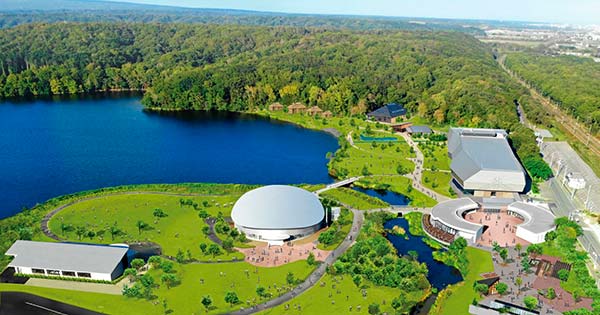
<th><img src="https://www.iea.usp.br/imagens/parque-e-museu-nacional-ainu-upopoy" alt="Parque e Museu Nacional Ainu Upopoy" class="image-inline" title="Parque e Museu Nacional Ainu Upopoy" /></th>
</tr>
<tr>
<td><span class="discreet">Upopoy National Ainu Museum and Park in Hokkaido, northern Japan</span></td>
</tr>
</tbody>
</table>
<p>The appreciation that Japanese culture has given to an alleged ethnic homogeneity of its population for centuries is well known. However, this conception has weakened in this century, especially since 2013, when Tokyo was chosen to host the 2020 Olympics and Paralympics (held in 2021, due to the COVID-19 pandemic). The government's intention became to present a new Japan to the world, in tune with the emphasis on diversity and inclusion that permeates many societies today.</p>
<p>One of the ways that the Japanese government found for this purpose was to promote a growing appreciation of the Ainu culture. The indigenous people from the North of the country currently number 13,000 individuals according to official data. The contingent must be much larger if one considers the people who have refused to recognize themselves as Ainu due to rejection.</p>
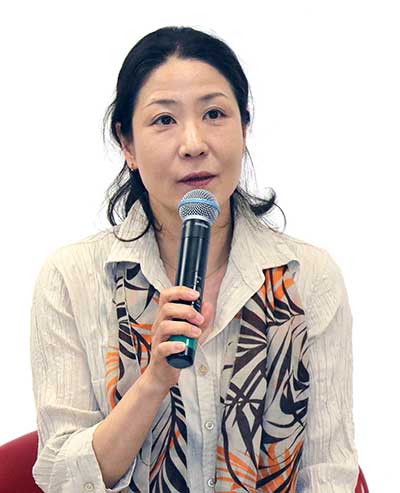
<p>With policies that value the culture of these people, they are now trying to redefine themselves. This is the opinion of sociologist <a href="https://www.iea.usp.br/en/persons/speakers/mariko-murata" class="external-link">Mariko Murata</a>, a professor at the Department of Sociology at Kansai University. "Museums can be a space for carrying out this redefinition process. Nonetheless, they are very colonial, which makes us think about how we can decolonise them."</p>
<table class="tabela-esquerda">
<tbody>
<tr>
<th><img src="https://www.iea.usp.br/imagens/mariko-murata-29-5-23" alt="Mariko Murata - 29/5/23" class="image-inline" title="Mariko Murata - 29/5/23" /></th>
</tr>
<tr>
<td><span class="discreet">Sociologist Mariko Murata (Kansai University)</span></td>
</tr>
</tbody>
</table>
<p>On May 29, Murata spoke at the seminar <a href="https://www.iea.usp.br/en/events/between-diversity-decolonisation">Decolonising Museums and Exhibitions on the Indigenous Ainu in Japan</a>, organized by <a class="external-link" href="http://www.forumpermanente.org/en" target="_blank">IEA's Research Group Fórum Permanente: Cultural System Between Public and Private</a> and the <a href="https://www.iea.usp.br/en/research/chairs/olavo-setubal-chair-of-arts-culture-and-science" class="external-link">Olavo Setubal Chair of Art, Culture, and Science</a>.</p>
<p>As part of the governmental action to value Ainu culture the Upopoy National Ainu Museum and Park was inaugurated in Hokkaido in 2020. However, despite the importance of the initiative, there were many criticisms about the way the museum was structured and presented the Ainu culture, according to the sociologist.</p>
<p>Murata explained that the Japanese central government began taking land from the Ainu in the 19th century. The Matsumae clan, which had been responsible for the northern border of Japan since the end of the 16th century, forbade them to engage in trade on their own. "In the following period, the government created a land reconnaissance agency. In 1863, the island was named Hokkaido, and this marks the beginning of the policy of Ainu assimilation."</p>
<p>In the late 19th and early 20th centuries, the Ainu were even shown at industrial exhibitions, said the researcher. "After World War II, they were ignored as if they did not exist, and their culture was practically extinct. Only in 2008 did the government recognize them as an indigenous people of Japan."</p>
<table class="tabela-direita">
<tbody>
<tr>
<th><img src="https://www.iea.usp.br/imagens/exposicao-permanente-do-museu-e-parque-ainu-nacional-upopoy" alt="Exposição permanente do Museu e Parque Ainu Nacional Upopoy" class="image-inline" title="Exposição permanente do Museu e Parque Ainu Nacional Upopoy" /></th>
</tr>
<tr>
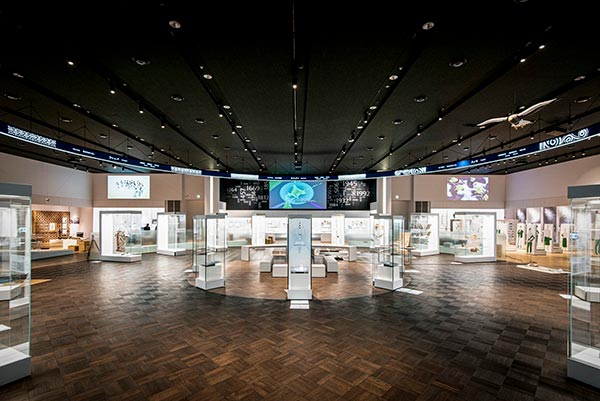
<td><span class="discreet">Permanent exhibition at the Upopoy National Ainu Museum and Park</span></td>
</tr>
</tbody>
</table>
<p>With the choice of Tokyo for the last editions of the Olympics and Paralympics, Ainu culture suddenly came to the fore. "The government wanted to make their culture a symbol of Japan's diversity, something important for tourism and global political relations," said the Murata.</p>
<p>According to her, when the Upopoy was inaugurated, there were about 20 small museums with collections established by the Ainu or formed by researchers, governments, or traders. The Ainu had also previously engaged in tourist activities for income.</p>
<p><span>In 1984, the Ainu built a museum which was improved and now forms part of Upopoy.</span></p>
<table class="tabela-esquerda">
<tbody>
<tr>
<th><img src="https://www.iea.usp.br/imagens/museu-nacional-ainu-upopoy-lareira-digital" alt="Museu Nacional Ainu Upopoy - Lareira digital" class="image-inline" title="Museu Nacional Ainu Upopoy - Lareira digital" /></th>
</tr>
<tr>
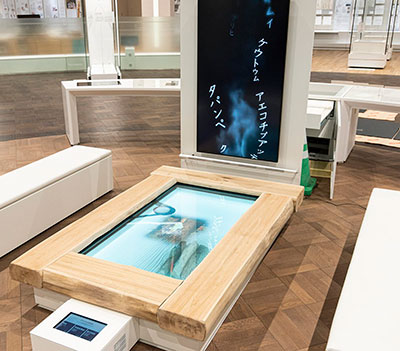
<td><span class="discreet">Fireplace simulation: the use of too many digital resources is criticized</span></td>
</tr>
</tbody>
</table>
<p><span>In addition to objects and records from the ethnic group's past, the Upopoy also shows how the Ainu live today: their activities as fishermen, traders, cooks, forest explorers, among other aspects. The biggest criticism of how the museum presents the Ainu culture lies in the controversial narrative, said the researcher. "The Ainu are agraphers. The panels are in Japanese and four other languages. The pronoun 'we' is used, as in 'our land.' Using 'we' for an exhibition does not explain everything, such as the case of the relationship with the colonisers and the process of colonisation. We rarely use the first person pronoun in a sentence for historical descriptions."</span></p>
<p>Murata said that new types of exhibitions avoid representing the Ainu culture as pre-modern, showing people in their current lives and with an excess of digital resources. "One of the criticisms is that the museum ignores the tragic history of the Ainu over the last 150 years. Their culture is explained from the Japanese point of view and, moreover, ignores the spirituality of the people.</p>
<table class="tabela-direita">
<tbody>
<tr>
<th><img src="https://www.iea.usp.br/imagens/ponto-de-cultura-memorial-museu-indigena-kaninde-de-aratuba" alt="Ponto de Cultura: Memorial Museu Indígena Kanindé de Aratuba" class="image-inline" title="Ponto de Cultura: Memorial Museu Indígena Kanindé de Aratuba" /></th>
</tr>
<tr>
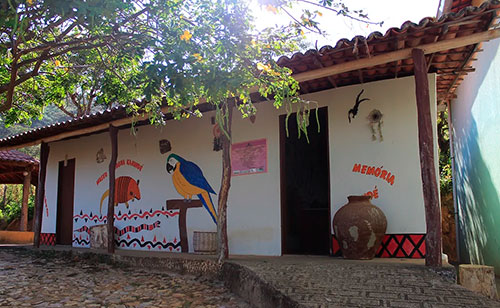
<td><span class="discreet">Kanindé Indigenous Museum Memorial in Aratuba (Ceará, Brazil)</span></td>
</tr>
</tbody>
</table>
<p>However, despite all the critical comments, the situation raised by Upopoy has sparked a discussion that had never happened before, said Murata. "The decolonisation of museums in Japan is a controversial issue. We are starting to create this space to think of Japan as non-homogeneous".</p>
<p>For her, Japan needs to recognize its diversity, which includes Koreans, Okinawans, Ainu, and immigrants who went there to work, like Brazilians. "Foreigners are 2% of the population, a number that should increase. Diversity is crucial for a country like Japan to continue to exist," she pointed out.</p>
<p><strong>Decolonisation in Brazil</strong></p>
<p>The meeting also opened space for the Brazilian reality regarding decolonisation, with presentations on museums created by indigenous peoples and on the <a class="external-link" href="http://http//www.museuafrobrasil.org.br/en/o-museu/introduction">Emanoel Araújo Afro Brasil Museu</a>. The indigenous participants were: Kaingang shaman assistant <a href="https://www.iea.usp.br/en/persons/speakers/susilene-melo" class="external-link">Susilene Elias de Melo</a>, one of the persons in charge of the <a class="external-link" href="https://periodicos.unb.br/index.php/museologia/article/view/36180">Worikg Museum</a>, created from the collection of her grandmother, Jandira Ubelino, of the Vanuíre Indigenous Land in the municipality of Arco-Íris (São Paulo), and <a href="https://www.iea.usp.br/en/persons/speakers/suzenalson-kaninde" class="external-link">Suzenalson da Silva Santos</a>, a doctoral student in social history at the Federal University of Ceará (UFC) and coordinator of the <a class="external-link" href="https://povokaninde.wixsite.com/historiandokanindes/museu-kaninde">Kanindé Indigenous Museum Memorial</a>, located in Aratuba (Ceará).</p>
<p><a href="https://www.iea.usp.br/en/persons/speakers/sandra-salles" class="external-link">Sandra Mara Salles</a> spoke on behalf of the Afro Brasil Museum. A parallel theme to the meeting, but also involving ethnic issues, was the presentation on Japanese-Brazilian visual artists given by semiotician <a href="https://www.iea.usp.br/en/persons/speakers/michiko-okano" class="external-link">Michiko Okano</a>, from the School of Philosophy, Languages, and Human Sciences at the Federal University of São Paulo (UNIFESP).</p>
<p><dl class="image-left captioned" style="width:300px;">
<dt><img src="https://www.iea.usp.br/imagens/suzenalson-da-silva-santos/image" alt="Suzenalson da Silva Santos" title="Suzenalson da Silva Santos" height="300" width="300" /></dt>
 <dd class="image-caption" style="width:300px;">Suzenalson da Silva Santos</dd>
</dl></p>
<p>During his speech, Suzenalson da Silva Santos said that there was a movement in the 1990s for the rebirth of indigenous cultures in Ceará: "There was an appropriation of a format from the colonisers, the so-called museum, and spaces called museums began to emerge."</p>
<p>In 1995, his father Sotero, chief and master of Kanindé culture, created a small space to show the history of his people in society. "Other stages and actions of the process were born from this initiative," he said.</p>
<p>"We did not have a school when the museum was created. We were one of the peoples to conquer schools very late, only in 2006. The museum presents objects in the context that universities have called decolonisation, another perspective to talk about this indigenous movement."</p>
<p>According to him, the implementation of the museum brought a lot of training to the community, covering several generations, from master Sotero to the youngest members, formed in the perspective of heritage education and living with the master. "The museum's activities relate to indigenous education. It is located next to the school and is part of the school curriculum," he said.</p>
<table class="tabela-direita">
<tbody>
<tr>
<th><img src="https://www.iea.usp.br/imagens/museu-worikg" alt="Museu Worikg" class="image-inline" title="Museu Worikg" /><br /><br /></th>
</tr>
<tr>
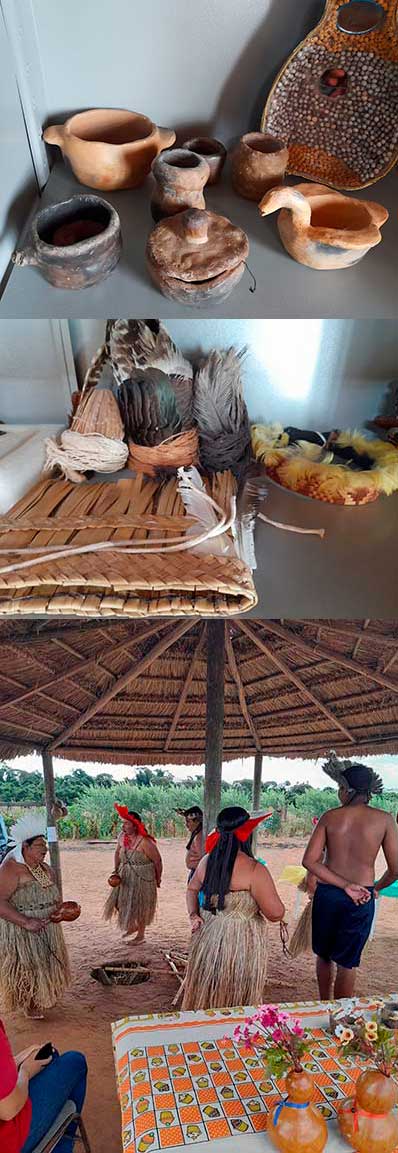
<td><span class="discreet">From the top: headdresses, ceramics, and dance performance at the Worikg Museum in the Vanuíre Indigenous Land (São Paulo, Brazil)</span></td>
</tr>
</tbody>
</table>
<p>Santos stated that the museum's relationships with other indigenous peoples have grown: "In 2014, a network of memory and museology was created, engaging indigenous communities from all states of the country. They are spaces, points of culture, and houses of memory. In Ceará alone there are 17 locations. At the last meeting of the network there were representatives of 32 initiatives from various parts of Brazil."</p>
<p>He highlighted that these initiatives have been organized autonomously or in partnership with various actors, such as universities. He added that there are villages that work with community tourism.</p>
<p>According to Santos, the emergence of indigenous museums does not only mean an effort for self-affirmation but also a movement to build the communities' own memory in dynamic processes following the peculiarities of each people.</p>
<p><dl class="image-left captioned" style="width:300px;">
<dt><img src="https://www.iea.usp.br/imagens/susilene-elias-de-melo/image" alt="Susilene Elias de Melo" title="Susilene Elias de Melo" height="300" width="300" /></dt>
 <dd class="image-caption" style="width:300px;">Susilene Elias de Melo</dd>
</dl></p>
<p>Susilene Elias de Melo said that the desire to build a museum to record the Kaingang culture was born in 2015 as a wish of her grandmother Jandira Ubelina, a shaman who died the following year. "We were left with the need to put the museum on its feet, as she wanted. In 2017, we held the first exhibition at the Worikg Museum,” she reported.</p>
<p>Now, Melo continues the work with her mother, the new shaman, of which she is an assistant just as her mother was to her grandmother. "Singing, dancing, eating... I learned everything from both of them," she said.</p>
<p>The museum stays open year-round and has several school visits per week. "We do not have much help. We took a little from here, a little from there," said Melo.</p>
<p>For a long time, the Kaingang culture in the Tupã region "was dormant, even to protect our territory," she said. "It was common to say that the Kaingang were extinct. We are firm and strong in the center-west of the state of São Paulo. We are a living museum."</p>
<p>In Tupã there is the Índia Vanuíre Historical and Pedagogical Museum, owned by the state government, dedicated to the memory of the indigenous peoples of western São Paulo. Melo said she had no complaints about the museum, Worikg's partner. "If we have our museum today, it was because of my mother's trip to the Tupã museum. She wanted to know why non-indigenous people talk so much about indigenous people." She also mentioned a partnership with USP's Museum of Archeology and Ethnology (MAE).</p>
<p>The museum is not just about material culture. There is a spiritual side, as a place of healing and empowerment, she said. "People think they are going to see a museum like the one in the city. But the museum is the territory, it is everything you experience. I am a museum, my mother is a museum. There is a bonfire inside the museum and the visit includes singing, dancing, and walking on the trail. We are also building our clay house."</p>
<table class="tabela-esquerda">
<tbody>
<tr>
<th><img src="https://www.iea.usp.br/imagens/museu-afro-brasil-emanoel-araujo" alt="Museu Afro Brasil Emanoel Araújo" class="image-inline" title="Museu Afro Brasil Emanoel Araújo" /></th>
</tr>
<tr>
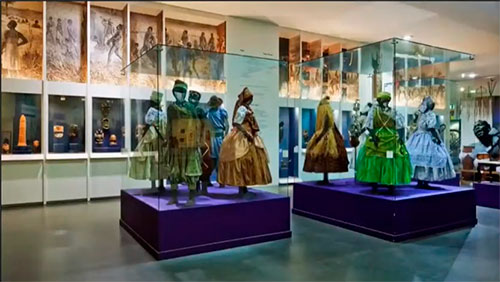
<td><span class="discreet">Emanoel Araújo Afro Brasil Museum</span></td>
</tr>
</tbody>
</table>
<p>According to the executive director of the Emanoel Araújo Afro Brasil Museum, the institution is experiencing a moment of transition with a new reflection on the formation of the collection and on the cultural program.</p>
<p>Sandra Salles recalled that the museum was created from the private collection of artist, curator, and cultural manager Emanoel Araújo, who founded it in 2004 and stayed for 18 years as its director and curator. His <span>name was added to the institution's original name after his death in 2022</span></p>
<p>The museum contains items related to religiosity of African origin and popular Catholicism, objects from work and life on farms, sculptures, paintings, among other items. The collection includes photographs and information about black people from different areas of arts and knowledge.</p>
<p>For Salles, the museum is decolonial in its narrative construction and perspective by talking about unofficial history. "However, being the narrative of a single man, its creator and leader, it is necessary to make room for other voices to be heard <span>as a decolonial practice</span>," she said.</p>
<p><dl class="image-right captioned" style="width:300px;">
<dt><img src="https://www.iea.usp.br/imagens/sandra-mara-salles-2021/image" alt="Sandra Mara Salles - 2021" title="Sandra Mara Salles - 2021" height="255" width="300" /></dt>
 <dd class="image-caption" style="width:300px;">Sandra Mara Salles</dd>
</dl></p>
<p>"Since last year, the museum has been trying to build a network of Afro-Brazilian collections, to connect with other spaces, including private collections, in order to have another vision of its own collection," she said.</p>
<p>An example of these connections is the dialogue initiated in 2018 with Quilombo de São Pedro, in the Ribeira Valley (São Paulo), with the aim of creating a memory center to promote tourism and cultural practices. The local residents also participate in the Afro Brasil Museum, as in the case of the exhibition <i>Roça É Vida</i>, which will open on June 24, curated jointly with a working group from the Quilombo.</p>
<p>The museological plan is being rethought with the participation of all the institution's professionals, said Salles. There will be external participation in this discussion, with conversation circles and working groups. "We are going to send invitations to different sectors of society to participate in this, so that they can say which museum they want. I think this is the moment for the black movement to participate in redefining the museum's model," she added.</p>
<p style="text-align: right; "><span class="discreet">Photos (from the top): 1, 3, and 4 - Upopoy National Ainu Museum and Park; 2 - Leonor Calasans/IEA-USP; 5 - Kanindé Indigenous Museum Memorial; 6 - personal archive of Susenalson da Silva Santos; 7 - Worikg Museum; 8 - Índia Vanuíre Historical and Pedagogical Museum; 9 - Emanoel Araújo Afro Brasil Museum; 10 - IEA-USP.</span></p>]]></content:encoded>
    <dc:publisher>No publisher</dc:publisher>
    <dc:creator>Richard Meckien</dc:creator>
    <dc:rights>Original version in Portuguese by Mauro Bellesa.</dc:rights>
    
      <dc:subject>Indigenous people</dc:subject>
    
    
      <dc:subject>Olavo Setubal Chair</dc:subject>
    
    
      <dc:subject>Black people</dc:subject>
    
    
      <dc:subject>cover</dc:subject>
    
    
      <dc:subject>Culture</dc:subject>
    
    
      <dc:subject>Decolonisation</dc:subject>
    
    
      <dc:subject>Japan</dc:subject>
    
    
      <dc:subject>Research Group: Fórum Permanente: Cultural System Between Public and Private</dc:subject>
    
    
      <dc:subject>Event</dc:subject>
    
    <dc:date>2023-06-02T16:10:00Z</dc:date>
    <dc:type>Notícia</dc:type>
  </item>


  <item rdf:about="https://www.iea.usp.br/en/news/japanese-museums">
    <title>Mariko Murata addresses the issues and possibilities of decolonising museums in Japan</title>
    <link>https://www.iea.usp.br/en/news/japanese-museums</link>
    <description></description>
    <content:encoded xmlns:content="http://purl.org/rss/1.0/modules/content/"><![CDATA[<table class="tabela-direita">
<tbody>
<tr>
<th><img src="https://www.iea.usp.br/imagens/exposicao-permanente-do-museu-e-parque-ainu-nacional-upopoy" alt="Exposição permanente do Museu e Parque Ainu Nacional Upopoy" class="image-inline" title="Exposição permanente do Museu e Parque Ainu Nacional Upopoy" /></th>
</tr>
<tr>
<td><span class="discreet">Permanent exhibition of Ainu artifacts at the Upopoy National Ainu Museumnd Park</span></td>
</tr>
</tbody>
</table>
<p dir="ltr">The practice of museum decolonisation will be examined by Japanese sociologist <a href="https://www.iea.usp.br/en/persons/speakers/mariko-murata" class="external-link">Mariko Murata</a> (Kansai University) on May 29, at 10:00 am, when she will give the conference <span>"Decolonising Museums and Exhibitions on the Indigenous Ainu in Japan."</span></p>
<p dir="ltr">The debaters will be <a href="https://www.iea.usp.br/en/persons/speakers/michiko-okano" class="external-link">Michiko Okano</a> (Federal University of São Paulo), <a href="https://www.iea.usp.br/en/persons/speakers/sandra-salles" class="external-link">Sandra Mara Salles</a> (Afro Brasil Museum), <a href="https://www.iea.usp.br/en/persons/speakers/susilene-melo" class="external-link">Susilene Elias de Melo</a> (Worikg Museum), and <a href="https://www.iea.usp.br/en/persons/speakers/suzenalson-kaninde" class="external-link">Suzenalson da Silva Santos</a> (Kanindé Museum). The mediator will be <a href="https://www.iea.usp.br/en/persons/speakers/ilana-goldstein" class="external-link">Ilana Goldstein</a> (Federal University of São Paulo).</p>
<p dir="ltr">The activity has been organized by <a class="external-link" href="http://www.forumpermanente.org/en">IEA's Research Group Fórum Permanente: Cultural System Between Public and Private</a> in partnership with the <a href="https://www.iea.usp.br/research/chairs/olavo-setubal-chair-of-arts-culture-and-science" class="external-link">Olavo Setubal Chair of Art, Culture, and Science</a>. It will be held in English with simultaneous translation into Portuguese, taking place in the Alfredo Bosi Room, at the IEA. There will be a live transmission over the internet.</p>
<table class="tabela-esquerda">
<tbody>
<tr>
<th><img src="https://www.iea.usp.br/imagens/mariko-murata" alt="Mariko Murata" class="image-inline" title="Mariko Murata" /></th>
</tr>
<tr>
<td><span class="discreet">Sociologist Mariko Murata</span></td>
</tr>
</tbody>
</table>
<p><span><span>Ainu, the earliest settlers of northern Japan, have been colonised and marginalised by the Japanese for centuries</span>, according to Murata. <span>They were also collected, exhibited, and subjected to othering in expositions and museum exhibitions</span>. <span>Meanwhile, the Ainu people themselves created some collections as part of their ethnic movement, also organizing ethnic tourism in their settlements.</span></span><br /><br />In 2020, the <a class="external-link" href="https://ainu-upopoy.jp/en/facility/museum/">Upopoy National Ainu Museum and Park</a> was opened in Hokkaido <span>as the first national museum specialising in Ainu culture. <span>While the movement to establish a national museum had started earlier, it became part of the government’s campaign to showcase the diversity of Japanese culture to the international audience only after Japan’s bid for the Tokyo 2020/2021 Olympic and Paralympic Games.</span></span><br /><br /><span>The museum adopted various methods to decolonise the earlier representation of Ainu culture. However, since its opening, the museum received much criticism, especially due to its approach to storytelling from a first-person perspective of the Ainu.</span></p>
<p><span>For Murata, m<span>useum exhibitions are media that convey the museums’ messages directly to the audience; they are also sites of tension, negotiation, and contestation among the stakeholders.</span></span></p>
<p> </p>
<hr />
<p><i><strong><span>Decolonising Museums and Exhibitions on the Indigenous Ainu in Japan</span></strong><br />May 29, at 10:00 am<br />The event will be held in English and there will be simultaneous translation into Portuguese<br />Venue: Alfredo Bosi Room (IEA - 109, Rua da Praça do Relógio, ground floor, Cidade Universitária, São Paulo, SP)<br />Live transmission at <a href="https://www.iea.usp.br/aovivo" class="external-link">http://www.iea.usp.br/aovivo</a><br />More information with Sandra Sedini (<a class="mail-link" href="mailto:sedini@usp.br">sedini@usp.br</a>) or by phone (+55 11 3091 1687)<br /><a href="https://www.iea.usp.br/en/iea/events/between-diversity-decolonisation" class="external-link">http://www.iea.usp.br/en/iea/events/between-diversity-decolonisation</a></i></p>
<p style="text-align: right; "><span class="discreet">Photos (from the top): Upopoy National Ainu Museum and Park and Kansai University</span></p>]]></content:encoded>
    <dc:publisher>No publisher</dc:publisher>
    <dc:creator>Richard Meckien</dc:creator>
    <dc:rights>Original version in Portuguese by Mauro Bellesa.</dc:rights>
    
      <dc:subject>Olavo Setubal Chair</dc:subject>
    
    
      <dc:subject>cover</dc:subject>
    
    
      <dc:subject>Museums</dc:subject>
    
    
      <dc:subject>Culture</dc:subject>
    
    
      <dc:subject>Decolonisation</dc:subject>
    
    
      <dc:subject>Research Group: Fórum Permanente: Cultural System Between Public and Private</dc:subject>
    
    
      <dc:subject>Event</dc:subject>
    
    <dc:date>2023-05-17T14:05:00Z</dc:date>
    <dc:type>Notícia</dc:type>
  </item>


  <item rdf:about="https://www.iea.usp.br/en/media-library/photos/events-2022/inauguration-conceicao-evaristo-september-9-2022">
    <title>Inauguration of Conceição Evaristo - Olavo Setubal Chair of Art, Culture, and Science - September 9, 2022</title>
    <link>https://www.iea.usp.br/en/media-library/photos/events-2022/inauguration-conceicao-evaristo-september-9-2022</link>
    <description></description>
    
    <dc:publisher>No publisher</dc:publisher>
    <dc:creator>Richard Meckien</dc:creator>
    <dc:rights></dc:rights>
    
      <dc:subject>Culture</dc:subject>
    
    
      <dc:subject>Literature</dc:subject>
    
    
      <dc:subject>Art</dc:subject>
    
    
      <dc:subject>Olavo Setubal Chair</dc:subject>
    
    <dc:date>2022-09-08T13:25:00Z</dc:date>
    <dc:type>Pasta</dc:type>
  </item>


  <item rdf:about="https://www.iea.usp.br/en/news/iea-zif-promote-exhibition">
    <title>IEA and ZiF promote the exhibition "Grace at the boundary of knowledge" at the MariAntonia Center</title>
    <link>https://www.iea.usp.br/en/news/iea-zif-promote-exhibition</link>
    <description></description>
    <content:encoded xmlns:content="http://purl.org/rss/1.0/modules/content/"><![CDATA[<p><span id="docs-internal-guid-f2554a7e-7fff-30dd-3e24-80b53d0ddb03"> </span></p>
<p dir="ltr"><span><img src="https://www.iea.usp.br/imagens/banner_grace_500x243.png" alt="Banner Grace" class="image-right" title="Banner Grace" /></span><span>The exhibition <i>Grace at the boundary of knowledge</i>, by artist <a href="https://www.sandraboeschenstein.ch/">Sandra Boeschenstein</a>, will be inaugurated at the University of São Paulo's MariAntonia Cultural Center <span>on August 6, </span><span>at 11:00 am</span>. With free admission, it will run until November 20 and will be open to the public from Tuesday to Sunday and on holidays from 10:00 am to 6:00 pm. At the opening, at 12:00 pm, there will be a conversation between the artist and the Brazilian curator.</span></p>
<p dir="ltr"><span class="ChMk0b JLqJ4b"><span class="Q4iAWc">Curated by Martin Grossmann (Institute of Advanced Studies at USP) and Britta Padberg, former executive director at Bielefeld University's <a class="external-link" href="https://www.uni-bielefeld.de/ZiF/">Center for Interdisciplinary Research (ZiF)</a>, the exhibition showcases an "unregulated encounter of things, images, and words that unleashes the qualities and potentials of media."</span></span><span> <span>Boeschenstein</span></span><span class="ChMk0b JLqJ4b"><span class="Q4iAWc">'s attention is focused on these transitions and on the ways of experiencing them.</span></span><span> </span><span class="ChMk0b JLqJ4b"><span class="Q4iAWc">According to the organizers, "the exhibition is a continuum of intertwined gestures, placing the act of perception at the center and making visible the dynamic nature of meanings."</span></span></p>
<blockquote>
<div dir="ltr">
<div dir="ltr">
<div class="gmail_quote">
<div>
<div>
<div>
<div>"In this case, the MariAntonia Cultural Center becomes an interactive extension of this interdisciplinary platform that is the IEA-USP by providing the ambience and the necessary complementarity for its realization. This partnership, whether with MariAntonia or with the ZIF, further enhances this ambitious mission of fostering encounters of different cultures, knowledges, disciplines, and practices that the IEA has been carrying out throughout its 35 years of life," explains Grossmann.<br /><br />Whether for her singular investment in the language of drawing in expanded mode or for her remarkable participations in other institutes for advanced study in Europe, interacting in equivalence with scientists and intellectuals of different matrices, Sandra Boeschenstein provokes reactions and questionings of the most diverse forms <span>with her daring drawings</span>.<br /><br /><i>Grace at the boundary of knowledge</i> establishes a kind of game with the visitor. However, the pieces, the board (the spatiality), the rules, and the references are not objectively delineated. Warning: the experience causes strangeness, displacement, and questioning, all fundamental to the updating and expansion of knowledge.<br /><br />The activity is a cooperation between the ZiF and the IEA. Support is provided by the <a class="external-link" href="https://prohelvetia.ch/en/">Swiss Arts Council Pro Helvetia</a>, IEA's research group <a class="external-link" href="http://www.forumpermanente.org/en">Fórum Permanente</a>, and USP's <a class="external-link" href="https://prceu.usp.br/en/">Office of the Provost for Culture and Extension (PRCEU)</a>.</div>
<br /><span><span id="docs-internal-guid-d5be1f93-7fff-b64e-9857-05388d98ddf8">
<p dir="ltr"><span><strong>The artist</strong></span></p>
<p dir="ltr"><span>Sandra Boeschenstein</span><span> is a visual artist who lives and works in Zurich. She has studied Philosophy and Art History at the University of Zurich for a year and graduated as an artist from the University of Arts in Bern in 1995.</span></p>
<p dir="ltr"><span>Through drawing, she proposes to seek knowledge and analyze the interaction between perception and thought, exploring the border between tangible and intangible, between image and language, and between information and poetry. Over the past few years, Boeschenstein has expanded her drawing on paper to drawings on walls, in which she arranges real objects that relate to the images and lines in space.</span></p>
<blockquote>
<div dir="ltr">
<div dir="ltr">
<div class="gmail_quote">
<div>
<div>
<div>
<div></div>
</div>
</div>
</div>
</div>
</div>
</div>
</blockquote>
<p class="callout"><span id="docs-internal-guid-ccd6c880-7fff-39ae-94ad-0677b10c5023"><span>“When is something and how does it accrue meaning? How do the situation, the image, and language touch each other? What is the appearance of a knowledge beckoning between material, picture, and language and that cannot be further extracted? Bringing light into darkness is simpler than darkness into light. The boundary of knowledge forms in the hierarchy-free play of these two actions. This is work with both the constructing and the decaying energies of meanings” <br /><strong>Sandra Boeschenstein</strong><br /></span></span></p>
<p dir="ltr"><i><span><strong> </strong></span></i></p>
<hr />
<i><strong>Grace at the boundary of knowledge<br /></strong></i></span><i><span>August 6 - November 20<br /></span><span>Free of charge<br /></span><span>Tuesdays to Sundays and holidays, 10:00 am - 6:00 pm</span></i>
<p><i>MariAntonia Center - Joaquim Nabuco Building<br /></i><i>Address: Rua Maria Antônia, 258, Vila Buarque - São Paulo, SP<br /></i><i>Near subway stations: Higienópolis (Yellow line) and Santa Cecília (Red line)</i></p>
<p><i><img src="https://www.iea.usp.br/imagens/Regua_video_grace_branco_600x337.png" alt="Régua vídeo Grace branco - 600x337" class="image-inline" title="Régua vídeo Grace branco - 600x337" /></i></p>
</span></div>
</div>
</div>
</div>
</div>
</div>
</blockquote>]]></content:encoded>
    <dc:publisher>No publisher</dc:publisher>
    <dc:creator>Richard Meckien</dc:creator>
    <dc:rights>Original version in Portuguese by Beatriz Herminio</dc:rights>
    
      <dc:subject>Culture</dc:subject>
    
    
      <dc:subject>Research Group: Fórum Permanente: Cultural System Between Public and Private</dc:subject>
    
    
      <dc:subject>Art</dc:subject>
    
    
      <dc:subject>Exhibition</dc:subject>
    
    <dc:date>2022-07-06T19:10:00Z</dc:date>
    <dc:type>Notícia</dc:type>
  </item>


  <item rdf:about="https://www.iea.usp.br/en/news/journal-issue-99">
    <title>"Estudos Avançados" #99 presents dossier on the COVID-19 pandemic</title>
    <link>https://www.iea.usp.br/en/news/journal-issue-99</link>
    <description> </description>
    <content:encoded xmlns:content="http://purl.org/rss/1.0/modules/content/"><![CDATA[<p><img src="https://www.iea.usp.br/imagens/capa-de-estudos-avancados-99" alt="Capa de &quot;Estudos Avançados&quot; 99" class="image-right" title="Capa de &quot;Estudos Avançados&quot; 99" /></p>
<p><span>Dedicated to the </span><span>COVID-19 </span><span>victims, the 99th </span><span>issue of the journal </span><i><a href="https://www.iea.usp.br/en/journal" class="external-link">Estudos Avançados</a></i><span> presents a dossier on the pandemic caused by the Sars-CoV-2 coronavirus. </span><span>The online version (Portuguese only) is available at </span><a class="external-link" href="https://www.scielo.br/scielo.php?script=sci_issuetoc&amp;pid=0103-401420200002&amp;lng=pt&amp;nrm=iso">SciELO</a>.</p>
<p>According to sociologist <a href="https://www.iea.usp.br/en/persons/researchers/sergio-adorno" class="external-link">Sérgio Adorno</a>, editor of the publication, the object of the dossier is the complexity of the pandemic, reflected in the 17 articles written by 47 researchers from two dozen universities and research institutions in several Brazilian states.</p>
<p><span>"</span>Its multiple aspects are addressed by experienced researchers through extensive investigations, some of which are produced in the effervescence of events, in the seemingly uninterrupted search for scientific responses, and by government plans to stop its natural course, fertilized by unfavorable social and political conditions," notes the editor.</p>
<p>He points out that the pandemic is above all a public health problem, involving different types of collectives, which are represented, for example, by groups with different degrees of vulnerability<span>.</span></p>
<p><span>"</span>Not without reason, the dossier addresses issues more properly situated in this domain, such as the norms of international and national regulatory bodies, and the race for the discovery of vaccines, the performance of tests, and consequent epidemiological modeling that enable the assessment of both scenarios and guidelines for prevention."</p>
<p>However, the pandemic also reveals the harsh social reality, accentuated by the "acute process of economic recession that, in societies like Brazil, means the worsening of social inequalities that are projected with greater intensity in the metropolises, as is the case of São Paulo," says Adorno.</p>
<p>He reinforces that the space studies of the dossier demonstrate how inequalities affect the poorest, the black population, and the residents of neighborhoods where populations with low education and income predominate, "the most vulnerable to contamination and deaths" by COVID-19.</p>
<p>Other topics addressed by the dossier have been highlighted by Adorno, such as issues regarding the right to privacy in the face of intense data tracking and monitoring, the dangers of spreading Sars-Cov-2 in Brazilian biomes, and the absence of government policies<span> </span><span>capable of containing the pandemic's progress </span><span>in the country</span><span>.</span></p>
<p>The dossier begins with an article by the collaborator in the organization of the journal's set of texts, José da Rocha Carvalheiro, a professor of social medicine at USP's School of Medicine in Ribeirão Preto (FMRP) and a member of <a href="https://www.iea.usp.br/en/research/research-groups/innovation-and-competitiveness-observatory" class="external-link">IEA's Innovation and Competitiveness Observatory</a>.</p>
<p>In the article, Carvalheiro states that COVID-19 in Brazil will not be a disease limited in time, but in space: "An endemic disease or, perhaps, a collection of endemic diseases with different characteristics spread across the national territory. Due to the diversity, the control proposals will inevitably have their own characteristics. This requires a coordination effort and political skill on the part of the leaders."</p>
<p>The effort of the journal to collaborate with the academic and public debate about COVID-19 and its consequences does not end in the current issue. Issue #100, to be launched in the next four months, will feature articles on the impact of the pandemic in areas such as <span>(national and international) </span><span>economy, international relations, education, labor market, agriculture, food, and engineering.</span></p>
<p><strong>Youth</strong></p>
<p>Another highlight of the issue is a set of articles on the Brazilian youth, a topic addressed <span>by </span><i>Estudos Avançados </i><span>for the first time</span><span>. Organized with the collaboration of Professor Marilia Pontes Sposito, from USP's School of Education (FE) and co-author of one of the articles, the section "Portrait of Youth" contains six texts written by a dozen education and sociology researchers from USP, the Federal University of ABC (UFABC), the Federal University of São Carlos (UFSCar), the Federal University of Ceará (UFC), the University of Brasília (UnB), </span><span>Pará State University (UEPA), UNISINOS, and the Federal University of Alfenas (UNIFAL).</span></p>
<p>According to Adorno, the section "deals with an issue that is always present in public debates: youth as a social matter." Despite the variety of topics covered, he identifies "t<span>he effort to review theses that seemed consolidated in the specialized literature </span><span>based on original investigations</span><span>" </span><span>as an axis that articulates all contributions.</span></p>
<p>With regard to the educational scope, there are articles on the participation of high school students in the institutional plan of schools (based on the results of research on the subject in urban centers in Brazil, Argentina, Mexico, and Spain), the difficulties for schooling of the Brazilian youth that emerged since the 1990s, and what <span>the occupation of schools in Rio Grande do Sul in May and June 2016 has </span><span>represented for its protagonists.</span></p>
<p>The section also features articles on public performance through the Facebook profiles of young conservatives, youth cultural production on the outskirts of Fortaleza, and the policies and proposals for the professional training of young people and their insertion in the labour market in the last three decades.</p>
<p>The list below contains the names of the authors who have contributed with each one of the addressed themes:</p>
<p><strong>Covid-19 Pandemic</strong></p>
<p><strong> </strong><i>José da Rocha Carvalheiro<br /></i><i>Cláudio Maierovitch Pessanha Henriques and Wa</i><i>gner Vasconcelos<br /></i><i>Paulo Marchiori Buss, Santiago Alcázar, and Luiz Augusto Galvão<br /></i><i>Glauco Arbix<br /></i><i>Carmen Phang Romero Casas, Julio Silva, Rodolfo Castro, Marcelo Ribeiro-Alves, and Carolina Mendes Franco<br /></i><i>Naomar de Almeida Filho<br /></i><i>Raul Borges Guimarães, Rafael de Castro Catão, Oséias da Silva Martinuci, Edmur Azevedo Pugliesi, and Patricia Sayuri Silvestre Matsumoto<br /></i><i>Marcos Silveira Buckeridge and Arlindo Philippi Jr.<br /></i><i>Vinicius Carvalho Jardim and Marcos Silveira Buckeridge<br /></i><i>Gabriela Capobianco Palhares, Alessandro Santiago dos Santos, Eduardo Altomare Ariente, and Jefferson de Oliveira Gomes<br /></i><i>André Luis Acosta, Fernando Xavier, Leonardo Suveges Moreira Chaves, Ester Cerdeira Sabino, Antonio Mauro Saraiva, and Maria Anice Murebe Sallum<br /></i><i>Sandra Caponi<br /></i><i>Márcia Pereira Alves dos Santos, Joilda Silva Nery, Emanuelle Freitas Goes, Alexandre da Silva, Andreia Beatriz Silva dos Santos, Luís Eduardo Batista, and Edna Maria de Araújo<br /></i><i>Eugênio Bucci<br /></i><i>Fernando Xavier, João Rodrigo Windischi Olenscki, André Luis Acosta, Maria Anice Mureb Sallum, and Antonio Mauro Saraiva<br /></i><i>Marcos Antônio Mattedi, Eduardo Augusto Werneck Ribeiro, Maiko Rafael Spiess, and Leandro Ludwig<br /></i><i>José Eli da Veiga</i></p>
<p><strong>Portrait of Youth</strong></p>
<p dir="ltr"><i>Marilia Pontes Sposito, Elmir de Almeida, and Felipe de Souza Tarábola<br /></i><i>Adriano Souza Senkevics and Marília Pinto de Carvalho<br /></i><i>Livia de Tommasi and Maria Carla Corrochano<br /></i><i>Glória Diógenes<br /></i><i>Wivian Weller and Lucélia de Moraes Braga Bassalo<br /></i><i>Luís Antonio Groppo and Rodrigo Manoel Dias da Silva</i></p>
<div id="_mcePaste">
<div class="tlid-results-container results-container">
<div class="tlid-result result-dict-wrapper">
<div class="result tlid-copy-target">
<div class="text-wrap tlid-copy-target"></div>
</div>
</div>
</div>
</div>]]></content:encoded>
    <dc:publisher>No publisher</dc:publisher>
    <dc:creator>Richard Meckien</dc:creator>
    <dc:rights>Original version in Portuguese by Mauro Bellesa.</dc:rights>
    
      <dc:subject>Literature</dc:subject>
    
    
      <dc:subject>Sustainable development</dc:subject>
    
    
      <dc:subject>Journal</dc:subject>
    
    
      <dc:subject>Work</dc:subject>
    
    
      <dc:subject>Public Policies</dc:subject>
    
    
      <dc:subject>Environment</dc:subject>
    
    
      <dc:subject>Culture</dc:subject>
    
    
      <dc:subject>Sociology</dc:subject>
    
    
      <dc:subject>Publications</dc:subject>
    
    <dc:date>2020-07-08T17:40:00Z</dc:date>
    <dc:type>Notícia</dc:type>
  </item>


  <item rdf:about="https://www.iea.usp.br/en/news/journal-issue-98">
    <title>"Estudos Avançados" #98 analyzes labor precariousness and transformations</title>
    <link>https://www.iea.usp.br/en/news/journal-issue-98</link>
    <description> </description>
    <content:encoded xmlns:content="http://purl.org/rss/1.0/modules/content/"><![CDATA[<p><img src="https://www.iea.usp.br/imagens/capa-de-estudos-avancados-98" alt="Capa de &quot;Estudos Avançados&quot; 98" class="image-right" title="Capa de &quot;Estudos Avançados&quot; 98" /></p>
<p>At a time of marked reduction in the possibility of work for a large number of workers as a result of restrictions on displacement and public contact due to the COVID-19 crisis, the <span>98th issue of the journal </span><i><a href="https://www.iea.usp.br/en/journal" class="external-link">Estudos Avançados</a></i><span>, released this month</span>, discusses two themes <span>already problematic </span>in Brazil before the pandemic: the still little recognition of care work, which is essential in view of the aging population, and the characteristics and impacts of new forms of work, including on workers' health. <span>The online version (Portuguese only) is available at </span><a class="external-link" href="https://www.scielo.br/scielo.php?script=sci_issuetoc&amp;pid=0103-401420200001&amp;lng=pt&amp;nrm=iso">SciELO</a>.</p>
<p>The content of the issue was defined before the World Health Organization (WHO) declared the pandemic caused by the international spread of the novel coronavirus SARS-CoV-2. Thus, rigorous analyses are not presented, as they could not have been produced in the early stages of the outbreak.</p>
<p>However, the issues addressed in the dossiers deserve extra attention as they are among those for which society must seek answers in the post-pandemic period in order to ensure decent and equal work for everyone, in addition to rights and health protection.</p>
<p>In "Work, Gender, and Care", the first dossier, care for people is analyzed in its various forms. An example is when care occurs as "help," without being characterized as a professional activity or as a parental obligation. The topic is discussed by sociologists Nadya Araujo Guimarães, a senior professor at USP's Faculty of Philosophy, Languages and Literature, and Human Sciences (FFLCH), and Priscila Pereira Faria Vieira, a researcher at the Brazilian Center of Analysis and Planning (CEBRAP).</p>
<p>Helena Hirata, former visiting professor at the IEA and director emeritus of research at the French National Center for Scientific Research (CNRS), addresses the main points of convergence and divergence in the activity of elderly caregivers in Brazil, Japan, and France, without neglecting the centrality of women in this work. The objective is to demonstrate how gender, race, and social class help to build the professional and personal trajectories of caregivers.</p>
<p>In the article "Care and Responsibility," Natacha Borgeaud-Garciandía discusses the work of immigrant caregivers for the elderly in Buenos Aires. A researcher at the Latin American Faculty of Social Sciences (FLACSO), Borgeaud-Garciandía focuses on responsibility as the assumption of a moral obligation towards a vulnerable person. One of the addressed aspects is the role of responsibility in the complexity of the <span>caregivers' </span>exploitation plots within the framework of unequal power relations.</p>
<p>The legal treatment of care in Brazil and public policies aimed at the socialization of social reproduction activities fall short of social demands, according to Regina Stela Corrêa Vieira, a researcher at CEBRAP and a professor of the graduate program in Law at the University of West Santa Catarina (UNOESC). To her, <span>labor law, which "historically ignores or neglects domestic work, whether paid or unpaid," has made some progress such as the Constitutional Amendment 72/2013 and the ratification of Convention C189 of the International Labor Organization (ILO), but currently sees labor reform as a "threat to the hard-won rights of domestic workers."</span></p>
<p>The struggle of these female workers for the enhancement of their professional activity is also analyzed in an article by Louisa Acciari, from the Federal University of Rio de Janeiro (UFRJ), and Tatiane Pinto, from the Federal Rural University of Rio de Janeiro (UFRRJ), who discuss informal negotiations with employers and union mobilization in the category. They propose a redefinition of the concept of work with the full inclusion of care work, something "indispensable to guarantee the dignity and equal rights."</p>
<p><strong>Labor precariousness</strong></p>
<p>The discussion on the lack of rights and dignity in the context of caregivers and domestic employees in general is extended in the second dossier of the isssue to address the characteristics and impacts of the transformations underway in the world of work, including health.</p>
<p>In his article, sanitary professional René Mendes, a collaborating researcher at the IEA, summarizes the concerns that led him to propose the development of the research project "Impacts of the New Morphologies of Contemporary Work on Life, Sickness, and Death."</p>
<p>Mendes starts from the perceptions of existing studies on the problem <span>mainly </span><span>carried out from a sociological perspective, but seeks to deepen the reflections on the nature and complexity of the pathogenesis mechanisms of the new morphologies of work on the workers' life and health </span><span>from the perspective of social epidemiology</span><span>.</span></p>
<p>One of these new forms of work is the "uberization," subject of the article by Ludmila Costhek Abílio, a researcher at the University of Campinas's Center for Union Studies and Labor Economics (CESIT-UNICAMP). Her study is based on empirical research with cosmetic dealers and motorcycle drivers, and on secondary data on Uber drivers and the so-called bike boys.</p>
<p>Abílio's analysis considers two theses: 1) uberization is an ongoing global trend to consolidate the worker as an available subordinate self-manager <span>defined as a just-in-time worker</span><span> devoid of guarantees and rights; 2) companies present themselves as mediators, when they actually operate forms of subordination and work control, in what can be called algorithmic work management.</span></p>
<p>The third article in the dossier, authored by <span>sociologist </span><span>Clemente Ganz Lúcio, a technician at the Inter-Union Department of Statistics and Socioeconomic Studies (DIEESE), presents a brief history and the current context of the debates </span><span>on union reform and the system of labor relations in the National Congress and in the Federal Government. </span>Lúcio points out that countless aspects of the world of work have undergone changes, such as jobs, occupations, labor dynamics, forms of hiring, working hours, and working conditions, among others.</p>
<p>For him, some guidelines should be considered in these changes. One of them is the development of an autonomous and effective system of self-regulation between workers and employers, which supports the union's restructuring of the labor relations system and resolves conflicts through instruments created by the parties.</p>
<p><strong>Bioeconomics, energy, and vegetation</strong></p>
<p>Themes related to the environment and sustainable development have had a regular presence throughout the journal's 33 years, and are present in this issue in three articles. André Luiz Willerding, a biotechnologist at the <span>Amazonas State Secretariat for Economic Development, Science, Technology, and Innovation (SEDECTI), and five other researchers from SEDECTI an </span>Amazonas State University<span>, present an overview of the state's reality regarding the development of bioeconomy strongly linked to the potential of natural resources. According to the authors, the discussion on this theme goes against the search for alternatives for the state's economy, still centralized around the Manaus Industrial Pole, which "becomes increasingly threatened year after year."</span></p>
<p>Another region addressed in this section is the Brazilian Northeast, in an article on the importance of integrating social, economic, and environmental policies around the supply of energy to the semiarid region. Based on the food-water-energy nexus, which seeks to examine the interrelationships of these three essential components of environmental and human quality, Marcel Burztyn, from <span>University of Brasília's</span><span> Center for Sustainable Development (CDS-UnB), proposes the promotion of photovoltaic energy generation by family farmers.</span></p>
<p>When studying issues such as the degree of complexity and diversification of the Brazilian landscape, it must be taken into account that a landscape may be the result of recent environmental changes or relics of much more remote conditions. This is what geologists Daniel Meira Arruda, from the Federal University of Minas Gerais (UFMG), and Carlos Ernesto Gonçalves Rynaud Schaefer, from the Federal University of Viçosa (UFV), point out in another article. They discuss the biogeographic theories formulated and modified over the past 60 years of studies on the reconstruction of Brazil's vegetation under the impact of the climatic changes of the Last Glacial Maximum (LGM), which occurred 18,000 years ago. According to both researchers, the recent advance of global climate models has provided new perspectives for a more faithful reconstruction of the conditions of that period.</p>
<p><strong>Literature and other cultural themes</strong></p>
<p><strong> </strong>The <span>"Culture" </span><span>section brings texts about works by writers Samuel Beckett, José de Alencar and Murilo Mendes, and about the costumes of the Brazilian Indians during the time of Johan Maurits van Nassau-Siegen's </span><span>government</span><span> (1637-1644) during the Dutch occupation in the country's Northeast. The set of articles also includes "The Impediments of Memory," by Jeanne Marie Gagnebin, and "Ideological Automata," by Benhur Bortolotto</span><i>.</i></p>
<p><i>Estudos Avançados</i> #98 also presents tributes for the ten years since the death of Portuguese writer José Saramago, winner of the 1998 Nobel Prize for Literature. There are three articles on some aspects of the author's work written by Jaime Bertoluci, Marcelo Lachat, and Jean-Pierre Chauvin.</p>
<p>Finally, the edition includes reviews of five books: "Reflection as Resistance: Homage to Alfredo Bosi," organized by Augusto Massi, Erwin Torralbo Gimenez, Marcus Vinicius Mazzari, and Murilo Marcondes de Moura; "The French School of Geography: a Contextual Approach," by Vincent Berdoulay; "The Double Night of Linden Trees," by Marcus Vinicius Mazzari; "Historia von D. Johann Fausten," translated, organized, and commented by Magali Moura; and "The Tragical History of the Life and Death of Doctor Faustus," by Christopher Marlowe, with translation and notes by Luís Bueno and Caetano Waldrigues Galindo.</p>
<p>The list below contains the names of the authors who have contributed with each one of the addressed themes:</p>
<p><strong><span>Work, Gender, and Care</span></strong></p>
<p dir="ltr"><i>Nadya Araujo Guimarães and</i><i> Priscila Pereira Faria Vieira<br /></i><i>Helena Hirata<br /></i><i>Natacha Borgeaud-Garciandía<br /></i><i>Regina Stela Corrêa Vieira<br /></i><i>Louisa Acciari and Tatiane Pinto</i></p>
<p><strong>Labor Issues</strong></p>
<p dir="ltr"><i>René Mendes<br /></i><i>Ludmila Costhek Abílio<br /></i><i>Clemente Ganz Lúcio</i></p>
<p><strong>Environment and Development</strong></p>
<p dir="ltr"><i>André Luis Willerding, Leonardo Rodrigo </i><i>da Silva, Roseana Pereira da Silva, Geison </i><i>Maicon Oliveira de Assis, and Estevão Vicente Cavalcanti Monteiro de Paula<br /></i><i>Marcel Bursztyn<br /></i><i>Daniel Meira Arruda and</i><i> Carlos Ernesto Gonçalves Reynaud Schaefer</i></p>
<p dir="ltr"><strong>Culture</strong></p>
<p><i>Jeanne Marie Gagnebin<br /></i><i>Luciano Gatti<br /></i><i>Fabiano Lemos and Ulysses Pinheiro<br /></i><i>Pablo Simpson<br /></i><i>Aline Leal Fernandes Barbosa<br /></i><i>Benhur Bortolotto<br /></i><i>Fausto Viana</i></p>
<p dir="ltr"><strong>José Saramago: Themes and Languages</strong></p>
<p><i>J</i><i>aime Bertoluci<br /></i><i>Marcelo Lachat<br /></i><i>Jean Pierre Chauvin</i></p>
<p dir="ltr"><strong>Reviews</strong></p>
<p><i>Alexandre Koji Shiguehara<br /></i><i>Nilson Cortez Crocia de Barros<br /></i><i>Klaus F. W. Eggensperger<br /></i><i>Rafael Rocca dos Santos</i></p>
<div id="_mcePaste">
<div class="tlid-results-container results-container">
<div class="tlid-result result-dict-wrapper">
<div class="result tlid-copy-target">
<div class="text-wrap tlid-copy-target"></div>
</div>
</div>
</div>
</div>]]></content:encoded>
    <dc:publisher>No publisher</dc:publisher>
    <dc:creator>Richard Meckien</dc:creator>
    <dc:rights>Original version in Portuguese by Mauro Bellesa.</dc:rights>
    
      <dc:subject>Literature</dc:subject>
    
    
      <dc:subject>Sustainable development</dc:subject>
    
    
      <dc:subject>Journal</dc:subject>
    
    
      <dc:subject>Work</dc:subject>
    
    
      <dc:subject>Public Policies</dc:subject>
    
    
      <dc:subject>Environment</dc:subject>
    
    
      <dc:subject>Culture</dc:subject>
    
    
      <dc:subject>Sociology</dc:subject>
    
    
      <dc:subject>Publications</dc:subject>
    
    <dc:date>2020-05-08T17:40:00Z</dc:date>
    <dc:type>Notícia</dc:type>
  </item>


  <item rdf:about="https://www.iea.usp.br/en/news/peripheral-cultural-collectives">
    <title>Dennis de Oliveira analyzes peripheral cultural collectives in São Paulo</title>
    <link>https://www.iea.usp.br/en/news/peripheral-cultural-collectives</link>
    <description></description>
    <content:encoded xmlns:content="http://purl.org/rss/1.0/modules/content/"><![CDATA[<table class="tabela-direita-300">
<tbody>
<tr>
<th><img src="https://www.iea.usp.br/imagens/dennis-de-oliveira-2018" alt="Dennis de Oliveira - 2018" class="image-inline" title="Dennis de Oliveira - 2018" /></th>
</tr>
<tr>
<td><span class="discreet">Dennis de Oliveira: ''The collectives express criticism of the dominant model and enhance proposals for another sociability''</span></td>
</tr>
</tbody>
</table>
<p>Based mainly on community ties and experiences of political resistance to the social oppressions that occur in the peripheries, cultural collectives "reinvent forms of productive organization, constituting local arrangements based on other logics, distinct from the neoliberal productive paradigm," according to Professor <a href="https://www.iea.usp.br/en/persons/researchers/dennis-oliveira" class="external-link">Dennis de Oliveira</a>, from the Department of Journalism and Publishing at USP's School of Communications and Arts (ECA), a participant in <a href="https://www.iea.usp.br/en/persons/sabbatical" class="external-link">IEA's Sabbatical Year Program</a> in 2019.</p>
<p>From July to December, he will develop the project "Insurgent Outskirts: the Culture and Communication Collectives in the Peripheries of São Paulo," in which he will map the performance of these groups and analyze three aspects:</p>
<ul>
<li>the experiences of the collectives in relation to the role of communicative processes as guiding axes of their organizational perspectives;</li>
<li>the resignification processes of the peripheral territories from the collectives' action;</li>
<li>the relations maintained by the collectives with government agencies, companies, universities, and other institutions.</li>
</ul>
<p> </p>
<div id="_mcePaste">For him, the peripheral cultural collectives constitute a form of organization that expresses criticism of the dominant model and enhances proposals for another sociability. "Their motivations, organization, and achievements make up what is called a 'potentially counter-hegemonic popular culture,' especially because it repositions subjects historically separated from the public political sphere and gives them visibility," says Oliveira.<br /><br />The delimitation of the scope of study to collectives funded by government funding programs is due to Oliveira's interest in investigating the tensions, conflicts, and negotiations that occur in the process of relationship between the collectives' organizational experiences and the State's institutional structures.<br /><br />"We understand that the potentialities expressed in these experiments are not exempt from permanent conflicts, mechanisms of co-optation, and resistance."<br /><br />Regarding the local impact of the collectives, the territories where they are inserted are resignified, "ceasing to be just places with needs and becoming an empowered locus, giving voice to the subjects of these territories and visibility to their actions," he says.<br /><br />As for the role of communicative processes as guides of the collectives' <span>organization</span><span>, Oliveira explains that this is due to the fact that the organization is based on the flows of information and communication, "retrieving the historical experience of social networks (which is different from network platforms) existing in the traditions of popular cultures." The appropriation of technologies of existing social networking platforms currently enhances this organizational experience, according to the researcher.</span></div>
<div id="_mcePaste"><br />Concern<span>ing the insertion of the </span><span>collectives' artists and producers in the predominant cultural market in society, Oliveira </span>defends the hypothesis that it is a product of significance tensioning, "because the predominant cultural market has a logic and objectives distinct from the meanings given by peripheral cultural practices."</div>
<div><br />"It is necessary to observe how this insertion keeps or empties the senses of each structure, always remembering that the conception of market culture is hegemonic. To this end, we have reconstructed Gramsci's concept of 'transformism,' when the Italian thinker was dealing with co-optations of workers' leadership within the State apparatus."<br /><br />But as hegemonic culture takes place within the cultural industry, to what extent does the aforementioned insertion not point to a "cultural transformism?" Oliveira replies that, at first, he does not have a closed position on this, given the dynamism of cultural processes, "more complex than the institutional structures of the stricto-sensu State," which were the basis for the construction of this concept in Gramsci. He intends to develop this issue in the course of his research project.<br /><br /><span class="discreet"> </span></div>
<div style="text-align: right; "><span class="discreet">Photo: Jornal da USP</span>
<p> </p>
</div>]]></content:encoded>
    <dc:publisher>No publisher</dc:publisher>
    <dc:creator>Richard Meckien</dc:creator>
    <dc:rights>Original version in Portuguese by Mauro Bellesa.</dc:rights>
    
      <dc:subject>Cultural Politics</dc:subject>
    
    
      <dc:subject>Communication</dc:subject>
    
    
      <dc:subject>Research</dc:subject>
    
    
      <dc:subject>Culture</dc:subject>
    
    
      <dc:subject>Sabbatical</dc:subject>
    
    
      <dc:subject>Researchers</dc:subject>
    
    <dc:date>2019-07-25T13:05:00Z</dc:date>
    <dc:type>Notícia</dc:type>
  </item>


  <item rdf:about="https://www.iea.usp.br/en/news/evolutionary-approaches-to-culture">
    <title>New scientific field analyzes cultural transmission from an evolutionary point of view</title>
    <link>https://www.iea.usp.br/en/news/evolutionary-approaches-to-culture</link>
    <description></description>
    <content:encoded xmlns:content="http://purl.org/rss/1.0/modules/content/"><![CDATA[<table class="tabela-esquerda-300">
<tbody>
<tr>
<th><img src="https://www.iea.usp.br/imagens/eduardo-ottoni-28-5-19" alt="Eduardo Ottoni - 28/5/19" class="image-inline" title="Eduardo Ottoni - 28/5/19" /></th>
</tr>
<tr>
<td><span class="discreet">Ethologist Eduardo Ottoni conducts studies in evolutionary psychology, and animal behavior and cognition, with emphasis on the processes of social information transmission and behavioral traditions in animals</span></td>
</tr>
</tbody>
</table>
<p>When ethologist <a href="https://www.iea.usp.br/en/persons/researchers/eduardo-ottoni" class="external-link">Eduardo Ottoni</a>, from USP's Institute of Psychology (IP), began researching the use of tools by capuchin monkeys in the 1990s, he did not imagine that his and other researchers' work dedicated to the study of the species were contributing to the consolidation of a new scientific discipline: cultural evolution.</p>
<p>The volume of relevant critical mass in the area led to the creation of the <a class="external-link" href="https://culturalevolutionsociety.org/">Cultural Evolution Society</a> in 2017, during a meeting in Jena, Germany. "The keynote of that meeting was to optimize the inclusion and interaction of various theoretical and applied perspectives related to the study of cultural phenomena, from the humanities to information and natural sciences," says Ottoni, who joined <a href="https://www.iea.usp.br/en/persons/sabbatical" class="external-link">IEA's Sabbatical Year Program</a> in 2019.</p>
<p>As outcomes of the project "Evolutionary Approaches to Culture," he is writing a textbook on the subject and two articles for specialized periodicals. In addition, the professor is planning a workshop to take place in November. The idea is to invite four foreign researchers, including Rachel Kendal, from the University of Durham, president of the Cultural Evolution Society.</p>
<p>With these contributions, he hopes to foster debates on recent field study perspectives, which include Darwinian approaches to cultural evolution, gene-culture coevolution, extended cognition, and behavioral traditions in nonhuman animals.</p>
<table class="tabela-direita-200-borda">
<tbody>
<tr>
<td>
<h3>Related material</h3>
<p><strong>Workshop "Primate Archaeology: Humans and Non-Humans" - May 28, 2019</strong></p>
<ul>
<li><a href="https://www.iea.usp.br/en/media-library/video/primate-archaeology-humans-and-non-humans-part-1-of-2" class="external-link">Video 1</a> | <a href="https://www.iea.usp.br/en/media-library/video/primate-archaeology-humans-and-non-humans-part-2-of-2" class="external-link">Video 2</a></li>
<li><a href="https://www.iea.usp.br/en/media-library/photos/events-2019/primate-archaeology-humans-and-non-humans-may-28-2019" class="external-link">Photos</a></li>
</ul>
</td>
</tr>
</tbody>
</table>
<p><strong>Origins</strong></p>
<p>According to Ottoni, there used to be a complete division between the humanities and the biological approaches to cultural evolution, with prejudices on both sides. "Some areas of the human sciences imagined horrible things when one spoke of biology, and there were even pejorative classifications, such as calling someone a 'genetic determinist.'"</p>
<p>In this context, a perspective of cultural anthropology associated with the <i>tabula rasa</i> theory has appeared, making no sense according to the ethologist. "The conception was that evolution gave us the brain and sense organs, with everything related to culture being a social and flexible construction, with nothing to channel or determine it."</p>
<p>On the biological side, restrictions were also established with the Neo-Darwinian synthesis, developed from the late 19th century until the discovery of DNA in the 1940s, says the researcher. "Neo-Darwinism generated a model with more restrictions on culture than Darwin's original model."</p>
<p>The Neo-Darwinian model speaks of "particulate" and non-Lamarckist inheritance (as it would not involve the inheritance of acquired characters) with "blind" variation (in relation to selection), specifies Ottoni. "This model can hardly be applied to culture."</p>
<p>"Darwin speaks basically of inheritable variation with consequences in terms of fitness (aptitude). This model, indeed, serves well to model cultural processes."</p>
<p>The extreme example of this restrictive model has been given by evolutionary biologist Richard Dawkins, "although he has been the creator of the 'meme' concept as a unit of culture transmission," says the professor. "It was a metaphor or a kind of theoretical exercise on the information process."</p>
<p>"For Dawkins, culture affects the success of the organism and thus becomes part of the phenotype in a broader sense of the term, which he calls the extended phenotype (the set of 'selectable' characteristics of the individual). The implication of this is that culture affects fitness but is not 'inherited' in the same way as genes."</p>
<p><strong>Coevolution</strong></p>
<p>These humanistic and biological conceptions have allowed for a lot of discussion, but they have been replaced by a new point of view: cultural aspects would not be something isolated from the organism, but a very important part in the processes of biological evolution, Ottoni explains.</p>
<p>"Genetic evolution is no longer considered as the only information transmission line in time. Cultural evolution has come to be considered another transmission line, with somewhat different rules in its dynamics. Both lines interact and there is also a perspective that has gained visibility and relevance: culture would not be exclusive to humans."</p>
<p>Ottoni says that the reason he ended up heading to this area was the discussion of cultural processes in capuchin monkeys after the initially accidental discovery that they use tools and that they learned to use them with each other. "We already knew of the more sophisticated use of tools by chimpanzees."</p>
<p>Researchers began to discard anything that could be explained by genetic variation or, in the case of differences in behavior between groups, by ecological differences. "Having discarded these aspects, we must verify the degree of importance of social interaction for learning."</p>
<p>This approach has been applied to the use of tools by nonhuman primates: chimpanzees, monkeys, and orangutans. The idea of existence of cultural processes in other nonhuman animals has also been present in studies of vocal communication in cetaceans, experimental studies with fish, and in other cases, adds the ethologist.</p>
<p>All of this echoed general evolution models and authors working on the idea of niche construction: "In a more traditional evolutionary model, individuals expose their extended phenotype to the environment and nature kills some more than others. However, every organism minimally transforms its environment, but some transform it more and will change the selective pressures to which they are subject."</p>
<p>As an example he cites the termite, whose organic structure is adequate to live in the controlled temperature and humidity of the termite mound built by the colony. "It could not stand to be exposed to the savannah climate." This concept of niche-building in evolutionary biology has been developed over almost a century, and though it still generates many polemics it has become a classic, says Ottoni.</p>
<p>"But there is also the idea of the niche's cultural construction, something more intense and determining. This changes the organism-environment relationship in natural selection: when the organism transforms the environment, other things get to be selected."</p>
<table class="tabela-esquerda-300">
<tbody>
<tr>
<th><img src="https://www.iea.usp.br/imagens/macaco-prego-quebrando-castanha" alt="Macaco-prego quebrando castanha" class="image-inline" title="Macaco-prego quebrando castanha" /></th>
</tr>
<tr>
<td><span class="discreet">Capuchin monkey breaking nuts with stones at Serra da Capivara National Park</span></td>
</tr>
</tbody>
</table>
<p><strong>Machiavellian intelligence</strong></p>
<p>The classical anthropological conception was that ecological aspects of natural selection produced the development of human intellect. "According to this explanation, the hominins went out into the savannah and lacked the survivability their predators had in that space, needing to build weapons since they also lacked the predators' natural utilities such as claws and tusks. Basically, it is an idea of technology supplying natural needs."</p>
<p>In contrast, the hypothesis of what became known as "Machiavellian intelligence" emerged. Supporters of this idea argued that the pressures of social complexity would have been more important for the evolution of primate intellect than the development of technologies.</p>
<p>"A submodel for social learning arose from the hypothesis about the social origins of the intellect: the idea of cultural intelligence. This means that if humans, ever since their ancestors, increasingly depend on technological development and relationship dynamics, they increasingly depend on culture. Thus, everything that genetically favors the evolution of capacities that predispose to the aptitude for socially mediated learning and the establishment of cultural processes would be part of a selection process."</p>
<p>Ottoni claims that this ability was a specific selective pressure that marked the history of primates. "It started with primatologists and then expanded to the study of other animals."</p>
<p>Until recently, however, many researchers called whatever perpetuated through socially mediated learning in nonhuman primates "traditions," he notes. "'Tradition' is not a good word because it denotes vertical transmission from generation to generation, while cultural transmission also happens between individuals of the same age group horizontally."</p>
<p>What should be used is "culture," with a status similar to "genetics," argues the professor. In this model, there is a flow of information that is marginal but interdependent with genetics. "If we call this process 'cultural,' the questions change: does human culture have peculiarities or is it just a case of hypertrophy? If it is peculiar, then what happens differently in humans?"</p>
<p>Faced with these questions, scientists have refined learning concepts, as in the case of imitation, according to Ottoni. "Maybe only humans imitate in the strict sense of the term. Is there such imitation in chimpanzees?"</p>
<p>The key issue is to <span>operationally </span>define these aspects in order to compare socially mediated learning processes in humans and nonhumans, and see what is different, says the researcher. One of the "hottest" research themes in this scenario today is that of cumulative culture: "Human culture is clearly cumulative, with progressive improvements."</p>
<table class="grid listing">
<tbody>
<tr>
<td>
<h3><i>Group selection</i></h3>
<p>One of the controversial points in the history of evolutionary biology is the selection of groups, which even Darwin has suggested.</p>
<p>Ottoni points out that "strictly speaking, in molecular terms, genes get to be selected, but in most modeling situations we tend to talk about organisms being selected."</p>
<p>"If the carrier of an allele (alternative form of a gene) has no children or has fewer children than the carrier of another allele of the same gene, this other allele will predominate. A genetic variant has been selected and that is what will make a difference in time, but who got favored <span>with existence </span>or not were individuals."</p>
<p>Although individuals compete, there will be times when social groups with more technologies, skills, cooperation, or any other characteristics that make them more successful in an environment similar to other groups will be favored and transmit more genes, the researcher comments.</p>
<p>According to him, several authors spoke of group selection and the sacrifice of individuals for the benefit of the group in the post-Darwin period, which occurred in the transition between the 19th and 20th centuries.</p>
<p>However, as the molecular approach matured, "it became obvious that in molecular terms it is not quite so." The idea of sacrificing one's own fitness is too complicated to integrate into a model that includes the non-sacrificial, says the ethologist, "even though there is one relevant exception (and fundamental to the history of evolutionary thinking): the concept of 'including fitness'." In this case, the organism sacrifices some fitness to promote that of relatives and thus collaborates for the transmission of genes with some degree of resemblance to its own.</p>
<p>“This is the basis of the notion of kin selection, a natural selection process where one sacrifices some of its own fitness to help relatives, which sounds 'altruistic' but can actually produce a 'positive fitness balance' as it favors genes common to it and its relatives." For the neo-Darwinian model, Ottoni explains, the kin selection would be the first evolutionary "level" of cooperation and eusociality, characterized by the presence of wide-ranging castes of individuals in a colony that do not reproduce.</p>
<p>He says it was clear that it would be difficult for group fitness to produce an advantage that would overcome the individual fitness deficit, which is what will transmit the DNA rather than the group. This naive version of group selection has been virtually ruled out, according to Ottoni. "The issue is currently discussed with modeling coming from population genetics."</p>
<p>He comments that modern proponents of group selection have shown two things by mathematical modeling: 1) molecular group selection is not as unlikely as classical neo-Darwinian authors thought; 2) the importance of kin selection in explaining aspects such as eusociality could have been “overrated”</p>
<p>"The classic version of the Neo-Darwinian synthesis and its version of behavior, sociobiology, sort of ruled out concrete cases of that."</p>
<p>One of the most important scientists in this change of mind is American biologist Edward Wilson, author of <i>Sociobiology</i>, says Ottoni. "Working with a new generation of mathematicians, he has published a series of questions about the classical modeling of sociobiology and the evolution of termite eusociality. Wilson is one of the authors of the concept that a termite colony is a superorganism."</p>
<p>The classic models of how eusociality evolved had a lot to do with the idea of haplodiploidy (in most social insects, males have only one complete set of chromosomes in a cell, while females have two), which produces complicated kinship, he says. "A bee is much more 'related' to the queen than to her own offspring, so there is less interest in laying eggs. There would be a molecular explanation for why it is more advantageous not to reproduce."</p>
<p>This was complicated to sustain because of several exceptions, he said. "There is at least one species of mammal, the naked mole-rat, which lives in colonies in Africa, as well as termites, and ants that copulate with one male and others that copulate with several over a lifetime."</p>
<p>Thus Wilson proposed a new model for eusociality, "placing the creation of a shared nest as the starting point of this evolutionary process of a superorganism, a major investment from which it is not worth leaving."</p>
<p>"This model gets increasingly complex and Wilson is even able to include humans in eusociality, with human societies becoming so complex that they have the properties of organisms."</p>
<p>He also rediscussed the molecular selection of groups. For Wilson, "although it is more difficult to collectively take advantage of gaining fitness as compensation for individual fitness loss, this is not impossible, with eusociality being just an extreme case where the species has taken a particular path."</p>
<p>Molecular group selection is highly controversial and there are numerous debates on opposing currents, comments Ottoni.</p>
<p><strong>Groups and cultural evolution</strong></p>
<p>Most researchers who study the model of cultural evolution do not even mention molecular group selection. "What they show is that certain things that are difficult to model in molecular evolution actually happen in cultural evolution. In the case of DNA, the individual transmits what it has, but in culture there are other mechanisms, such as assimilation."</p>
<p>Another example is the issue of homogeneity. "For genetic selection to occur, there must be a clear genetic difference between two groups. Homogeneity in groups of one species so that natural selection differentially favors one or the other is very rare."</p>
<p>In this respect, culture is completely different. The ethologist explains: "If an individual goes to another group and masters some knowledge that the new group does not have, everyone will learn. But most commonly they will adjust to what the group is used to."</p>
<p>More complicated things can occur. "An individual does not migrate but sees the neighboring group beginning to practice horticulture, realizing that it provides more food in winter than hunting and gathering," Ottoni exemplifies.</p>
<p>"It is no use me wanting to have a gene that my neighbor has and that I would love to have. I will not get that gene from them. But the neighbor's cultural practice I can copy."</p>
</td>
</tr>
</tbody>
</table>
<p style="text-align: right; "><span class="discreet">Photos (from the top): Leonor Calasans / IEA-USP and Tiago Falótico / IP-USP</span></p>]]></content:encoded>
    <dc:publisher>No publisher</dc:publisher>
    <dc:creator>Richard Meckien</dc:creator>
    <dc:rights>Original version in Portuguese by Mauro Bellesa.</dc:rights>
    
      <dc:subject>Evolutionary psychology</dc:subject>
    
    
      <dc:subject>Research</dc:subject>
    
    
      <dc:subject>Culture</dc:subject>
    
    
      <dc:subject>Sabbatical</dc:subject>
    
    
      <dc:subject>Theory of evolution</dc:subject>
    
    <dc:date>2019-06-14T15:50:00Z</dc:date>
    <dc:type>Notícia</dc:type>
  </item>


  <item rdf:about="https://www.iea.usp.br/en/news/herkenhoff-nader-new-holders-olavo-setubal-chair-2019">
    <title>Paulo Herkenhoff and Helena Nader are the new holders of the Olavo Setubal Chair</title>
    <link>https://www.iea.usp.br/en/news/herkenhoff-nader-new-holders-olavo-setubal-chair-2019</link>
    <description></description>
    <content:encoded xmlns:content="http://purl.org/rss/1.0/modules/content/"><![CDATA[<table class="tabela-direita-400">
<tbody>
<tr>
<th><img src="https://www.iea.usp.br/imagens/paulo-herkenhoff-e-helena-nader" alt="Paulo Herkenhoff e Helena Nader" class="image-inline" title="Paulo Herkenhoff e Helena Nader" /></th>
</tr>
<tr>
<td><strong>Art curator Paulo Herkenhoff and biochemist Helena Nader</strong></td>
</tr>
</tbody>
</table>
<p>In 2019 the <a href="https://www.iea.usp.br/en/research/chairs/olavo-setubal-chair-of-arts-culture-and-science/catedra-olavo-setubal" class="external-link">Olavo Setubal Chair of Art, Culture, and Science</a> will have two holders who will address the visual arts and science, as well as the intersections between them.</p>
<p>The positions have been taken on by art critic, curator, and cultural manager <a href="https://www.iea.usp.br/en/persons/researchers/paulo-herkenhoff" class="external-link">Paulo Herkenhoff</a>, and by biochemist <a href="https://www.iea.usp.br/en/persons/researchers/helena-nader" class="external-link">Helena Nader</a>, a professor at the Federal University of São Paulo (UNIFESP) and former president of the Brazilian Society for the Advancement of Science (SBPC).</p>
<p>The inauguration took place on <strong>March 28</strong> during a ceremony in the University Council Room. Social, educational and cultural activist <a href="https://www.iea.usp.br/en/persons/researchers/eliana-sousa-silva" class="external-link">Eliana Sousa Silva</a>, t<span>he previous holder, </span>will continue to be linked to the Chair while coordinating the ongoing project Democracy, Arts and Knowledge.</p>
<p>The coordinator of the chair and former director of the IEA, <a href="https://www.iea.usp.br/en/persons/researchers/martin-grossmann" class="external-link">Martin Grossmann</a>, emphasizes that the initiative, as a result of an agreement between the IEA and <a class="external-link" href="http://www.itaucultural.org.br/">Itaú Cultural</a>, has an open configuration, both thematic and organizational, hence the possibility of simultaneously exploring two areas of knowledge.</p>
<p><span>For him, the choice of Paulo Herkenhoff and Helena Nader is due to the role of "curators" that both play in their areas of activity. "<span>Herkenhoff</span> has important institutional participation in the field of the arts and Nader acts almost as a diplomat to the world of science, science politics, technology and innovation."</span></p>
<p>It will not be the first time that science will be next to art in an activity of the chair. In 2016, holder <a href="https://www.iea.usp.br/en/persons/researchers/rouanet" class="external-link">Sérgio Paulo Rouanet</a> organized the seminar "Science and Its Borders."</p>
<p>At a preliminary meeting on March 8 to gather the IEA directors, the chair coordination, and the new members, Director <a href="https://www.iea.usp.br/en/persons/researchers/paulo-saldiva" class="external-link">Paulo Saldiva</a> said that choosing Herkenhoff and Nader will allow a reflection on the false duality between the creative process and the scientific one. In reference to Jacob Bronowski's book "Science and Human Values," he affirmed that there are "extremely intuitive things when you do science and very accurate ones when you paint a picture."</p>
<p>Still in relation to the dialogue between art and science, Herkenhoff cited the concept of a "black hole" applied to ghettos by artist Cildo Meirelles: "The energy trapped in the ghetto ends up growing and self-feeding, an example of which is <span>New York's</span> Harlem in the 1920s."</p>
<table class="tabela-esquerda-200-borda">
<tbody>
<tr>
<td><a href="https://www.iea.usp.br/en/@@search?Subject%3Alist=Olavo%20Setubal%20Chair" class="external-link">More on the Olavo Setubal Chair of Art, Culture, and Sc</a><a href="https://www.iea.usp.br/en/@@search?Subject%3Alist=Olavo%20Setubal%20Chair" class="external-link">ience</a></td>
</tr>
</tbody>
</table>
<p>Another aspect emphasized by Saldiva is the importance of the new holders' action so that the chair is a space of dissemination and clarification for art and science "at a time when both areas are under attack."</p>
<p>This is a crucial function in the current context of the country, according to Nader: "We must take advantage of this space to strengthen art, culture, and science." In that sense, she and Herkenhoff hope that their stay at the IEA will contribute to the development of scientific and artistic education.</p>
<p>Specifically referring to the role of art in this context, Herkenhoff sees it as a possibility of healing, of something that makes life possible: "As sculptor Louise Burgeois said, 'art is a guarantee of sanity.'"</p>
<p><strong>Paulo Herkenhoff</strong></p>
<p>In the 1970s Herkenhoff worked in a law firm and eventually participated in the reorganization of the Açude Museum and the Chácara do Céu Museum, both created by the Raymundo Ottoni de Castro Maya Foundation in 1964 and 1972, respectively.</p>
<p><span>In the following decade, he worked at the Brazilian Art Foundation (FUNARTE) and traveled to several cities in the country. He highlights two works from that period: a show in Curitiba, with the participation of 250 artists from the Americas, and a project in Belém about visuality and diversity of the Amazon.</span></p>
<p><span>He was the curator general of the 24th São Paulo Art Biennial, the so-called "Biennial of Anthropophagy," held in 1998. So that the exhibition could have a historiographic and critical character about the city, Herkenhoff considered the Brazilian Anthropophagic Movement as a representation of São Paulo and a response to it. The objective was to address the concept of anthropophagy as a "process of cultural formation with a view to autonomy." Also worthy of note is his curatorship of the Brazilian pavilion at the 47th Venice Biennale in 1997.</span></p>
<p>Herkenhoff has also been director of the Rio de Janeiro Museum of Fine Arts, chief curator of <span>Rio de Janeiro's </span>Museum of Modern Art (MAM), curator of the Eva Klabin Rapaport Foundation, adjunct curator at the Department of Painting and Sculpture at New York's MoMA, and cultural director of the Rio de Janeiro Art Museum (MAR).<span> </span></p>
<p>At MoMA, in 2002, he had three months to organize the exhibition "Tempo," in which artists from different countries addressed the phenomenological and fictional perceptions of time aspects. It was pointed out by The New York Times as a reference for directions to be taken by the museum.</p>
<p>Herkenhoff's bibliographic production includes works on various Brazilian artists, collections, artistic production in historical periods, and contemporary art in Brazil and Latin America.</p>
<p><strong>Helena Nader</strong></p>
<p>A professor of Molecular Biology at UNIFESP, Helena Nader has allied her teaching and research activities with the role of academic administrator, director of scientific entities and adviser of research support agencies.</p>
<p>Nader has graduated in biomedical sciences from UNIFESP and in biology from USP. She has performed postdoctoral research at the University of Southern California. She is a productivity fellow at the <span>National Council for Scientific and Technological Development (</span>CNPq), a member of the Brazilian Academy of Sciences (ABC) and of the São Paulo State Academy of Sciences (ACIESP), and participates in The World Academy of Sciences (TWAS).</p>
<p>She is an adviser to several national and international journals, and has been a visiting researcher in the United States (Loyola University Chicago Stritch School of Medicine (SSOM) and W. Alton Jones Cell Science Center) and in Italy (Ronzoni Institute for Chemical and Biochemical Research and Opocrin Research Laboratories).</p>
<p>Her main focuses of research are glycobiology, and cellular and molecular biology of proteoglycans, especially heparin and heparan sulfate. Her works are related to the involvement of these compounds in hemostasis, in the control of cell division and in cell transformation.</p>
<p>Helena served as president <span>of SBPC</span> for three terms (2011 to 2017), president of the Brazilian Society of Biochemistry and Molecular Biology (SBBq), provost for Undergraduation and provost for Postgraduation and Research at UNIFESP, coordinator of the Advisory Committee in Biophysics, Pharmacology, Physiology and Neurosciences (CABF) of CNPq, adjunct coordinator of the Biological Evaluation Area of the Coordination for the Improvement of Higher Education Personnel (CAPES), and member of the Biology Coordination of the São Paulo Research Foundation (FAPESP).</p>
<p>Nader received the National Order of Scientific Merit (Comendador class in 2002 and Grand Cross class in 2008), the Brazilian Navy's Tamandare Medal of Merit in 2013, and the 2007 Scopus Award by Elsevier and CAPES.</p>
<p style="text-align: right; "><span class="discreet">Photos: Leonor Calasans / IEA-USP</span></p>]]></content:encoded>
    <dc:publisher>No publisher</dc:publisher>
    <dc:creator>Richard Meckien</dc:creator>
    <dc:rights>Original version in Portuguese by Mauro Bellesa and Fernanda Rezende.</dc:rights>
    
      <dc:subject>Art</dc:subject>
    
    
      <dc:subject>Olavo Setubal Chair</dc:subject>
    
    
      <dc:subject>ST&amp;I</dc:subject>
    
    
      <dc:subject>Research</dc:subject>
    
    
      <dc:subject>Culture</dc:subject>
    
    <dc:date>2019-03-18T14:40:00Z</dc:date>
    <dc:type>Notícia</dc:type>
  </item>


  <item rdf:about="https://www.iea.usp.br/eventos/memoria-democracia">
    <title>Memória, Democracia e Resistência: Reflexões sobre o Nazifascismo na Alemanha</title>
    <link>https://www.iea.usp.br/eventos/memoria-democracia</link>
    <description></description>
    <content:encoded xmlns:content="http://purl.org/rss/1.0/modules/content/"><![CDATA[<p>A experiência da ditadura e do nazifascismo na Alemanha é frequentemente usada como ponto de referência quando se discute a possibilidade de resistência sob regimes autoritários e totalitários e a importância da memória do mal para se criar uma cultura democrática. Serve também como pano de fundo ao analisar a ascensão de novas forças nacionalistas, populistas e autoritárias na Europa e além.</p>
<p>O evento reúne pesquisadores de diferentes áreas com interesse nos estudos alemães e traz diferentes perspectivas sobre as repercussões do regime nazista ontem e hoje. É uma iniciativa da Cátedra Martius de Estudos Alemães e Europeus e do Grupo de Pesquisa Qualidade da Democracia em rememoração da "Noite dos Cristais" (9 de novembro de 1938).</p>]]></content:encoded>
    <dc:publisher>No publisher</dc:publisher>
    <dc:creator>Cláudia Regina</dc:creator>
    <dc:rights></dc:rights>
    
      <dc:subject>Cultural Politics</dc:subject>
    
    
      <dc:subject>Grupo de Pesquisa Qualidade da Democracia</dc:subject>
    
    
      <dc:subject>Direitos humanos</dc:subject>
    
    
      <dc:subject>Evento público</dc:subject>
    
    
      <dc:subject>Culture</dc:subject>
    
    
      <dc:subject>Cultura</dc:subject>
    
    
      <dc:subject>Democracia</dc:subject>
    
    <dc:date>2018-10-29T13:50:00Z</dc:date>
    <dc:type>Evento</dc:type>
  </item>


  <item rdf:about="https://www.iea.usp.br/en/news/93-estudos-avancados-reflects-on-the-teaching-of-humanities">
    <title>"Estudos Avançados" #93 reflects on the teaching of humanities</title>
    <link>https://www.iea.usp.br/en/news/93-estudos-avancados-reflects-on-the-teaching-of-humanities</link>
    <description></description>
    <content:encoded xmlns:content="http://purl.org/rss/1.0/modules/content/"><![CDATA[<p><span id="docs-internal-guid-f9d48d4d-7fff-d22f-ce8f-49ea379f72fb"> </span></p>
<p dir="ltr"><span><img src="https://www.iea.usp.br/imagens/capa-estudos-avancados-93/@@images/a264861c-632d-4ea5-9b50-5a6b15118a23.jpeg" alt="Capa Estudos Avançados 93" class="image-right" title="Capa Estudos Avançados 93" />The 93rd issue of the institutional journal "Estudos Avançados" inaugurates a series of publications focused on primary and secondary education. The main dossier of this issue brings a set of articles on the teaching of humanities, area of knowledge chosen to open the sequence. Besides reflections on the current conjuncture of Brazilian education, the texts present reflections on the teaching of philosophy, history, geography, music, literature and religion.</span></p>
<p dir="ltr">The journal also has three other sections, with different themes. In the first one, <i>Urban Life and Health</i>, four articles seek to understand how environmental and behavioral attributes of large cities affect the lives of their inhabitants. The second set of texts, <i>Arts and Culture</i>, brings comprehensive discussions on higher education in the arts and reflections on important works of the last century. The last section honors economist Paul Singer, who died in April, with a large and expressive interview in 2016.</p>
<p dir="ltr"><span>To editor Alfredo Bosi, the humanities face a paradoxical situation. "At the same time we have a reflection on the new methods proposed by pedagogy and specific didactics that open new directions for teaching, we face a depreciation of the same humanities by the technicist thinking that has been generalized in bureaucratic organs inside and outside the University," he points out. He believes that the intense demand for specialization generated by industrial and technological revolutions has hampered the balance between human and biological sciences.</span></p>
<p dir="ltr"><span>This context, according to Bosi, fuels the need to think about knowledge in a holistic and problematic way. A starting point, for him, would be to apply philosophy as a methodology of any and all modality of knowledge. "The reader will find articles by professors who experience this project both in public schools and in particular situations, such as teaching reading to inmates or the successful attempt to introduce Greek and Latin to elementary school students," he says.</span></p>
<p dir="ltr"><span>Bosi dedicates issue #93 to Paul Singer and Paulo Freire, who, according to him, "took their democratic ideals to the heart of the economy and pedagogy of the oppressed ones."</span></p>
<p dir="ltr"><span><strong>Dossier</strong></span></p>
<p dir="ltr">Between 2012 and 2013, Ana Vieira Pereira participated in a series of workshops on creative writing and reading mediation at the Romão Gomes Military Prison in São Paulo. Pereira's experiences and apprenticeships in the period are reported in the article <i>Sidelines - Literature Experiences with Imprisoned Persons</i>, which also composes the main dossier. According to her, the work made it possible to perceive literature and the telling of their own history as "powerful mechanisms for the personal reorganization and the discovery of new forms within the field of language".</p>
<p dir="ltr">In the article <i>The reform of secondary education and its questionable conception of quality of education</i>, Celso João Ferretti critically analyzes the reform promoted by the Ministry of Education in 2017. The political and economic interests of the restructuring, the ideological disputes that were presented and the official objectives <span>announced </span>by Michel Temer's government are some of the points dealt with by Ferretti. He further states that he has given "special attention to the curriculum flexibilization and the quality of education conception on which the reform is based."</p>
<p dir="ltr"><span>In the article <i>Latin and Greek in a municipal school of Elementary School</i>, Paula da Cunha Corrêa presents a successful pedagogical experience conducted from 2013 at the Desembargador Amorim Lima Municipal School of Elementary Education (EMEF.) Using the "Minimus" method, created by Barbara Bell, Corrêa has organized the implementation of classic language courses - Latin and Greek - for students in the 4th and 7th grades of the school, which is located in the city of São Paulo. According to her, in addition to language teaching, the project offers "diverse aspects of classical culture," to students, namely mythology, history, politics, theater, poetry, music, art and architecture." The "Minimus Project" is still in force and seeks new schools to expand its operation area.</span></p>
<p dir="ltr"><span><strong>Other themes</strong></span></p>
<p dir="ltr">The first two texts of the section <i>Urban Life and Health</i> show the consequences of violence and lack of basic sanitation for the health of the peripheral population. The latter two present comments on the last book authored by physician Paulo Saldiva, current director at the IEA-USP.</p>
<p dir="ltr">In <i>The metropolis and the health of its inhabitants</i>, Helena Ribeiro describes and analyzes the general themes addressed in Saldiva's work. According to her, the book clearly shows "the problems that urbanization has brought to physical and mental health" of the inhabitants of large cities.</p>
<p dir="ltr">Article writer Fabio Angeoletto emphasizes that the problems presented by Saldiva are not limited to São Paulo and other metropolises, but to all Brazilian cities, in <i>Urban life and health</i>. For him, the conclusion of the reading gives rise to a clear but not explicit message by the author: "Cities, in their complexity, demand planning, and multiple academic formations and social actors need to be involved in this work."</p>
<p dir="ltr">Among the seven authors in the <i>Arts and Culture</i> section are former IEA Director <a href="https://www.iea.usp.br/en/persons/researchers/martin-grossmann" class="external-link">Martin Grossmann</a> and two USP professors that participated in the first edition of the Institute's <a href="https://www.iea.usp.br/en/persons/sabbatical/sabbatical-professors" class="external-link">Sabbatical Year Program</a> in 2016: <a href="https://www.iea.usp.br/en/persons/researchers/daria" class="external-link">Dária Jaremtchuk</a> and <a href="https://www.iea.usp.br/en/persons/researchers/lucia-barbosa" class="external-link">Lúcia Maciel Barbosa de Oliveira</a>. The papers in this edition represent part of the results of their research at the Institute.</p>
<p dir="ltr">In the article <i>Abdias do Nascimento in the United States: a "black art painter,"</i> <span>Jaremtchuk </span>discusses the 10-year period that the Brazilian painter has spent in the United States. According to her, the time was fundamental for Nascimento to reaffirm "his commitment to the creation of works aligned with the African cultural heritage."</p>
<p dir="ltr">In Oliveira's <i>On Conquests and Tensions</i>, in turn, there is a discussion on the emergence of new cultural dynamics anchored in information and communication technologies. "The current moment demands a non-simplifying understanding of the innumerable representations, contradictions, voices and silences that vie for visibility in the public arena," she argues.</p>
<p dir="ltr"><span><strong>Paul Singer</strong></span></p>
<p dir="ltr"><span>The last article of the issue celebrates economist Paul Singer, who died April 16, 2018, at the age of 86. Singer was a full professor at USP's School of Economics, Business and Accounting (FEA,) and a member of the first composition of IEA's Board (1987-1992.) Born in Vienna, he was the creator and greatest advocate of the "Solidarity Economy."</span></p>
<p dir="ltr">The article <i>Paul Singer: a life of struggle and work for socialism and democratic participation</i>, by Cris Andrada and Egeu Esteves, presents an interview with the economist in the year 2016. Singer talks about his migration to Brazil, the youth in the Post-war São Paulo, his relationship with the union movement - with emphasis on the participation in the 300,000 Strike - and, notoriously, Solidarity Economy.</p>
<p dir="ltr"><span>"Only a few bring together intellectual greatness, genuine humility, and deep coherence between the writer and the practitioner," say the authors. "Paul Singer not only reflected on the violence of the world of work, but also devoted his studies to sharing it with workers, shoulder to shoulder, for years."</span></p>
<div><span>
<p>The list below contains the names of the authors who have contributed with each one of the addressed themes:</p>
<p><strong>The Teaching of Humanities</strong></p>
<p dir="ltr"><i>Franklin Leopoldo e Silva<br /></i><i>Celso de Rui Beiseigel<br /></i><i>Celso João Ferretti<br /></i><i>Marcus Sacrini and Valéria De Marco<br /></i><i>Ausonia Donato and Monique Borba Cerqueira<br /></i><i>Marcos Natali<br /></i><i>Neide Luzia de Rezende<br /></i><i style="text-align: justify; ">Ana Vieira Pereira<br /></i><i style="text-align: justify; ">Paula da Cunha Corrêa<br /></i><i>Circe Fernandes Bittencourt<br /></i><i>Antonia Terra de Calazans Fernandes<br /></i><i>Rafael Straforini<br /></i><i>Geraldo José de Paiva<br /></i><i>Antonio Carlos Moraes Dias Carrasqueira</i></p>
<p><strong>Urban Life and Health</strong></p>
<p dir="ltr"><i>Amélia Cohn<br /></i><i>Ana Lydia Sawaya, Maria Paula de Albuquerque and Semiramis Martins Álvares Domene<br /></i><i>Helena Ribeiro<br /></i><i style="text-align: justify; ">Fabio Angeoletto</i></p>
<p><strong>Arts and Culture</strong></p>
<p dir="ltr"><i>Dária Jaremtchuk<br /></i><i>Lúcia Maciel Barbosa de Oliveira<br /></i><i>Martha Ribeiro<br /></i><i>Isis Baldini, Martin Grossmann, Pamela Prado and Vinicius Spricigo<br /></i><i>Ana Mae Barbosa<br /></i><i>Martin Grossmann<br /></i><i>Paulo Roberto Ramos</i></p>
<p><strong>Paul Singer</strong></p>
<p><strong> </strong><i><i><i>Cris Andrada e Egeu Esteves</i></i></i></p>
</span></div>]]></content:encoded>
    <dc:publisher>No publisher</dc:publisher>
    <dc:creator>Richard Meckien</dc:creator>
    <dc:rights>Original version in Portuguese by Victor Matioli.</dc:rights>
    
      <dc:subject>Cities</dc:subject>
    
    
      <dc:subject>Art</dc:subject>
    
    
      <dc:subject>Humanities</dc:subject>
    
    
      <dc:subject>Journal</dc:subject>
    
    
      <dc:subject>Culture</dc:subject>
    
    
      <dc:subject>Health</dc:subject>
    
    
      <dc:subject>Education</dc:subject>
    
    <dc:date>2018-08-13T16:30:00Z</dc:date>
    <dc:type>Notícia</dc:type>
  </item>


  <item rdf:about="https://www.iea.usp.br/en/events/between-diversity-decolonisation">
    <title>Decolonising Museums and Exhibitions on the Indigenous Ainu in Japan</title>
    <link>https://www.iea.usp.br/en/events/between-diversity-decolonisation</link>
    <description></description>
    <content:encoded xmlns:content="http://purl.org/rss/1.0/modules/content/"><![CDATA[<div class="kssattr-target-parent-fieldname-text-69d0218562c643ad9cceea31ef7dd80d kssattr-macro-rich-field-view kssattr-templateId-widgets/rich kssattr-atfieldname-text " id="parent-fieldname-text-69d0218562c643ad9cceea31ef7dd80d">
<p><strong><a href="https://www.iea.usp.br/eventos/representacao-ainu-japao/" class="external-link">Clique aqui para a versão em Português</a></strong></p>
<p dir="ltr" id="docs-internal-guid-d0a3bb30-7fff-08ba-a56a-eac3b67b6e4f">This presentation examines the practice of decolonising museums. It particularly focuses on the museum exhibits related to the Indigenous Ainu and promotes museal consciousness towards the issue of decolonising Ainu culture.</p>
<p dir="ltr">Ainu, the earliest settlers of northern Japan, had been colonised and marginalised by the Japanese for centuries. They were also collected, exhibited, and subjected to othering in expositions and museum exhibitions. Meanwhile, the Ainu people themselves created some collections as part of their ethnic movement. The Ainu hosts also organised ethnic tourism in the Ainu settlements.</p>
<p dir="ltr">In 2020, the <a class="external-link" href="https://ainu-upopoy.jp/en/facility/museum/">Upopoy National Ainu Museum and Park</a> opened as the first national museum specialising in Ainu culture. While the movement to establish a national museum had started earlier, it became part of the government’s campaign to showcase the diversity of Japanese culture to the international audience only after Japan’s bid for the Tokyo 2020 Olympic and Paralympic Games. The museum adopted various methods to decolonise the earlier representation of Ainu culture. However, since its opening, the museum received much criticism, especially due to its approach to storytelling from a first-person perspective of the Ainu. Museum exhibitions are media that convey the museums’ messages directly to the audience; they are also sites of tension, negotiation, and contestation among the stakeholders.</p>
<p dir="ltr">Accordingly, this presentation aims to analyse the aforementioned process in which the complexity of decolonising museums is at stake. It will also assess other museum exhibits on Ainu culture for comparison and measure how museum practices have changed over time.</p>
<p dir="ltr"><strong>Presenter:</strong><span id="docs-internal-guid-604d4eda-7fff-4fc5-e33a-13ba5121a137"> </span></p>
<p dir="ltr"><span id="docs-internal-guid-604d4eda-7fff-4fc5-e33a-13ba5121a137"><a href="https://www.iea.usp.br/en/persons/speakers/mariko-murata" class="external-link">Mariko Murata</a> (Kansai University)<br /></span></p>
<ul id="docs-internal-guid-bf824f07-7fff-b90b-a64d-62489d94c7b7">
</ul>
<p><strong>Mediator:</strong></p>
<p><a href="https://www.iea.usp.br/en/persons/speakers/ilana-goldstein" class="external-link">Ilana Goldstein</a> (Federal University of São Paulo)</p>
<p><strong>Debaters:</strong></p>
<p><a href="https://www.iea.usp.br/en/persons/speakers/michiko-okano" class="external-link">Michiko Okano</a> (<span>Federal University of São Paulo</span>)<br /><a href="https://www.iea.usp.br/en/persons/speakers/sandra-salles" class="external-link">Sandra Mara Salles</a> (Afro Brasil Museum)<br /><a href="https://www.iea.usp.br/en/persons/speakers/susilene-melo" class="external-link">Susilene Elias de Melo</a><span> (Worikg Museum)<br /></span><a href="https://www.iea.usp.br/en/persons/speakers/suzenalson-kaninde" class="external-link">Suzenalson da Silva Santos</a><span> (Kanindé Museum)</span></p>
<p dir="ltr"><span>Free and public event </span><strong>|</strong><span> No registration required<br /></span><span>Online and on-site event </span><strong>|</strong><span> No attendance certification will be provided<br /></span><span>The event will be held in English and there will be simultaneous translation into Portuguese </span><strong>|</strong><span> Live transmission at </span><a href="https://www.iea.usp.br/aovivo" class="external-link">http://www.iea.usp.br/aovivo</a></p>
<h3><strong>Organization</strong></h3>
<p><a class="external-link" href="http://www.forumpermanente.org/en"><span>IEA's Research Group </span>Fórum Permanente: Cultural System Between Public and Private</a></p>
<h3><strong>Partner</strong></h3>
<p><span><a href="https://www.iea.usp.br/en/research/chairs/olavo-setubal-chair-of-arts-culture-and-science" class="external-link">Olavo Setubal Chair of Art, Culture, and Science</a></span></p>
</div>
<div></div>]]></content:encoded>
    <dc:publisher>No publisher</dc:publisher>
    <dc:creator>Richard Meckien</dc:creator>
    <dc:rights></dc:rights>
    
      <dc:subject>Olavo Setubal Chair</dc:subject>
    
    
      <dc:subject>Museums</dc:subject>
    
    
      <dc:subject>Culture</dc:subject>
    
    
      <dc:subject>Decolonisation</dc:subject>
    
    
      <dc:subject>Research Group: Fórum Permanente: Cultural System Between Public and Private</dc:subject>
    
    
      <dc:subject>Event</dc:subject>
    
    <dc:date>2018-07-30T18:50:00Z</dc:date>
    <dc:type>Evento</dc:type>
  </item>


  <item rdf:about="https://www.iea.usp.br/en/news/eliana-sousa-silva-takes-on-olavo-setubal-chair">
    <title>Eliana Sousa Silva, director of the Tide Networks, takes on the Olavo Setubal Chair of Art, Culture and Science</title>
    <link>https://www.iea.usp.br/en/news/eliana-sousa-silva-takes-on-olavo-setubal-chair</link>
    <description></description>
    <content:encoded xmlns:content="http://purl.org/rss/1.0/modules/content/"><![CDATA[<table class="tabela-direita-400">
<tbody>
<tr>
<th><img src="https://www.iea.usp.br/imagens/eliana-sousa-silva-27-3-2018" alt="Eliana Sousa Silva - 27/3/2018" class="image-inline" title="Eliana Sousa Silva - 27/3/2018" /></th>
</tr>
<tr>
<td>
<p><strong>Eliana Sousa Silva: "I think it is fundamental to think of my insertion at USP space from the recognition of the power that the peripheries and favelas bring as their essence"</strong></p>
</td>
</tr>
</tbody>
</table>
<p><span>"Together we will make </span><span>an opportunity out of </span><span>this experience at USP, which will </span><span>contribute to the university being more open, more democratic, more black and peripheral."</span><span> It was with this statement that educator and social activist </span><a href="https://www.iea.usp.br/en/persons/researchers/eliana-sousa-silva" class="external-link">Eliane Sousa Silva</a><span>, founder and director of the </span><a class="external-link" href="http://redesdamare.org.br/">Tide Development Network</a><span>, concluded her inaugural address as holder of the </span><a href="https://www.iea.usp.br/en/research/chairs/olavo-setubal-chair-of-arts-culture-and-science" class="external-link">Olavo Setubal Chair of Art, Culture and Science</a><span> in 2018, during a ceremony at USP's University Council Room on March 27. The chair is based at the IEA and is the result of a partnership between the Institute and Itaú Cultural.</span></p>
<p>Taken by emotion, <span>the professor recalled the death of her friend Marielle Franco, a city councilwoman brutally murdered on March 14 in Rio de Janeiro. For Silva, who like Franco grew up in the Favela da Maré, the chair is an opportunity to contribute to "the struggle for many other Marielles to emerge and to live in fullness, joy and freedom."</span></p>
<p>Franco has been a "forged" leadership from the work begun by Silva and her companions at Maré in the "most basic rights struggles." She was a pre-college student of a course created <span>by Silva's activist group</span> in the favela in 1997.</p>
<p>"She was, like many young people from Maré and from so many peripheries, someone who dared to take up flags of struggles that faced the inequalities that characterize us. Her choice was for the parliamentary path and in only one year she showed her strength and convictions. We have to engage as a society so that this crime is cleared up and the culprits blamed."</p>
<table class="tabela-direita-200-borda">
<tbody>
<tr>
<td>
<h3>Related material</h3>
<p><strong>Media library</strong></p>
<ul>
<li><a href="https://www.iea.usp.br/en/media-library/photos/events-2018/posse-eliana-sousa-silva-catedra-olavo-setubal-de-arte-cultura-e-ciencia-27-de-marco-de-2018" class="external-link">Photos<br /><br /></a></li>
</ul>
<hr />
<p><i><a href="https://www.iea.usp.br/en/pesquisa/catedras-e-convenios/catedra-olavo-setubal-de-arte-cultura-e-ciencia/noticias-1" class="external-link"><br /></a><a href="https://www.iea.usp.br/en/@@search?Subject%3Alist=Olavo%20Setubal%20Chair" class="external-link">More on the Olavo Setubal Chair of Art, Culture and Sc</a></i><i><a href="https://www.iea.usp.br/en/@@search?Subject%3Alist=Olavo%20Setubal%20Chair" class="external-link">ience</a></i></p>
</td>
</tr>
</tbody>
</table>
<p><strong>Academic insertion</strong></p>
<p>Silva said that the invitation t<span>o take on the chair </span>at the end of 2017 surprised her and came exactly<span> the year she retired from UFRJ after 30 years of work at the institution. "My last two activities are the ones that mostly synthesized the greater sense of my insertion in an academic space: the creation of an area within the Dean of Extension called the University-Community Integration Division, and the coordination of a specialization course in public security, aimed at professionals of the police apparatus."</span></p>
<p>These activities allowed her to "elucidate the political-pedagogical role that the university can fulfill in its engagement with the real demands of Brazilian society." This led her to consider that working in the chair could be an opportunity to think "the relationship of proximity that must exist between what is produced at USP and the demands of society, in particular the favelas and peripheries."</p>
<p>She affirmed that the peripheries bring "the capacity for inventiveness and resilience," in their essence, "being urgent to go beyond the traditional representations regarding these populations, which are recurrently focused on the idea of lack and absence."</p>
<p><span><strong>Axes for citizenship</strong></span></p>
<p>Before Silva's speech, dance critic and researcher Helena Katz, a professor at the Post-Graduation Program in Communication and Semiotics at PUC-SP, gave the address to the new chairholder.</p>
<p>Katz talked about Silva's life and militancy trajectory, and highlighted the five axes necessary for full citizenship formulated by the professor over the several years of work at Maré:</p>
<ul>
<li>education, "a fundamental component for autonomy, already present in that first pre-college course;"</li>
<li>art and culture, "in which I highlight the Maré Arts Center, a place created in partnership with choreographer Lia Rodrigues, who develops the forms of autonomy that dance can promote in communities such as that <span>with an improvingly palpable success</span>;"</li>
<li>communication, "such as the production of the newspaper 'Maré de Noticias,' distributed door-to-door and free of charge;"</li>
<li>territorial development: "the right to an address and a ZIP code, with the production of a street guide, bringing the possibility of an inhabitant of Maré to, for example, buy a refrigerator and have it delivered to their house;"</li>
<li>public security: "a taboo subject in a place where everyone is afraid of the police and the State."</li>
</ul>
<p> </p>
<table class="tabela-esquerda-400">
<tbody>
<tr>
<th><img src="https://www.iea.usp.br/imagens/vahan-agopyan-eliana-sousa-silva-e-maria-alice-setubal-27-3-2018" alt="Vahan Agopyan, Eliana Sousa Silva e Maria Alice Setubal - 27/3/2018" class="image-inline" title="Vahan Agopyan, Eliana Sousa Silva e Maria Alice Setubal - 27/3/2018" /></th>
</tr>
<tr>
<td><strong>USP's President Vahan Agopyan and Olavo Setubal's daughter Maria Alice Setubal (right) have honored the inauguration of the new chairholder</strong></td>
</tr>
</tbody>
</table>
<p>Silva's inauguration has been honored by educator Maria Alice Setubal, daughter of the chair's patron and president of the Tide Setubal Foundation. "Eliana is a person who can stand firmly and build bridges so that we can do things together to show the powers of the peripheries," she said.</p>
<p>The chair's general coordinator, <a href="https://www.iea.usp.br/en/persons/researchers/martin-grossmann" class="external-link">Martin Grossmann</a>, former director of the IEA, said that Silva's presence made USP approach Maré "to learn from those who have the experience of living in an area of permanent conflict." For him, although the university has another rhythm to work, according to the needs of research and analysis, "it can no longer be out of step with the demands of society."</p>
<p><strong>New leaderships</strong></p>
<p>Grossmann has emphasized the professors' concern to support new leaderships, an objective also present in another activity of the initiative: the support for young researchers. As sponsor of the chair, <a class="external-link" href="http://www.itaucultural.org.br/">Itaú Cultural</a> suppported the first <a class="external-link" href="http://www.ica.usp.br/">Intercontinental Academia</a> in 2015/2016, a project developed under <a class="external-link" href="http://www.ubias.net">UBIAS</a> network, which brings together institutes for advanced study linked to universities from all continents.</p>
<p>Eduardo Saron, director of Itaú Cultural, has affirmed that Silva's choice to take on the chair this year represents a special symbolic aspect due to the fact that 2018 marks the 70th anniversary of the Universal Declaration of Human Rights, "when, for the first time, culture was considered a right alongside health, education and other areas."</p>
<p>For him, one of the most striking features of Silva's cultural work is the dialogue between the production and internal interests of Maré with the external artistic production. "The democratization of access is important, but what is the most relevant is the exchange in which the contact to external repertoires matters more than the artistic making itself."</p>
<p>The inauguration of Silva also marked the closing of architect and graphic designer <a href="https://www.iea.usp.br/en/persons/researchers/ricardo-ohtake" class="external-link">Ricardo Ohtake</a> as chairholder. Having attended the ceremony, he said that the work that Silva helped to develop at Maré made "the cultural rise of the periphery" possible "and acquired political contours, leading to what happened with Marielle Franco."</p>
<p>Ohtake has briefly reported on the cycle of seminars and the course for cultural managers he coordinated throughout 2017. The focus of both activities was the process of creating cultural institutions from the post-war period, especially in São Paulo, the performance of outstanding cultural managers of the period, and outstanding exhibitions for the artistic renovation of the country. He said that the work will be concluded with the launch of a book on the seminars by the end of 2018.</p>
<p>The process of choosing who would hold the chair in 2018 was not easy, according to IEA's director <a href="https://www.iea.usp.br/en/iea/organization/direction" class="external-link">Paulo Saldiva</a>. "While thinking about the course we would give to the chair, we tried to think of some contribution that would make us better and give us the strenght to stimulate changes in society." The presence of Silva will reach young people, in his opinion.</p>
<p>At the ceremony closing, USP's President Vahan Agopyan said that Silva's generation is able to achieve greater progress than the previous generation's improvements to the country and said it is "an honor for USP to have a person with his capacity and conviction as a partner."</p>
<p>"Now, with Eliana's presence, we will see art and culture being disseminated throughout the urban context, showing that this is possible, and that we can improve the country through art and culture," he stated. Agopyan has also highlighted the fact that Silva considers education, and art and culture two of the priority axes for full citizenship: "Until these priorities are established, the country will not be what we want."</p>
<p style="text-align: right; "><span class="discreet">Photos: Leonor Calasans / IEA-USP</span></p>]]></content:encoded>
    <dc:publisher>No publisher</dc:publisher>
    <dc:creator>Richard Meckien</dc:creator>
    <dc:rights>Original version in Portuguese by Mauro Bellesa.</dc:rights>
    
      <dc:subject>Art</dc:subject>
    
    
      <dc:subject>Olavo Setubal Chair</dc:subject>
    
    
      <dc:subject>Culture</dc:subject>
    
    
      <dc:subject>Education</dc:subject>
    
    
      <dc:subject>Event</dc:subject>
    
    <dc:date>2018-03-28T17:10:00Z</dc:date>
    <dc:type>Notícia</dc:type>
  </item>


  <item rdf:about="https://www.iea.usp.br/en/media-library/photos/events-2018/posse-eliana-sousa-silva-catedra-olavo-setubal-de-arte-cultura-e-ciencia-27-de-marco-de-2018">
    <title>Eliana Sousa Silva taking over the Olavo Setubal Chair of Art, Culture and Science - March 27, 2018</title>
    <link>https://www.iea.usp.br/en/media-library/photos/events-2018/posse-eliana-sousa-silva-catedra-olavo-setubal-de-arte-cultura-e-ciencia-27-de-marco-de-2018</link>
    <description></description>
    
    <dc:publisher>No publisher</dc:publisher>
    <dc:creator>Richard Meckien</dc:creator>
    <dc:rights></dc:rights>
    
      <dc:subject>Institutional</dc:subject>
    
    
      <dc:subject>Culture</dc:subject>
    
    
      <dc:subject>Art</dc:subject>
    
    
      <dc:subject>Olavo Setubal Chair</dc:subject>
    
    <dc:date>2018-03-27T03:00:00Z</dc:date>
    <dc:type>Pasta</dc:type>
  </item>


</rdf:RDF>